1939 Washington Quarter Coin Value: How Much Is It Worth?
The 1939 Washington quarter is a 90% silver coin that still turns up in collections, junk-silver lots, and the occasional estate drawer. Circulated examples start around $16.43 in well-worn condition, while uncirculated pieces can climb considerably higher — selected guide estimates reach $321 for a gem-quality 1939-S in MS65.
Proof strikes and certain error coins occupy their own price tier entirely.
Fast Way to Identify Your 1939 Washington Quarter
Want a quick read on what you have? Upload clear photos of the front and back of your 1939 quarter using our identifier tool.
It can help with preliminary identification of your coin's mint, version, and general type. This is not a certified authentication or precise grade assignment, but it is a solid starting point before you dig deeper.
1939 Washington Quarter Value
Upload both sides of your 1939 Washington Quarter.
Front Obverse
Upload photo
Back Reverse
Upload photo
Which 1939 Washington Quarter Versions Are Worth Money?
- The 1939-S in MS65 carries the highest selected guide estimate among business strikes at $321, reflecting lower survival rates in top condition compared to Philadelphia.
- The 1939 Proof at PR65 is estimated around $258 — a separate manufacturing category with mirrored fields and sharp detail.
- A 1939 Philadelphia quarter struck on a nickel planchet sold for $4,025 in MS67 at Heritage in January 2012, an extremely unusual wrong-planchet error.
- The 1939-D over S mintmark variety is a recognized repunched-mintmark error that commands a premium when authenticated.
- Even the common 1939 Philadelphia business strike reaches $82 at the MS65 level, well above its silver melt value.
Step 1: Identify Your 1939 Washington Quarter Mint Mark and Version
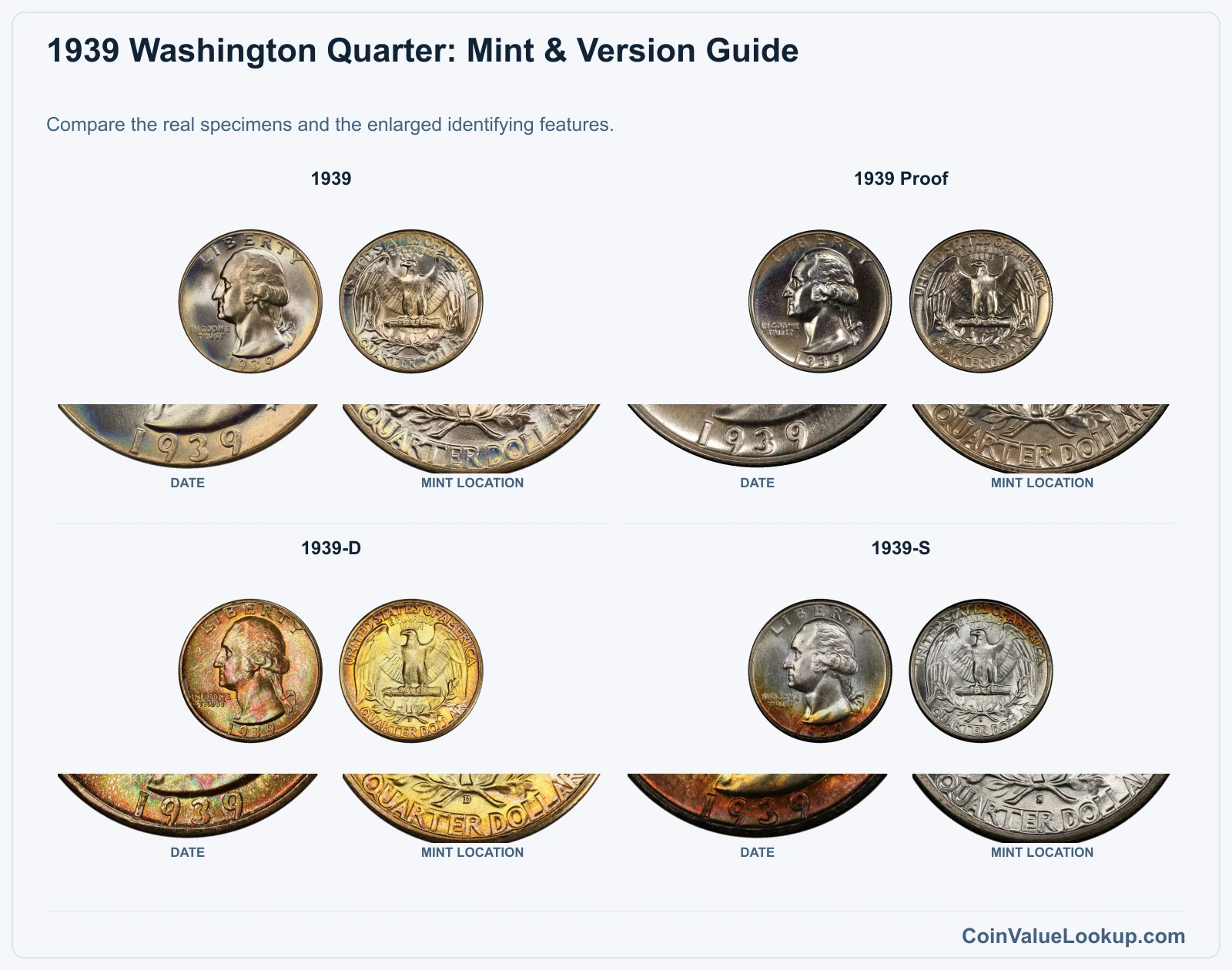
Start with the date on the obverse — you are looking for 1939 just below Washington's bust. Then flip the coin over and check directly beneath the wreath tie on the reverse for a small D or S mintmark.
No mintmark at all means Philadelphia. That is normal for this era; Philadelphia did not stamp its coins with a P until much later.
The standard composition is 90% silver and 10% copper, with a nominal weight of 6.25 grams and a diameter of about 24.3 mm. Look at the edge: you should see reeding (tiny vertical lines) all the way around, with no copper-colored stripe.
A visible copper layer would indicate a later clad coin, not a 1939.
Philadelphia business strikes, Denver issues, San Francisco issues, and Philadelphia proofs are all distinct branches of this year. The proof is a separate manufacturing category — not simply a high-grade circulation coin — and should be evaluated on its own terms.
Step 2: Check Your 1939 Washington Quarter Grade
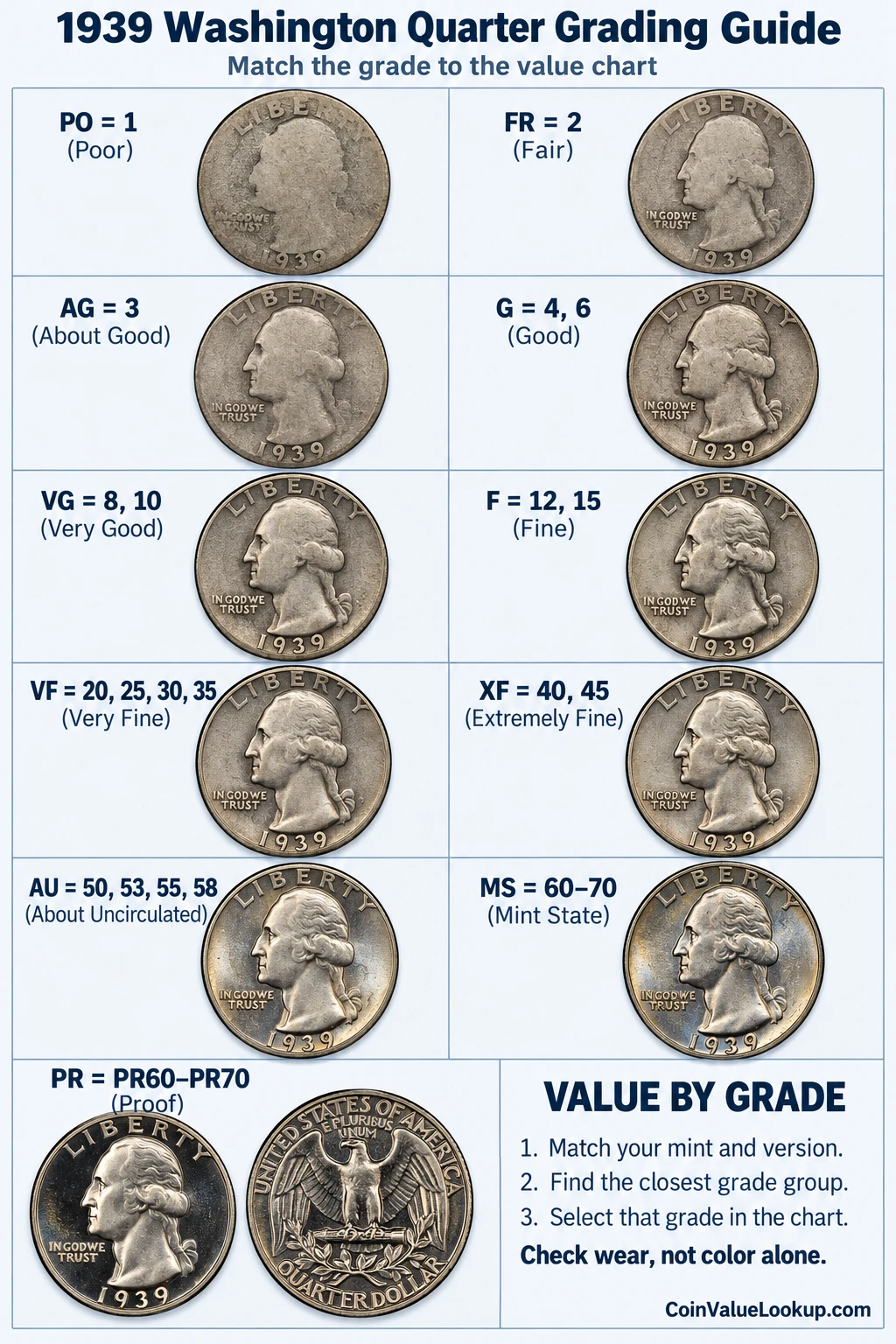
Focus first on Washington's hair above the ear and along the forehead. On a well-preserved coin, individual strands are visible and the luster flows unbroken across these areas.
As a coin circulates, the hair flattens into smooth patches and the cheek and jawline lose definition.
On the reverse, examine the eagle's breast feathers and wing tips. These high points wear early, so even moderate use shows up there.
A weak strike can mimic wear. If the luster is intact but certain details seem soft, the die may not have fully impressed the design — that is different from friction.
Look for hairlines (fine parallel scratches from cleaning) and rim dings, which lower a coin's appeal regardless of how much silver detail remains.
Use the comparison image to match your coin's surfaces against known grade benchmarks. Shine alone does not equal a high grade; a cleaned coin often has an unnatural brightness that experienced graders spot immediately.
Step 3: Check 1939 Washington Quarter Value by Mint and Version
1939 Washington Quarter
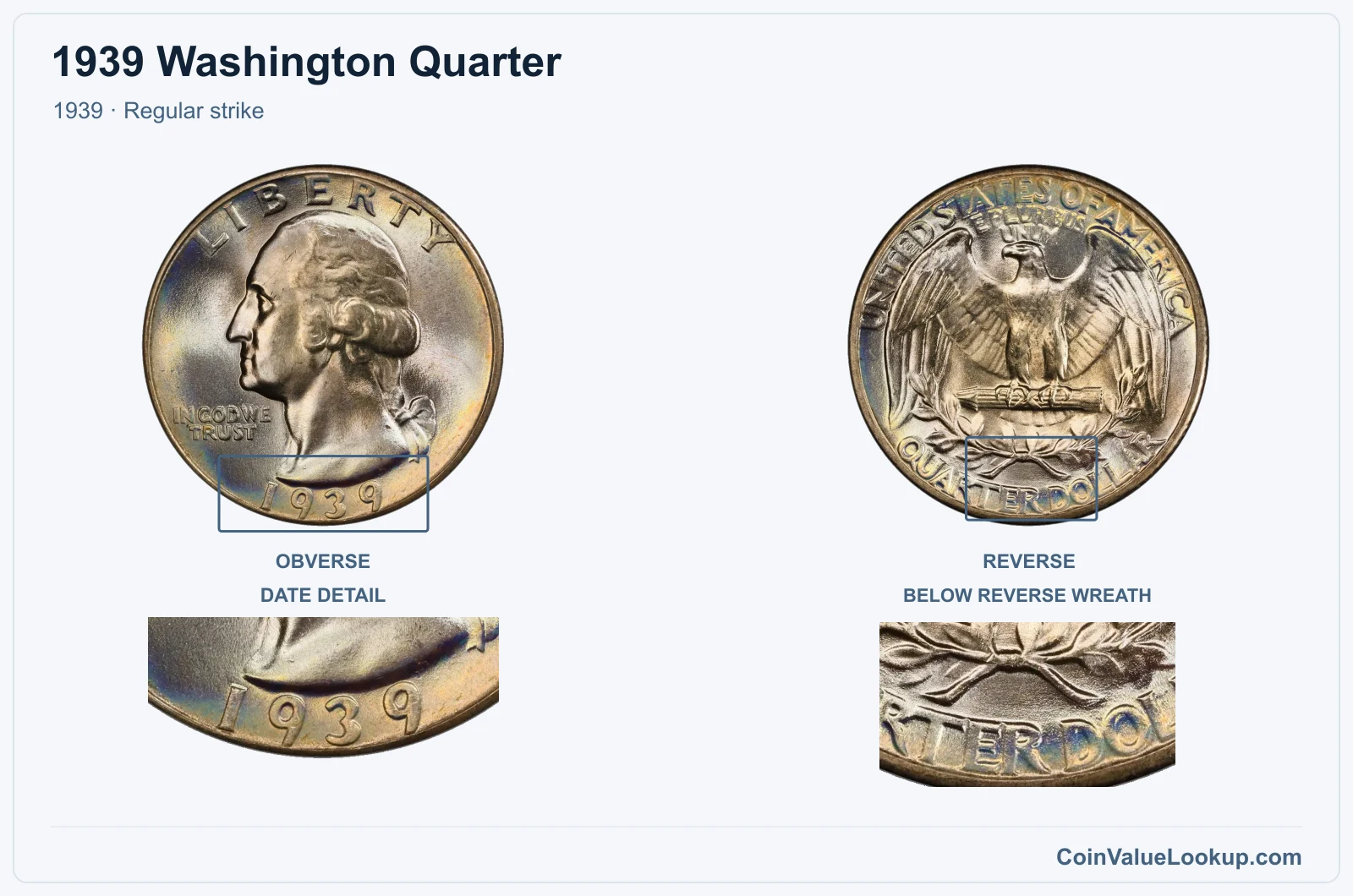
The 1939 Philadelphia quarter carries no mintmark — just a blank space beneath the reverse wreath. Philadelphia struck the largest share of this year's quarters, and gem-grade survivors are readily available compared to the branch mints.
In heavily worn G4 condition, guide estimates sit around $16.43. At MS60, that rises to about $27, and a full MS65 example is estimated near $82.
These are guide figures, not guaranteed sale prices, and the silver content provides a floor value that shifts with the metal market.
Original, untampered surfaces matter more than age. A lightly circulated coin with original toning can be more appealing than a harshly cleaned uncirculated piece.
| Range | Grade | Price | Auction Records | Appraisal |
|---|---|---|---|---|
| PO | PO 1 | — | Coin Identifier | |
| FR | FR 2 | — | Coin Identifier | |
| AG | AG 3 | — | Coin Identifier | |
| G | G 4 | — | Coin Identifier | |
| G 6 | — | Coin Identifier | ||
| VG | VG 8 | — | Coin Identifier | |
| VG 10 | — | Coin Identifier | ||
| F | F 12 | — | Coin Identifier | |
| F 15 | — | Coin Identifier | ||
| VF | VF 20 | — | Coin Identifier | |
| VF 25 | — | Coin Identifier | ||
| VF 30 | — | Coin Identifier | ||
| VF 35 | — | Coin Identifier | ||
| XF | XF 40 | — | Coin Identifier | |
| XF 45 | — | Coin Identifier | ||
| AU | AU 50 | — | Coin Identifier | |
| AU 53 | — | Coin Identifier | ||
| AU 55 | — | Coin Identifier | ||
| AU 58 | Coin Identifier | |||
| MS | MS 60 | — | Coin Identifier | |
| MS 61 | — | Coin Identifier | ||
| MS 62 | Coin Identifier | |||
| MS 63 | Coin Identifier | |||
| MS 64 | Coin Identifier | |||
| MS 65 | Coin Identifier | |||
| MS 66 | Coin Identifier | |||
| MS 67 | Coin Identifier | |||
| MS 68 | Coin Identifier | |||
| MS 69 | — | — | — | |
| MS 70 | — | — | — |
1939 Washington Quarter — Proof
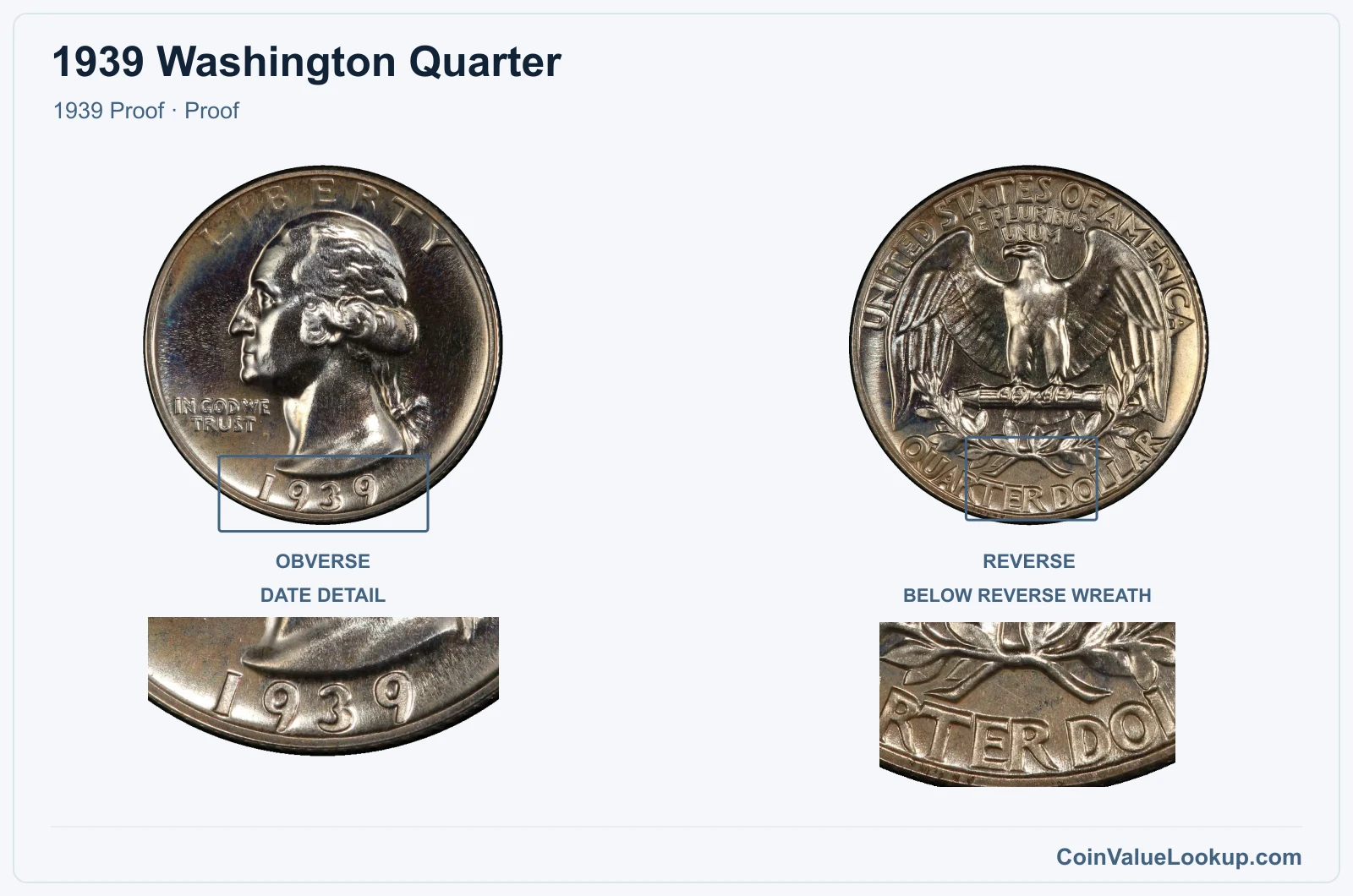
The 1939 Proof was struck at Philadelphia using specially prepared dies and polished planchets. The result is deeply mirrored fields and crisp, fully formed design elements — a different animal from even the nicest business strike.
A proof is a manufacturing method, not a grade above Mint State. Coins that have been polished or lightly circulated do not become proofs retroactively.
If your coin has cartoonishly reflective fields and razor-sharp rims right out of the holder, you may have the real thing.
At PR65, the selected guide estimate is $258. Proof quarters from this era were sold directly to collectors, so most survivors are well preserved.
Condition differences — hairlines, haze, toning — still separate a PR63 from a PR66 by a wide margin in price.
Coin Value Lookup is a handy place to look up guides for other Washington quarter dates and denominations if you are working through a collection.
| Range | Grade | Price | Auction Records | Appraisal |
|---|---|---|---|---|
| PR | PR 1 | — | Coin Identifier | |
| PR 2 | — | Coin Identifier | ||
| PR 3 | — | Coin Identifier | ||
| PR 4 | — | Coin Identifier | ||
| PR 6 | — | Coin Identifier | ||
| PR 8 | — | Coin Identifier | ||
| PR 10 | — | Coin Identifier | ||
| PR 12 | — | Coin Identifier | ||
| PR 15 | — | Coin Identifier | ||
| PR 20 | — | Coin Identifier | ||
| PR 25 | — | Coin Identifier | ||
| PR 30 | — | Coin Identifier | ||
| PR 35 | — | Coin Identifier | ||
| PR 40 | — | Coin Identifier | ||
| PR 45 | — | Coin Identifier | ||
| PR 50 | — | Coin Identifier | ||
| PR 53 | — | Coin Identifier | ||
| PR 55 | — | Coin Identifier | ||
| PR 58 | — | Coin Identifier | ||
| PR 60 | — | Coin Identifier | ||
| PR 61 | Coin Identifier | |||
| PR 62 | Coin Identifier | |||
| PR 63 | Coin Identifier | |||
| PR 64 | Coin Identifier | |||
| PR 65 | Coin Identifier | |||
| PR 66 | Coin Identifier | |||
| PR 67 | Coin Identifier | |||
| PR 68 | Coin Identifier | |||
| PR 69 | — | — | — | |
| PR 70 | — | — | — |
1939 Washington Quarter — D
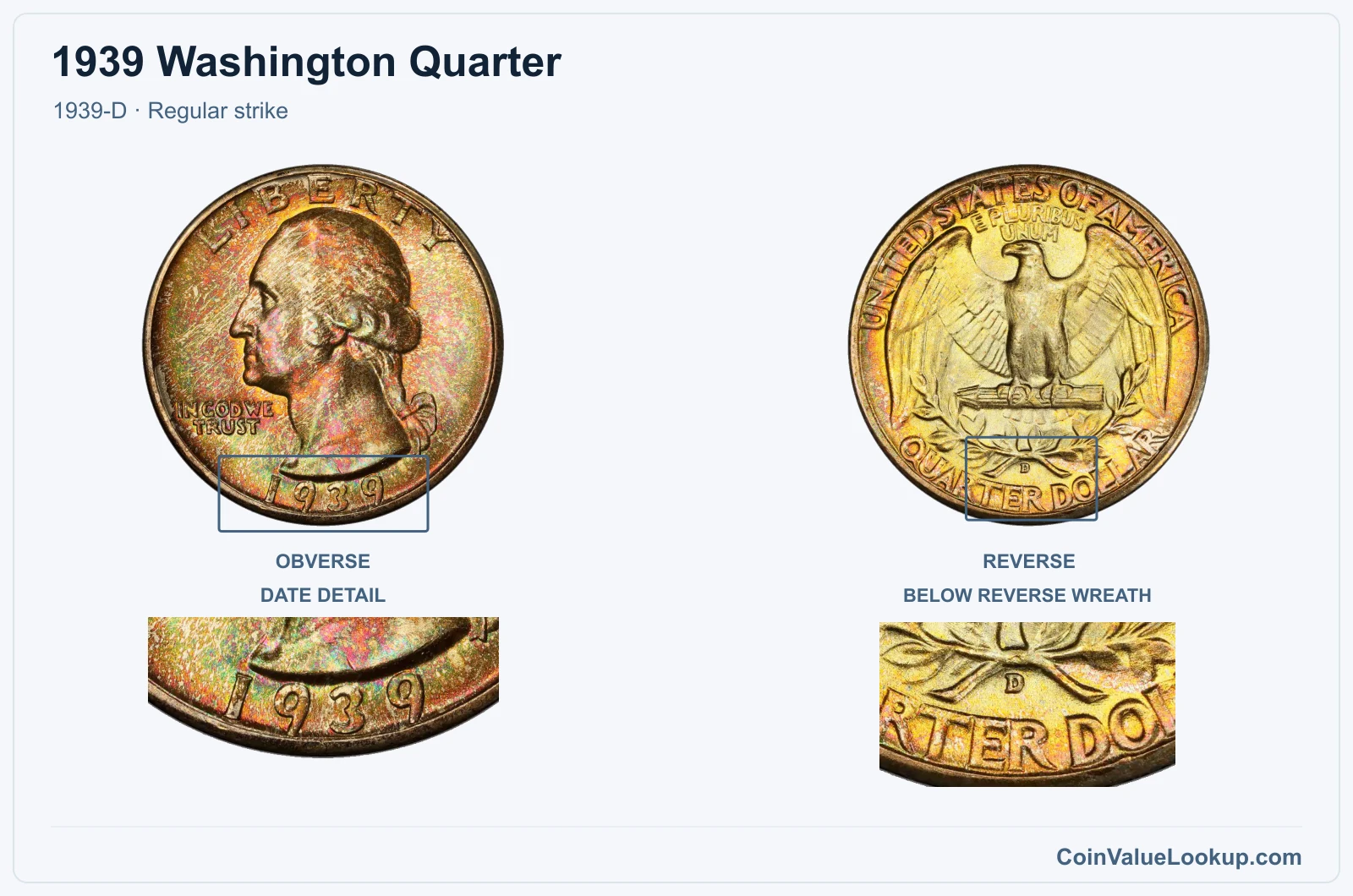
The 1939-D carries a small D mintmark on the reverse, just below the wreath. Denver's output for this year is less commonly encountered in top grades than Philadelphia's, and the price gap reflects that.
Guide estimates place a G4 example at about $16.43, the same starting point as Philadelphia. The difference shows up higher on the scale: an MS60 is estimated around $58, and an MS65 reaches roughly $111.
That is a meaningful step above the no-mintmark version at the same grades.
When checking for a D mintmark, use good light and slight magnification. The letter should be cleanly impressed and centered, not scratched or added after the fact.
| Range | Grade | Price | Auction Records | Appraisal |
|---|---|---|---|---|
| PO | PO 1 | — | Coin Identifier | |
| FR | FR 2 | — | Coin Identifier | |
| AG | AG 3 | — | Coin Identifier | |
| G | G 4 | — | Coin Identifier | |
| G 6 | — | Coin Identifier | ||
| VG | VG 8 | — | Coin Identifier | |
| VG 10 | — | Coin Identifier | ||
| F | F 12 | — | Coin Identifier | |
| F 15 | — | Coin Identifier | ||
| VF | VF 20 | — | Coin Identifier | |
| VF 25 | — | Coin Identifier | ||
| VF 30 | — | Coin Identifier | ||
| VF 35 | — | Coin Identifier | ||
| XF | XF 40 | Coin Identifier | ||
| XF 45 | — | Coin Identifier | ||
| AU | AU 50 | — | Coin Identifier | |
| AU 53 | — | Coin Identifier | ||
| AU 55 | — | Coin Identifier | ||
| AU 58 | Coin Identifier | |||
| MS | MS 60 | — | Coin Identifier | |
| MS 61 | — | Coin Identifier | ||
| MS 62 | Coin Identifier | |||
| MS 63 | Coin Identifier | |||
| MS 64 | Coin Identifier | |||
| MS 65 | Coin Identifier | |||
| MS 66 | Coin Identifier | |||
| MS 67 | Coin Identifier | |||
| MS 68 | Coin Identifier | |||
| MS 69 | — | — | — | |
| MS 70 | — | — | — |
1939 Washington Quarter — S
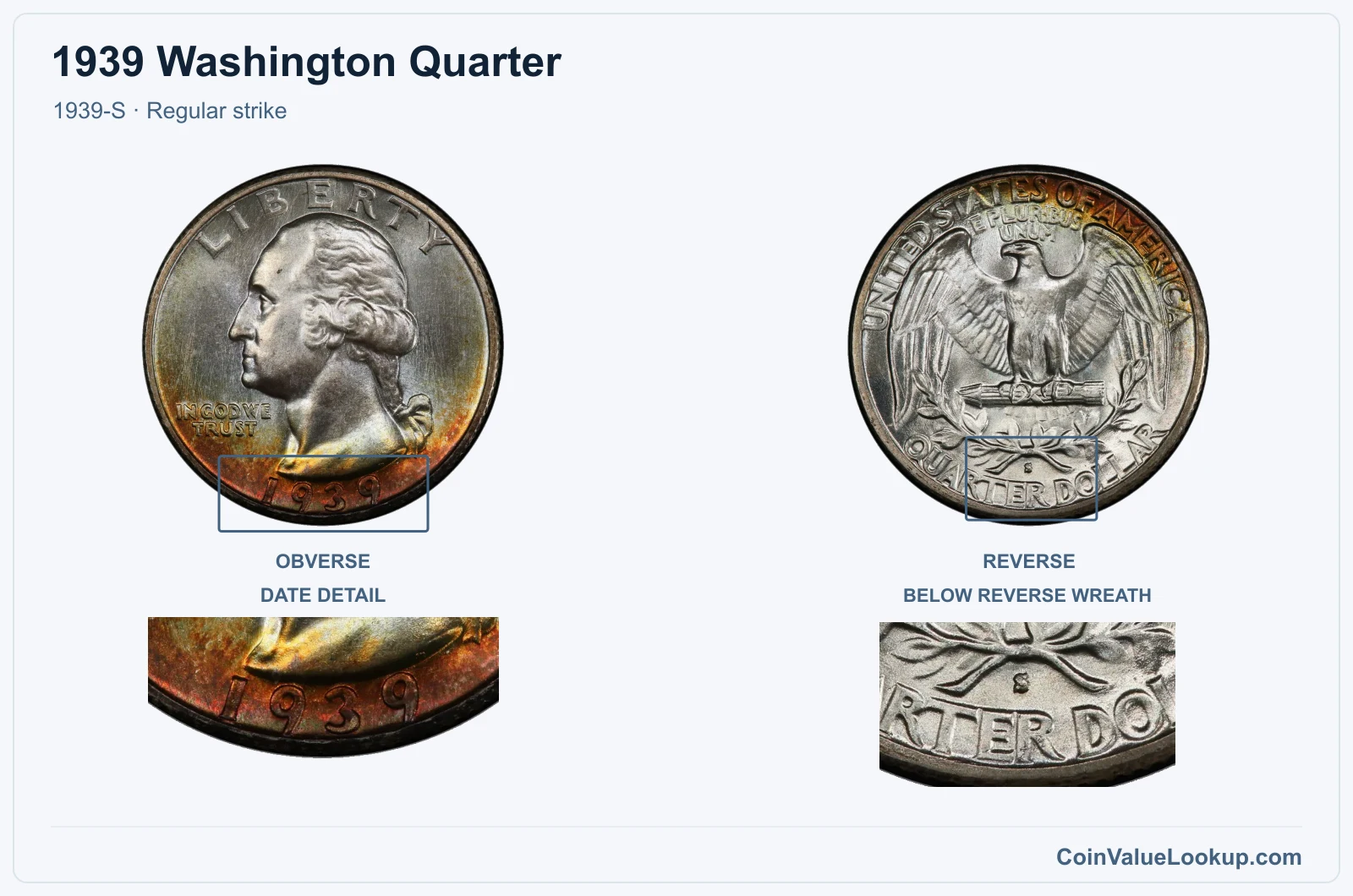
The 1939-S, struck in San Francisco, carries the highest business-strike guide estimates of the year's three mints. A G4 coin starts at the familiar $16.43, but an MS60 jumps to about $126 and an MS65 is estimated near $321.
That premium exists because fewer San Francisco quarters survived in uncirculated condition. West Coast commerce wore these coins down efficiently, so finding one with full original luster and sharp hair detail is genuinely harder than locating a comparable Philadelphia piece.
The S mintmark sits in the same spot beneath the reverse wreath. Confirm it is a period-correct S and not a tooled or added letter — authentication matters when the price difference between mints is this large.
| Range | Grade | Price | Auction Records | Appraisal |
|---|---|---|---|---|
| PO | PO 1 | — | Coin Identifier | |
| FR | FR 2 | — | Coin Identifier | |
| AG | AG 3 | — | Coin Identifier | |
| G | G 4 | — | Coin Identifier | |
| G 6 | — | Coin Identifier | ||
| VG | VG 8 | — | Coin Identifier | |
| VG 10 | — | Coin Identifier | ||
| F | F 12 | — | Coin Identifier | |
| F 15 | — | Coin Identifier | ||
| VF | VF 20 | — | Coin Identifier | |
| VF 25 | — | Coin Identifier | ||
| VF 30 | — | Coin Identifier | ||
| VF 35 | — | Coin Identifier | ||
| XF | XF 40 | — | Coin Identifier | |
| XF 45 | — | Coin Identifier | ||
| AU | AU 50 | Coin Identifier | ||
| AU 53 | Coin Identifier | |||
| AU 55 | Coin Identifier | |||
| AU 58 | Coin Identifier | |||
| MS | MS 60 | — | Coin Identifier | |
| MS 61 | — | Coin Identifier | ||
| MS 62 | Coin Identifier | |||
| MS 63 | Coin Identifier | |||
| MS 64 | Coin Identifier | |||
| MS 65 | Coin Identifier | |||
| MS 66 | Coin Identifier | |||
| MS 67 | Coin Identifier | |||
| MS 68 | Coin Identifier | |||
| MS 69 | — | — | — | |
| MS 70 | — | — | — |
1939 Washington Quarter Error List
1. 1939 Washington Quarter — Struck on a Nickel Planchet
This is a 1939 Philadelphia quarter that was struck on a five-cent nickel planchet instead of the correct silver quarter blank. The quarter design gets crammed onto the smaller, lighter disc, so peripheral lettering and design elements are truncated or missing at the edges.
The key diagnostics are weight and diameter. A normal quarter weighs about 6.25 grams and measures roughly 24.3 mm across.
A nickel planchet is noticeably smaller and lighter. If your coin looks like a shrunken quarter, weigh it before getting excited — and then get it authenticated, because a filed-down or damaged quarter can mimic the appearance.
One certified example graded PCGS MS67 sold for $4,025 at a Heritage auction in January 2012. That is a single realized price for an exceptionally well-preserved wrong-planchet coin, not a general market estimate for every such error.
2. 1939 Washington Quarter — Doubled Die Obverse
A doubled die obverse has been documented on 1939 Philadelphia quarters, with light doubling visible on the obverse motto. The effect is subtle — do not expect dramatic separation like some Lincoln cent doubled dies.
You will need magnification and good directional lighting to see repeated contours in the lettering.
Genuine die doubling produces a consistent, die-made pattern where letter shapes are duplicated with slight offset. Machine doubling, by contrast, creates flat shelf-like distortions from die bounce during striking and carries almost no premium.
One ANACS-attributed MS65 specimen sold at Heritage in May 2000 for $45. That is a single historical result from over two decades ago, not current market guidance.
Scratches, wear marks, and post-strike damage can also create letter anomalies that look doubled at first glance, so authenticated attribution is the safest route.
3. 1939 Washington Quarter — D over S Mintmark
The 1939-D over S is a recognized repunched mintmark variety where a D was punched over an earlier S impression in the working die. PCGS attributes this variety, and it is a collectible piece within the Washington quarter series.
Under magnification, look at the reverse mintmark area for traces of the underlying S shape beneath or around the D. You may see curved remnants that do not belong to a normal D punch.
Extra metal alone is not sufficient proof — die polish, grease fills, and post-mint damage can all create misleading marks in the mintmark region.
No supported price range is available for this variety in the current research. Value depends on authenticated identity, the clarity of the overmintmark, and overall condition.
Professional certification from a major grading service is essential before assigning meaningful value to any repunched mintmark claim.
4. 1939 Washington Quarter — Defective Planchet
A 1939 Philadelphia quarter struck on a defective planchet has been cataloged, with one example graded MS66 by NGC appearing at Heritage. The defect originated in the blank itself — a flaw present before the coin was struck — rather than damage picked up afterward in circulation or storage.
Distinguishing a genuine planchet defect from post-mint scratches, gouges, or corrosion is the whole game here. A manufacturing defect is typically struck over by the die impression, meaning design details flow across or around the disrupted area.
Damage added later sits on top of the finished design and interrupts it.
No supported price range is available for this category. Each defective planchet coin is evaluated individually based on the nature and severity of the defect, the coin's overall condition, and whether it has been professionally attributed.
Do not assume every rough-looking 1939 quarter qualifies.