2021 Kennedy Half Dollar Coin Value: How Much Is It Worth?
The 2021 Kennedy half dollar carries a face value of 50 cents, and most circulated clad examples are worth exactly that. Collector guide estimates for specific mint, finish and grade combinations range from about $2.50 to $37.00, according to USA Coin Book.
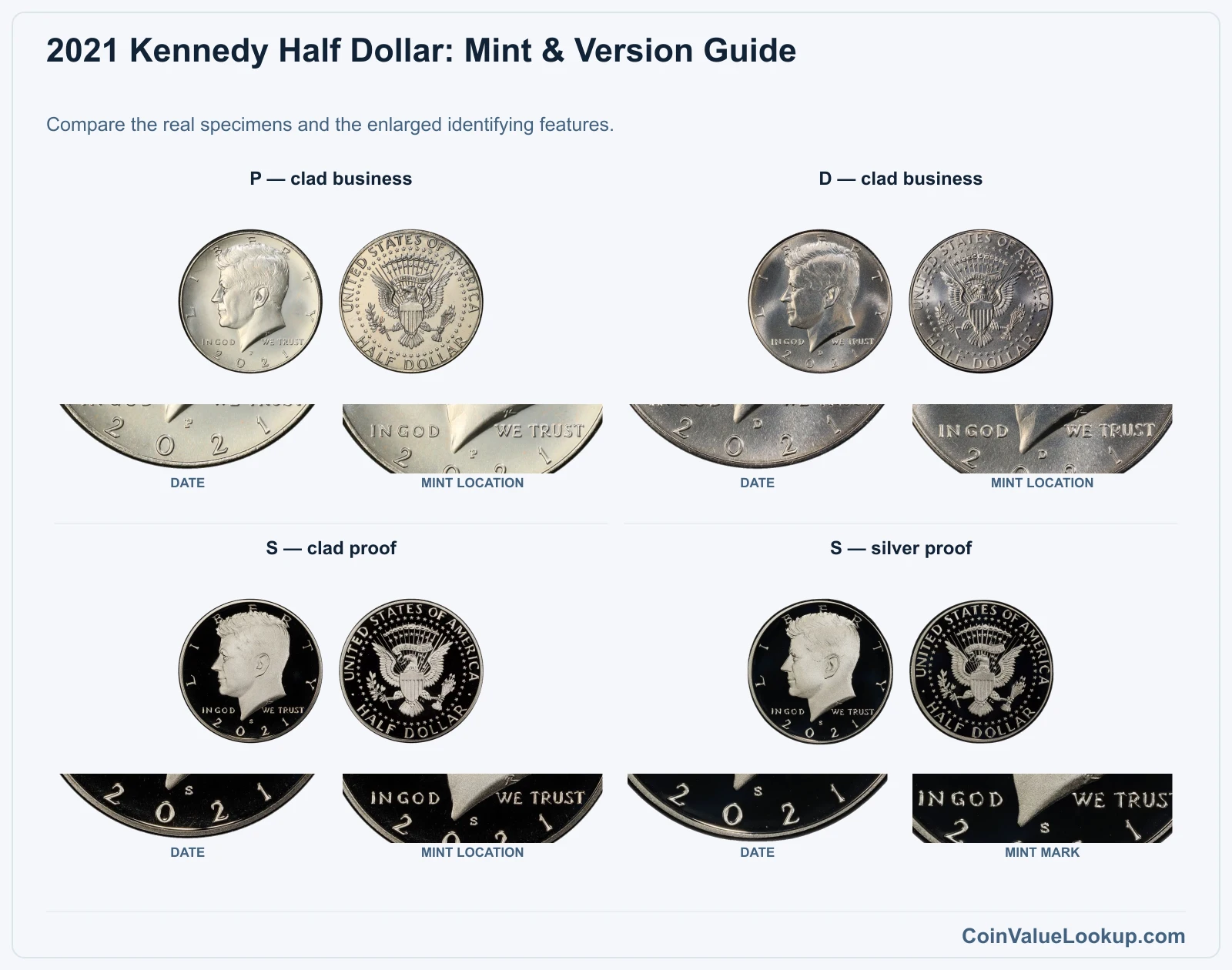
Before assuming your coin is ordinary, you need to figure out whether it is a business strike, a clad proof or the heavier silver proof, because each version follows a different value path.
Fast Way to Identify Your 2021 Kennedy Half Dollar
The quickest way to start is to snap clear photos of both sides of your coin and upload them here. A front-and-back image pair allows for preliminary identification of the mint, finish and any visible anomalies.
This is not a substitute for professional authentication or certified grading, but it gives you a solid starting point before digging deeper.
2021 Kennedy Half Dollar Value
Upload both sides of your 2021 Kennedy Half Dollar.
Front Obverse
Upload photo
Back Reverse
Upload photo
Which 2021 Kennedy Half Dollar Versions Are Worth Money?
- The 2021 S silver proof, struck in 99.9% silver, carries the highest guide estimate at $37.00 in PR65 — confirm composition by weight and edge color.
- Business strikes from Philadelphia or Denver in MS65 condition list at $2.50, making high grade and careful storage the main value drivers for clad coins.
- The S clad proof is a mid-range collectible at $6.26 in PR65 — distinguish it from the silver proof before pricing.
- Mint-made errors such as die cracks, clips and doubled dies have been reported for this date and can add collector interest beyond normal values.
Step 1: Identify Your 2021 Kennedy Half Dollar Mint Mark and Version
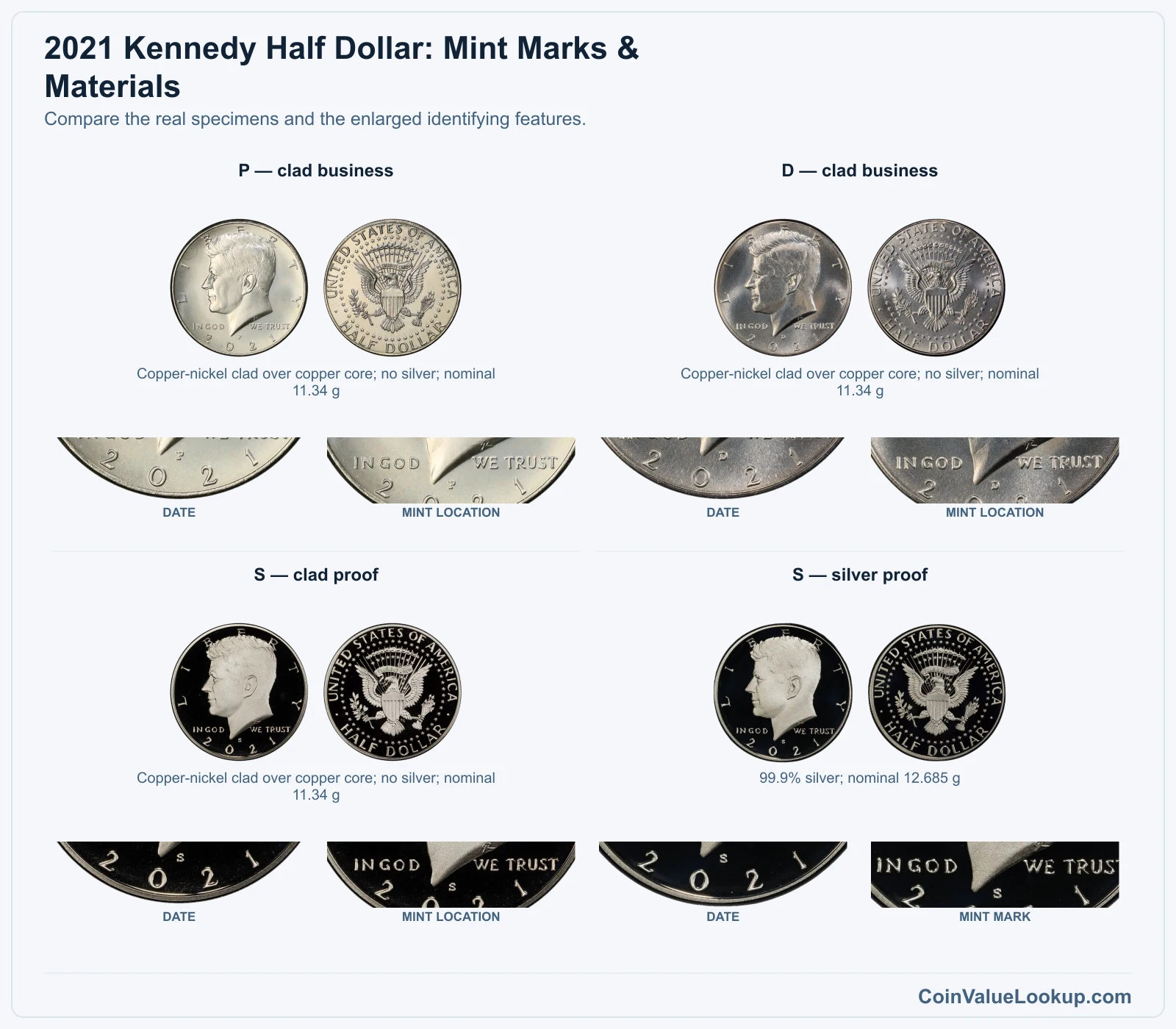
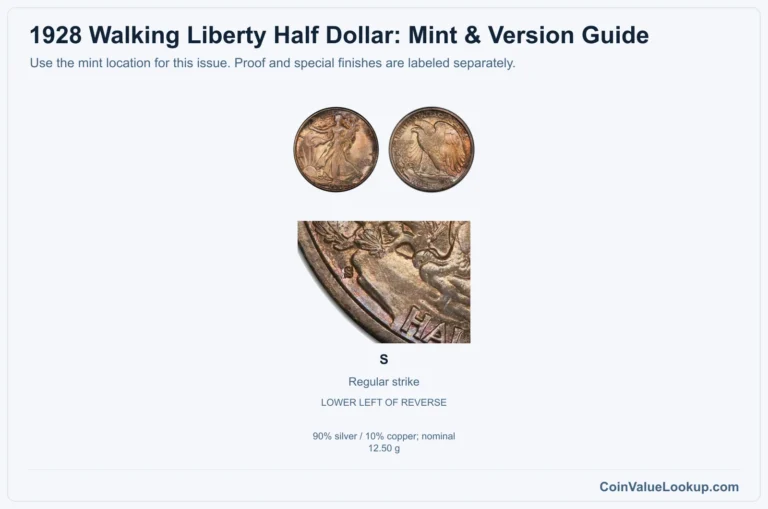
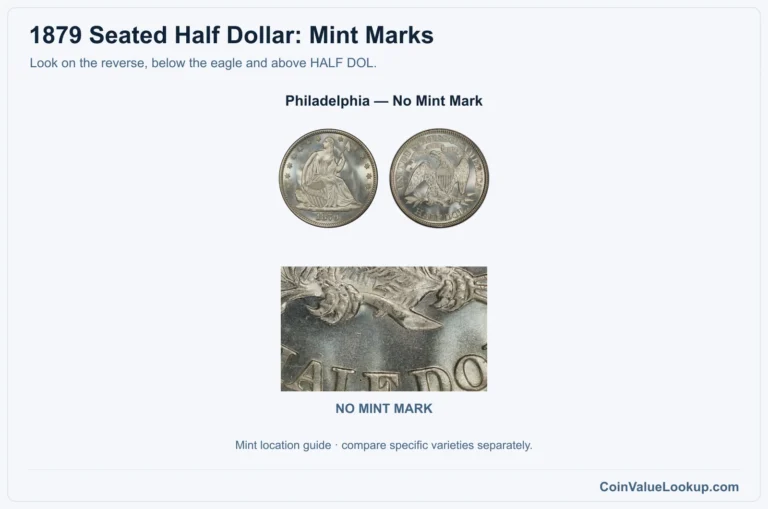
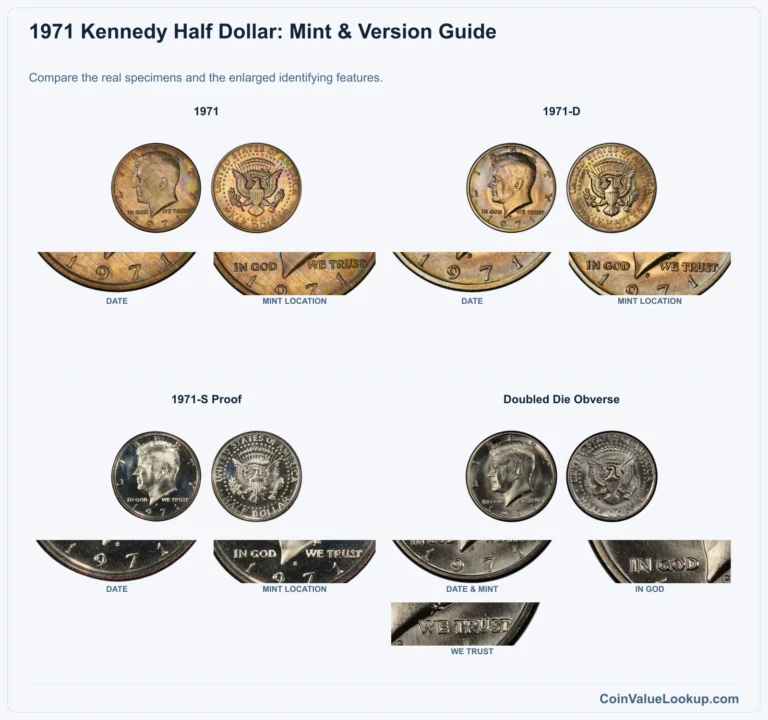
Look beneath Kennedy's portrait on the obverse, just above the date. That is where the mintmark lives.
A "P" means Philadelphia, "D" means Denver, and "S" means San Francisco.
Philadelphia coins minted before 1980 carry no mintmark at all, but by 2021 every Philly half dollar shows the "P." If you see an "S," you still have work to do: San Francisco struck both a clad proof and a 99.9% silver proof this year.
To tell them apart, compare the edge and the weight. A clad coin shows a visible copper-colored stripe along the edge and weighs about 11.34 grams.
The silver proof weighs roughly 12.685 grams, has a uniform silver-colored edge and was sold in special Mint packaging.
Do not rely on surface color alone. Toning, lighting and aftermarket plating can make a clad coin look silver or even golden.
When in doubt, weigh it on a calibrated scale and check the original packaging.
Step 2: Check Your 2021 Kennedy Half Dollar Grade
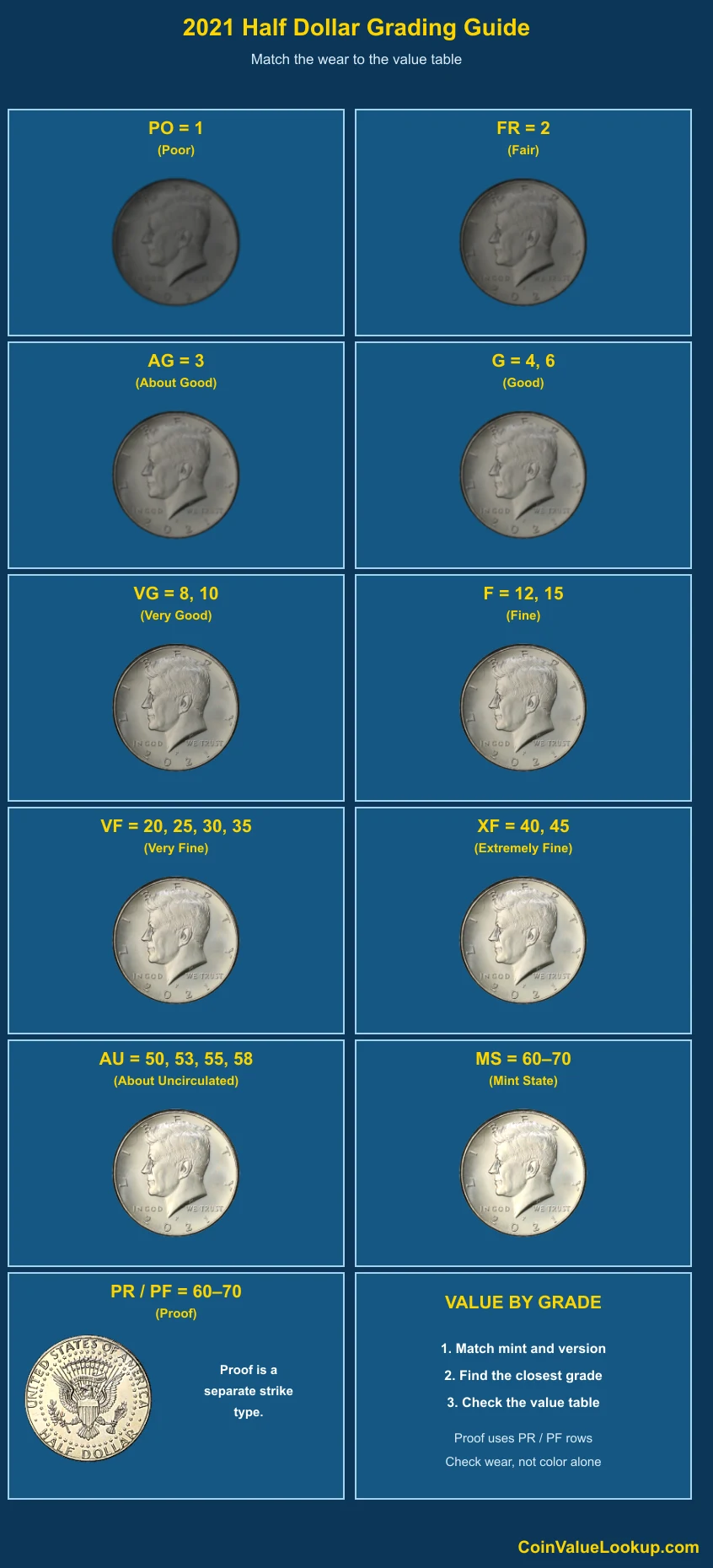
Start with Kennedy's cheek and jawline on the obverse. Even light circulation smooths the highest points there first, then moves into the hair above the ear.
On the reverse, the eagle's breast feathers and the tops of the wings lose detail early.
Mint State coins can still look rough. Bag marks from contact with other coins during production lower the technical grade even though the coin never entered a cash register.
Compare yours to the reference image for a realistic check.
Proofs need a separate evaluation. Look for hairlines from handling, haze from improper storage and contact marks on the mirrored fields.
A proof with heavy hairlines grades lower than one with clean, reflective surfaces, regardless of how sharp the design looks.
Step 3: Check 2021 Kennedy Half Dollar Value by Mint and Version
2021 Kennedy Half Dollar — P — clad business
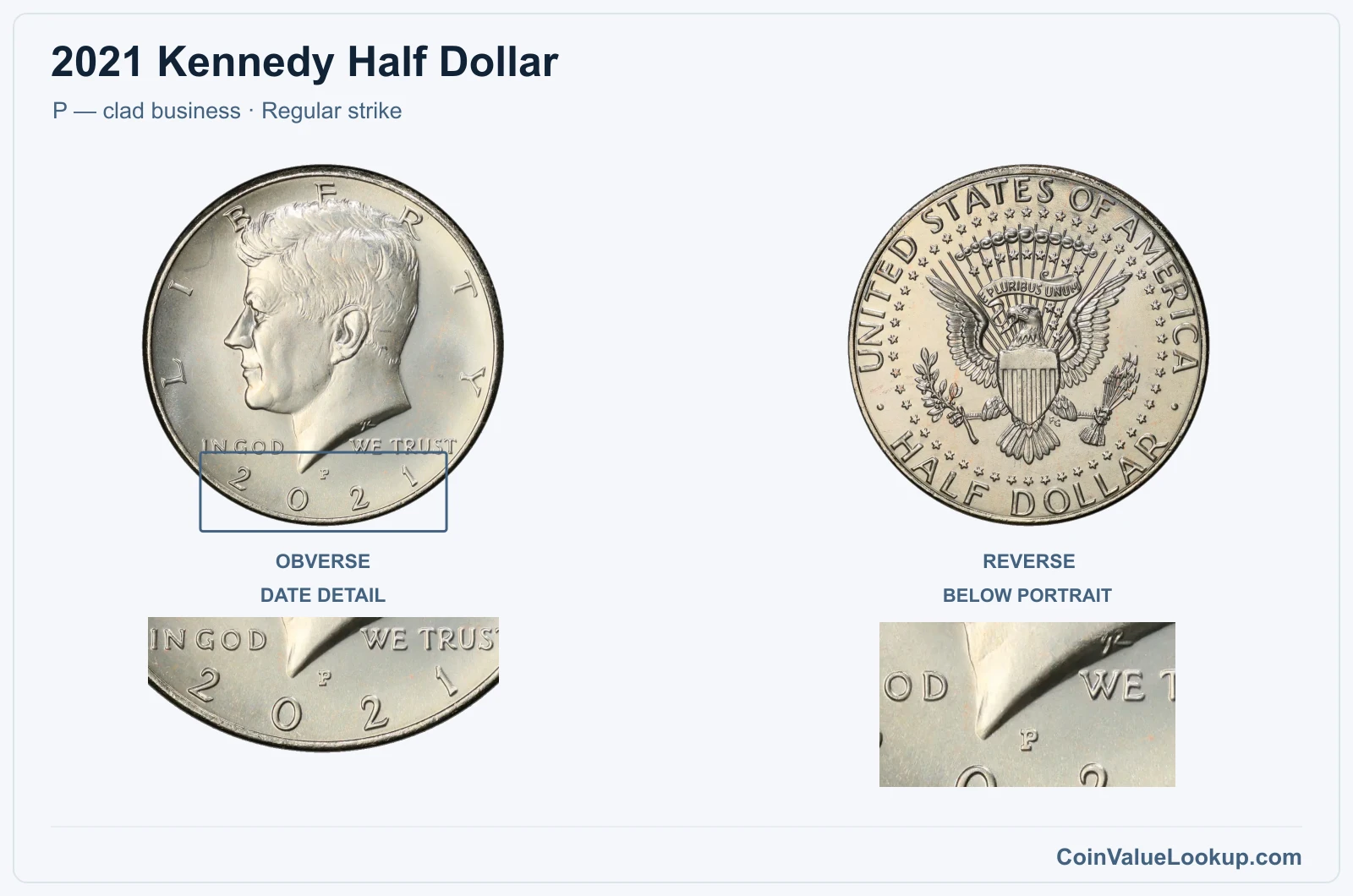
The 2021-P Kennedy half dollar is a copper-nickel clad business strike from the Philadelphia Mint. Look for the "P" mintmark below Kennedy's portrait.
It weighs about 11.34 grams and shows a copper stripe along the edge.
Most circulated examples trade at face value. In MS65 condition — meaning strong luster with only minor contact marks — the USA Coin Book guide estimate is $2.50.
That is not a buying offer, just a published reference point. If yours has visible wear on the cheek or jaw, it is almost certainly a spender.
Range Grade
Price Auction Records Appraisal PO PO 1
—
Coin Identifier FR FR 2
—
Coin Identifier AG AG 3
—
Coin Identifier G G 4
—
Coin Identifier
G 6
—
Coin Identifier VG VG 8
—
Coin Identifier
VG 10
—
Coin Identifier F F 12
—
Coin Identifier
F 15
—
Coin Identifier VF VF 20
—
Coin Identifier
VF 25
—
Coin Identifier
VF 30
—
Coin Identifier
VF 35
—
Coin Identifier XF XF 40
—
Coin Identifier
XF 45
—
Coin Identifier AU AU 50
—
Coin Identifier
AU 53
—
Coin Identifier
AU 55
—
Coin Identifier
AU 58
—
Coin Identifier MS MS 60
—
Coin Identifier
MS 61
—
Coin Identifier
MS 62
—
Coin Identifier
MS 63
—
Coin Identifier
MS 64
—
Coin Identifier
MS 65
—
Coin Identifier
MS 66
—
Coin Identifier
MS 67
—
Coin Identifier
MS 68
—
—
—
MS 69
—
—
—
MS 70
—
—
—
2021 Kennedy Half Dollar — D — clad business
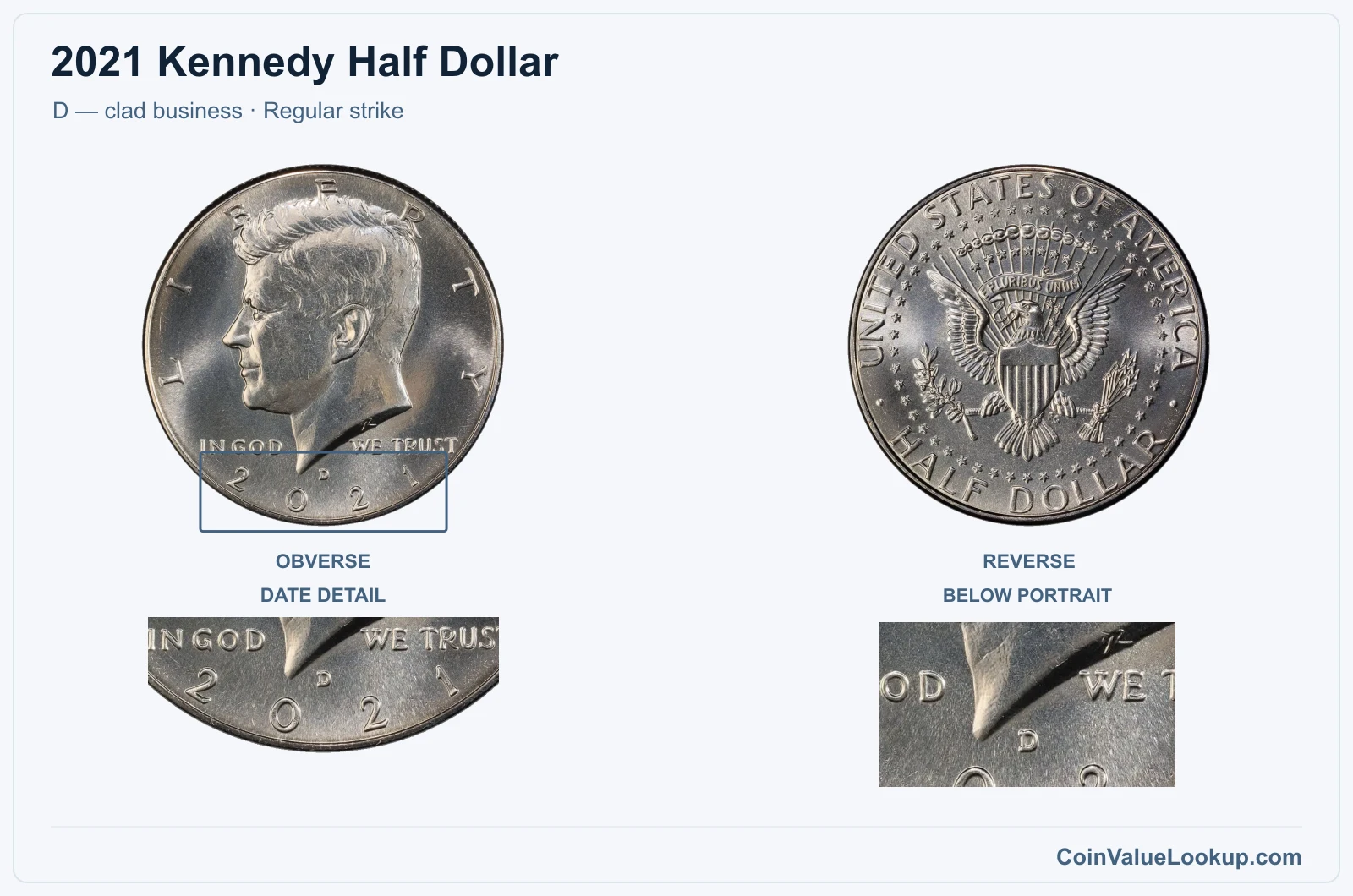
The 2021-D comes from the Denver Mint and is identical in composition to the Philadelphia issue: copper-nickel clad, 11.34 grams. The "D" mintmark sits in the same spot beneath Kennedy's portrait.
In MS65 condition the USA Coin Book guide estimate is also $2.50. Circulated pieces are face-value coins.
The key to any premium is original, unmarked surfaces and strong luster, so coins pulled from rolls before they hit circulation have the best shot at collector-grade status.
Range Grade
Price Auction Records Appraisal PO PO 1
—
Coin Identifier FR FR 2
—
Coin Identifier AG AG 3
—
Coin Identifier G G 4
—
Coin Identifier
G 6
—
Coin Identifier VG VG 8
—
Coin Identifier
VG 10
—
Coin Identifier F F 12
—
Coin Identifier
F 15
—
Coin Identifier VF VF 20
—
Coin Identifier
VF 25
—
Coin Identifier
VF 30
—
Coin Identifier
VF 35
—
Coin Identifier XF XF 40
—
Coin Identifier
XF 45
—
Coin Identifier AU AU 50
—
Coin Identifier
AU 53
—
Coin Identifier
AU 55
—
Coin Identifier
AU 58
—
Coin Identifier MS MS 60
—
Coin Identifier
MS 61
—
Coin Identifier
MS 62
—
Coin Identifier
MS 63
—
Coin Identifier
MS 64
—
Coin Identifier
MS 65
—
Coin Identifier
MS 66
—
Coin Identifier
MS 67
—
Coin Identifier
MS 68
—
—
—
MS 69
—
—
—
MS 70
—
—
—
2021 Kennedy Half Dollar — S — clad proof
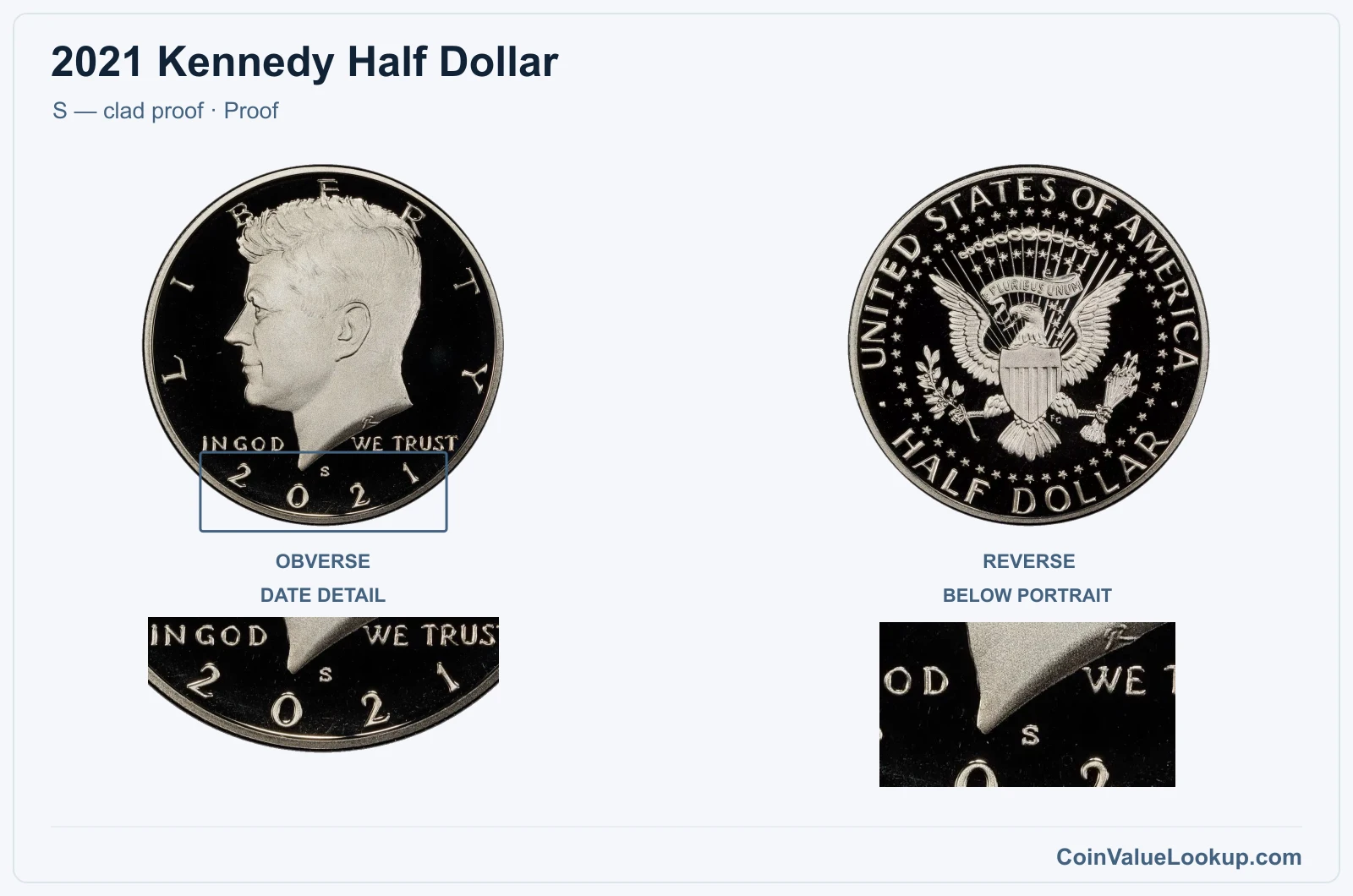
San Francisco also struck a clad proof this year. Same copper-nickel clad composition as the business strikes, same 11.34-gram weight, but with mirror-like fields and frosted raised design elements.
The "S" mintmark confirms the facility.
Coin Value Lookup is a useful starting point if you want to compare Kennedy half dollar values across multiple years and mints.
In PR65 the USA Coin Book guide estimate is $6.26. Grade proofs by checking for hairlines across the flat mirrored areas and any haze or contact marks.
Do not confuse this version with the silver proof — they share a mintmark but differ in weight, edge appearance and price.
Range Grade
Price Auction Records Appraisal PR PR 1
—
Coin Identifier
PR 2
—
Coin Identifier
PR 3
—
Coin Identifier
PR 4
—
Coin Identifier
PR 6
—
Coin Identifier
PR 8
—
Coin Identifier
PR 10
—
Coin Identifier
PR 12
—
Coin Identifier
PR 15
—
Coin Identifier
PR 20
—
Coin Identifier
PR 25
—
Coin Identifier
PR 30
—
Coin Identifier
PR 35
—
Coin Identifier
PR 40
—
Coin Identifier
PR 45
—
Coin Identifier
PR 50
—
Coin Identifier
PR 53
—
Coin Identifier
PR 55
—
Coin Identifier
PR 58
—
Coin Identifier
PR 60
—
Coin Identifier
PR 61
—
Coin Identifier
PR 62
—
Coin Identifier
PR 63
—
Coin Identifier
PR 64
—
Coin Identifier
PR 65
—
Coin Identifier
PR 66
—
Coin Identifier
PR 67
—
Coin Identifier
PR 68
—
Coin Identifier
PR 69
—
Coin Identifier
PR 70
—
Coin Identifier
2021 Kennedy Half Dollar — S — silver proof
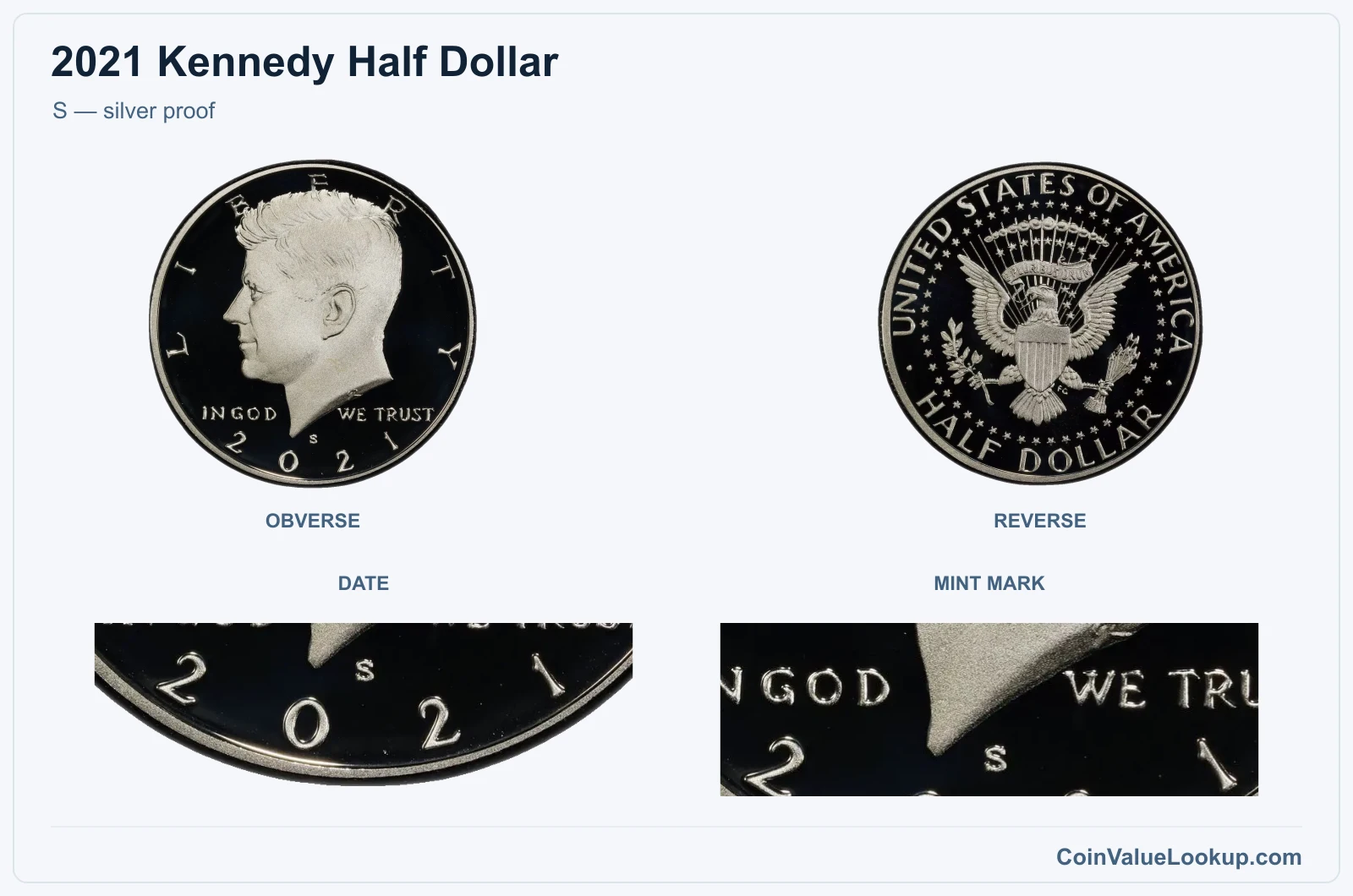
This is the premium branch for 2021. The S silver proof is struck in 99.9% silver and weighs approximately 12.685 grams, noticeably heavier than the clad versions.
The silver fineness shifted to .999 starting in 2019, so this is not the older 90% composition.
In PR65 the USA Coin Book guide estimate is $37.00 — the highest listed value among this year's Kennedy halves. Confirm the composition by weighing the coin and inspecting the edge: a uniform silver color with no copper stripe is what you are looking for.
Original Mint packaging is strong supporting evidence. Surface quality matters here just as much as with the clad proof, so check for hairlines and haze before assuming top grade.
Range Grade
Price Auction Records Appraisal PR PR 1
—
Coin Identifier
PR 2
—
Coin Identifier
PR 3
—
Coin Identifier
PR 4
—
Coin Identifier
PR 6
—
Coin Identifier
PR 8
—
Coin Identifier
PR 10
—
Coin Identifier
PR 12
—
Coin Identifier
PR 15
—
Coin Identifier
PR 20
—
Coin Identifier
PR 25
—
Coin Identifier
PR 30
—
Coin Identifier
PR 35
—
Coin Identifier
PR 40
—
Coin Identifier
PR 45
—
Coin Identifier
PR 50
—
Coin Identifier
PR 53
—
Coin Identifier
PR 55
—
Coin Identifier
PR 58
—
Coin Identifier
PR 60
—
Coin Identifier
PR 61
—
Coin Identifier
PR 62
—
Coin Identifier
PR 63
—
Coin Identifier
PR 64
—
Coin Identifier
PR 65
—
Coin Identifier
PR 66
—
Coin Identifier
PR 67
—
Coin Identifier
PR 68
—
Coin Identifier
PR 69
—
Coin Identifier
PR 70
—
Coin Identifier
2021 Kennedy Half Dollar Error List
1. 2021 Kennedy Half Dollar — Die Crack / Die Chip
Die cracks have been reported on 2021 Kennedy half dollars. On the coin itself, a crack shows up as a thin raised line running across part of the design or field, created when the steel die develops a fracture during use.
A die chip is a small raised blob where a tiny piece of the die broke away.
To check, tilt the coin under good light and feel for a raised line that follows no intentional design element. An interior chip is a contained bump; a crack that reaches the rim may qualify as a cud, which is a separate category.
Do not confuse die cracks with incuse scratches, corrosion trails or foreign material stuck to the surface. Scratches sit below the surface; cracks sit above it.
Value depends on visibility, location and overall coin condition.
2. 2021 Kennedy Half Dollar — Missing Clad Layer
A missing clad layer error occurs when one of the outer copper-nickel layers is absent from the planchet before striking. The result is a coin that looks distinctly different on the affected side, often showing an exposed copper-colored surface.
Compare both faces of your coin. If one side appears copper-toned while the other looks normal, check the edge — you should see an asymmetric layer structure.
Weigh the coin too; a missing clad layer will make it lighter than the standard 11.34 grams.
The main lookalikes are toning, corrosion and coins where someone chemically stripped or plated the surface after leaving the Mint. Post-mint damage lacks the uniform, flat copper appearance of a genuine missing-clad error.
Value depends on the coin's condition and how clearly the error presents.
3. 2021 Kennedy Half Dollar — Rotated Dies
A rotated reverse error means the reverse die was not aligned correctly relative to the obverse die when the coin was struck. Normal U.S. coins use medal alignment: hold the obverse upright, flip the coin top to bottom, and the reverse should also appear upright.
If the eagle is tilted — say 15, 45 or even 180 degrees off — you may have a rotation error. Measure the degree of rotation; larger offsets are generally more desirable to collectors.
Be careful with photos. A picture taken at a casual angle can make a perfectly normal coin look rotated.
Always test with the physical coin in hand, flipping it on a vertical axis. Value depends on the degree of rotation and the coin's overall condition.
4. 2021 Kennedy Half Dollar — Doubled Die Obverse
Doubled die obverse varieties have been reported on 2021 Kennedy half dollars. True doubling comes from a misalignment during the die-making process and produces consistent separation or notching visible on lettering, the date or design elements on every coin struck by that die.
Compare suspect areas — especially "LIBERTY," "IN GOD WE TRUST" and the date — against a known normal example under the same lighting. Look for a secondary image that is uniform and directional, not random.
The common lookalike is machine doubling, which produces a flat, shelf-like distortion without the raised, separated profile of a genuine doubled die. Worn die contours and photographic reflections can also mimic doubling.
Value varies with the strength and location of the doubling and the coin's condition.
5. 2021 Kennedy Half Dollar — Clipped Planchet
Clipped planchet errors occur when the blank is punched incorrectly from the metal strip, leaving a missing section. The clip can be curved, straight or irregular depending on how the feed mechanism failed.
Look for a missing portion of the coin's edge that is not sharp or filed-looking. Genuine clips often show a characteristic weakness in the design opposite the missing area, sometimes called the Blakesley effect, because metal did not flow evenly during striking.
An edge that has been cut, filed or corroded after minting will typically show tool marks or rough, uneven texture rather than the smooth contour of a genuine clip. Value depends on the clip's size, shape and the coin's overall condition.
6. 2021 Kennedy Half Dollar — Struck-Through Error
A struck-through error happens when foreign material — grease, wire, cloth, even another planchet fragment — gets between the die and the coin during striking. The result is a localized depression or area of incomplete detail where the obstruction blocked the die's impression.
Grease-filled dies are the most common version, leaving soft or missing detail in a contained area. A retained foreign object sometimes leaves an impression of its shape.
These look quite different from each other, so describe what you see carefully.
Do not confuse a struck-through with ordinary wear, cleaning damage or a weak strike. Wear removes detail gradually and symmetrically across high points; a struck-through affects a specific, often irregular zone.
Value depends on how dramatic and identifiable the obstruction impression is.
7. 2021 Kennedy Half Dollar — Die Break / Cud
A cud is a specific type of die break where a piece of the die along the rim breaks away entirely. The result on the coin is a raised, featureless blob that connects to the rim and replaces whatever design was in that area.
Look for an area along the edge where normal detail — letters, stars or rim denticles — gives way to a smooth, raised lump. The boundary between the cud and the intact design should be fairly distinct.
Do not mistake a rim dent or a corrosion bump for a cud. A dent pushes metal inward and sits below the normal surface; a cud is raised.
Interior die chips that do not touch the rim are classified separately as die chips, not cuds. Value depends on the cud's size, location and the coin's overall grade.