2007 Jefferson Nickel Coin Value: How Much Is It Worth?
Most 2007 Jefferson nickels are worth close to face value in circulated condition. For standard Philadelphia and Denver business strikes, USA Coin Book guide estimates place these coins at roughly $0.30 in MS60 and $0.61 in MS65 — modest premiums above five cents, but only for uncirculated examples.
Proofs, satin-finish Mint Set issues, and genuine mint errors each follow a different value path, so identifying exactly what you have is the first step.
Fast Way to Identify Your 2007 Jefferson Nickel
The quickest way to start figuring out what your 2007 nickel is worth is to upload clear photos of the front and back. Our identifier can offer a preliminary identification of your coin's mint, finish, and general type based on those images.
It won't authenticate errors or assign an exact grade, but it will point you in the right direction before you dig deeper.
2007 Jefferson Nickel Value
Upload both sides of your 2007 Jefferson Nickel.
Front Obverse
Upload photo
Back Reverse
Upload photo
Which 2007 Jefferson Nickel Versions Are Worth Money?
- The 2007-S proof nickel carries a USA Coin Book guide value of about $5.30 in PR65, well above any business strike at the same relative quality.
- Satin-finish P and D coins from sealed Mint Sets occupy their own collector niche; value depends on authenticated identity and condition rather than a simple guide number.
- Genuine mint errors such as struck-through, off-center, die cap, or doubled die reverse examples can carry premiums that depend on the specific error's visibility and severity.
- Certified high-grade business strikes in MS65 or above are uncommon enough to trade above the $0.61 guide anchor, so checking condition carefully is worthwhile.
Step 1: Identify Your 2007 Jefferson Nickel Mint Mark and Version
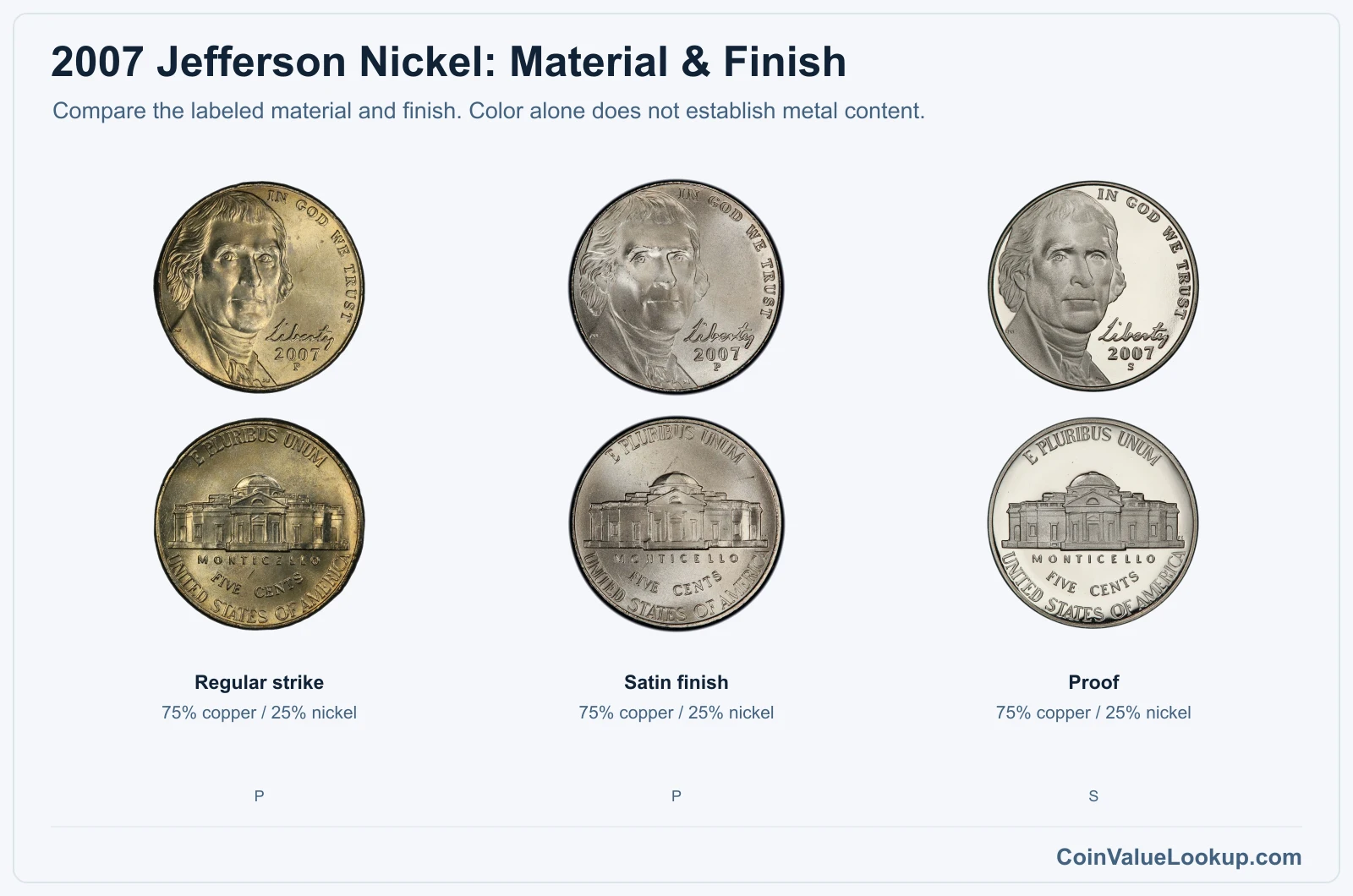
Start with the date on the obverse — it should read 2007 beneath the forward-facing Jefferson portrait. Then look for a small mintmark letter near the right side of the obverse: P for Philadelphia, D for Denver, or S for San Francisco.
A P or D coin pulled from pocket change is a normal business strike: 75% copper, 25% nickel, 5.00 grams, 21.2 mm diameter, plain edge. The reverse shows Monticello, Jefferson's Virginia home.
An S mintmark means you have a proof, struck at San Francisco for collector sets. These have sharply squared rims and mirror-like fields that are obvious once you know what to look for.
There is also a satin-finish version for both P and D mints, issued in 2007 United States Mint Sets. These have a distinctive soft, even luster that differs from the cartwheel shine of a business strike.
A shiny coin from circulation is not automatically satin — genuine satin-finish pieces came only from those sealed Mint Sets.
Step 2: Check Your 2007 Jefferson Nickel Grade
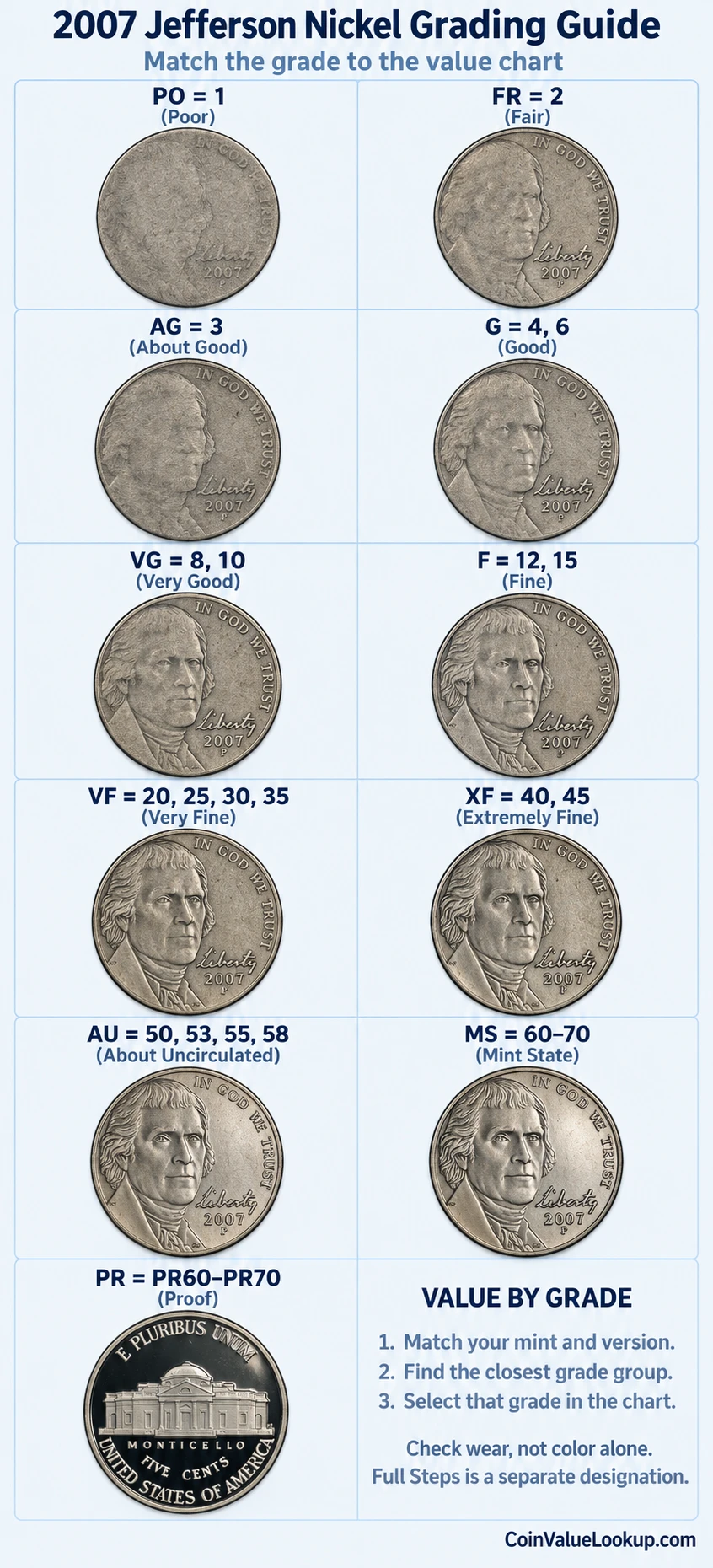
For business strikes, focus on the high points of Jefferson's cheek, jaw, and hair above the ear. These areas show wear first.
An MS60 coin is technically uncirculated but may have bag marks and reduced luster, while an MS65 piece has strong luster with only minor contact marks.
On the Monticello reverse, the steps between the columns can appear mushy even on uncirculated coins. That is a strike-quality issue, not wear, so judge grade from the portrait side first.
For proofs, look for hairlines from handling and the depth of contrast between mirrored fields and frosted devices. Satin-finish coins should show uniform soft texture without the glossy fields of a business strike or the mirror finish of a proof.
Use the comparison image to match your coin's overall look. Compare similar design and finish types — a satin coin measured against a business-strike photo will give misleading results.
Step 3: Check 2007 Jefferson Nickel Value by Mint and Version
2007 Jefferson Nickel — P — Business strike
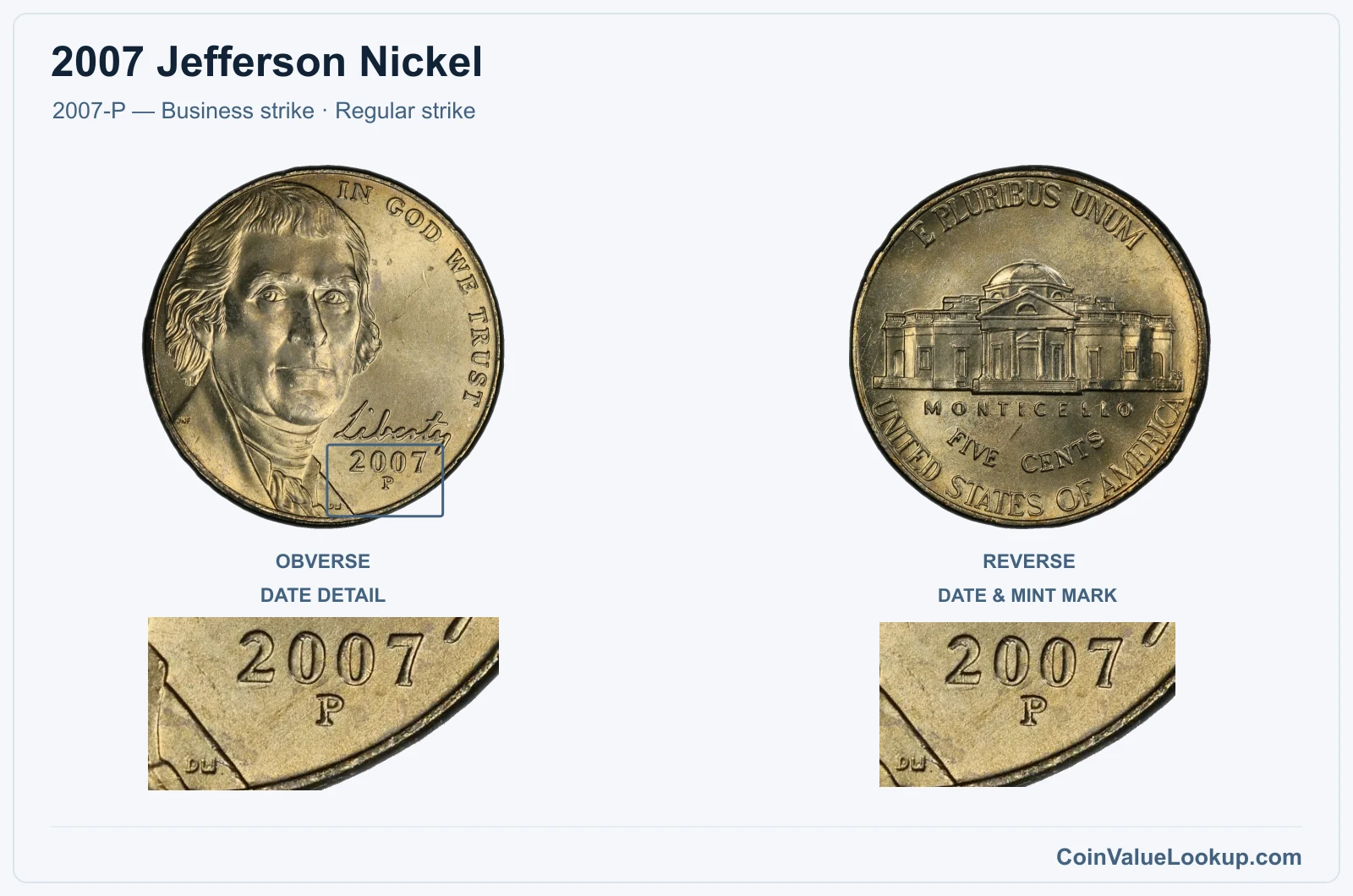
The 2007-P business strike is the most common version you will encounter. It features the forward-facing Jefferson portrait introduced in 2006 on the obverse and the restored Monticello design on the reverse.
The mintmark P sits on the obverse near the date.
USA Coin Book lists guide values of about $0.30 in MS60 and $0.61 in MS65. In circulated grades these are essentially face-value coins.
The premium only kicks in for clean, uncirculated examples with good luster and minimal bag marks.
| Range | Grade | Price | Auction Records | Appraisal |
|---|---|---|---|---|
| PO | PO 1 | — | Coin Identifier | |
| FR | FR 2 | — | Coin Identifier | |
| AG | AG 3 | — | Coin Identifier | |
| G | G 4 | — | Coin Identifier | |
| G 6 | — | Coin Identifier | ||
| VG | VG 8 | — | Coin Identifier | |
| VG 10 | — | Coin Identifier | ||
| F | F 12 | — | Coin Identifier | |
| F 15 | — | Coin Identifier | ||
| VF | VF 20 | — | Coin Identifier | |
| VF 25 | — | Coin Identifier | ||
| VF 30 | — | Coin Identifier | ||
| VF 35 | — | Coin Identifier | ||
| XF | XF 40 | — | Coin Identifier | |
| XF 45 | — | Coin Identifier | ||
| AU | AU 50 | — | Coin Identifier | |
| AU 53 | — | Coin Identifier | ||
| AU 55 | — | Coin Identifier | ||
| AU 58 | — | Coin Identifier | ||
| MS | MS 60 | — | Coin Identifier | |
| MS 61 | — | Coin Identifier | ||
| MS 62 | — | Coin Identifier | ||
| MS 63 | — | Coin Identifier | ||
| MS 64 | Coin Identifier | |||
| MS 65 | — | Coin Identifier | ||
| MS 66 | Coin Identifier | |||
| MS 67 | — | — | — | |
| MS 68 | — | — | — | |
| MS 69 | — | — | — | |
| MS 70 | — | — | — |
2007 Jefferson Nickel — P SP — Satin Finish Special Strike
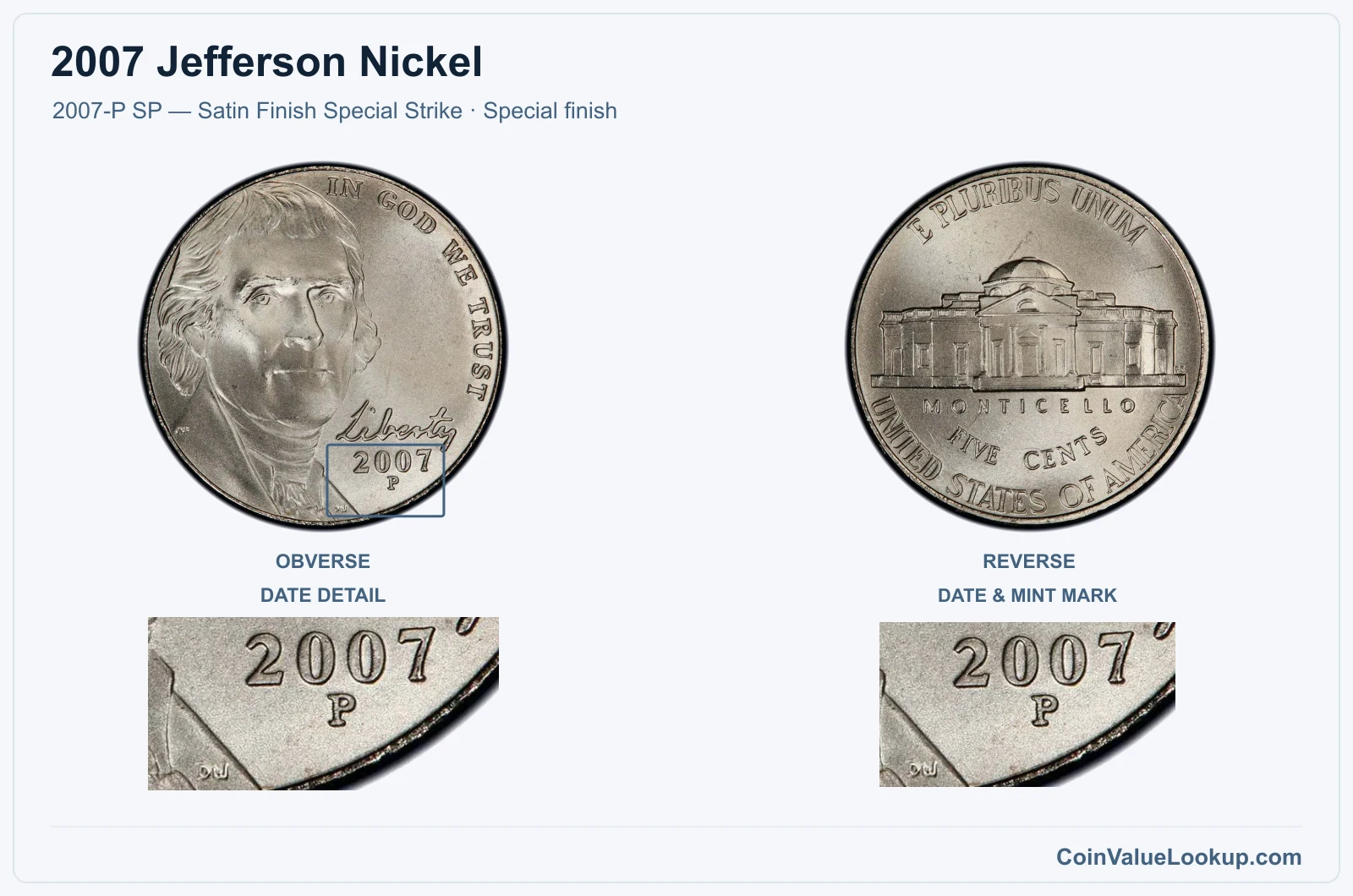
The 2007-P satin-finish nickel was produced exclusively for that year's United States Mint Set. It carries the same forward-facing Jefferson obverse and Monticello reverse as the business strike, but the surface has a distinctive soft, even sheen rather than the sharp cartwheel luster of a regular coin.
No numeric guide range is adopted for this version. Value depends on authenticated identity and condition.
If you think you have one, confirm it came from a Mint Set — a slightly dull circulation coin is not the same thing. Certification by a grading service as an SP (Special Strike) designation helps establish authenticity.
Coin Value Lookup is a useful starting point if you want to look up guides for this and other Jefferson nickel issues across different years and mints.
| Range | Grade | Price | Auction Records | Appraisal |
|---|---|---|---|---|
| SP | SP 1 | — | Coin Identifier | |
| SP 2 | — | Coin Identifier | ||
| SP 3 | — | Coin Identifier | ||
| SP 4 | — | Coin Identifier | ||
| SP 6 | — | Coin Identifier | ||
| SP 8 | — | Coin Identifier | ||
| SP 10 | — | Coin Identifier | ||
| SP 12 | — | Coin Identifier | ||
| SP 15 | — | Coin Identifier | ||
| SP 20 | — | Coin Identifier | ||
| SP 25 | — | Coin Identifier | ||
| SP 30 | — | Coin Identifier | ||
| SP 35 | — | Coin Identifier | ||
| SP 40 | — | Coin Identifier | ||
| SP 45 | — | Coin Identifier | ||
| SP 50 | — | Coin Identifier | ||
| SP 53 | — | Coin Identifier | ||
| SP 55 | — | Coin Identifier | ||
| SP 58 | — | Coin Identifier | ||
| SP 60 | — | Coin Identifier | ||
| SP 61 | — | Coin Identifier | ||
| SP 62 | — | Coin Identifier | ||
| SP 63 | — | Coin Identifier | ||
| SP 64 | — | Coin Identifier | ||
| SP 65 | — | Coin Identifier | ||
| SP 66 | — | Coin Identifier | ||
| SP 67 | — | Coin Identifier | ||
| SP 68 | — | Coin Identifier | ||
| SP 69 | — | Coin Identifier | ||
| SP 70 | — | — | — |
2007 Jefferson Nickel — D — Business strike
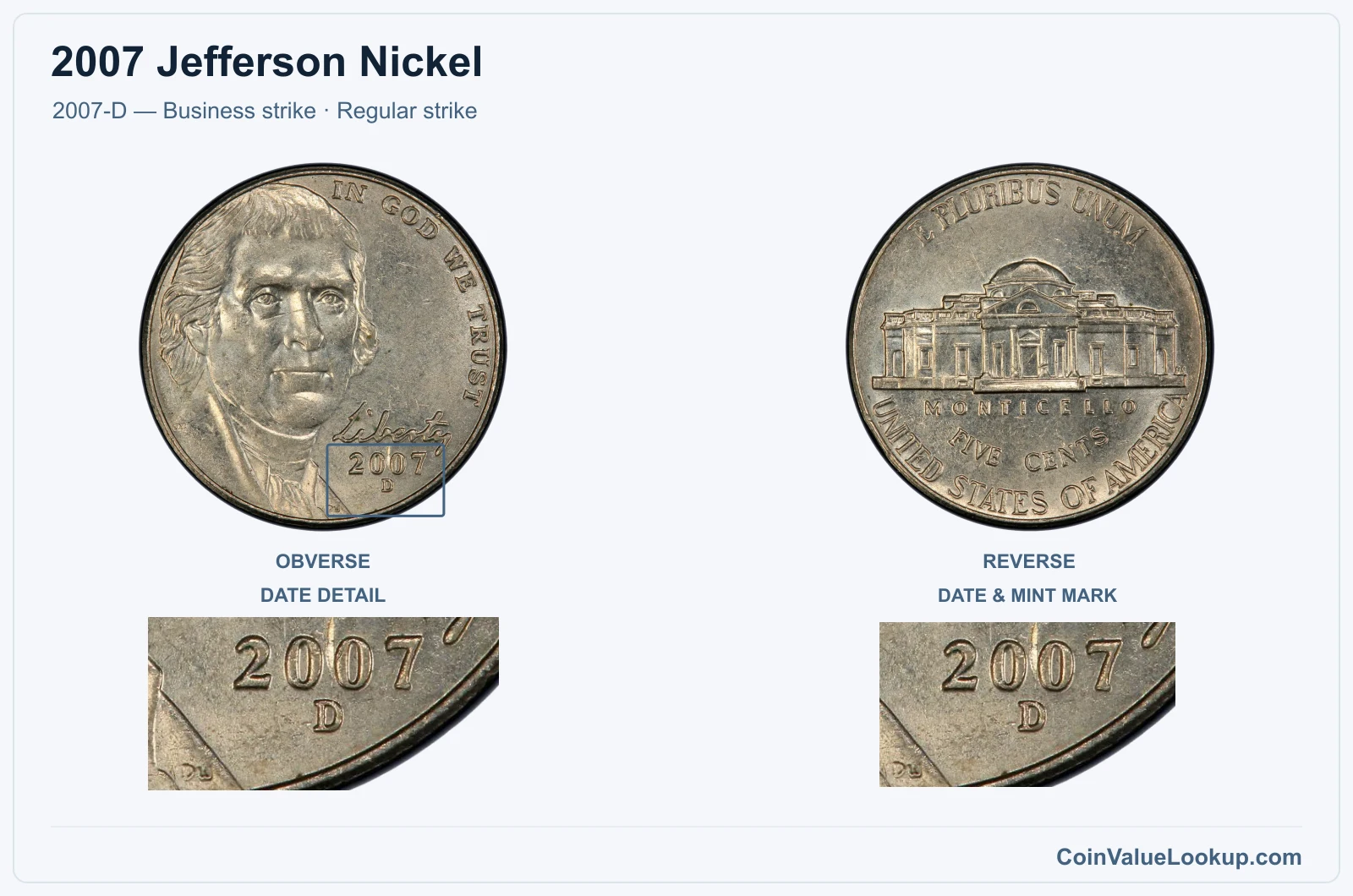
The 2007-D business strike is the Denver Mint counterpart to the Philadelphia issue. Same design, same 75% copper and 25% nickel composition, same 5.00-gram weight.
Look for the D mintmark on the obverse.
Guide values from USA Coin Book are identical to the P mint: about $0.30 at MS60 and $0.61 at MS65. In worn condition, this coin spends at face value.
Only uncirculated pieces with clean surfaces command a small collector premium.
| Range | Grade | Price | Auction Records | Appraisal |
|---|---|---|---|---|
| PO | PO 1 | — | Coin Identifier | |
| FR | FR 2 | — | Coin Identifier | |
| AG | AG 3 | — | Coin Identifier | |
| G | G 4 | — | Coin Identifier | |
| G 6 | — | Coin Identifier | ||
| VG | VG 8 | — | Coin Identifier | |
| VG 10 | — | Coin Identifier | ||
| F | F 12 | — | Coin Identifier | |
| F 15 | — | Coin Identifier | ||
| VF | VF 20 | — | Coin Identifier | |
| VF 25 | — | Coin Identifier | ||
| VF 30 | — | Coin Identifier | ||
| VF 35 | — | Coin Identifier | ||
| XF | XF 40 | — | Coin Identifier | |
| XF 45 | — | Coin Identifier | ||
| AU | AU 50 | — | Coin Identifier | |
| AU 53 | — | Coin Identifier | ||
| AU 55 | — | Coin Identifier | ||
| AU 58 | — | Coin Identifier | ||
| MS | MS 60 | — | Coin Identifier | |
| MS 61 | — | Coin Identifier | ||
| MS 62 | — | Coin Identifier | ||
| MS 63 | Coin Identifier | |||
| MS 64 | — | Coin Identifier | ||
| MS 65 | — | Coin Identifier | ||
| MS 66 | — | — | — | |
| MS 67 | — | — | — | |
| MS 68 | — | — | — | |
| MS 69 | — | — | — | |
| MS 70 | — | — | — |
2007 Jefferson Nickel — D SP — Satin Finish Special Strike
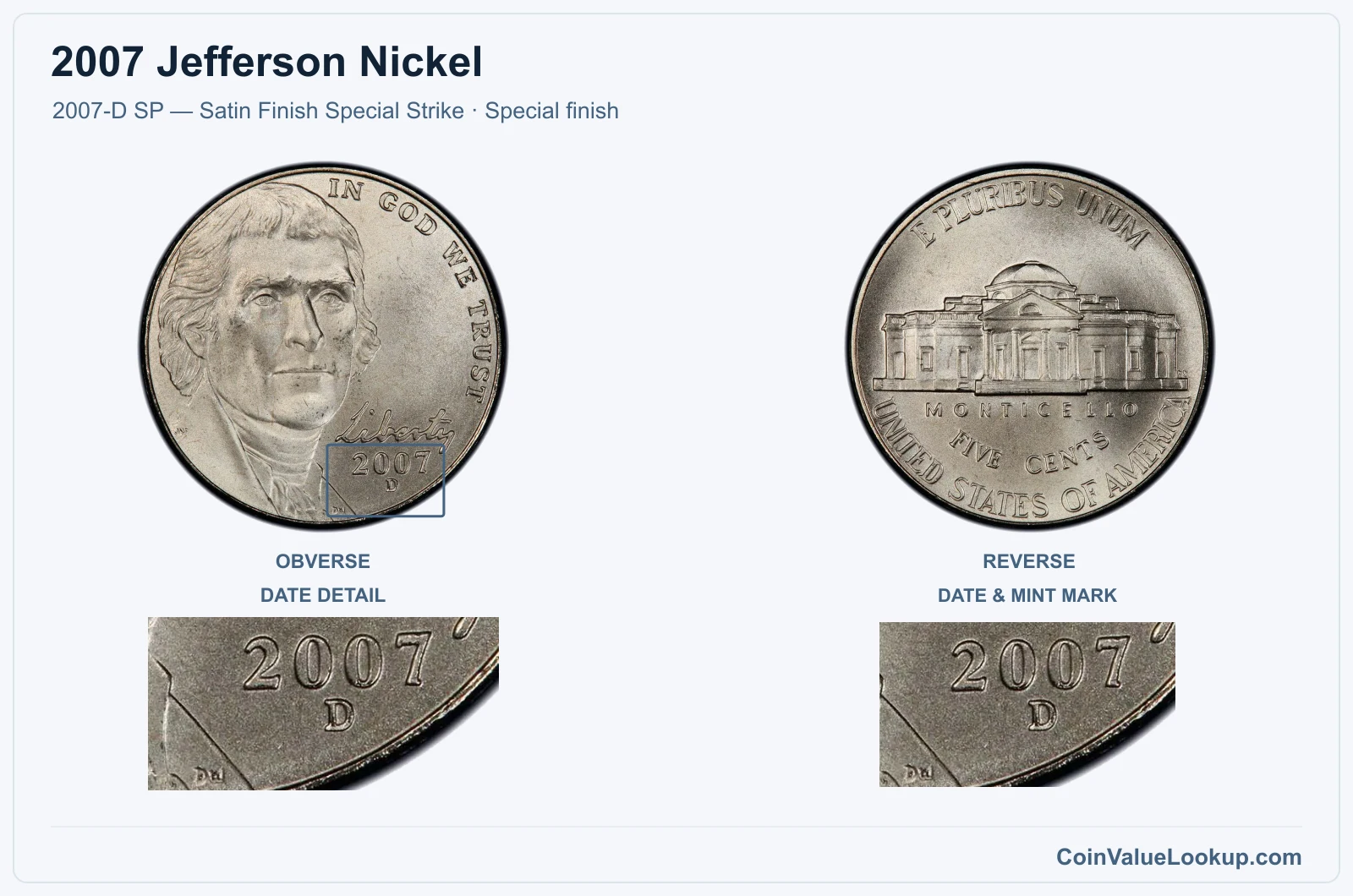
The 2007-D satin-finish nickel is the Denver counterpart of the satin P, also exclusive to the 2007 Mint Set. It has the same forward-facing portrait and Monticello reverse with a uniform soft luster across both sides.
No numeric guide range has been adopted for this version. As with the P satin, its value hinges on authenticated identity and overall condition.
These coins should not be confused with lightly circulated business strikes that have lost some of their original shine — genuine satin coins have a fundamentally different surface texture that is consistent and intentional.
| Range | Grade | Price | Auction Records | Appraisal |
|---|---|---|---|---|
| SP | SP 1 | — | Coin Identifier | |
| SP 2 | — | Coin Identifier | ||
| SP 3 | — | Coin Identifier | ||
| SP 4 | — | Coin Identifier | ||
| SP 6 | — | Coin Identifier | ||
| SP 8 | — | Coin Identifier | ||
| SP 10 | — | Coin Identifier | ||
| SP 12 | — | Coin Identifier | ||
| SP 15 | — | Coin Identifier | ||
| SP 20 | — | Coin Identifier | ||
| SP 25 | — | Coin Identifier | ||
| SP 30 | — | Coin Identifier | ||
| SP 35 | — | Coin Identifier | ||
| SP 40 | — | Coin Identifier | ||
| SP 45 | — | Coin Identifier | ||
| SP 50 | — | Coin Identifier | ||
| SP 53 | — | Coin Identifier | ||
| SP 55 | — | Coin Identifier | ||
| SP 58 | — | Coin Identifier | ||
| SP 60 | — | Coin Identifier | ||
| SP 61 | — | Coin Identifier | ||
| SP 62 | — | Coin Identifier | ||
| SP 63 | — | Coin Identifier | ||
| SP 64 | — | Coin Identifier | ||
| SP 65 | — | Coin Identifier | ||
| SP 66 | — | Coin Identifier | ||
| SP 67 | — | Coin Identifier | ||
| SP 68 | — | Coin Identifier | ||
| SP 69 | — | Coin Identifier | ||
| SP 70 | — | — | — |
2007 Jefferson Nickel — S PR — Proof
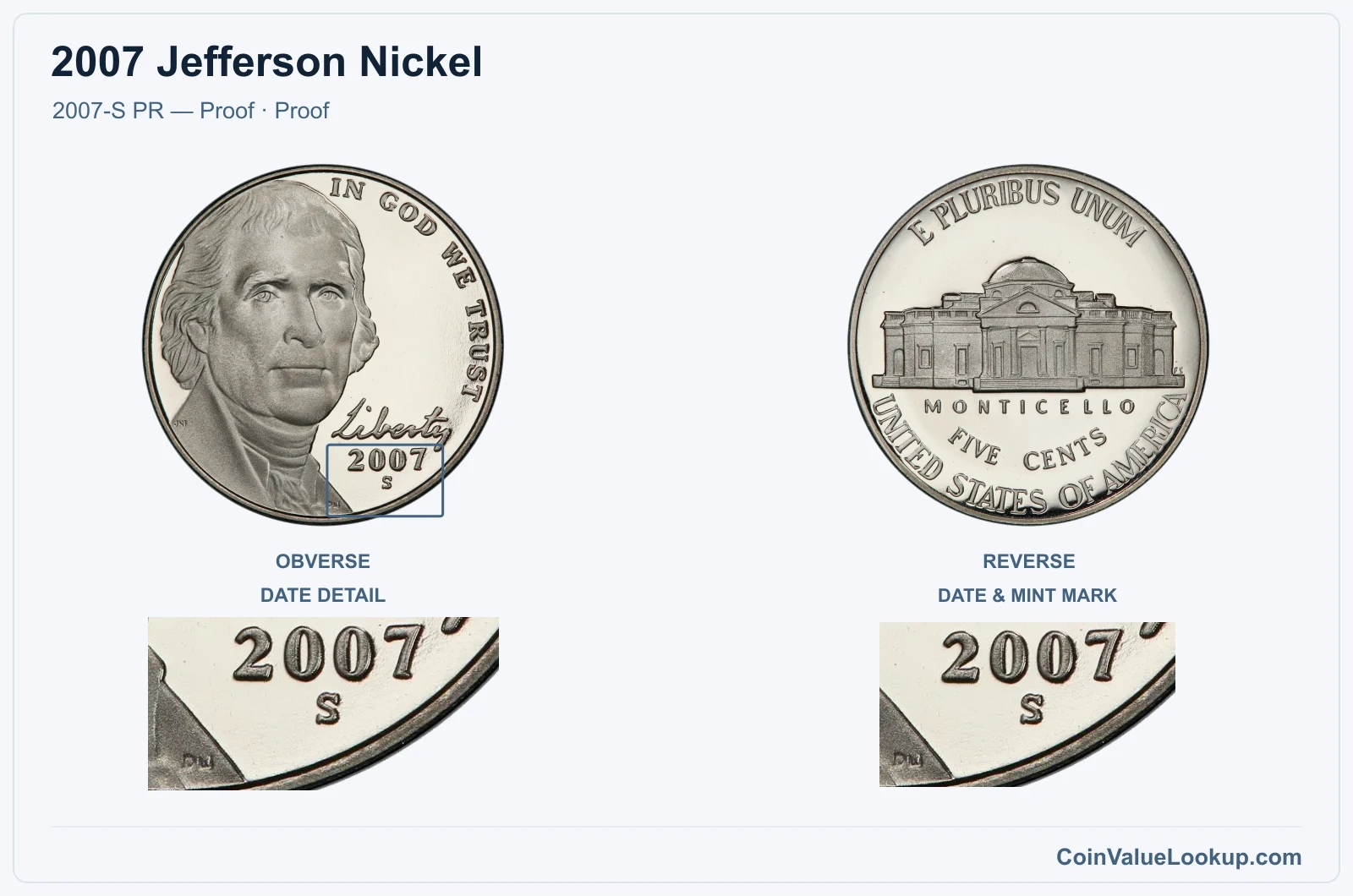
The 2007-S proof nickel was struck at San Francisco for collector proof sets. It features deeply mirrored fields and sharp frosted devices on the same forward-facing Jefferson and Monticello design used across all 2007 nickels.
USA Coin Book places the guide value at about $5.30 in PR65. That makes it the highest-valued standard 2007 nickel version at its respective grade.
Look for the S mintmark on the obverse. Any proof you find loose outside its original case should be examined for hairlines and haze, which affect both grade and desirability.
| Range | Grade | Price | Auction Records | Appraisal |
|---|---|---|---|---|
| PR | PR 1 | — | Coin Identifier | |
| PR 2 | — | Coin Identifier | ||
| PR 3 | — | Coin Identifier | ||
| PR 4 | — | Coin Identifier | ||
| PR 6 | — | Coin Identifier | ||
| PR 8 | — | Coin Identifier | ||
| PR 10 | — | Coin Identifier | ||
| PR 12 | — | Coin Identifier | ||
| PR 15 | — | Coin Identifier | ||
| PR 20 | — | Coin Identifier | ||
| PR 25 | — | Coin Identifier | ||
| PR 30 | — | Coin Identifier | ||
| PR 35 | — | Coin Identifier | ||
| PR 40 | — | Coin Identifier | ||
| PR 45 | — | Coin Identifier | ||
| PR 50 | — | Coin Identifier | ||
| PR 53 | — | Coin Identifier | ||
| PR 55 | — | Coin Identifier | ||
| PR 58 | — | Coin Identifier | ||
| PR 60 | — | Coin Identifier | ||
| PR 61 | — | Coin Identifier | ||
| PR 62 | — | Coin Identifier | ||
| PR 63 | — | Coin Identifier | ||
| PR 64 | — | Coin Identifier | ||
| PR 65 | — | Coin Identifier | ||
| PR 66 | — | Coin Identifier | ||
| PR 67 | — | Coin Identifier | ||
| PR 68 | — | Coin Identifier | ||
| PR 69 | Coin Identifier | |||
| PR 70 | Coin Identifier |
2007 Jefferson Nickel Error List
1. 2007 Jefferson Nickel — Obverse struck through on proof
A 2007-S proof nickel certified by NGC as PR69 Ultra Cameo has been documented with an obverse struck-through anomaly. A struck-through occurs when foreign material sits between the die and the planchet during striking, leaving an impression or void in the coin's surface.
The exact shape and location of the obstruction are visible in the certified coin's photographs. Do not assume the material was grease, wire, or any specific substance — the certification identifies the error category without specifying the object.
This could be mistaken for a hairline scratch, cleaning mark, or post-mint gouge. The key difference is that a struck-through impression is pressed into the surface during manufacture, while scratches and gouges displace metal in a different way.
No numeric price range is adopted; value depends on the specific coin's authenticated identity, condition, and the error's visual impact.
2. 2007 Jefferson Nickel — Die Cap / Capped-Die Strike
A die cap (or capped-die strike) error has been reported for the 2007 nickel. This happens when a struck coin sticks to a die and becomes a cap over it, then subsequent blanks are struck through that cap.
The coin that stuck to the die develops a distinctive cupped shape.
Look at both sides carefully. The adhered coin will have one normal side and one increasingly spread, mirror-image side.
A coin struck through a cap shows a mushy, weakened impression on the capped side.
Do not confuse this with a coin bent in a vise, dropped on concrete, or simply showing a weak strike from a worn die. Post-mint damage bends metal without the characteristic die-contact spreading.
No numeric price range is adopted; value depends on condition, the degree of capping, and authentication of the error.
3. 2007 Jefferson Nickel — Improper Annealing
Improper annealing errors have been reported for the 2007 nickel. Annealing is the heat treatment applied to planchets before striking to soften the metal.
When this process goes wrong, the resulting coin can show unusual surface discoloration or a different texture than normal.
These coins may appear darker, streaky, or have a rough, granular look compared to a standard nickel. Check the edge as well — it may share the same abnormal appearance.
The tricky part: environmental toning, corrosion, and coins exposed to heat after minting can look similar. Surface discoloration alone is a screening clue, not proof.
Authentication by a third-party grading service helps distinguish a genuine planchet error from post-mint damage. No numeric price range is adopted; the value of an improperly annealed piece depends on the severity and authenticated condition.
4. 2007 Jefferson Nickel — Die Crack / Die Chip
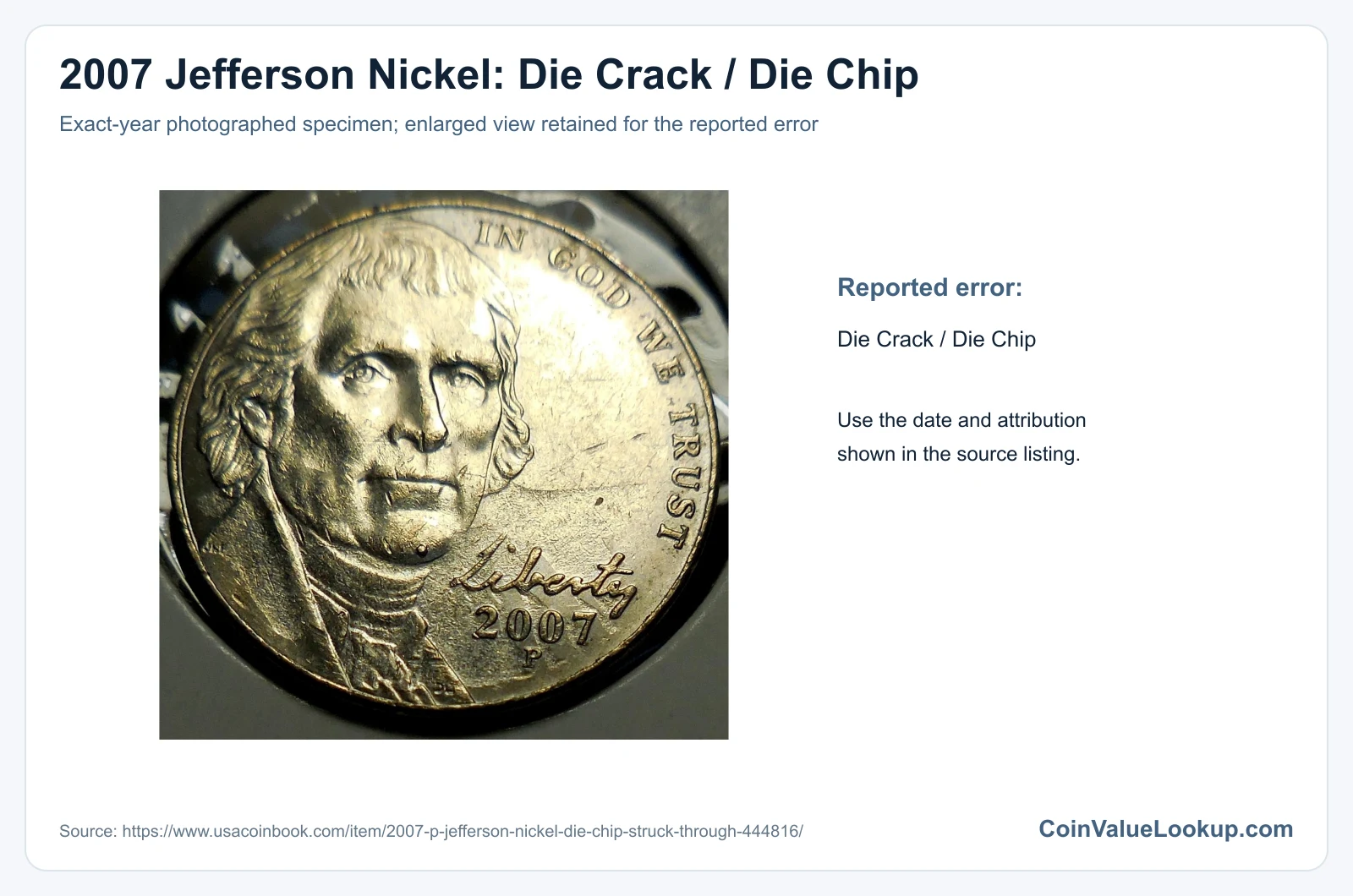
Die crack and die chip errors have been reported for the 2007 nickel. When a die develops a crack, the fissure fills with metal during striking, leaving a raised line on the finished coin.
A die chip works the same way but produces a small raised blob instead of a line.
Raised is the keyword here. Scratches are incuse — they go into the surface.
Die cracks sit above it. Run a fingernail across a suspected crack; if you can feel it raised above the field, that is a good sign.
A crack that reaches the rim is sometimes called a cud, and those tend to attract more collector attention.
Corrosion buildup or foreign material stuck to the surface can mimic a die crack at first glance. No numeric price range is adopted; value varies with the crack's size, location, and the coin's overall condition.
5. 2007 Jefferson Nickel — Off-Center Strike
Off-center strike errors have been reported for the 2007 nickel. This occurs when the planchet is not properly seated between the dies, so the design is displaced to one side, leaving a blank crescent where no metal was struck.
The date must be visible for the coin to be readily attributable to 2007, which directly affects collectibility. A 10% off-center coin looks mildly shifted; a 50% piece is dramatically half-blank.
More displacement generally means more collector interest, up to the point where the date disappears.
Do not confuse this with a clipped planchet, a misaligned die (where the design is complete but shifted), or a coin that was flattened unevenly after leaving the mint. No numeric price range is adopted; value depends on the percentage of displacement, date visibility, and condition.
6. 2007 Jefferson Nickel — Clipped Planchet
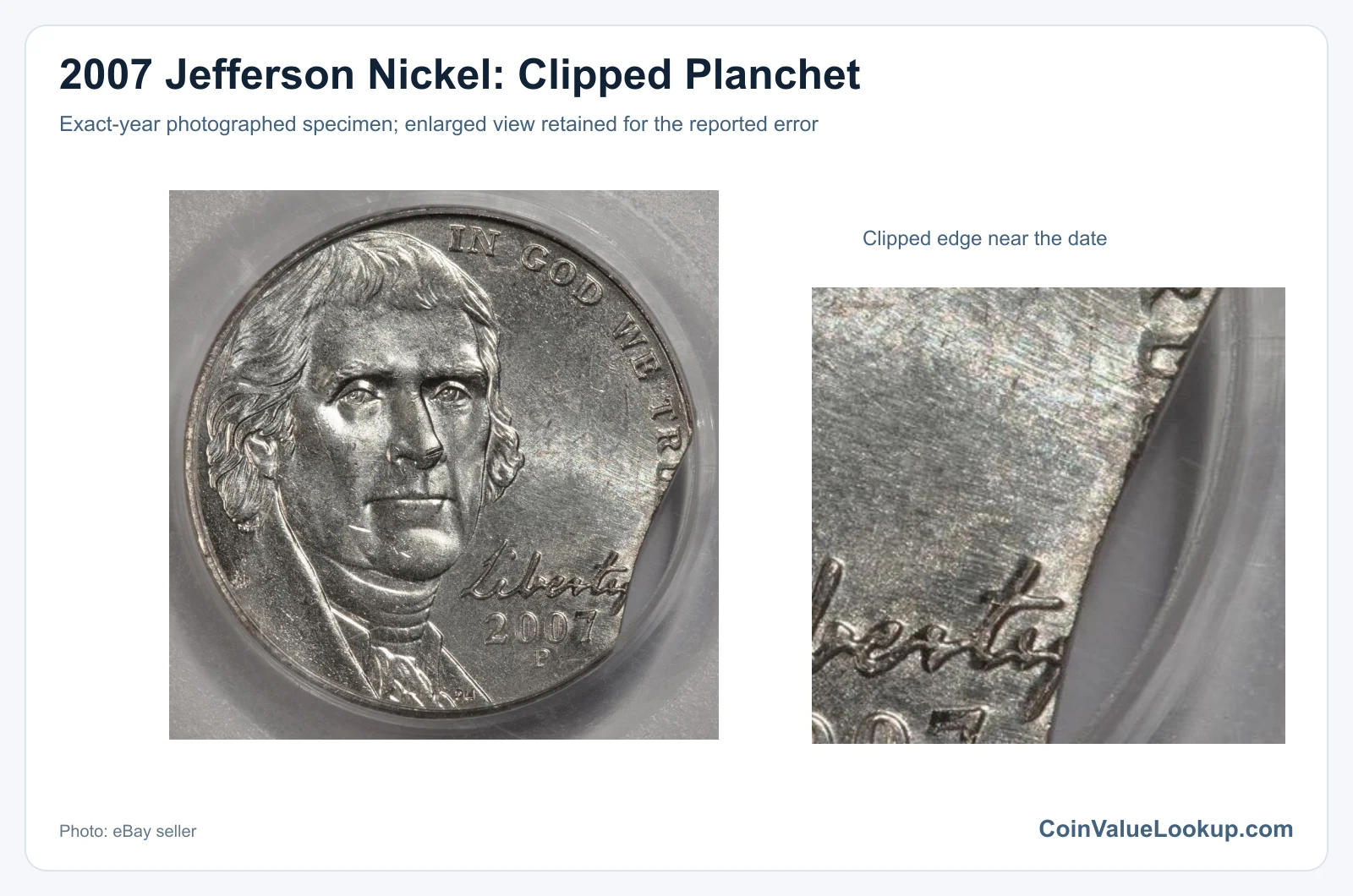
Clipped planchet errors have been reported for the 2007 nickel. These occur when the blanking press overlaps a previously punched area of the metal strip, producing a planchet with a missing curved, straight, or ragged section.
Look at the edge where the clip occurred. The missing area should show a distinct boundary, and you may notice design weakness on the opposite side of the coin — metal could not flow fully during striking.
That opposite-side weakness is a useful diagnostic.
A coin with a filed edge, a deliberate cut, or corrosion eating away the rim is not a clip. Genuine clips have a smooth, consistent edge profile at the missing section that matches the manufacturing process.
No numeric price range is adopted; value depends on the clip's size, shape, and the coin's overall condition.
7. 2007 Jefferson Nickel — Doubled Die Reverse
A doubled die reverse error has been reported for the 2007 nickel. This type of error originates during die manufacture, producing a die with slightly doubled design elements that then stamp every coin it strikes.
To check, compare the reverse lettering and architectural lines of Monticello against a known normal 2007 nickel. Genuine doubling shows consistent, directional separation on specific design elements — usually visible under magnification on letters like MONTICELLO or E PLURIBUS UNUM.
Machine doubling is the common lookalike. It produces flat, shelf-like distortion rather than the rounded, equally strong secondary image of a true doubled die.
Reflections and random contact marks can also fool the eye. No numeric price range is adopted; value depends on the doubling's visibility, location, and authenticated condition.