1886 Indian Head Penny Coin Value: How Much Is It Worth?
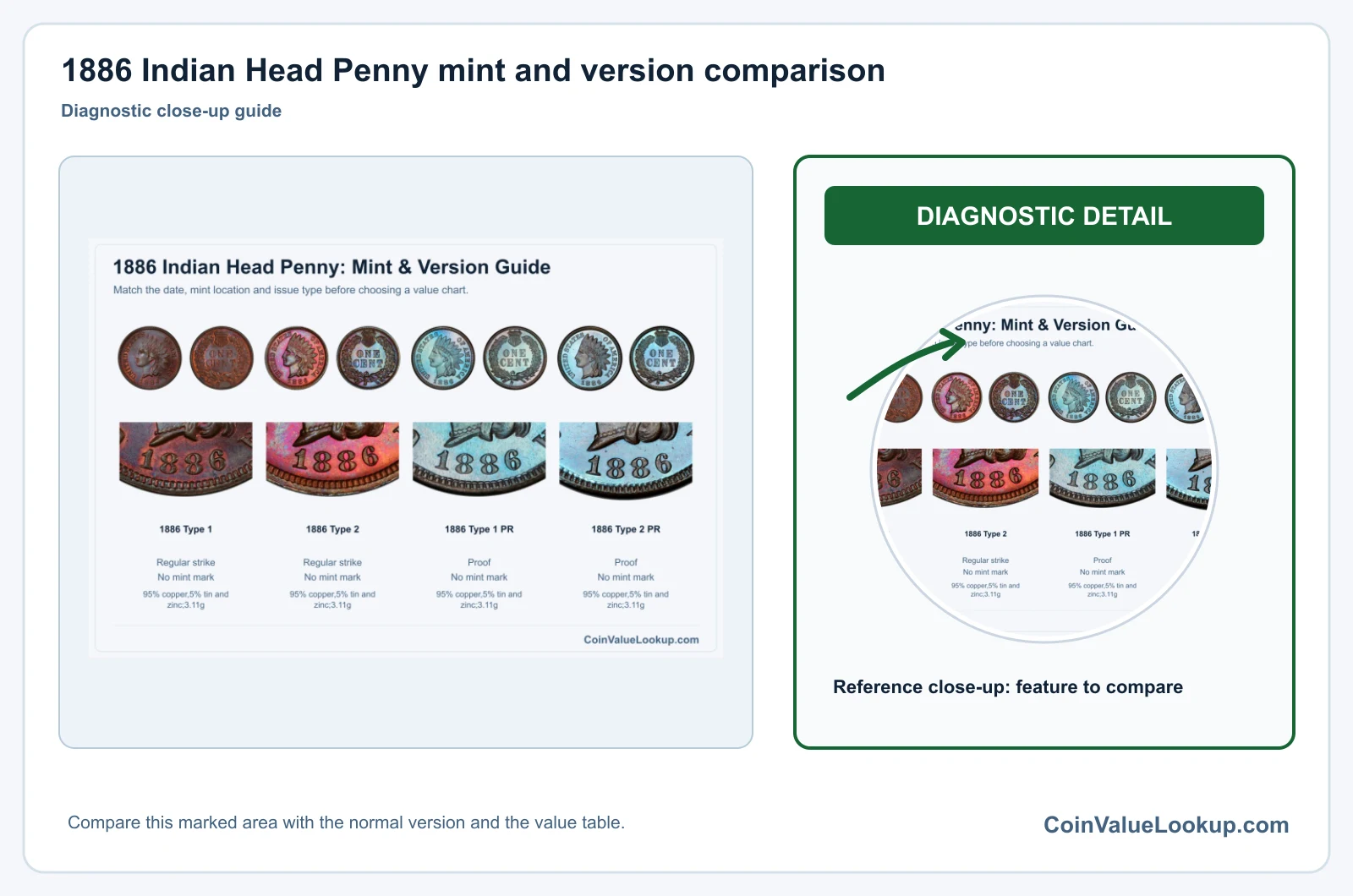
The 1886 Indian Head Penny is a date that rewards careful looking. Two distinct hub types were used this year, and which one you have matters.
Guide estimates from USA Coin Book range from about $12 at G4 for a Type 1 business strike up to $666 at MS63 for a Type 2 business strike. Proof versions also exist.
These are retail guide figures, not guaranteed offers, and they assume original, undamaged surfaces in the stated grade.
Fast Way to Identify Your 1886 Indian Head Penny
Not sure which type you have, or whether your coin is even an 1886 Indian cent? Upload clear photos of the front and back, and our identifier can give you a preliminary read on the year, design and type.
It is not a substitute for professional authentication or grading, but it is a solid starting point before you dig deeper.
1886 Indian Head Penny Value
Upload both sides of your 1886 Indian Head Penny.
Front Obverse
Upload photo
Back Reverse
Upload photo
Which 1886 Indian Head Penny Versions Are Worth Money?
- Type 2 business strikes carry higher guide values than Type 1 at the same grade, with USA Coin Book listing $666 at MS63 versus $344 for Type 1.
- Type 2 Proof coins are also valued above Type 1 Proofs, with a PR63 guide figure of $612 compared to $376.
- Check the lowest feather position on the reverse to determine your type before looking up any price.
- Original uncirculated surfaces with strong luster add desirability; cleaning, corrosion or damage lower marketability regardless of type.
Step 1: Identify Your 1886 Indian Head Penny Mint Mark and Version
Every regular 1886 Indian Head cent was struck at the Philadelphia Mint. There is no mintmark on this coin.
If you see the letter L on the ribbon behind the portrait, that is the designer's initial, not a mintmark.
The key distinction this year is Type 1 versus Type 2. Flip the coin to the reverse and find the word AMERICA in the legend.
Now look at the lowest feather in the wreath cluster below that word. On a Type 1, the tip of that feather points to the space between the letters I and C.
On a Type 2, it points between C and A. This is a hub change, not a minor die crack or a trick of light, so the difference is consistent across every specimen of each type.
Both types come in business-strike and proof formats. Proof is a method of manufacture involving specially prepared dies and planchets; it is not simply a higher grade than Mint State.
A business strike that has been polished to a mirror finish is not a proof. Genuine proofs show squared rims, fully mirrored fields, and precise strike detail that differs from even a well-preserved business coin.
Before reading any price column, confirm your coin's type (1 or 2), its strike format (business or proof), and its overall condition. Borrowing a price from the wrong column is one of the most common mistakes collectors make with this date.
Step 2: Check Your 1886 Indian Head Penny Grade
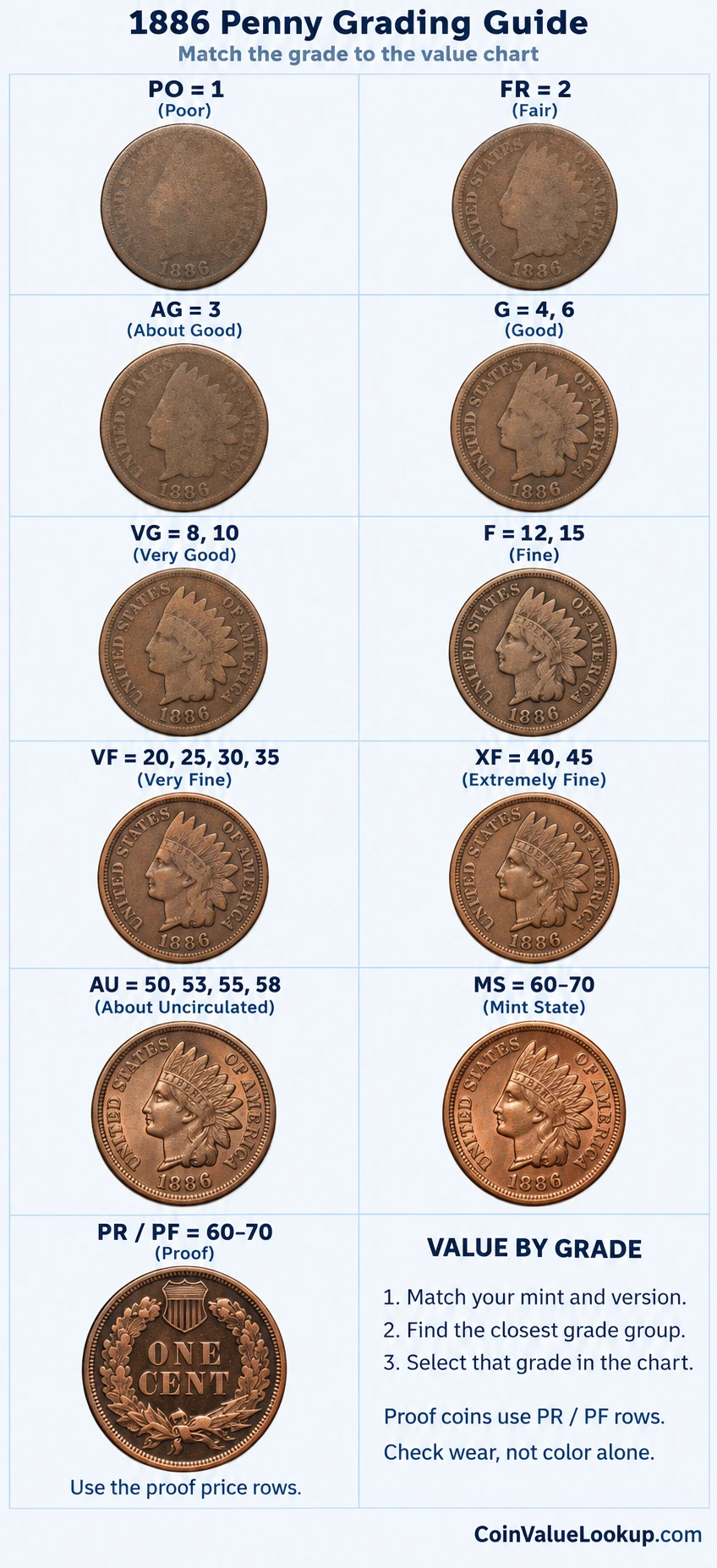
Start with the obverse. The word LIBERTY is incused into the headband, and its letters wear down progressively: L and Y tend to soften first, then the interior letters.
In lower grades like G4, most or all of LIBERTY may be gone. By contrast, a coin grading around MS63 should show full LIBERTY with original mint luster intact.
Check the feather tips above the headband and the hair detail behind the ear. These are high points that show friction early.
The cheek below the eye is another quick tell: even light cabinet friction leaves a dull patch there.
On the reverse, the wreath leaves and shield details wear from the highest relief inward. Compare your coin to the reference image to see where your wear level falls.
One important caution: the 1886 Indian cent can come with a soft original strike, especially on the feather tips and hair diamonds. A weakly struck coin is not the same as a worn coin.
If the luster is full and unbroken but certain details are mushy, that could be a strike issue rather than circulation wear. Do not downgrade based on one soft area alone.
Bronze Indian cents are sometimes described with color designations like BN, RB, or RD. These refer to how much original copper-red color remains, not to a different metal.
A BN coin has toned to brown; an RD coin retains most of its original red. Color affects value, but the guide prices listed here do not specify a color tier, so treat them as general benchmarks.
Step 3: Check 1886 Indian Head Penny Value by Mint and Version
1886 Indian Head Penny — Type 1
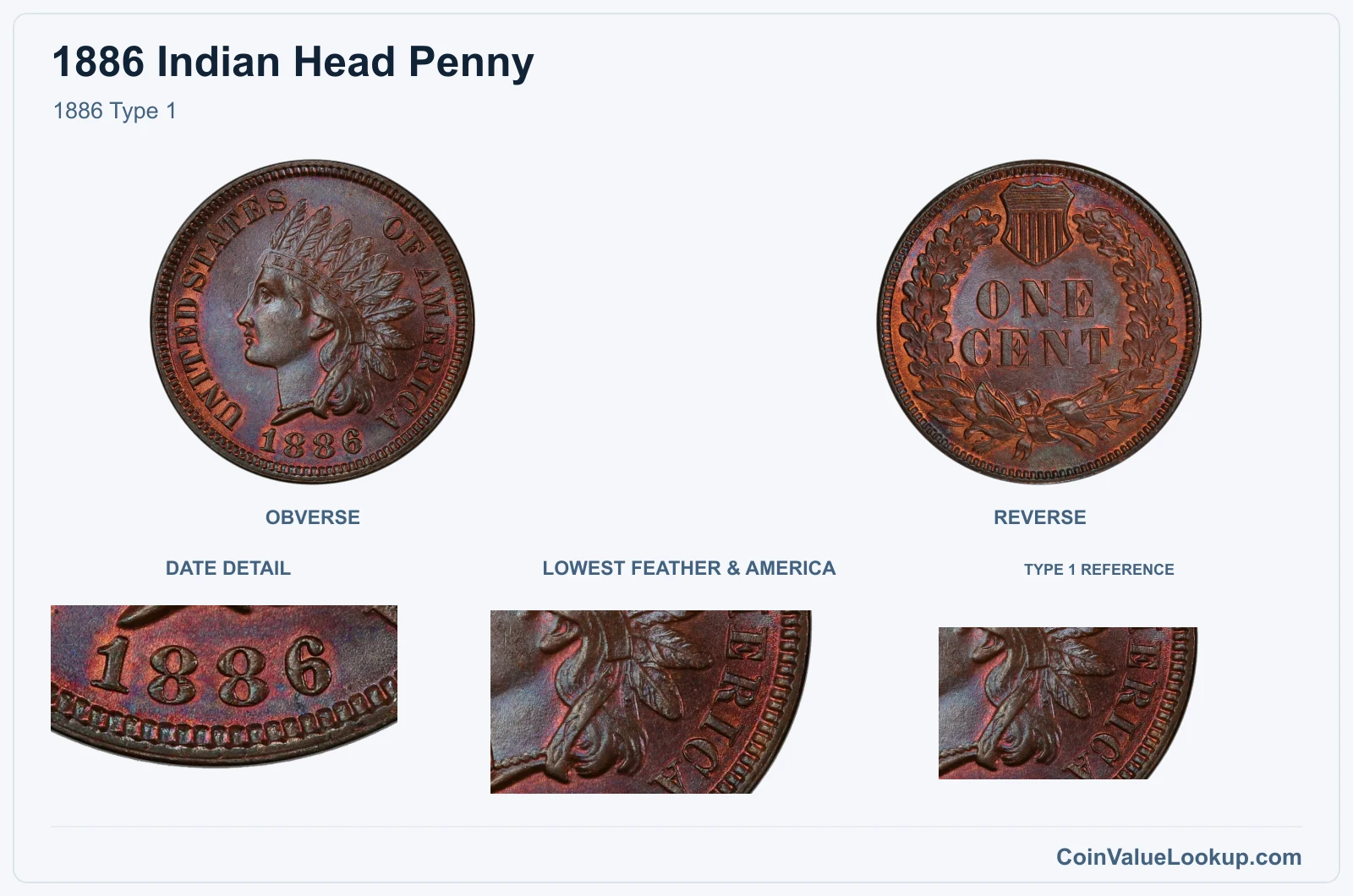
The 1886 Type 1 is the earlier hub variety for this date. On the reverse, the lowest feather in the cluster beneath AMERICA points to the space between the letters I and C.
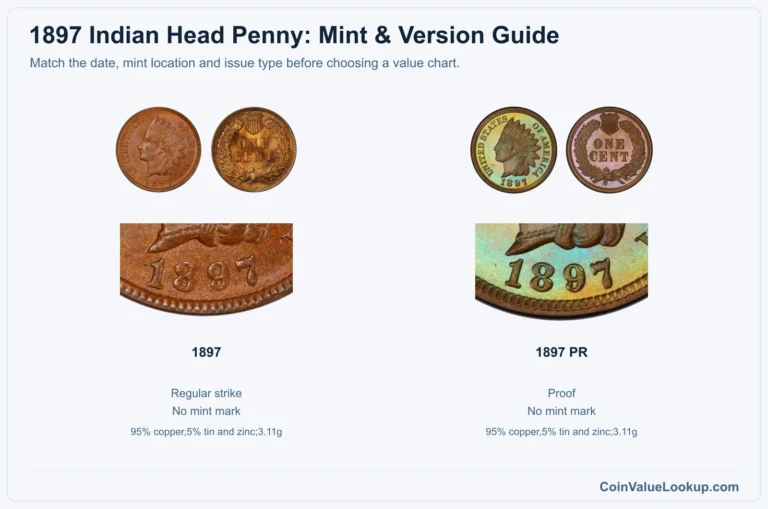
All 1886 cents were struck at Philadelphia from a bronze alloy of 95% copper with 5% tin and zinc, weighing 3.11 grams.
USA Coin Book lists the Type 1 business strike at about $12 in G4 and $344 in MS63. These are guide estimates, not offers.
Compare only coins of the same type and similar original surfaces when judging value.
| Range | Grade | Price | Auction Records | Appraisal |
|---|---|---|---|---|
| PO | PO 1 | — | Coin Identifier | |
| FR | FR 2 | — | Coin Identifier | |
| AG | AG 3 | — | Coin Identifier | |
| G | G 4 | Coin Identifier | ||
| G 6 | — | Coin Identifier | ||
| VG | VG 8 | — | Coin Identifier | |
| VG 10 | — | Coin Identifier | ||
| F | F 12 | — | Coin Identifier | |
| F 15 | — | Coin Identifier | ||
| VF | VF 20 | Coin Identifier | ||
| VF 25 | Coin Identifier | |||
| VF 30 | Coin Identifier | |||
| VF 35 | Coin Identifier | |||
| XF | XF 40 | Coin Identifier | ||
| XF 45 | Coin Identifier | |||
| AU | AU 50 | Coin Identifier | ||
| AU 53 | Coin Identifier | |||
| AU 55 | Coin Identifier | |||
| AU 58 | Coin Identifier | |||
| MS | MS 60 | — | Coin Identifier | |
| MS 61 | Coin Identifier | |||
| MS 62 | Coin Identifier | |||
| MS 63 | Coin Identifier | |||
| MS 64 | Coin Identifier | |||
| MS 65 | Coin Identifier | |||
| MS 66 | Coin Identifier | |||
| MS 67 | — | — | — | |
| MS 68 | — | — | — | |
| MS 69 | — | — | — | |
| MS 70 | — | — | — |
1886 Indian Head Penny — Type 2
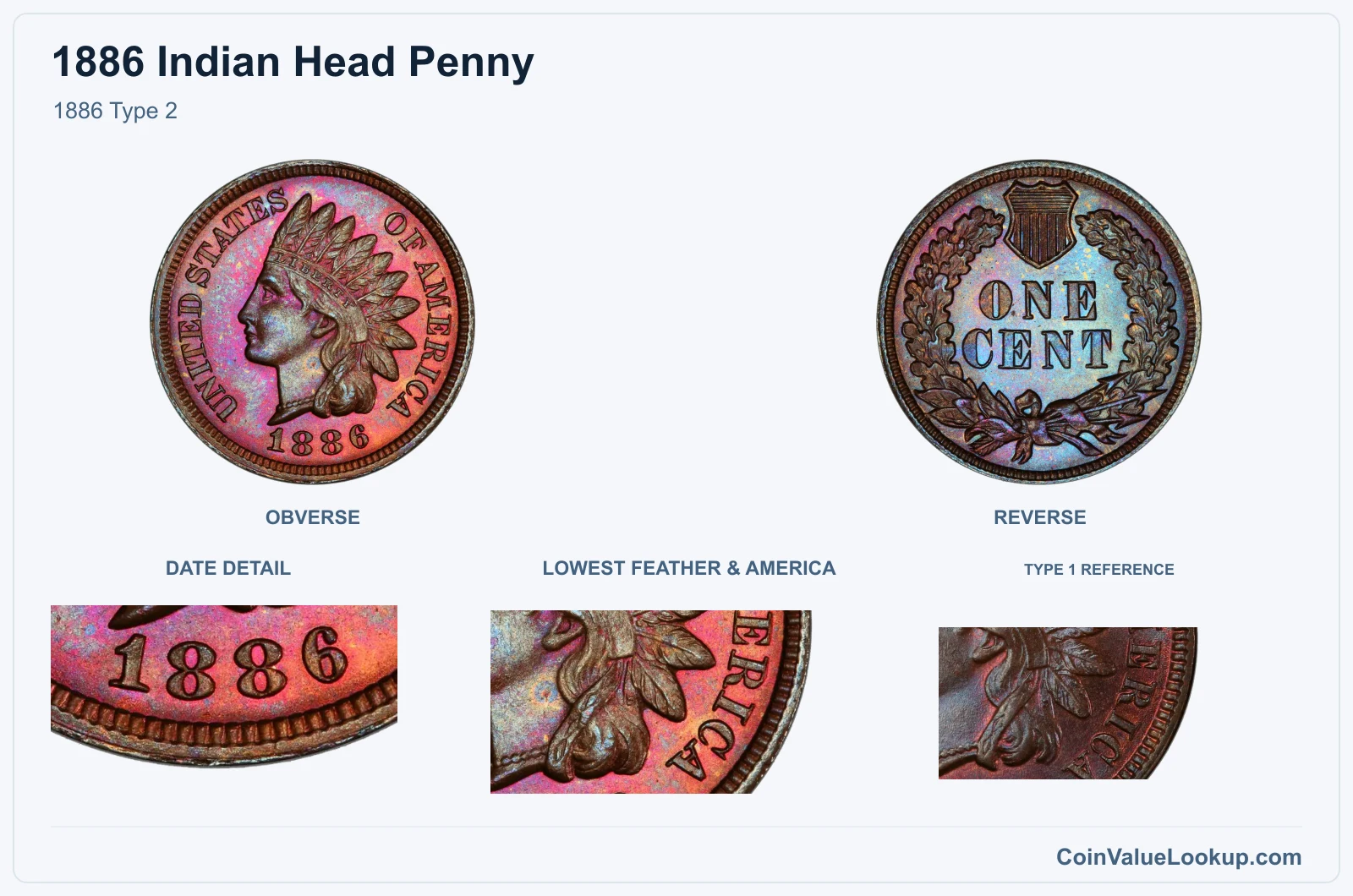
The Type 2 uses a revised hub where the lowest feather points between the letters C and A of AMERICA. That single diagnostic separates it from the Type 1, and it consistently brings higher prices at the same grade.
USA Coin Book estimates $15 at G4 and $666 at MS63 for a Type 2 business strike. The premium over Type 1 grows substantially in uncirculated condition.
Composition and weight are identical to the Type 1: 95% copper, 5% tin and zinc, 3.11 grams. Do not assume a coin is Type 2 just because it looks sharp; check the feather position carefully.
Coin Value Lookup is a good place to look up guides for other Indian Head cent dates and types if you are working through a collection.
| Range | Grade | Price | Auction Records | Appraisal |
|---|---|---|---|---|
| PO | PO 1 | — | Coin Identifier | |
| FR | FR 2 | — | Coin Identifier | |
| AG | AG 3 | Coin Identifier | ||
| G | G 4 | — | Coin Identifier | |
| G 6 | Coin Identifier | |||
| VG | VG 8 | Coin Identifier | ||
| VG 10 | — | Coin Identifier | ||
| F | F 12 | — | Coin Identifier | |
| F 15 | — | Coin Identifier | ||
| VF | VF 20 | — | Coin Identifier | |
| VF 25 | Coin Identifier | |||
| VF 30 | Coin Identifier | |||
| VF 35 | Coin Identifier | |||
| XF | XF 40 | Coin Identifier | ||
| XF 45 | Coin Identifier | |||
| AU | AU 50 | Coin Identifier | ||
| AU 53 | Coin Identifier | |||
| AU 55 | Coin Identifier | |||
| AU 58 | Coin Identifier | |||
| MS | MS 60 | — | Coin Identifier | |
| MS 61 | Coin Identifier | |||
| MS 62 | Coin Identifier | |||
| MS 63 | Coin Identifier | |||
| MS 64 | Coin Identifier | |||
| MS 65 | Coin Identifier | |||
| MS 66 | — | — | — | |
| MS 67 | — | — | — | |
| MS 68 | — | — | — | |
| MS 69 | — | — | — | |
| MS 70 | — | — | — |
1886 Indian Head Penny — Type 1 PR
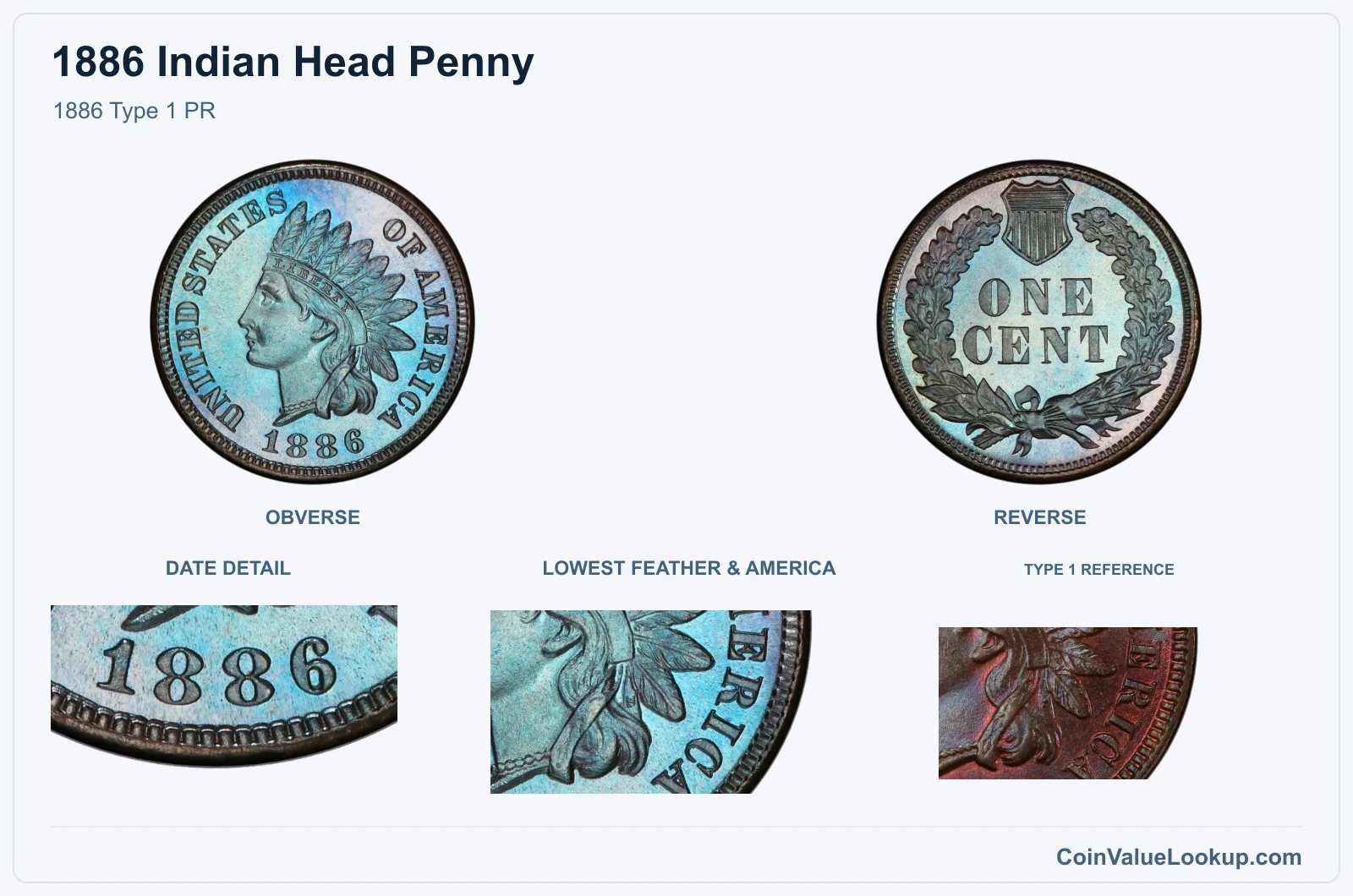
Proof Type 1 coins were produced for collectors at the Philadelphia Mint using polished dies and carefully prepared planchets. The result is fully mirrored fields and sharp design detail that differs visibly from even a pristine business strike.
Rim geometry on proofs is typically squared and precise.
USA Coin Book lists the Type 1 Proof at about $376 in PR63. Verify proof surfaces before assuming you have one.
A business strike that has been polished or dipped will not have the consistent, deep mirror reflectivity or the squared rims of a genuine proof. Professional certification is the safest confirmation.
| Range | Grade | Price | Auction Records | Appraisal |
|---|---|---|---|---|
| PR | PR 1 | — | Coin Identifier | |
| PR 2 | — | Coin Identifier | ||
| PR 3 | — | Coin Identifier | ||
| PR 4 | — | Coin Identifier | ||
| PR 6 | — | Coin Identifier | ||
| PR 8 | — | Coin Identifier | ||
| PR 10 | — | Coin Identifier | ||
| PR 12 | — | Coin Identifier | ||
| PR 15 | — | Coin Identifier | ||
| PR 20 | — | Coin Identifier | ||
| PR 25 | — | Coin Identifier | ||
| PR 30 | — | Coin Identifier | ||
| PR 35 | — | Coin Identifier | ||
| PR 40 | — | Coin Identifier | ||
| PR 45 | — | Coin Identifier | ||
| PR 50 | — | Coin Identifier | ||
| PR 53 | — | Coin Identifier | ||
| PR 55 | — | Coin Identifier | ||
| PR 58 | — | Coin Identifier | ||
| PR 60 | — | Coin Identifier | ||
| PR 61 | — | Coin Identifier | ||
| PR 62 | Coin Identifier | |||
| PR 63 | Coin Identifier | |||
| PR 64 | Coin Identifier | |||
| PR 65 | Coin Identifier | |||
| PR 66 | Coin Identifier | |||
| PR 67 | Coin Identifier | |||
| PR 68 | Coin Identifier | |||
| PR 69 | — | — | — | |
| PR 70 | — | — | — |
1886 Indian Head Penny — Type 2 PR
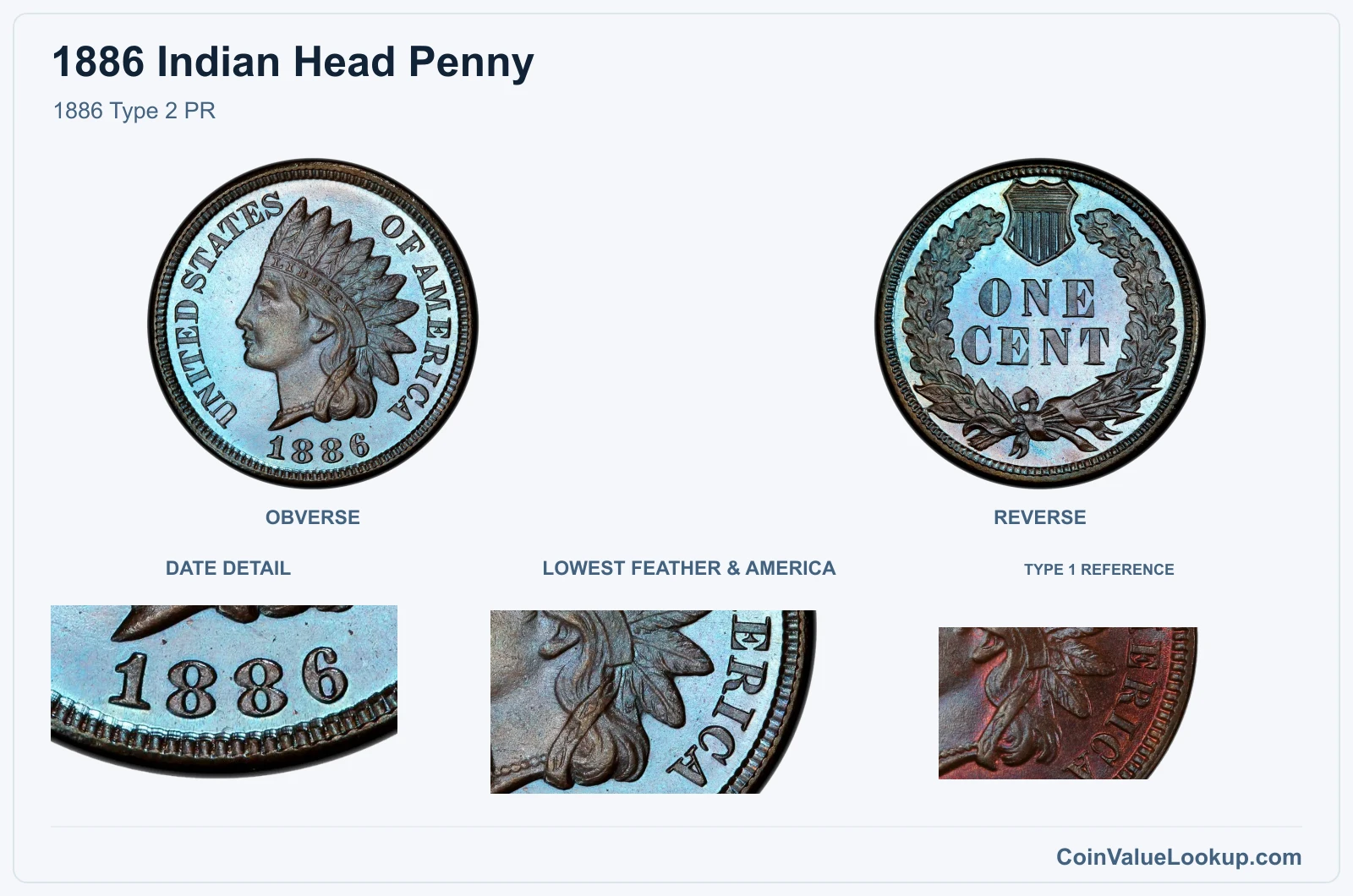
The Proof Type 2 combines the revised hub, where the lowest feather points between C and A, with proof manufacturing techniques. It is the scarcest regular configuration for the 1886 Indian cent.
USA Coin Book places the Type 2 Proof at about $612 in PR63, well above the Type 1 Proof at the same grade. As with any proof, look for squared rims, fully mirrored fields, and crisp device edges that business strikes rarely match.
A polished circulated coin is not a proof no matter how shiny it looks. If you suspect you have a proof Type 2, professional authentication is worth the cost given the value difference.
| Range | Grade | Price | Auction Records | Appraisal |
|---|---|---|---|---|
| PR | PR 1 | — | Coin Identifier | |
| PR 2 | — | Coin Identifier | ||
| PR 3 | — | Coin Identifier | ||
| PR 4 | — | Coin Identifier | ||
| PR 6 | — | Coin Identifier | ||
| PR 8 | — | Coin Identifier | ||
| PR 10 | — | Coin Identifier | ||
| PR 12 | — | Coin Identifier | ||
| PR 15 | — | Coin Identifier | ||
| PR 20 | — | Coin Identifier | ||
| PR 25 | — | Coin Identifier | ||
| PR 30 | — | Coin Identifier | ||
| PR 35 | — | Coin Identifier | ||
| PR 40 | — | Coin Identifier | ||
| PR 45 | — | Coin Identifier | ||
| PR 50 | — | Coin Identifier | ||
| PR 53 | — | Coin Identifier | ||
| PR 55 | — | Coin Identifier | ||
| PR 58 | — | Coin Identifier | ||
| PR 60 | — | Coin Identifier | ||
| PR 61 | — | Coin Identifier | ||
| PR 62 | Coin Identifier | |||
| PR 63 | Coin Identifier | |||
| PR 64 | Coin Identifier | |||
| PR 65 | Coin Identifier | |||
| PR 66 | Coin Identifier | |||
| PR 67 | Coin Identifier | |||
| PR 68 | — | — | — | |
| PR 69 | — | — | — | |
| PR 70 | — | — | — |
1886 Indian Head Penny Error List
1. 1886 Indian Head Penny — Repunched Date
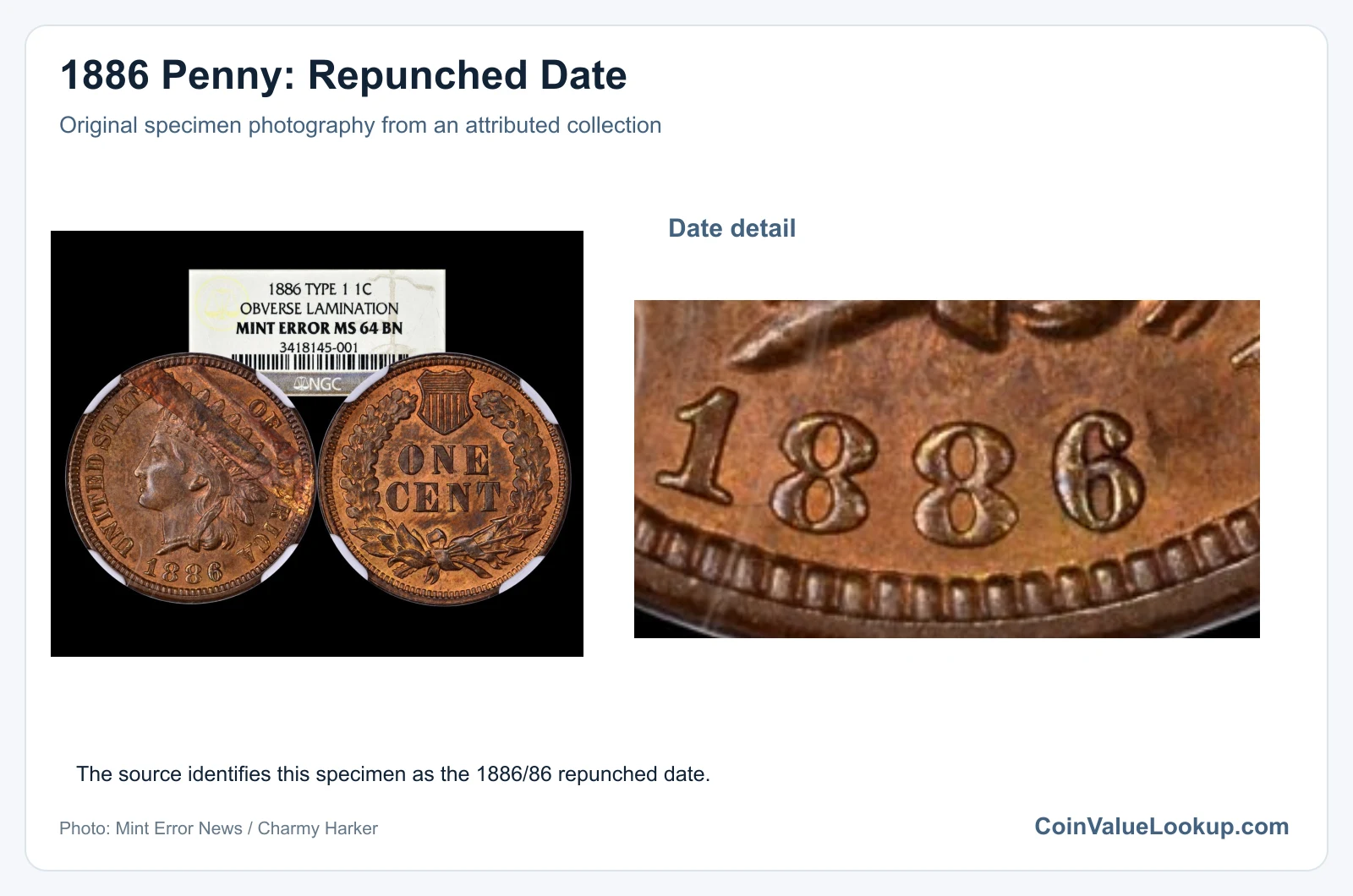
A repunched date on the 1886 Indian Head cent shows remnants of an earlier position of one or more date numerals beside the final, correctly placed digits. The Mint hand-punched date numerals into working dies, and occasionally the first impression landed slightly off, requiring a correction punch.
The leftover traces of that first strike are the diagnostic.
Look closely at each digit in 1886 with magnification. You may see a ghost outline, a thickened serif, or a secondary digit edge peeking out from behind the final number.
This is different from doubling of the entire design, which involves the hub rather than a hand punch.
Damaged dates and machine doubling can mimic a repunched date. Machine doubling produces flat, shelf-like distortion, while a genuine repunch shows a rounded secondary impression.
No specific price range is adopted here; value depends on the individual coin's authenticated identity, the severity and visibility of the repunch, and overall condition.
2. 1886 Indian Head Penny — Misplaced Date
A misplaced date occurs when partial impressions of date digits appear away from the normal date position, often embedded in the denticles along the rim or partially hidden near the portrait. This happened when the punch slipped or was initially placed in the wrong spot, leaving a fragmentary numeral in an unexpected location.
To identify one, examine the denticles and the area near the bust truncation under magnification. You are looking for shapes that clearly match part of a numeral, such as a curved top of an 8 or a straight segment of a 1.
Compare what you see to reference photographs of confirmed examples.
Die chips, random scratches, and small bumps can fool you. The key distinction is whether the mark has the precise geometry of an actual digit.
No supported price range is adopted; value depends on authenticated identity, the clarity of the misplaced digit, and the coin's condition.
3. 1886 Indian Head Penny — Die Crack
Die cracks on the 1886 Indian cent appear as thin, raised lines running across the coin's field or through design elements. They formed when a working die developed a fracture from repeated striking pressure.
Because the crack is a gap in the die face, metal flows into it during striking, producing a raised line on the finished coin.
To document a die crack, note exactly where the line begins and ends. Some run from the rim through a letter; others cross the portrait or wreath.
Severity ranges from a faint hairline to a heavy cud-style break at the rim.
Do not confuse a die crack with an incuse scratch, which is pressed into the surface rather than raised above it. Corrosion lines and displaced-metal scrapes also sit differently under magnification.
No specific price range is adopted for die cracks on this date; value depends on the crack's size, location, visual appeal, and the coin's authenticated condition.