1967 Jefferson Nickel Coin Value: How Much Is It Worth?
The 1967 Jefferson nickel is one of those coins sitting in almost every junk jar in America. Most circulated examples are worth face value or close to it.
Uncirculated pieces carry modest premiums, with guide estimates around $0.30 at MS60 and up to $6.25 at MS65. Special Mint Set specimens and certain mint errors are where things get more interesting.
Fast Way to Identify Your 1967 Jefferson Nickel
Want a quick read on what you have? Upload clear photos of both the front and back of your 1967 nickel.
Our identifier can give you a preliminary identification based on finish, visible features, and overall condition. It is not a substitute for professional authentication, but it is a solid starting point.
1967 Jefferson Nickel Value
Upload both sides of your 1967 Jefferson Nickel.
Front Obverse
Upload photo
Back Reverse
Upload photo
Which 1967 Jefferson Nickel Versions Are Worth Money?
- Uncirculated business strikes graded MS65 carry a guide value around $6.25, with Full Steps designations commanding additional premiums that require separate assessment.
- SMS Special Strike specimens, especially those with professionally attributed cameo contrast, are a distinct collector finish valued separately from ordinary strikes.
- A 1967 nickel struck on a cent planchet sold through Heritage Auctions in August 2010 for $1,725 in NGC MS66 Red condition.
- A cud die break variety graded PCGS MS64 brought $1,200 at a Heritage auction in March 2021.
- Doubled die obverse and doubled die reverse varieties have been cataloged for this year and may carry premiums depending on visibility and condition.
Step 1: Identify Your 1967 Jefferson Nickel Mint Mark and Version
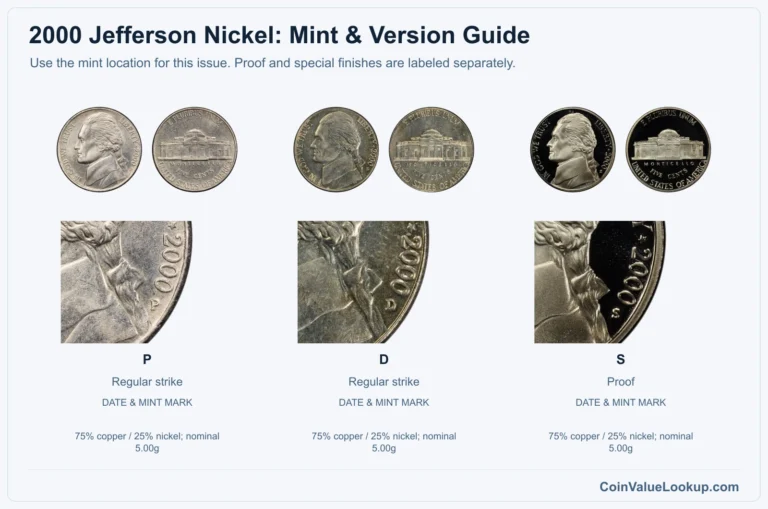
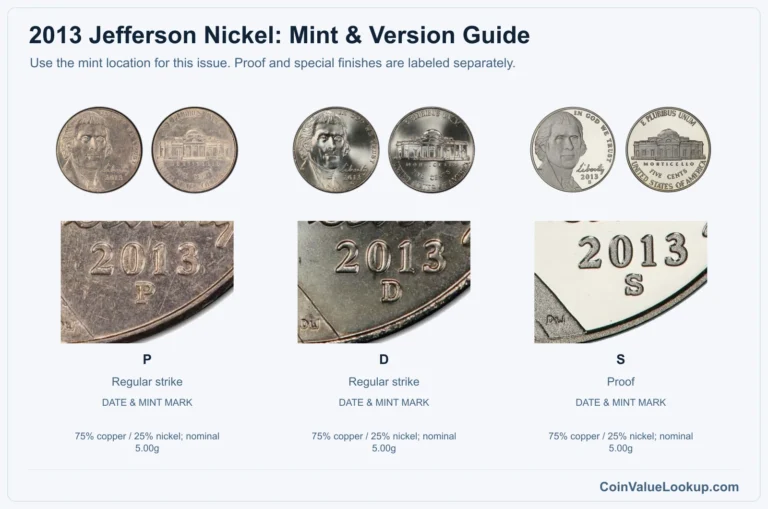
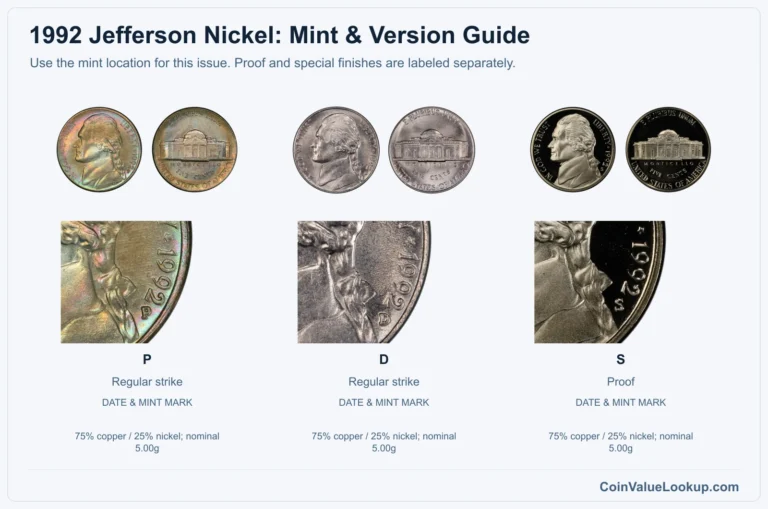
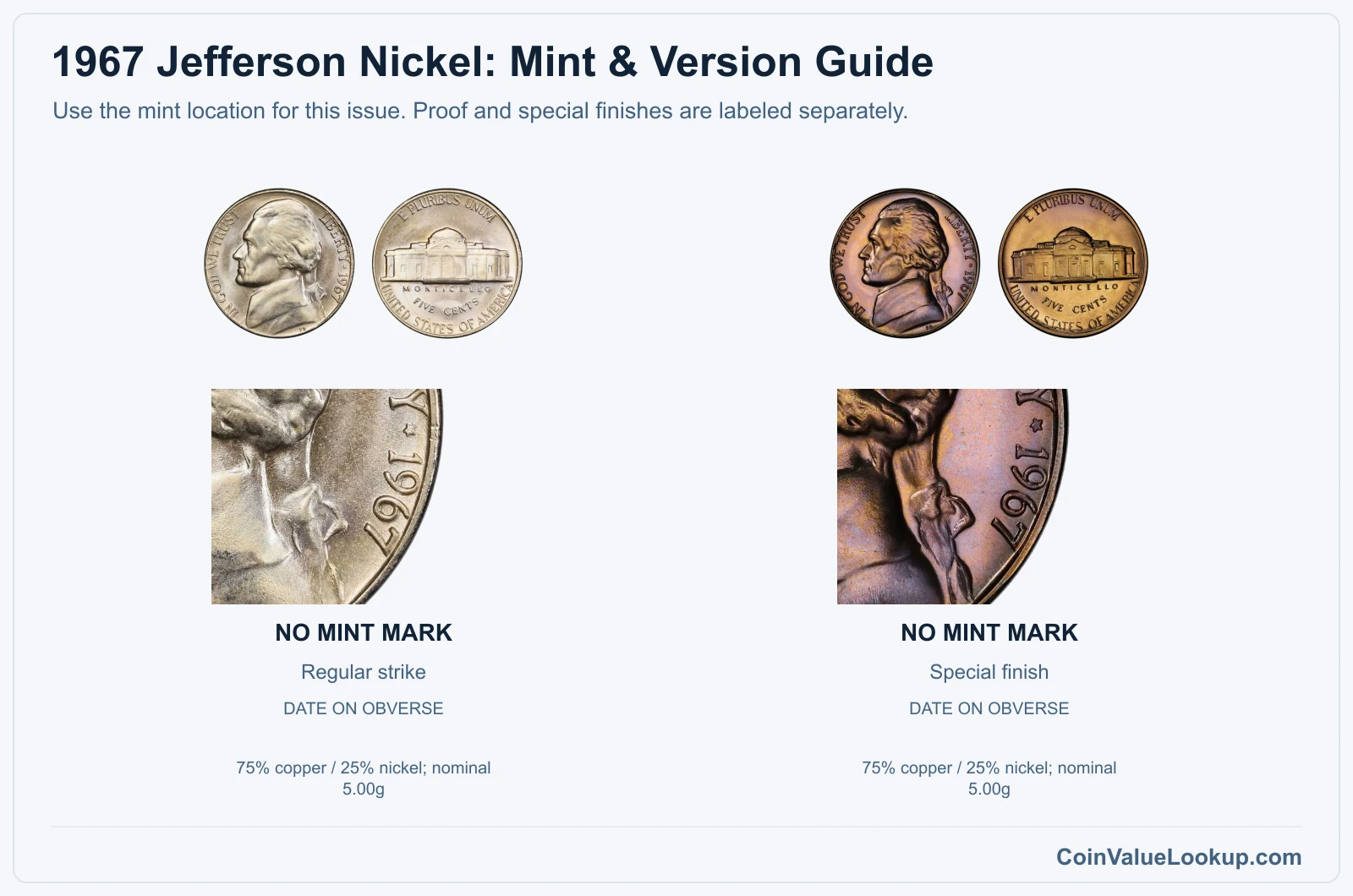
In 1967, the U.S. Mint suppressed mintmarks on all coins. That means the absence of a mintmark on your nickel is completely normal and does not tell you which facility struck it.
Do not assume Philadelphia just because there is no letter.
There are two main branches to sort out. The first is the ordinary business strike, produced for general circulation.
The second is the Special Mint Set (SMS) specimen, struck at San Francisco with better preparation than a regular coin but not classified as a standard proof.
SMS coins tend to show sharper design details and a distinctive satin or brilliant finish compared to the softer luster of a business strike. Some SMS nickels received a cameo designation from grading services, meaning frosted devices against mirror-like fields.
That designation requires professional attribution.
The coin itself is 75% copper and 25% nickel, weighs about 5.00 grams, measures 21.2 mm across, and has a plain edge. Weighing your coin can help screen for wrong-planchet errors but cannot authenticate one on its own.
Record the date, note the finish, and photograph both sides before looking up values.
Step 2: Check Your 1967 Jefferson Nickel Grade
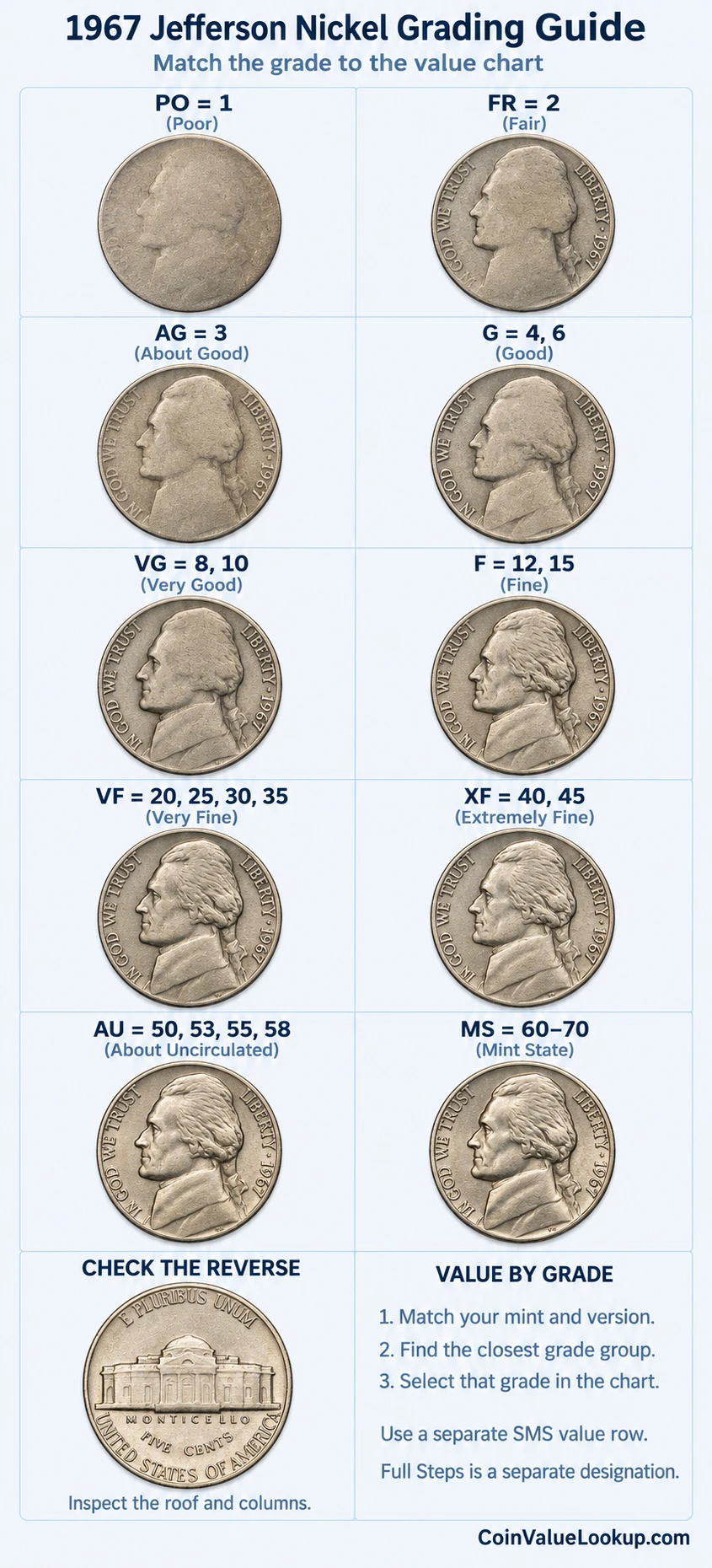
Start with Jefferson's cheek and the hair above his ear. On a well-struck uncirculated coin, you will see full, rounded detail with original mint luster intact.
As the coin wears, the cheek flattens first, then the hair strands merge together.
Flip it over and check Monticello. The roof lines and the four columns are your supporting evidence.
Columns that blur into each other and a roof that loses its triangular sharpness signal moderate to heavy wear.
Do not confuse a weak strike with actual circulation wear. Some 1967 nickels left the press with mushy details, especially on Monticello's steps.
Full Steps is a separate strike-quality designation applied only to Mint State coins where the steps on Monticello are uninterrupted. A shiny surface alone does not guarantee a high grade.
Use the comparison image to match your coin's wear pattern against known grade benchmarks. That side-by-side approach beats guessing every time.
Step 3: Check 1967 Jefferson Nickel Value by Mint and Version
1967 Jefferson Nickel — No mintmark (facility not inferred) Business strike
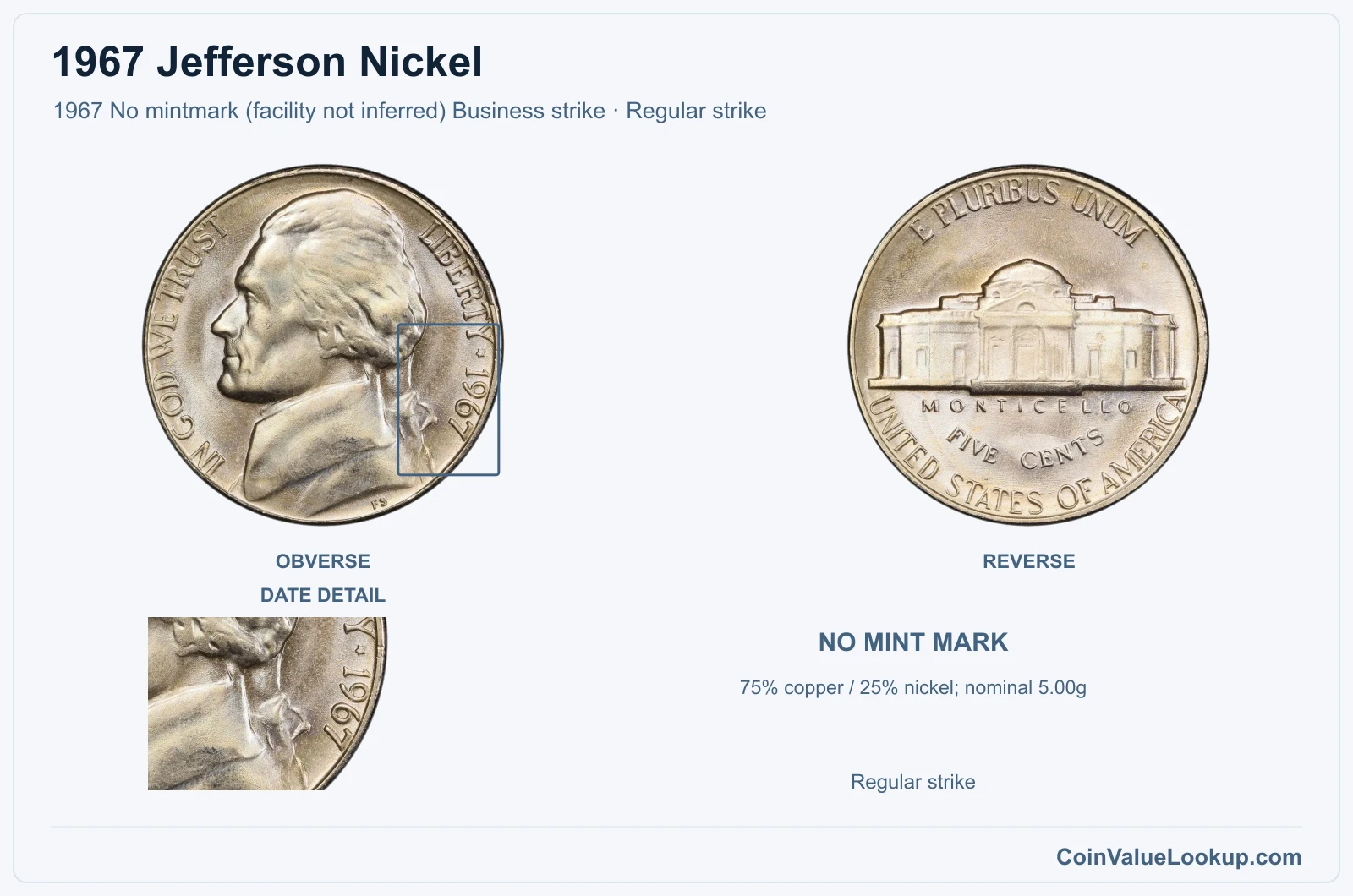
This is the standard 1967 Jefferson nickel you will find in pocket change. It carries the familiar Jefferson portrait on the obverse and Monticello on the reverse, struck in 75% copper and 25% nickel at a nominal weight of 5.00 grams.
No mintmark appears on the coin, and that is expected. Business strikes from this year cannot be attributed to a specific mint facility based on appearance alone.
Do not confuse a normal business strike with an SMS specimen; the finish and preparation differ.
Guide estimates from USA Coin Book place a business strike at roughly $0.30 in MS60 condition and about $6.25 at MS65. Circulated examples are generally worth face value.
Full Steps coins, where Monticello's steps are sharply defined without interruption, trade at separate premiums that depend on the specific grade.
| Range | Grade | Price | Auction Records | Appraisal |
|---|---|---|---|---|
| PO | PO 1 | — | Coin Identifier | |
| FR | FR 2 | — | Coin Identifier | |
| AG | AG 3 | — | Coin Identifier | |
| G | G 4 | — | Coin Identifier | |
| G 6 | — | Coin Identifier | ||
| VG | VG 8 | — | Coin Identifier | |
| VG 10 | — | Coin Identifier | ||
| F | F 12 | — | Coin Identifier | |
| F 15 | — | Coin Identifier | ||
| VF | VF 20 | — | Coin Identifier | |
| VF 25 | — | Coin Identifier | ||
| VF 30 | — | Coin Identifier | ||
| VF 35 | — | Coin Identifier | ||
| XF | XF 40 | — | Coin Identifier | |
| XF 45 | — | Coin Identifier | ||
| AU | AU 50 | — | Coin Identifier | |
| AU 53 | — | Coin Identifier | ||
| AU 55 | — | Coin Identifier | ||
| AU 58 | — | Coin Identifier | ||
| MS | MS 60 | — | Coin Identifier | |
| MS 61 | — | Coin Identifier | ||
| MS 62 | — | Coin Identifier | ||
| MS 63 | — | Coin Identifier | ||
| MS 64 | Coin Identifier | |||
| MS 65 | Coin Identifier | |||
| MS 66 | Coin Identifier | |||
| MS 67 | Coin Identifier | |||
| MS 68 | — | — | — | |
| MS 69 | — | — | — | |
| MS 70 | — | — | — |
1967 Jefferson Nickel — San Francisco (no mintmark) SMS Special Strike
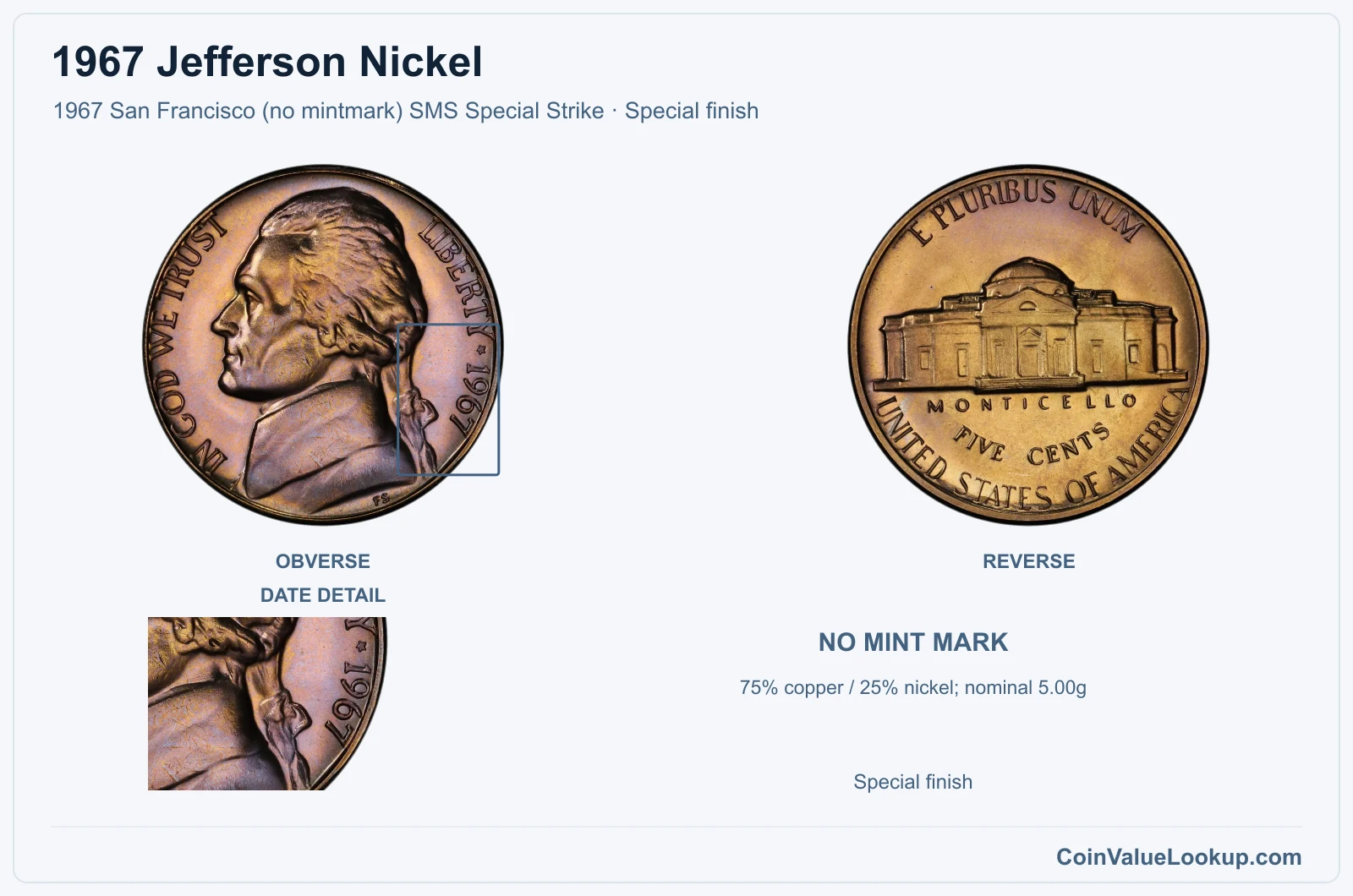
Special Mint Set nickels were produced at the San Francisco Mint despite carrying no mintmark, part of the 1965–1967 program that replaced standard proof sets. These coins received better preparation than ordinary business strikes but are not classified as regular proofs.
SMS specimens typically show a distinctive finish, sometimes satin-like, sometimes closer to brilliant. Cameo and Deep Cameo designations indicate frosted design elements against reflective fields, and those require professional attribution from a grading service.
If you have a 1967 nickel from an original Special Mint Set holder, that is your strongest clue. Loose SMS coins can be harder to distinguish from well-preserved business strikes without experience.
No specific guide price anchor was adopted for ordinary SMS pieces in the data reviewed, so value depends on the individual coin's authenticated identity, condition, and any special designations. Coin Value Lookup is a good place to start exploring guides for different finishes and grades across the Jefferson nickel series.
| Range | Grade | Price | Auction Records | Appraisal |
|---|---|---|---|---|
| SP | SP 1 | — | Coin Identifier | |
| SP 2 | — | Coin Identifier | ||
| SP 3 | — | Coin Identifier | ||
| SP 4 | — | Coin Identifier | ||
| SP 6 | — | Coin Identifier | ||
| SP 8 | — | Coin Identifier | ||
| SP 10 | — | Coin Identifier | ||
| SP 12 | — | Coin Identifier | ||
| SP 15 | — | Coin Identifier | ||
| SP 20 | — | Coin Identifier | ||
| SP 25 | — | Coin Identifier | ||
| SP 30 | — | Coin Identifier | ||
| SP 35 | — | Coin Identifier | ||
| SP 40 | — | Coin Identifier | ||
| SP 45 | — | Coin Identifier | ||
| SP 50 | — | Coin Identifier | ||
| SP 53 | — | Coin Identifier | ||
| SP 55 | — | Coin Identifier | ||
| SP 58 | — | Coin Identifier | ||
| SP 60 | — | Coin Identifier | ||
| SP 61 | — | Coin Identifier | ||
| SP 62 | — | Coin Identifier | ||
| SP 63 | — | Coin Identifier | ||
| SP 64 | — | Coin Identifier | ||
| SP 65 | Coin Identifier | |||
| SP 66 | Coin Identifier | |||
| SP 67 | Coin Identifier | |||
| SP 68 | Coin Identifier | |||
| SP 69 | — | — | — | |
| SP 70 | — | — | — |
1967 Jefferson Nickel Error List
1. 1967 Jefferson Nickel — Struck on a cent planchet
This error occurs when a copper Lincoln cent planchet accidentally feeds into the nickel press. The result is a cent-sized coin, weighing roughly 3.1 grams instead of the usual 5.0 grams, bearing the Jefferson nickel design.
Legends appear cropped and stretched because the smaller blank cannot accommodate the full die impression.
Check the edge carefully. It should show copper, not the usual nickel alloy.
Weigh the coin if possible. Be cautious with lookalikes: copper plating, chemical toning, or a nickel that has been physically ground down can all mimic the appearance.
A Heritage Auctions example graded NGC MS66 Red, weighing 3.1 grams, sold in August 2010 for $1,725. That price reflects one authenticated specimen in a specific high grade, not a blanket value for every suspicious-looking piece.
2. 1967 Jefferson Nickel — Cud die break
A cud die break shows up as a raised, featureless blob connected to the rim. On the documented 1967 example, the cud appears at the 12 o'clock position, recording a chunk of the die that broke away during production.
The displaced metal fills the gap, leaving a smooth lump rather than normal design detail.
Do not mistake an incuse gouge, a bit of glued metal, or rim corrosion for a genuine cud. A real cud is raised, roughly uniform, and always touches the rim.
Photograph the entire coin first, then magnify the feature.
A Heritage Auctions specimen graded PCGS MS64, showing the 12 o'clock cud, sold in March 2021 for $1,200. Size, location, and grade all influence what a cud error brings at auction.
3. 1967 Jefferson Nickel — Incomplete and curved clip
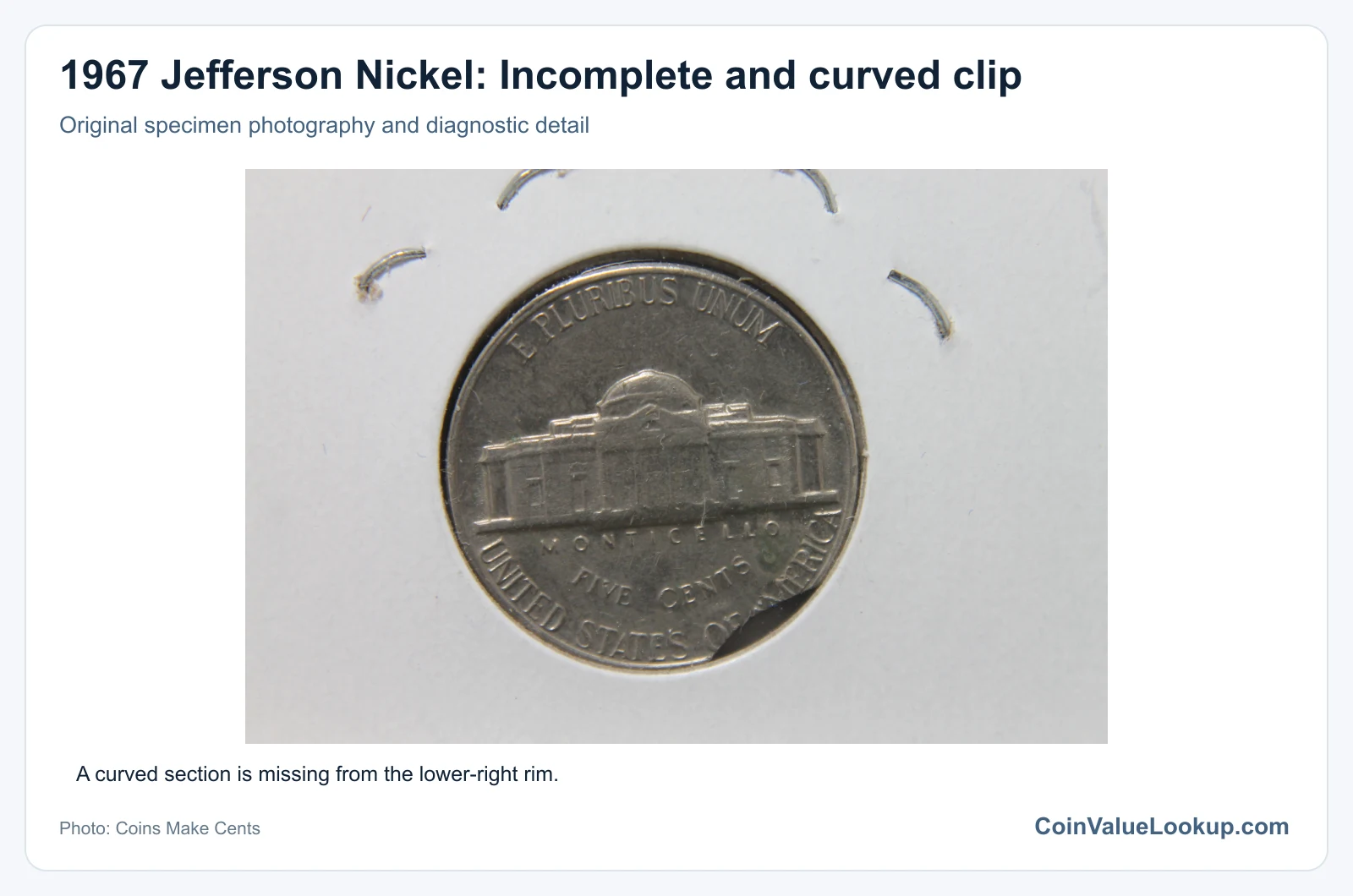
A curved clip results from a blanking error where the punch overlaps a previously cut area or misses part of the metal strip. The coin ends up with a crescent-shaped shortage along the rim, and the strike may show metal flow distortion near the missing area.
Look closely at the rim and edge transitions around the clip. Genuine clips often show a characteristic Blakesley effect, a weak area of the rim opposite the clip.
A simple crescent shape alone is not enough to confirm the error.
Pliers damage, sawing, or post-mint edge breakage can look similar but lack the consistent strike-flow evidence of a genuine incomplete planchet. A Heritage Auctions example graded NGC MS66 with a curved clip at the 12:30 position sold in August 2010 for $230.
4. 1967 Jefferson Nickel — Struck on a dime planchet
When a dime-sized planchet ends up in the nickel press, the result is a noticeably thin, undersized coin carrying a partial Jefferson nickel design. The documented example weighs just 2.20 grams, well under the standard 5.0-gram nickel weight, and was graded NGC AU58.
The date must clearly read 1967 to confirm it is a nickel die impression and not simply a damaged dime. Do not assume silver content from a pale surface; the 1967 dime planchet is copper-nickel clad.
A normal nickel with a damaged or filed-down edge is the main lookalike. Check for proportional design reduction and consistent edge characteristics rather than post-mint tooling marks.
No specific price range was adopted for this error, so value depends on the individual coin's authenticated identity, condition, and severity of the off-metal impression.
5. 1967 Jefferson Nickel — Doubled Die Reverse
A Doubled Die Reverse variety has been cataloged for the 1967 nickel. This type of error shows consistent doubling on reverse design elements, such as letters in MONTICELLO or E PLURIBUS UNUM, visible as separation, notching, or thickening when compared to a normal coin.
Examine your coin's reverse legends and architectural details under good magnification and even lighting. The doubling should appear consistent across affected areas, not random or one-sided.
Machine doubling is the most common lookalike. It tends to produce a flat, shelf-like displacement rather than the rounded, separated profiles of a true doubled die.
Reflections and photographic artifacts can also fool you. No specific price was adopted for this variety, so value depends on the visibility of the doubling, overall condition, and professional attribution.
6. 1967 Jefferson Nickel — Doubled Die Obverse
A Doubled Die Obverse variety has also been cataloged for the 1967 nickel. This error appears on the front of the coin, potentially affecting lettering such as IN GOD WE TRUST, LIBERTY, or the date, as well as design contours around Jefferson's portrait.
Compare your coin's obverse lettering to a known normal example under matching lighting. Look for consistent separation or notching in the affected letters rather than a flat shelf of displaced metal.
Machine doubling is again the primary lookalike. It leaves a flat, directional smear that differs from the distinct, raised profiles of genuine hub doubling.
Worn die contours can also create misleading effects. No numerical price was adopted for this variety; value hinges on the specific variety's identity, how visible the doubling is, and the coin's overall condition as confirmed by a grading service.