1923 Mercury Dime Coin Value: How Much Is It Worth?
A 1923 Mercury Dime in well-worn Good-4 condition carries a guide value around $7.16, while gem Mint State examples can reach much higher — up to roughly $166 for a Philadelphia coin or about $1,526 for a San Francisco strike in MS65, according to USA Coin Book estimates. Only two mints produced dimes this year: Philadelphia and San Francisco.
No Denver issue exists for 1923, so if you see a D mintmark, look again carefully. Full Bands designations and identified errors each deserve their own exact comparisons beyond these baseline figures.
Fast Way to Identify Your 1923 Mercury Dime
Snap clear photos of both sides of your 1923 dime and upload them here for a preliminary identification. The tool can help you spot whether you have a Philadelphia or San Francisco issue based on the mintmark location, and flag visual clues worth investigating further.
It is not a substitute for professional authentication or precise grading, but it is a solid first step.
1923 Mercury Dime Value
Upload both sides of your 1923 Mercury Dime.
Front Obverse
Upload photo
Back Reverse
Upload photo
Which 1923 Mercury Dime Versions Are Worth Money?
- Only Philadelphia (no mintmark) and San Francisco (S) versions exist for 1923 — no Denver issue was produced.
- San Francisco strikes in high Mint State grades command significantly higher guide values than their Philadelphia counterparts at the same grade.
- A 1923-S in MS65 carries a USA Coin Book estimate around $1,526, compared to roughly $166 for a Philadelphia MS65.
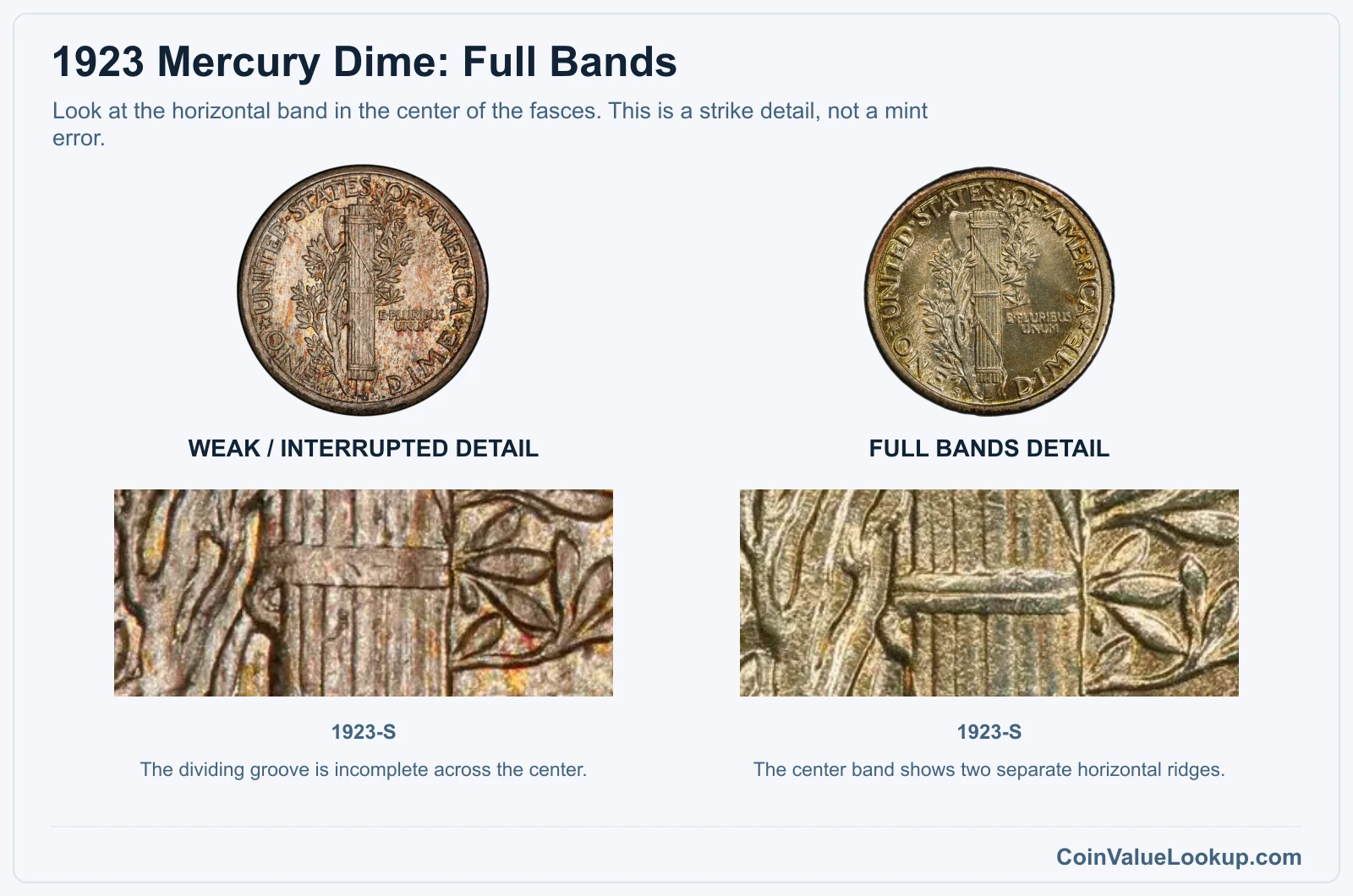
- Full Bands examples — where the central fasces bands are fully separated — can attract additional premiums beyond standard Mint State pricing.
- Confirmed mint errors such as off-center strikes, laminations, or broadstrikes on a 1923 dime are uncommon and worth professional evaluation.
Step 1: Identify Your 1923 Mercury Dime Mint Mark and Version
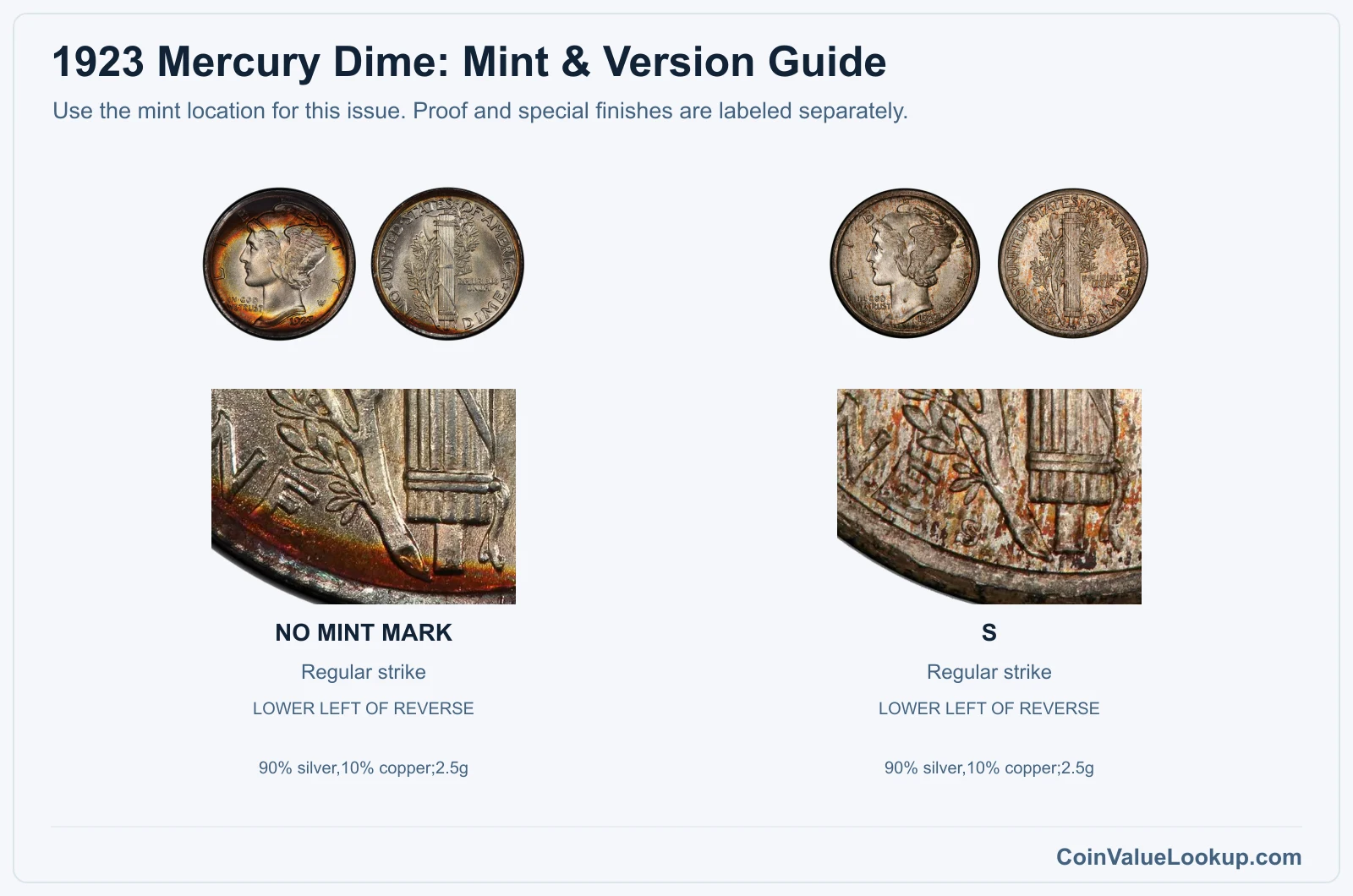
The 1923 Mercury Dime came from just two mints. Philadelphia coins carry no mintmark at all.
San Francisco coins show a small "S" on the reverse, at the lower left near the word ONE.
Don't confuse the "AW" monogram on the obverse with a mintmark — those are designer Adolph Weinman's initials, and they appear on every Mercury Dime regardless of mint.
All 1923 dimes are struck in 90% silver and 10% copper, weighing about 2.5 grams with a diameter of 17.9 mm. The edge is reeded.
There is no Denver mint version for this date, period. If someone offers you a 1923-D Mercury Dime, that coin does not exist in the regular issue series.
Step 2: Check Your 1923 Mercury Dime Grade
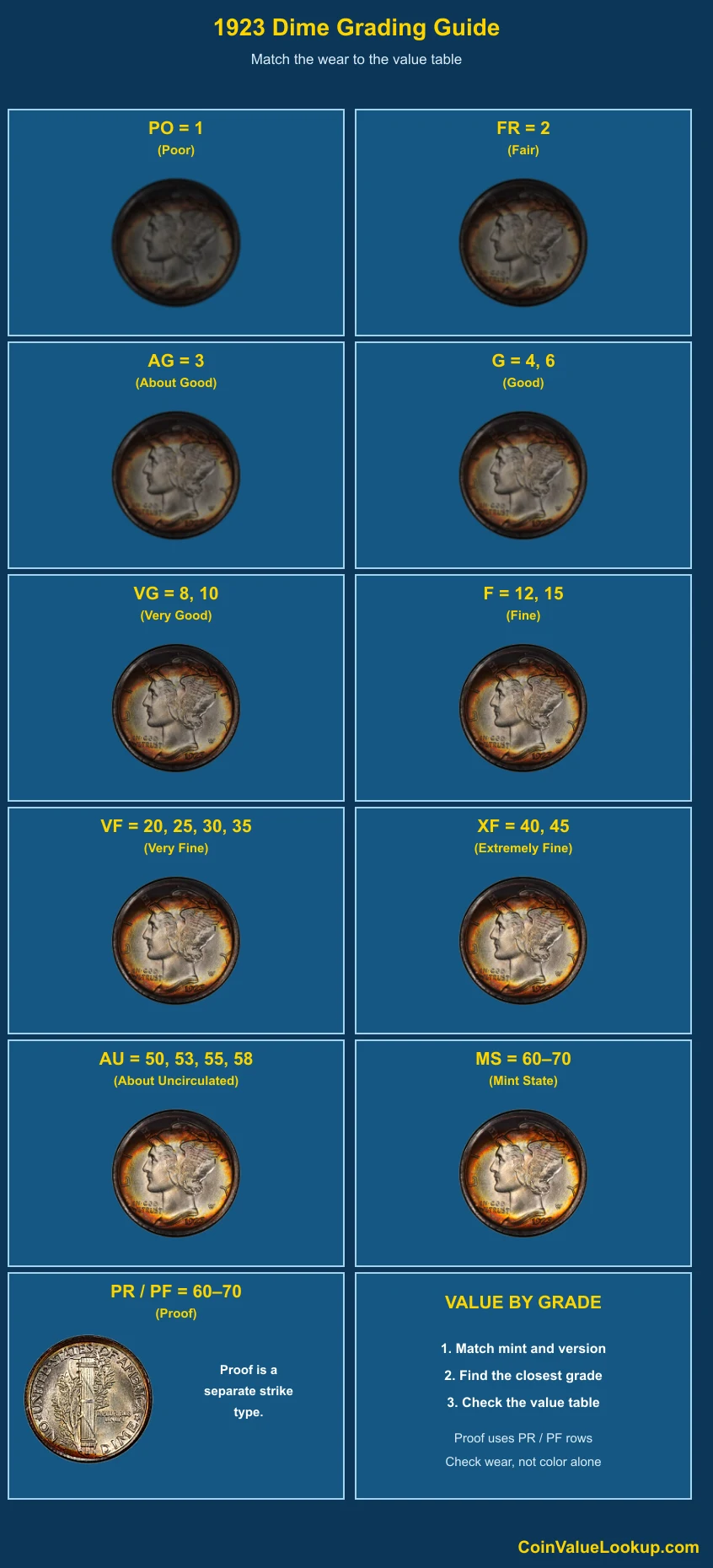
Start by examining Liberty's hair detail above and in front of the ear. On a well-circulated coin, this area wears flat first.
The wing feathers on the cap and the fasces bands on the reverse lose definition next.
Luster matters a lot. An uncirculated coin should show unbroken mint frost across both faces, with contact marks and bag abrasions being normal for lower Mint State grades.
Weak bands on the reverse fasces do not automatically mean wear from circulation — some coins simply received a softer strike at the mint. Full Bands (FB) is a separate designation that NGC and other services evaluate by checking band separation.
Different grading services may apply slightly different criteria for that call.
Use the comparison image to match your coin's wear pattern against known grade benchmarks. Look for cleaning, which often shows as unnatural brightness or hairline scratches under magnification.
Step 3: Check 1923 Mercury Dime Value by Mint and Version
1923 Mercury Dime — No Mint Mark — Silver Circulation
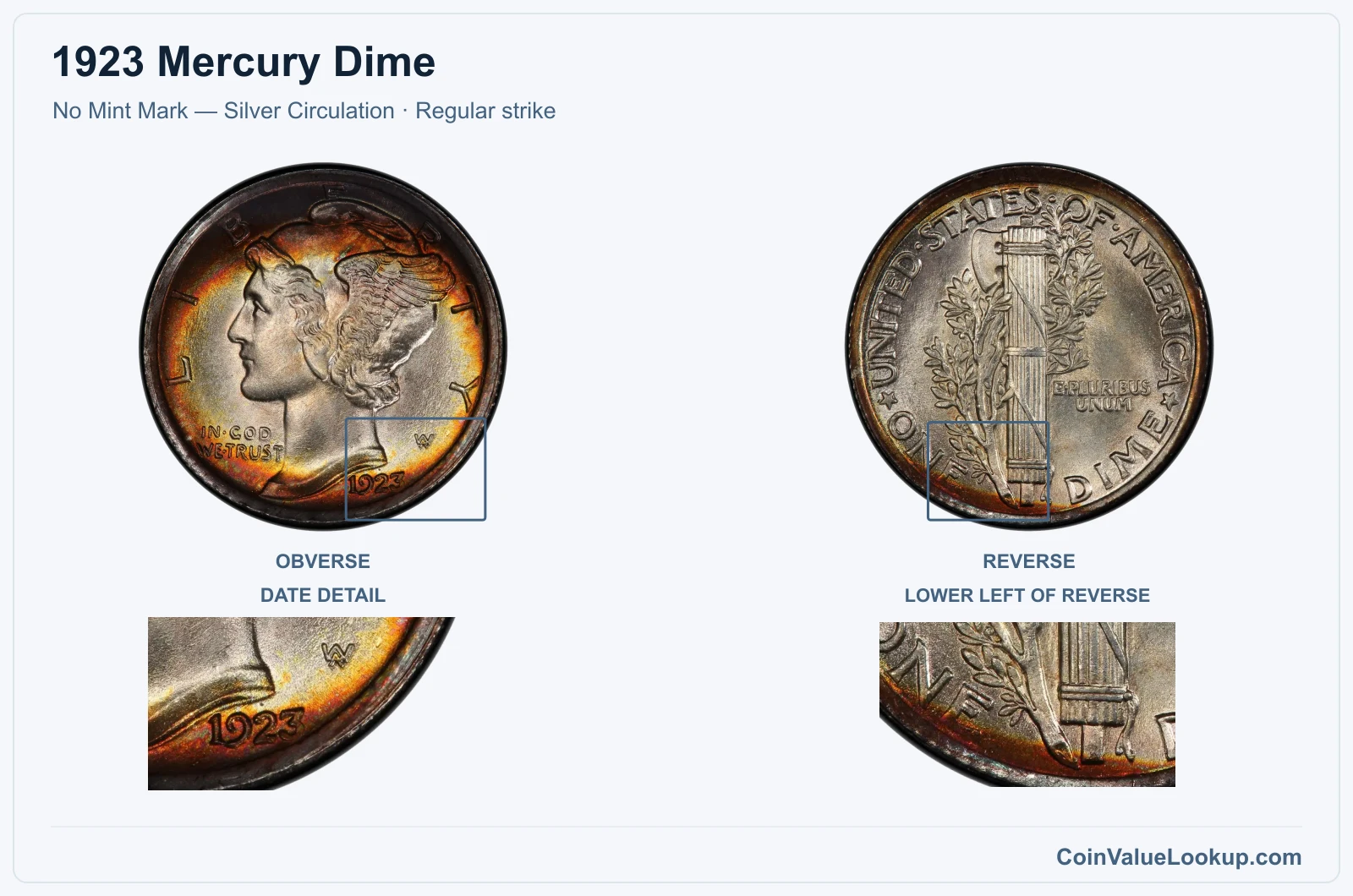
The 1923 Philadelphia dime has no mintmark anywhere on the coin. Look at the lower-left reverse beside ONE — you should see bare metal, nothing stamped there.
USA Coin Book lists a guide estimate of about $7.16 in Good-4, rising to around $166 in MS65 for a regular strike without Full Bands designation.
Philadelphia produced the lion's share of 1923 dimes, so finding one is not difficult. The challenge is condition.
Most surviving examples show heavy wear. A coin with original luster and minimal contact marks in the MS60-plus range is a different animal entirely from the typical pocket-worn specimen.
Coin Value Lookup is a handy starting point if you want to look up guide values for other dates and mints in the Mercury Dime series.
Range Grade
Price Auction Records Appraisal PO PO 1
—
Coin Identifier FR FR 2
—
Coin Identifier AG AG 3
—
Coin Identifier G G 4
—
Coin Identifier
G 6
—
Coin Identifier VG VG 8
—
Coin Identifier
VG 10
—
Coin Identifier F F 12
—
Coin Identifier
F 15
—
Coin Identifier VF VF 20
—
Coin Identifier
VF 25
—
Coin Identifier
VF 30
—
Coin Identifier
VF 35
—
Coin Identifier XF XF 40
—
Coin Identifier
XF 45
—
Coin Identifier AU AU 50
Coin Identifier
AU 53
—
Coin Identifier
AU 55
Coin Identifier
AU 58
Coin Identifier MS MS 60
—
Coin Identifier
MS 61
—
Coin Identifier
MS 62
Coin Identifier
MS 63
Coin Identifier
MS 64
Coin Identifier
MS 65
Coin Identifier
MS 66
Coin Identifier
MS 67
Coin Identifier
MS 68
—
—
—
MS 69
—
—
—
MS 70
—
—
—
1923 Mercury Dime — S — Silver Circulation
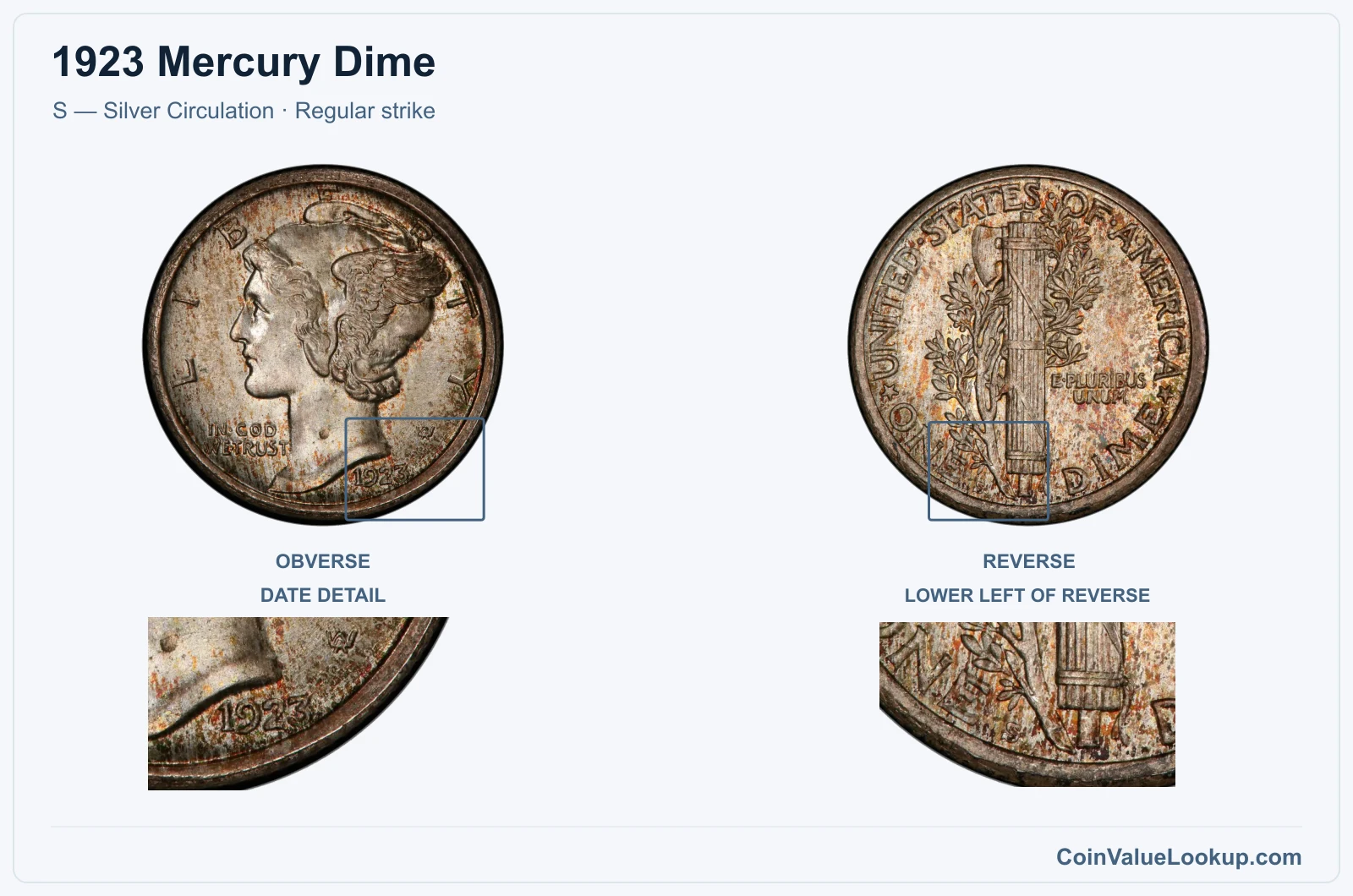
San Francisco dimes carry a small "S" mintmark on the reverse, positioned at the lower left near the denomination. This is the scarcer of the two 1923 issues, and the price gap in upper grades is dramatic.
USA Coin Book estimates about $7.16 in Good-4 — identical to the Philadelphia coin at that worn level — but an MS65 example jumps to roughly $1,526.
That steep climb reflects genuine scarcity in high grades. Many 1923-S dimes saw hard use, so survivors with full luster and sharp detail are tough to locate.
Full Bands coins would warrant their own separate price comparison; do not assume the standard MS65 figure covers an FB example. If your 1923-S looks sharp and has minimal wear, it is worth careful evaluation by a professional grading service.
Range Grade
Price Auction Records Appraisal PO PO 1
—
Coin Identifier FR FR 2
—
Coin Identifier AG AG 3
—
Coin Identifier G G 4
—
Coin Identifier
G 6
—
Coin Identifier VG VG 8
—
Coin Identifier
VG 10
—
Coin Identifier F F 12
Coin Identifier
F 15
—
Coin Identifier VF VF 20
—
Coin Identifier
VF 25
—
Coin Identifier
VF 30
Coin Identifier
VF 35
—
Coin Identifier XF XF 40
Coin Identifier
XF 45
Coin Identifier AU AU 50
Coin Identifier
AU 53
Coin Identifier
AU 55
Coin Identifier
AU 58
Coin Identifier MS MS 60
—
Coin Identifier
MS 61
Coin Identifier
MS 62
Coin Identifier
MS 63
Coin Identifier
MS 64
Coin Identifier
MS 65
Coin Identifier
MS 66
Coin Identifier
MS 67
Coin Identifier
MS 68
—
—
—
MS 69
—
—
—
MS 70
—
—
—
1923 Mercury Dime Error List
1. 1923 Mercury Dime — Off-Center Strike
An off-center strike happens when the planchet is not properly seated between the dies at the moment of striking. The result is a displaced design with a blank crescent of unstruck metal on one side.
On a 1923 dime, the key factor for collectibility is whether the date remains fully visible — without it, identification becomes a problem and value drops sharply.
Don't confuse this with a clipped planchet, which shows a curved bite out of the edge, or with one-sided die misalignment that shifts only the obverse or reverse image. Post-mint damage from being flattened or squeezed can also mimic an off-center look, but the edge profile will differ.
Value depends on the percentage off-center, date visibility, and overall condition. Have it evaluated professionally rather than assuming a price.
2. 1923 Mercury Dime — Lamination / Split Planchet
Lamination errors occur when the metal separates within the planchet itself, producing a peeling flap, a retained sliver, or a visible split in the coin's surface. On a 90% silver dime, this typically appears as a thin layer lifting away from the body of the coin.
Photograph the edge and the affected face together — that combination shows evaluators the depth and nature of the separation. The size, location, and severity all affect how collectors view the piece.
This can look superficially like post-mint scraping, corrosion pitting, or a coin that someone deliberately cut into. The difference is that a genuine lamination follows the metal's internal structure rather than showing tool marks or chemical damage patterns.
No specific price range is established here, so professional assessment is the right next step if you suspect a lamination on your 1923 dime.
3. 1923 Mercury Dime — Broadstrike
A broadstrike occurs when the coin is struck without the retaining collar that normally constrains the planchet's edge, giving the dime its reeded rim and precise diameter. The result is a coin that spreads outward, appearing slightly larger than normal with a smooth or irregular edge instead of the usual reeding.
The full design is still present and centered, which distinguishes a broadstrike from an off-center error where part of the design is missing entirely. Also watch out for coins that were simply flattened after leaving the mint — those show distortion and damage marks rather than the clean metal flow of a genuine broadstrike.
Check the edge carefully. A true broadstrike on a 1923 dime will lack the normal reeded pattern.
Value depends on the coin's condition and how obvious the error is, so professional evaluation is recommended rather than relying on an assumed price.