1798 Draped Bust Dollar Coin Value: How Much Is It Worth?
The 1798 Draped Bust Dollar is one of the earliest silver dollars struck by the United States Mint in Philadelphia. Its value depends on which reverse design it carries, specific date and digit style, overall condition, and whether the surfaces remain original.
This year has an unusually large number of distinct versions — Small Eagle reverses, Heraldic Eagle reverses, and several numeral and design sub-varieties — so pinning down exactly which one you hold is the critical first step.
Fast Way to Identify Your 1798 Draped Bust Dollar
Snap clear photos of both the front and back of your coin and upload them for a preliminary identification. The tool can help narrow down which of the many 1798 varieties you might have based on visual details.
It will not authenticate, grade, or guarantee a price, but it gives you a solid starting point before seeking professional evaluation.
1798 Draped Bust Dollar Value
Upload both sides of your 1798 Draped Bust Dollar.
Front Obverse
Upload photo
Back Reverse
Upload photo
Which 1798 Draped Bust Dollar Versions Are Worth Money?
- The 1798 Small Eagle, 13 Stars and Small Eagle, 15 Stars use the earlier reverse type — the star count on the obverse separates them and each is collected as a distinct variety.
- Heraldic Eagle varieties split into sub-types by the shape of the 9 in the date (Knob vs. Pointed) and the number of vertical lines in the shield (4 vs. 5).
- The 10 Arrows variety has an unusual arrow count in the eagle's talon compared to the standard arrangement, making it a recognized design difference.
- The 5 Stripes variety shows a reduced stripe count on the shield, another distinguishable variation from the normal layout.
- The Wide Date variety is identified by increased spacing between the date numerals, best confirmed by comparing digit gaps to a known normal-date example.
- Authenticated identity, original surfaces, and precise grade drive value for every version — cleaning or damage significantly reduces comparability to guide estimates.
Step 1: Identify Your 1798 Draped Bust Dollar Mint Mark and Version
All 1798 Draped Bust Dollars were struck at the Philadelphia Mint. There is no mintmark to look for.
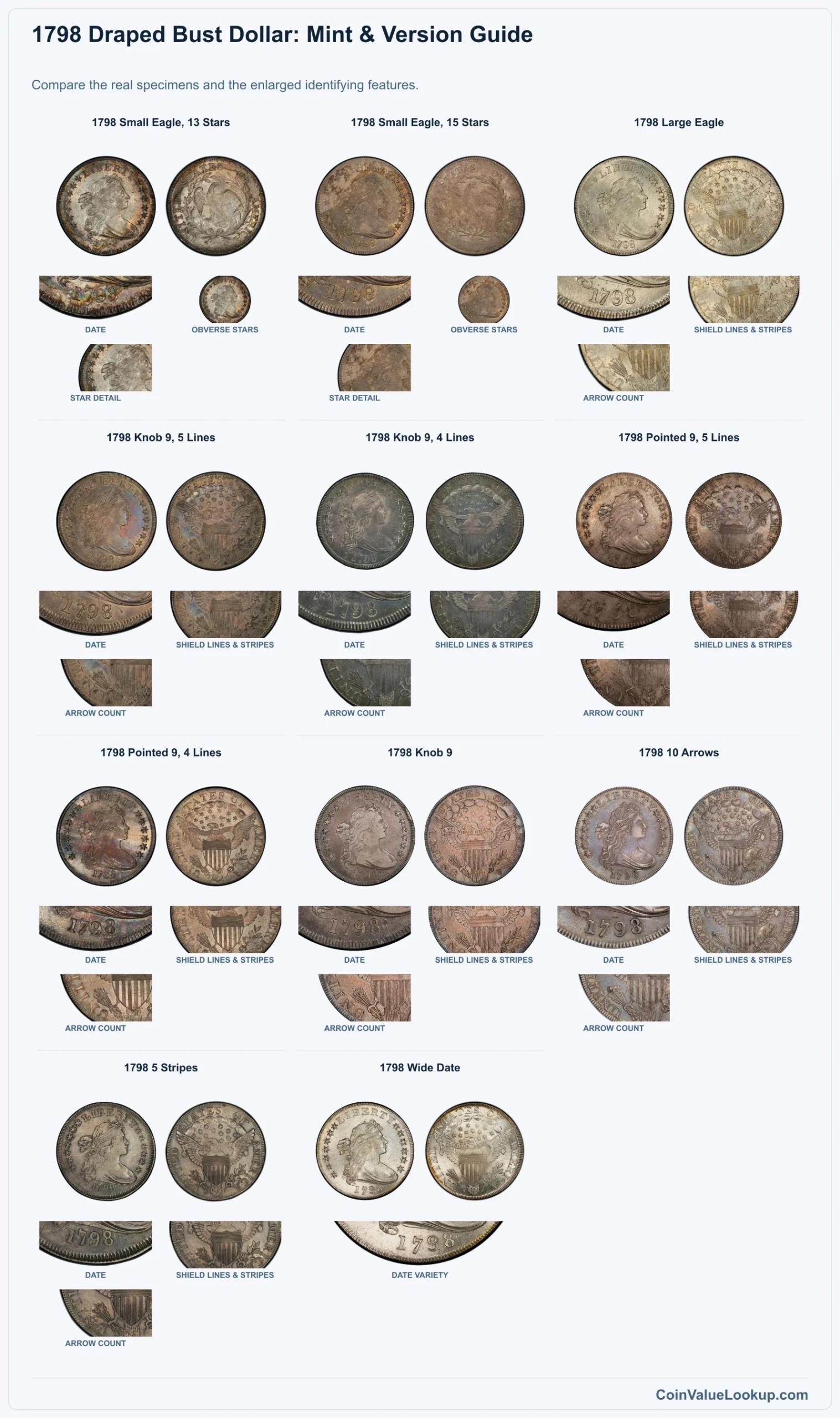
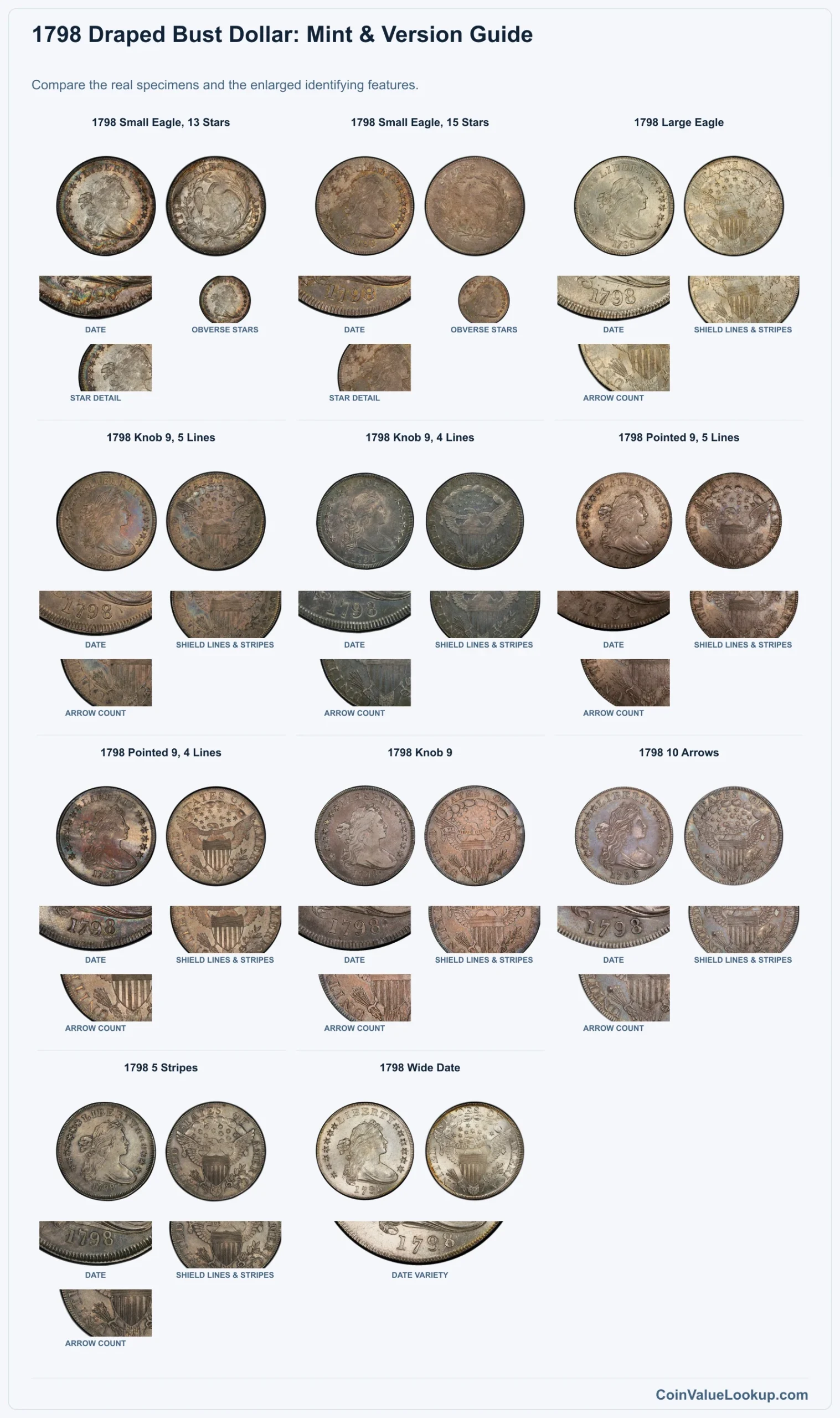
The obverse shows a Draped Bust Liberty facing right. What changes across varieties is the reverse eagle type and specific design elements in the date numerals, star count, arrow count, and stripe arrangement.
First, identify which eagle is on the reverse. The Small Eagle reverse shows a naturalistic eagle perched on a wreath.
The Heraldic Eagle (Large Eagle) reverse depicts an eagle with a shield on its breast, arrows in one talon, and an olive branch in the other.
If your coin has the Small Eagle, count the stars around Liberty. Thirteen stars and fifteen stars are both known for 1798.
If it has the Heraldic Eagle, look closely at the digit "9" in the date — it may have a round knob at the top (Knob 9) or taper to a point (Pointed 9). Then count the vertical lines inside the shield's stripes, the number of arrows in the eagle's talon, the number of stripes on the shield, and check the spacing of the date digits.
These details separate the Knob 9 (5 Lines), Knob 9 (4 Lines), Pointed 9 (5 Lines), Pointed 9 (4 Lines), plain Knob 9, 10 Arrows, 5 Stripes, and Wide Date varieties.
The coin is a silver-copper alloy at the early federal dollar standard, with a nominal weight of 26.96 grams and a lettered edge. If yours is significantly lighter, magnetic, or has visible base metal, it may be a reproduction.
Step 2: Check Your 1798 Draped Bust Dollar Grade
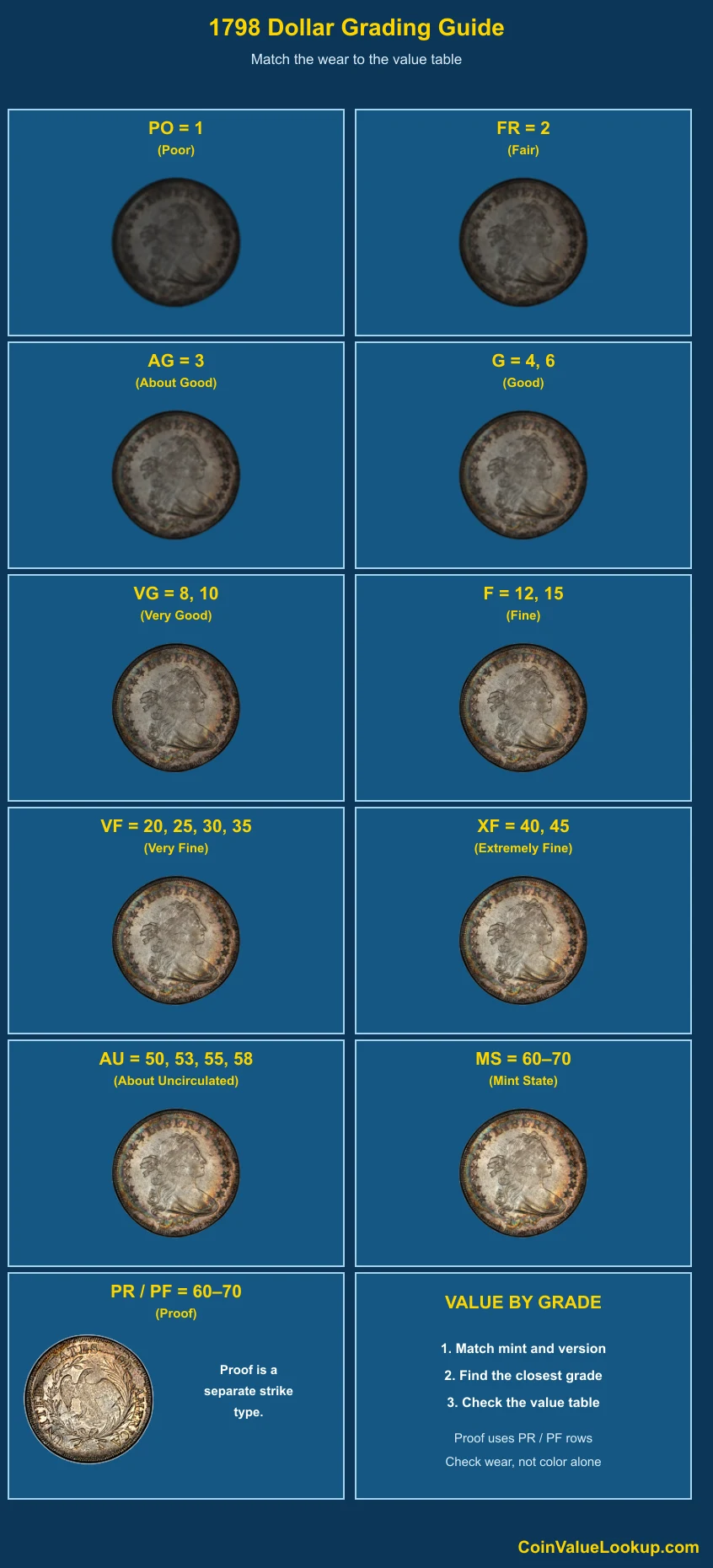
Focus on Liberty's hair above the forehead and around the ear. On a well-circulated coin, the individual strands merge into a flat area; on a lightly worn piece, you can still trace separate curls.
The drapery across Liberty's bust also loses definition early.
On the reverse, the eagle's breast feathers are the first to flatten. For Heraldic Eagle reverses, also check the wing tips and the shield lines.
One tricky thing with early dollars: weak strikes are common. A soft area in the hair or on the eagle does not always mean wear — it can be a strike issue.
Compare your coin to the grading image for this type to see what genuine wear looks like versus original softness.
AU (About Uncirculated) examples will show full luster in the protected areas with only the highest points lightly rubbed. Mint State coins retain complete luster and show no friction, though they may have bag marks from early handling.
Coins that have been cleaned, polished, or artificially toned will grade lower than their apparent wear suggests. Original toning and surfaces matter enormously for this series.
Step 3: Check 1798 Draped Bust Dollar Value by Mint and Version
1798 Draped Bust Dollar — Small Eagle, 13 Stars
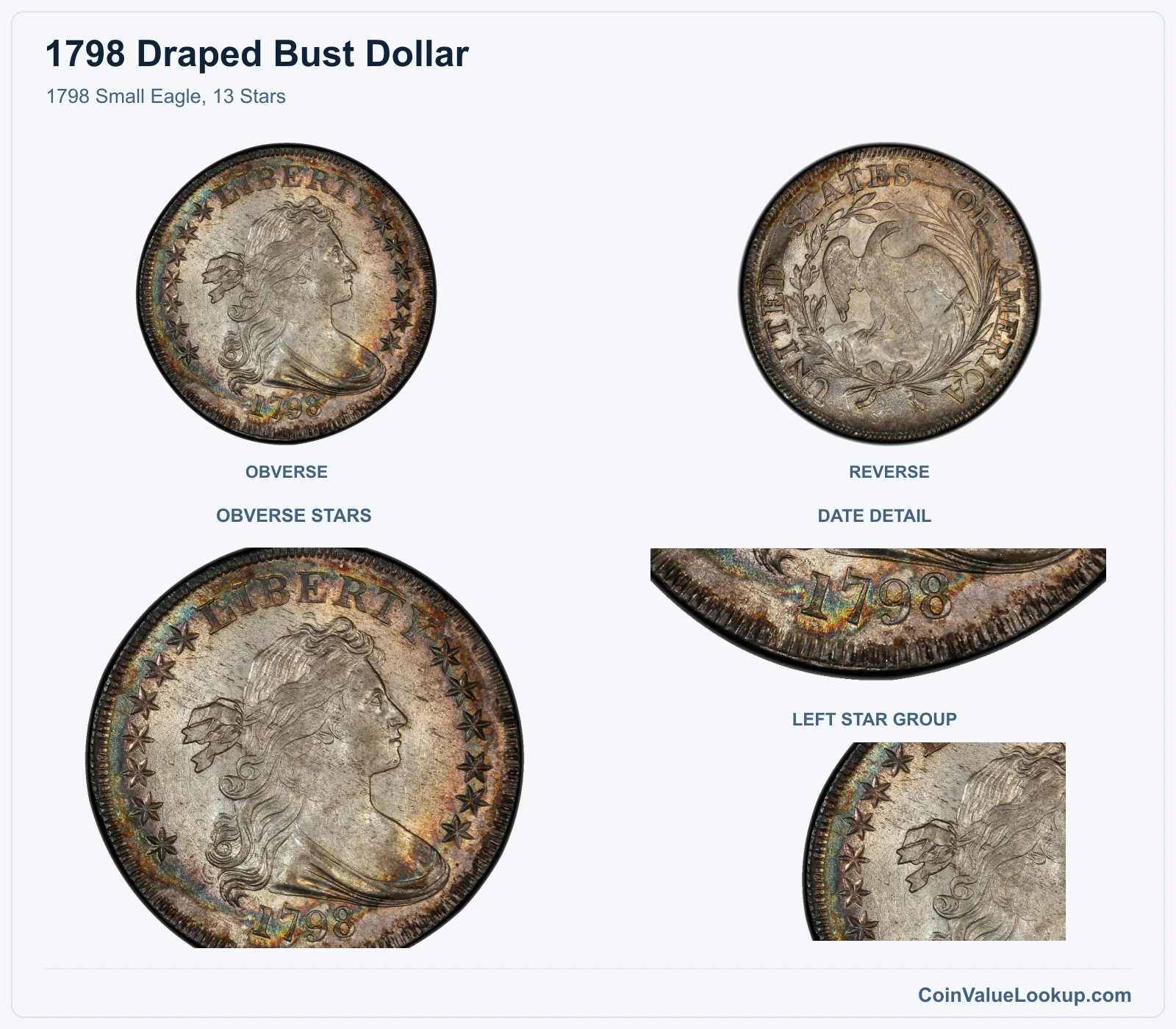
The 1798 Small Eagle, 13 Stars features the older reverse design with a naturalistic eagle perched on a wreath. Count the stars around Liberty — this version has exactly thirteen.
It is a silver-copper alloy coin struck only in Philadelphia, with no mintmark. Because the Mint transitioned to the Heraldic Eagle reverse during 1798, the Small Eagle issues represent the tail end of that earlier design.
Value depends entirely on authenticated identity and condition. Original, uncleared surfaces and a firm grade assignment from a reputable service are essential for an accurate assessment.
Polishing or environmental damage can sharply reduce what a collector will pay.
Range Grade
Price Auction Records Appraisal PO PO 1
—
Coin Identifier FR FR 2
—
Coin Identifier AG AG 3
—
Coin Identifier G G 4
Coin Identifier
G 6
Coin Identifier VG VG 8
—
Coin Identifier
VG 10
Coin Identifier F F 12
Coin Identifier
F 15
Coin Identifier VF VF 20
Coin Identifier
VF 25
Coin Identifier
VF 30
Coin Identifier
VF 35
Coin Identifier XF XF 40
Coin Identifier
XF 45
Coin Identifier AU AU 50
Coin Identifier
AU 53
Coin Identifier
AU 55
Coin Identifier
AU 58
Coin Identifier MS MS 60
—
Coin Identifier
MS 61
—
Coin Identifier
MS 62
—
Coin Identifier
MS 63
Coin Identifier
MS 64
—
—
—
MS 65
—
—
—
MS 66
—
—
—
MS 67
—
—
—
MS 68
—
—
—
MS 69
—
—
—
MS 70
—
—
—
1798 Draped Bust Dollar — Small Eagle, 15 Stars
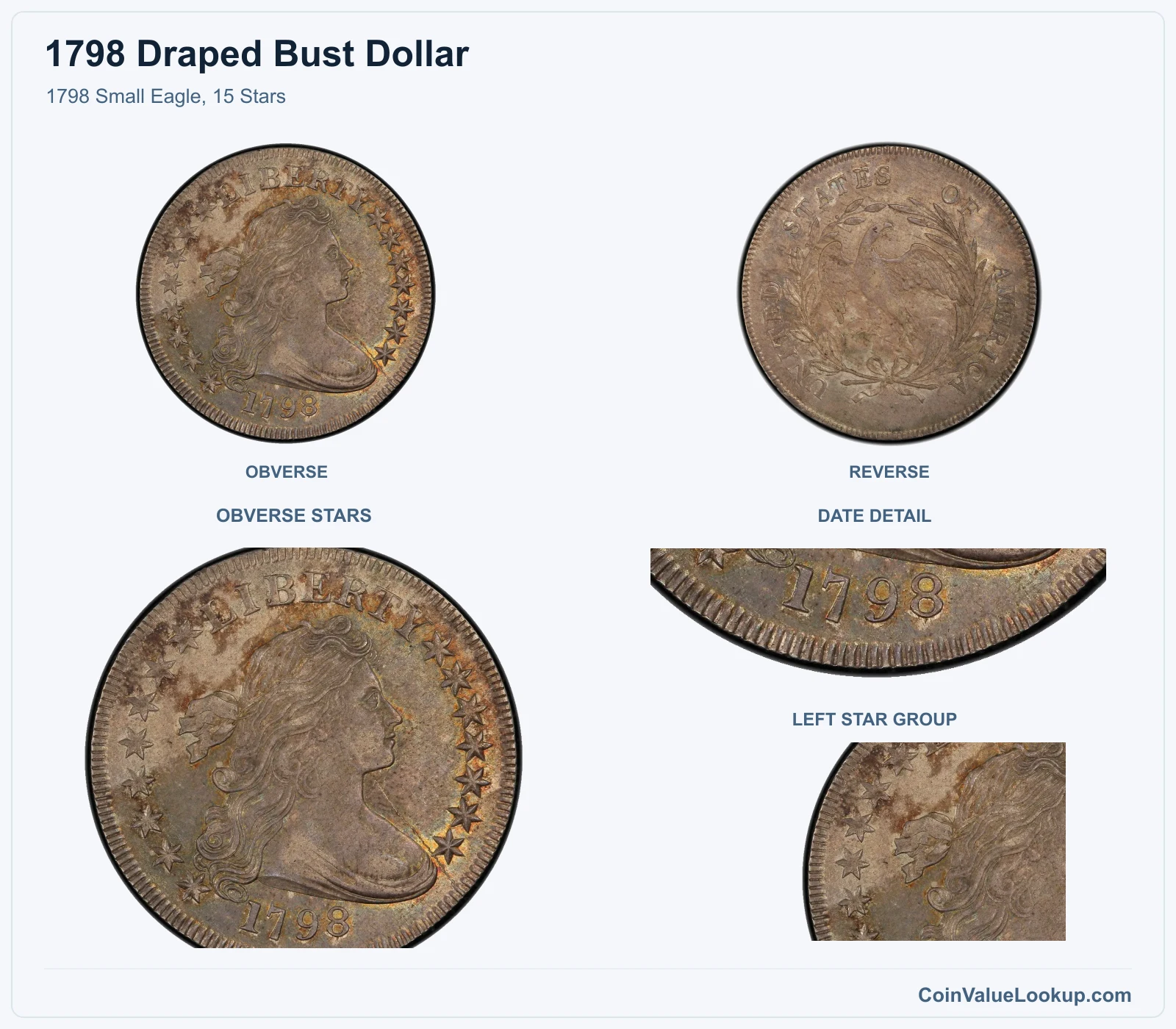
The 1798 Small Eagle, 15 Stars carries the same naturalistic eagle reverse but adds two extra stars on the obverse for a total of fifteen. The additional stars recognize the newly admitted states at the time.
It is straightforward to distinguish from the 13 Stars version — just count carefully around the entire obverse border. As with all 1798 dollars, this was struck at Philadelphia in silver-copper alloy at the early federal standard.
Value hinges on authenticated identity and the coin's grade and surface quality. Cleaning and tooling are common problems in this era, so original surfaces carry a premium.
Range Grade
Price Auction Records Appraisal PO PO 1
—
Coin Identifier FR FR 2
—
Coin Identifier AG AG 3
—
Coin Identifier G G 4
—
Coin Identifier
G 6
Coin Identifier VG VG 8
—
Coin Identifier
VG 10
Coin Identifier F F 12
Coin Identifier
F 15
Coin Identifier VF VF 20
Coin Identifier
VF 25
Coin Identifier
VF 30
Coin Identifier
VF 35
Coin Identifier XF XF 40
Coin Identifier
XF 45
Coin Identifier AU AU 50
Coin Identifier
AU 53
Coin Identifier
AU 55
Coin Identifier
AU 58
Coin Identifier MS MS 60
Coin Identifier
MS 61
—
Coin Identifier
MS 62
Coin Identifier
MS 63
—
—
—
MS 64
—
—
—
MS 65
—
—
—
MS 66
—
—
—
MS 67
—
—
—
MS 68
—
—
—
MS 69
—
—
—
MS 70
—
—
—
1798 Draped Bust Dollar — Large Eagle
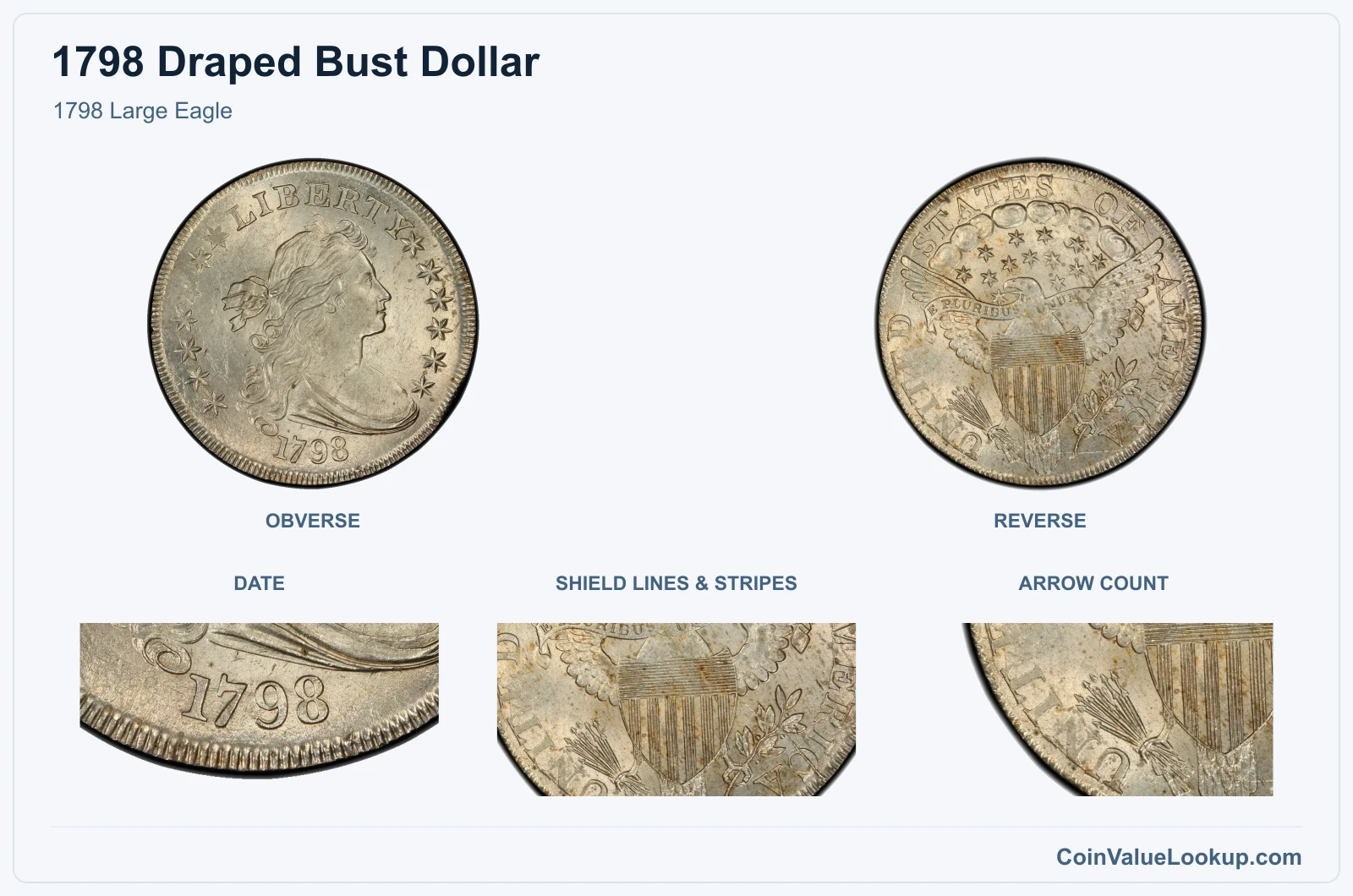
The 1798 Large Eagle is the broader category for coins carrying the Heraldic Eagle reverse. The eagle holds arrows and an olive branch, with a shield on its breast and a constellation of stars above its head.
Several sub-varieties exist within this reverse type, separated by digit shape, line count, arrow count, and stripe details. If your coin has the Heraldic Eagle but does not match any specific sub-variety, it may fall under this general heading.
Authentication and grading by a recognized service are needed for accurate valuation. Condition and originality of surfaces are the main value drivers.
Range Grade
Price Auction Records Appraisal PO PO 1
Coin Identifier FR FR 2
Coin Identifier AG AG 3
Coin Identifier G G 4
Coin Identifier
G 6
Coin Identifier VG VG 8
Coin Identifier
VG 10
Coin Identifier F F 12
Coin Identifier
F 15
Coin Identifier VF VF 20
Coin Identifier
VF 25
Coin Identifier
VF 30
Coin Identifier
VF 35
Coin Identifier XF XF 40
Coin Identifier
XF 45
Coin Identifier AU AU 50
Coin Identifier
AU 53
Coin Identifier
AU 55
Coin Identifier
AU 58
Coin Identifier MS MS 60
—
Coin Identifier
MS 61
Coin Identifier
MS 62
Coin Identifier
MS 63
Coin Identifier
MS 64
Coin Identifier
MS 65
—
Coin Identifier
MS 66
—
—
—
MS 67
—
—
—
MS 68
—
—
—
MS 69
—
—
—
MS 70
—
—
—
1798 Draped Bust Dollar — Knob 9, 5 Lines
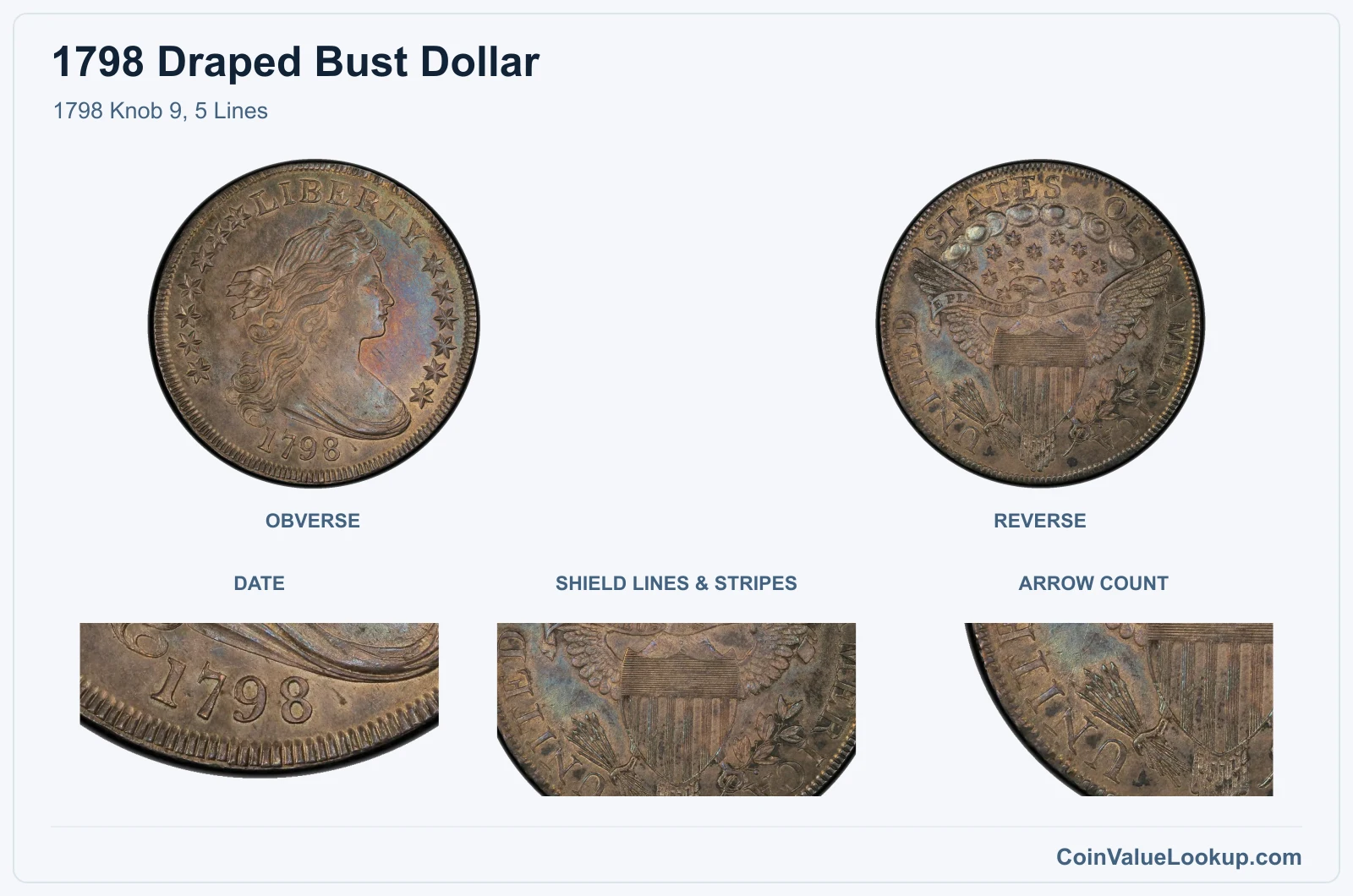
On the 1798 Knob 9, 5 Lines variety, the top of the digit 9 in the date has a rounded, bulbous shape rather than tapering to a point. Then look at the shield on the reverse — count the vertical lines running through the shield's pale (center section).
This version has five. Both details need to match.
Struck in Philadelphia, silver-copper alloy, with a lettered edge. Value depends on an authenticated match to this specific combination and the coin's preservation.
Cleaned or damaged pieces are worth less than problem-free examples at the same wear level.
Range Grade
Price Auction Records Appraisal PO PO 1
—
Coin Identifier FR FR 2
—
Coin Identifier AG AG 3
—
Coin Identifier G G 4
—
Coin Identifier
G 6
—
Coin Identifier VG VG 8
—
Coin Identifier
VG 10
—
Coin Identifier F F 12
—
Coin Identifier
F 15
—
Coin Identifier VF VF 20
—
Coin Identifier
VF 25
—
Coin Identifier
VF 30
—
Coin Identifier
VF 35
Coin Identifier XF XF 40
—
Coin Identifier
XF 45
Coin Identifier AU AU 50
—
Coin Identifier
AU 53
—
Coin Identifier
AU 55
—
Coin Identifier
AU 58
—
Coin Identifier MS MS 60
—
Coin Identifier
MS 61
—
Coin Identifier
MS 62
—
Coin Identifier
MS 63
—
Coin Identifier
MS 64
—
—
—
MS 65
—
—
—
MS 66
—
—
—
MS 67
—
—
—
MS 68
—
—
—
MS 69
—
—
—
MS 70
—
—
—
1798 Draped Bust Dollar — Knob 9, 4 Lines
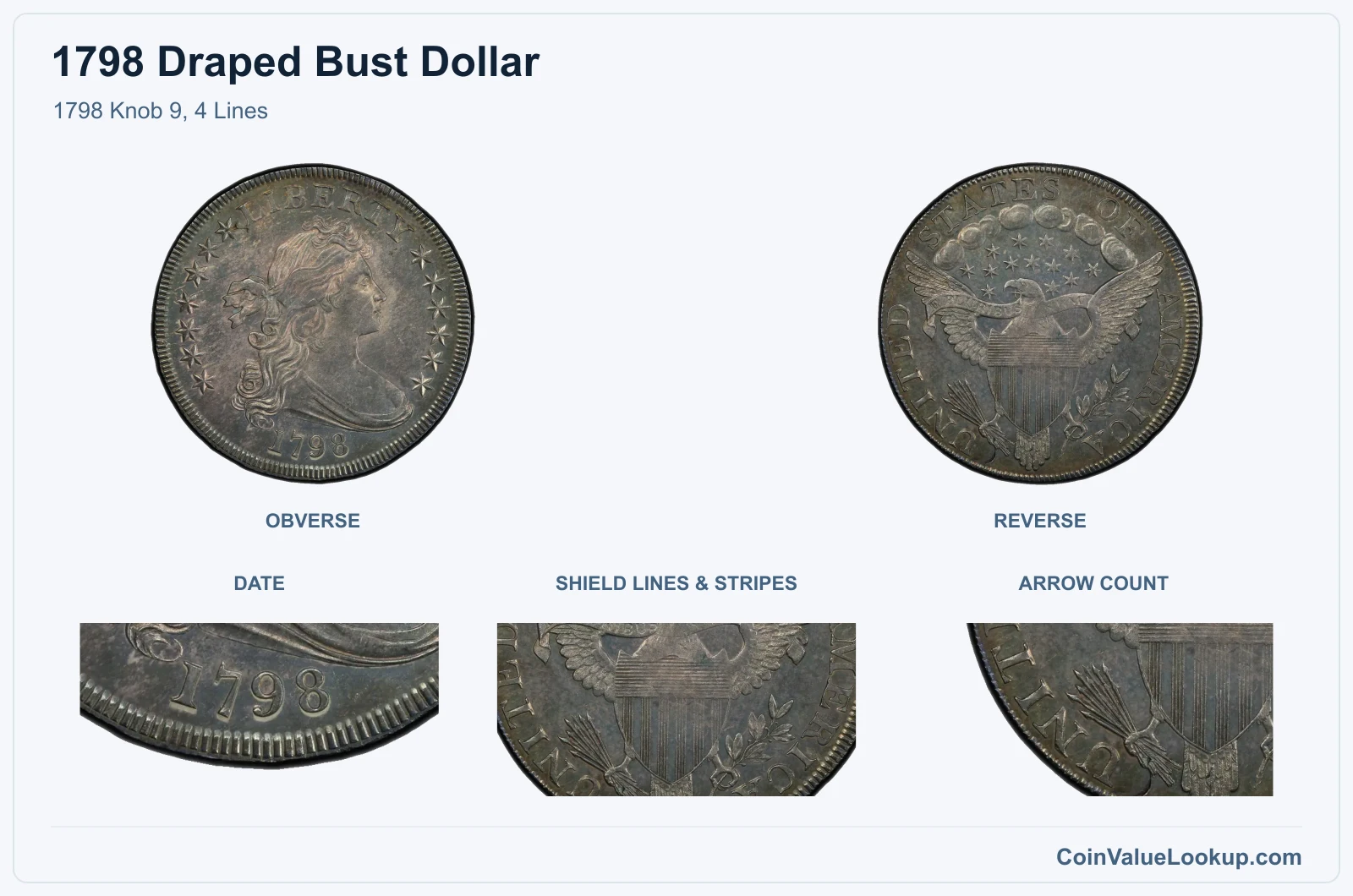
The 1798 Knob 9, 4 Lines shares the same rounded-top 9 as the previous variety but has only four vertical lines in the shield on the reverse. It is a small detail that requires careful inspection — use magnification and good lighting.
Everything else is consistent with the 1798 Heraldic Eagle type: Philadelphia strike, silver-copper alloy, lettered edge. Confirming the exact variety before estimating value matters because each sub-type has its own collector following.
Professional authentication will verify the line count and date style. Surface quality and grade remain the primary value factors.
Range Grade
Price Auction Records Appraisal PO PO 1
—
Coin Identifier FR FR 2
—
Coin Identifier AG AG 3
—
Coin Identifier G G 4
—
Coin Identifier
G 6
—
Coin Identifier VG VG 8
—
Coin Identifier
VG 10
—
Coin Identifier F F 12
—
Coin Identifier
F 15
—
Coin Identifier VF VF 20
—
Coin Identifier
VF 25
—
Coin Identifier
VF 30
Coin Identifier
VF 35
—
Coin Identifier XF XF 40
—
Coin Identifier
XF 45
—
Coin Identifier AU AU 50
—
Coin Identifier
AU 53
Coin Identifier
AU 55
—
Coin Identifier
AU 58
—
Coin Identifier MS MS 60
—
Coin Identifier
MS 61
—
Coin Identifier
MS 62
—
Coin Identifier
MS 63
—
—
—
MS 64
—
—
—
MS 65
—
—
—
MS 66
—
—
—
MS 67
—
—
—
MS 68
—
—
—
MS 69
—
—
—
MS 70
—
—
—
1798 Draped Bust Dollar — Pointed 9, 5 Lines
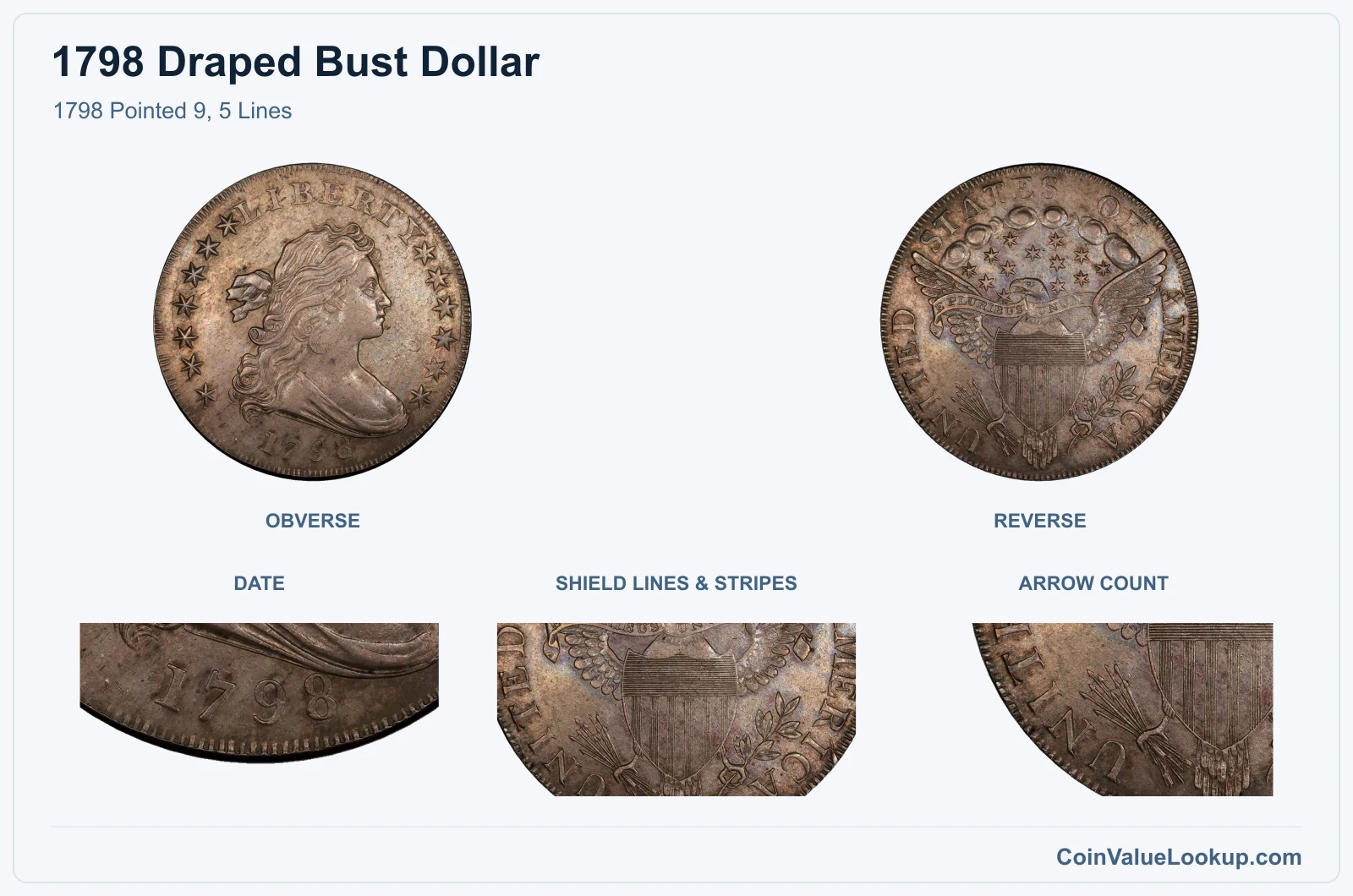
The Pointed 9, 5 Lines variety has a 9 in the date that tapers upward to a narrow tip instead of ending in a rounded knob. The shield on the reverse shows five vertical lines through the pale.
Compare the top of the 9 side-by-side with images of a confirmed Knob 9 to be sure — the difference can be subtle on worn coins.
Coin Value Lookup can help you find guides for this and many other early dollar varieties if you are trying to sort through what you have.
As always, authenticated identity and original surfaces determine what a specific example is worth. Grade carefully and avoid paying premiums based solely on seller attributions.
Range Grade
Price Auction Records Appraisal PO PO 1
—
Coin Identifier FR FR 2
—
Coin Identifier AG AG 3
—
Coin Identifier G G 4
—
Coin Identifier
G 6
—
Coin Identifier VG VG 8
—
Coin Identifier
VG 10
—
Coin Identifier F F 12
—
Coin Identifier
F 15
—
Coin Identifier VF VF 20
—
Coin Identifier
VF 25
—
Coin Identifier
VF 30
—
Coin Identifier
VF 35
—
Coin Identifier XF XF 40
—
Coin Identifier
XF 45
—
Coin Identifier AU AU 50
—
Coin Identifier
AU 53
—
Coin Identifier
AU 55
—
Coin Identifier
AU 58
—
—
— MS MS 60
—
—
—
MS 61
—
—
—
MS 62
—
—
—
MS 63
—
—
—
MS 64
—
—
—
MS 65
—
—
—
MS 66
—
—
—
MS 67
—
—
—
MS 68
—
—
—
MS 69
—
—
—
MS 70
—
—
—
1798 Draped Bust Dollar — Pointed 9, 4 Lines
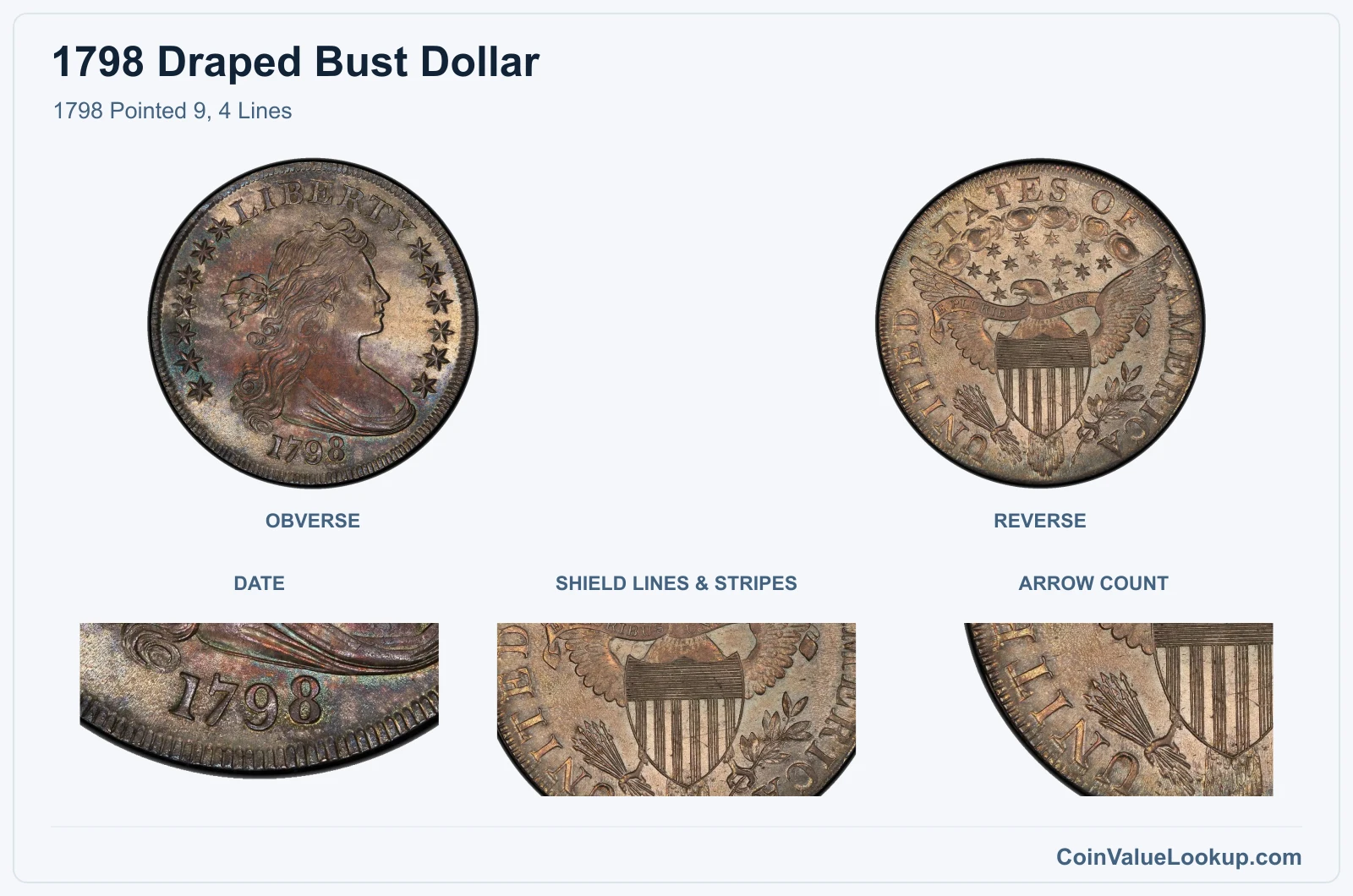
The 1798 Pointed 9, 4 Lines is another Heraldic Eagle sub-variety. Here the 9 tapers to a point and the shield has four vertical lines instead of five.
It is the combination of both features that defines this version — checking just one is not enough. Struck at Philadelphia in the standard early federal silver-copper alloy.
If your coin has been cleaned or shows signs of tooling around the date or shield, authentication becomes even more important. Individual value depends on confirmed identity plus the coin's condition and surface preservation.
Range Grade
Price Auction Records Appraisal PO PO 1
—
Coin Identifier FR FR 2
—
Coin Identifier AG AG 3
—
Coin Identifier G G 4
—
Coin Identifier
G 6
—
Coin Identifier VG VG 8
Coin Identifier
VG 10
—
Coin Identifier F F 12
Coin Identifier
F 15
Coin Identifier VF VF 20
Coin Identifier
VF 25
—
Coin Identifier
VF 30
Coin Identifier
VF 35
Coin Identifier XF XF 40
Coin Identifier
XF 45
Coin Identifier AU AU 50
Coin Identifier
AU 53
Coin Identifier
AU 55
Coin Identifier
AU 58
Coin Identifier MS MS 60
—
Coin Identifier
MS 61
—
Coin Identifier
MS 62
—
Coin Identifier
MS 63
—
Coin Identifier
MS 64
—
Coin Identifier
MS 65
—
Coin Identifier
MS 66
—
—
—
MS 67
—
—
—
MS 68
—
—
—
MS 69
—
—
—
MS 70
—
—
—
1798 Draped Bust Dollar — Knob 9
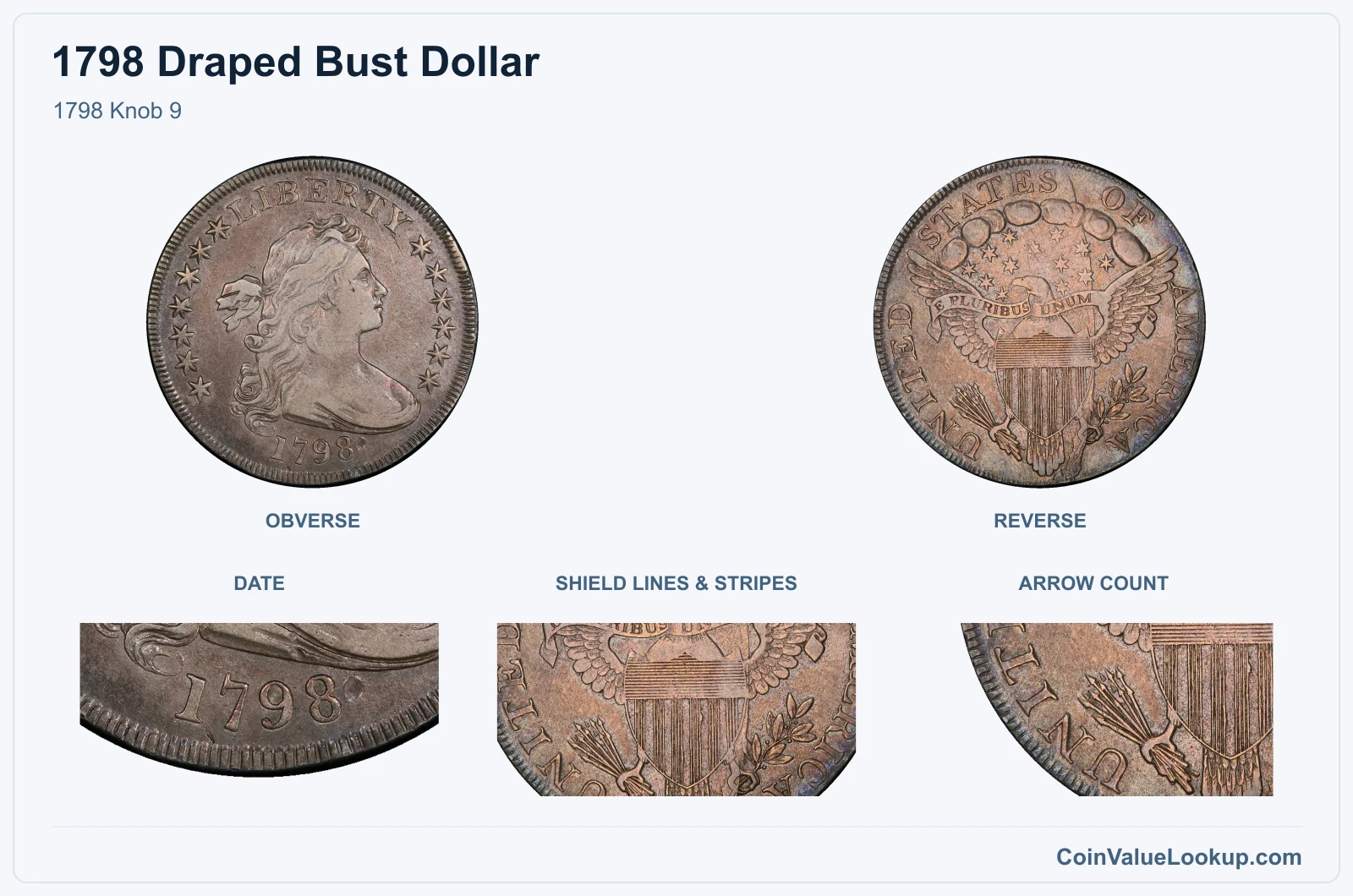
The plain 1798 Knob 9 designation applies to Heraldic Eagle reverses that share the rounded-top 9 but do not fit neatly into the 4 Lines or 5 Lines sub-categories, or where the line count distinction is not the defining characteristic. Check that the top of the 9 is clearly round and bulbous.
Philadelphia mint, silver-copper alloy, lettered edge — all consistent with the rest of the series. Value is determined individually based on the coin's authenticated identity, preservation, and grade.
Problem-free examples with original toning command the most interest.
Range Grade
Price Auction Records Appraisal PO PO 1
—
Coin Identifier FR FR 2
—
Coin Identifier AG AG 3
—
Coin Identifier G G 4
—
Coin Identifier
G 6
—
Coin Identifier VG VG 8
—
Coin Identifier
VG 10
—
Coin Identifier F F 12
Coin Identifier
F 15
Coin Identifier VF VF 20
—
Coin Identifier
VF 25
Coin Identifier
VF 30
Coin Identifier
VF 35
Coin Identifier XF XF 40
Coin Identifier
XF 45
Coin Identifier AU AU 50
Coin Identifier
AU 53
—
Coin Identifier
AU 55
Coin Identifier
AU 58
Coin Identifier MS MS 60
—
Coin Identifier
MS 61
—
Coin Identifier
MS 62
—
Coin Identifier
MS 63
Coin Identifier
MS 64
—
—
—
MS 65
—
—
—
MS 66
—
—
—
MS 67
—
—
—
MS 68
—
—
—
MS 69
—
—
—
MS 70
—
—
—
1798 Draped Bust Dollar — 10 Arrows
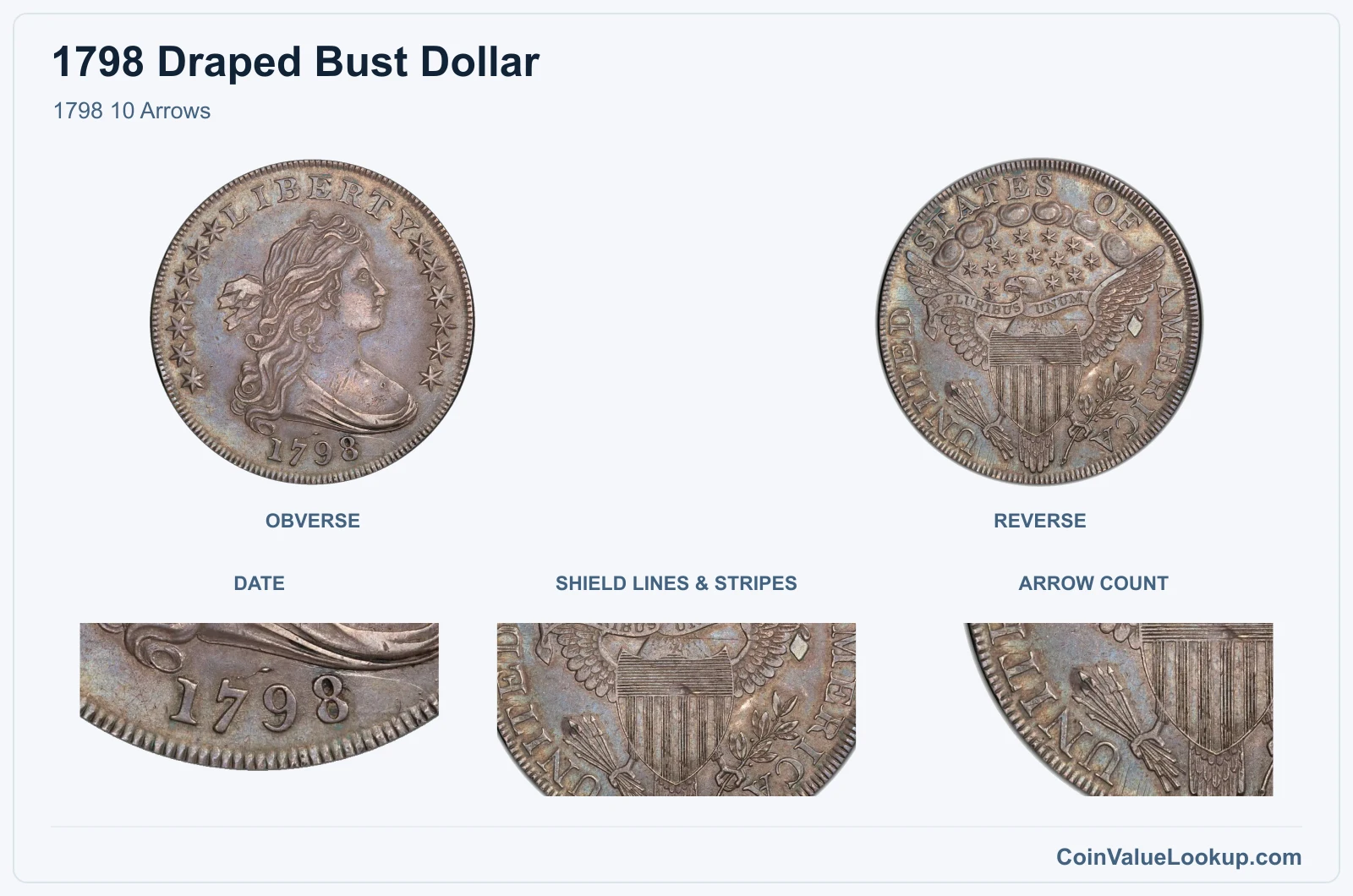
The 1798 10 Arrows variety is identified by counting the arrows clutched in the eagle's right talon on the Heraldic Eagle reverse. Where the standard design typically uses a different count, this version distinctly shows ten arrows.
You will need magnification — some arrows overlap and are easy to miscount. Everything else about the coin follows the standard 1798 Heraldic Eagle format: Philadelphia strike, silver-copper alloy, lettered edge.
Valuation requires authentication of the arrow count and overall condition assessment. Do not rely on raw-eye identification alone for this variety.
Range Grade
Price Auction Records Appraisal PO PO 1
—
Coin Identifier FR FR 2
—
Coin Identifier AG AG 3
—
Coin Identifier G G 4
Coin Identifier
G 6
—
Coin Identifier VG VG 8
Coin Identifier
VG 10
Coin Identifier F F 12
Coin Identifier
F 15
Coin Identifier VF VF 20
Coin Identifier
VF 25
Coin Identifier
VF 30
Coin Identifier
VF 35
Coin Identifier XF XF 40
Coin Identifier
XF 45
Coin Identifier AU AU 50
Coin Identifier
AU 53
Coin Identifier
AU 55
Coin Identifier
AU 58
Coin Identifier MS MS 60
—
Coin Identifier
MS 61
Coin Identifier
MS 62
—
Coin Identifier
MS 63
Coin Identifier
MS 64
—
—
—
MS 65
—
—
—
MS 66
—
—
—
MS 67
—
—
—
MS 68
—
—
—
MS 69
—
—
—
MS 70
—
—
—
1798 Draped Bust Dollar — 5 Stripes
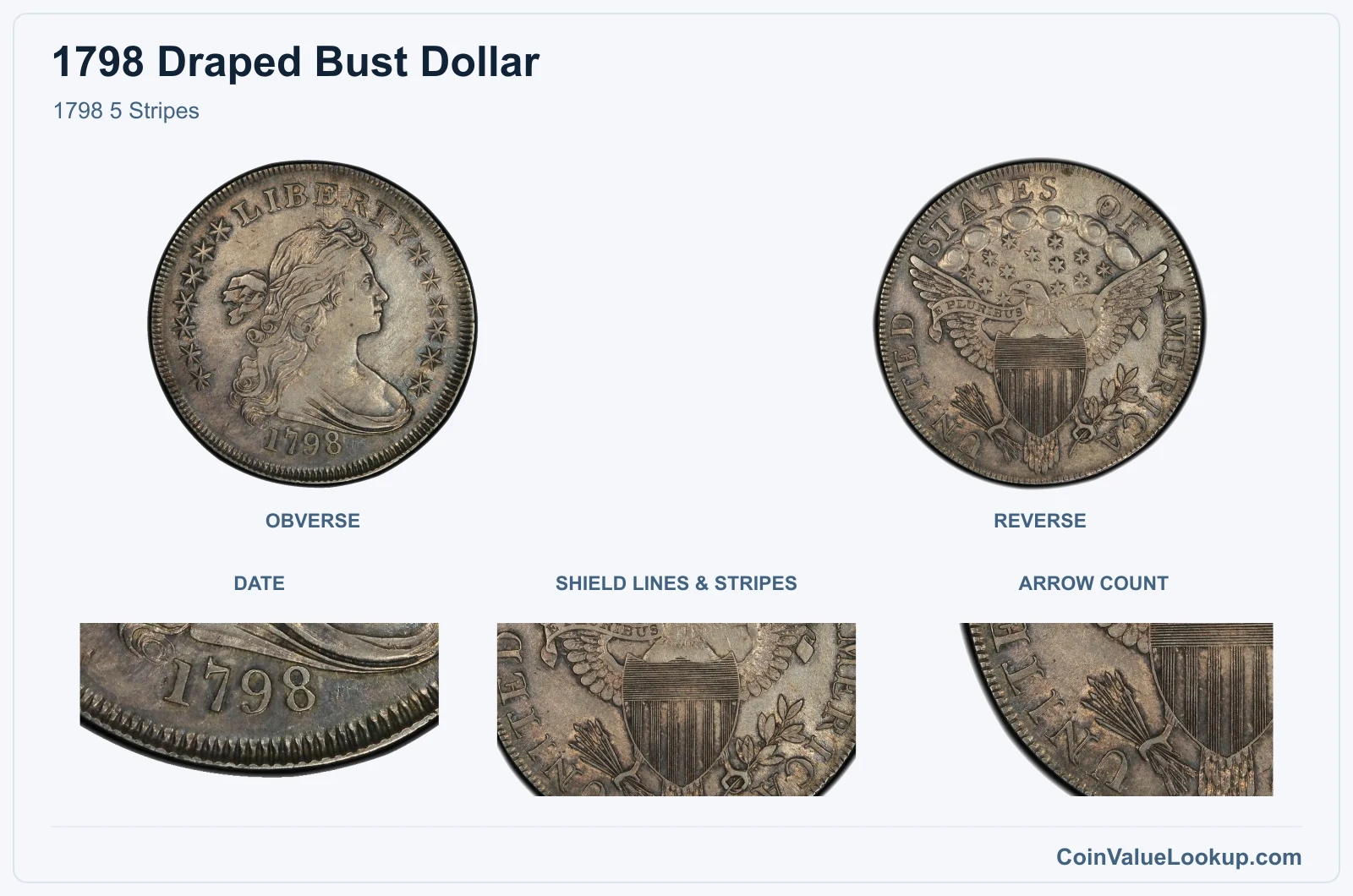
The 1798 5 Stripes variety refers to the number of horizontal stripes visible on the shield carried by the Heraldic Eagle. This is fewer than the standard arrangement seen on other 1798 dies.
Count the stripes carefully under magnification, because wear can obscure the uppermost and lowermost lines on the shield. Struck at Philadelphia, silver-copper alloy, nominal 26.96 grams, lettered edge.
As with every early dollar variety, authentication and professional grading are the reliable paths to valuation. Cleaned or damaged coins lose comparability to condition-census examples.
Range Grade
Price Auction Records Appraisal PO PO 1
—
Coin Identifier FR FR 2
—
Coin Identifier AG AG 3
Coin Identifier G G 4
—
Coin Identifier
G 6
—
Coin Identifier VG VG 8
Coin Identifier
VG 10
Coin Identifier F F 12
Coin Identifier
F 15
—
Coin Identifier VF VF 20
Coin Identifier
VF 25
Coin Identifier
VF 30
Coin Identifier
VF 35
Coin Identifier XF XF 40
Coin Identifier
XF 45
Coin Identifier AU AU 50
Coin Identifier
AU 53
Coin Identifier
AU 55
Coin Identifier
AU 58
Coin Identifier MS MS 60
—
Coin Identifier
MS 61
Coin Identifier
MS 62
—
—
—
MS 63
—
—
—
MS 64
—
—
—
MS 65
—
—
—
MS 66
—
—
—
MS 67
—
—
—
MS 68
—
—
—
MS 69
—
—
—
MS 70
—
—
—
1798 Draped Bust Dollar — Wide Date
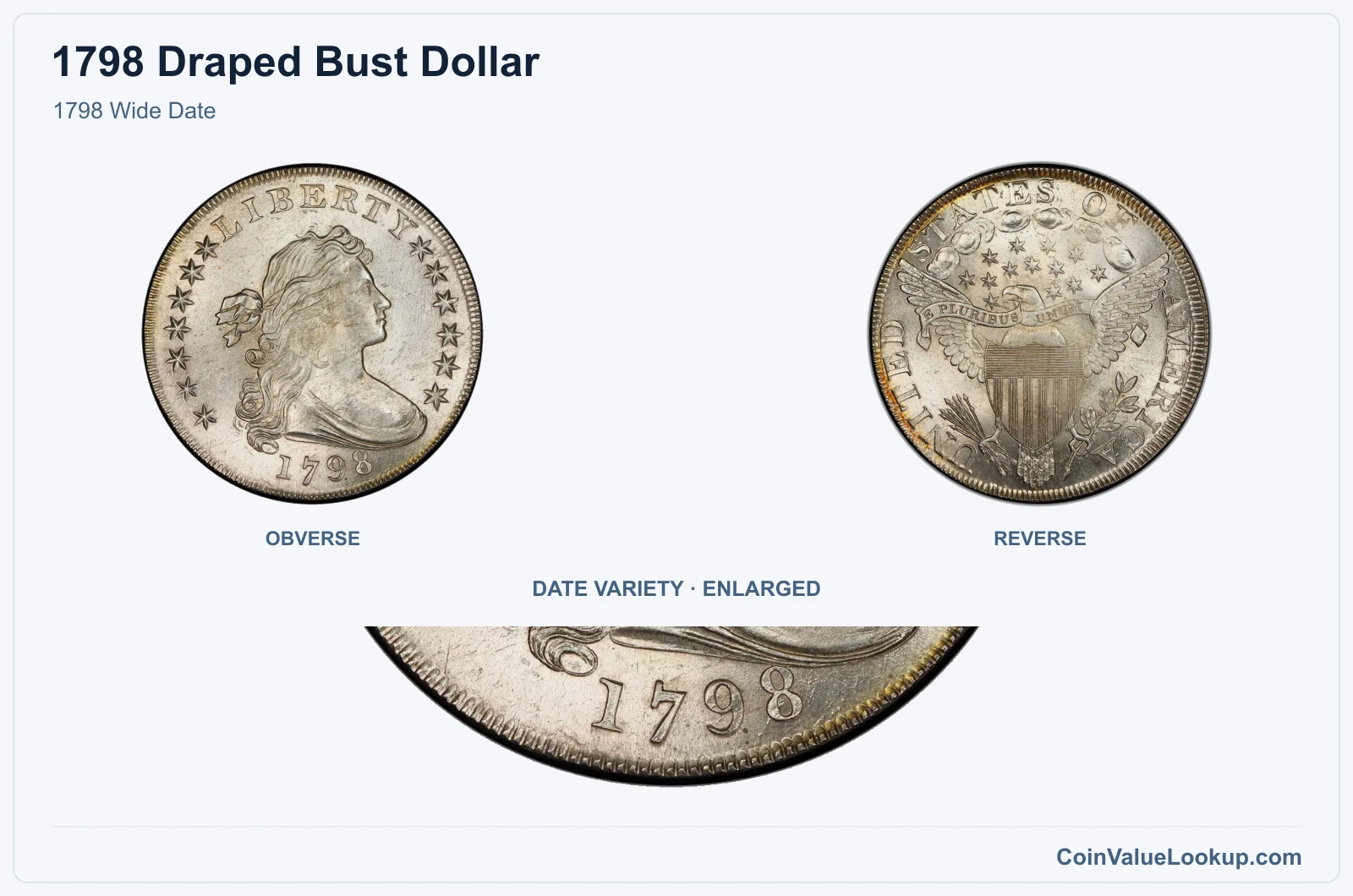
The 1798 Wide Date variety is distinguished by noticeably increased spacing between the four digits of the date. Compare it against a normal-date 1798 and the gap between numerals — especially the 7 and 9 — will be visibly larger.
This is a Heraldic Eagle reverse coin struck in Philadelphia. Silver-copper alloy, lettered edge, same nominal weight as the rest.
Confirming the date spacing is relatively easy with a side-by-side reference image. Value still comes down to authenticated identity, surface quality, and grade.
An original, uncleaned Wide Date in solid condition will draw serious collector attention.
Range Grade
Price Auction Records Appraisal PO PO 1
Coin Identifier FR FR 2
—
Coin Identifier AG AG 3
—
Coin Identifier G G 4
—
Coin Identifier
G 6
Coin Identifier VG VG 8
Coin Identifier
VG 10
Coin Identifier F F 12
Coin Identifier
F 15
Coin Identifier VF VF 20
Coin Identifier
VF 25
Coin Identifier
VF 30
Coin Identifier
VF 35
Coin Identifier XF XF 40
Coin Identifier
XF 45
Coin Identifier AU AU 50
Coin Identifier
AU 53
Coin Identifier
AU 55
Coin Identifier
AU 58
Coin Identifier MS MS 60
—
Coin Identifier
MS 61
Coin Identifier
MS 62
Coin Identifier
MS 63
Coin Identifier
MS 64
Coin Identifier
MS 65
Coin Identifier
MS 66
—
—
—
MS 67
—
—
—
MS 68
—
—
—
MS 69
—
—
—
MS 70
—
—
—
1798 Draped Bust Dollar Error List
1. 1798 Draped Bust Dollar — Die Crack / Die Chip
Die cracks appear as thin raised lines on the coin's surface, caused by fractures in the steel die during striking. On a 1798 Draped Bust Dollar, look for these raised ridges running through design elements or across fields.
A die chip is a related feature — a small raised blob where a piece of the die broke away, leaving a void that fills with metal during the strike.
If the raised line extends to the rim and leaves a larger raised area, that is called a cud, which is a more dramatic form of die damage. Do not confuse die cracks with incuse scratches, surface corrosion, or foreign material sitting on the coin — those are damage, not mint-made errors.
Die cracks are raised; scratches are recessed.
The value impact depends on the crack's size, location, and visibility, plus the coin's overall grade. Professional authentication is needed to confirm a genuine die crack versus post-strike damage.
2. 1798 Draped Bust Dollar — Clashed Dies
Clashed dies occur when the obverse and reverse dies strike each other without a planchet between them, transferring faint mirror-image impressions of one design onto the opposite die. On a 1798 Draped Bust Dollar, incused denticle impressions — clash marks from the obverse — are sometimes visible above the letters ES and OF on the reverse.
Look for design traces that do not belong on the side you are examining. The transferred impressions will be aligned with where the opposite die's features would fall, which helps confirm a genuine clash rather than random marks.
Scratches, raised lines from other causes, or a brockage (where a struck coin acts as a die) can mimic clash marks to an untrained eye.
The value of a clash depends on how dramatic and visible the transferred design is, along with the coin's overall condition. Subtle clashes add modest interest; strong, unmistakable clashes attract more attention.
Professional evaluation is recommended.