1903 Morgan Silver Dollar Coin Value: How Much Is It Worth?
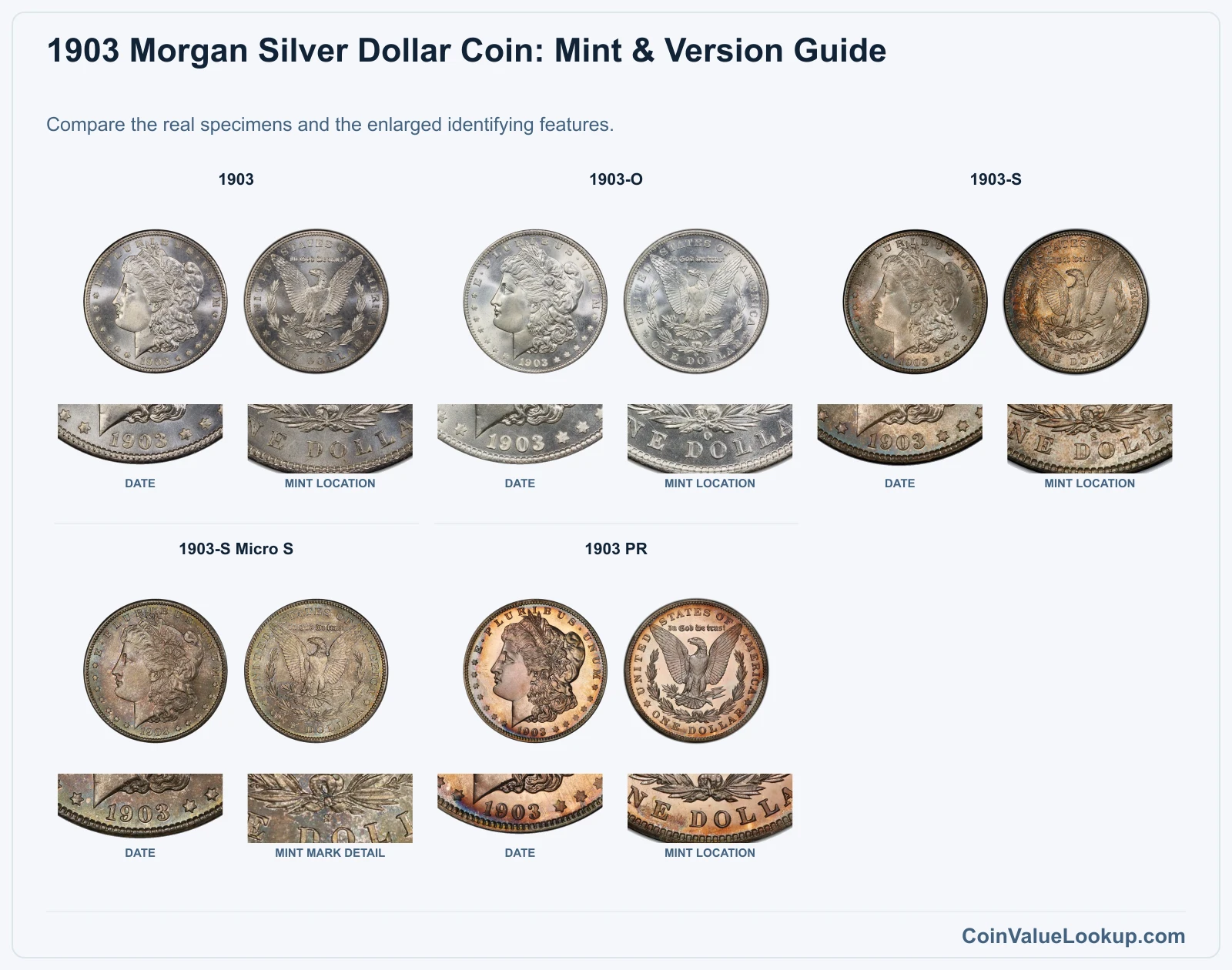
The 1903 Morgan Silver Dollar is a collectible 90% silver coin struck across multiple mints, with several distinct versions that matter for value. Its worth depends on the specific mint, condition, variety and whether original surfaces survive.
Because each branch carries different scarcity, identifying your exact coin is the essential first step.
Fast Way to Identify Your 1903 Morgan Silver Dollar
The quickest way to start figuring out what you have is to upload clear photos of both the front and back of your coin. Our preliminary identification tool can help you narrow down the mint, general condition and version so you know which branch to research further.
Sharp, well-lit images make all the difference.
1903 Morgan Silver Dollar Value
Upload both sides of your 1903 Morgan Silver Dollar.
Front Obverse
Upload photo
Back Reverse
Upload photo
Which 1903 Morgan Silver Dollar Versions Are Worth Money?
- Check the mintmark location below the wreath bow: 1903-S, especially the Micro S variety, is a distinct collectible branch worth confirming.
- 1903 Proof issues were produced as a separate manufacturing finish at Philadelphia and carry their own value profile apart from business strikes.
- Prooflike or Deep Mirror Prooflike surfaces on eligible business strikes can affect pricing, but a shiny coin does not automatically qualify.
- Do not pay a premium for ordinary wear, cleaning, artificial plating, glare or an unverified error claim. Authentication matters before paying variety prices.
Step 1: Identify Your 1903 Morgan Silver Dollar Mint Mark and Version
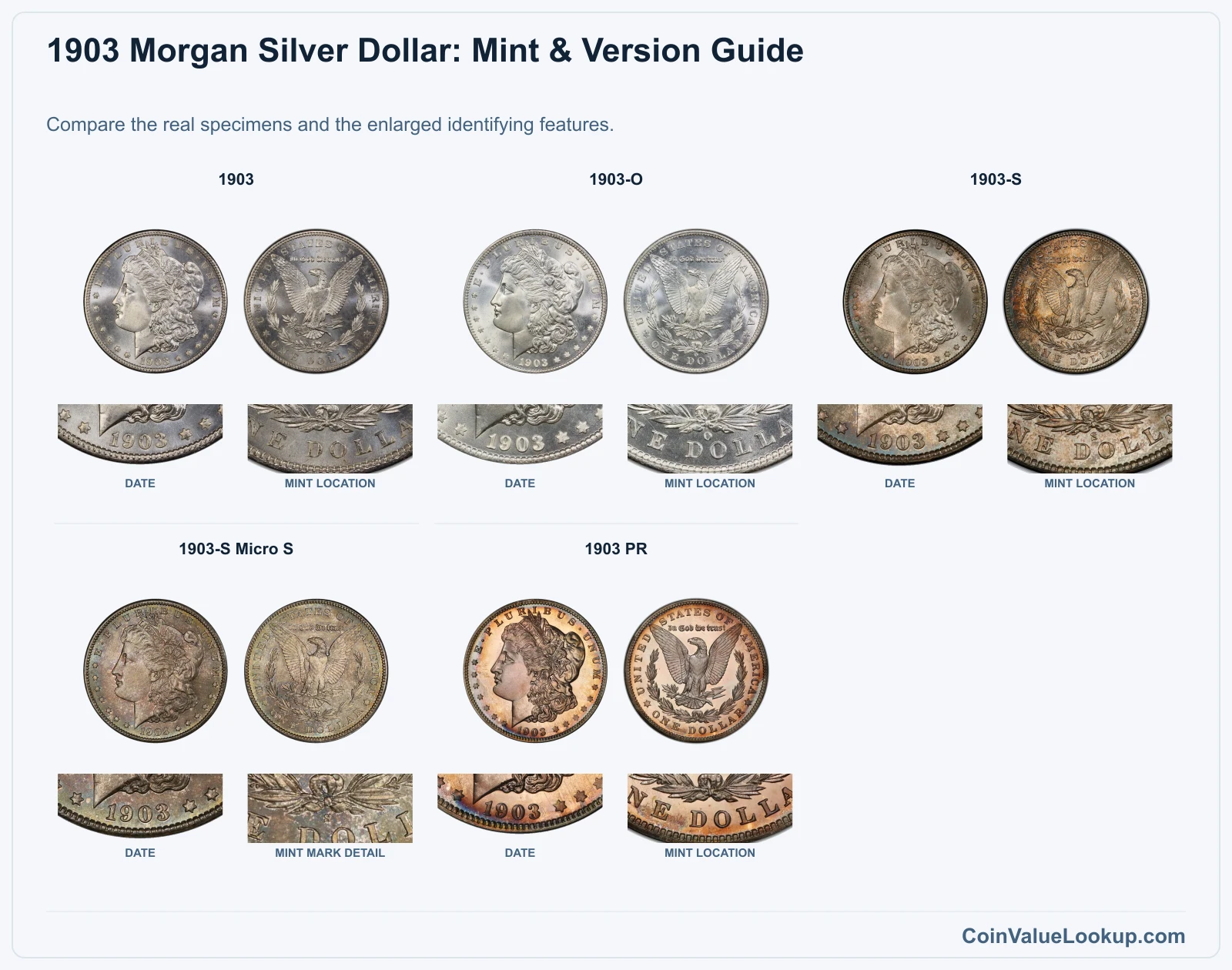
Flip your coin to the reverse and look directly below the bow that ties the wreath together. That is where the mintmark sits.
No letter means Philadelphia. An "O" is New Orleans, and an "S" is San Francisco.
There is no Carson City or Denver version for 1903.
The coin is 90% silver and 10% copper, weighing 26.73 grams. If yours feels noticeably lighter or doesn't ring like silver, it may be a replica or plated piece.
The obverse shows Liberty's head with a Phrygian cap and wheat stalks, designed by George T. Morgan.
The reverse features an eagle with outstretched wings within a wreath, with a reeded edge around the rim.
For 1903 specifically, the versions that exist are: 1903 Philadelphia, 1903-O, 1903-S, 1903-S Micro S and 1903 Proof. Each one has its own value profile, so matching yours to the right branch is critical before you look at any price.
A shiny coin is not automatically a proof or prooflike piece. Prooflike and Deep Mirror Prooflike are surface designations applied to qualifying business strikes, and proof is a separate manufacturing method.
Cleaning, polishing or natural luster can all mimic reflectivity without actually qualifying for any premium designation.
Step 2: Check Your 1903 Morgan Silver Dollar Grade
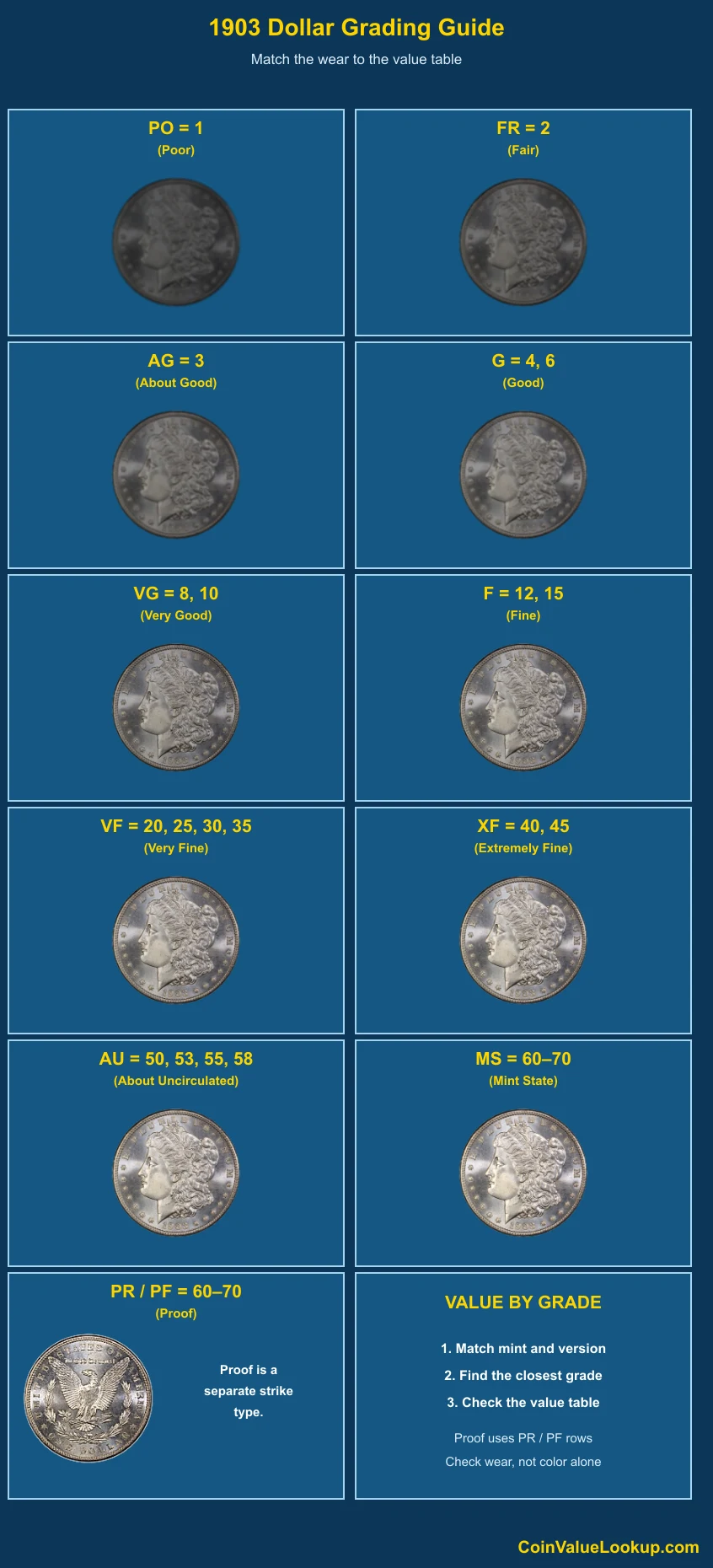
Start with the hair above Liberty's ear and the flatness of her cheek. On well-circulated coins, the hair strands above the ear merge into a smooth, featureless area first.
The cap details and the cotton bolls go next.
On the reverse, the eagle's breast feathers are the high point and show wear early. Compare yours against the same-type grading image to see where your coin falls.
Mint State coins still have full luster across both sides, but bag marks from storage can knock the grade down without being actual circulation wear. A coin covered in tiny nicks from jostling in a mint bag is still technically uncirculated, just not a pristine one.
For proof coins, grading focuses on hairlines from handling rather than wear from spending. A proof with heavy wipe marks grades lower than one with clean fields, even though neither saw circulation.
Cleaned or polished coins lose their originality and are graded differently by authentication services, which typically reduces their market appeal regardless of how much detail remains.
Step 3: Check 1903 Morgan Silver Dollar Value by Mint and Version
1903 Morgan Silver Dollar
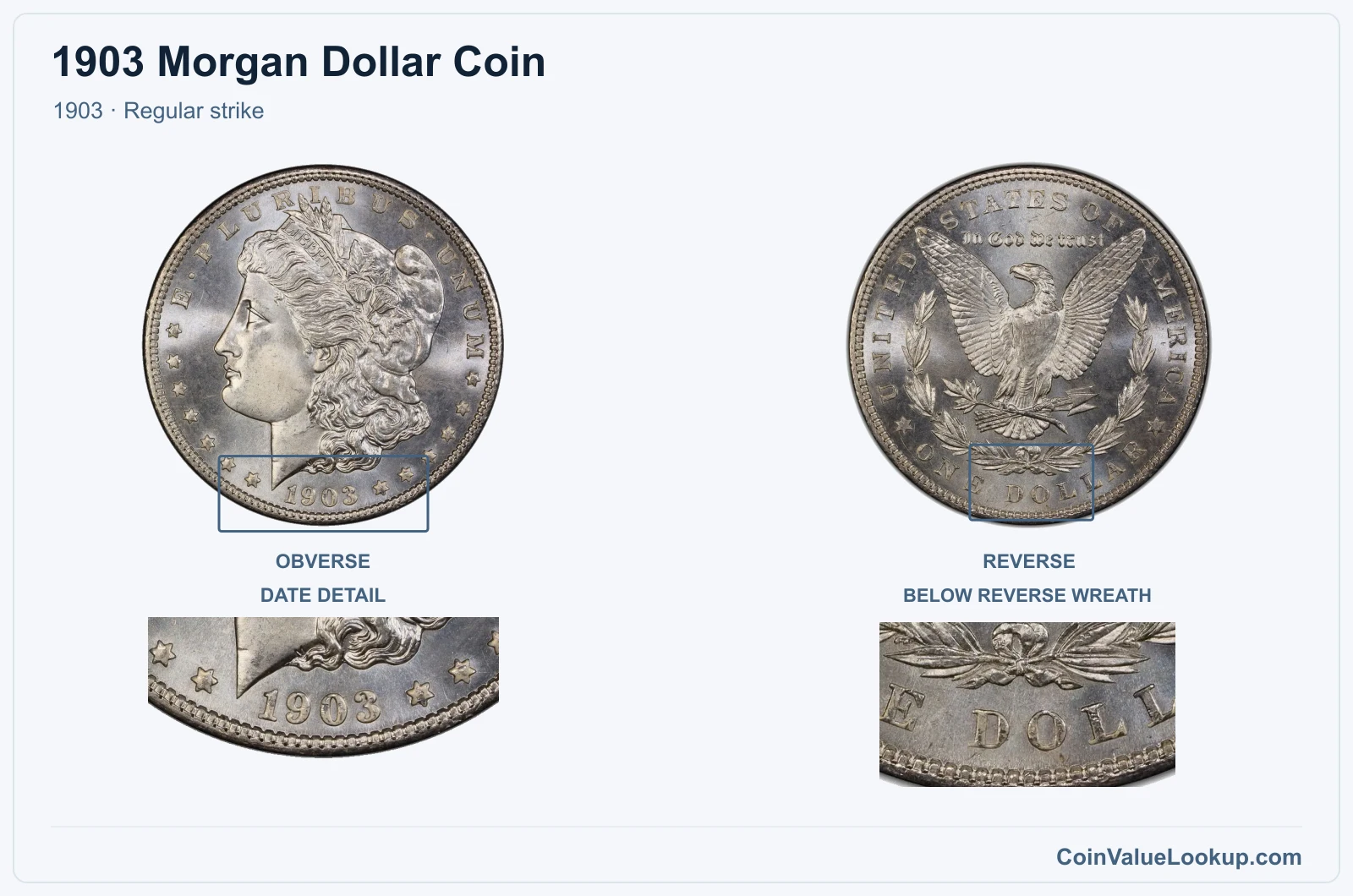
The 1903 Philadelphia Morgan Dollar has no mintmark below the wreath. It was a regular business strike in 90% silver.
Value depends on the coin's authenticated grade and the preservation of original surfaces. Cleaned or polished examples lose comparability to original coins in the same grade.
Prooflike and Deep Mirror Prooflike designations apply to some Philadelphia business strikes that exhibit mirror-like fields. These are surface characteristics, not proof manufacture.
Pricing varies by grade and surface quality, so individual assessment by an authentication service is the most reliable path to an accurate value.
Range Grade
Price Auction Records Appraisal PO PO 1
—
Coin Identifier FR FR 2
—
Coin Identifier AG AG 3
Coin Identifier G G 4
—
Coin Identifier
G 6
Coin Identifier VG VG 8
—
Coin Identifier
VG 10
—
Coin Identifier F F 12
Coin Identifier
F 15
—
Coin Identifier VF VF 20
—
Coin Identifier
VF 25
—
Coin Identifier
VF 30
Coin Identifier
VF 35
—
Coin Identifier XF XF 40
Coin Identifier
XF 45
Coin Identifier AU AU 50
Coin Identifier
AU 53
Coin Identifier
AU 55
Coin Identifier
AU 58
Coin Identifier MS MS 60
Coin Identifier
MS 61
Coin Identifier
MS 62
Coin Identifier
MS 63
Coin Identifier
MS 64
Coin Identifier
MS 65
Coin Identifier
MS 66
Coin Identifier
MS 67
Coin Identifier
MS 68
Coin Identifier
MS 69
—
—
—
MS 70
—
—
—
1903 Morgan Silver Dollar — O
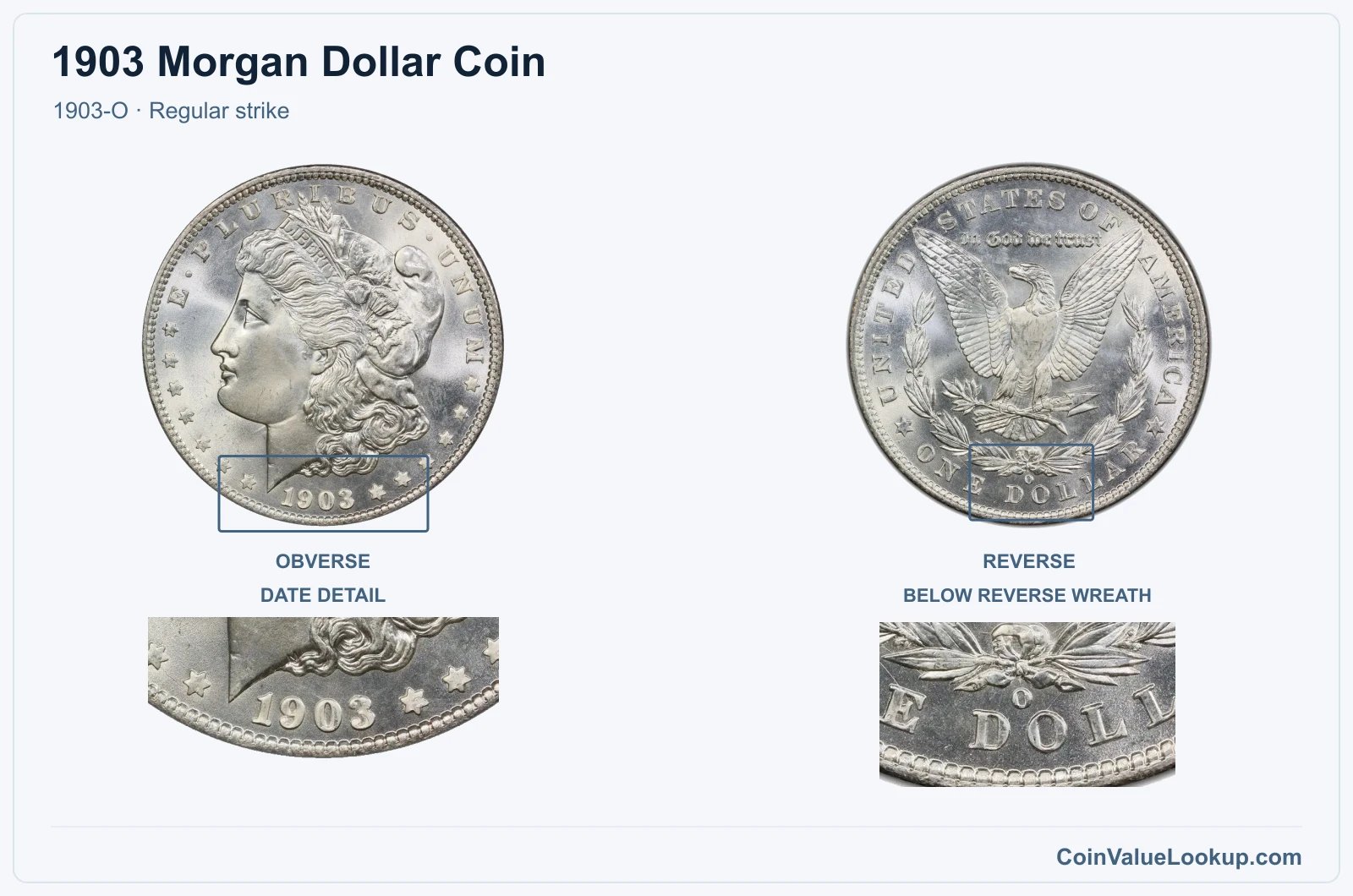
The 1903-O was struck at the New Orleans Mint, identified by a small "O" below the wreath bow. This date-mint combination is one of the more interesting stops in the Morgan series.
Coin Value Lookup is a useful starting point if you want to look up guides for other dates and mints in the Morgan Dollar series.
Value for the 1903-O depends on authenticated grade and original surfaces. Bag marks, toning and luster all factor into what a given example is worth.
Cleaning reduces comparability and typically lowers the market appeal of an otherwise solid coin.
Range Grade
Price Auction Records Appraisal PO PO 1
Coin Identifier FR FR 2
Coin Identifier AG AG 3
Coin Identifier G G 4
Coin Identifier
G 6
Coin Identifier VG VG 8
Coin Identifier
VG 10
Coin Identifier F F 12
Coin Identifier
F 15
Coin Identifier VF VF 20
Coin Identifier
VF 25
Coin Identifier
VF 30
Coin Identifier
VF 35
Coin Identifier XF XF 40
Coin Identifier
XF 45
Coin Identifier AU AU 50
—
Coin Identifier
AU 53
Coin Identifier
AU 55
Coin Identifier
AU 58
Coin Identifier MS MS 60
Coin Identifier
MS 61
Coin Identifier
MS 62
Coin Identifier
MS 63
Coin Identifier
MS 64
Coin Identifier
MS 65
Coin Identifier
MS 66
Coin Identifier
MS 67
Coin Identifier
MS 68
—
—
—
MS 69
—
—
—
MS 70
—
—
—
1903 Morgan Silver Dollar — S
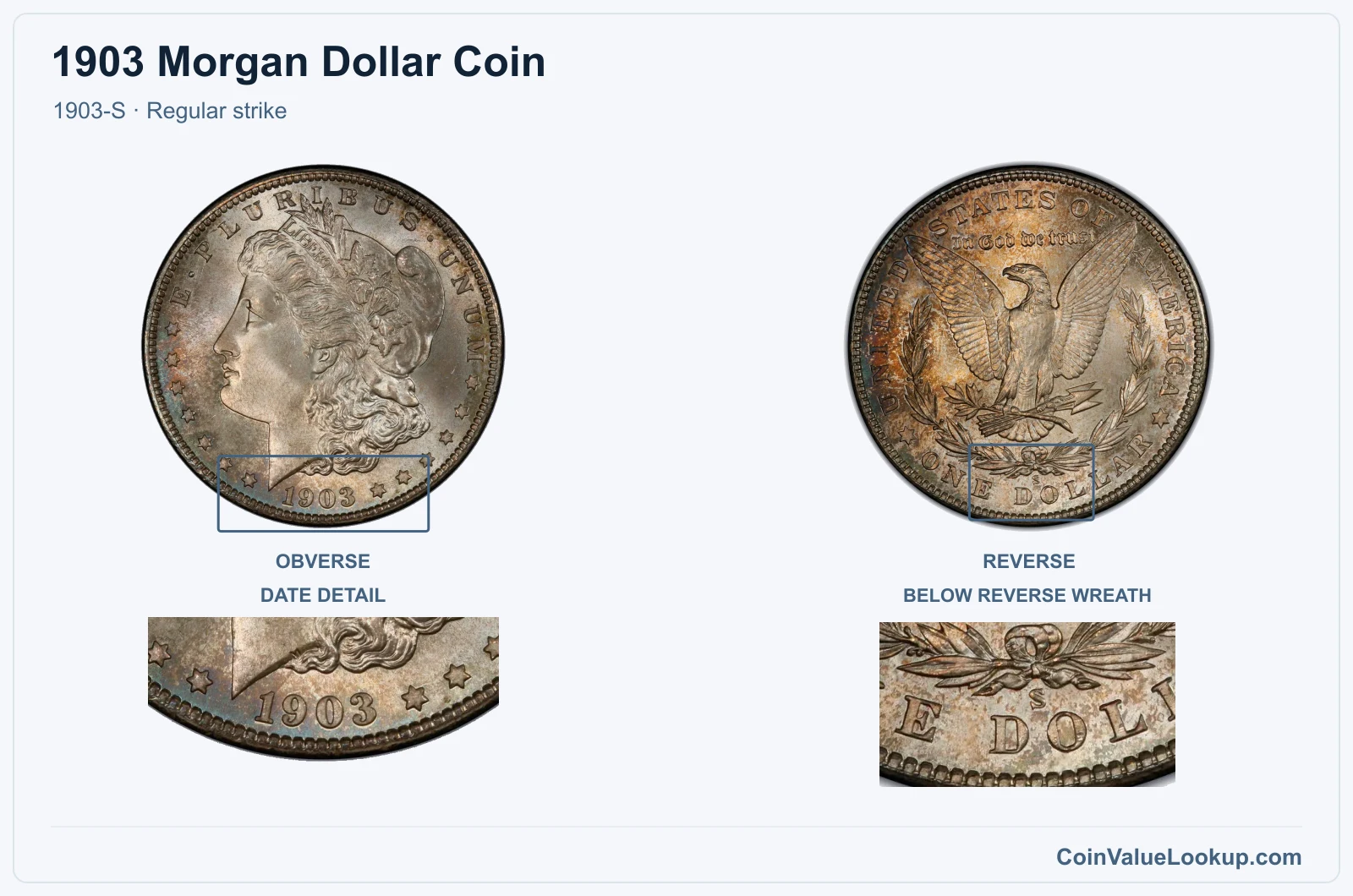
The 1903-S carries a small "S" mintmark below the wreath and was produced at the San Francisco Mint. Before assigning value, confirm whether your coin has the normal-size S or the smaller Micro S variety, because they are tracked separately.
For the standard 1903-S, value depends on authenticated grade and original surfaces. Higher Mint State grades tend to be scarce for this date.
Polished or cleaned coins are graded differently and generally bring less interest from collectors compared to problem-free examples.
Range Grade
Price Auction Records Appraisal PO PO 1
—
Coin Identifier FR FR 2
Coin Identifier AG AG 3
Coin Identifier G G 4
Coin Identifier
G 6
Coin Identifier VG VG 8
Coin Identifier
VG 10
Coin Identifier F F 12
Coin Identifier
F 15
Coin Identifier VF VF 20
Coin Identifier
VF 25
Coin Identifier
VF 30
Coin Identifier
VF 35
Coin Identifier XF XF 40
Coin Identifier
XF 45
Coin Identifier AU AU 50
Coin Identifier
AU 53
Coin Identifier
AU 55
Coin Identifier
AU 58
Coin Identifier MS MS 60
Coin Identifier
MS 61
Coin Identifier
MS 62
Coin Identifier
MS 63
Coin Identifier
MS 64
Coin Identifier
MS 65
Coin Identifier
MS 66
Coin Identifier
MS 67
Coin Identifier
MS 68
—
—
—
MS 69
—
—
—
MS 70
—
—
—
1903 Morgan Silver Dollar — S Micro S
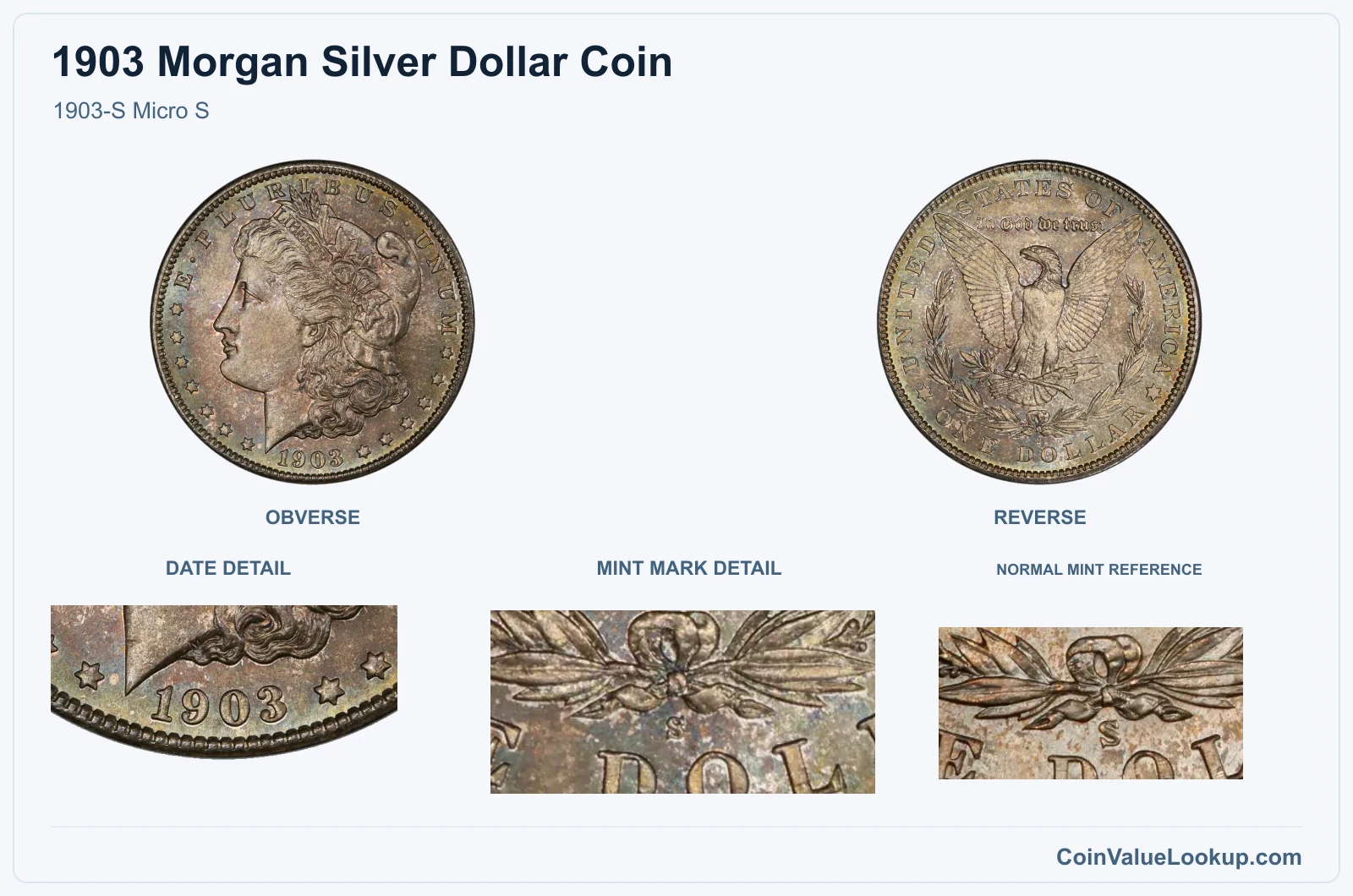
The 1903-S Micro S is a recognized variety where the San Francisco mintmark is noticeably smaller than the standard "S" punch used on other 1903-S dollars. To identify it, compare the size of your mintmark directly against a known normal example at the same magnification.
The difference is visible but not dramatic, so a reference image helps.
This variety is tracked separately from the regular 1903-S. Value depends on the authenticated identity of the variety, the coin's grade and the condition of its surfaces.
Because variety attribution matters here, third-party certification confirming the Micro S designation is important before assigning or paying a premium. Cleaning or damage reduces comparability regardless of the variety.
Range Grade
Price Auction Records Appraisal PO PO 1
—
Coin Identifier FR FR 2
—
Coin Identifier AG AG 3
Coin Identifier G G 4
Coin Identifier
G 6
Coin Identifier VG VG 8
Coin Identifier
VG 10
Coin Identifier F F 12
Coin Identifier
F 15
Coin Identifier VF VF 20
Coin Identifier
VF 25
Coin Identifier
VF 30
Coin Identifier
VF 35
Coin Identifier XF XF 40
Coin Identifier
XF 45
Coin Identifier AU AU 50
Coin Identifier
AU 53
Coin Identifier
AU 55
Coin Identifier
AU 58
Coin Identifier MS MS 60
—
Coin Identifier
MS 61
—
Coin Identifier
MS 62
Coin Identifier
MS 63
—
—
—
MS 64
—
—
—
MS 65
Coin Identifier
MS 66
—
—
—
MS 67
—
—
—
MS 68
—
—
—
MS 69
—
—
—
MS 70
—
—
—
1903 Morgan Silver Dollar — PR
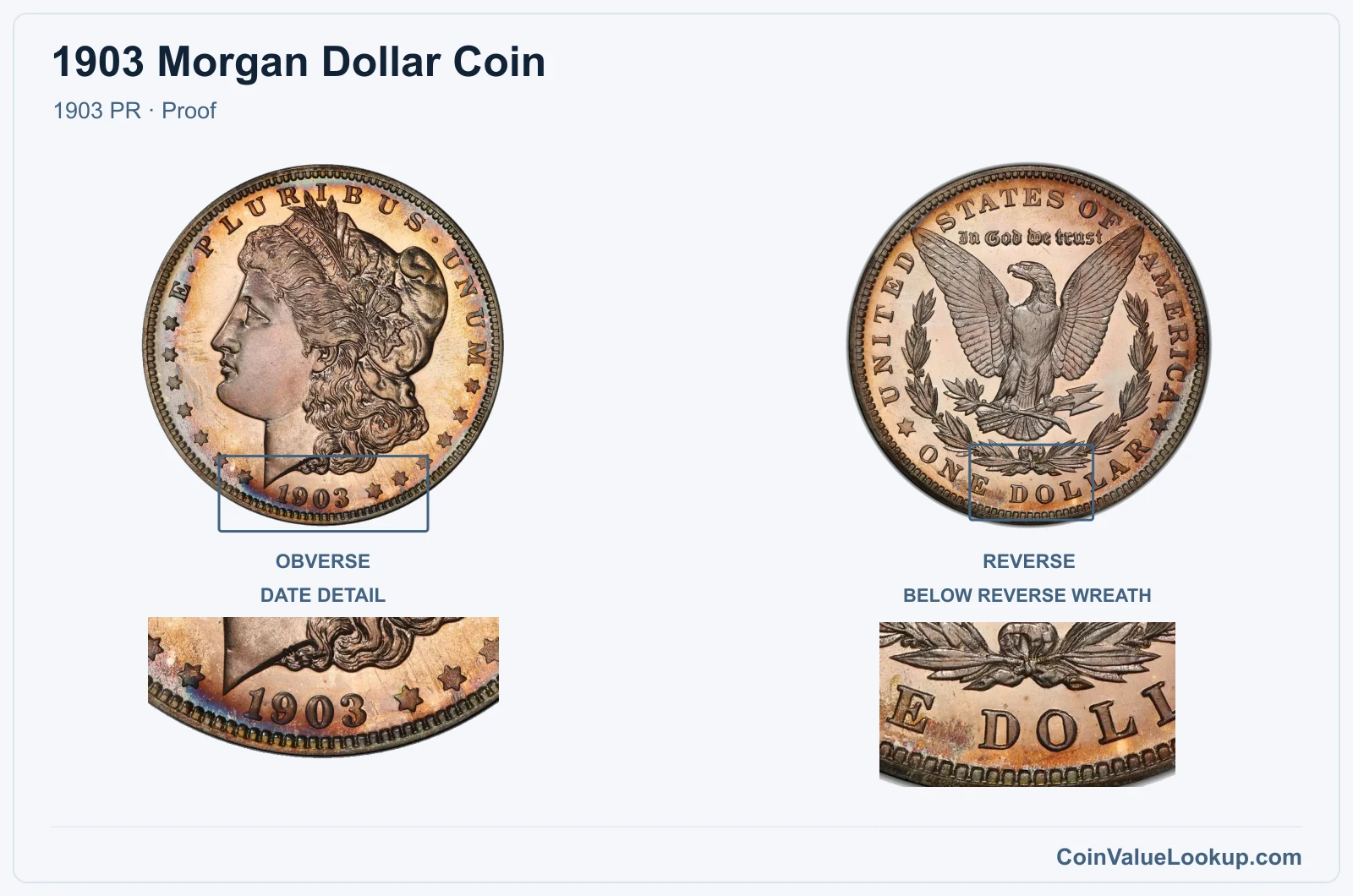
The 1903 Proof Morgan Dollar was manufactured at Philadelphia using specially prepared dies and planchets, producing sharp detail and mirror-like fields by design. A proof is a manufacturing method, not simply a high grade or a shiny coin.
Business strikes with reflective surfaces do not qualify.
Proof Morgans were made in limited quantities for collectors. Grading focuses on hairlines, haze and the preservation of the original mirror finish rather than circulation wear.
Value depends on the authenticated proof designation and the specific grade assigned. Individual assessment through a reputable grading service is the best way to determine what a particular proof example is worth.
Range Grade
Price Auction Records Appraisal PR PR 1
—
Coin Identifier
PR 2
—
Coin Identifier
PR 3
—
Coin Identifier
PR 4
—
Coin Identifier
PR 6
—
Coin Identifier
PR 8
—
Coin Identifier
PR 10
—
Coin Identifier
PR 12
—
Coin Identifier
PR 15
—
Coin Identifier
PR 20
—
Coin Identifier
PR 25
—
Coin Identifier
PR 30
—
Coin Identifier
PR 35
—
Coin Identifier
PR 40
—
Coin Identifier
PR 45
—
Coin Identifier
PR 50
Coin Identifier
PR 53
—
Coin Identifier
PR 55
Coin Identifier
PR 58
Coin Identifier
PR 60
Coin Identifier
PR 61
Coin Identifier
PR 62
Coin Identifier
PR 63
Coin Identifier
PR 64
Coin Identifier
PR 65
Coin Identifier
PR 66
Coin Identifier
PR 67
Coin Identifier
PR 68
Coin Identifier
PR 69
—
—
—
PR 70
—
—
—
1903 Morgan Silver Dollar Error List
1. 1903 Morgan Silver Dollar — Clashed Dies
A clashed die error on the 1903-O Morgan Dollar occurs when the obverse and reverse dies strike each other without a planchet between them. This transfers faint traces of one die's design onto the opposite die.
On struck coins, you may see ghost-like impressions of Liberty's hair or profile in the reverse fields, or eagle feather outlines in the obverse fields.
The reported version for 1903 involves the O-mint coin with clashed dies through debris. Look for the transferred design elements aligned with where the opposite die features would naturally fall.
Random scratches, stray raised lines or post-mint damage do not follow this alignment pattern. Value depends on the visibility and severity of the clash, along with the coin's overall condition.
Authentication is recommended before paying a premium.
2. 1903 Morgan Silver Dollar — Repunched Mintmark
A repunched mintmark on the 1903-S Morgan Dollar shows remnants of a second or shifted "S" mintmark near the primary one. During production, mintmarks were hand-punched into working dies, and a misaligned first impression sometimes left a visible trace when corrected.
To spot this, examine the mintmark area below the wreath bow under magnification. You are looking for doubling, a shadow letter or a partial second impression offset from the main "S." Machine doubling, die chips or corrosion around the mark can mimic an RPM but have different characteristics.
Machine doubling tends to look flat and shelf-like, while a true repunched mintmark shows a rounded, raised secondary impression. Value depends on the clarity of the repunching and overall coin condition.
Third-party confirmation is worth pursuing.
3. 1903 Morgan Silver Dollar — Die Gouge / Named Raised-Line Variety
A die gouge error on the 1903 Philadelphia Morgan Dollar appears as a raised line or lump of extra metal on the coin's surface. This happens when the die itself gets scratched or damaged, and that incuse mark on the die transfers as a raised feature on every coin struck from it.
Look for an unexpected raised line or blob that does not match any part of the normal design. Its position should be consistent across multiple coins from the same die.
An incuse scratch made after the coin left the mint goes into the surface rather than rising above it, which is the key distinction. Unrelated die cracks tend to follow stress patterns across the die face.
Value depends on the prominence and location of the gouge, plus overall grade. Authentication helps confirm it is die-origin rather than post-mint damage.
4. 1903 Morgan Silver Dollar — Struck-Through Error
A struck-through error on a 1903 Morgan Dollar happens when foreign material, such as grease, a thread or a metal fragment, gets between the die and the planchet during striking. The result is a localized depression, an impression of the object or an area of incomplete design.
Grease fill-ins tend to produce soft, rounded areas of missing detail, while a retained foreign object may leave a sharper impression or even remain embedded in the coin. Ordinary wear, cleaning marks and weak strikes from tired dies can look similar at first glance but lack the distinct depression or object outline of a true struck-through.
The size, type of obstruction and location on the design all influence collector interest. Condition of the rest of the coin matters too.
Have the coin examined professionally before assuming it qualifies.
5. 1903 Morgan Silver Dollar — Off-Center Strike
An off-center strike on a 1903 Morgan Dollar occurs when the planchet is not properly seated between the dies, resulting in a shifted design and a blank crescent along one edge. The percentage of off-center displacement and whether the date remains visible are the two biggest factors for collector interest.
A coin with a small shift might be subtle, while a dramatic off-center piece will show a large unstruck area. The date needs to be readable for most collectors to consider it desirable.
Do not confuse this with a clipped planchet, which removes a curved wedge of metal before striking, or with one-sided misalignment where the design is complete but slightly shifted. Post-mint flattening or damage can also mimic displacement.
Value depends on the degree of the error and overall condition, so professional authentication is recommended.