1897 Indian Head Penny Coin Value: How Much Is It Worth?
A regular 1897 Indian Head penny in well-worn Good-4 condition carries a guide value around $3.62, while an uncirculated MS63 example jumps to roughly $92 according to USA Coin Book. Proofs, die varieties and striking errors sit outside that ordinary range and need their own evaluation.
Condition and original surfaces matter a lot here, so let's walk through what to look for.
Fast Way to Identify Your 1897 Indian Head Penny
The quickest way to start figuring out what your 1897 Indian Head penny is worth is to upload clear photos of both the front and back. Our identifier can offer a preliminary read on the coin's version and general condition based on those images.
Snap them in good light, keep the coin flat, and make sure the date is legible.
1897 Indian Head Penny Value
Upload both sides of your 1897 Indian Head Penny.
Front Obverse
Upload photo
Back Reverse
Upload photo
Which 1897 Indian Head Penny Versions Are Worth Money?
- Business strikes in original uncirculated condition (MS63) can reach around $92, far above the $3.62 guide value for a worn Good-4 example.
- Proof strikes carry a separate premium, with a PR63 example listed near $313 in guide references.
- Die varieties such as repunched dates, misplaced dates or doubled dies may add value depending on authenticated identity and condition.
- Coins retaining full original red copper color tend to command stronger prices than brown-toned examples at equivalent grades.
Step 1: Identify Your 1897 Indian Head Penny Mint Mark and Version
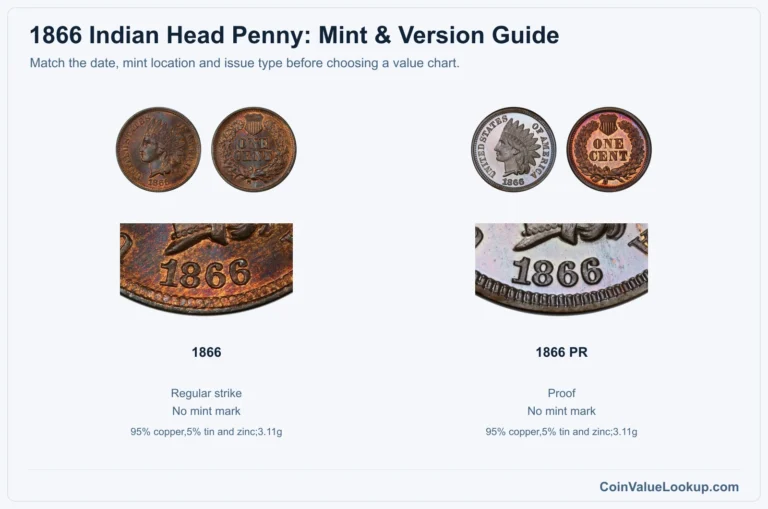
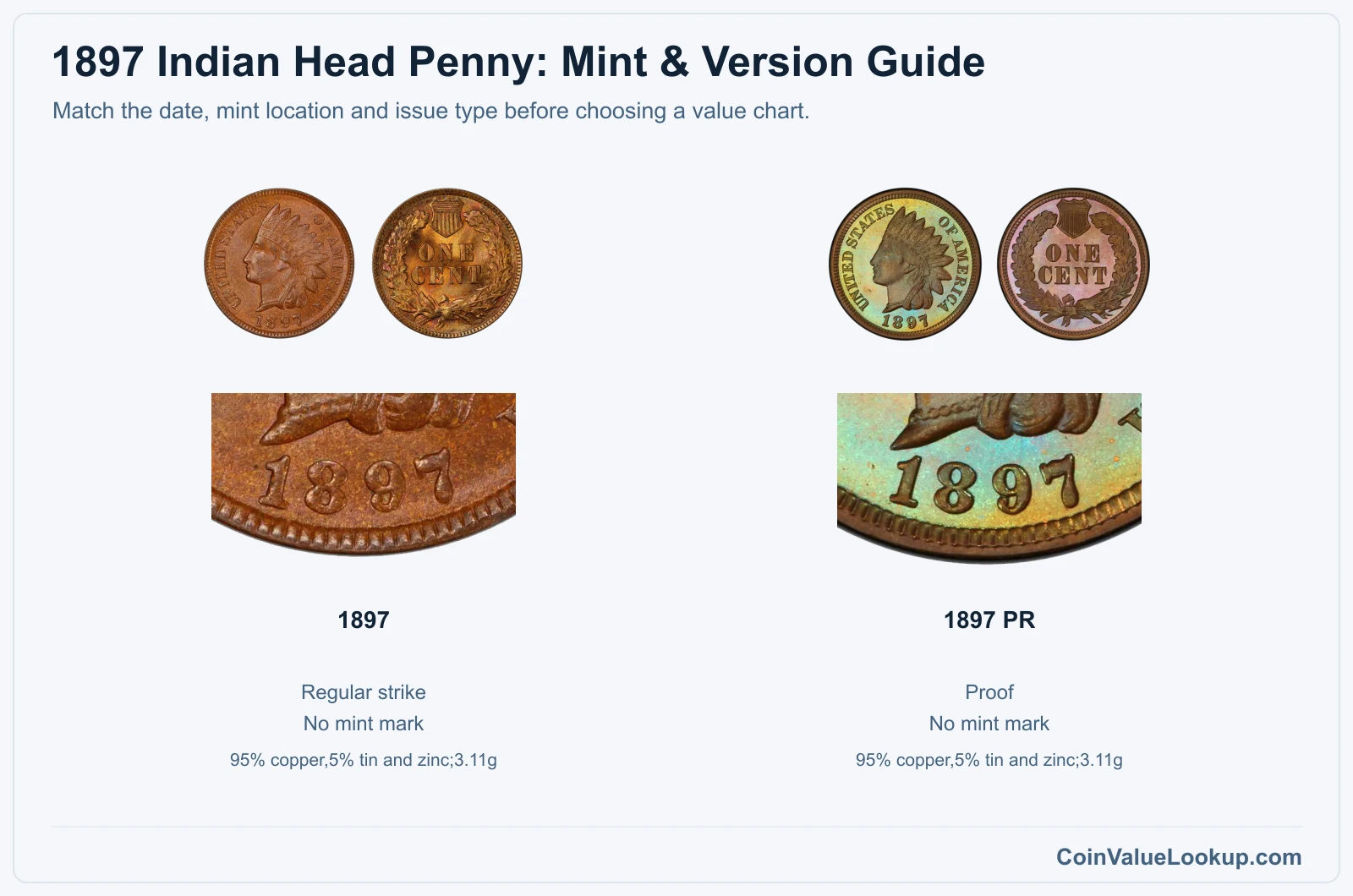
Every regular 1897 Indian Head cent was struck at the Philadelphia Mint. There is no mintmark on this coin, and the small "L" sometimes visible on the ribbon behind the portrait is a designer's initial, not a mint identifier.
The obverse features an idealized portrait wearing a feathered headdress, while the reverse shows an oak wreath surrounding a shield. If your coin has a wheat-ear reverse or a flying eagle, you have a different series entirely.
You need to separate two basic branches: the standard business strike made for circulation and the specially manufactured proof. Proofs were produced in small numbers for collectors and have distinctive mirrored surfaces and sharper rim geometry.
A polished or cleaned business strike can look shiny, but that does not make it a proof. Confirm proof status through surface character, not just reflectivity.
The alloy is bronze: 95% copper with 5% tin and zinc, weighing about 3.11 grams. Color designations like BN, RB or RD describe how much original copper-red color remains; they are not different metals.
Step 2: Check Your 1897 Indian Head Penny Grade
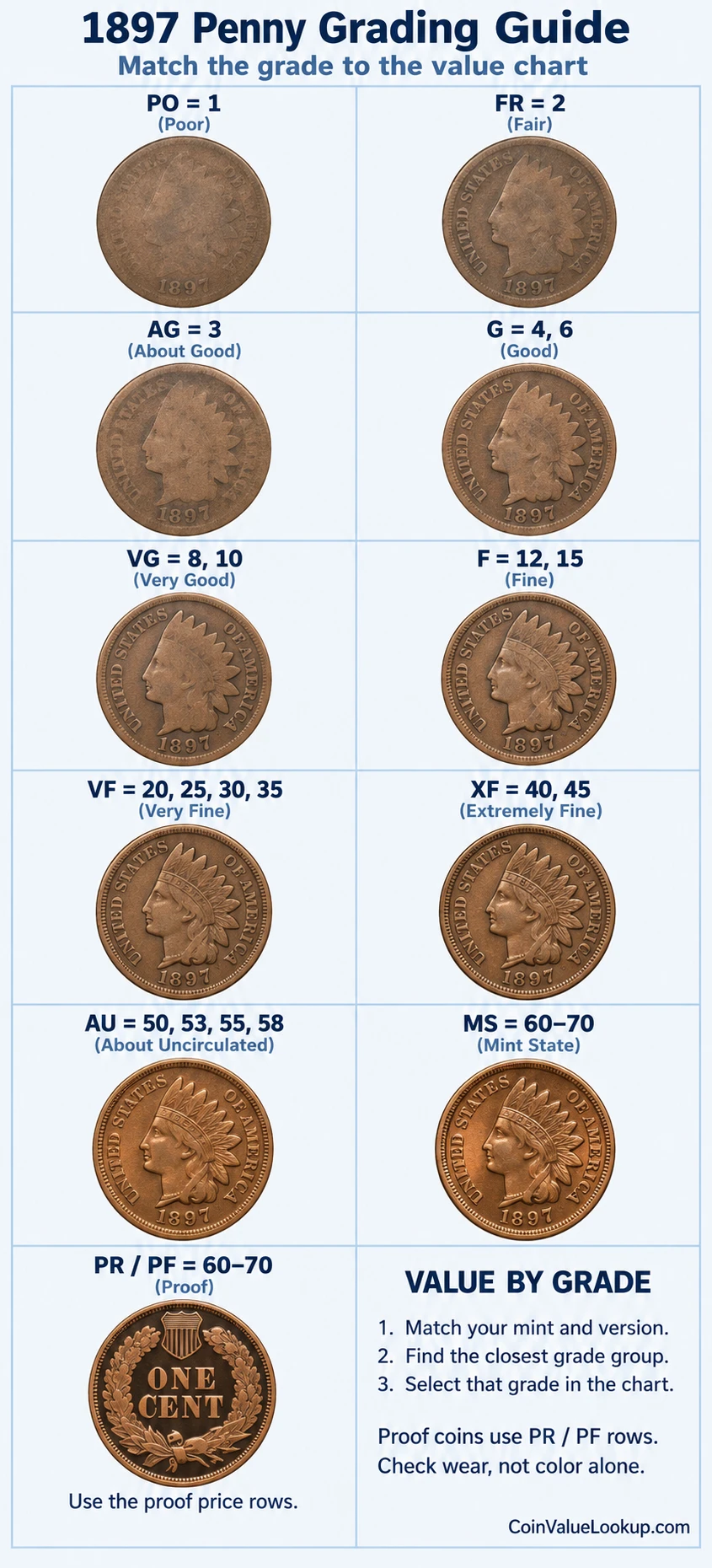
Start with the headband. On a well-struck example, the word LIBERTY is fully readable in higher grades and progressively lost as wear increases.
At Good-4, only a trace or none of LIBERTY may remain, and the portrait is a flat outline.
Check the feather tips above the ear next. These are high points and wear first, but a soft original strike can leave them mushy even without circulation.
Don't call a coin worn solely because one feather is weak.
The cheek and hair below the headdress should show fine detail on mint-state pieces. On the reverse, look at the wreath leaves and the shield.
Flattened leaf veins and a smooth shield indicate moderate to heavy wear.
Luster is your friend. Original mint luster on an 1897 cent looks cartwheel-like under a tilted light.
Once that's gone, the coin has seen some use. Compare your coin against the reference grading image to judge where it falls.
Surface problems — cleaning, scratches, corrosion, environmental damage — reduce both grade and marketability regardless of how sharp the design looks. A cleaned AU can sell for less than an original VF.
Step 3: Check 1897 Indian Head Penny Value by Mint and Version
1897 Indian Head Penny
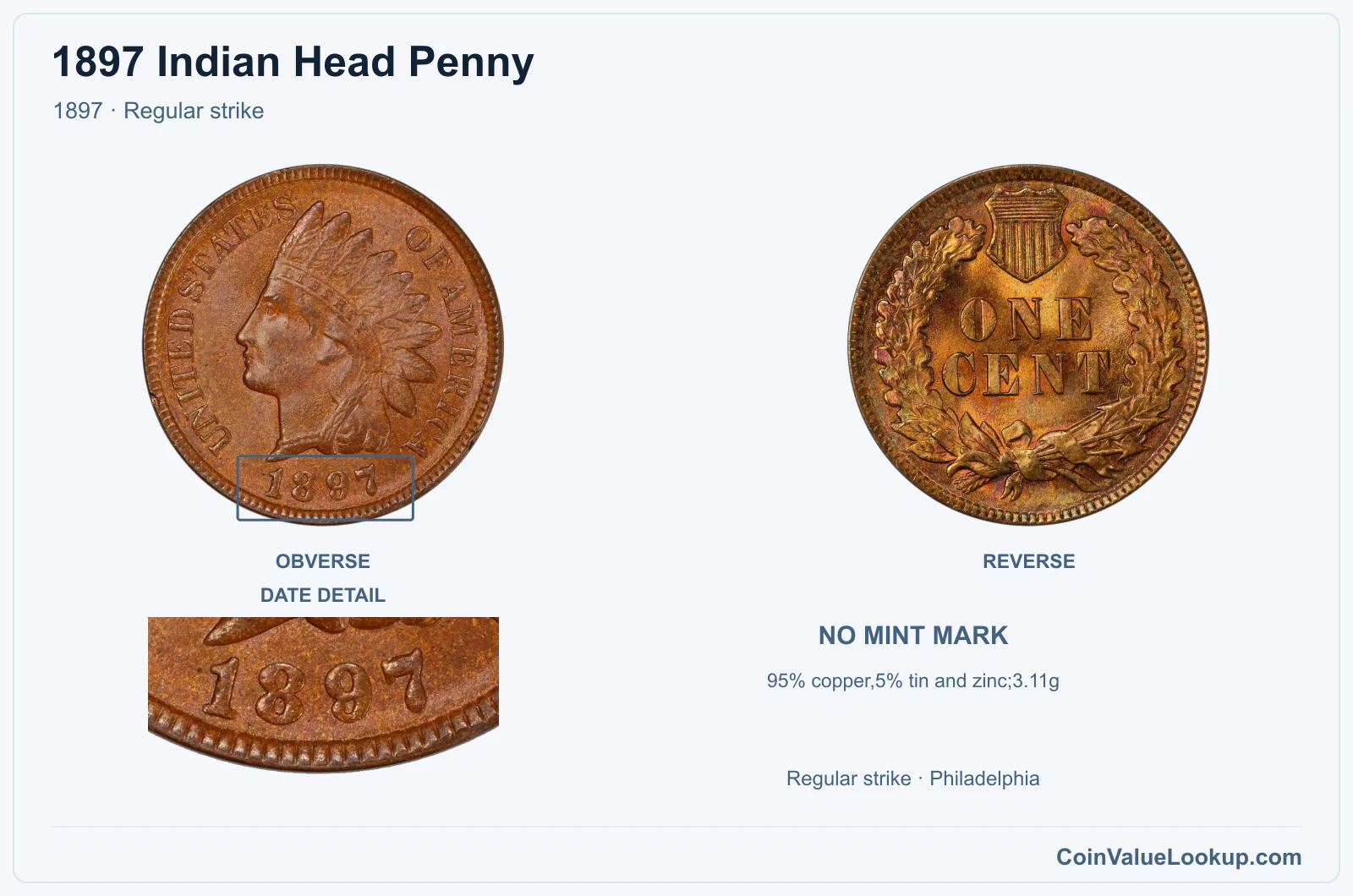
This is the standard 1897 Indian Head cent struck for everyday commerce at Philadelphia. No mintmark appears on the coin.
The bronze alloy weighs about 3.11 grams, and the design pairs the Indian portrait obverse with the oak wreath and shield reverse used from 1860 onward.
USA Coin Book lists a guide value of roughly $3.62 at Good-4 and around $92 at MS63. Those are retail guide estimates, not guaranteed sale prices.
Original surfaces and remaining copper color both influence what a buyer will actually pay. A heavily cleaned or damaged coin will trade well below guide figures even if its wear level looks right.
Coin Value Lookup is a handy starting point if you want to compare this cent's value against other dates in the series or check related denominations.
| Range | Grade | Price | Auction Records | Appraisal |
|---|---|---|---|---|
| PO | PO 1 | — | Coin Identifier | |
| FR | FR 2 | — | Coin Identifier | |
| AG | AG 3 | — | Coin Identifier | |
| G | G 4 | — | Coin Identifier | |
| G 6 | — | Coin Identifier | ||
| VG | VG 8 | Coin Identifier | ||
| VG 10 | — | Coin Identifier | ||
| F | F 12 | — | Coin Identifier | |
| F 15 | — | Coin Identifier | ||
| VF | VF 20 | — | Coin Identifier | |
| VF 25 | — | Coin Identifier | ||
| VF 30 | — | Coin Identifier | ||
| VF 35 | — | Coin Identifier | ||
| XF | XF 40 | Coin Identifier | ||
| XF 45 | Coin Identifier | |||
| AU | AU 50 | — | Coin Identifier | |
| AU 53 | — | Coin Identifier | ||
| AU 55 | Coin Identifier | |||
| AU 58 | Coin Identifier | |||
| MS | MS 60 | — | Coin Identifier | |
| MS 61 | Coin Identifier | |||
| MS 62 | Coin Identifier | |||
| MS 63 | Coin Identifier | |||
| MS 64 | Coin Identifier | |||
| MS 65 | Coin Identifier | |||
| MS 66 | — | — | — | |
| MS 67 | — | — | — | |
| MS 68 | — | — | — | |
| MS 69 | — | — | — | |
| MS 70 | — | — | — |
1897 Indian Head Penny — PR
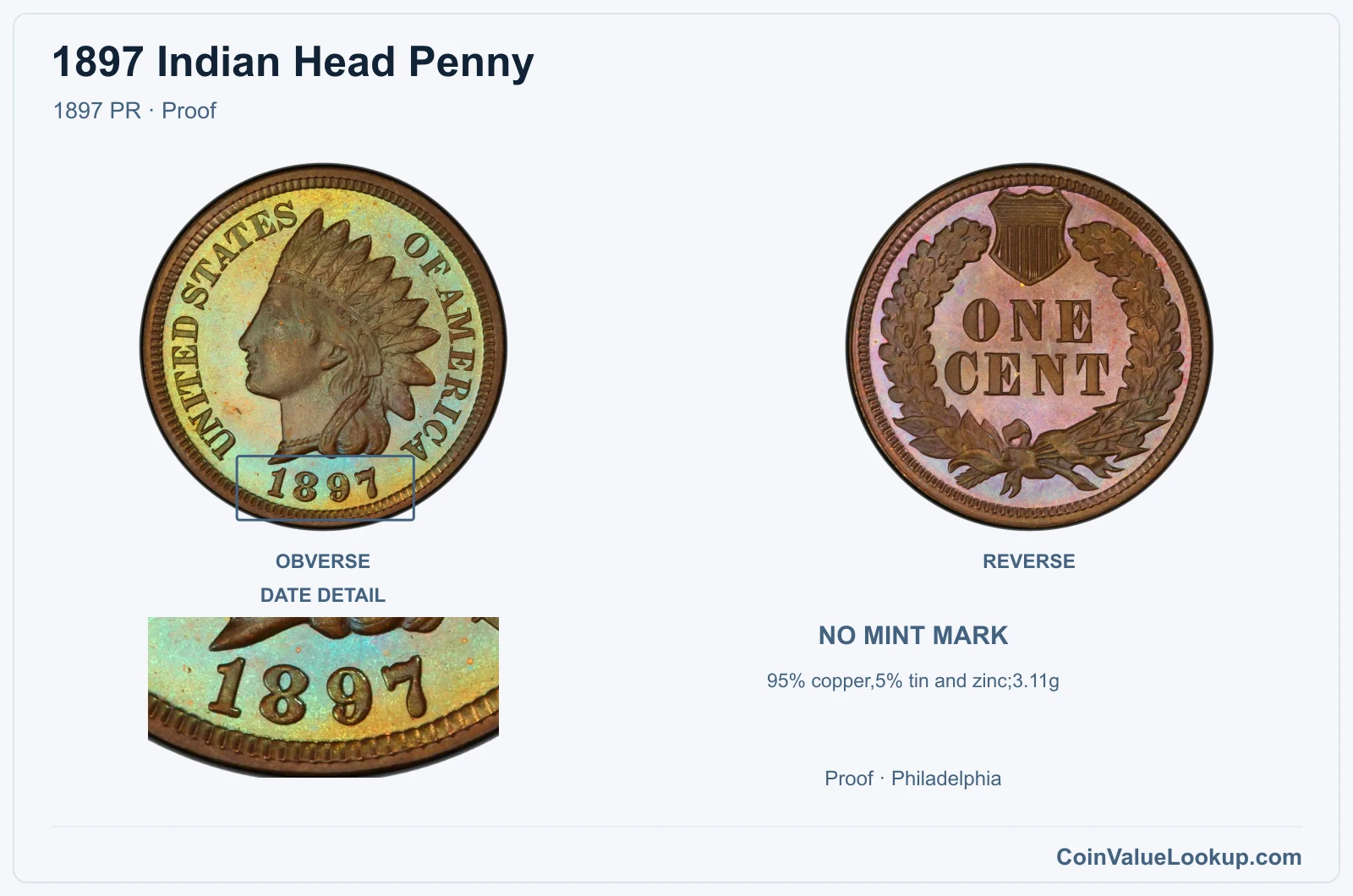
The 1897 proof Indian Head cent was a specially manufactured coin sold directly to collectors, not released into circulation. It shares the same bronze composition, weight and design as the business strike, but it was produced with polished dies and planchets under controlled conditions.
A PR63 example carries a USA Coin Book guide value near $313. That is substantially above even a high-grade business strike, reflecting the proof's limited production and collector demand.
Identifying a genuine proof takes more than noticing a shiny surface. Look for fully squared, knife-edge rims, deeply mirrored fields and sharp design details that exceed what a typical business strike delivers.
A coin that has simply been polished or dipped will lack that characteristic rim geometry and field depth. If you are unsure, professional authentication is worth the fee before you assign proof status and proof pricing.
| Range | Grade | Price | Auction Records | Appraisal |
|---|---|---|---|---|
| PR | PR 1 | — | Coin Identifier | |
| PR 2 | — | Coin Identifier | ||
| PR 3 | — | Coin Identifier | ||
| PR 4 | — | Coin Identifier | ||
| PR 6 | — | Coin Identifier | ||
| PR 8 | — | Coin Identifier | ||
| PR 10 | — | Coin Identifier | ||
| PR 12 | — | Coin Identifier | ||
| PR 15 | — | Coin Identifier | ||
| PR 20 | — | Coin Identifier | ||
| PR 25 | — | Coin Identifier | ||
| PR 30 | — | Coin Identifier | ||
| PR 35 | — | Coin Identifier | ||
| PR 40 | — | Coin Identifier | ||
| PR 45 | — | Coin Identifier | ||
| PR 50 | — | Coin Identifier | ||
| PR 53 | — | Coin Identifier | ||
| PR 55 | — | Coin Identifier | ||
| PR 58 | — | Coin Identifier | ||
| PR 60 | — | Coin Identifier | ||
| PR 61 | Coin Identifier | |||
| PR 62 | Coin Identifier | |||
| PR 63 | Coin Identifier | |||
| PR 64 | Coin Identifier | |||
| PR 65 | Coin Identifier | |||
| PR 66 | Coin Identifier | |||
| PR 67 | Coin Identifier | |||
| PR 68 | — | — | — | |
| PR 69 | — | — | — | |
| PR 70 | — | — | — |
1897 Indian Head Penny Error List
1. 1897 Indian Head Penny — Misplaced Date
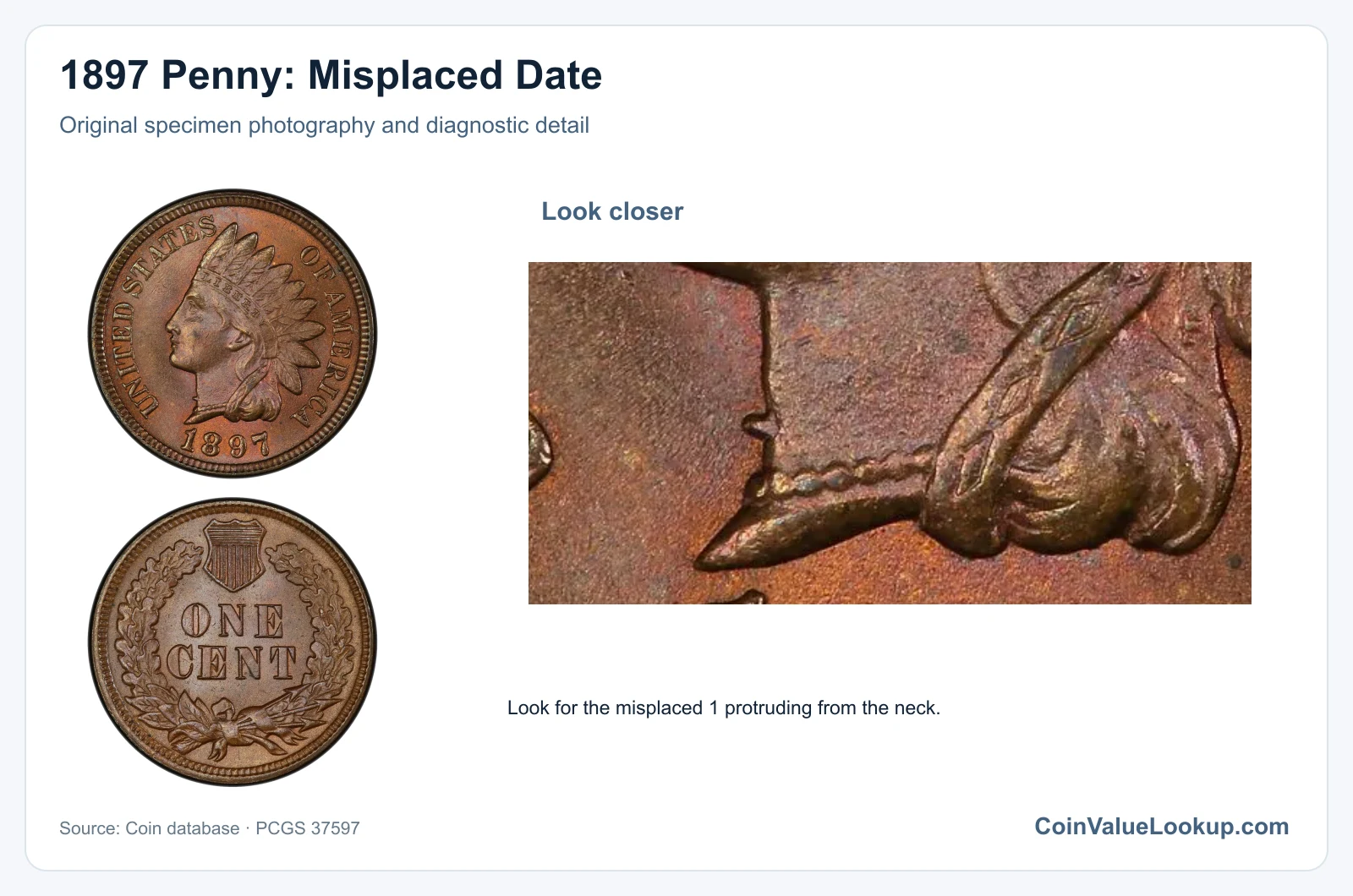
A misplaced date on an 1897 Indian Head cent shows partial impressions of one or more date digits in unexpected locations, typically embedded in the denticles near the base of the portrait or displaced away from where the final date sits. These traces come from an early, off-target punch of the date into the die before correction.
To spot one, examine the denticles and surrounding field near the date under magnification. You are looking for the distinctive curved shape of a numeral, not random lumps.
Die chips, scratches and corrosion can mimic a partial digit at first glance, so compare what you see against known examples.
No specific price range is supported for this variety. Value depends on the authenticated identity, the clarity of the misplaced digits and overall coin condition, so individual assessment by a knowledgeable dealer or grading service is the way to go.
2. 1897 Indian Head Penny — Repunched Date
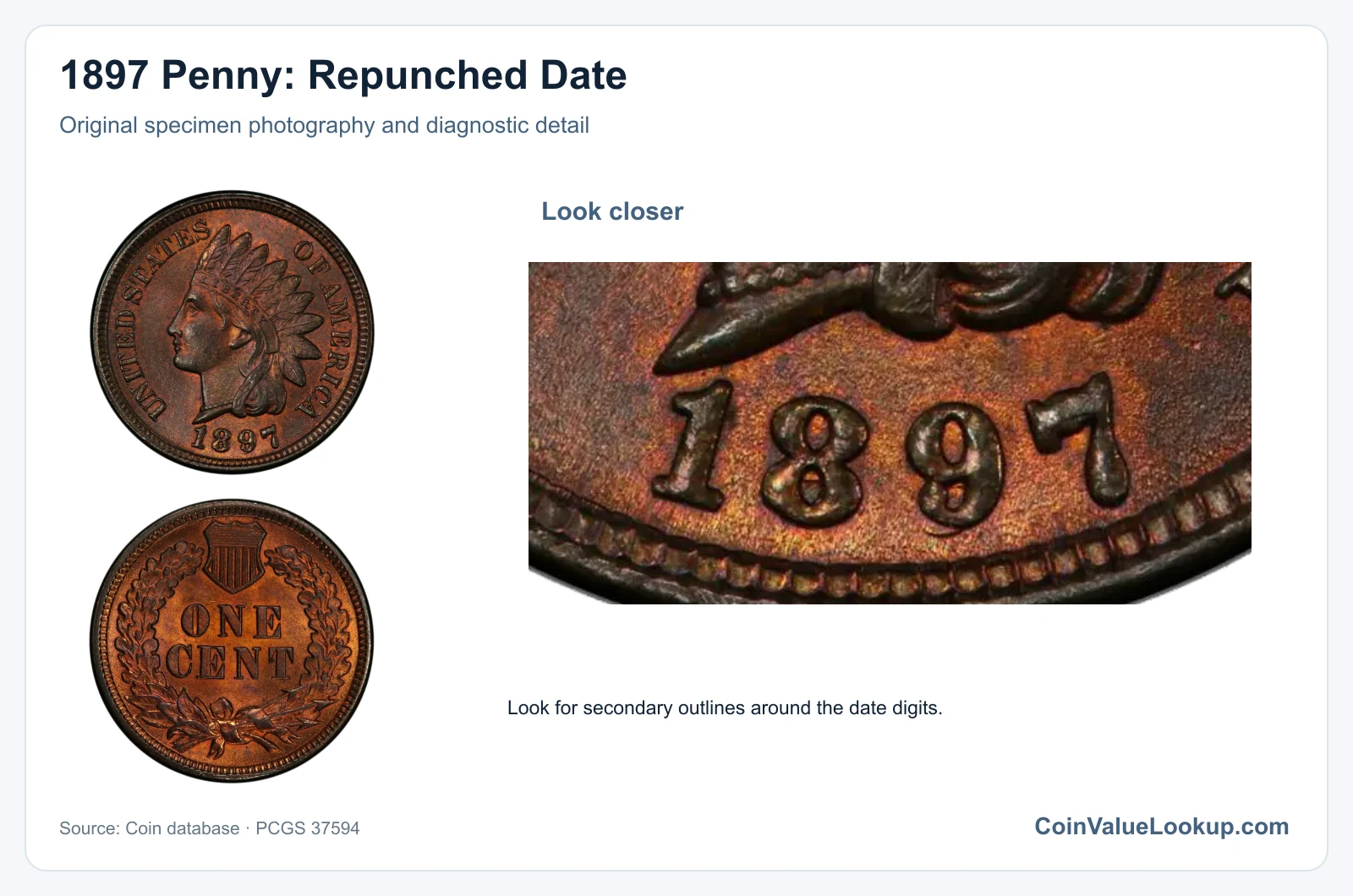
Repunched dates on the 1897 Indian Head cent occur when the date numerals were punched into the working die more than once in slightly different positions. The result is visible remnants of the earlier punch sitting beside or overlapping the final date digits.
Under magnification, look for a shadow or secondary outline near one or more of the numerals — typically a slight offset or doubling confined to the date area. This is distinct from a doubled die, which affects the entire obverse design through a hub error rather than manual punching.
Damaged dates and machine doubling are common lookalikes. Machine doubling produces a flat, shelf-like distortion rather than the rounded, clearly separated secondary image of a repunched date.
No supported price range exists for this variety; value hinges on authenticated attribution, the strength of the repunching and the coin's condition.
3. 1897 Indian Head Penny — Die Crack
Die cracks appear as thin, raised lines running across the surface of the coin. On an 1897 Indian Head cent, you might find one crossing the field, cutting through letters or running from the rim into the design.
They are raised because the cracked die allowed metal to flow into the gap during striking.
When examining your coin, note where the line begins and where it ends. A genuine die crack is raised above the surrounding surface and follows a somewhat irregular path.
An incuse scratch, by contrast, cuts into the metal. Corrosion lines and displaced-metal scrapes can also imitate a crack, so check with magnification.
There is no adopted price range for die cracks on this date. The length, location and visual impact of the crack, combined with the coin's overall grade, determine any premium.
Individual assessment is recommended.
4. 1897 Indian Head Penny — Die Break / Cud
A cud is a specific type of die break where a piece of the die has broken away at the rim, leaving a raised, featureless blob of metal on the struck coin that connects directly to the edge. On an 1897 Indian Head cent, a cud will obliterate part of the design where it sits and show a smooth, rounded boundary where the die fragment separated.
Smaller interior die breaks that do not reach the rim can also appear as raised lumps, but they are not technically cuds. Rim dents from post-mint damage are recessed rather than raised, and corrosion will show a different texture under magnification.
No specific price range is supported for cuds on this date. A large, dramatic cud that displaces recognizable design elements tends to attract more collector interest than a small chip near the edge, so evaluation depends on size, position and the coin's condition.
5. 1897 Indian Head Penny — Rotated Dies
Normal United States coins are struck in medal alignment: hold the obverse upright, flip the coin top to bottom and the reverse should also appear upright. A rotated die error means the reverse is turned to some degree away from that standard orientation.
To test your 1897 Indian Head cent, hold the obverse so the portrait faces you correctly, then flip the coin along its vertical axis. If the wreath on the reverse is tilted, you may have a die rotation.
Make sure you are flipping top-to-bottom, not left-to-right, or you will get a false reading. Also confirm the tilt is not just your photograph being crooked.
No adopted price range exists for rotated dies on this date. Greater degrees of rotation generally attract more interest, and professional confirmation is worthwhile before assigning any premium.
6. 1897 Indian Head Penny — Die Gouge / Named Raised-Line Variety
A die gouge on an 1897 Indian Head cent shows up as a raised line or blob of extra metal in a specific location on the coin's surface. It is caused by damage to the die itself — a scratch or nick in the steel that fills with metal during striking and produces a raised feature on every coin struck from that die.
The key diagnostic is that the feature is raised, not incuse. An incuse scratch on the coin's surface is post-mint damage, not a die gouge.
Die cracks are also raised but tend to follow longer, more irregular paths, while a gouge is usually shorter and more localized.
Some die gouges have earned collector nicknames based on their appearance or location. No supported price range is available for this category on the 1897 date.
Value depends on the specific variety, its visual prominence and the coin's overall condition.
7. 1897 Indian Head Penny — Doubled Die Obverse
A doubled die obverse on the 1897 Indian Head cent results from a misalignment during the hubbing process that created the die, leaving a secondary impression of design elements on the obverse. Under magnification, affected letters, the date or portrait details will show consistent separation or notching — a clear secondary outline rather than a flat, shelf-like distortion.
Machine doubling is the most common lookalike and is far less valuable. It produces a flat, displaced shelf on the design elements and lacks the rounded, three-dimensional secondary image of a true doubled die.
Worn die contours and reflections under certain lighting can also fool you.
Compare your coin's obverse lettering and design details against a normal example under matching light conditions. No adopted price range exists for this variety on the 1897 date, so individual assessment based on authenticated attribution, doubling strength and coin condition is necessary.
8. 1897 Indian Head Penny — Off-Center Strike
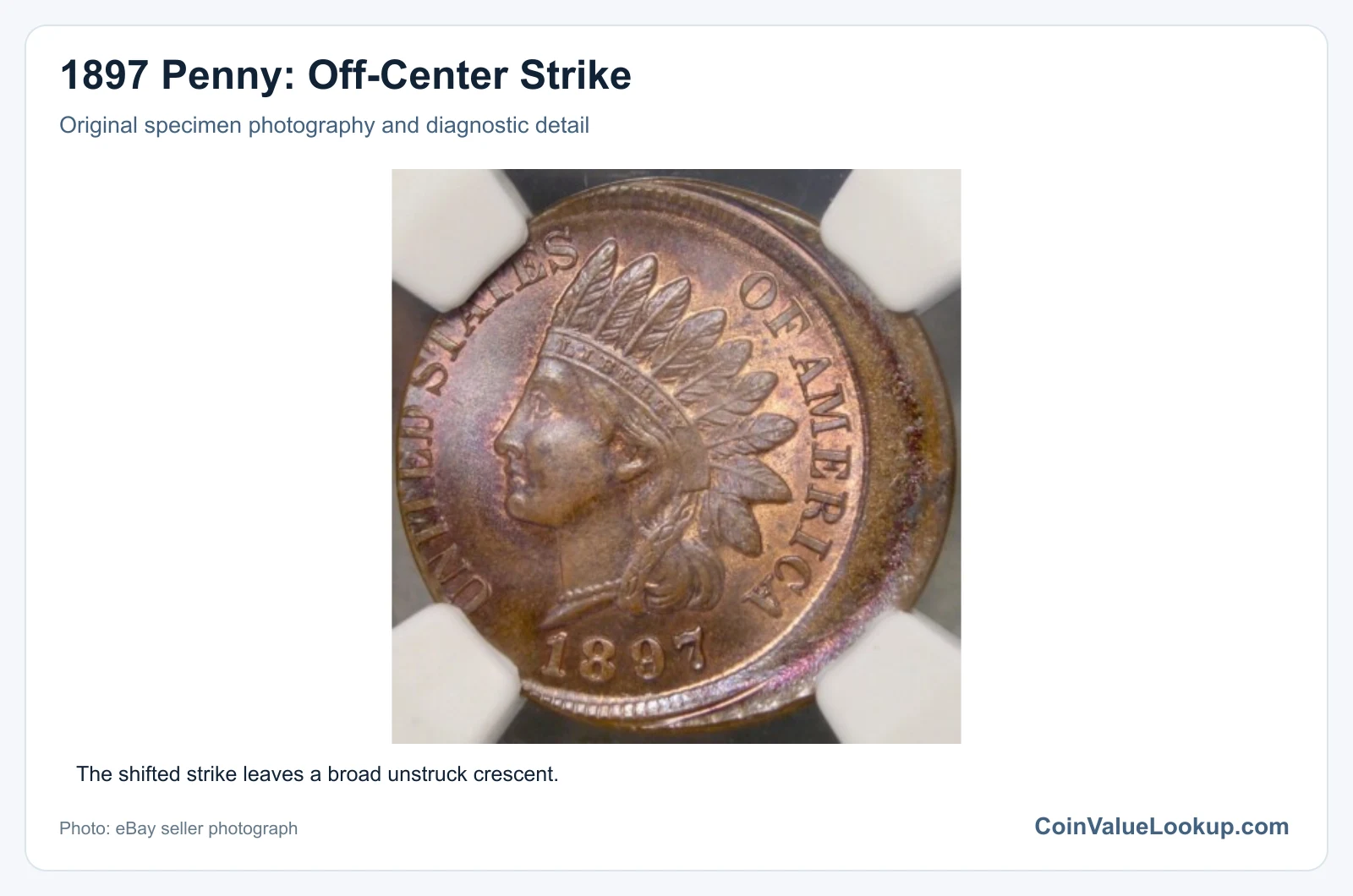
An off-center strike happens when the planchet is not properly seated in the coining chamber, so the dies impress the design shifted to one side. The result is a crescent-shaped blank area on part of the coin where no design was struck at all.
On an 1897 Indian Head cent, the key collecting consideration is whether the date remains fully visible despite the off-center shift. A coin with a readable date is far more identifiable and desirable than one where the date has disappeared into the unstruck area.
Do not confuse off-center strikes with clipped planchets, which have a curved missing section but a fully centered design. One-sided die misalignment and post-mint flattening can also create misleading appearances.
No supported price range is available, so value depends on the percentage of off-center shift, date visibility, condition and professional authentication.