2019 Jefferson Nickel Coin Value: How Much Is It Worth?
The 2019 Jefferson nickel is a common modern issue, and most circulated examples are worth face value. For uncirculated Philadelphia and Denver business strikes, retail guide estimates run about $0.30 at MS60 to $0.61 at MS65.
Proofs and coins with certified Full Steps designations occupy their own pricing tiers, and authentic error coins need individual assessment.
Fast Way to Identify Your 2019 Jefferson Nickel
The quickest way to start figuring out what your 2019 nickel is worth is to upload clear photos of both the front and back. Our identifier can give you a preliminary read on which version you have based on mintmark, finish and overall condition.
It is not a substitute for professional authentication or exact grading, but it points you in the right direction.
2019 Jefferson Nickel Value
Upload both sides of your 2019 Jefferson Nickel.
Front Obverse
Upload photo
Back Reverse
Upload photo
Which 2019 Jefferson Nickel Versions Are Worth Money?
- Certified high-grade Mint State examples with a Full Steps designation can command premiums well above ordinary uncirculated values for the P and D mints.
- The 2019-S proof is a separate collector market; a guide estimate of about $5.30 at PR65 reflects the proof finish, not just condition.
Step 1: Identify Your 2019 Jefferson Nickel Mint Mark and Version
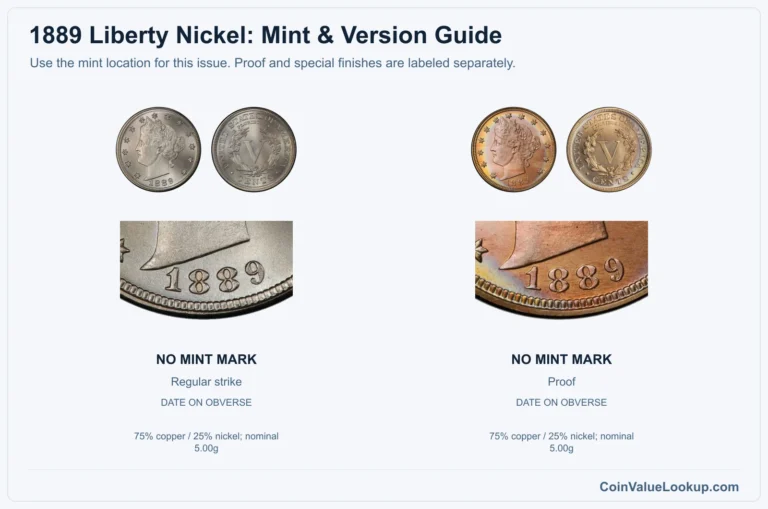
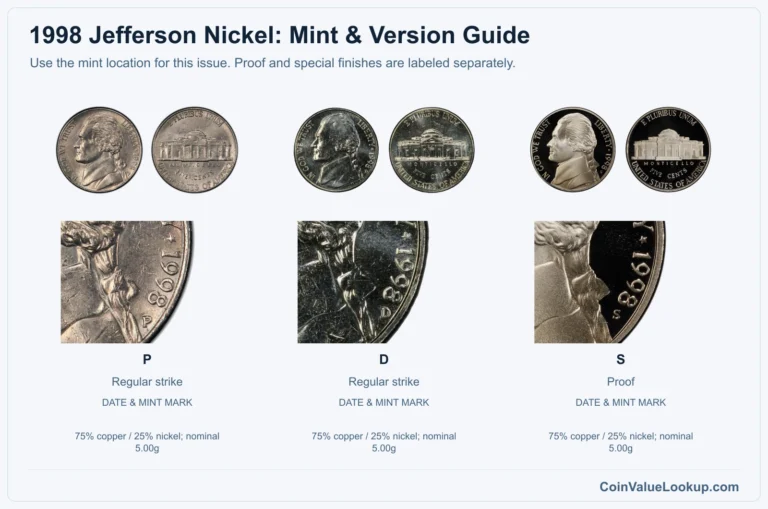
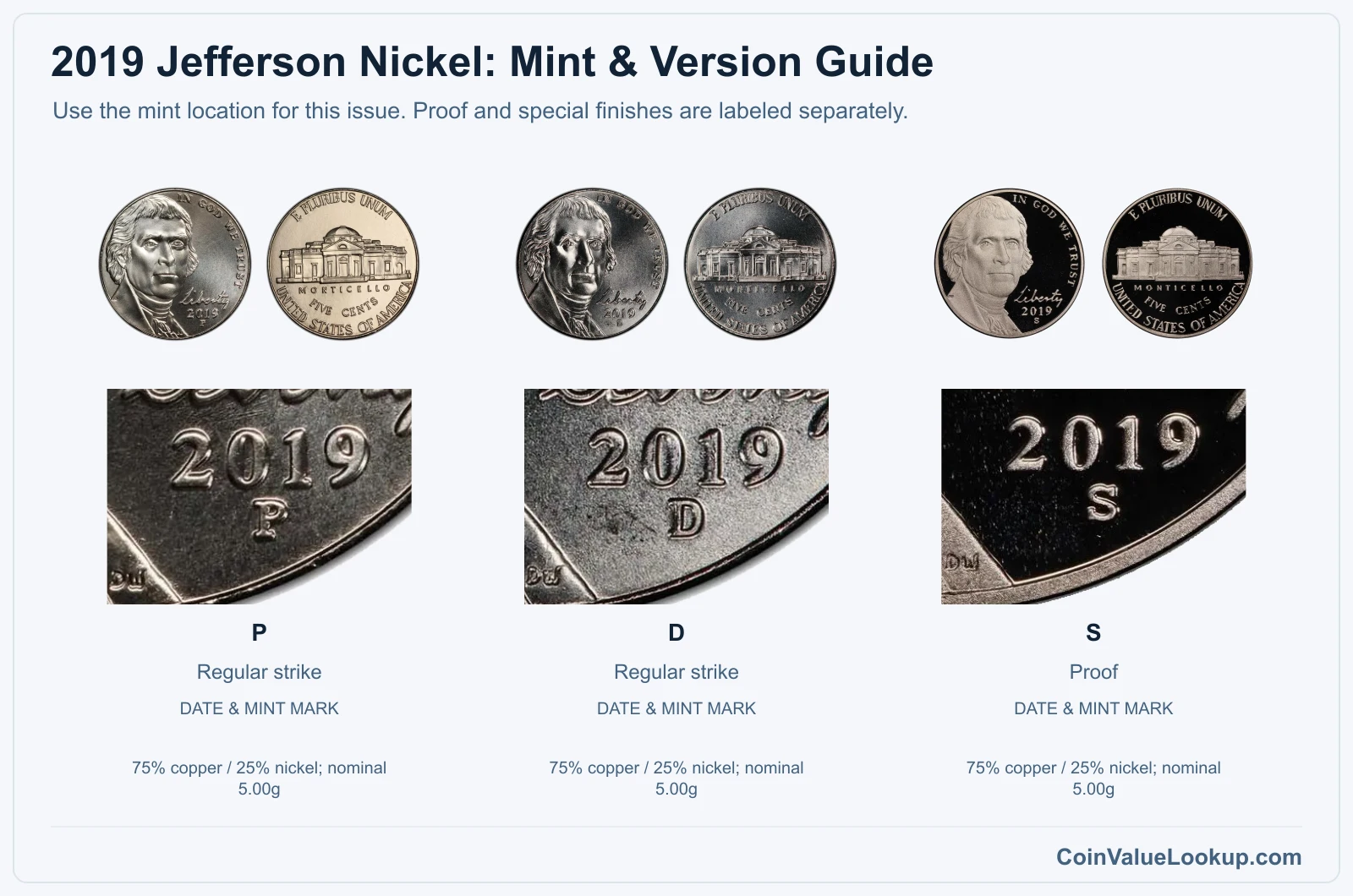
Flip the coin to the obverse and find the mintmark just below the date. You will see a P for Philadelphia, a D for Denver, or an S for San Francisco.
All three share the same forward-facing Jefferson portrait on the front and Monticello on the reverse.
The standard alloy is 75 percent copper and 25 percent nickel, weighing 5 grams with a 21.2 mm diameter and a plain edge. There is no silver version of this coin, so do not let the color fool you.
The S-mint coin is a proof, struck with polished dies for collectors. A shiny circulation-strike nickel is not a proof; proof coins have sharp, mirror-like fields and were sold in sealed sets, not released into pocket change.
Distinguishing finish from condition matters before you try to assign a value.
Step 2: Check Your 2019 Jefferson Nickel Grade
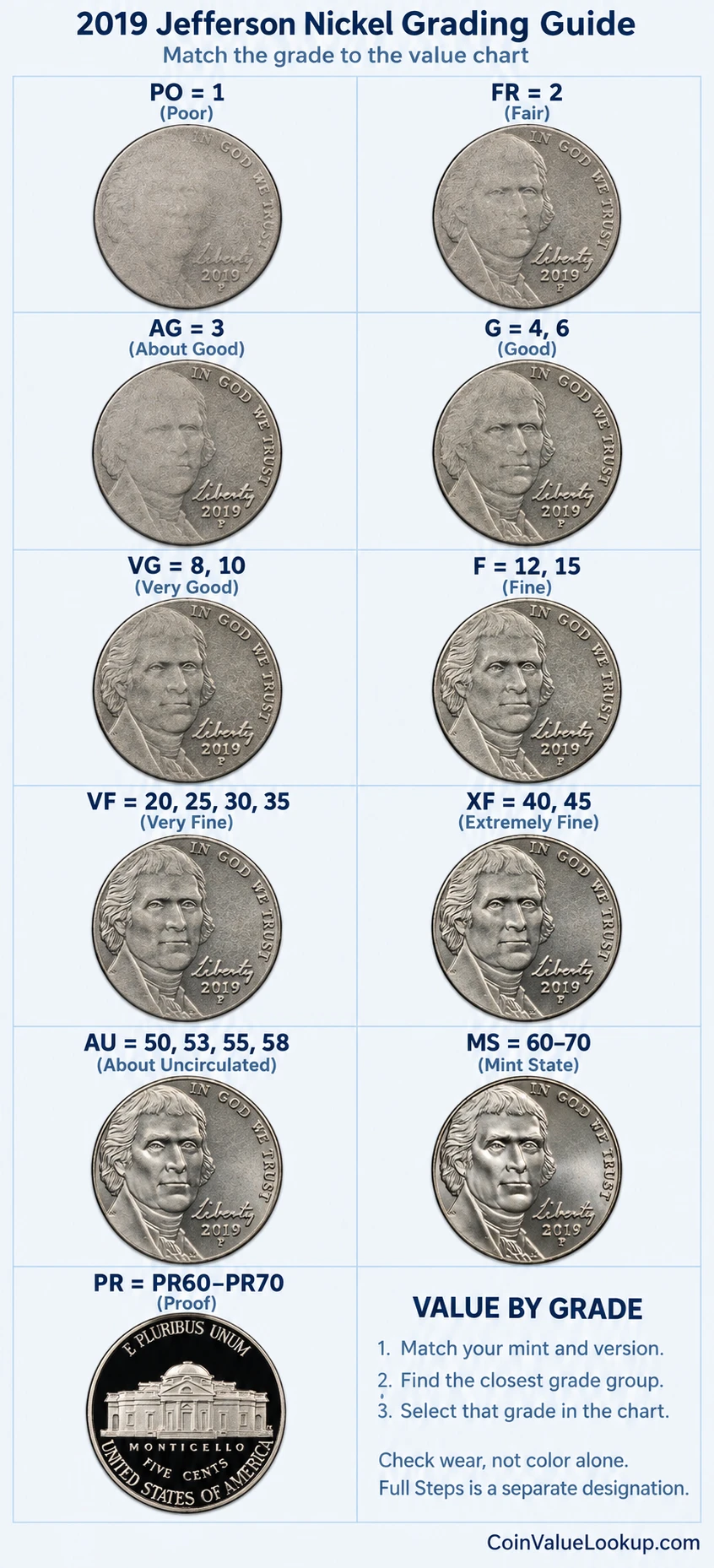
Start with Jefferson's cheek, the hair detail above his ear, and the shoulder area. These are the first spots to lose sharpness on a circulated nickel.
On the reverse, check the columns and steps of Monticello.
A Full Steps designation means the steps at the base of Monticello are fully separated and distinct. That label reflects strike quality, not the coin's overall grade, so a coin can be MS65 without Full Steps and vice versa.
Luster matters a lot on modern nickels. An uncirculated coin should have unbroken cartwheel luster across both sides.
Contact marks and scuffs from bag handling pull the grade down even without actual wear.
Use the comparison image to match your coin's detail level against known grade benchmarks for this same portrait type. Do not compare against older-style Jefferson nickels with a different relief.
Step 3: Check 2019 Jefferson Nickel Value by Mint and Version
2019 Jefferson Nickel — P Business strike
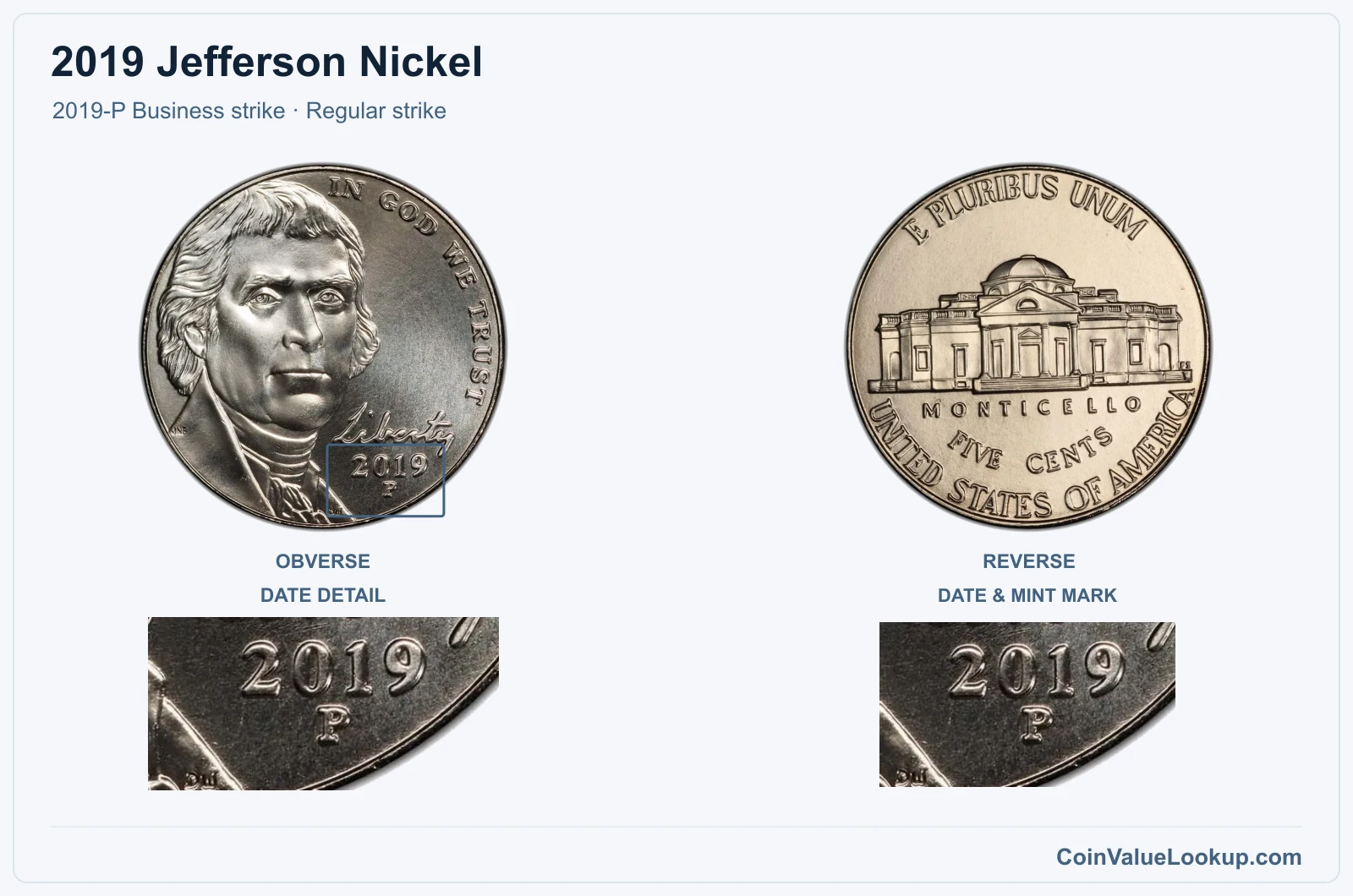
The 2019-P business strike is the Philadelphia issue, carrying a small P mintmark below the date. It is struck on a standard 75 percent copper, 25 percent nickel planchet weighing 5 grams.
Retail guide estimates place ordinary examples around $0.30 at MS60 and $0.61 at MS65.
Those figures cover typical uncirculated coins without special designations. A piece certified with Full Steps or in an exceptionally high Mint State grade will sit in a different value range entirely.
Circulated examples are still just worth five cents.
Coin Value Lookup is a handy starting point if you want to look up guides for this nickel or other coins in the Jefferson series.
| Range | Grade | Price | Auction Records | Appraisal |
|---|---|---|---|---|
| PO | PO 1 | — | Coin Identifier | |
| FR | FR 2 | — | Coin Identifier | |
| AG | AG 3 | — | Coin Identifier | |
| G | G 4 | — | Coin Identifier | |
| G 6 | — | Coin Identifier | ||
| VG | VG 8 | — | Coin Identifier | |
| VG 10 | — | Coin Identifier | ||
| F | F 12 | — | Coin Identifier | |
| F 15 | — | Coin Identifier | ||
| VF | VF 20 | — | Coin Identifier | |
| VF 25 | — | Coin Identifier | ||
| VF 30 | — | Coin Identifier | ||
| VF 35 | — | Coin Identifier | ||
| XF | XF 40 | — | Coin Identifier | |
| XF 45 | — | Coin Identifier | ||
| AU | AU 50 | — | Coin Identifier | |
| AU 53 | — | Coin Identifier | ||
| AU 55 | — | Coin Identifier | ||
| AU 58 | — | Coin Identifier | ||
| MS | MS 60 | — | Coin Identifier | |
| MS 61 | — | Coin Identifier | ||
| MS 62 | — | Coin Identifier | ||
| MS 63 | — | Coin Identifier | ||
| MS 64 | — | Coin Identifier | ||
| MS 65 | — | Coin Identifier | ||
| MS 66 | — | — | — | |
| MS 67 | — | — | — | |
| MS 68 | — | — | — | |
| MS 69 | — | — | — | |
| MS 70 | — | — | — |
2019 Jefferson Nickel — D Business strike
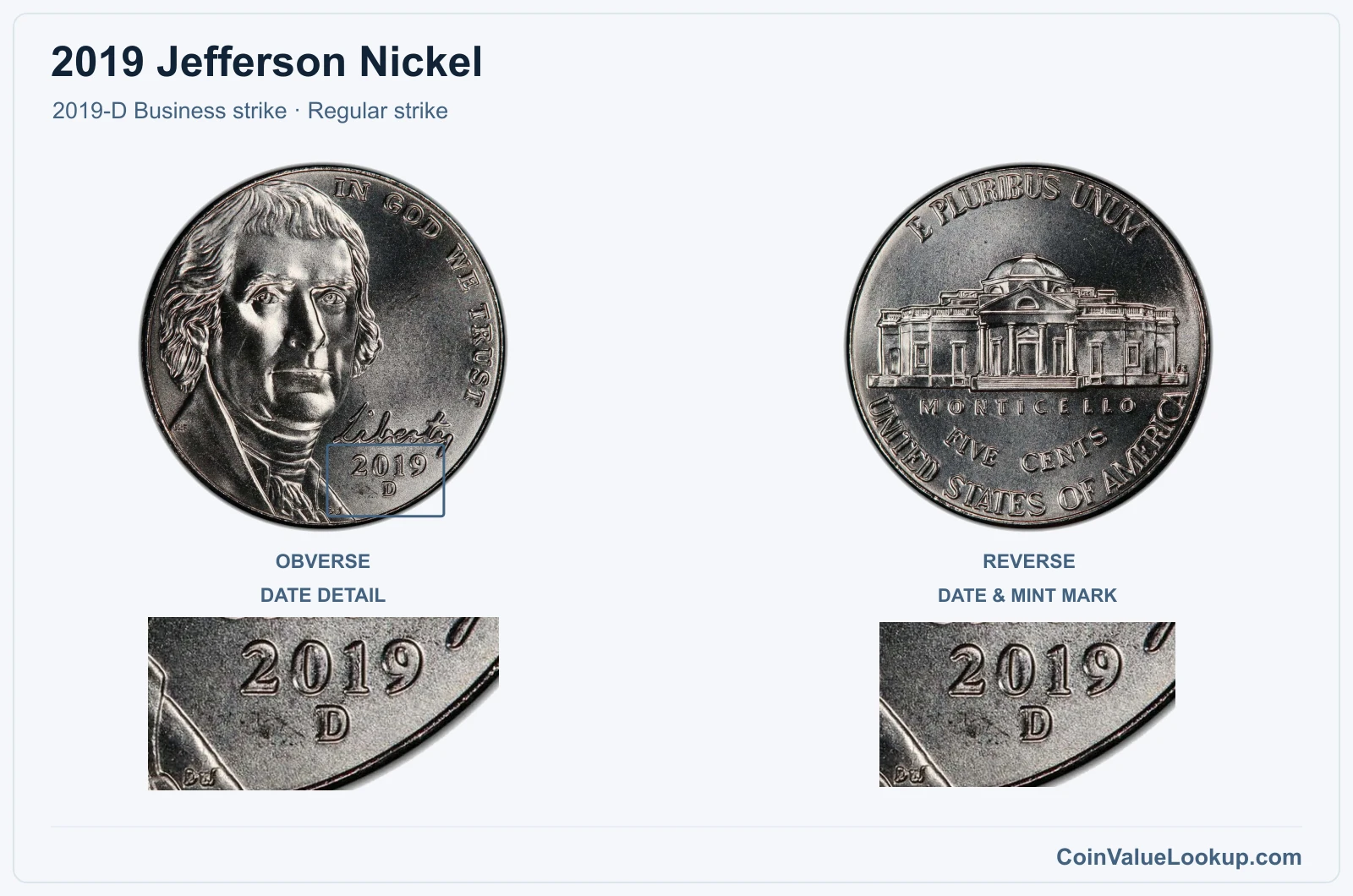
The 2019-D comes from the Denver Mint and shows a D mintmark below the date. Same alloy, same weight, same design as the Philadelphia coin.
Retail guide estimates are also about $0.30 at MS60 and $0.61 at MS65 for ordinary uncirculated pieces.
Like the P-mint version, these numbers do not account for Full Steps coins or those grading well above MS65. A worn 2019-D nickel pulled from circulation has no premium over face value.
Focus on luster and strike sharpness if you think yours might be uncirculated.
| Range | Grade | Price | Auction Records | Appraisal |
|---|---|---|---|---|
| PO | PO 1 | — | Coin Identifier | |
| FR | FR 2 | — | Coin Identifier | |
| AG | AG 3 | — | Coin Identifier | |
| G | G 4 | — | Coin Identifier | |
| G 6 | — | Coin Identifier | ||
| VG | VG 8 | — | Coin Identifier | |
| VG 10 | — | Coin Identifier | ||
| F | F 12 | — | Coin Identifier | |
| F 15 | — | Coin Identifier | ||
| VF | VF 20 | — | Coin Identifier | |
| VF 25 | — | Coin Identifier | ||
| VF 30 | — | Coin Identifier | ||
| VF 35 | — | Coin Identifier | ||
| XF | XF 40 | — | Coin Identifier | |
| XF 45 | — | Coin Identifier | ||
| AU | AU 50 | — | Coin Identifier | |
| AU 53 | — | Coin Identifier | ||
| AU 55 | — | Coin Identifier | ||
| AU 58 | — | Coin Identifier | ||
| MS | MS 60 | — | Coin Identifier | |
| MS 61 | — | Coin Identifier | ||
| MS 62 | — | Coin Identifier | ||
| MS 63 | — | Coin Identifier | ||
| MS 64 | — | Coin Identifier | ||
| MS 65 | — | Coin Identifier | ||
| MS 66 | — | Coin Identifier | ||
| MS 67 | — | — | — | |
| MS 68 | — | — | — | |
| MS 69 | — | — | — | |
| MS 70 | — | — | — |
2019 Jefferson Nickel — S Proof
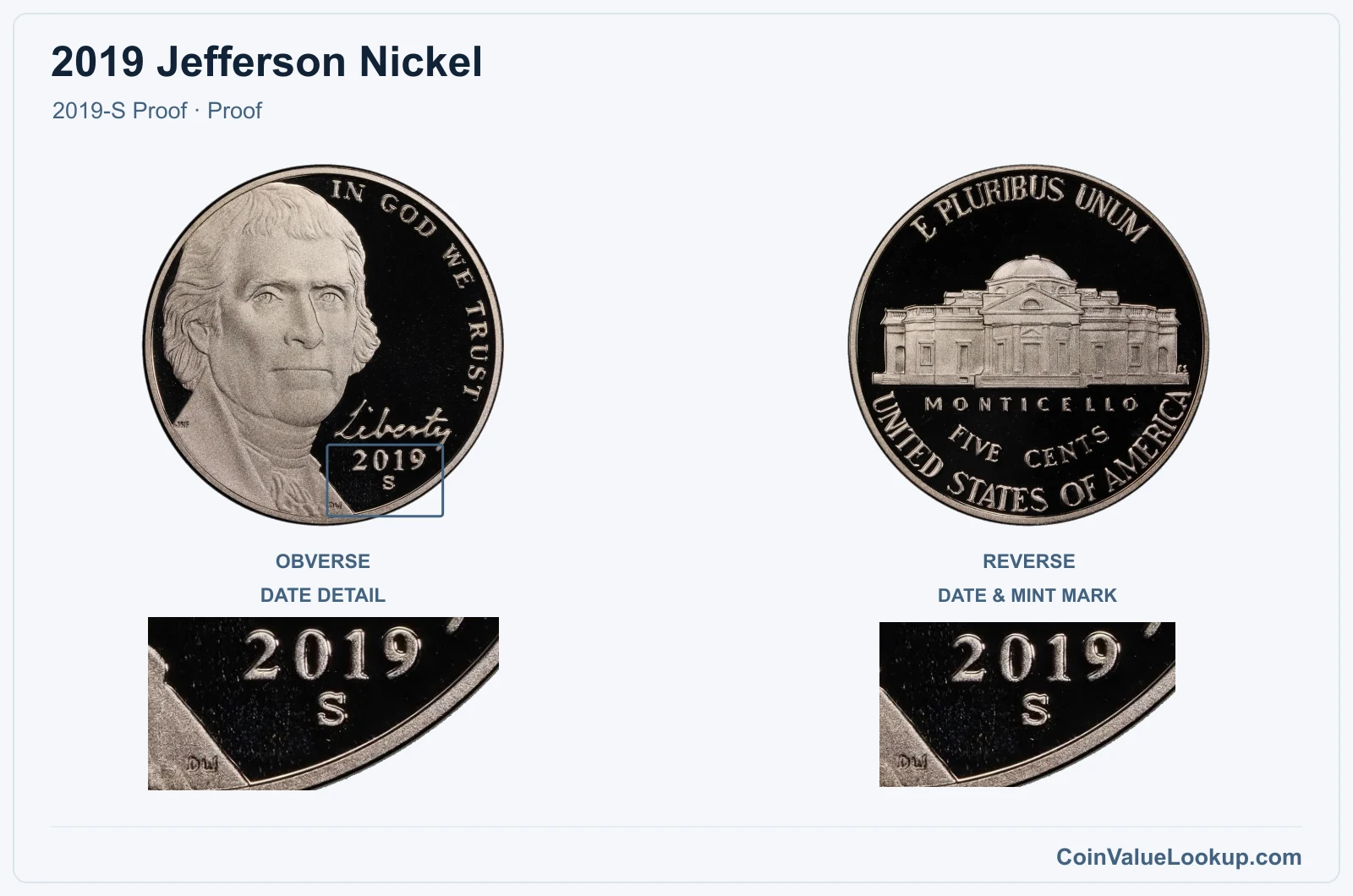
The 2019-S proof was struck at the San Francisco Mint exclusively for collector sets. It carries an S mintmark and has mirror-like fields with sharply defined devices, a result of the proof striking process using polished dies and planchets.
A retail guide estimate places it around $5.30 at PR65. That is a modest figure, typical for a modern proof nickel, but it still far exceeds face value.
Coins grading higher or carrying a deep cameo contrast designation are valued separately from this ordinary PR65 anchor.
Do not confuse a well-preserved business strike for a proof. True proofs were never released into circulation and have a distinctly different surface character when examined under light.
| Range | Grade | Price | Auction Records | Appraisal |
|---|---|---|---|---|
| PR | PR 1 | — | Coin Identifier | |
| PR 2 | — | Coin Identifier | ||
| PR 3 | — | Coin Identifier | ||
| PR 4 | — | Coin Identifier | ||
| PR 6 | — | Coin Identifier | ||
| PR 8 | — | Coin Identifier | ||
| PR 10 | — | Coin Identifier | ||
| PR 12 | — | Coin Identifier | ||
| PR 15 | — | Coin Identifier | ||
| PR 20 | — | Coin Identifier | ||
| PR 25 | — | Coin Identifier | ||
| PR 30 | — | Coin Identifier | ||
| PR 35 | — | Coin Identifier | ||
| PR 40 | — | Coin Identifier | ||
| PR 45 | — | Coin Identifier | ||
| PR 50 | — | Coin Identifier | ||
| PR 53 | — | Coin Identifier | ||
| PR 55 | — | Coin Identifier | ||
| PR 58 | — | Coin Identifier | ||
| PR 60 | — | Coin Identifier | ||
| PR 61 | — | Coin Identifier | ||
| PR 62 | — | Coin Identifier | ||
| PR 63 | — | Coin Identifier | ||
| PR 64 | — | Coin Identifier | ||
| PR 65 | — | Coin Identifier | ||
| PR 66 | — | Coin Identifier | ||
| PR 67 | — | Coin Identifier | ||
| PR 68 | — | Coin Identifier | ||
| PR 69 | — | Coin Identifier | ||
| PR 70 | — | Coin Identifier |
2019 Jefferson Nickel Error List
1. 2019 Jefferson Nickel — Doubled die reverse
A doubled die reverse has been attributed on the 2019-P Jefferson nickel. The diagnostic areas to examine are beneath the upper-left door frame and the triangular pediment of Monticello, plus the gap between the left column and the door frame.
Under magnification, you should see a secondary image or shelf of displaced design in those zones.
This attribution applies to a normal business-strike finish from the Philadelphia Mint. Do not assume it extends to other mints or special finishes.
The main lookalike is machine doubling, which shows flat, shelf-like displacement that lacks the rounded secondary image of a true doubled die. Reflections along Monticello's architectural edges can also mimic doubling.
Because each authenticated specimen varies in severity and condition, no single price range applies. Value depends on the specific die marriage, how pronounced the doubling is, and the coin's overall grade as confirmed by a third-party grading service.
2. 2019 Jefferson Nickel — Die Crack / Die Chip
Die cracks and die chips have been reported on 2019 nickels. A die crack appears as a raised line across the coin's surface, tracing a fracture in the steel die.
A die chip shows up as a small raised blob where a piece of the die face broke away.
If the break reaches the rim and produces a larger raised area, collectors sometimes call it a cud. Interior chips tend to be smaller and less dramatic but still collectible.
Do not confuse these with incuse scratches, spots of corrosion, or foreign material stuck to the surface. Die cracks and chips are raised above the field because they represent missing die metal.
Value depends on the size, location, and visual impact of the crack or chip, as well as the coin's overall condition. Each piece needs individual assessment.
3. 2019 Jefferson Nickel — Broadstrike
A broadstrike occurs when the coin is struck without the retaining collar that normally forms the rim and constrains the diameter. The result is a nickel that spreads outward, appearing slightly larger than normal with a weak or absent rim.
The full design is still present and roughly centered, which distinguishes a broadstrike from an off-center strike. Compare the edge profile: a broadstrike will lack the sharp, squared-off rim of a normal coin and may feel smoother along the perimeter.
Watch out for coins that were simply flattened after leaving the Mint. Post-mint damage can mimic the spread but usually shows uneven distortion and surface marks.
Authentic broadstrikes retain proper luster and die detail consistent with a single mint strike. Pricing depends on the degree of spread, centering, and grade, so individual assessment is necessary.
4. 2019 Jefferson Nickel — Off-Center Strike
An off-center strike happens when the planchet is not properly seated between the dies at the moment of striking. Part of the design is missing, and a blank crescent of unstruck metal appears on one side.
Collectors generally want to see the date still visible even on a dramatically off-center coin, because the date confirms the year and increases desirability. The percentage of off-center displacement matters too: a 5 percent shift is common and minor, while 50 percent or more is eye-catching.
Do not mistake a clipped planchet or post-mint flattening for an off-center strike. A true off-center piece shows a complete shift in the design relative to the planchet, not a missing chunk of metal.
Value varies widely with the percentage, date visibility, and condition, so each coin requires its own evaluation.
5. 2019 Jefferson Nickel — Feeder-Finger Marks
Feeder-finger marks are parallel, evenly spaced impressions left on a planchet by the mechanical fingers that push blanks into striking position. They appear as raised or slightly recessed lines running across the coin's surface, often in a consistent pattern.
The key identifier is the regularity. Random scratches from handling go in all directions and vary in depth.
Feeder-finger marks tend to be parallel, similarly spaced, and extend across a significant portion of the design. Die-polish lines can also look similar but are usually finer and follow the die's finishing pattern.
Not every scratch on a nickel is a mint error. Look for the telltale repeating pattern and check whether the marks sit under the design detail, which would confirm they were present before striking.
Value depends on prominence and overall coin condition.
6. 2019 Jefferson Nickel — Struck-Through Error
A struck-through error occurs when foreign material sits between the die and the planchet during striking. On 2019 nickels, the reported category is a struck-through-grease error.
Grease filling the die cavity prevents the design from fully transferring, leaving a smooth, depressed area where detail should be.
The missing detail is localized, not spread across the whole coin the way general wear would be. That is the main distinction: wear reduces high points first and affects the entire surface gradually, while a grease strike-through creates a sharply bounded blank spot.
Also rule out cleaning, which can remove detail but usually leaves hairlines, and ordinary weak strikes, which tend to affect specific areas consistently across many coins from the same die pair. Each struck-through coin is unique, so value depends on the size of the affected area, its location, and the coin's condition.
7. 2019 Jefferson Nickel — Lamination / Split Planchet
A lamination error shows up as peeling, flaking, or separated layers of metal on the coin's surface. It results from impurities or gas trapped within the alloy during planchet production, causing the metal to delaminate under striking pressure or over time.
Look for a retained flap of metal that lifts away from the surface, or a void where a piece has already broken off. Photographing the edge alongside the affected face helps document the depth of the separation.
Corrosion can mimic the rough texture, and deliberate scraping or cutting can create flaps that look similar. The difference is that a genuine lamination follows the metal's internal structure and usually has smooth, rounded edges where the layers parted naturally.
Pricing requires individual assessment based on the size of the affected area, whether the flap is retained, and the coin's overall grade.