1890 Morgan Silver Dollar Coin Value: How Much Is It Worth?
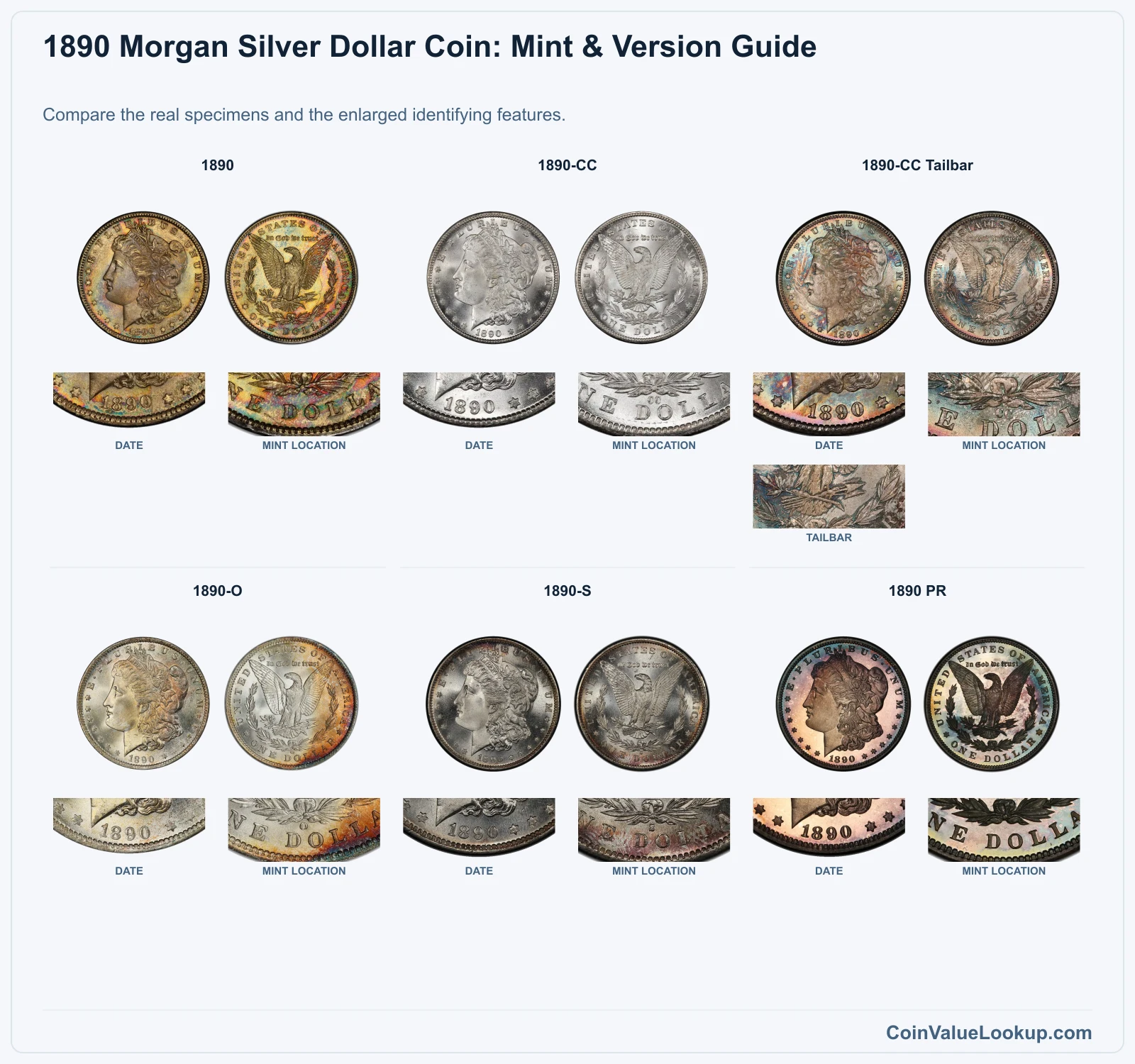
The 1890 Morgan Silver Dollar spans a wide range of collector value depending on mint, variety and condition. Guide estimates run from about $74 in well-worn grades to $12,194 for a top-condition Carson City Tailbar variety.
That spread tells you the mint and specific die variety matter enormously here.
A circulated Philadelphia or New Orleans piece is common enough. The Carson City issues, especially the Tailbar, and the scarce proof finish are where things get interesting.
Before you assign a value, pin down which version you actually have.
Fast Way to Identify Your 1890 Morgan Silver Dollar
Upload clear photos of both sides of your 1890 Morgan Dollar and our identifier can provide a preliminary identification of your coin's mint and general version. This is not authentication or exact grading, but it gives you a solid starting point.
Make sure the mintmark area below the wreath bow is in focus.
1890 Morgan Silver Dollar Value
Upload both sides of your 1890 Morgan Silver Dollar.
Front Obverse
Upload photo
Back Reverse
Upload photo
Which 1890 Morgan Silver Dollar Versions Are Worth Money?
- 1890-CC Tailbar: A named die variety from Carson City with a raised line at the eagle's tail feathers. Guide estimates reach $12,194 in MS65.
- 1890 Proof: Proof-finish Philadelphia strikes require individual assessment for value; a shiny surface alone is not proof attribution.
- 1890-CC (standard): Carson City mint coins carry a meaningful premium over other mints, with guide estimates from $191 in G4 to $4,284 in MS65.
- 1890-O in high Mint State grades: Guide estimates reach $1,381 at MS65, well above its $74 entry at G4.
- PL or DMPL surface designations on eligible business strikes can affect pricing beyond the base grade for any mint.
Step 1: Identify Your 1890 Morgan Silver Dollar Mint Mark and Version
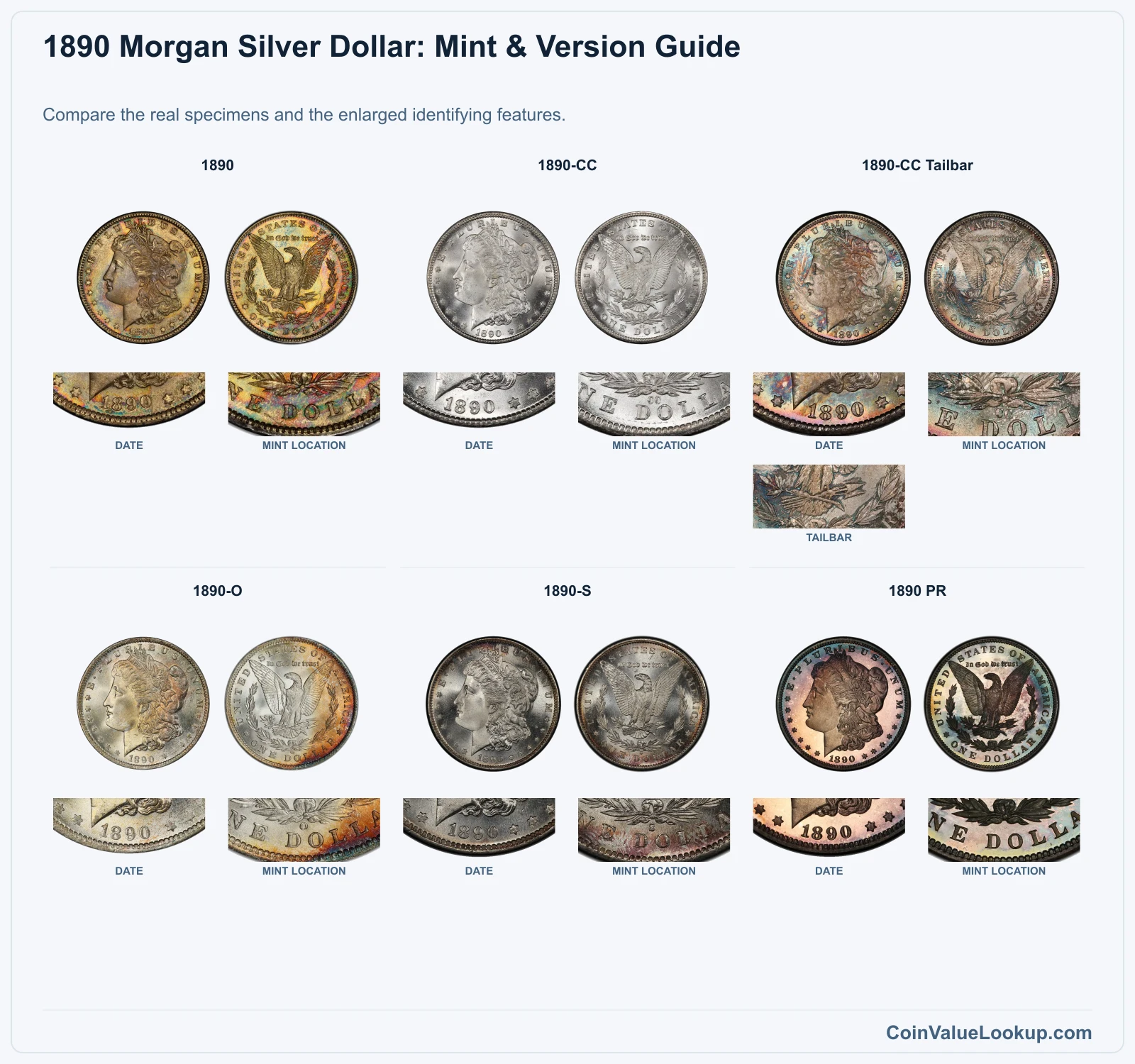
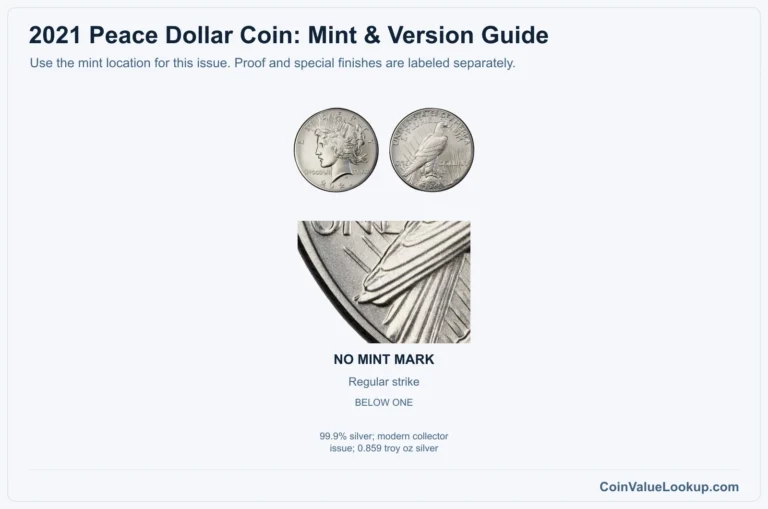
Start on the reverse, directly below the ribbon bow that ties the wreath. That is where the mintmark lives.
No letter means Philadelphia. A CC means Carson City.
An O is New Orleans, and an S is San Francisco.
All business-strike 1890 Morgan Dollars are 90% silver and 10% copper, weighing 26.73 grams, with a reeded edge. The obverse shows the Morgan Liberty head; the reverse has an eagle within a wreath.
The 1890-CC Tailbar is a named die variety, not just any Carson City coin. Look for a distinctive raised line extending from the eagle's tail feathers on the reverse.
If your CC coin lacks that feature, it is a standard 1890-CC.
Proofs were struck at Philadelphia with no mintmark, but a proof is a manufacturing method, not simply a shiny coin. Prooflike (PL) and deep-mirror prooflike (DMPL) are surface designations applied to eligible business strikes and are completely separate from proof manufacture.
A bright, reflective surface alone does not make a coin proof or prooflike.
Step 2: Check Your 1890 Morgan Silver Dollar Grade
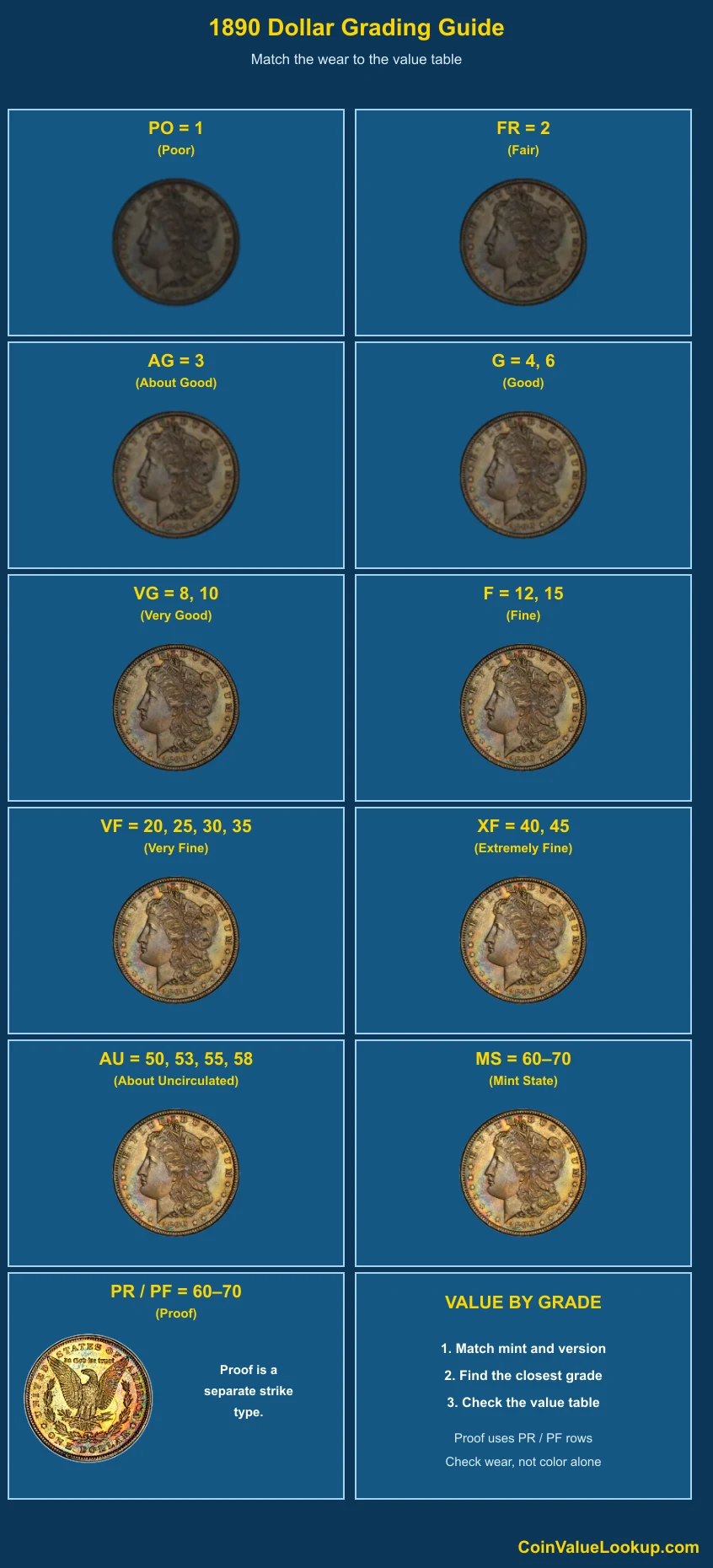
Focus on the hair detail above Liberty's ear, her cheek and the cap on the obverse. On the reverse, watch the eagle's breast feathers.
These are the high points that show wear first.
In Good-4, the outline of the design is visible but nearly all fine detail has worn away. By About Uncirculated, only the lightest friction shows on those high points, and luster remains over most of the surface.
Mint State coins should have no wear at all, but that does not mean they look perfect. Bag marks, which are contact marks from coins bouncing against each other in storage bags, can lower the Mint State grade significantly.
A coin can be technically uncirculated and still look rough.
Use the comparison image to match your coin's wear pattern against circulated, AU and Mint State examples of the same type. Proof coins are evaluated separately for hairlines, haze and surface quality.
Cleaned or polished coins lose much of their collector premium regardless of remaining detail.
Step 3: Check 1890 Morgan Silver Dollar Value by Mint and Version
1890 Morgan Silver Dollar
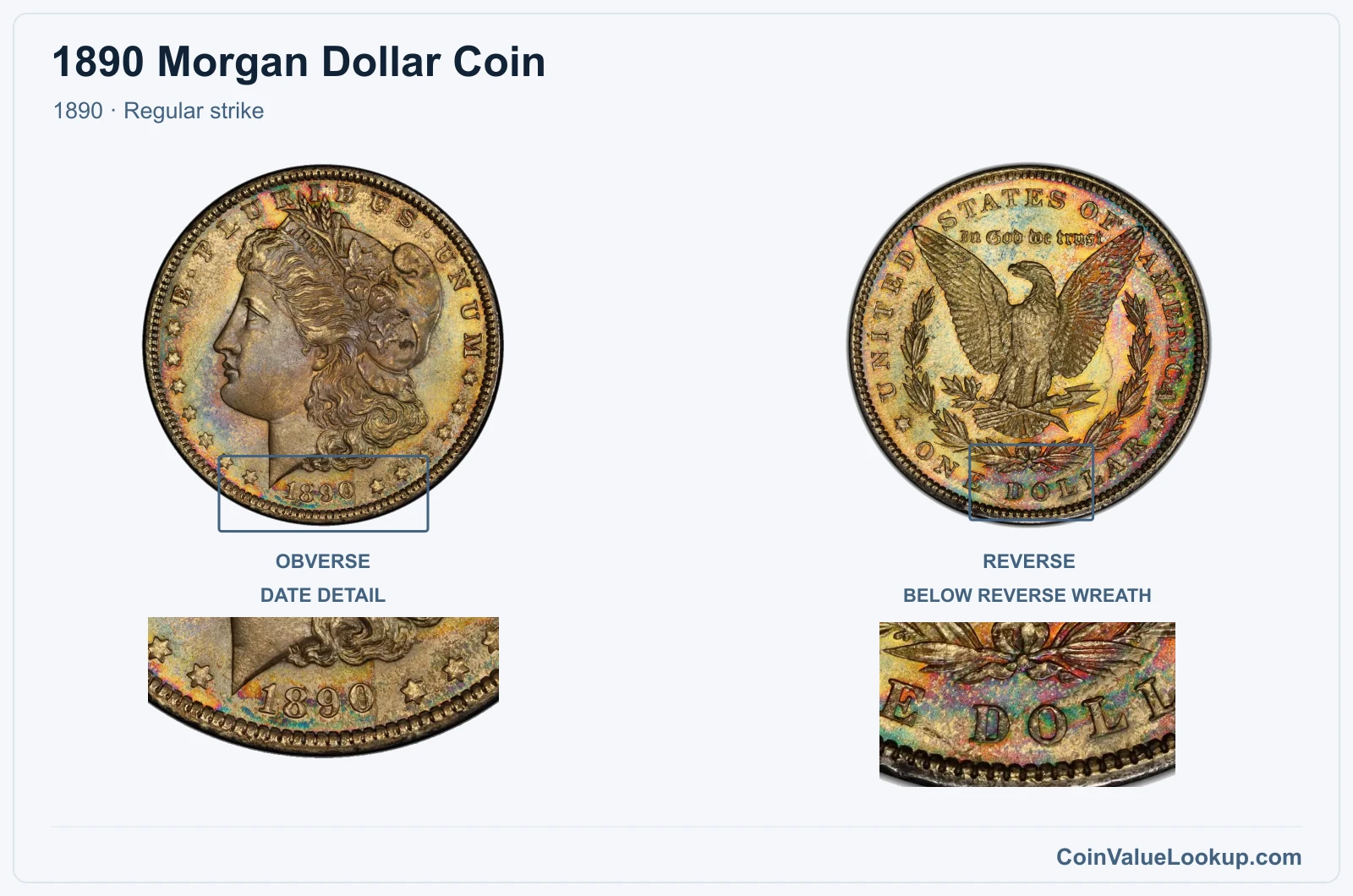
The 1890 Philadelphia Morgan Dollar carries no mintmark. It is the most available issue of the year in circulated grades.
A well-worn G4 example has an estimated guide value around $74, while a gem MS65 reaches roughly $1,224 per USA Coin Book.
Original, uncleaned surfaces matter. A coin that has been polished or dipped may look shiny but loses collector appeal.
PL and DMPL designations can apply to business strikes with strong mirror fields, but only when properly attributed, not just because a coin looks reflective in hand.
Range Grade
Price Auction Records Appraisal PO PO 1
—
Coin Identifier FR FR 2
—
Coin Identifier AG AG 3
—
Coin Identifier G G 4
—
Coin Identifier
G 6
—
Coin Identifier VG VG 8
—
Coin Identifier
VG 10
—
Coin Identifier F F 12
—
Coin Identifier
F 15
—
Coin Identifier VF VF 20
—
Coin Identifier
VF 25
—
Coin Identifier
VF 30
—
Coin Identifier
VF 35
—
Coin Identifier XF XF 40
—
Coin Identifier
XF 45
Coin Identifier AU AU 50
Coin Identifier
AU 53
Coin Identifier
AU 55
Coin Identifier
AU 58
Coin Identifier MS MS 60
Coin Identifier
MS 61
Coin Identifier
MS 62
Coin Identifier
MS 63
Coin Identifier
MS 64
Coin Identifier
MS 65
Coin Identifier
MS 66
Coin Identifier
MS 67
—
—
—
MS 68
—
—
—
MS 69
—
—
—
MS 70
—
—
—
1890 Morgan Silver Dollar — CC
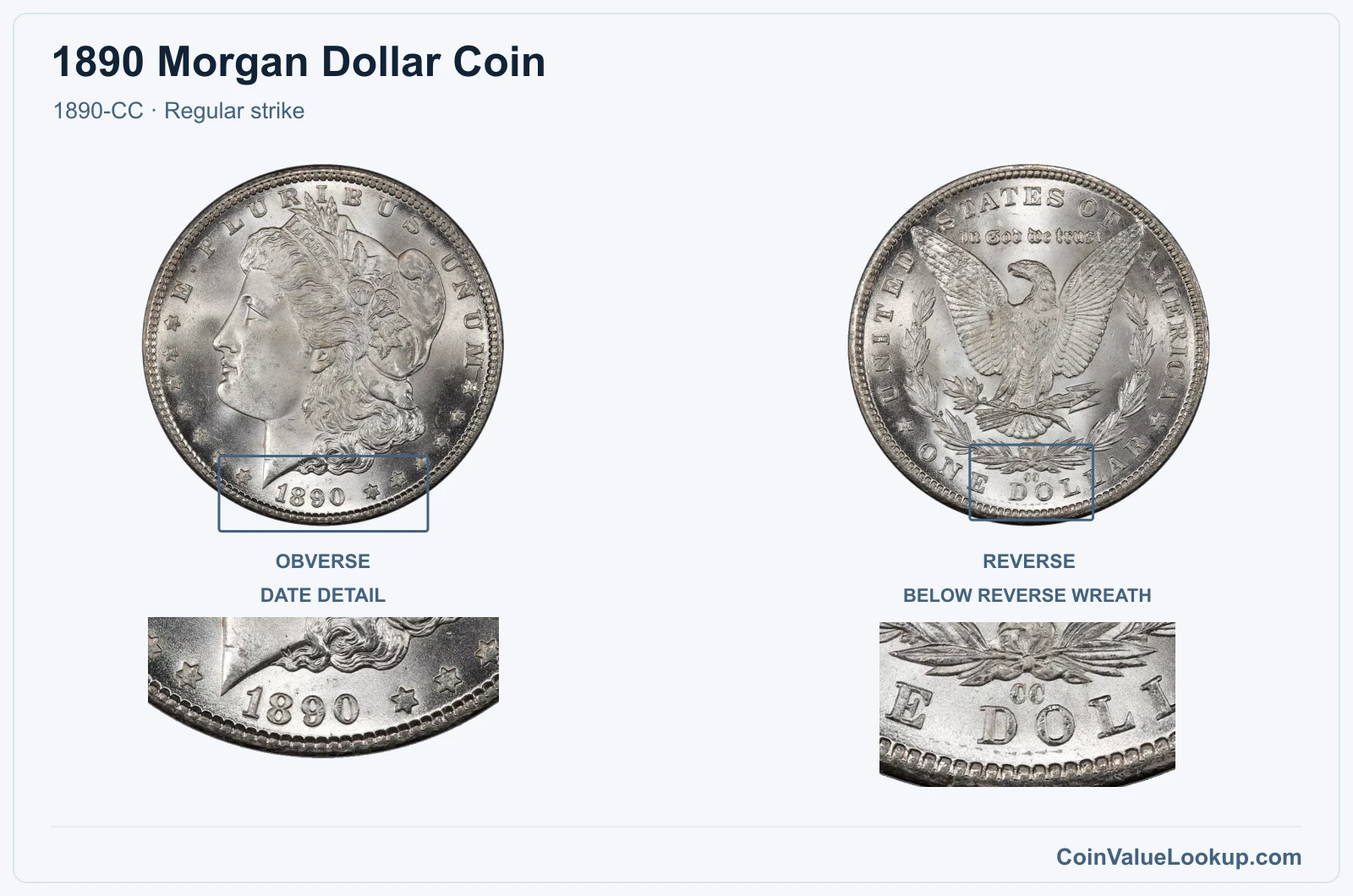
The 1890-CC is struck at the Carson City Mint and carries a CC mintmark below the wreath bow. Carson City Morgans always command a premium because of lower production and strong collector demand.
Guide estimates from USA Coin Book place the 1890-CC at about $191 in G4 and $4,284 in MS65. These are guide figures, not guaranteed sale prices.
Condition and originality of surfaces are critical here. Before paying a CC premium, confirm the mintmark is genuine and not tooled or added.
Range Grade
Price Auction Records Appraisal PO PO 1
—
Coin Identifier FR FR 2
Coin Identifier AG AG 3
Coin Identifier G G 4
Coin Identifier
G 6
Coin Identifier VG VG 8
Coin Identifier
VG 10
Coin Identifier F F 12
Coin Identifier
F 15
Coin Identifier VF VF 20
Coin Identifier
VF 25
Coin Identifier
VF 30
Coin Identifier
VF 35
Coin Identifier XF XF 40
Coin Identifier
XF 45
Coin Identifier AU AU 50
Coin Identifier
AU 53
Coin Identifier
AU 55
Coin Identifier
AU 58
Coin Identifier MS MS 60
Coin Identifier
MS 61
Coin Identifier
MS 62
Coin Identifier
MS 63
Coin Identifier
MS 64
Coin Identifier
MS 65
Coin Identifier
MS 66
Coin Identifier
MS 67
—
—
—
MS 68
—
—
—
MS 69
—
—
—
MS 70
—
—
—
1890 Morgan Silver Dollar — CC Tailbar
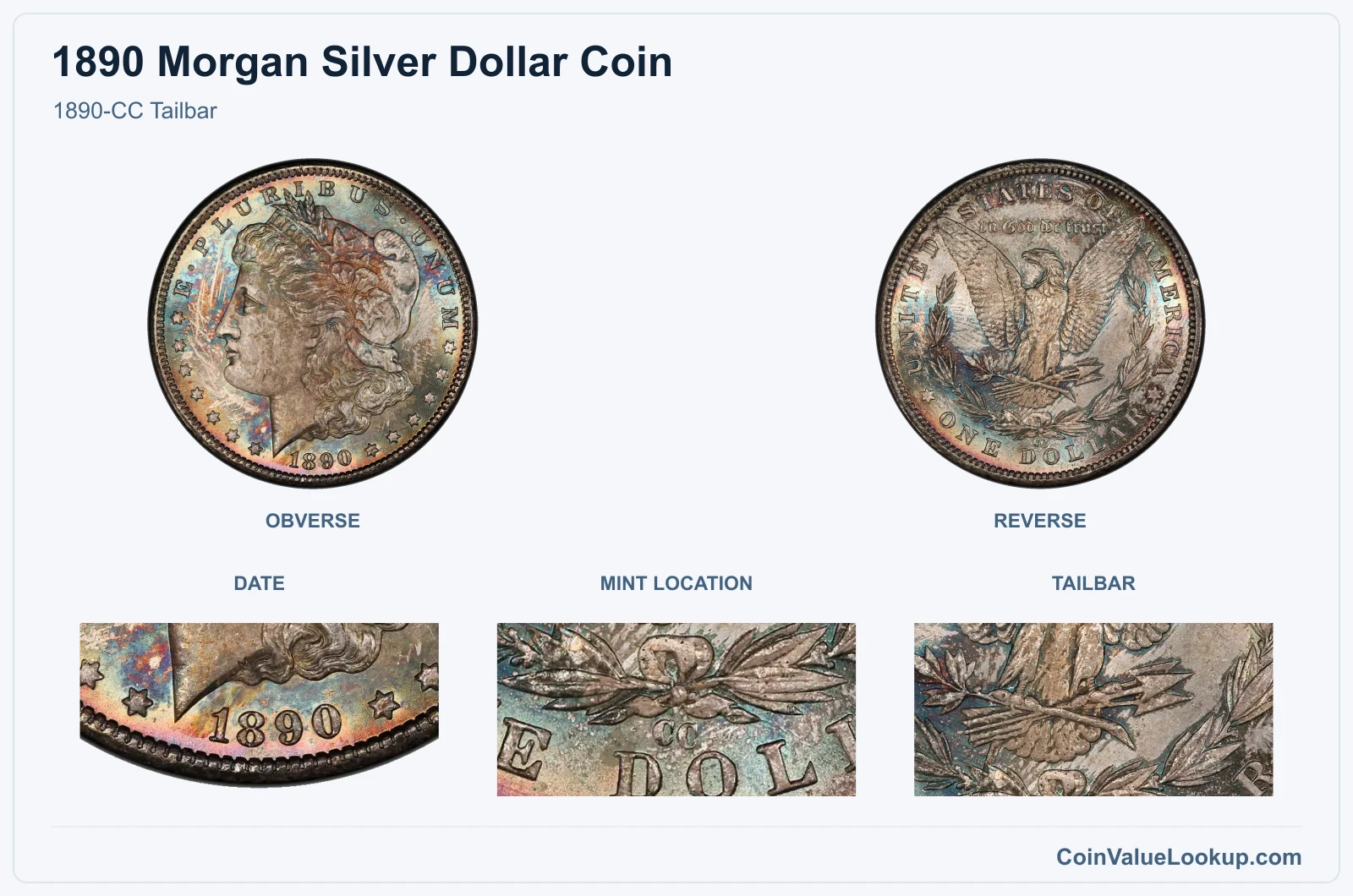
The 1890-CC Tailbar is a specific named die variety, not just any 1890-CC. The identifying feature is a raised line extending from the eagle's tail feathers on the reverse.
This line is a die gouge that was present on one particular die pair used at Carson City.
Guide estimates from USA Coin Book are $254 in G4 and climb to $12,194 in MS65. That is a significant jump over the standard 1890-CC, which tells you attribution matters.
If you have an 1890-CC, inspect the tail feather area carefully under magnification. The Tailbar should be a clear raised feature, not a scratch or mark in the field.
Professional attribution is worth pursuing if you believe you have this variety.
Range Grade
Price Auction Records Appraisal PO PO 1
—
Coin Identifier FR FR 2
—
Coin Identifier AG AG 3
—
Coin Identifier G G 4
Coin Identifier
G 6
Coin Identifier VG VG 8
Coin Identifier
VG 10
Coin Identifier F F 12
Coin Identifier
F 15
Coin Identifier VF VF 20
Coin Identifier
VF 25
Coin Identifier
VF 30
Coin Identifier
VF 35
Coin Identifier XF XF 40
Coin Identifier
XF 45
Coin Identifier AU AU 50
Coin Identifier
AU 53
Coin Identifier
AU 55
Coin Identifier
AU 58
Coin Identifier MS MS 60
—
Coin Identifier
MS 61
Coin Identifier
MS 62
Coin Identifier
MS 63
Coin Identifier
MS 64
Coin Identifier
MS 65
Coin Identifier
MS 66
—
—
—
MS 67
—
—
—
MS 68
—
—
—
MS 69
—
—
—
MS 70
—
—
—
1890 Morgan Silver Dollar — O
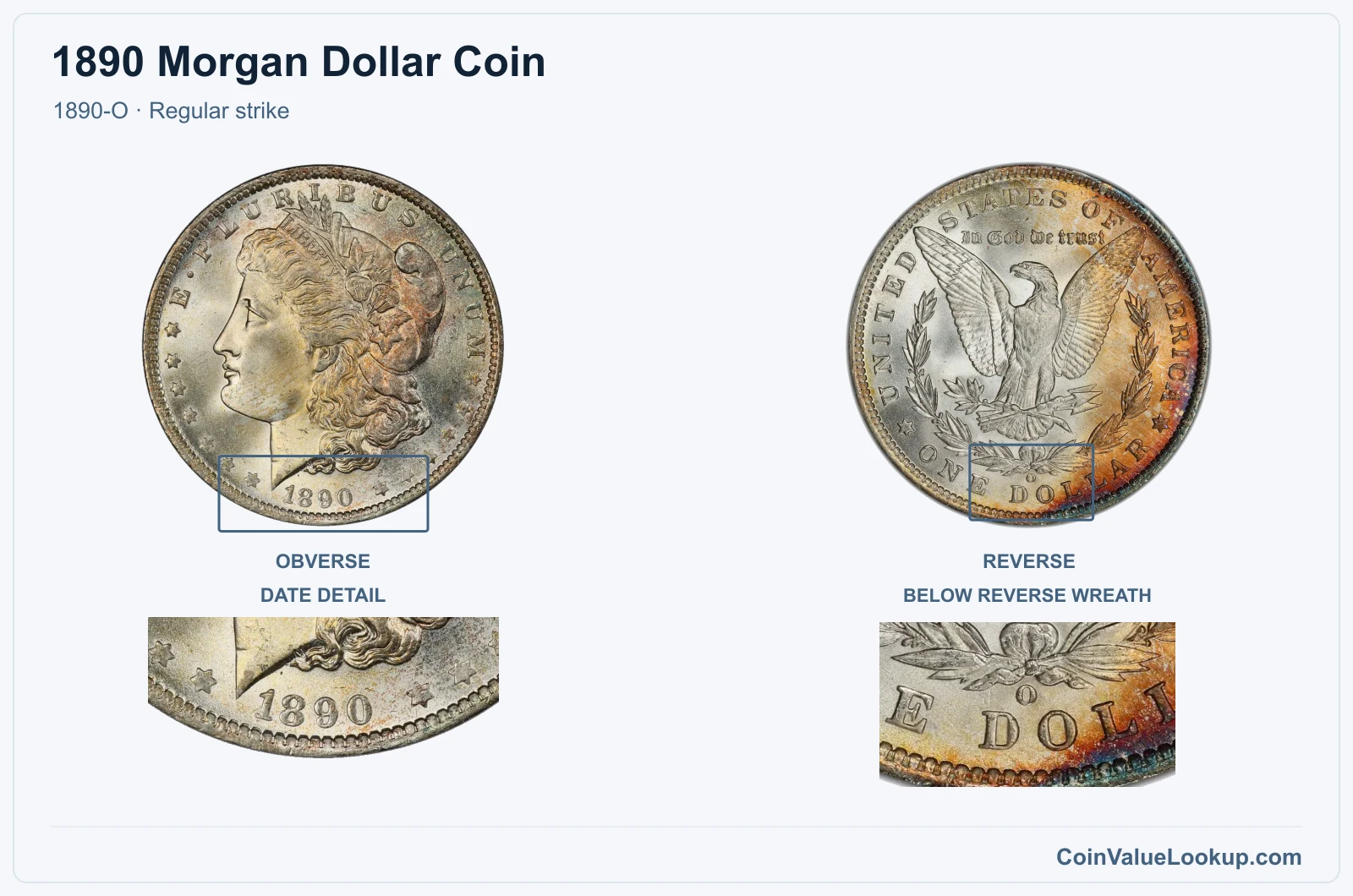
The 1890-O was struck in New Orleans and carries an O mintmark. In lower circulated grades, it sits alongside the Philadelphia issue at around $74 in G4 per USA Coin Book.
The spread widens in Mint State. An MS65 example has a guide estimate of about $1,381.
Original luster and minimal bag marks separate the higher-grade coins from the crowd. Cleaning or polishing reduces comparability to guide values.
Range Grade
Price Auction Records Appraisal PO PO 1
Coin Identifier FR FR 2
Coin Identifier AG AG 3
—
Coin Identifier G G 4
—
Coin Identifier
G 6
Coin Identifier VG VG 8
Coin Identifier
VG 10
Coin Identifier F F 12
—
Coin Identifier
F 15
—
Coin Identifier VF VF 20
Coin Identifier
VF 25
—
Coin Identifier
VF 30
Coin Identifier
VF 35
Coin Identifier XF XF 40
Coin Identifier
XF 45
Coin Identifier AU AU 50
Coin Identifier
AU 53
Coin Identifier
AU 55
Coin Identifier
AU 58
Coin Identifier MS MS 60
Coin Identifier
MS 61
Coin Identifier
MS 62
Coin Identifier
MS 63
Coin Identifier
MS 64
Coin Identifier
MS 65
Coin Identifier
MS 66
Coin Identifier
MS 67
—
—
—
MS 68
—
—
—
MS 69
—
—
—
MS 70
—
—
—
1890 Morgan Silver Dollar — S
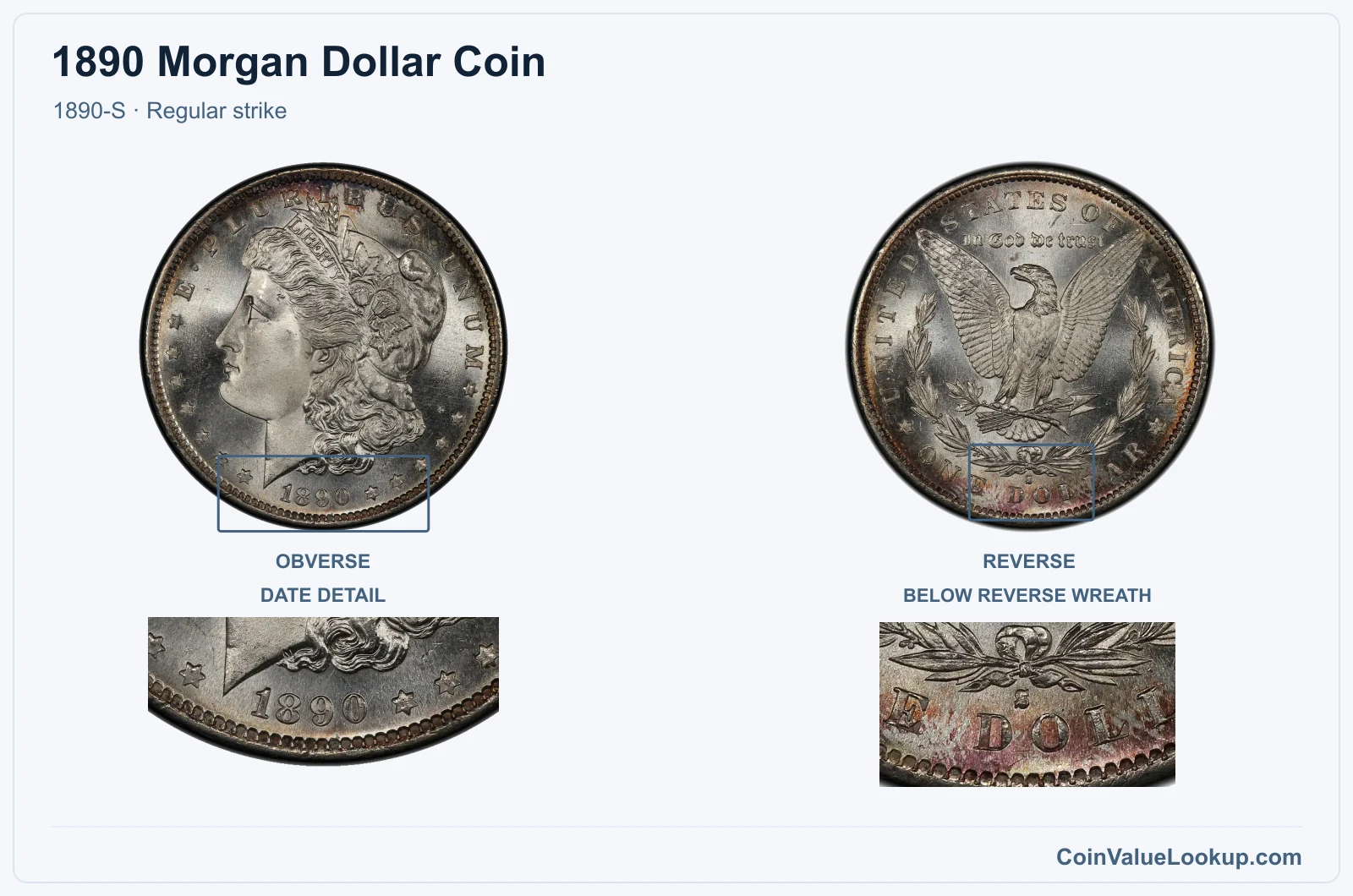
The 1890-S carries an S mintmark for San Francisco. Guide estimates from USA Coin Book place it at roughly $74 in G4 and $1,164 in MS65.
San Francisco strikes often show better overall quality than some other mints, but each coin must be evaluated individually. As with all business-strike Morgans, PL and DMPL surface designations can apply when mirror-like fields are properly attributed.
Coin Value Lookup is a good starting point if you want to look up guide values for other dates and mints in the Morgan Dollar series.
Range Grade
Price Auction Records Appraisal PO PO 1
—
Coin Identifier FR FR 2
—
Coin Identifier AG AG 3
—
Coin Identifier G G 4
—
Coin Identifier
G 6
—
Coin Identifier VG VG 8
—
Coin Identifier
VG 10
—
Coin Identifier F F 12
—
Coin Identifier
F 15
—
Coin Identifier VF VF 20
—
Coin Identifier
VF 25
—
Coin Identifier
VF 30
—
Coin Identifier
VF 35
—
Coin Identifier XF XF 40
—
Coin Identifier
XF 45
Coin Identifier AU AU 50
Coin Identifier
AU 53
Coin Identifier
AU 55
Coin Identifier
AU 58
Coin Identifier MS MS 60
Coin Identifier
MS 61
Coin Identifier
MS 62
Coin Identifier
MS 63
Coin Identifier
MS 64
Coin Identifier
MS 65
Coin Identifier
MS 66
Coin Identifier
MS 67
Coin Identifier
MS 68
—
—
—
MS 69
—
—
—
MS 70
—
—
—
1890 Morgan Silver Dollar — PR
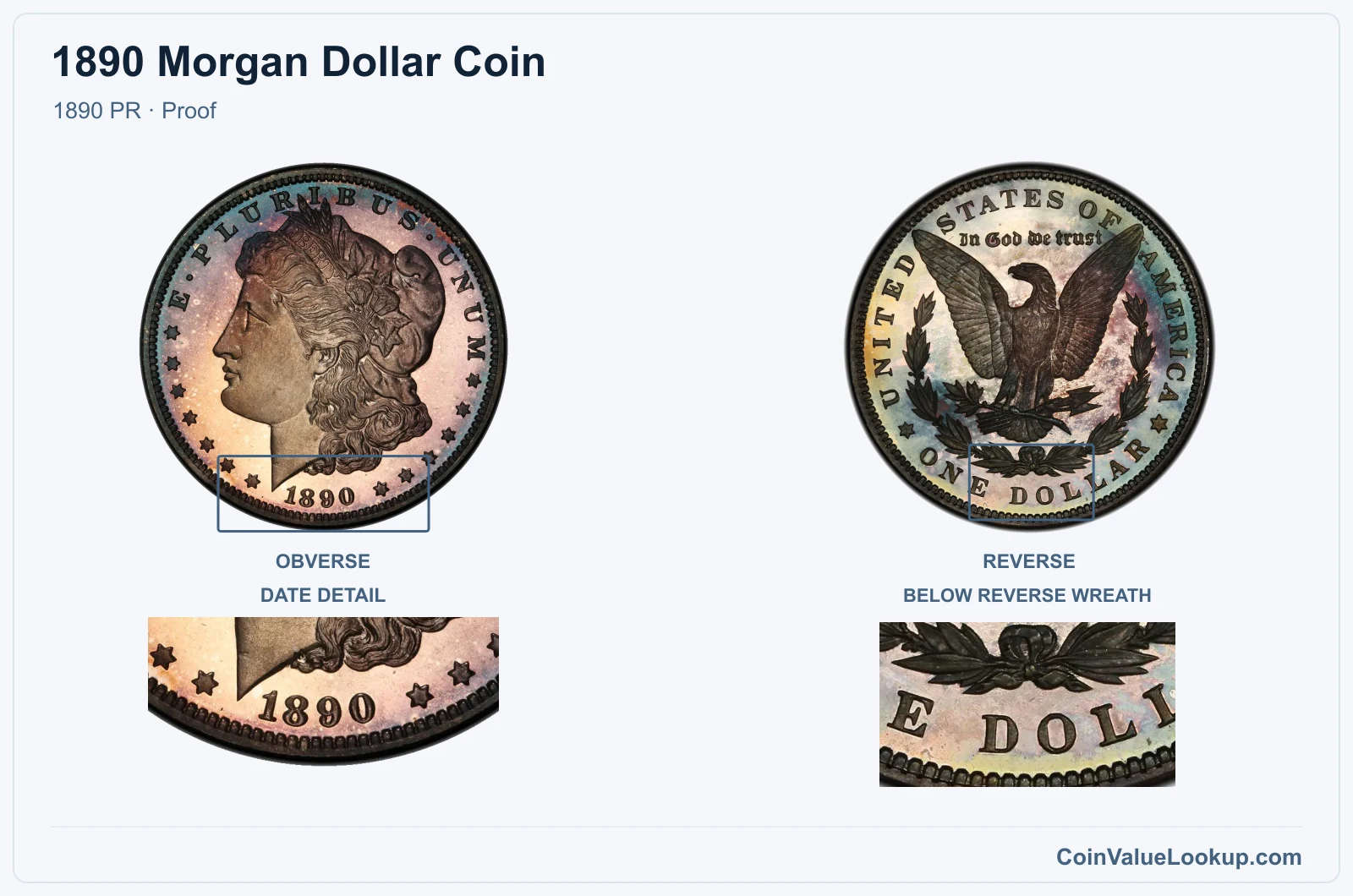
The 1890 Proof Morgan Dollar was produced at Philadelphia with no mintmark, using a proof manufacturing process. This is a fundamentally different product from a business strike, no matter how shiny a regular coin may appear.
No supported numeric guide range was adopted for this version. Value depends on authenticated identity, condition and any error characteristics.
Proof Morgans are evaluated for hairlines, surface haze, toning and overall eye appeal rather than the bag-mark criteria used for business strikes. Professional authentication is strongly recommended before buying or selling any coin claimed to be a proof.
Range Grade
Price Auction Records Appraisal PR PR 1
—
Coin Identifier
PR 2
—
Coin Identifier
PR 3
—
Coin Identifier
PR 4
—
Coin Identifier
PR 6
—
Coin Identifier
PR 8
—
Coin Identifier
PR 10
—
Coin Identifier
PR 12
—
Coin Identifier
PR 15
—
Coin Identifier
PR 20
—
Coin Identifier
PR 25
—
Coin Identifier
PR 30
—
Coin Identifier
PR 35
—
Coin Identifier
PR 40
—
Coin Identifier
PR 45
—
Coin Identifier
PR 50
Coin Identifier
PR 53
—
Coin Identifier
PR 55
—
Coin Identifier
PR 58
Coin Identifier
PR 60
—
Coin Identifier
PR 61
Coin Identifier
PR 62
Coin Identifier
PR 63
Coin Identifier
PR 64
Coin Identifier
PR 65
Coin Identifier
PR 66
Coin Identifier
PR 67
Coin Identifier
PR 68
Coin Identifier
PR 69
—
—
—
PR 70
—
—
—
1890 Morgan Silver Dollar Error List
1. 1890 Morgan Silver Dollar — Die Gouge / Named Raised-Line Variety
A die gouge appears as a raised line or lump of extra metal on the coin's surface, created when the die itself was damaged before striking. On the 1890 Morgan Dollar series, the most recognized example is the 1890-CC Tailbar, where a raised line extends from the eagle's tail feathers on the reverse.
To identify it, compare the tail feather area of your CC coin against a normal 1890-CC. The Tailbar is consistent and raised, not incuse.
An incuse scratch, random surface damage or an unrelated die crack can mimic this look at a glance but will differ in position, profile and consistency. Condition, visibility of the feature and the specific variety all affect value.
No numerical price range is provided here because individual assessment matters.
2. 1890 Morgan Silver Dollar — Doubled Die
A doubled die occurs when the die itself receives a misaligned impression during its manufacture, producing consistent doubling across every coin struck from that die. On 1890 Morgan Dollars, a doubled die error has been reported for the series.
Look for design separation or notching on lettering, stars or Liberty's profile that is uniform and repeatable. True die doubling will appear in the same position on every coin from that die pair.
Do not confuse it with machine doubling, which creates flat, shelf-like distortion, or with reflections and post-mint impressions from damage. Value depends on the specific doubled features, their visibility and the coin's condition.
No numerical price range is adopted for this category.
3. 1890 Morgan Silver Dollar — Off-Center Strike
An off-center strike happens when the coin blank is not properly seated in the collar during striking. The result is a displaced design with a blank crescent of unstruck metal along one edge.
For an 1890 Morgan Dollar off-center error, the key question is how much of the design is shifted and whether the date remains visible. A date-visible example is far more identifiable and desirable.
Do not confuse this with a clipped planchet, which produces a curved bite out of the edge, or with post-mint flattening from damage. A genuine off-center strike will show the full design shifted uniformly in one direction.
Value depends on the percentage off-center, date visibility and overall condition.
4. 1890 Morgan Silver Dollar — Clashed Dies
Clashed dies occur when the obverse and reverse dies strike each other without a planchet between them. The result is faint ghost impressions of the opposing design transferred onto each die, which then appear on subsequent coins.
On an 1890 Morgan Dollar, look for traces of Liberty's hair or profile on the reverse, or parts of the eagle and wreath on the obverse. These ghost features will align with where the opposite die would have made contact.
Scratches, random raised lines and brockage errors can look similar but differ in position and symmetry. A true clash will line up with the expected opposing design elements.
Value depends on the strength and visibility of the clash, along with the coin's overall condition. No specific price range is adopted here.
5. 1890 Morgan Silver Dollar — Die Crack / Die Chip
Die cracks and die chips result from stress fractures in the steel die. A crack shows as a raised line on the finished coin, while a chip appears as a small raised blob.
Cracks that reach the rim can produce a raised lump called a cud.
On 1890 Morgan Dollars, die cracks have been reported across the series. Examine both sides under good light and look for thin raised lines connecting design elements, or small raised lumps in the fields or on devices.
Do not mistake incuse scratches, corrosion or foreign material stuck to the surface for die cracks. A genuine die crack is raised, follows the coin's contour naturally and will appear in the same place on other coins from the same die.
Value depends on size, location and condition of the coin.