1864 Indian Head Penny Coin Value: How Much Is It Worth?
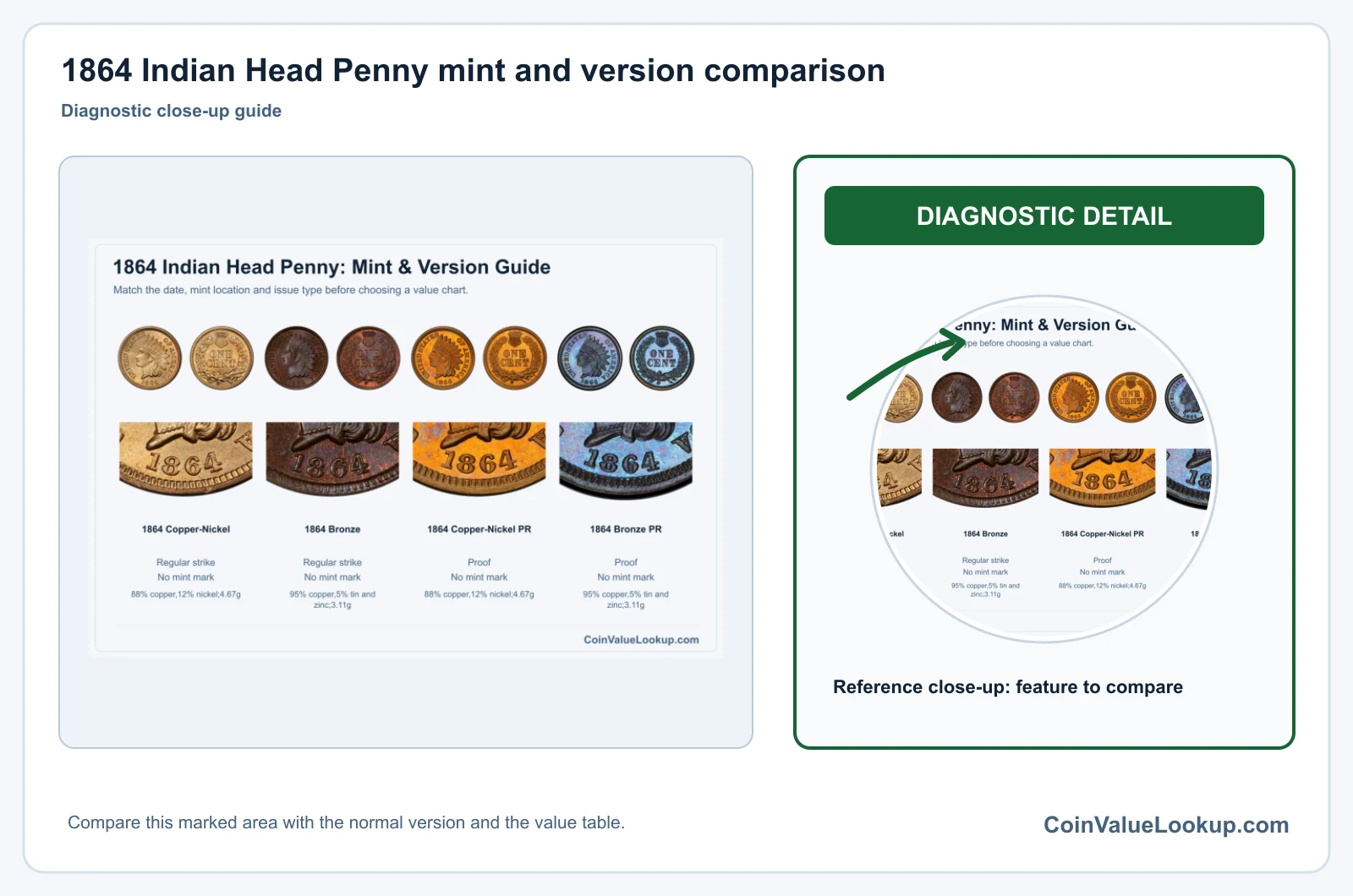
The 1864 Indian Head penny is a special year in the series because the U.S. Mint switched from copper-nickel to bronze partway through production. That means three distinct business-strike versions exist, and getting the right one matters a lot for value.
Guide estimates for regular strikes range from about $21 at G4 for a Bronze No L up to $721 at MS63 for the L on Ribbon variety. Proofs and mint errors require separate evaluation.
Fast Way to Identify Your 1864 Indian Head Penny
The fastest way to figure out what you have is to snap clear photos of both sides of your coin and upload them to our identifier. It can help with preliminary identification of your version and material type based on the images.
A kitchen scale that reads to 0.1 grams is also your best friend here, since the copper-nickel and bronze versions weigh noticeably different amounts.
1864 Indian Head Penny Value
Upload both sides of your 1864 Indian Head Penny.
Front Obverse
Upload photo
Back Reverse
Upload photo
Which 1864 Indian Head Penny Versions Are Worth Money?
- Weigh your coin first: copper-nickel (4.67g) and bronze (3.11g) versions have very different guide values at every grade level.
- Check the ribbon for the designer's L initial; the 1864 L on Ribbon bronze variety lists around $73 at G4 and $721 at MS63, well above the No L bronze.
- Proof copper-nickel and proof bronze versions exist and carry significant premiums, with the PR63 copper-nickel listed near $1,344.
- The 1864 L on Ribbon proof is extremely rare, with a guide value near $37,253 at PR63, making it the standout issue of this date.
- Original uncirculated surfaces with strong remaining color can command more than a cleaned or damaged coin of the same technical grade.
Step 1: Identify Your 1864 Indian Head Penny Mint Mark and Version
Start with weight. A copper-nickel 1864 tips the scale at about 4.67 grams, while a bronze example weighs roughly 3.11 grams.
If you only have one coin, even a cheap postal scale can tell these apart.
Once you know it is bronze, grab a loupe and look at the lower end of the ribbon trailing behind the Indian portrait on the obverse. The designer's initial "L" (for James B. Longacre) appears there on some 1864 bronze cents but not others.
That L is not a mintmark; every regular 1864 Indian cent was struck at Philadelphia with no mintmark.
The obverse shows a bust wearing a feathered headdress with LIBERTY on the headband. The reverse features an oak wreath with a small shield at the top and ONE CENT in the center.
Do not confuse this with the earlier laurel-wreath reverse used in 1859 or the later Lincoln wheat design.
Proof versions exist in both copper-nickel and bronze compositions (including L on Ribbon proofs). A proof is a special manufacturing finish with mirrored fields and sharp rims, not simply a high-grade coin.
A polished business strike is not a proof, no matter how shiny it looks.
Step 2: Check Your 1864 Indian Head Penny Grade
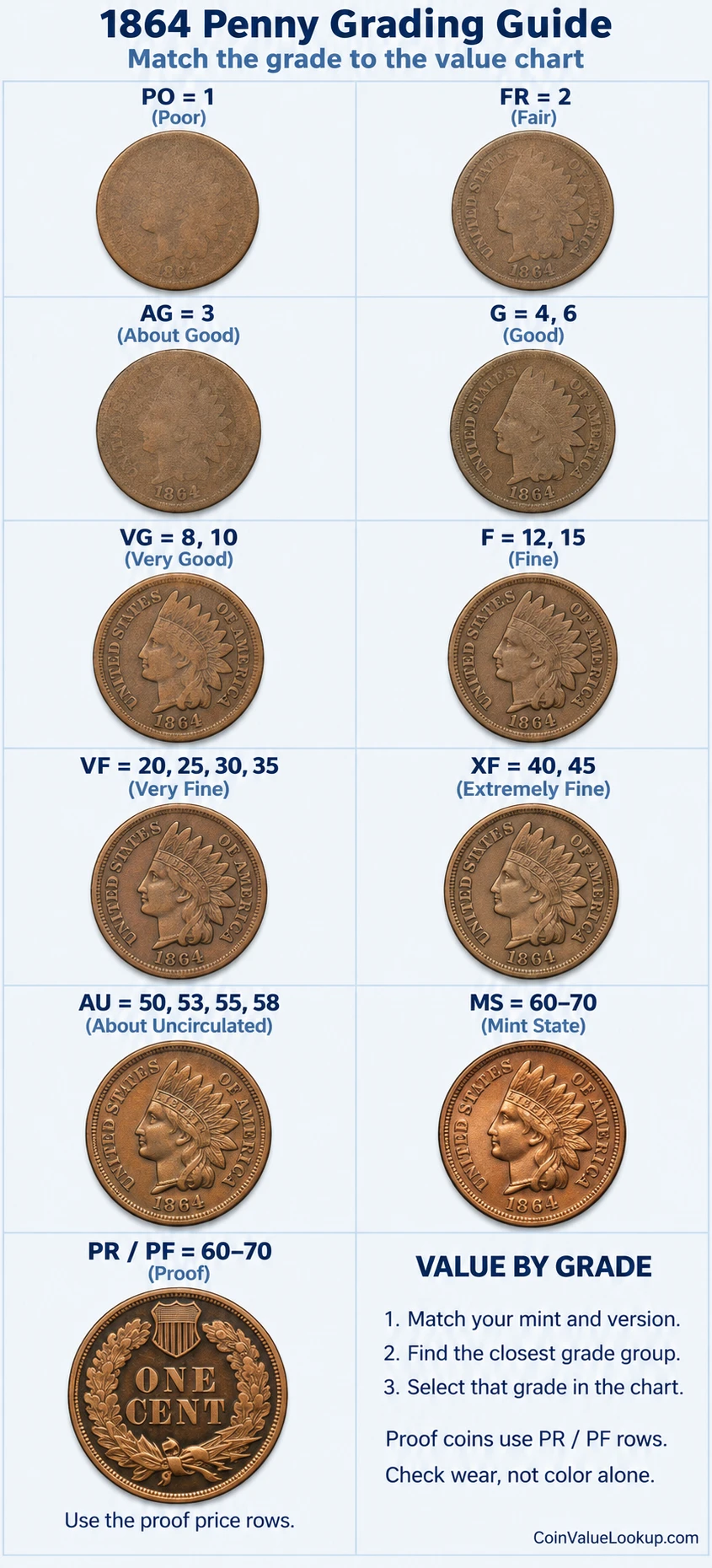
Check LIBERTY on the headband first. On a well-struck coin in Good condition (G4), LIBERTY is mostly worn away.
By Fine, at least partial letters should be readable. At About Uncirculated, only the slightest rub shows on the highest points of the hair and feathers.
Don't rely on one diagnostic alone. The 1864 Indian cent can come weakly struck from the die, leaving soft feather tips or hair detail even on an uncirculated coin.
Look at the cheek, the diamond shapes on the ribbon, and the wreath leaves as a group before deciding on a grade.
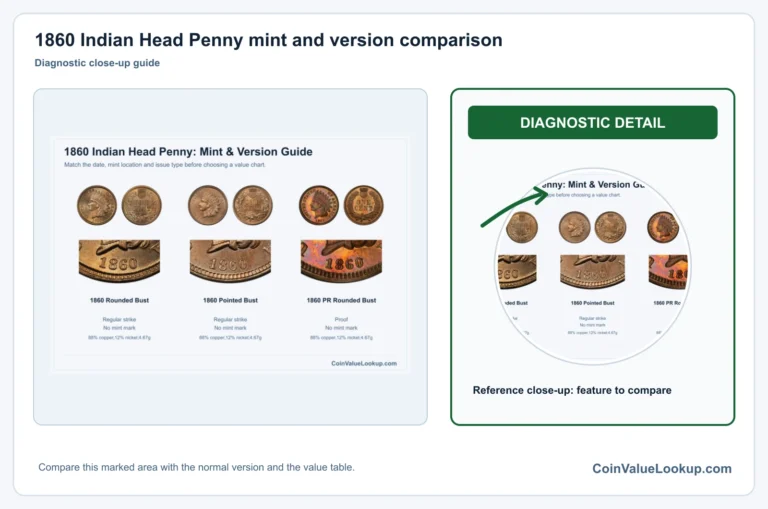
Use the comparison image to match your coin's overall sharpness, luster and surface quality. Original luster on an uncirculated example will be even and undisturbed.
Cleaning, harsh dipping or retoning can hide or mimic wear and will reduce a coin's marketability regardless of remaining detail.
For bronze examples you may see color designations like BN (brown), RB (red-brown) and RD (red). These describe how much original copper color remains, not a different metal.
Copper-nickel coins are graded without those color suffixes, and their values should not be compared using bronze RD premiums.
Step 3: Check 1864 Indian Head Penny Value by Mint and Version
1864 Indian Head Penny — Copper-Nickel
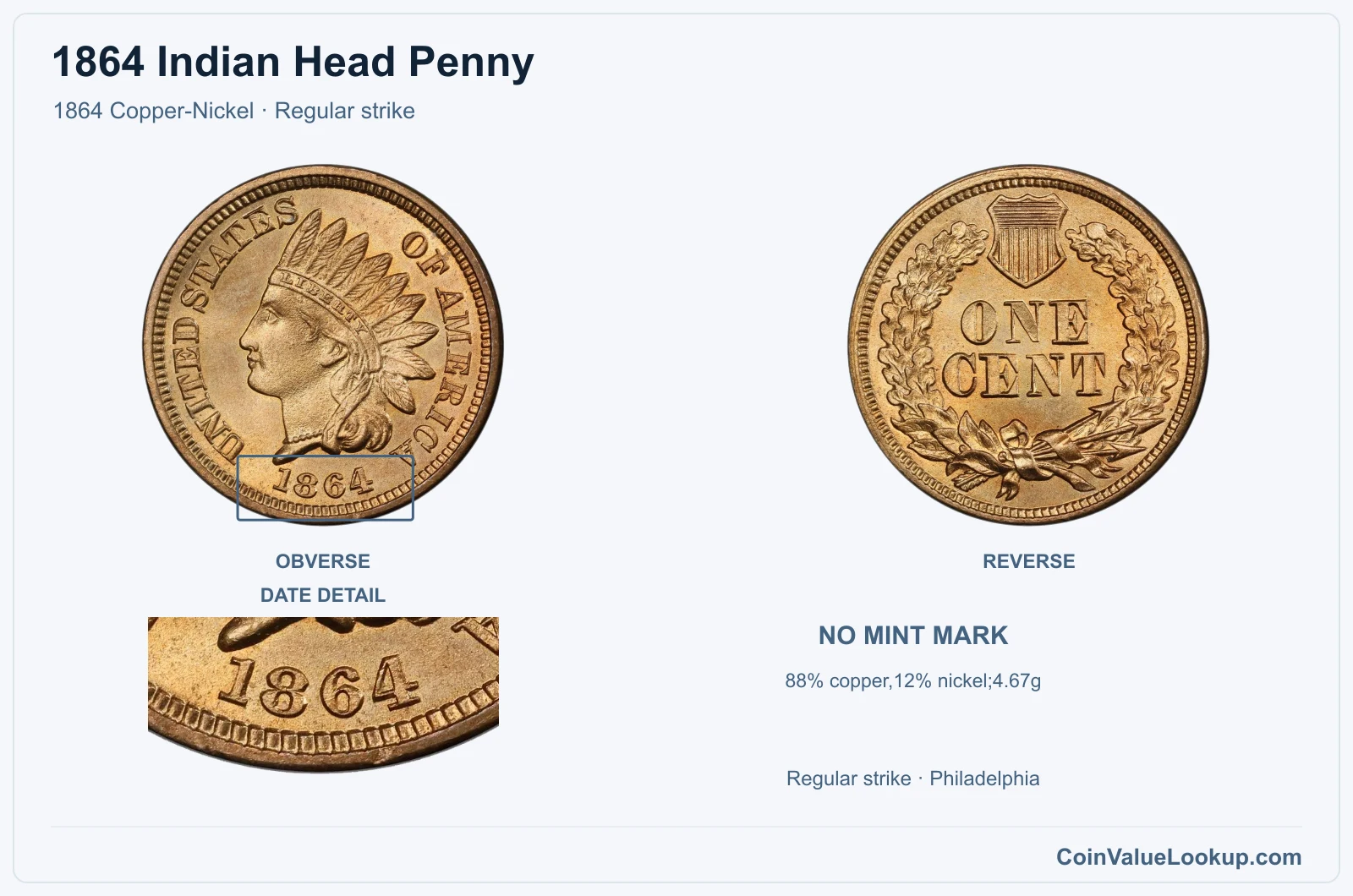
The 1864 copper-nickel Indian cent is the heavier of the two compositions at 4.67 grams (88% copper, 12% nickel). It was struck at Philadelphia with no mintmark.
On a kitchen scale, the weight difference from a bronze example is obvious.
Guide values run about $30 at G4 and around $527 at MS63, according to USA Coin Book. Always compare coins of matching grade and original surfaces.
Do not apply L on Ribbon premiums to this version; it is a completely different alloy and design variety.
| Range | Grade | Price | Auction Records | Appraisal |
|---|---|---|---|---|
| PO | PO 1 | — | Coin Identifier | |
| FR | FR 2 | — | Coin Identifier | |
| AG | AG 3 | — | Coin Identifier | |
| G | G 4 | — | Coin Identifier | |
| G 6 | Coin Identifier | |||
| VG | VG 8 | — | Coin Identifier | |
| VG 10 | — | Coin Identifier | ||
| F | F 12 | Coin Identifier | ||
| F 15 | — | Coin Identifier | ||
| VF | VF 20 | Coin Identifier | ||
| VF 25 | Coin Identifier | |||
| VF 30 | Coin Identifier | |||
| VF 35 | Coin Identifier | |||
| XF | XF 40 | Coin Identifier | ||
| XF 45 | Coin Identifier | |||
| AU | AU 50 | Coin Identifier | ||
| AU 53 | Coin Identifier | |||
| AU 55 | Coin Identifier | |||
| AU 58 | Coin Identifier | |||
| MS | MS 60 | Coin Identifier | ||
| MS 61 | Coin Identifier | |||
| MS 62 | Coin Identifier | |||
| MS 63 | Coin Identifier | |||
| MS 64 | Coin Identifier | |||
| MS 65 | Coin Identifier | |||
| MS 66 | Coin Identifier | |||
| MS 67 | Coin Identifier | |||
| MS 68 | — | — | — | |
| MS 69 | — | — | — | |
| MS 70 | — | — | — |
1864 Indian Head Penny — Bronze
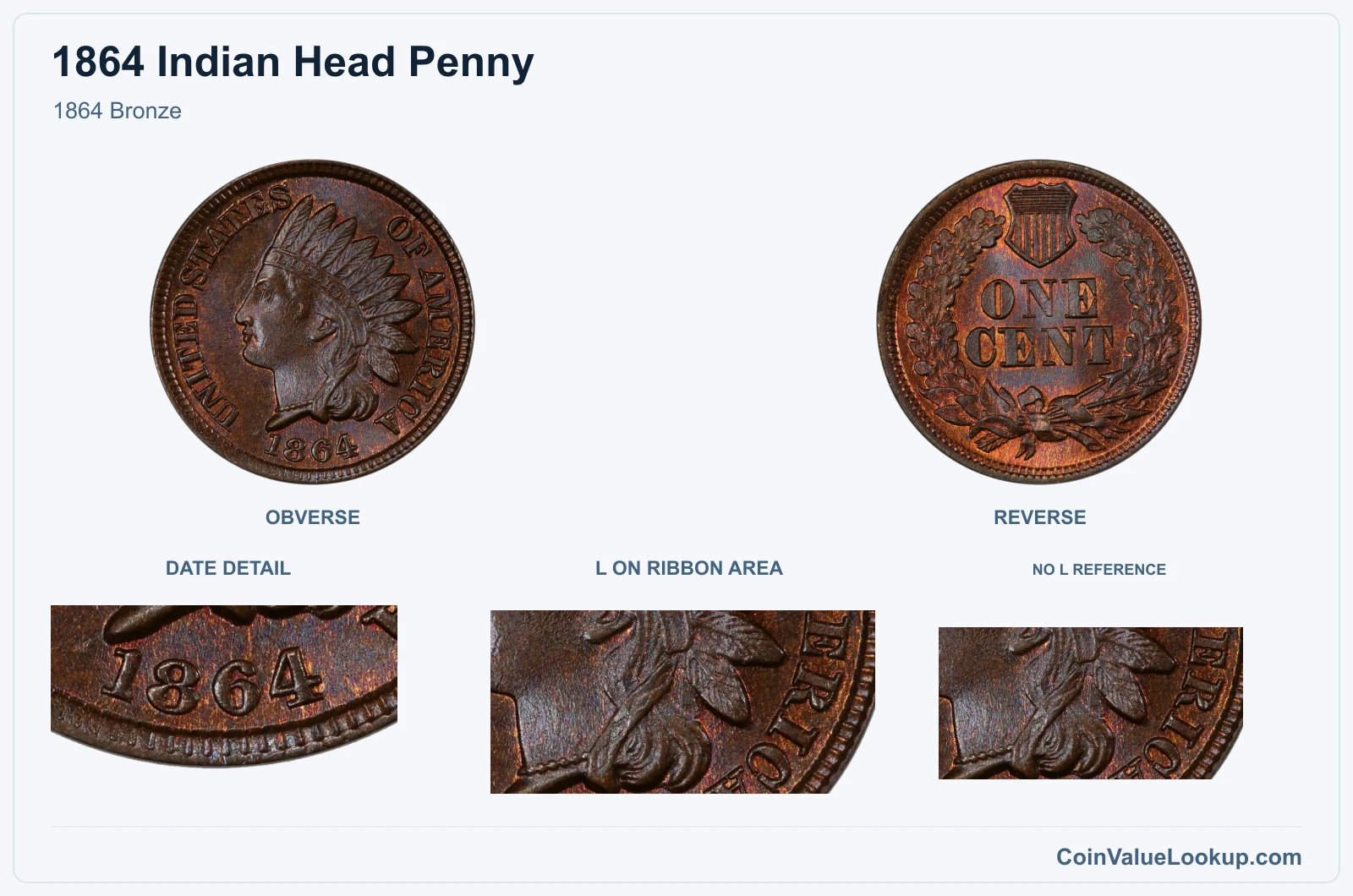
The 1864 Bronze No L is the more common of the two bronze versions. It weighs about 3.11 grams (95% copper, 5% tin and zinc) and was struck at Philadelphia with no mintmark.
Look carefully at the ribbon trailing from the headdress. If there is no small letter L at the lower portion, you have the No L variety.
USA Coin Book lists this version at roughly $21 in G4 and $194 in MS63. These are retail guide estimates, not guaranteed offers.
Coins with original surfaces and no problems will be the most desirable at any grade level.
Coin Value Lookup is a handy starting point if you want to look up values for other dates in the Indian cent series or compare across denominations.
| Range | Grade | Price | Auction Records | Appraisal |
|---|---|---|---|---|
| PO | PO 1 | — | Coin Identifier | |
| FR | FR 2 | — | Coin Identifier | |
| AG | AG 3 | Coin Identifier | ||
| G | G 4 | — | Coin Identifier | |
| G 6 | — | Coin Identifier | ||
| VG | VG 8 | — | Coin Identifier | |
| VG 10 | — | Coin Identifier | ||
| F | F 12 | — | Coin Identifier | |
| F 15 | — | Coin Identifier | ||
| VF | VF 20 | — | Coin Identifier | |
| VF 25 | — | Coin Identifier | ||
| VF 30 | Coin Identifier | |||
| VF 35 | Coin Identifier | |||
| XF | XF 40 | Coin Identifier | ||
| XF 45 | Coin Identifier | |||
| AU | AU 50 | Coin Identifier | ||
| AU 53 | Coin Identifier | |||
| AU 55 | Coin Identifier | |||
| AU 58 | Coin Identifier | |||
| MS | MS 60 | Coin Identifier | ||
| MS 61 | Coin Identifier | |||
| MS 62 | Coin Identifier | |||
| MS 63 | Coin Identifier | |||
| MS 64 | Coin Identifier | |||
| MS 65 | Coin Identifier | |||
| MS 66 | Coin Identifier | |||
| MS 67 | Coin Identifier | |||
| MS 68 | — | — | — | |
| MS 69 | — | — | — | |
| MS 70 | — | — | — |
1864 Indian Head Penny — L on Ribbon
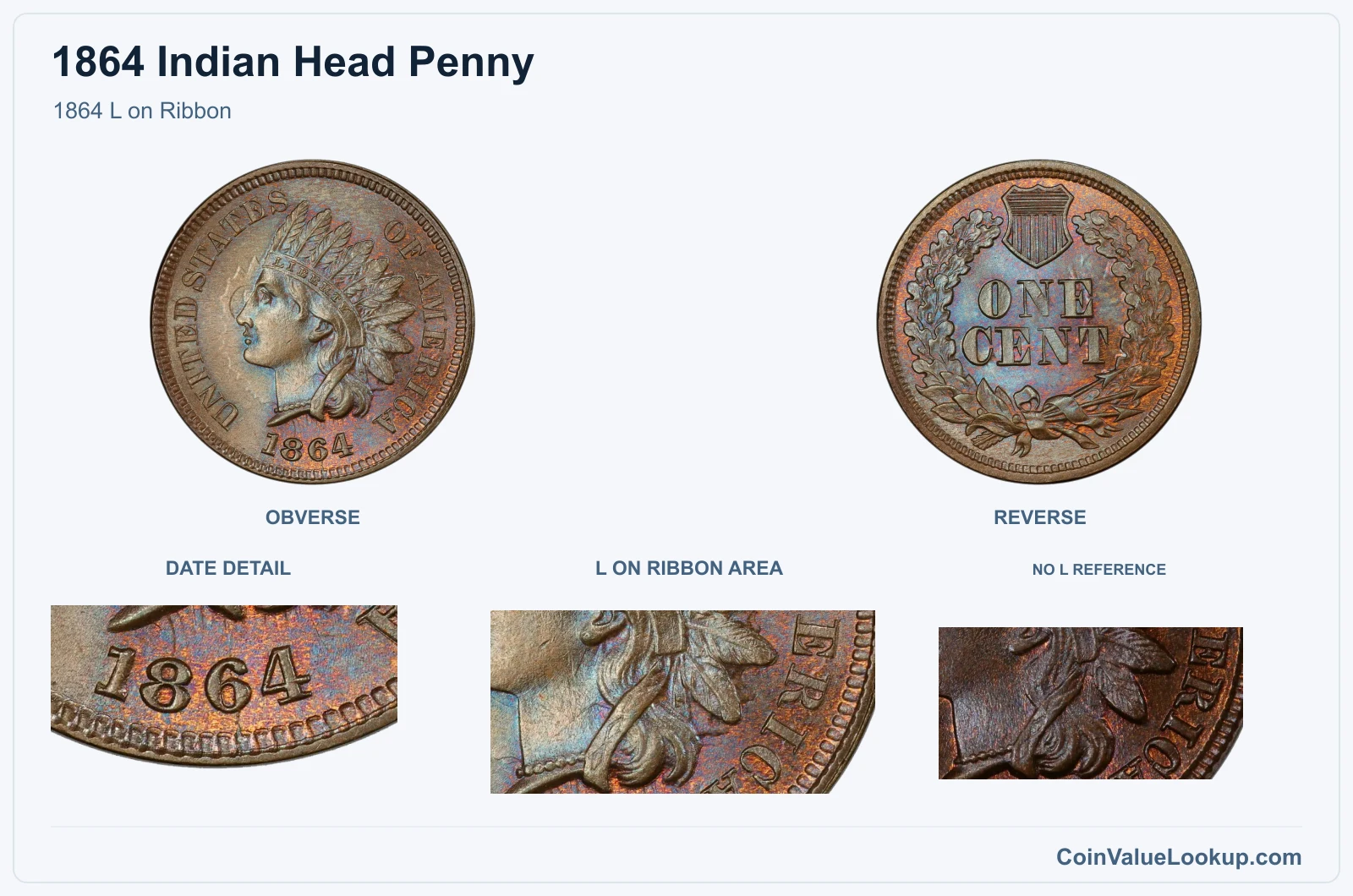
This is the one people hope they have. The 1864 L on Ribbon variety shows a small letter L (designer James B. Longacre's initial) on the lower portion of the ribbon behind the Indian portrait.
It is bronze, weighing 3.11 grams, struck at Philadelphia.
Because the L was added to the die partway through the year, these are scarcer than the No L bronze. USA Coin Book guide estimates are about $73 at G4 and $721 at MS63.
On worn examples the L can be faint or nearly invisible, so use magnification and good lighting. Confirm the weight is in the 3.1-gram range to rule out the copper-nickel composition before hunting for the L.
| Range | Grade | Price | Auction Records | Appraisal |
|---|---|---|---|---|
| PO | PO 1 | — | Coin Identifier | |
| FR | FR 2 | Coin Identifier | ||
| AG | AG 3 | Coin Identifier | ||
| G | G 4 | Coin Identifier | ||
| G 6 | Coin Identifier | |||
| VG | VG 8 | Coin Identifier | ||
| VG 10 | Coin Identifier | |||
| F | F 12 | Coin Identifier | ||
| F 15 | Coin Identifier | |||
| VF | VF 20 | Coin Identifier | ||
| VF 25 | Coin Identifier | |||
| VF 30 | Coin Identifier | |||
| VF 35 | Coin Identifier | |||
| XF | XF 40 | Coin Identifier | ||
| XF 45 | Coin Identifier | |||
| AU | AU 50 | Coin Identifier | ||
| AU 53 | Coin Identifier | |||
| AU 55 | Coin Identifier | |||
| AU 58 | Coin Identifier | |||
| MS | MS 60 | Coin Identifier | ||
| MS 61 | Coin Identifier | |||
| MS 62 | Coin Identifier | |||
| MS 63 | Coin Identifier | |||
| MS 64 | Coin Identifier | |||
| MS 65 | Coin Identifier | |||
| MS 66 | Coin Identifier | |||
| MS 67 | — | — | — | |
| MS 68 | — | — | — | |
| MS 69 | — | — | — | |
| MS 70 | — | — | — |
1864 Indian Head Penny — Copper-Nickel PR
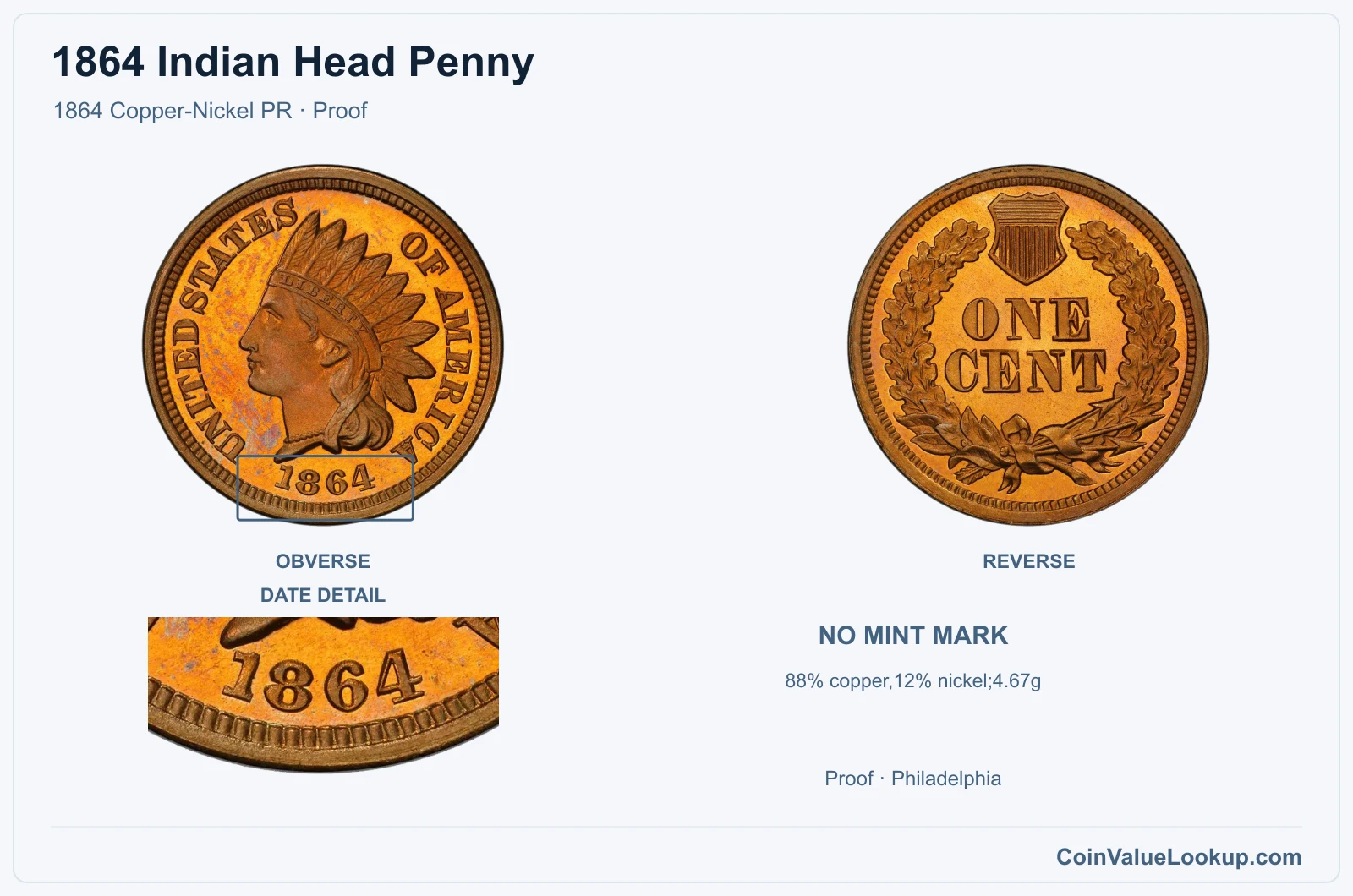
The 1864 copper-nickel proof was specially manufactured with mirrored fields and squared-off rims. It weighs 4.67 grams, matching the copper-nickel business strike composition.
Philadelphia only.
USA Coin Book lists this at about $1,344 in PR63. Proof status must be verified by examining the coin's surfaces, rim geometry and overall manufacturing detail.
A business strike that has been polished may look reflective, but it is not a proof. If you suspect you have one, professional authentication is the safest route.
| Range | Grade | Price | Auction Records | Appraisal |
|---|---|---|---|---|
| PR | PR 1 | — | Coin Identifier | |
| PR 2 | — | Coin Identifier | ||
| PR 3 | — | Coin Identifier | ||
| PR 4 | — | Coin Identifier | ||
| PR 6 | — | Coin Identifier | ||
| PR 8 | — | Coin Identifier | ||
| PR 10 | — | Coin Identifier | ||
| PR 12 | — | Coin Identifier | ||
| PR 15 | — | Coin Identifier | ||
| PR 20 | — | Coin Identifier | ||
| PR 25 | — | Coin Identifier | ||
| PR 30 | — | Coin Identifier | ||
| PR 35 | — | Coin Identifier | ||
| PR 40 | — | Coin Identifier | ||
| PR 45 | — | Coin Identifier | ||
| PR 50 | — | Coin Identifier | ||
| PR 53 | — | Coin Identifier | ||
| PR 55 | — | Coin Identifier | ||
| PR 58 | — | Coin Identifier | ||
| PR 60 | — | Coin Identifier | ||
| PR 61 | — | Coin Identifier | ||
| PR 62 | Coin Identifier | |||
| PR 63 | Coin Identifier | |||
| PR 64 | Coin Identifier | |||
| PR 65 | Coin Identifier | |||
| PR 66 | Coin Identifier | |||
| PR 67 | Coin Identifier | |||
| PR 68 | — | — | — | |
| PR 69 | — | — | — | |
| PR 70 | — | — | — |
1864 Indian Head Penny — Bronze PR
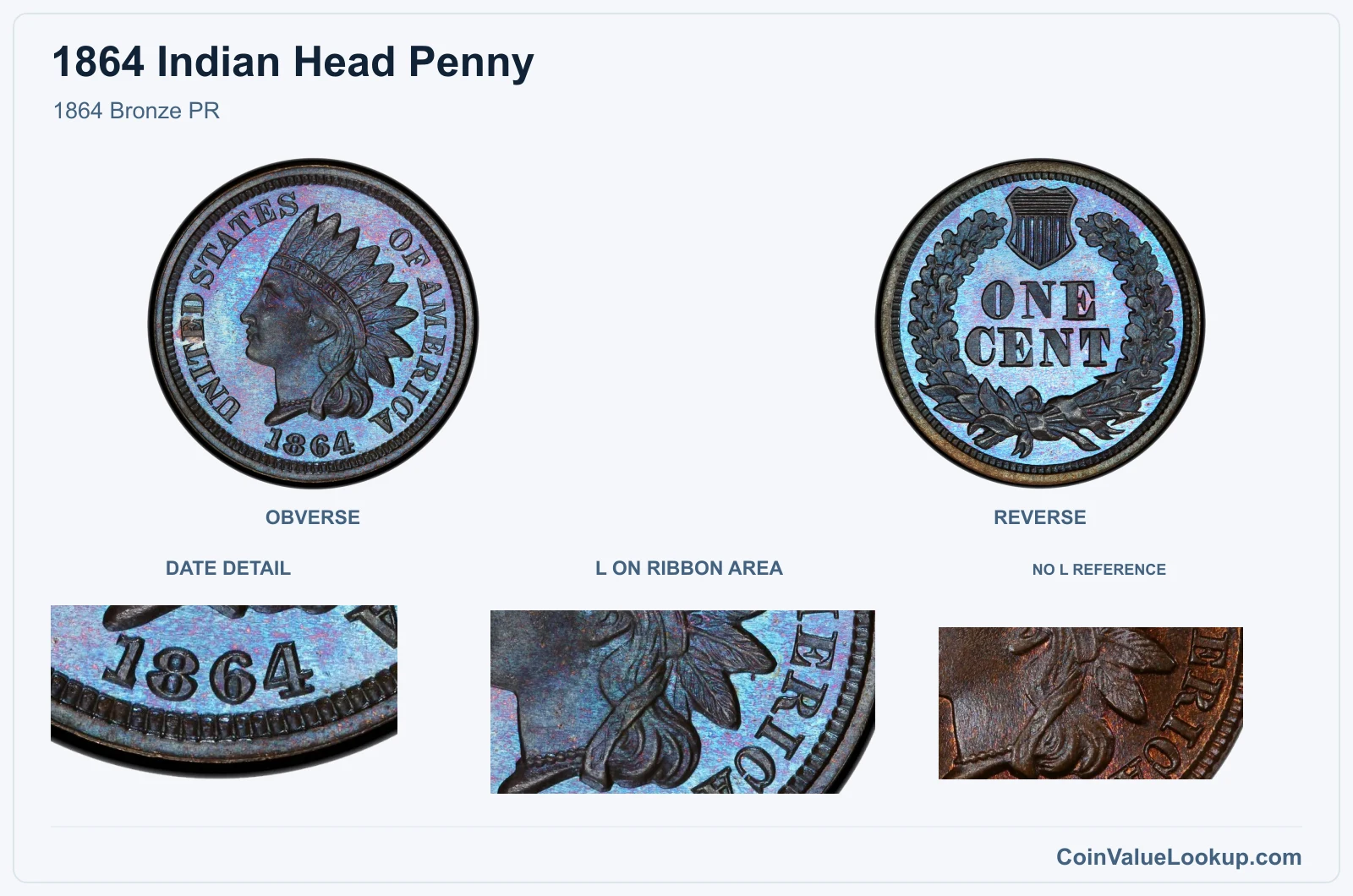
The 1864 Bronze No L proof shares its 3.11-gram bronze composition with the regular business strike but was produced with proof manufacturing methods. It shows deeply mirrored fields and crisp design edges that a circulation strike simply does not have.
USA Coin Book places this version at around $790 in PR63. As with all proofs, confirm the coin's surfaces, sharp rims and squared edge profile before assuming proof status.
A shiny old coin is not automatically a proof.
| Range | Grade | Price | Auction Records | Appraisal |
|---|---|---|---|---|
| PR | PR 1 | — | Coin Identifier | |
| PR 2 | — | Coin Identifier | ||
| PR 3 | — | Coin Identifier | ||
| PR 4 | — | Coin Identifier | ||
| PR 6 | — | Coin Identifier | ||
| PR 8 | — | Coin Identifier | ||
| PR 10 | — | Coin Identifier | ||
| PR 12 | — | Coin Identifier | ||
| PR 15 | — | Coin Identifier | ||
| PR 20 | — | Coin Identifier | ||
| PR 25 | — | Coin Identifier | ||
| PR 30 | — | Coin Identifier | ||
| PR 35 | — | Coin Identifier | ||
| PR 40 | — | Coin Identifier | ||
| PR 45 | — | Coin Identifier | ||
| PR 50 | — | Coin Identifier | ||
| PR 53 | — | Coin Identifier | ||
| PR 55 | — | Coin Identifier | ||
| PR 58 | — | Coin Identifier | ||
| PR 60 | — | Coin Identifier | ||
| PR 61 | — | Coin Identifier | ||
| PR 62 | — | Coin Identifier | ||
| PR 63 | Coin Identifier | |||
| PR 64 | Coin Identifier | |||
| PR 65 | Coin Identifier | |||
| PR 66 | Coin Identifier | |||
| PR 67 | Coin Identifier | |||
| PR 68 | — | — | — | |
| PR 69 | — | — | — | |
| PR 70 | — | — | — |
1864 Indian Head Penny — L On Ribbon PR
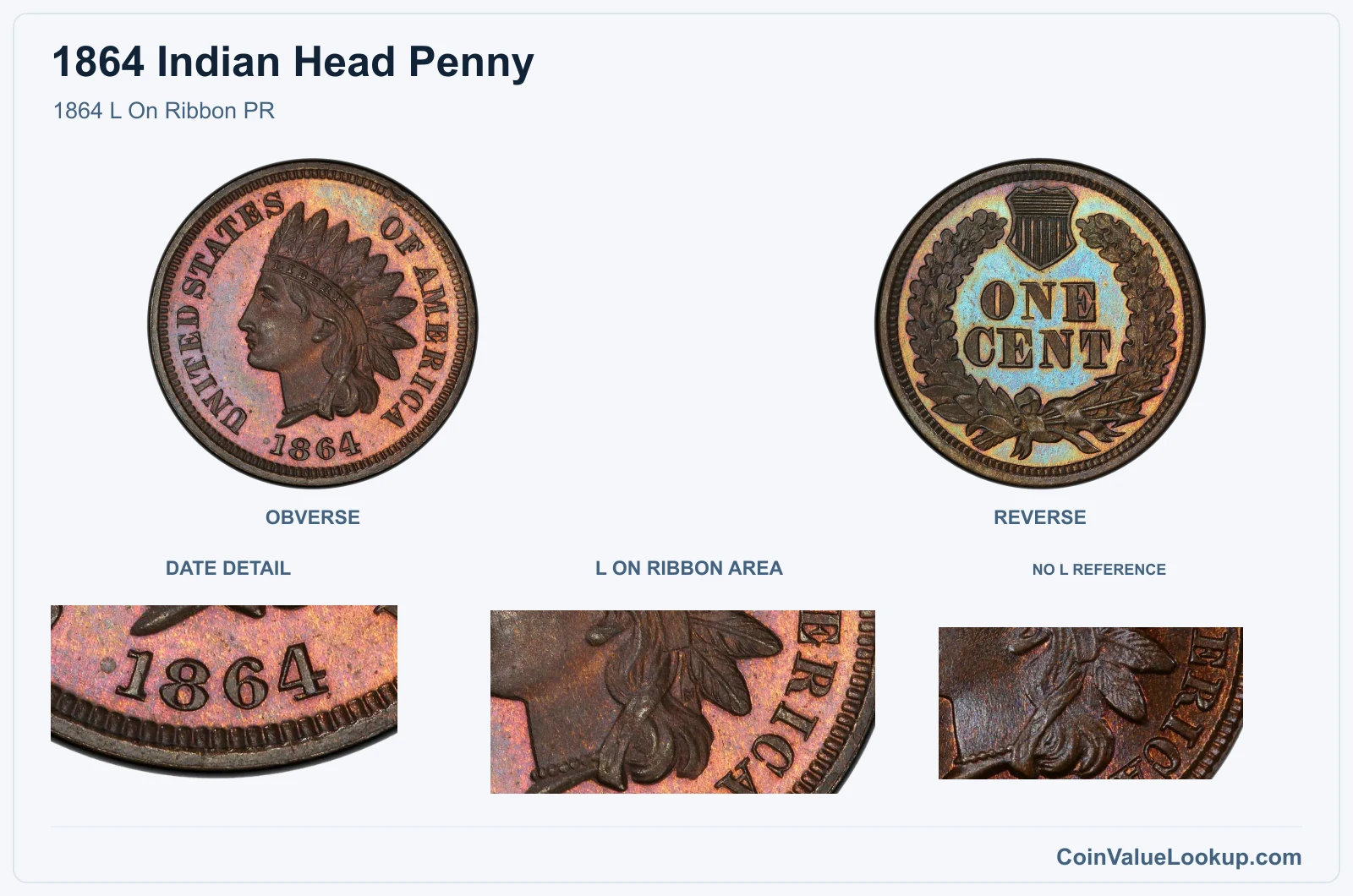
This is the rarest regular-issue proof in the 1864 Indian cent lineup. The L on Ribbon proof combines the scarce L variety with proof manufacturing in bronze at 3.11 grams.
Very few were produced.
The USA Coin Book guide estimate sits at approximately $37,253 in PR63, reflecting extreme rarity. If you believe you have one, do not clean it or handle it carelessly.
Professional third-party authentication and grading is essential for a coin at this level. Verify both the L initial on the ribbon and genuine proof surfaces, including mirrored fields and precisely finished rims, before drawing any conclusions.
| Range | Grade | Price | Auction Records | Appraisal |
|---|---|---|---|---|
| PR | PR 1 | — | Coin Identifier | |
| PR 2 | — | Coin Identifier | ||
| PR 3 | — | Coin Identifier | ||
| PR 4 | — | Coin Identifier | ||
| PR 6 | — | Coin Identifier | ||
| PR 8 | — | Coin Identifier | ||
| PR 10 | — | Coin Identifier | ||
| PR 12 | — | Coin Identifier | ||
| PR 15 | — | Coin Identifier | ||
| PR 20 | — | Coin Identifier | ||
| PR 25 | — | Coin Identifier | ||
| PR 30 | — | Coin Identifier | ||
| PR 35 | — | Coin Identifier | ||
| PR 40 | — | Coin Identifier | ||
| PR 45 | — | Coin Identifier | ||
| PR 60 | — | Coin Identifier | ||
| PR 61 | — | Coin Identifier | ||
| PR 62 | — | Coin Identifier | ||
| PR 63 | — | Coin Identifier | ||
| PR 64 | Coin Identifier | |||
| PR 65 | Coin Identifier | |||
| PR 66 | Coin Identifier | |||
| PR 67 | — | — | — | |
| PR 68 | — | — | — | |
| PR 69 | — | — | — | |
| PR 70 | — | — | — |
1864 Indian Head Penny Error List
1. 1864 Indian Head Penny — Die Break / Cud
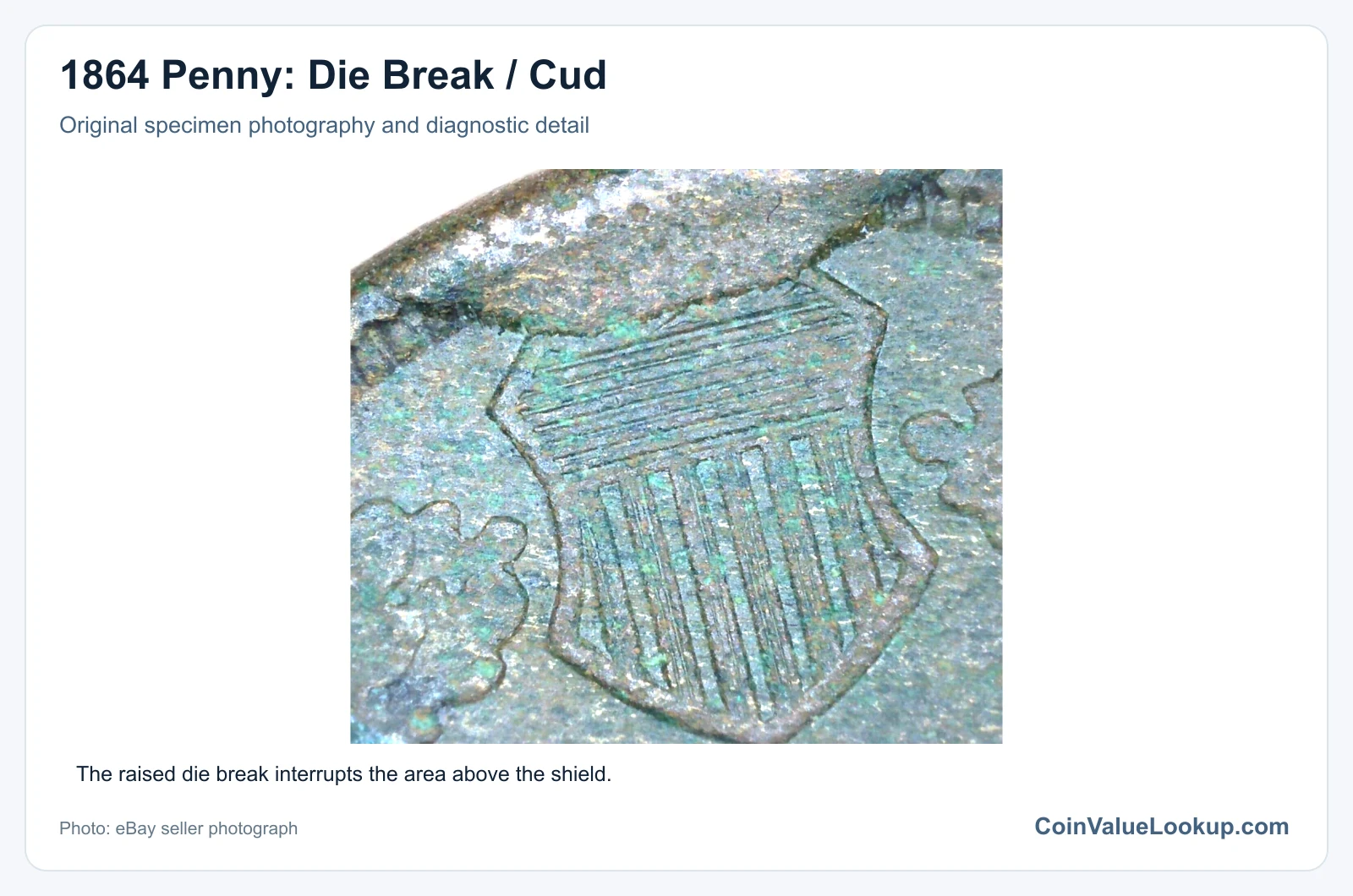
A die break or cud on an 1864 Indian cent shows up as a raised, irregularly shaped blob of metal on the coin's surface. A true cud connects to the rim and represents a chunk of the die that broke away, leaving the planchet metal to fill the void during striking.
Look for a displaced or missing portion of the normal design adjacent to the raised area. Compare the edge texture closely; a rim dent, corrosion patch, or small interior die chip can mimic a cud to an untrained eye.
Dents are depressed, not raised.
Value depends on the size, location and visual impact of the break, plus the coin's overall grade and authenticated identity. No fixed price range applies across the board.
2. 1864 Indian Head Penny — Off-Center Strike
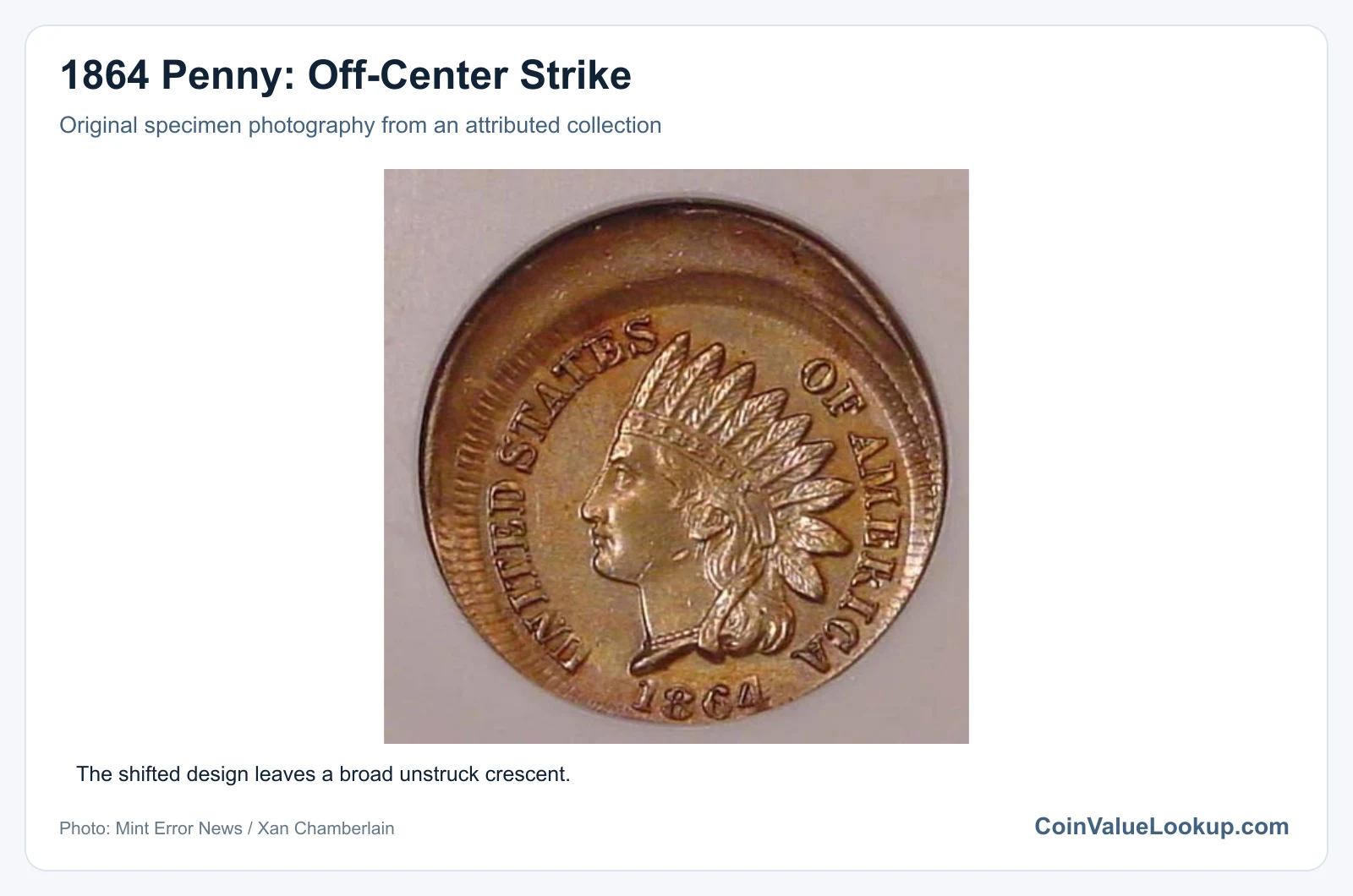
An off-center strike happens when the planchet is not properly seated between the dies. The result is a displaced design with an unstruck crescent of blank metal on one side of the coin.
The key detail for collectors: is the date still visible? An off-center 1864 Indian cent with a readable date and clear displacement is far more collectible than one where the date has vanished into the unstruck area.
Check that the missing area is a smooth, original planchet surface, not a clipped edge or post-mint flattening.
Pricing depends on the percentage of off-center displacement, date visibility, the specific version and the coin's condition. Each piece needs individual assessment by a qualified grading service.
3. 1864 Indian Head Penny — Die Crack
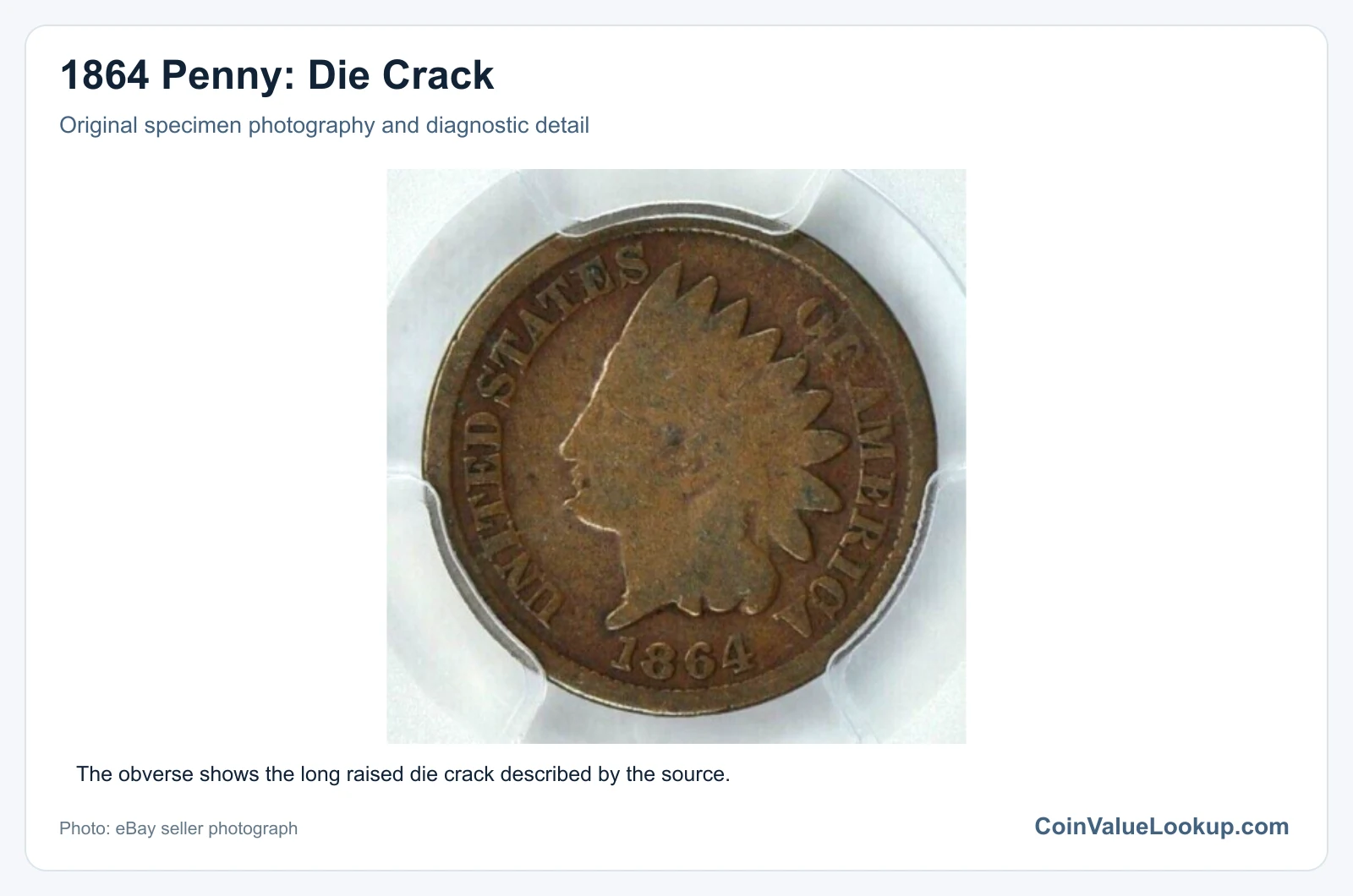
Die cracks appear as thin, raised lines running across the coin's field or through design elements. They result from stress fractures in the steel die during production.
To confirm, feel the line with a fingernail or look under magnification; a genuine die crack is raised above the surface. An incuse scratch, on the other hand, cuts into the metal.
Corrosion lines and displaced-metal scrapes can also look similar at first glance but will show different surface textures under magnification.
Record where the crack begins and ends, and note whether it connects to the rim or stays within the design. Value varies by prominence, location and the coin's overall condition, so individual assessment is necessary.
4. 1864 Indian Head Penny — Double / Multiple Strike
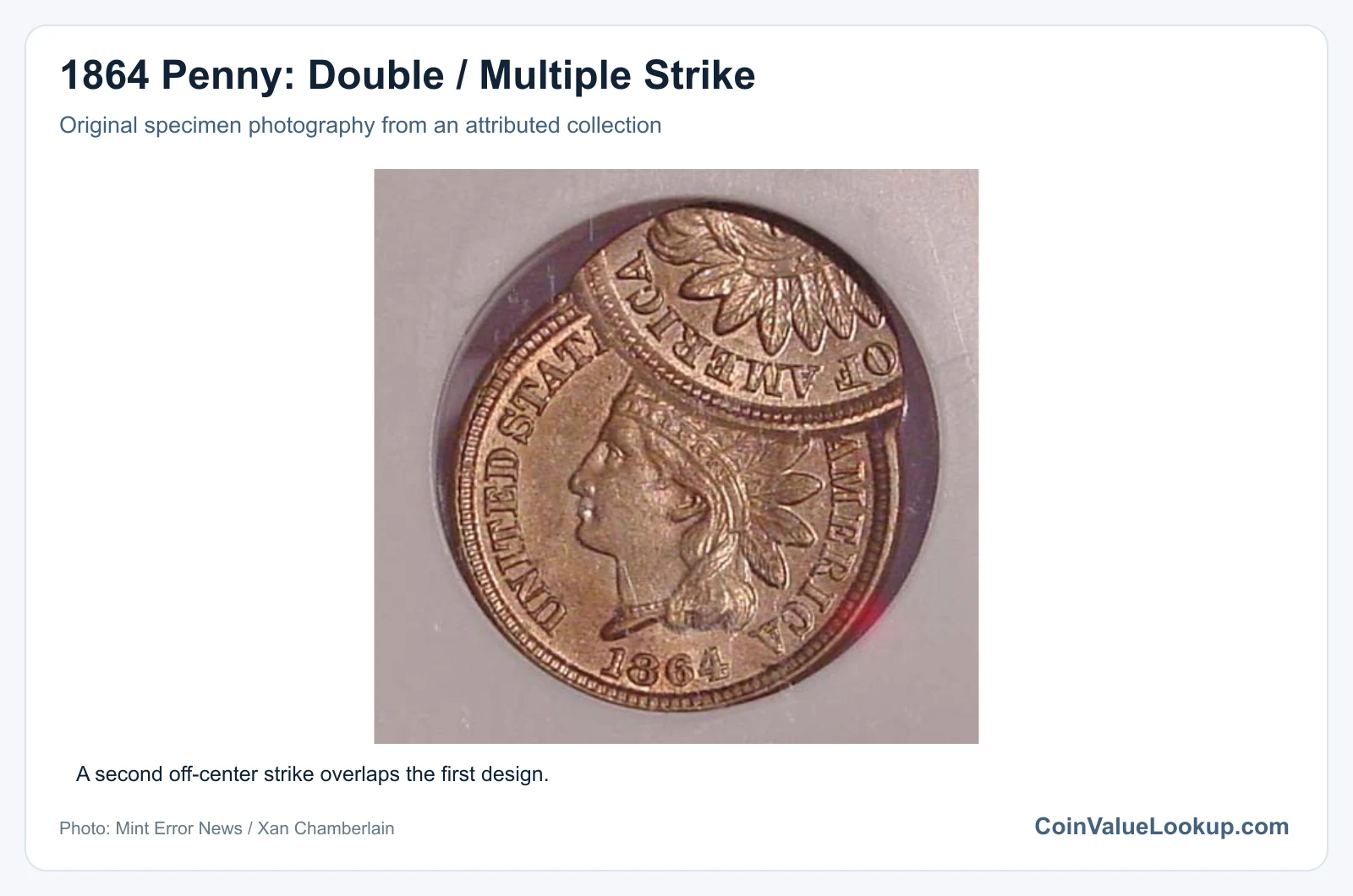
A double or multiple strike occurs when the coin is struck more than once by the dies, with some shift or rotation between impressions. You will see two (or more) separate, displaced sets of design elements rather than merely thickened letters.
This is different from a doubled die, which is a single strike from a die that was itself made with overlapping hub impressions. It is also different from mechanical doubling, which produces flat, shelf-like distortion on lettering.
A true double strike shows distinct, fully formed secondary impressions.
Value depends on how dramatic the displacement is, whether the date and design are identifiable, and the coin's authenticated identity and grade. Each example needs individual evaluation.
5. 1864 Indian Head Penny — Clipped Planchet
A clipped planchet error means a portion of the original metal blank was missing before the coin was struck. It can be curved, straight or ragged depending on how the clip happened during blank production.
Look at the edge texture in the clipped area. Genuine clips often show metal-flow weakness on the opposite side of the coin from the missing section, because the metal could not fill the die cavity completely.
A filed notch or deliberate edge cut will have tool marks and no corresponding weakness.
Corrosion eating into the rim can also mimic a clip. Check for pitting or uneven surface damage.
Value depends on clip size, type and the coin's overall grade and identity.
6. 1864 Indian Head Penny — Rotated Dies
Rotated dies means the obverse and reverse are not aligned in the normal 180-degree coin-turn orientation used on U.S. coins. To check, hold the obverse upright and flip the coin top to bottom.
The reverse should appear upright as well. If it is tilted, you may have a rotation error.
Before getting excited, make sure you are not simply looking at a rotated photograph. Physically handle the coin and check alignment repeatedly.
Minor rotations of a few degrees are less significant than dramatic 45-degree or 90-degree shifts.
Value depends on the degree of rotation, the coin's version, grade and authenticated identity. There is no single price that covers all rotation errors for this date.
7. 1864 Indian Head Penny — Struck-Through Error
A struck-through error occurs when foreign material, such as grease, a thread or a metal fragment, gets between the die and the planchet during striking. The result is a localized depression or incomplete design area where the obstruction blocked the die's impression.
Grease-filled dies tend to produce smooth, rounded depressions, while a retained foreign object can leave a distinct shape or texture. Either way, the affected area will lack normal design detail.
Do not confuse this with ordinary wear, cleaning marks or a weakly struck area from insufficient die pressure. Under magnification, a struck-through impression has a specific boundary and depth that differs from gradual circulation wear.
Pricing depends on the type and size of obstruction, visual impact and the coin's authenticated grade.
8. 1864 Indian Head Penny — Repunched Date
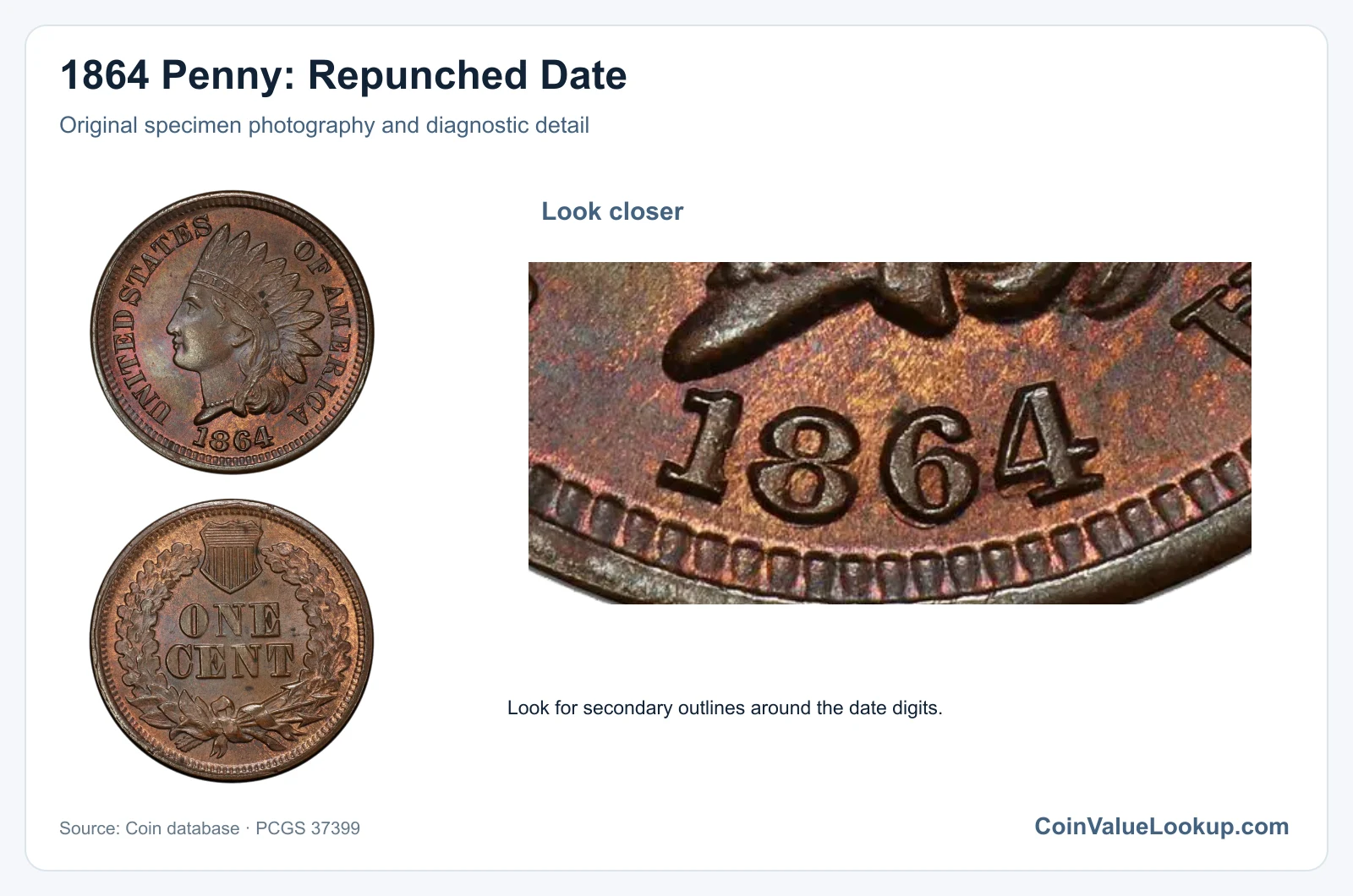
A repunched date on an 1864 Indian cent shows remnants of an earlier, slightly misaligned date punch beside or beneath the final numerals. Under magnification you can spot traces of a secondary 1, 8, 6 or 4 peeking out from behind the primary digits.
This is a die variety, not a full-coin doubled strike. The extra impression comes from the date punch being applied more than once to the working die at slightly different positions.
It is distinct from machine doubling, which produces flat shelf-like distortion, and from simple date damage caused by contact marks or corrosion.
Value depends on the visibility and direction of the repunching, the affected digits, and the coin's overall grade and authenticated identity. Individual assessment is the way to go here.