1866 Indian Head Penny Coin Value: How Much Is It Worth?
The 1866 Indian Head penny is a post-Civil War bronze cent struck only at the Philadelphia Mint. Guide estimates for regular business strikes range from about $73 in G4 (a well-worn but readable coin) to around $556 in MS63 (a choice uncirculated example with original luster).
Proofs, major die varieties and mint errors require separate evaluation beyond those figures.
Fast Way to Identify Your 1866 Indian Head Penny
Want a quick read on your 1866 Indian Head cent? Upload clear photos of both the front and back of your coin.
Our identifier can offer a preliminary identification of the version and general condition based on those images. It is not a substitute for professional authentication or certified grading, but it gives you a solid starting point.
1866 Indian Head Penny Value
Upload both sides of your 1866 Indian Head Penny.
Front Obverse
Upload photo
Back Reverse
Upload photo
Which 1866 Indian Head Penny Versions Are Worth Money?
- Business strikes in original uncirculated condition (MS63) can reach around $556 according to guide estimates — original surfaces and remaining red-brown color matter.
- Proof examples carry a guide value near $438 at PR63; verify genuine proof manufacture before assuming this category.
- Die varieties such as doubled die obverse, repunched date and misplaced date have been reported for this year and may carry individual premiums depending on severity and authentication.
- Coins with full original red or red-brown color and no cleaning are more marketable than dark or artificially retoned examples.
Step 1: Identify Your 1866 Indian Head Penny Mint Mark and Version
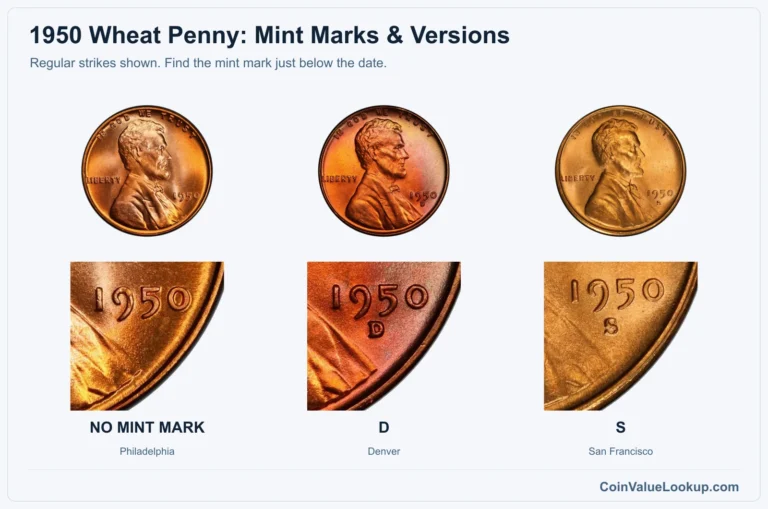
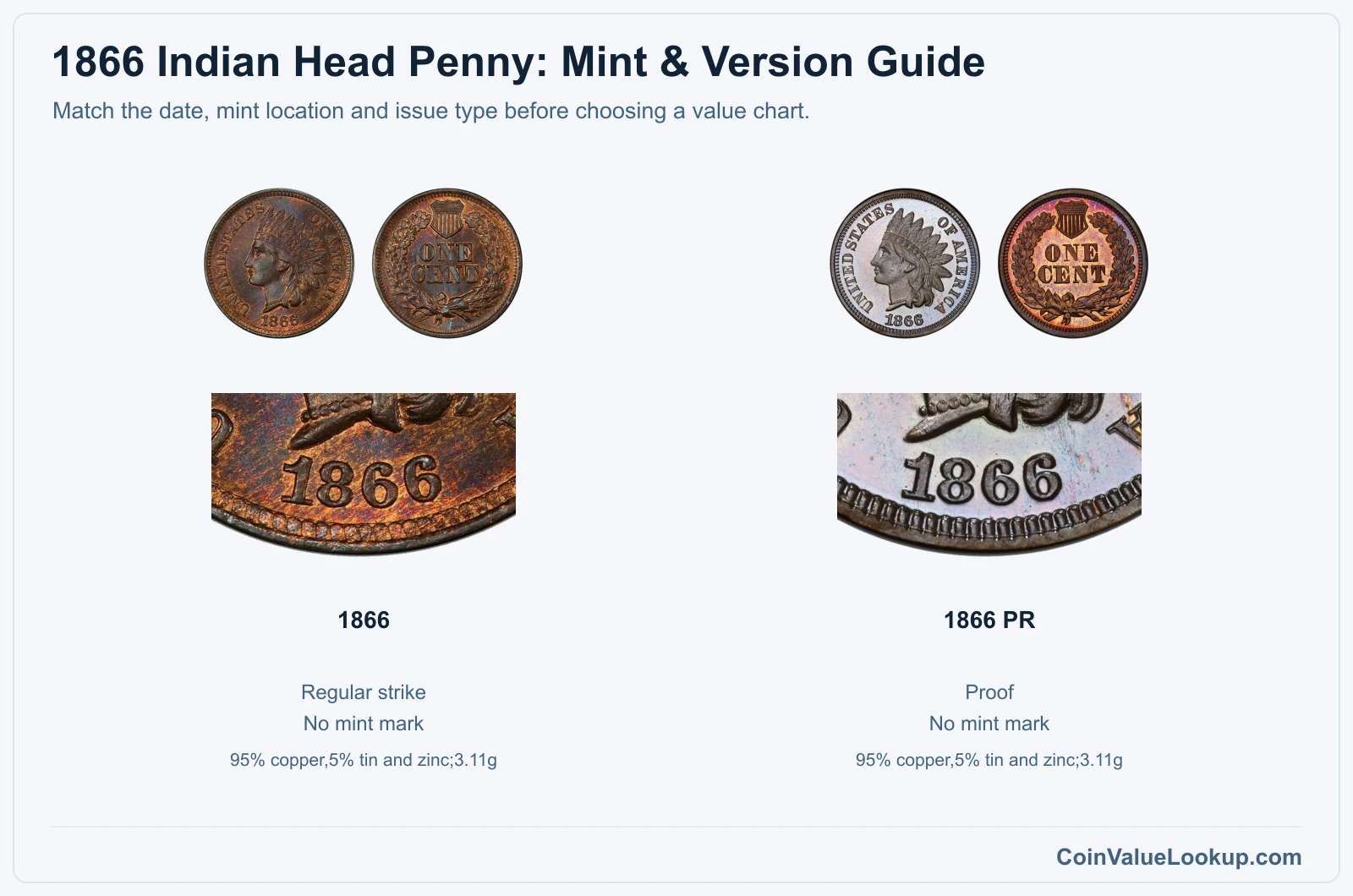
Every regular 1866 Indian Head cent was struck at the Philadelphia Mint. There is no mintmark on this coin.
The small "L" on the headdress ribbon is the engraver's initial, not a mint identifier.
The obverse shows a Liberty portrait wearing a feathered headdress, and the reverse features an oak wreath surrounding a federal shield. If your coin has wheat ears or a Lincoln portrait on the other side, you have a different series entirely.
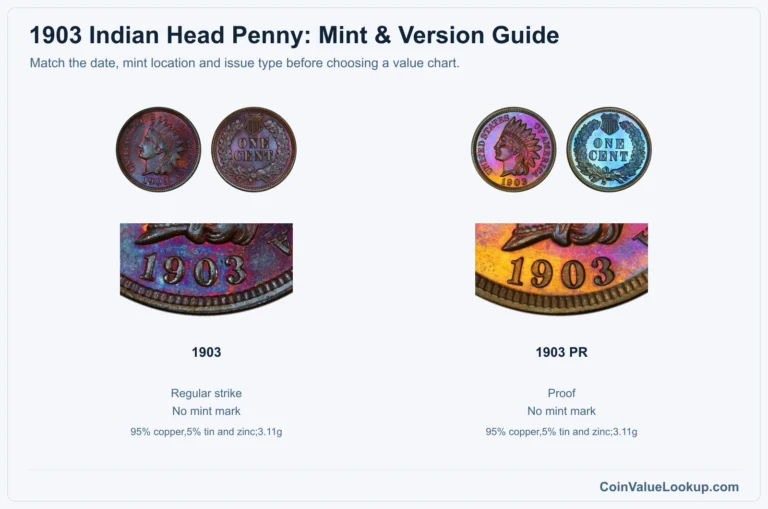
Two main branches exist for 1866: the standard business strike and the proof. Business strikes were made for circulation and show a normal satin or semi-lustrous surface.
Proofs were specially manufactured presentation pieces with mirrored fields and sharp rims.
Do not call a coin "proof" just because someone polished it. Genuine proofs have a specific rim geometry and die finish that differ from a cleaned circulation coin.
Mirrored polish alone is not enough evidence. Confirm the exact finish before looking up a value.
Step 2: Check Your 1866 Indian Head Penny Grade
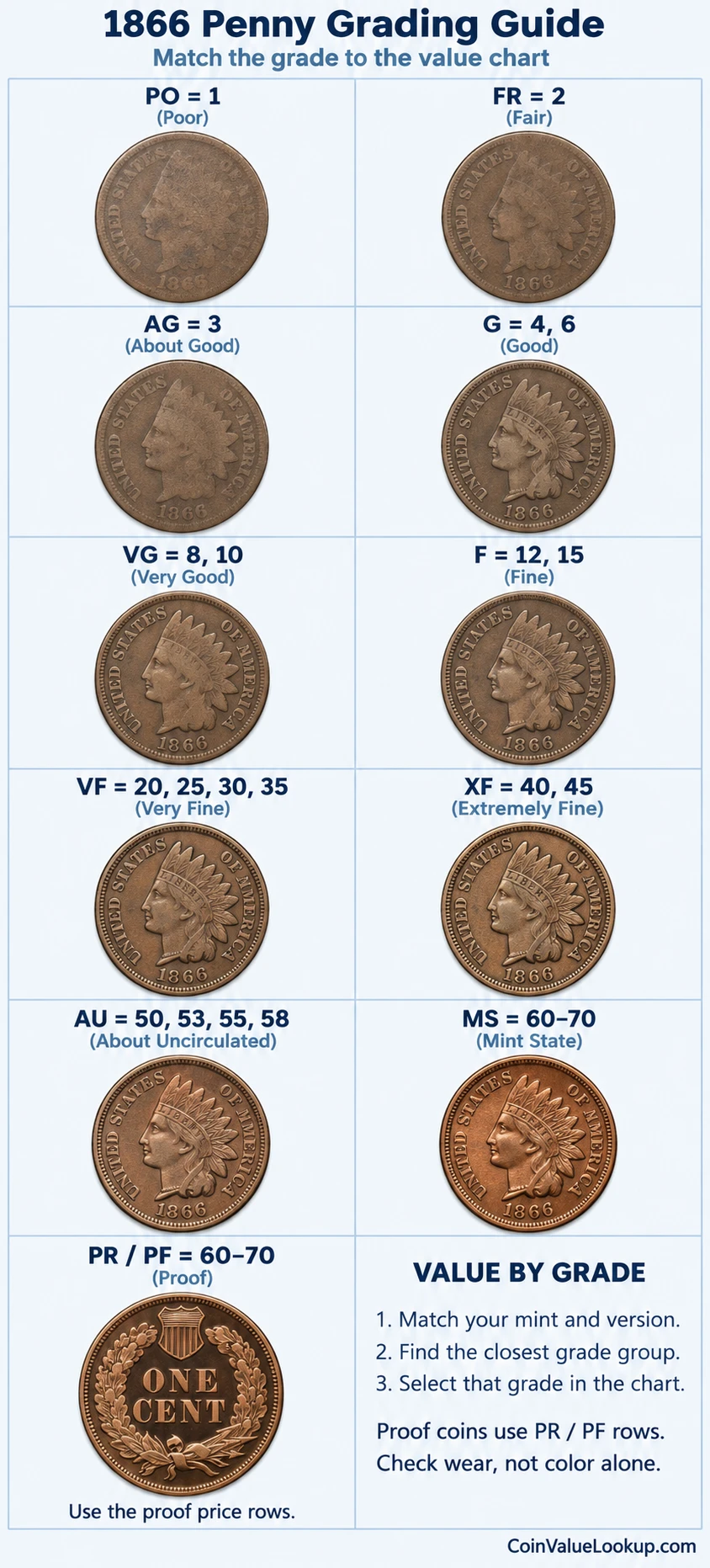
Start with the headband. On a well-preserved coin, every letter of LIBERTY is sharp and fully separated.
As the coin wears, the letters merge with the band, beginning with the middle letters. A coin grading G4 will show a readable date and outline of the portrait but very little headband detail.
Next, check the feather tips above the ear and the hair curls below the headdress. These are high points that wear first.
On the reverse, look at the bow knot and the leaf tips near the top of the wreath.
Here is the tricky part: some 1866 cents left the press with a soft strike, especially in the feather and hair areas. A weakly struck coin can look worn even when it is not.
Check for luster in the protected areas of the design before downgrading.
The comparison image nearby shows typical wear stages. Match your coin to the closest example, paying attention to the overall surface rather than fixating on one detail.
Bronze color designations like BN, RB and RD describe how much original copper-red color remains. They are not separate materials or grades, just color descriptions that affect collector preference and price.
Step 3: Check 1866 Indian Head Penny Value by Mint and Version
1866 Indian Head Penny
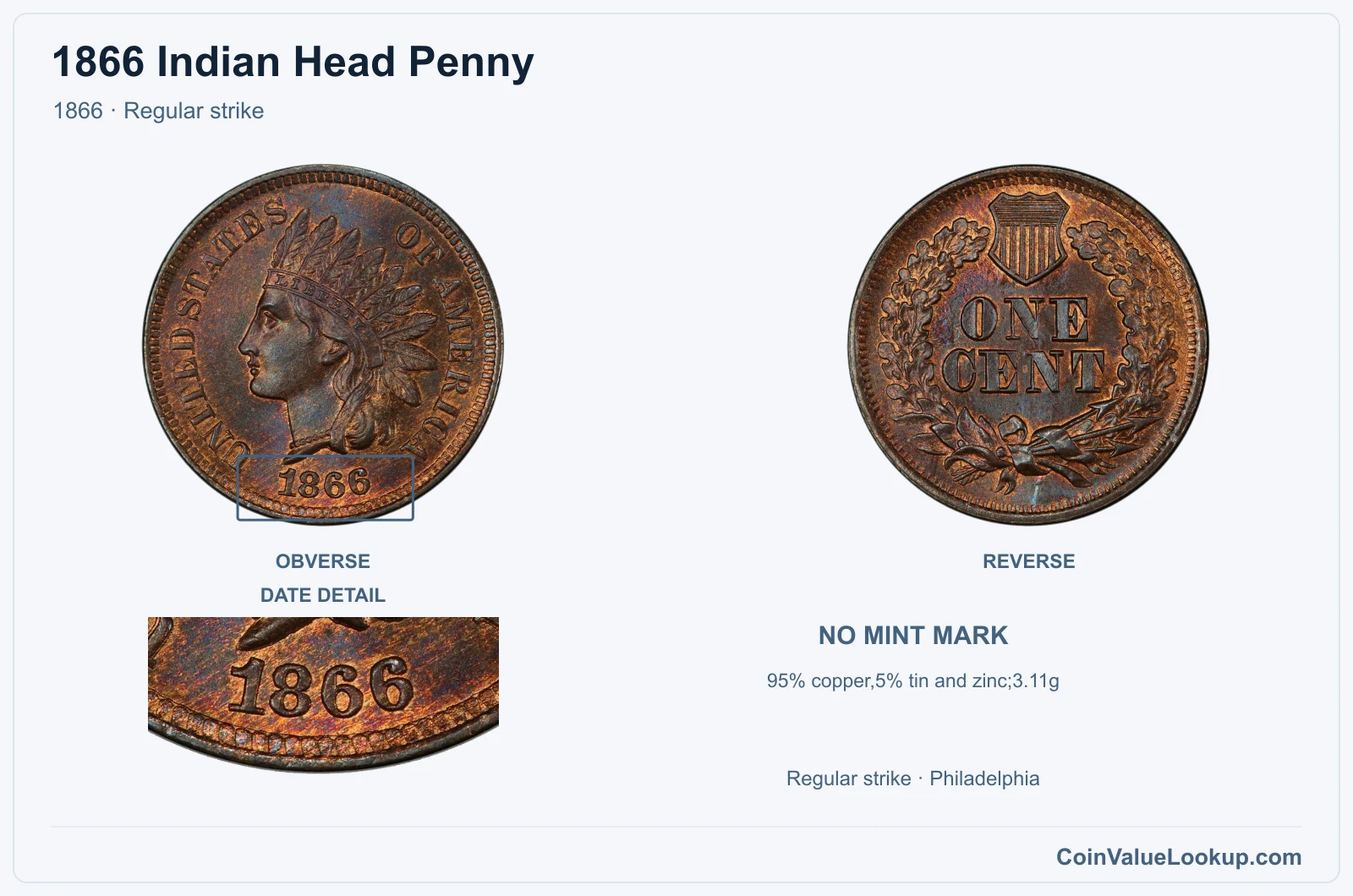
The standard 1866 Indian Head cent is a Philadelphia business strike in bronze, weighing 3.11 grams (95% copper, 5% tin and zinc). No mintmark appears on the coin.
Guide estimates from USA Coin Book place a G4 example around $73 and an MS63 around $556.
Condition drives everything here. A circulated piece in the $73 neighborhood is common enough, but finding one with original mint luster and strong detail pushes value sharply higher.
Cleaned or corroded coins trade well below guide figures regardless of technical grade. Compare only within the same finish — do not borrow proof or rare-variety pricing for a regular strike.
| Range | Grade | Price | Auction Records | Appraisal |
|---|---|---|---|---|
| PO | PO 1 | — | Coin Identifier | |
| FR | FR 2 | — | Coin Identifier | |
| AG | AG 3 | Coin Identifier | ||
| G | G 4 | — | Coin Identifier | |
| G 6 | Coin Identifier | |||
| VG | VG 8 | Coin Identifier | ||
| VG 10 | Coin Identifier | |||
| F | F 12 | Coin Identifier | ||
| F 15 | Coin Identifier | |||
| VF | VF 20 | Coin Identifier | ||
| VF 25 | Coin Identifier | |||
| VF 30 | Coin Identifier | |||
| VF 35 | Coin Identifier | |||
| XF | XF 40 | Coin Identifier | ||
| XF 45 | Coin Identifier | |||
| AU | AU 50 | Coin Identifier | ||
| AU 53 | Coin Identifier | |||
| AU 55 | Coin Identifier | |||
| AU 58 | Coin Identifier | |||
| MS | MS 60 | — | Coin Identifier | |
| MS 61 | Coin Identifier | |||
| MS 62 | Coin Identifier | |||
| MS 63 | Coin Identifier | |||
| MS 64 | Coin Identifier | |||
| MS 65 | Coin Identifier | |||
| MS 66 | Coin Identifier | |||
| MS 67 | — | — | — | |
| MS 68 | — | — | — | |
| MS 69 | — | — | — | |
| MS 70 | — | — | — |
1866 Indian Head Penny — PR
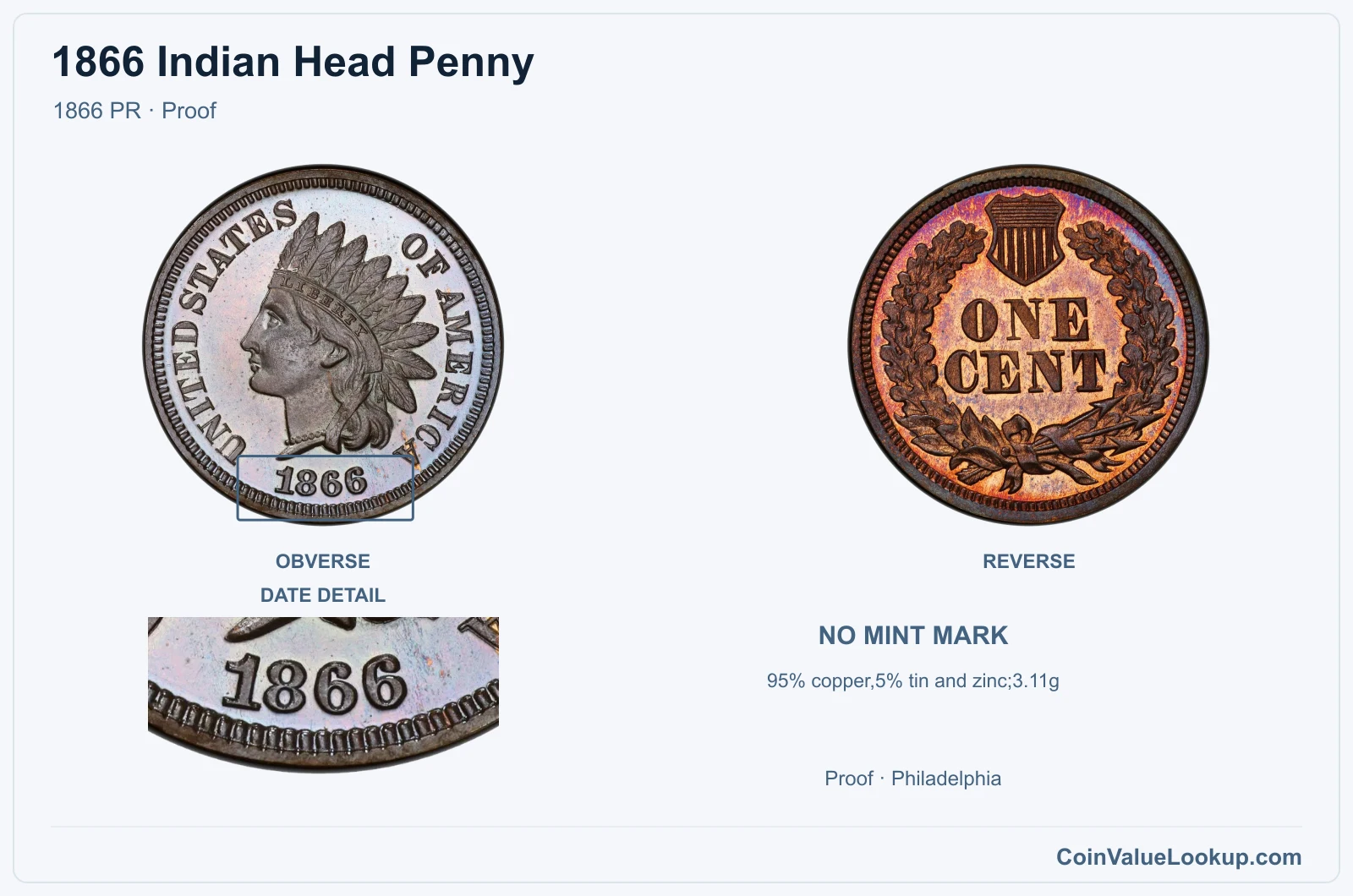
The 1866 proof Indian Head cent was a limited production aimed at collectors, struck at Philadelphia with specially prepared dies. The composition is the same bronze alloy as the business strike.
USA Coin Book lists a PR63 example at roughly $438.
Genuine proofs show deeply mirrored fields, squared-off rims, and a level of detail that stands apart from even the best business strikes. A polished circulated coin is not a proof, no matter how shiny someone made it.
If you suspect you have a proof, examine the rim profile and field reflectivity under a single directed light source.
Coin Value Lookup is a useful place to start when you want to compare your coin against guides for different years and denominations. It can help you narrow down what you are looking at before pursuing professional authentication.
| Range | Grade | Price | Auction Records | Appraisal |
|---|---|---|---|---|
| PR | PR 1 | — | Coin Identifier | |
| PR 2 | — | Coin Identifier | ||
| PR 3 | — | Coin Identifier | ||
| PR 4 | — | Coin Identifier | ||
| PR 6 | — | Coin Identifier | ||
| PR 8 | — | Coin Identifier | ||
| PR 10 | — | Coin Identifier | ||
| PR 12 | — | Coin Identifier | ||
| PR 15 | — | Coin Identifier | ||
| PR 20 | — | Coin Identifier | ||
| PR 25 | — | Coin Identifier | ||
| PR 30 | — | Coin Identifier | ||
| PR 35 | — | Coin Identifier | ||
| PR 40 | — | Coin Identifier | ||
| PR 45 | — | Coin Identifier | ||
| PR 50 | — | Coin Identifier | ||
| PR 53 | — | Coin Identifier | ||
| PR 55 | — | Coin Identifier | ||
| PR 58 | — | Coin Identifier | ||
| PR 60 | — | Coin Identifier | ||
| PR 61 | — | Coin Identifier | ||
| PR 62 | Coin Identifier | |||
| PR 63 | Coin Identifier | |||
| PR 64 | Coin Identifier | |||
| PR 65 | Coin Identifier | |||
| PR 66 | Coin Identifier | |||
| PR 67 | — | — | — | |
| PR 68 | — | — | — | |
| PR 69 | — | — | — | |
| PR 70 | — | — | — |
1866 Indian Head Penny Error List
1. 1866 Indian Head Penny — Die Crack
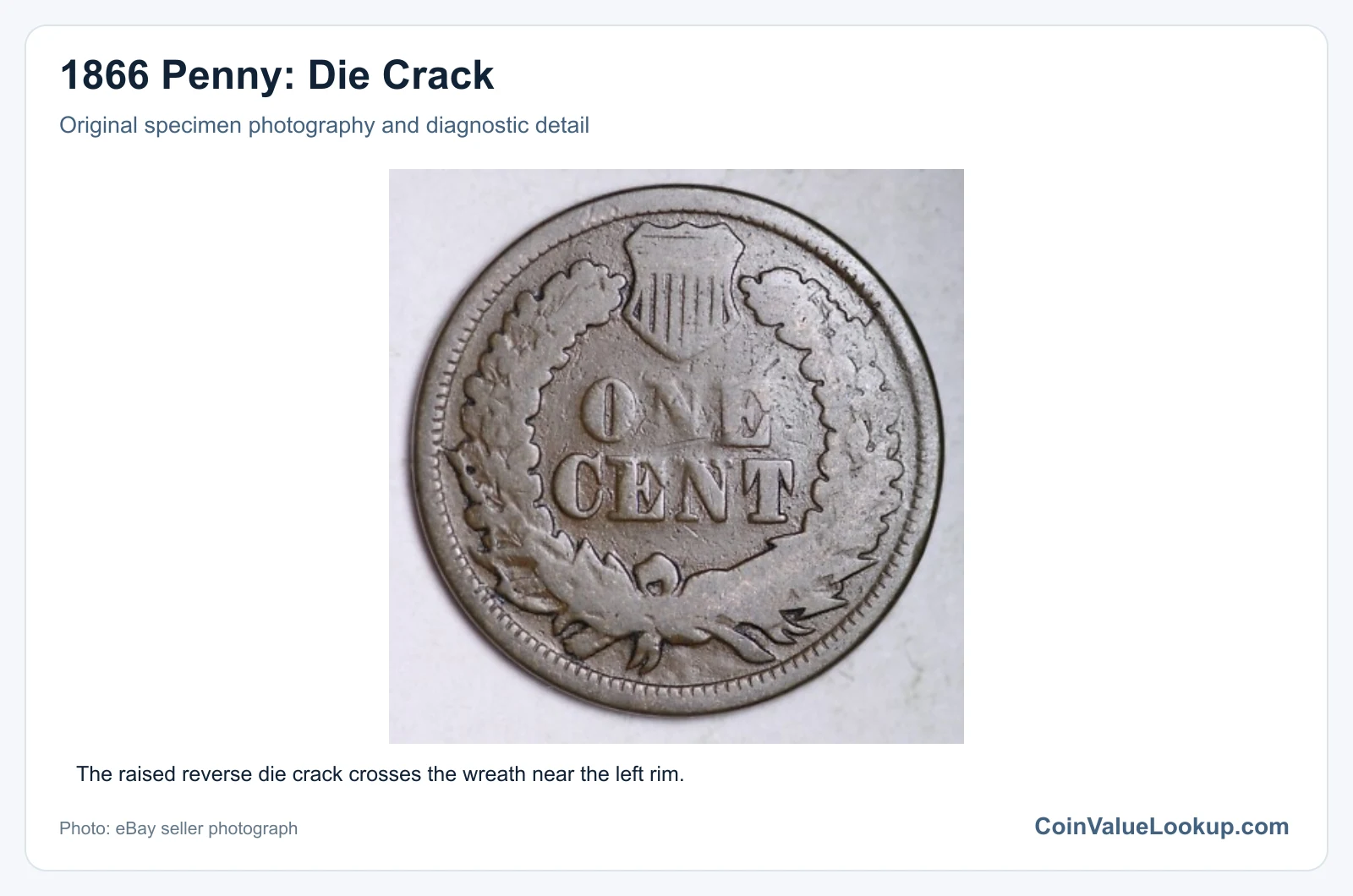
A die crack shows up as a thin raised line running across the surface of the coin. It is literally a fracture in the steel die that transferred as a ridge onto every coin struck after the crack formed.
On an 1866 Indian Head cent, look for a line that crosses the field or cuts through design elements. Note exactly where it starts and where it ends.
Do not confuse a die crack with a scratch or corrosion line. A genuine crack is raised above the surface, while a scratch is incuse (pressed into the metal).
Corrosion tends to follow no clean geometric path and usually pits the surface. Value depends on the crack's size, location and the coin's overall condition.
Professional authentication is needed to confirm the variety and assess its significance.
2. 1866 Indian Head Penny — Die Break / Cud
A die break, sometimes called a cud when it connects to the rim, appears as a raised blob of metal where part of the die face broke away. The coin shows a featureless lump in place of whatever design element used to be there.
On an 1866 cent, a rim-connected cud is the most distinctive form — a smooth raised area interrupting the normal border.
Do not mistake a rim dent or post-mint damage for a cud. A genuine cud is raised and flat-topped, not pushed inward.
Interior die chips are smaller and do not reach the rim. Pricing for die breaks varies widely based on size, location and eye appeal.
Each example needs individual assessment by a qualified grading service to confirm the error and assign a premium.
3. 1866 Indian Head Penny — Doubled Die Obverse
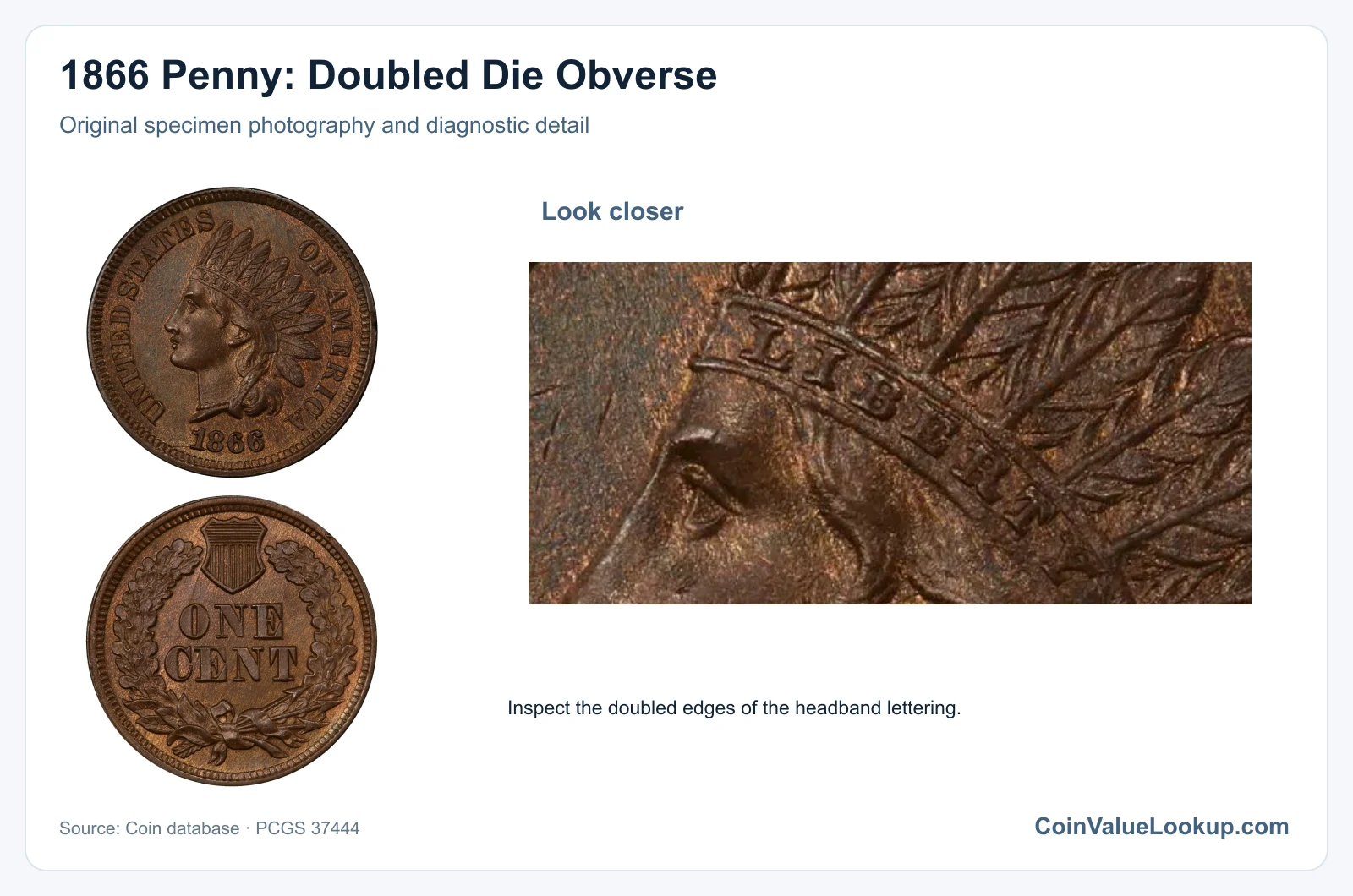
A doubled die obverse on an 1866 Indian Head cent means the die received a second, slightly misaligned impression during its manufacture. The result is consistent doubling visible on the obverse lettering or design — look for separation, notching or a shadowed outline on LIBERTY, the date digits or the portrait details.
The key word is consistent. Every affected element shifts in the same direction.
Machine doubling, by contrast, often produces a flat shelf on one side of a letter and varies across the coin. Worn dies can also create mushy outlines that look like doubling but are just tired metal.
Compare your coin to a known normal example under the same lighting. If you see true separation on multiple design points, have it examined by a third-party grading service for confirmation.
No standard price range is established here; value depends on the strength of the doubling and the coin's condition.
4. 1866 Indian Head Penny — Misplaced Date
A misplaced date occurs when partial impressions of one or more date digits appear somewhere they should not be — embedded in the denticles below the date, partially hidden near the portrait bust, or displaced from the final date position. On an 1866 cent, look carefully in and around the lower border area for ghostly fragments of a numeral.
These traces are small and easy to miss without magnification. They also look nothing like random die chips or scratches, which do not form recognizable numeral shapes.
Compare any suspect mark against the known shape of the digits 1, 8 and 6.
No set price range applies. The value of a confirmed misplaced date depends on how visible and dramatic the displacement is, along with the coin's grade and eye appeal.
Authentication through a professional service is the right move if you believe you have one.
5. 1866 Indian Head Penny — Repunched Date
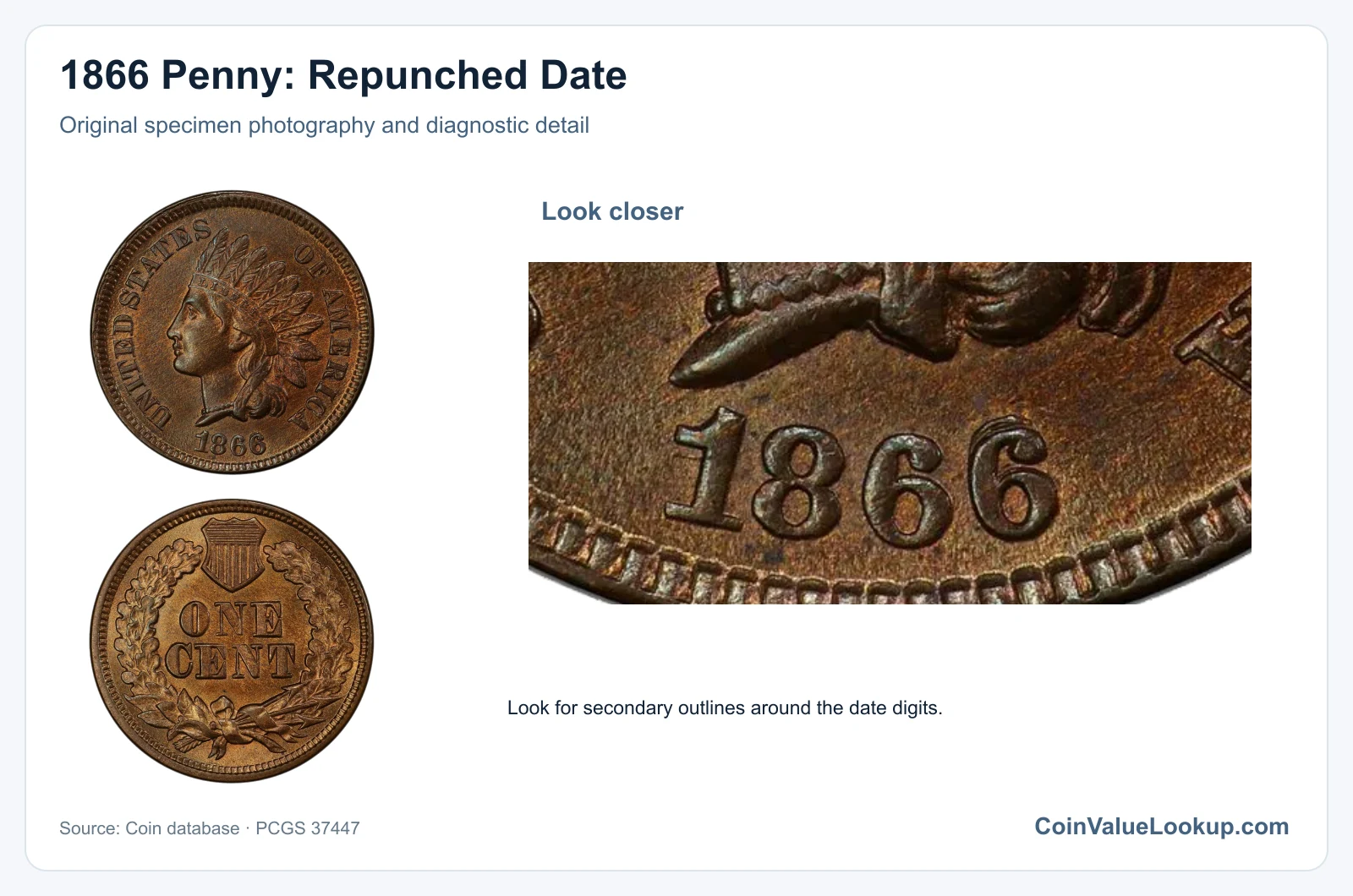
A repunched date means the date was hand-punched into the die more than once, with the second punch landing slightly off from the first. On an 1866 Indian Head cent, look beside or beneath the final date numerals for traces of an earlier impression — a shadow digit, partial serif or extra curve peeking out from behind the main numbers.
This is different from doubled die doubling, which affects the entire obverse design, not just the date area. It is also different from post-strike damage that smears or flattens a digit.
Genuine repunching shows crisp remnants of a separate punch position.
A damaged or corroded date can mimic repunching at first glance, so use magnification and compare with reference images. Value varies by the clarity and position of the repunching, plus overall coin condition.
Professional grading and attribution are recommended.
6. 1866 Indian Head Penny — Rotated Dies
Rotated dies happen when one of the two dies shifts its angular alignment during production. Normally, if you hold the obverse upright and flip the coin top to bottom, the reverse also appears upright.
With a rotation error, the reverse is tilted — sometimes slightly, sometimes dramatically.
To test your 1866 cent, hold the obverse so the portrait faces you correctly. Flip the coin on its vertical axis (like turning a book page).
If the reverse wreath is tilted rather than perfectly upright, you may have a rotation error.
Be careful with photographs — a picture rotated in editing does not count. You need the physical coin in hand or very clear paired images showing the alignment.
Pricing depends on the degree of rotation and the coin's overall grade. Larger rotations generally draw more collector interest, but each piece needs individual evaluation.