1883 Indian Head Penny Coin Value: How Much Is It Worth?
An 1883 Indian Head penny in well-worn condition books around $6.25 at a G4 grade, while an uncirculated example at MS63 can reach roughly $112 according to USA Coin Book retail estimates. Proof strikes carry a separate premium, with a PR63 listed near $313.
These guide figures are not guaranteed offers and apply only to the specific grade and finish described. Proofs, major die varieties and mint errors each require their own evaluation.
Fast Way to Identify Your 1883 Indian Head Penny
The quickest way to get a preliminary read on your 1883 Indian Head cent is to upload clear photos of the front and back. A well-lit, in-focus image of each side lets us help identify the strike type, approximate grade range and any obvious die varieties or errors worth investigating further.
Snap both sides and submit them for a first look.
1883 Indian Head Penny Value
Upload both sides of your 1883 Indian Head Penny.
Front Obverse
Upload photo
Back Reverse
Upload photo
Which 1883 Indian Head Penny Versions Are Worth Money?
- Business strikes range from about $6.25 at G4 to $112 at MS63; original uncirculated surfaces with strong color command the most interest.
- Proof issues are valued separately, with a PR63 listed near $313; confirm proof manufacture before applying proof pricing.
- Several die error categories have been reported for this date, including doubled die reverse, repunched date and die cracks, each requiring individual assessment.
- Cleaning, corrosion and artificial toning lower marketability even on otherwise high-grade coins; original surfaces matter.
Step 1: Identify Your 1883 Indian Head Penny Mint Mark and Version
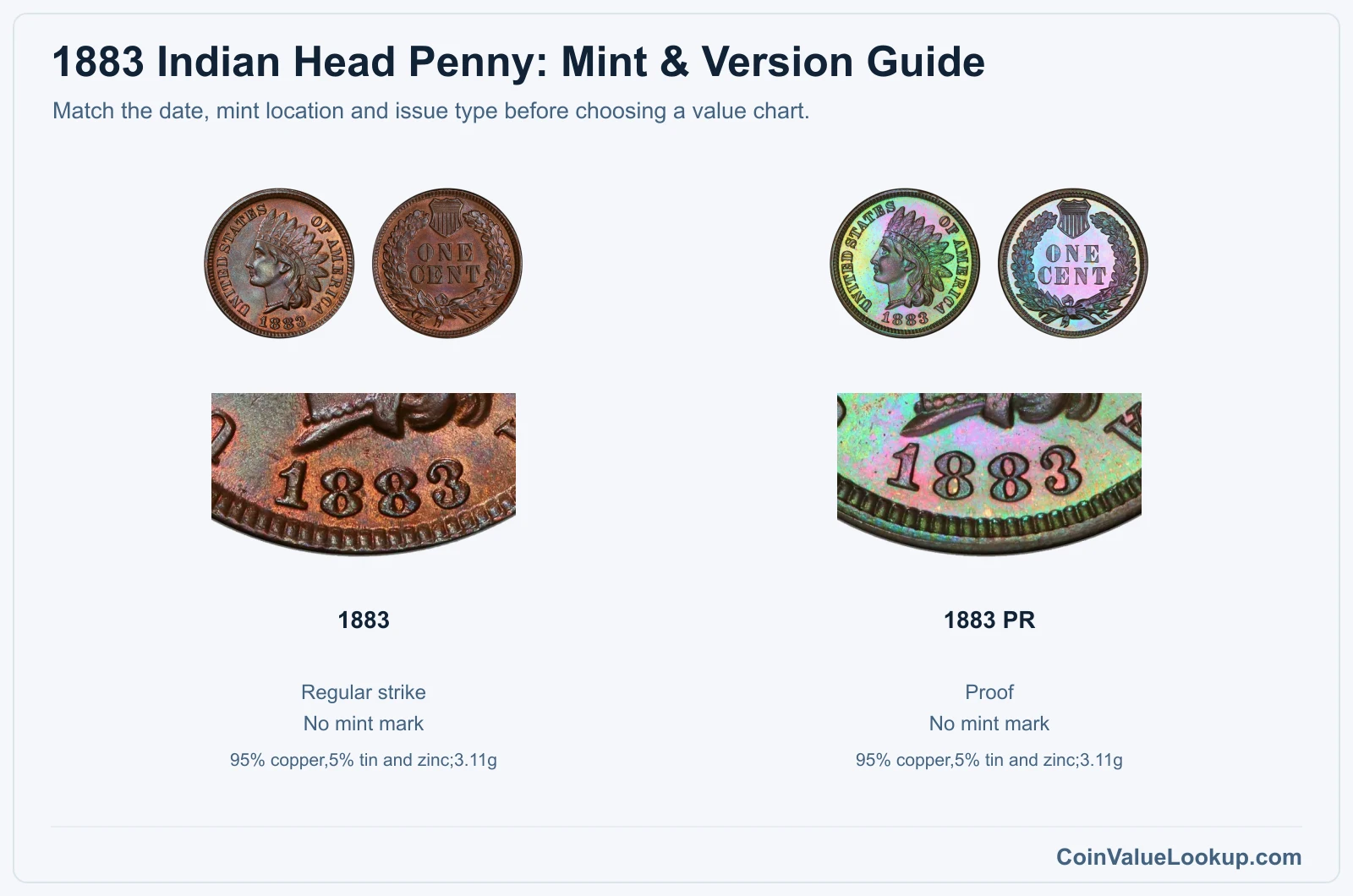
Every regular 1883 Indian Head cent was struck at Philadelphia, so there is no mintmark to look for. The small "L" on the ribbon behind the portrait is a designer initial, not a mintmark.
On the obverse you should see the Indian portrait wearing a feathered headdress with LIBERTY spelled across the headband. The reverse shows an oak wreath enclosing ONE CENT, topped by a small shield.
Do not confuse this coin with the copper-nickel Indian cents made before mid-1864. The 1883 is a bronze issue, composed of 95% copper with 5% tin and zinc, weighing about 3.11 grams.
A copper-nickel cent is noticeably lighter in color and heavier at around 4.67 grams.
Separate business strikes from proofs before you look up a value. A proof is a manufacturing method, not a higher grade than Mint State.
Proof coins were made with specially prepared dies and planchets, resulting in sharp rims and mirror-like fields. A polished or cleaned business strike is not a proof, no matter how shiny it looks.
Step 2: Check Your 1883 Indian Head Penny Grade
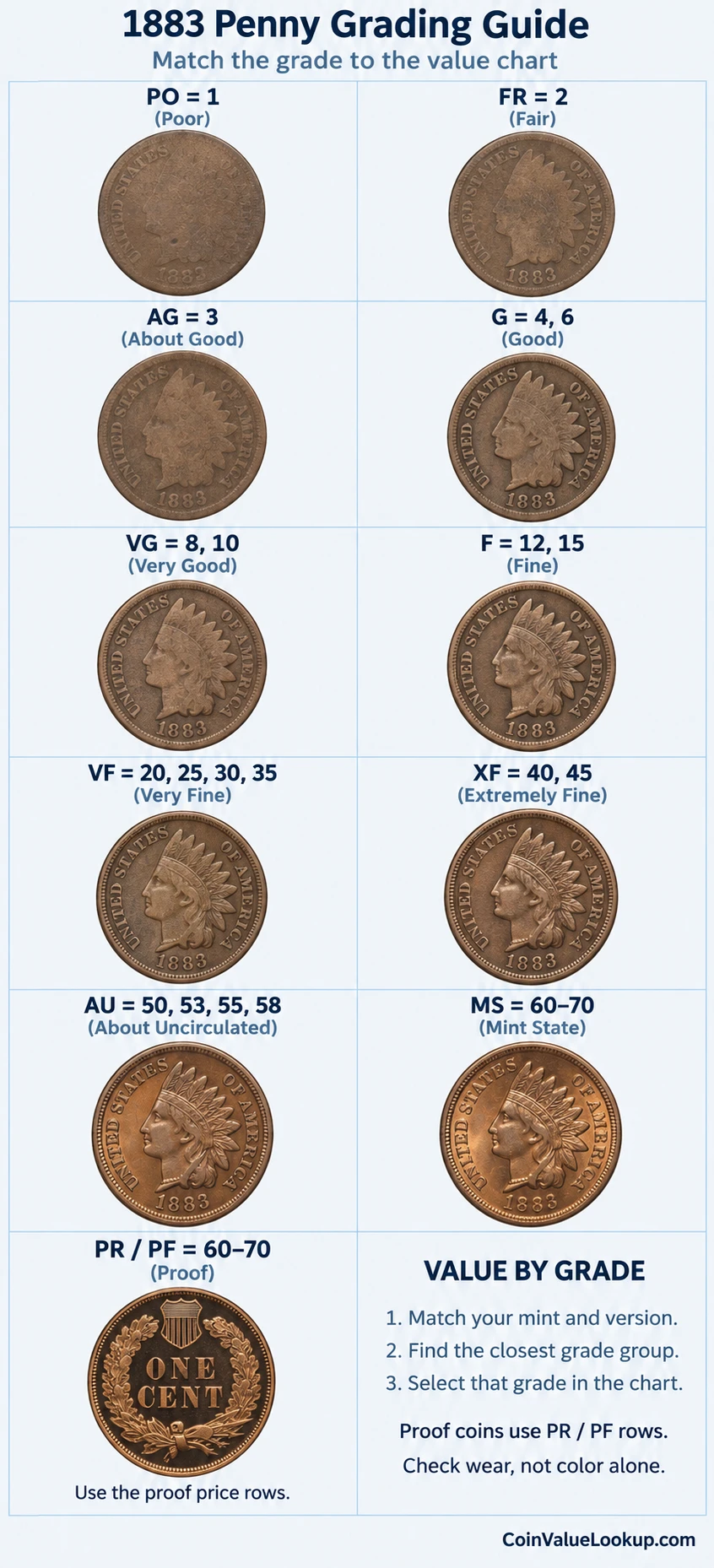
Start with the headband. On a well-worn coin the word LIBERTY disappears letter by letter, with the middle letters going first.
At G4, maybe one or two letters are faintly visible. By VF the full word is readable, though not crisp.
Next check the feather tips above the ear and the hair curls behind the portrait. These are high points that show friction early.
A soft original strike can leave feather tips mushy even on a coin that never circulated, so do not downgrade based on one area alone.
On the reverse, look at the wreath leaves and the shield. Wear flattens the leaf veins and the horizontal lines on the shield.
Compare your coin side-by-side with the grading comparison image to judge how much detail remains.
Bronze color matters for uncirculated pieces. BN (brown), RB (red-brown) and RD (red) describe how much original copper color survives.
These are color descriptions, not separate materials. More original red generally means a higher market premium, while cleaning, corrosion or environmental damage reduces desirability regardless of remaining detail.
Step 3: Check 1883 Indian Head Penny Value by Mint and Version
1883 Indian Head Penny
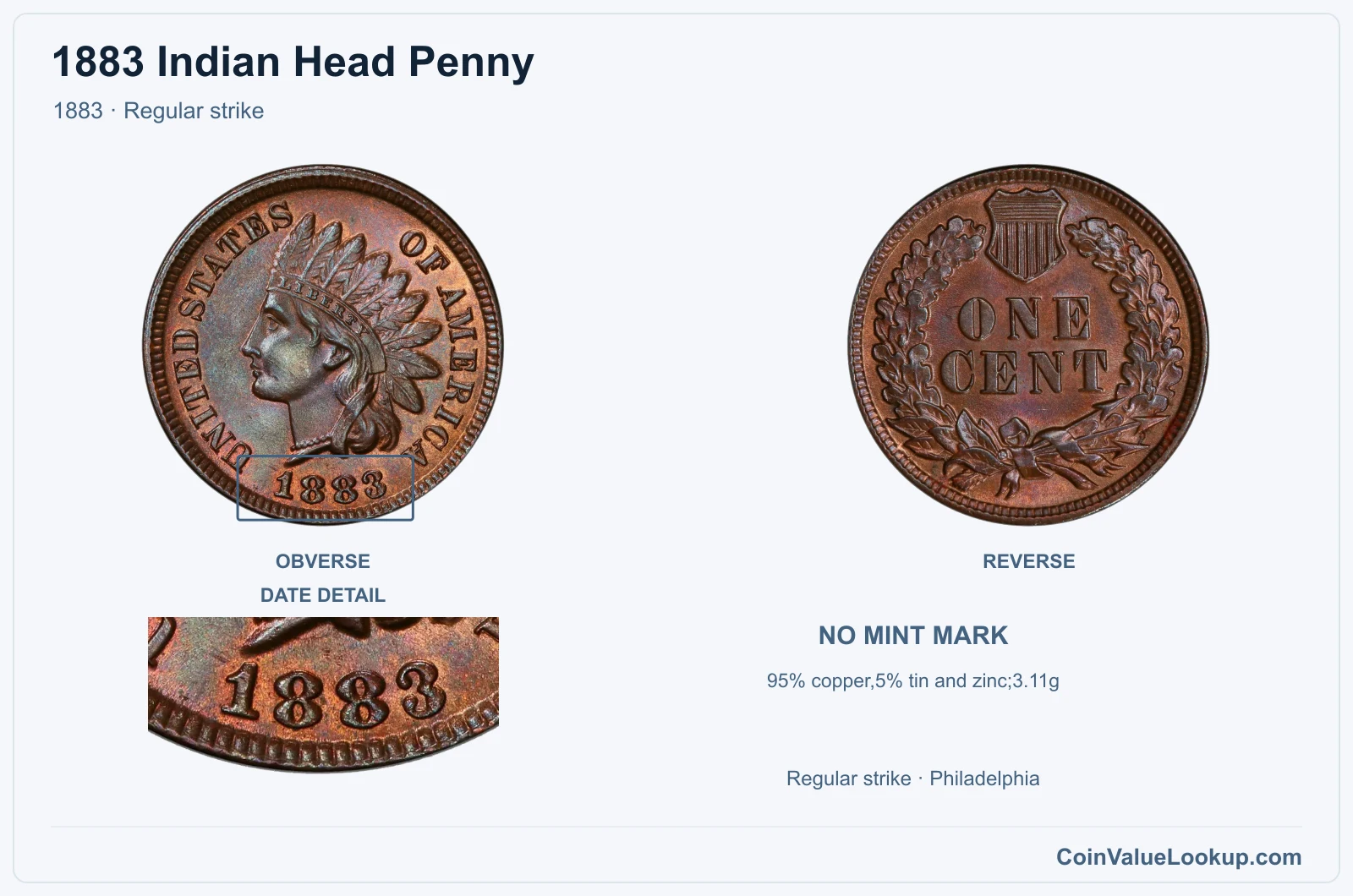
The standard 1883 Indian Head cent is a Philadelphia business strike in bronze, weighing about 3.11 grams. No mintmark appears on any regular issue of this date.
USA Coin Book lists retail estimates of roughly $6.25 in G4 and $112 in MS63.
Condition is the main driver here. A coin with full headband LIBERTY, sharp feather detail and original brown-to-red luster will bring far more than a cleaned or corroded example of the same technical grade.
Compare your coin against known-grade examples before assuming an MS number.
| Range | Grade | Price | Auction Records | Appraisal |
|---|---|---|---|---|
| PO | PO 1 | — | Coin Identifier | |
| FR | FR 2 | — | Coin Identifier | |
| AG | AG 3 | — | Coin Identifier | |
| G | G 4 | — | Coin Identifier | |
| G 6 | — | Coin Identifier | ||
| VG | VG 8 | Coin Identifier | ||
| VG 10 | — | Coin Identifier | ||
| F | F 12 | — | Coin Identifier | |
| F 15 | — | Coin Identifier | ||
| VF | VF 20 | — | Coin Identifier | |
| VF 25 | Coin Identifier | |||
| VF 30 | — | Coin Identifier | ||
| VF 35 | — | Coin Identifier | ||
| XF | XF 40 | Coin Identifier | ||
| XF 45 | Coin Identifier | |||
| AU | AU 50 | Coin Identifier | ||
| AU 53 | Coin Identifier | |||
| AU 55 | Coin Identifier | |||
| AU 58 | Coin Identifier | |||
| MS | MS 60 | — | Coin Identifier | |
| MS 61 | — | Coin Identifier | ||
| MS 62 | Coin Identifier | |||
| MS 63 | Coin Identifier | |||
| MS 64 | Coin Identifier | |||
| MS 65 | Coin Identifier | |||
| MS 66 | Coin Identifier | |||
| MS 67 | — | — | — | |
| MS 68 | — | — | — | |
| MS 69 | — | — | — | |
| MS 70 | — | — | — |
1883 Indian Head Penny — PR
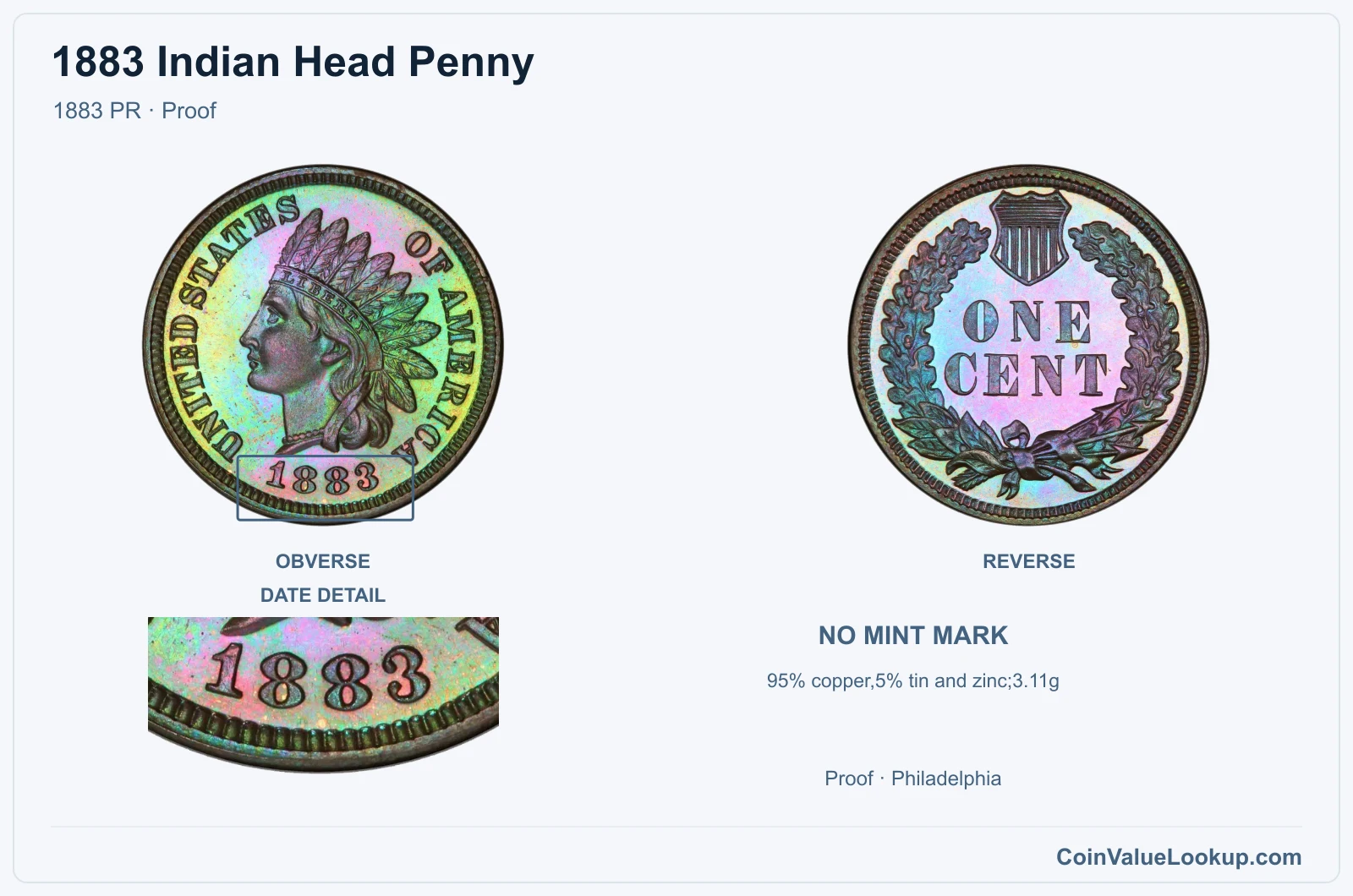
The 1883 proof Indian Head cent was also struck at Philadelphia in the same bronze alloy. These were specially manufactured for collectors, with sharply detailed devices and mirror-like fields.
USA Coin Book lists a PR63 at around $313.
Identifying a real proof takes more than spotting a shiny surface. Look for squared, knife-edge rims and fully struck design elements with crisp definition that business strikes rarely achieve.
The fields should show deep reflectivity, not just the surface polish someone gave a coin with a cloth.
Coin Value Lookup is a good starting point if you want to compare this date against other Indian Head cent years and denominations. You can look up guides for the whole series in one place.
| Range | Grade | Price | Auction Records | Appraisal |
|---|---|---|---|---|
| PR | PR 1 | — | Coin Identifier | |
| PR 2 | — | Coin Identifier | ||
| PR 3 | — | Coin Identifier | ||
| PR 4 | — | Coin Identifier | ||
| PR 6 | — | Coin Identifier | ||
| PR 8 | — | Coin Identifier | ||
| PR 10 | — | Coin Identifier | ||
| PR 12 | — | Coin Identifier | ||
| PR 15 | — | Coin Identifier | ||
| PR 20 | — | Coin Identifier | ||
| PR 25 | — | Coin Identifier | ||
| PR 30 | — | Coin Identifier | ||
| PR 35 | — | Coin Identifier | ||
| PR 40 | — | Coin Identifier | ||
| PR 45 | — | Coin Identifier | ||
| PR 50 | — | Coin Identifier | ||
| PR 53 | — | Coin Identifier | ||
| PR 55 | — | Coin Identifier | ||
| PR 58 | — | Coin Identifier | ||
| PR 60 | — | Coin Identifier | ||
| PR 61 | — | Coin Identifier | ||
| PR 62 | Coin Identifier | |||
| PR 63 | Coin Identifier | |||
| PR 64 | Coin Identifier | |||
| PR 65 | Coin Identifier | |||
| PR 66 | Coin Identifier | |||
| PR 67 | Coin Identifier | |||
| PR 68 | — | — | — | |
| PR 69 | — | — | — | |
| PR 70 | — | — | — |
1883 Indian Head Penny Error List
1. 1883 Indian Head Penny — Die Crack
A die crack appears as a thin, raised line running across the coin's surface. It forms when the steel die develops a fracture from repeated striking.
On an 1883 Indian cent, look for a line that crosses either the field or part of the design, and note exactly where it starts and ends.
Do not confuse a die crack with an incuse scratch, a corrosion line or displaced metal from a hit. A genuine crack is raised above the surface and follows a path that makes sense mechanically.
Published references list die crack varieties for this date. Pricing depends on the crack's size, location and the coin's overall authenticated condition, so each piece needs individual evaluation.
2. 1883 Indian Head Penny — Die Break / Cud
A cud is a specific type of die break where a chunk of the die rim breaks away, leaving a raised, featureless blob on the coin that connects to the rim. Interior die breaks can also occur, leaving a raised area surrounded by normal design.
On an 1883 Indian cent, check the entire rim for an area that looks like a smooth lump rather than a denticle or design element. Compare it against a rim dent (which is incuse, not raised), corrosion buildup or a smaller interior die chip.
A true cud will show the surrounding struck detail flowing into and ending at the raised mass. Value depends on the size and location of the break plus the coin's authenticated grade, so individual assessment is needed.
3. 1883 Indian Head Penny — Doubled Die Reverse
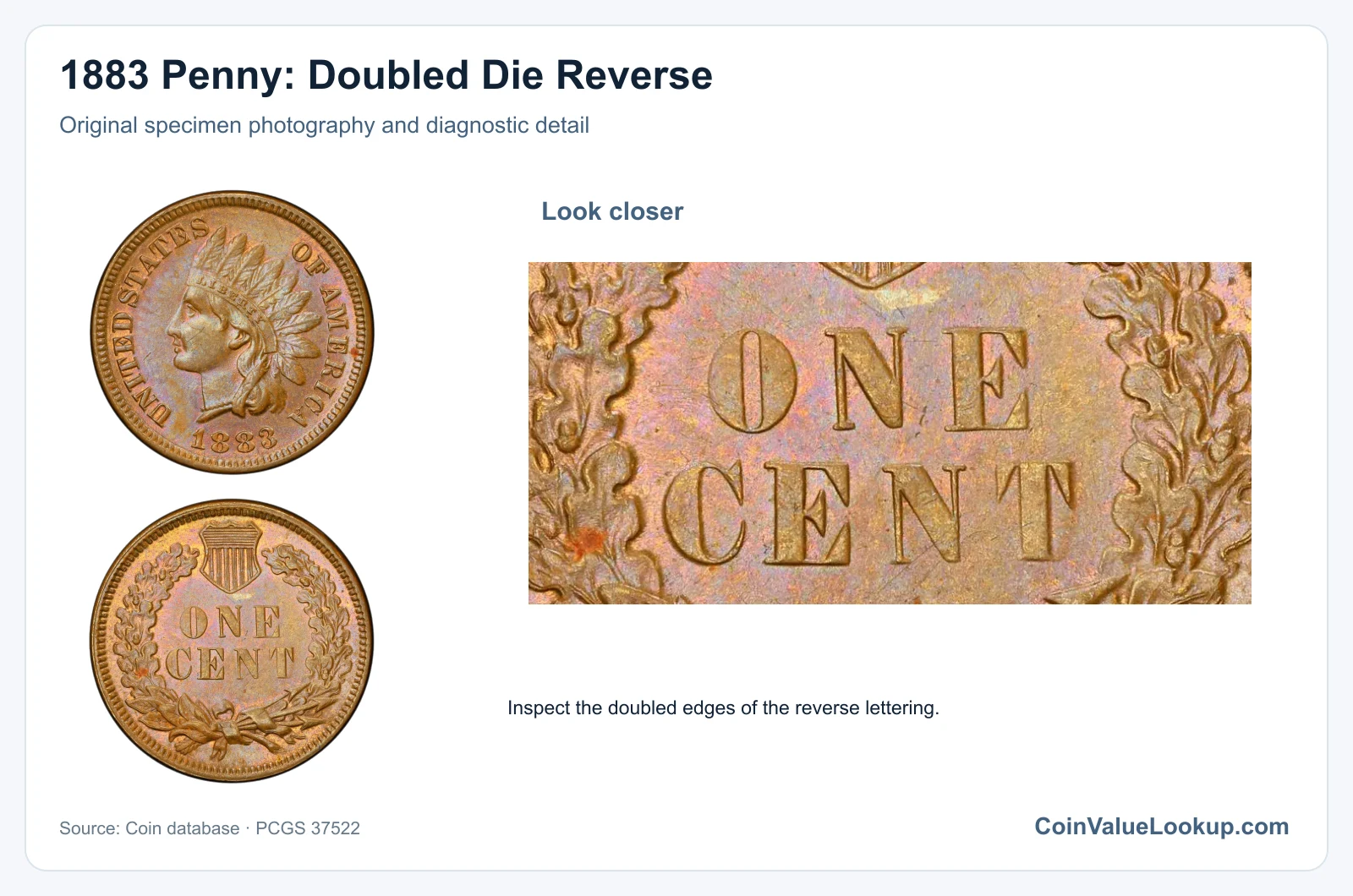
A doubled die reverse shows distinct doubling on the reverse lettering or design elements. This happens during die manufacture, not during the strike itself.
On the 1883 Indian cent, compare the wreath details and the ONE CENT legend against a normal example. True hub doubling will show a consistent secondary image across multiple design elements.
The main lookalike is machine doubling, which is flat and shelf-like rather than showing a full second impression. Reflections under magnification or random contact damage can also mimic doubling to an untrained eye.
No specific numeric price range is adopted for this variety, so coins suspected of showing a doubled die reverse should be evaluated individually based on authenticated identity and overall condition.
4. 1883 Indian Head Penny — Misplaced Date
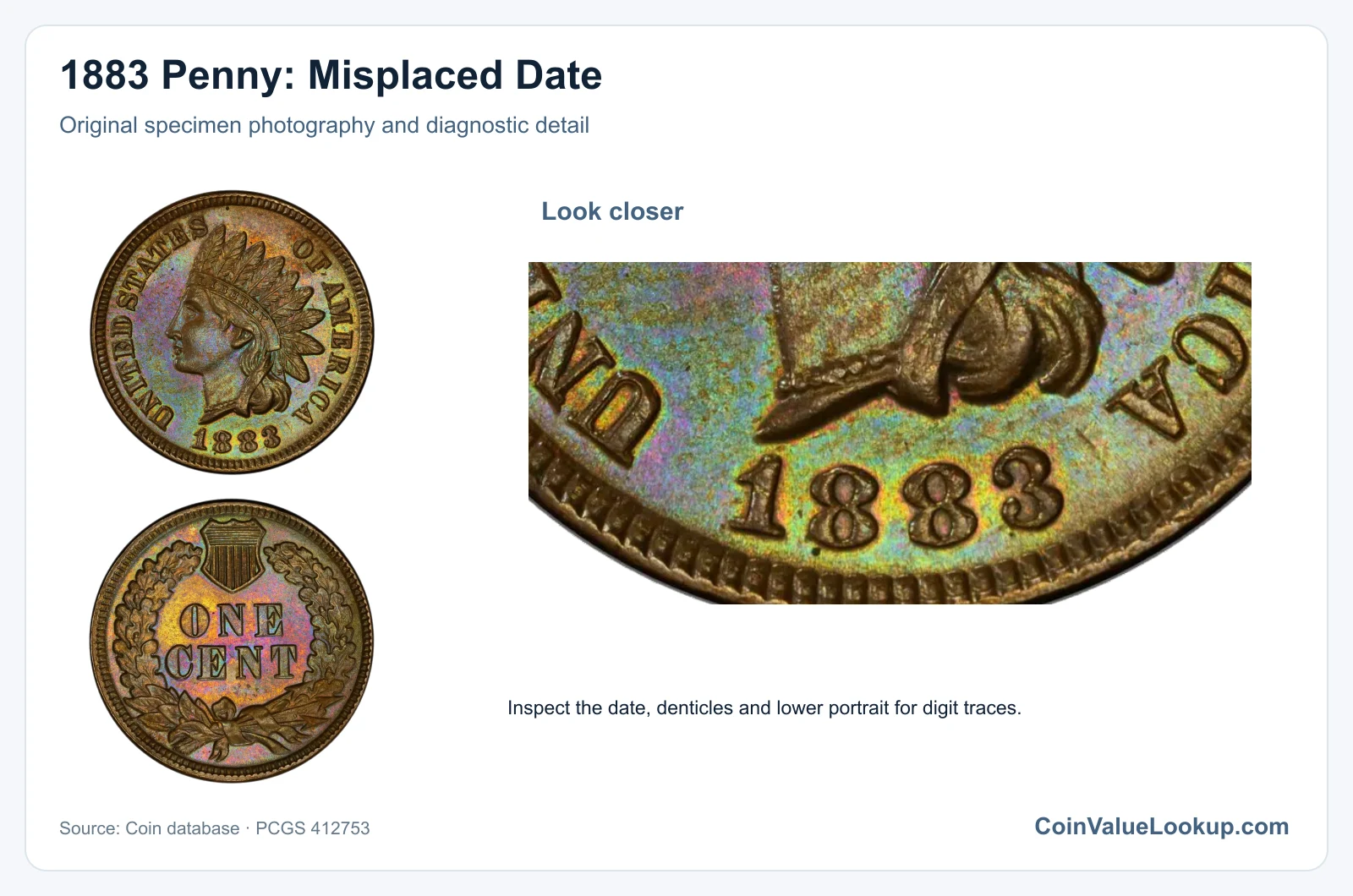
A misplaced date variety shows partial remnants of date digits in an incorrect location, often partially embedded in the denticles below the date or near the portrait. On the 1883 Indian cent, look carefully in those areas for a recognizable fragment of a numeral that does not belong there.
These traces are subtle. You will need magnification and good lighting.
Compare any suspicious bump against the shapes of the actual date digits. Die chips, scratches and random raised spots can look similar but will not match the contour of a specific numeral.
Published sources report this category for the 1883 date. Pricing requires individual assessment based on the coin's authenticated identity and condition.
5. 1883 Indian Head Penny — Clashed Dies
Clashed dies occur when the obverse and reverse dies strike each other without a planchet between them. The result is a ghostly impression of the opposite design transferred onto each die, which then appears as faint extra details on subsequent coins.
On an 1883 Indian cent, look for traces of the wreath in the obverse field or hints of the portrait on the reverse. These ghost images should align with where the opposing design would naturally fall.
Do not confuse clashed-die traces with random scratches, raised lines from die polishing or a brockage (which involves a previously struck coin, not die-to-die contact). Value is assessed individually by the strength of the clash and the coin's authenticated condition.
6. 1883 Indian Head Penny — Repunched Date
A repunched date shows remnants of an earlier punch position next to or beneath the final date numerals. On the 1883 Indian cent, examine each digit under magnification for traces of a secondary image, especially along the tops or bases of the numbers.
This is different from a doubled die, which affects the entire design through a hub error. A repunched date is localized to the date digits and results from the date punch being applied more than once in slightly different positions.
Lookalikes include a damaged or corroded date and machine doubling, which tends to look flat and mechanical. No adopted price range exists for this variety, so each coin needs individual evaluation based on its authenticated identity and error severity.
7. 1883 Indian Head Penny — Die Chip
A die chip shows up as a small, localized raised lump on the coin's surface. It happens when a tiny piece of the die face breaks away, and the resulting void fills with metal during striking.
On the 1883 Indian cent, check inside letters, within design elements and in the surrounding fields for any small raised blob.
The key diagnostic is that the surrounding struck detail flows smoothly into the raised area. Compare this against a gouge or impact mark, which will show displaced metal and sharp edges rather than a rounded lump.
Glued material or debris can also mimic a die chip but will not integrate with the struck surface. Published sources report this category for 1883 cents.
Each coin's value depends on the chip's location, size and the overall authenticated grade.