1895 Indian Head Penny Coin Value: How Much Is It Worth?
An 1895 Indian Head penny in well-worn condition carries a guide value around $3.62 at the G4 grade level, while a nicer uncirculated example at MS63 can reach roughly $92 according to USA Coin Book retail estimates. Proofs are a different animal entirely, with PR63 examples listed near $313.
These are guide figures, not guaranteed offers, and actual results depend on the specific coin's condition, surfaces and originality.
Fast Way to Identify Your 1895 Indian Head Penny
The quickest way to start figuring out what your 1895 Indian Head penny might be worth is to upload clear photos of both the front and back. Our identifier can offer a preliminary read on which version you have based on those images.
Just make sure the lighting is even and the coin fills most of the frame.
1895 Indian Head Penny Value
Upload both sides of your 1895 Indian Head Penny.
Front Obverse
Upload photo
Back Reverse
Upload photo
Which 1895 Indian Head Penny Versions Are Worth Money?
- Business-strike 1895 cents in MS63 condition list near $92 in the USA Coin Book guide, a significant jump over circulated grades.
- Proof 1895 cents at PR63 are listed around $313, reflecting their limited special production at Philadelphia.
- Coins retaining original red or red-brown copper color in uncirculated grades are more desirable than fully toned brown pieces.
- Misplaced date, repunched date and die break varieties exist for this date and can carry premiums assessed individually by error severity and condition.
Step 1: Identify Your 1895 Indian Head Penny Mint Mark and Version
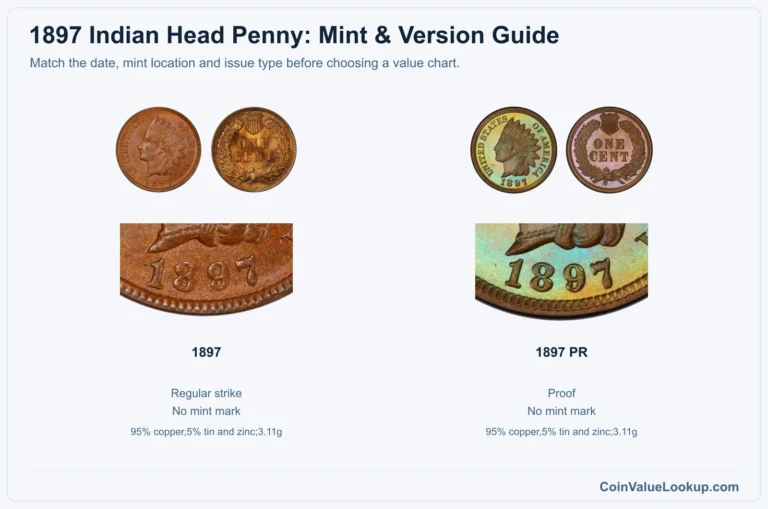
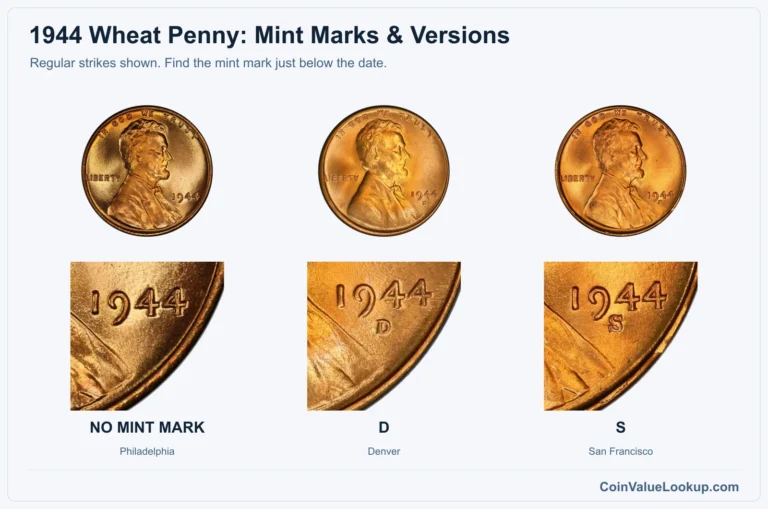
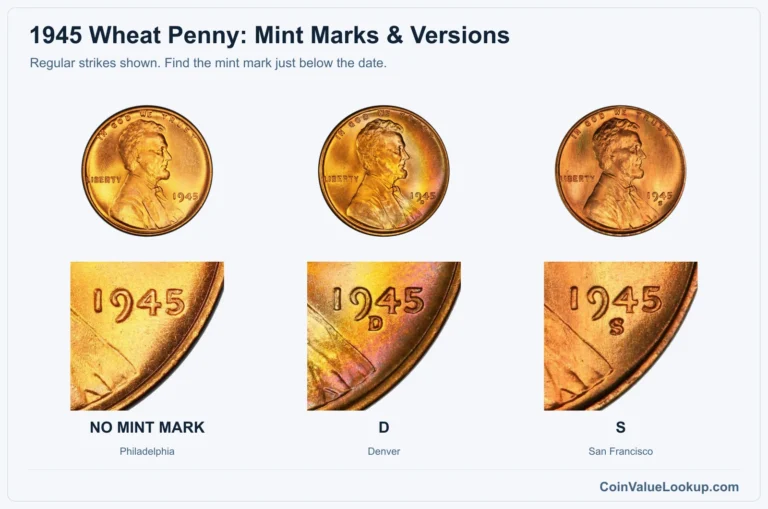
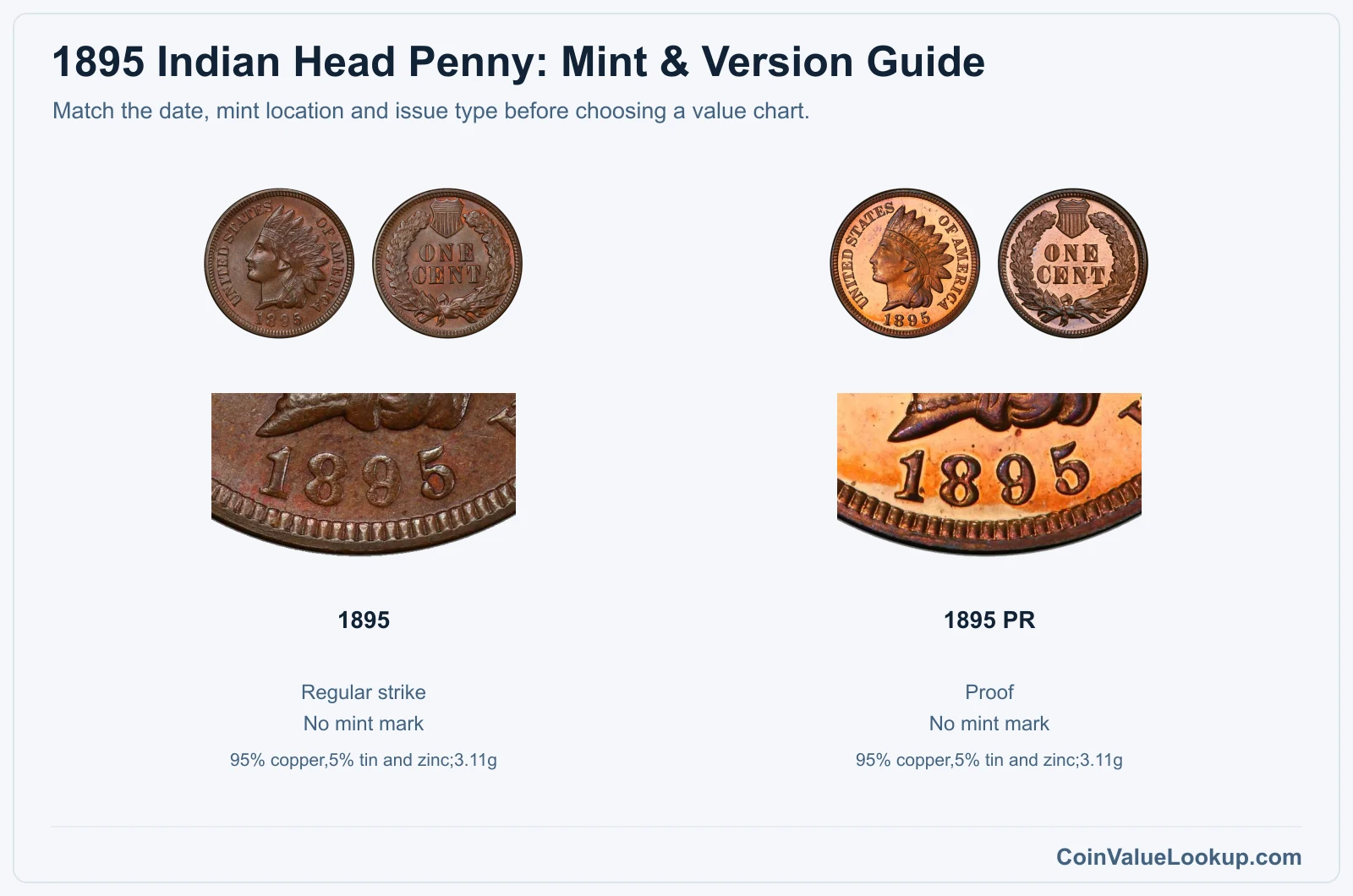
Every regular 1895 Indian Head cent was struck at the Philadelphia Mint. There is no mintmark to hunt for on this date.
The small "L" you might spot on the ribbon behind the portrait is the engraver's initial, not a mint designation.
The obverse shows a figure wearing a feathered headdress, and the reverse features an oak wreath surrounding a shield. If your coin has a wheat-ear reverse or a seated figure, you are looking at a different series entirely.
You need to separate business strikes from proofs before pricing. A proof 1895 cent was specially manufactured with polished dies, producing mirrored fields and sharp rims.
Simply polishing or cleaning a regular coin does not make it a proof. Look for squared-off rims, fully reflective surfaces, and overall sharpness that a business strike just does not achieve.
The alloy is 95% copper with 5% tin and zinc, weighing about 3.11 grams. Color designations like BN, RB and RD describe how much original copper-red color remains on the surface.
They are not separate metals.
Step 2: Check Your 1895 Indian Head Penny Grade
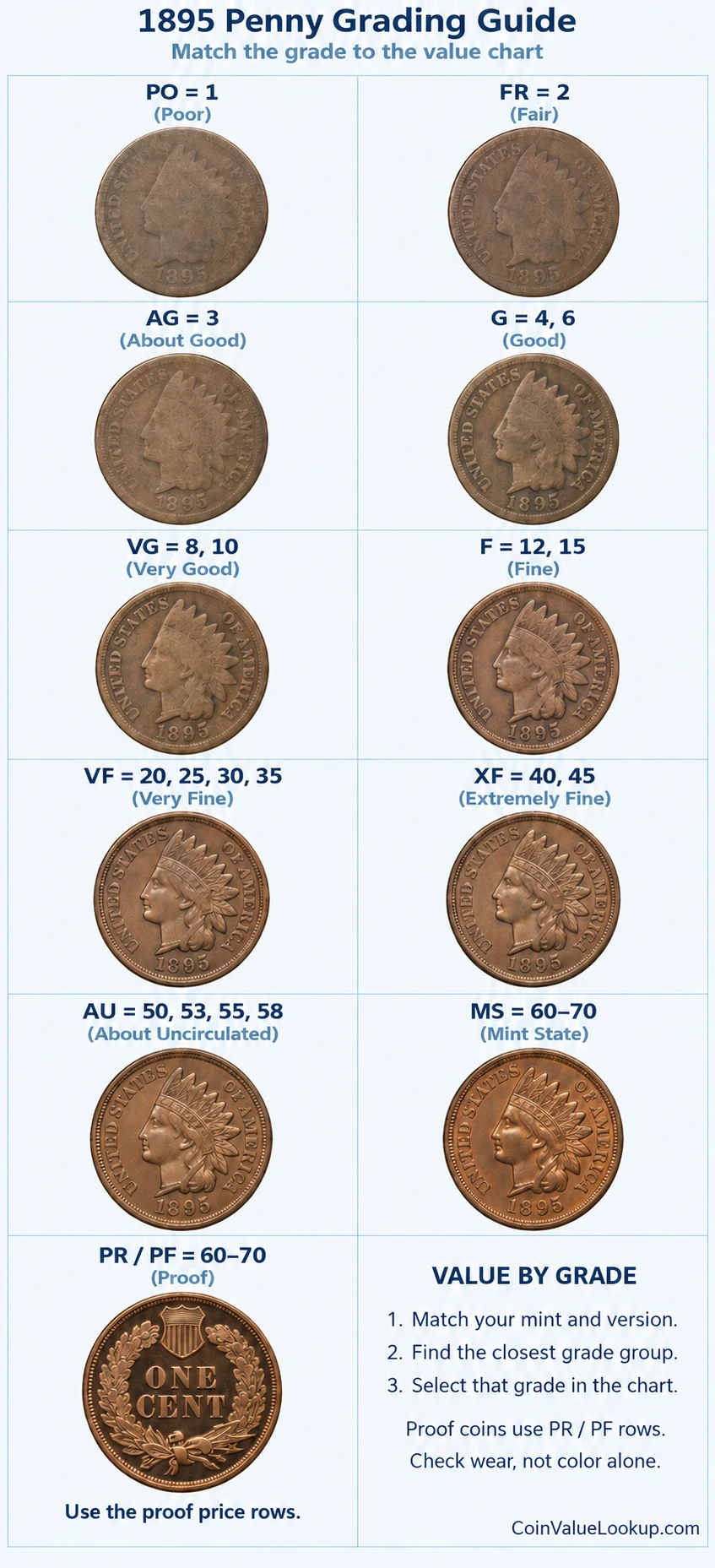
Start with the headband. The word LIBERTY is inscribed across it, and the letters wear away progressively from the highest point down.
On a well-circulated coin, only a few letters may survive.
Next, check the feather tips and the hair curls above the ear. These are high-relief areas that show wear first.
The cheek will flatten and lose its contour as the grade drops.
On the reverse, the leaf veins in the wreath and the horizontal lines on the shield are your wear indicators. A coin with full, crisp detail there and unbroken luster is in a different league from one that is smooth and dark.
One catch: the 1895 can come softly struck from the factory, especially in the feather and diamond areas. A weak strike is not the same thing as wear.
Wear produces a smooth, flattened surface; a soft strike still shows underlying luster and rounded-but-present detail. Use the comparison image to calibrate what genuine wear looks like on this specific type before jumping to conclusions about grade.
Step 3: Check 1895 Indian Head Penny Value by Mint and Version
1895 Indian Head Penny
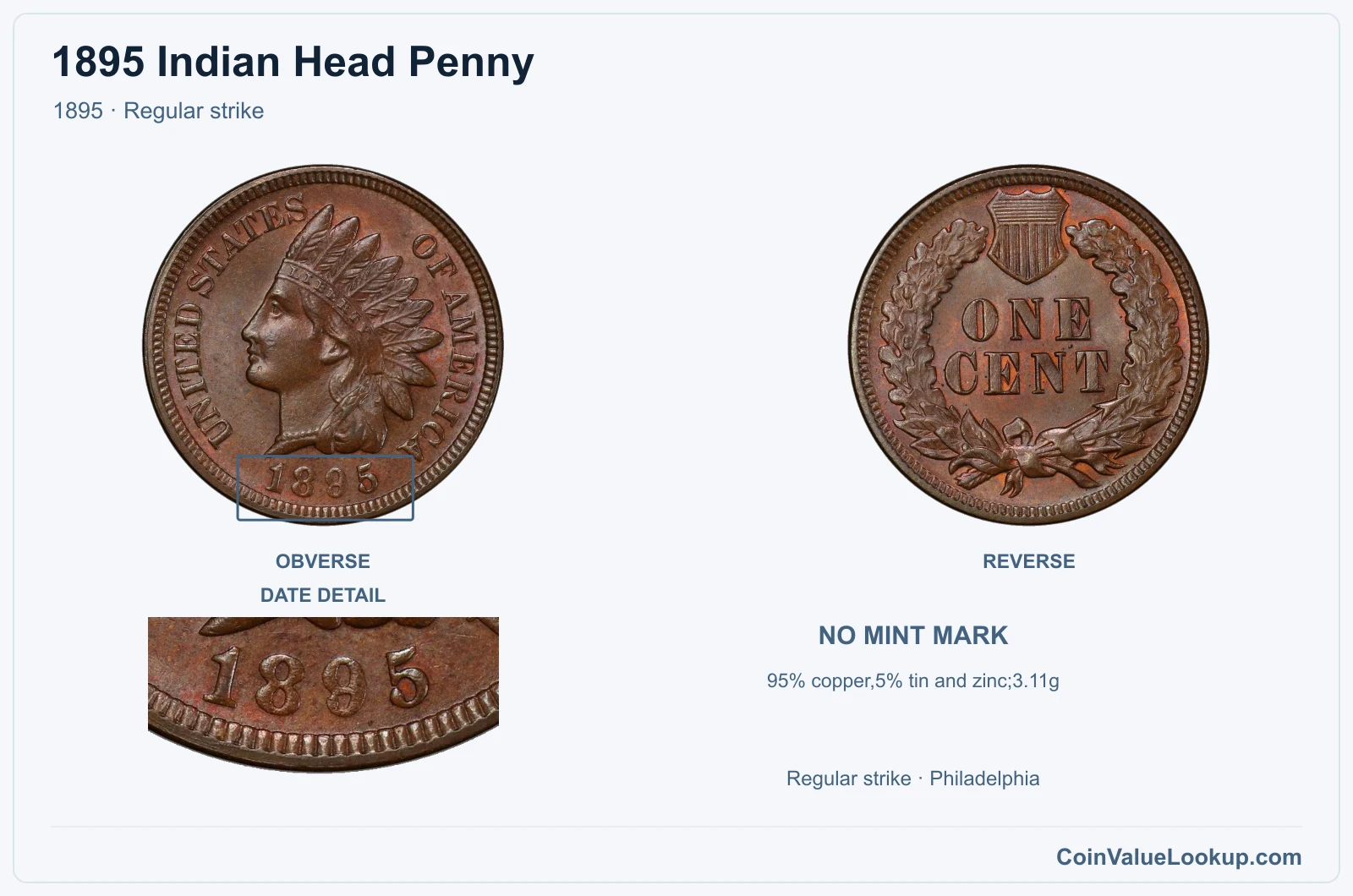
This is the standard 1895 Indian Head cent struck for circulation at Philadelphia. No mintmark appears on the coin.
The alloy is 95% copper with 5% tin and zinc, tipping the scale at 3.11 grams.
USA Coin Book lists retail guide values of about $3.62 in G4 and around $92 in MS63. That is a wide spread, and it tells you condition matters enormously.
A dark, worn example is common. An original, lustrous uncirculated piece with strong detail is not.
When evaluating your coin, focus on honest surfaces. Cleaning, harsh polishing or environmental damage will push a coin below what these guide figures suggest, even if the underlying detail looks decent.
Compare your coin's surfaces and sharpness against graded examples of the same type before drawing any conclusions about value.
| Range | Grade | Price | Auction Records | Appraisal |
|---|---|---|---|---|
| PO | PO 1 | — | Coin Identifier | |
| FR | FR 2 | — | Coin Identifier | |
| AG | AG 3 | — | Coin Identifier | |
| G | G 4 | — | Coin Identifier | |
| G 6 | — | Coin Identifier | ||
| VG | VG 8 | — | Coin Identifier | |
| VG 10 | — | Coin Identifier | ||
| F | F 12 | — | Coin Identifier | |
| F 15 | — | Coin Identifier | ||
| VF | VF 20 | — | Coin Identifier | |
| VF 25 | — | Coin Identifier | ||
| VF 30 | — | Coin Identifier | ||
| VF 35 | — | Coin Identifier | ||
| XF | XF 40 | — | Coin Identifier | |
| XF 45 | Coin Identifier | |||
| AU | AU 50 | Coin Identifier | ||
| AU 53 | — | Coin Identifier | ||
| AU 55 | — | Coin Identifier | ||
| AU 58 | Coin Identifier | |||
| MS | MS 60 | — | Coin Identifier | |
| MS 61 | — | Coin Identifier | ||
| MS 62 | Coin Identifier | |||
| MS 63 | Coin Identifier | |||
| MS 64 | Coin Identifier | |||
| MS 65 | Coin Identifier | |||
| MS 66 | — | — | — | |
| MS 67 | — | — | — | |
| MS 68 | — | — | — | |
| MS 69 | — | — | — | |
| MS 70 | — | — | — |
1895 Indian Head Penny — PR
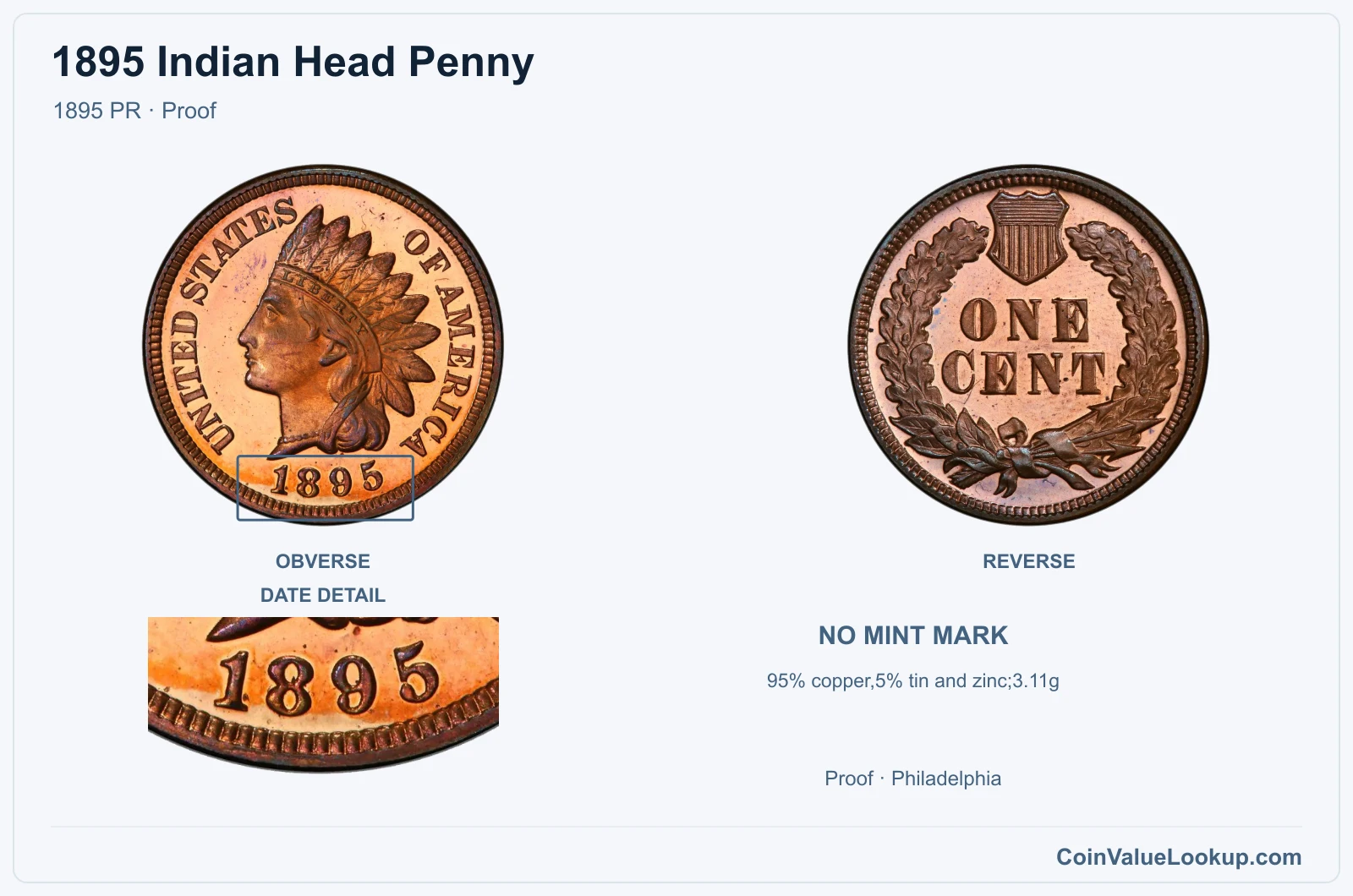
The 1895 proof Indian Head cent was a special product of the Philadelphia Mint, struck from polished dies onto carefully prepared planchets. These were made for collectors, not commerce.
At PR63, the USA Coin Book guide lists a value near $313. That is a single grade point; higher or lower proof grades will differ.
Proof status is a manufacturing method, not a grade above Mint State, so a proof can still have contact marks or haze that limits its assigned number.
Coin Value Lookup is a useful starting point if you want to compare this date with other Indian Head cent years or explore related series values.
Identifying a genuine proof requires checking for mirrored fields, squared rims and overall precision that business strikes lack. A circulation coin that someone buffed to a shine is not a proof, no matter how reflective it looks.
If you are unsure, professional authentication is the safest route before assuming proof status.
| Range | Grade | Price | Auction Records | Appraisal |
|---|---|---|---|---|
| PR | PR 1 | — | Coin Identifier | |
| PR 2 | — | Coin Identifier | ||
| PR 3 | — | Coin Identifier | ||
| PR 4 | — | Coin Identifier | ||
| PR 6 | — | Coin Identifier | ||
| PR 8 | — | Coin Identifier | ||
| PR 10 | — | Coin Identifier | ||
| PR 12 | — | Coin Identifier | ||
| PR 15 | — | Coin Identifier | ||
| PR 20 | — | Coin Identifier | ||
| PR 25 | — | Coin Identifier | ||
| PR 30 | — | Coin Identifier | ||
| PR 35 | — | Coin Identifier | ||
| PR 40 | — | Coin Identifier | ||
| PR 45 | — | Coin Identifier | ||
| PR 50 | — | Coin Identifier | ||
| PR 53 | — | Coin Identifier | ||
| PR 55 | — | Coin Identifier | ||
| PR 58 | — | Coin Identifier | ||
| PR 60 | — | Coin Identifier | ||
| PR 61 | — | Coin Identifier | ||
| PR 62 | Coin Identifier | |||
| PR 63 | Coin Identifier | |||
| PR 64 | Coin Identifier | |||
| PR 65 | Coin Identifier | |||
| PR 66 | Coin Identifier | |||
| PR 67 | — | — | — | |
| PR 68 | — | — | — | |
| PR 69 | — | — | — | |
| PR 70 | — | — | — |
1895 Indian Head Penny Error List
1. 1895 Indian Head Penny — Misplaced Date
A misplaced date on an 1895 Indian Head cent shows partial impressions of one or more date digits in the wrong location, typically embedded in the denticles or near the portrait base, away from where the final date sits. The die received an errant punch before the date was correctly positioned.
To spot one, look closely at the denticle area below and around the date with magnification. You are searching for the recognizable outline of a numeral, partial curves of an 8 or 9, for instance, not just a random blob.
Die chips, scratches and accidental dings can mimic parts of numerals if you squint hard enough. The key difference is that a genuine misplaced digit follows the exact contour of one of the date numerals and appears at a consistent depth.
No specific price range is established for this variety; value depends on the severity of the misplacement, overall coin condition and third-party authentication.
2. 1895 Indian Head Penny — Repunched Date
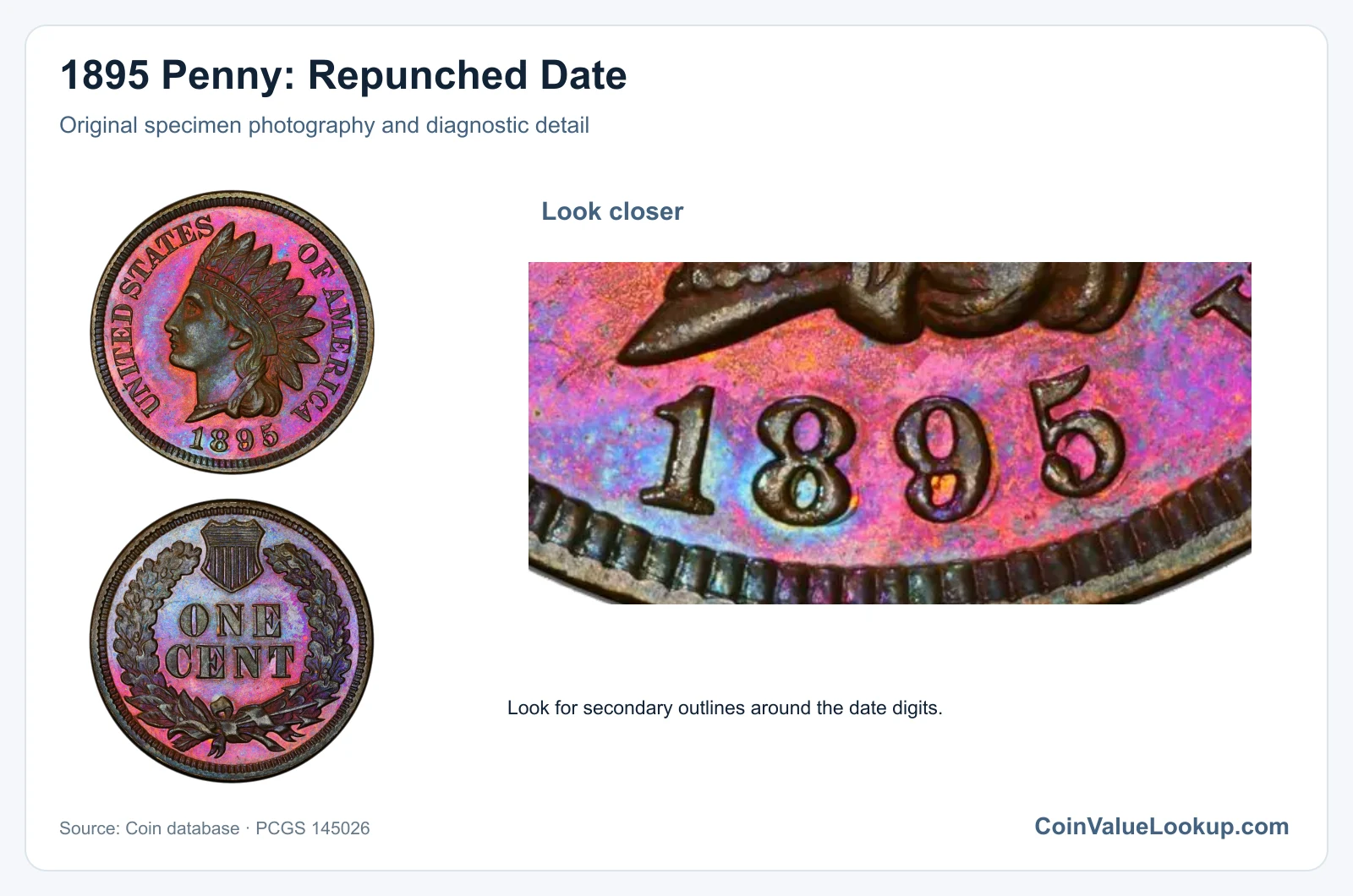
A repunched date on the 1895 cent occurs when the date numerals were punched into the working die more than once, with the second impression slightly offset from the first. The result is visible remnants of the earlier punch position alongside the final digits.
Look for doubling, shadowing or extra serifs adjacent to one or more of the four date numerals. This is different from mechanical doubling, which tends to produce flat, shelf-like displacement across multiple design elements rather than being confined to the date area.
Damage from circulation or post-mint contact can also create misleading doubled appearances. Genuine repunching will be consistent in direction and depth, and it should be visible under magnification as a distinct second impression rather than mushed metal.
Pricing depends entirely on the specific die variety, the clarity of the repunching and the coin's grade, so individual assessment by a knowledgeable service is the practical path.
3. 1895 Indian Head Penny — Die Break / Cud
A die break or cud on an 1895 Indian Head cent appears as a raised, irregular blob of metal on the coin's surface. A true cud connects to the rim, formed when a chunk of the die edge broke away and left an open cavity that the planchet metal filled during striking.
These are distinct from interior die cracks, which show as fine raised lines across the design without reaching the rim. A cud displaces or obliterates part of the normal design where it occurs and has a defined boundary where intact design meets the raised mass.
Do not confuse rim damage, corrosion buildup or lamination flaws with a genuine cud. Rim dings push metal inward and show displaced surface, while a cud is raised and smooth with a clearly defined edge where the die broke.
Value hinges on the size, location and overall condition of the coin, and there is no fixed price range for this category. Professional authentication helps confirm the diagnosis and establish market standing.