1870 Liberty Seated Dime Coin Value: How Much Is It Worth?
The 1870 Liberty Seated Dime spans a wide value range depending on mint and condition. USA Coin Book guide estimates place the Philadelphia issue around $23 at G4 and up to $560 at MS63, while the scarcer San Francisco mint coin runs from roughly $379 at G4 to about $3,432 at MS63.
Proofs struck at Philadelphia carry a guide value near $725 at PR63. These are retail guide anchors across different mints, grades and finishes, not a promise for any single coin.
Fast Way to Identify Your 1870 Liberty Seated Dime
Want a quick read on what you have? Upload clear photos of both sides of your 1870 dime and our identifier can offer a preliminary take on the mint, version and approximate grade.
It is not a substitute for professional authentication or certification, but it gives you a useful starting point before you dig deeper.
1870 Liberty Seated Dime Value
Upload both sides of your 1870 Liberty Seated Dime.
Front Obverse
Upload photo
Back Reverse
Upload photo
Which 1870 Liberty Seated Dime Versions Are Worth Money?
- The San Francisco (S mint) issue is much scarcer than the Philadelphia coin, with guide values starting around $379 even at G4.
- Philadelphia Proofs carry a guide value near $725 at PR63, well above the regular business strike.
- Error varieties like the Doubled Die Reverse and Repunched Date can add collector interest beyond normal issue values.
- Condition matters enormously: a Philadelphia regular issue jumps from about $23 at G4 to roughly $560 at MS63.
Step 1: Identify Your 1870 Liberty Seated Dime Mint Mark and Version
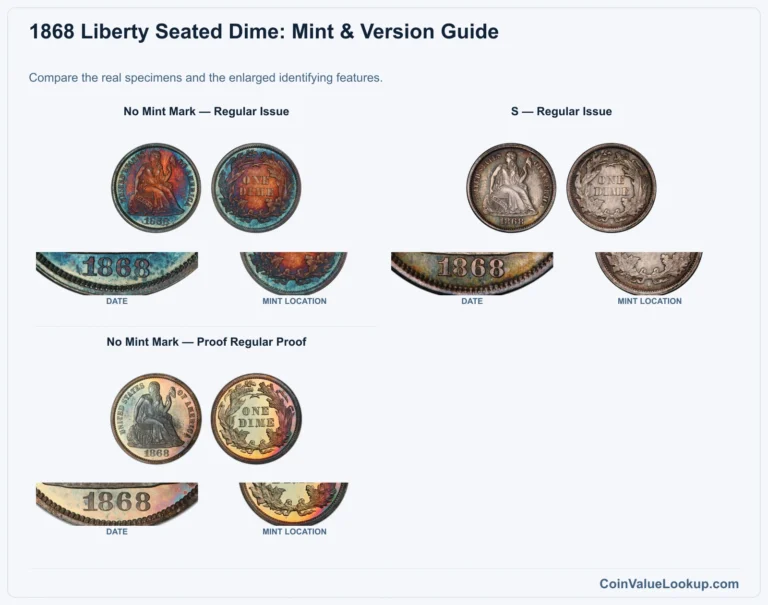
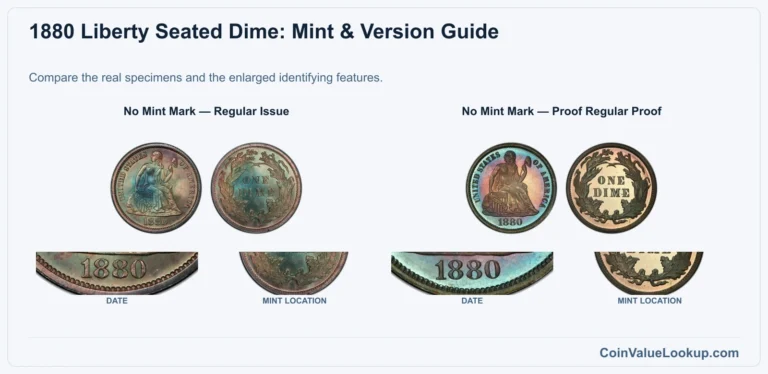
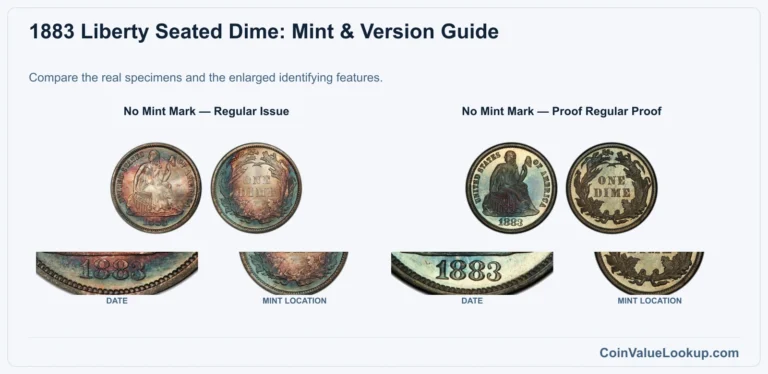
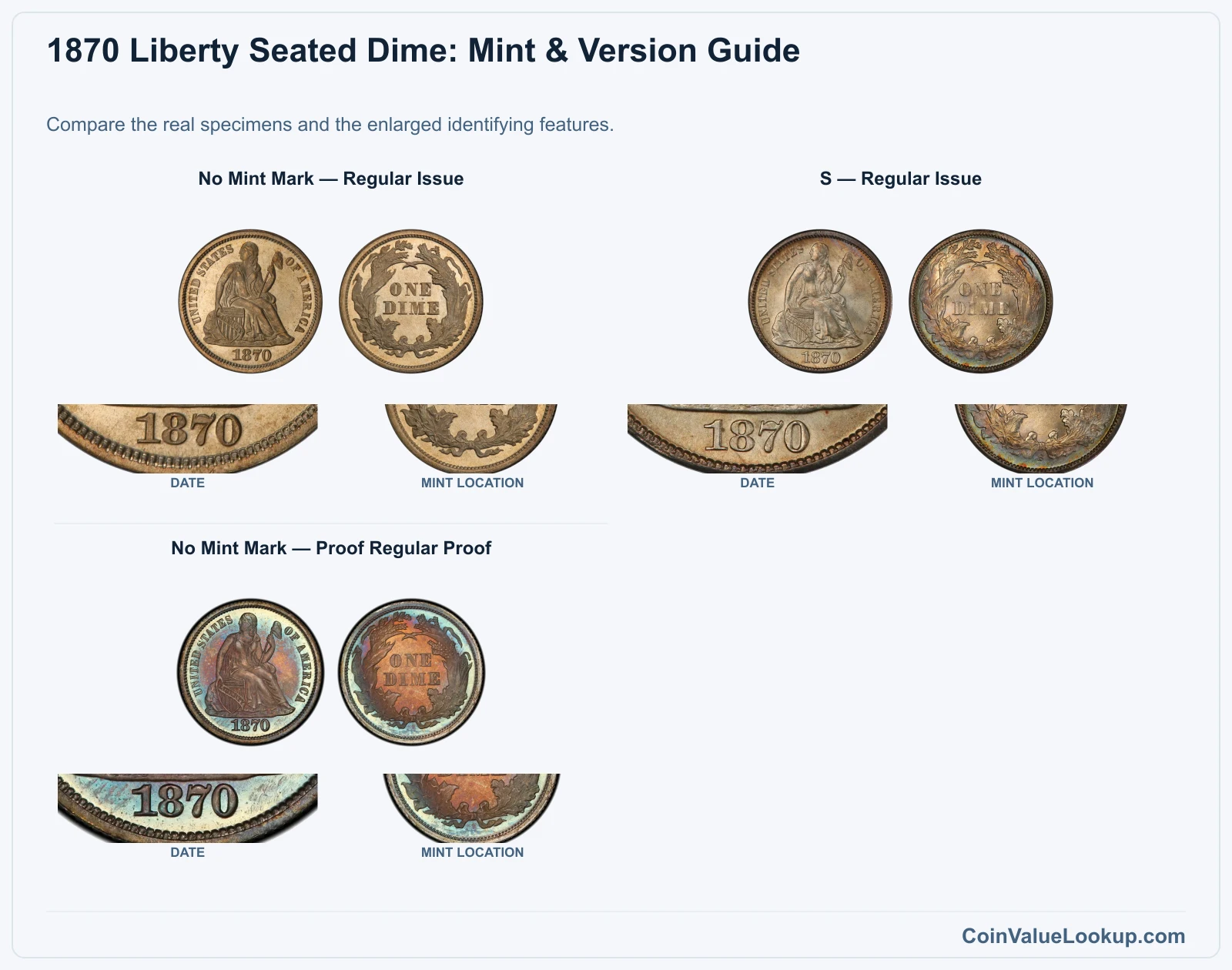
The 1870 Liberty Seated Dime shows a seated Liberty figure on the obverse with the date below and stars around the border. The reverse displays the words ONE DIME inside an agricultural wreath.
All regular issues are struck in 90% silver and 10% copper, measure 17.9mm across and have a reeded edge with a nominal weight of 2.49 grams.
Philadelphia coins carry no mintmark at all. San Francisco issues have a small "S" on the reverse, typically found within the wreath near the bottom.
Make sure you are looking at an actual 1870 date and not an 1871 that looks similar at a glance.
Do not confuse this coin with a half dime, which is smaller and lighter. If yours has a mintmark you cannot identify, or the design details seem off, compare it carefully against known reference images for the year before drawing conclusions.
Step 2: Check Your 1870 Liberty Seated Dime Grade
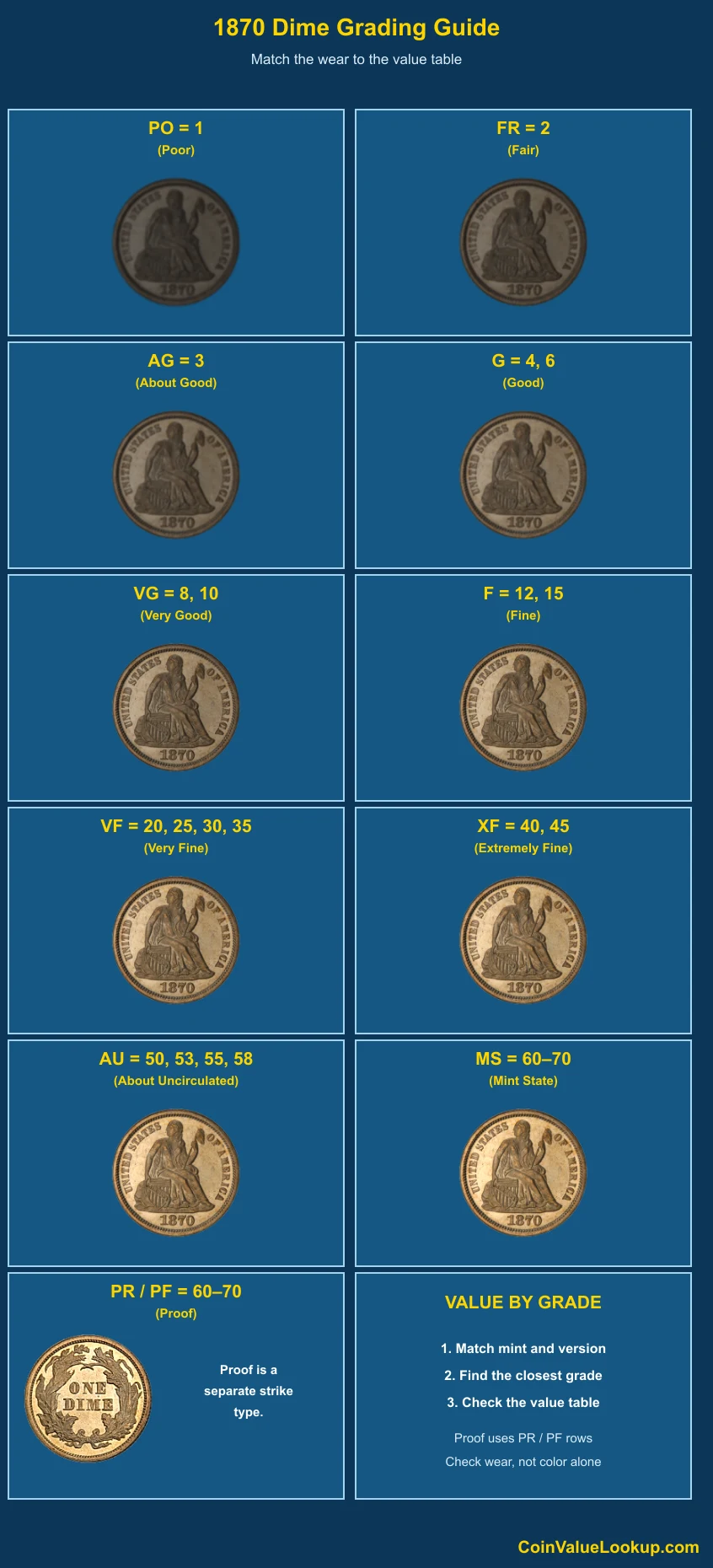
Start with the obverse. On a well-worn coin (around Good-4), the seated Liberty is a flat outline, the shield is almost invisible and the stars are smooth bumps.
As grade improves, look for the clasp on Liberty's gown at the shoulder, detail in the breast and knee area, and lines within the shield.
On the reverse, the highest points of the wreath leaves wear first. A mid-grade coin (Fine to Very Fine) will show most leaf detail but some flatness on the bow at the bottom of the wreath.
Luster is your friend. A coin that still shows original cartwheel shine across both faces is likely in the About Uncirculated to Mint State range.
But beware: weak strikes and worn dies can soften the design without any actual circulation, so compare your coin's details against the reference comparison image for context.
A polished coin is not a Proof. Proofs have mirror fields from deliberate die preparation at the Philadelphia Mint, not from someone buffing a business strike in the garage.
Keep business strikes, Proofs and cleaned coins in separate mental buckets.
Step 3: Check 1870 Liberty Seated Dime Value by Mint and Version
1870 Liberty Seated Dime — No Mint Mark — Regular Issue
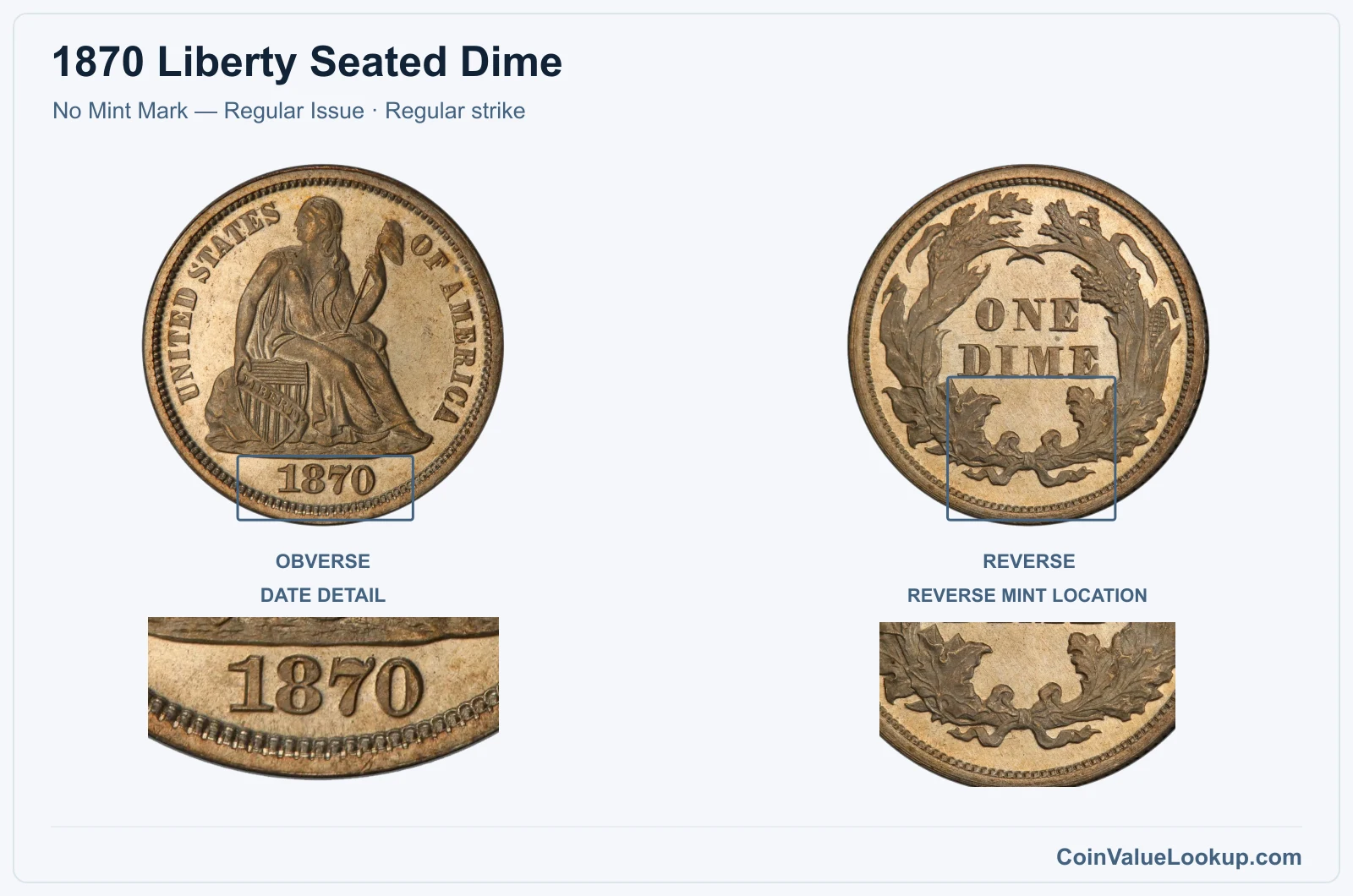
The 1870 Philadelphia regular issue carries no mintmark anywhere on the coin. It features the Legend Obverse design paired with the agricultural wreath reverse.
This is the more common of the two business-strike mints for the year.
USA Coin Book places its retail guide value at about $23 in G4 and around $560 in MS63. That is a big spread, so accurate grading matters a lot here.
Look for original surfaces, no cleaning, and clear date digits to get the best sense of where your coin falls.
Range Grade
Price Auction Records Appraisal PO PO 1
—
Coin Identifier FR FR 2
—
Coin Identifier AG AG 3
—
Coin Identifier G G 4
—
Coin Identifier
G 6
—
Coin Identifier VG VG 8
—
Coin Identifier
VG 10
—
Coin Identifier F F 12
—
Coin Identifier
F 15
—
Coin Identifier VF VF 20
—
Coin Identifier
VF 25
—
Coin Identifier
VF 30
—
Coin Identifier
VF 35
—
Coin Identifier XF XF 40
Coin Identifier
XF 45
Coin Identifier AU AU 50
Coin Identifier
AU 53
—
Coin Identifier
AU 55
Coin Identifier
AU 58
Coin Identifier MS MS 60
Coin Identifier
MS 61
Coin Identifier
MS 62
Coin Identifier
MS 63
Coin Identifier
MS 64
Coin Identifier
MS 65
Coin Identifier
MS 66
Coin Identifier
MS 67
—
—
—
MS 68
—
—
—
MS 69
—
—
—
MS 70
—
—
—
1870 Liberty Seated Dime — S — Regular Issue
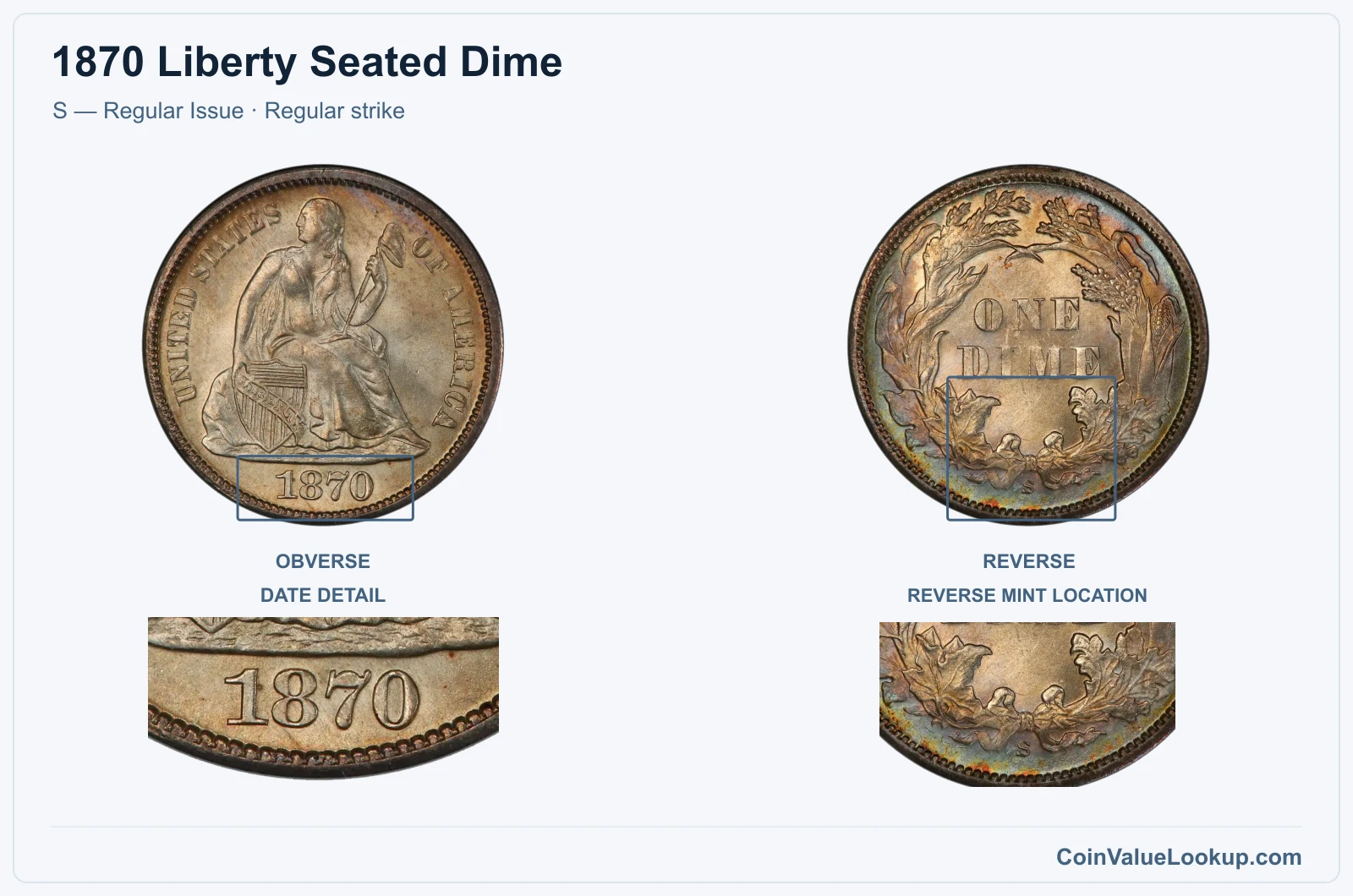
The San Francisco issue bears a small "S" mintmark on the reverse inside the wreath. This is the scarce one.
Guide estimates from USA Coin Book put it at roughly $379 in G4 and approximately $3,432 at MS63, reflecting significantly lower surviving populations compared to Philadelphia.
Because of that scarcity, even well-circulated examples in lower grades carry real money. Check that the "S" is clear and not a tooled addition.
Original surfaces and honest wear are what collectors want.
Coin Value Lookup is a good place to look up guides for other dates and mints in the Liberty Seated Dime series if you are building a set or just curious about related coins.
Range Grade
Price Auction Records Appraisal PO PO 1
—
Coin Identifier FR FR 2
—
Coin Identifier AG AG 3
Coin Identifier G G 4
Coin Identifier
G 6
Coin Identifier VG VG 8
Coin Identifier
VG 10
Coin Identifier F F 12
Coin Identifier
F 15
Coin Identifier VF VF 20
Coin Identifier
VF 25
Coin Identifier
VF 30
Coin Identifier
VF 35
Coin Identifier XF XF 40
Coin Identifier
XF 45
Coin Identifier AU AU 50
—
Coin Identifier
AU 53
Coin Identifier
AU 55
—
Coin Identifier
AU 58
Coin Identifier MS MS 60
—
Coin Identifier
MS 61
Coin Identifier
MS 62
Coin Identifier
MS 63
Coin Identifier
MS 64
Coin Identifier
MS 65
Coin Identifier
MS 66
Coin Identifier
MS 67
—
—
—
MS 68
—
—
—
MS 69
—
—
—
MS 70
—
—
—
1870 Liberty Seated Dime — No Mint Mark — Proof Regular Proof
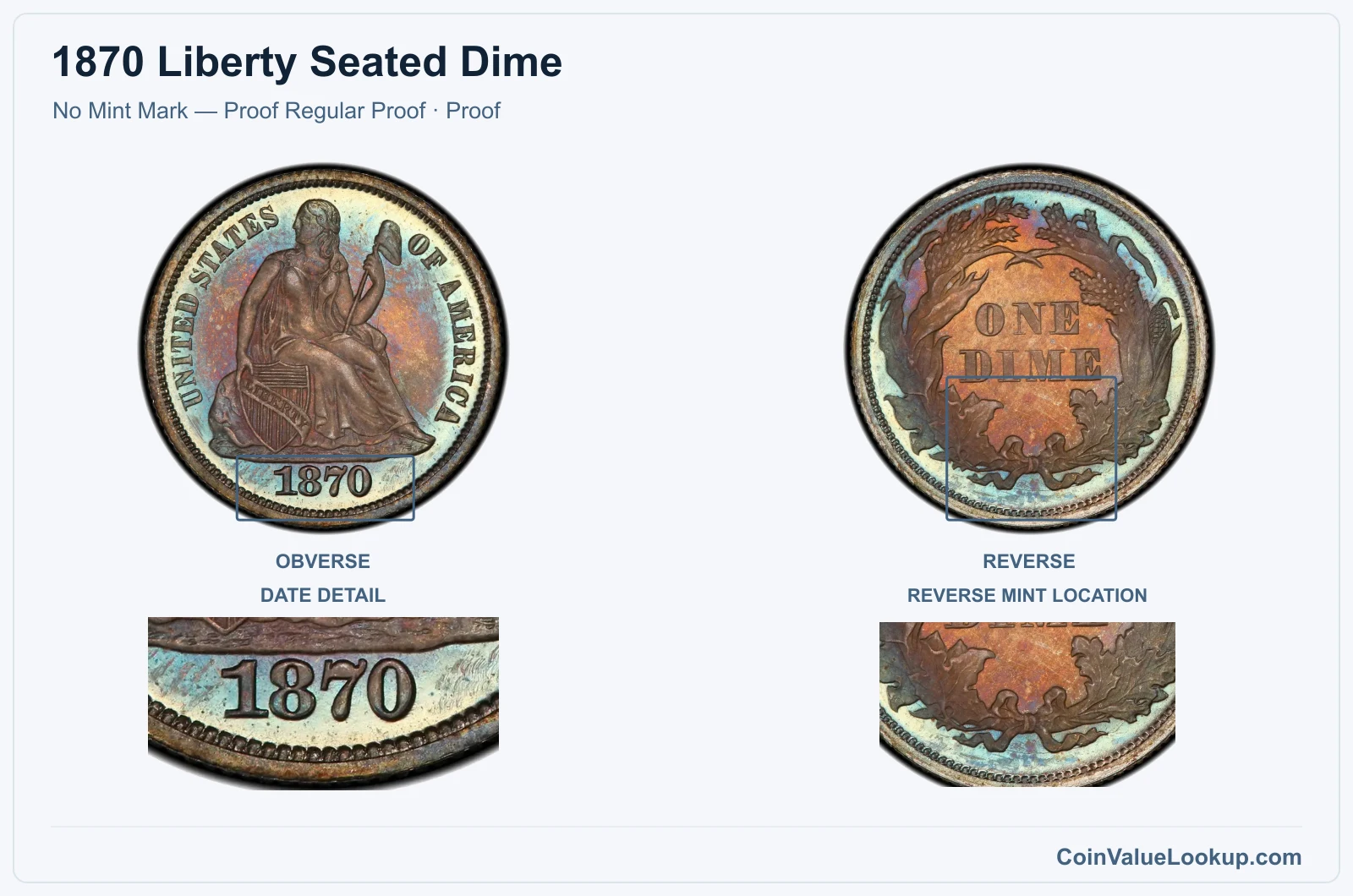
Philadelphia Proof dimes of 1870 were struck with specially prepared dies on polished planchets, giving them mirror-like fields. USA Coin Book lists a guide value near $725 at PR63.
These are collectible in their own right, separate from business strikes.
To identify a genuine Proof, look for deeply reflective fields and sharp design details that result from the careful die preparation, not from polishing after the fact. Hairlines from handling can lower the grade but do not change the coin's Proof identity.
A brilliant business strike is not a Proof, no matter how shiny it looks. If you suspect you have one, professional attribution from a major grading service is the safest route.
Range Grade
Price Auction Records Appraisal PR PR 1
—
Coin Identifier
PR 2
—
Coin Identifier
PR 3
—
Coin Identifier
PR 4
—
Coin Identifier
PR 6
—
Coin Identifier
PR 8
—
Coin Identifier
PR 10
—
Coin Identifier
PR 12
—
Coin Identifier
PR 15
—
Coin Identifier
PR 20
—
Coin Identifier
PR 25
—
Coin Identifier
PR 30
—
Coin Identifier
PR 35
—
Coin Identifier
PR 40
—
Coin Identifier
PR 45
—
Coin Identifier
PR 50
—
Coin Identifier
PR 53
—
Coin Identifier
PR 55
—
Coin Identifier
PR 58
—
Coin Identifier
PR 60
Coin Identifier
PR 61
Coin Identifier
PR 62
Coin Identifier
PR 63
Coin Identifier
PR 64
Coin Identifier
PR 65
Coin Identifier
PR 66
Coin Identifier
PR 67
Coin Identifier
PR 68
—
—
—
PR 69
—
—
—
PR 70
—
—
—
1870 Liberty Seated Dime Error List
1. 1870 Liberty Seated Dime — Repunched Date
A Repunched Date on an 1870 dime shows traces of an earlier position of one or more date numerals alongside the final placement. This happened when the date punch was applied to the die more than once in slightly different positions.
Look closely at each digit in 1870 under magnification. You may see ghost outlines, split serifs or thickened bases where the first impression was not perfectly aligned with the final one.
The remnants are raised, just like the rest of the design, because they originate in the die itself.
Do not confuse this with machine doubling, which tends to produce a flat shelf to one side of the lettering, or with simple damage to the date area. Condition, visibility of the extra punch and the specific variety all affect how much a collector might pay, so no single price range applies to every example.
2. 1870 Liberty Seated Dime — Die Crack / Die Chip
Die cracks on 1870 Philadelphia dimes appear as thin raised lines running across the coin's surface, formed when the steel die developed fractures during use. A die chip looks like a small raised blob, usually within a letter or device, where a piece of the die broke away and left a void that the planchet metal filled.
A crack that connects from the design to the rim is sometimes called a cud when large enough, but most examples on seated dimes are thin interior lines. They are always raised because they represent recessed damage in the die.
Do not mistake incuse scratches, corrosion or foreign material sitting on the surface for die cracks. A scratch is cut into the metal; a crack sits above it.
Value depends on the crack's size, location and the coin's overall condition. No specific price range is adopted for these.
3. 1870 Liberty Seated Dime — Doubled Die Reverse
A Doubled Die Reverse on the 1870 dime shows a secondary impression of the reverse design elements, most visibly at the letters of ONE and DIME. Under magnification, you can see separated or notched contours on those letters where the die received a second, slightly misaligned hub impression during manufacture.
Compare against a normal coin. The doubling on a true DDR will be consistent across multiple design elements on the same side and will show raised, rounded secondary profiles.
Machine doubling is the common lookalike. It produces a flat, shelf-like displacement to one side of the lettering and lacks the three-dimensional quality of genuine hub doubling.
Reflections from lighting can also fool you, so check under different angles. Value depends on the strength of doubling, the coin's grade and the specific die marriage involved.
4. 1870 Liberty Seated Dime — Off-Center Strike
An off-center strike happens when the planchet is not properly seated in the collar before the dies come together. The result is a design that is shifted to one side, leaving an unstruck crescent of blank metal on the opposite edge.
On an 1870 seated dime, the key collector consideration is whether the date remains fully visible. A coin struck 5-10% off-center with a complete date is far more desirable than one struck 50% off-center with the date missing.
Do not confuse an off-center strike with a clipped planchet, which has a curved bite taken out of the blank before striking, or with post-mint damage like being flattened unevenly. A genuine off-center strike will show the design cleanly fading into blank planchet.
No specific price range is adopted; value depends on the degree of mis-strike, date visibility and overall condition.
5. 1870 Liberty Seated Dime — Lamination / Split Planchet
A lamination error on an 1870 seated dime appears as peeling, flaking or separated metal on one or both faces. It can look like a retained flap still attached to the surface or an area where a thin layer has broken away entirely, exposing rough metal beneath.
This defect originates in the planchet itself, caused by impurities or gas pockets within the silver alloy that prevent the metal from bonding properly during rolling. It is a pre-strike or at-strike issue, not post-mint damage.
The lookalikes to watch for are scraping, corrosion and deliberately altered coins. Corrosion tends to pit the surface rather than peel in layers, and deliberate cuts usually show tool marks at the edges.
Photograph the edge and affected face together for the clearest documentation. Value depends on the size of the lamination, whether it is retained and the coin's condition overall.