1881 Liberty Seated Dime Coin Value: How Much Is It Worth?
The 1881 Liberty Seated Dime is a genuinely scarce coin. Philadelphia was the only mint striking this date for circulation, and the mintage was low enough that Proof coins can actually be easier to find than business strikes in certain grades.
Retail guide estimates range from about $221 in G4 to $967 in MS63 for the regular issue, with Proofs around $725 at PR63. Original surfaces matter a lot here, so knowing what you have is the first step.
Fast Way to Identify Your 1881 Liberty Seated Dime
The quickest way to start figuring out what your 1881 Seated Dime is worth is to upload clear photos of both the front and back. Our identifier can give you a preliminary read on the version and condition.
Snap the coin in even light, avoid glare, and make sure the date and any tiny details near the wreath are visible.
1881 Liberty Seated Dime Value
Upload both sides of your 1881 Liberty Seated Dime.
Front Obverse
Upload photo
Back Reverse
Upload photo
Which 1881 Liberty Seated Dime Versions Are Worth Money?
- The 1881 regular business strike is a low-mintage Philadelphia issue; guide values start at roughly $221 in G4 and reach about $967 at MS63.
- The 1881 Proof, struck at Philadelphia with specially prepared dies, carries a guide estimate near $725 at PR63 and may actually be more available than the circulation issue in some grade ranges.
- Original, unpolished surfaces on either version are critical to realizing full value; cleaning or polishing will significantly reduce a coin's desirability.
Step 1: Identify Your 1881 Liberty Seated Dime Mint Mark and Version
First, confirm you are looking at a Liberty Seated Dime and not the smaller half dime. The obverse shows a seated Liberty figure with a shield, and the reverse reads ONE DIME inside an agricultural wreath.
The diameter should be about 17.9mm with a reeded edge, and it is struck in 90% silver and 10% copper at a nominal weight of 2.50 grams.
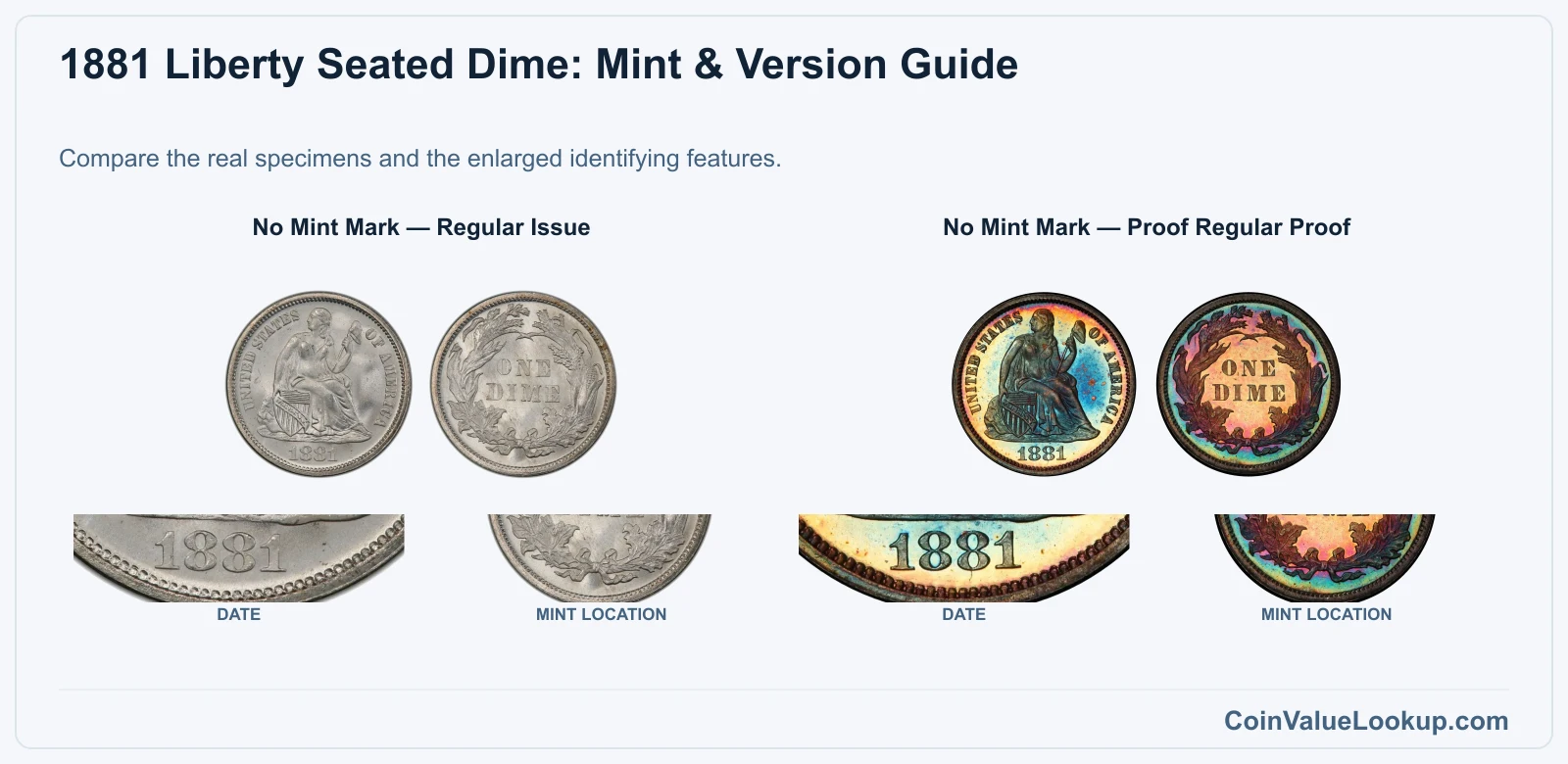
For 1881, there is no mintmark to hunt for. Philadelphia was the sole mint producing this date for circulation.
If you see an S, CC, or O on the reverse near the wreath bow, you have a different year or a problem.
The two versions to distinguish are the regular business strike and the Proof. A Proof will have deeply mirrored fields from specially prepared dies, not just a shiny surface.
Polished coins can fool you, so look for the squared-off rims and consistent reflective depth across both faces that characterize genuine Proof manufacture.
Step 2: Check Your 1881 Liberty Seated Dime Grade
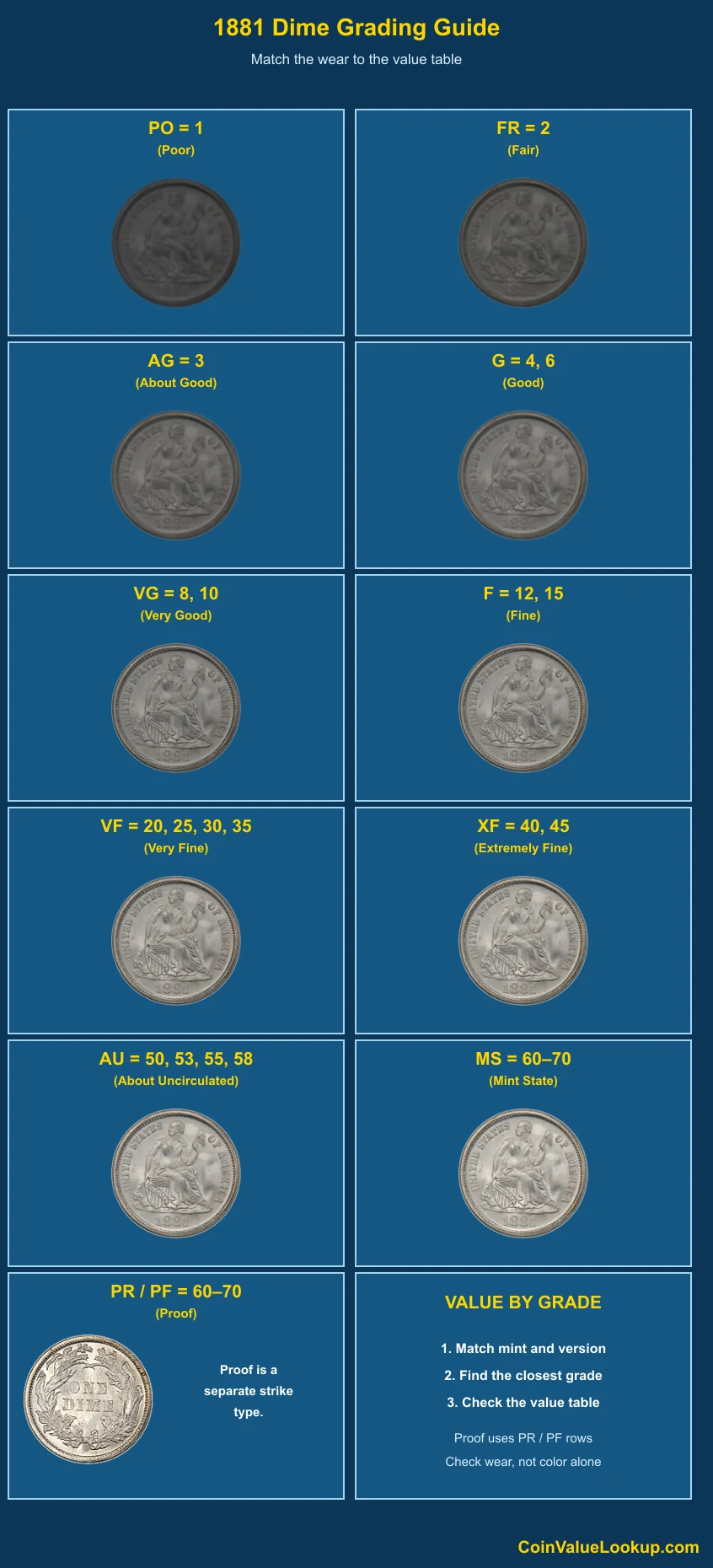
Start by checking Liberty's head, the area around her breast and knee, and the shield on her lap. These are the first spots to lose detail from circulation wear.
On the reverse, examine the highest leaves of the wreath.
A coin grading around G4 (Good) will show a clear outline of Liberty but most interior detail will be gone. At MS63 (Mint State, choice uncirculated), you should see full luster with only minor contact marks or blemishes.
Do not confuse a weak strike with heavy wear. Seated Dimes were sometimes struck from tired dies, which can leave soft details even on an uncirculated coin.
Look at the overall luster and surfaces together with the design sharpness. Compare your coin side-by-side with the reference image to get a realistic read on where it falls.
Also keep Proofs firmly separate from business strikes. A business strike with strong luster is not a Proof, no matter how pretty it looks.
Proof identification requires mirrored fields from deliberate die preparation, not just brilliance.
Step 3: Check 1881 Liberty Seated Dime Value by Mint and Version
1881 Liberty Seated Dime — No Mint Mark — Regular Issue
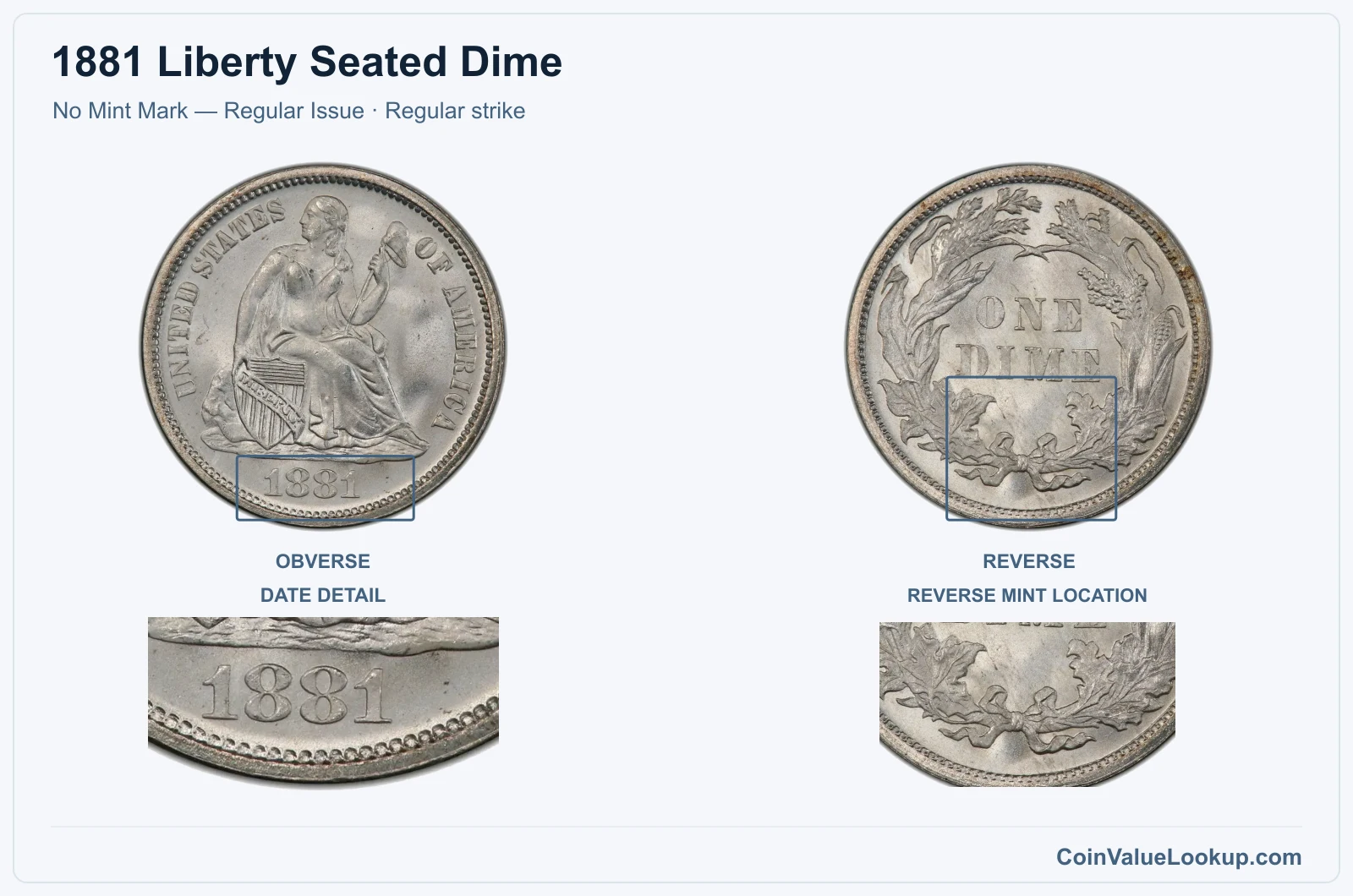
The 1881 regular issue was struck only at Philadelphia, so there is no mintmark anywhere on the coin. It uses the Legend Obverse paired with the agricultural wreath reverse, the standard design for late-date Seated Dimes.
This is a genuinely low-mintage date. Retail guide estimates place it at about $221 in G4 and around $967 in MS63, according to USA Coin Book.
Because so few were made for commerce, even well-worn examples carry a solid premium over more common years in the series.
Coin Value Lookup is a good place to look up guides for other dates and mints in the Liberty Seated Dime series if you are building a set or just curious about what else is out there.
Range Grade
Price Auction Records Appraisal PO PO 1
—
Coin Identifier FR FR 2
—
Coin Identifier AG AG 3
—
Coin Identifier G G 4
—
Coin Identifier
G 6
—
Coin Identifier VG VG 8
—
Coin Identifier
VG 10
Coin Identifier F F 12
—
Coin Identifier
F 15
—
Coin Identifier VF VF 20
Coin Identifier
VF 25
Coin Identifier
VF 30
Coin Identifier
VF 35
Coin Identifier XF XF 40
Coin Identifier
XF 45
Coin Identifier AU AU 50
Coin Identifier
AU 53
Coin Identifier
AU 55
—
Coin Identifier
AU 58
Coin Identifier MS MS 60
Coin Identifier
MS 61
Coin Identifier
MS 62
Coin Identifier
MS 63
Coin Identifier
MS 64
Coin Identifier
MS 65
Coin Identifier
MS 66
Coin Identifier
MS 67
Coin Identifier
MS 68
Coin Identifier
MS 69
—
—
—
MS 70
—
—
—
1881 Liberty Seated Dime — No Mint Mark — Proof Regular Proof
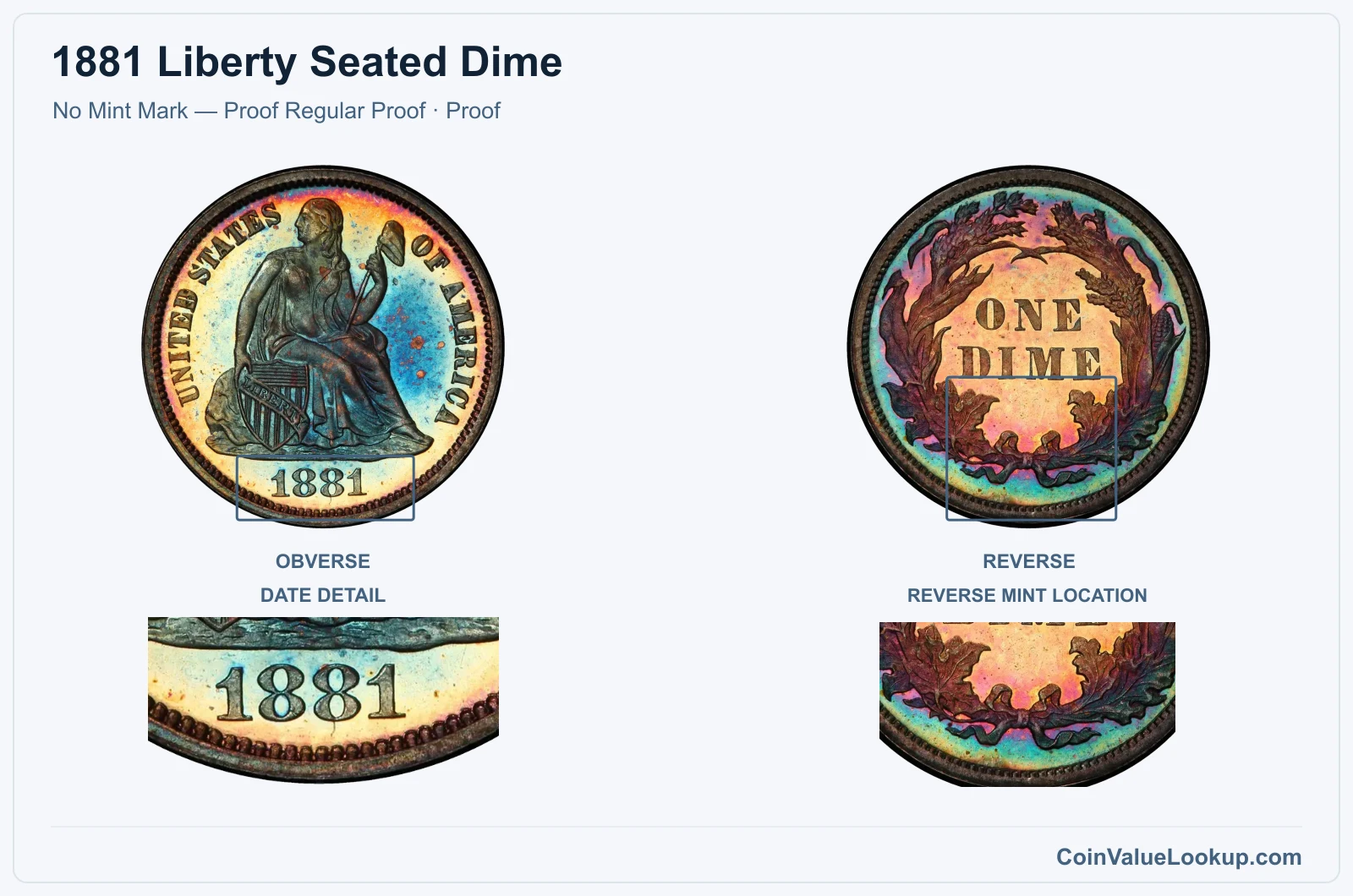
The 1881 Proof Seated Dime was produced at Philadelphia using specially prepared dies that give the fields a deep, mirror-like finish. This is a manufacturing process, not a grade above Mint State.
Look for perfectly reflective surfaces across both the obverse and reverse, with sharply squared rims and crisp detail that business strikes rarely match.
Hairlines from old cleaning or mishandling are common on surviving Proofs and will affect the grade. A coin with mirror fields but covered in fine scratches is still a Proof, just a lower-grade one.
The USA Coin Book guide estimate sits at about $725 in PR63.
Here is the odd part of 1881: the Proof may actually be easier to locate than the regular circulation strike in some grades, because collectors preserved Proofs while business strikes entered commerce and wore down. That makes the business strike the tougher find in high grades, even though the Proof carries its own premium for the finish.
Range Grade
Price Auction Records Appraisal PR PR 1
—
Coin Identifier
PR 2
—
Coin Identifier
PR 3
—
Coin Identifier
PR 4
—
Coin Identifier
PR 6
—
Coin Identifier
PR 8
—
Coin Identifier
PR 10
—
Coin Identifier
PR 12
—
Coin Identifier
PR 15
—
Coin Identifier
PR 20
—
Coin Identifier
PR 25
—
Coin Identifier
PR 30
—
Coin Identifier
PR 35
—
Coin Identifier
PR 40
—
Coin Identifier
PR 45
—
Coin Identifier
PR 50
—
Coin Identifier
PR 53
—
Coin Identifier
PR 55
Coin Identifier
PR 58
—
Coin Identifier
PR 60
Coin Identifier
PR 61
Coin Identifier
PR 62
Coin Identifier
PR 63
Coin Identifier
PR 64
Coin Identifier
PR 65
Coin Identifier
PR 66
Coin Identifier
PR 67
Coin Identifier
PR 68
Coin Identifier
PR 69
—
—
—
PR 70
—
—
—