1916 Mercury Dime Coin Value: How Much Is It Worth?
A 1916 Mercury Dime — properly called the Winged Liberty Head — can range from about $8.50 in well-worn Good-4 condition to over $32,000 at the Mint State 65 level, depending on which mint struck it. Both the Mercury and Barber designs carry a 1916 date, so make sure you are looking at the Winged Liberty type before using these values.
The Denver mint issue is the famous key date, and it deserves extra scrutiny for authenticity.
Fast Way to Identify Your 1916 Mercury Dime
Snap clear photos of both the front and back of your dime and upload them here for a preliminary identification. Good lighting and a steady hand help — the reverse mintmark area matters a lot on this date.
This tool can help sort out which mint version you have, though it is not a substitute for professional authentication or grading.
1916 Mercury Dime Value
Upload both sides of your 1916 Mercury Dime.
Front Obverse
Upload photo
Back Reverse
Upload photo
Which 1916 Mercury Dime Versions Are Worth Money?
- The 1916-D (Denver) is the key date in the entire Mercury Dime series; a USA Coin Book guide estimate places it around $1,247 in G-4 and roughly $32,661 in MS-65, so even heavily worn examples carry real value.
- A Full Bands designation — where the central fasces bands are fully separated — can push premiums higher on any mint's coin, though Full Bands pricing is tracked separately from regular Mint State values.
- Coins retaining original Mint State surfaces and luster are worth considerably more than cleaned or damaged examples, regardless of mint.
Step 1: Identify Your 1916 Mercury Dime Mint Mark and Version
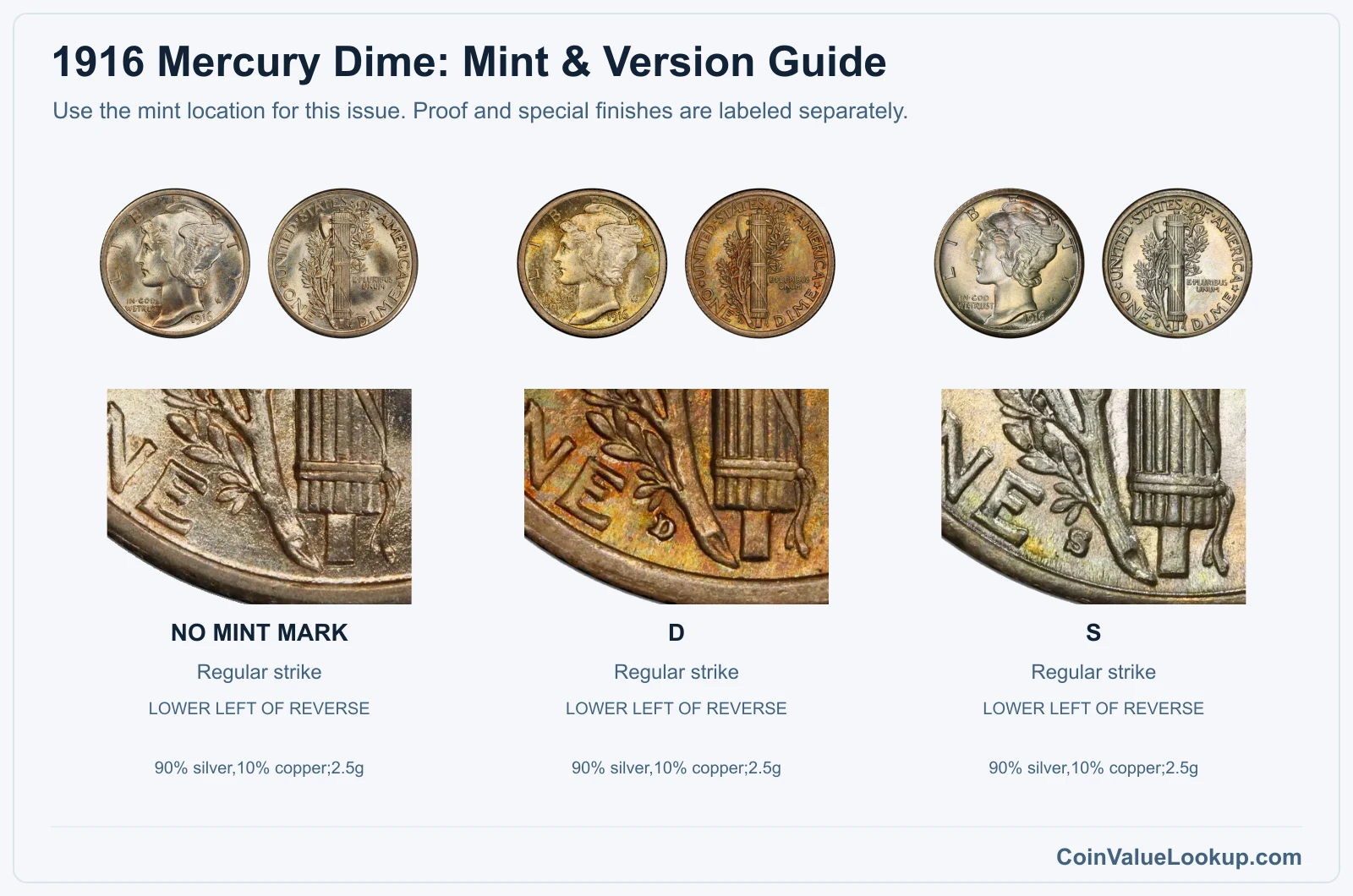
Three mints produced the 1916 Winged Liberty dime: Philadelphia, Denver, and San Francisco. Philadelphia coins carry no mintmark at all.
Denver and San Francisco pieces show a small D or S on the lower-left reverse, just to the left of the word ONE near the base of the olive branch.
The initials AW on the obverse near Liberty's neck stand for designer Adolph Weinman. They do not indicate a West Point mint — that facility was not striking coins in 1916.
All three versions are struck in the same 90% silver, 10% copper alloy, weigh about 2.5 grams, and measure 17.9 mm with a reeded edge. If your coin is noticeably lighter or the edge is smooth, something else is going on.
Because the 1916-D is extremely valuable, counterfeit and altered examples exist. Some fakes are Barber dimes with an added date, and some are Philadelphia or San Francisco coins with a fake D mintmark glued, soldered, or tooled into place.
Any 1916-D should be examined carefully or sent to a third-party grading service before you spend serious money.
Step 2: Check Your 1916 Mercury Dime Grade
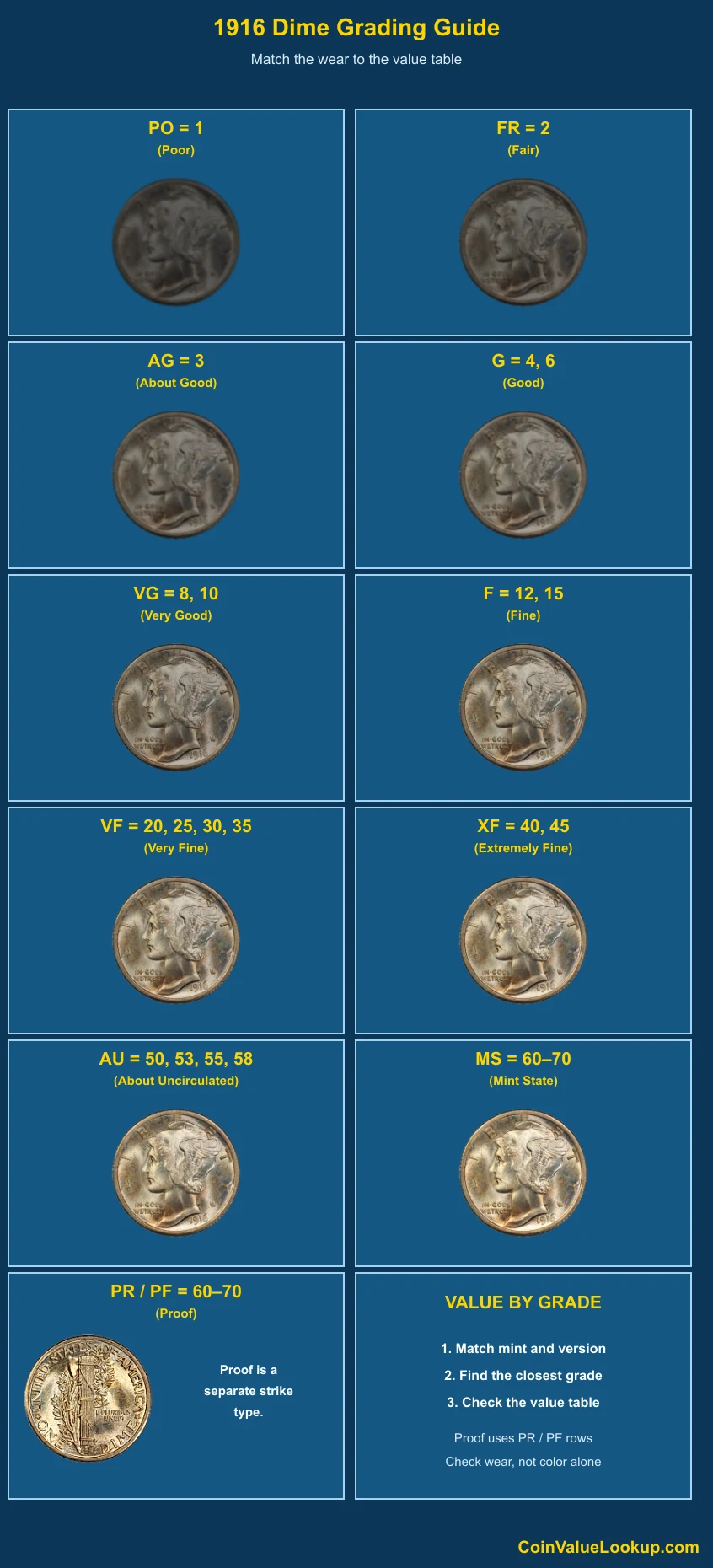
Start by checking the hair detail above and in front of Liberty's ear. On a lightly worn coin, the highest points there flatten first — the individual strands merge into a smooth patch.
The wings on the cap lose feather definition next.
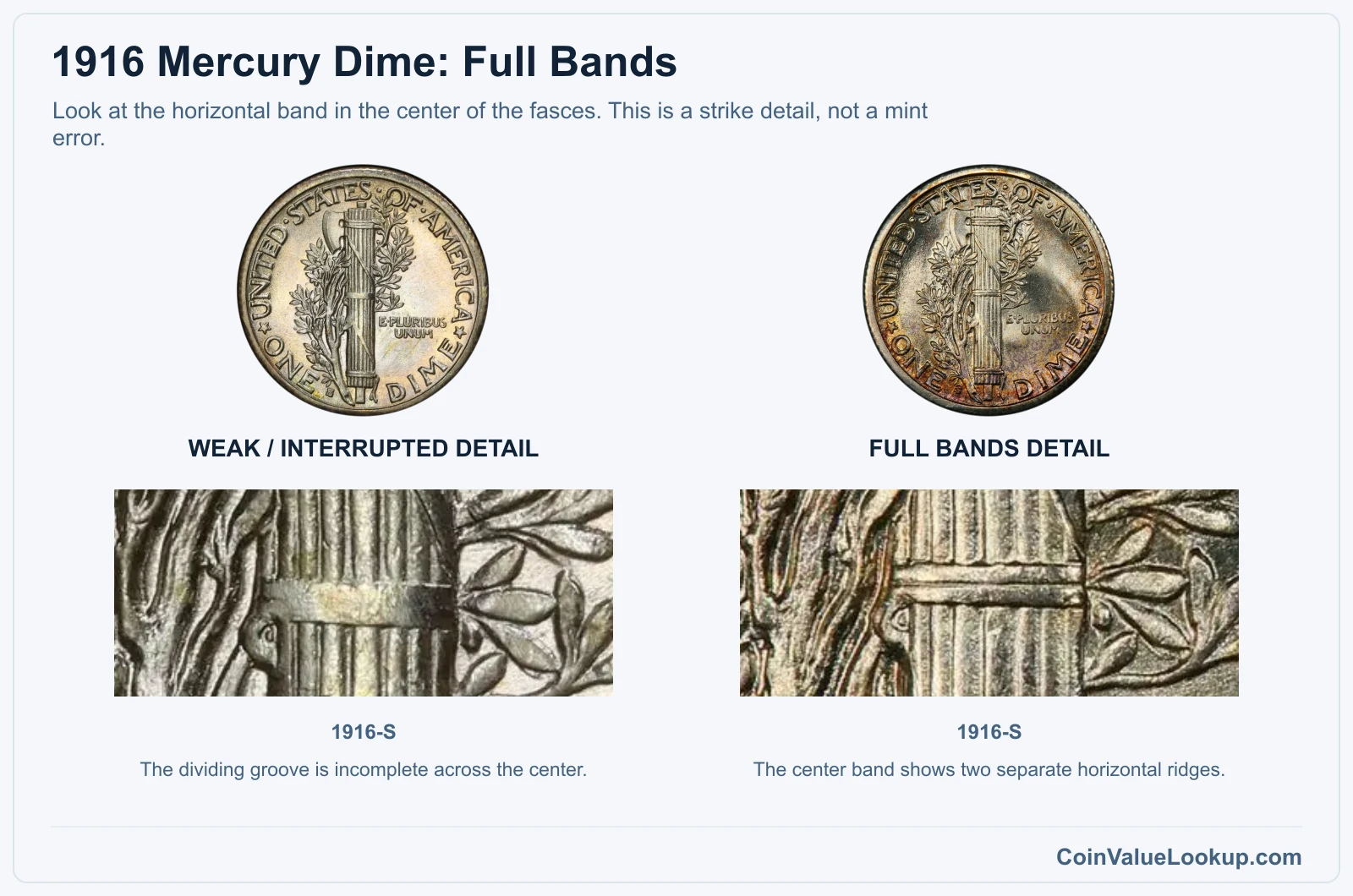
On the reverse, examine the horizontal bands that tie the fasces together. These bands are a key grading and pricing feature.
A coin with fully separated central bands qualifies for a Full Bands designation, which is a strike characteristic, not a grade or an error. Different grading services may apply slightly different criteria for this designation.
Compare your coin to the reference image for your estimated grade. Look for contact marks, luster breaks, and any signs of cleaning such as unnatural shininess or hairline scratches under a light.
Weak peripheral legends or soft bands do not automatically mean heavy circulation — some 1916 dimes, especially branch-mint strikes, simply came off the press that way.
Step 3: Check 1916 Mercury Dime Value by Mint and Version
1916 Mercury Dime — No Mint Mark — Silver Circulation
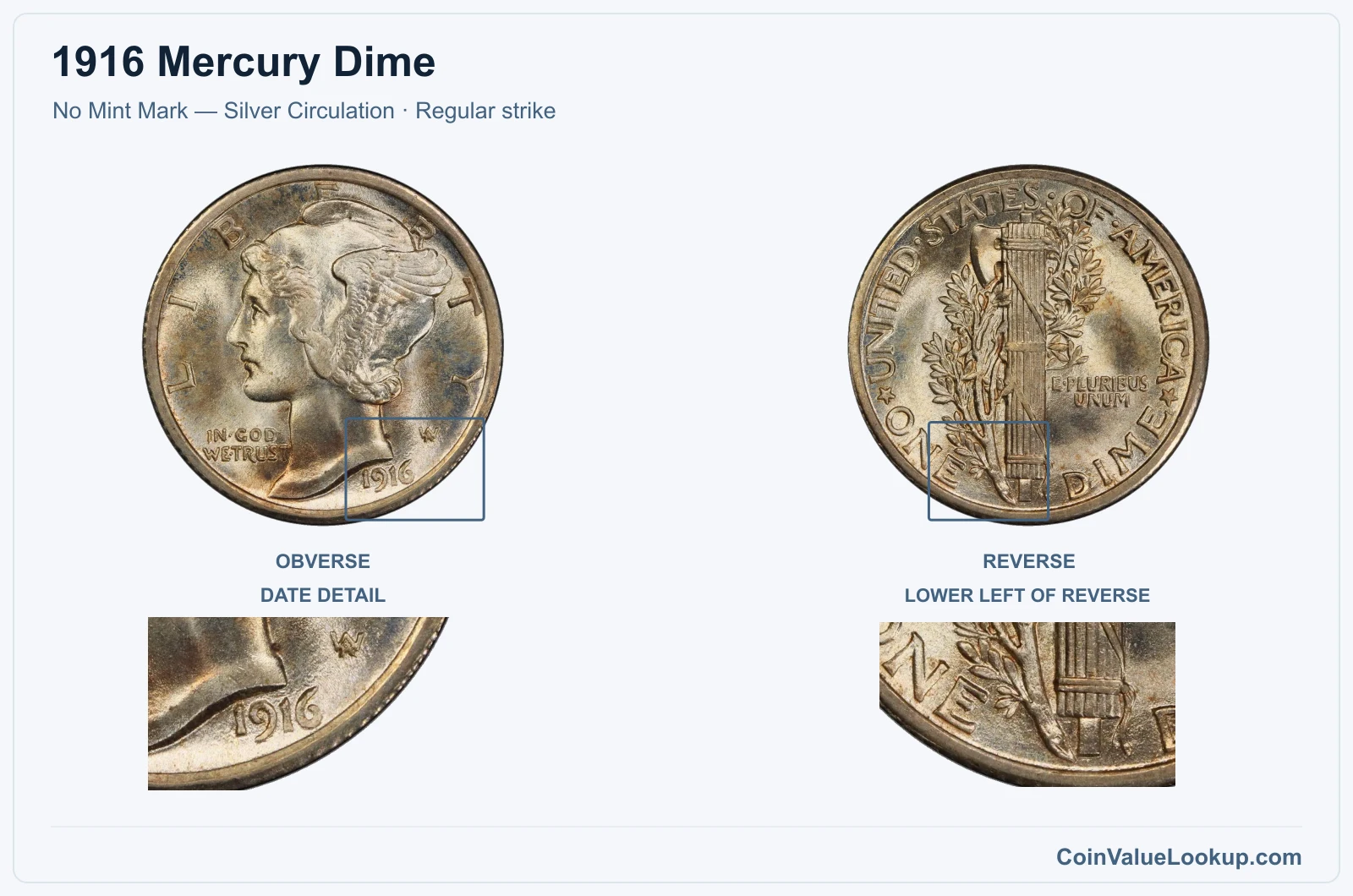
The Philadelphia issue has no mintmark anywhere on the coin. In heavily worn Good-4 condition, a USA Coin Book guide estimate puts it around $8.50.
A nice Mint State 65 example jumps to roughly $158 by the same guide.
Philadelphia struck the largest quantity of 1916 Mercury Dimes, so these are the most available of the three. Still, the coin is over a century old and 90% silver, so even common examples carry a baseline value.
When you check the reverse, make sure there truly is no tiny letter beside ONE — a worn S can look almost invisible on a tired coin.
Range Grade
Price Auction Records Appraisal PO PO 1
—
Coin Identifier FR FR 2
—
Coin Identifier AG AG 3
—
Coin Identifier G G 4
—
Coin Identifier
G 6
—
Coin Identifier VG VG 8
—
Coin Identifier
VG 10
—
Coin Identifier F F 12
—
Coin Identifier
F 15
—
Coin Identifier VF VF 20
—
Coin Identifier
VF 25
—
Coin Identifier
VF 30
—
Coin Identifier
VF 35
—
Coin Identifier XF XF 40
—
Coin Identifier
XF 45
—
Coin Identifier AU AU 50
—
Coin Identifier
AU 53
—
Coin Identifier
AU 55
—
Coin Identifier
AU 58
Coin Identifier MS MS 60
Coin Identifier
MS 61
Coin Identifier
MS 62
Coin Identifier
MS 63
Coin Identifier
MS 64
Coin Identifier
MS 65
Coin Identifier
MS 66
Coin Identifier
MS 67
Coin Identifier
MS 68
Coin Identifier
MS 69
—
—
—
MS 70
—
—
—
1916 Mercury Dime — D — Silver Circulation
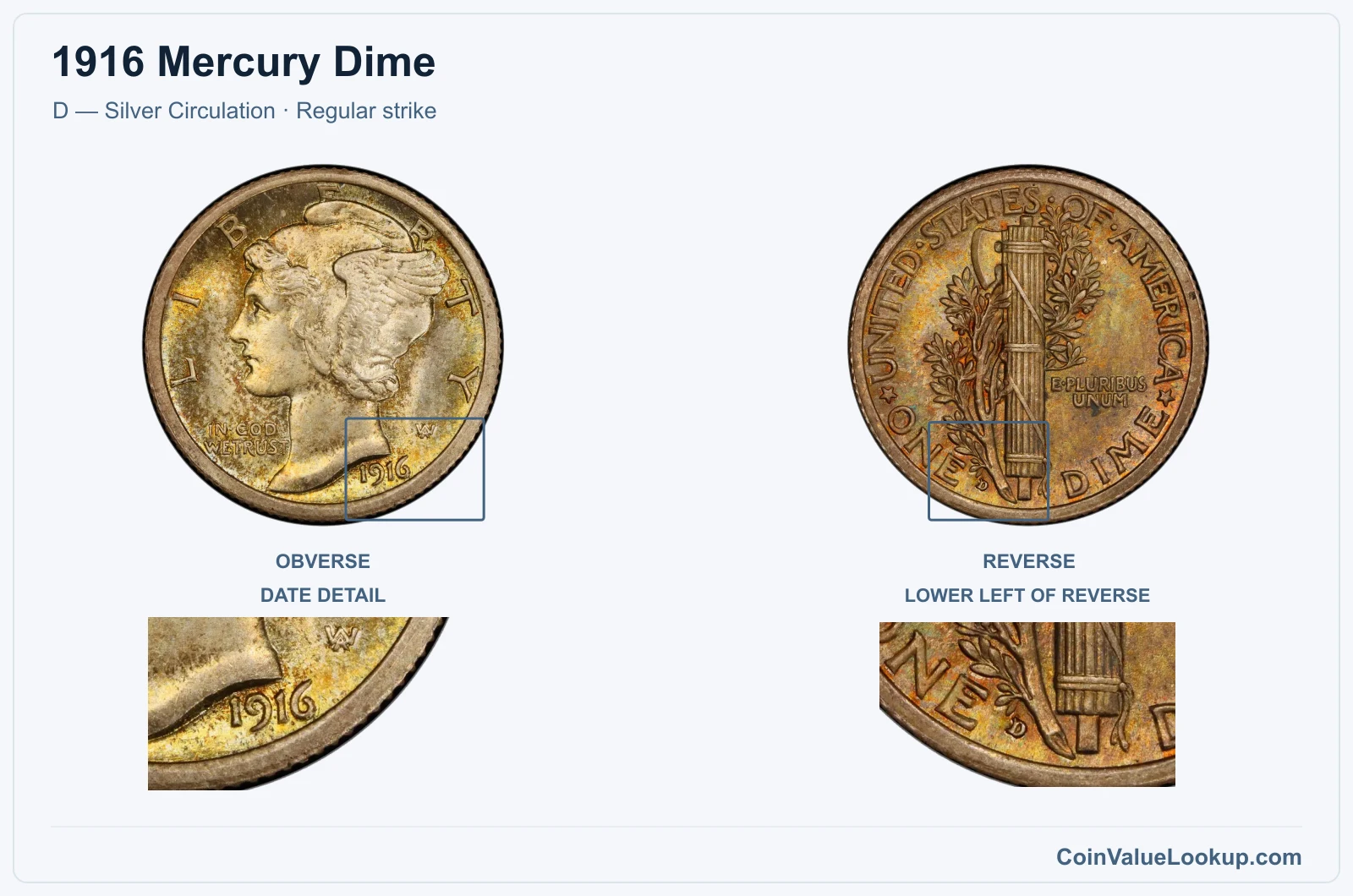
This is the one. The 1916-D Mercury Dime is one of the most recognized key dates in all of American numismatics.
Denver's mintage was tiny, and surviving examples are scarce in any grade.
A USA Coin Book guide estimate places a Good-4 around $1,247 and a Mint State 65 around $32,661. Even a well-worn, honest example is a serious coin.
Look for a small D on the lower-left reverse beside ONE. Because of the enormous price gap, altered coins are everywhere.
Added mintmarks sometimes sit at the wrong angle, show a different texture from the surrounding field, or lack the proper relief. If you think you have a 1916-D, get it authenticated by a reputable third-party grading service before selling or buying.
Coin Value Lookup is a good starting point when you need to look up value guides for other dates and denominations in the Mercury Dime series or across other U.S. coin types.
Range Grade
Price Auction Records Appraisal PO PO 1
Coin Identifier FR FR 2
Coin Identifier AG AG 3
Coin Identifier G G 4
Coin Identifier
G 6
Coin Identifier VG VG 8
Coin Identifier
VG 10
Coin Identifier F F 12
Coin Identifier
F 15
Coin Identifier VF VF 20
Coin Identifier
VF 25
Coin Identifier
VF 30
Coin Identifier
VF 35
Coin Identifier XF XF 40
Coin Identifier
XF 45
Coin Identifier AU AU 50
Coin Identifier
AU 53
Coin Identifier
AU 55
Coin Identifier
AU 58
Coin Identifier MS MS 60
Coin Identifier
MS 61
Coin Identifier
MS 62
Coin Identifier
MS 63
Coin Identifier
MS 64
Coin Identifier
MS 65
Coin Identifier
MS 66
—
Coin Identifier
MS 67
—
—
—
MS 68
—
—
—
MS 69
—
—
—
MS 70
—
—
—
1916 Mercury Dime — S — Silver Circulation
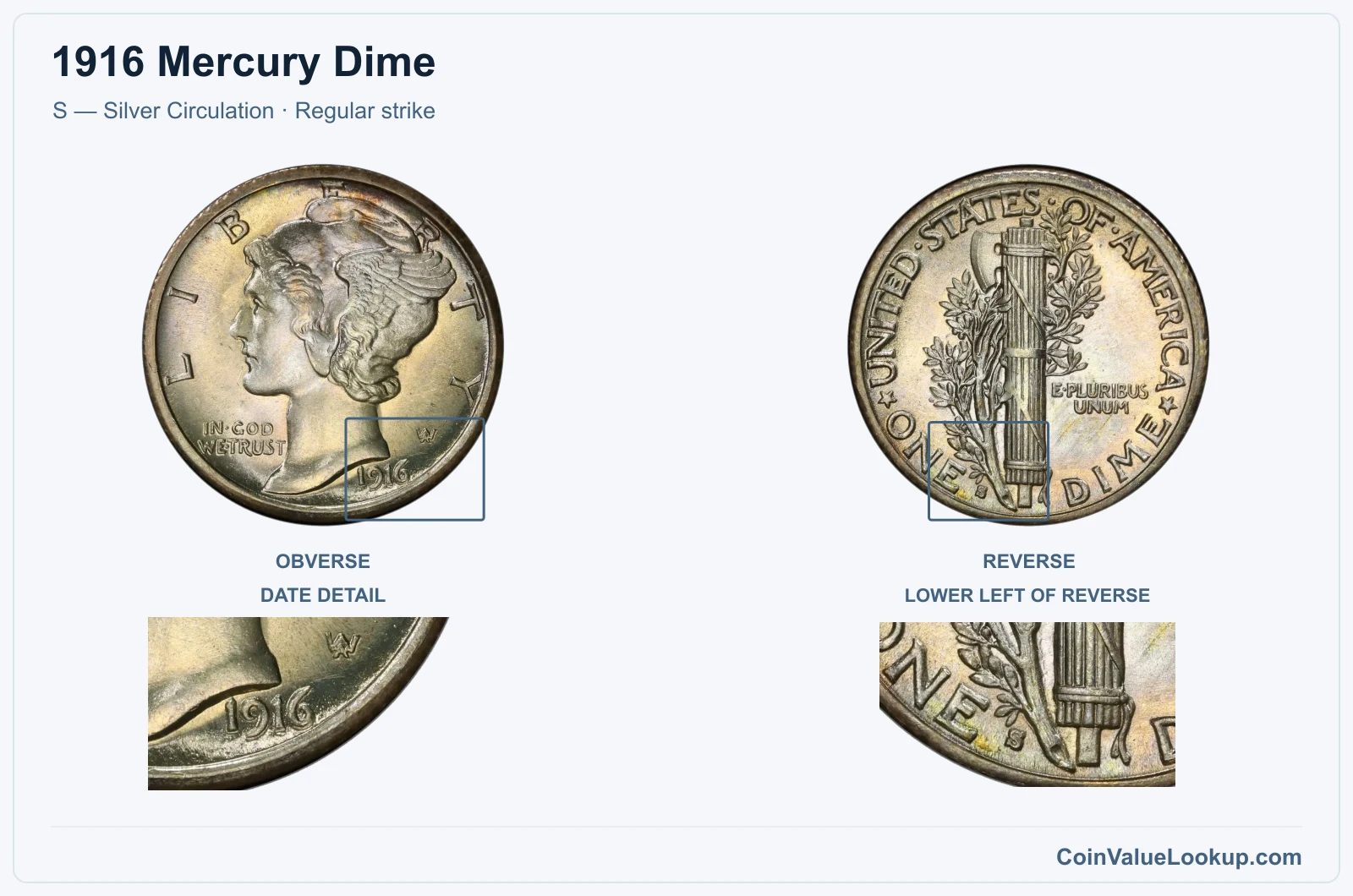
San Francisco's 1916 dime carries a small S on the lower-left reverse. In Good-4 condition, the USA Coin Book guide estimate is about $8.50 — the same as the Philadelphia issue.
At Mint State 65, the guide rises to roughly $273.
The S mintmark can sometimes be weakly struck, so use magnification. Don't confuse a soft S for a missing mintmark and then assume you have a Philadelphia coin — or worse, start imagining a D underneath.
These are solid, collectible coins on their own terms, and well-struck Mint State survivors with strong bands are genuinely hard to find.
Range Grade
Price Auction Records Appraisal PO PO 1
—
Coin Identifier FR FR 2
Coin Identifier AG AG 3
—
Coin Identifier G G 4
—
Coin Identifier
G 6
—
Coin Identifier VG VG 8
—
Coin Identifier
VG 10
—
Coin Identifier F F 12
—
Coin Identifier
F 15
—
Coin Identifier VF VF 20
—
Coin Identifier
VF 25
—
Coin Identifier
VF 30
Coin Identifier
VF 35
—
Coin Identifier XF XF 40
—
Coin Identifier
XF 45
—
Coin Identifier AU AU 50
—
Coin Identifier
AU 53
Coin Identifier
AU 55
Coin Identifier
AU 58
Coin Identifier MS MS 60
—
Coin Identifier
MS 61
—
Coin Identifier
MS 62
Coin Identifier
MS 63
Coin Identifier
MS 64
Coin Identifier
MS 65
Coin Identifier
MS 66
Coin Identifier
MS 67
Coin Identifier
MS 68
—
—
—
MS 69
—
—
—
MS 70
—
—
—
1916 Mercury Dime Error List
1. 1916 Mercury Dime — Off-Center Strike
An off-center strike happens when the planchet is not properly seated between the dies. The result is a displaced design with an unstruck crescent of blank metal along part of the edge.
The more dramatic the shift, the more obvious it is.
For collector interest, the date needs to remain visible — a 50% off-center coin with no date is mostly a curiosity. Condition, the percentage of off-center shift, and date visibility all affect value, so no single price applies.
Don't confuse a clipped planchet or one-sided die misalignment with a true off-center strike. Post-mint damage like hammering or bending can also create a lopsided appearance but won't produce the characteristic unstruck crescent with proper metal-flow patterns.
2. 1916 Mercury Dime — Broadstrike
A broadstrike occurs when a coin is struck without the retaining collar that normally constrains the planchet's edge. The metal spreads outward, making the coin visibly wider than normal while the full design still appears — just slightly expanded.
On a 1916 dime, the reeded edge would be absent or distorted on a genuine broadstrike. The design elements stretch toward the rim but remain complete, unlike an off-center strike where part of the design is missing entirely.
Watch out for coins that were simply flattened after leaving the mint — railroad tracks, vises, and workshop floors have ruined plenty of dimes. A real broadstrike shows even metal flow from the strike itself.
Value depends on the coin's condition and how dramatic the spread is.
3. 1916 Mercury Dime — Repunched Mintmark
A repunched mintmark shows traces of a second (or additional) position of the mintmark letter beneath or beside the final one. On a 1916 dime, this applies to the D or S on the reverse — Philadelphia coins have no mintmark to repunch.
Use magnification and compare the mintmark to a known normal example at the same zoom level. You are looking for a shadow, notch, or offset remnant of an earlier punch position.
Machine doubling, die chips, and simple corrosion around the mintmark area can mimic a repunched mintmark to the untrained eye. True repunching shows a distinctly positioned second impression of the letter, not just shelf-like flatness.
Condition and clarity of the repunching affect desirability, so individual assessment matters.
4. 1916 Mercury Dime — Die Crack / Die Chip
Die cracks appear as thin raised lines on the coin's surface, created when the steel die develops a fracture during use. Small raised blobs — die chips — form when a tiny piece of the die breaks away, leaving a void that fills with metal during striking.
On a 1916 dime, look for these raised features on either side. A die crack that connects to the rim may technically qualify as a die break, so location matters.
Interior chips that stay away from the rim are a separate category.
Don't mistake incuse scratches, corrosion lines, or debris stuck to the surface for genuine die cracks. A real crack is raised above the field and was struck into the coin, not pressed or scratched in afterward.
Value depends on prominence, location, and the coin's overall condition.
5. 1916 Mercury Dime — Die Break / Cud
A cud is a specific type of die break where a piece of the die along the rim breaks away completely. The result is a raised, featureless blob of metal at the rim that replaces part of the normal design.
It connects to the edge — that is what distinguishes a cud from an interior die chip.
On a 1916 dime, check the full periphery of both sides. A cud will feel raised and lack any design detail within its boundaries.
Rim dents from post-mint damage are the most common lookalike. A dent pushes metal inward and usually shows distortion rather than a flat, featureless raised area.
Corrosion buildup at the rim can also look suspicious under low magnification. Value depends on size, location, and the coin's overall grade.
6. 1916 Mercury Dime — Clipped Planchet
A clipped planchet error occurs when the blank is punched from the metal strip in a way that overlaps a previously punched hole or the strip's edge. The result is a missing curved, straight, or ragged section of the coin.
On a genuine clip, look for a characteristic weakness in the design directly opposite the missing area — the Blakesley effect — where metal flow was disrupted during striking. The edge at the clip will also show a different texture from the normal reeded edge.
Filed edges, deliberate cuts, and corrosion can all remove metal from a coin's rim and mimic a clip. These post-mint alterations typically lack the Blakesley effect and show tool marks or uneven surfaces under magnification.
The clip's size, shape, and the coin's condition all influence value.
7. 1916 Mercury Dime — Rotated Dies
Rotated dies occur when one of the two dies shifts from its normal alignment. For U.S. coins, the standard is medal alignment: hold the obverse upright, flip the coin top to bottom, and the reverse should also appear upright.
Any deviation from that is a rotation.
To test your 1916 dime, hold Liberty's portrait upright, then flip the coin along its vertical axis. The fasces on the reverse should be centered and upright.
If it is tilted, you may have a rotated-die error.
Make sure you are not just looking at a photograph taken at an angle or a coin placed sideways in a holder. The rotation must be consistent when you physically handle the piece.
Greater degrees of rotation generally attract more collector interest, but individual value depends on the extent and the coin's condition.