1801 Draped Bust Half Dollar Coin Value: How Much Is It Worth?
An 1801 Draped Bust Half Dollar is a genuinely scarce early American coin. Guide estimates for the ordinary Philadelphia issue range from approximately $1,206 at G4 to $18,712 at AU50.
Collector value far exceeds both face value and silver content, and special varieties or higher grades can push prices well beyond those anchors.
Fast Way to Identify Your 1801 Draped Bust Half Dollar
Want a quick read on what you have? Upload clear photos of the front and back of your coin, and our identifier will give you a preliminary identification of the design type and major version.
That first step helps you figure out whether your piece is the expected Draped Bust / Heraldic Eagle issue or something else entirely.
1801 Draped Bust Half Dollar Value
Upload both sides of your 1801 Draped Bust Half Dollar.
Front Obverse
Upload photo
Back Reverse
Upload photo
Which 1801 Draped Bust Half Dollar Versions Are Worth Money?
- Philadelphia — Heraldic Eagle: The sole regular issue for 1801, with guide values from about $1,206 at G4 to $18,712 at AU50, making even well-worn examples worth serious money.
- Clashed Dies variety: Reported for this date, clashed-die coins can carry a premium, though value depends heavily on how visible the clash traces are and the coin's overall condition.
Step 1: Identify Your 1801 Draped Bust Half Dollar Mint Mark and Version
Only the Philadelphia Mint struck half dollars in 1801, so the absence of a mintmark is completely normal. Do not look for a D, S, or O — none exist for this date.
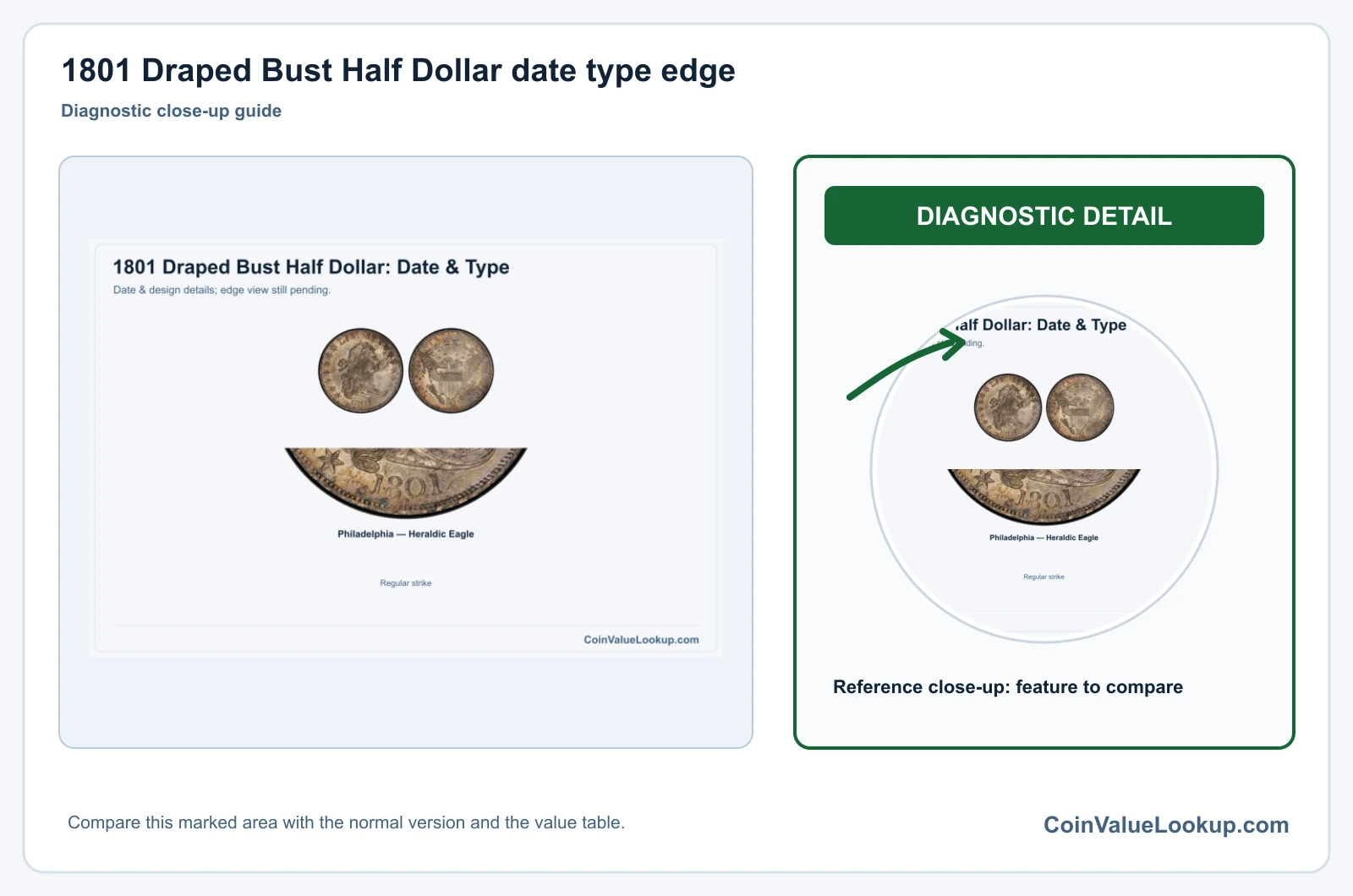
Confirm the denomination by reading the lettered edge: FIFTY CENTS OR HALF A DOLLAR. The obverse shows a draped Liberty bust facing right, while the reverse features the larger Heraldic Eagle holding arrows and an olive branch beneath a shield.
This is the Draped Bust / Heraldic Eagle type, which replaced the earlier Small Eagle reverse after 1797.
Nominal specs are about 32.5 mm in diameter and roughly 13.48 grams. Weight can help screen out obvious fakes, but it is not a substitute for proper authentication.
Two minor die marriages exist within this date, though they do not require separate pricing for a beginner's purposes. Be careful not to confuse an 1806 reverse (which can lack berry stems) with an 1801 variety — the dates are different coins entirely.
Step 2: Check Your 1801 Draped Bust Half Dollar Grade
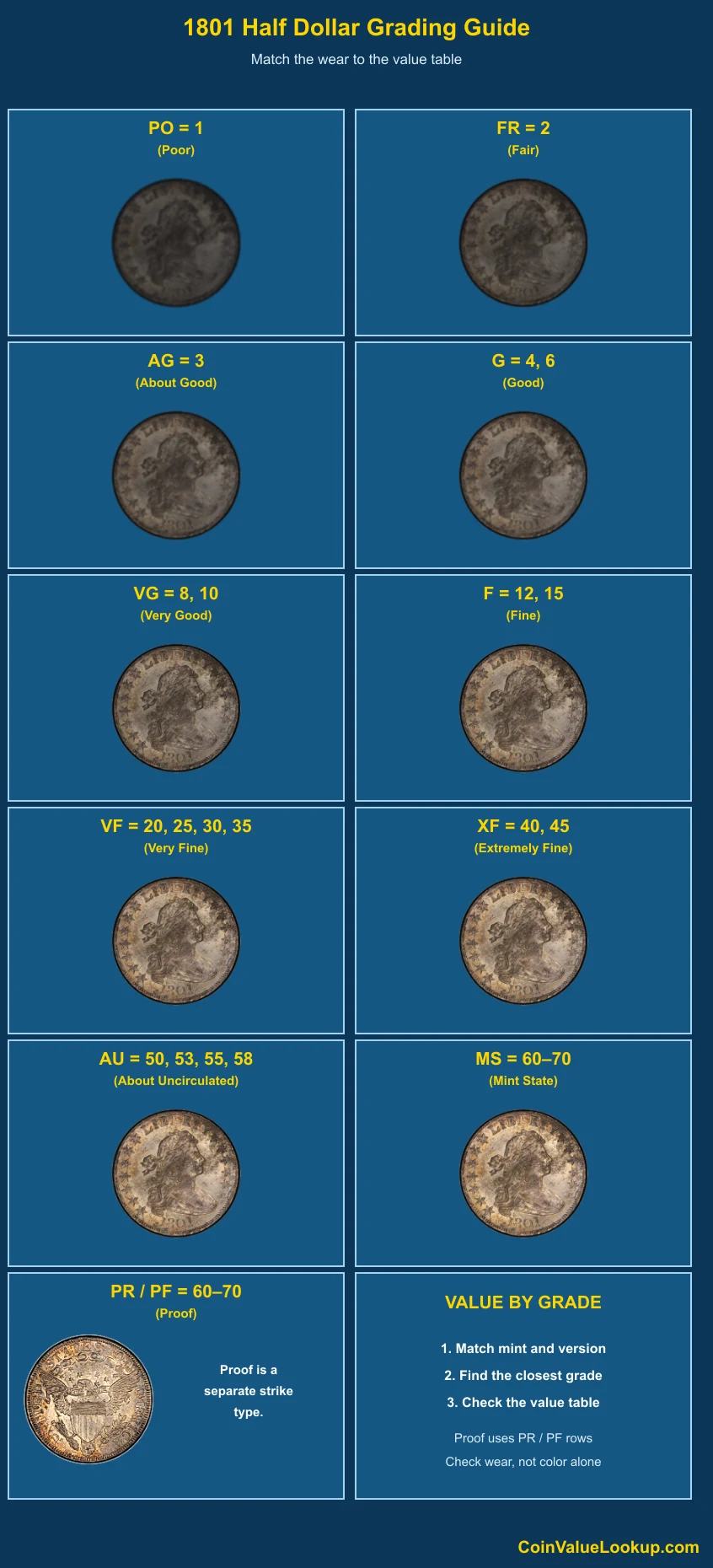
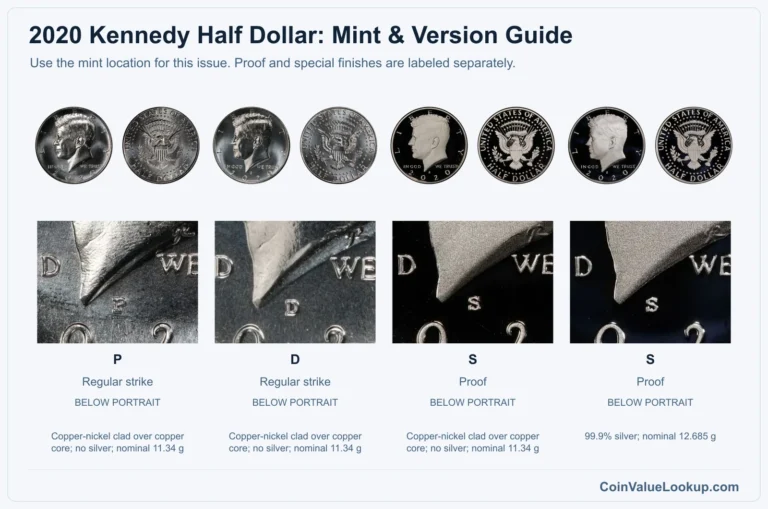
Focus your wear check on Liberty's hair strands above the forehead, the fullness of her cheek, and the drapery detail across her shoulder. Compare your coin against images of other Draped Bust half dollars, not modern designs like the Kennedy type — the relief and style are completely different.
On the reverse, examine the eagle's breast feathers and wing tips. Some 1801 halves were weakly struck from the start, so a soft area does not always mean wear.
The key distinction is whether the surface still has original mint luster in the fields. Lost luster with flat high points equals circulation wear; soft detail with intact luster points toward a strike issue.
Any cleaning, holes, plugs, tooling, or heavy scratches should be noted separately. A coin with those problems is typically graded as a "Details" piece, meaning it does not follow the same price curve as a straight-graded example.
The comparison image is your best friend here — hold your coin next to it under good light and be honest about what you see.
Step 3: Check 1801 Draped Bust Half Dollar Value by Mint and Version
1801 Draped Bust Half Dollar — Philadelphia — Heraldic Eagle
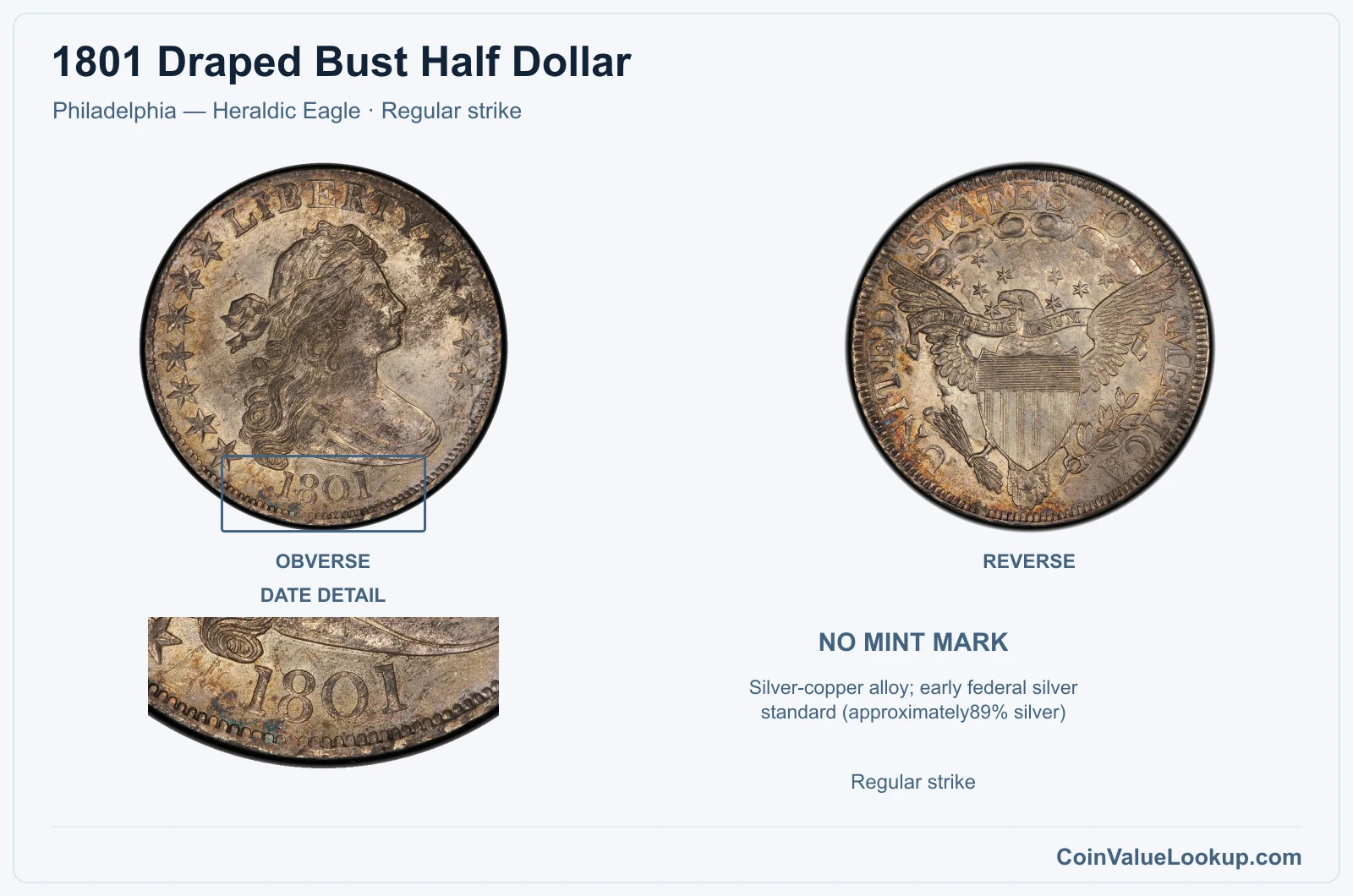
The 1801 Philadelphia Heraldic Eagle half dollar is struck in a silver-copper alloy at the early federal silver standard of approximately 89 percent silver. Every genuine example comes from Philadelphia with no mintmark.
This is a scarce date by any measure. Guide estimates place a well-worn G4 example around $1,206, a mid-grade VF20 near $3,267, and an AU50 close to $18,712, according to USA Coin Book.
Two minor die marriages are known, but the differences are subtle enough that beginners can treat them as a single collectible issue.
Coin Value Lookup is a handy starting point if you want to compare guide values for other Draped Bust dates or denominations. It can help you put this scarce 1801 issue into context alongside the rest of the series.
Range Grade
Price Auction Records Appraisal PO PO 1
—
Coin Identifier FR FR 2
—
Coin Identifier AG AG 3
Coin Identifier G G 4
Coin Identifier
G 6
Coin Identifier VG VG 8
Coin Identifier
VG 10
Coin Identifier F F 12
Coin Identifier
F 15
Coin Identifier VF VF 20
Coin Identifier
VF 25
Coin Identifier
VF 30
Coin Identifier
VF 35
Coin Identifier XF XF 40
Coin Identifier
XF 45
Coin Identifier AU AU 50
Coin Identifier
AU 53
Coin Identifier
AU 55
Coin Identifier
AU 58
Coin Identifier MS MS 60
Coin Identifier
MS 61
—
Coin Identifier
MS 62
Coin Identifier
MS 63
Coin Identifier
MS 64
Coin Identifier
MS 65
—
—
—
MS 66
—
—
—
MS 67
—
—
—
MS 68
—
—
—
MS 69
—
—
—
MS 70
—
—
—
1801 Draped Bust Half Dollar Error List
1. 1801 Draped Bust Half Dollar — Clashed Dies
A clashed-die error occurs when the obverse and reverse dies strike each other without a planchet between them. The result is faint ghost impressions of one die's design transferred onto the opposite die.
On an 1801 half dollar, look for traces of Liberty's portrait lingering around the eagle on the reverse, and hints of the eagle or shield ghosting near Liberty on the obverse.
These clash marks appear around the central devices on both faces. Do not confuse them with random scratches or raised lines from contact damage — scratches tend to be irregular and incised into the surface, while clash traces follow the contour of the opposite design.
Lot 403 from Heritage Auctions describes clash traces on an 1801 half dollar and also notes separate obverse scratches, reinforcing the need to distinguish the two.
No specific price data was adopted for this variety. The premium depends on how bold the clash impressions are, the coin's overall grade, and buyer interest.
A dramatic clash on a higher-grade coin will naturally attract more attention than faint traces on a worn piece.