1908 Liberty Nickel Coin Value: How Much Is It Worth?
A 1908 Liberty Nickel in well-worn Good-4 condition carries a guide value around $2.50, while an uncirculated MS63 example jumps to roughly $154 according to USA Coin Book estimates. Proof strikes anchored at about $344 in PR63 occupy their own tier.
Condition drives value sharply on this date, so knowing what you have matters.
Fast Way to Identify Your 1908 Liberty Nickel
The quickest way to get a preliminary identification of your 1908 Liberty Nickel is to upload clear photos of both the front and back. Good lighting and a steady shot help capture the date, any surface details, and the coin's overall condition.
From there, you can compare what you see against known versions and error types for this year.
1908 Liberty Nickel Value
Upload both sides of your 1908 Liberty Nickel.
Front Obverse
Upload photo
Back Reverse
Upload photo
Which 1908 Liberty Nickel Versions Are Worth Money?
- Business strikes range from about $2.50 in G4 to around $154 in MS63 — original uncirculated surfaces carry the real premium on this date.
- Proof strikes, confirmed by mirror fields and sharp rims, anchor near $344 in PR63 per USA Coin Book estimates.
- Repunched-date varieties, where remnants of an earlier punch position appear near the final numerals, can add collector interest if clearly visible and properly attributed.
- Error coins such as off-center strikes, clipped planchets, laminations, and misplaced dates have been reported for this year and may carry premiums depending on severity and condition.
Step 1: Identify Your 1908 Liberty Nickel Mint Mark and Version
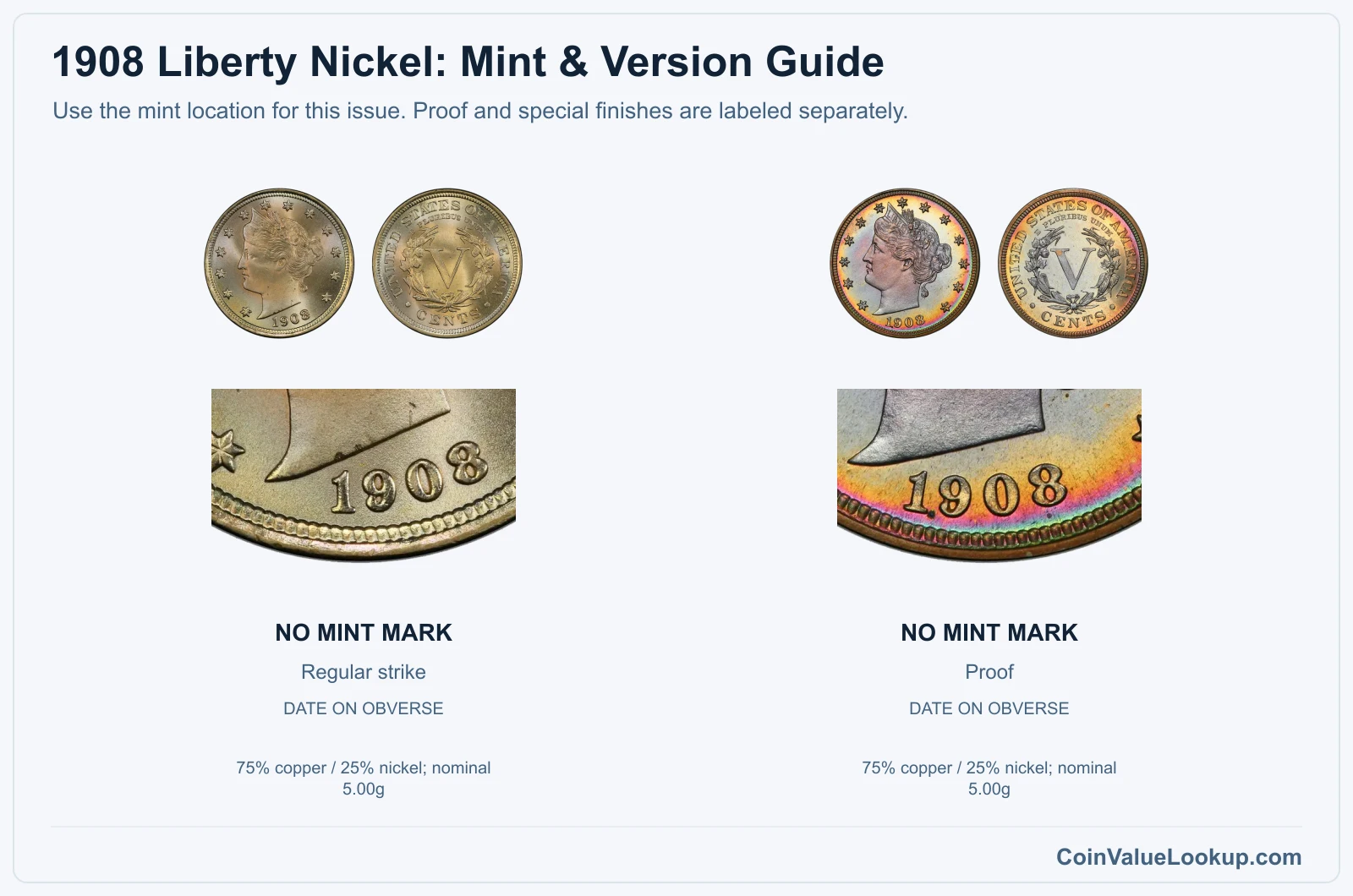
Every 1908 Liberty Nickel was struck at Philadelphia. There is no mintmark to hunt for — no D or S branch exists for this date.
The coin is 75% copper and 25% nickel, weighs about 5 grams, measures 21.2 mm across, and has a plain edge.
All regular 1908 nickels carry the "With CENTS" reverse design. The earlier "No CENTS" variety applies only to some 1883 issues, so if your coin says 1908 and has CENTS on the back, that is completely normal.
You may encounter claims of a dramatic "1908/9 overdate" on this date. Be cautious.
A repunched date — where remnants of an earlier punch position appear near the final numerals — is a documented variety category. But a true overdate requires an attributed match, not just a blurry digit.
Stick with repunched-date terminology unless a recognized attribution service confirms otherwise.
Step 2: Check Your 1908 Liberty Nickel Grade
Start with the word LIBERTY on the coronet above the portrait's forehead. On a well-circulated coin, those letters fade progressively — the first to soften are usually the B, E, and R.
If all seven letters are sharp and fully separated, you are likely looking at a higher-grade piece.
Next, check the high points of the hair curls above the ear and the cheek below the eye. These areas show friction first.
On the reverse, the corn ear at the center of the wreath and the individual leaves lose definition as wear increases.
Weak details alone do not prove the coin circulated. Some 1908 nickels left the press with a soft strike, especially at the hair curls.
Look at the fields — the flat areas around the design — for luster. A coin with full mint luster but slightly mushy hair was likely struck that way, not worn.
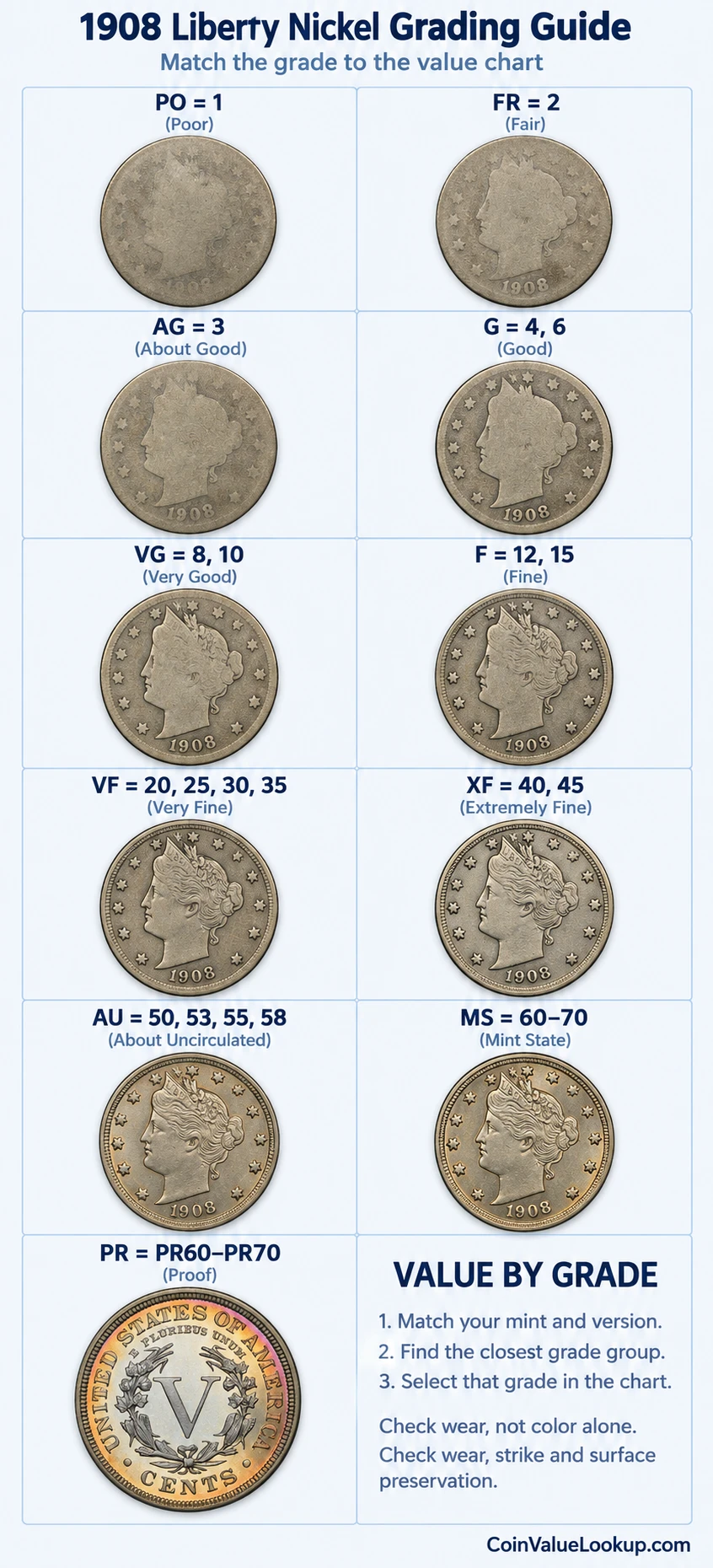
For mint-state coins, contact marks, bag abrasions, and overall eye appeal separate one grade from the next. Use the comparison image to match your coin's wear pattern against known grade benchmarks.
Proof is a manufacturing method, not a grade above Mint State. Proof 1908 nickels have mirror-like fields and sharp rims.
Inspect for hairlines from old cleaning and compare against attributed proof examples before assuming you have one.
Step 3: Check 1908 Liberty Nickel Value by Mint and Version
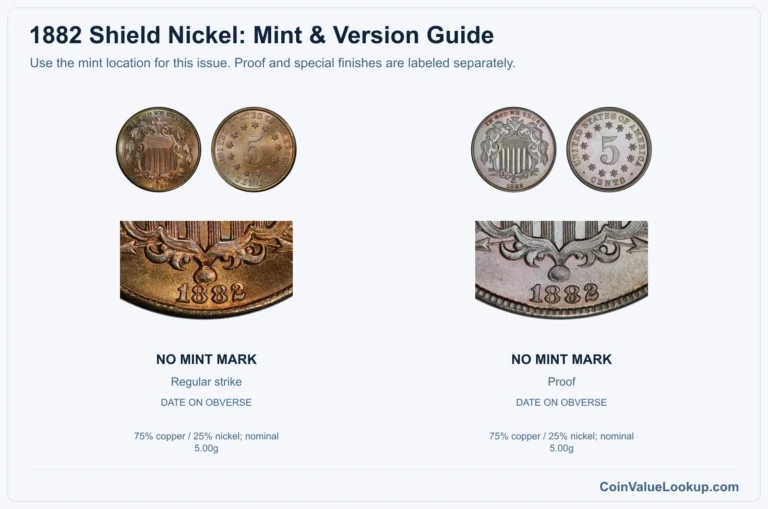
1908 Liberty Nickel — No Mint Mark — With CENTS Circulation
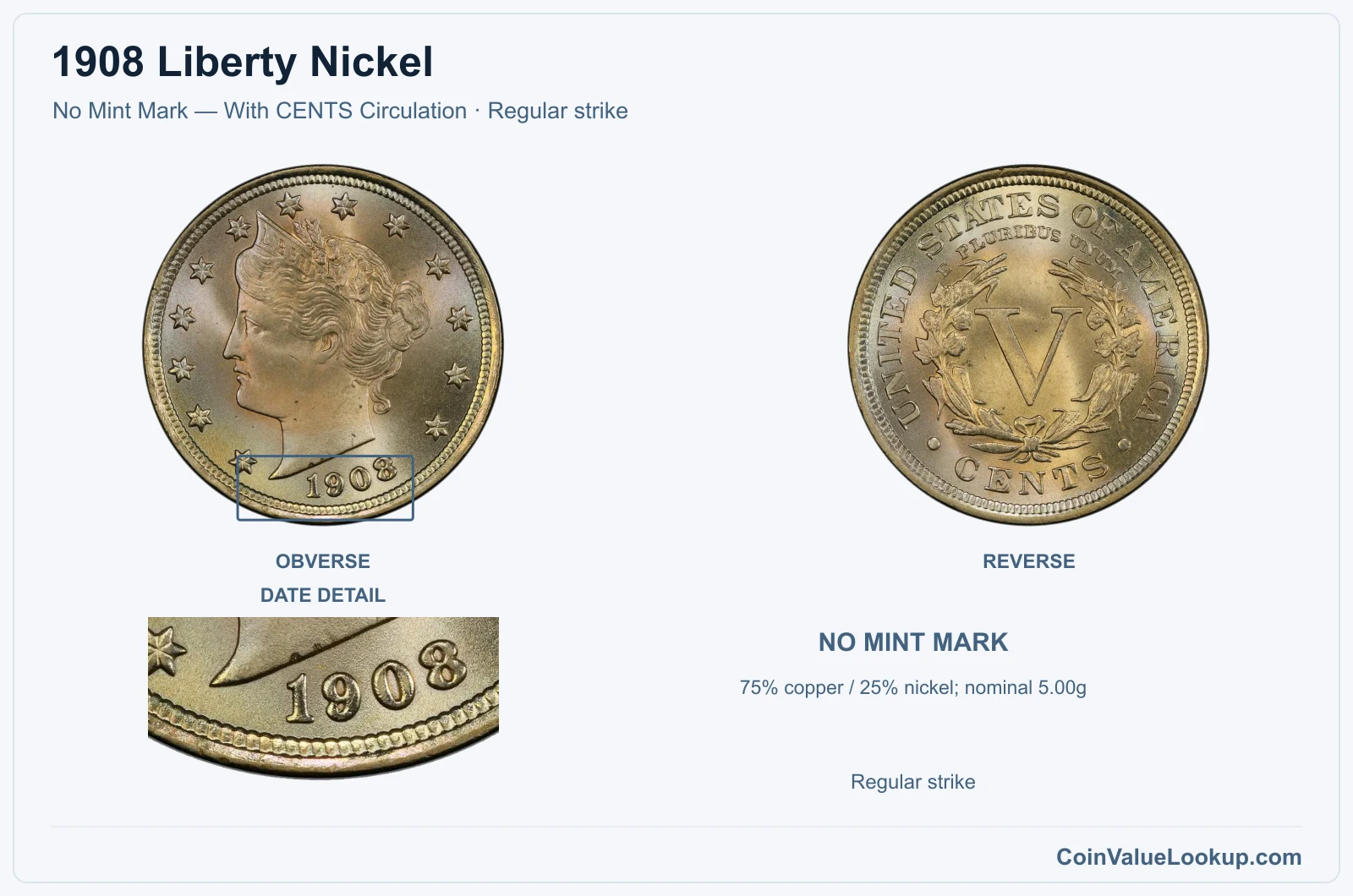
This is the standard 1908 Liberty Nickel struck for circulation at Philadelphia with the "With CENTS" reverse. No mintmark appears anywhere on the coin.
USA Coin Book estimates place it around $2.50 in G4 and roughly $154 in MS63.
Most survivors fall in the lower circulated grades. The jump in value toward uncirculated territory is steep, so a coin with original luster and minimal contact marks is worth careful examination.
At Coin Value Lookup you can look up guides for other Liberty Nickel dates to see how this one compares across the series.
Range Grade
Price Auction Records Appraisal PO PO 1
—
Coin Identifier FR FR 2
—
Coin Identifier AG AG 3
—
Coin Identifier G G 4
—
Coin Identifier
G 6
—
Coin Identifier VG VG 8
—
Coin Identifier
VG 10
—
Coin Identifier F F 12
—
Coin Identifier
F 15
—
Coin Identifier VF VF 20
—
Coin Identifier
VF 25
—
Coin Identifier
VF 30
—
Coin Identifier
VF 35
—
Coin Identifier XF XF 40
Coin Identifier
XF 45
—
Coin Identifier AU AU 50
Coin Identifier
AU 53
—
Coin Identifier
AU 55
—
Coin Identifier
AU 58
Coin Identifier MS MS 60
Coin Identifier
MS 61
Coin Identifier
MS 62
Coin Identifier
MS 63
Coin Identifier
MS 64
Coin Identifier
MS 65
Coin Identifier
MS 66
Coin Identifier
MS 67
Coin Identifier
MS 68
—
—
—
MS 69
—
—
—
MS 70
—
—
—
1908 Liberty Nickel — No Mint Mark — With CENTS Proof
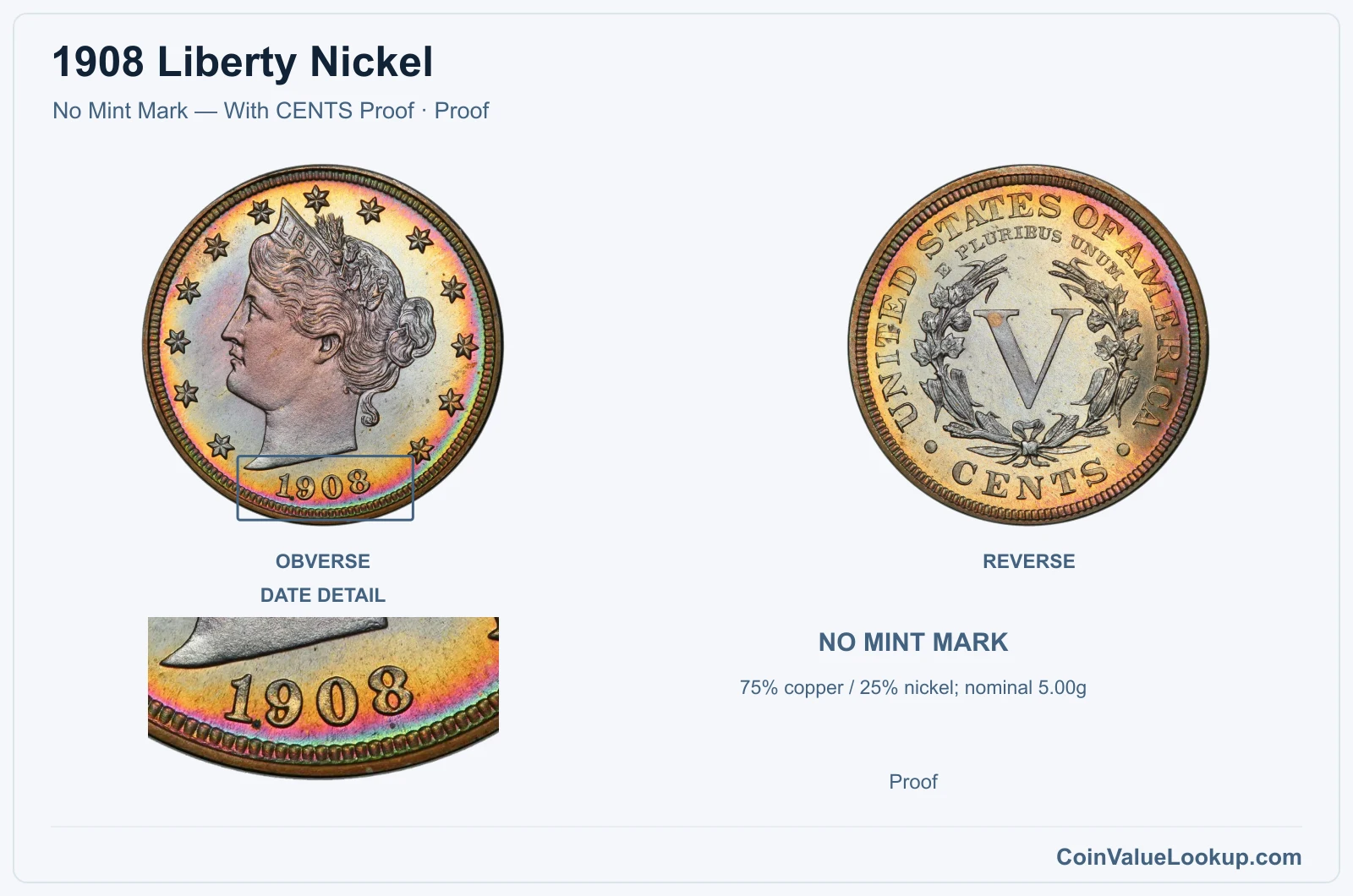
Philadelphia also produced proof 1908 Liberty Nickels for collectors. These were struck with polished dies on prepared planchets, producing mirror-like fields and crisp design edges that differ from even the best business strikes.
A PR63 example carries a guide value of about $344 per USA Coin Book. To confirm a proof, examine the fields under magnification — they should show deep reflectivity, not just a well-preserved business strike shine.
Rims on proofs tend to be sharper and more squared-off. Hairlines from past cleaning are common and will affect the grade.
When submitting photos, capture both faces and try to show the reflective quality of the fields and the rim profile.
Range Grade
Price Auction Records Appraisal PR PR 1
—
Coin Identifier
PR 2
—
Coin Identifier
PR 3
—
Coin Identifier
PR 4
—
Coin Identifier
PR 6
—
Coin Identifier
PR 8
—
Coin Identifier
PR 10
—
Coin Identifier
PR 12
—
Coin Identifier
PR 15
—
Coin Identifier
PR 20
—
Coin Identifier
PR 25
—
Coin Identifier
PR 30
—
Coin Identifier
PR 35
—
Coin Identifier
PR 40
—
Coin Identifier
PR 45
—
Coin Identifier
PR 50
—
Coin Identifier
PR 53
—
Coin Identifier
PR 55
—
Coin Identifier
PR 58
—
Coin Identifier
PR 60
—
Coin Identifier
PR 61
Coin Identifier
PR 62
Coin Identifier
PR 63
Coin Identifier
PR 64
Coin Identifier
PR 65
Coin Identifier
PR 66
Coin Identifier
PR 67
Coin Identifier
PR 68
Coin Identifier
PR 69
—
—
—
PR 70
—
—
—
1908 Liberty Nickel Error List
1. 1908 Liberty Nickel — Repunched Date
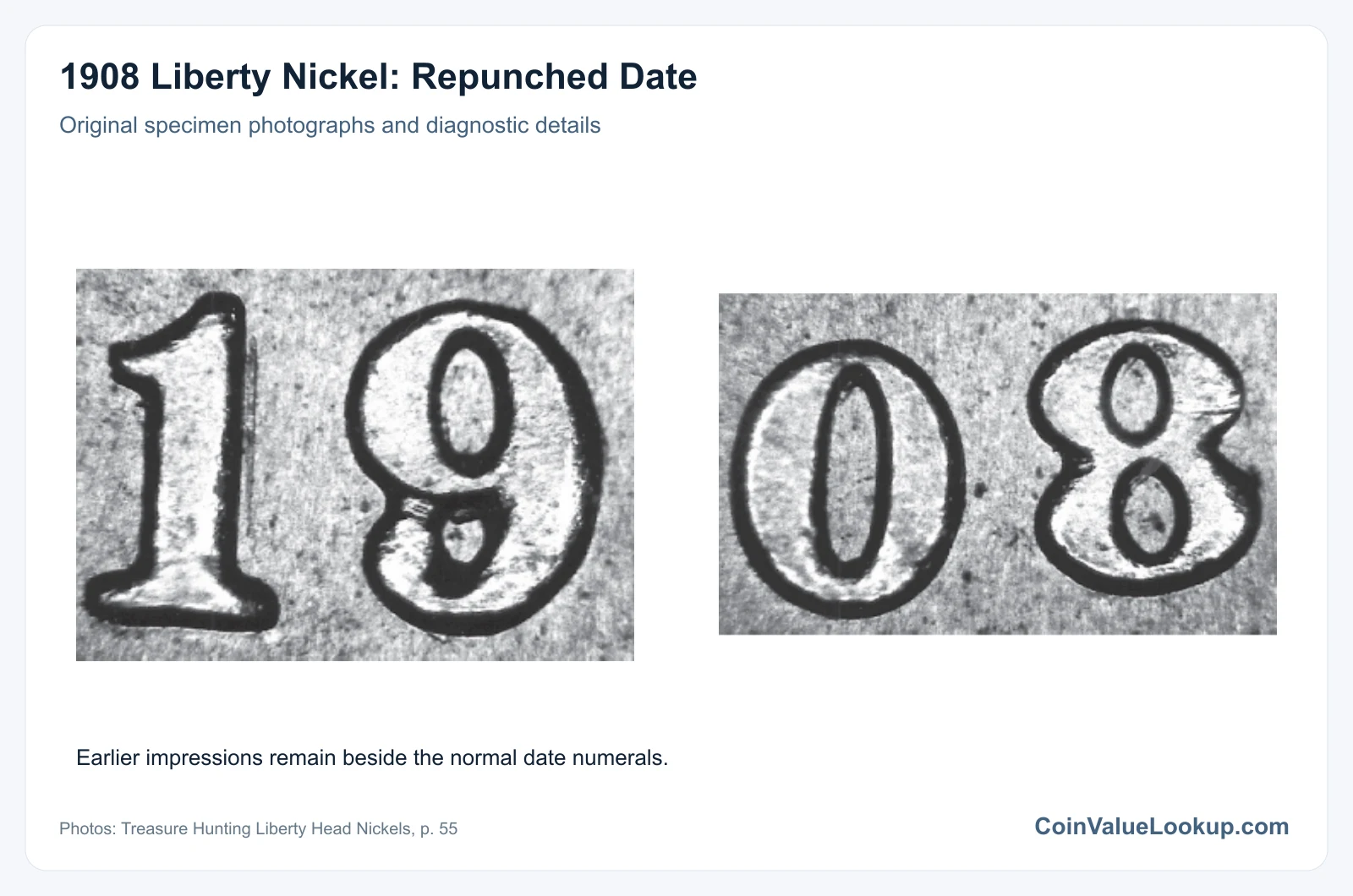
A repunched date on a 1908 Liberty Nickel shows traces of an earlier date-punch position alongside the final numerals. You might see a ghostly shadow of a digit slightly offset from where the number sits now.
This is different from doubled-die varieties, which affect the entire design — a repunched date is strictly about the date digits being punched more than once into the working die.
Under magnification, look for extra serifs, partial outlines, or notches near the 1, 9, 0, or 8. The lookalike to watch out for is machine doubling, which produces flat, shelf-like distortion rather than the rounded secondary image of a genuine repunch.
Post-mint damage to the date area can also mimic this. Value depends on the visibility of the repunching, the specific variety, and overall coin condition.
2. 1908 Liberty Nickel — Misplaced Date
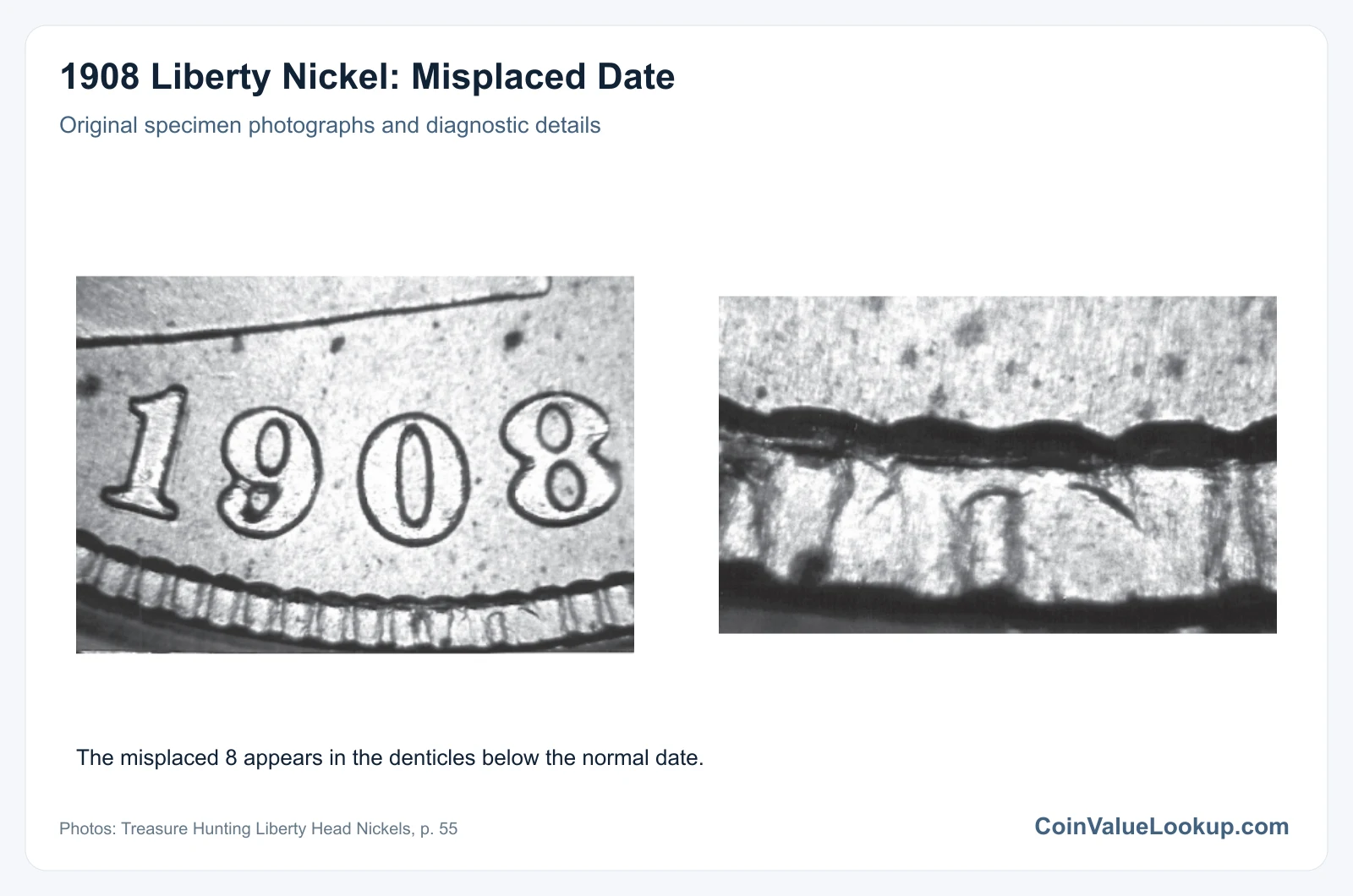
A misplaced date occurs when one or more date numerals are accidentally punched into an area of the die outside the intended date position. On a 1908 Liberty Nickel, look for faint remnants of a numeral appearing among the denticles (the small tooth-like projections along the rim) or in the field near the regular date.
These traces are typically subtle and require magnification. They differ from a repunched date because the stray digits appear well away from the normal date location, not merely offset within it.
Random die chips or damaged denticles can look similar at first glance, so compare carefully. The value of a misplaced-date variety depends on how clearly the displaced numeral is visible and the coin's overall condition.
3. 1908 Liberty Nickel — Lamination / Split Planchet
Lamination errors on a 1908 Liberty Nickel appear as peeling metal, a retained flap, or a visible separation within the copper-nickel alloy. The flaw originates during planchet preparation when impurities or gas pockets create weak spots in the metal that later crack or peel.
When photographing a suspected lamination, capture the edge of the coin along with the affected face — edge views often reveal the split more clearly. Lookalikes include surface scraping from post-mint contact, corrosion eating into the surface, and deliberately cut or altered coins.
Genuine lamination flaws follow the metal's natural structure and tend to have smooth, curved edges rather than sharp gouges. Value depends on the size, location, and condition of the error as well as the coin's overall grade.
4. 1908 Liberty Nickel — Off-Center Strike
An off-center strike happens when the planchet is not seated properly between the dies, shifting the entire design to one side and leaving a blank crescent on the opposite edge. A 1908 Liberty Nickel struck roughly 15% off center has been cataloged.
The key to value here is whether the date remains fully visible — off-center errors with a readable date are far more collectible than those where the date has been clipped away by the misalignment. Watch for lookalikes: a clipped edge affects only a portion of the rim without shifting the design, and post-mint flattening can distort a coin's shape without the telltale unstruck crescent.
Condition, percentage of off-center shift, and date visibility all factor into what a given example is worth.
5. 1908 Liberty Nickel — Clipped Planchet
A clipped planchet error means a portion of the original metal blank was missing before the coin was struck. On a 1908 Liberty Nickel, this can appear as a curved, straight, or ragged missing section along the edge.
At least one straight-end clip example in MS64, graded by PCGS, has appeared at auction.
Look for the Blakesley effect — a zone of weakness on the rim directly opposite the clip caused by reduced metal flow during striking. This diagnostic helps distinguish a genuine clip from a post-mint filed notch or edge cut, which will not produce that opposite-side weakness.
Corrosion eating away an edge can also mimic a clip but leaves rough, pitted surfaces rather than the smooth contour of a pre-strike blank defect. Value varies with clip size, type, and the coin's overall condition.