1837 Capped Bust Quarter Coin Value: How Much Is It Worth?
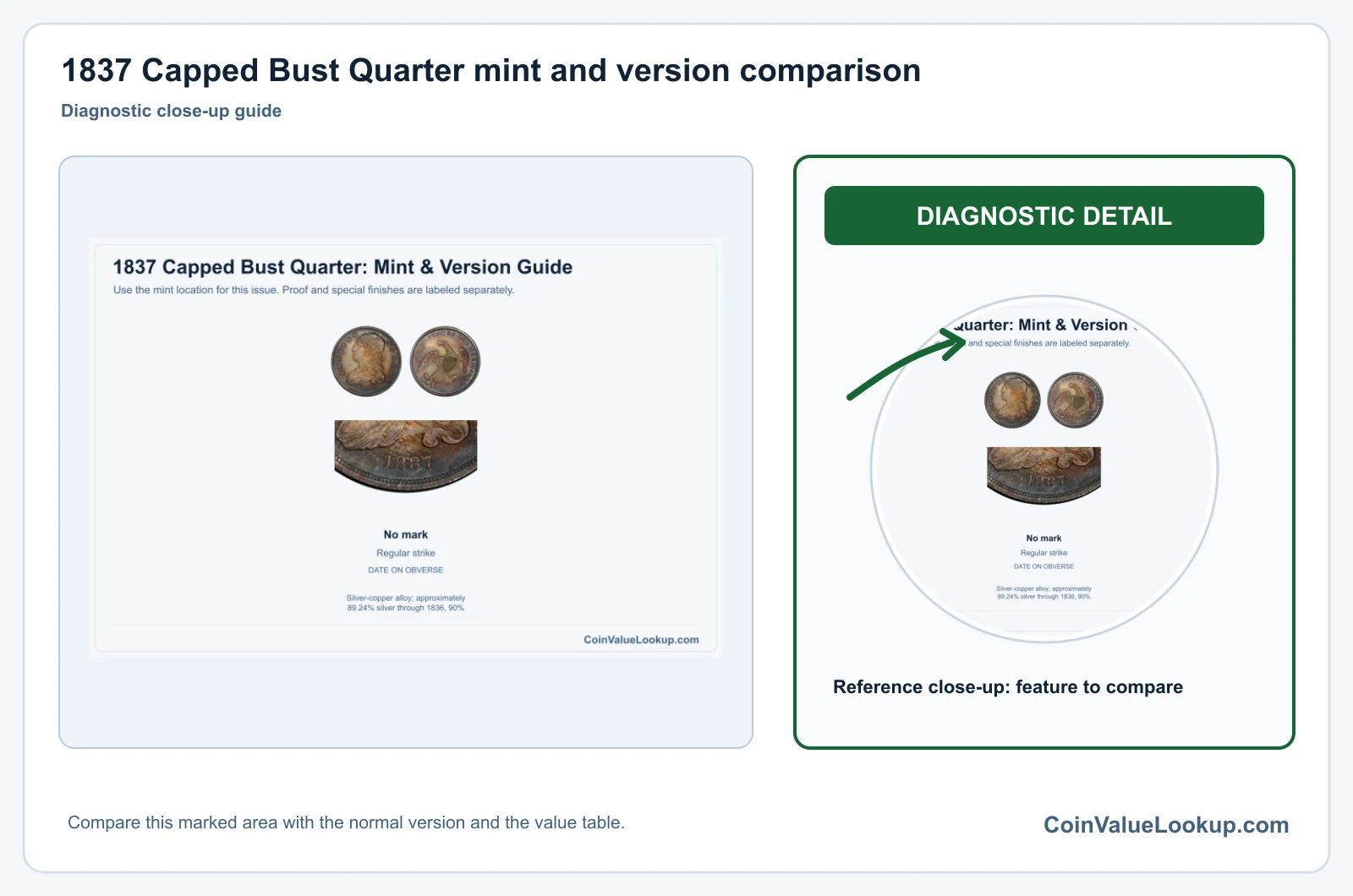
The 1837 Capped Bust Quarter is a late-series Philadelphia issue struck in 90% silver. USA Coin Book guide estimates place the business-strike version between $132.00 in Good-4 and $4,951.00 in MS63, depending on condition.
A proof version also exists but requires individual assessment. Mint, condition, and whether your coin is a business strike or proof all determine where it falls in those ranges.
Fast Way to Identify Your 1837 Capped Bust Quarter
Want a quick starting point? Upload clear photos of your coin's front and back, and our identifier can offer a preliminary read on which version you may have.
It won't authenticate or certify the coin, but it helps you figure out the right branch to research before you go further.
1837 Capped Bust Quarter Value
Upload both sides of your 1837 Capped Bust Quarter.
Front Obverse
Upload photo
Back Reverse
Upload photo
Which 1837 Capped Bust Quarter Versions Are Worth Money?
- The 1837 business strike reaches a USA Coin Book guide estimate of $4,951.00 at MS63 — condition is everything on this date.
- The 1837 proof is extremely scarce and requires professional authentication; no standard guide price is adopted, so individual assessment applies.
Step 1: Identify Your 1837 Capped Bust Quarter Mint Mark and Version
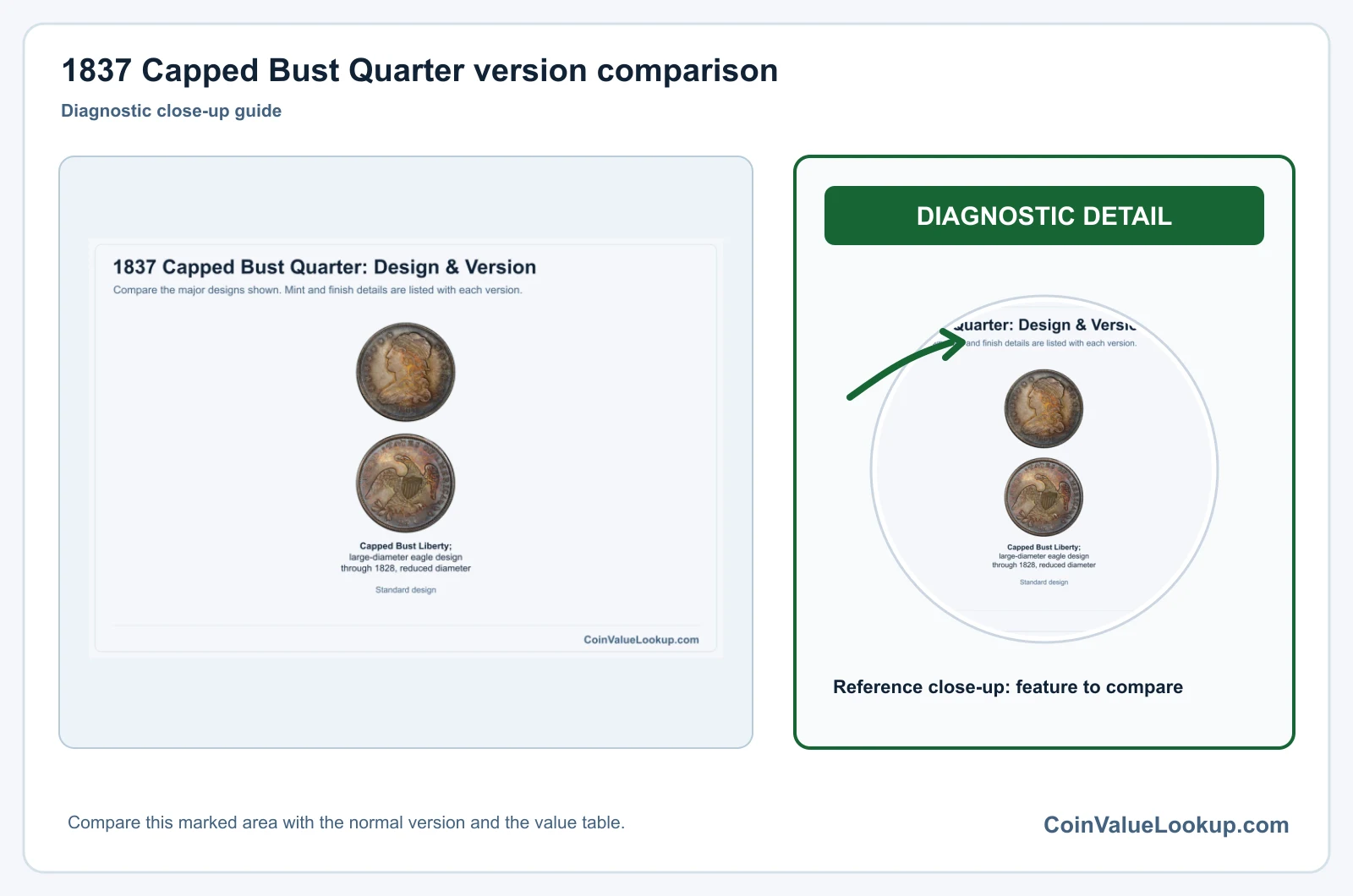
Every 1837 Capped Bust Quarter was struck at Philadelphia, so there is no mintmark to look for. The reduced-diameter design, used from 1831 onward, omits E PLURIBUS UNUM from the reverse.
Liberty wears a mobcap with a ribbon, and the reverse eagle is smaller than the wide-format type used through 1828.
The two branches for this date are the regular business strike and the proof. A proof 1837 is extremely scarce and independently listed by PCGS — it is a specific manufacturing finish, not simply a high-grade or polished coin.
If your coin has deeply mirrored fields and squared-off rims with unusually sharp detail, professional authentication is the only reliable path to confirming proof status.
The silver composition shifted to 90% silver / 10% copper starting in 1837, so this date sits right at the changeover. Earlier Capped Bust quarters used approximately 89.24% silver.
You cannot tell the difference by eye, but it matters for cataloging.
Step 2: Check Your 1837 Capped Bust Quarter Grade
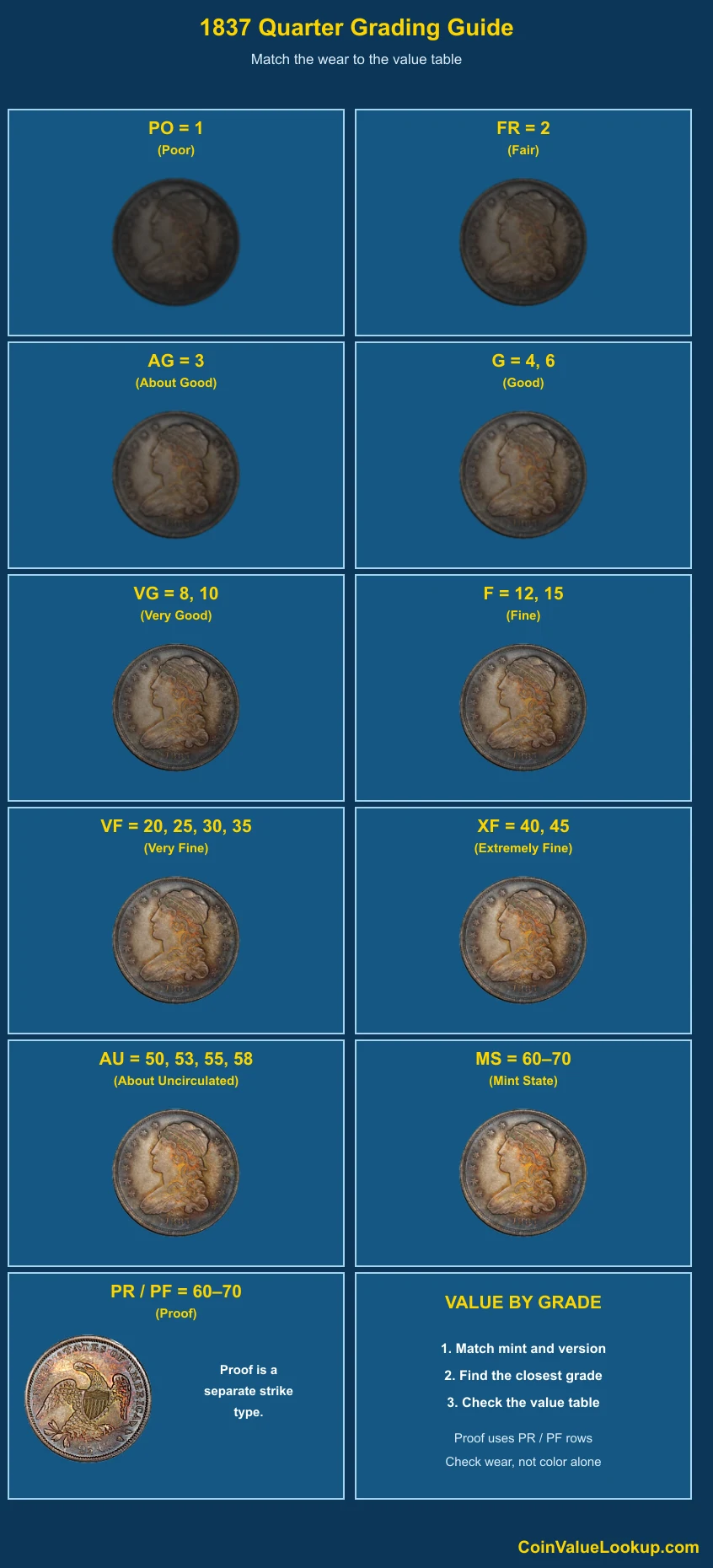
Start with Liberty's hair above her ear. On a lightly worn coin those curls begin to merge first; on a well-worn example, the cap folds flatten and the cheek loses definition.
Flip it over — the eagle's breast feathers and wing tips are the reverse wear checkpoints.
Compare your coin to the reference image of a known grade in this same type. A coin can look flat in one area yet be fully unworn if the die was weakly impressed during striking.
Weak strikes reduce detail without removing luster, while genuine wear dulls the surface and softens the highest points together.
Luster matters. An original coin in About Uncirculated still shows some cartwheel reflectivity in the fields.
A cleaned coin may look bright but feel slick, with tiny hairlines visible under magnification. Cleaning and damage lower value regardless of remaining detail.
Step 3: Check 1837 Capped Bust Quarter Value by Mint and Version
1837 Capped Bust Quarter
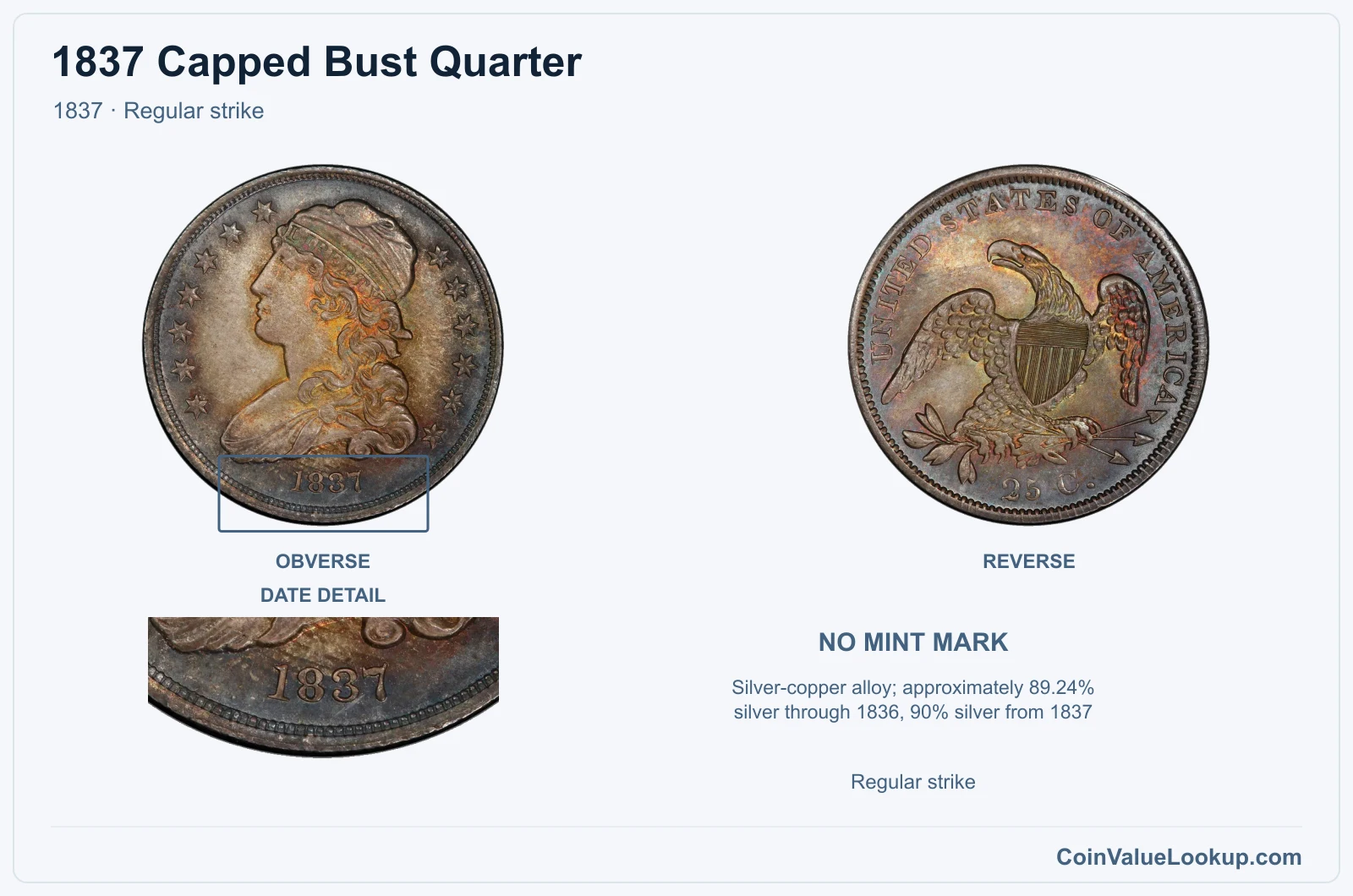
The regular 1837 quarter is a Philadelphia business strike in the reduced-diameter Capped Bust design, composed of 90% silver and 10% copper. USA Coin Book guide estimates place it at $132.00 in Good-4, $2,506.00 in MS60, and $4,951.00 in MS63.
These are retail guide estimates, not guaranteed offers.
Original surfaces matter more than you might expect. A coin grading VF with honest wear and natural toning can be more desirable than an AU that has been cleaned or harshly dipped.
Match your coin's mint, design details, and strike type before comparing it against any price table.
Range Grade
Price Auction Records Appraisal PO PO 1
—
Coin Identifier FR FR 2
Coin Identifier AG AG 3
—
Coin Identifier G G 4
—
Coin Identifier
G 6
Coin Identifier VG VG 8
Coin Identifier
VG 10
Coin Identifier F F 12
Coin Identifier
F 15
Coin Identifier VF VF 20
Coin Identifier
VF 25
Coin Identifier
VF 30
Coin Identifier
VF 35
Coin Identifier XF XF 40
Coin Identifier
XF 45
Coin Identifier AU AU 50
Coin Identifier
AU 53
Coin Identifier
AU 55
Coin Identifier
AU 58
Coin Identifier MS MS 60
—
Coin Identifier
MS 61
Coin Identifier
MS 62
Coin Identifier
MS 63
Coin Identifier
MS 64
Coin Identifier
MS 65
Coin Identifier
MS 66
Coin Identifier
MS 67
Coin Identifier
MS 68
—
—
—
MS 69
—
—
—
MS 70
—
—
—
1837 Capped Bust Quarter — proof
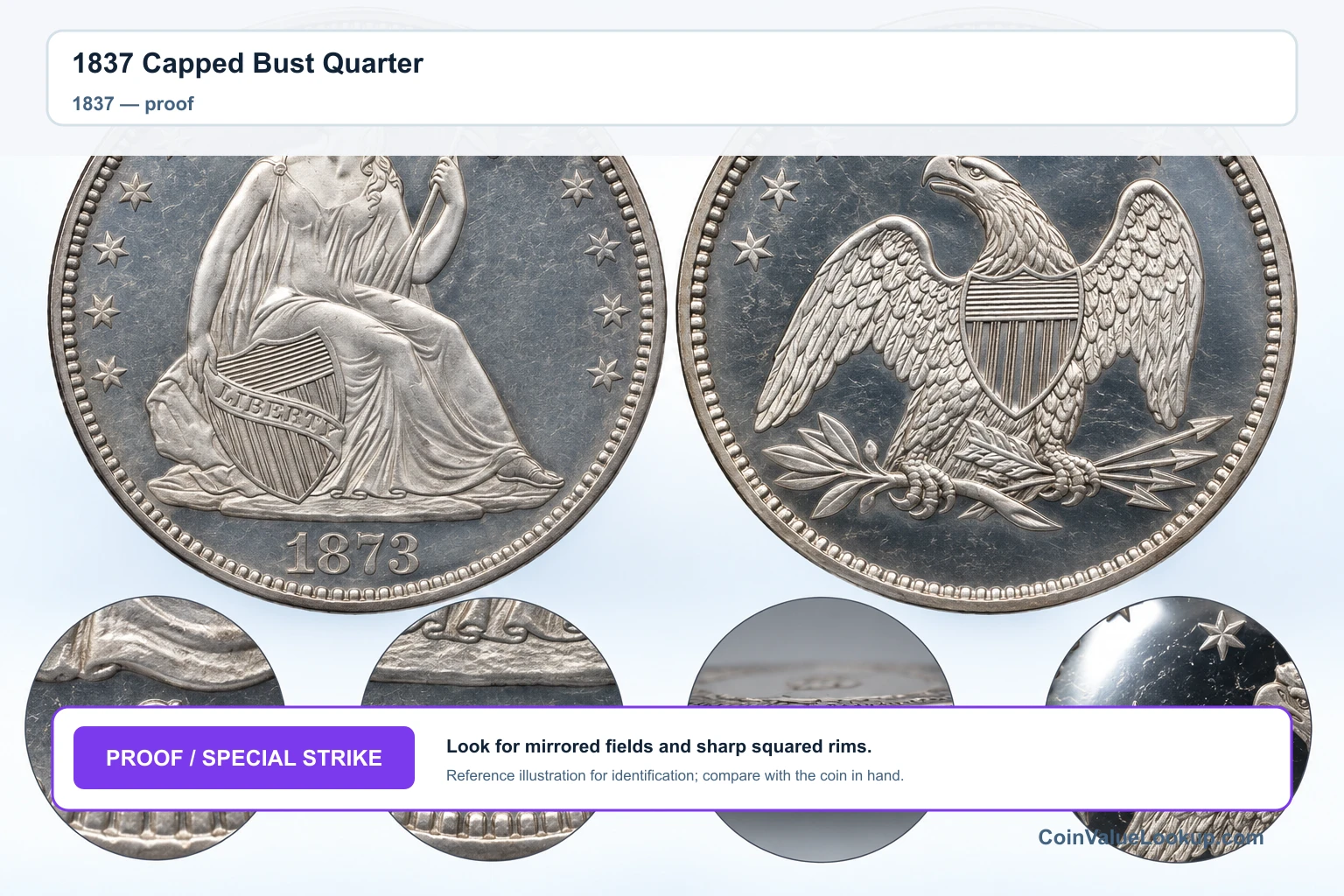
The 1837 proof Capped Bust Quarter is an extremely scarce Philadelphia issue independently listed by PCGS. It is a deliberate proof finish — mirrored fields, sharp rims, full detail from carefully prepared dies — not a polished or lightly circulated business strike that happens to look pretty.
No numerical guide price is adopted for this version. If you believe you have one, professional authentication is essential because the premium over a business strike is enormous, and misidentified proofs are common.
Condition, originality of surfaces, and provenance all factor into what any individual example might bring.
Coin Value Lookup is a good place to start researching other Capped Bust Quarter dates and denominations. You can look up guides for different years to compare where your coins stand.
1837 Capped Bust Quarter Proof Value by Grade
Reliable grade-by-grade prices are not currently available. The confirmed Proof catalogue entry has no usable grade-by-grade values in the current price feed. The regular-strike table does not price an authenticated Proof.
1837 Capped Bust Quarter Error List
1. 1837 Capped Bust Quarter — Die Crack / Die Chip
Die cracks on the 1837 Capped Bust Quarter appear as thin, raised lines running across the coin's surface, caused by fractures in the steel die during production. A die chip shows up as a small raised blob — essentially a tiny piece of metal that broke away from the die face, leaving a filled area that transferred onto the struck coin.
To tell these apart from damage, remember that die cracks and chips are raised above the field, while scratches and corrosion are incuse or pitted into the surface. Foreign material sitting on a coin can also mimic a chip, so check under magnification and see if the feature wipes away.
A rim-connected crack that removes a section of design is sometimes called a cud, which is a different category from an interior crack. No specific price range is adopted for this error on the 1837 quarter; value depends on the crack's size, location, and the coin's overall condition.