1886 Liberty Seated Quarter Coin Value: How Much Is It Worth?
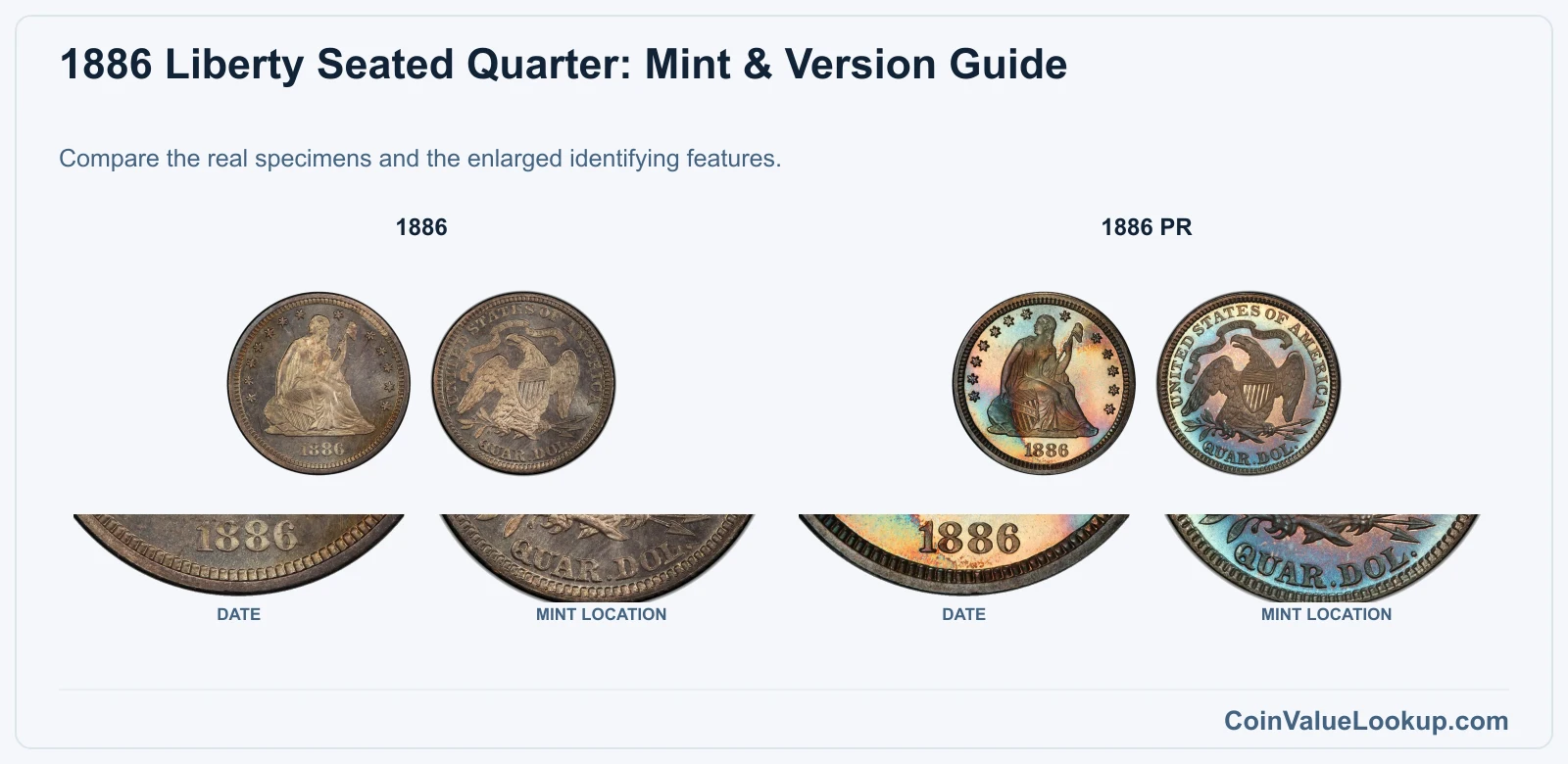
The 1886 Liberty Seated Quarter is a late-date issue in a series that ended just five years later. Struck at Philadelphia in 90% silver, it exists as both a regular business strike and a proof.
USA Coin Book guide estimates place these coins between roughly $446 and $2,042 depending on version and grade. Mint, condition, and whether the coin is a proof all determine where in that range a particular piece falls.
Fast Way to Identify Your 1886 Liberty Seated Quarter
Snap a clear photo of the front and back of your coin and upload both images to our identifier. It will give you a preliminary identification of the version, mint, and general type so you know which guide values to compare.
This is not a certified grade or authentication, just a solid starting point before you dig deeper.
1886 Liberty Seated Quarter Value
Upload both sides of your 1886 Liberty Seated Quarter.
Front Obverse
Upload photo
Back Reverse
Upload photo
Which 1886 Liberty Seated Quarter Versions Are Worth Money?
- The 1886 business strike can reach around $2,042 at MS63 according to USA Coin Book, making higher-grade survivors worth careful inspection.
- The 1886 proof carries a guide estimate of $938 at PR63, reflecting its limited collector-issue mintage and mirrored finish.
- Check mint and finish first; damage, wear, and a bright cleaned surface do not establish a rare version.
Step 1: Identify Your 1886 Liberty Seated Quarter Mint Mark and Version
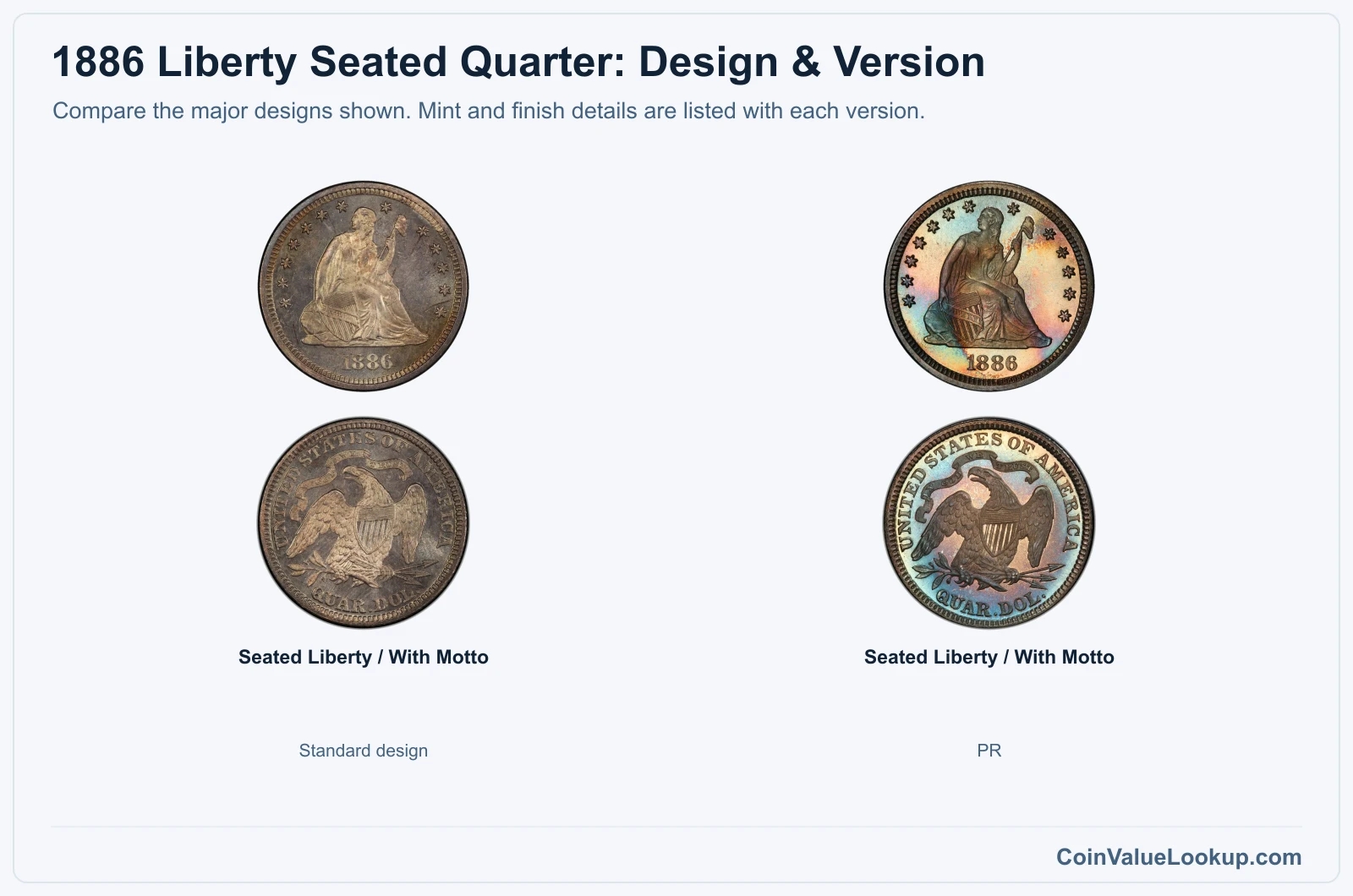
Every 1886 quarter was struck at the Philadelphia Mint, which used no mintmark. If you see a small letter below the eagle on the reverse, you have a different date or your coin needs a closer look.
The design shows a seated Liberty figure on the obverse and an eagle with a ribbon reading "In God We Trust" on the reverse, the With Motto type used from 1866 onward.
The metal is 90% silver and 10% copper at a standard weight of 6.25 grams. Two versions exist for 1886: the regular business strike and the proof.
Proofs were made in small numbers for collectors using specially prepared dies and planchets, producing mirrored fields that look nothing like a coin that simply stayed in a drawer.
Do not assume a shiny or lightly circulated coin is a proof. Cleaning can give a business strike a reflective look, but it also leaves fine hairlines visible under magnification.
If both fields are deeply mirrored and the devices show sharp, squared-off edges, a proof identification is worth pursuing through professional grading.
Step 2: Check Your 1886 Liberty Seated Quarter Grade
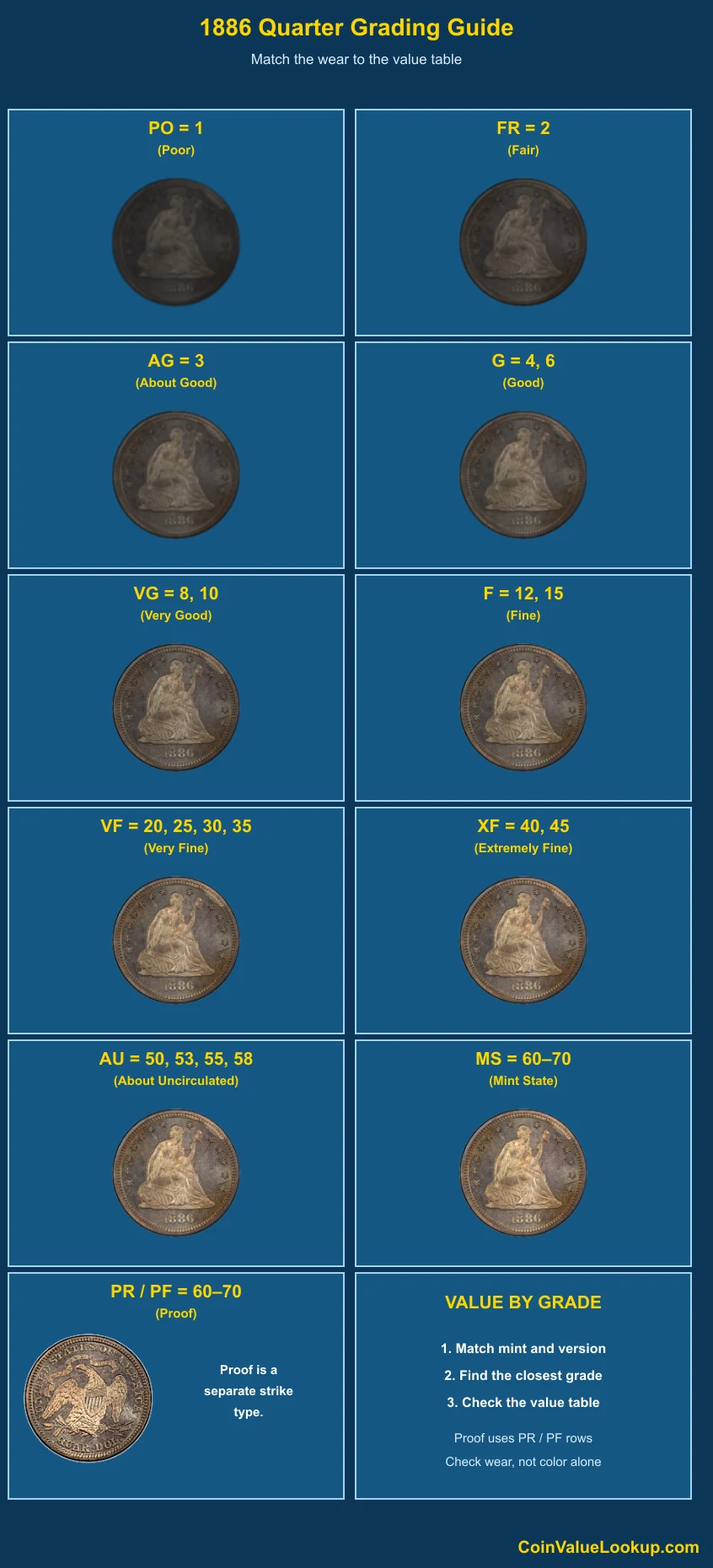
Start with Liberty herself. On a well-worn coin, her head, breast, knee, and the horizontal shield lines will be the first details to fade.
A coin grading around Good-4 will show a clear outline of Liberty but most interior detail is gone. As you move up the scale, those features progressively sharpen.
On the reverse, check the eagle's breast feathers and the tops of the wings. These high points wear quickly in circulation.
A Mint State coin retains full detail in all those areas plus original luster across the fields.
One trap with this series: the Philadelphia Mint sometimes delivered coins with weak central strikes. A coin can be technically uncirculated yet show soft detail on Liberty's head or the eagle's breast simply because the dies did not fully impress the design.
Compare your coin to the reference image and look for unbroken cartwheel luster in the fields. If luster is intact but detail is soft, that is likely a strike issue rather than wear.
Hairlines from cleaning and surface haze both reduce collector value even if the coin never circulated. Original toning, whether gray or rainbow, is generally preferred over a bright, scrubbed surface.
Step 3: Check 1886 Liberty Seated Quarter Value by Mint and Version
1886 Liberty Seated Quarter
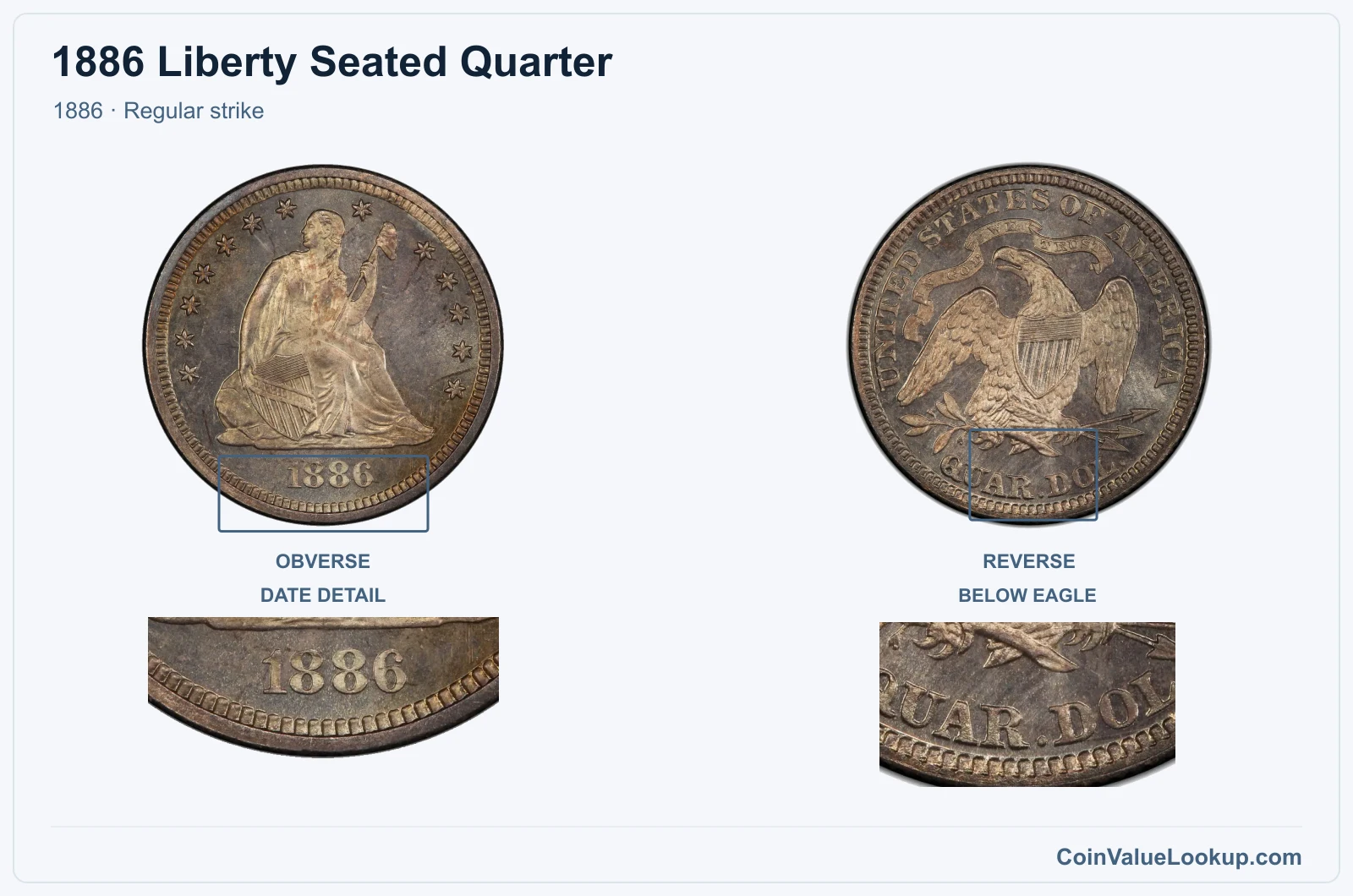
The 1886 business-strike quarter was produced at Philadelphia with no mintmark. It is struck in 90% silver and 10% copper at the standard 6.25-gram weight.
USA Coin Book estimates place a worn example at about $446 in G4 condition, rising to $1,531 at MS60 and $2,042 at MS63. Those jumps reflect how scarce original, uncirculated survivors are after nearly 140 years.
Look for the With Motto reverse, where the ribbon above the eagle reads "In God We Trust." Original surfaces matter here. A coin with honest gray toning and no signs of cleaning will always compare more favorably than one that has been polished, even if both show similar detail.
Coin Value Lookup is a useful place to look up guide values for Liberty Seated quarters and other series if you want to compare across dates and mints.
Range Grade
Price Auction Records Appraisal PO PO 1
—
Coin Identifier FR FR 2
—
Coin Identifier AG AG 3
—
Coin Identifier G G 4
—
Coin Identifier
G 6
—
Coin Identifier VG VG 8
Coin Identifier
VG 10
—
Coin Identifier F F 12
—
Coin Identifier
F 15
Coin Identifier VF VF 20
—
Coin Identifier
VF 25
Coin Identifier
VF 30
Coin Identifier
VF 35
Coin Identifier XF XF 40
Coin Identifier
XF 45
Coin Identifier AU AU 50
Coin Identifier
AU 53
—
Coin Identifier
AU 55
—
Coin Identifier
AU 58
Coin Identifier MS MS 60
—
Coin Identifier
MS 61
Coin Identifier
MS 62
Coin Identifier
MS 63
Coin Identifier
MS 64
Coin Identifier
MS 65
Coin Identifier
MS 66
Coin Identifier
MS 67
Coin Identifier
MS 68
—
—
—
MS 69
—
—
—
MS 70
—
—
—
1886 Liberty Seated Quarter — PR
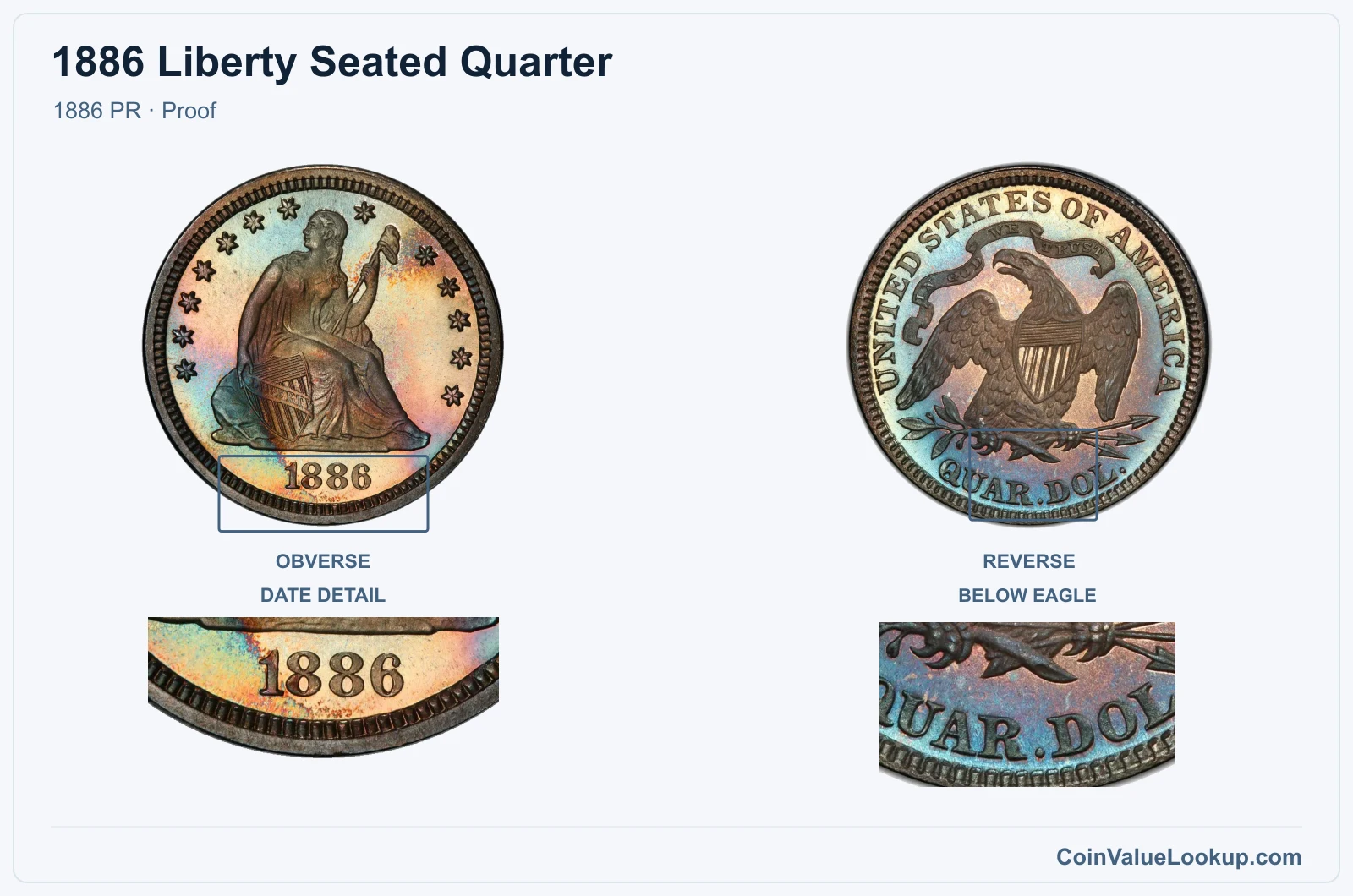
The 1886 proof quarter was struck at Philadelphia specifically for collectors, using polished dies and carefully prepared planchets. There is no mintmark.
The result is a coin with deeply mirrored fields and sharp, well-defined devices that look distinctly different from even a pristine business strike.
USA Coin Book estimates a PR63 example at $938. Proof grade depends heavily on surface preservation.
Hairlines from improper handling or cleaning, haze from decades of storage, and any spots or residue all pull the grade down. A proof that has been wiped will often show a network of fine lines under a loupe that are invisible to the naked eye.
Do not confuse a proof with a business strike that happens to be shiny. Proofs have squared-off rims and a specific mirror-like quality in the flat fields that regular strikes simply do not achieve.
Range Grade
Price Auction Records Appraisal PR PR 1
—
Coin Identifier
PR 2
—
Coin Identifier
PR 3
—
Coin Identifier
PR 4
—
Coin Identifier
PR 6
—
Coin Identifier
PR 8
—
Coin Identifier
PR 10
—
Coin Identifier
PR 12
—
Coin Identifier
PR 15
—
Coin Identifier
PR 20
—
Coin Identifier
PR 25
—
Coin Identifier
PR 50
—
Coin Identifier
PR 53
Coin Identifier
PR 55
—
Coin Identifier
PR 58
Coin Identifier
PR 60
Coin Identifier
PR 61
Coin Identifier
PR 62
Coin Identifier
PR 63
Coin Identifier
PR 64
Coin Identifier
PR 65
Coin Identifier
PR 66
Coin Identifier
PR 67
Coin Identifier
PR 68
Coin Identifier
PR 69
—
—
—
PR 70
—
—
—