1946 Jefferson Nickel Coin Value: How Much Is It Worth?
A 1946 Jefferson nickel in typical circulated condition carries a guide estimate of roughly $0.30 to $0.49 at VF20, depending on the mint. Push into uncirculated territory and the numbers climb: around $14 to $19 at MS65 for ordinary business strikes.
Prices vary by mint, condition, and whether a coin qualifies for the Full Steps designation. Authenticated error coins are a different story entirely.
Fast Way to Identify Your 1946 Jefferson Nickel
The quickest way to start figuring out what you have is to upload clear photos of both the front and back of your coin. Our identifier can give you a preliminary read on the year, mint, and general type.
It is not a substitute for professional authentication or grading, but it narrows things down fast.
1946 Jefferson Nickel Value
Upload both sides of your 1946 Jefferson Nickel.
Front Obverse
Upload photo
Back Reverse
Upload photo
Which 1946 Jefferson Nickel Versions Are Worth Money?
- Uncirculated examples with undisturbed luster and strong, fully separated Monticello steps can command premiums, but a Full Steps claim should be certified before assuming premium values apply.
- A 1946 nickel struck on a leftover wartime silver planchet is a rare transitional error; one authenticated Fine-12 example sold at Heritage in November 2022 for $9,600.
Step 1: Identify Your 1946 Jefferson Nickel Mint Mark and Version
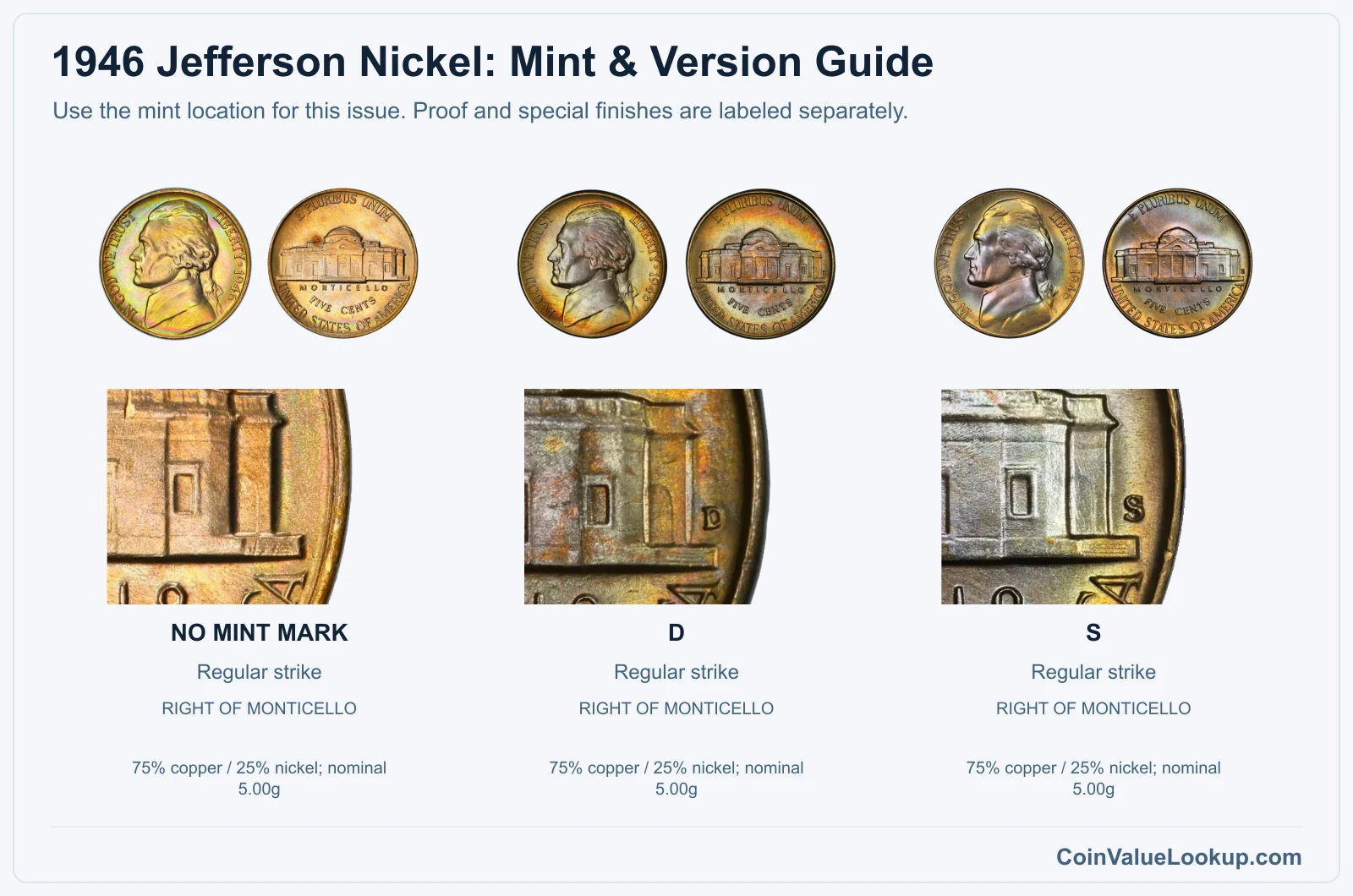
All three 1946 mints struck Jefferson nickels in the standard copper-nickel alloy: 75% copper and 25% nickel, weighing a nominal 5.00 grams with a 21.2 mm diameter. Philadelphia coins carry no mintmark.
Denver and San Francisco coins show a small D or S to the right of Monticello on the reverse.
Do not confuse these small postwar mintmarks with the large mintmarks used during the wartime silver series, which sit above the dome of Monticello. If you see a large mintmark above the dome on a 1946-dated coin, that is a red flag worth investigating further, not normal production.
Color alone cannot tell you the composition. A dark or unusual-looking nickel might just be environmentally toned, not a rare transitional piece.
Separate honest wear from corrosion, polishing, or evidence of mounting damage before drawing conclusions about value.
Step 2: Check Your 1946 Jefferson Nickel Grade
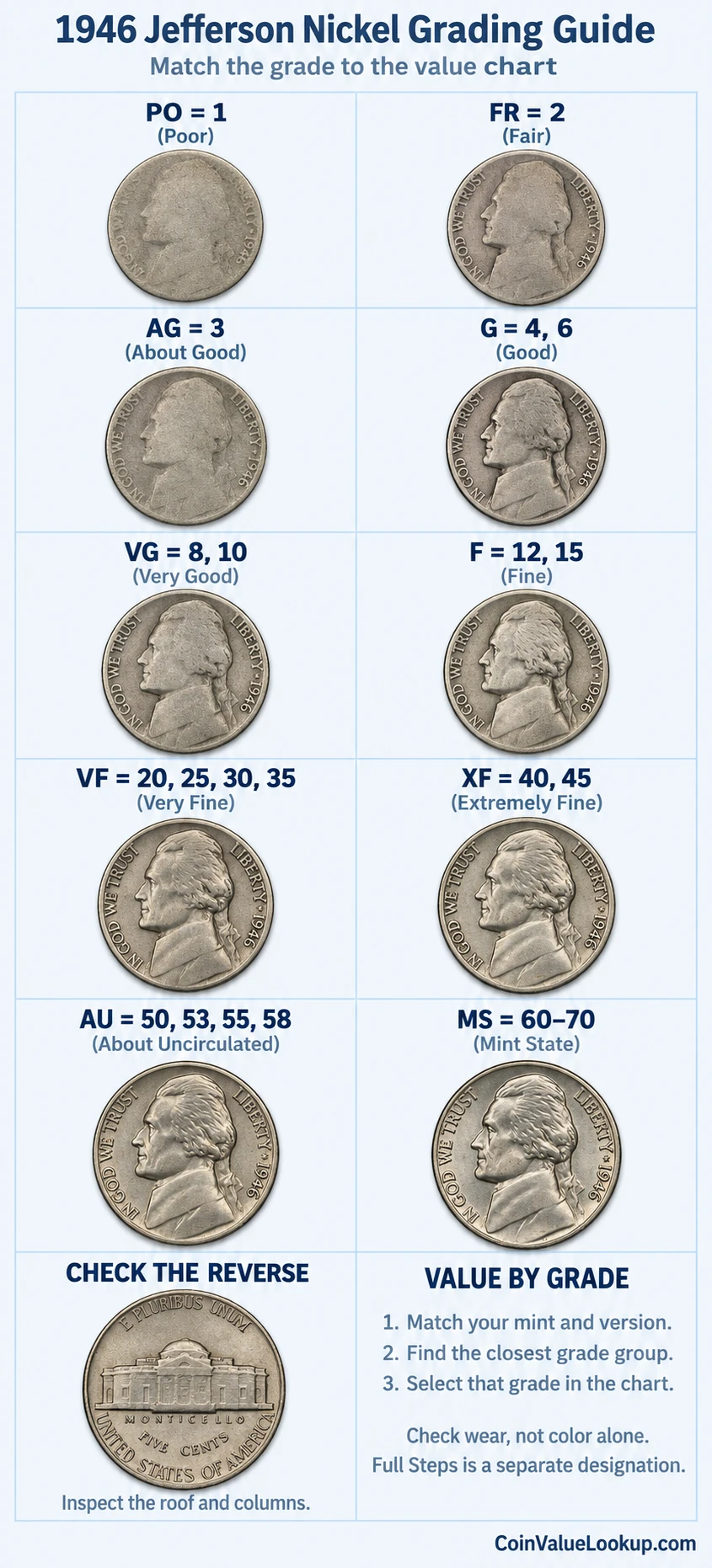
Start on the obverse. Jefferson's cheekbone and the hair detail above his ear are the first areas to lose sharpness from circulation.
On well-worn coins those areas blend together into a flat surface. Move to the reverse and check the roof and columns of Monticello for the same kind of softness.
Luster matters a lot. A coin that still has full, undisturbed mint luster across both sides is in a different league from one where the high points have gone dull.
Compare your coin side by side with the reference image to calibrate your eye.
Full Steps is a separate consideration that applies only to Mint State coins. At least five clearly separated steps on Monticello must be visible, and weak strike can mimic wear.
A coin with mushy steps is not necessarily circulated; it may simply have received a softer strike. Do not use steps alone as a grading shortcut.
Step 3: Check 1946 Jefferson Nickel Value by Mint and Version
1946 Jefferson Nickel
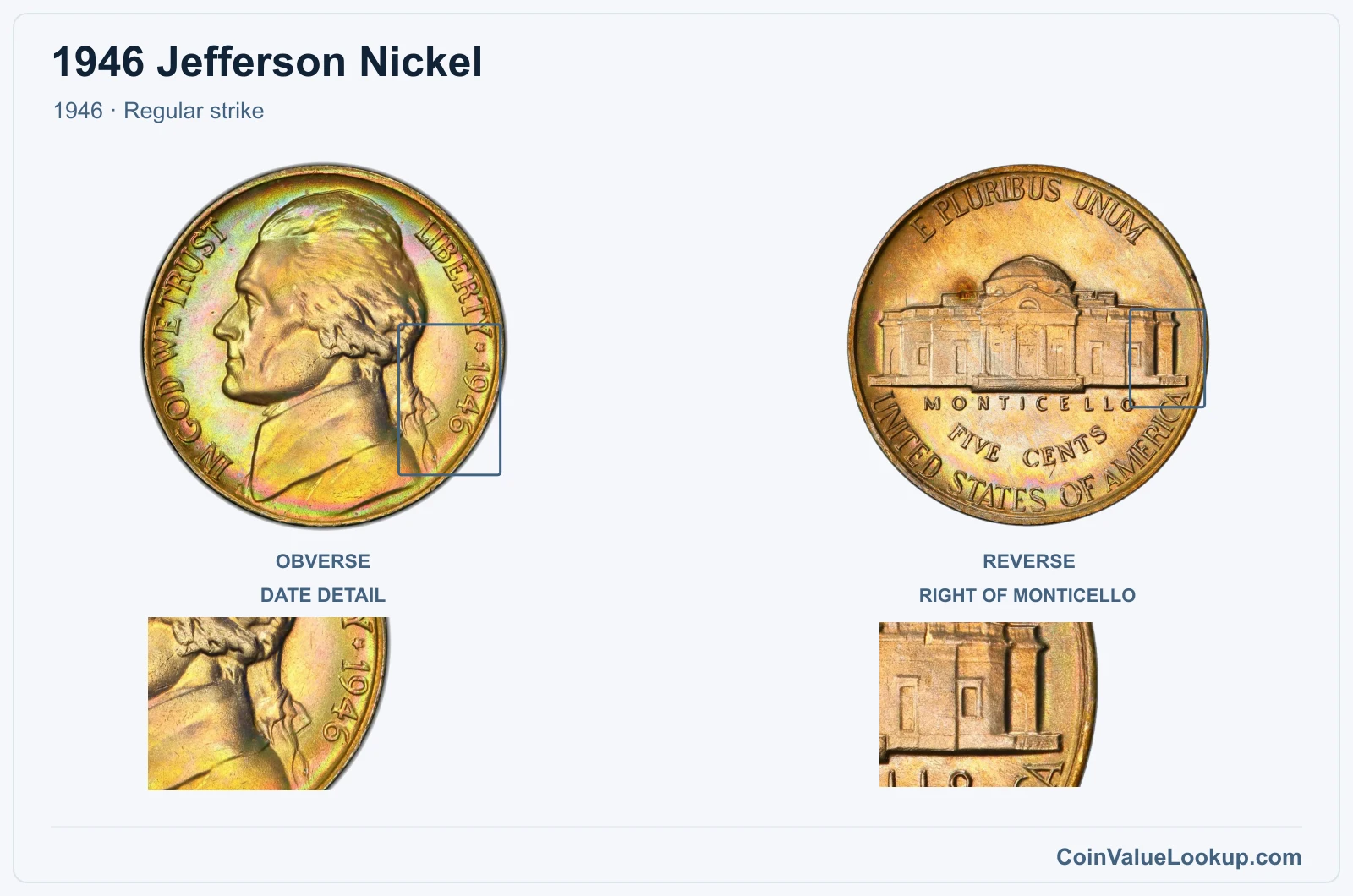
The 1946 Philadelphia nickel has no mintmark. Look on the reverse to the right of Monticello: if there is nothing there, you have the Philly issue.
USA Coin Book guide estimates place this at about $0.30 in VF20, $2.50 in MS60, and $19 in MS65.
That MS65 figure is the highest among the three mints at that grade, but all three trade close together. Circulated pieces are common enough to fill a bucket.
The jump in value comes with clean, lustrous Mint State examples, and especially those that earn a Full Steps designation from a grading service.
| Range | Grade | Price | Auction Records | Appraisal |
|---|---|---|---|---|
| PO | PO 1 | — | Coin Identifier | |
| FR | FR 2 | — | Coin Identifier | |
| AG | AG 3 | — | Coin Identifier | |
| G | G 4 | — | Coin Identifier | |
| G 6 | — | Coin Identifier | ||
| VG | VG 8 | — | Coin Identifier | |
| VG 10 | — | Coin Identifier | ||
| F | F 12 | — | Coin Identifier | |
| F 15 | — | Coin Identifier | ||
| VF | VF 20 | — | Coin Identifier | |
| VF 25 | — | Coin Identifier | ||
| VF 30 | — | Coin Identifier | ||
| VF 35 | — | Coin Identifier | ||
| XF | XF 40 | — | Coin Identifier | |
| XF 45 | — | Coin Identifier | ||
| AU | AU 50 | — | Coin Identifier | |
| AU 53 | — | Coin Identifier | ||
| AU 55 | — | Coin Identifier | ||
| AU 58 | — | Coin Identifier | ||
| MS | MS 60 | — | Coin Identifier | |
| MS 61 | — | Coin Identifier | ||
| MS 62 | — | Coin Identifier | ||
| MS 63 | — | Coin Identifier | ||
| MS 64 | Coin Identifier | |||
| MS 65 | Coin Identifier | |||
| MS 66 | Coin Identifier | |||
| MS 67 | Coin Identifier | |||
| MS 68 | — | — | — | |
| MS 69 | — | — | — | |
| MS 70 | — | — | — |
1946 Jefferson Nickel — D
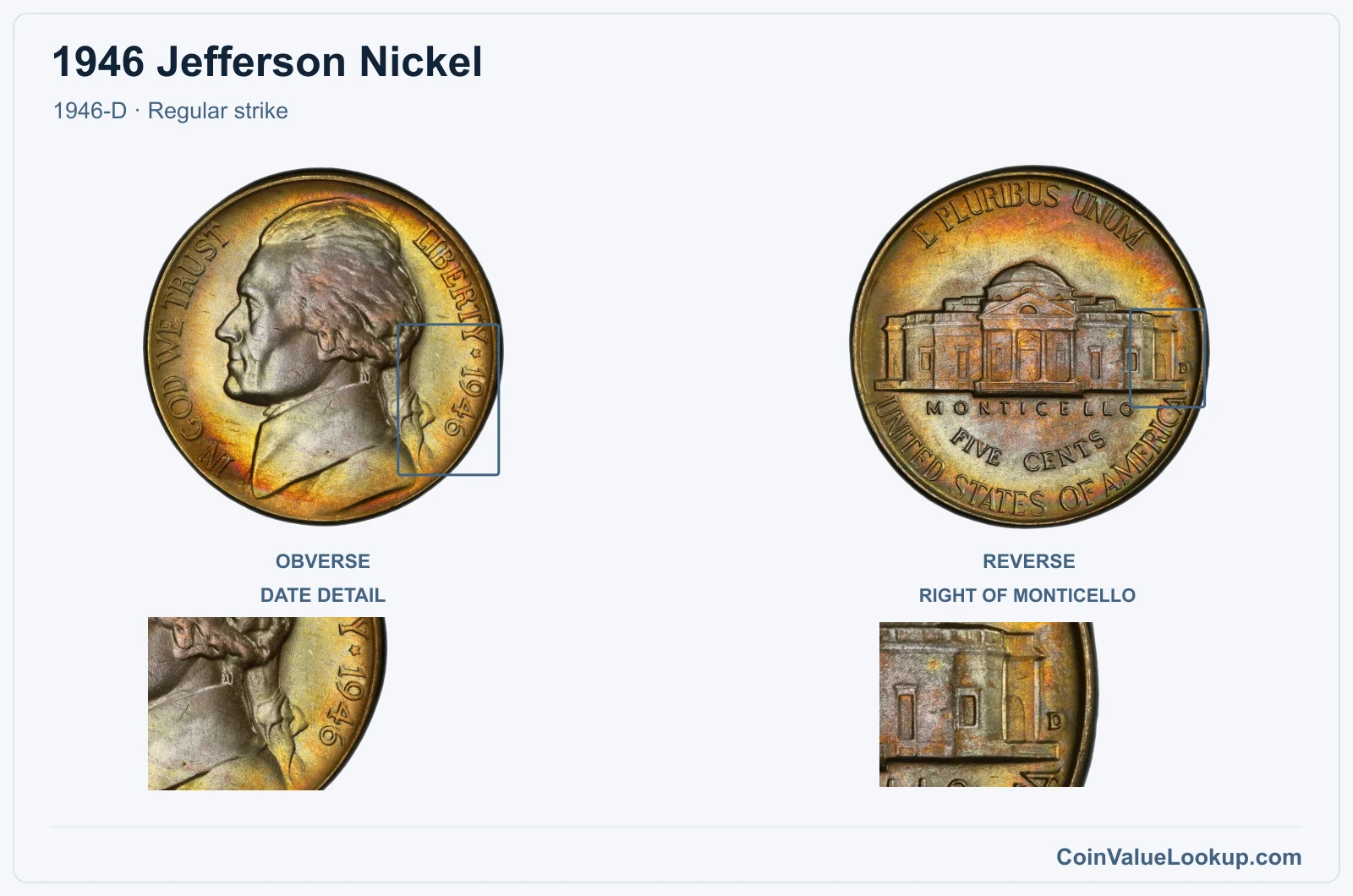
The 1946-D carries a small D mintmark to the right of Monticello on the reverse. Guide estimates from USA Coin Book put it at roughly $0.43 in VF20, $3.62 in MS60, and $15 in MS65.
Denver struck plenty of these, so circulated coins are easy to find. Mint State examples with strong luster bring the real premium.
If you are chasing Full Steps, keep circulated and Mint State values separate in your head; the Full Steps designation is a different pricing tier that requires certification.
| Range | Grade | Price | Auction Records | Appraisal |
|---|---|---|---|---|
| PO | PO 1 | — | Coin Identifier | |
| FR | FR 2 | — | Coin Identifier | |
| AG | AG 3 | — | Coin Identifier | |
| G | G 4 | — | Coin Identifier | |
| G 6 | — | Coin Identifier | ||
| VG | VG 8 | — | Coin Identifier | |
| VG 10 | — | Coin Identifier | ||
| F | F 12 | — | Coin Identifier | |
| F 15 | — | Coin Identifier | ||
| VF | VF 20 | — | Coin Identifier | |
| VF 25 | — | Coin Identifier | ||
| VF 30 | — | Coin Identifier | ||
| VF 35 | — | Coin Identifier | ||
| XF | XF 40 | — | Coin Identifier | |
| XF 45 | — | Coin Identifier | ||
| AU | AU 50 | — | Coin Identifier | |
| AU 53 | — | Coin Identifier | ||
| AU 55 | — | Coin Identifier | ||
| AU 58 | — | Coin Identifier | ||
| MS | MS 60 | — | Coin Identifier | |
| MS 61 | — | Coin Identifier | ||
| MS 62 | — | Coin Identifier | ||
| MS 63 | — | Coin Identifier | ||
| MS 64 | Coin Identifier | |||
| MS 65 | Coin Identifier | |||
| MS 66 | Coin Identifier | |||
| MS 67 | Coin Identifier | |||
| MS 68 | — | — | — | |
| MS 69 | — | — | — | |
| MS 70 | — | — | — |
1946 Jefferson Nickel — S
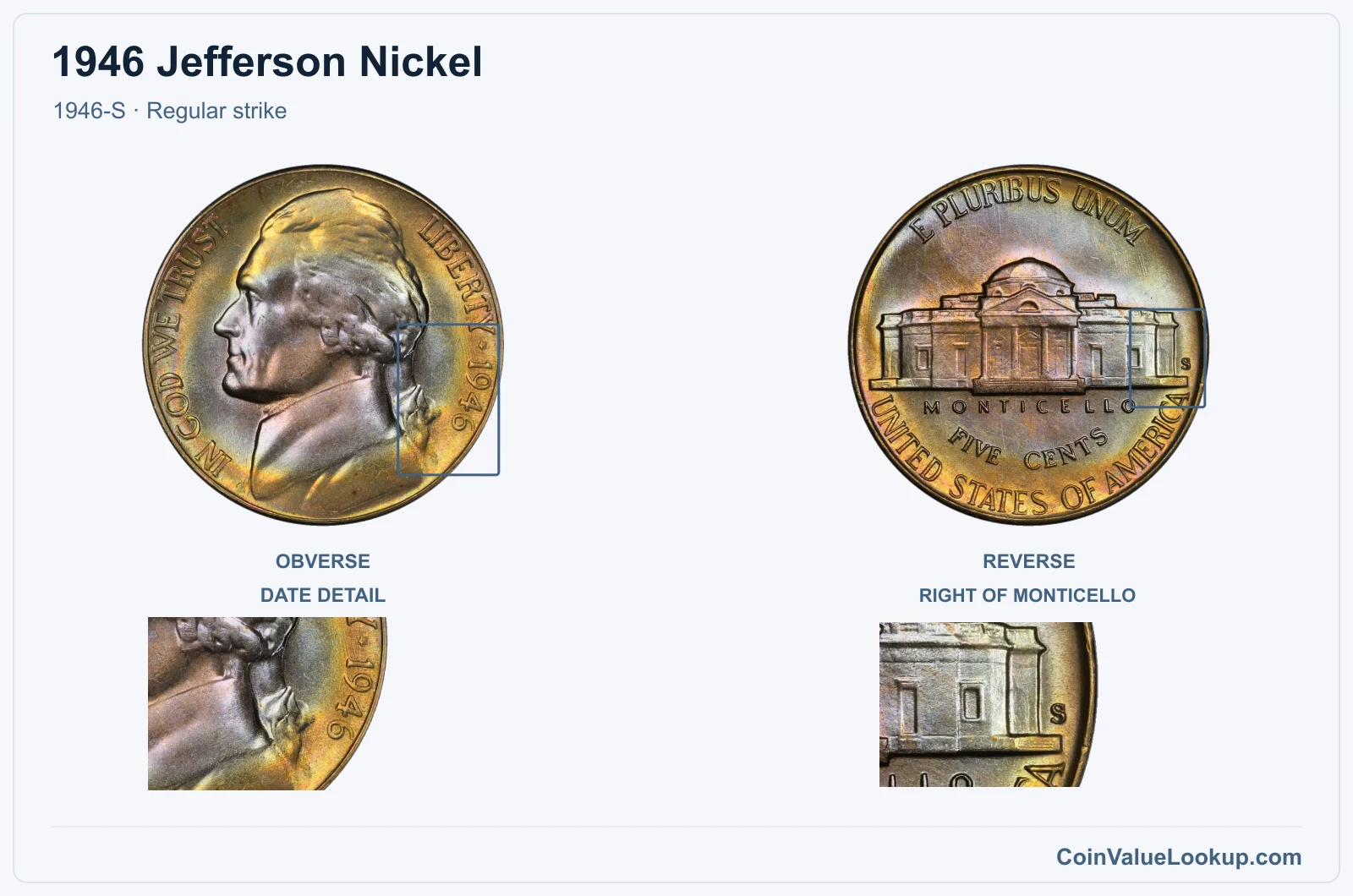
San Francisco's 1946-S shows a small S to the right of Monticello. Guide estimates sit at about $0.49 in VF20, $1.88 in MS60, and $14 in MS65 per USA Coin Book.
The VF20 price is slightly higher than the other two mints, but we are talking pocket change either way. Uncirculated coins with original surfaces are where the value picks up.
This mint also has a reported Doubled Die Obverse variety, so it is worth a close look under magnification.
Coin Value Lookup is a handy starting point when you want to look up values for other dates and denominations in the Jefferson nickel series or beyond.
| Range | Grade | Price | Auction Records | Appraisal |
|---|---|---|---|---|
| PO | PO 1 | — | Coin Identifier | |
| FR | FR 2 | — | Coin Identifier | |
| AG | AG 3 | — | Coin Identifier | |
| G | G 4 | — | Coin Identifier | |
| G 6 | — | Coin Identifier | ||
| VG | VG 8 | — | Coin Identifier | |
| VG 10 | — | Coin Identifier | ||
| F | F 12 | — | Coin Identifier | |
| F 15 | — | Coin Identifier | ||
| VF | VF 20 | — | Coin Identifier | |
| VF 25 | — | Coin Identifier | ||
| VF 30 | — | Coin Identifier | ||
| VF 35 | — | Coin Identifier | ||
| XF | XF 40 | — | Coin Identifier | |
| XF 45 | — | Coin Identifier | ||
| AU | AU 50 | — | Coin Identifier | |
| AU 53 | — | Coin Identifier | ||
| AU 55 | — | Coin Identifier | ||
| AU 58 | — | Coin Identifier | ||
| MS | MS 60 | — | Coin Identifier | |
| MS 61 | — | Coin Identifier | ||
| MS 62 | — | Coin Identifier | ||
| MS 63 | — | Coin Identifier | ||
| MS 64 | Coin Identifier | |||
| MS 65 | Coin Identifier | |||
| MS 66 | Coin Identifier | |||
| MS 67 | Coin Identifier | |||
| MS 68 | — | — | — | |
| MS 69 | — | — | — | |
| MS 70 | — | — | — |
1946 Jefferson Nickel Error List
1. 1946 Jefferson Nickel — Leftover wartime silver planchet
This is the headliner. A 1946-dated nickel struck on a leftover wartime silver planchet is a transitional error, meaning the Mint accidentally used blank stock from the discontinued 35% silver wartime alloy.
The design is normal 1946, but the metal is wrong.
Here is the tricky part: both silver and standard nickel blanks weigh approximately 5 grams, so a kitchen scale will not prove anything. You need material authentication, typically through a certified grading service, to confirm the alloy.
Do not rely on color alone; toning, plating, and Henning counterfeits can all fool the eye.
One Heritage Auctions example graded PCGS Fine-12 sold in November 2022 for $9,600. That is a single confirmed sale, not a market range, but it shows the kind of money a properly authenticated piece can bring.
2. 1946 Jefferson Nickel — Struck on a cent planchet
Sometimes a copper cent blank wandered into the wrong hopper and got struck with nickel dies. The result is a 1946 nickel on a smaller, copper-alloy planchet.
You will notice a reduced diameter, lighter weight, and design elements that are cropped or stretched near the rim because the blank was too small.
An ordinary nickel weighs 5 grams; a cent planchet is noticeably lighter. The copper color is distinctive, but be careful: environmental damage, copper plating, ground-down coins, and souvenir pieces can all mimic this error.
Certification is essential.
A Heritage Auctions example graded PCGS MS63 Brown sold in September 2019 for $840. Condition, centering, and how much of the date and design survived the wrong-size blank all influence what a given piece is worth.
3. 1946 Jefferson Nickel — Struck on a split blank
A split-planchet error happens when the metal blank separates into layers before the strike. The coin that results is noticeably thin and light.
One authenticated example, graded ANACS AU50, weighed just 2.81 grams, roughly half the normal 5-gram standard.
The key diagnostic is a rough, exposed internal surface on one side where the planchet split apart, while the other side still shows a struck design. The edge should look intact and consistent with Mint production, which helps prove the split happened before striking rather than after.
Do not confuse this with coins that have been acid-etched, ground down, or mechanically peeled. Those post-mint alterations leave different surface textures and edge profiles.
No specific price range is established here; value depends on the authenticated identity, condition, and how dramatic the split is.
4. 1946 Jefferson Nickel — Doubled Die Reverse
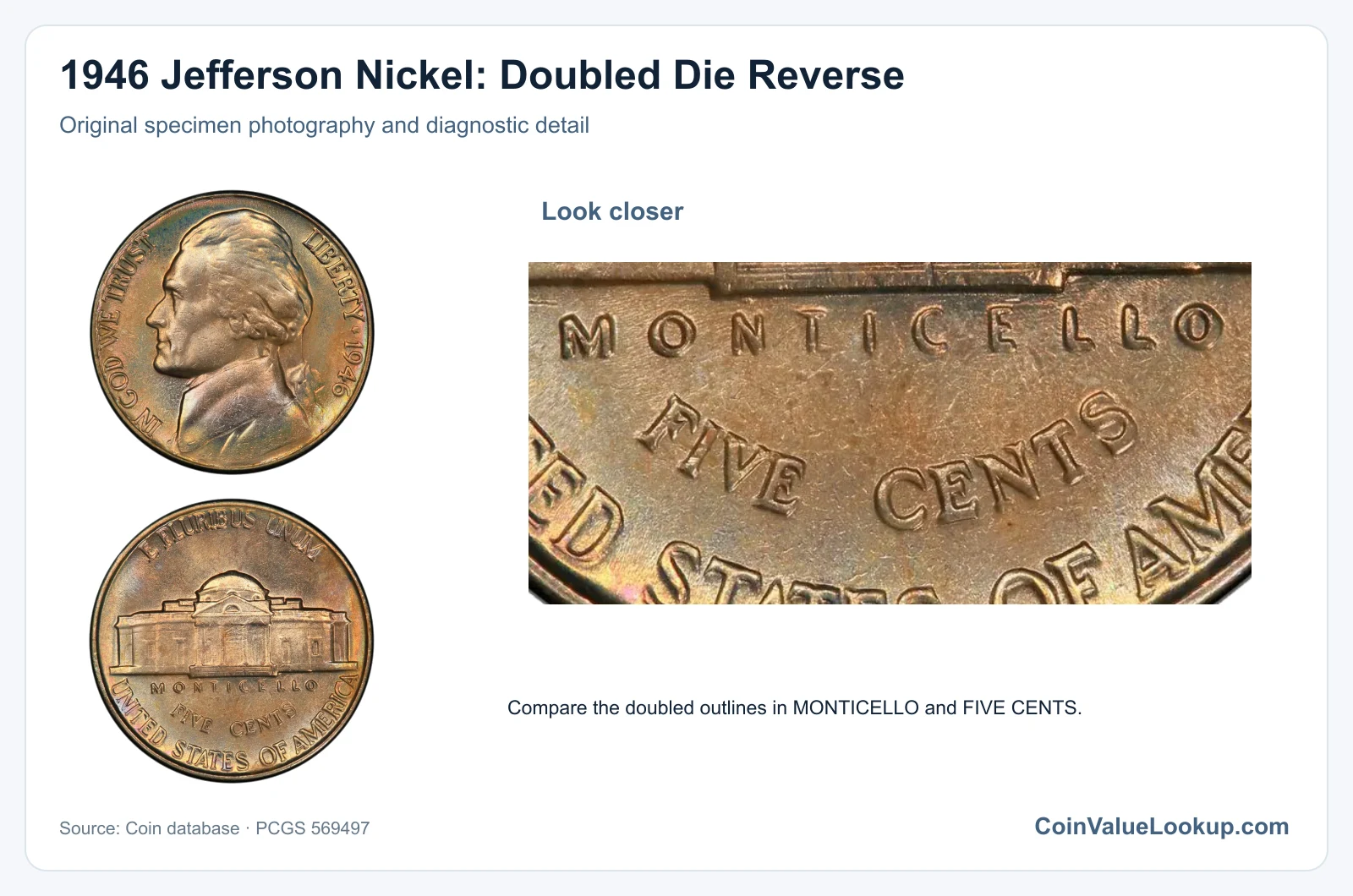
A Doubled Die Reverse has been reported for the 1946 Jefferson nickel. This type of error involves a misalignment during die production that leaves a doubled impression on reverse design elements such as lettering or architectural details of Monticello.
To check, compare your coin's reverse legends and design contours against a normal 1946 nickel under good lighting and magnification. True die doubling shows consistent separation or notching on the affected elements.
Machine doubling, by contrast, tends to produce a flat shelf that looks like a shadow rather than a crisp second impression.
No specific price range is established for this variety. Value depends on the visibility of the doubling, the coin's overall condition, and whether it can be attributed by a grading service.
5. 1946 Jefferson Nickel — Doubled Die Obverse
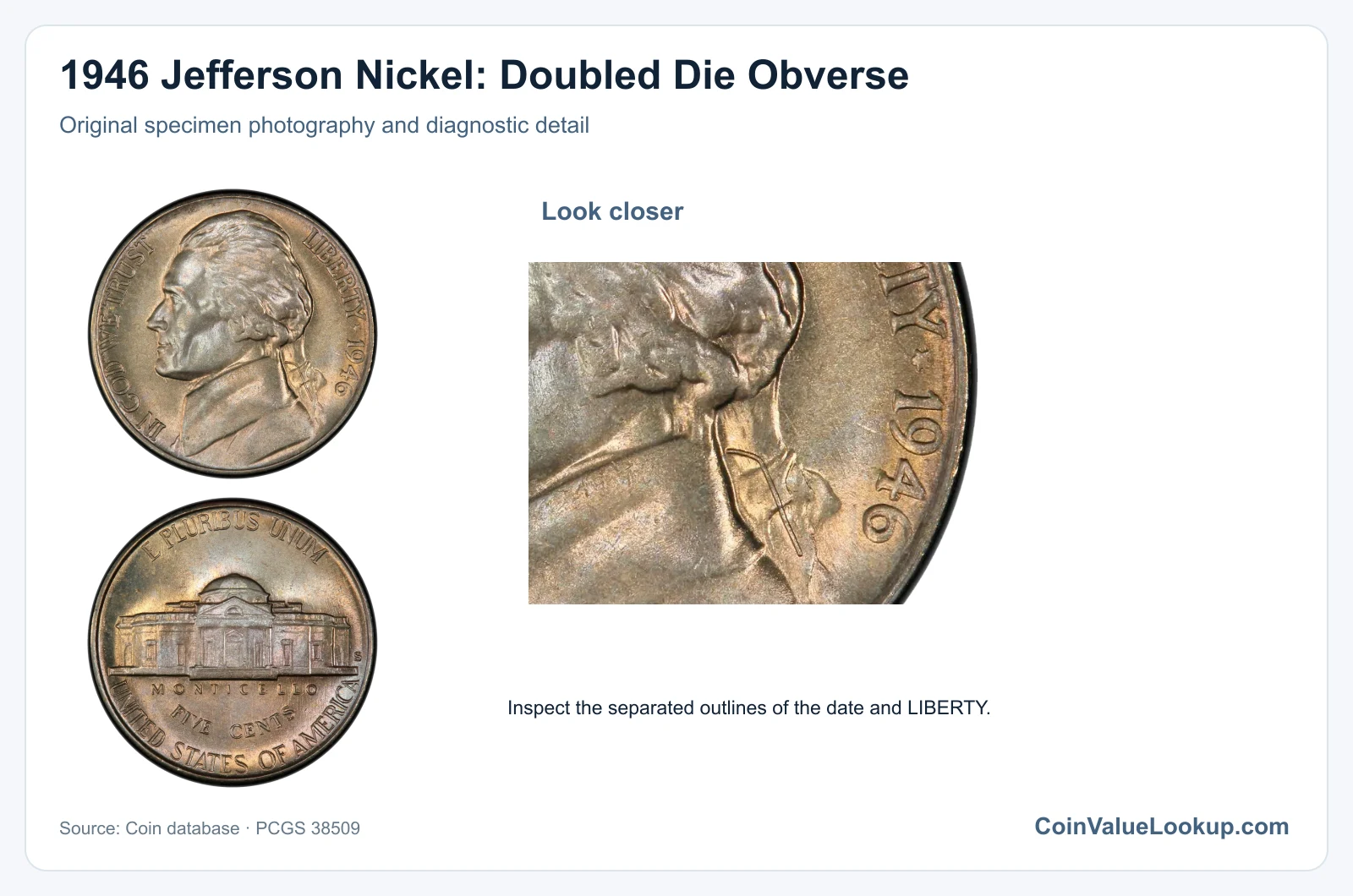
A Doubled Die Obverse has been reported specifically for the 1946-S mintmark. This means the San Francisco die received a doubled impression during production, and the effect shows on obverse design elements such as letters or portrait details.
Look for consistent separation or notching in the affected areas rather than the flat, shelf-like displacement that characterizes machine doubling. Lighting angle matters; rotate the coin and use magnification.
Compare directly against a normal 1946-S at the same scale.
No numerical price range is established. The value of a doubled die depends on how strong and visible the doubling is, the coin's condition, and whether a grading service can attribute it to the recognized variety.
6. 1946 Jefferson Nickel — Off-Center Strike
Off-center strikes occur when the blank is not properly seated between the dies. The result is a displaced design with an unstruck crescent of blank metal on one side.
These range from barely noticeable to dramatic, and the most collectible examples retain a fully visible date.
Do not confuse an off-center strike with a clipped planchet, which removes a section of metal before striking, or with post-mint damage like flattening from a vise. A genuine off-center coin will show a clean, uniform blank area where the die simply never reached.
No specific price range is adopted for this error. The percentage of off-center displacement, whether the date is readable, and the coin's overall condition all factor into what a collector will pay.
7. 1946 Jefferson Nickel — Inverted Mintmark
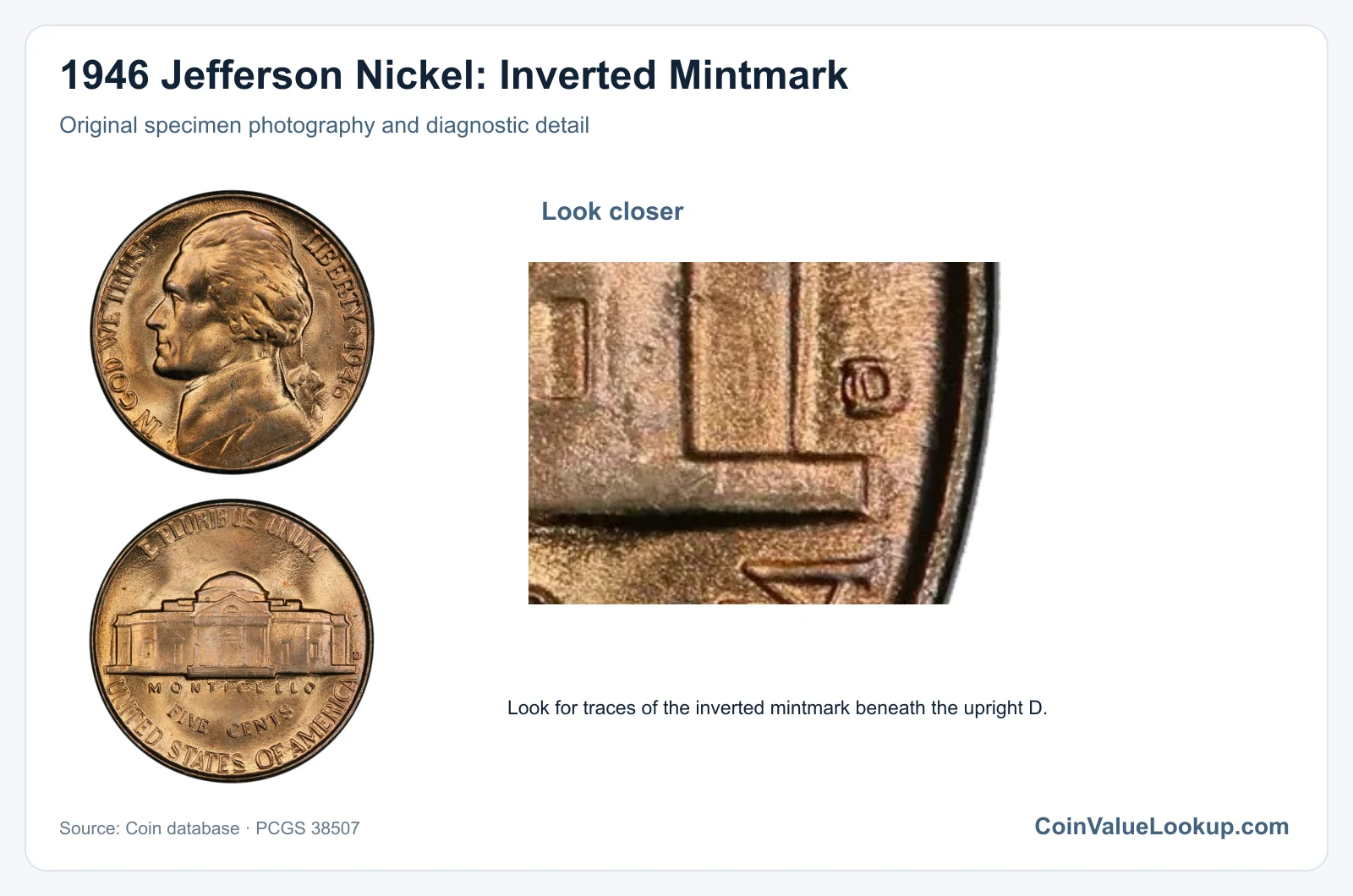
An inverted mintmark error on the 1946 nickel means the mintmark punch was applied upside down into the working die. The letter will appear rotated compared to its normal orientation for the same year and mint.
To identify this, you need a clear comparison at equal magnification between your coin's mintmark and a confirmed normal example from the same mint. The difference can be subtle, especially with letters like S and D that have limited asymmetry.
Do not confuse an inverted mark with a repunched mintmark or simple damage around the letter.
No numerical price range is established for this variety. The value depends on how clearly the inversion is visible, the coin's condition, and whether the error can be confirmed through professional attribution.
8. 1946 Jefferson Nickel — Over-Mintmark
An over-mintmark error means the die originally carried one mint letter and was then punched with a different one. Remnants of the first mintmark are still visible beneath or around the final letter.
Look carefully at the mintmark area to the right of Monticello under magnification. Traces of a different letter, usually in a slightly offset position, distinguish this from a repunched mintmark, which involves the same letter struck twice.
Die chips and corrosion around the mintmark can also create confusing shapes, so compare against a known genuine example.
No specific price range is adopted. Value depends on the clarity of the underlying mintmark, the coin's grade, and professional attribution confirming the variety.
9. 1946 Jefferson Nickel — Repunched Mintmark
A repunched mintmark occurs when the same letter punch is applied more than once in slightly different positions on the working die. The result is a mintmark that shows doubling, a shadow, or extra serifs that do not belong to the standard letter shape.
Inspect the D or S to the right of Monticello under magnification and compare it at matching scale to a normal 1946 mintmark. True repunching shows remnants of a secondary impression of the same letter.
Machine doubling, die chips, and corrosion around the mark can all create similar-looking artifacts.
No numerical price range is established. What a repunched mintmark example is worth depends on the strength and visibility of the repunching, the coin's condition, and whether a grading service can attribute it.