1951 Washington Quarter Coin Value: How Much Is It Worth?
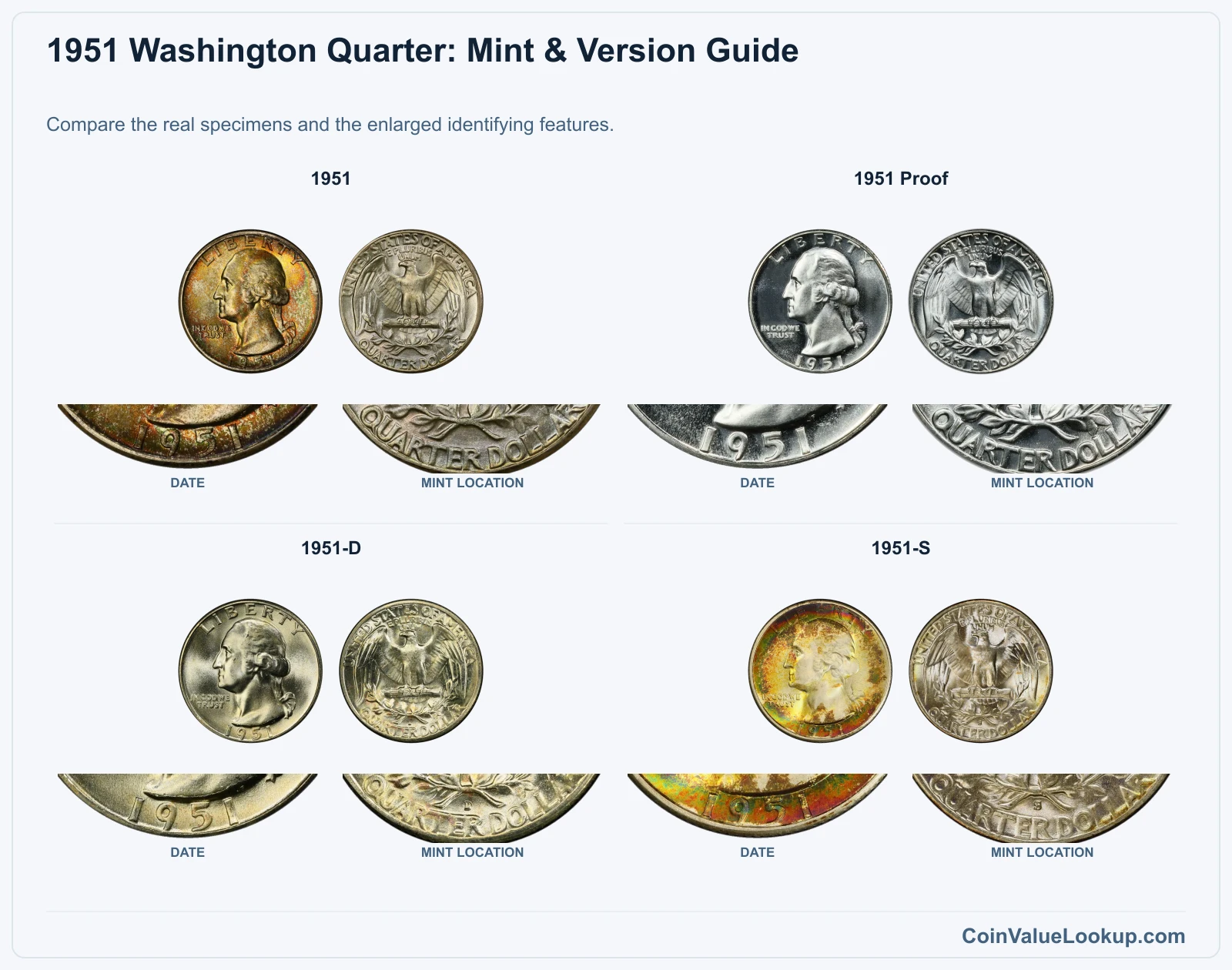
A 1951 Washington Quarter in average circulated condition starts around $16.43 based on retail guide estimates, while select uncirculated examples at MS65 can reach roughly $41 to $51 depending on the mint. These are guide-level retail estimates from USA Coin Book, not guaranteed sale prices.
Identifying your coin's mint, grade, and finish is the first step toward a useful value.
Fast Way to Identify Your 1951 Washington Quarter
Want a quick read on your 1951 quarter? Upload clear photos of the front and back to our identifier for a preliminary look at which version you have.
This is not a substitute for professional authentication or grading, but it can point you in the right direction before you dig deeper.
1951 Washington Quarter Value
Upload both sides of your 1951 Washington Quarter.
Front Obverse
Upload photo
Back Reverse
Upload photo
Which 1951 Washington Quarter Versions Are Worth Money?
- Philadelphia business strikes are comparatively accessible in gem grades; an MS65 example is listed around $41 in guide estimates.
- The 1951-S quarter at MS65 reaches roughly $51 in guide estimates, making it the highest-listed business strike at that grade level.
- The 1951-D at MS65 lists around $48, sitting between the Philadelphia and San Francisco issues in guide value.
- 1951 Proof quarters carry a PR65 guide estimate near $89, well above any business strike at comparable preservation.
- Repunched mintmark varieties on the D and S issues require exact die attribution and can carry a premium that depends on condition and error severity.
- A Doubled Die Obverse has been reported on the 1951-D; visibility and authentication determine any added value.
Step 1: Identify Your 1951 Washington Quarter Mint Mark and Version
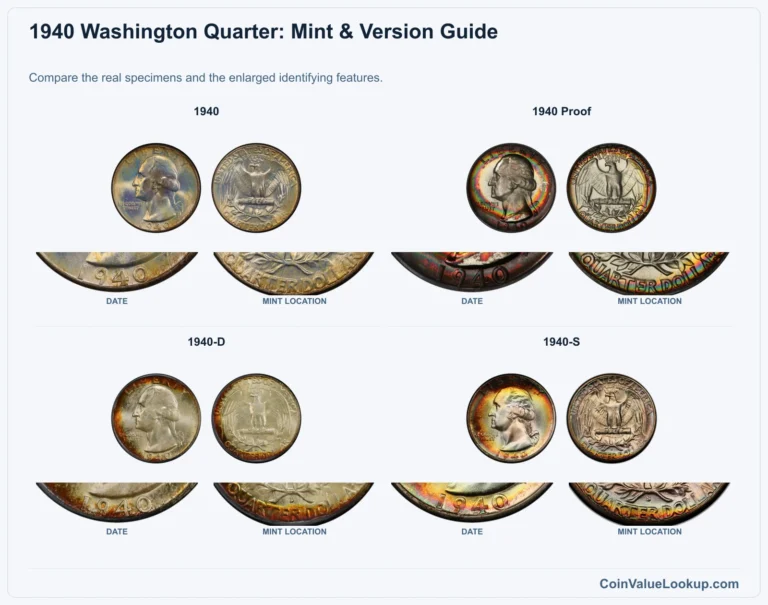
Start with the date on the obverse — it should read 1951. Then flip the coin over and look below the wreath on the reverse for a mintmark.
A "D" means Denver, an "S" means San Francisco, and no mintmark at all means Philadelphia. Do not confuse a blank mintmark area with damage or a missing letter; for this era, Philadelphia quarters simply have no mark.
All regular 1951 quarters are struck in 90% silver and 10% copper, weigh about 6.25 grams, and measure roughly 24.3 mm across. Every mint used that same alloy.
Finish is a separate question — Philadelphia also produced proof coins this year, and those have distinctly mirrored fields that set them apart from business strikes.
Proofs were made only at Philadelphia, so a coin with a D or S mintmark is always a business strike. If your Philadelphia coin has deeply reflective surfaces and razor-sharp detail, it may be a proof; a polished circulated coin is not.
Confirming finish matters because proof pricing follows a completely different scale.
Step 2: Check Your 1951 Washington Quarter Grade
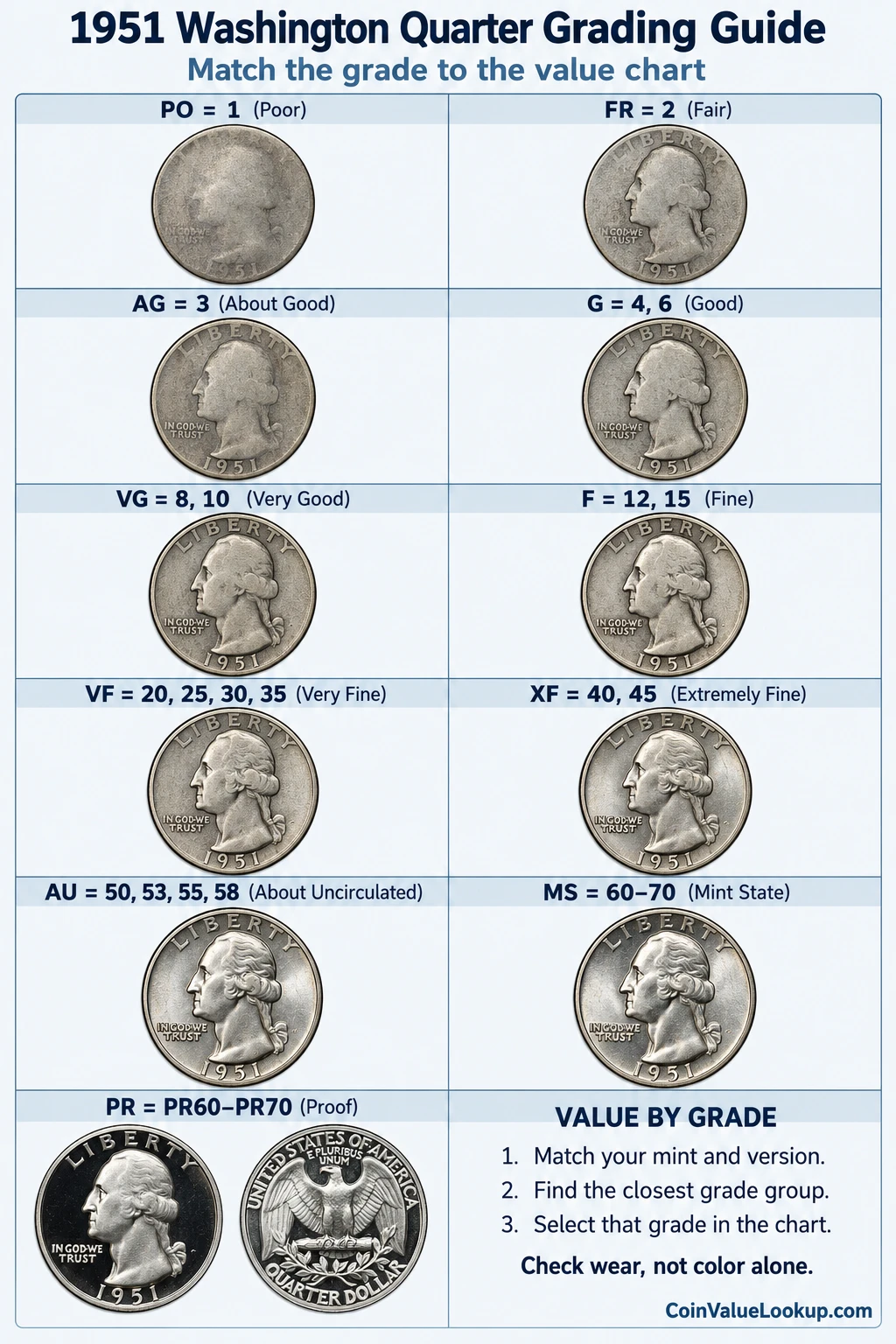
Look at Washington's hair above the ear first. On a well-worn coin, those strands blend into each other and lose individual definition.
A lightly circulated piece retains some separation. On the reverse, the eagle's breast feathers flatten early in the wear cycle.
Luster is a key indicator. A coin that still has its original mint sheen across the fields is in much better shape than one where the high points appear dull.
Weak strikes can also flatten hair detail without removing luster, so check both together.
Use the comparison image to match your coin's overall look against known grade benchmarks. Contact marks and bag damage are common on business strikes and affect eye appeal even when luster survives.
For proofs, hairline scratches from mishandling reduce the grade separately from any circulation wear.
Step 3: Check 1951 Washington Quarter Value by Mint and Version
1951 Washington Quarter
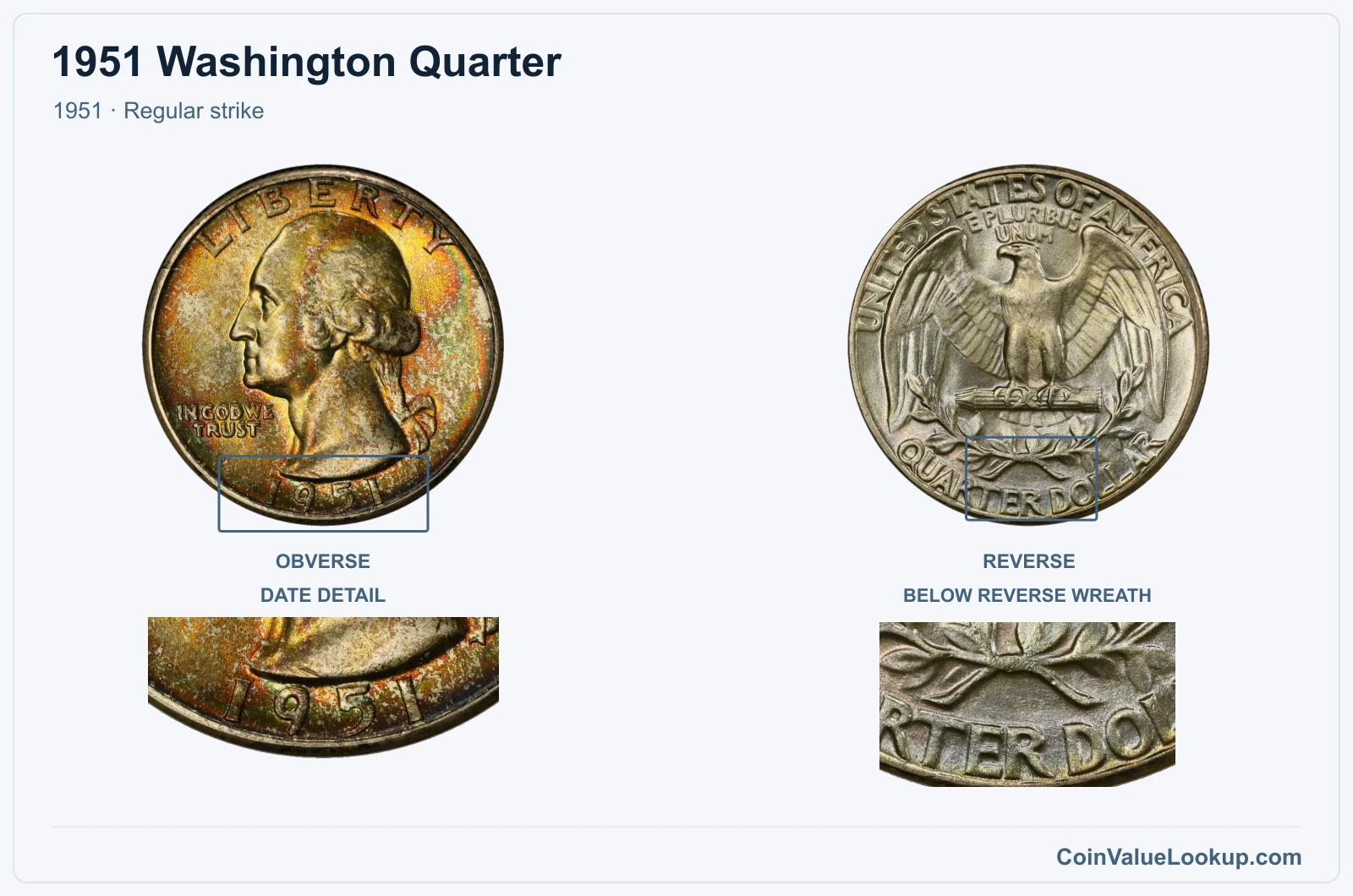
The 1951 Philadelphia quarter has no mintmark — just a blank space below the reverse wreath. It is a 90% silver business strike weighing about 6.25 grams.
Guide estimates from USA Coin Book place a G4 example at roughly $16.43, with an MS60 around $20 and an MS65 near $41.
Philadelphia gems are comparatively accessible for this date, meaning high-grade survivors turn up more regularly than their Denver or San Francisco counterparts. That said, original surfaces and clean fields still matter.
A bag-marked MS65 and a pristine MS65 can feel like different coins, so eye appeal counts even within the same technical grade.
| Range | Grade | Price | Auction Records | Appraisal |
|---|---|---|---|---|
| PO | PO 1 | — | Coin Identifier | |
| FR | FR 2 | — | Coin Identifier | |
| AG | AG 3 | — | Coin Identifier | |
| G | G 4 | — | Coin Identifier | |
| G 6 | — | Coin Identifier | ||
| VG | VG 8 | — | Coin Identifier | |
| VG 10 | — | Coin Identifier | ||
| F | F 12 | — | Coin Identifier | |
| F 15 | — | Coin Identifier | ||
| VF | VF 20 | — | Coin Identifier | |
| VF 25 | — | Coin Identifier | ||
| VF 30 | — | Coin Identifier | ||
| VF 35 | — | Coin Identifier | ||
| XF | XF 40 | — | Coin Identifier | |
| XF 45 | Coin Identifier | |||
| AU | AU 50 | — | Coin Identifier | |
| AU 53 | — | Coin Identifier | ||
| AU 55 | — | Coin Identifier | ||
| AU 58 | — | Coin Identifier | ||
| MS | MS 60 | — | Coin Identifier | |
| MS 61 | — | Coin Identifier | ||
| MS 62 | — | Coin Identifier | ||
| MS 63 | — | Coin Identifier | ||
| MS 64 | Coin Identifier | |||
| MS 65 | Coin Identifier | |||
| MS 66 | Coin Identifier | |||
| MS 67 | Coin Identifier | |||
| MS 68 | — | — | — | |
| MS 69 | — | — | — | |
| MS 70 | — | — | — |
1951 Washington Quarter — Proof
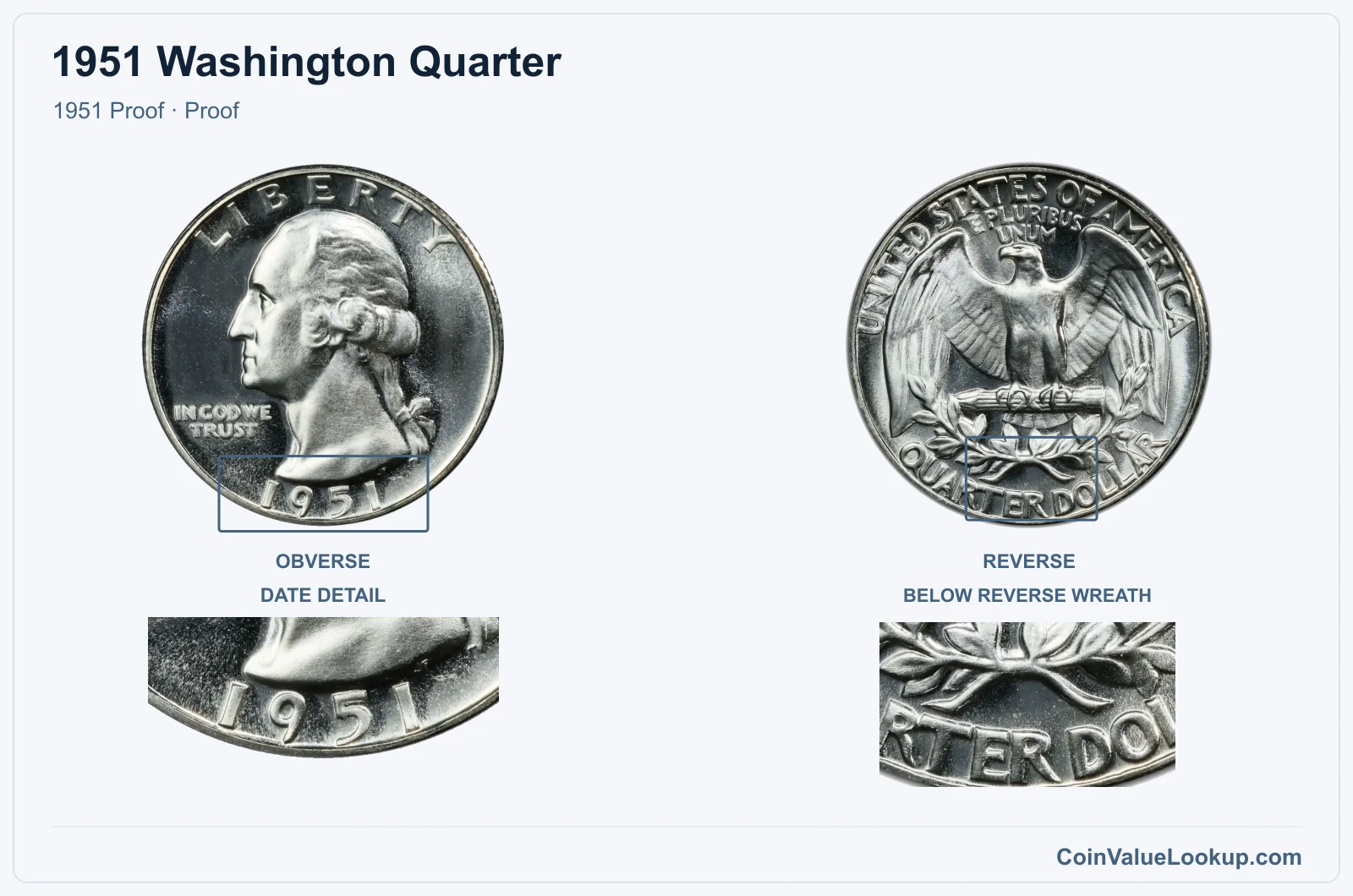
Philadelphia also struck proof quarters in 1951, resuming a practice that had been suspended during wartime. These coins have deeply reflective fields and exceptionally sharp detail produced by specially prepared dies and planchets.
A polished circulation coin is not a proof, no matter how shiny it looks.
The guide estimate for a PR65 is about $89, making this the highest-valued regular 1951 quarter at comparable preservation levels. Cameo and Deep Cameo designations exist for proofs with frosted devices against mirror fields, but those are graded on a separate scale.
Coin Value Lookup is a useful starting point when you want to compare this proof's value against other Washington Quarter dates and finishes. A quick search there can help frame what you are holding.
| Range | Grade | Price | Auction Records | Appraisal |
|---|---|---|---|---|
| PR | PR 1 | — | Coin Identifier | |
| PR 2 | — | Coin Identifier | ||
| PR 3 | — | Coin Identifier | ||
| PR 4 | — | Coin Identifier | ||
| PR 6 | — | Coin Identifier | ||
| PR 8 | — | Coin Identifier | ||
| PR 10 | — | Coin Identifier | ||
| PR 12 | — | Coin Identifier | ||
| PR 15 | — | Coin Identifier | ||
| PR 20 | — | Coin Identifier | ||
| PR 25 | — | Coin Identifier | ||
| PR 30 | — | Coin Identifier | ||
| PR 35 | — | Coin Identifier | ||
| PR 40 | — | Coin Identifier | ||
| PR 45 | — | Coin Identifier | ||
| PR 50 | — | Coin Identifier | ||
| PR 53 | — | Coin Identifier | ||
| PR 55 | — | Coin Identifier | ||
| PR 58 | — | Coin Identifier | ||
| PR 60 | — | Coin Identifier | ||
| PR 61 | — | Coin Identifier | ||
| PR 62 | — | Coin Identifier | ||
| PR 63 | Coin Identifier | |||
| PR 64 | Coin Identifier | |||
| PR 65 | Coin Identifier | |||
| PR 66 | Coin Identifier | |||
| PR 67 | Coin Identifier | |||
| PR 68 | Coin Identifier | |||
| PR 69 | — | — | — | |
| PR 70 | — | — | — |
1951 Washington Quarter — D
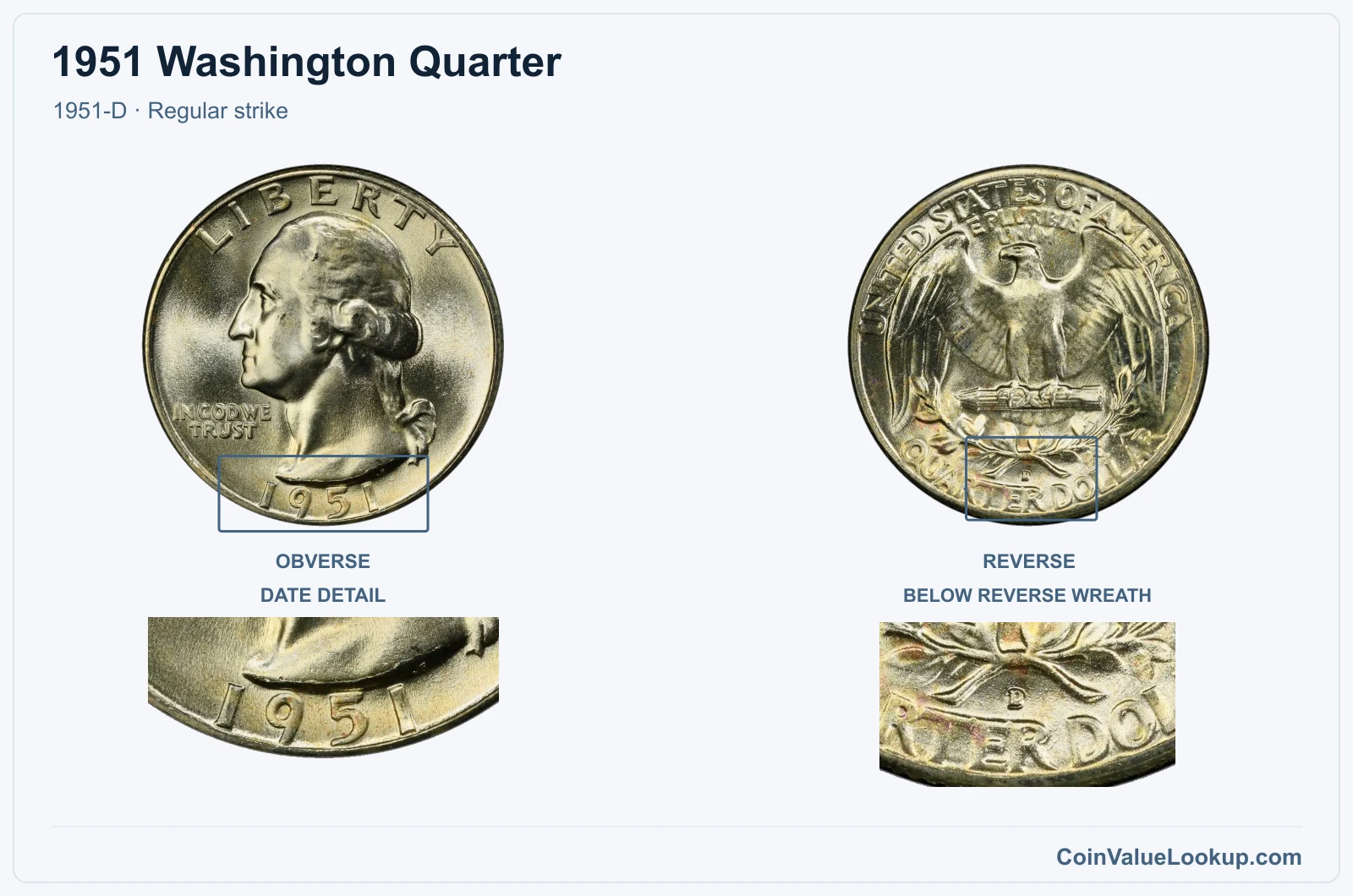
The 1951-D quarter carries a small "D" mintmark below the wreath on the reverse. Same 90% silver composition and 6.25-gram weight as the Philadelphia issue.
USA Coin Book guide estimates put G4 at about $16.43, MS60 at $20, and MS65 at $48.
That MS65 figure sits above the Philadelphia issue at the same grade, reflecting somewhat tighter supply in top condition. Denver coins from this era are worth examining closely for repunched mintmark varieties, which are a recognized category for 1951-D quarters.
| Range | Grade | Price | Auction Records | Appraisal |
|---|---|---|---|---|
| PO | PO 1 | — | Coin Identifier | |
| FR | FR 2 | — | Coin Identifier | |
| AG | AG 3 | — | Coin Identifier | |
| G | G 4 | — | Coin Identifier | |
| G 6 | — | Coin Identifier | ||
| VG | VG 8 | — | Coin Identifier | |
| VG 10 | — | Coin Identifier | ||
| F | F 12 | — | Coin Identifier | |
| F 15 | — | Coin Identifier | ||
| VF | VF 20 | — | Coin Identifier | |
| VF 25 | — | Coin Identifier | ||
| VF 30 | — | Coin Identifier | ||
| VF 35 | — | Coin Identifier | ||
| XF | XF 40 | — | Coin Identifier | |
| XF 45 | — | Coin Identifier | ||
| AU | AU 50 | — | Coin Identifier | |
| AU 53 | — | Coin Identifier | ||
| AU 55 | — | Coin Identifier | ||
| AU 58 | Coin Identifier | |||
| MS | MS 60 | — | Coin Identifier | |
| MS 61 | — | Coin Identifier | ||
| MS 62 | — | Coin Identifier | ||
| MS 63 | — | Coin Identifier | ||
| MS 64 | Coin Identifier | |||
| MS 65 | Coin Identifier | |||
| MS 66 | Coin Identifier | |||
| MS 67 | Coin Identifier | |||
| MS 68 | Coin Identifier | |||
| MS 69 | — | — | — | |
| MS 70 | — | — | — |
1951 Washington Quarter — S
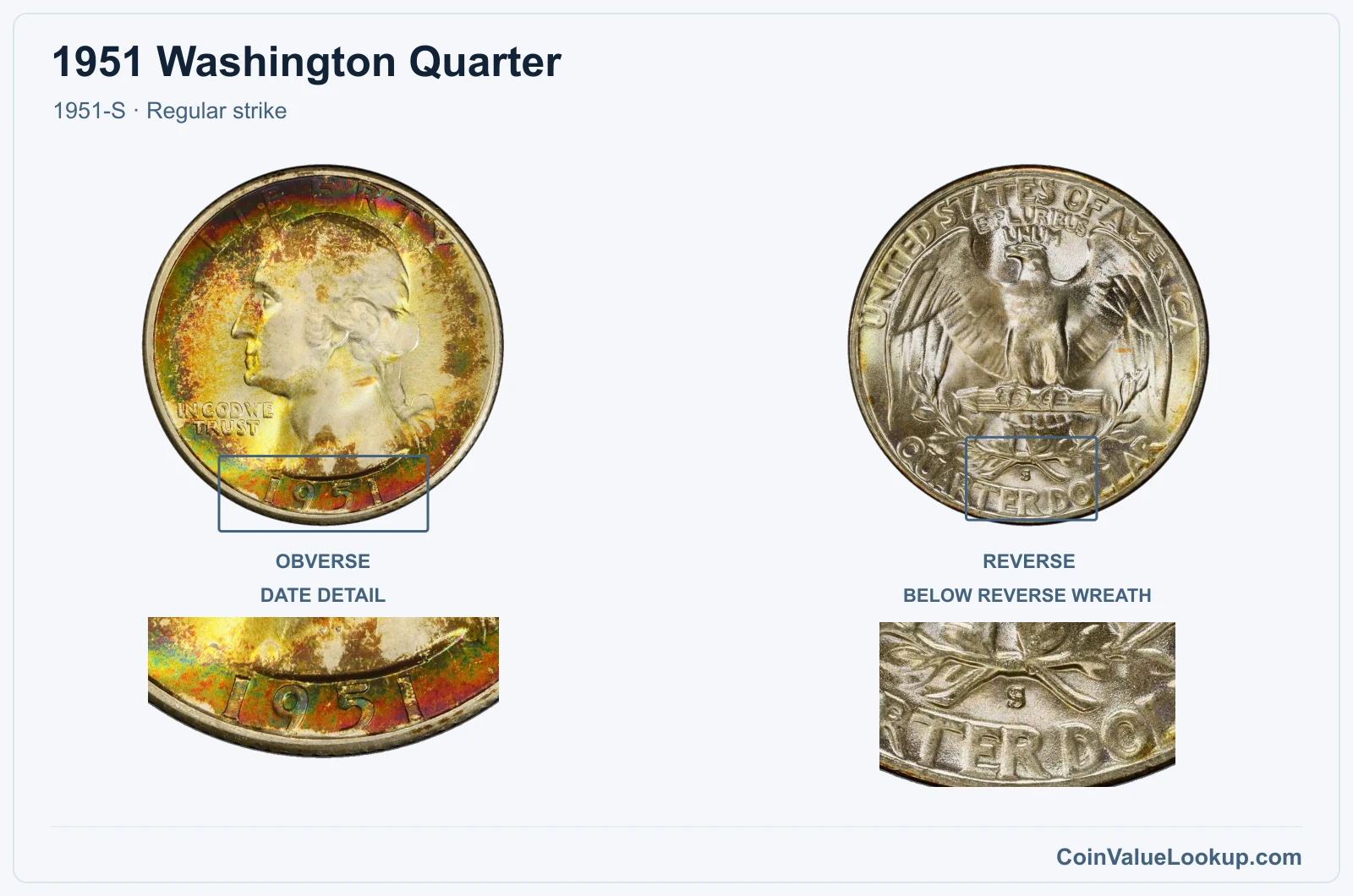
Look for the "S" mintmark below the reverse wreath to confirm a San Francisco strike. Composition is the standard 90% silver, 10% copper at roughly 6.25 grams.
Guide estimates list G4 at about $16.43, MS60 at $22, and MS65 near $51.
At MS65, the 1951-S carries the highest guide estimate among the three business-strike mints for this date. Condition is the variable that moves the needle — the jump from MS60 to MS65 more than doubles the listed value.
Like the Denver issue, San Francisco quarters also have recognized repunched mintmark varieties worth checking.
| Range | Grade | Price | Auction Records | Appraisal |
|---|---|---|---|---|
| PO | PO 1 | — | Coin Identifier | |
| FR | FR 2 | — | Coin Identifier | |
| AG | AG 3 | — | Coin Identifier | |
| G | G 4 | — | Coin Identifier | |
| G 6 | — | Coin Identifier | ||
| VG | VG 8 | — | Coin Identifier | |
| VG 10 | — | Coin Identifier | ||
| F | F 12 | — | Coin Identifier | |
| F 15 | — | Coin Identifier | ||
| VF | VF 20 | — | Coin Identifier | |
| VF 25 | — | Coin Identifier | ||
| VF 30 | — | Coin Identifier | ||
| VF 35 | — | Coin Identifier | ||
| XF | XF 40 | — | Coin Identifier | |
| XF 45 | — | Coin Identifier | ||
| AU | AU 50 | — | Coin Identifier | |
| AU 53 | — | Coin Identifier | ||
| AU 55 | — | Coin Identifier | ||
| AU 58 | — | Coin Identifier | ||
| MS | MS 60 | — | Coin Identifier | |
| MS 61 | — | Coin Identifier | ||
| MS 62 | — | Coin Identifier | ||
| MS 63 | — | Coin Identifier | ||
| MS 64 | Coin Identifier | |||
| MS 65 | Coin Identifier | |||
| MS 66 | Coin Identifier | |||
| MS 67 | Coin Identifier | |||
| MS 68 | Coin Identifier | |||
| MS 69 | — | — | — | |
| MS 70 | — | — | — |
1951 Washington Quarter Error List
1. 1951 Washington Quarter — Repunched D Mintmark
A repunched mintmark on the 1951-D quarter shows overlapping "D" impressions on the reverse, just below the wreath. The die received more than one punch of the mintmark letter, leaving a second raised outline that is visible under moderate magnification.
Compare your coin's D to a normal example at the same scale — the genuine variety has a clearly doubled contour that follows the letter's shape.
This is not the same thing as machine doubling, which produces a flat, shelf-like distortion rather than a fully raised second impression. Scratches, wear, or displaced metal from a misaligned strike can also mimic the look, so the exact die pattern matters.
PCGS recognizes this variety. No specific price range is adopted here; value depends on authenticated identity, the strength of the overlap, and overall coin condition.
2. 1951 Washington Quarter — Repunched S Mintmark
The 1951-S repunched mintmark shows an enlarged or doubled S below the reverse wreath, created when the mintmark punch was applied to the working die more than once. Look for raised duplicate contours around the S that follow the letter's curves — these are part of the die itself, not post-strike damage.
Machine doubling is the most common lookalike. It leaves a flattened shelf of displaced metal rather than a genuinely raised second impression.
Wear around the mintmark or added material from environmental damage can also create confusing outlines. PCGS recognizes the 1951-S/S repunched mintmark as a legitimate variety.
No numerical price is adopted for this attribution; what a given specimen is worth depends on the specific die match, the visibility of the repunching, and the coin's overall condition and grade.
3. 1951 Washington Quarter — Doubled Die Obverse
A Doubled Die Obverse has been reported for the 1951-D quarter. On a genuine DDO, obverse design elements such as letters or profile details show consistent separation or notching — a doubled contour that repeats in the same direction across multiple features.
Compare your coin to a normal 1951-D under the same lighting; the doubling should be visible as raised, parallel outlines rather than a flat shelf.
Machine doubling is the usual imposter here. It produces a flattened, washed-out secondary image without the sharp raised definition of a true hub-doubled die.
Worn die contours and reflections can also trick the eye. No numerical price is adopted for this variety; its value depends on the visibility and attribution of the doubling as well as the coin's condition.
Professional authentication is strongly recommended before assigning any premium.