1936 Washington Quarter Coin Value: How Much Is It Worth?
The 1936 Washington quarter is a 90% silver coin that spans a wide value range depending on mint, condition and variety. Circulated examples from Philadelphia or San Francisco start around $16 in well-worn grades per USA Coin Book guide estimates, while a Denver mint coin in MS65 condition can reach roughly $1,252.
Proofs and error varieties push values considerably higher. Four normal branches exist for this year, and each one is worth understanding.
Fast Way to Identify Your 1936 Washington Quarter
The quickest way to figure out what you have is to upload clear photos of both sides of your coin. A front shot catches the date and any doubling, while the back reveals the mintmark that determines which branch you own.
Submit those images and our identifier will give you a preliminary read on mint, version and general condition to point your research in the right direction.
1936 Washington Quarter Value
Upload both sides of your 1936 Washington Quarter.
Front Obverse
Upload photo
Back Reverse
Upload photo
Which 1936 Washington Quarter Versions Are Worth Money?
- The 1936-D quarter commands the highest business-strike premiums, with guide estimates reaching about $1,252 in MS65 — check for the D mintmark below the reverse wreath.
- The 1936 proof quarter, struck only at Philadelphia, carries a guide estimate near $12,169 in PR65 — genuine proofs have deeply mirrored fields that circulation polish cannot replicate.
- A doubled die obverse variety from the Philadelphia mint shows clear doubling on IN GOD WE TRUST and has sold at auction for over $1,100 in MS63.
- The 1936-S in high uncirculated grades can reach roughly $298 at MS65, making well-preserved San Francisco pieces worth a careful look.
Step 1: Identify Your 1936 Washington Quarter Mint Mark and Version
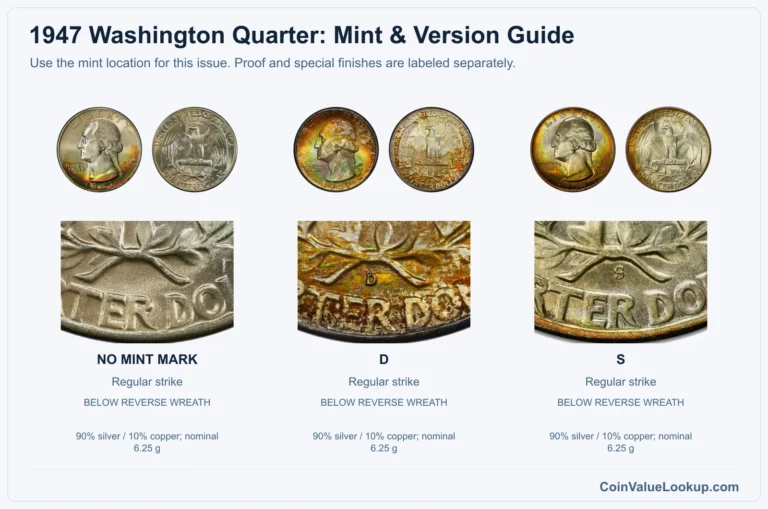
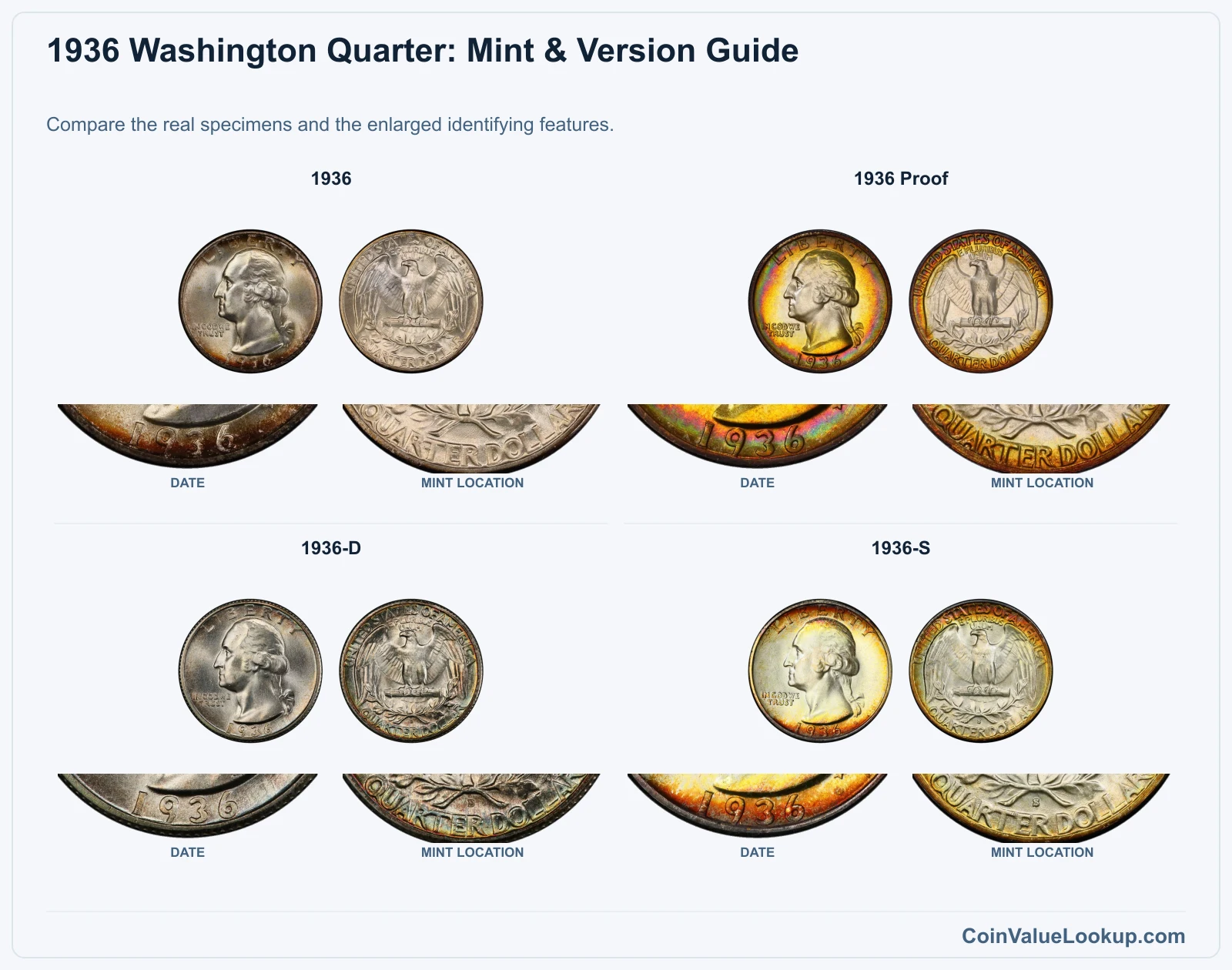
Start with the date on the obverse — 1936, below Washington's chin. Then flip the coin over and look immediately below the wreath tie on the reverse.
A small "D" means Denver, an "S" means San Francisco, and a blank space means Philadelphia.
All four normal branches of the 1936 quarter use the same design: John Flanagan's left-facing Washington portrait on the obverse, and an eagle with spread wings clutching arrows and olive branches on the reverse. The alloy is 90% silver and 10% copper, with a nominal weight of 6.25 grams and a diameter of about 24.3 mm.
Check the edge. It should be reeded — a series of fine vertical lines running around the rim.
There is no copper-clad sandwich stripe visible on a genuine silver quarter. If you see a copper layer, you have a later clad coin or a counterfeit.
A shiny business strike is not the same thing as a proof. Philadelphia produced both types this year, so brightness alone means nothing.
Proofs have mirror-like reflective fields and exceptionally sharp design detail created by a special striking process, not just a coin that avoided pocket change.
Step 2: Check Your 1936 Washington Quarter Grade
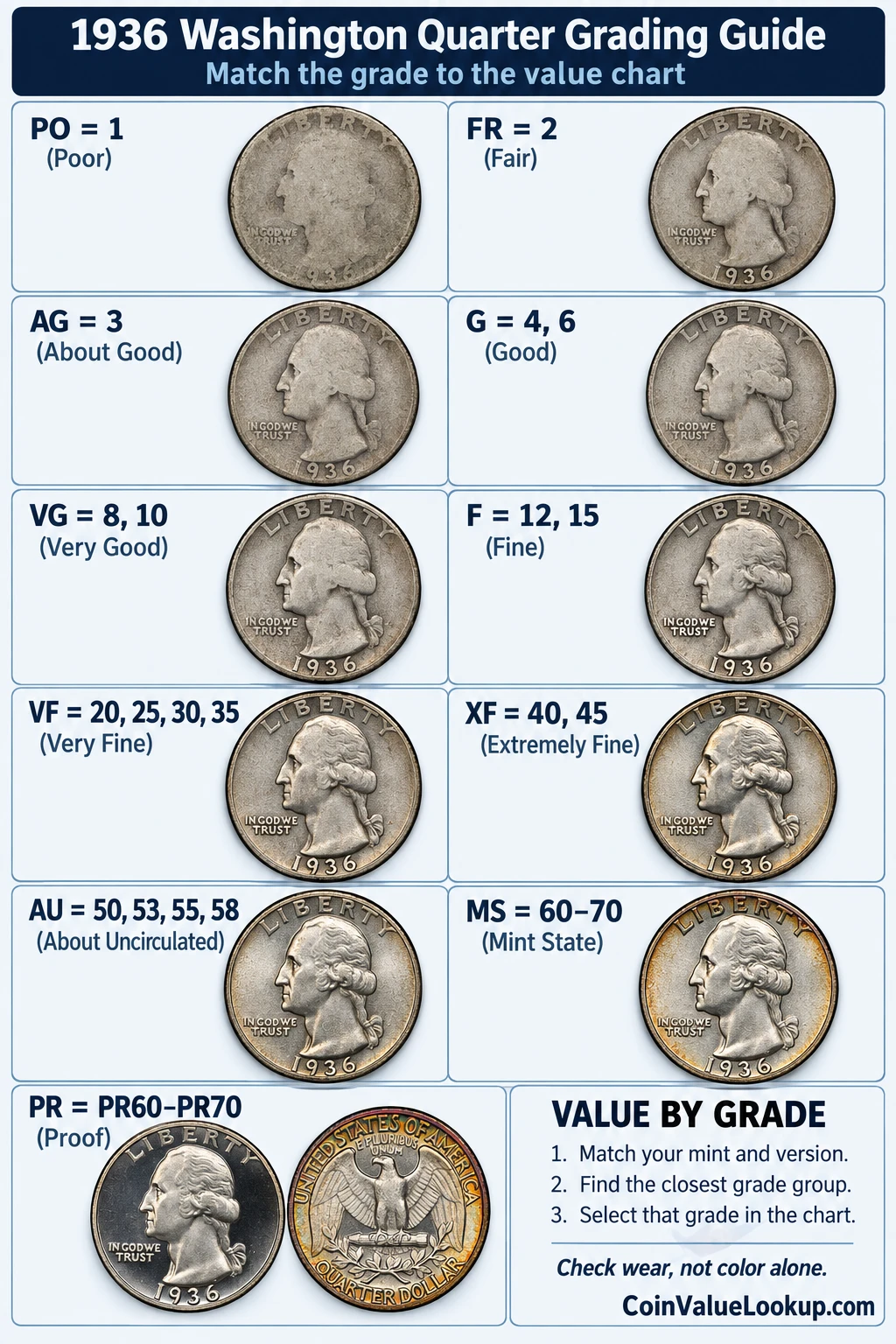
Focus on Washington's hair above the ear first. On a high-grade coin, individual strands are sharp and fully separated with unbroken luster.
As a coin wears, that area flattens and the cheek and jawline start to lose definition. Compare your coin against the reference image to gauge where it falls.
On the reverse, check the eagle's breast feathers and the detail in the wing tips. These are the next high points to show friction.
A weakly struck coin can look worn even when it is not, so consider whether the softness is uniform (strike issue) or concentrated on the highest points (actual wear).
Hairlines from cleaning are a red flag. Hold the coin at an angle under a single light source.
Fine parallel scratches across the fields usually mean someone "improved" the coin with a cloth, which actually hurts value. Rim nicks and contact marks also matter.
Do not assume a bright, shiny coin is uncirculated — that shine may be the result of polishing, not original mint luster.
Step 3: Check 1936 Washington Quarter Value by Mint and Version
1936 Washington Quarter
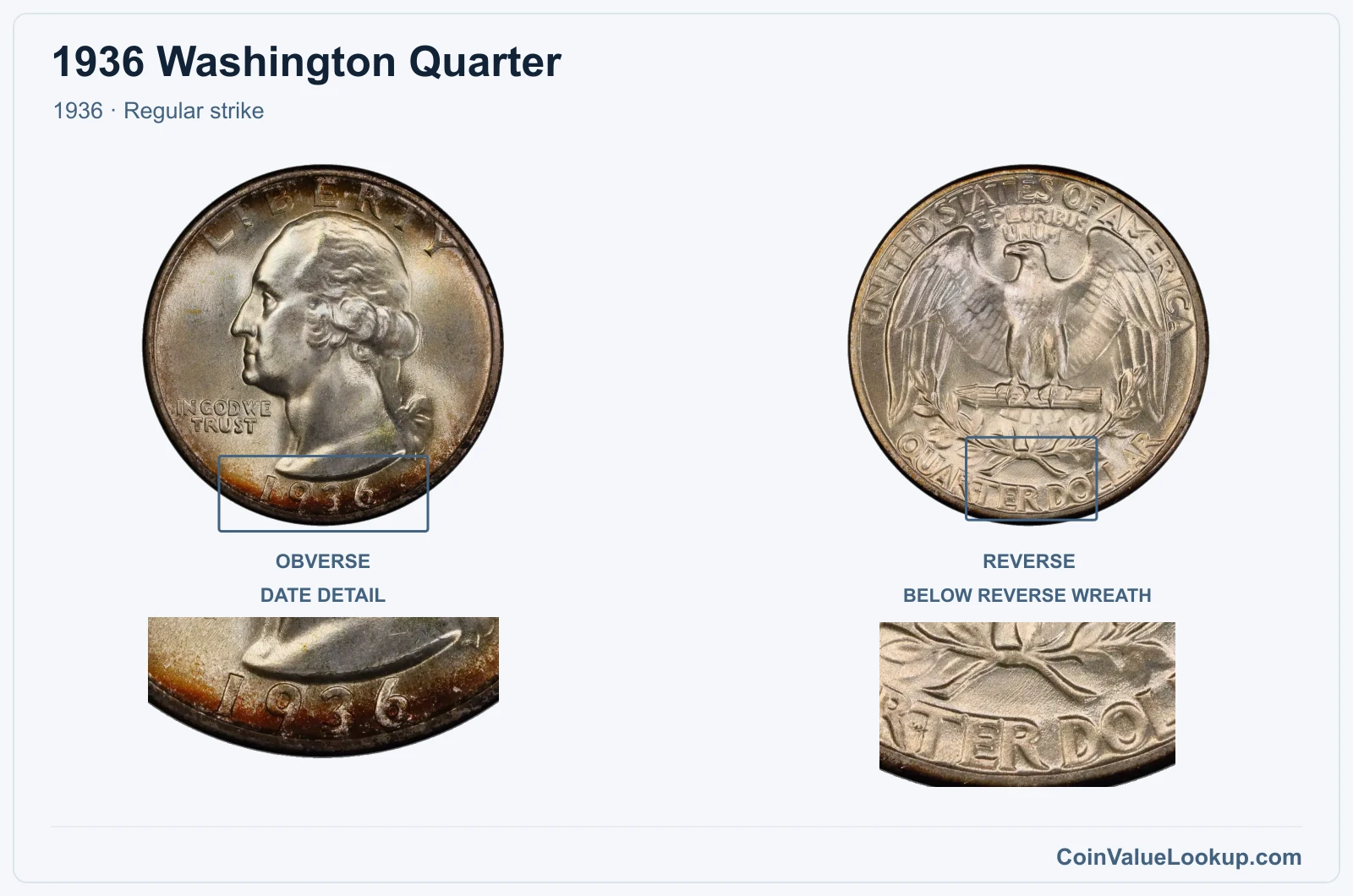
The 1936 Philadelphia quarter has no mintmark — look for a blank area below the wreath on the reverse. Philadelphia struck the largest quantity this year, so these are the most commonly encountered.
A well-worn example in Good-4 condition carries a USA Coin Book guide estimate around $16.43. That climbs to roughly $39 at MS60 and about $121 at MS65.
Original surfaces matter here. Toning is normal on an 88-year-old silver coin and is not damage.
The absence of a mintmark is likewise not an error — Philadelphia simply did not use one during this era. If your coin is bright and reflective, compare it carefully to a known proof before assuming you have one.
| Range | Grade | Price | Auction Records | Appraisal |
|---|---|---|---|---|
| PO | PO 1 | — | Coin Identifier | |
| FR | FR 2 | — | Coin Identifier | |
| AG | AG 3 | — | Coin Identifier | |
| G | G 4 | — | Coin Identifier | |
| G 6 | — | Coin Identifier | ||
| VG | VG 8 | — | Coin Identifier | |
| VG 10 | — | Coin Identifier | ||
| F | F 12 | — | Coin Identifier | |
| F 15 | — | Coin Identifier | ||
| VF | VF 20 | — | Coin Identifier | |
| VF 25 | — | Coin Identifier | ||
| VF 30 | — | Coin Identifier | ||
| VF 35 | — | Coin Identifier | ||
| XF | XF 40 | — | Coin Identifier | |
| XF 45 | — | Coin Identifier | ||
| AU | AU 50 | — | Coin Identifier | |
| AU 53 | — | Coin Identifier | ||
| AU 55 | Coin Identifier | |||
| AU 58 | Coin Identifier | |||
| MS | MS 60 | — | Coin Identifier | |
| MS 61 | — | Coin Identifier | ||
| MS 62 | Coin Identifier | |||
| MS 63 | Coin Identifier | |||
| MS 64 | Coin Identifier | |||
| MS 65 | Coin Identifier | |||
| MS 66 | Coin Identifier | |||
| MS 67 | Coin Identifier | |||
| MS 68 | Coin Identifier | |||
| MS 69 | — | — | — | |
| MS 70 | — | — | — |
1936 Washington Quarter — Proof
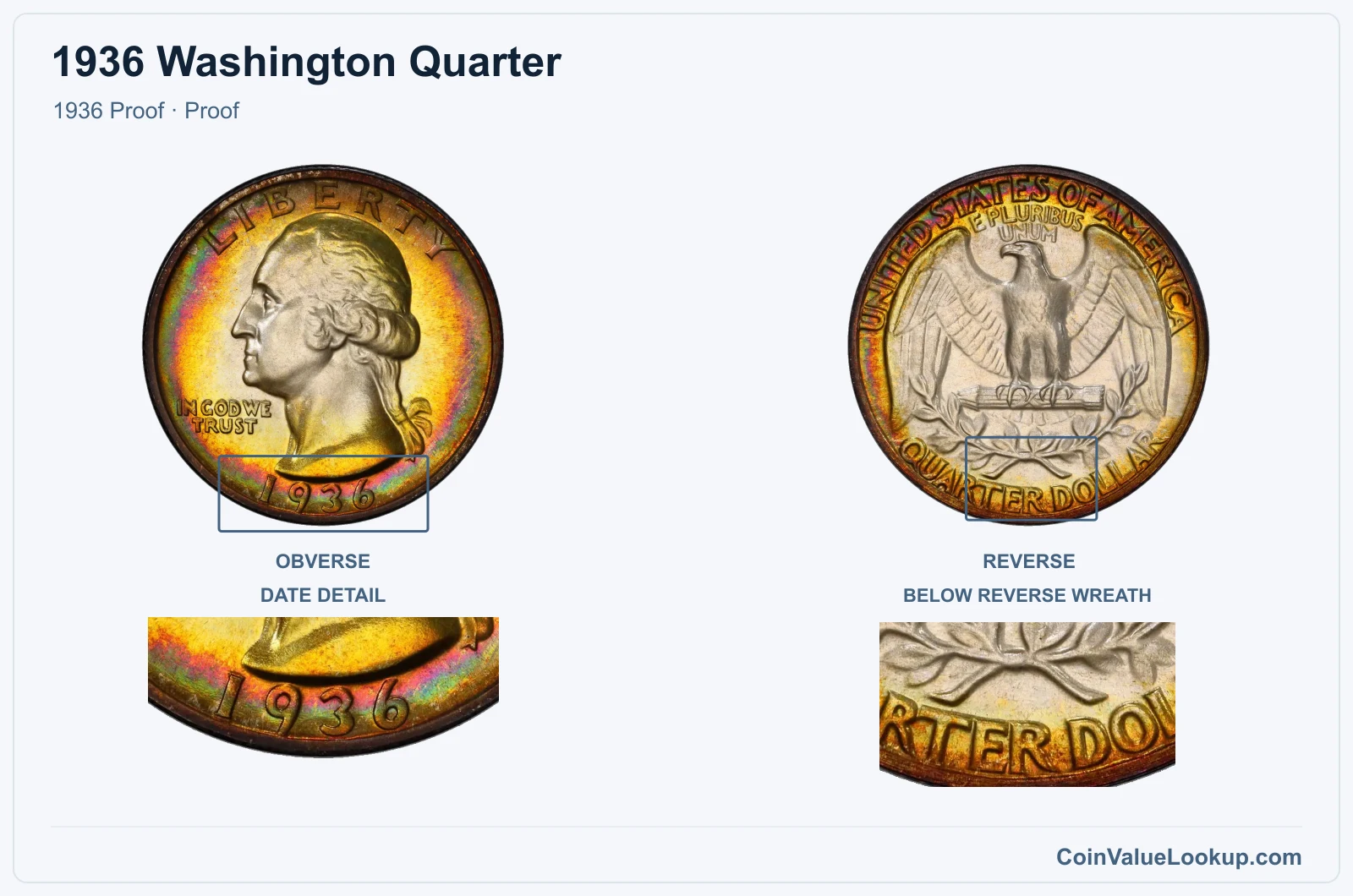
The 1936 proof quarter was manufactured at Philadelphia using specially prepared dies and polished planchets, producing deeply mirrored fields and razor-sharp design detail. Like the business strike, it carries no mintmark.
These are genuinely scarce coins. A PR65 example carries a USA Coin Book guide estimate of approximately $12,169.
That price reflects the limited proof production of the era and sustained collector demand for early Washington quarter proofs.
How do you tell a proof from a shiny business strike? Real proofs show a liquid-mirror surface in the flat fields, and the design elements stand in high relief against that background.
A polished or lightly circulated business strike may gleam, but it lacks the uniform reflective depth of a proof field. If you are unsure, professional authentication is the safest path.
Coin Value Lookup is a good starting point if you want to compare your coin across different Washington quarter years and mints before deciding whether to pursue certification.
| Range | Grade | Price | Auction Records | Appraisal |
|---|---|---|---|---|
| PR | PR 1 | — | Coin Identifier | |
| PR 2 | — | Coin Identifier | ||
| PR 3 | — | Coin Identifier | ||
| PR 4 | — | Coin Identifier | ||
| PR 6 | — | Coin Identifier | ||
| PR 8 | — | Coin Identifier | ||
| PR 10 | — | Coin Identifier | ||
| PR 12 | — | Coin Identifier | ||
| PR 15 | — | Coin Identifier | ||
| PR 20 | — | Coin Identifier | ||
| PR 25 | — | Coin Identifier | ||
| PR 30 | — | Coin Identifier | ||
| PR 35 | — | Coin Identifier | ||
| PR 40 | — | Coin Identifier | ||
| PR 45 | — | Coin Identifier | ||
| PR 50 | — | Coin Identifier | ||
| PR 53 | — | Coin Identifier | ||
| PR 55 | — | Coin Identifier | ||
| PR 58 | Coin Identifier | |||
| PR 60 | Coin Identifier | |||
| PR 61 | Coin Identifier | |||
| PR 62 | Coin Identifier | |||
| PR 63 | Coin Identifier | |||
| PR 64 | Coin Identifier | |||
| PR 65 | Coin Identifier | |||
| PR 66 | Coin Identifier | |||
| PR 67 | Coin Identifier | |||
| PR 68 | — | Coin Identifier | ||
| PR 69 | — | — | — | |
| PR 70 | — | — | — |
1936 Washington Quarter — D
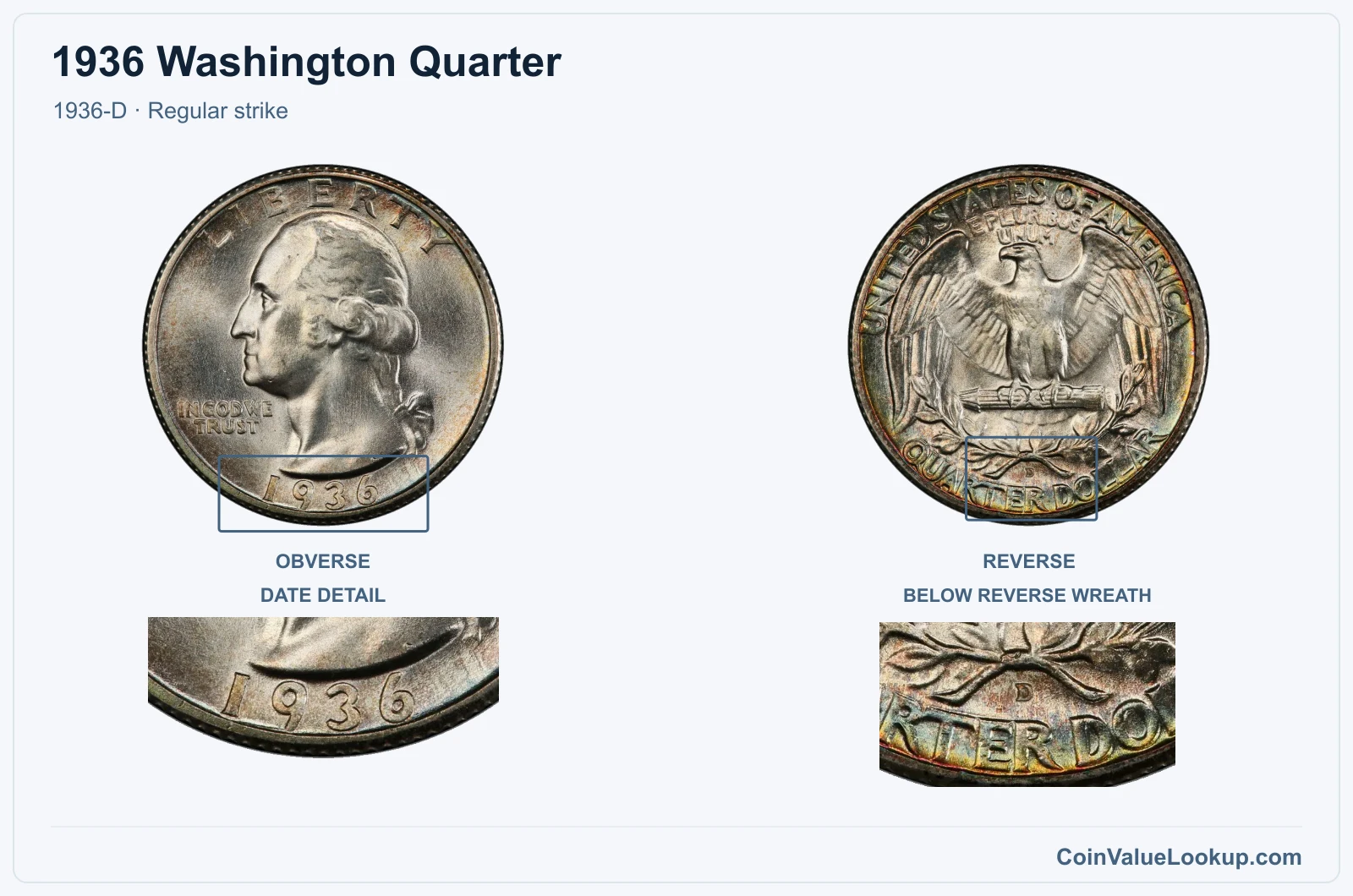
The 1936-D is the key business-strike issue of the year. Look for the small "D" mintmark below the wreath tie on the reverse.
Denver production was lower, and survival in upper grades is tough.
Guide estimates reflect that scarcity. A Good-4 example sits around $35 — already more than double the Philadelphia coin in the same grade.
At MS60 the estimate jumps to about $730, and an MS65 reaches roughly $1,252 according to USA Coin Book.
Because of the premium, authentication matters. Altered mintmarks do exist, so examine the D under magnification for tool marks or unusual positioning.
A genuine D should sit cleanly in the expected location with consistent depth.
| Range | Grade | Price | Auction Records | Appraisal |
|---|---|---|---|---|
| PO | PO 1 | — | Coin Identifier | |
| FR | FR 2 | — | Coin Identifier | |
| AG | AG 3 | Coin Identifier | ||
| G | G 4 | Coin Identifier | ||
| G 6 | — | Coin Identifier | ||
| VG | VG 8 | — | Coin Identifier | |
| VG 10 | — | Coin Identifier | ||
| F | F 12 | — | Coin Identifier | |
| F 15 | Coin Identifier | |||
| VF | VF 20 | — | Coin Identifier | |
| VF 25 | — | Coin Identifier | ||
| VF 30 | Coin Identifier | |||
| VF 35 | — | Coin Identifier | ||
| XF | XF 40 | Coin Identifier | ||
| XF 45 | Coin Identifier | |||
| AU | AU 50 | Coin Identifier | ||
| AU 53 | Coin Identifier | |||
| AU 55 | Coin Identifier | |||
| AU 58 | Coin Identifier | |||
| MS | MS 60 | — | Coin Identifier | |
| MS 61 | Coin Identifier | |||
| MS 62 | Coin Identifier | |||
| MS 63 | Coin Identifier | |||
| MS 64 | Coin Identifier | |||
| MS 65 | Coin Identifier | |||
| MS 66 | Coin Identifier | |||
| MS 67 | Coin Identifier | |||
| MS 68 | — | — | — | |
| MS 69 | — | — | — | |
| MS 70 | — | — | — |
1936 Washington Quarter — S
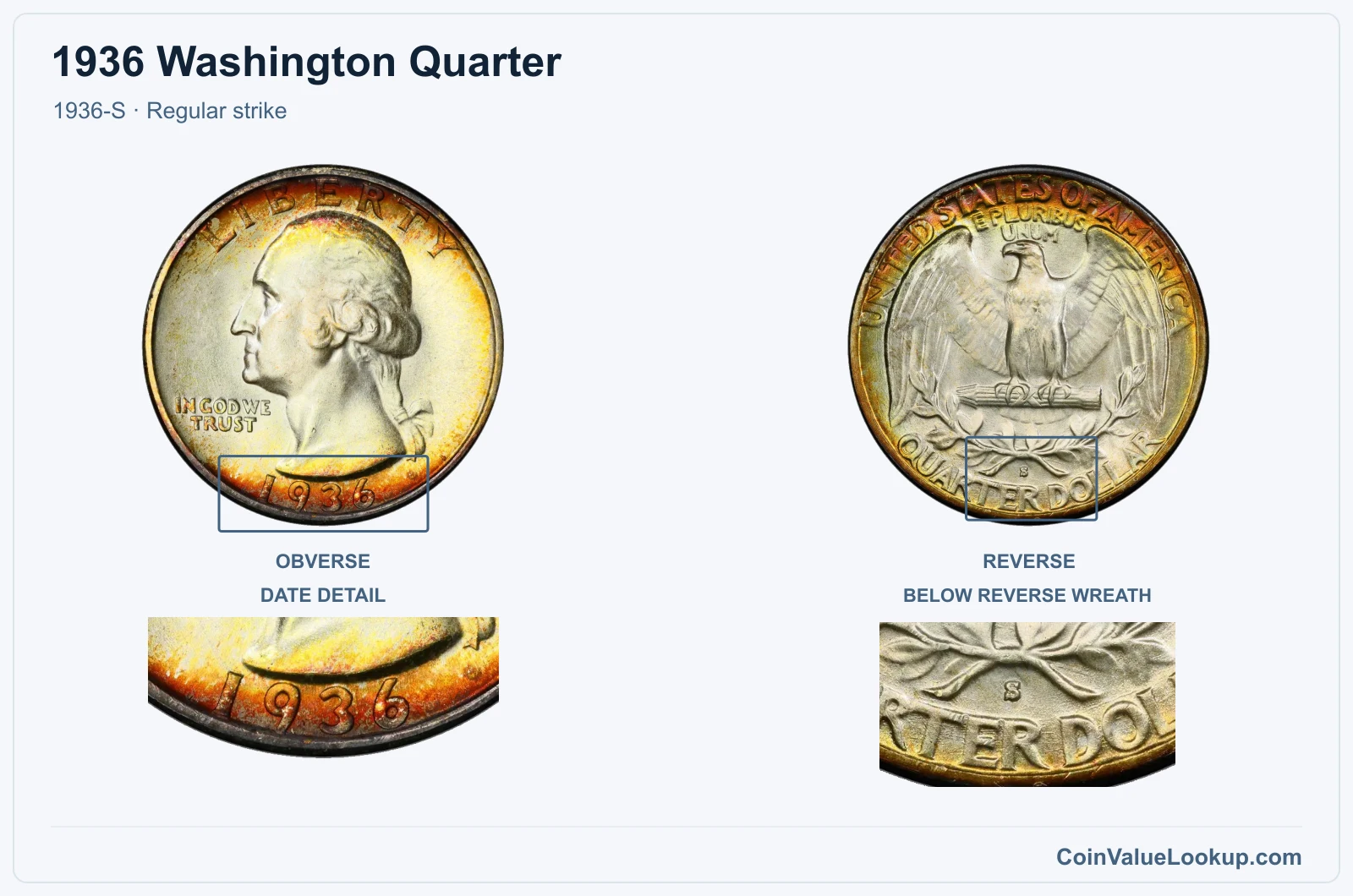
The 1936-S carries a small "S" mintmark below the wreath on the reverse, indicating San Francisco production. In lower circulated grades, values track close to the Philadelphia issue — about $16.43 at Good-4 per USA Coin Book estimates.
The gap widens in higher grades. An MS60 example is estimated near $156, and MS65 reaches roughly $298.
That is well below the Denver coin but still a meaningful premium over Philadelphia. San Francisco coins from this period sometimes show softer strikes, so check the hair detail and eagle breast carefully before assuming wear.
| Range | Grade | Price | Auction Records | Appraisal |
|---|---|---|---|---|
| PO | PO 1 | — | Coin Identifier | |
| FR | FR 2 | — | Coin Identifier | |
| AG | AG 3 | — | Coin Identifier | |
| G | G 4 | — | Coin Identifier | |
| G 6 | — | Coin Identifier | ||
| VG | VG 8 | — | Coin Identifier | |
| VG 10 | — | Coin Identifier | ||
| F | F 12 | — | Coin Identifier | |
| F 15 | — | Coin Identifier | ||
| VF | VF 20 | — | Coin Identifier | |
| VF 25 | — | Coin Identifier | ||
| VF 30 | — | Coin Identifier | ||
| VF 35 | — | Coin Identifier | ||
| XF | XF 40 | — | Coin Identifier | |
| XF 45 | Coin Identifier | |||
| AU | AU 50 | Coin Identifier | ||
| AU 53 | Coin Identifier | |||
| AU 55 | Coin Identifier | |||
| AU 58 | Coin Identifier | |||
| MS | MS 60 | — | Coin Identifier | |
| MS 61 | — | Coin Identifier | ||
| MS 62 | Coin Identifier | |||
| MS 63 | Coin Identifier | |||
| MS 64 | Coin Identifier | |||
| MS 65 | Coin Identifier | |||
| MS 66 | Coin Identifier | |||
| MS 67 | Coin Identifier | |||
| MS 68 | Coin Identifier | |||
| MS 69 | — | — | — | |
| MS 70 | — | — | — |
1936 Washington Quarter Error List
1. 1936 Washington Quarter — Doubled Die Obverse
The 1936 Philadelphia doubled die obverse is a legitimate die variety where the motto IN GOD WE TRUST shows clear doubled letter outlines. LIBERTY and the date may show lesser but visible doubling as well.
The doubling was created during the die-making process, so it repeats in a consistent, die-made pattern across affected coins.
To check yours, use at least 5x magnification on the motto letters. Genuine die doubling produces a second set of letter outlines that follows a uniform direction.
Flat, shelf-like machine doubling — caused by die bounce during striking — looks different: it tends to appear as a flat shelf on one side of the letter rather than a full secondary outline. Scratches and post-mint damage also mimic doubling at a glance.
A PCGS-graded MS63 example sold at Heritage Auctions in February 2017 for $1,116.25, giving a concrete reference point for a mid-grade uncirculated specimen of this variety.
2. 1936 Washington Quarter — Off-Center Strike
An off-center strike occurs when the planchet is not properly seated in the collar before the dies come together, producing a displaced design and an unstruck crescent of blank metal along part of the rim. The further off center the strike, the more dramatic the visual, but the date must remain visible for the coin to be readily attributable to 1936.
Do not confuse an off-center strike with a clipped planchet, which shows a curved bite out of the edge, or with one-sided die misalignment, which shifts one side relative to the other without leaving blank metal. Post-mint flattening from damage can also create an uneven appearance.
Value depends on condition, the percentage of displacement and whether key design elements — especially the date — are intact. Each piece is essentially unique, so individual assessment is necessary.
3. 1936 Washington Quarter — Die Crack / Die Chip
Die cracks and die chips appear as raised lines or small raised blobs on the coin's surface, transferred from fractures in the steel die. A crack running to the rim that produces a raised lump of unstruck metal is sometimes called a cud — these are the most visually dramatic examples.
Interior die cracks show up as thin raised lines across the design or fields. Small die chips look like tiny raised dots or bumps, often near letters or design elements.
The key word is raised: incuse scratches, corrosion pitting and foreign material sitting on the surface are not die cracks.
Because each die crack is unique to its die state, value depends on the size, location and visual impact of the crack, plus the overall condition of the coin. A large rim cud will generally attract more interest than a hairline interior crack.
4. 1936 Washington Quarter — Repunched Mintmark
A repunched mintmark occurs when the mintmark punch was applied more than once in slightly different positions, leaving remnants of the earlier placement visible under magnification. On a 1936 quarter, this would appear on the D or S mintmark below the reverse wreath.
Look closely at the mintmark edges. A repunched mark may show a second outline, a notch or a shadow of the letter offset from the primary impression.
Compare what you see to the mintmark on a known normal example at the same magnification — the difference should be obvious if a repunch is present.
Machine doubling near the mintmark, small die chips and corrosion can all mimic a repunched mintmark to the untrained eye. Genuine repunching shows a distinct secondary impression with its own contour, not a flat shelf or random pitting.
Value depends on the clarity of the extra impression and the coin's overall condition.
5. 1936 Washington Quarter — Clashed Dies
Clashed dies result when the obverse and reverse dies strike each other without a planchet between them. The impact transfers traces of the opposite design onto each die, and those ghost images then appear on subsequent coins as faint incuse or raised impressions in areas that should be blank.
On a 1936 quarter, look for faint outlines of the eagle or wing feathers on Washington's cheek or neck area on the obverse, or traces of Washington's profile appearing in the reverse fields. The transferred design elements will align with where the opposite die's features would meet.
Do not confuse die clash marks with random scratches, raised lines from die cracks, or a brockage — which involves striking against a previously struck coin rather than a bare die. Value for clashed-die coins depends on how visible the transferred design is and the overall condition of the piece.