1967 Kennedy Half Dollar Coin Value: How Much Is It Worth?
The 1967 Kennedy half dollar is a 40% silver coin still commonly found in collections and coin rolls. A worn example tracks closely with the silver market, with a guide estimate around $13.31, while a gem Mint State 65 regular strike carries a guide value near $99 according to USA Coin Book.
Two distinct finishes exist for this date, and several documented errors can push values well above those baselines.
Fast Way to Identify Your 1967 Kennedy Half Dollar
The quickest way to start figuring out what you have is to upload clear photos of both the front and back of your coin. Our identifier can provide a preliminary identification based on those images, helping you sort out which finish and variety you might be holding.
From there you can compare details against the specific versions and errors described below.
1967 Kennedy Half Dollar Value
Upload both sides of your 1967 Kennedy Half Dollar.
Front Obverse
Upload photo
Back Reverse
Upload photo
Which 1967 Kennedy Half Dollar Versions Are Worth Money?
- A 1967 regular business strike in MS65 condition carries a guide estimate near $99, well above its silver melt value.
- The 1967 SMS finish is a distinct special strike worth individual assessment based on authenticated condition and identity.
- A recognized quadrupled-die obverse variety on the SMS finish shows dramatic raised doubling in the motto and date area.
- A confirmed struck-on-quarter-blank error sold for $1,769 in MS65 at Heritage Auctions in June 2026.
- A matched separated clad layer pair graded AU58 by PCGS realized $390.40 at Heritage Auctions in June 2026.
- A curved clipped planchet error in AU58, certified by ANACS, sold for $50 at Heritage in March 2022.
Step 1: Identify Your 1967 Kennedy Half Dollar Mint Mark and Version
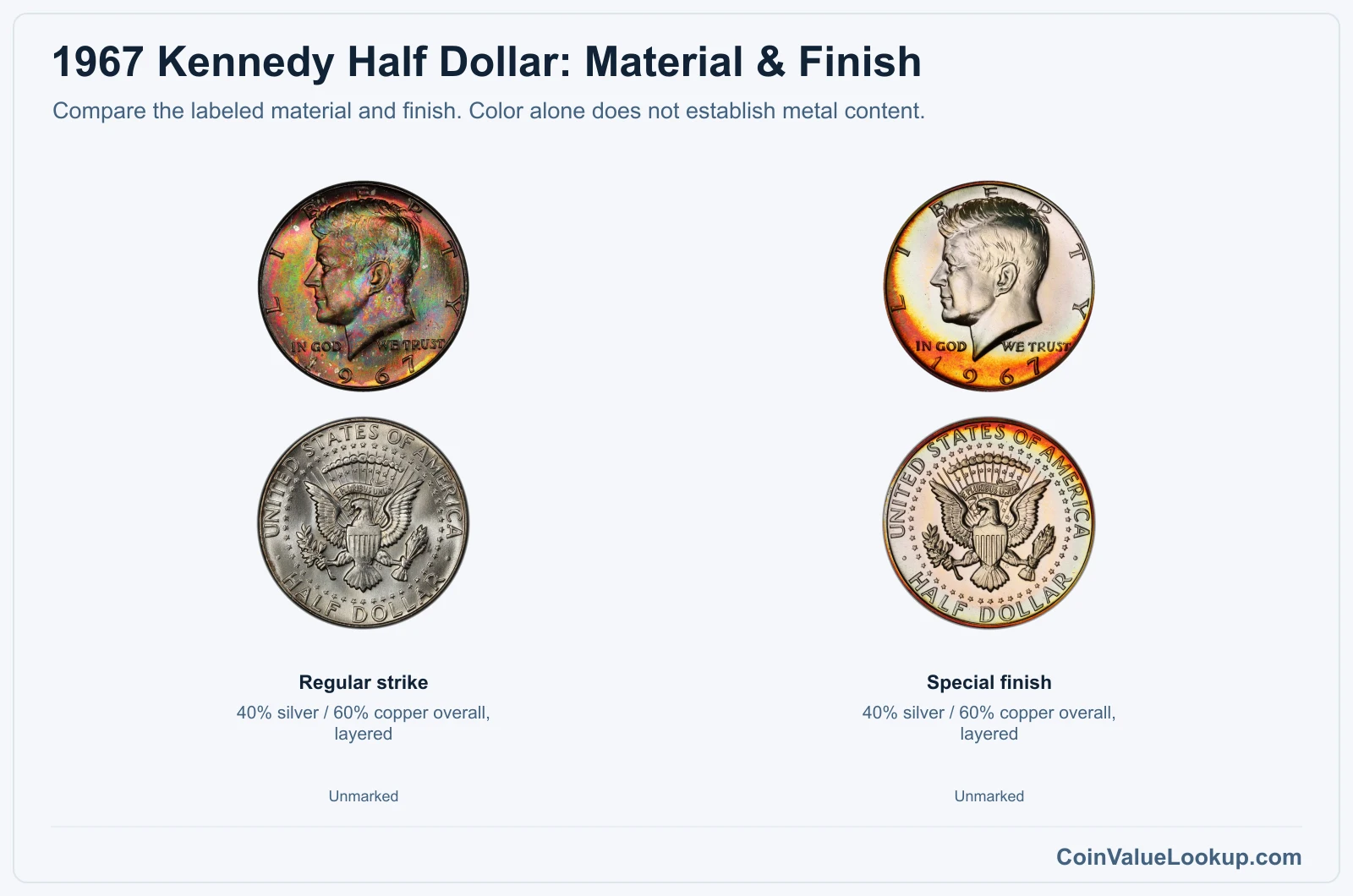
Every 1967 Kennedy half dollar lacks a mintmark. That is normal for this date, so do not assume a missing-mintmark error or look for an S stamp.
The coin weighs roughly 11.50 grams and measures about 30.61 mm across.
It is made from a layered 40% silver and 60% copper composition, with outer layers of 80% silver and an inner layer of about 20.9% silver. This puts it firmly in the silver-clad era, not the later copper-nickel clad series.
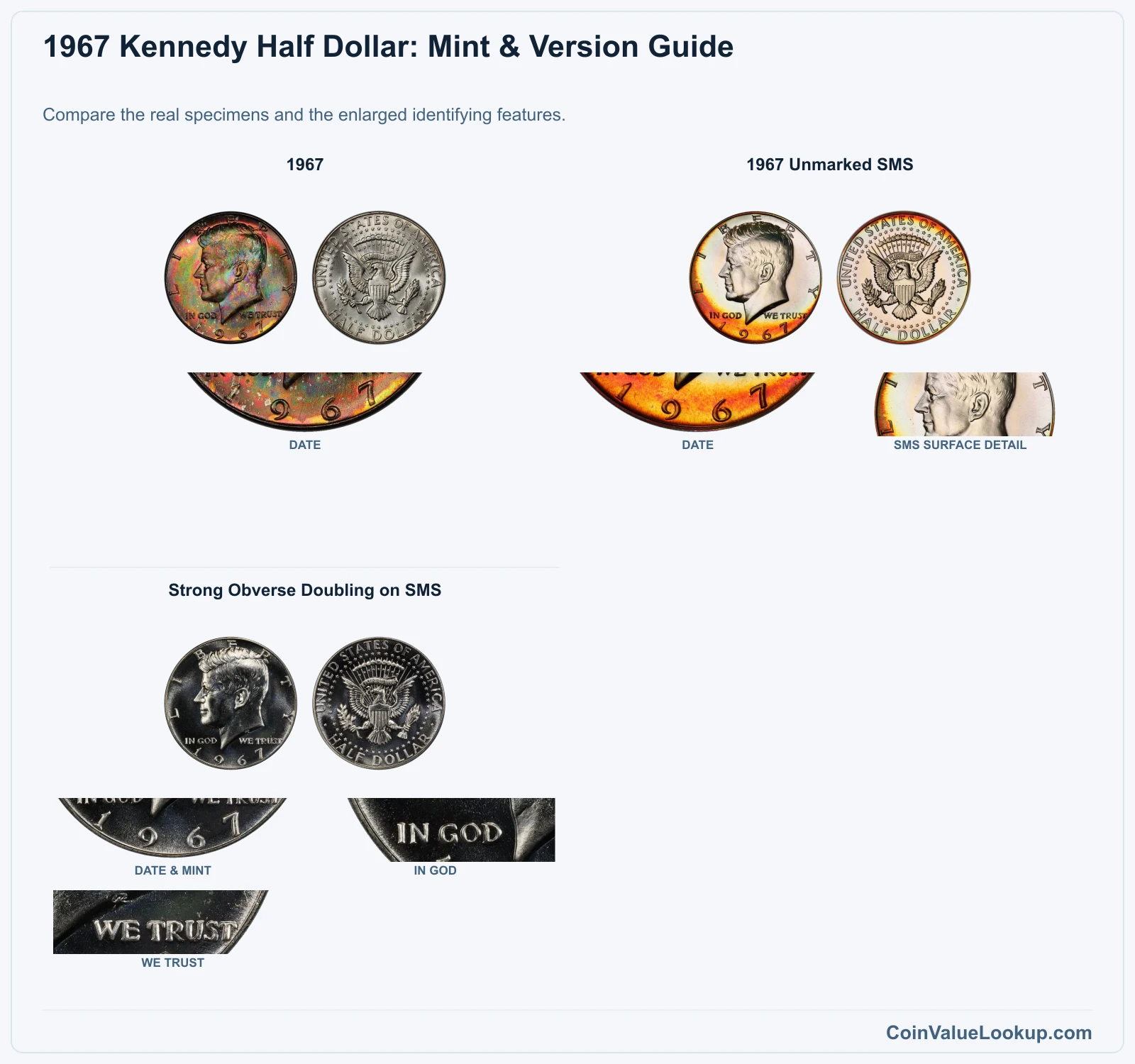
Two finishes were produced: a regular business strike and a Special Mint Set (SMS) strike. Both are unmarked.
The SMS is a special manufacturing process, not a proof and not simply a higher-grade business strike. SMS coins often show a sharper, more reflective finish than their business-strike counterparts, though telling them apart takes practice and side-by-side comparison.
Starting in 1968, a D or S mintmark appears on the obverse below Kennedy's neck, but for 1966 and 1967 there is nothing there on either version.
Step 2: Check Your 1967 Kennedy Half Dollar Grade
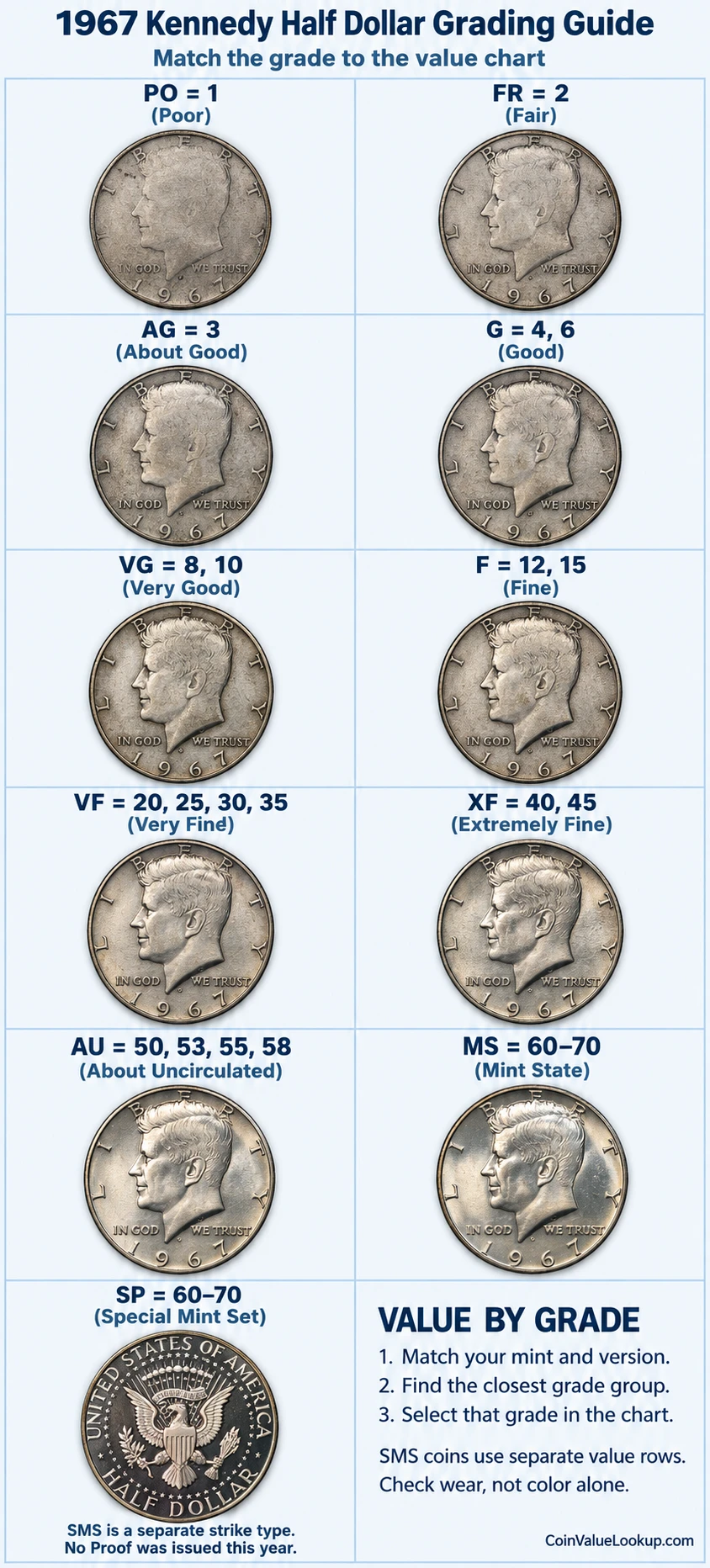
Focus first on the hair detail above Kennedy's ear and across his cheek and jawline. On a well-circulated coin those areas flatten and lose luster early.
A coin with full, unbroken luster across both sides is a candidate for Mint State grades.
Flip it over and check the eagle's breast feathers, tail feathers and the shield. Weak detail there can sometimes be a strike issue rather than wear, so compare your coin to a known same-type example before assuming heavy circulation.
Hairlines and contact marks are different from wear. Hairlines are thin, often parallel scratches usually caused by cleaning or rough storage.
Contact marks are deeper, random dings from coins banging together in bags. Both reduce the grade but neither means the coin was spent.
SMS coins are graded on the same numeric scale as business strikes. An SMS finish does not automatically place a coin above Mint State, and cameo contrast, while attractive, does not by itself determine silver content or a higher technical grade.
Use the comparison image to match your coin's surfaces to a reference at the same grade level.
Step 3: Check 1967 Kennedy Half Dollar Value by Mint and Version
1967 Kennedy Half Dollar
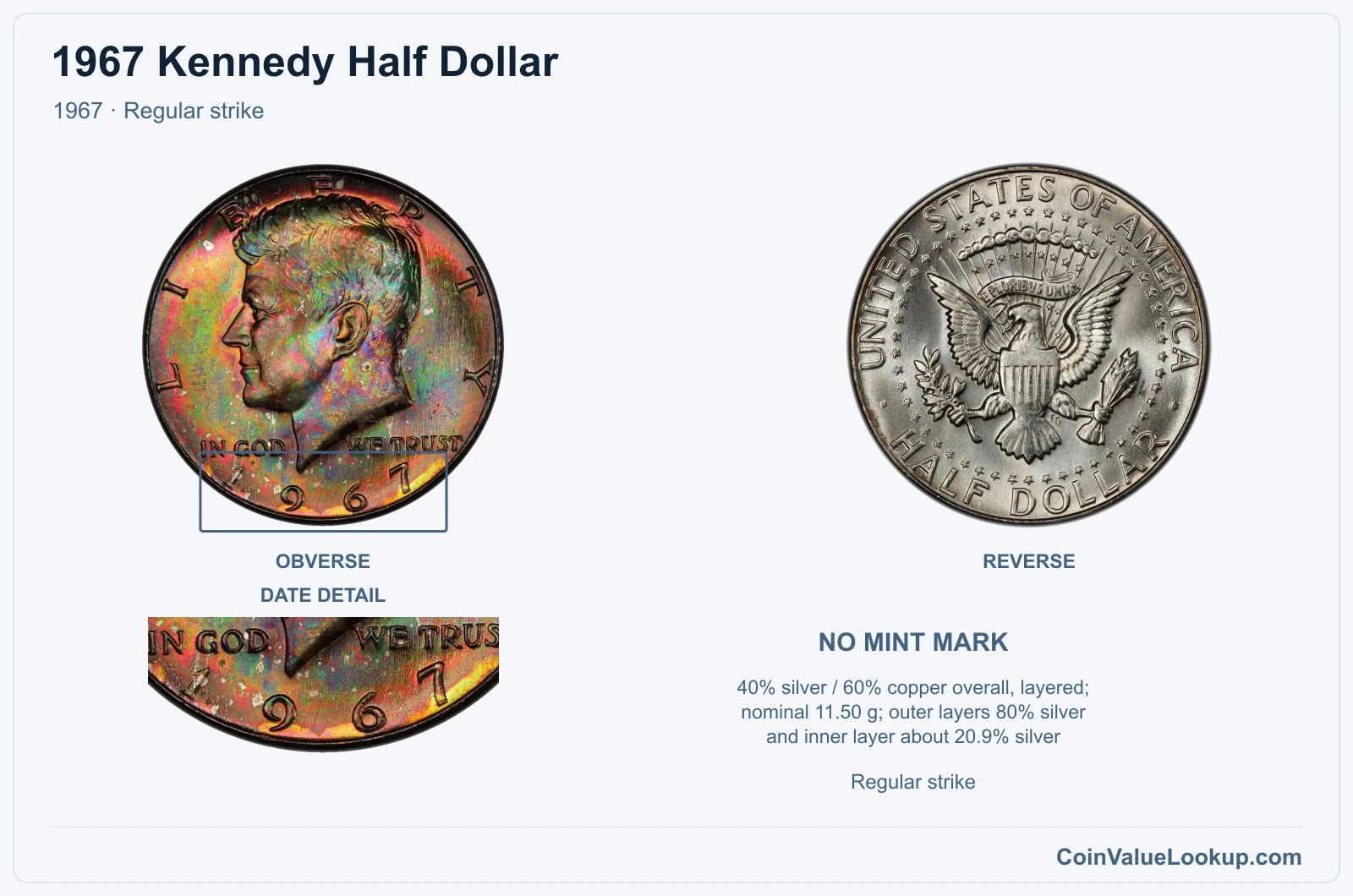
This is the standard 1967 Kennedy half dollar business strike. No mintmark, 40% silver layered composition, 11.50 grams.
The obverse carries the familiar Kennedy portrait and the reverse shows the presidential-seal eagle.
Guide estimates from USA Coin Book place this coin at about $14.35 in MS60 and roughly $99 in MS65. Circulated examples trade near their silver content, which fluctuates with the metal market.
In lower Mint State grades the premium over melt is modest, but a true MS65 with clean surfaces commands a real jump.
If your coin lacks the sharper, more reflective look of an SMS strike and came from general circulation or a bank roll, this is almost certainly what you have.
| Range | Grade | Price | Auction Records | Appraisal |
|---|---|---|---|---|
| PO | PO 1 | — | Coin Identifier | |
| FR | FR 2 | Coin Identifier | ||
| AG | AG 3 | Coin Identifier | ||
| G | G 4 | — | Coin Identifier | |
| G 6 | — | Coin Identifier | ||
| VG | VG 8 | — | Coin Identifier | |
| VG 10 | — | Coin Identifier | ||
| F | F 12 | — | Coin Identifier | |
| F 15 | — | Coin Identifier | ||
| VF | VF 20 | — | Coin Identifier | |
| VF 25 | — | Coin Identifier | ||
| VF 30 | — | Coin Identifier | ||
| VF 35 | — | Coin Identifier | ||
| XF | XF 40 | — | Coin Identifier | |
| XF 45 | — | Coin Identifier | ||
| AU | AU 50 | — | Coin Identifier | |
| AU 53 | Coin Identifier | |||
| AU 55 | — | Coin Identifier | ||
| AU 58 | Coin Identifier | |||
| MS | MS 60 | — | Coin Identifier | |
| MS 61 | Coin Identifier | |||
| MS 62 | Coin Identifier | |||
| MS 63 | Coin Identifier | |||
| MS 64 | Coin Identifier | |||
| MS 65 | Coin Identifier | |||
| MS 66 | Coin Identifier | |||
| MS 67 | Coin Identifier | |||
| MS 68 | — | — | — | |
| MS 69 | — | — | — | |
| MS 70 | — | — | — |
1967 Kennedy Half Dollar — Unmarked SMS
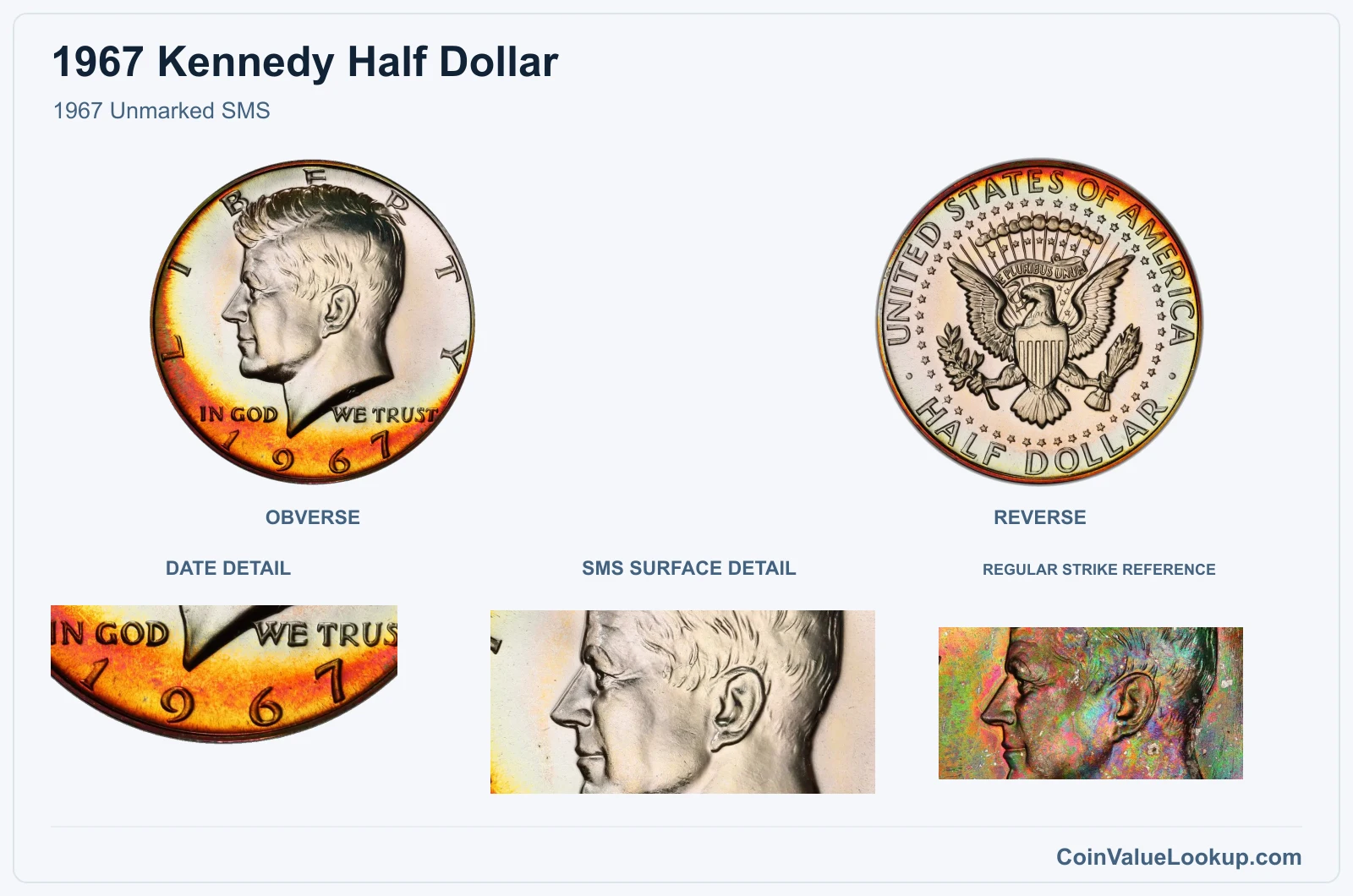
The 1967 SMS Kennedy half dollar was produced for Special Mint Sets sold directly by the U.S. Mint during the years when proof sets were not offered. Same composition as the regular strike, same absent mintmark, but the manufacturing process gave these coins a distinctly sharper, often semi-reflective finish.
Telling an SMS from a business strike requires careful comparison. Look for crisper device edges and more mirror-like fields than a typical bag coin would show.
If your coin came in an original government-sealed SMS holder, that settles it.
Coin Value Lookup is a good starting point if you want to compare guide values across different Kennedy half dollar years and finishes.
No single supported guide price is adopted for this version. Value depends on authenticated identity, condition and whether any variety or error is present, so individual assessment matters here.
| Range | Grade | Price | Auction Records | Appraisal |
|---|---|---|---|---|
| PR | PR 1 | — | Coin Identifier | |
| PR 2 | — | Coin Identifier | ||
| PR 3 | — | Coin Identifier | ||
| PR 4 | — | Coin Identifier | ||
| PR 6 | — | Coin Identifier | ||
| PR 8 | — | Coin Identifier | ||
| PR 10 | — | Coin Identifier | ||
| PR 12 | — | Coin Identifier | ||
| PR 15 | — | Coin Identifier | ||
| PR 20 | — | Coin Identifier | ||
| PR 25 | — | Coin Identifier | ||
| PR 30 | — | Coin Identifier | ||
| PR 35 | — | Coin Identifier | ||
| PR 40 | — | Coin Identifier | ||
| PR 45 | — | Coin Identifier | ||
| PR 50 | — | Coin Identifier | ||
| PR 53 | — | Coin Identifier | ||
| PR 55 | — | Coin Identifier | ||
| PR 58 | Coin Identifier | |||
| PR 60 | — | Coin Identifier | ||
| PR 61 | — | Coin Identifier | ||
| PR 62 | Coin Identifier | |||
| PR 63 | Coin Identifier | |||
| PR 64 | Coin Identifier | |||
| PR 65 | Coin Identifier | |||
| PR 66 | Coin Identifier | |||
| PR 67 | Coin Identifier | |||
| PR 68 | Coin Identifier | |||
| PR 69 | — | — | — | |
| PR 70 | — | — | — |
1967 Kennedy Half Dollar — Strong Obverse Doubling on SMS
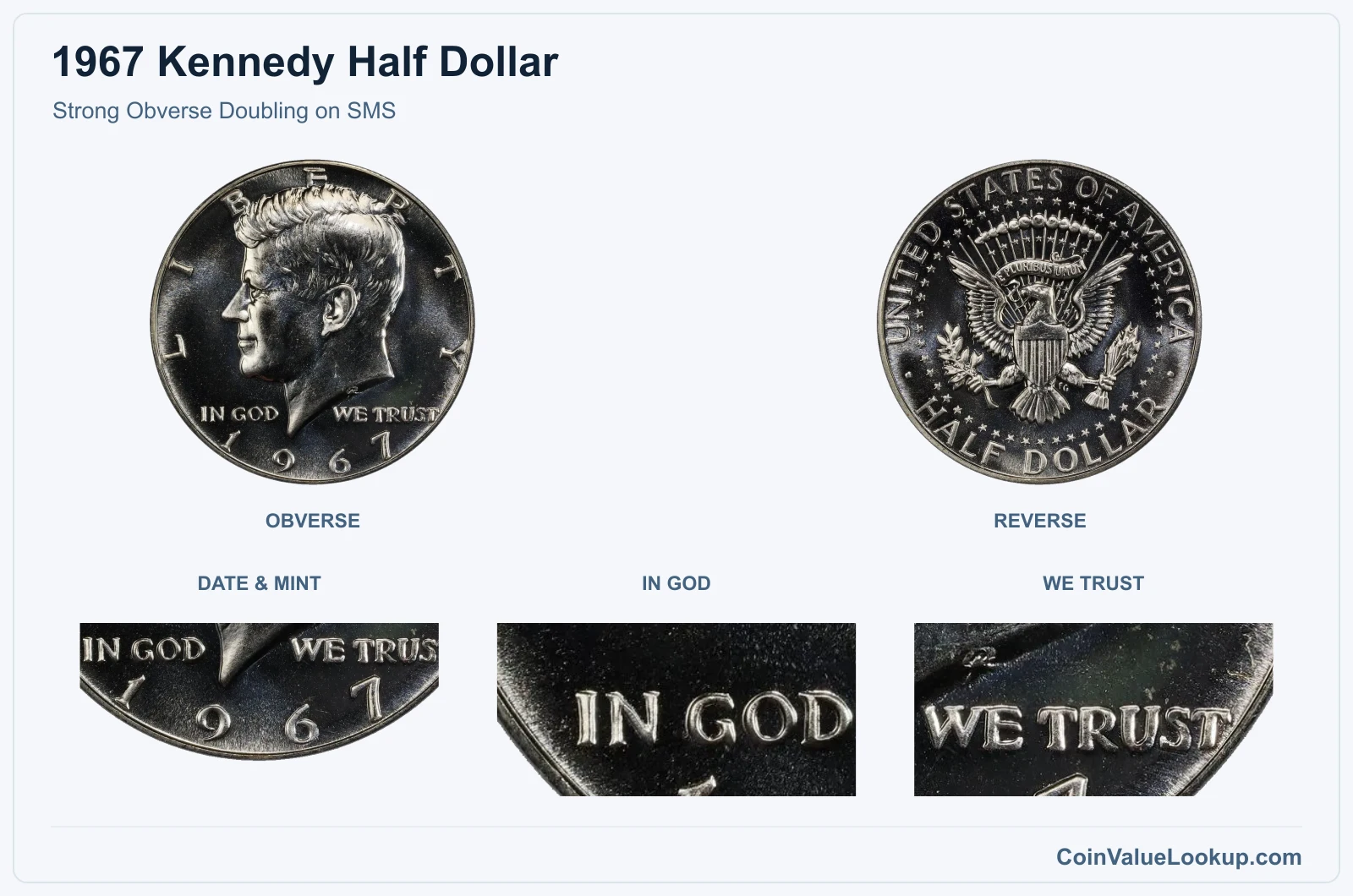
This is the recognized quadrupled-die obverse variety found on the 1967 SMS Kennedy half dollar. The diagnostic is multiple raised impressions and visible thickening in the motto lettering and the date area on the obverse.
It is not subtle once you know what to look for.
Hub doubling like this happens during the die-making process, when the hub impresses the die more than once with slight misalignment each time. The result is permanently raised extra metal on every coin struck from that die.
Compare the motto lettering on a suspect coin to a normal 1967 SMS example side by side. On the doubled version the letters look noticeably thicker or show distinct secondary outlines.
Do not confuse this with flat, shelf-like machine doubling, which is a lower-value strike artifact. No supported guide price is adopted, so value depends on authenticated identity and condition.
Range Grade
Price Auction Records Appraisal SP SP 1
—
Coin Identifier
SP 2
—
Coin Identifier
SP 3
—
Coin Identifier
SP 4
—
Coin Identifier
SP 6
—
Coin Identifier
SP 8
—
Coin Identifier
SP 10
—
Coin Identifier
SP 12
—
Coin Identifier
SP 15
—
Coin Identifier
SP 20
—
Coin Identifier
SP 25
—
Coin Identifier
SP 30
—
Coin Identifier
SP 35
—
Coin Identifier
SP 40
—
Coin Identifier
SP 45
—
Coin Identifier
SP 50
—
Coin Identifier
SP 53
—
Coin Identifier
SP 55
—
Coin Identifier
SP 58
—
Coin Identifier
SP 60
—
Coin Identifier
SP 61
—
Coin Identifier
SP 62
—
Coin Identifier
SP 63
—
Coin Identifier
SP 64
—
Coin Identifier
SP 65
Coin Identifier
SP 66
Coin Identifier
SP 67
Coin Identifier
SP 68
—
—
—
SP 69
—
—
—
SP 70
—
—
—
1967 Kennedy Half Dollar Error List
1. 1967 Kennedy Half Dollar — Strong Obverse Doubling on SMS
The strong obverse doubling variety on the 1967 SMS Kennedy half dollar shows a quadrupled die impression. You will see multiple raised outlines and thickened lettering in the motto (IN GOD WE TRUST) and the date.
The effect is caused by repeated, slightly shifted hub impressions during die manufacture, locking extra raised metal into the die itself.
To check yours, place it next to a normal 1967 SMS coin and compare the lettering thickness. The difference should be obvious without magnification on a well-preserved example.
Machine doubling, which is flat and shelf-like rather than raised, is not the same thing and does not carry the same premium. Glare, post-mint damage and actual double strikes are also lookalikes to rule out.
No supported numerical price is adopted for this variety. Value depends on authenticated identity, condition and severity of the doubling.
2. 1967 Kennedy Half Dollar — Separated Clad Layer with Matching Piece
This error involves the physical separation of one of the layered silver-clad layers from the host coin. On the 1967 Kennedy half dollar, this means part of the 40% silver sandwich structure has come apart during or after striking, leaving a thinner host coin and a matching detached piece.
The key to authentication is keeping both pieces together and confirming they fit. The detached layer and host should show struck design details and matching date and mint characteristics.
Post-mint cutting, filing or peeling of plating on a different coin type is not the same error.
A matched pair of this error, graded AU58 by PCGS, sold at Heritage Auctions in June 2026 for $390.40 total for both pieces. That gives you a reference point, though condition and completeness of the match will influence what any individual pair brings.
3. 1967 Kennedy Half Dollar — Struck on a Quarter Blank
A 1967 Kennedy half dollar struck on a quarter-size blank is a dramatic wrong-planchet error. The certified example weighs just 5.7 grams, roughly half the normal 11.50 grams of a standard half dollar blank.
That weight alone is a dead giveaway.
Visually the coin will be noticeably smaller in diameter than a regular half, with peripheral design elements lost or incomplete because the smaller blank could not reach the full extent of the dies. The date and central portrait should still be identifiable, which is how the coin gets attributed as a half dollar rather than a quarter.
Do not confuse this with a coin that has been cut down, filed or otherwise altered after leaving the Mint. Authenticated struck surfaces and proper weight are essential.
A specimen graded NGC MS65 sold at Heritage Auctions in June 2026 for $1,769.
4. 1967 Kennedy Half Dollar — Curved Clipped Planchet
A curved clipped planchet error occurs when the blank is punched from strip metal that overlaps a previously punched hole. The result is a smooth, curved bite missing from the edge of the coin before it is ever struck.
On a genuine clip, look for the smooth clip boundary where it meets the rim, and check the opposite side of the coin for a weak rim area known as the Blakesley effect, which is caused by incomplete metal flow opposite the missing section. A coin that has been cut or filed after minting will lack these diagnostics.
A 1967 Kennedy half dollar with a curved clip, graded AU58 by ANACS, sold at Heritage Auctions on March 28, 2022 (lot 45179) for $50. Size of the clip, grade and eye appeal all affect what these bring at auction.
5. 1967 Kennedy Half Dollar — Struck-Through Error
A struck-through error happens when foreign material sits on the die or planchet during striking. The result is a localized depression, an impression of the obstruction, or incomplete design detail in that area.
Grease fills, retained staples and thread impressions are common subtypes, each with a different appearance.
On a 1967 Kennedy half dollar, look for a distinct area where the design is muted, depressed or shows the outline of something that does not belong. This is different from ordinary wear, which is even and follows high points, and different from scratches or cleaning marks, which leave directional lines.
No supported numerical price is adopted for this category. Value depends heavily on the size, location and visibility of the obstruction impression, as well as the coin's overall condition.
A small grease fill on the reverse is far less dramatic than a large retained-object impression across Kennedy's portrait.