1966 Kennedy Half Dollar Coin Value: How Much Is It Worth?
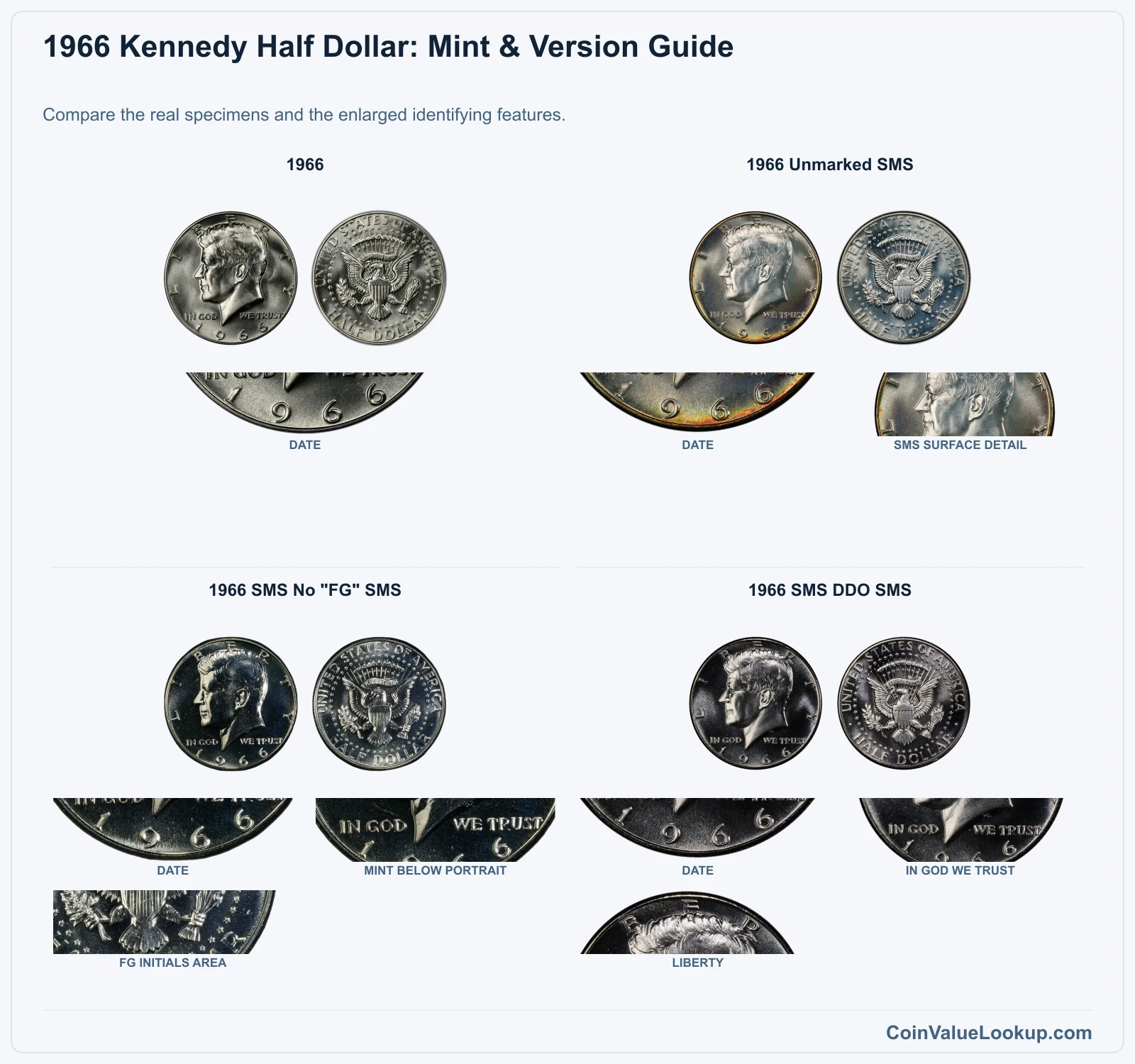
A 1966 Kennedy half dollar is a 40% silver coin, and even a worn example tracks the silver market — guide estimates start around $13.31 for a circulated piece and reach roughly $99 for a regular-issue example graded MS65 (according to USA Coin Book). Silver spot prices shift daily, so that lower figure is a moving target.
Beyond ordinary strikes, a separate Special Mint Set finish exists for this date, along with recognized varieties like the SMS No FG and SMS Doubled Die Obverse. Some error coins from 1966 have sold for hundreds or even thousands.
Read on for what to look for.
Fast Way to Identify Your 1966 Kennedy Half Dollar
The quickest way to start figuring out what you have is to upload clear photos of both the front and back of your coin. Our identifier can give you a preliminary read on the finish, variety and general condition based on those images.
It cannot authenticate, certify or assign a final grade, but it points you in the right direction before you decide on professional services.
1966 Kennedy Half Dollar Value
Upload both sides of your 1966 Kennedy Half Dollar.
Front Obverse
Upload photo
Back Reverse
Upload photo
Which 1966 Kennedy Half Dollar Versions Are Worth Money?
- The 1966 SMS No FG variety — where Frank Gasparro's initials are completely absent from the reverse — is a recognized rarity; one graded SP68 sold for $2,365 in 2014.
- A 1966 SMS coin struck on a clad quarter planchet brought $960 at Heritage Auctions in 2020, graded SP62 by PCGS.
- A 1966 regular-issue half struck on a quarter planchet sold for $575 at Heritage in 2005, graded MS64 by NGC.
- The 1966 SMS Doubled Die Obverse shows raised doubling on IN GOD WE TRUST spreading southward — value depends on the specific die attribution, condition and authentication.
- High-grade regular 1966 halves at MS65 carry a guide estimate around $99, well above melt, driven by eye appeal and preservation.
Step 1: Identify Your 1966 Kennedy Half Dollar Mint Mark and Version
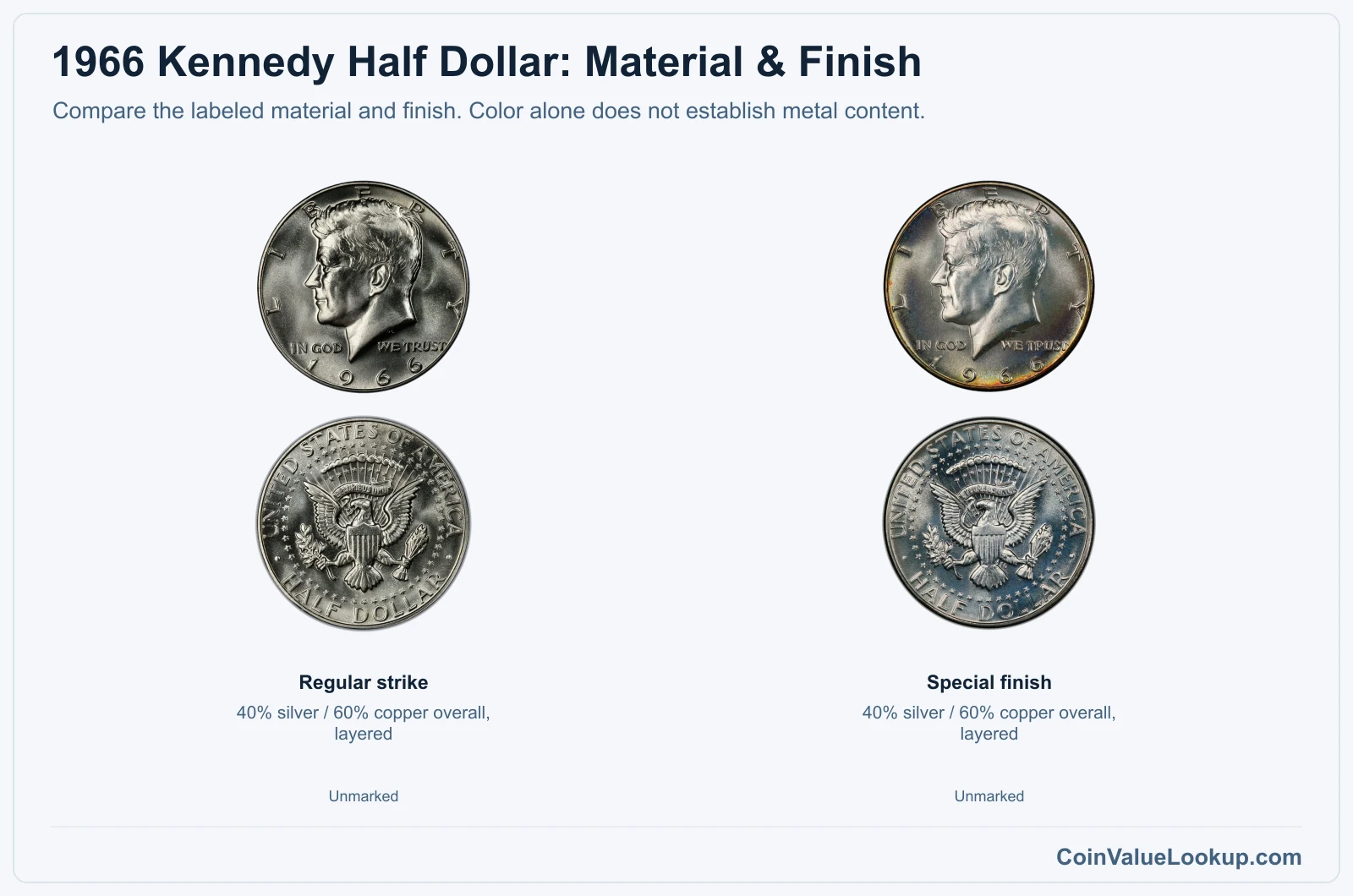
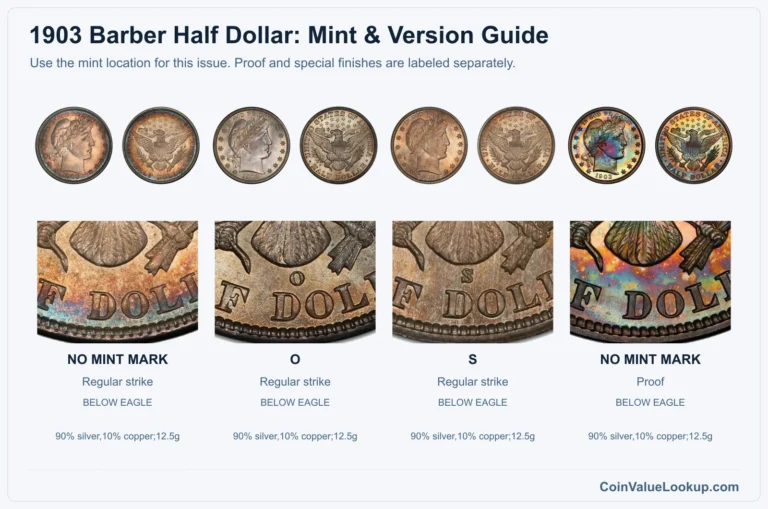
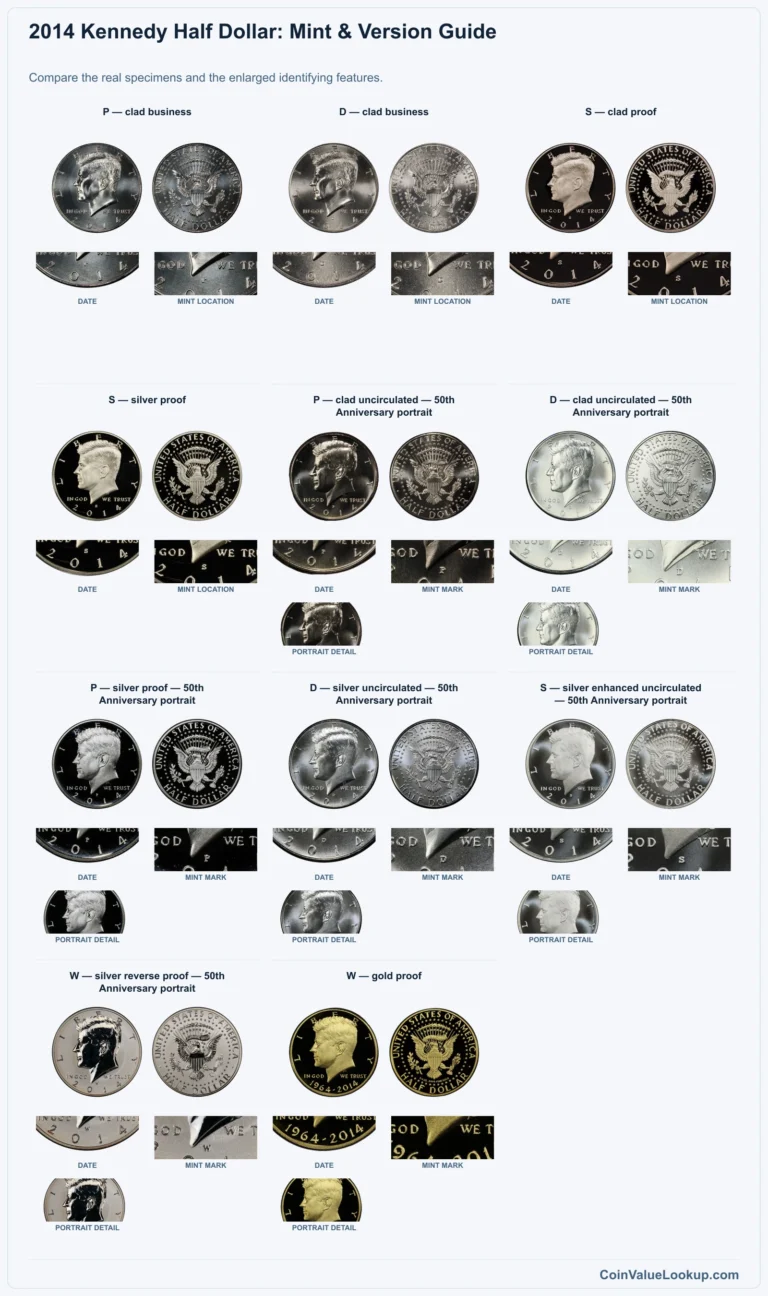
Every 1966 Kennedy half dollar left the Philadelphia Mint without a mintmark. That is normal — do not assume a missing mintmark adds value, and do not look for an "S" stamp on SMS coins.
The S and D marks did not appear on Kennedy halves until 1968.
The coin is 40% silver overall, weighing about 11.50 grams with a diameter of roughly 30.61 mm. Outer layers are 80% silver, while the inner layer is about 20.9% silver.
The edge will show the layered construction if you look closely.
Two finishes exist for this date. Regular circulation strikes have a typical business-strike luster.
Special Mint Set (SMS) coins, sold in sealed government sets, display a distinctive satin-to-brilliant quality with sharper detail — they were made with extra care but are not proofs. Telling them apart takes practice: compare luster quality and strike sharpness against known examples of each finish.
Beyond finish, check the reverse for the designer initials "FG" (Frank Gasparro) between the eagle's left leg and the tail feathers. Their complete absence on an SMS coin points to the recognized No FG variety.
On the obverse, examine IN GOD WE TRUST for raised doubling — a known SMS doubled die shows the motto spread mainly southward.
Step 2: Check Your 1966 Kennedy Half Dollar Grade
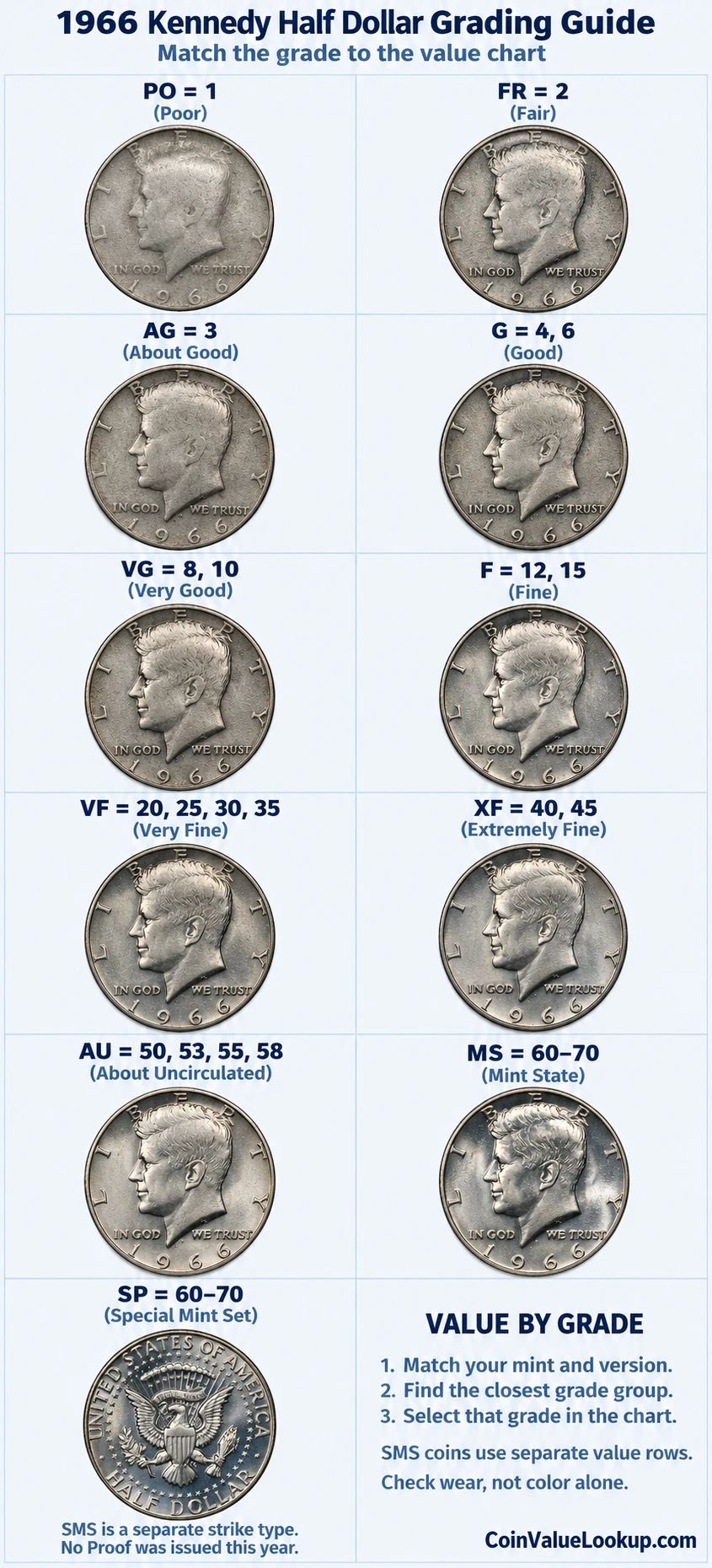
Start on the obverse. Hair detail above the ear and along the part line wears first — look for flatness or a dull patch where luster has been rubbed away.
The cheek and jawline are next. A coin with full luster and no rub across those areas is a candidate for Mint State.
Flip to the reverse. The eagle's breast feathers, tail feathers and horizontal shield lines lose definition with wear, but be careful: some 1966 halves came with a softer strike, so weak breast feathers alone do not prove circulation.
Compare your coin side by side with the grading comparison image to separate strike softness from actual wear.
For SMS coins, hairlines from mishandling in the set holder are common and drag down the grade. Contact marks — small dings from other coins — matter too.
These are not the same as circulation wear, but they still reduce the assigned grade.
Remember that SMS is a manufacturing finish, not a grade above Mint State. A scratched-up SMS coin grades lower than a pristine one.
Brightness or contrast alone does not establish grade or silver content.
Step 3: Check 1966 Kennedy Half Dollar Value by Mint and Version
1966 Kennedy Half Dollar
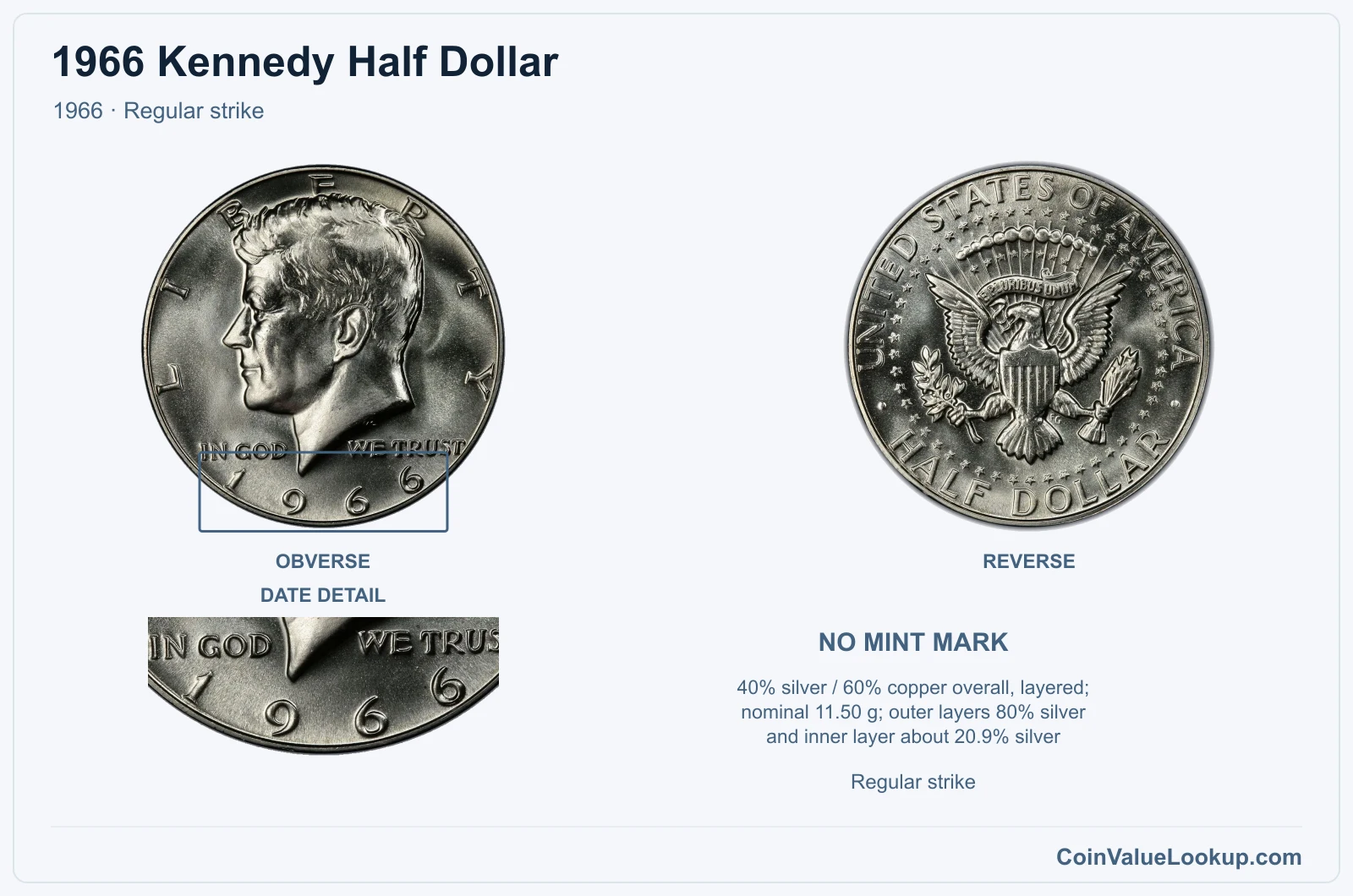
This is the standard 1966 Kennedy half dollar struck for circulation. No mintmark appears below the bust — that is expected for all 1966 halves.
The coin is 40% silver overall, nominally 11.50 grams, with a Kennedy portrait obverse and presidential-seal eagle reverse.
Guide estimates from USA Coin Book place an MS60 example around $14.35, climbing to roughly $99 at MS65. Worn coins track silver melt value, so their price fluctuates with the precious-metals market.
To reach the higher estimates, a coin needs full original luster and minimal bag marks — the kind of piece that was set aside early or never spent.
| Range | Grade | Price | Auction Records | Appraisal |
|---|---|---|---|---|
| PO | PO 1 | — | Coin Identifier | |
| FR | FR 2 | — | Coin Identifier | |
| AG | AG 3 | — | Coin Identifier | |
| G | G 4 | — | Coin Identifier | |
| G 6 | — | Coin Identifier | ||
| VG | VG 8 | — | Coin Identifier | |
| VG 10 | — | Coin Identifier | ||
| F | F 12 | — | Coin Identifier | |
| F 15 | — | Coin Identifier | ||
| VF | VF 20 | — | Coin Identifier | |
| VF 25 | — | Coin Identifier | ||
| VF 30 | — | Coin Identifier | ||
| VF 35 | — | Coin Identifier | ||
| XF | XF 40 | — | Coin Identifier | |
| XF 45 | — | Coin Identifier | ||
| AU | AU 50 | — | Coin Identifier | |
| AU 53 | — | Coin Identifier | ||
| AU 55 | Coin Identifier | |||
| AU 58 | — | Coin Identifier | ||
| MS | MS 60 | — | Coin Identifier | |
| MS 61 | — | Coin Identifier | ||
| MS 62 | Coin Identifier | |||
| MS 63 | — | Coin Identifier | ||
| MS 64 | Coin Identifier | |||
| MS 65 | Coin Identifier | |||
| MS 66 | Coin Identifier | |||
| MS 67 | Coin Identifier | |||
| MS 68 | Coin Identifier | |||
| MS 69 | — | — | — | |
| MS 70 | — | — | — |
1966 Kennedy Half Dollar — Unmarked SMS
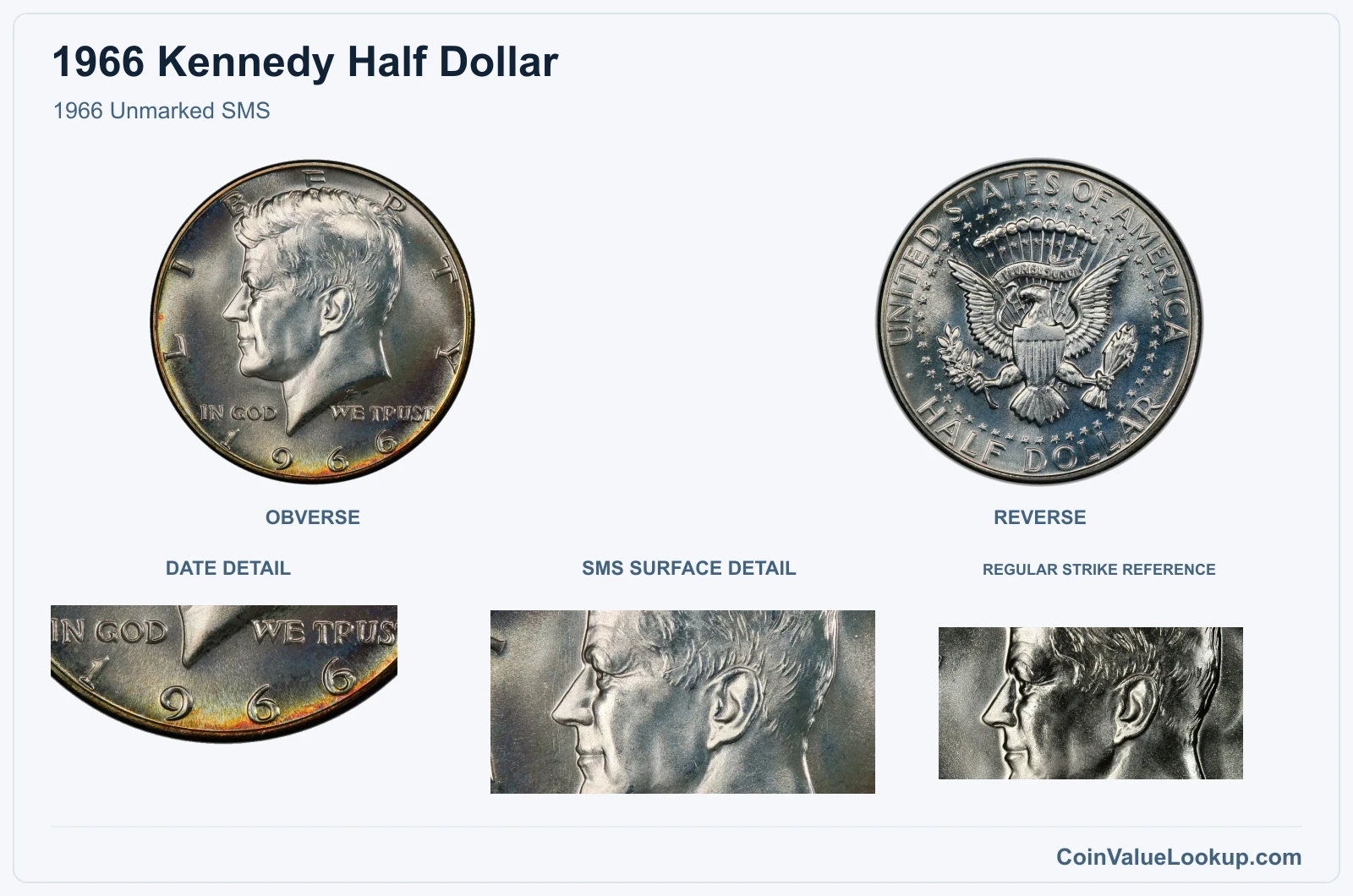
The 1966 SMS (Special Mint Set) Kennedy half dollar was produced with enhanced striking quality and packaged in sealed government sets, replacing traditional proof sets for 1965–1967. It shares the same 40% silver composition and unmarked Philadelphia origin as the regular strike, but look for noticeably sharper design details and a distinctive finish ranging from satiny to semi-reflective.
No reliable numeric guide range is adopted for this version across grades. Value depends on authenticated identity, surface preservation and any recognized variety (such as No FG or DDO).
If you believe you have an SMS coin outside its original packaging, professional authentication is worth considering — the finish differences are real but can be subtle on lower-grade pieces.
Coin Value Lookup is a good starting point if you want to look up other Kennedy half dollar dates and compare what different years and finishes are bringing.
| Range | Grade | Price | Auction Records | Appraisal |
|---|---|---|---|---|
| SP | SP 1 | — | Coin Identifier | |
| SP 2 | — | Coin Identifier | ||
| SP 3 | — | Coin Identifier | ||
| SP 4 | — | Coin Identifier | ||
| SP 6 | — | Coin Identifier | ||
| SP 8 | — | Coin Identifier | ||
| SP 10 | — | Coin Identifier | ||
| SP 12 | — | Coin Identifier | ||
| SP 15 | — | Coin Identifier | ||
| SP 20 | — | Coin Identifier | ||
| SP 25 | — | Coin Identifier | ||
| SP 30 | — | Coin Identifier | ||
| SP 35 | — | Coin Identifier | ||
| SP 40 | — | Coin Identifier | ||
| SP 45 | — | Coin Identifier | ||
| SP 50 | — | Coin Identifier | ||
| SP 53 | — | Coin Identifier | ||
| SP 55 | — | Coin Identifier | ||
| SP 58 | — | Coin Identifier | ||
| SP 60 | — | Coin Identifier | ||
| SP 61 | — | Coin Identifier | ||
| SP 62 | — | Coin Identifier | ||
| SP 63 | — | Coin Identifier | ||
| SP 64 | Coin Identifier | |||
| SP 65 | Coin Identifier | |||
| SP 66 | Coin Identifier | |||
| SP 67 | Coin Identifier | |||
| SP 68 | Coin Identifier | |||
| SP 69 | — | — | — | |
| SP 70 | — | — | — |
1966 Kennedy Half Dollar — SMS No "FG" SMS
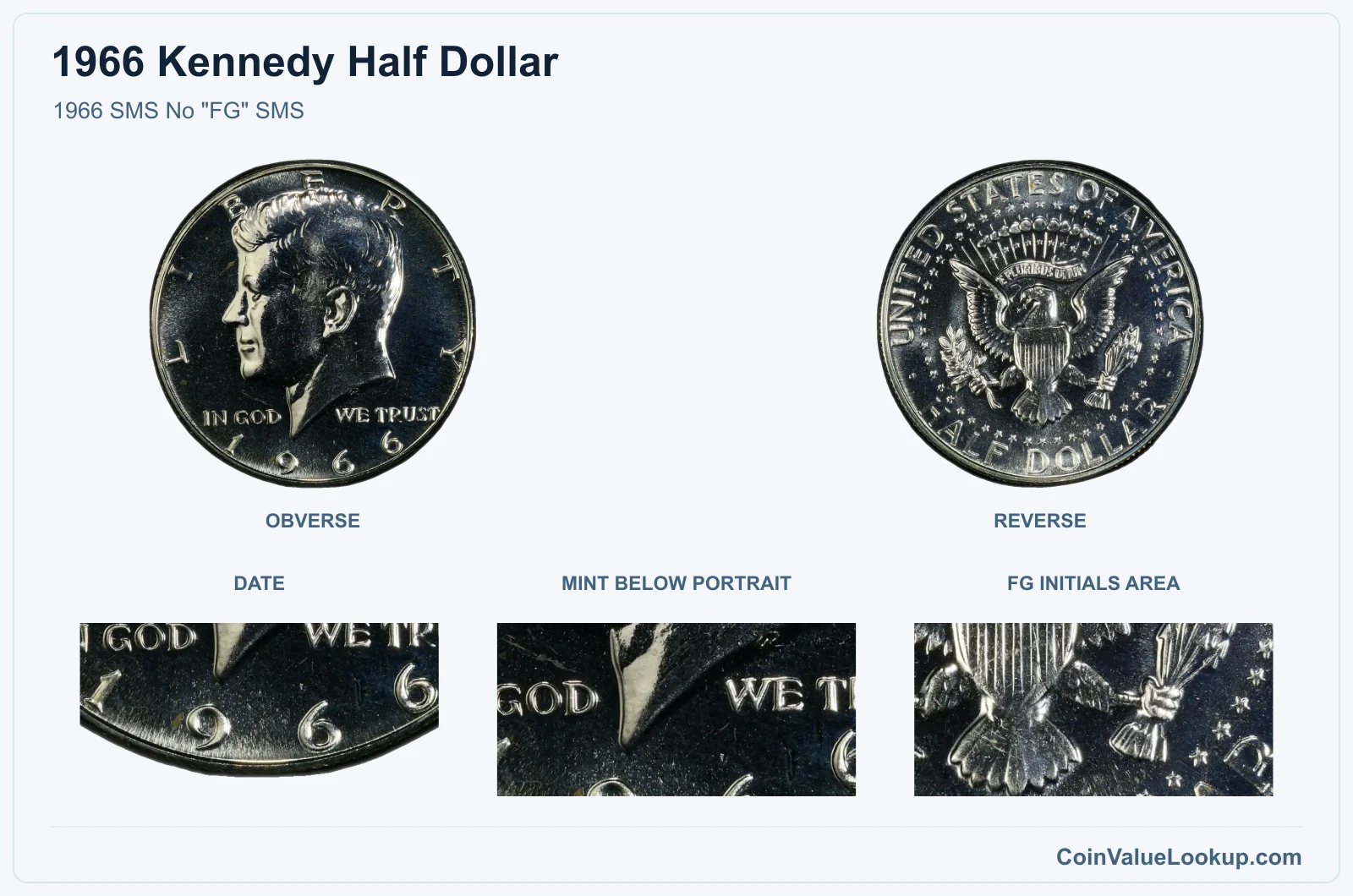
The 1966 SMS No FG variety results from heavy die polishing that completely removed designer Frank Gasparro's "FG" initials from the reverse. To qualify, there should be zero trace of the letters at 5x magnification in the area between the eagle's left leg (your right as you look at the coin) and the tail/arrow bundle.
Do not confuse this with merely weak or partially visible initials — those show up on plenty of normal SMS halves and do not qualify. A PCGS-reported SP68 example sold for $2,365 in 2014, illustrating the premium a top-grade specimen can carry.
Lower-grade examples and coins that only partially lack the initials will not approach that figure. Authentication by a major grading service is effectively required to realize full market value on this variety.
| Range | Grade | Price | Auction Records | Appraisal |
|---|---|---|---|---|
| SP | SP 1 | — | Coin Identifier | |
| SP 2 | — | Coin Identifier | ||
| SP 3 | — | Coin Identifier | ||
| SP 4 | — | Coin Identifier | ||
| SP 6 | — | Coin Identifier | ||
| SP 8 | — | Coin Identifier | ||
| SP 10 | — | Coin Identifier | ||
| SP 12 | — | Coin Identifier | ||
| SP 15 | — | Coin Identifier | ||
| SP 20 | — | Coin Identifier | ||
| SP 25 | — | Coin Identifier | ||
| SP 30 | — | Coin Identifier | ||
| SP 35 | — | Coin Identifier | ||
| SP 40 | — | Coin Identifier | ||
| SP 45 | — | Coin Identifier | ||
| SP 50 | — | Coin Identifier | ||
| SP 53 | — | Coin Identifier | ||
| SP 55 | — | Coin Identifier | ||
| SP 58 | — | Coin Identifier | ||
| SP 60 | — | Coin Identifier | ||
| SP 61 | — | Coin Identifier | ||
| SP 62 | — | Coin Identifier | ||
| SP 63 | Coin Identifier | |||
| SP 64 | — | Coin Identifier | ||
| SP 65 | Coin Identifier | |||
| SP 66 | Coin Identifier | |||
| SP 67 | Coin Identifier | |||
| SP 68 | — | Coin Identifier | ||
| SP 69 | — | — | — | |
| SP 70 | — | — | — |
1966 Kennedy Half Dollar — SMS DDO SMS
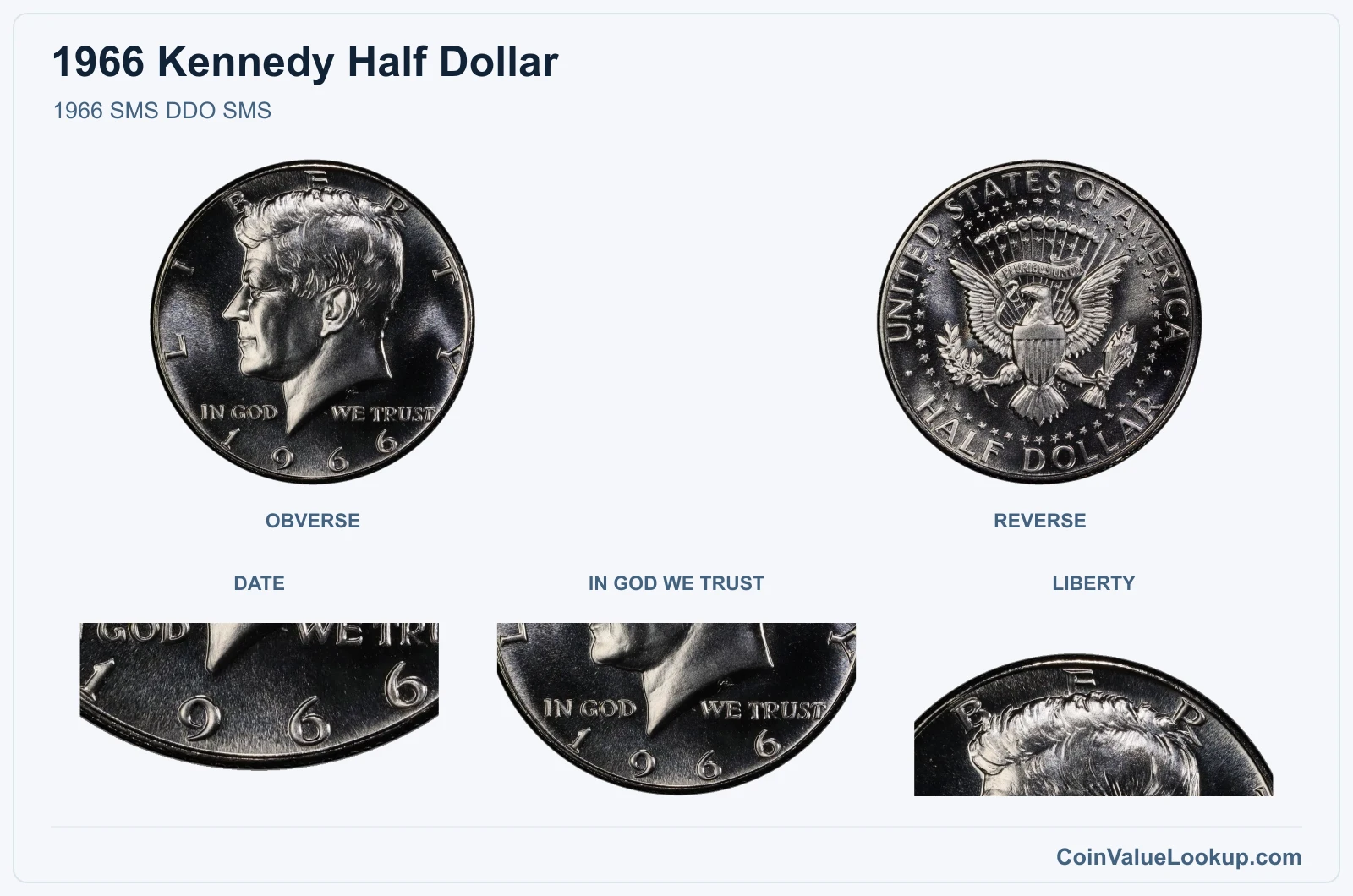
Several doubled die obverse varieties exist among 1966 SMS Kennedy halves, and the specific die attribution matters. The recognized variety here shows genuine raised doubling on the motto IN GOD WE TRUST, with the secondary image spread mainly toward the south (downward).
This is hub doubling — it appears as a raised, slightly offset repeat of the lettering, not flat or shelf-like.
Do not confuse this with machine doubling (worthless mechanical damage), glare in photos, or other 1966 doubled dies that show different spread directions. The exact pattern must match the attributed variety.
No reliable numeric price range is available; value depends on authentication, the specific die pair and condition. Professional grading service attribution is the practical path to establishing this variety for resale.
| Range | Grade | Price | Auction Records | Appraisal |
|---|---|---|---|---|
| SP | SP 1 | — | Coin Identifier | |
| SP 2 | — | Coin Identifier | ||
| SP 3 | — | Coin Identifier | ||
| SP 4 | — | Coin Identifier | ||
| SP 6 | — | Coin Identifier | ||
| SP 8 | — | Coin Identifier | ||
| SP 10 | — | Coin Identifier | ||
| SP 12 | — | Coin Identifier | ||
| SP 15 | — | Coin Identifier | ||
| SP 20 | — | Coin Identifier | ||
| SP 25 | — | Coin Identifier | ||
| SP 30 | — | Coin Identifier | ||
| SP 35 | — | Coin Identifier | ||
| SP 40 | — | Coin Identifier | ||
| SP 45 | — | Coin Identifier | ||
| SP 50 | — | Coin Identifier | ||
| SP 53 | — | Coin Identifier | ||
| SP 55 | — | Coin Identifier | ||
| SP 58 | — | Coin Identifier | ||
| SP 60 | — | Coin Identifier | ||
| SP 61 | — | Coin Identifier | ||
| SP 62 | — | Coin Identifier | ||
| SP 63 | — | Coin Identifier | ||
| SP 64 | — | Coin Identifier | ||
| SP 65 | — | Coin Identifier | ||
| SP 66 | Coin Identifier | |||
| SP 67 | Coin Identifier | |||
| SP 68 | Coin Identifier | |||
| SP 69 | — | — | — | |
| SP 70 | — | — | — |
1966 Kennedy Half Dollar Error List
1. 1966 Kennedy Half Dollar — SMS Doubled Die Obverse
On 1966 SMS Kennedy halves, look at the motto IN GOD WE TRUST for raised doubling that spreads mainly downward (south). Genuine hub doubling will show as a slightly offset, raised secondary image of the letters — it will be consistent across the entire motto, not random or flat.
Several different 1966 SMS doubled dies have been documented, and each shows its own specific spread direction and strength. The exact pattern on your coin must match the attributed variety; a different spread direction means a different die, not the same listing.
Machine doubling — flat, shelf-like displacement — is mechanical damage and carries no premium. Glare, post-mint scratches and double-struck coins also mimic doubling at first glance.
No numeric price range is adopted for this error. Value depends on the exact die attribution, condition and professional authentication.
2. 1966 Kennedy Half Dollar — Missing FG Initials
The 1966 SMS No FG variety is caused by aggressive die polishing that erased Frank Gasparro's initials from the reverse die. Check the space between the eagle's left leg (viewer's right side) and the tail-feather and arrow bundle.
At 5x magnification, there should be absolutely no trace of "F" or "G" for the recognized attribution.
Weakly struck initials, wear-flattened letters, grease-filled impressions and deliberate post-mint removal can all look similar in photos but do not qualify. Compare your reverse against a normal 1966 SMS reverse side by side to see the difference clearly.
A PCGS-reported SP68 example sold for $2,365 in 2014 — a strong result reflecting both the variety and an exceptional grade. Lower-condition examples will bring less, and authentication by a major service is practically necessary to confirm the attribution.
3. 1966 Kennedy Half Dollar — Struck on a Quarter Planchet
A 1966 Kennedy half dollar struck on a quarter-sized planchet is a dramatic wrong-planchet error. The Kennedy design appears on the smaller blank, so peripheral legends are cut off or distorted while the central design remains relatively sharp.
The coin will be noticeably smaller and lighter than a normal half — do not use the standard 11.50-gram catalog weight as a reference for this error.
A documented example graded MS64 by NGC sold for $575 at Heritage Auctions in February 2005. Look for authenticated strike characteristics: the design should be genuinely impressed into the metal, not cut down or filed from a larger coin.
Post-mint alteration, plating and impact damage can produce fakes. Edge texture and metal-flow patterns are important confirmation points — comparison to certified examples helps.
4. 1966 Kennedy Half Dollar — SMS Struck on a Clad Quarter Planchet
This is the SMS version of the wrong-planchet error: a 1966 Special Mint Set Kennedy half struck on a clad quarter blank. The SMS surface quality — sharper and more reflective than a business strike — should be visible on the central portion, while the outer legends fall off the smaller flan.
A PCGS SP62 example sold for $960 at Heritage Auctions on August 15, 2020 (lot 92124). That sale illustrates the premium the SMS finish adds over the regular-strike version of the same error.
Again, do not apply the normal 11.50-gram half-dollar weight to this coin — it will weigh what a quarter blank weighs. Post-mint cutting, filing, plating and impact damage can fake this appearance.
Authenticated edge characteristics and correct strike detail are essential for confirmation.
5. 1966 Kennedy Half Dollar — Off-Center Strike
An off-center strike happens when the planchet is not properly seated between the dies, producing a displaced design and an unstruck crescent along part of the rim. The date must remain visible for the coin to be attributed to 1966.
The percentage of off-center displacement and the visibility of the date both heavily influence value. A slight 2–3% shift is common and not especially collectible, while a dramatic 20%+ shift with a readable date draws real interest.
No numeric price range is adopted for this error — condition, the degree of displacement and market demand at the time of sale all affect what a given coin brings.
Do not confuse an off-center strike with a clipped planchet, a misaligned die (which still shows a complete design) or post-mint flattening. The unstruck area should have a clean, natural planchet surface.
6. 1966 Kennedy Half Dollar — Missing Clad Layer
A 1966 SMS half dollar with a missing clad layer is struck on a planchet where one of the outer silver-content layers failed to bond or was absent before striking. The affected face may show an unusual color or surface texture compared to the normal layered appearance, and the edge will look different from a standard coin.
Weigh the coin — it should come in lighter than the normal 11.50 grams if material is genuinely missing. Compare the edge cross-section with a normal 1966 half to see whether a layer is absent.
Toning, environmental corrosion, plating and deliberate surface removal after minting can all mimic this error. No numeric price range is adopted; value depends on condition, how dramatic the missing layer is and professional confirmation.
7. 1966 Kennedy Half Dollar — Struck-Through Error
A struck-through error occurs when foreign material — grease, wire, cloth, a fragment of another planchet — sits between the die and the blank during striking. The result is a localized depression, an impression of the object, or incomplete design detail in the affected area.
On a 1966 half dollar, look for a clearly defined area where the design is missing or distorted in a way that does not match normal wear or a weak strike. Grease-filled dies produce a smooth, filled-in appearance; retained foreign objects may leave a distinct impression or even remain embedded.
Scratches, cleaning marks and ordinary wear-related detail loss are not struck-through errors.
No numeric price range is adopted. The size, location and visual drama of the obstruction, along with overall coin condition, determine what a collector will pay.
8. 1966 Kennedy Half Dollar — Clipped Planchet
A clipped planchet error means a portion of the blank was missing before the coin was struck. On a 1966 half dollar, look for a straight or curved section of missing metal along the edge.
The clip should show natural metal flow and a characteristic weakness in the design on the opposite side of the coin — called the Blakesley effect — where the thinner edge of the blank could not fill the die completely.
Do not confuse this with an edge that has been cut, filed or corroded after minting. Post-mint damage tends to leave sharp, unnatural edges and no corresponding design weakness on the opposite side.
The shape of the clip (straight, curved or ragged) and its size affect collectibility.
No numeric price range is adopted. Value depends on the clip's size, the coin's overall condition and whether the date remains fully visible.