1941 Mercury Dime Coin Value: How Much Is It Worth?
A 1941 Mercury Dime in well-worn Good-4 condition runs about $5.73 according to USA Coin Book guide estimates, while a Mint State 65 example can reach around $34 to $41 depending on the mint. Philadelphia proof strikes, Full Bands designations, and scarce varieties like the Large S push values higher.
Four mints and finishes exist for this date, so identifying yours is the first step.
Fast Way to Identify Your 1941 Mercury Dime
Snap a clear photo of both sides of your 1941 dime and upload them here for a preliminary identification. The tool can help you figure out which mint version you have and spot obvious variety features.
It works from your images alone, so good lighting and focus on the mintmark area help a lot.
1941 Mercury Dime Value
Upload both sides of your 1941 Mercury Dime.
Front Obverse
Upload photo
Back Reverse
Upload photo
Which 1941 Mercury Dime Versions Are Worth Money?
- The 1941-S Large S variety had one recorded sale of $900 in MS65 Full Bands condition, making it worth a close look at your S-mint dime's mintmark size.
- Philadelphia proof strikes carry guide estimates around $227 at PR65, well above any business-strike version at the same relative quality.
- Mint State coins with fully separated fasces bands (Full Bands designation) can command premiums over regular examples of the same grade.
- Doubled die obverse and repunched mintmark errors have been reported for 1941 dimes and can carry premiums tied to visibility and condition.
Step 1: Identify Your 1941 Mercury Dime Mint Mark and Version
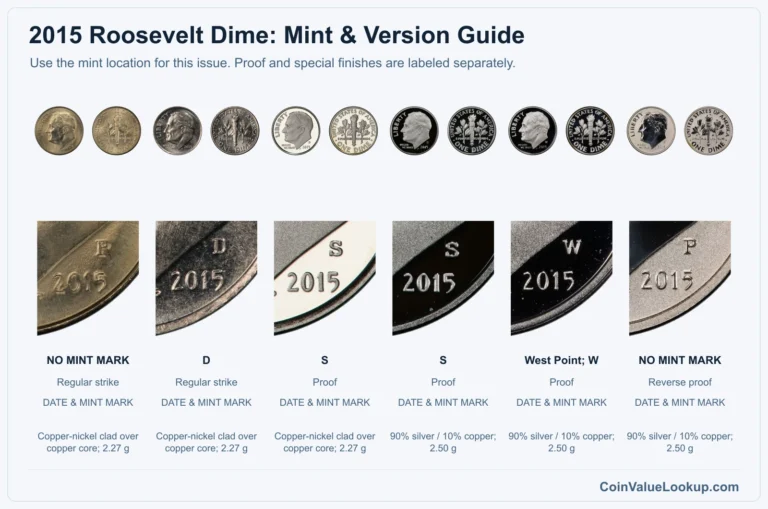
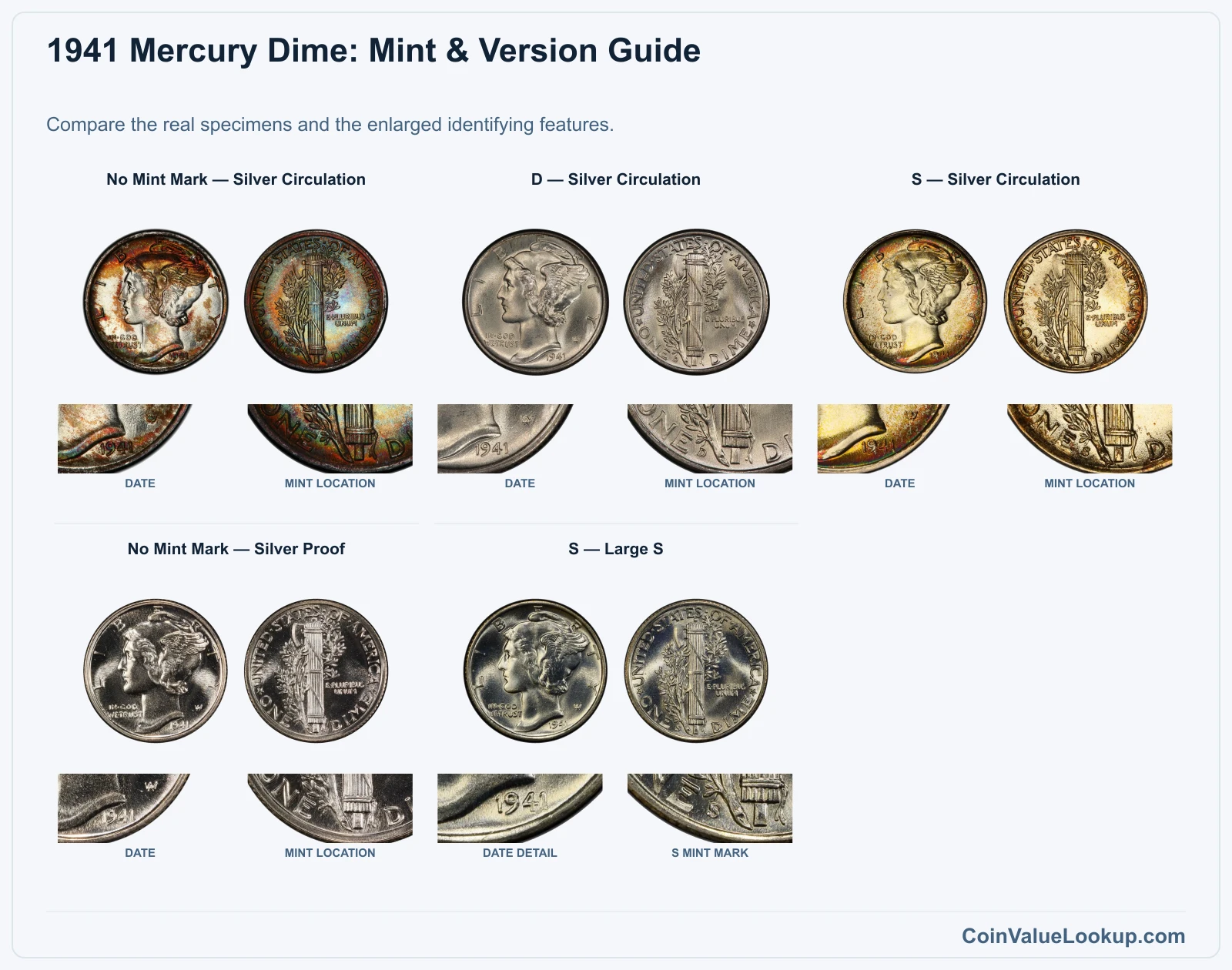
Three business-strike mints produced 1941 Mercury Dimes: Philadelphia (no mintmark), Denver (D), and San Francisco (S). Philadelphia also struck proof versions this year.
The mintmark sits on the reverse, lower left, just beside the word ONE near the base of the fasces.
If you see the letters "AW" on the obverse near Liberty's neck, that is designer Adolph Weinman's monogram, not a mintmark and definitely not a West Point mark. All 1941 dimes are 90% silver and 10% copper, weigh about 2.5 grams, and measure 17.9 mm with a reeded edge.
No composition changes occurred across mints this year.
The San Francisco issue also exists in a Large S mintmark variety. Compare your S mintmark side by side with a known normal-size S at the same scale.
The Large S is a different punch style, not a strike error.
Step 2: Check Your 1941 Mercury Dime Grade
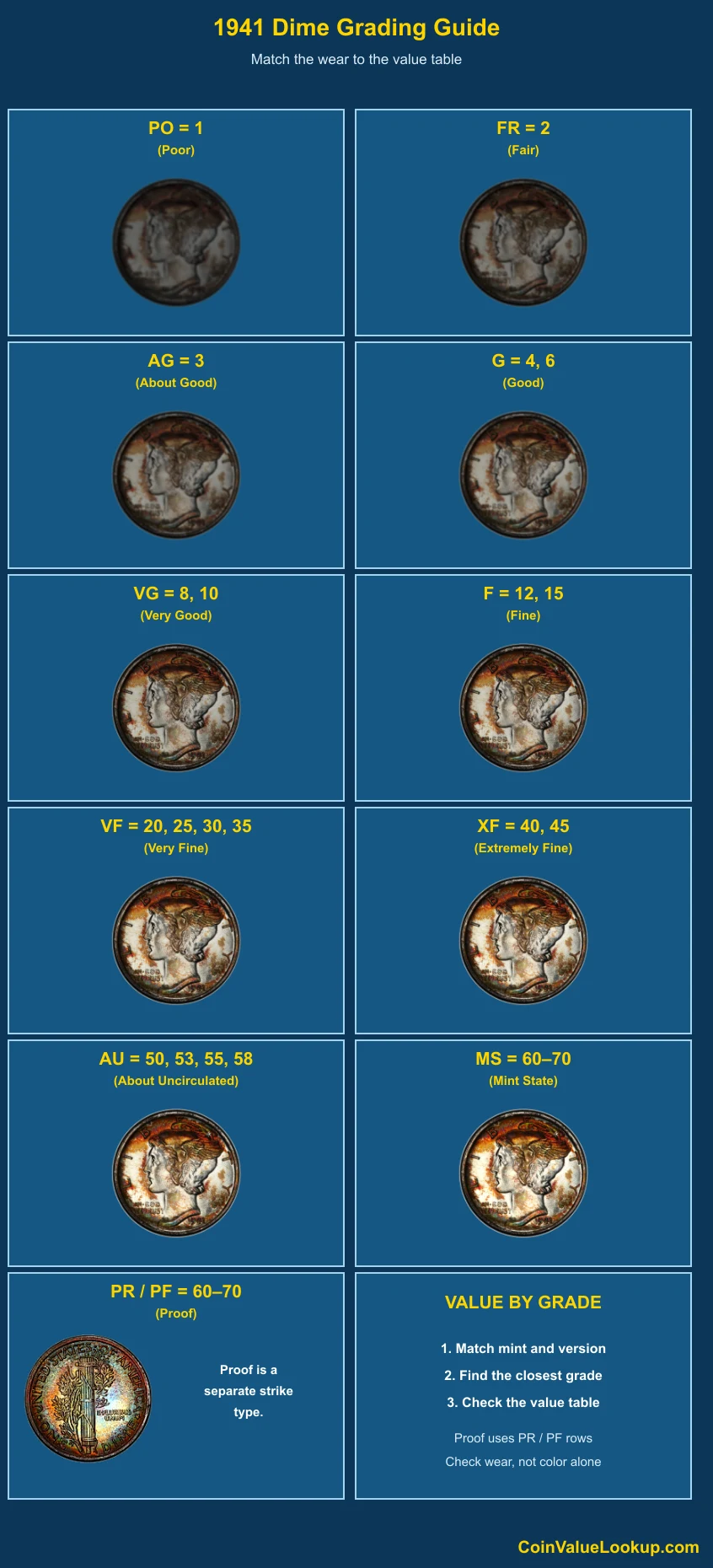
Start with the obverse. Liberty's hair detail above and in front of the ear wears down first, followed by the cap and wing feathers.
On the reverse, the horizontal bands across the center of the fasces lose definition early. These are the spots that separate a VG coin from a Fine one.
Luster matters as much as detail. A coin with full design but dull, cleaned surfaces will grade lower than one with original mint bloom.
Contact marks, scratches, and hairlines from old cleaning all factor in.
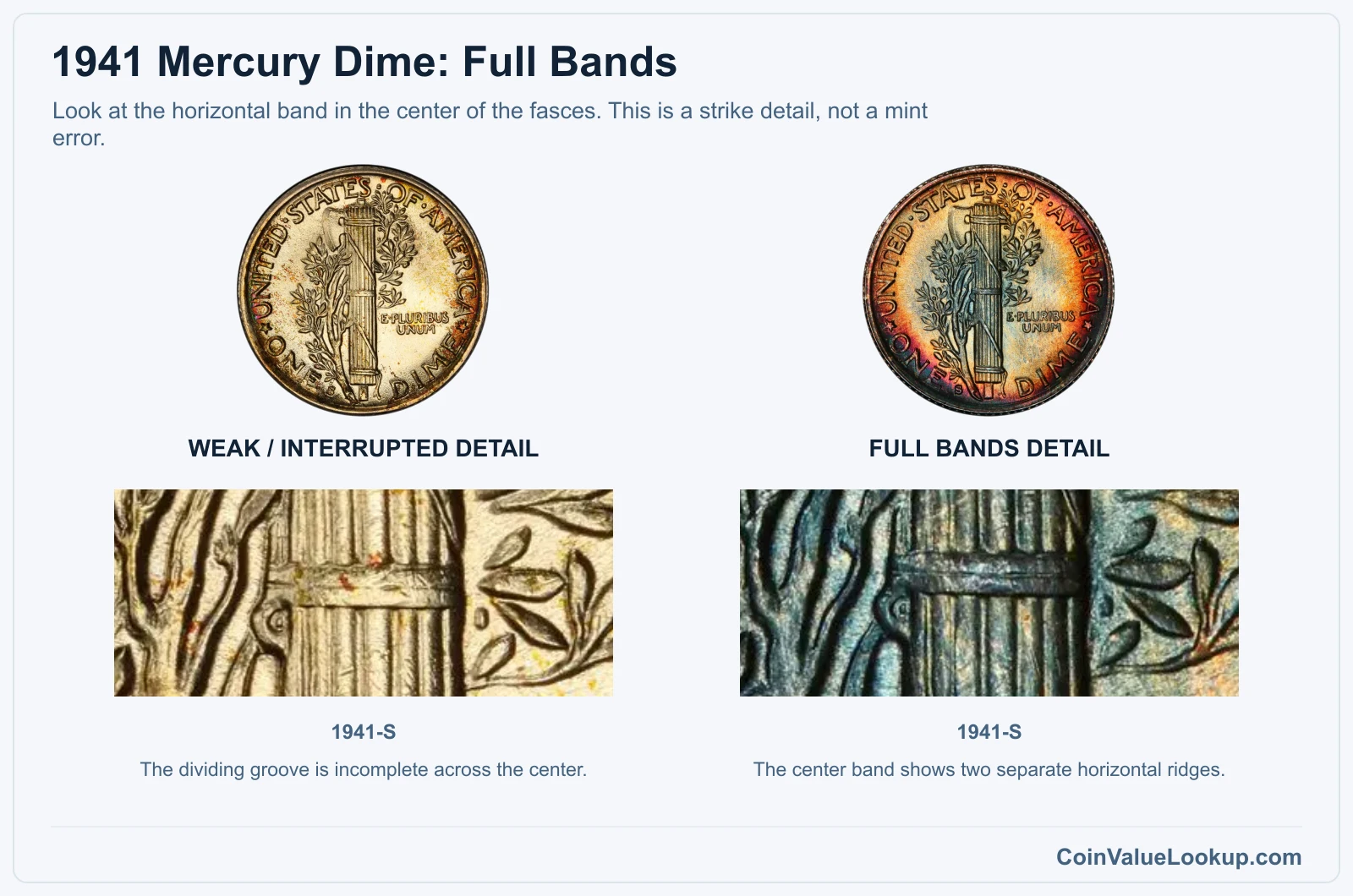
Full Bands is a separate strike designation, not a grade level. NGC evaluates whether the central and outer bands of the fasces are fully separated.
A coin can be MS65 without Full Bands if the strike was soft in that area. Weak bands or soft peripheral lettering do not automatically mean the coin circulated.
Branch-mint strikes from Denver and San Francisco were sometimes softer from the press.
Use the comparison image to check your coin's wear points against known grade examples. Proof is a manufacturing method, not a grade above Mint State.
Step 3: Check 1941 Mercury Dime Value by Mint and Version
1941 Mercury Dime — No Mint Mark — Silver Circulation
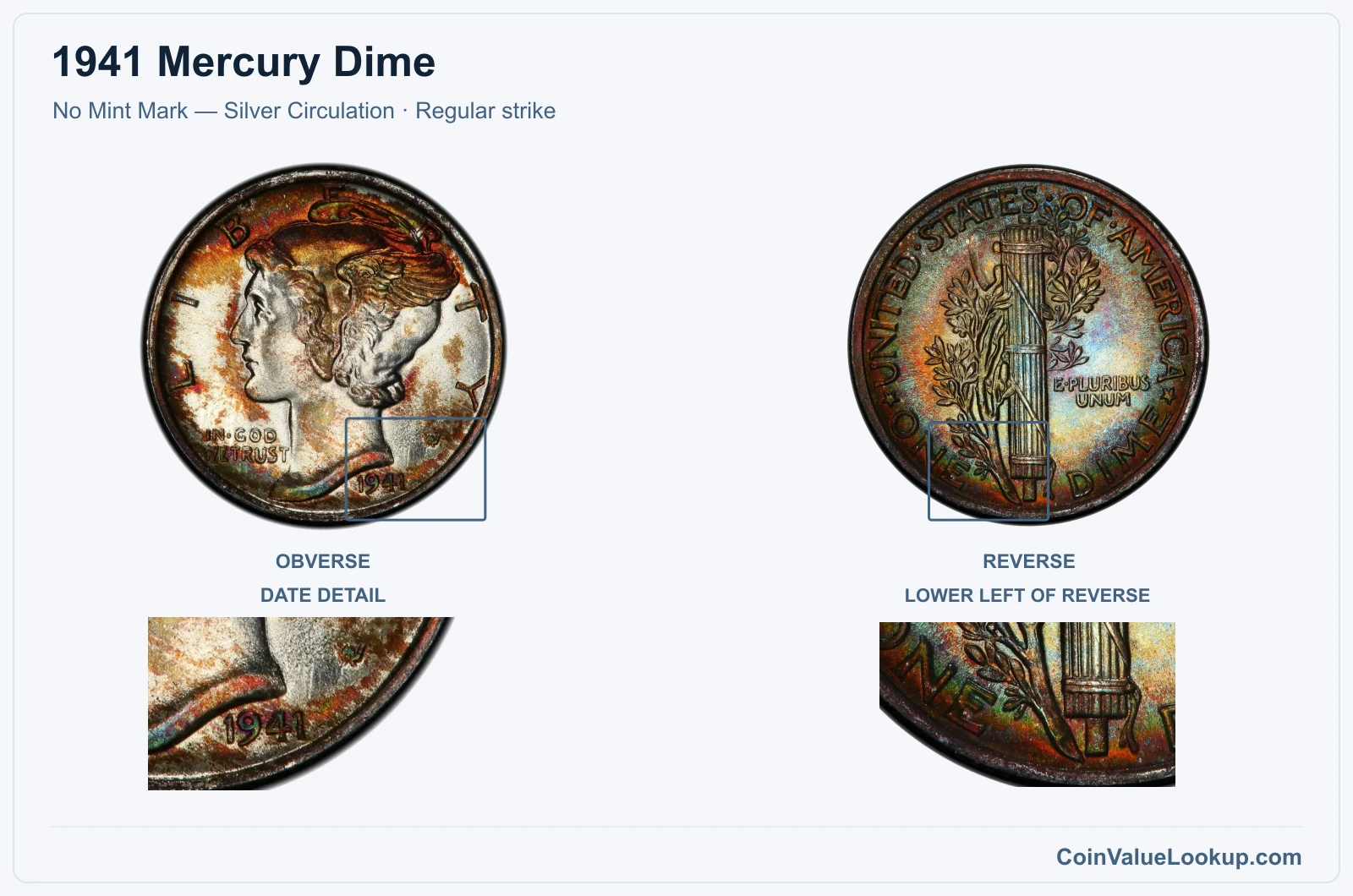
The 1941 Philadelphia dime carries no mintmark. Look at the reverse near the base of the fasces, to the left of ONE.
If that space is empty, you have a Philly strike. USA Coin Book estimates place this version at about $5.73 in Good-4 and around $41 in MS65.
Full Bands examples trade at a premium over regular Mint State coins, but the guide snapshot does not include a separate FB price, so treat that as a different tier requiring its own research. Most surviving Philadelphia dimes from 1941 are well-circulated, and heavily worn pieces are mainly worth their silver content.
Range Grade
Price Auction Records Appraisal PO PO 1
—
Coin Identifier FR FR 2
—
Coin Identifier AG AG 3
—
Coin Identifier G G 4
—
Coin Identifier
G 6
—
Coin Identifier VG VG 8
—
Coin Identifier
VG 10
—
Coin Identifier F F 12
—
Coin Identifier
F 15
—
Coin Identifier VF VF 20
—
Coin Identifier
VF 25
—
Coin Identifier
VF 30
—
Coin Identifier
VF 35
—
Coin Identifier XF XF 40
Coin Identifier
XF 45
—
Coin Identifier AU AU 50
—
Coin Identifier
AU 53
—
Coin Identifier
AU 55
Coin Identifier
AU 58
Coin Identifier MS MS 60
—
Coin Identifier
MS 61
—
Coin Identifier
MS 62
Coin Identifier
MS 63
Coin Identifier
MS 64
Coin Identifier
MS 65
Coin Identifier
MS 66
Coin Identifier
MS 67
Coin Identifier
MS 68
Coin Identifier
MS 69
—
—
—
MS 70
—
—
—
1941 Mercury Dime — D — Silver Circulation
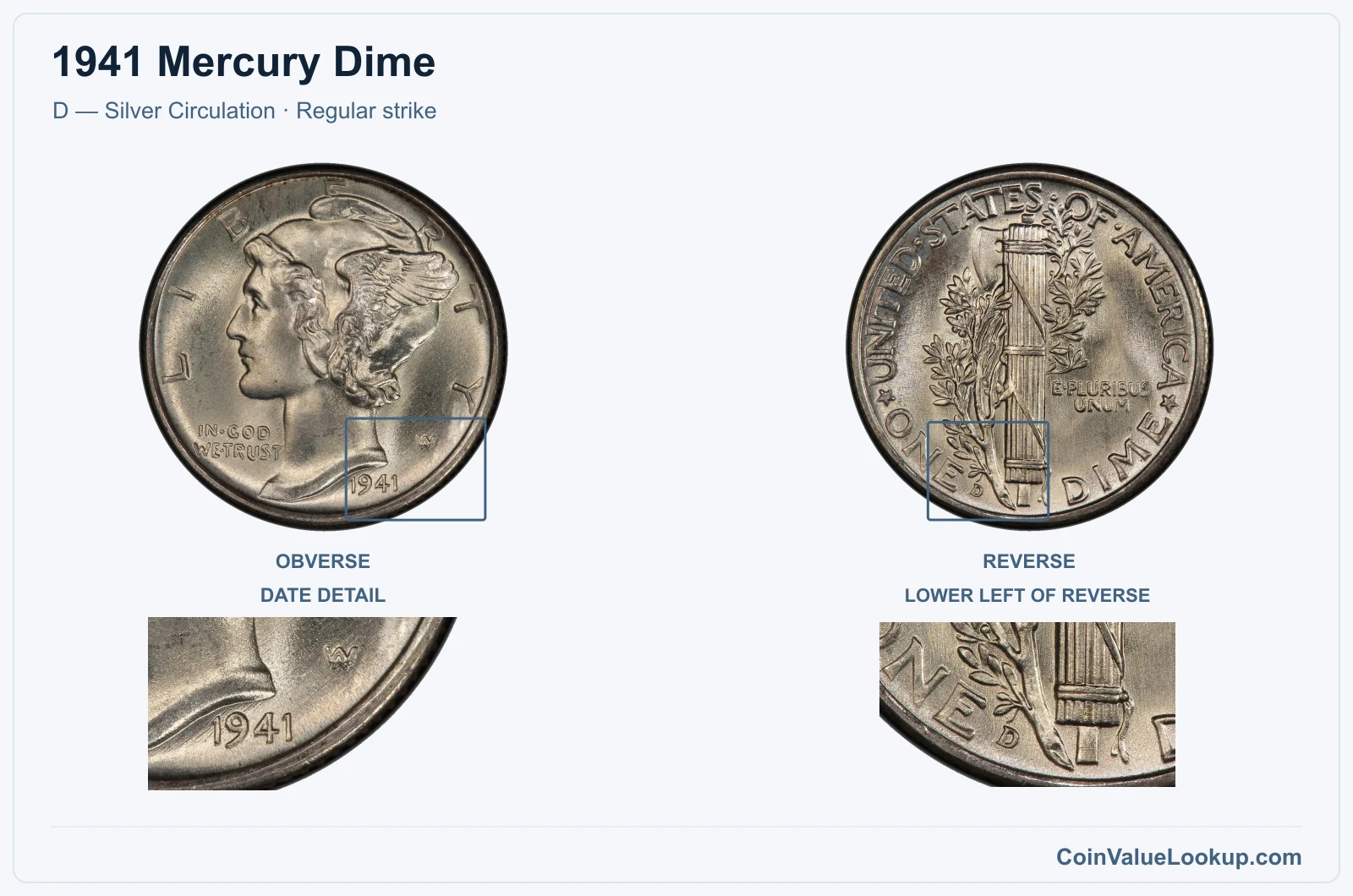
A small "D" on the reverse left of ONE identifies the Denver issue. Guide estimates run about $5.73 in Good-4 and approximately $34 in MS65, making it the lowest-priced mint at the top Mint State level listed.
Denver strikes sometimes came off the press with softer detail on the fasces bands. That does not mean the coin circulated.
Compare actual wear points on Liberty's hair and wing before assuming a grade. Full Bands pieces exist but no FB-specific price was provided in the guide snapshot, so those need separate evaluation.
Range Grade
Price Auction Records Appraisal PO PO 1
—
Coin Identifier FR FR 2
—
Coin Identifier AG AG 3
—
Coin Identifier G G 4
—
Coin Identifier
G 6
—
Coin Identifier VG VG 8
—
Coin Identifier
VG 10
—
Coin Identifier F F 12
—
Coin Identifier
F 15
—
Coin Identifier VF VF 20
—
Coin Identifier
VF 25
—
Coin Identifier
VF 30
—
Coin Identifier
VF 35
—
Coin Identifier XF XF 40
—
Coin Identifier
XF 45
—
Coin Identifier AU AU 50
—
Coin Identifier
AU 53
Coin Identifier
AU 55
—
Coin Identifier
AU 58
Coin Identifier MS MS 60
—
Coin Identifier
MS 61
—
Coin Identifier
MS 62
Coin Identifier
MS 63
—
Coin Identifier
MS 64
—
Coin Identifier
MS 65
Coin Identifier
MS 66
Coin Identifier
MS 67
Coin Identifier
MS 68
Coin Identifier
MS 69
—
—
—
MS 70
—
—
—
1941 Mercury Dime — S — Silver Circulation
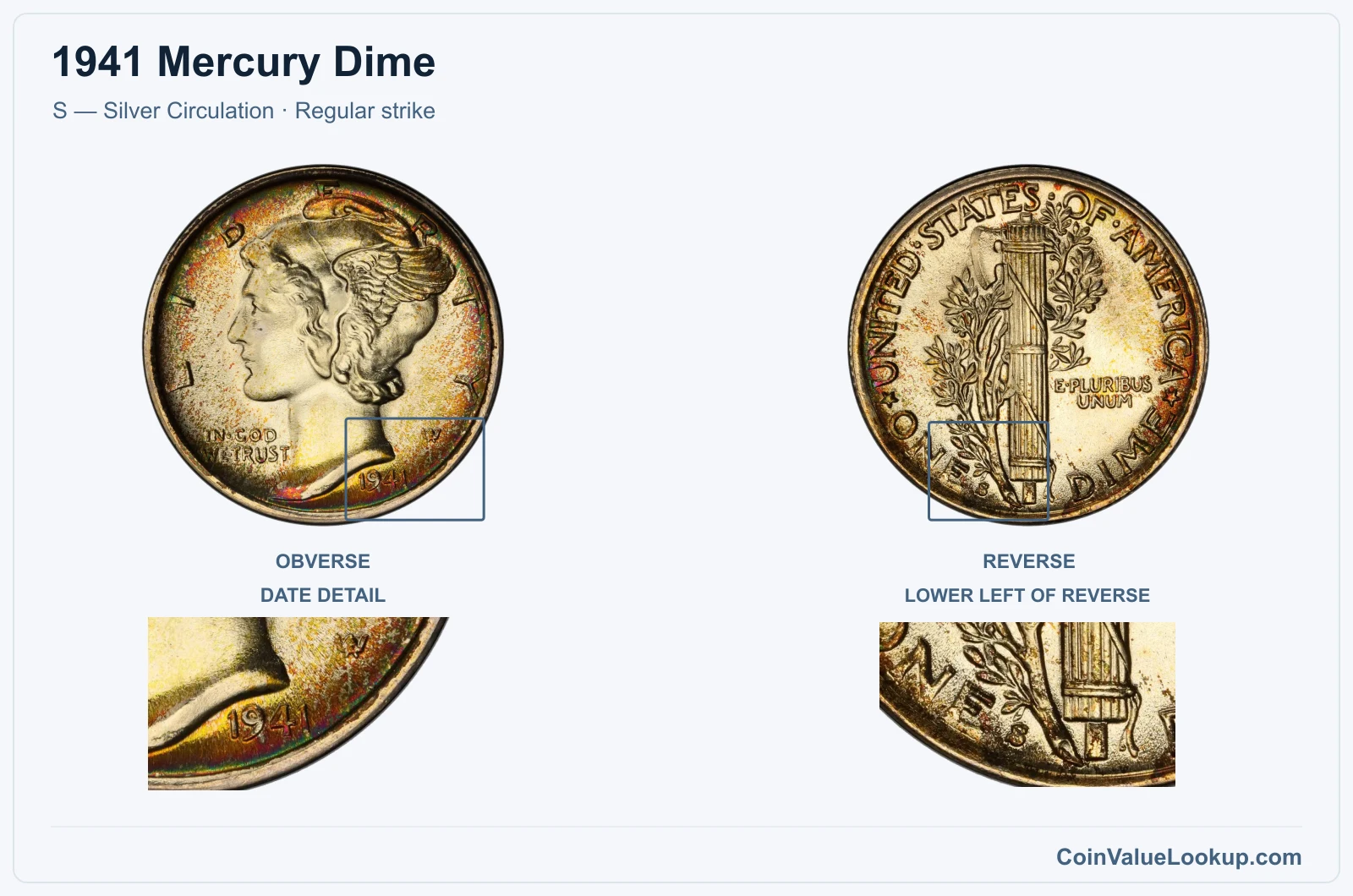
San Francisco coins show an "S" in the same lower-left reverse position. Guide values sit at roughly $5.73 in Good-4 and about $41 in MS65, matching Philadelphia.
Before you move on, measure that mintmark against a known normal example. San Francisco used two punch sizes this year, and the Large S variety is listed separately below.
If your S looks noticeably bigger, you may have something more interesting on your hands. Regular S-mint pieces in circulated grades are common and trade near silver value.
Range Grade
Price Auction Records Appraisal PO PO 1
—
Coin Identifier FR FR 2
—
Coin Identifier AG AG 3
—
Coin Identifier G G 4
—
Coin Identifier
G 6
—
Coin Identifier VG VG 8
—
Coin Identifier
VG 10
—
Coin Identifier F F 12
—
Coin Identifier
F 15
—
Coin Identifier VF VF 20
—
Coin Identifier
VF 25
—
Coin Identifier
VF 30
—
Coin Identifier
VF 35
—
Coin Identifier XF XF 40
—
Coin Identifier
XF 45
—
Coin Identifier AU AU 50
—
Coin Identifier
AU 53
—
Coin Identifier
AU 55
—
Coin Identifier
AU 58
—
Coin Identifier MS MS 60
—
Coin Identifier
MS 61
—
Coin Identifier
MS 62
—
Coin Identifier
MS 63
—
Coin Identifier
MS 64
—
Coin Identifier
MS 65
Coin Identifier
MS 66
Coin Identifier
MS 67
Coin Identifier
MS 68
Coin Identifier
MS 69
—
—
—
MS 70
—
—
—
1941 Mercury Dime — No Mint Mark — Silver Proof
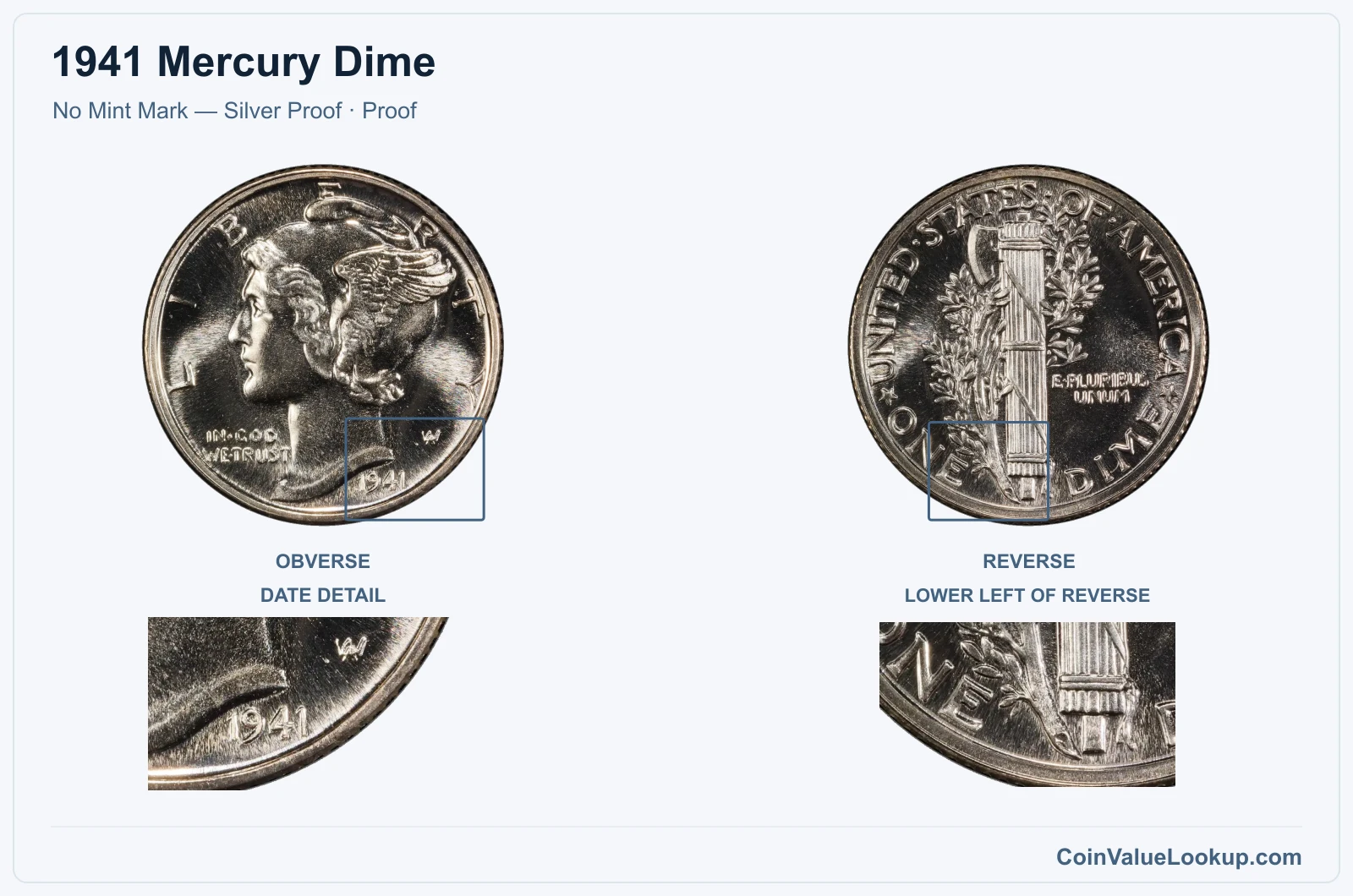
Philadelphia struck proof Mercury Dimes from 1936 through 1942, and 1941 is part of that run. These are brilliant silver proofs with deeply reflective fields and sharp rims.
There is no mintmark, same as the business strike, so reflective surfaces and squared-off rims are the giveaway.
Coin Value Lookup is a good starting point if you are trying to compare your coin against other Mercury Dime dates and finishes.
USA Coin Book estimates a PR65 example at about $227. Cameo contrast may appear on some pieces, but that is a quality filter rather than a separate alloy or design.
Full Bands is not tracked separately for proofs in the guide snapshot provided.
Range Grade
Price Auction Records Appraisal PR PR 1
—
Coin Identifier
PR 2
—
Coin Identifier
PR 3
—
Coin Identifier
PR 4
—
Coin Identifier
PR 6
—
Coin Identifier
PR 8
—
Coin Identifier
PR 10
—
Coin Identifier
PR 12
—
Coin Identifier
PR 15
—
Coin Identifier
PR 20
—
Coin Identifier
PR 25
—
Coin Identifier
PR 30
—
Coin Identifier
PR 35
—
Coin Identifier
PR 40
—
Coin Identifier
PR 45
—
Coin Identifier
PR 50
—
Coin Identifier
PR 53
—
Coin Identifier
PR 55
—
Coin Identifier
PR 58
—
Coin Identifier
PR 60
Coin Identifier
PR 61
Coin Identifier
PR 62
Coin Identifier
PR 63
Coin Identifier
PR 64
Coin Identifier
PR 65
Coin Identifier
PR 66
Coin Identifier
PR 67
Coin Identifier
PR 68
Coin Identifier
PR 69
Coin Identifier
PR 70
—
—
—
1941 Mercury Dime — S — Large S
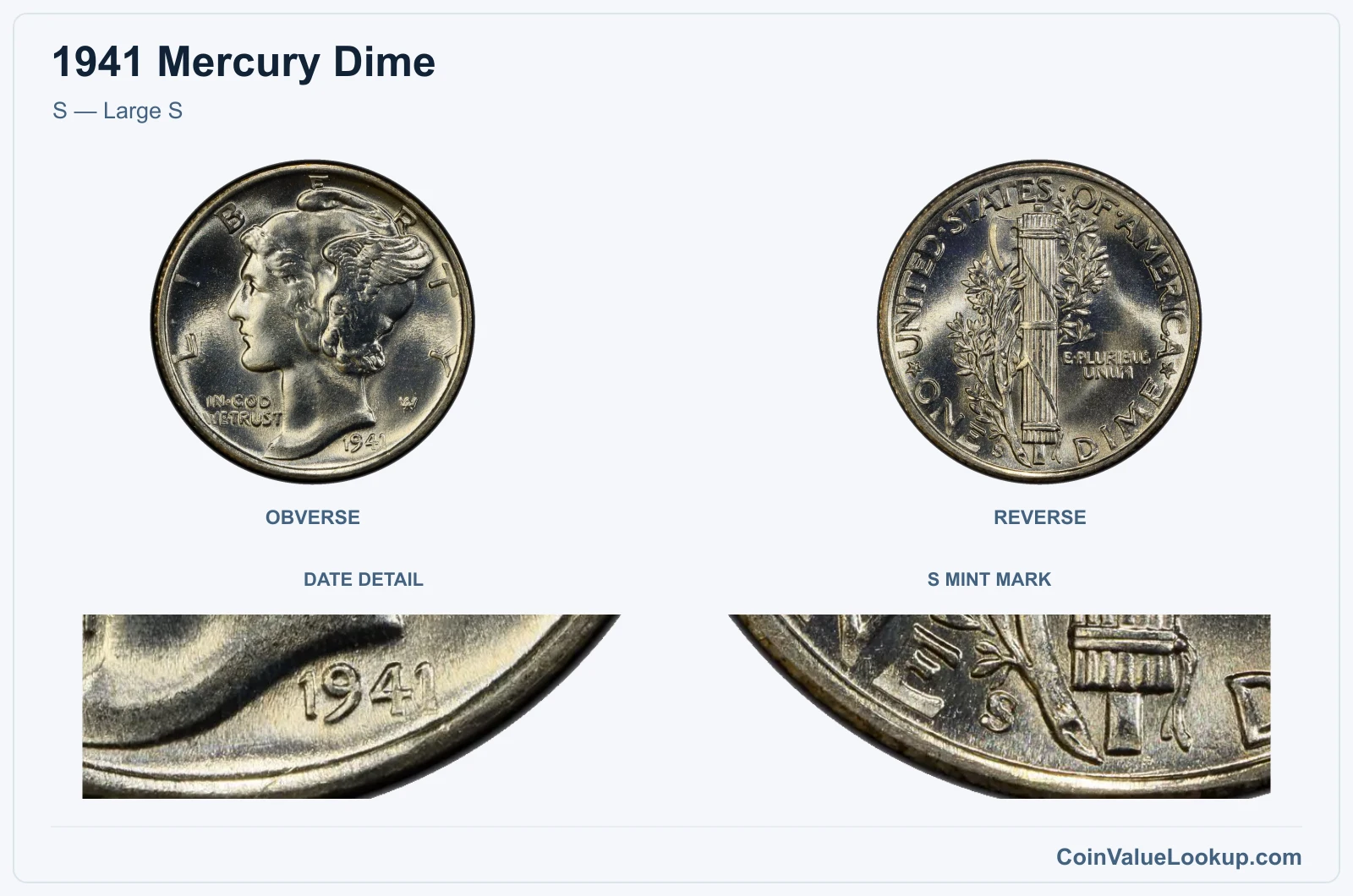
The 1941-S Large S is a recognized variety where San Francisco used a visibly larger mintmark punch than the normal issue. This is a punch-style difference, not an accidental strike error.
You need to compare your coin's S directly against a standard-size S at the same magnification to tell them apart.
One recorded sale in MS65 Full Bands condition brought $900 according to PCGS data. That is a single transaction, not a market range, and it applies specifically to that grade and FB designation.
A circulated Large S or one without Full Bands should not be assumed to carry the same premium. Still, it costs nothing to grab a loupe and check.
Range Grade
Price Auction Records Appraisal PO PO 1
—
Coin Identifier FR FR 2
—
Coin Identifier AG AG 3
—
Coin Identifier G G 4
—
Coin Identifier
G 6
—
Coin Identifier VG VG 8
—
Coin Identifier
VG 10
—
Coin Identifier F F 12
—
Coin Identifier
F 15
—
Coin Identifier VF VF 20
—
Coin Identifier
VF 25
—
Coin Identifier
VF 30
—
Coin Identifier
VF 35
—
Coin Identifier XF XF 40
—
Coin Identifier
XF 45
—
Coin Identifier AU AU 50
—
Coin Identifier
AU 53
Coin Identifier
AU 55
Coin Identifier
AU 58
Coin Identifier MS MS 60
—
Coin Identifier
MS 61
—
Coin Identifier
MS 62
Coin Identifier
MS 63
—
Coin Identifier
MS 64
Coin Identifier
MS 65
Coin Identifier
MS 66
—
Coin Identifier
MS 67
—
Coin Identifier
MS 68
—
—
—
MS 69
—
—
—
MS 70
—
—
—
1941 Mercury Dime Error List
1. 1941 Mercury Dime — Doubled Die Obverse
A Doubled Die Obverse has been reported for the 1941 Mercury Dime. The diagnostic involves comparing obverse lettering or design elements against a normal coin under consistent lighting.
Genuine hub doubling shows consistent separation or notching on affected letters and design features rather than a flat, shelf-like distortion.
The main lookalike is machine doubling, which tends to produce flat, featureless shelving on one side of the letters. Reflections from die polish or contours from a worn die can also mimic doubling at first glance.
No specific price range was provided for this variety. Value depends on how visible the doubling is, which letters are affected, and the coin's overall condition.
A barely perceptible doubled die in low grade is a different animal from a strong one in Mint State.
2. 1941 Mercury Dime — Repunched Mintmark
Repunched Mintmark varieties have been reported for the 1941 dime. These occur when the mintmark punch was applied more than once, leaving a trace of a second impression near or under the final mark.
To check, inspect the D or S mintmark under magnification for remnants of an earlier, differently positioned punch.
Do not confuse a repunched mintmark with machine doubling of the mintmark, die chips that add metal around the letter, or simple corrosion pitting. A genuine RPM shows a clear second outline or partial letter in a different position.
No specific price range is available for this category. The premium depends on the visibility of the extra impression, the overall grade of the coin, and collector demand for the specific variety.
3. 1941 Mercury Dime — Doubled Die Reverse
A Doubled Die Reverse has been reported specifically for the 1941-D Denver issue. The diagnostic involves comparing reverse legends and design contours with a known normal 1941-D under matching magnification.
Look for consistent doubling on lettering or design elements rather than random displacement.
Machine doubling is the most common lookalike. It produces flat, shelf-like distortion instead of the rounded, separated profiles of a true hub-doubled die.
Random post-mint damage and light reflections can also fool you at lower magnification. No numerical price was provided for this variety.
Value will depend on the strength and location of the doubling as well as the coin's condition and surfaces.
4. 1941 Mercury Dime — Off-Center Strike
Off-center strikes have been reported for the 1941 Mercury Dime. An off-center coin shows a displaced design with an unstruck crescent along part of the rim where the planchet was not fully seated in the collar.
The most collectible examples retain a readable date despite the misalignment.
Do not confuse an off-center strike with a clipped planchet, which produces a curved bite out of the edge, or with one-sided die misalignment that shifts only the obverse or reverse. Post-mint flattening from damage can also create an odd-looking rim.
No specific price range was adopted for this error. Value varies widely based on the percentage of off-center shift, whether the date is visible, and the coin's overall condition.