1942 Walking Liberty Half Dollar Coin Value: How Much Is It Worth?
The 1942 Walking Liberty Half Dollar is a 90% silver coin that still turns up in collections, estates and the occasional junk-silver bag. Guide estimates for this date range from around $34.00 in well-worn condition up to $630.00 for a top-grade proof, depending on mint, condition and version.
Those figures are reference anchors from a published guide, not guaranteed sale prices or current silver-melt quotes. Mint origin, surface quality and strike sharpness all play a role in where a specific coin falls within that spread.
Fast Way to Identify Your 1942 Walking Liberty Half Dollar
Want a quick read on what you have? Upload clear photos of the front and back of your 1942 Walking Liberty Half Dollar.
That gives us enough to make a preliminary identification of the mint, general condition and version. It is not a substitute for professional authentication or precise grading, but it is a solid starting point.
1942 Walking Liberty Half Dollar Value
Upload both sides of your 1942 Walking Liberty Half Dollar.
Front Obverse
Upload photo
Back Reverse
Upload photo
Which 1942 Walking Liberty Half Dollar Versions Are Worth Money?
- The 1942 proof (PR) carries the highest single guide anchor at $630.00 in PR65, but it must show genuine mirrored fields and sharp devices, not a polished business strike.
- Denver (1942-D) and San Francisco (1942-S) business strikes share an MS63 guide estimate of $118.00, higher than the Philadelphia business strike at that grade.
- Philadelphia business strikes (1942, no mintmark) start at $34.00 in G4 and reach $91.00 in MS63, with strong original surfaces making the difference.
- Check for reported error varieties such as a doubled die reverse, double strike in collar, or wrong-planchet strike, as these can carry additional value beyond standard guide figures.
Step 1: Identify Your 1942 Walking Liberty Half Dollar Mint Mark and Version
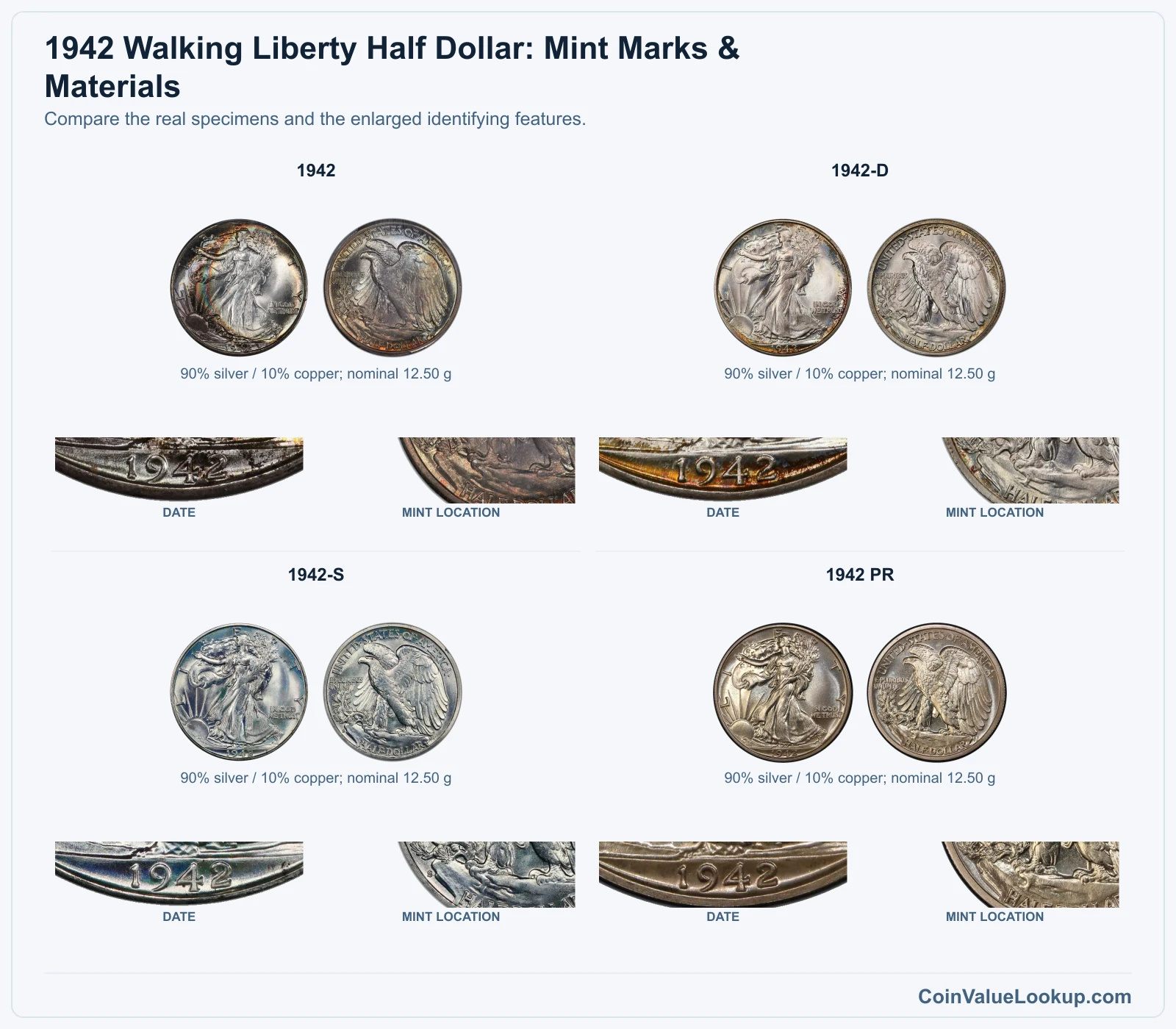
Every 1942 Walking Liberty Half Dollar is struck in 90% silver and 10% copper, weighing a nominal 12.50 grams. Toning, dark patina or cabinet wear do not change that alloy.
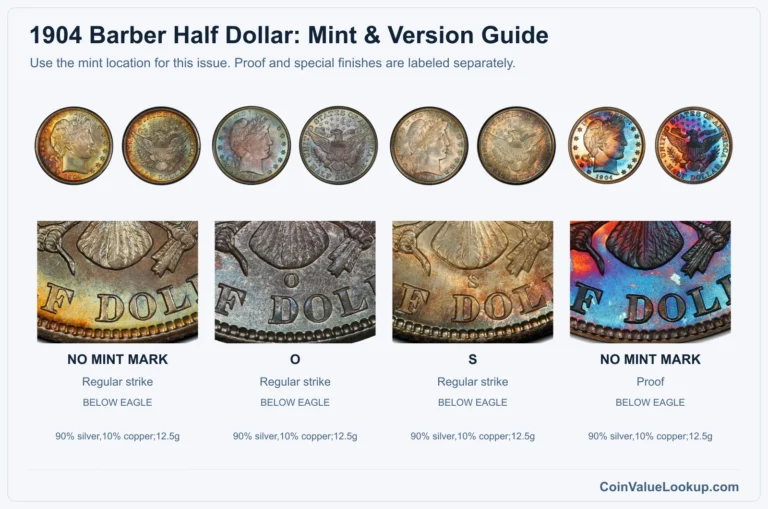
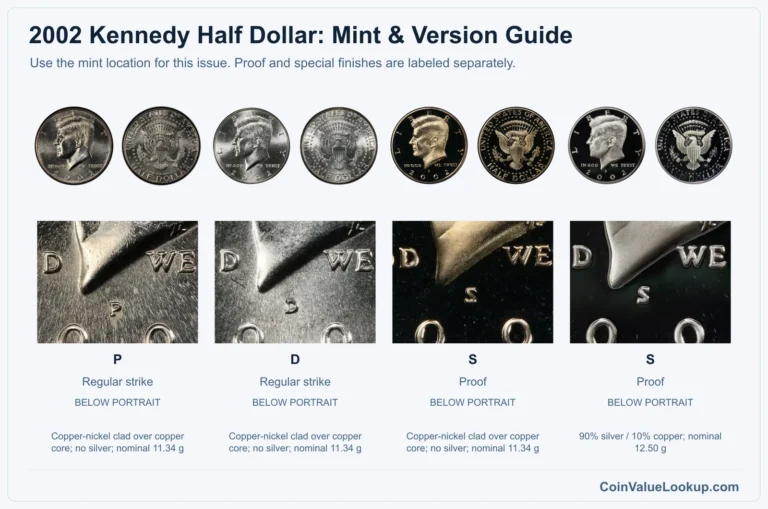
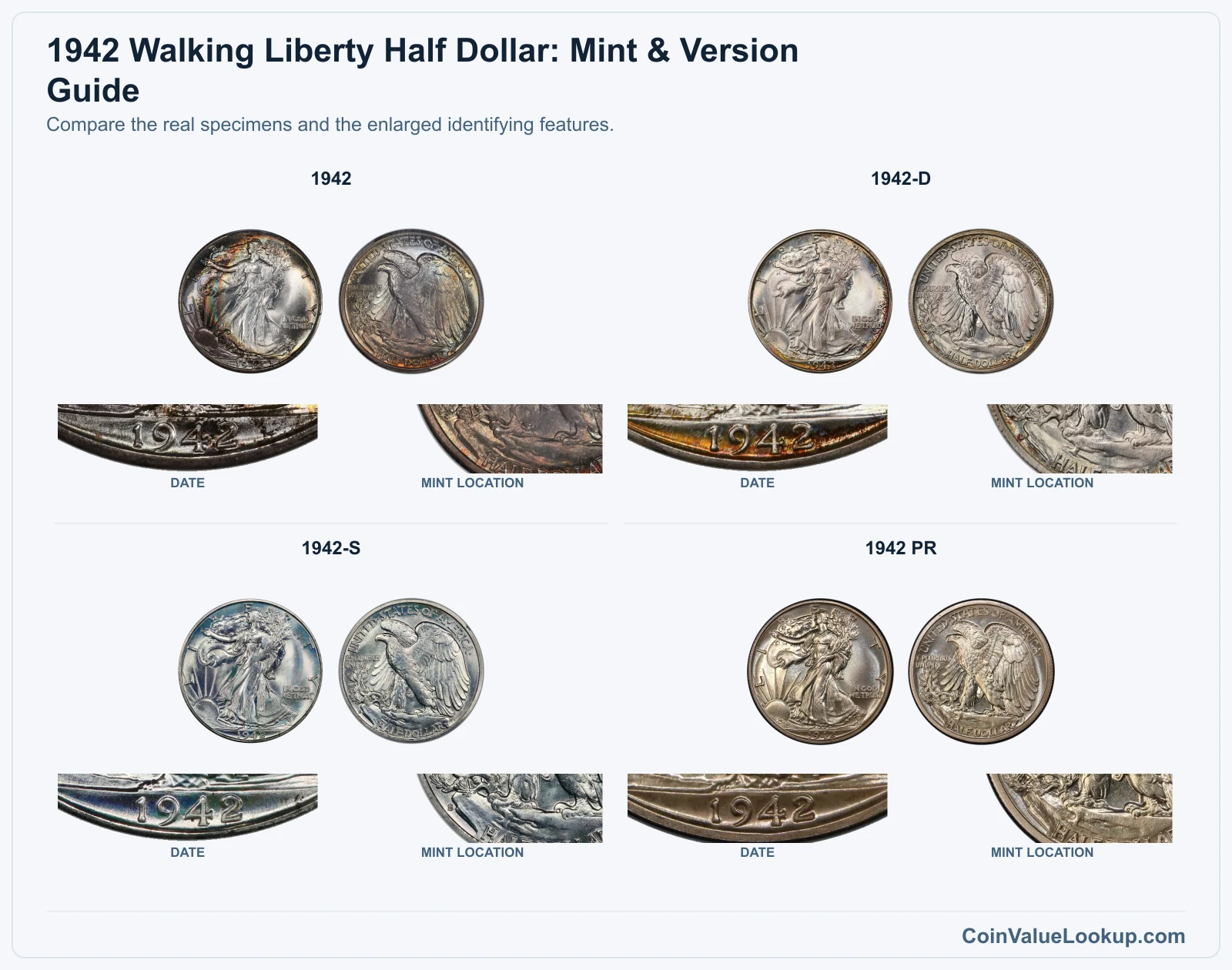
For 1942, there are four branches to sort out: the Philadelphia business strike (no mintmark), the Denver issue (D), the San Francisco issue (S), and the Philadelphia proof (no mintmark, mirror fields). The mintmark on business strikes sits on the reverse, lower left, near the 8 o'clock position along the rim.
Philadelphia coins carry no mark at all.
Separating a proof from a regular Philadelphia strike is critical. Genuine proofs have mirrored fields and exceptionally sharp design details from specially prepared dies.
A polished circulated coin is not a proof, no matter how shiny someone made it. If the fields look glassy and the devices are razor-edged, you may have the real thing, but hairlines, haze and any signs of circulation wear affect value significantly.
Step 2: Check Your 1942 Walking Liberty Half Dollar Grade
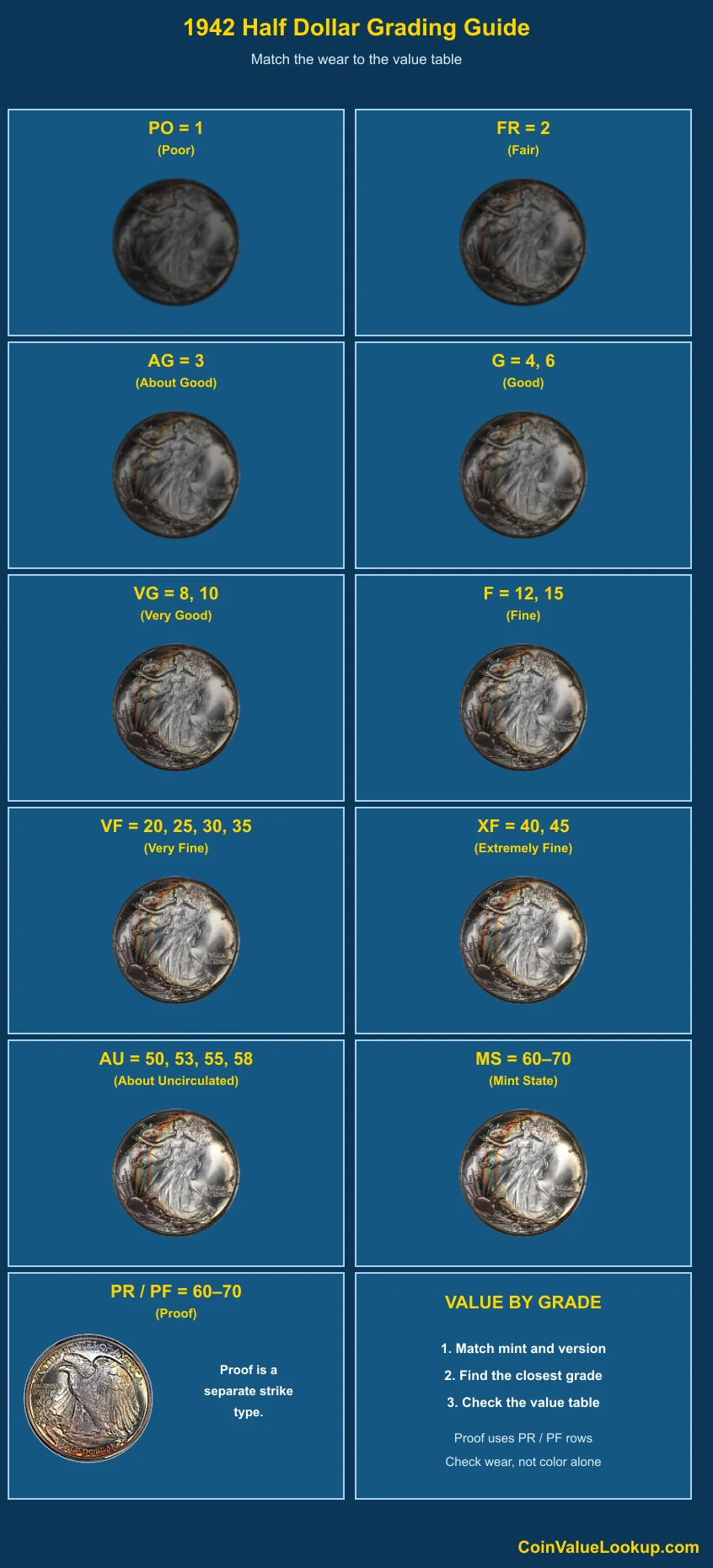
Start with Liberty's head, breast and left hand on the obverse. These are the first spots to show smoothing from wear.
The skirt lines over the forward knee go next. On the reverse, check the eagle's breast feathers, leg and the tops of the wing feathers.
Here is the catch with Walkers: weak central strikes happen on coins that never saw a day of circulation. A soft left hand or mushy head does not automatically mean the coin is worn.
Look at the surrounding luster. If the fields still have full cartwheel shimmer but the hand is flat, that is a strike issue, not wear.
Compare your coin side by side with the grading comparison image. Actual smoothing from contact feels and looks different from a weak impression.
Smoothed areas lose luster and develop a slick, reflective quality that differs from the frosty texture of an untouched surface. Problem-free original surfaces matter.
Cleaning, scratches and rim damage all pull value below what a grade chart would suggest.
Step 3: Check 1942 Walking Liberty Half Dollar Value by Mint and Version
1942 Walking Liberty Half Dollar
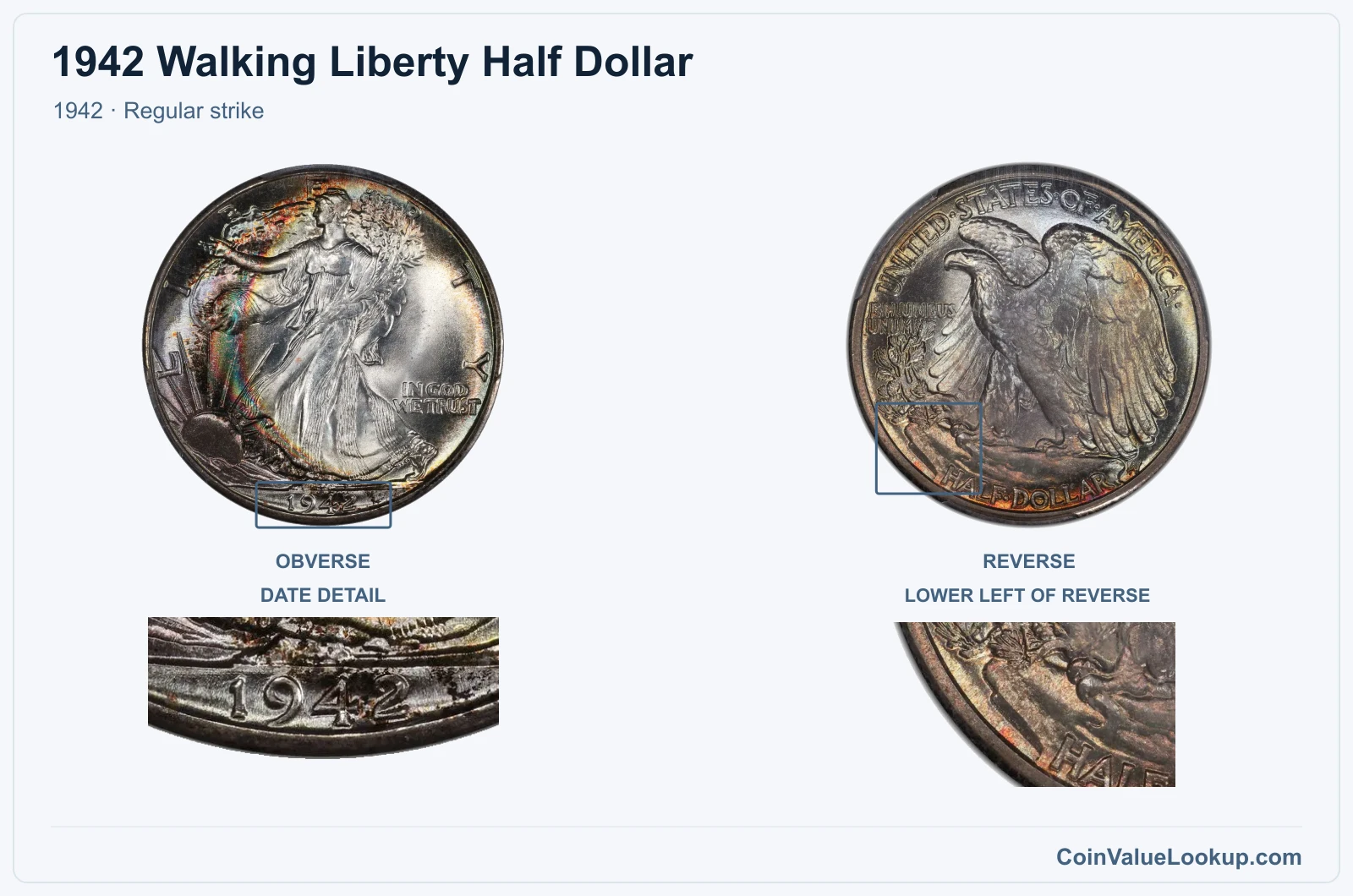
The 1942 Philadelphia business strike has no mintmark. Look at the reverse lower left, confirming there is nothing there.
In Good-4 condition, a published guide places this coin at about $34.00. In MS63, the estimate rises to around $91.00.
These are guide anchors from USA Coin Book, not guaranteed selling prices.
Silver content gives every example a base floor, but a cleaned or damaged coin does not equal a problem-free one at the same technical grade. Original surfaces with natural toning or luster are what buyers want.
Strong central detail, particularly a fully formed left hand and sharp head, can be surprisingly scarce even on mint-state examples.
Range Grade
Price Auction Records Appraisal PO PO 1
—
Coin Identifier FR FR 2
—
Coin Identifier AG AG 3
—
Coin Identifier G G 4
—
Coin Identifier
G 6
—
Coin Identifier VG VG 8
—
Coin Identifier
VG 10
—
Coin Identifier F F 12
—
Coin Identifier
F 15
Coin Identifier VF VF 20
—
Coin Identifier
VF 25
Coin Identifier
VF 30
—
Coin Identifier
VF 35
—
Coin Identifier XF XF 40
—
Coin Identifier
XF 45
Coin Identifier AU AU 50
Coin Identifier
AU 53
Coin Identifier
AU 55
Coin Identifier
AU 58
Coin Identifier MS MS 60
—
Coin Identifier
MS 61
Coin Identifier
MS 62
Coin Identifier
MS 63
Coin Identifier
MS 64
Coin Identifier
MS 65
Coin Identifier
MS 66
Coin Identifier
MS 67
Coin Identifier
MS 68
Coin Identifier
MS 69
—
—
—
MS 70
—
—
—
1942 Walking Liberty Half Dollar — D
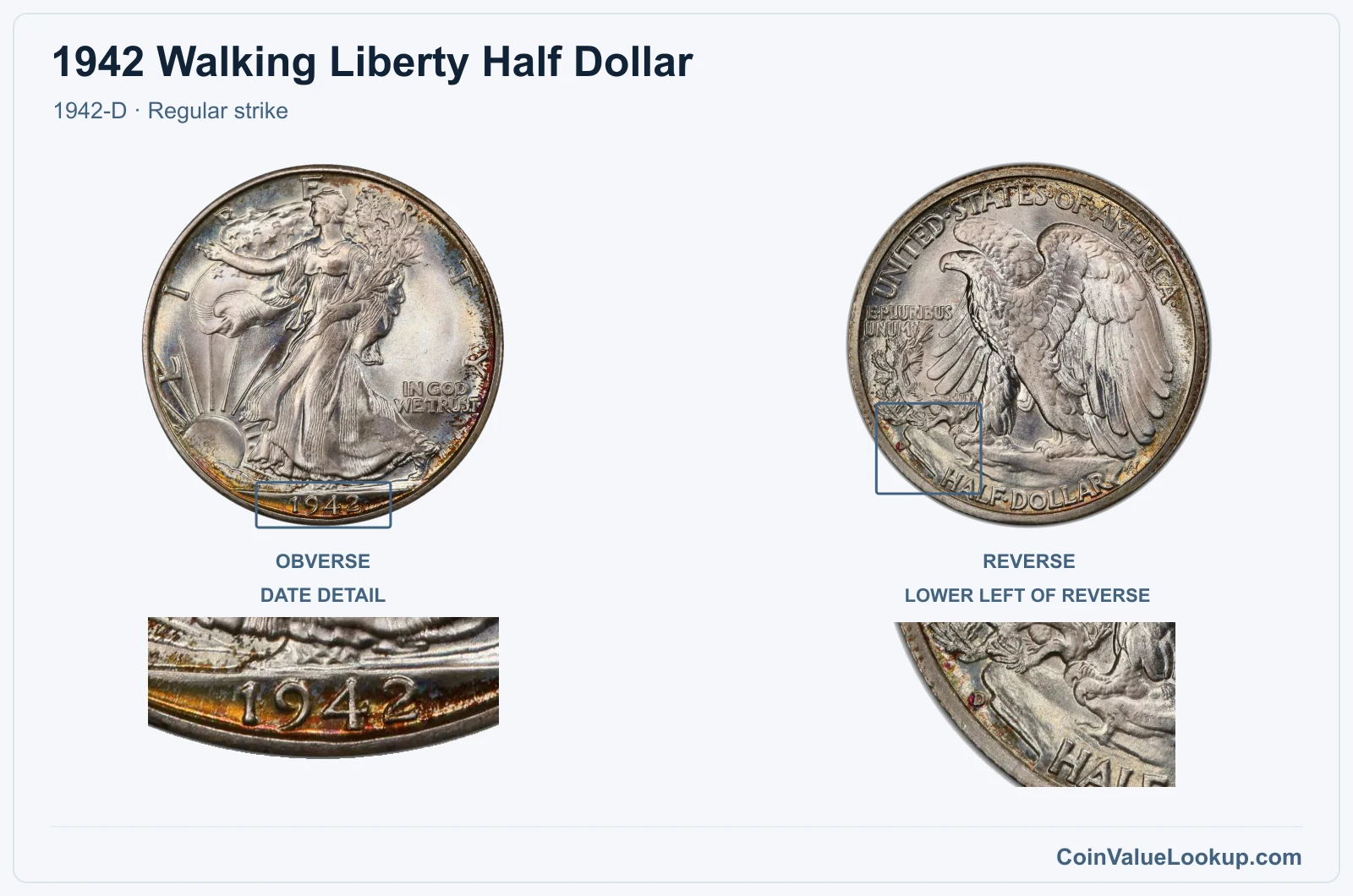
The 1942-D was struck in Denver. Flip the coin over and look at the lower left of the reverse for a small "D" mintmark near the rim.
In Good-4, this one also sits at roughly $34.00, but the MS63 guide estimate jumps to about $118.00, noticeably above the Philadelphia version at the same grade.
That premium reflects collector demand for the Denver issue in upper grades. Still, the same caution applies: cleaned or scratched pieces lose the premium that original surfaces command.
Weak strikes occur here too, so use luster and actual smoothing rather than soft detail alone to judge wear.
Coin Value Lookup is a good starting point if you are sorting through several dates or denominations. You can look up guides for other Walking Liberty Half Dollars and compare values across years.
Range Grade
Price Auction Records Appraisal PO PO 1
—
Coin Identifier FR FR 2
—
Coin Identifier AG AG 3
—
Coin Identifier G G 4
—
Coin Identifier
G 6
—
Coin Identifier VG VG 8
—
Coin Identifier
VG 10
—
Coin Identifier F F 12
—
Coin Identifier
F 15
—
Coin Identifier VF VF 20
—
Coin Identifier
VF 25
—
Coin Identifier
VF 30
—
Coin Identifier
VF 35
—
Coin Identifier XF XF 40
—
Coin Identifier
XF 45
—
Coin Identifier AU AU 50
Coin Identifier
AU 53
—
Coin Identifier
AU 55
Coin Identifier
AU 58
Coin Identifier MS MS 60
—
Coin Identifier
MS 61
—
Coin Identifier
MS 62
Coin Identifier
MS 63
Coin Identifier
MS 64
Coin Identifier
MS 65
Coin Identifier
MS 66
Coin Identifier
MS 67
Coin Identifier
MS 68
Coin Identifier
MS 69
—
—
—
MS 70
—
—
—
1942 Walking Liberty Half Dollar — S
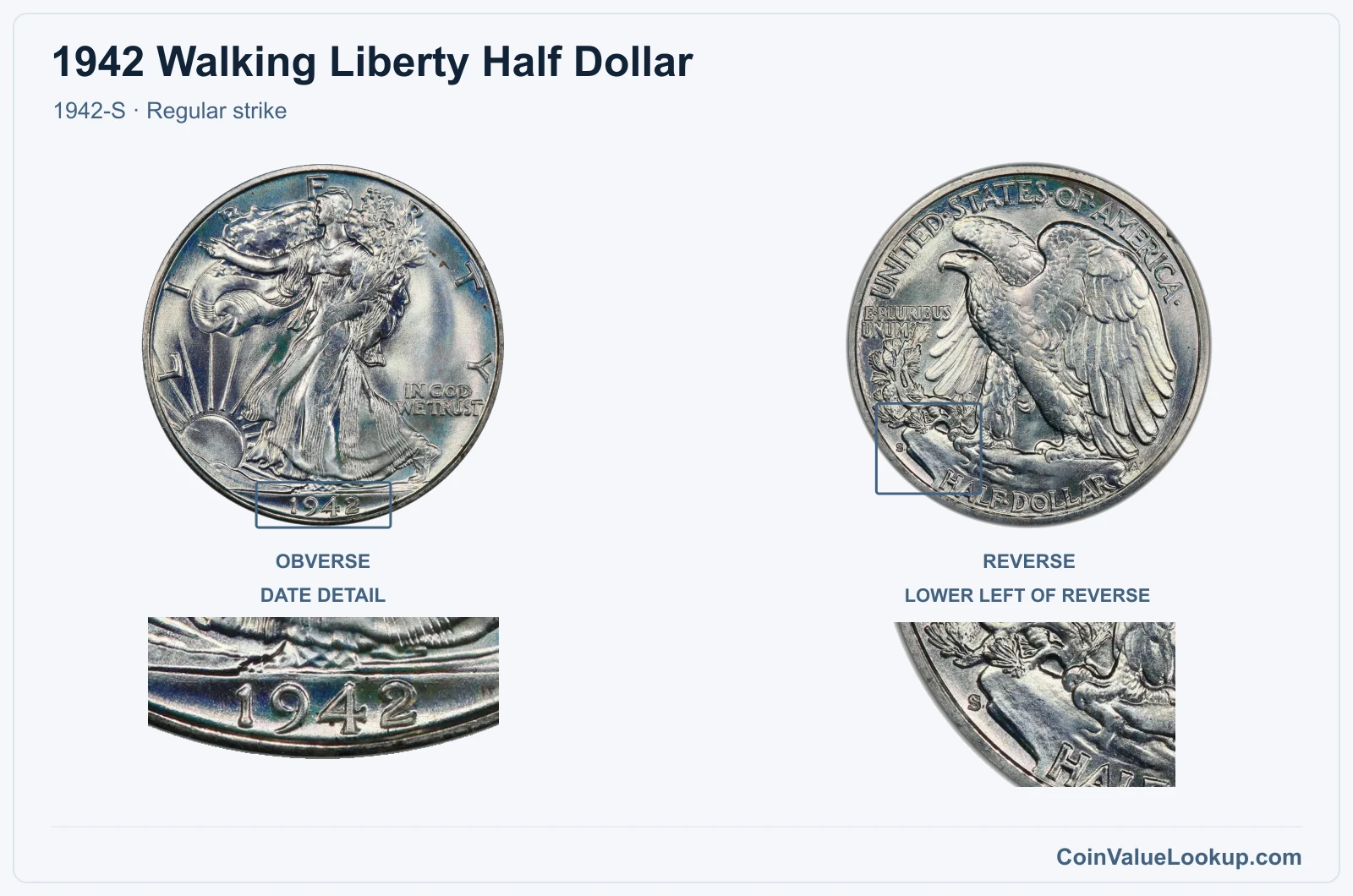
The 1942-S carries a small "S" mintmark on the reverse lower left. It shares the same guide anchors as the Denver issue: around $34.00 in G4 and about $118.00 in MS63 per published estimates.
San Francisco Walkers of this era can show softer strikes than their Philadelphia or Denver siblings. Do not mistake a flat left hand for heavy wear if the fields still carry undisturbed luster.
Match the mint, assess actual smoothing on the high points, and check for original surfaces before comparing to the price chart. Cleaned or damaged coins trade well below these guide figures regardless of their apparent grade.
Range Grade
Price Auction Records Appraisal PO PO 1
—
Coin Identifier FR FR 2
—
Coin Identifier AG AG 3
—
Coin Identifier G G 4
—
Coin Identifier
G 6
—
Coin Identifier VG VG 8
—
Coin Identifier
VG 10
—
Coin Identifier F F 12
—
Coin Identifier
F 15
—
Coin Identifier VF VF 20
—
Coin Identifier
VF 25
—
Coin Identifier
VF 30
—
Coin Identifier
VF 35
—
Coin Identifier XF XF 40
—
Coin Identifier
XF 45
—
Coin Identifier AU AU 50
Coin Identifier
AU 53
—
Coin Identifier
AU 55
—
Coin Identifier
AU 58
Coin Identifier MS MS 60
—
Coin Identifier
MS 61
—
Coin Identifier
MS 62
Coin Identifier
MS 63
Coin Identifier
MS 64
Coin Identifier
MS 65
Coin Identifier
MS 66
Coin Identifier
MS 67
Coin Identifier
MS 68
—
—
—
MS 69
—
—
—
MS 70
—
—
—
1942 Walking Liberty Half Dollar — PR
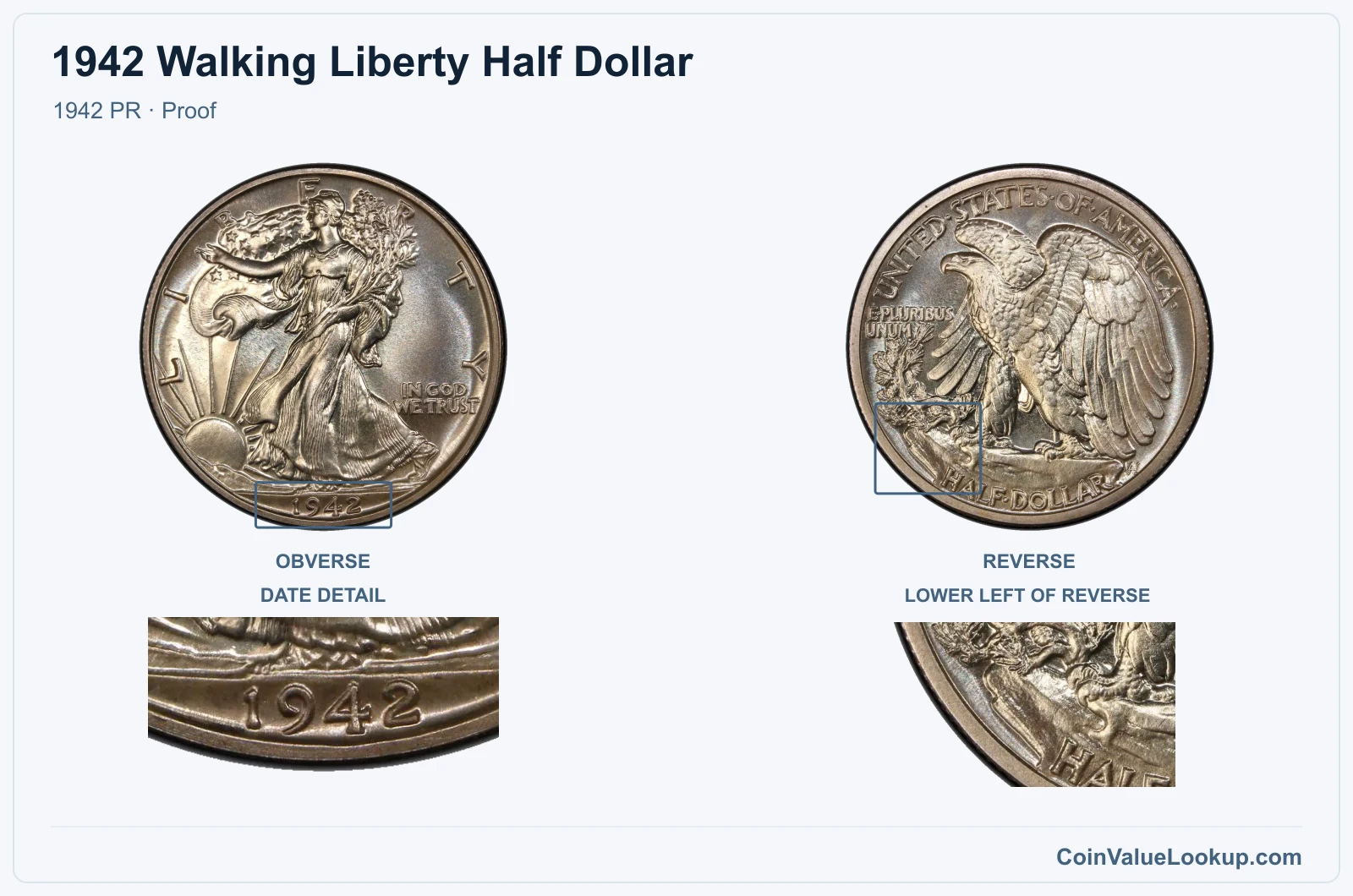
The 1942 proof carries no mintmark, just like the Philadelphia business strike, but it is an entirely different animal. Genuine proofs were made on polished planchets with specially prepared dies, giving the fields a mirror-like finish and the design elements an unusually crisp impression.
At PR65, the published guide estimate is $630.00. That is the highest single anchor among all 1942 Walking Liberty Half Dollar branches.
To qualify, the coin needs minimal hairlines, no haze and sharp devices throughout. Cameo contrast, where frosty devices sit against mirrored fields, can appear on some examples.
Be careful. A regular business strike that somebody polished is not a proof.
The difference is in the die preparation and planchet finish at the mint, not post-production shine. If you are unsure, professional certification from a major grading service settles the question.
Range Grade
Price Auction Records Appraisal PR PR 1
—
Coin Identifier
PR 2
—
Coin Identifier
PR 3
—
Coin Identifier
PR 4
—
Coin Identifier
PR 6
—
Coin Identifier
PR 8
—
Coin Identifier
PR 10
—
Coin Identifier
PR 12
—
Coin Identifier
PR 15
—
Coin Identifier
PR 20
—
Coin Identifier
PR 25
—
Coin Identifier
PR 30
—
Coin Identifier
PR 35
—
Coin Identifier
PR 40
—
Coin Identifier
PR 45
—
Coin Identifier
PR 50
—
Coin Identifier
PR 53
—
Coin Identifier
PR 55
—
Coin Identifier
PR 58
Coin Identifier
PR 60
Coin Identifier
PR 61
Coin Identifier
PR 62
Coin Identifier
PR 63
Coin Identifier
PR 64
Coin Identifier
PR 65
Coin Identifier
PR 66
Coin Identifier
PR 67
Coin Identifier
PR 68
Coin Identifier
PR 69
Coin Identifier
PR 70
—
—
—
1942 Walking Liberty Half Dollar Error List
1. 1942 Walking Liberty Half Dollar — Doubled Die Reverse
A doubled die reverse has been reported for the 1942 Walking Liberty Half Dollar. This variety shows doubling on reverse design elements such as lettering or contours of the eagle.
To check, compare your coin's reverse closely against a known normal example, ideally under magnification.
The doubling from a genuine doubled die is consistent and affects the entire area struck by the misaligned die impression. Machine doubling, by contrast, tends to look flat and shelf-like, often showing up as a thin raised lip beside letters.
Random contact marks or reflections from lighting can also mimic doubling to the untrained eye.
No specific price range is available for this variety. Value depends on the strength and visibility of the doubling, overall condition of the coin, and market demand.
Professional authentication is recommended if you believe you have a match.
2. 1942 Walking Liberty Half Dollar — Double / Multiple Strike
A double struck in collar error has been reported for the 1942 Walking Liberty Half Dollar. On a genuine double strike, the coin received two separate impressions from the dies, producing overlapping or displaced design elements.
You might see a second, offset outline of Liberty or the eagle layered over the primary image.
This is different from a doubled die, which originates from the die itself. A double strike happens to an individual planchet during the striking process.
Look for two distinct sets of design features rather than merely thickened or spread lettering.
Post-mint damage, vise marks or deliberate alterations can mimic the look. A legitimate double strike will show a consistent geometric relationship between the two impressions.
No adopted price range is available; value depends heavily on how dramatic the displacement is, the coin's preservation, and authentication by a recognized grading service.
3. 1942 Walking Liberty Half Dollar — Wrong Planchet / Off-Metal Strike
A 1942 Walking Liberty Half Dollar struck on a Washington quarter planchet has been reported. If genuine, this coin was fed the wrong blank at the mint, resulting in a half dollar design impressed on a smaller, lighter planchet.
The design would be incomplete around the edges because the planchet could not fill the full half dollar die cavity.
To evaluate a suspect coin, measure the weight and diameter carefully. A genuine quarter planchet will be noticeably smaller and lighter than the standard 12.50-gram, 30.6 mm half dollar blank.
The edge and overall proportions should match a quarter blank, not a filed-down or acid-reduced half dollar.
Lookalikes include coins that have been plated, corroded, acid-treated or deliberately altered to appear undersized. No numerical price range is available for this error.
Value depends on authenticity, condition and the specific characteristics of the strike. Professional third-party authentication is strongly advised for any wrong-planchet claim.