1966 Jefferson Nickel Coin Value: How Much Is It Worth?
The 1966 Jefferson nickel is one of those coins nearly everyone has floating in a jar somewhere. Most circulated examples are worth face value or close to it.
Uncirculated pieces carry modest premiums, with guide estimates around $0.30 at MS60 and up to $6.25 at MS65 according to USA Coin Book. Special Mint Set specimens and certain mint errors occupy a different tier entirely.
Fast Way to Identify Your 1966 Jefferson Nickel
Snap clear photos of both the front and back of your 1966 nickel and upload them for a preliminary identification. Good lighting and a steady hand help the process distinguish surface finish, strike quality, and any visible anomalies.
This is not a substitute for professional authentication, but it gives you a solid starting point.
1966 Jefferson Nickel Value
Upload both sides of your 1966 Jefferson Nickel.
Front Obverse
Upload photo
Back Reverse
Upload photo
Which 1966 Jefferson Nickel Versions Are Worth Money?
- Uncirculated business strikes graded MS65 list around $6.25 in the USA Coin Book guide; Full Steps examples command separate, higher premiums.
- SMS Special Strike specimens from San Francisco, especially those with professionally attributed cameo contrast, appeal to finish-focused collectors.
- A 1966 nickel struck on a clad dime blank sold for $862.50 at Heritage Auctions in August 2006 in PCGS MS63.
- Wrong-planchet errors such as a strike on a cent-sized copper blank are individually assessed based on authenticated identity and condition.
- Doubled Die Obverse varieties and significant off-center strikes are reported for this date and can carry premiums depending on visibility and grade.
Step 1: Identify Your 1966 Jefferson Nickel Mint Mark and Version
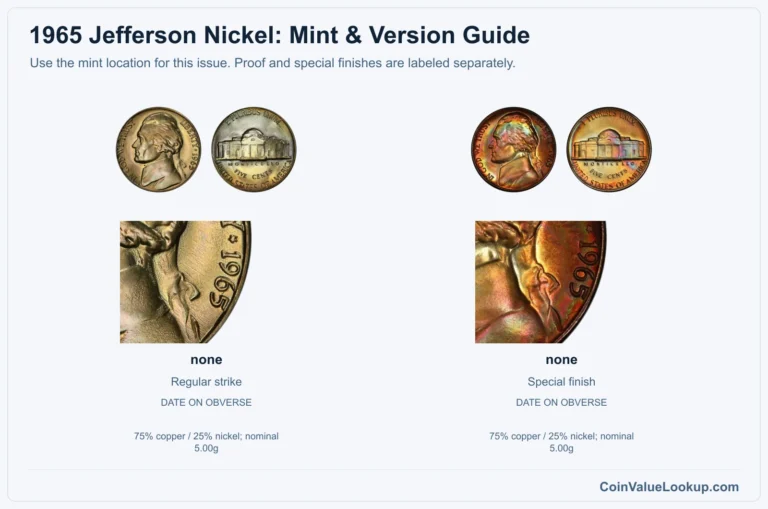
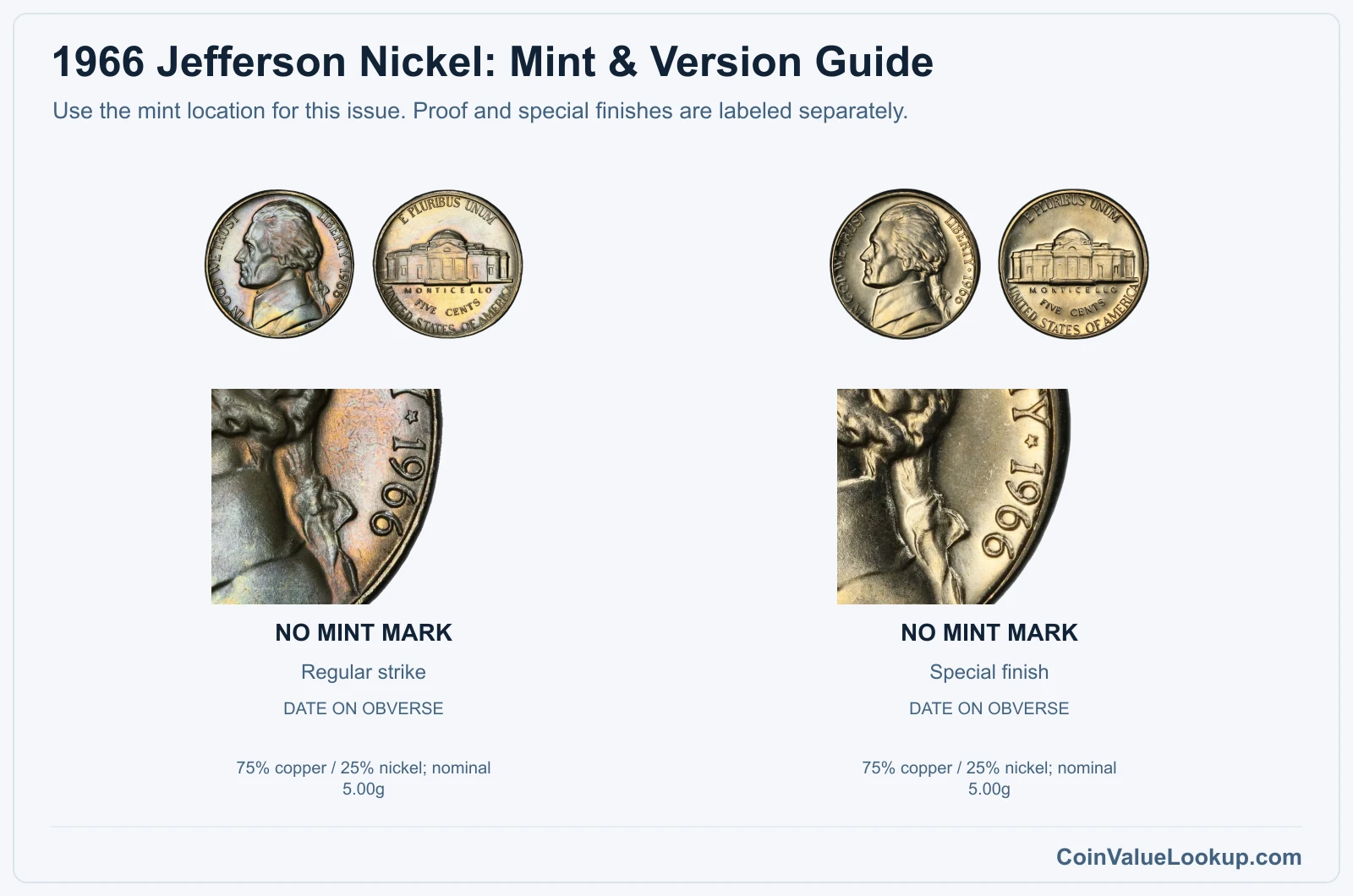
Every 1966 Jefferson nickel lacks a mintmark, and that is completely normal. The U.S. Mint suppressed mintmarks from 1965 through 1967, so the absence of a letter below the date tells you nothing about which facility struck the coin.
Business strikes and Special Mint Set coins both show no mintmark.
The standard coin is 75% copper and 25% nickel, weighs 5.00 grams, measures 21.2 mm across, and has a plain edge. Weighing your coin can screen out wrong-planchet errors, but weight alone does not authenticate anything.
To separate a business strike from an SMS specimen, look at the overall finish. SMS coins were produced at San Francisco with better preparation than regular strikes, giving them sharper detail and sometimes a satin or lightly reflective surface.
They are not proofs, though. Record the date, note the absence of a mintmark, assess the finish, and photograph both sides before looking up values.
Step 2: Check Your 1966 Jefferson Nickel Grade
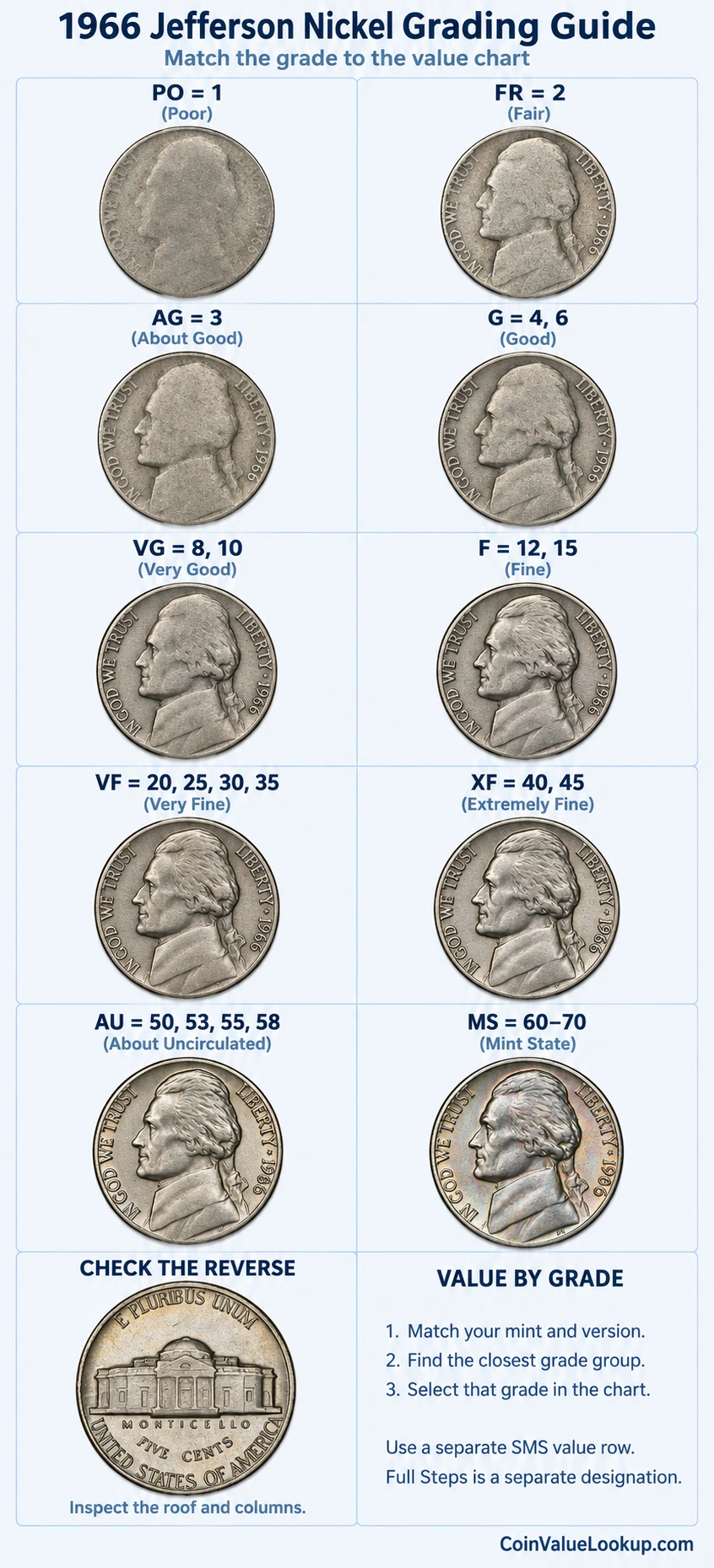
Start with Jefferson's cheek and hair above his ear. On a well-worn coin, the cheek flattens out and the hair strands merge into a smooth blob.
A coin with only light wear retains individual hair detail and some original luster in protected areas.
Flip it over and check the roof and columns of Monticello. These are the reverse's high points and show wear early.
Columns that blend into the building indicate moderate to heavy circulation.
Don't confuse a weak strike with actual wear. Some 1966 nickels simply left the press with mushy detail, especially in the steps at the base of Monticello.
Full Steps is a separate strike-quality designation applied only to Mint State business strikes where those steps are sharply defined and uninterrupted. A shiny surface does not guarantee a high grade if the details were never fully struck.
Use the comparison image to judge where your coin falls on the spectrum from well-worn to gem uncirculated.
Step 3: Check 1966 Jefferson Nickel Value by Mint and Version
1966 Jefferson Nickel — No mintmark (facility not inferred) Business strike
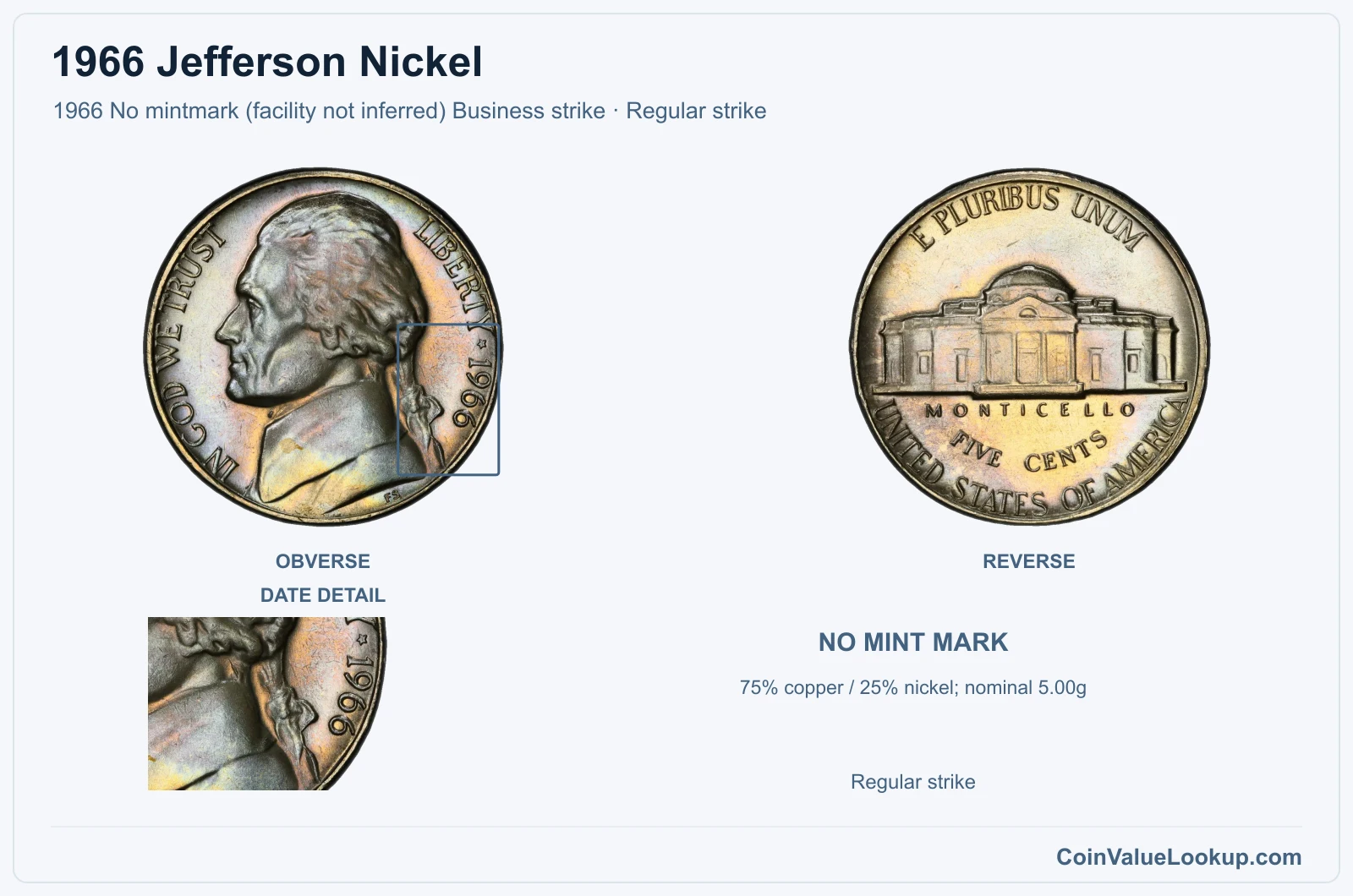
This is the standard 1966 Jefferson nickel produced for circulation. It is 75% copper and 25% nickel, weighs 5.00 grams, and carries no mintmark — which is perfectly normal for any 1966 nickel regardless of the striking facility.
Circulated examples are common and generally worth only face value. The USA Coin Book guide places uncirculated pieces at about $0.30 in MS60 condition, climbing to roughly $6.25 at MS65.
Full Steps coins — those with sharply defined, uninterrupted steps on Monticello — are a separate category and carry their own premiums above these baseline figures.
When evaluating yours, make sure the finish matches a normal business strike: slightly satiny or frosty, without the enhanced sharpness of an SMS coin.
| Range | Grade | Price | Auction Records | Appraisal |
|---|---|---|---|---|
| PO | PO 1 | — | Coin Identifier | |
| FR | FR 2 | — | Coin Identifier | |
| AG | AG 3 | — | Coin Identifier | |
| G | G 4 | — | Coin Identifier | |
| G 6 | — | Coin Identifier | ||
| VG | VG 8 | — | Coin Identifier | |
| VG 10 | — | Coin Identifier | ||
| F | F 12 | — | Coin Identifier | |
| F 15 | — | Coin Identifier | ||
| VF | VF 20 | — | Coin Identifier | |
| VF 25 | — | Coin Identifier | ||
| VF 30 | — | Coin Identifier | ||
| VF 35 | — | Coin Identifier | ||
| XF | XF 40 | — | Coin Identifier | |
| XF 45 | — | Coin Identifier | ||
| AU | AU 50 | — | Coin Identifier | |
| AU 53 | — | Coin Identifier | ||
| AU 55 | — | Coin Identifier | ||
| AU 58 | — | Coin Identifier | ||
| MS | MS 60 | — | Coin Identifier | |
| MS 61 | — | Coin Identifier | ||
| MS 62 | — | Coin Identifier | ||
| MS 63 | — | Coin Identifier | ||
| MS 64 | Coin Identifier | |||
| MS 65 | Coin Identifier | |||
| MS 66 | Coin Identifier | |||
| MS 67 | Coin Identifier | |||
| MS 68 | — | — | — | |
| MS 69 | — | — | — | |
| MS 70 | — | — | — |
1966 Jefferson Nickel — San Francisco (no mintmark) SMS Special Strike
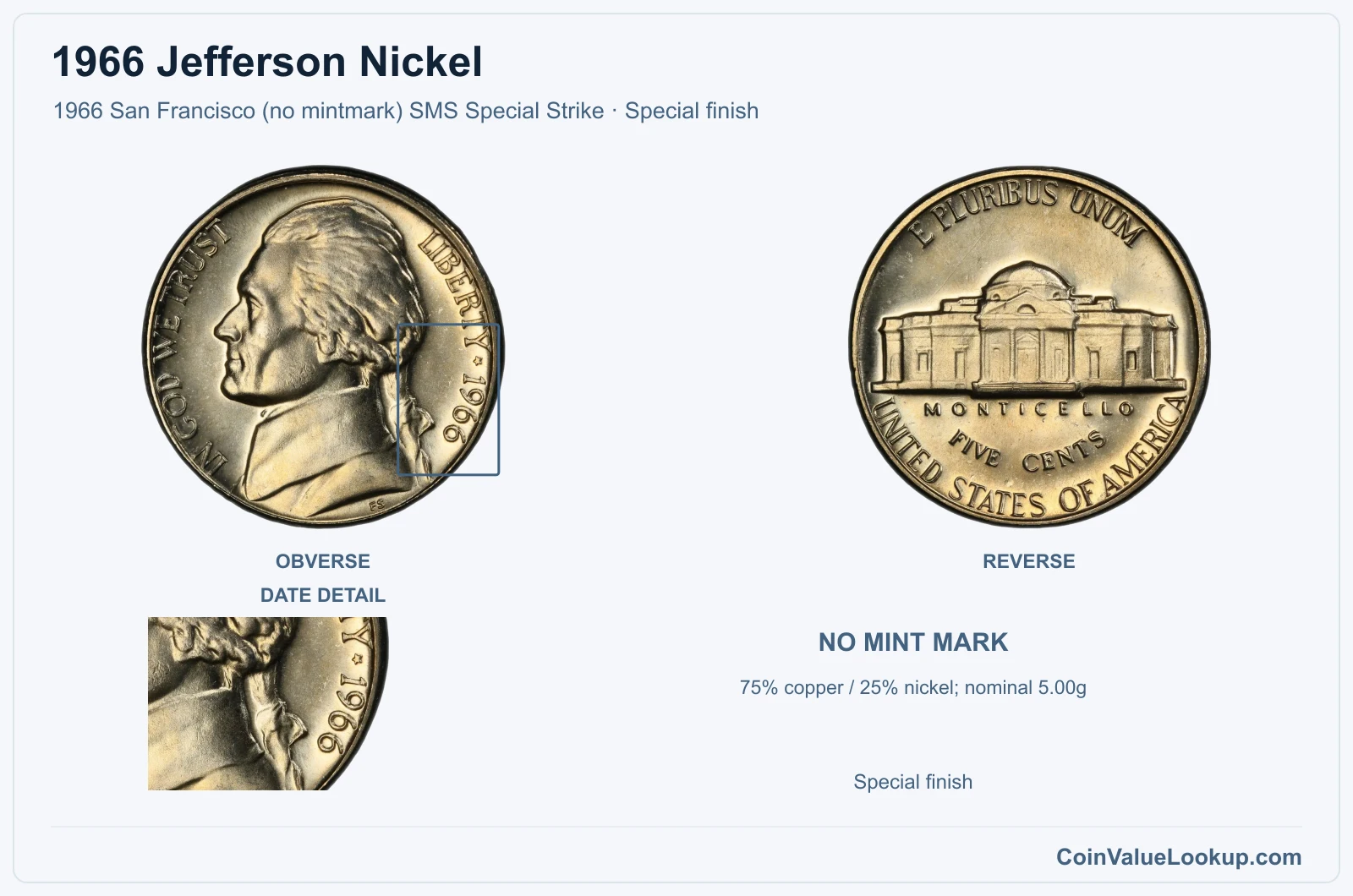
Special Mint Set coins were produced at the San Francisco facility from 1965 through 1967, taking the place of regular proof sets during those years. They carry no mintmark, just like business strikes, so identification depends on the coin's finish rather than a letter on the surface.
SMS nickels typically show sharper detail and a more refined surface than ordinary strikes. Some display cameo contrast — frosted devices against reflective fields — and those pieces, when professionally attributed, attract dedicated collectors.
SMS coins are graded on the SP scale, not the MS or PR scale.
Coin Value Lookup can help you explore guides for different Jefferson nickel years and finishes when you are ready to compare.
Because no standard guide anchor was adopted for this finish, value depends on the individual coin's authenticated identity, condition, and any special designations like cameo or deep cameo. Have the coin evaluated on its own merits rather than applying business-strike prices.
| Range | Grade | Price | Auction Records | Appraisal |
|---|---|---|---|---|
| SP | SP 1 | — | Coin Identifier | |
| SP 2 | — | Coin Identifier | ||
| SP 3 | — | Coin Identifier | ||
| SP 4 | — | Coin Identifier | ||
| SP 6 | — | Coin Identifier | ||
| SP 8 | — | Coin Identifier | ||
| SP 10 | — | Coin Identifier | ||
| SP 12 | — | Coin Identifier | ||
| SP 15 | — | Coin Identifier | ||
| SP 20 | — | Coin Identifier | ||
| SP 25 | — | Coin Identifier | ||
| SP 30 | — | Coin Identifier | ||
| SP 35 | — | Coin Identifier | ||
| SP 40 | — | Coin Identifier | ||
| SP 45 | — | Coin Identifier | ||
| SP 50 | — | Coin Identifier | ||
| SP 53 | — | Coin Identifier | ||
| SP 55 | — | Coin Identifier | ||
| SP 58 | — | Coin Identifier | ||
| SP 60 | — | Coin Identifier | ||
| SP 61 | — | Coin Identifier | ||
| SP 62 | — | Coin Identifier | ||
| SP 63 | — | Coin Identifier | ||
| SP 64 | — | Coin Identifier | ||
| SP 65 | Coin Identifier | |||
| SP 66 | Coin Identifier | |||
| SP 67 | Coin Identifier | |||
| SP 68 | Coin Identifier | |||
| SP 69 | — | — | — | |
| SP 70 | — | — | — |
1966 Jefferson Nickel Error List
1. 1966 Jefferson Nickel — Struck on a clad dime blank
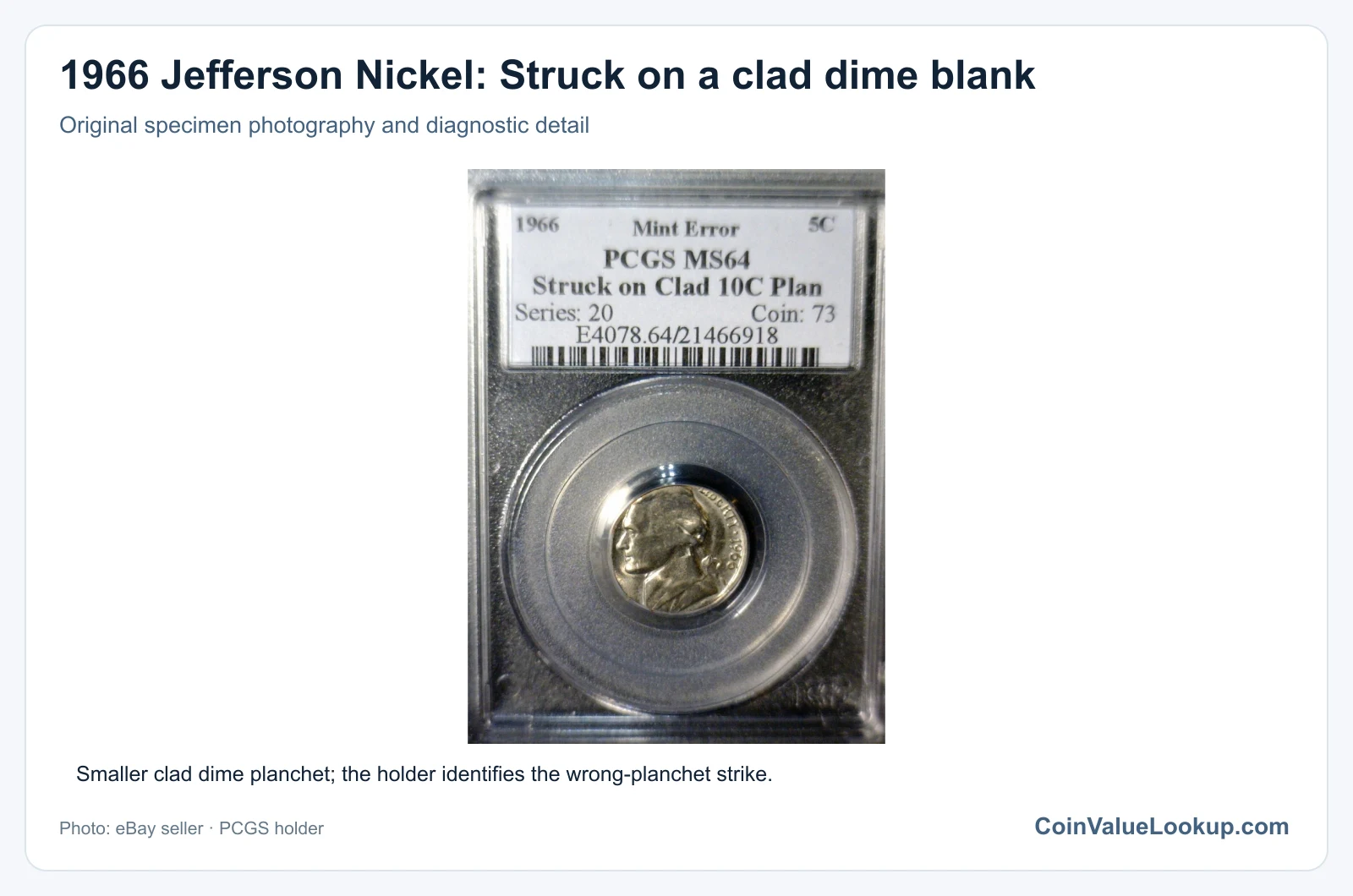
A 1966 nickel struck on a clad dime blank is noticeably smaller than a standard nickel, and the design is visibly incomplete around the edges because the blank was never large enough to fill the dies. The edge may show a copper core sandwiched between clad layers, which is a clue that the planchet came from dime stock rather than the solid copper-nickel alloy used for nickels.
Don't confuse this with a nickel that has simple edge damage or a normal coin that looks small due to heavy wear. Certification by a major grading service is the way to confirm the blank's identity.
A PCGS MS63 example of this error sold for $862.50 at a Heritage auction in August 2006. That figure reflects one specific coin's condition and authentication, not a guaranteed price for every specimen.
2. 1966 Jefferson Nickel — Struck on a cent planchet
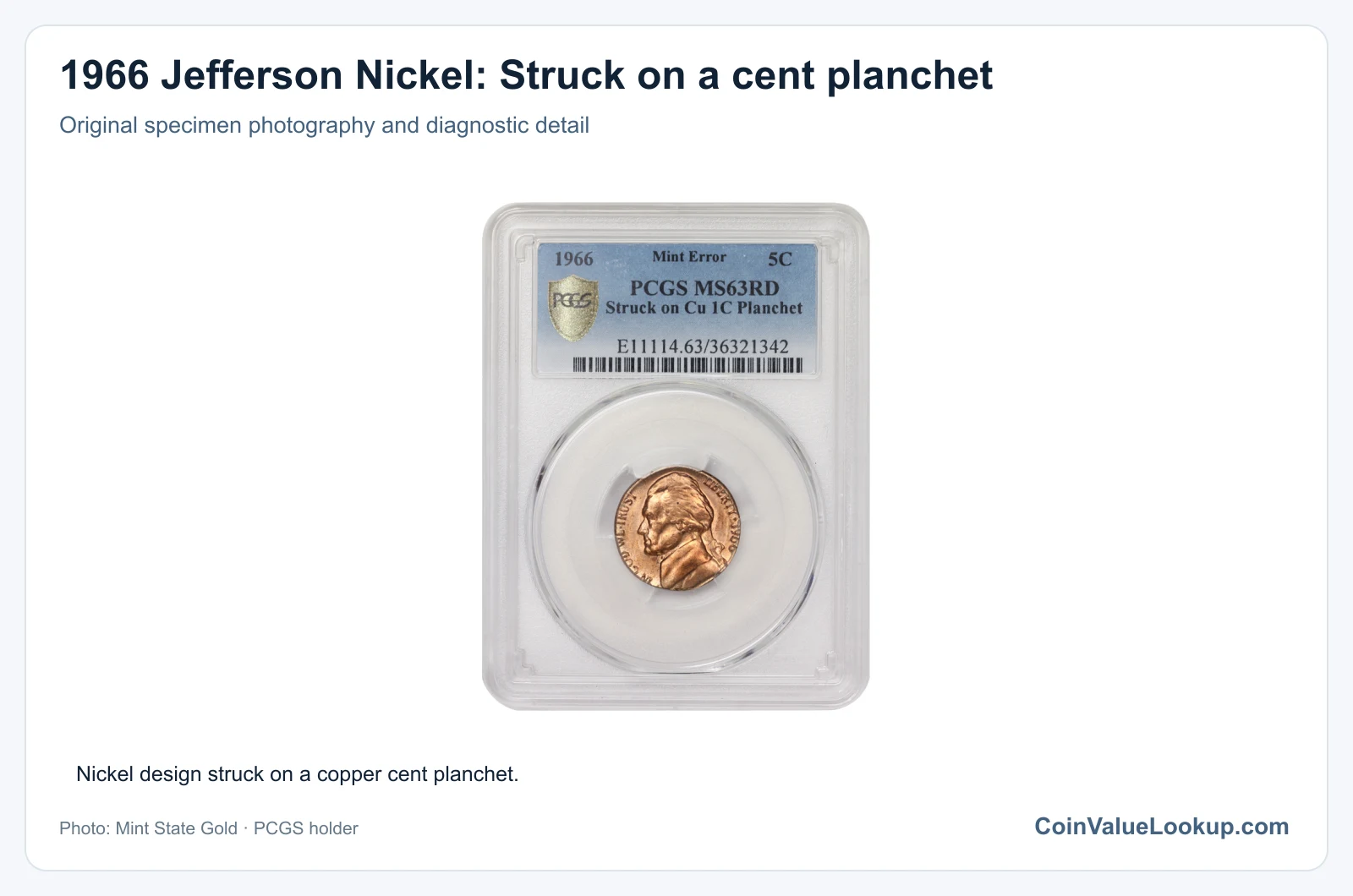
This error occurs when a cent-sized copper blank accidentally enters the nickel press and receives the Jefferson nickel design. The result is a coin that is copper colored, undersized, and shows cropped or stretched legends because the blank was far too small for the nickel dies.
Weight is a useful first check: a normal nickel runs about 5 grams, while a cent planchet is significantly lighter.
Look-alikes include copper-plated nickels, chemically toned coins, and nickels that have been ground down after leaving the mint. None of those will show the correct combination of reduced diameter, copper composition throughout, and properly struck design elements.
A PCGS MS64 example is documented, and value depends entirely on the individual coin's authenticated identity, condition, and the severity of the error.
3. 1966 Jefferson Nickel — Detached laminations
A lamination error on a 1966 nickel means internal separation within the alloy caused layers to detach after the coin was struck. The exposed area typically has a rough, granular texture where the metal separated.
One documented NGC MS65 example actually consists of three related pieces — the main coin and the detached layers — housed together.
This looks very different from a coin that has been intentionally cut apart or chemically stripped. Genuine lamination exposes an uneven, crystalline subsurface rather than smooth tool marks or acid etching.
The separated pieces should fit the parent coin's contours.
No standard price range is adopted for this error. Value hinges on the authenticated identity of the coin, the size and visual impact of the separation, and overall condition.
Professional grading helps establish all three.
4. 1966 Jefferson Nickel — Rotated reverse
On a properly struck coin, if you hold the obverse upright and flip the coin top-to-bottom, the reverse should also appear upright. A rotated-die error means Monticello is tilted to some degree relative to Jefferson's portrait because one die was out of alignment during striking.
An NGC MS65 specimen of this error is documented in a two-coin lot, though the exact angle of rotation is not specified. Larger rotations are generally more desirable to collectors.
Be careful testing this at home. Flipping side-to-side instead of top-to-bottom gives a false rotation reading.
Also rule out trick coins that have been physically reassembled. A genuine rotated die affects the entire reverse design uniformly.
Value is individually assessed based on the degree of rotation, condition, and professional authentication.
5. 1966 Jefferson Nickel — Doubled Die Obverse
A Doubled Die Obverse on a 1966 nickel shows consistent doubling on obverse design elements — letters, the date, or portions of Jefferson's portrait. Under magnification, look for separation or notching in the lettering that repeats in the same direction across multiple characters.
This is die doubling, created during the die-making process.
The key distinction is separating true die doubling from machine doubling, which is flat, shelf-like, and caused by bounce during the strike itself. Reflections and worn die contours can also mimic doubling to the untrained eye.
No specific price range is adopted for this variety. The value of any doubled die depends on the visibility of the doubling, which design elements are affected, and the coin's overall condition.
Professional attribution helps confirm the variety.
6. 1966 Jefferson Nickel — Off-Center Strike
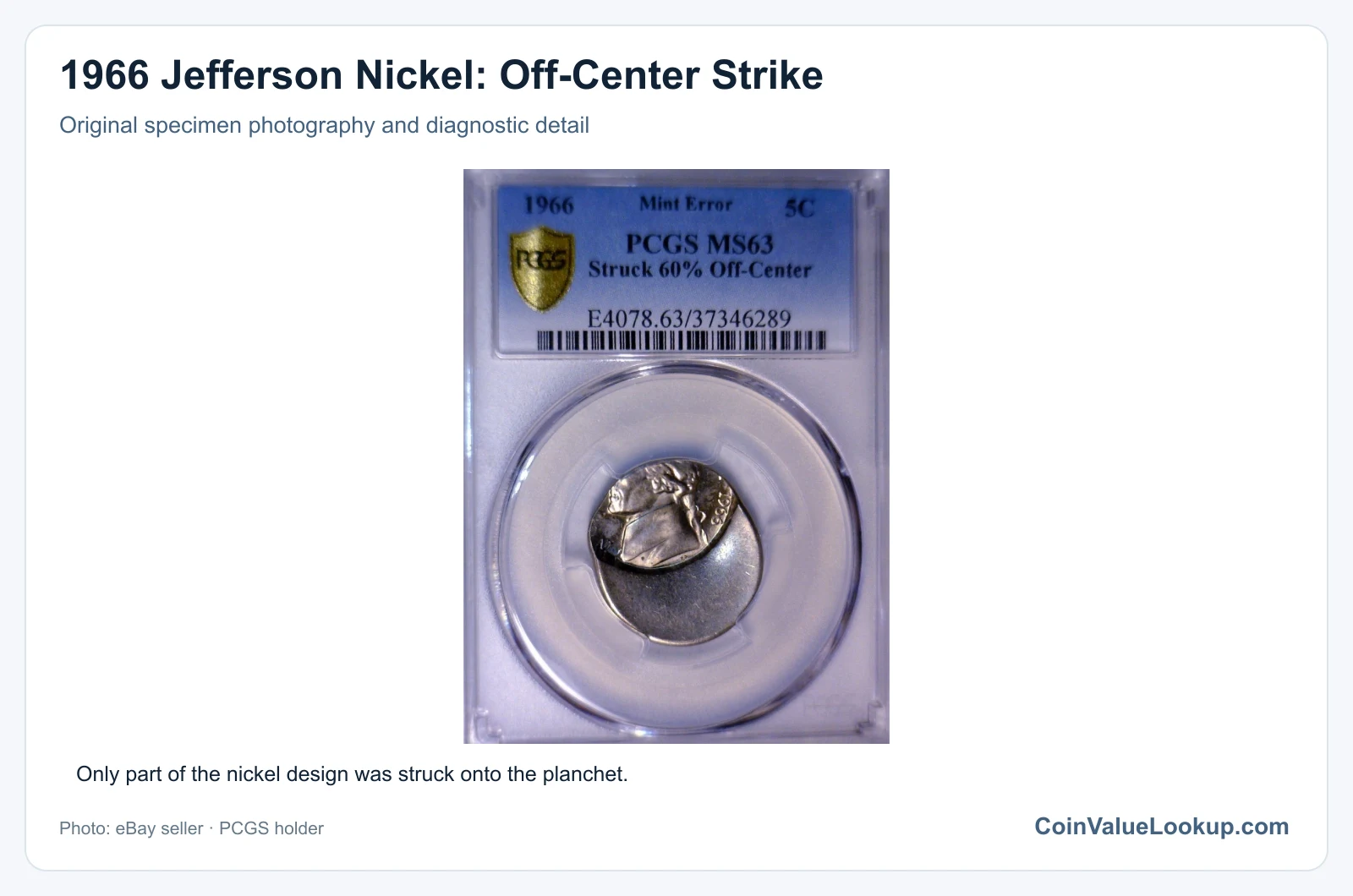
An off-center strike happens when the blank is not properly seated between the dies, producing a coin with a displaced design and an unstruck crescent of bare metal along one edge. The most collectible examples retain a visible date, since that is how buyers confirm the year.
Don't confuse an off-center strike with a clipped planchet, which involves a missing piece of the original blank rather than a shifted impression. Post-mint damage — someone hammering or flattening a coin — can also create misleading asymmetry, but it will not produce the smooth, unstruck crescent that a genuine off-center coin displays.
No standard price range is adopted for this error. Value depends on the percentage of off-center shift, whether the date remains visible, and the coin's overall grade.
7. 1966 Jefferson Nickel — Clipped Planchet
A clipped planchet error means the blank was incompletely punched from the metal strip before striking, leaving a missing curved, straight, or ragged section along the edge. Genuine clips often produce a characteristic area of design weakness on the side opposite the missing metal, where the thinner blank could not fully fill the die.
Edge texture matters when screening for authenticity. A real clip shows metal flow consistent with the original punching process, while a filed notch or deliberate cut leaves tool marks and sharp edges.
Corrosion can eat away an edge too, but it will not produce the smooth contour or opposing-side weakness of a true clip.
No specific price range is adopted for this variety. Each clipped-planchet nickel is assessed individually based on the size and type of clip, the coin's condition, and whether it has been professionally attributed.