1936 Wheat Penny Coin Value: How Much Is It Worth?
A 1936 Wheat penny in circulated condition starts around $0.18 at Good-4 and climbs to about $7.29 at MS63, depending on which mint struck it. Those are guide estimates for ordinary circulation strikes.
Proofs, doubled die varieties, and mint errors each carry their own pricing, often significantly higher. Original surfaces, color, and the absence of cleaning or corrosion all affect what a buyer will actually pay.
Fast Way to Identify Your 1936 Wheat Penny
The quickest way to start figuring out what you have is to upload clear photos of both sides of your coin. A well-lit front shot shows the date, mintmark, and Lincoln portrait detail, while the back reveals the wheat reverse condition.
This gives a solid starting point for preliminary identification of your coin's mint, variety, and approximate grade.
1936 Wheat Penny Value
Upload both sides of your 1936 Wheat Penny.
Front Obverse
Upload photo
Back Reverse
Upload photo
Which 1936 Wheat Penny Versions Are Worth Money?
- Three Doubled Die Obverse varieties exist for the 1936 Philadelphia cent, each guided around $34 in G4 and up to $1,879 in MS63 — check your date and motto letters for consistent doubling.
- The 1936-S mint mark brings the highest ordinary guide value at MS63, listed at $7.29, slightly above the Philadelphia and Denver issues at that grade.
- Philadelphia Satin and Brilliant proof finishes were produced in 1936 and are distinct collectible issues whose value depends on authenticated identity and condition.
- Mint errors such as off-center strikes, broadstrikes, and die breaks can carry premiums that depend on severity and authentication.
Step 1: Identify Your 1936 Wheat Penny Mint Mark and Version
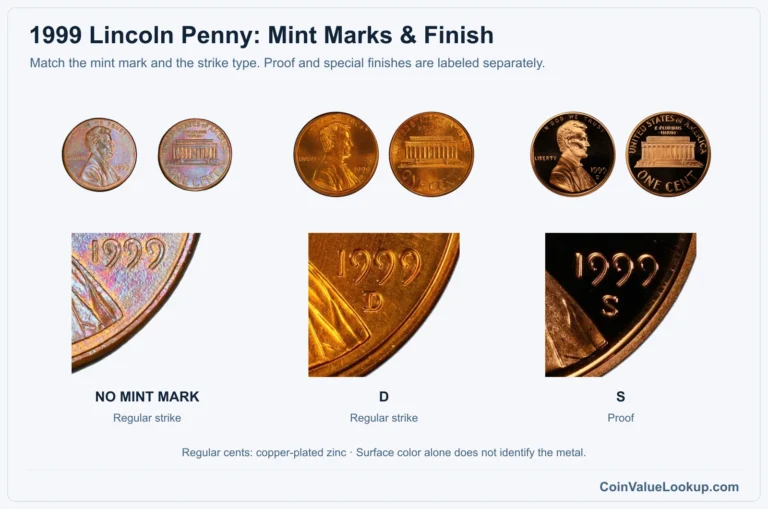
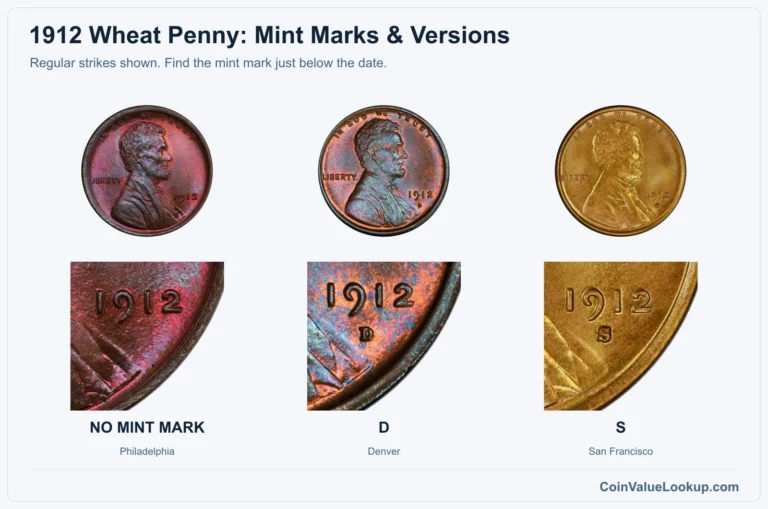
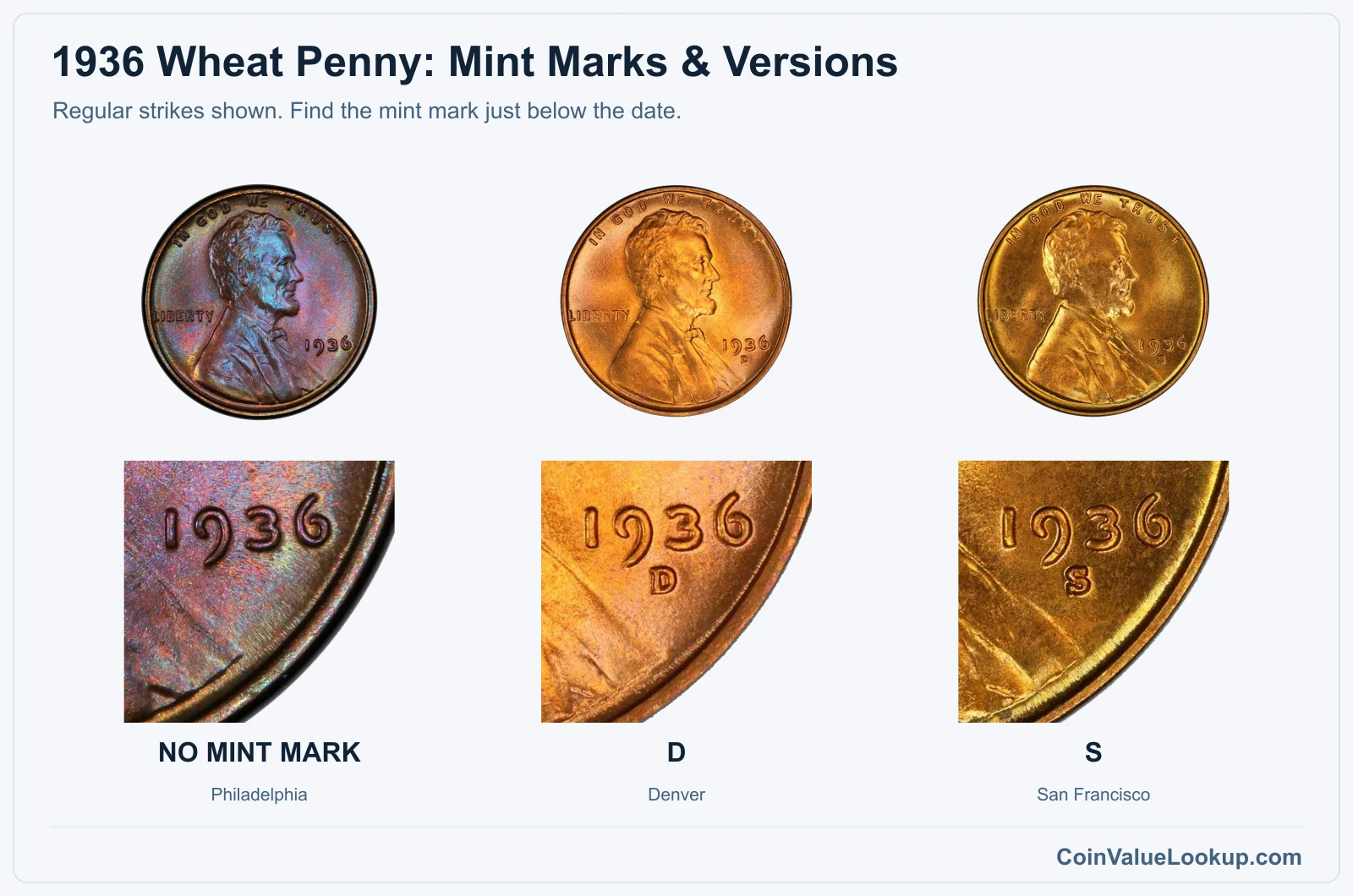
Flip your 1936 penny over and look just below the date on the front. If there is no small letter there, it was struck at Philadelphia.
A "D" means Denver, and an "S" means San Francisco.
All three mints produced standard Lincoln cents this year with the Wheat reverse design. The coin is 95% copper with 5% tin and zinc, weighs about 3.11 grams, and has a plain edge.
Philadelphia also resumed proof production in 1936 after a hiatus. Two distinct proof finishes exist: Satin and Brilliant.
A Satin proof has a soft, matte-like texture rather than mirror fields, while a Brilliant proof shows the classic reflective surface most people associate with proofs. A polished circulation coin is not a proof, no matter how shiny it looks.
Color matters but works differently than people expect. A coin described as Red, Red-Brown, or Brown refers to how much original copper luster remains.
Color alone does not determine grade. It is a separate value factor layered on top of wear assessment.
Finally, this date has three recognized Doubled Die Obverse varieties. They show doubling on the date and motto lettering.
Compare your coin closely to a normal example under good light before jumping to conclusions.
Step 2: Check Your 1936 Wheat Penny Grade
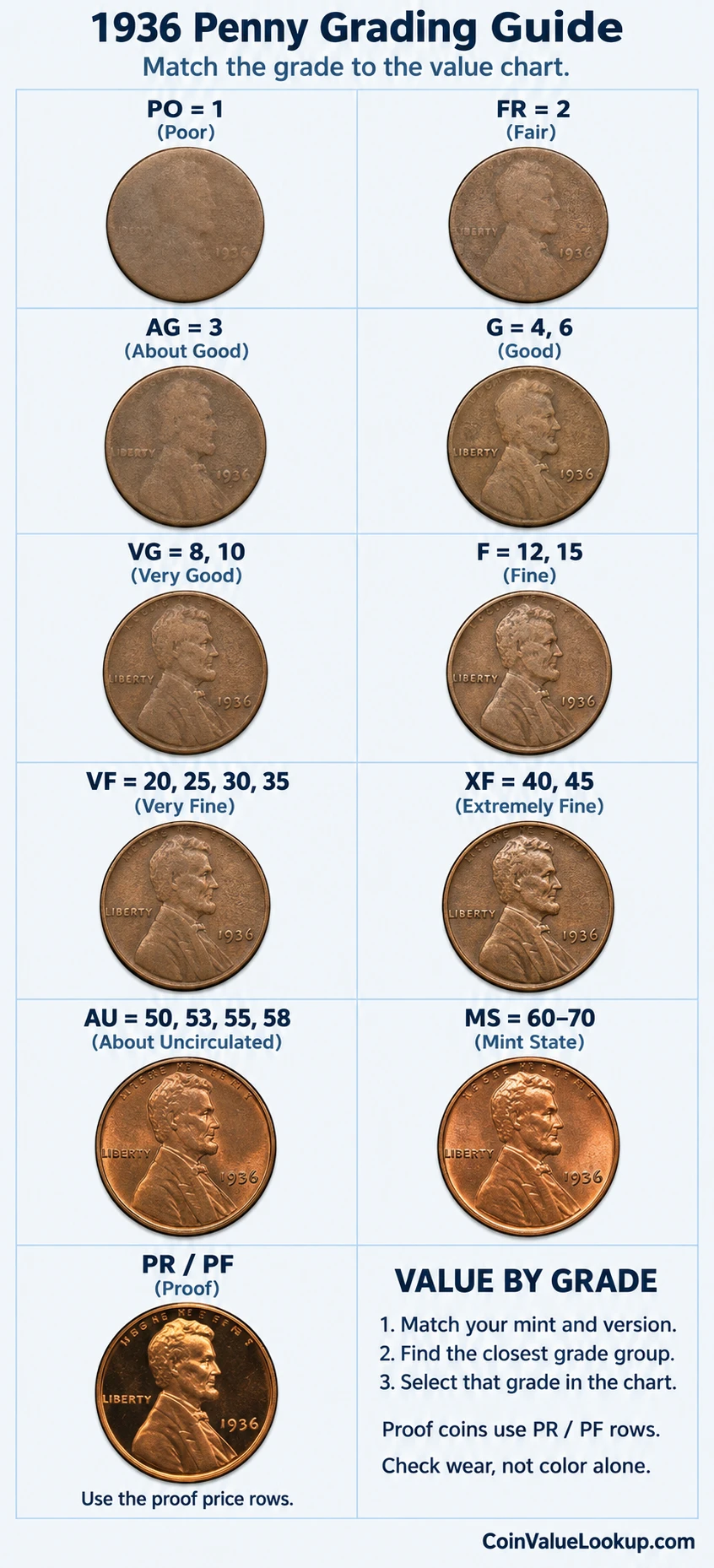
Start with Lincoln's cheekbone, jawline, and the fine hair detail above his ear. These are the highest points on the obverse and wear down first.
On the reverse, check the individual wheat grains and the horizontal lines between the stalks.
A coin at Good-4 will have a visible outline of Lincoln with most fine detail worn smooth. By Fine-12, the ear and jaw show separation.
At MS63 (uncirculated), full original luster remains with only minor contact marks allowed.
Weak strikes can fool you. Some 1936 cents left the press with soft detail, especially on the hair, that looks like light wear but is not.
Compare your coin to the reference image to distinguish original striking weakness from actual circulation wear.
Corrosion, spots, and cleaning each reduce a coin's appeal and value. A cleaned coin that has been re-toned often has an unnatural, hazy appearance.
These surface problems are assessed separately from wear grade.
Step 3: Check 1936 Wheat Penny Value by Mint and Version
1936 Wheat Penny
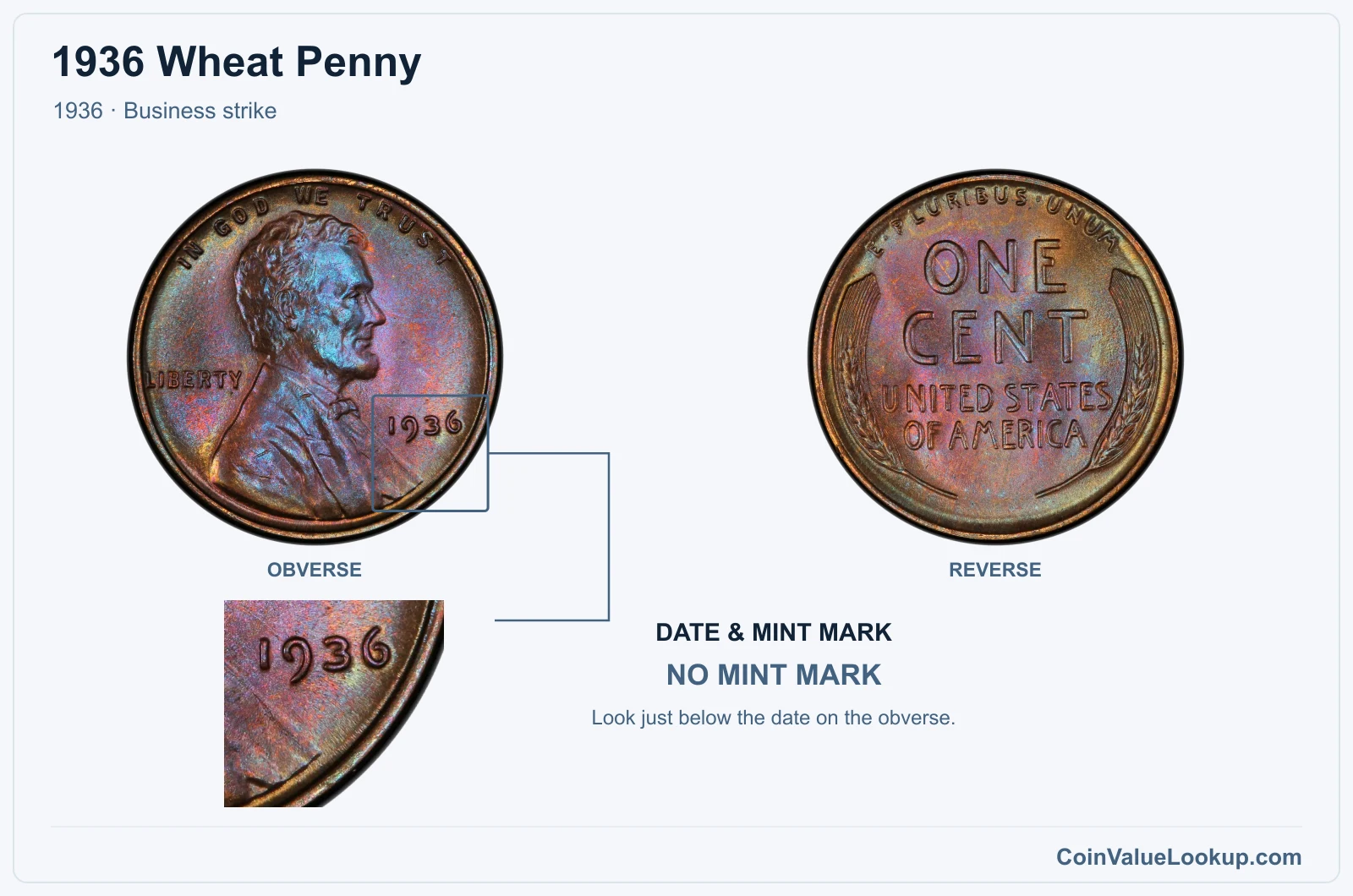
The 1936 Philadelphia cent has no mintmark below the date. Huge quantities were struck, making this the most common branch of the year in circulated grades.
Guide values run from about $0.18 in Good-4 to $6.25 in MS63, per USA Coin Book estimates.
Most examples you find in jars and rolls will grade somewhere in the Fine to Very Fine range. To command the higher end, a coin needs full original luster with minimal bag marks.
Color is not specified in the guide pricing, so do not assume a listed MS63 figure reflects a certified Red designation.
| Range | Grade | Price | Auction Records | Appraisal |
|---|---|---|---|---|
| PO | PO 1 | — | Coin Identifier | |
| FR | FR 2 | — | Coin Identifier | |
| AG | AG 3 | — | Coin Identifier | |
| G | G 4 | — | Coin Identifier | |
| G 6 | — | Coin Identifier | ||
| VG | VG 8 | — | Coin Identifier | |
| VG 10 | — | Coin Identifier | ||
| F | F 12 | — | Coin Identifier | |
| F 15 | — | Coin Identifier | ||
| VF | VF 20 | — | Coin Identifier | |
| VF 25 | — | Coin Identifier | ||
| VF 30 | — | Coin Identifier | ||
| VF 35 | Coin Identifier | |||
| XF | XF 40 | — | Coin Identifier | |
| XF 45 | Coin Identifier | |||
| AU | AU 50 | — | Coin Identifier | |
| AU 53 | — | Coin Identifier | ||
| AU 55 | — | Coin Identifier | ||
| AU 58 | — | Coin Identifier | ||
| MS | MS 60 | — | Coin Identifier | |
| MS 61 | — | Coin Identifier | ||
| MS 62 | — | Coin Identifier | ||
| MS 63 | — | Coin Identifier | ||
| MS 64 | — | Coin Identifier | ||
| MS 65 | — | Coin Identifier | ||
| MS 66 | — | Coin Identifier | ||
| MS 67 | — | Coin Identifier | ||
| MS 68 | — | — | — | |
| MS 69 | — | — | — | |
| MS 70 | — | — | — |
1936 Wheat Penny — DDO, Type 1
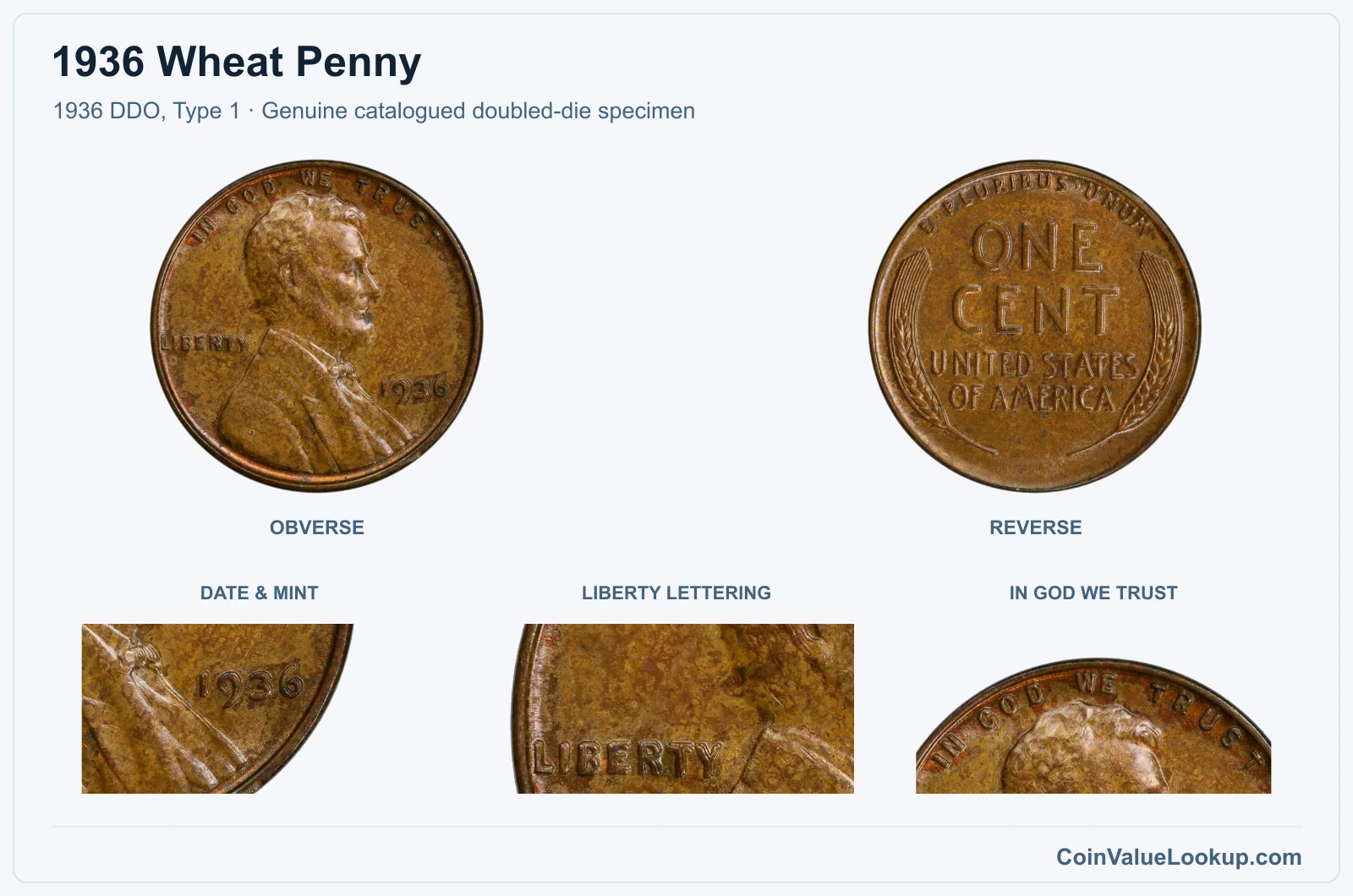
The 1936 Doubled Die Obverse, Type 1 is a Philadelphia-struck variety showing clear doubling on the date and motto. Under magnification, you should see consistent separation or notching on the affected letters rather than the flat shelf typical of machine doubling.
Guide values jump dramatically compared to a normal 1936 cent: around $34 at Good-4 and approximately $1,879 at MS63 according to USA Coin Book. That price gap reflects genuine collector demand for this die variety.
Compare your coin side by side with a known normal 1936 cent under the same lighting before drawing conclusions. Authentication by a grading service is the standard way collectors confirm this variety.
| Range | Grade | Price | Auction Records | Appraisal |
|---|---|---|---|---|
| PO | PO 1 | — | Coin Identifier | |
| FR | FR 2 | — | Coin Identifier | |
| AG | AG 3 | — | Coin Identifier | |
| G | G 4 | — | Coin Identifier | |
| G 6 | — | Coin Identifier | ||
| VG | VG 8 | — | Coin Identifier | |
| VG 10 | — | Coin Identifier | ||
| F | F 12 | Coin Identifier | ||
| F 15 | — | Coin Identifier | ||
| VF | VF 20 | — | Coin Identifier | |
| VF 25 | — | Coin Identifier | ||
| VF 30 | Coin Identifier | |||
| VF 35 | Coin Identifier | |||
| XF | XF 40 | Coin Identifier | ||
| XF 45 | Coin Identifier | |||
| AU | AU 50 | Coin Identifier | ||
| AU 53 | — | Coin Identifier | ||
| AU 55 | — | Coin Identifier | ||
| AU 58 | — | Coin Identifier | ||
| MS | MS 60 | — | Coin Identifier | |
| MS 61 | — | Coin Identifier | ||
| MS 62 | Coin Identifier | |||
| MS 63 | Coin Identifier | |||
| MS 64 | — | Coin Identifier | ||
| MS 65 | — | Coin Identifier | ||
| MS 66 | — | — | — | |
| MS 67 | — | — | — | |
| MS 68 | — | — | — | |
| MS 69 | — | — | — | |
| MS 70 | — | — | — |
1936 Wheat Penny — DDO, Type 2
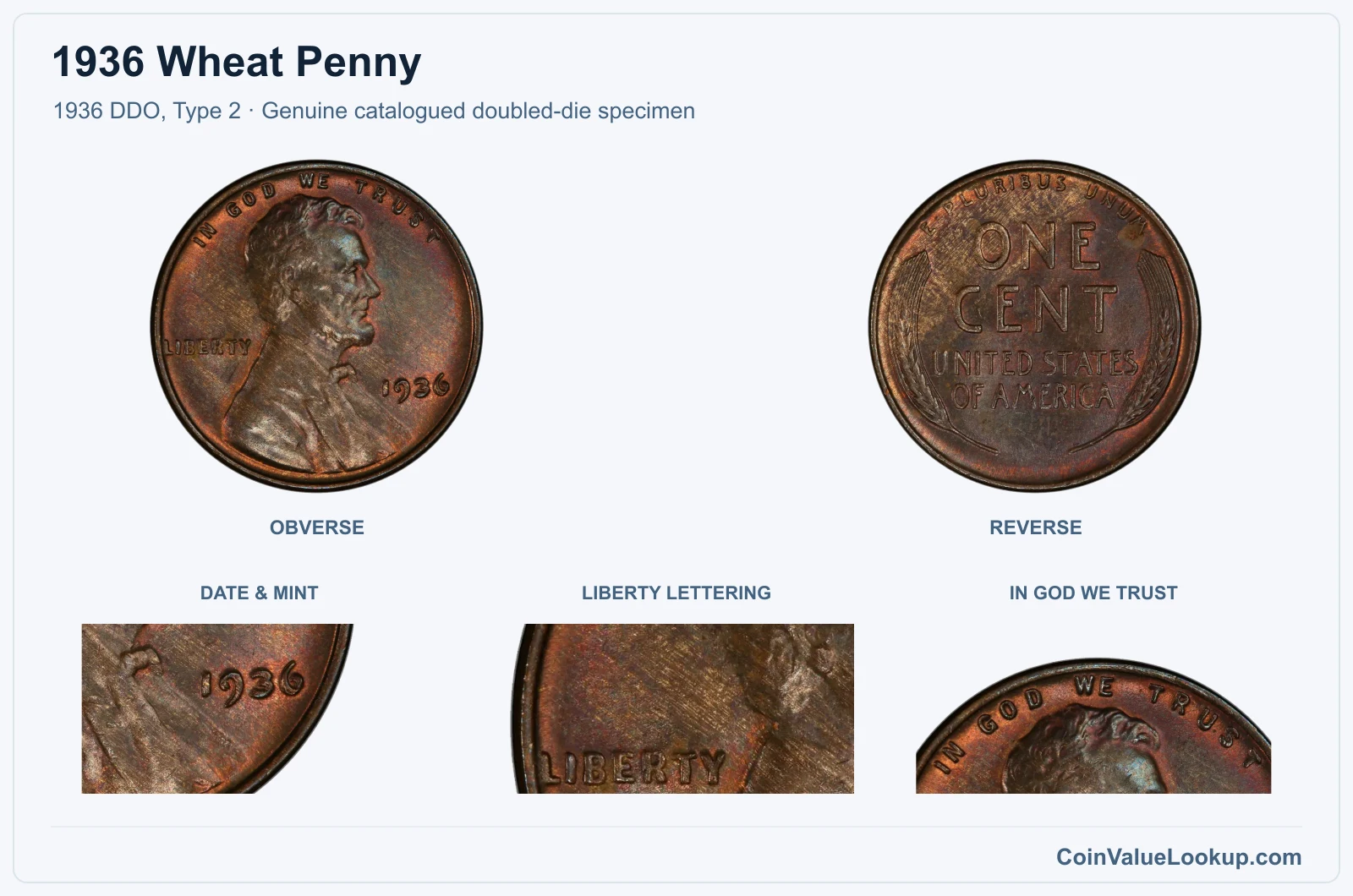
Type 2 of the 1936 Doubled Die Obverse is another distinct Philadelphia hub-doubling variety. Like the Type 1, it affects the date digits and motto lettering, but the direction or degree of doubling differs.
Guide estimates are identical to Type 1: roughly $34 in Good-4 and up to $1,879 in MS63. Distinguishing between the three DDO types requires careful comparison of exactly which letters and digits show the strongest doubling and in what direction the separation runs.
A 5x to 10x loupe helps, and photographing the doubling clearly is essential if you plan to submit for professional grading.
Coin Value Lookup is a good place to look up guides for other dates and denominations while you are sorting through your wheat pennies.
| Range | Grade | Price | Auction Records | Appraisal |
|---|---|---|---|---|
| PO | PO 1 | — | Coin Identifier | |
| FR | FR 2 | — | Coin Identifier | |
| AG | AG 3 | — | Coin Identifier | |
| G | G 4 | — | Coin Identifier | |
| G 6 | — | Coin Identifier | ||
| VG | VG 8 | — | Coin Identifier | |
| VG 10 | — | Coin Identifier | ||
| F | F 12 | Coin Identifier | ||
| F 15 | — | Coin Identifier | ||
| VF | VF 20 | — | Coin Identifier | |
| VF 25 | — | Coin Identifier | ||
| VF 30 | Coin Identifier | |||
| VF 35 | — | Coin Identifier | ||
| XF | XF 40 | Coin Identifier | ||
| XF 45 | Coin Identifier | |||
| AU | AU 50 | Coin Identifier | ||
| AU 53 | Coin Identifier | |||
| AU 55 | — | Coin Identifier | ||
| AU 58 | Coin Identifier | |||
| MS | MS 60 | — | Coin Identifier | |
| MS 61 | — | Coin Identifier | ||
| MS 62 | — | Coin Identifier | ||
| MS 63 | — | Coin Identifier | ||
| MS 64 | Coin Identifier | |||
| MS 65 | — | Coin Identifier | ||
| MS 66 | — | Coin Identifier | ||
| MS 67 | — | — | — | |
| MS 68 | — | — | — | |
| MS 69 | — | — | — | |
| MS 70 | — | — | — |
1936 Wheat Penny — DDO, Type 3
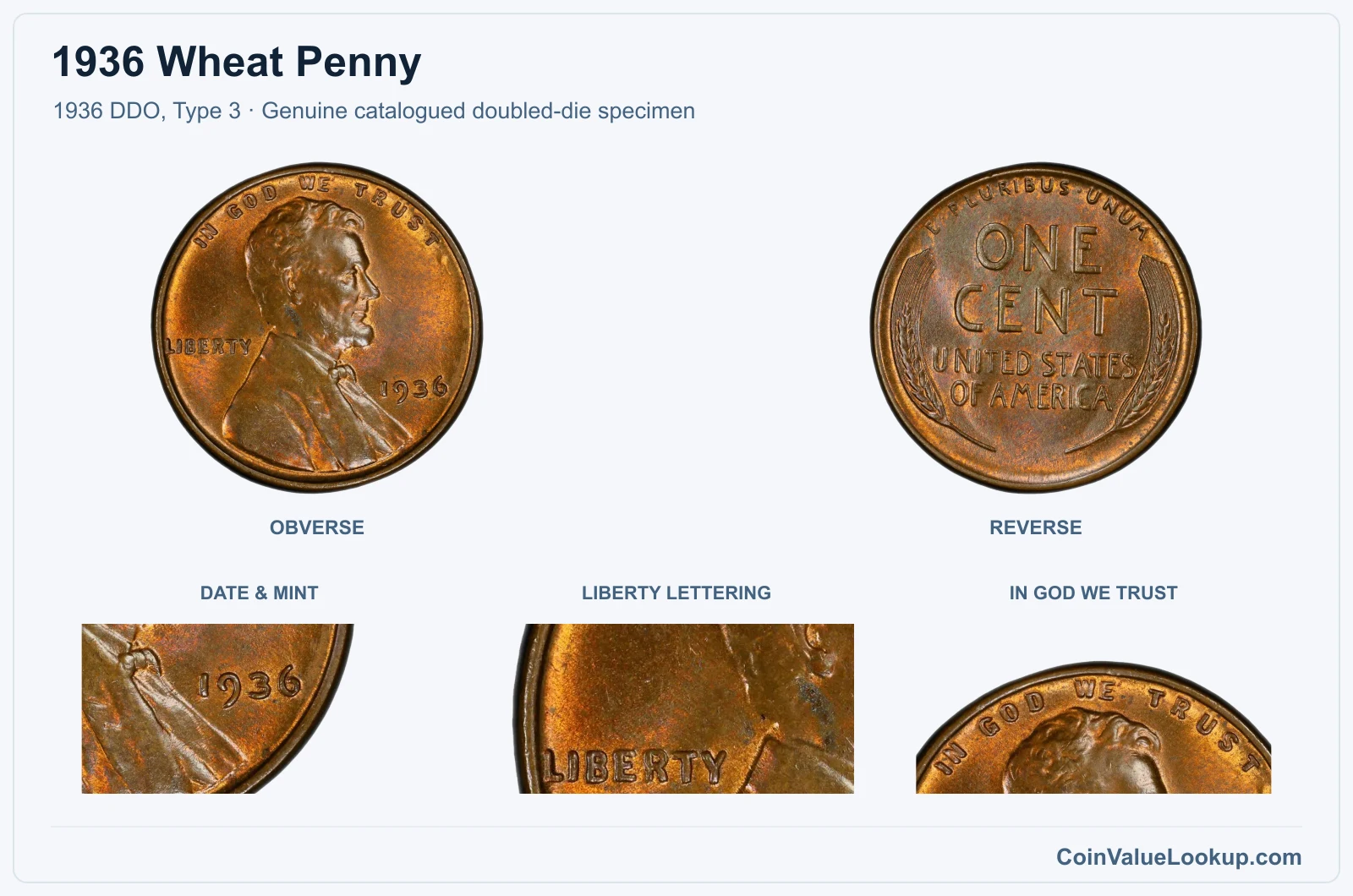
The Type 3 Doubled Die Obverse rounds out the trio of recognized 1936 Philadelphia DDO varieties. Same concept: hub doubling visible on the obverse date and motto, different in its specific characteristics from Types 1 and 2.
Pricing guidance matches the other two types at about $34 in G4 and approximately $1,879 at MS63. The existence of three separate types means you cannot simply confirm doubling and call it done — you need to identify which type you have if you are seeking a specific attribution.
Normal design sharpness, die polish lines, and machine doubling are all things that can mimic a DDO at first glance.
| Range | Grade | Price | Auction Records | Appraisal |
|---|---|---|---|---|
| PO | PO 1 | — | Coin Identifier | |
| FR | FR 2 | — | Coin Identifier | |
| AG | AG 3 | — | Coin Identifier | |
| G | G 4 | — | Coin Identifier | |
| G 6 | — | — | — | |
| VG | VG 8 | — | — | — |
| VG 10 | — | — | — | |
| F | F 12 | — | Coin Identifier | |
| F 15 | — | — | — | |
| VF | VF 20 | — | — | — |
| VF 25 | — | — | — | |
| VF 30 | — | Coin Identifier | ||
| VF 35 | Coin Identifier | |||
| XF | XF 40 | — | Coin Identifier | |
| XF 45 | Coin Identifier | |||
| AU | AU 50 | — | Coin Identifier | |
| AU 53 | — | Coin Identifier | ||
| AU 55 | — | Coin Identifier | ||
| AU 58 | — | Coin Identifier | ||
| MS | MS 60 | — | Coin Identifier | |
| MS 61 | — | Coin Identifier | ||
| MS 62 | — | Coin Identifier | ||
| MS 63 | — | Coin Identifier | ||
| MS 64 | — | Coin Identifier | ||
| MS 65 | — | Coin Identifier | ||
| MS 66 | — | — | — | |
| MS 67 | — | — | — | |
| MS 68 | — | — | — | |
| MS 69 | — | — | — | |
| MS 70 | — | — | — |
1936 Wheat Penny — D
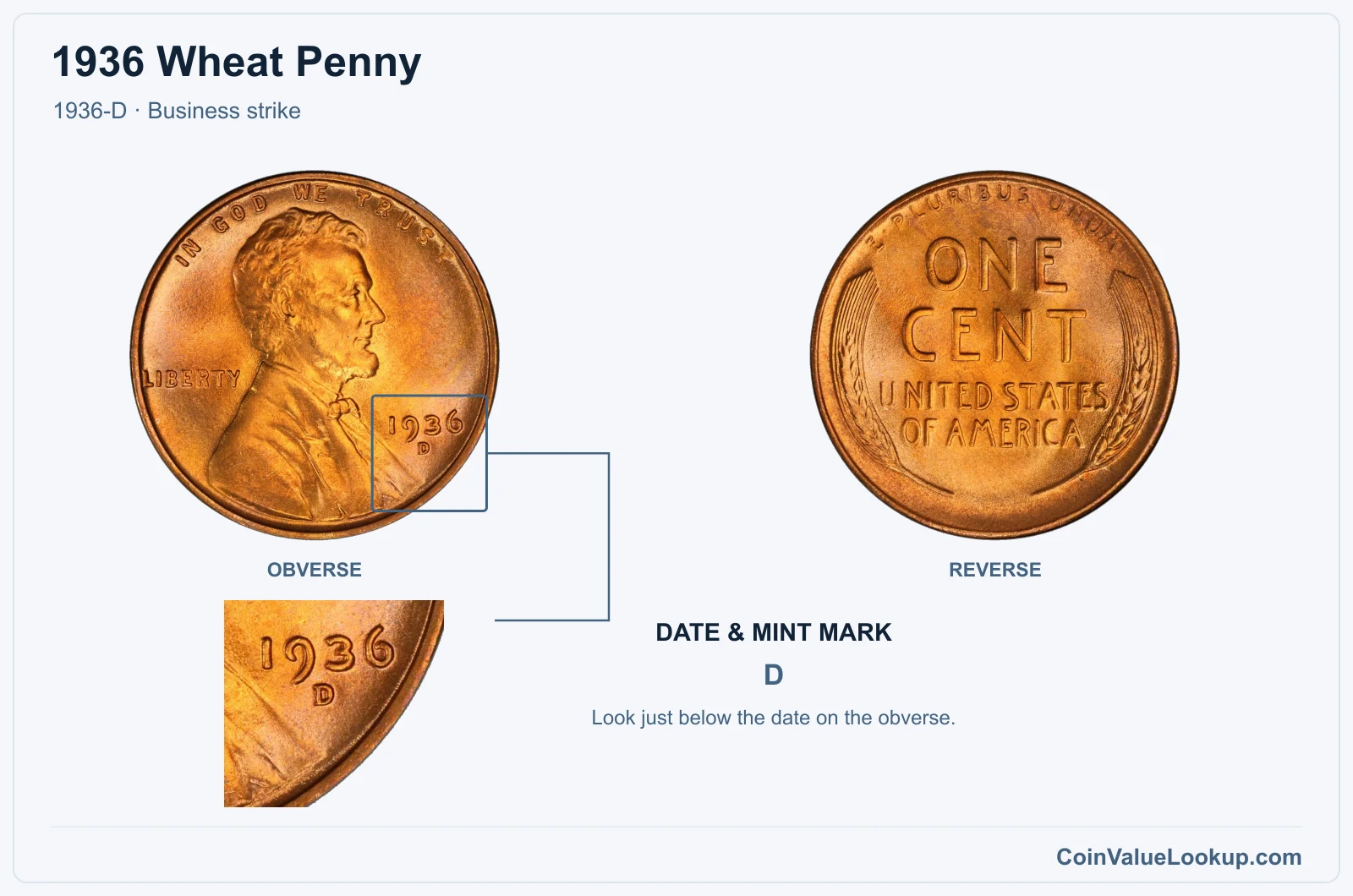
The 1936-D carries a small "D" mintmark below the date, indicating Denver production. Guide values range from about $0.18 in Good-4 to $4.96 in MS63.
This is a straightforward, affordable issue in circulated grades. At the MS63 level it actually lists slightly below the Philadelphia and San Francisco counterparts for this year.
As with all branches, the guide price does not specify color, so a certified Red example at MS63 could trade differently than an unspecified one. Check for a clear, well-positioned mintmark to confirm the Denver origin.
| Range | Grade | Price | Auction Records | Appraisal |
|---|---|---|---|---|
| PO | PO 1 | — | Coin Identifier | |
| FR | FR 2 | — | Coin Identifier | |
| AG | AG 3 | — | Coin Identifier | |
| G | G 4 | — | Coin Identifier | |
| G 6 | — | Coin Identifier | ||
| VG | VG 8 | — | Coin Identifier | |
| VG 10 | — | Coin Identifier | ||
| F | F 12 | — | Coin Identifier | |
| F 15 | — | Coin Identifier | ||
| VF | VF 20 | — | Coin Identifier | |
| VF 25 | — | Coin Identifier | ||
| VF 30 | — | Coin Identifier | ||
| VF 35 | — | Coin Identifier | ||
| XF | XF 40 | — | Coin Identifier | |
| XF 45 | — | Coin Identifier | ||
| AU | AU 50 | — | Coin Identifier | |
| AU 53 | — | Coin Identifier | ||
| AU 55 | — | Coin Identifier | ||
| AU 58 | — | Coin Identifier | ||
| MS | MS 60 | — | Coin Identifier | |
| MS 61 | — | Coin Identifier | ||
| MS 62 | — | Coin Identifier | ||
| MS 63 | — | Coin Identifier | ||
| MS 64 | Coin Identifier | |||
| MS 65 | Coin Identifier | |||
| MS 66 | Coin Identifier | |||
| MS 67 | Coin Identifier | |||
| MS 68 | Coin Identifier | |||
| MS 69 | — | — | — | |
| MS 70 | — | — | — |
1936 Wheat Penny — S
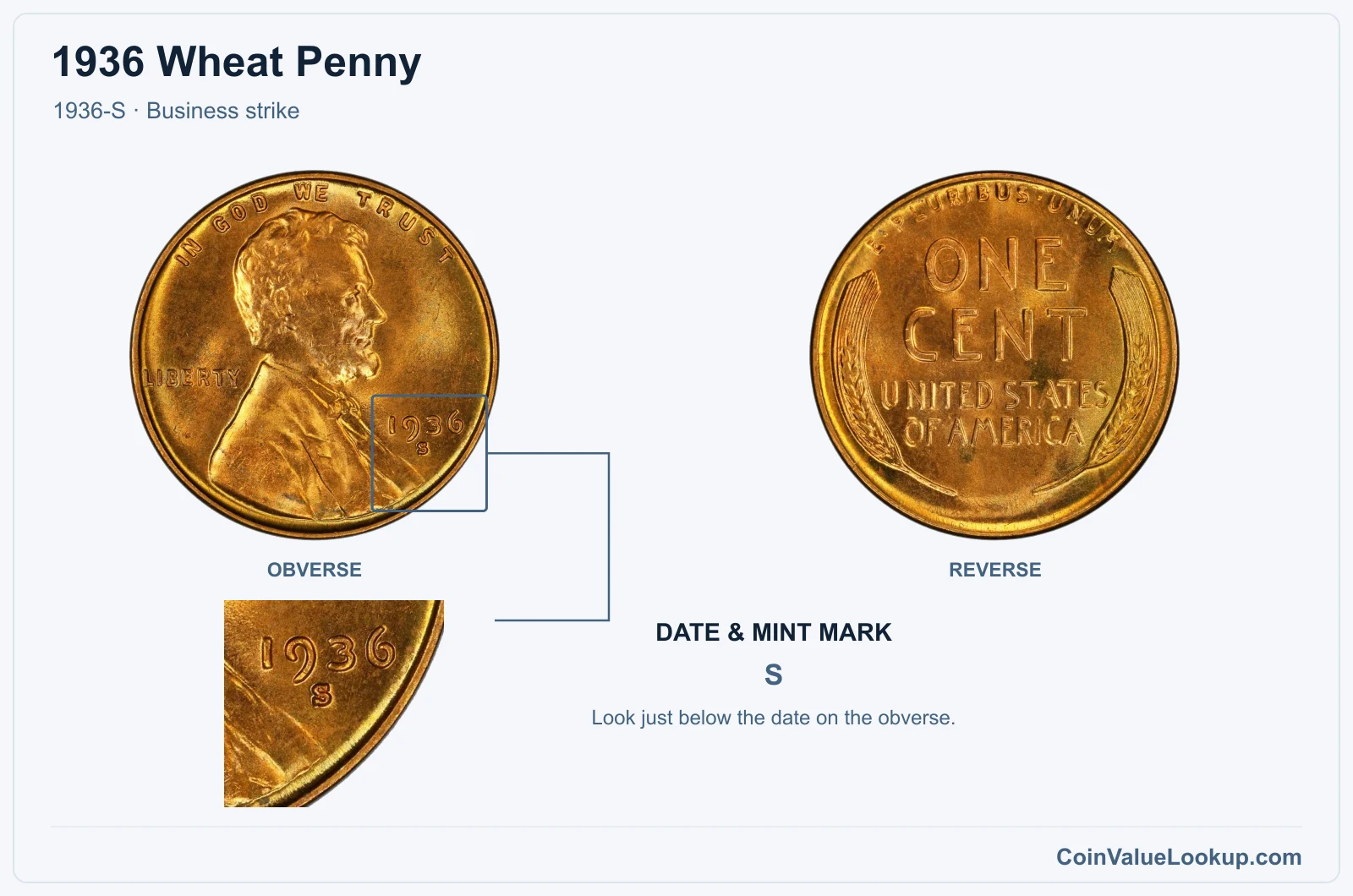
The 1936-S shows a small "S" mintmark below the date, struck at San Francisco. It carries the highest ordinary-branch guide value at MS63 among the three circulation mints this year, listed at $7.29.
In Good-4, it starts at $0.18 like the others.
San Francisco cents from this era tend to come with softer strikes on occasion, so do not mistake weak original detail for wear. A nice original MS63 example with good luster is a solid representative coin for a Wheat cent collection.
Color and surface quality remain separate factors not baked into these guide figures.
| Range | Grade | Price | Auction Records | Appraisal |
|---|---|---|---|---|
| PO | PO 1 | — | Coin Identifier | |
| FR | FR 2 | — | Coin Identifier | |
| AG | AG 3 | — | Coin Identifier | |
| G | G 4 | — | Coin Identifier | |
| G 6 | — | Coin Identifier | ||
| VG | VG 8 | — | Coin Identifier | |
| VG 10 | — | Coin Identifier | ||
| F | F 12 | — | Coin Identifier | |
| F 15 | — | Coin Identifier | ||
| VF | VF 20 | — | Coin Identifier | |
| VF 25 | — | Coin Identifier | ||
| VF 30 | — | Coin Identifier | ||
| VF 35 | — | Coin Identifier | ||
| XF | XF 40 | — | Coin Identifier | |
| XF 45 | — | Coin Identifier | ||
| AU | AU 50 | — | Coin Identifier | |
| AU 53 | — | Coin Identifier | ||
| AU 55 | — | Coin Identifier | ||
| AU 58 | — | Coin Identifier | ||
| MS | MS 60 | — | Coin Identifier | |
| MS 61 | — | Coin Identifier | ||
| MS 62 | — | Coin Identifier | ||
| MS 63 | Coin Identifier | |||
| MS 64 | Coin Identifier | |||
| MS 65 | Coin Identifier | |||
| MS 66 | Coin Identifier | |||
| MS 67 | Coin Identifier | |||
| MS 68 | — | — | — | |
| MS 69 | — | — | — | |
| MS 70 | — | — | — |
1936 Wheat Penny — Satin PR
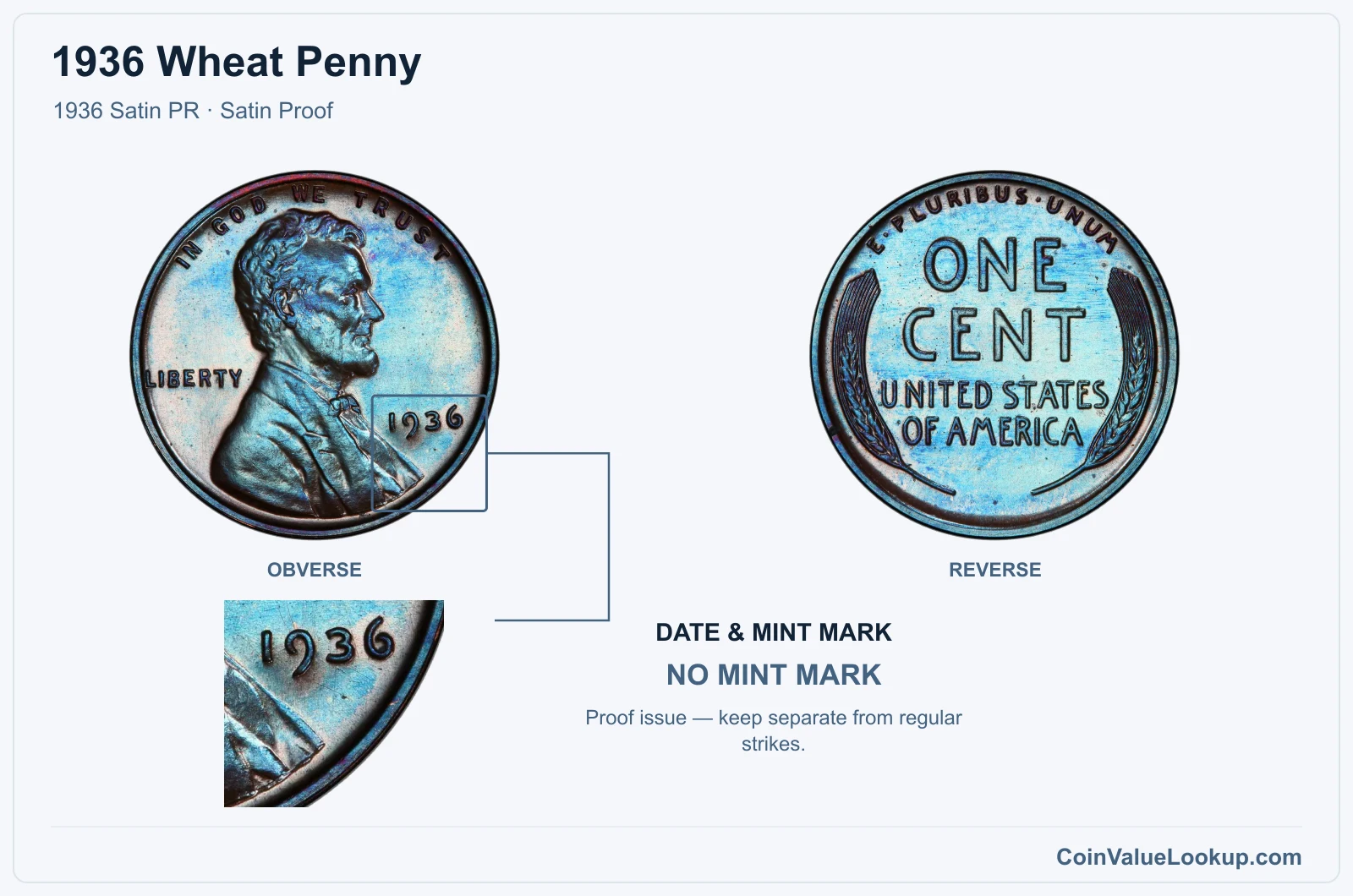
The 1936 Satin Proof is a Philadelphia-only issue with a distinctive soft, matte-like surface texture instead of mirrored fields. This was the first proof finish used when the Mint resumed proof coinage in 1936, and it looks quite different from the Brilliant proofs that followed.
No specific guide price range is adopted here because value depends on authenticated identity and individual condition. A Satin proof must be confirmed as a genuine proof striking — a lightly circulated business strike that happens to lack luster is not the same thing.
Professional authentication is the standard path for these coins, since the Satin finish can be subtle to untrained eyes.
| Range | Grade | Price | Auction Records | Appraisal |
|---|---|---|---|---|
| PR | PR 1 | — | Coin Identifier | |
| PR 2 | — | Coin Identifier | ||
| PR 3 | — | Coin Identifier | ||
| PR 4 | — | Coin Identifier | ||
| PR 6 | — | Coin Identifier | ||
| PR 8 | — | Coin Identifier | ||
| PR 10 | — | Coin Identifier | ||
| PR 12 | — | Coin Identifier | ||
| PR 15 | — | Coin Identifier | ||
| PR 20 | — | Coin Identifier | ||
| PR 25 | — | Coin Identifier | ||
| PR 30 | — | Coin Identifier | ||
| PR 35 | — | Coin Identifier | ||
| PR 40 | — | Coin Identifier | ||
| PR 45 | — | Coin Identifier | ||
| PR 50 | — | Coin Identifier | ||
| PR 53 | — | Coin Identifier | ||
| PR 55 | — | Coin Identifier | ||
| PR 58 | — | Coin Identifier | ||
| PR 60 | — | Coin Identifier | ||
| PR 61 | Coin Identifier | |||
| PR 62 | — | Coin Identifier | ||
| PR 63 | Coin Identifier | |||
| PR 64 | Coin Identifier | |||
| PR 65 | Coin Identifier | |||
| PR 66 | Coin Identifier | |||
| PR 67 | — | — | — | |
| PR 68 | — | — | — | |
| PR 69 | — | — | — | |
| PR 70 | — | — | — |
1936 Wheat Penny — Brilliant PR
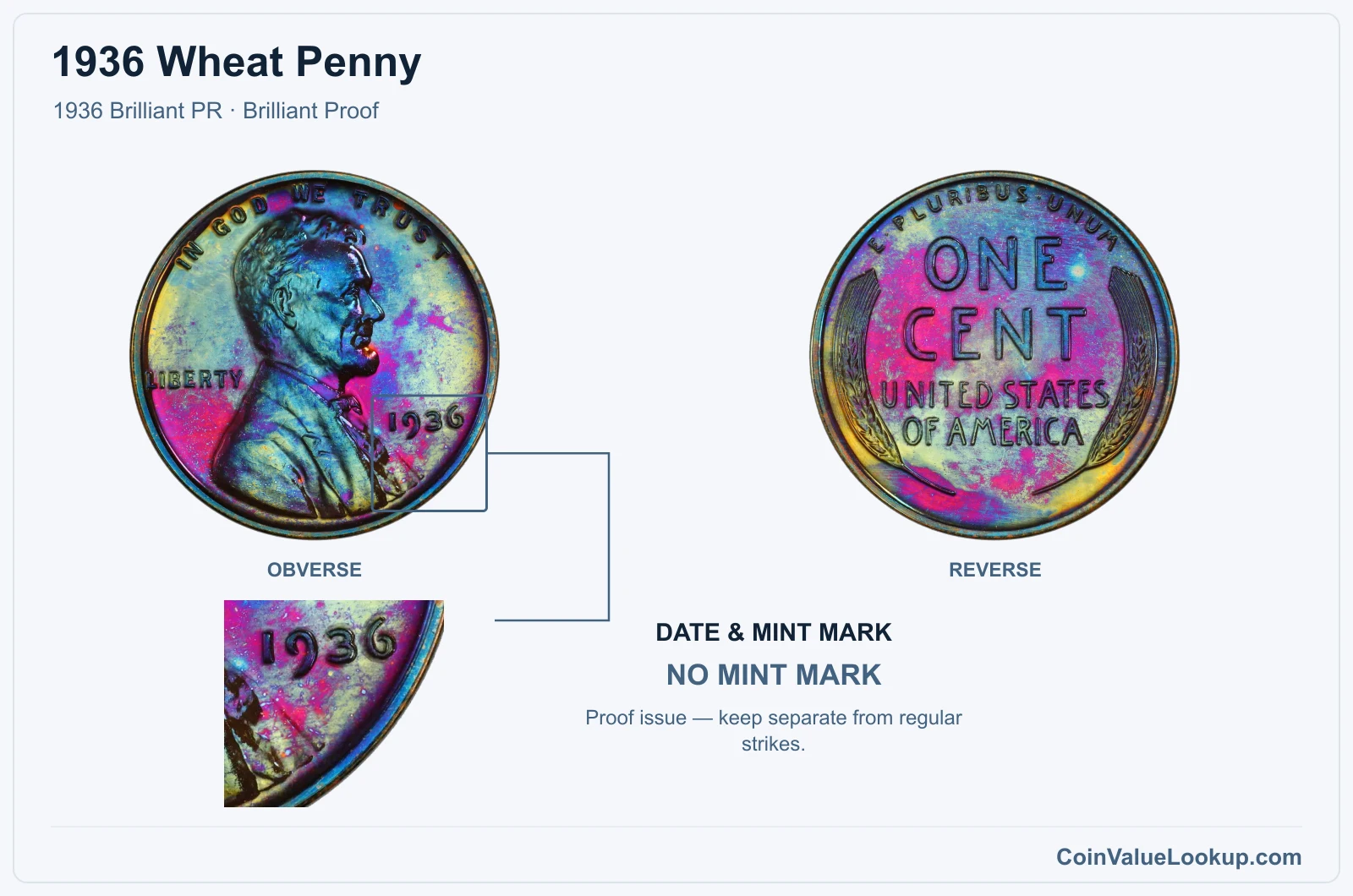
The 1936 Brilliant Proof features the classic mirror-field finish most collectors picture when they hear the word proof. These were also struck only at Philadelphia.
As with the Satin proof, no specific guide price range is adopted. Value depends on the coin's authenticated identity, surface preservation, and any contrast designations such as Cameo or Deep Cameo, which describe the degree of frost on the devices against mirrored fields.
These contrast designations are manufacturing characteristics, not errors. A polished circulation cent can look reflective, but it lacks the sharp, squared-off rim and full detail that distinguish a genuine proof striking.
| Range | Grade | Price | Auction Records | Appraisal |
|---|---|---|---|---|
| PR | PR 1 | — | Coin Identifier | |
| PR 2 | — | Coin Identifier | ||
| PR 3 | — | Coin Identifier | ||
| PR 4 | — | Coin Identifier | ||
| PR 6 | — | Coin Identifier | ||
| PR 8 | — | Coin Identifier | ||
| PR 10 | — | Coin Identifier | ||
| PR 12 | — | Coin Identifier | ||
| PR 15 | — | Coin Identifier | ||
| PR 20 | — | Coin Identifier | ||
| PR 25 | — | Coin Identifier | ||
| PR 30 | — | Coin Identifier | ||
| PR 35 | — | Coin Identifier | ||
| PR 40 | — | Coin Identifier | ||
| PR 45 | — | Coin Identifier | ||
| PR 50 | — | Coin Identifier | ||
| PR 53 | — | Coin Identifier | ||
| PR 55 | — | Coin Identifier | ||
| PR 58 | — | Coin Identifier | ||
| PR 60 | — | Coin Identifier | ||
| PR 61 | — | Coin Identifier | ||
| PR 62 | — | Coin Identifier | ||
| PR 63 | Coin Identifier | |||
| PR 64 | Coin Identifier | |||
| PR 65 | Coin Identifier | |||
| PR 66 | — | Coin Identifier | ||
| PR 67 | — | — | — | |
| PR 68 | — | — | — | |
| PR 69 | — | — | — | |
| PR 70 | — | — | — |
1936 Wheat Penny Error List
1. 1936 Wheat Penny — Doubled Die Obverse
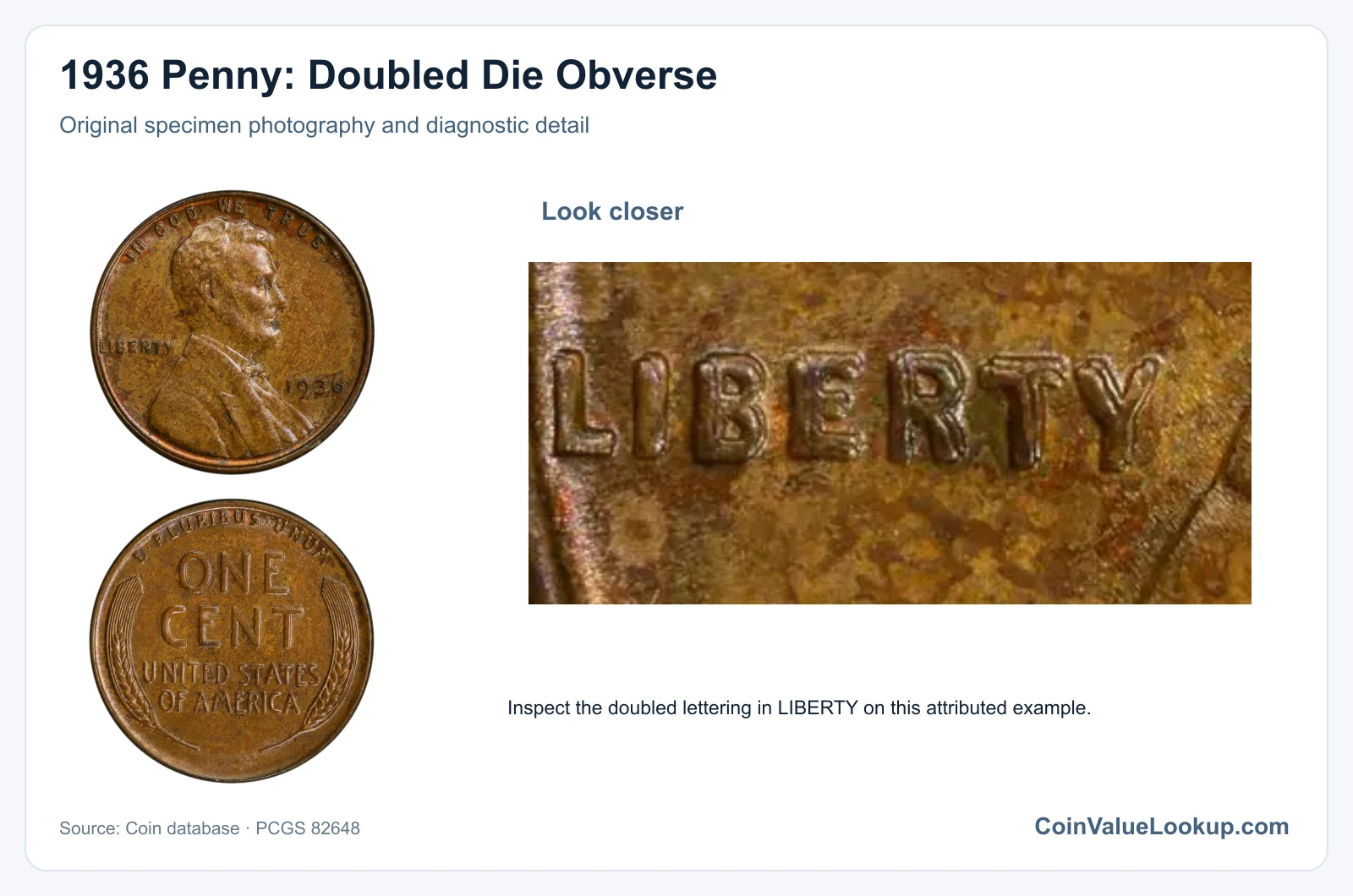
A Doubled Die Obverse on a 1936 Wheat cent shows consistent doubling on obverse design elements such as date digits and motto lettering. The key word is consistent — every affected letter or numeral shifts in the same direction by roughly the same amount, because the doubling happened when the die itself was made.
To check, compare your coin's obverse lettering against a known normal 1936 cent under identical lighting and magnification. Look for clear separation or notching on letter edges rather than a flat, shelf-like distortion.
Machine doubling, reflective lighting tricks, and worn die contours can all mimic a DDO to the casual eye. Value depends on the specific type, condition, and professional authentication, so no single price range applies across the board.
2. 1936 Wheat Penny — Off-Center Strike
An off-center strike happens when the planchet is not seated properly between the dies, causing the design to shift to one side while leaving an unstruck crescent of blank metal. The percentage of off-center displacement and whether the date remains visible are the two biggest factors affecting desirability.
On a 1936 Wheat cent, look for a clearly displaced Lincoln portrait and a corresponding blank area. A coin that is 5% off-center looks like a minor curiosity; one at 20–50% with a full date visible is far more collectible.
Do not confuse an off-center strike with a clipped planchet edge, a one-sided die misalignment, or post-mint damage from being smashed. Value requires individual assessment based on authenticated identity and severity.
3. 1936 Wheat Penny — Struck-Through Error
A struck-through error occurs when foreign material — grease, a metal fragment, fabric, or another obstruction — sits between the die and planchet during striking. The result is a localized depression or incomplete area of design where the material intervened.
On a 1936 cent, look for an impression that is recessed into the coin's surface rather than scratched across it. Grease-filled dies leave a smooth, filled-in area, while a retained foreign object can leave a distinct shape.
Ordinary wear, scratches from circulation, cleaning marks, and weak strike areas can all look similar at first glance. The difference is that a genuine struck-through has a specific, bounded shape consistent with material obstruction rather than gradual surface loss.
Professional assessment determines value.
4. 1936 Wheat Penny — Broadstrike
A broadstrike results when the coin is struck without the normal collar die that constrains its diameter. The metal spreads outward during striking, producing a coin that is wider than standard with a missing or distorted rim profile.
On a 1936 Wheat cent, a broadstrike will show the full design but with the edges spreading beyond the normal 19mm diameter. The rim will appear weak or absent, and the overall coin looks slightly larger and thinner than normal.
Do not confuse this with an off-center strike, which shifts the design to one side, or with a coin that was flattened after leaving the Mint. Check the edge profile carefully — post-mint damage tends to be uneven, while a broadstrike is relatively uniform.
Value depends on authentication and the degree of spread.
5. 1936 Wheat Penny — Lamination / Split Planchet
A lamination or split planchet error shows metal peeling, flaking, or separating within the coin's alloy. This occurs because of impurities or improper mixing in the metal before the planchet was punched and struck.
On a 1936 cent, look for a raised flap of metal, a missing layer exposing a rough underlayer, or a visible crack running parallel to the surface. Photograph the edge along with the affected face, since the edge view often shows the separation most clearly.
Scraping from circulation, corrosion pitting, and deliberately altered coins can all look somewhat similar. The distinguishing feature is that a genuine lamination follows the metal's internal structure rather than showing tool marks or external chemical damage.
Individual assessment by a professional service determines both authenticity and value.
6. 1936 Wheat Penny — Die Break / Cud
A die break or cud error appears as a raised, featureless blob on the coin's surface. It happens when a piece of the die fractures and falls away, leaving a void that fills with metal during striking.
A true cud connects to the rim; interior raised lumps are called interior die breaks or die chips.
On a 1936 Wheat cent, look for a raised area with no design detail that merges into the rim edge. The boundary between the cud and the normal design should be relatively sharp.
Rim dents from post-mint contact, corrosion buildup, and small interior die chips are common lookalikes. Rim dents are incuse rather than raised, which is the simplest way to tell them apart.
The size and location of the cud affect collector interest, and value depends on authenticated identity and condition.