1860 Indian Head Penny Coin Value: How Much Is It Worth?
The 1860 Indian Head penny sits at a crossroads in the series — the first year with the oak wreath and shield reverse, and the last before the Civil War changed everything. Guide estimates for regular business strikes range from about $15 at G4 (a well-worn but readable coin) up to roughly $721 at MS63 (a choice uncirculated example), depending on which bust variety you hold.
Proofs, major varieties, and mint errors require separate evaluation.
Fast Way to Identify Your 1860 Indian Head Penny
Want a quick read on your 1860 Indian Head cent? Upload clear photos of both the front and back of your coin for a preliminary identification.
Good lighting and a steady hand help — try to capture the bust tip, the date, and the wreath detail. This is not a substitute for professional authentication, but it can point you in the right direction.
1860 Indian Head Penny Value
Upload both sides of your 1860 Indian Head Penny.
Front Obverse
Upload photo
Back Reverse
Upload photo
Which 1860 Indian Head Penny Versions Are Worth Money?
- The Pointed Bust variety guides around $30 at G4 and about $721 at MS63 — roughly double the Rounded Bust at both ends, making it worth checking your bust tip carefully.
- Proof Rounded Bust examples guide near $1,243 at PR63, reflecting their limited original mintage and collector demand for early proof Indian cents.
- Original uncirculated surfaces with full luster can carry strong premiums over cleaned or damaged examples at the same technical grade.
Step 1: Identify Your 1860 Indian Head Penny Mint Mark and Version
Every 1860 Indian Head cent was struck at Philadelphia, so there is no mintmark to hunt for. If you see an "L" on the ribbon, that is a designer initial found on later dates — it does not appear on the 1860.
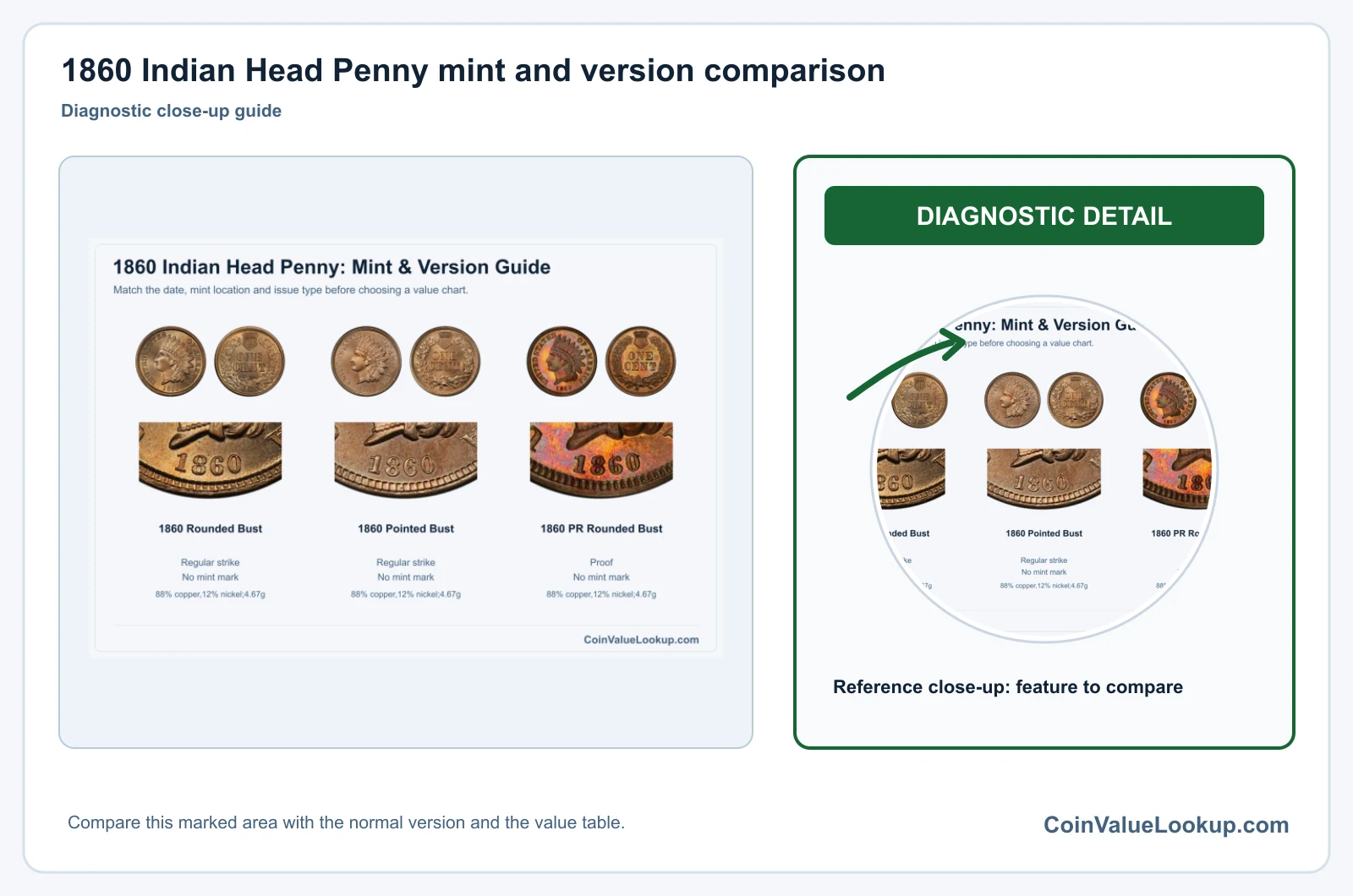
The key identification step is deciding whether your coin has the Pointed Bust or the Rounded Bust. Flip the coin to the portrait side and look at the lowest point of the bust truncation, just above the date.
On a Pointed Bust, the bottom of the bust comes to a distinct, sharp point. On a Rounded Bust, that same area is smoother, more blunt, and curves gently.
Both varieties share the same oak wreath and shield reverse, so the reverse will not help you tell them apart. Make sure you are actually looking at an Indian Head cent and not a Flying Eagle cent (1856–1858) or a later Lincoln cent before comparing prices.
The Indian Head design features a woman wearing a feathered headdress on the obverse and a wreath on the reverse.
Proof coins were also struck in 1860, but proof is a method of manufacture — not a grade above Mint State. Mirrored surfaces alone do not confirm proof origin; rim geometry and overall manufacturing quality matter too.
Step 2: Check Your 1860 Indian Head Penny Grade
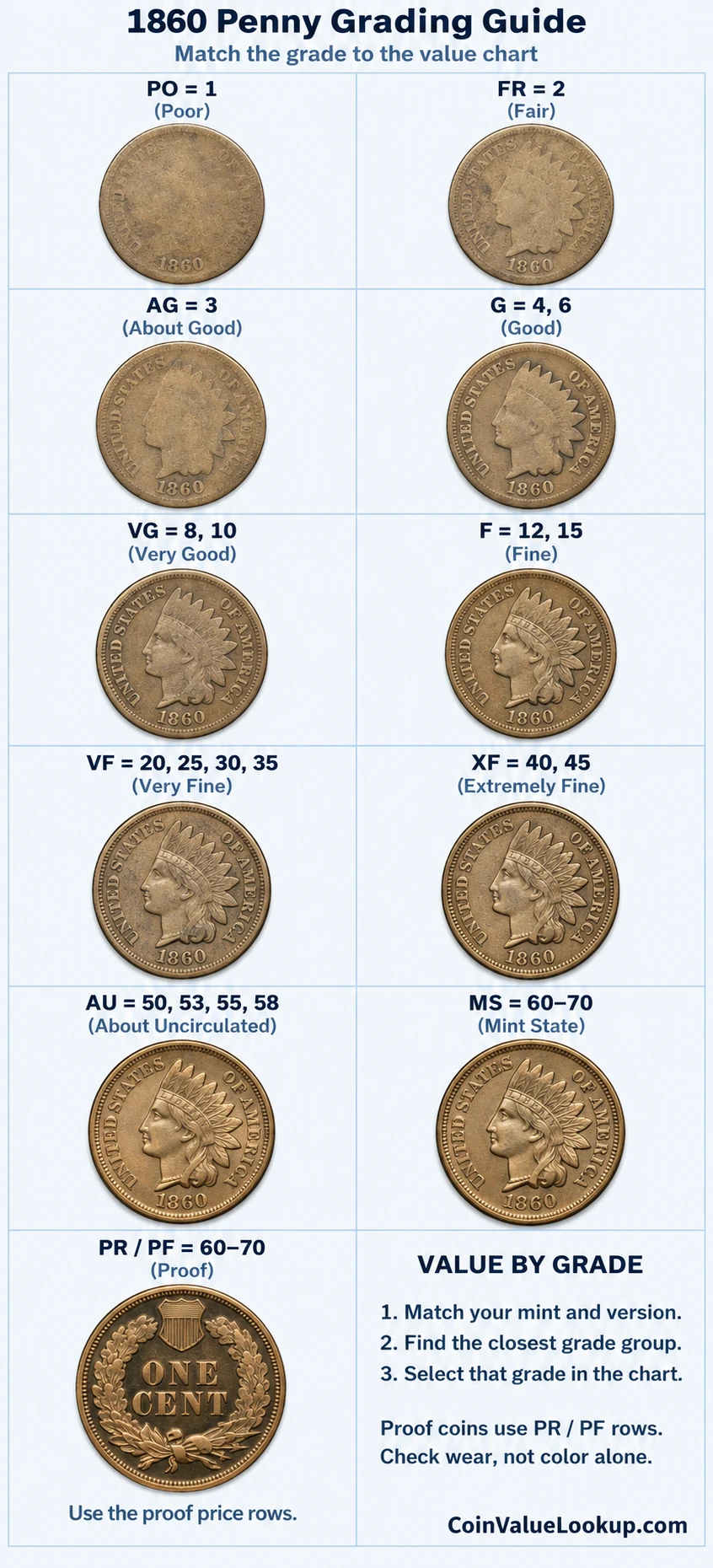
Start with the headband. The word LIBERTY is incised into the headband, and it wears away progressively.
On a well-worn coin (around Good-4), you may see only a trace of one or two letters. By Fine-12 or so, most letters should be readable.
Next, check the feather tips above the headband and the hair curls behind the ear. These are high points that show friction first.
A coin with full, sharp feather detail and no wear on the cheek or hair is a candidate for Mint State.
Do not rely on a single detail. A soft original strike — and these exist on 1860 cents — can leave feathers or hair looking flat even on an uncirculated coin.
Compare your coin's overall sharpness against the reference comparison image rather than grading from one mushy letter.
The 1860 is a copper-nickel issue, so color designations like BN, RB, and RD that apply to later bronze cents do not factor in. Look instead for original luster and an absence of cleaning, corrosion, or contact marks.
Cleaned coins often show hairline scratches under magnification and an unnatural brightness.
Step 3: Check 1860 Indian Head Penny Value by Mint and Version
1860 Indian Head Penny — Rounded Bust
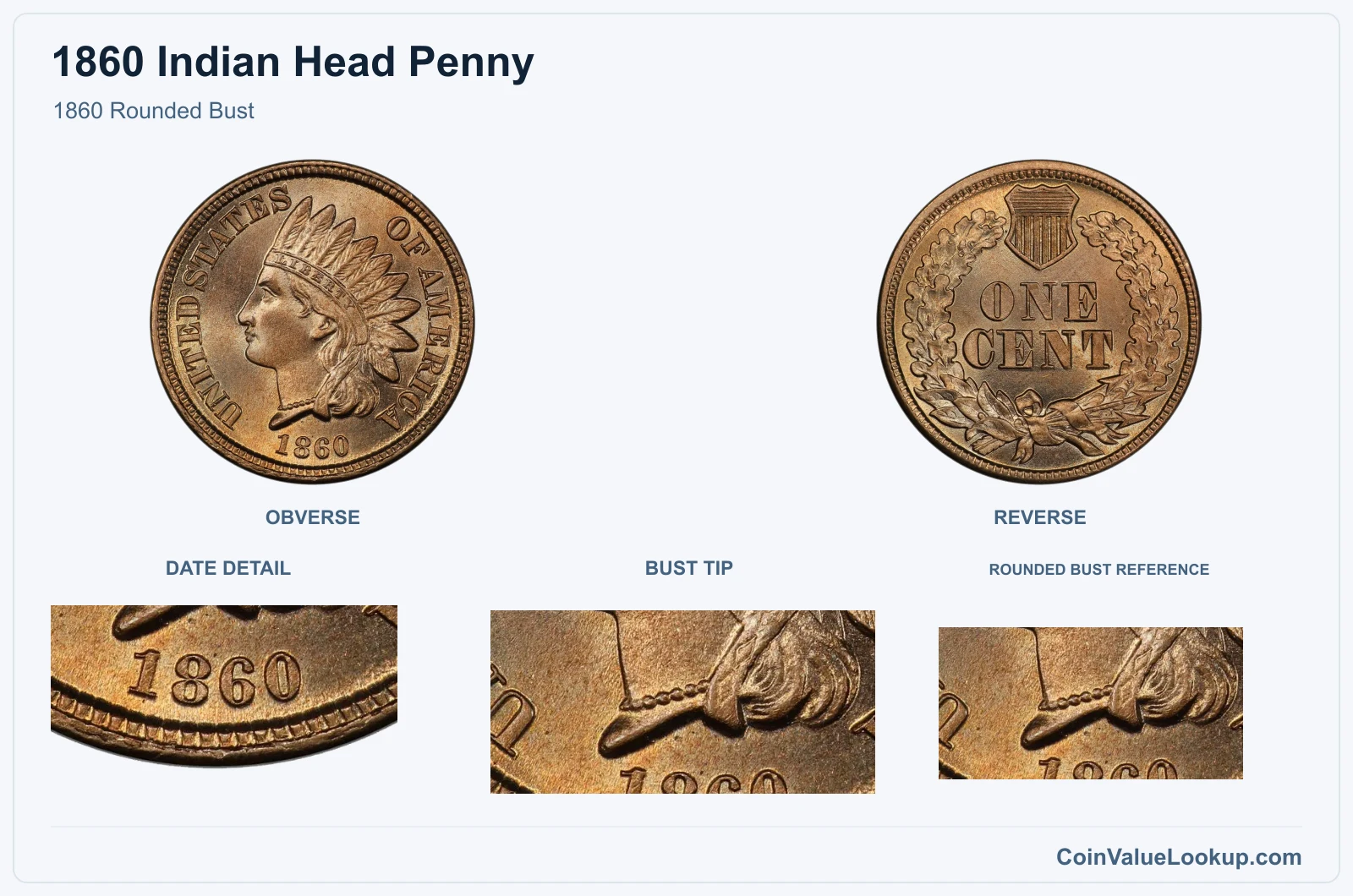
The Rounded Bust is the more common of the two 1860 varieties. Look at the bottom of the portrait truncation just above the date: it curves gently without coming to a sharp point.
Guide estimates from USA Coin Book place this version around $15 at G4 and about $407 at MS63.
All 1860 cents are copper-nickel (88% copper, 12% nickel) and weigh approximately 4.67 grams. That composition gives them a lighter, more silvery look compared to the bronze Indian cents that followed in 1864.
Compare only like grades and original surfaces when pricing — do not apply rare-variety pricing to a standard Rounded Bust coin.
| Range | Grade | Price | Auction Records | Appraisal |
|---|---|---|---|---|
| PO | PO 1 | — | Coin Identifier | |
| FR | FR 2 | — | Coin Identifier | |
| AG | AG 3 | Coin Identifier | ||
| G | G 4 | — | Coin Identifier | |
| G 6 | — | Coin Identifier | ||
| VG | VG 8 | Coin Identifier | ||
| VG 10 | — | Coin Identifier | ||
| F | F 12 | — | Coin Identifier | |
| F 15 | — | Coin Identifier | ||
| VF | VF 20 | — | Coin Identifier | |
| VF 25 | — | Coin Identifier | ||
| VF 30 | Coin Identifier | |||
| VF 35 | Coin Identifier | |||
| XF | XF 40 | Coin Identifier | ||
| XF 45 | Coin Identifier | |||
| AU | AU 50 | Coin Identifier | ||
| AU 53 | Coin Identifier | |||
| AU 55 | Coin Identifier | |||
| AU 58 | Coin Identifier | |||
| MS | MS 60 | Coin Identifier | ||
| MS 61 | Coin Identifier | |||
| MS 62 | Coin Identifier | |||
| MS 63 | Coin Identifier | |||
| MS 64 | Coin Identifier | |||
| MS 65 | Coin Identifier | |||
| MS 66 | Coin Identifier | |||
| MS 67 | Coin Identifier | |||
| MS 68 | — | — | — | |
| MS 69 | — | — | — | |
| MS 70 | — | — | — |
1860 Indian Head Penny — Pointed Bust
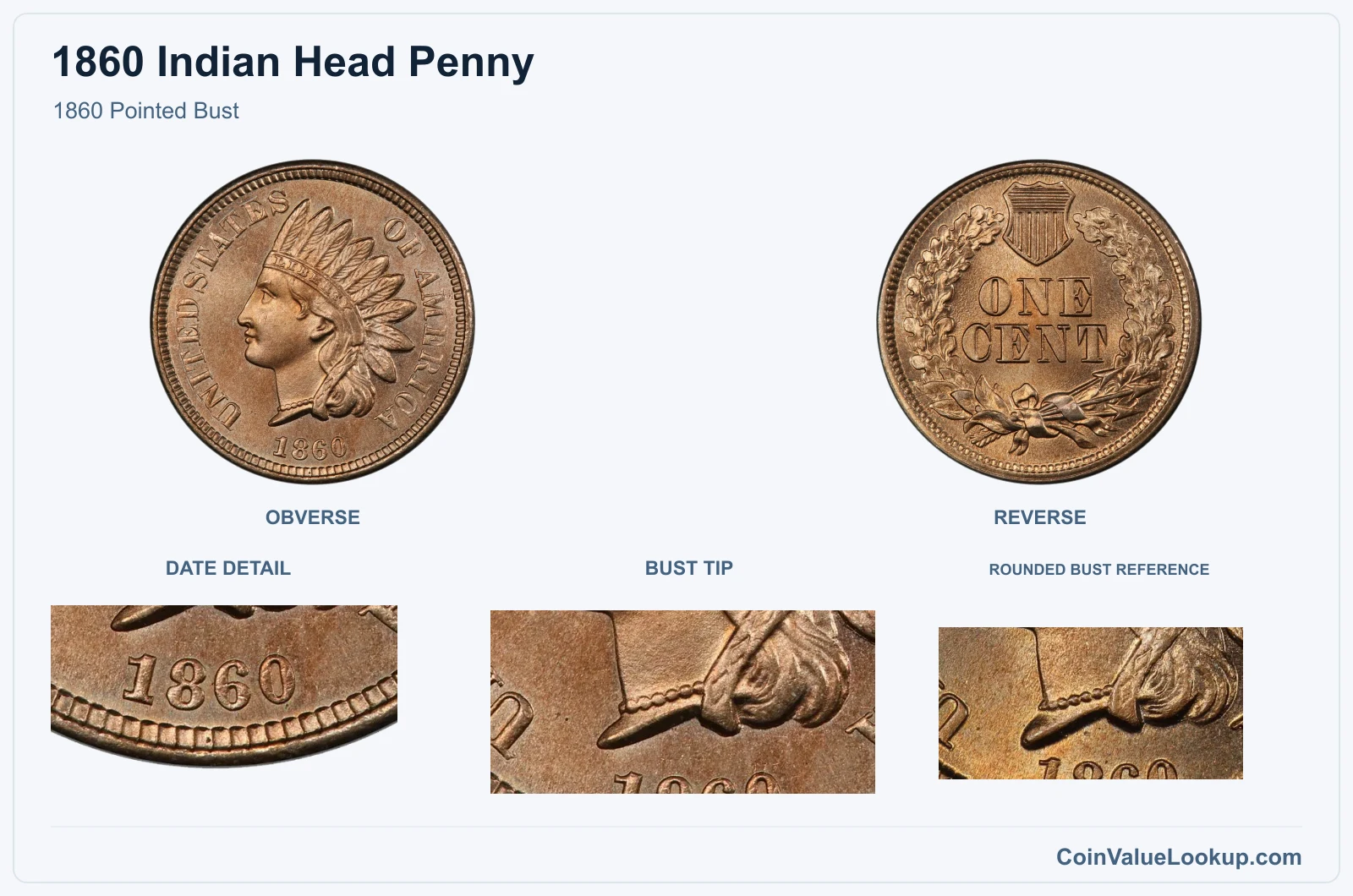
The Pointed Bust is the variety to hope for. At the lowest point of the portrait truncation, the bust tapers to a distinct, sharp point rather than a smooth curve.
Side-by-side with a Rounded Bust coin, the difference is easy to spot.
USA Coin Book guides this variety at roughly $30 in G4 and about $721 in MS63 — noticeably higher than the Rounded Bust at the same grades. Like all 1860 cents, it is copper-nickel (88% copper, 12% nickel, 4.67 grams) and was struck at Philadelphia with no mintmark.
If you are browsing Coin Value Lookup for coin guides, this is exactly the kind of subtle variety that rewards a closer look. Make sure original surfaces are intact before getting excited about high-grade pricing; cleaning or corrosion will reduce market appeal regardless of the bust type.
| Range | Grade | Price | Auction Records | Appraisal |
|---|---|---|---|---|
| PO | PO 1 | — | Coin Identifier | |
| FR | FR 2 | — | Coin Identifier | |
| AG | AG 3 | — | Coin Identifier | |
| G | G 4 | — | Coin Identifier | |
| G 6 | — | Coin Identifier | ||
| VG | VG 8 | — | Coin Identifier | |
| VG 10 | — | Coin Identifier | ||
| F | F 12 | — | Coin Identifier | |
| F 15 | — | Coin Identifier | ||
| VF | VF 20 | — | Coin Identifier | |
| VF 25 | — | Coin Identifier | ||
| VF 30 | — | Coin Identifier | ||
| VF 35 | Coin Identifier | |||
| XF | XF 40 | Coin Identifier | ||
| XF 45 | Coin Identifier | |||
| AU | AU 50 | Coin Identifier | ||
| AU 53 | Coin Identifier | |||
| AU 55 | Coin Identifier | |||
| AU 58 | Coin Identifier | |||
| MS | MS 60 | Coin Identifier | ||
| MS 61 | Coin Identifier | |||
| MS 62 | Coin Identifier | |||
| MS 63 | Coin Identifier | |||
| MS 64 | Coin Identifier | |||
| MS 65 | Coin Identifier | |||
| MS 66 | Coin Identifier | |||
| MS 67 | Coin Identifier | |||
| MS 68 | — | — | — | |
| MS 69 | — | — | — | |
| MS 70 | — | — | — |
1860 Indian Head Penny — PR Rounded Bust
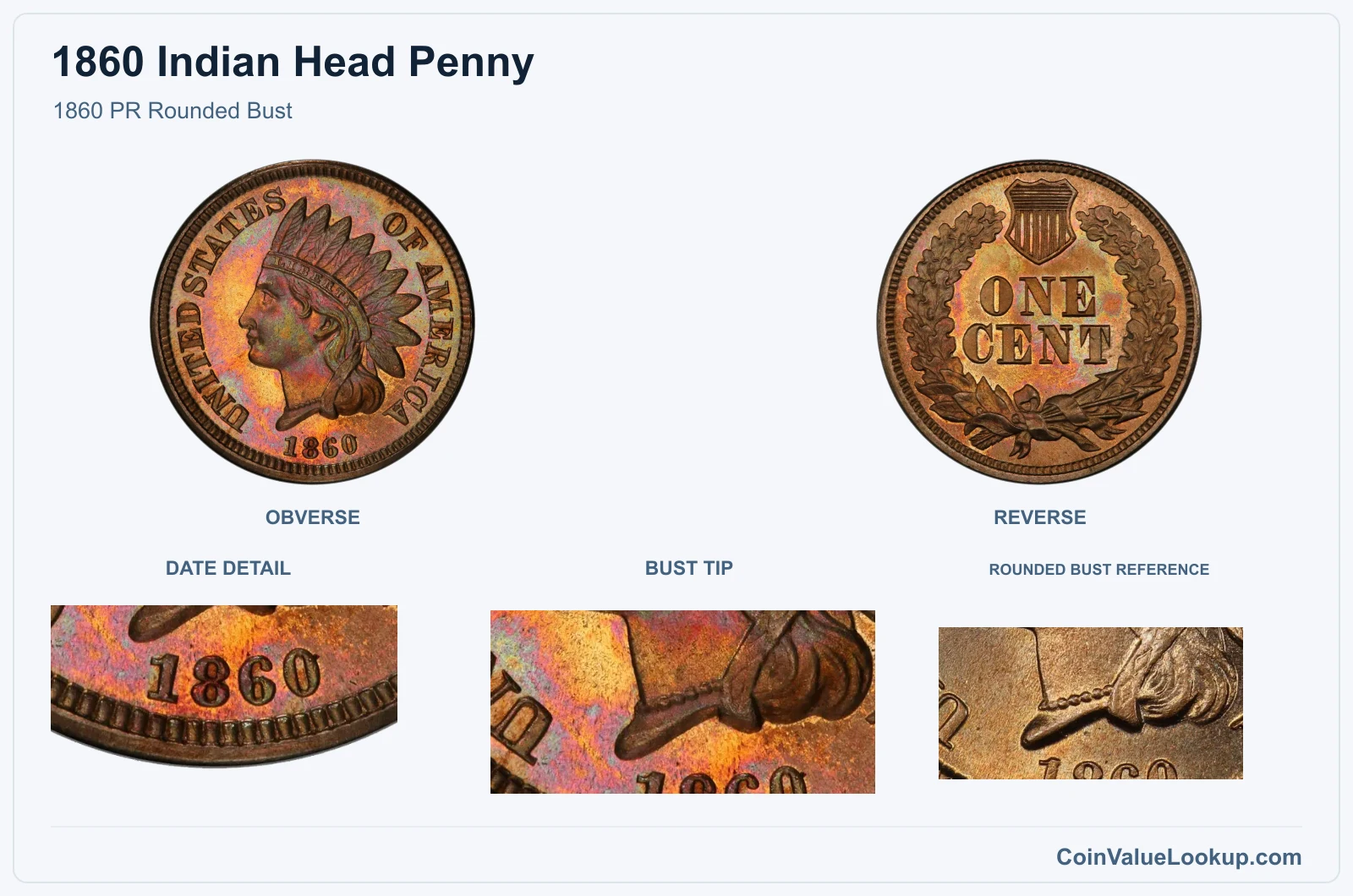
Proof 1860 Indian Head cents were struck with specially prepared dies on polished planchets, producing mirrored fields and sharp design details. Only the Rounded Bust type is listed here with proof pricing.
USA Coin Book guides a PR63 example at approximately $1,243.
Do not assume a shiny coin is a proof. Polished business strikes can mimic proof surfaces to the untrained eye.
Genuine proofs show precise rim geometry, fully squared-up design edges, and deep mirror reflections in the fields. Professional authentication is strongly recommended before paying proof premiums.
This is still a copper-nickel issue at 4.67 grams, same as the business strikes — the difference is entirely in how it was manufactured.
| Range | Grade | Price | Auction Records | Appraisal |
|---|---|---|---|---|
| PR | PR 1 | — | Coin Identifier | |
| PR 2 | — | Coin Identifier | ||
| PR 3 | — | Coin Identifier | ||
| PR 4 | — | Coin Identifier | ||
| PR 6 | — | Coin Identifier | ||
| PR 8 | — | Coin Identifier | ||
| PR 10 | — | Coin Identifier | ||
| PR 12 | — | Coin Identifier | ||
| PR 15 | — | Coin Identifier | ||
| PR 20 | — | Coin Identifier | ||
| PR 25 | — | Coin Identifier | ||
| PR 30 | — | Coin Identifier | ||
| PR 35 | — | Coin Identifier | ||
| PR 40 | — | Coin Identifier | ||
| PR 45 | — | Coin Identifier | ||
| PR 50 | — | Coin Identifier | ||
| PR 53 | — | Coin Identifier | ||
| PR 55 | — | Coin Identifier | ||
| PR 58 | — | Coin Identifier | ||
| PR 60 | — | Coin Identifier | ||
| PR 61 | — | Coin Identifier | ||
| PR 62 | Coin Identifier | |||
| PR 63 | Coin Identifier | |||
| PR 64 | Coin Identifier | |||
| PR 65 | Coin Identifier | |||
| PR 66 | Coin Identifier | |||
| PR 67 | — | — | — | |
| PR 68 | — | — | — | |
| PR 69 | — | — | — | |
| PR 70 | — | — | — |
1860 Indian Head Penny Error List
1. 1860 Indian Head Penny — Doubled Die Obverse
A doubled die obverse on an 1860 Indian Head cent shows consistent separation or notching on the obverse lettering or design elements. This is not a subtle effect visible only in your imagination — under magnification, you should see a clear second impression slightly offset from the primary one.
Compare suspect areas to a normal 1860 cent under matching lighting conditions. Genuine doubled dies produce uniform separation across affected areas.
Machine doubling, by contrast, tends to show a flat shelf on one side of the design and lacks the rounded, raised profile of a true doubled die. Reflections or worn die contours can also mimic doubling.
No specific price range is adopted for this category; value depends on the authenticated identity of the die variety, the severity of doubling, and the coin's overall condition.
2. 1860 Indian Head Penny — Repunched Date
On a repunched date 1860 cent, you can see remnants of an earlier date-punch position beside or beneath the final numerals. The digits were physically punched into the working die, and if the engraver's first strike was slightly off, traces of that initial impression remain.
This is a different category from a doubled die, which affects the entire design from a hubbing issue. A repunched date involves only the date numerals.
Look for shadow digits, partial outlines, or notching confined to the 1, 8, 6, or 0.
Do not confuse a damaged date — from post-strike hits or corrosion — with a repunched date. Machine doubling on the date area can also look similar but lacks the distinct secondary punch impression.
Pricing depends on authenticated identity, severity, and condition; no specific price range is adopted here.
3. 1860 Indian Head Penny — Die Crack
Die cracks appear as raised lines crossing the coin's field or design. They formed when the steel die developed a fracture during use, and that crack transferred as a thin raised ridge on every coin struck afterward.
On an 1860 Indian Head cent, look for a line that crosses smoothly over both field and design elements in a continuous path. Note where it begins and ends.
A die crack is raised — you can feel it with a fingertip or see it catch light under magnification.
Do not confuse a die crack with an incuse scratch (which is cut into the surface, not raised), corrosion lines, or displaced-metal scrapes from contact damage. Value depends on the crack's location, length, and the coin's overall condition; no adopted price range exists for this category.
4. 1860 Indian Head Penny — Die Break / Cud
A cud is a specific type of die break where a piece of the die broke away at the rim, leaving a raised, featureless blob of metal on the struck coin that connects to the rim edge. Interior die breaks that do not reach the rim are sometimes called retained breaks rather than cuds.
On an 1860 cent, examine the rim carefully for any raised, amorphous lump that obliterates part of the normal design. The boundary between the cud and the remaining design should be fairly sharp.
A rim dent is the opposite — it is pushed inward, not raised outward. Corrosion bumps lack the smooth, flat-topped profile of a true cud, and an interior die chip will not connect to the rim.
Pricing is individual and depends on authenticated identity, size, location, and condition.
5. 1860 Indian Head Penny — Clashed Dies
Clashed dies occur when the obverse and reverse dies strike each other without a planchet between them. The impact transfers faint traces of each die's design onto the other.
On a subsequently struck 1860 cent, you might see ghost outlines of the wreath on the obverse or traces of the portrait on the reverse.
These transferred impressions align with where the opposing design would be during normal striking. That alignment is your best diagnostic: random scratches or raised lines will not correspond to the opposite die's layout.
Do not mistake post-strike scratches, handling marks, or brockage effects for die clash evidence. A brockage involves a previously struck coin stuck to the die, which creates a different kind of transferred image.
No adopted price range exists for clashed-die 1860 cents; value is assessed individually based on clarity and coin condition.
6. 1860 Indian Head Penny — Die Chip
A die chip shows up as a small, localized raised lump on the coin, usually filling part of a letter, numeral, or nearby open field. It forms when a tiny fragment of the die surface breaks away, leaving a void that fills with metal during striking.
On an 1860 Indian Head cent, examine letters in UNITED STATES OF AMERICA or the date numerals for any small blob that disrupts the normal design. The surrounding struck detail should flow naturally into the raised area — that continuity distinguishes a die chip from post-strike damage.
A gouge or impact mark is typically incuse (pushed in), not raised. Glue residue or foreign material stuck to the surface can mimic a die chip but usually looks different under magnification and may have irregular edges.
Pricing depends on the chip's size, location, and the coin's condition; no specific range is adopted here.