1894 Indian Head Penny Coin Value: How Much Is It Worth?
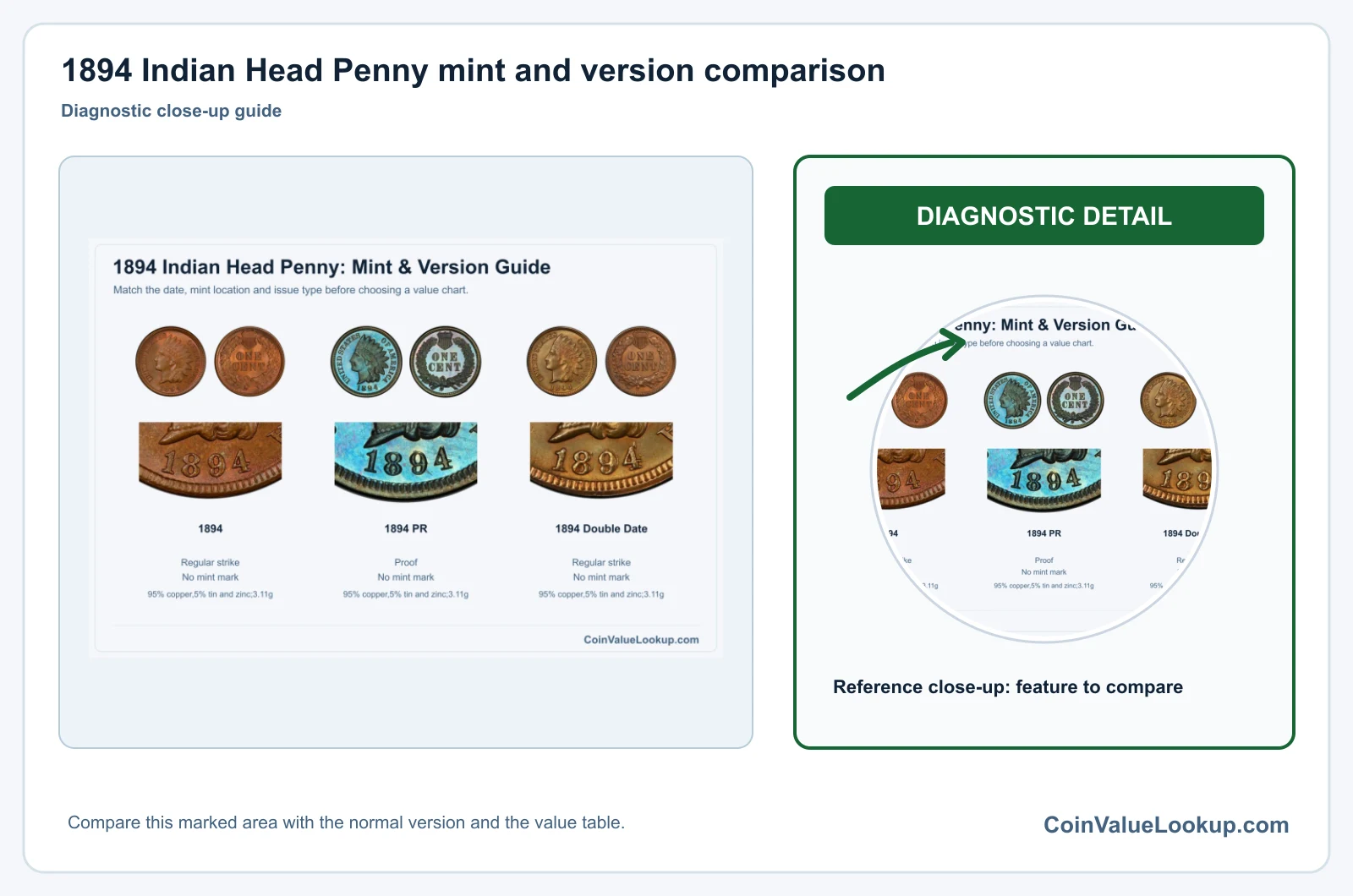
The 1894 Indian Head penny is a solid collectible from the Philadelphia Mint. Guide estimates for a regular business strike range from about $8.64 in G4 (a well-worn but readable coin) to roughly $186 in MS63 (an uncirculated example with moderate bag marks).
Proofs, the Doubled Date variety, and mint errors each carry their own separate valuations.
Fast Way to Identify Your 1894 Indian Head Penny
Want a quick read on your 1894 Indian Head cent? Upload clear photos of both the front and back, and our identifier can offer a preliminary take on which version you might have.
This is not a substitute for professional authentication or grading, but it gives you a starting point before diving deeper into the details.
1894 Indian Head Penny Value
Upload both sides of your 1894 Indian Head Penny.
Front Obverse
Upload photo
Back Reverse
Upload photo
Which 1894 Indian Head Penny Versions Are Worth Money?
- The 1894 Doubled Date variety shows repunched date digits and lists around $92 at G4, climbing to roughly $2,497 at MS63 per guide estimates.
- Regular business strikes in uncirculated condition (MS63) are guided near $186, a meaningful step up from the $8.64 G4 level.
- Proof examples at PR63 are guided near $313; confirm proof manufacturing characteristics before assuming this premium.
- Mint errors such as die cracks, cuds, misplaced dates, and repunched dates each require individual assessment for value.
Step 1: Identify Your 1894 Indian Head Penny Mint Mark and Version
Every regular 1894 Indian Head cent was struck at the Philadelphia Mint. There is no mintmark on this coin, and the small "L" on the ribbon behind the portrait is a designer's initial, not a mint indicator.
The obverse shows a bust wearing a feathered headdress with the word LIBERTY inscribed on the headband. The reverse features an oak wreath surrounding the denomination, topped by a small shield.
If your coin has a wheat-ear reverse or a flying eagle, you are looking at a different series entirely.
One major variety to watch for is the Doubled Date. On these coins, remnants of an earlier punch position are visible beside the final date digits.
Check all four numerals closely against a known normal example before jumping to conclusions.
Proof strikes exist for this year as well. A proof is a method of manufacture involving specially prepared dies and planchets, not simply a high grade.
Mirrored surfaces alone do not confirm proof origin; you also need to verify the sharp rim geometry and other manufacturing hallmarks consistent with proof production.
Step 2: Check Your 1894 Indian Head Penny Grade
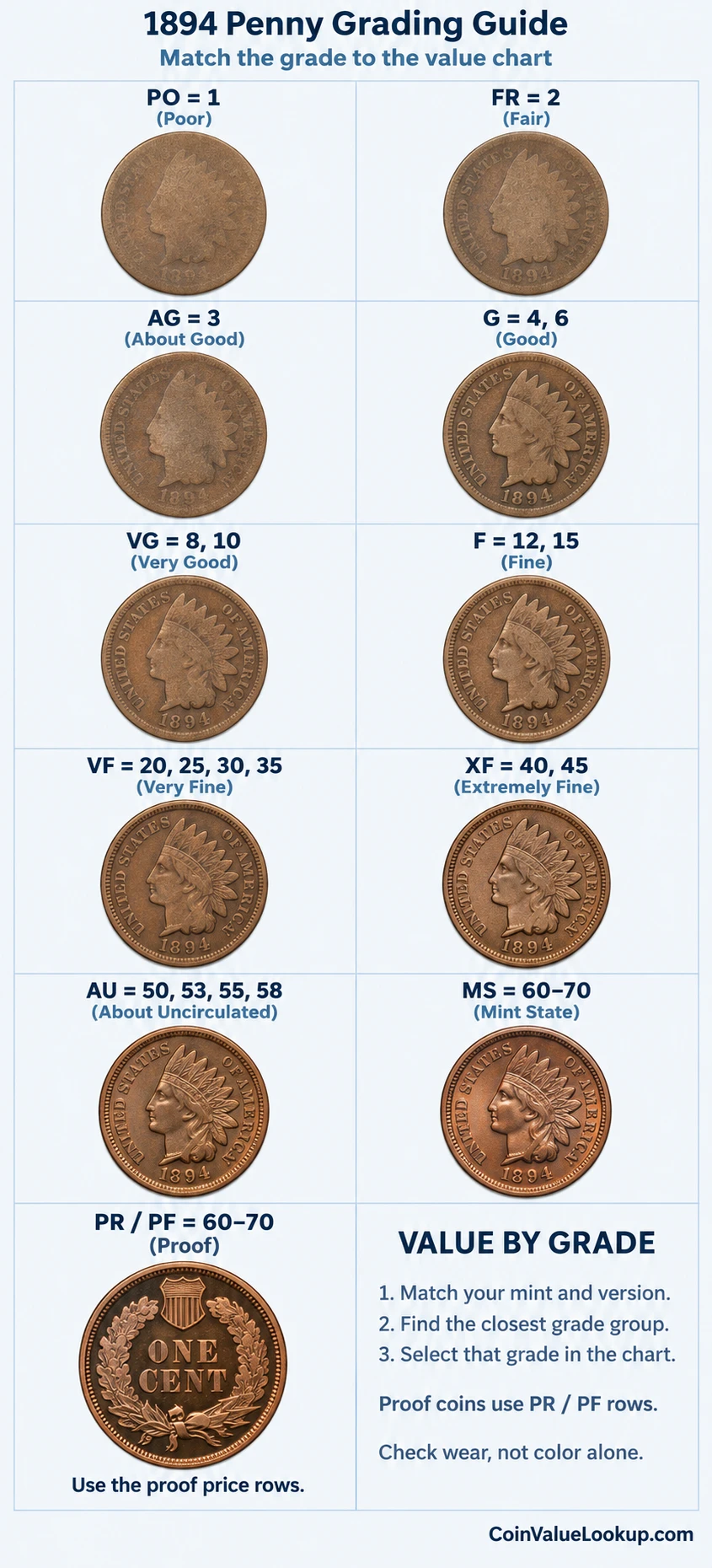
Start with the headband. On a well-worn coin, the letters of LIBERTY will be partially or fully gone; a G4 example typically shows only a faint outline.
As you move up the scale, more letters become distinct, and by AU the full word should be readable with only light friction on the highest points.
Check the feather tips above the ear and the hair curls below the headband. These are high-relief areas that wear first.
A soft original strike, however, can leave feathers mushy even on an uncirculated coin, so do not downgrade based on one weak spot alone.
On the reverse, examine the leaf tips and the shield detail. Luster is your friend here: an unbroken cartwheel across the fields generally signals minimal wear.
Use the comparison image to match your coin's overall sharpness.
Bronze color designations like BN (brown), RB (red-brown), and RD (red) describe the amount of original copper color remaining. These are not different materials.
A coin with full red surfaces will typically bring more than a brown example in the same technical grade, but cleaning or recoloring destroys that premium.
Step 3: Check 1894 Indian Head Penny Value by Mint and Version
1894 Indian Head Penny
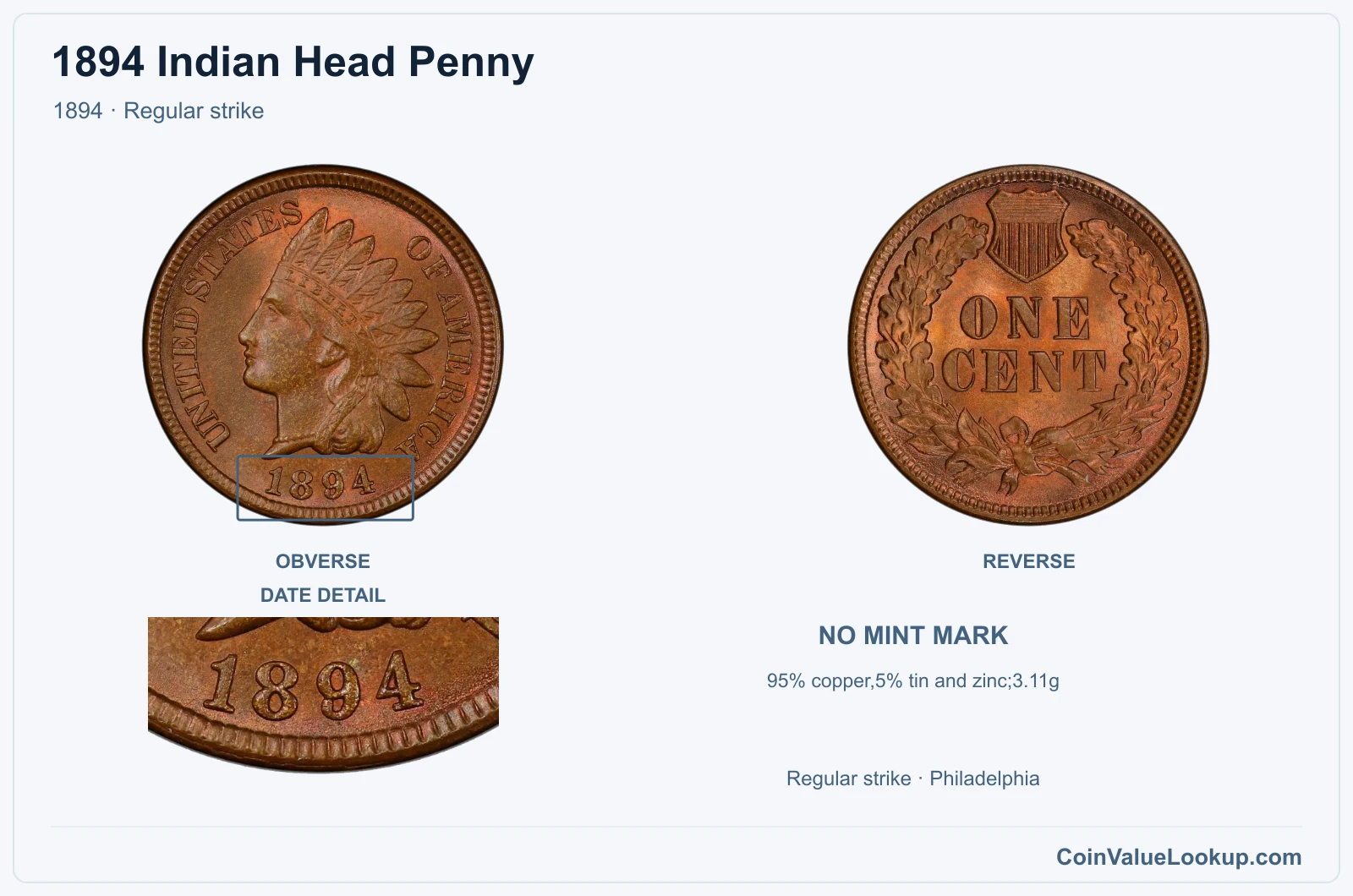
This is the standard 1894 Indian Head cent, struck for circulation at Philadelphia. It weighs 3.11 grams and is composed of 95% copper with 5% tin and zinc.
No mintmark appears on the coin.
USA Coin Book guides this version at about $8.64 in G4, which is a coin worn smooth but with the date and major design elements still legible. At MS63, an uncirculated piece with some contact marks, the guide climbs to around $186.
Original, problem-free surfaces matter here. Cleaned, corroded, or damaged coins trade well below these figures, even at the same technical grade.
Do not borrow pricing from the Doubled Date variety for a normal-date coin. Compare all four digits to a known Doubled Date image before claiming that premium.
| Range | Grade | Price | Auction Records | Appraisal |
|---|---|---|---|---|
| PO | PO 1 | — | Coin Identifier | |
| FR | FR 2 | — | Coin Identifier | |
| AG | AG 3 | — | Coin Identifier | |
| G | G 4 | — | Coin Identifier | |
| G 6 | — | Coin Identifier | ||
| VG | VG 8 | — | Coin Identifier | |
| VG 10 | — | Coin Identifier | ||
| F | F 12 | — | Coin Identifier | |
| F 15 | — | Coin Identifier | ||
| VF | VF 20 | — | Coin Identifier | |
| VF 25 | — | Coin Identifier | ||
| VF 30 | — | Coin Identifier | ||
| VF 35 | — | Coin Identifier | ||
| XF | XF 40 | — | Coin Identifier | |
| XF 45 | Coin Identifier | |||
| AU | AU 50 | Coin Identifier | ||
| AU 53 | — | Coin Identifier | ||
| AU 55 | Coin Identifier | |||
| AU 58 | Coin Identifier | |||
| MS | MS 60 | — | Coin Identifier | |
| MS 61 | — | Coin Identifier | ||
| MS 62 | Coin Identifier | |||
| MS 63 | Coin Identifier | |||
| MS 64 | Coin Identifier | |||
| MS 65 | Coin Identifier | |||
| MS 66 | Coin Identifier | |||
| MS 67 | — | — | — | |
| MS 68 | — | — | — | |
| MS 69 | — | — | — | |
| MS 70 | — | — | — |
1894 Indian Head Penny — PR
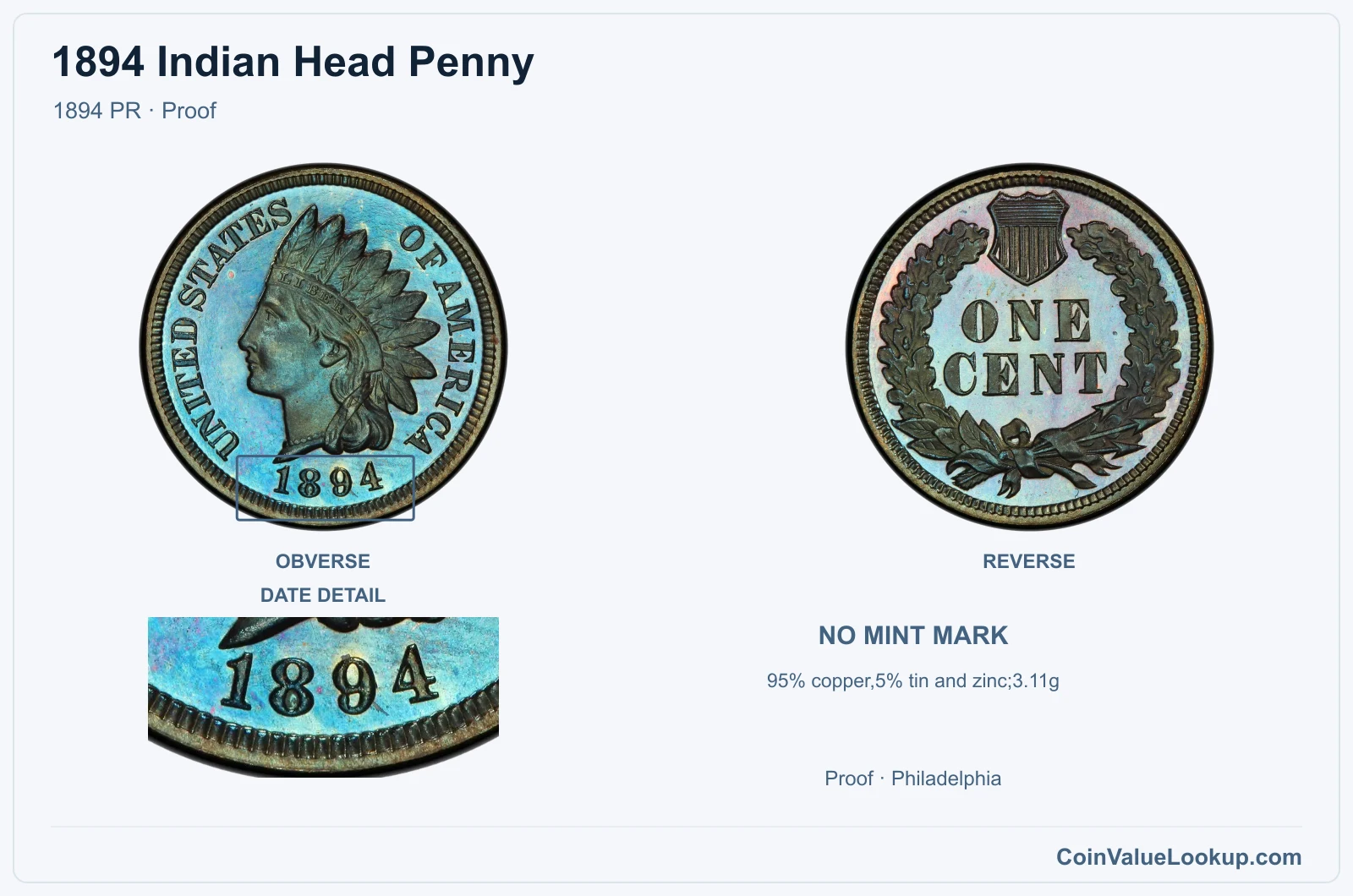
The 1894 proof Indian Head cent was manufactured with specially prepared dies on polished planchets, producing sharp detail and mirror-like fields. At PR63, USA Coin Book guides this coin near $313.
Proof status must be verified through manufacturing evidence, not appearance alone. A business strike that has been polished can mimic reflectivity, but it will lack the precise rim profile and die characteristics of a genuine proof.
If you are uncertain, professional authentication from a third-party grading service is the safest path.
Coin Value Lookup is a good place to start when you want to compare guide values across different series, years, and conditions before deciding whether to submit a coin for professional review.
| Range | Grade | Price | Auction Records | Appraisal |
|---|---|---|---|---|
| PR | PR 1 | — | Coin Identifier | |
| PR 2 | — | Coin Identifier | ||
| PR 3 | — | Coin Identifier | ||
| PR 4 | — | Coin Identifier | ||
| PR 6 | — | Coin Identifier | ||
| PR 8 | — | Coin Identifier | ||
| PR 10 | — | Coin Identifier | ||
| PR 12 | — | Coin Identifier | ||
| PR 15 | — | Coin Identifier | ||
| PR 20 | — | Coin Identifier | ||
| PR 25 | — | Coin Identifier | ||
| PR 30 | — | Coin Identifier | ||
| PR 35 | — | Coin Identifier | ||
| PR 40 | — | Coin Identifier | ||
| PR 45 | — | Coin Identifier | ||
| PR 50 | — | Coin Identifier | ||
| PR 53 | — | Coin Identifier | ||
| PR 55 | — | Coin Identifier | ||
| PR 58 | — | Coin Identifier | ||
| PR 60 | — | Coin Identifier | ||
| PR 61 | Coin Identifier | |||
| PR 62 | — | Coin Identifier | ||
| PR 63 | Coin Identifier | |||
| PR 64 | Coin Identifier | |||
| PR 65 | Coin Identifier | |||
| PR 66 | Coin Identifier | |||
| PR 67 | — | Coin Identifier | ||
| PR 68 | — | — | — | |
| PR 69 | — | — | — | |
| PR 70 | — | — | — |
1894 Indian Head Penny — Double Date
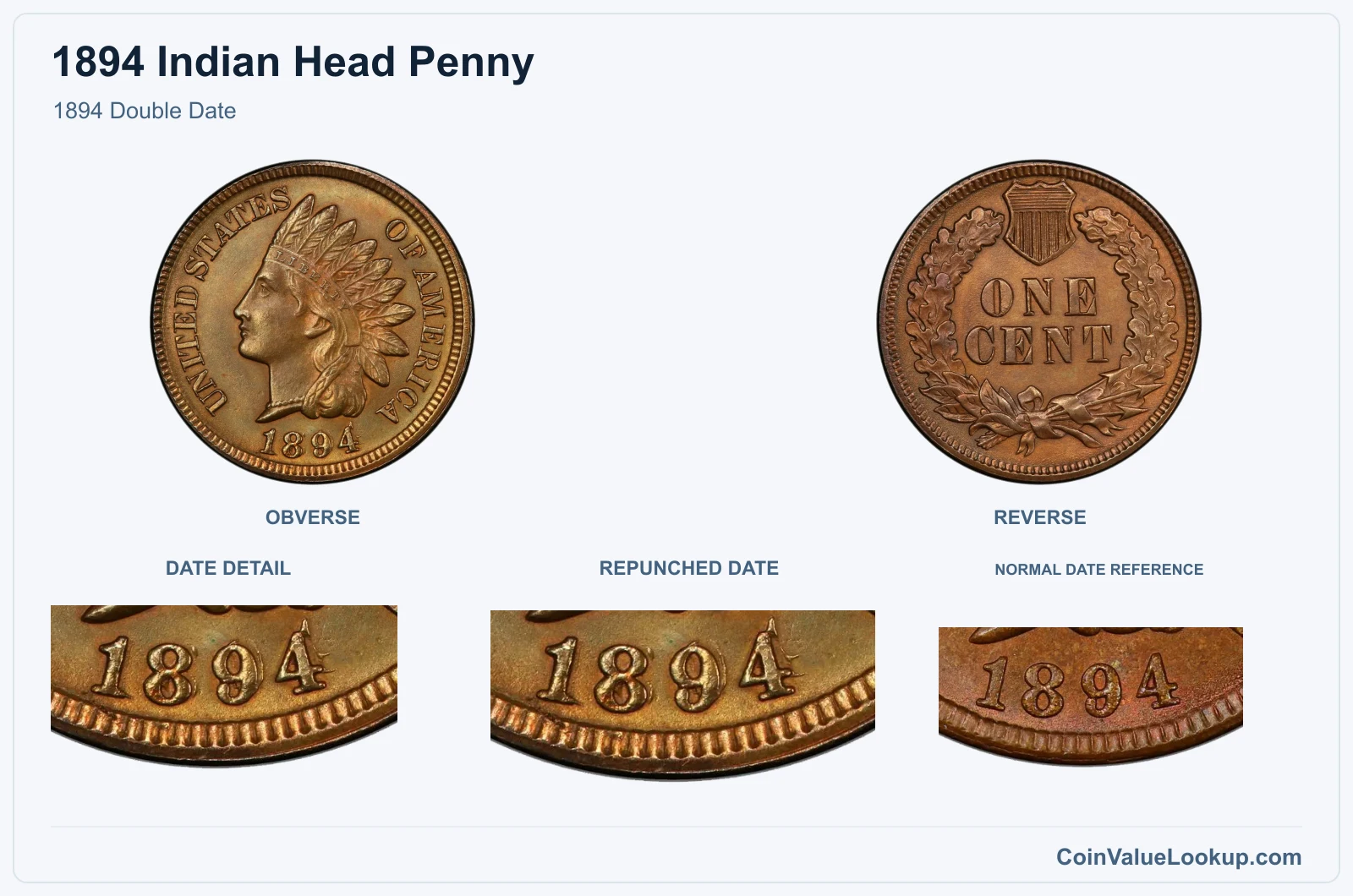
The 1894 Doubled Date is a repunched-date variety where the Mint punched the date into the working die more than once, leaving visible remnants of the earlier position beside the final digits. This is a mechanical variety created during die preparation, distinct from machine doubling or post-strike damage.
To identify it, examine all four date numerals under magnification. You should see traces of earlier digit impressions slightly offset from the final positions.
Compare your coin side-by-side with photographs of a confirmed normal date.
Guide estimates from USA Coin Book place this variety at roughly $92 in G4 and around $2,497 in MS63. That is a dramatic jump over the standard issue, which is why proper identification matters.
A worn coin with an ambiguous date is not automatically a Doubled Date; you need clear remnants of the secondary punch positions to justify this classification.
Ordinary-issue reference: Ordinary-issue reference only: The table below shows prices for the 1894 Indian Cent (regular strike). It does not represent the value of the specific 1894 Double Date variety or its variety premium. Year, mint, metal and strike type are matched; the specific variety is not priced by this table.
Range Grade
Price1894 Indian Cent — Ordinary-Issue Reference (Regular Strike) (BN) Price1894 Indian Cent — Ordinary-Issue Reference (Regular Strike) (RB) Price1894 Indian Cent — Ordinary-Issue Reference (Regular Strike) (RD) Auction Records Appraisal PO PO 1
—
Coin Identifier FR FR 2
—
Coin Identifier AG AG 3
—
Coin Identifier G G 4
—
Coin Identifier
G 6
—
Coin Identifier VG VG 8
—
Coin Identifier
VG 10
—
Coin Identifier F F 12
—
Coin Identifier
F 15
—
Coin Identifier VF VF 20
—
Coin Identifier
VF 25
—
Coin Identifier
VF 30
—
Coin Identifier
VF 35
—
Coin Identifier XF XF 40
—
Coin Identifier
XF 45
Coin Identifier AU AU 50
Coin Identifier
AU 53
—
Coin Identifier
AU 55
Coin Identifier
AU 58
Coin Identifier MS MS 60
—
Coin Identifier
MS 61
—
Coin Identifier
MS 62
Coin Identifier
MS 63
Coin Identifier
MS 64
Coin Identifier
MS 65
Coin Identifier
MS 66
Coin Identifier
MS 67
—
—
Coin Identifier
MS 68
—
—
—
—
—
MS 69
—
—
—
—
—
MS 70
—
—
—
—
—
1894 Indian Head Penny Error List
1. 1894 Indian Head Penny — Misplaced Date
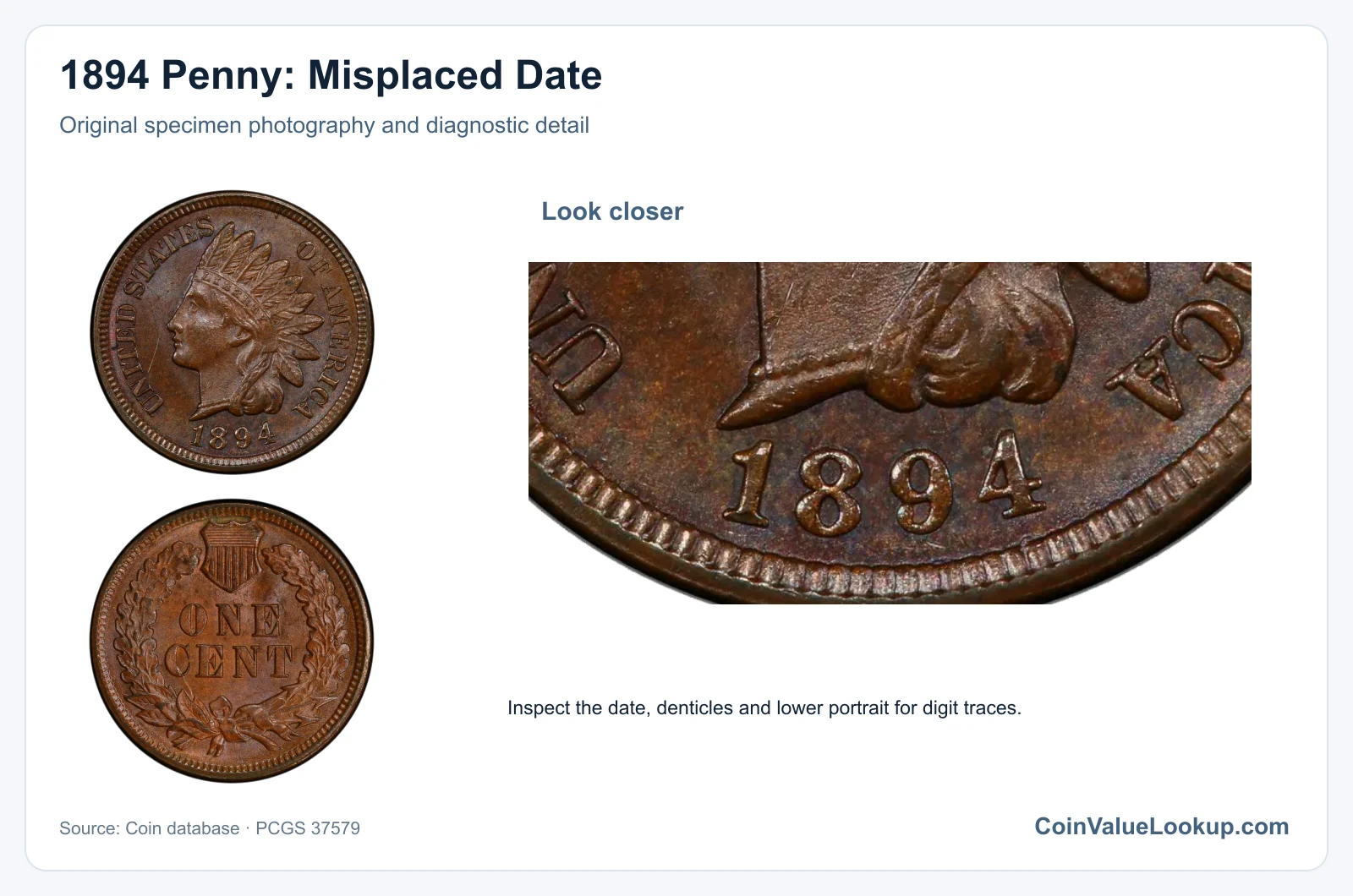
A misplaced date occurs when a partial impression of one or more date digits appears somewhere it should not be, typically embedded in the denticles (the small tooth-like projections along the rim) or near the portrait, well away from the coin's final correctly positioned date.
To spot this on an 1894 Indian Head cent, look along the lower rim area and the field near the bust with good magnification. You are searching for the outline or partial shape of a numeral that does not belong in that location.
Die chips, scratches, and random metal lumps can mimic portions of digits, so the shape must clearly correspond to part of a recognizable number from the date. Value depends on the specific die, the clarity and size of the misplaced element, and the coin's overall condition.
Professional authentication is the surest way to confirm this category and establish an individual assessment.
2. 1894 Indian Head Penny — Repunched Date
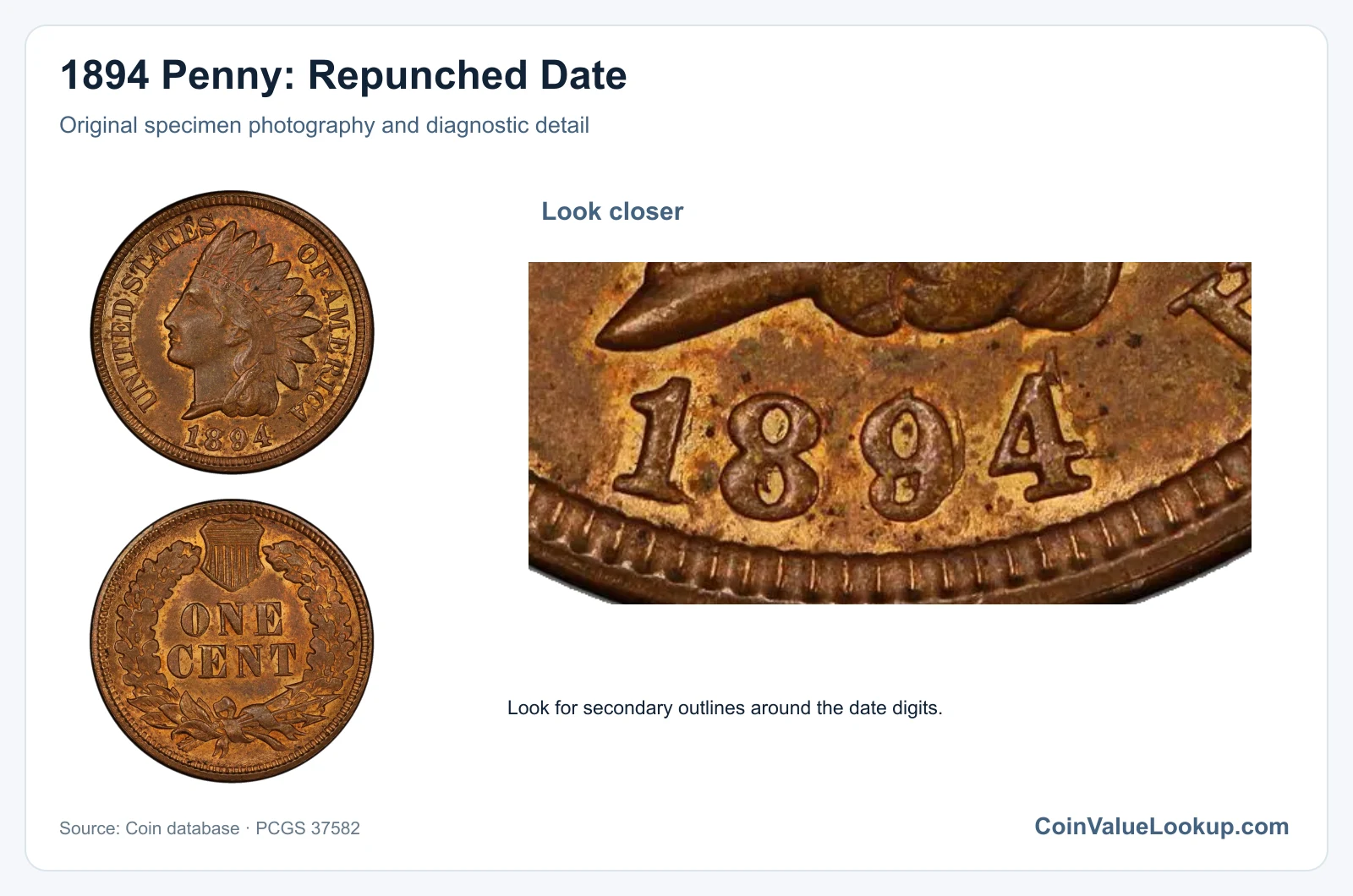
A repunched date shows evidence that the date digits were punched into the die more than once, with the earlier position not perfectly aligned to the final one. On an 1894 Indian Head cent, you will see faint remnants of numerals slightly offset from the primary date.
This is related to the major Doubled Date variety listed above, but repunched-date errors can appear in varying degrees of severity. Minor shifts may only affect one or two digits.
Do not confuse this with machine doubling, which produces flat, shelf-like traces without the rounded profile of a genuine secondary punch impression. Damage from contact or cleaning can also distort date digits in misleading ways.
Because value depends on the specific die pair, the clarity of the repunching, and the coin's grade, each example needs individual assessment by a qualified grading service.
3. 1894 Indian Head Penny — Die Crack
Die cracks appear as thin, raised lines running across the coin's surface. They form when the steel die develops a fracture during use, and the crack fills with metal during striking, leaving a ridge on the finished coin.
On an 1894 Indian Head cent, examine both sides for lines that cross the field or cut through design elements. Note where the line starts and ends, because position and length affect collector interest.
A raised die crack should not be confused with an incuse scratch, which is cut into the surface rather than raised above it. Corrosion channels and displaced-metal scrapes can also mimic cracks at first glance but lack the clean, consistent profile.
Value varies widely depending on severity, location, and overall coin condition, so individual assessment through a reputable authentication service is recommended.
4. 1894 Indian Head Penny — Die Break / Cud
A cud is a specific type of die break where a piece of the die rim breaks away entirely. The result is a raised, featureless blob of metal attached to the coin's rim, replacing whatever design or lettering occupied that area.
On an 1894 Indian Head cent, look for an irregular raised lump connected to the rim. The key distinction is that a true cud must touch the rim; an interior die break that does not reach the edge is technically a retained die break, not a cud.
Rim dents caused by post-strike damage push metal inward and are recessed, not raised. Corrosion bumps and interior die chips also lack the rim connection.
Large, well-defined cuds tend to attract more collector interest than small ones. Each example needs individual assessment based on size, location, and the coin's overall condition and grade.