1897 Barber Dime Coin Value: How Much Is It Worth?
The 1897 Barber Dime spans a wide value range depending on mint and condition. Philadelphia examples start around $12.26 in well-worn G4, while the scarce New Orleans issue can reach roughly $1,882 at MS63 according to USA Coin Book guide estimates.
Clean, original XF and AU examples from New Orleans are genuinely harder to find than heavily worn survivors.
Fast Way to Identify Your 1897 Barber Dime
Want a quick read on what you have? Upload clear photos of the front and back of your 1897 dime.
That lets us provide a preliminary identification of the mint, finish, and general condition so you know which version you are holding before diving deeper into values.
1897 Barber Dime Value
Upload both sides of your 1897 Barber Dime.
Front Obverse
Upload photo
Back Reverse
Upload photo
Which 1897 Barber Dime Versions Are Worth Money?
- The 1897-O (New Orleans) is the scarcest mint this year; clean XF and AU examples are especially hard to locate and carry strong premiums over worn pieces.
- Fully uncirculated examples from any mint command the highest ordinary premiums, but original surfaces matter more than simple shininess.
- Check for the error categories listed below, such as repunched dates, clipped planchets, and off-center strikes; old damage and weak strikes are not automatically valuable.
Step 1: Identify Your 1897 Barber Dime Mint Mark and Version
The 1897 Barber Dime shows a right-facing Liberty head wearing a cap and laurel wreath on the obverse, with ONE DIME enclosed in a cereal wreath on the reverse. Do not confuse this with the later Mercury or earlier Seated Liberty designs.
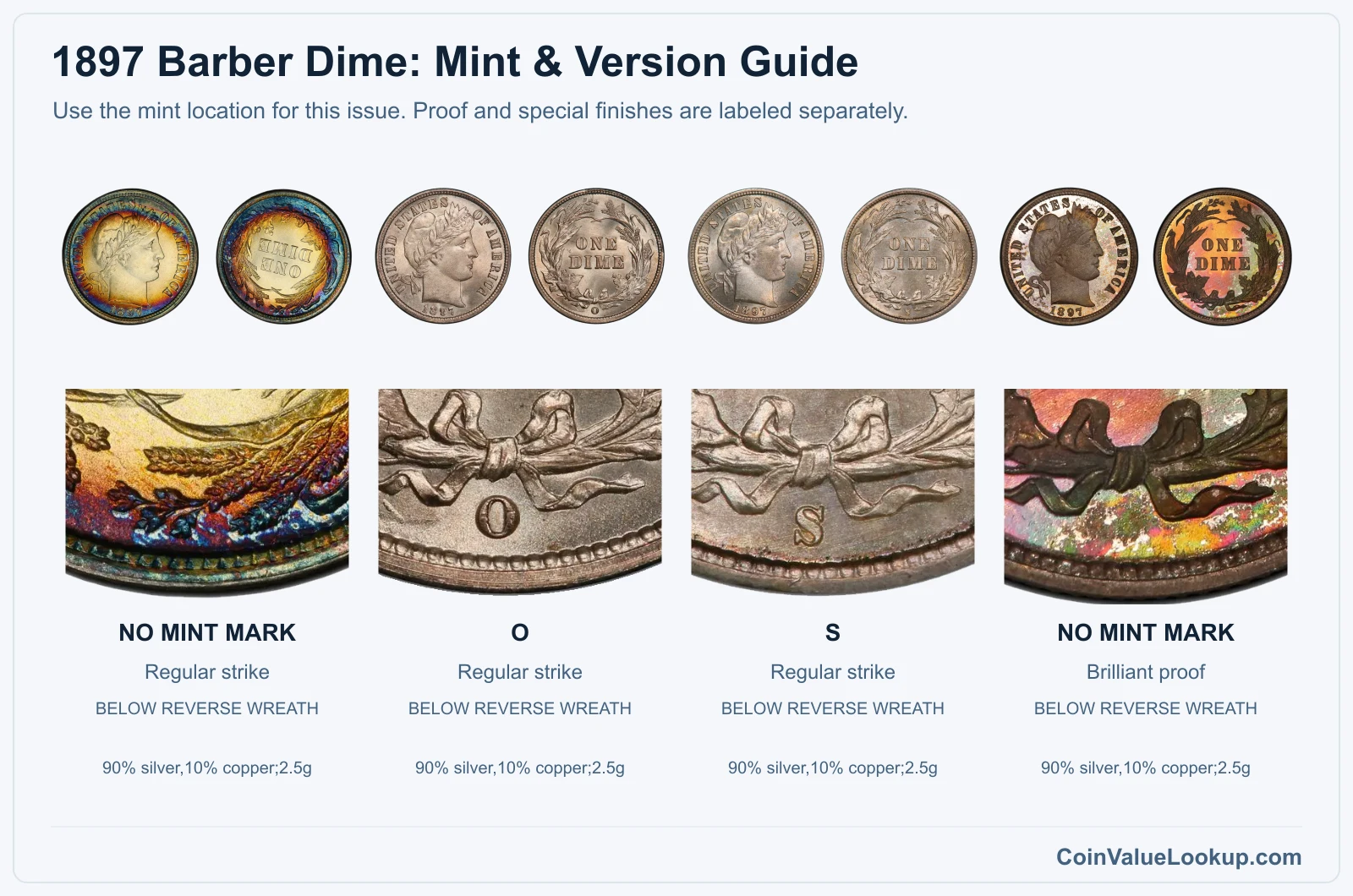
Three mints produced business strikes this year: Philadelphia, New Orleans, and San Francisco. The mintmark sits on the reverse, just below the wreath's bow knot.
No mintmark means Philadelphia.
Philadelphia also struck proof examples with mirrored fields, so a Philadelphia coin could be either a business strike or a proof. Proofs are a manufacturing method, not a grade above Mint State.
All regular 1897 dimes are 90% silver and 10% copper, weigh 2.5 grams, measure 17.9 mm in diameter, and have a reeded edge. If your coin lacks reeding, is the wrong weight, or shows a different design, you may have something else entirely.
Step 2: Check Your 1897 Barber Dime Grade
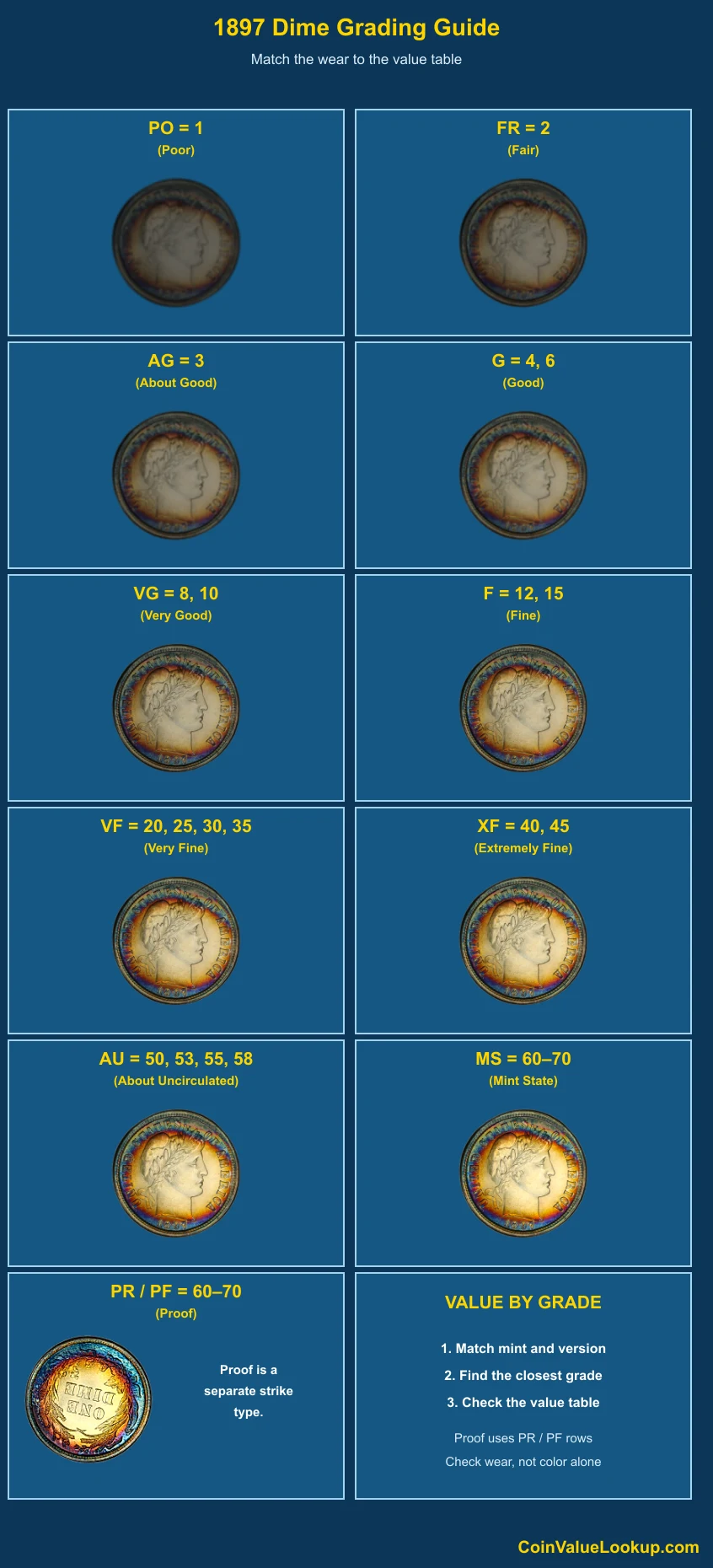
Grading a Barber Dime means evaluating actual wear across the whole coin, not just counting letters. Focus on the LIBERTY inscription in the headband, the hair detail above the ear, Liberty's cheek, and the wreath leaves and ribbon on the reverse.
The rim should also be checked for contact marks.
A coin grading Good (G4) will have a smooth headband with LIBERTY fully gone. At Fine, several letters return.
At Extremely Fine, nearly all detail is present with only light rub on the high points.
New Orleans coins are sometimes softly struck from the factory, which can mimic wear on an otherwise uncirculated piece. Compare your coin carefully against the grading comparison image to separate genuine wear from strike weakness.
Mint State requires unbroken original luster across the entire surface. Watch for hairlines from old cleanings and unnatural brightness, both of which reduce a coin's grade and appeal.
A cleaned coin that looks shiny is not the same as a lustrous one.
Step 3: Check 1897 Barber Dime Value by Mint and Version
1897 Barber Dime — No Mint Mark — Silver Circulation
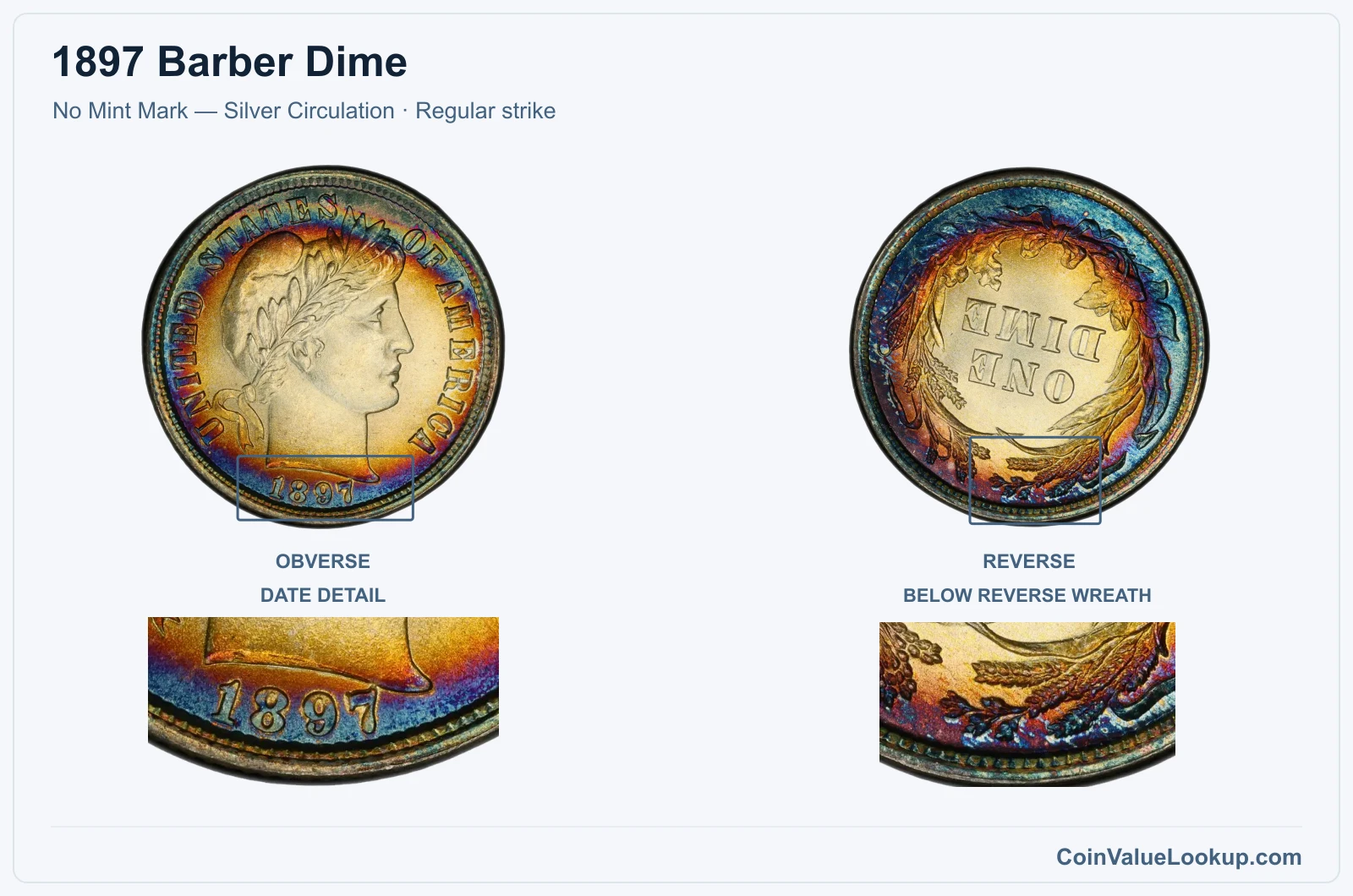
The Philadelphia issue carries no mintmark on the reverse. In well-worn G4 condition, USA Coin Book estimates a value around $12.26, rising to roughly $253 at MS63.
This is the most available mint for 1897 and the easiest to find in lower grades.
That said, truly uncirculated survivors with original luster are still uncommon for a coin over 125 years old. Look for full detail on the headband and hair, and check that the luster has not been artificially enhanced by cleaning.
Range Grade
Price Auction Records Appraisal PO PO 1
—
Coin Identifier FR FR 2
—
Coin Identifier AG AG 3
—
Coin Identifier G G 4
—
Coin Identifier
G 6
—
Coin Identifier VG VG 8
—
Coin Identifier
VG 10
—
Coin Identifier F F 12
—
Coin Identifier
F 15
—
Coin Identifier VF VF 20
—
Coin Identifier
VF 25
—
Coin Identifier
VF 30
—
Coin Identifier
VF 35
—
Coin Identifier XF XF 40
—
Coin Identifier
XF 45
Coin Identifier AU AU 50
Coin Identifier
AU 53
—
Coin Identifier
AU 55
Coin Identifier
AU 58
Coin Identifier MS MS 60
—
Coin Identifier
MS 61
Coin Identifier
MS 62
Coin Identifier
MS 63
Coin Identifier
MS 64
Coin Identifier
MS 65
Coin Identifier
MS 66
Coin Identifier
MS 67
Coin Identifier
MS 68
Coin Identifier
MS 69
—
—
—
MS 70
—
—
—
1897 Barber Dime — O — Silver Circulation
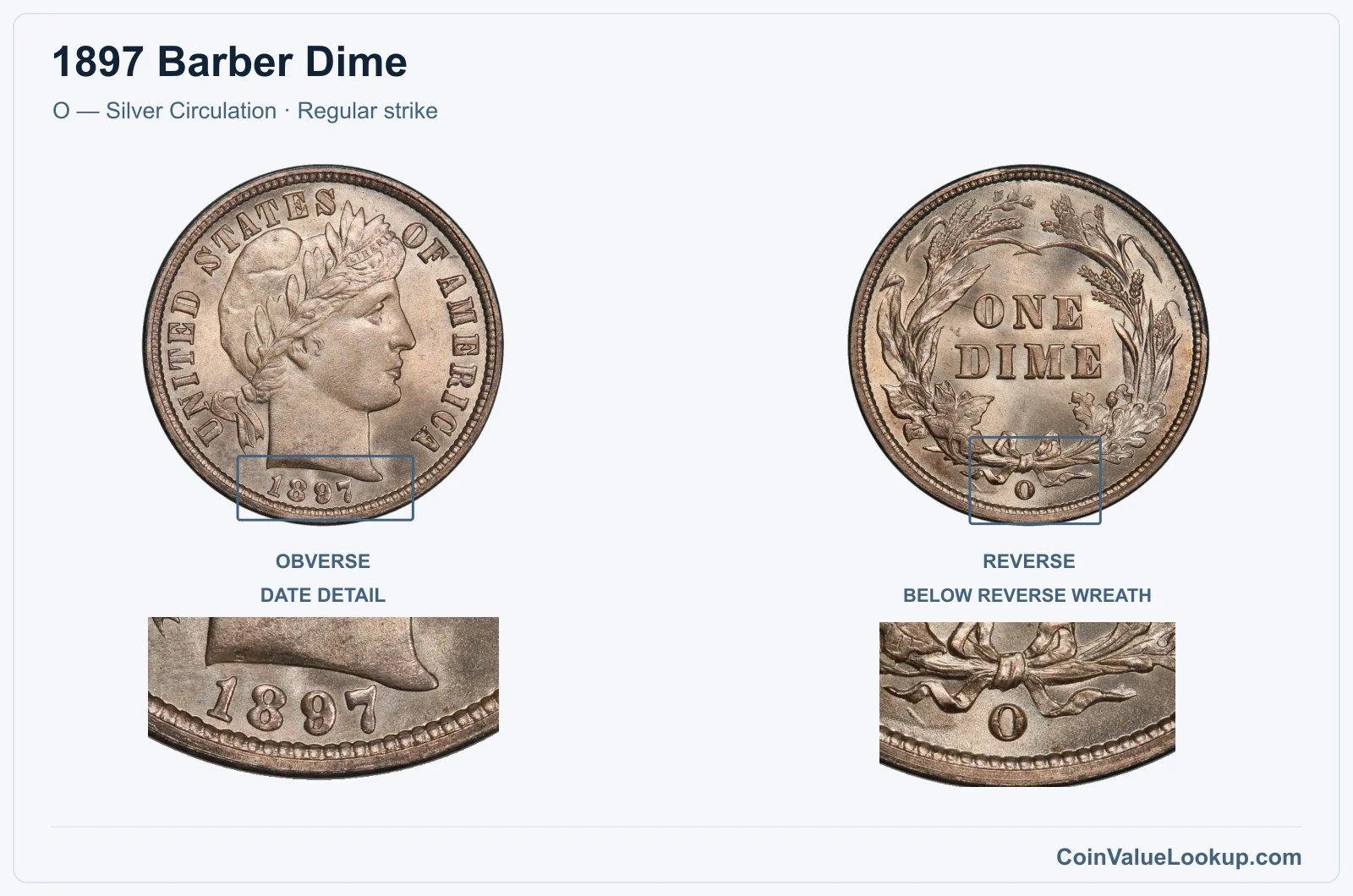
The 1897-O is the key business strike this year. Look for a small "O" mintmark below the wreath bow on the reverse.
USA Coin Book estimates about $95 even in G4, climbing to approximately $1,882 at MS63.
Clean examples in the XF to AU range can actually be harder to track down than heavily worn pieces, because most survivors saw extensive circulation. New Orleans strikes tend to be softer than Philadelphia or San Francisco issues, so some softness on the headband letters may be original strike weakness rather than wear.
Compare carefully against the grading image before concluding your coin is lower grade than it actually is.
Coin Value Lookup is a good starting point if you want to compare your 1897-O against values for other dates in the Barber Dime series.
Range Grade
Price Auction Records Appraisal PO PO 1
—
Coin Identifier FR FR 2
—
Coin Identifier AG AG 3
Coin Identifier G G 4
Coin Identifier
G 6
—
Coin Identifier VG VG 8
Coin Identifier
VG 10
Coin Identifier F F 12
Coin Identifier
F 15
Coin Identifier VF VF 20
Coin Identifier
VF 25
Coin Identifier
VF 30
Coin Identifier
VF 35
Coin Identifier XF XF 40
Coin Identifier
XF 45
Coin Identifier AU AU 50
Coin Identifier
AU 53
—
Coin Identifier
AU 55
Coin Identifier
AU 58
Coin Identifier MS MS 60
—
Coin Identifier
MS 61
—
Coin Identifier
MS 62
Coin Identifier
MS 63
Coin Identifier
MS 64
Coin Identifier
MS 65
Coin Identifier
MS 66
Coin Identifier
MS 67
Coin Identifier
MS 68
—
—
—
MS 69
—
—
—
MS 70
—
—
—
1897 Barber Dime — S — Silver Circulation
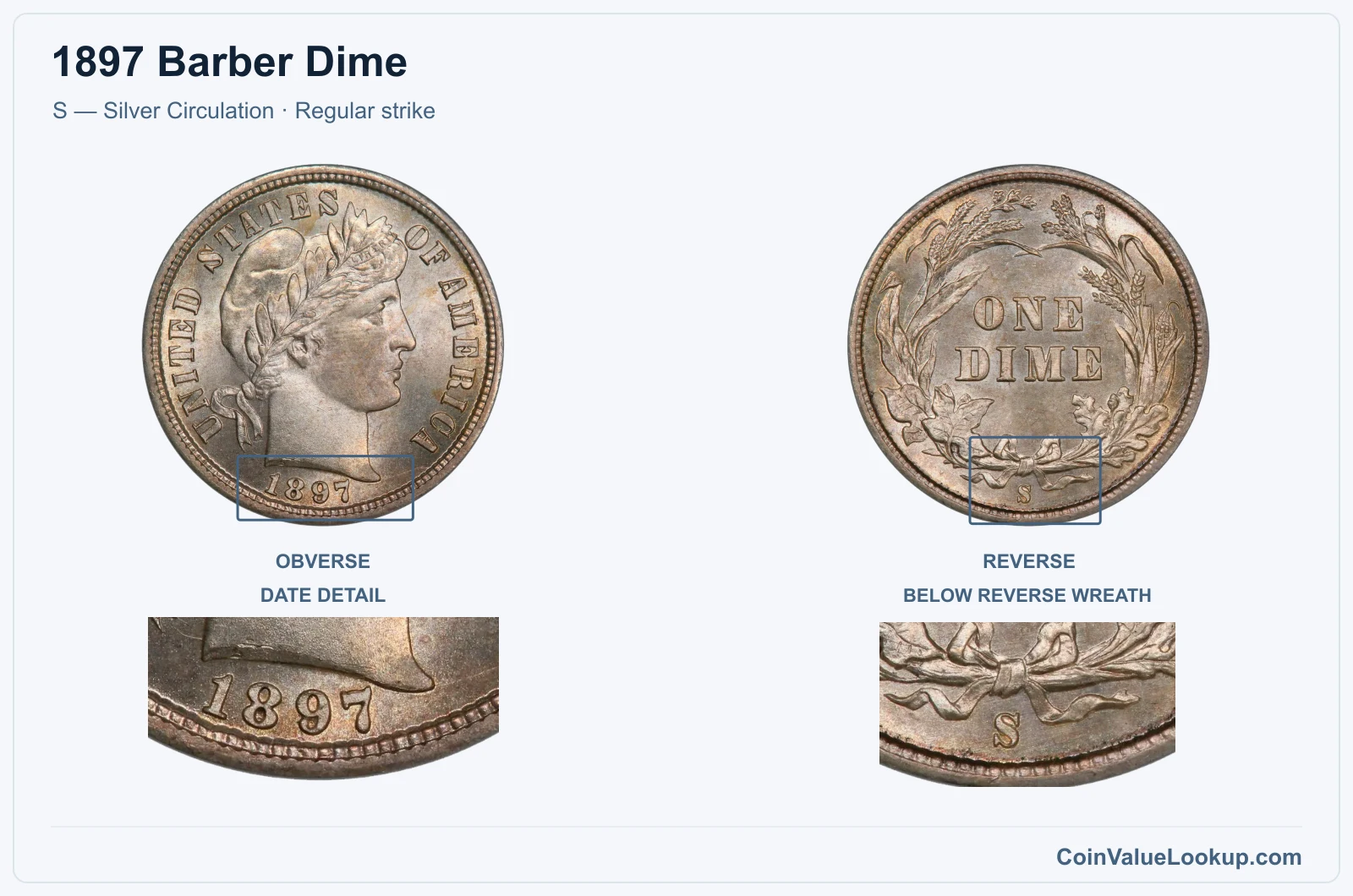
San Francisco coins carry an "S" mintmark below the reverse wreath bow. Guide estimates from USA Coin Book place the 1897-S at about $34 in G4 and around $1,161 at MS63.
This sits between Philadelphia and New Orleans in both scarcity and price. Surviving examples tend to show honest circulation wear.
Mint State pieces with full, original luster are uncommon and worth careful examination if you believe yours qualifies.
Range Grade
Price Auction Records Appraisal PO PO 1
—
Coin Identifier FR FR 2
—
Coin Identifier AG AG 3
—
Coin Identifier G G 4
Coin Identifier
G 6
—
Coin Identifier VG VG 8
—
Coin Identifier
VG 10
—
Coin Identifier F F 12
Coin Identifier
F 15
Coin Identifier VF VF 20
Coin Identifier
VF 25
Coin Identifier
VF 30
Coin Identifier
VF 35
Coin Identifier XF XF 40
Coin Identifier
XF 45
Coin Identifier AU AU 50
Coin Identifier
AU 53
Coin Identifier
AU 55
Coin Identifier
AU 58
Coin Identifier MS MS 60
—
Coin Identifier
MS 61
Coin Identifier
MS 62
Coin Identifier
MS 63
Coin Identifier
MS 64
Coin Identifier
MS 65
Coin Identifier
MS 66
Coin Identifier
MS 67
—
Coin Identifier
MS 68
—
—
—
MS 69
—
—
—
MS 70
—
—
—
1897 Barber Dime — No Mint Mark — Brilliant Silver Proof
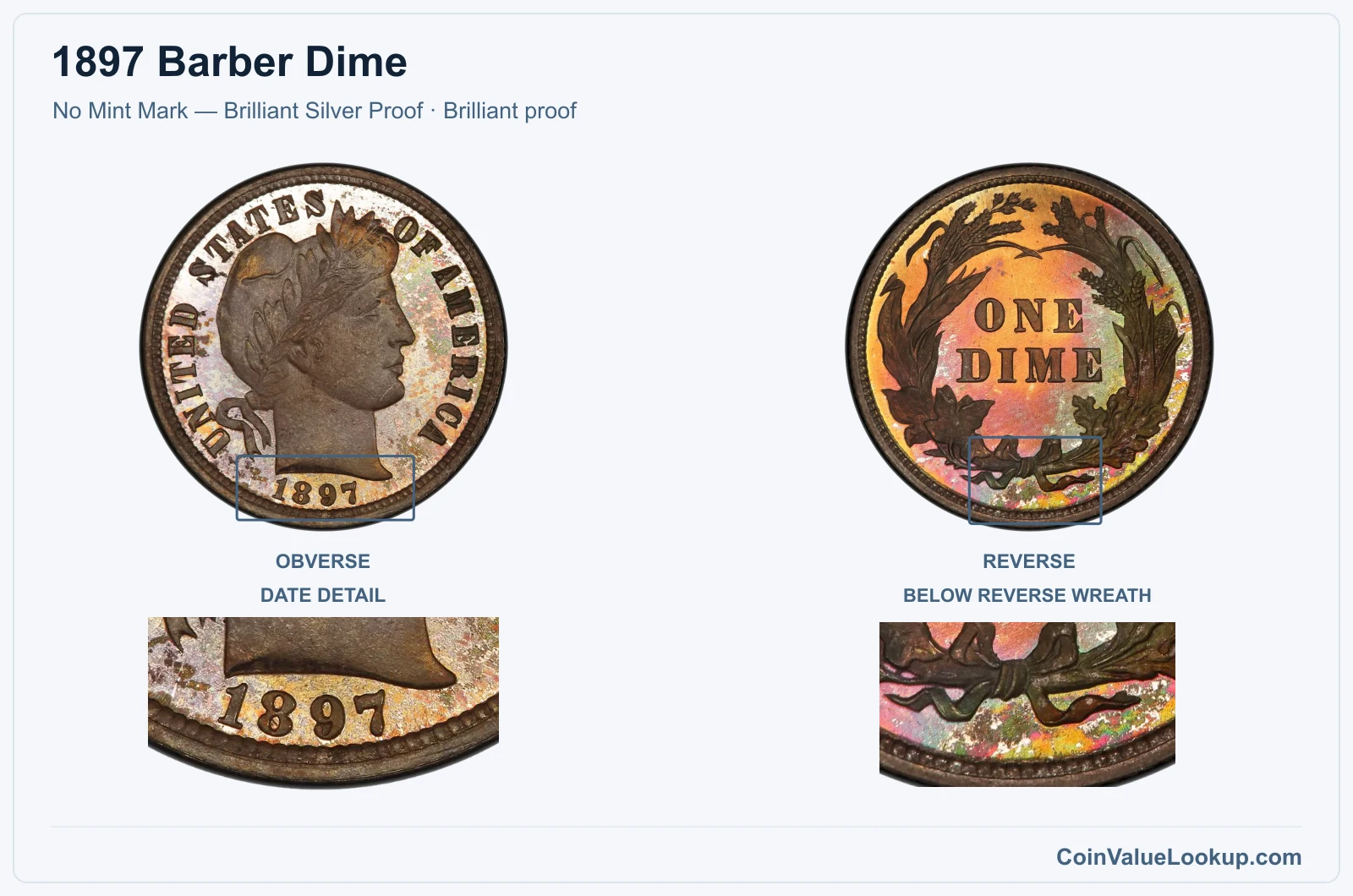
Philadelphia produced proof Barber Dimes with mirrored fields and sharply defined rims, struck from specially prepared dies. A proof is a manufacturing method, not simply a higher grade than Mint State.
USA Coin Book estimates about $616 at PR63.
Cameo and Deep Cameo designations describe the degree of contrast between frosted devices and mirrored fields. Do not assume a bright coin is automatically Cameo, and do not apply the PR63 price to a Deep Cameo example, as those are valued differently.
Look for squared-off rims and perfectly reflective surfaces as basic indicators of proof manufacture.
Range Grade
Price Auction Records Appraisal PR PR 1
—
Coin Identifier
PR 2
—
Coin Identifier
PR 3
—
Coin Identifier
PR 4
—
Coin Identifier
PR 6
—
Coin Identifier
PR 8
—
Coin Identifier
PR 10
—
Coin Identifier
PR 12
—
Coin Identifier
PR 15
—
Coin Identifier
PR 20
—
Coin Identifier
PR 25
—
Coin Identifier
PR 30
—
Coin Identifier
PR 35
—
Coin Identifier
PR 40
—
Coin Identifier
PR 45
—
Coin Identifier
PR 50
—
Coin Identifier
PR 53
—
Coin Identifier
PR 55
—
Coin Identifier
PR 58
—
Coin Identifier
PR 60
Coin Identifier
PR 61
Coin Identifier
PR 62
Coin Identifier
PR 63
Coin Identifier
PR 64
Coin Identifier
PR 65
Coin Identifier
PR 66
Coin Identifier
PR 67
Coin Identifier
PR 68
Coin Identifier
PR 69
—
—
—
PR 70
—
—
—
1897 Barber Dime Error List
1. 1897 Barber Dime — Repunched Date
A repunched date on the 1897 Barber Dime shows remnants of an earlier position of one or more date numerals alongside the final placement. You will see faint ghost digits, usually slightly offset, near the base or tops of the numbers in the date.
This is a die variety created during manufacture when the date punch was applied more than once in slightly different positions.
Do not confuse this with machine doubling, which produces flat, shelf-like doubling across the entire design, or with post-mint damage to the date area. A true repunched date will show clear, raised remnants that match the shape of the numerals.
Value depends on the visibility of the repunching, overall coin condition, and collector demand for the specific variety.
2. 1897 Barber Dime — Clipped Planchet
A clipped planchet error means the coin blank was incompletely punched from the metal strip before striking. On a 1897 dime, look for a missing curved, straight, or irregular portion along the edge where metal is simply absent, not cut or filed away after the fact.
A genuine clip often shows a characteristic weakness in the design on the side opposite the missing area, called the Blakesley effect. The edge near the clip will have a natural, unfinished look rather than tool marks.
Post-mint damage like filing, edge cuts, or corrosion can mimic a clip. If the missing area has sharp tool marks or the surrounding metal looks disturbed, that is likely damage.
Value depends on the size and type of clip, overall condition, and whether the date remains fully visible.
3. 1897 Barber Dime — Off-Center Strike
An off-center strike happens when the planchet is not properly seated between the dies at the moment of striking. The result is a displaced design with a blank, unstruck crescent on one side of the coin.
The percentage of off-center displacement and whether the date is still readable are the two biggest factors in desirability.
A 1897 dime struck, say, 10–15% off-center with a full date visible is more collectible than one struck so far off that the date is lost. Do not confuse an off-center strike with a clipped planchet, a misaligned die (where the design is complete but slightly shifted), or post-mint flattening from damage.
A true off-center coin will have a clean, unstruck area of blank planchet. Value depends on the degree of displacement, the coin's condition, and the visibility of key design elements.