1899 Barber Dime Coin Value: How Much Is It Worth?
A circulated 1899 Barber Dime in Good condition starts around $12 to $19 depending on the mint, while an uncirculated example can reach into the hundreds or over a thousand dollars for the scarcer New Orleans issue. Three mints produced this date — Philadelphia, New Orleans, and San Francisco — so identifying your mintmark is the first step toward understanding what you have.
Fast Way to Identify Your 1899 Barber Dime
The quickest way to get a preliminary identification of your 1899 Barber Dime is to upload clear photos of the front and back. Good lighting and a steady shot help.
The obverse shows Liberty's profile and the reverse shows the wreath and any mintmark. Two photos are all it takes to start narrowing things down.
1899 Barber Dime Value
Upload both sides of your 1899 Barber Dime.
Front Obverse
Upload photo
Back Reverse
Upload photo
Which 1899 Barber Dime Versions Are Worth Money?
- The 1899-O in higher grades commands the strongest guide values among business strikes, with estimates reaching around $1,131 at MS63 compared to $273 for a Philadelphia coin in the same grade.
- San Francisco strikes in uncirculated condition carry strong premiums — roughly $394 at MS60 — because survivors with original surfaces are scarce.
- The 1899 Philadelphia proof, struck for collectors with mirrored fields, carries guide estimates near $616 at PR63.
- A reported Misplaced Date variety exists on 1899-S coins, where stray digit fragments appear near the denticles — worth checking if you hold an S-mint example.
Step 1: Identify Your 1899 Barber Dime Mint Mark and Version
The 1899 Barber Dime features Charles Barber's right-facing Liberty head on the obverse and the words ONE DIME inside a cereal wreath on the reverse. Don't confuse it with the later Mercury (Winged Liberty) dime or earlier half-dime designs — they're different coins entirely.
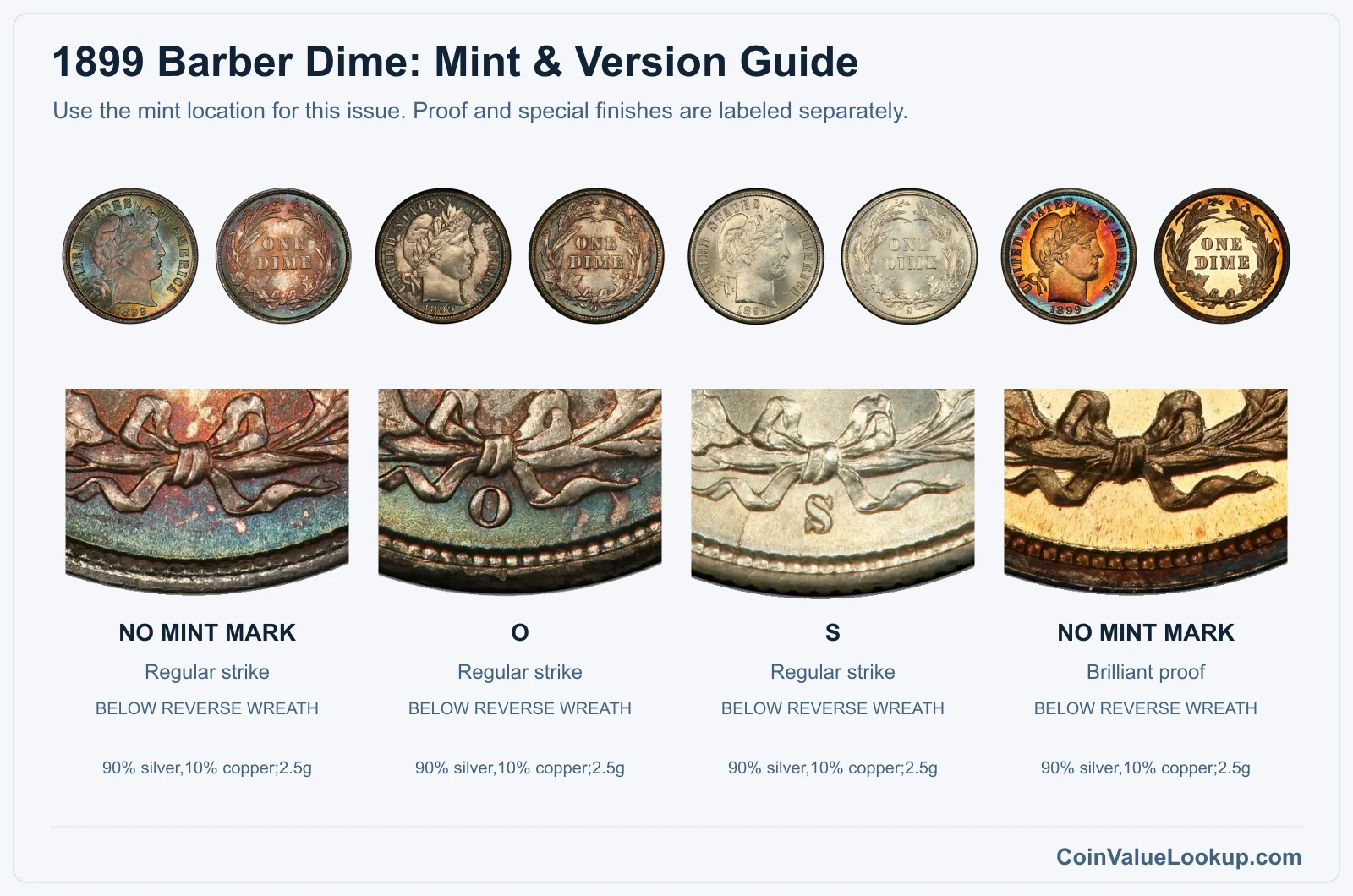
Three mints struck this date: Philadelphia, New Orleans, and San Francisco. To find the mintmark, flip the coin over and look just below the bow that ties the wreath together.
An "O" means New Orleans, an "S" means San Francisco, and no letter at all means Philadelphia.
All normal 1899 Barber Dimes are 90% silver and 10% copper, weigh about 2.5 grams, measure 17.9 mm across, and have a reeded edge. If yours feels too light or the edge is smooth, something is off.
Coin Value Lookup is a handy place to look up guides for Barber Dimes and other series when you want to compare your coin against published values.
Step 2: Check Your 1899 Barber Dime Grade
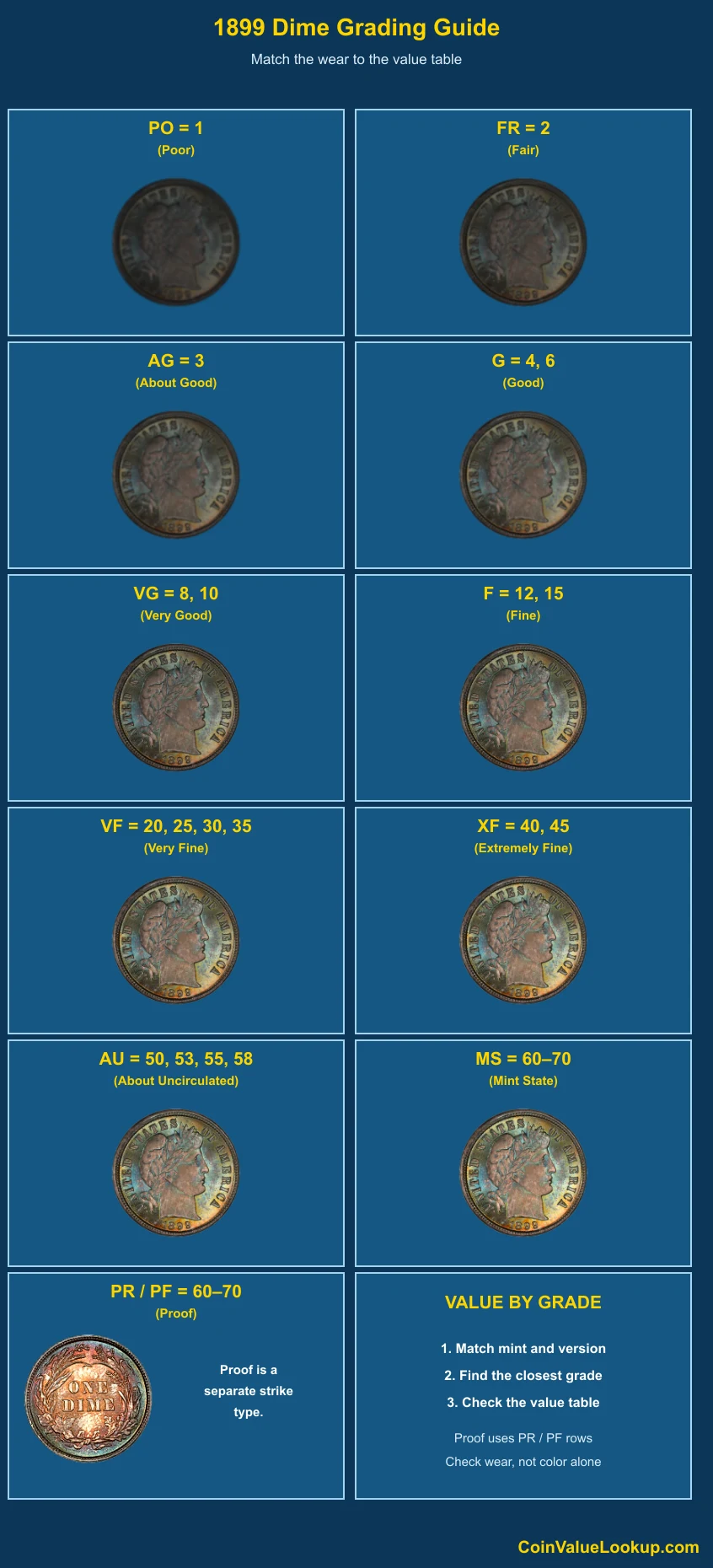
Grading a Barber Dime means reading the actual wear across the whole coin, not just counting letters in LIBERTY. Start with the headband on Liberty's forehead — on a well-worn coin those letters vanish first, but also check the hair detail above the ear, the smoothness of the cheek, and the crispness of the wreath leaves on the reverse.
New Orleans coins are often softly struck from the factory, so a mushy headband doesn't always mean heavy wear. Compare your coin's surfaces carefully against the reference image rather than assuming soft detail equals circulation damage.
For Mint State, you need unbroken luster across the fields and devices. Hairlines from cleaning, rim bumps, and dull spots all count against the grade.
A proof is a special manufacturing finish with mirrored fields — it's not simply a grade higher than Mint State.
Step 3: Check 1899 Barber Dime Value by Mint and Version
1899 Barber Dime — No Mint Mark — Silver Circulation
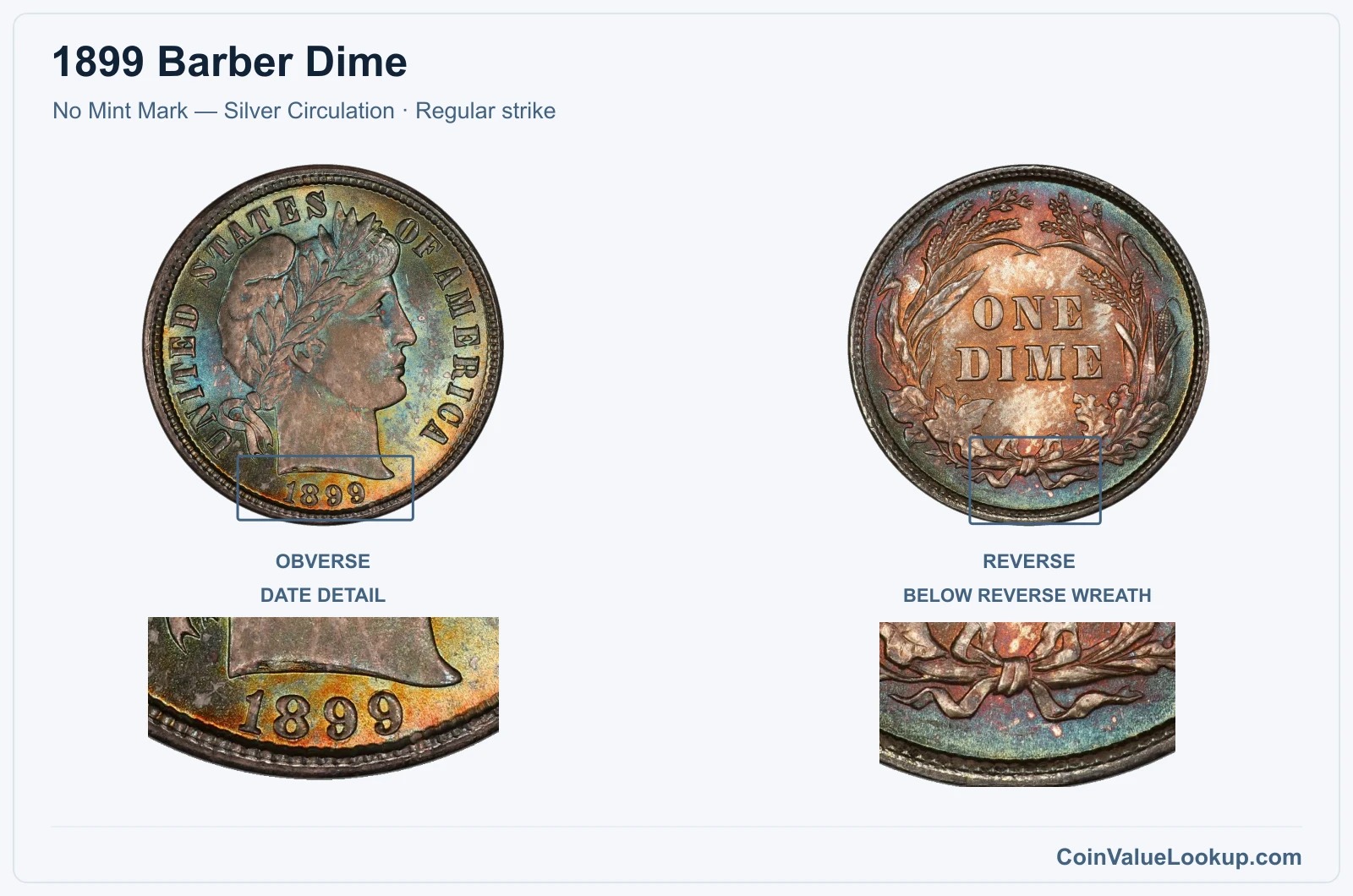
The Philadelphia Mint struck 1899 Barber Dimes without a mintmark. Look at the reverse below the wreath bow — if nothing is there, you have the P-mint coin.
These are 90% silver, 2.5 grams, with a reeded edge. Guide estimates place a well-worn G4 example around $12.26 and an uncirculated MS63 coin near $273.
Most surviving examples are heavily circulated, so anything with sharp headband detail and original luster will stand out. Full dates with readable legends are the baseline for collectibility.
Range Grade
Price Auction Records Appraisal PO PO 1
—
Coin Identifier FR FR 2
—
Coin Identifier AG AG 3
—
Coin Identifier G G 4
—
Coin Identifier
G 6
—
Coin Identifier VG VG 8
—
Coin Identifier
VG 10
—
Coin Identifier F F 12
—
Coin Identifier
F 15
—
Coin Identifier VF VF 20
—
Coin Identifier
VF 25
—
Coin Identifier
VF 30
—
Coin Identifier
VF 35
—
Coin Identifier XF XF 40
—
Coin Identifier
XF 45
—
Coin Identifier AU AU 50
Coin Identifier
AU 53
Coin Identifier
AU 55
Coin Identifier
AU 58
Coin Identifier MS MS 60
—
Coin Identifier
MS 61
Coin Identifier
MS 62
Coin Identifier
MS 63
Coin Identifier
MS 64
Coin Identifier
MS 65
Coin Identifier
MS 66
Coin Identifier
MS 67
Coin Identifier
MS 68
Coin Identifier
MS 69
—
—
—
MS 70
—
—
—
1899 Barber Dime — O — Silver Circulation
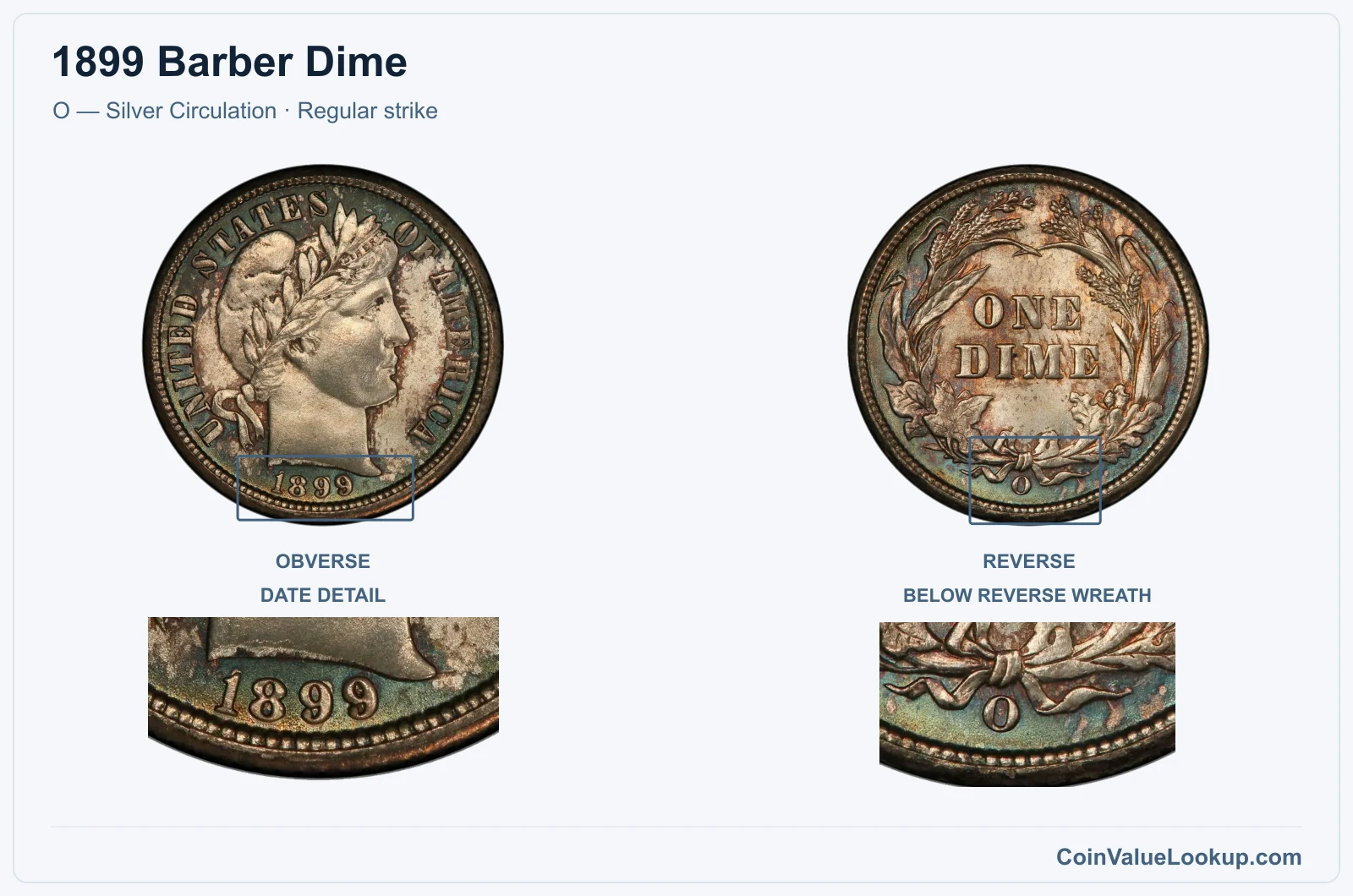
An "O" mintmark below the wreath bow on the reverse identifies the New Orleans Mint issue. This is the key business-strike version for 1899 in higher grades — guide estimates put a G4 around $19 while an MS63 jumps to roughly $1,131.
That price gap tells you something: plenty of these circulated hard, but finding one with full mint luster is a different story. Be aware that New Orleans coins are sometimes weakly struck, especially on the headband and hair detail above the ear.
A soft strike is not the same as wear, so compare the luster and surface quality carefully before assuming a lower grade. Standard specs apply: 90% silver, 10% copper, 2.5 grams, 17.9 mm diameter.
Range Grade
Price Auction Records Appraisal PO PO 1
—
Coin Identifier FR FR 2
—
Coin Identifier AG AG 3
—
Coin Identifier G G 4
—
Coin Identifier
G 6
—
Coin Identifier VG VG 8
—
Coin Identifier
VG 10
—
Coin Identifier F F 12
Coin Identifier
F 15
Coin Identifier VF VF 20
Coin Identifier
VF 25
Coin Identifier
VF 30
Coin Identifier
VF 35
Coin Identifier XF XF 40
Coin Identifier
XF 45
Coin Identifier AU AU 50
Coin Identifier
AU 53
Coin Identifier
AU 55
Coin Identifier
AU 58
—
Coin Identifier MS MS 60
Coin Identifier
MS 61
Coin Identifier
MS 62
Coin Identifier
MS 63
Coin Identifier
MS 64
Coin Identifier
MS 65
Coin Identifier
MS 66
Coin Identifier
MS 67
Coin Identifier
MS 68
—
—
—
MS 69
—
—
—
MS 70
—
—
—
1899 Barber Dime — S — Silver Circulation
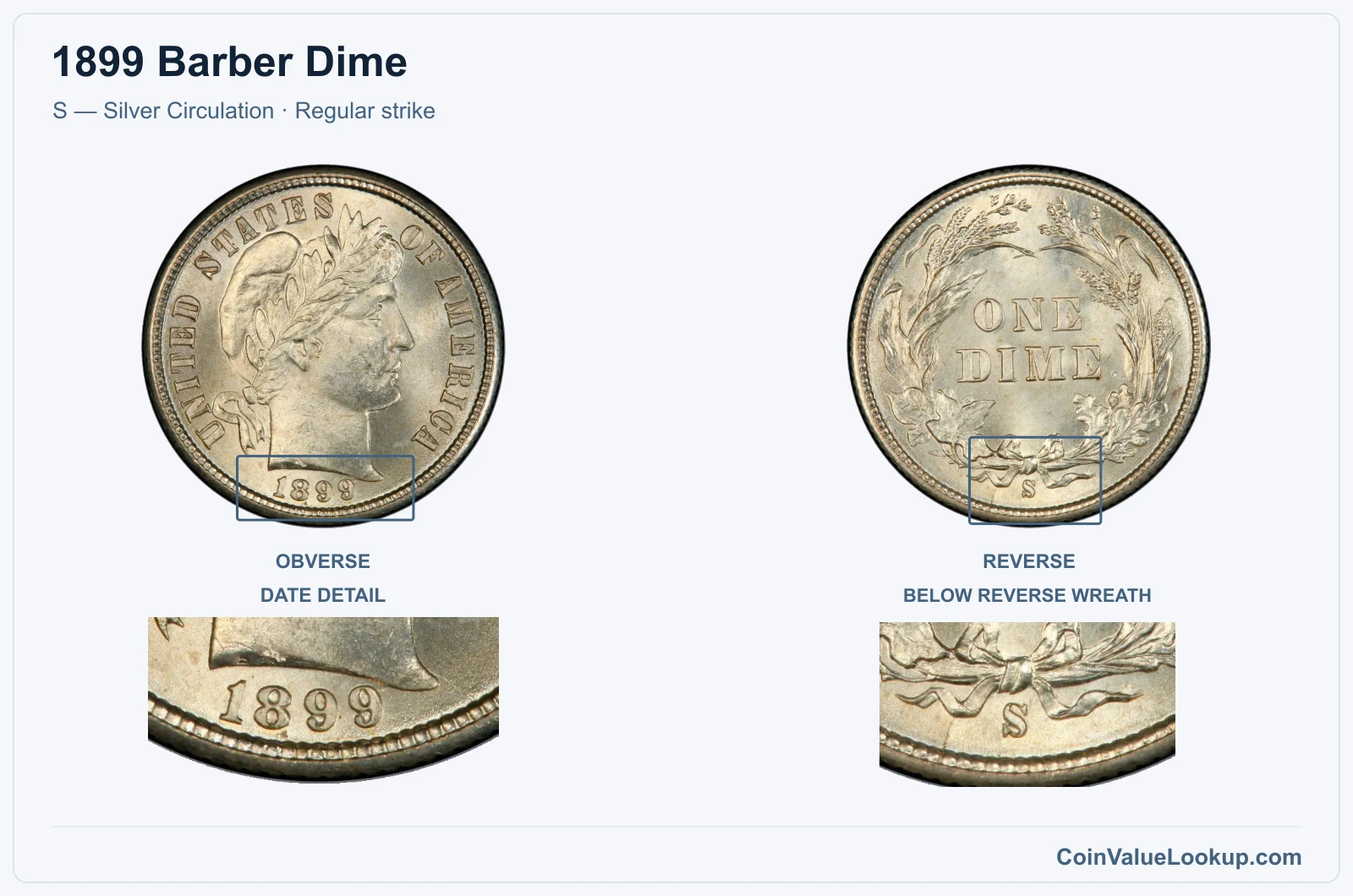
A small "S" below the reverse wreath bow marks the San Francisco issue. In well-worn G4 condition, guide estimates sit around $18, while an uncirculated MS60 example reaches approximately $394.
San Francisco Barber Dimes from this era don't survive in large numbers with original surfaces. As with any branch mint coin, verify the mintmark under magnification — old corrosion or damage near the bow can obscure it.
The coin is 90% silver, 2.5 grams, and 17.9 mm across with the standard reeded edge.
Range Grade
Price Auction Records Appraisal PO PO 1
—
Coin Identifier FR FR 2
—
Coin Identifier AG AG 3
—
Coin Identifier G G 4
—
Coin Identifier
G 6
—
Coin Identifier VG VG 8
—
Coin Identifier
VG 10
—
Coin Identifier F F 12
—
Coin Identifier
F 15
—
Coin Identifier VF VF 20
—
Coin Identifier
VF 25
—
Coin Identifier
VF 30
—
Coin Identifier
VF 35
Coin Identifier XF XF 40
Coin Identifier
XF 45
—
Coin Identifier AU AU 50
Coin Identifier
AU 53
Coin Identifier
AU 55
Coin Identifier
AU 58
Coin Identifier MS MS 60
Coin Identifier
MS 61
Coin Identifier
MS 62
Coin Identifier
MS 63
Coin Identifier
MS 64
Coin Identifier
MS 65
Coin Identifier
MS 66
Coin Identifier
MS 67
Coin Identifier
MS 68
—
—
—
MS 69
—
—
—
MS 70
—
—
—
1899 Barber Dime — No Mint Mark — Brilliant Silver Proof
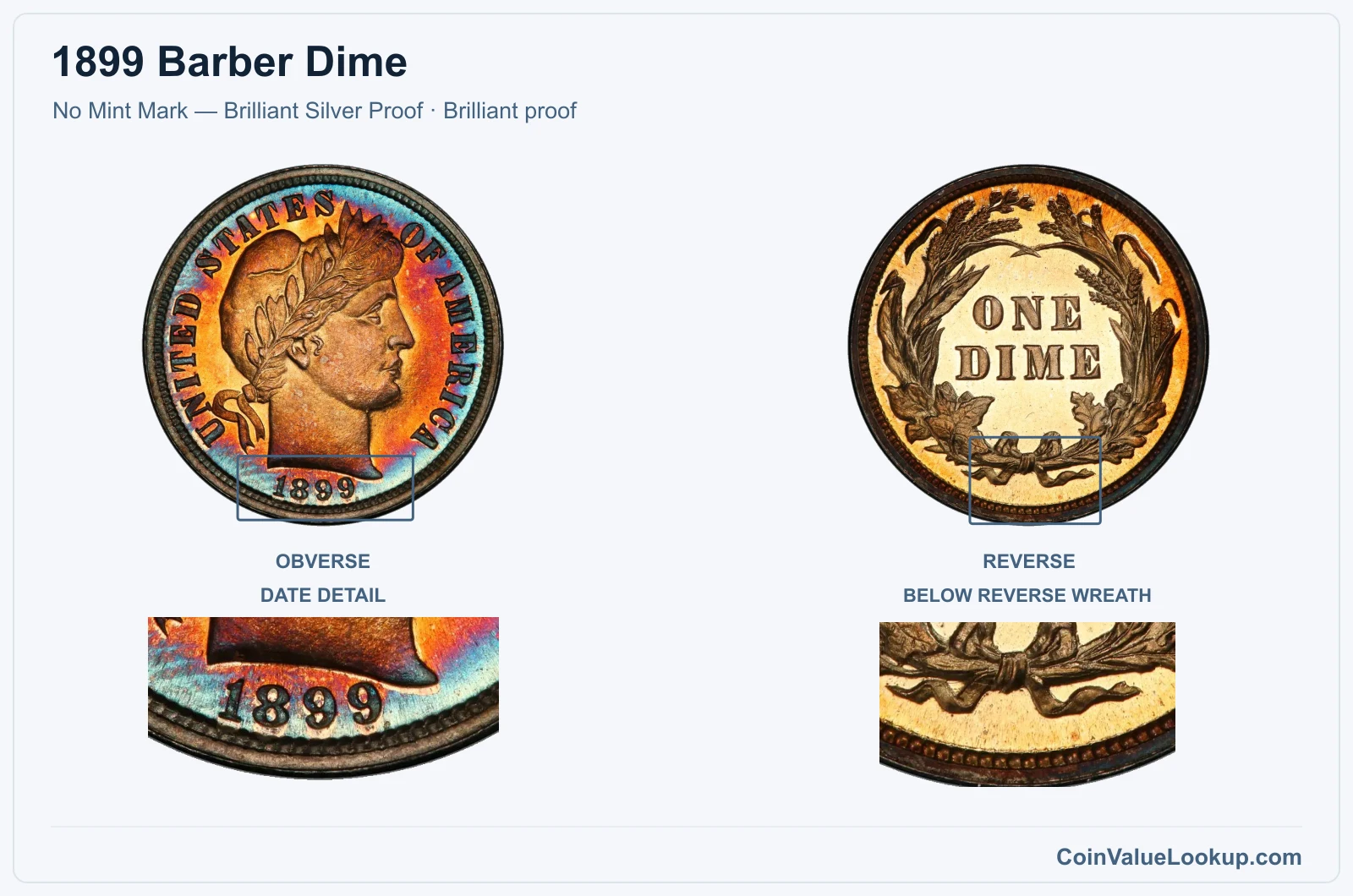
Philadelphia produced proof Barber Dimes for collectors, and the 1899 proof is part of a long run from 1892 through 1915. A proof coin has deeply mirrored fields and sharply defined rims — it looks distinctly different from even a pristine business strike.
Guide estimates place a PR63 example near $616. Some proofs show contrast between frosted devices and mirror fields (often called cameo), but don't assume your coin has that feature just because it looks bright.
Cameo and Deep Cameo designations carry different premiums and require third-party confirmation. Same silver composition as the business strikes: 90% silver, 10% copper, 2.5 grams with a reeded edge.
Range Grade
Price Auction Records Appraisal PR PR 1
—
Coin Identifier
PR 2
—
Coin Identifier
PR 3
—
Coin Identifier
PR 4
—
Coin Identifier
PR 6
—
Coin Identifier
PR 8
—
Coin Identifier
PR 10
—
Coin Identifier
PR 12
—
Coin Identifier
PR 15
—
Coin Identifier
PR 20
—
Coin Identifier
PR 25
—
Coin Identifier
PR 30
—
Coin Identifier
PR 35
—
Coin Identifier
PR 40
—
Coin Identifier
PR 45
—
Coin Identifier
PR 50
—
Coin Identifier
PR 53
—
Coin Identifier
PR 55
Coin Identifier
PR 58
—
Coin Identifier
PR 60
Coin Identifier
PR 61
Coin Identifier
PR 62
Coin Identifier
PR 63
Coin Identifier
PR 64
Coin Identifier
PR 65
Coin Identifier
PR 66
Coin Identifier
PR 67
Coin Identifier
PR 68
Coin Identifier
PR 69
—
—
—
PR 70
—
—
—
1899 Barber Dime Error List
1. 1899 Barber Dime — Misplaced Date
A recognized Misplaced Date variety has been reported on 1899-S Barber Dimes. The diagnostic involves fragments of stray digits visible among the denticles below the normal date position.
Under magnification, you may see the tops of numbers poking into the tooth-like border — they match published reference images for this specific variety.
This is distinct from random rim damage or machine doubling, which can produce superficially similar marks. Rim hits create irregular dents without the characteristic digit shapes, while machine doubling tends to produce flat, shelf-like doubling rather than misplaced impressions.
No reliable numerical price data is available for this variety in the supplied references. Value depends on the visibility of the displaced digits, overall condition of the coin, and collector demand.
If you have an 1899-S and notice something odd near the base of the date, it's worth a closer look under a loupe.