1908 Barber Dime Coin Value: How Much Is It Worth?
The 1908 Barber Dime was struck at four mints, giving collectors several branches to track down. Guide estimates for ordinary business strikes range from about $12.26 at G4 to $794 at MS63, depending on the mint.
Proofs and error varieties carry their own separate value considerations.
Fast Way to Identify Your 1908 Barber Dime
The quickest way to start figuring out what your 1908 Barber Dime is worth is to upload clear photos of the front and back. Our identifier can give you a preliminary read on mint, version, and overall condition.
Grab a well-lit shot of each side and let the tool do the first pass for you.
1908 Barber Dime Value
Upload both sides of your 1908 Barber Dime.
Front Obverse
Upload photo
Back Reverse
Upload photo
Which 1908 Barber Dime Versions Are Worth Money?
- The San Francisco (S) mint issue guides at $794 in MS63, the highest business-strike figure among the four mints for this date.
- The New Orleans (O) mint issue guides at $670 in MS63, reflecting scarcity in higher grades and often softer original strikes.
- Denver (D) examples guide at $316 in MS63, a noticeable step above Philadelphia for uncirculated survivors.
- Proof strikes from Philadelphia guide at $616 in PR63 and are a distinct manufacturing format, not simply a high grade.
- Error varieties such as repunched dates, off-center strikes, broadstrikes, and the 1908-D misplaced date can add value depending on visibility and condition.
Step 1: Identify Your 1908 Barber Dime Mint Mark and Version
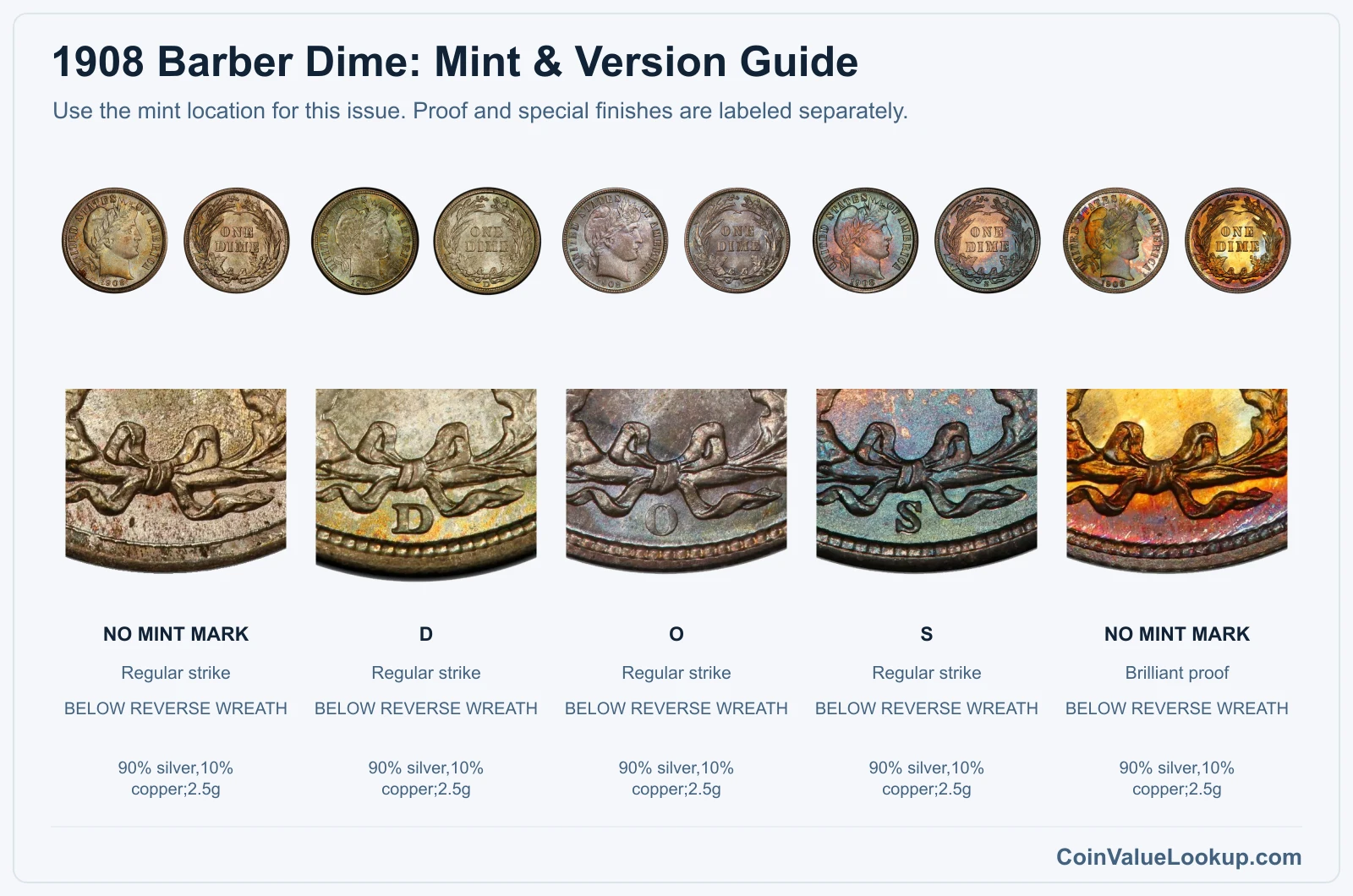
The obverse shows a right-facing Liberty head wearing a cap and headband inscribed LIBERTY. The reverse displays ONE DIME inside an open wreath tied with a bow at the bottom.
Do not confuse this with the later Mercury (Winged Liberty) design or the earlier Seated Liberty.
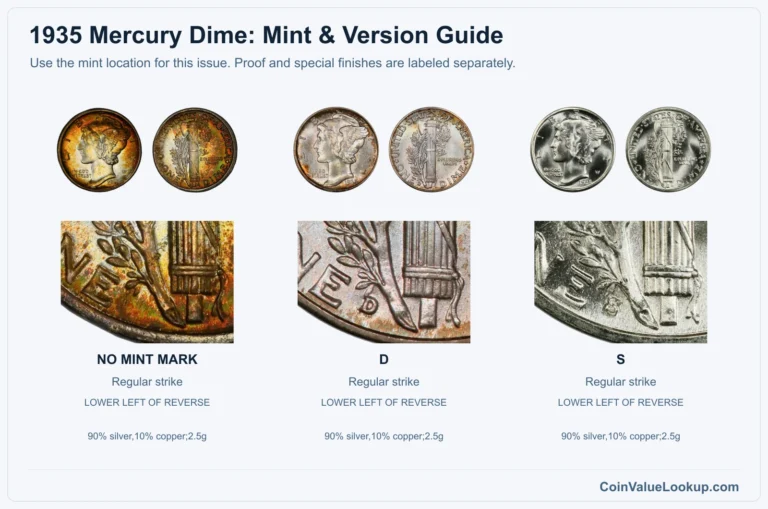
Four mints produced the 1908 Barber Dime: Philadelphia (no mintmark), Denver (D), New Orleans (O), and San Francisco (S). The mintmark sits just below the bow on the reverse wreath.
If you see no letter there, your coin is from Philadelphia.
All standard 1908 Barber Dimes are 90% silver and 10% copper, weigh 2.5 grams, measure 17.9 mm, and have a reeded edge. Anything far outside those specs could indicate an error or a counterfeit, so a basic check against these numbers is a good first step.
Step 2: Check Your 1908 Barber Dime Grade
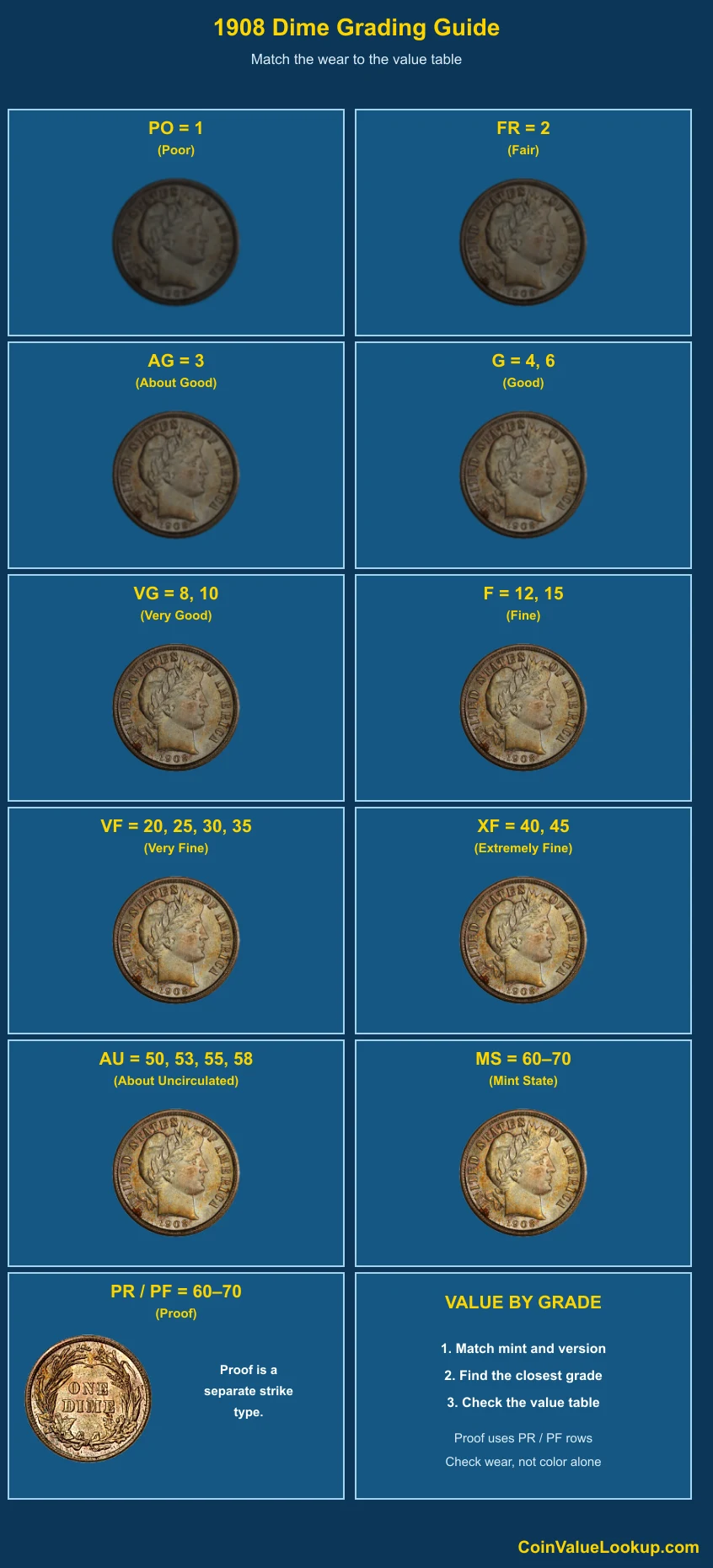
Grading a Barber Dime means looking at multiple areas together, not just counting letters in the headband. Start with the word LIBERTY on the headband: at lower grades the letters merge and disappear, starting from the center outward.
By Good (G4), the outline of the head is clear but most interior detail is gone.
Check the hair above the forehead and behind the ear, the cheek contour, and the wreath leaves on the reverse. Each area wears at a slightly different rate, so a coin with a sharp wreath but a flat cheek may have been unevenly struck rather than heavily worn.
New Orleans strikes in particular can look weaker than their actual grade because the dies were sometimes less sharply impressed. Don't downgrade an O-mint coin purely on softness without examining luster and contact marks.
Mint State requires unbroken original luster across both sides. Hold the coin under a single light source and tilt it slowly.
Any break in the cartwheel luster on high points means the coin has seen circulation. Also watch for hairlines from old cleaning, which can masquerade as luster but shows a different, uniform reflectivity.
Compare your coin to the reference image to calibrate your eye.
Step 3: Check 1908 Barber Dime Value by Mint and Version
1908 Barber Dime — No Mint Mark — Silver Circulation
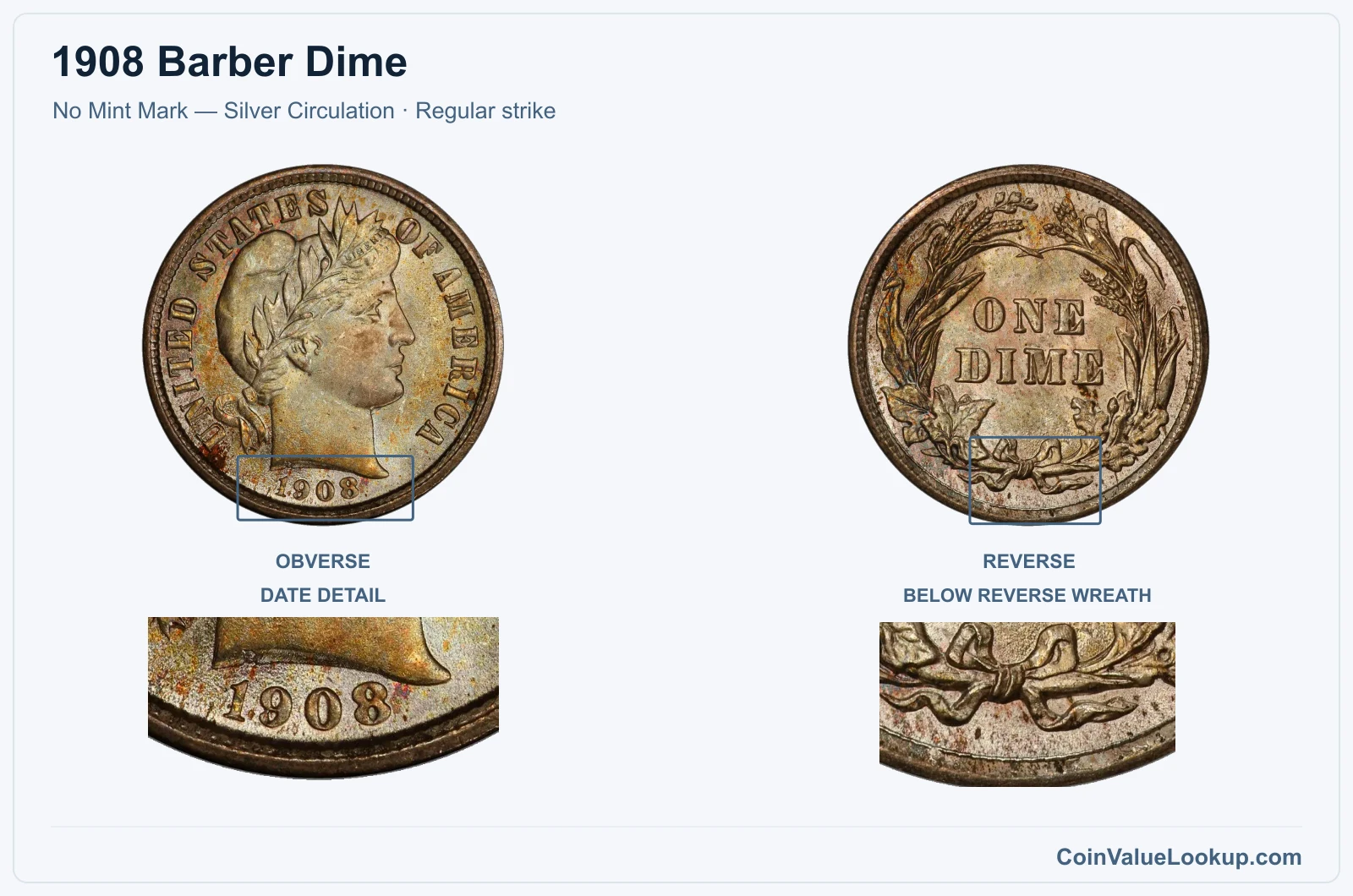
The Philadelphia issue carries no mintmark. Look below the reverse wreath bow and confirm the space is empty.
Guide estimates place this coin at about $12.26 in G4 and $253 in MS63, making it the most affordable mint for this date in uncirculated condition.
Philadelphia struck the largest share of 1908 dimes, so circulated examples turn up regularly. The premium really kicks in once you cross into Mint State, where original luster and clean surfaces matter.
Examine the obverse cheek and the reverse wreath tips for the first signs of wear.
Range Grade
Price Auction Records Appraisal PO PO 1
—
Coin Identifier FR FR 2
—
Coin Identifier AG AG 3
—
Coin Identifier G G 4
Coin Identifier
G 6
—
Coin Identifier VG VG 8
—
Coin Identifier
VG 10
—
Coin Identifier F F 12
—
Coin Identifier
F 15
—
Coin Identifier VF VF 20
—
Coin Identifier
VF 25
—
Coin Identifier
VF 30
—
Coin Identifier
VF 35
—
Coin Identifier XF XF 40
Coin Identifier
XF 45
—
Coin Identifier AU AU 50
Coin Identifier
AU 53
Coin Identifier
AU 55
Coin Identifier
AU 58
Coin Identifier MS MS 60
—
Coin Identifier
MS 61
Coin Identifier
MS 62
Coin Identifier
MS 63
Coin Identifier
MS 64
Coin Identifier
MS 65
Coin Identifier
MS 66
Coin Identifier
MS 67
Coin Identifier
MS 68
—
—
—
MS 69
—
—
—
MS 70
—
—
—
1908 Barber Dime — D — Silver Circulation
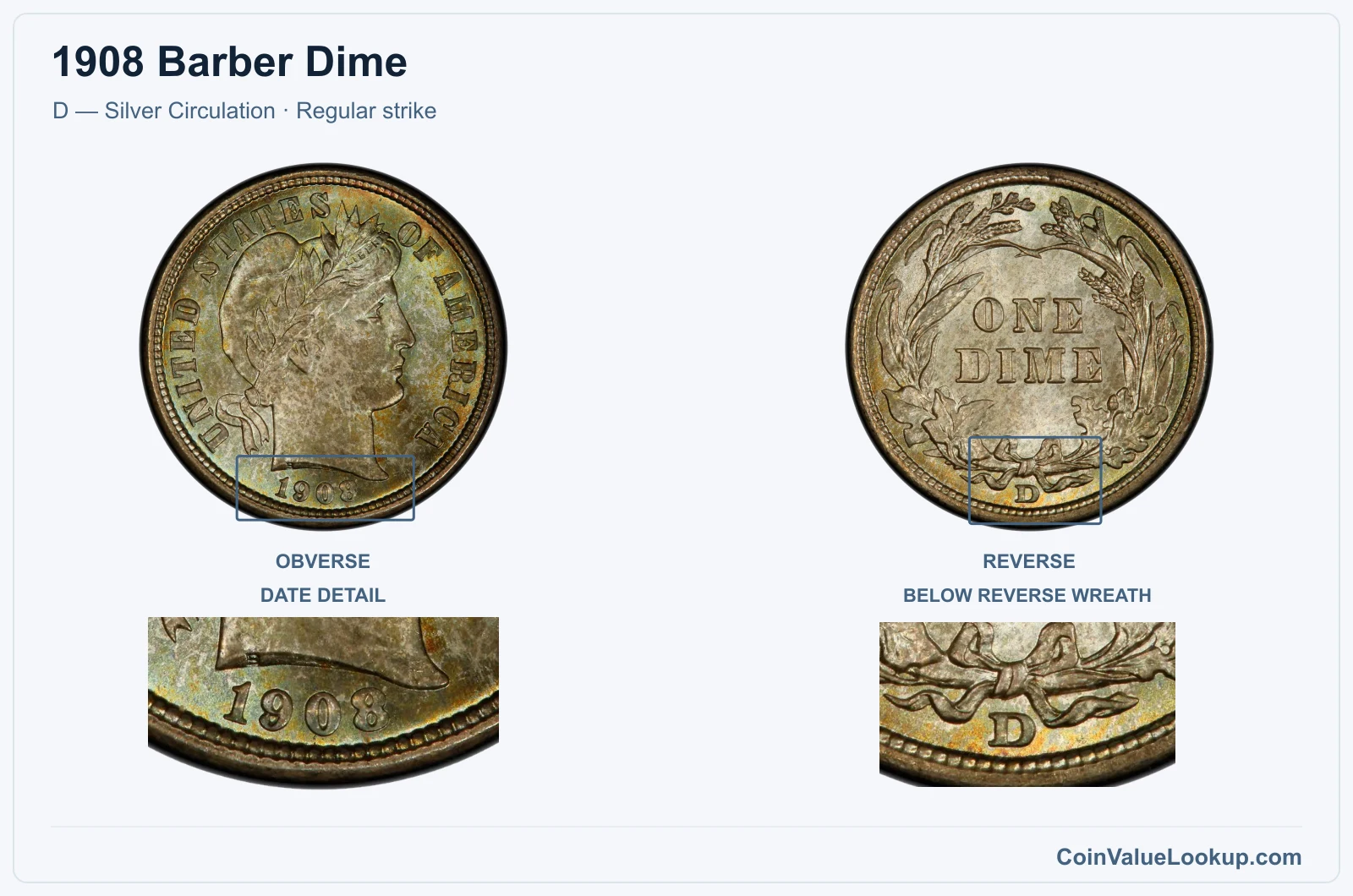
The Denver mint placed a small D below the wreath bow on the reverse. Confirm it is a D and not a damaged O or S, because wear and corrosion can blur mintmark shapes on well-circulated pieces.
Guide values run about $12.26 at G4 and $316 at MS63. That MS63 figure is higher than Philadelphia's, reflecting fewer surviving uncirculated examples from Denver.
When evaluating surface quality, check for bag marks on Liberty's cheek and across the open fields, which are the first places contact shows.
Range Grade
Price Auction Records Appraisal PO PO 1
—
Coin Identifier FR FR 2
—
Coin Identifier AG AG 3
—
Coin Identifier G G 4
—
Coin Identifier
G 6
—
Coin Identifier VG VG 8
—
Coin Identifier
VG 10
—
Coin Identifier F F 12
—
Coin Identifier
F 15
—
Coin Identifier VF VF 20
—
Coin Identifier
VF 25
—
Coin Identifier
VF 30
Coin Identifier
VF 35
—
Coin Identifier XF XF 40
Coin Identifier
XF 45
Coin Identifier AU AU 50
—
Coin Identifier
AU 53
Coin Identifier
AU 55
Coin Identifier
AU 58
Coin Identifier MS MS 60
—
Coin Identifier
MS 61
Coin Identifier
MS 62
Coin Identifier
MS 63
Coin Identifier
MS 64
Coin Identifier
MS 65
Coin Identifier
MS 66
Coin Identifier
MS 67
Coin Identifier
MS 68
—
—
—
MS 69
—
—
—
MS 70
—
—
—
1908 Barber Dime — O — Silver Circulation
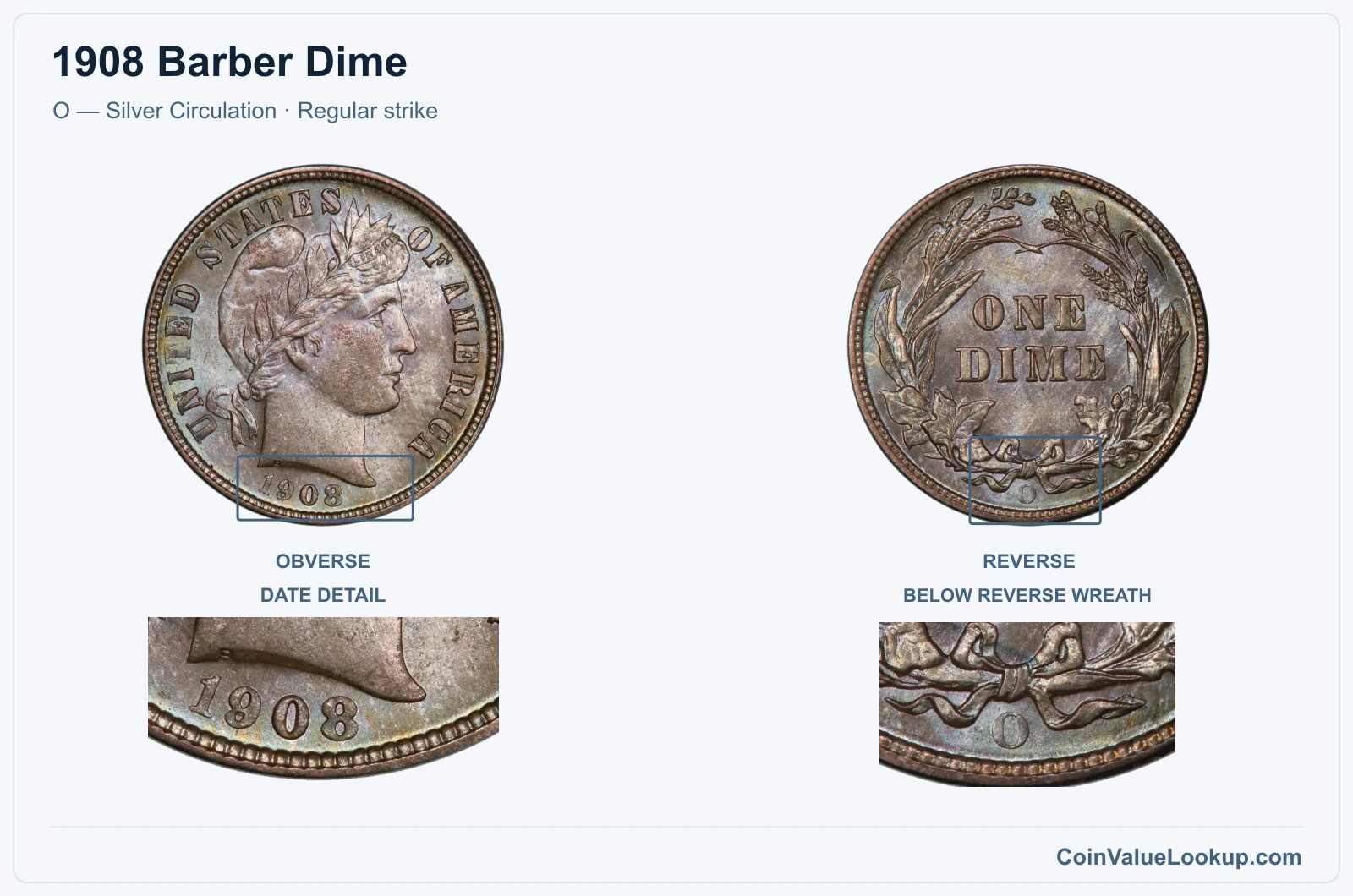
New Orleans coins carry an O mintmark below the wreath bow. This is the last year New Orleans struck Barber Dimes, which adds historical interest for series collectors.
Guide estimates are about $12.26 at G4 and $670 at MS63.
The jump to $670 in MS63 tells the story: most O-mint survivors are well circulated, and finding one with full original luster is genuinely difficult. New Orleans strikes can also appear softer than other mints, so do not mistake a weak strike for heavy wear.
Compare overall luster and contact marks before concluding the coin is lower grade.
Coin Value Lookup is a useful starting point if you want to compare this O-mint dime against other dates and mints in the Barber series.
Range Grade
Price Auction Records Appraisal PO PO 1
—
Coin Identifier FR FR 2
—
Coin Identifier AG AG 3
—
Coin Identifier G G 4
—
Coin Identifier
G 6
—
Coin Identifier VG VG 8
—
Coin Identifier
VG 10
—
Coin Identifier F F 12
—
Coin Identifier
F 15
—
Coin Identifier VF VF 20
—
Coin Identifier
VF 25
Coin Identifier
VF 30
Coin Identifier
VF 35
—
Coin Identifier XF XF 40
Coin Identifier
XF 45
Coin Identifier AU AU 50
Coin Identifier
AU 53
Coin Identifier
AU 55
Coin Identifier
AU 58
Coin Identifier MS MS 60
—
Coin Identifier
MS 61
Coin Identifier
MS 62
Coin Identifier
MS 63
Coin Identifier
MS 64
Coin Identifier
MS 65
Coin Identifier
MS 66
Coin Identifier
MS 67
Coin Identifier
MS 68
—
—
—
MS 69
—
—
—
MS 70
—
—
—
1908 Barber Dime — S — Silver Circulation
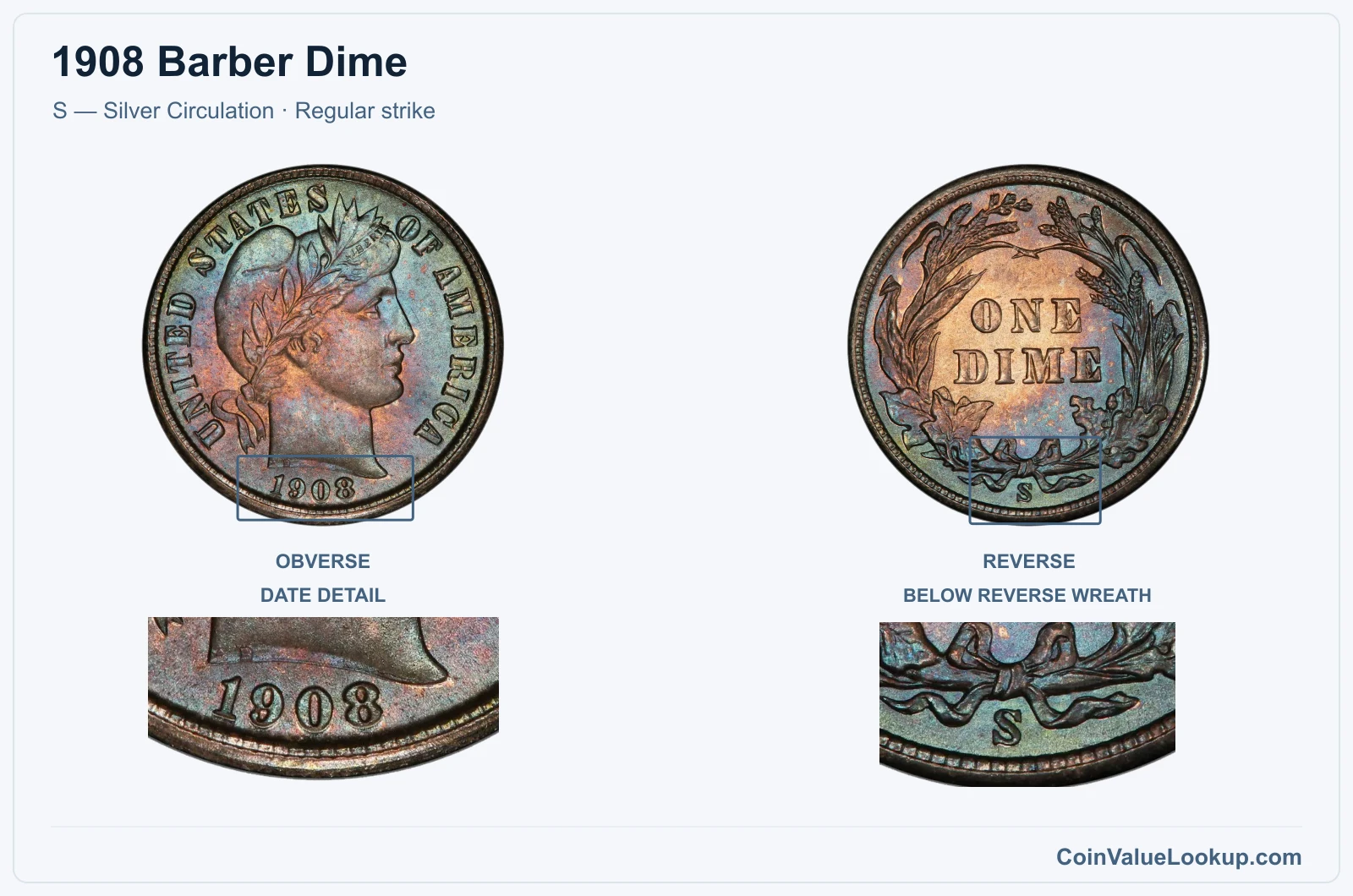
San Francisco placed an S below the reverse wreath bow. At G4 the guide value matches the other mints at $12.26, but at MS63 it leads all four business-strike issues at $794.
That spread between circulated and uncirculated prices signals real scarcity in higher grades.
When examining an S-mint piece, pay close attention to the mintmark clarity. A weak or filled S can sometimes look like a blob, especially on lower-grade coins.
Full Mint State examples should show sharp reeding, unbroken luster, and minimal contact marks on Liberty's cheek and the wreath.
Range Grade
Price Auction Records Appraisal PO PO 1
—
Coin Identifier FR FR 2
—
Coin Identifier AG AG 3
—
Coin Identifier G G 4
—
Coin Identifier
G 6
—
Coin Identifier VG VG 8
—
Coin Identifier
VG 10
—
Coin Identifier F F 12
—
Coin Identifier
F 15
—
Coin Identifier VF VF 20
—
Coin Identifier
VF 25
—
Coin Identifier
VF 30
Coin Identifier
VF 35
Coin Identifier XF XF 40
Coin Identifier
XF 45
Coin Identifier AU AU 50
Coin Identifier
AU 53
Coin Identifier
AU 55
Coin Identifier
AU 58
Coin Identifier MS MS 60
—
Coin Identifier
MS 61
Coin Identifier
MS 62
Coin Identifier
MS 63
Coin Identifier
MS 64
Coin Identifier
MS 65
Coin Identifier
MS 66
Coin Identifier
MS 67
Coin Identifier
MS 68
—
—
—
MS 69
—
—
—
MS 70
—
—
—
1908 Barber Dime — No Mint Mark — Brilliant Silver Proof
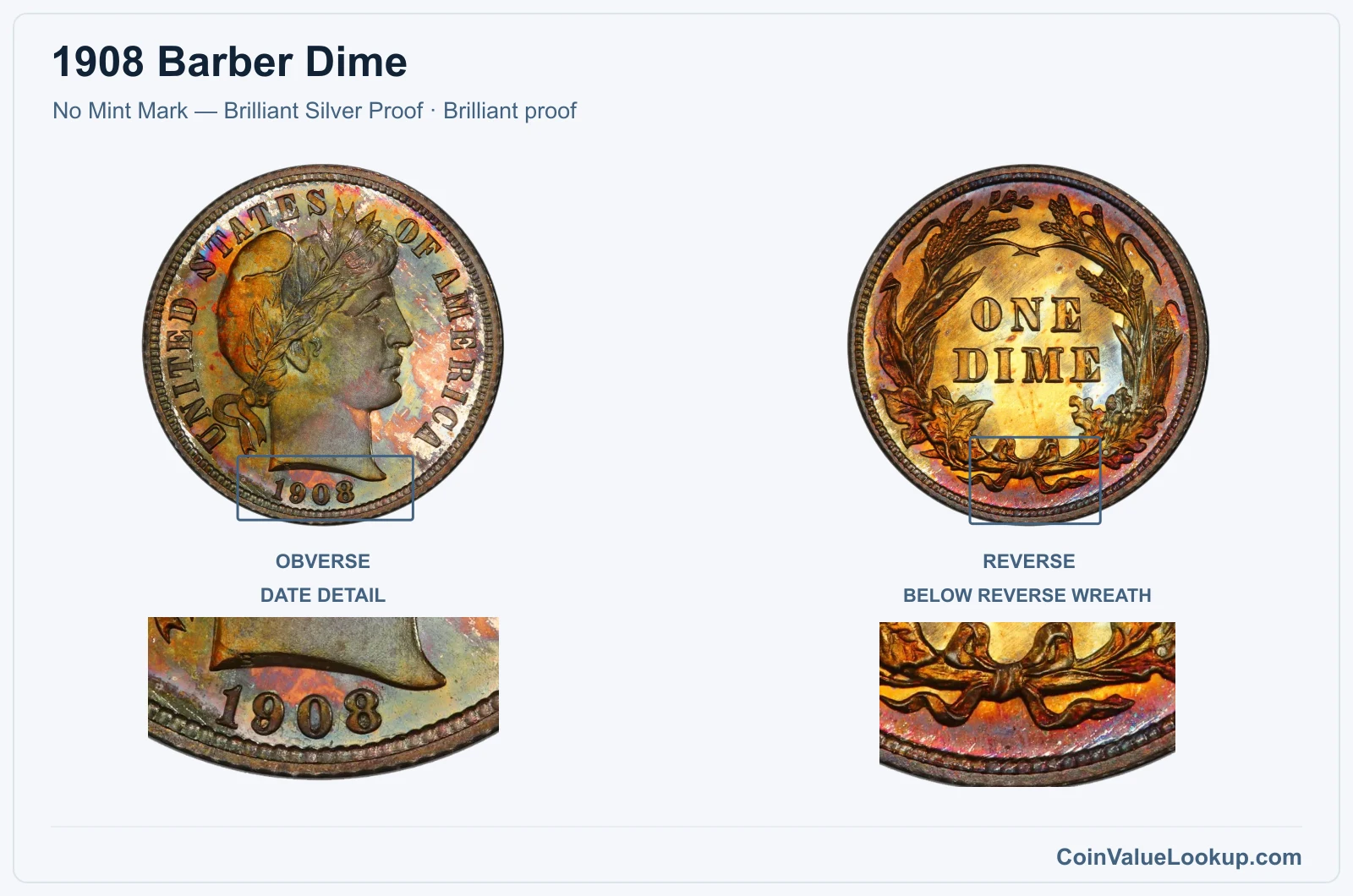
Philadelphia produced Brilliant Proofs of the Barber Dime for collectors. These were struck with polished dies on polished planchets, producing mirror-like fields and sharp design details.
A proof is a method of manufacture, not a grade above Mint State, so a poorly handled proof can still show contact marks or hairlines.
The guide estimate for PR63 is about $616. Cameo and Deep Cameo designations describe the degree of contrast between frosted devices and mirrored fields.
Do not assume an ordinary PR63 price applies to a contrast-designated coin, as those carry separate valuations. When examining a suspected proof, look for squared, razor-sharp rims and deeply reflective flat surfaces that differ from the cartwheel luster of a business strike.
Range Grade
Price Auction Records Appraisal PR PR 1
—
Coin Identifier
PR 2
—
Coin Identifier
PR 3
—
Coin Identifier
PR 4
—
Coin Identifier
PR 6
—
Coin Identifier
PR 8
—
Coin Identifier
PR 10
—
Coin Identifier
PR 12
—
Coin Identifier
PR 15
—
Coin Identifier
PR 20
—
Coin Identifier
PR 25
—
Coin Identifier
PR 30
—
Coin Identifier
PR 35
—
Coin Identifier
PR 40
—
Coin Identifier
PR 45
—
Coin Identifier
PR 50
—
Coin Identifier
PR 53
—
Coin Identifier
PR 55
—
Coin Identifier
PR 58
—
Coin Identifier
PR 60
Coin Identifier
PR 61
Coin Identifier
PR 62
Coin Identifier
PR 63
Coin Identifier
PR 64
Coin Identifier
PR 65
Coin Identifier
PR 66
Coin Identifier
PR 67
Coin Identifier
PR 68
Coin Identifier
PR 69
—
—
—
PR 70
—
—
—
1908 Barber Dime Error List
1. 1908 Barber Dime — Repunched Date
A repunched date on a 1908 Barber Dime shows remnants of an earlier date-punch position alongside the final numerals. You may see shadow digits, thickened serifs, or offset outlines on one or more of the four date numerals.
This is distinct from doubled die errors, which affect the entire design, not just the date.
To spot this, use magnification and angled light on the date area. Compare each numeral against a normal 1908 date.
The most common lookalikes are machine doubling, which produces flat, shelf-like doubling without depth, and simple post-mint damage that dents or displaces individual digits. Condition, the clarity of the repunching, and the specific variant all affect the coin's value, so individual assessment matters here.
2. 1908 Barber Dime — Off-Center Strike
An off-center strike occurs when the planchet is not properly centered between the dies at the moment of striking. The result is a design shifted to one side with a blank, unstruck crescent on the opposite side.
The coin retains its full diameter but the image is displaced.
The value depends heavily on how far off center the strike landed and whether the date remains fully visible. A 5% shift is mildly interesting.
A 10–20% shift with a complete date is more desirable. Do not confuse an off-center strike with a clipped planchet, which removes metal from the edge, or with post-mint damage where a coin was squeezed or flattened unevenly after leaving the mint.
Condition and the degree of displacement both affect what such a piece is worth.
3. 1908 Barber Dime — Broadstrike
A broadstrike happens when the collar die, which normally confines the planchet and forms the reeded edge, fails to engage during striking. The metal spreads outward beyond the normal 17.9 mm diameter, and the edge typically appears smooth or irregular rather than reeded.
Look for a coin that has a complete or nearly complete design but is visibly wider than normal, with the design elements slightly spread apart. The edge profile is the key diagnostic: a genuine broadstrike lacks the crisp reeding of a normally struck Barber Dime.
Do not confuse this with an off-center strike, where the design is shifted and partially missing, or with a coin flattened by external force after minting. Value depends on condition and how dramatic the spread is.
4. 1908 Barber Dime — Misplaced Date
The misplaced date variety has been reported specifically on 1908-D Barber Dimes. Look for stray remnants of one or more date digits appearing in the denticles or lower field area where they do not belong.
These fragments were left by an errant impression of the date punch before the final, correctly positioned date was applied.
This is different from a repunched date, where the displacement is within the date area itself. With a misplaced date, the extra digit traces show up outside the normal date location entirely.
The main lookalikes are die scratches, damage marks, or machine doubling, none of which produce recognizable numeral fragments in the denticles. Individual value depends on how visible the misplaced fragments are and the coin's overall condition.