1827 Capped Bust Dime Coin Value: How Much Is It Worth?
The 1827 Capped Bust Dime is an early American silver dime struck at the Philadelphia Mint, nearly two centuries old and still actively collected. A guide estimate places a well-worn example around $287.00 in Good-4 condition, though your coin's actual value depends on its specific variety, surface condition and grade.
Original surfaces, the exact date variety and any mint-made anomalies all factor into what a particular piece is worth — these anchors are guide estimates, not guaranteed offers.
Fast Way to Identify Your 1827 Capped Bust Dime
Snap clear photos of the front and back of your 1827 dime and upload them to our identifier for a preliminary look at what you have. This step helps sort out the basic version and approximate condition before you dig deeper.
It is not a substitute for professional authentication or exact grading, but it gives you a solid starting point.
1827 Capped Bust Dime Value
Upload both sides of your 1827 Capped Bust Dime.
Front Obverse
Upload photo
Back Reverse
Upload photo
Which 1827 Capped Bust Dime Versions Are Worth Money?
- The 1827 business strike in Good-4 carries a guide estimate around $287.00; higher grades command more, and original surfaces matter.
- The 1827 PR (proof) is extremely scarce early proof coinage; no standard guide price is adopted, so individual assessment by an authenticated specimen is essential.
- An 1827/7 overdate variety has been reported and can add significant collector interest depending on visibility and condition.
- Die cracks have been documented on some 1827 dies; prominent examples on otherwise attractive coins draw specialist attention.
- Always confirm the exact variety and condition before comparing to any published value — cleaning, scratches and corrosion reduce what a coin is worth relative to guide figures.
Step 1: Identify Your 1827 Capped Bust Dime Mint Mark and Version
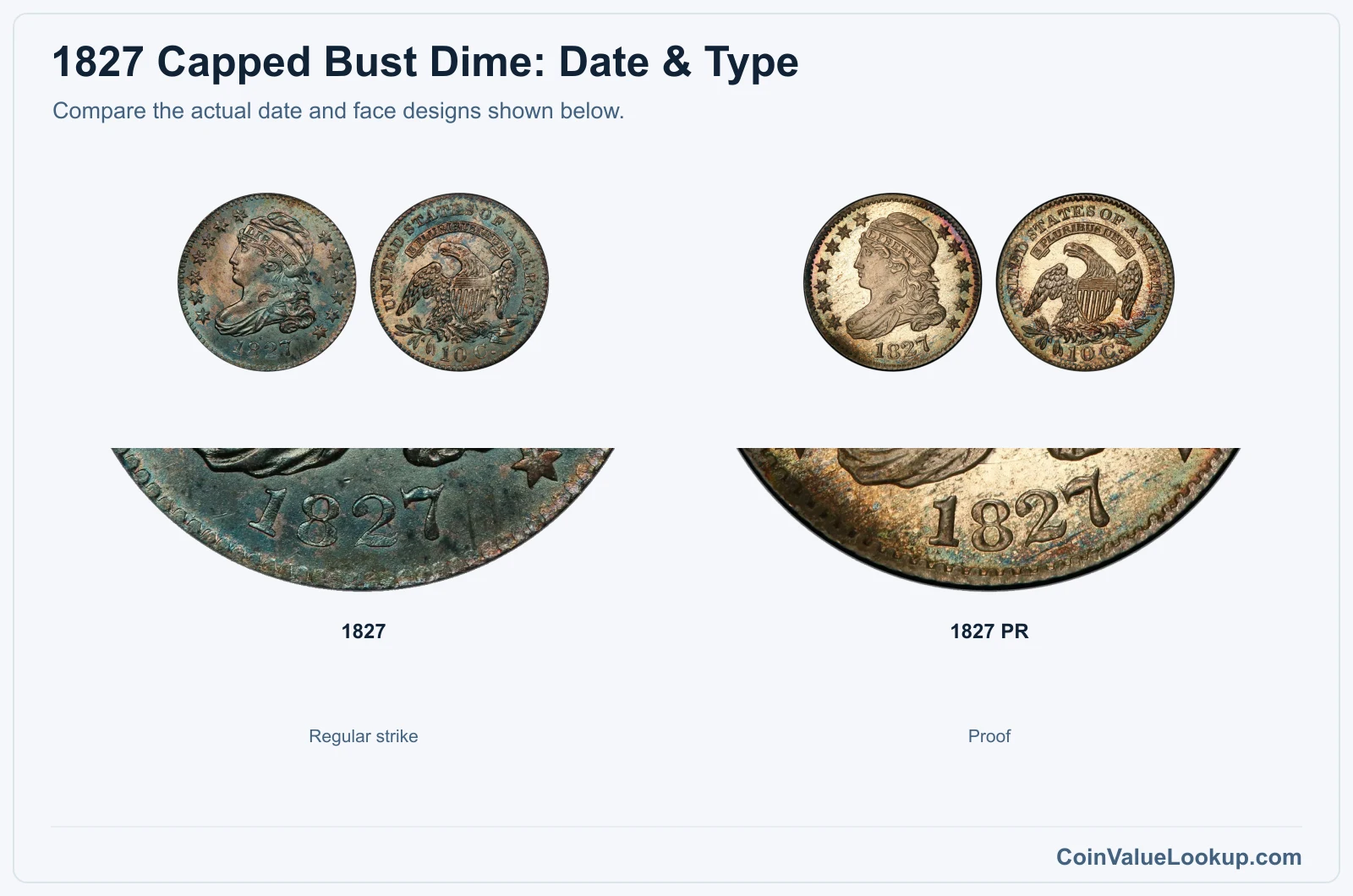
Every 1827 Capped Bust Dime was struck at the Philadelphia Mint, so there is no mintmark to hunt for. The denomination reads 10 C.
on the reverse — do not confuse this coin with the smaller Capped Bust half dime, which is an entirely different series.
The design features a left-facing Liberty wearing a cloth cap, surrounded by large dentils on a wider planchet than later dimes. The reverse shows a heraldic eagle with a shield on its breast.
The coin is struck in a silver-copper alloy containing approximately 89.24% silver.
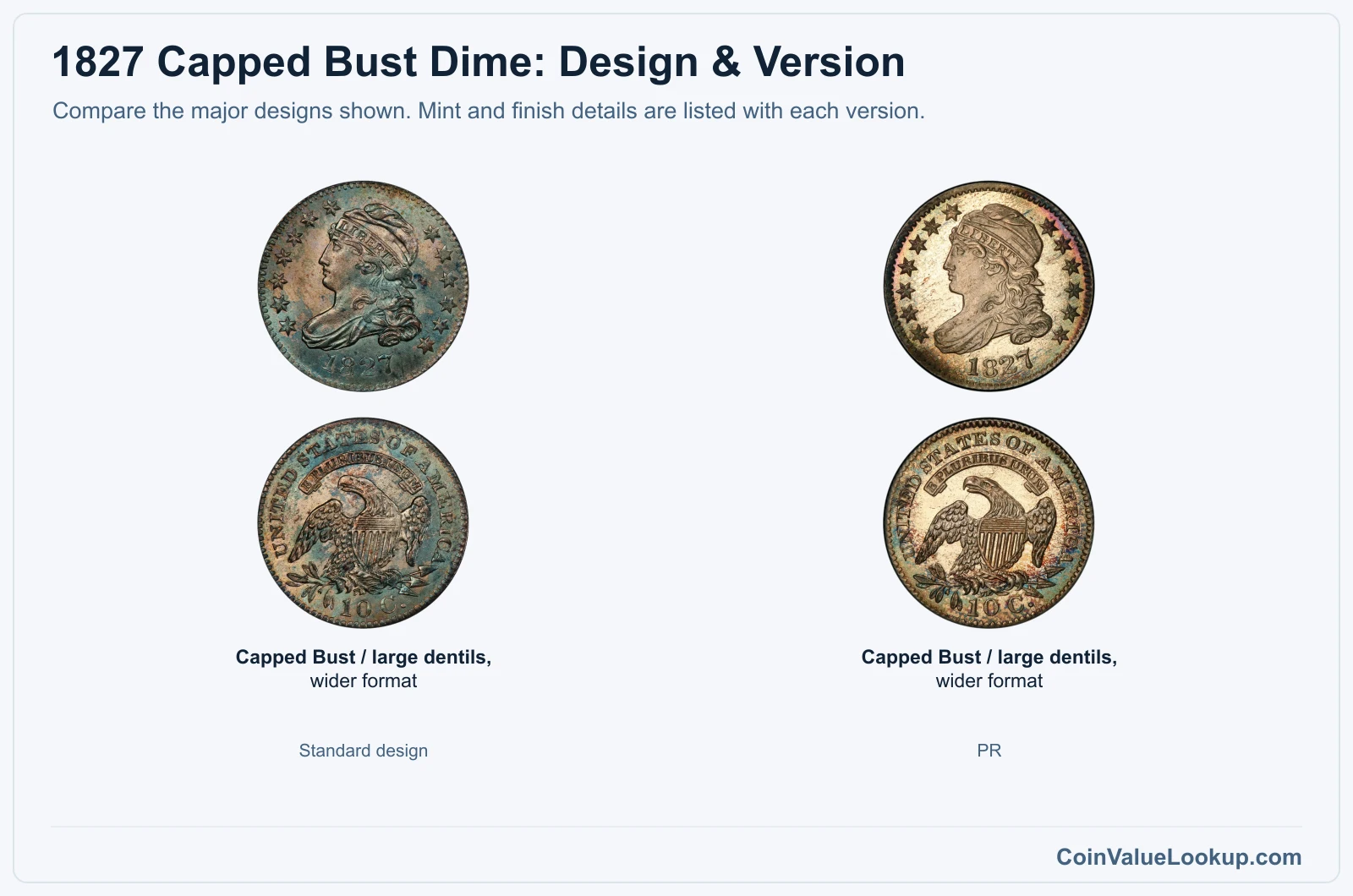
Two branches matter for this date. The standard 1827 business strike is the one most collectors encounter.
A proof version (1827 PR) also exists but is extremely scarce and requires professional attribution. Simply looking shiny or well-struck does not make a coin a proof — that distinction comes from how the Mint prepared the dies and planchet, not from how the coin looks after the fact.
Step 2: Check Your 1827 Capped Bust Dime Grade
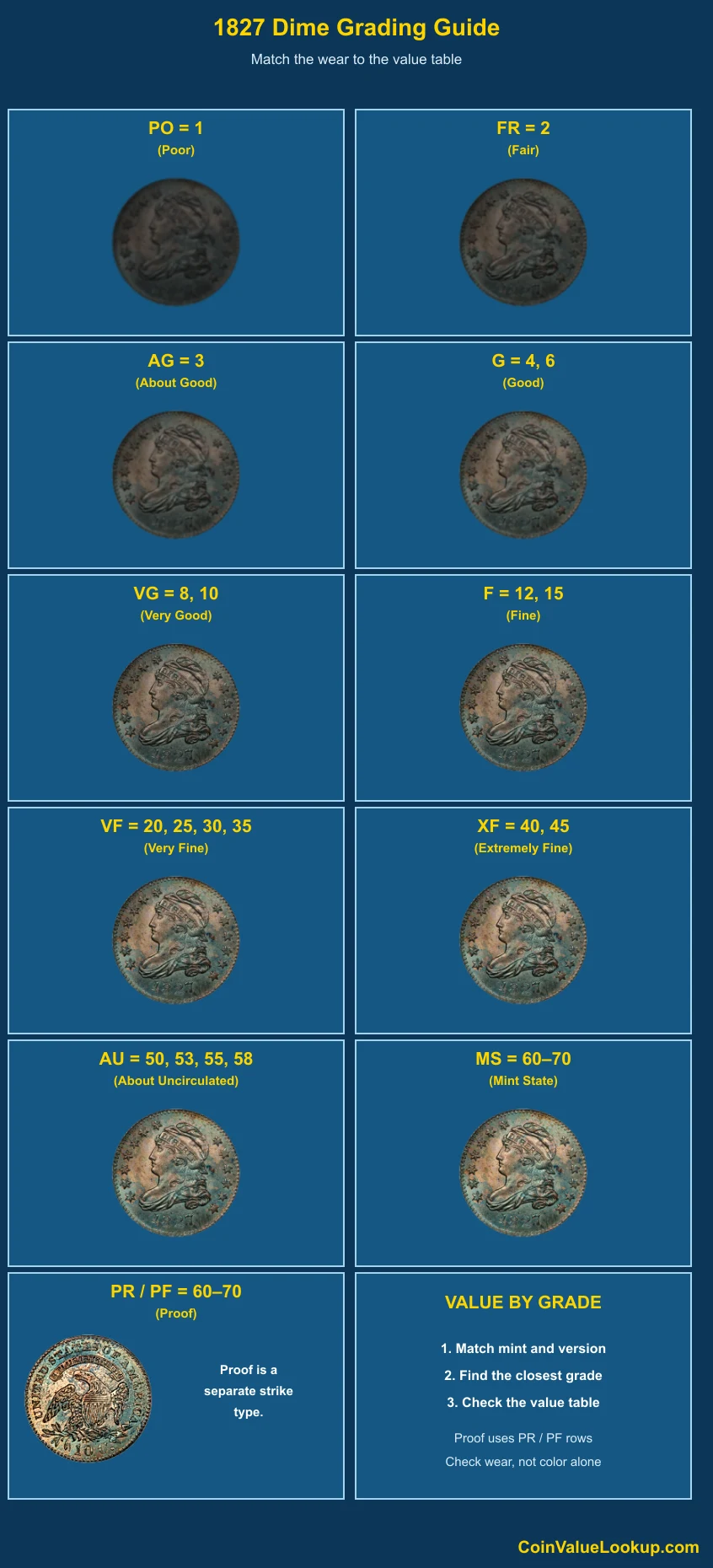
Start with Liberty's hair above and behind the ear, the cheek, and the clasp of the drapery near the shoulder. These are the first areas to show friction on a Capped Bust Dime.
On the reverse, check the eagle's breast feathers and the tops of the wings.
Compare your coin side-by-side with the reference image for this type. Early 1800s coins were made on hand-operated presses, so even a fully uncirculated piece can show uneven strike strength or soft spots that look like wear but are not.
Luster is your friend here. A coin with original mint luster across protected areas is less worn than one that merely has sharp details but a flat, dull surface.
Contact marks — tiny nicks from other coins jostling in bags — are normal and separate from actual circulation wear.
Do not clean or polish the coin. A dark, original-surface dime is almost always worth more than one that has been scrubbed bright.
Step 3: Check 1827 Capped Bust Dime Value by Mint and Version
1827 Capped Bust Dime
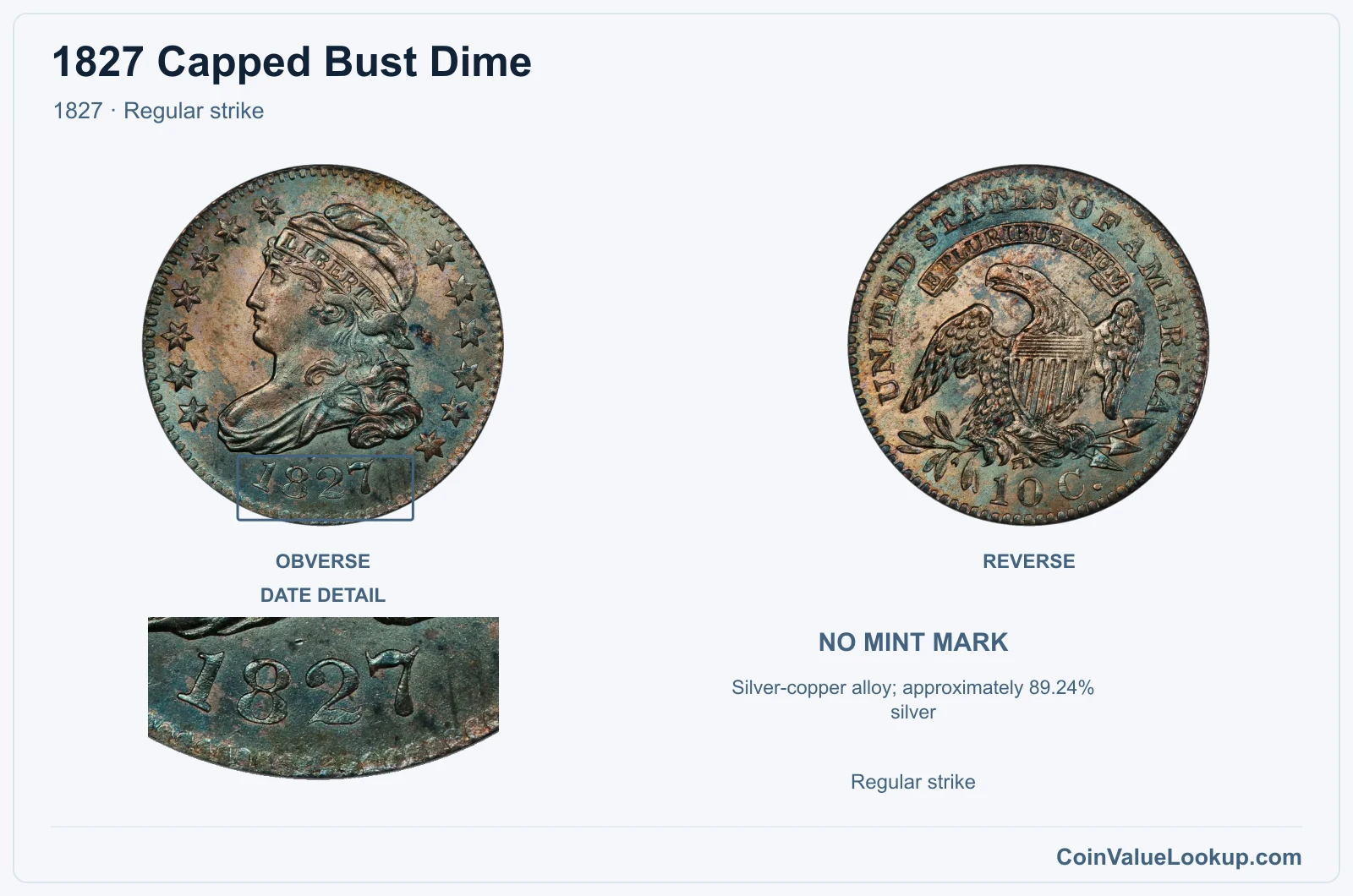
The standard 1827 Capped Bust Dime is a Philadelphia business strike on a silver-copper planchet of about 89.24% silver. In Good-4 condition — meaning the major design is outlined but most detail is worn smooth — a guide estimate from USA Coin Book places this coin at roughly $287.00.
That figure climbs as the grade improves.
Confirm the date, the large-dentil Capped Bust design and the absence of any mintmark before using that anchor. Brightness alone does not equal a higher grade; original toned surfaces with underlying luster typically indicate a better-preserved coin than one that has been cleaned to look new.
Scratches, corrosion and tooling all pull a coin below the guide figure for its apparent grade.
Range Grade
Price Auction Records Appraisal PO PO 1
Coin Identifier FR FR 2
—
Coin Identifier AG AG 3
Coin Identifier G G 4
Coin Identifier
G 6
Coin Identifier VG VG 8
Coin Identifier
VG 10
Coin Identifier F F 12
Coin Identifier
F 15
Coin Identifier VF VF 20
Coin Identifier
VF 25
Coin Identifier
VF 30
Coin Identifier
VF 35
Coin Identifier XF XF 40
Coin Identifier
XF 45
Coin Identifier AU AU 50
Coin Identifier
AU 53
Coin Identifier
AU 55
Coin Identifier
AU 58
Coin Identifier MS MS 60
—
Coin Identifier
MS 61
Coin Identifier
MS 62
Coin Identifier
MS 63
Coin Identifier
MS 64
Coin Identifier
MS 65
Coin Identifier
MS 66
Coin Identifier
MS 67
Coin Identifier
MS 68
—
—
—
MS 69
—
—
—
MS 70
—
—
—
1827 Capped Bust Dime — PR
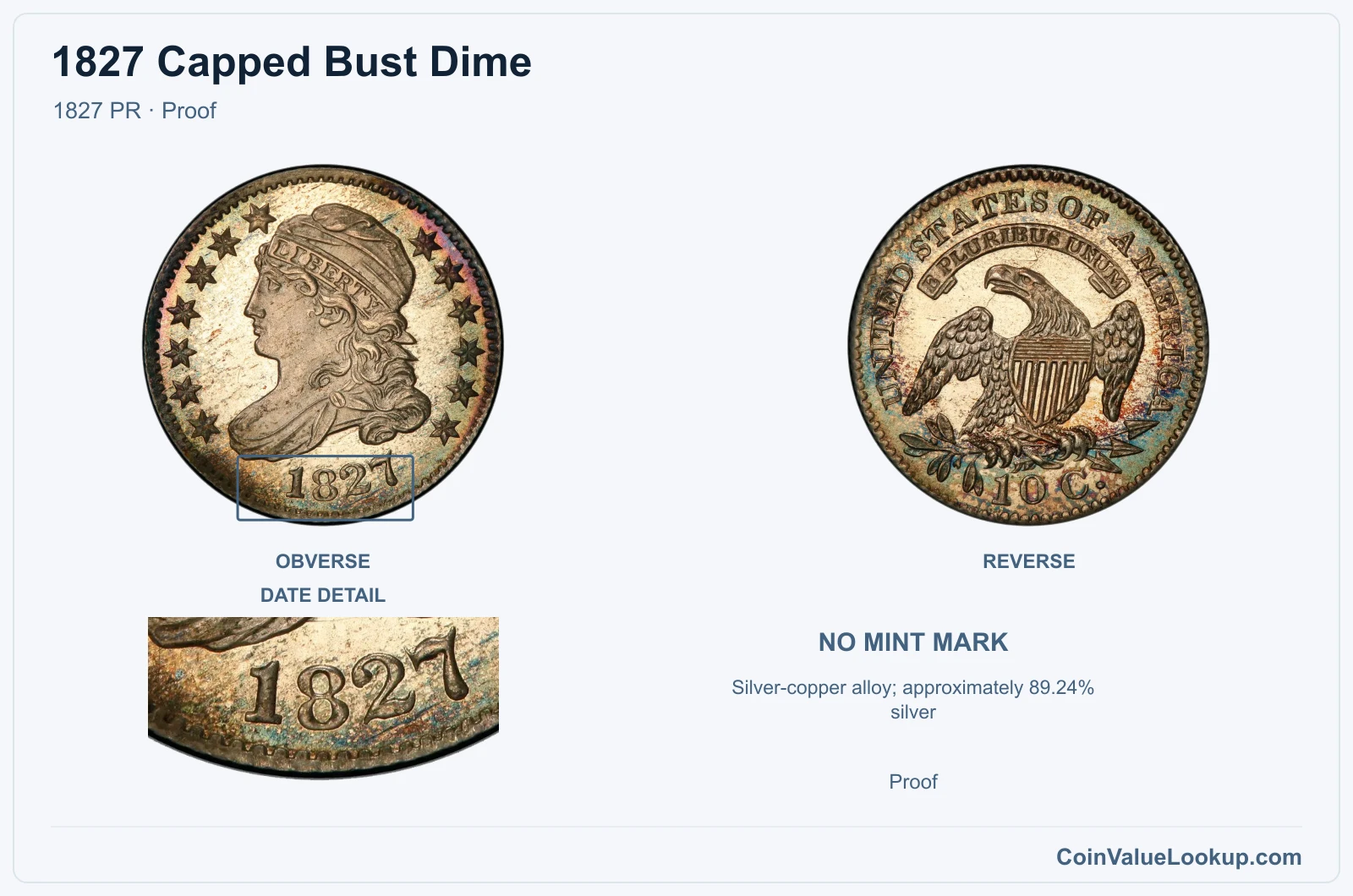
The 1827 PR is an early proof striking, made in tiny numbers for presentation or favored collectors. These were produced on polished planchets using specially prepared dies, resulting in deeply mirrored fields and sharp detail that business strikes rarely match.
A reflective or strongly struck circulation coin is not automatically a proof. Genuine early proofs are confirmed through professional attribution services, not guesswork.
Because of their extreme scarcity, no standard numeric guide price is adopted here. Each authenticated proof trades on its own merits — its surfaces, any hairlines, toning character and provenance all influence the price.
Coin Value Lookup is a good place to start when you want to look up guides for other early silver denominations alongside this one. If you are holding a candidate proof, professional certification is the logical next step before assigning any value.
Range Grade
Price Auction Records Appraisal PR PR 1
—
Coin Identifier
PR 2
—
Coin Identifier
PR 3
—
Coin Identifier
PR 4
—
Coin Identifier
PR 6
—
Coin Identifier
PR 8
—
Coin Identifier
PR 10
—
Coin Identifier
PR 12
—
Coin Identifier
PR 15
—
Coin Identifier
PR 20
—
Coin Identifier
PR 25
—
Coin Identifier
PR 30
—
Coin Identifier
PR 35
—
Coin Identifier
PR 40
—
Coin Identifier
PR 45
—
Coin Identifier
PR 50
—
Coin Identifier
PR 53
—
Coin Identifier
PR 55
—
Coin Identifier
PR 58
—
Coin Identifier
PR 60
—
Coin Identifier
PR 61
—
Coin Identifier
PR 62
—
Coin Identifier
PR 63
—
Coin Identifier
PR 64
Coin Identifier
PR 65
—
Coin Identifier
PR 66
Coin Identifier
PR 67
—
—
—
PR 68
—
—
—
PR 69
—
—
—
PR 70
—
—
—
1827 Capped Bust Dime Error List
1. 1827 Capped Bust Dime — Overdate
An 1827/7 overdate has been reported on some 1827 Capped Bust Dimes. This die variety shows traces of an earlier 7 beneath the final digit in the date, where the Mint re-engraved or re-punched the numeral into an existing die.
Look carefully at the base and upper loop of the final 7 for ghost outlines of the previous digit that do not align perfectly.
Not every 1827 dime is an overdate — only those struck from the specific re-cut die carry this feature. A date that simply looks mushy from heavy wear or a post-mint scratch through the numerals is not the same thing.
Ordinary machine doubling, which appears as flat shelf-like traces, also mimics an overdate to the untrained eye.
No standard guide price is adopted for this variety. The value depends on how clearly the underlying date shows, the coin's overall condition and its surface quality.
A professional opinion helps confirm the attribution.
2. 1827 Capped Bust Dime — Die Crack / Die Chip
Die cracks and die chips have been documented on certain 1827 Capped Bust Dime dies. A die crack appears as a thin raised line on the coin's surface, tracing where the steel die fractured during use.
A die chip is a small raised blob where a tiny piece of the die broke away, leaving a void that filled with metal during striking. If the crack reaches the rim and a larger section of the die collapses, collectors call that a cud — a raised, featureless lump at the edge.
Do not confuse these with scratches, which are incuse (pressed into the surface) rather than raised. Corrosion pitting or bits of foreign material stuck to the coin can also mimic a chip but lack the sharp, consistent profile of a genuine die defect.
No set price is adopted for die-crack varieties on this date. Value hinges on the crack's prominence, location and the coin's overall grade and eye appeal.