1804 Draped Bust Dime Coin Value: How Much Is It Worth?
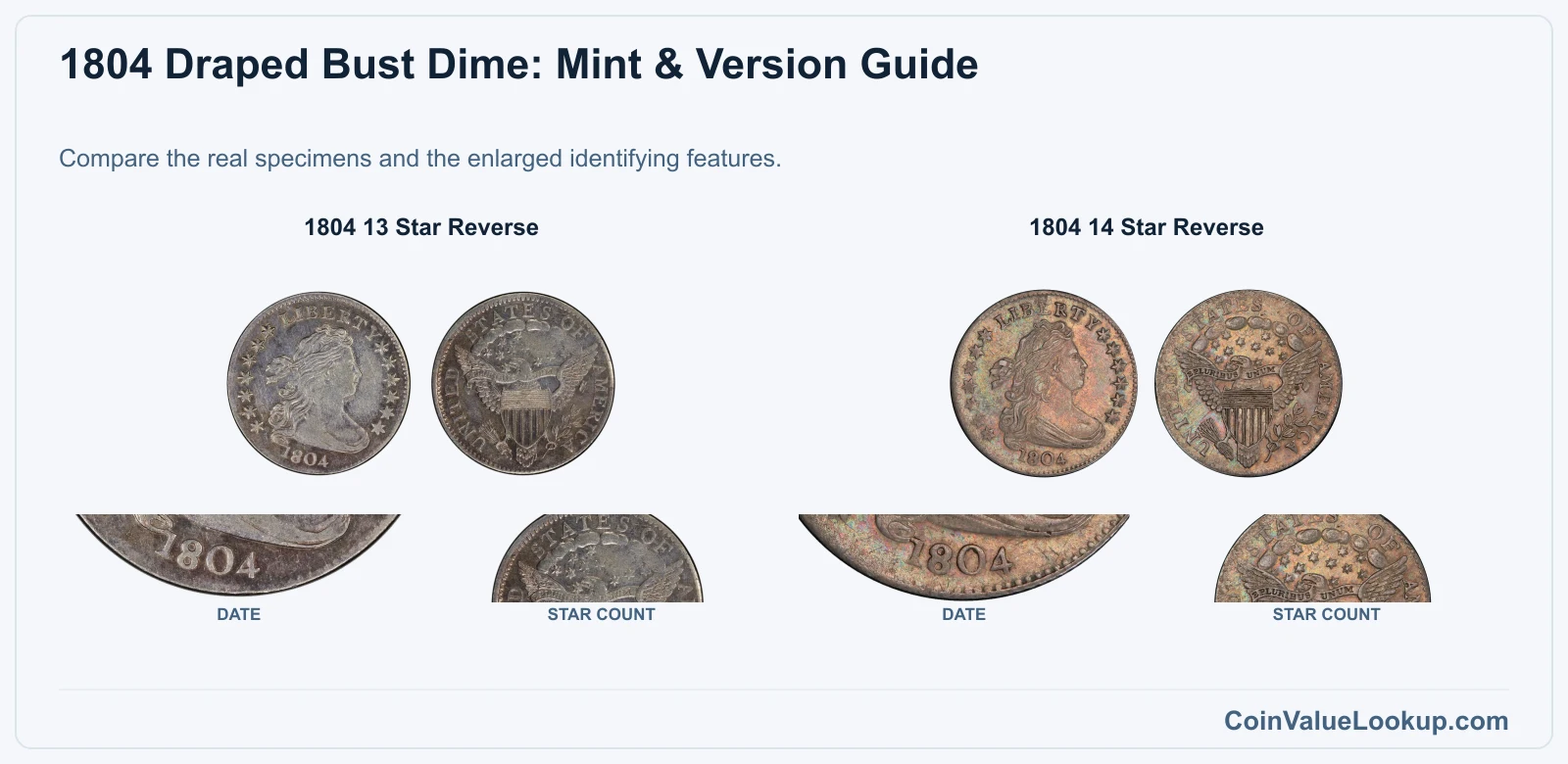
The 1804 Draped Bust Dime is one of the earliest silver dimes struck at the Philadelphia Mint, and surviving examples remain genuinely scarce more than two centuries later. Two distinct die varieties exist for this date, distinguished by the number of stars on the reverse.
Guide estimates for these varieties in Good-4 condition range from roughly $5,624 to $8,439, though actual value depends on the specific variety, grade and surface condition. These figures are guide anchors, not guaranteed offers.
Fast Way to Identify Your 1804 Draped Bust Dime
If you think you have an 1804 Draped Bust Dime, the quickest first step is to upload clear photos of both the front and back of your coin. Our identifier can give you a preliminary read on which variety and general condition you might be looking at.
Good lighting and a steady hand help a lot with coins this old.
1804 Draped Bust Dime Value
Upload both sides of your 1804 Draped Bust Dime.
Front Obverse
Upload photo
Back Reverse
Upload photo
Which 1804 Draped Bust Dime Versions Are Worth Money?
- The 1804 14 Star Reverse variety carries a higher guide estimate at G4 ($8,439) and is the scarcer of the two die varieties for this date.
- The 1804 13 Star Reverse variety is listed at $5,624 in G4 condition and is the more commonly encountered version, though still a rare early silver coin.
- Count the stars above the eagle on the reverse to determine which variety you hold; this single detail significantly affects the guide value.
- Original, uncleaned surfaces with natural toning are strongly preferred over brightened or damaged examples, regardless of variety.
- Coins with visible die cracks or chips may attract additional collector interest, though no specific price premium is established in the current data.
Step 1: Identify Your 1804 Draped Bust Dime Mint Mark and Version
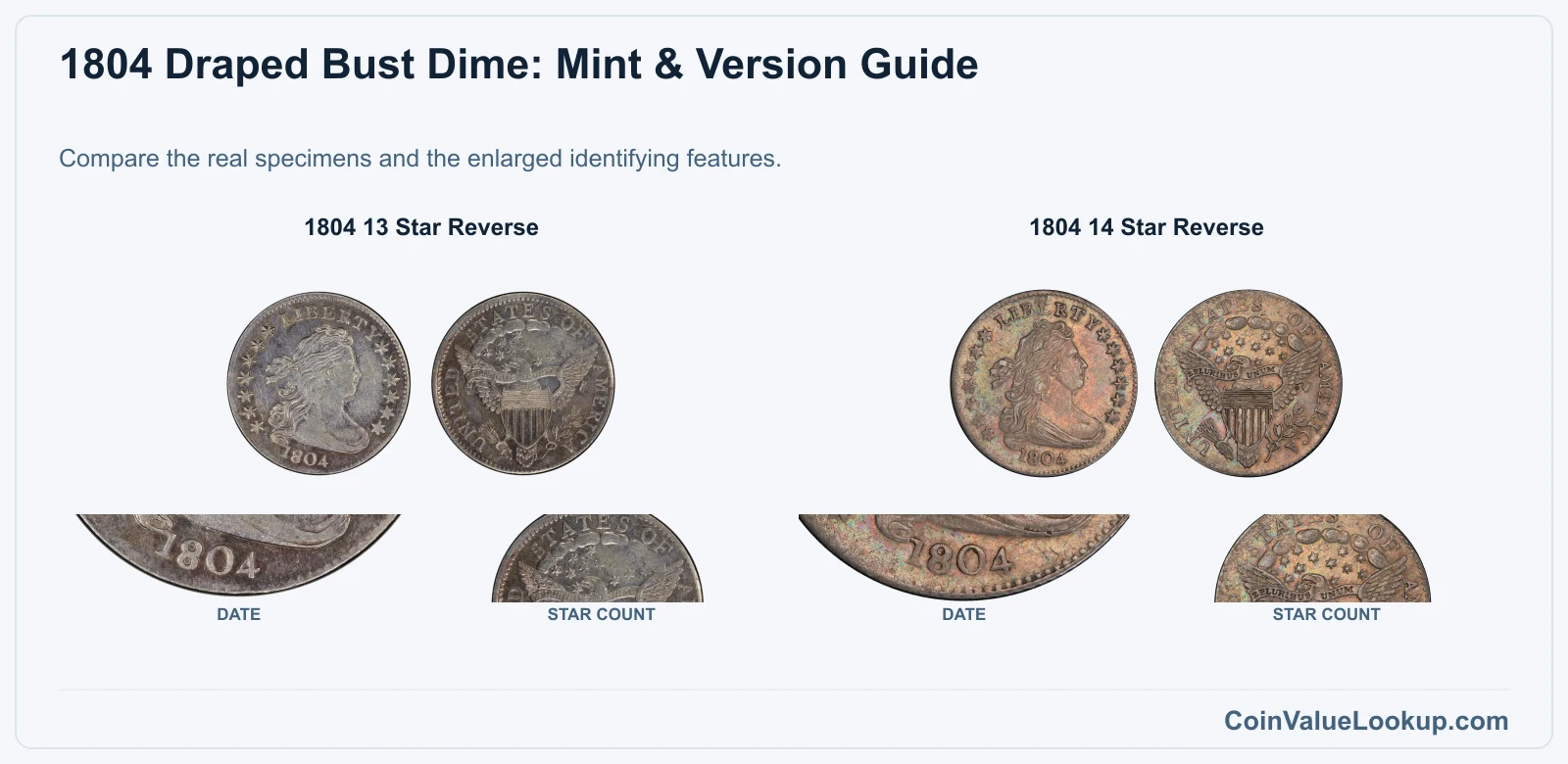
All 1804 dimes were struck at the Philadelphia Mint, so there is no mintmark to hunt for. The design pairs the Draped Bust of Liberty on the obverse with a Heraldic Eagle on the reverse.
The key variety distinction is the star count above the eagle on the reverse. The 13 Star Reverse has thirteen small stars arranged in an arc over the eagle, while the 14 Star Reverse squeezes in one extra.
Count carefully, because worn stars can blur together.
The coin is struck in a silver-copper alloy of approximately 89.24% silver. It does not display a "10C" denomination anywhere on the design, which can trip up beginners.
Be careful not to confuse this coin with a Draped Bust Half Dime, which uses a very similar design but is noticeably smaller and thinner. Also avoid comparing it to a silver dollar of the same era; the shared design elements can fool a quick glance.
Size and weight are your friends here.
Coin Value Lookup is a good place to look up guides for other early U.S. coins if you are sorting through a collection. It can help you narrow down denominations and dates before you dig deeper.
Step 2: Check Your 1804 Draped Bust Dime Grade
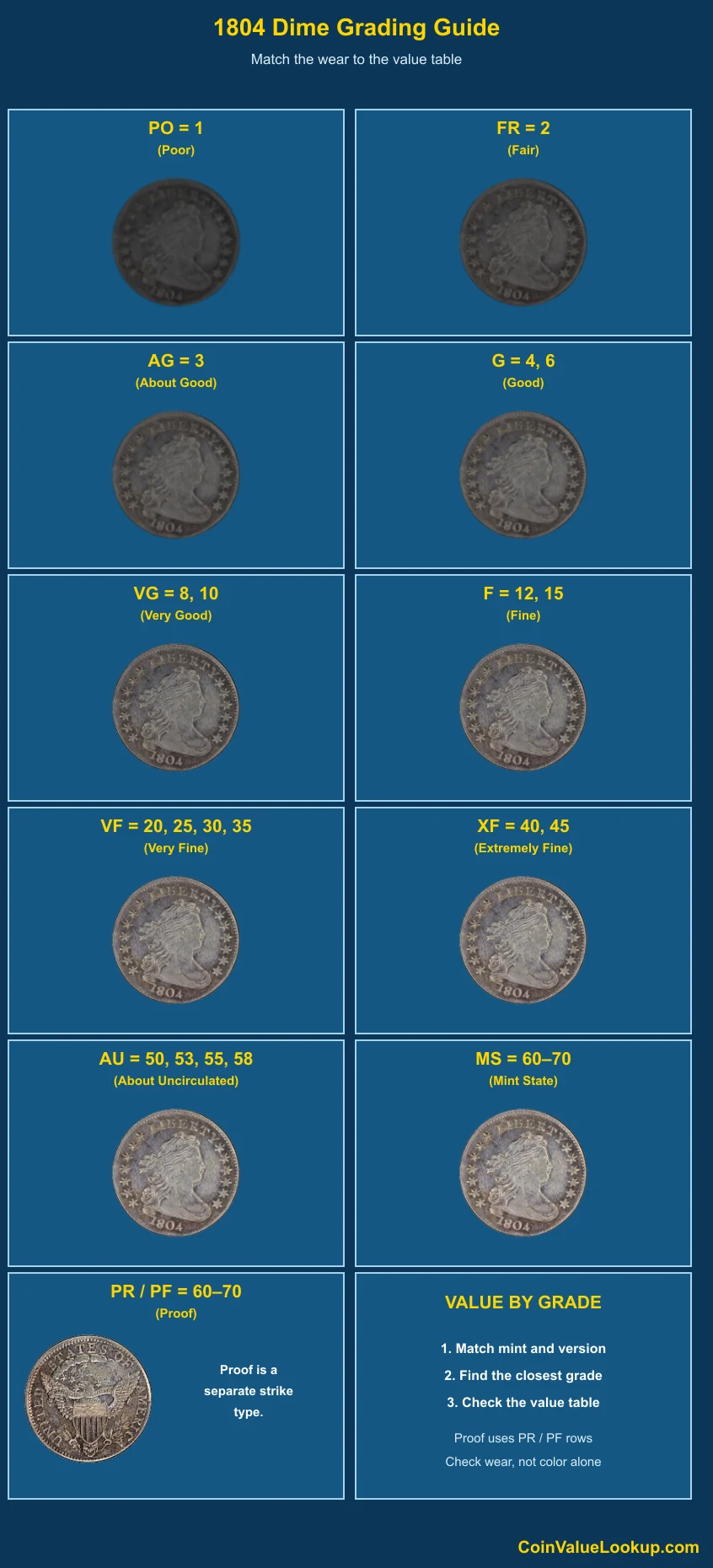
Start by examining Liberty's hair detail, especially the strands above the forehead and behind the ear. On a well-worn coin, these merge into a flat area.
The cheek and the drapery folds across the bust are next; smoothness there signals heavy circulation.
Flip the coin over and check the eagle's breast feathers and wing tips. These are high points that wear first.
Early dimes were struck on hand-operated screw presses, so even an unworn coin can show uneven strike strength. One side might look sharper than the other, or certain stars may appear weak.
That is a strike issue, not wear, and it matters when grading.
Luster is your best friend for separating lightly circulated from uncirculated pieces. Original mint luster on a 220-year-old coin is rare and fragile.
Do not clean or polish the surface trying to make it look brighter; that destroys value faster than almost anything else.
Use the comparison image to match your coin's wear pattern against known grade benchmarks. Look at contact marks, rim dings and overall eye appeal together with the technical wear.
Step 3: Check 1804 Draped Bust Dime Value by Mint and Version
1804 Draped Bust Dime — 13 Star Reverse
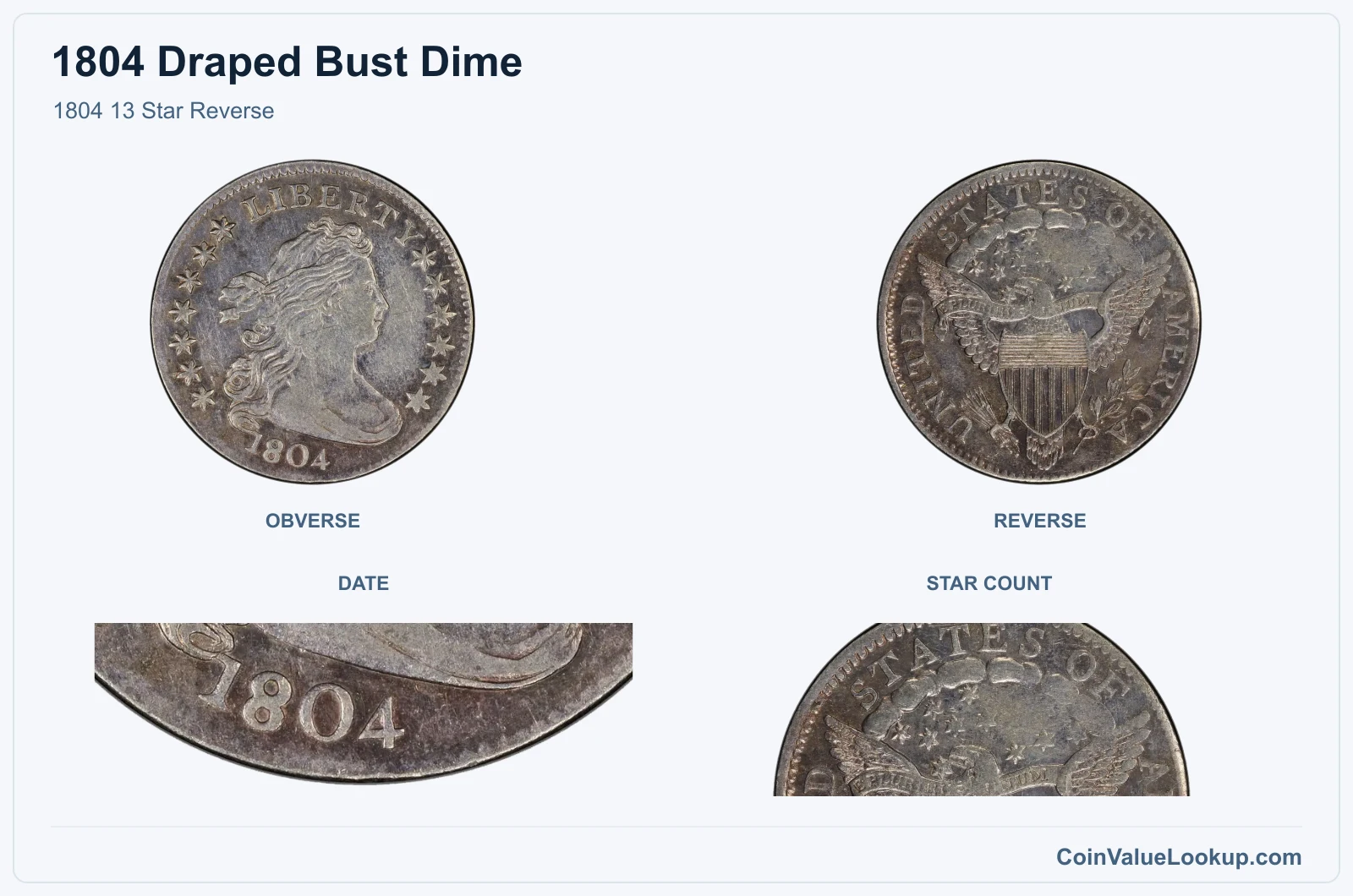
The 1804 13 Star Reverse is the more frequently seen of the two varieties for this date, though "frequent" is relative for a coin from 1804. To identify it, count the small stars arranged in an arc above the Heraldic Eagle on the reverse.
You should find exactly thirteen.
This version carries a guide estimate of approximately $5,624 in Good-4 condition, per USA Coin Book. That figure is a reference point, not a guaranteed purchase price.
Actual value shifts with surface quality, sharpness and overall eye appeal.
Original surfaces matter enormously. A coin with honest gray or golden toning and no signs of cleaning will compare more favorably to guide estimates than one that has been scrubbed bright.
Match the date, design and star count before assuming your coin fits this listing.
Range Grade
Price Auction Records Appraisal PO PO 1
—
Coin Identifier FR FR 2
—
Coin Identifier AG AG 3
Coin Identifier G G 4
—
Coin Identifier
G 6
Coin Identifier VG VG 8
—
Coin Identifier
VG 10
—
Coin Identifier F F 12
Coin Identifier
F 15
Coin Identifier VF VF 20
Coin Identifier
VF 25
Coin Identifier
VF 30
Coin Identifier
VF 35
Coin Identifier XF XF 40
Coin Identifier
XF 45
Coin Identifier AU AU 50
—
Coin Identifier
AU 53
Coin Identifier
AU 55
Coin Identifier
AU 58
—
—
— MS MS 60
—
—
—
MS 61
—
—
—
MS 62
—
—
—
MS 63
—
—
—
MS 64
—
—
—
MS 65
—
—
—
MS 66
—
—
—
MS 67
—
—
—
MS 68
—
—
—
MS 69
—
—
—
MS 70
—
—
—
1804 Draped Bust Dime — 14 Star Reverse
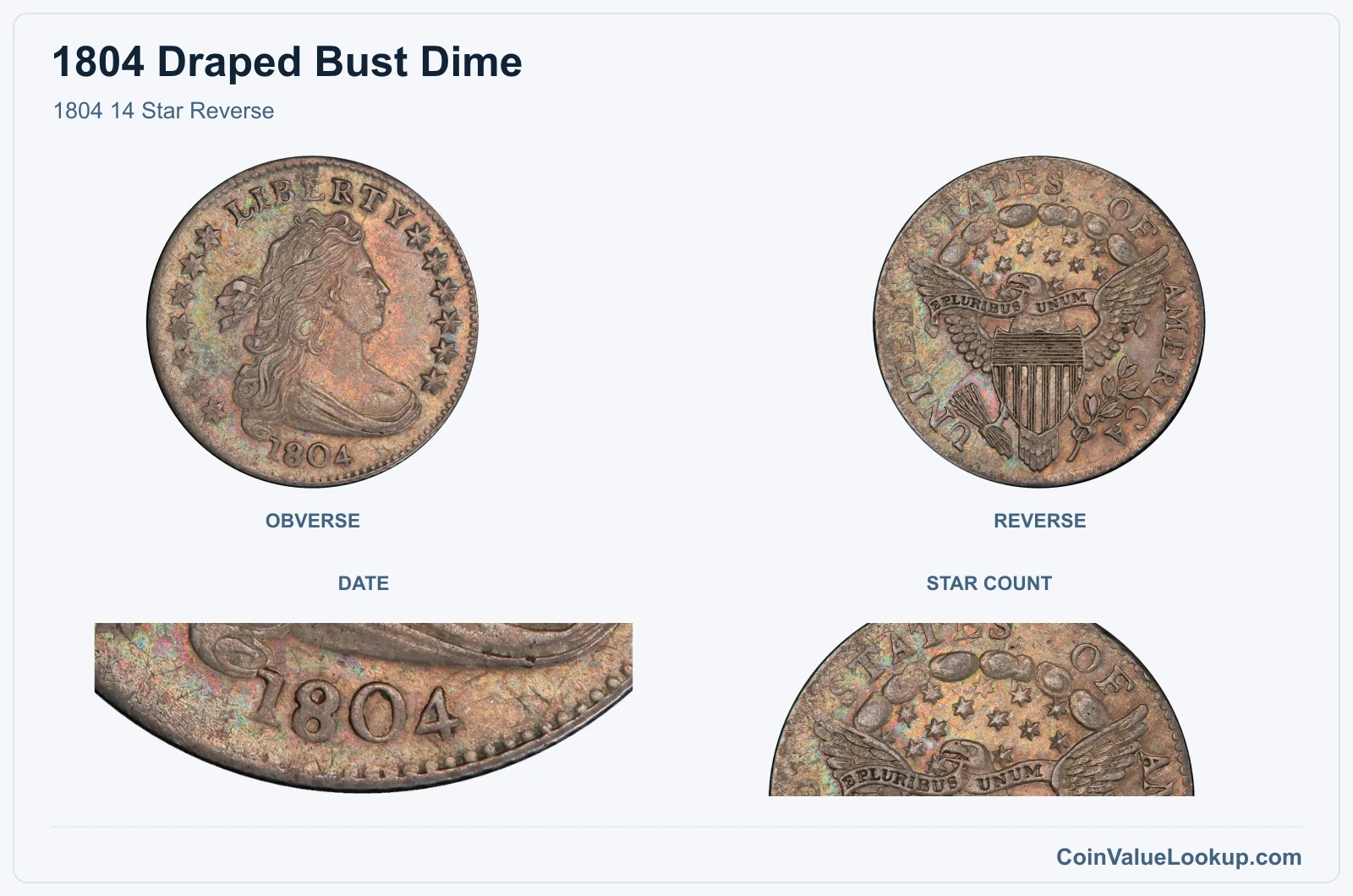
The 1804 14 Star Reverse is the scarcer variety and the one that commands the higher guide figure. Flip the coin to the reverse and count the stars above the eagle.
If you get fourteen, you have this version.
The extra star was an intentional die-design choice, not an error. Different dies were engraved with different star arrangements during this era, so both counts are legitimate Philadelphia Mint products.
In Good-4 condition, the guide estimate sits at roughly $8,439 according to USA Coin Book. That premium over the 13 Star version reflects the lower survival rate of this particular die pairing.
As always, cleaning, scratches, corrosion or artificial toning will reduce how closely a real-world coin tracks to any published guide figure. Confirm the date, the Draped Bust and Heraldic Eagle design and the 14-star count before comparing your coin to this value.
Range Grade
Price Auction Records Appraisal PO PO 1
—
Coin Identifier FR FR 2
—
Coin Identifier AG AG 3
—
Coin Identifier G G 4
Coin Identifier
G 6
—
Coin Identifier VG VG 8
Coin Identifier
VG 10
—
Coin Identifier F F 12
Coin Identifier
F 15
Coin Identifier VF VF 20
Coin Identifier
VF 25
—
Coin Identifier
VF 30
—
Coin Identifier
VF 35
Coin Identifier XF XF 40
Coin Identifier
XF 45
Coin Identifier AU AU 50
Coin Identifier
AU 53
Coin Identifier
AU 55
—
Coin Identifier
AU 58
Coin Identifier MS MS 60
—
—
—
MS 61
—
—
—
MS 62
—
—
—
MS 63
—
—
—
MS 64
—
—
—
MS 65
—
—
—
MS 66
—
—
—
MS 67
—
—
—
MS 68
—
—
—
MS 69
—
—
—
MS 70
—
—
—
1804 Draped Bust Dime Error List
1. 1804 Draped Bust Dime — Die Crack / Die Chip
Die cracks appear as thin, raised lines running across the coin's surface, caused by fractures in the steel die during striking. A die chip looks like a small raised blob, often near lettering or design elements.
Both are genuine mint-made features baked into the coin at production.
On 1804 Draped Bust Dimes, die cracks have been reported in reference sources. Not every 1804 dime has one; it depends on which specific die pair struck your coin and how late in that die's life it was used.
To distinguish a real die crack from damage, remember that die cracks are raised above the field, while post-mint scratches are incuse, meaning they cut into the surface. Corrosion pitting and deposited foreign material can also mimic a chip at first glance, so use magnification and good lighting.
No specific price premium has been established in the current data for die cracks on this date. The visibility, location and overall condition of the coin all factor into any additional interest from collectors.
A professional evaluation is recommended for significant examples.