1866 Liberty Seated Dime Coin Value: How Much Is It Worth?
The 1866 Liberty Seated Dime is a scarce coin from the post-Civil War era, struck at Philadelphia and San Francisco. Retail guide estimates for normal business strikes range from about $151 at G4 up to roughly $7,815 at MS63, depending on the mint.
Proofs and specific varieties carry their own pricing. Sorting out which mint struck your coin is the first and most important step.
Fast Way to Identify Your 1866 Liberty Seated Dime
Snap clear photos of both the front and back of your dime and upload them here for a preliminary identification. Good lighting and a steady hand help — we need to see the date, the seated Liberty design, and especially the area below the reverse wreath where a mintmark may or may not appear.
This is not a substitute for professional authentication, but it gets the conversation started.
1866 Liberty Seated Dime Value
Upload both sides of your 1866 Liberty Seated Dime.
Front Obverse
Upload photo
Back Reverse
Upload photo
Which 1866 Liberty Seated Dime Versions Are Worth Money?
- The Philadelphia business strike (no mintmark) is the scarcer issue, with a guide value of about $933 at G4 — check carefully that a weak S mintmark has not worn away before assuming you have one.
- San Francisco strikes are more available but still carry strong value, with guide estimates from roughly $151 at G4 to $7,815 at MS63.
- Philadelphia Proofs are rare early-date issues with mirrored fields; a PR63 example carries a guide estimate around $725.
- A die crack variety exists on 1866-S coins, running from Liberty's ear down toward the shield and from below the date toward the rim — condition and visibility affect any premium.
- Original, uncleaned surfaces with correct mint attribution matter far more than a shiny appearance when determining value.
Step 1: Identify Your 1866 Liberty Seated Dime Mint Mark and Version
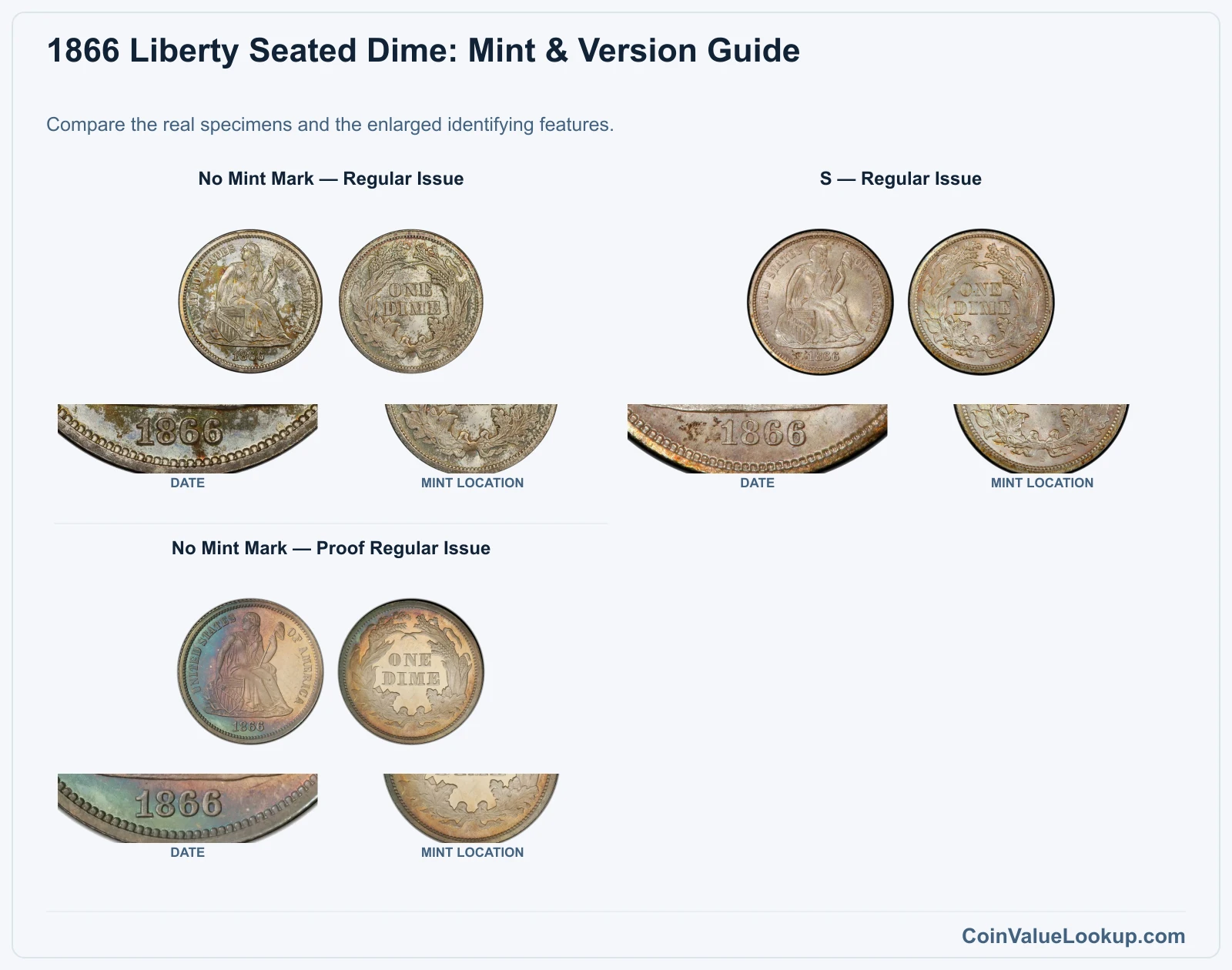
Start by confirming the obverse shows a seated Liberty figure and the reverse reads ONE DIME inside a large agricultural wreath. Half dimes are smaller and say HALF DIME — set those aside.
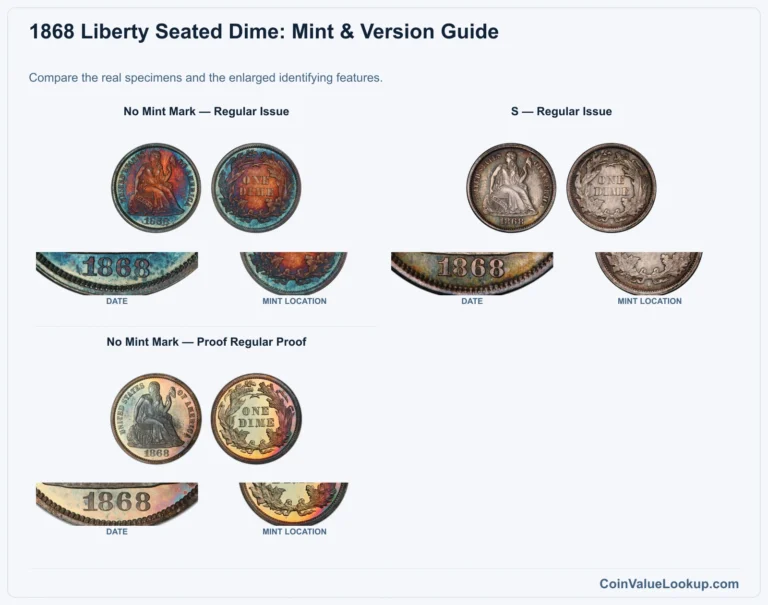
Flip the coin over and look directly below the wreath for a small "S" mintmark. Philadelphia coins carry no letter at all.
This distinction matters a lot because the Philadelphia issue is considerably scarcer than the San Francisco coin.
Here is the catch: some 1866-S dimes were struck with a very weak S punch. On well-worn examples, that S can vanish entirely, making the coin look like the rarer Philadelphia issue.
Compare the date's position and the angle at which the numerals slope — Philadelphia and San Francisco dies were not identical in their date placement. If you are unsure, a reputable grading service can confirm under magnification.
The normal alloy for both mints is 90% silver and 10% copper, with a nominal weight of 2.49 grams and a reeded edge at 17.9 mm diameter. Terms like Small Weak S and Small Thin S describe different die appearances of the San Francisco mintmark, not separate metal compositions or design types.
Step 2: Check Your 1866 Liberty Seated Dime Grade
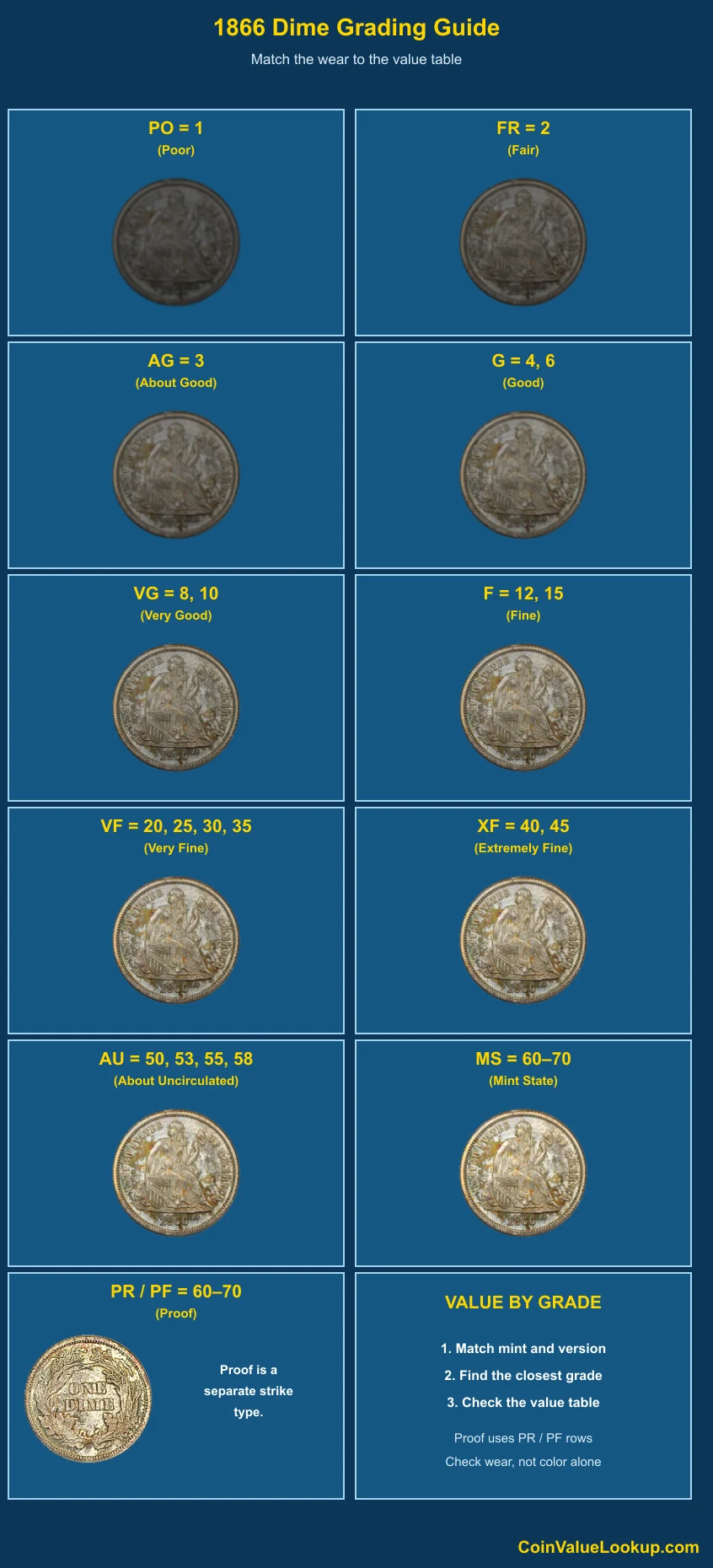
Hold your dime under a single angled light and compare it to the grading reference image. Focus on Liberty's head, the shield on her arm, the folds of her gown, and her feet — these are the first areas to lose definition as the coin circulates.
Separate actual wear from strike weakness. Some 1866 dimes left the press with soft detail on Liberty's head or the wreath base, and that is a manufacturing characteristic, not damage from use.
Original mint luster — a cartwheel shimmer when tilted — is another key indicator of grade. A coin can have sharp detail but dead, cleaned surfaces, which tanks its desirability.
Proof coins have mirrored fields and sharp rims from specially prepared dies. A polished circulation strike is not a Proof, no matter how shiny someone has buffed it.
Hairlines from wiping or cleaning are graded differently on Proofs than on business strikes, so keep the two categories in separate mental buckets.
Step 3: Check 1866 Liberty Seated Dime Value by Mint and Version
1866 Liberty Seated Dime — No Mint Mark — Regular Issue
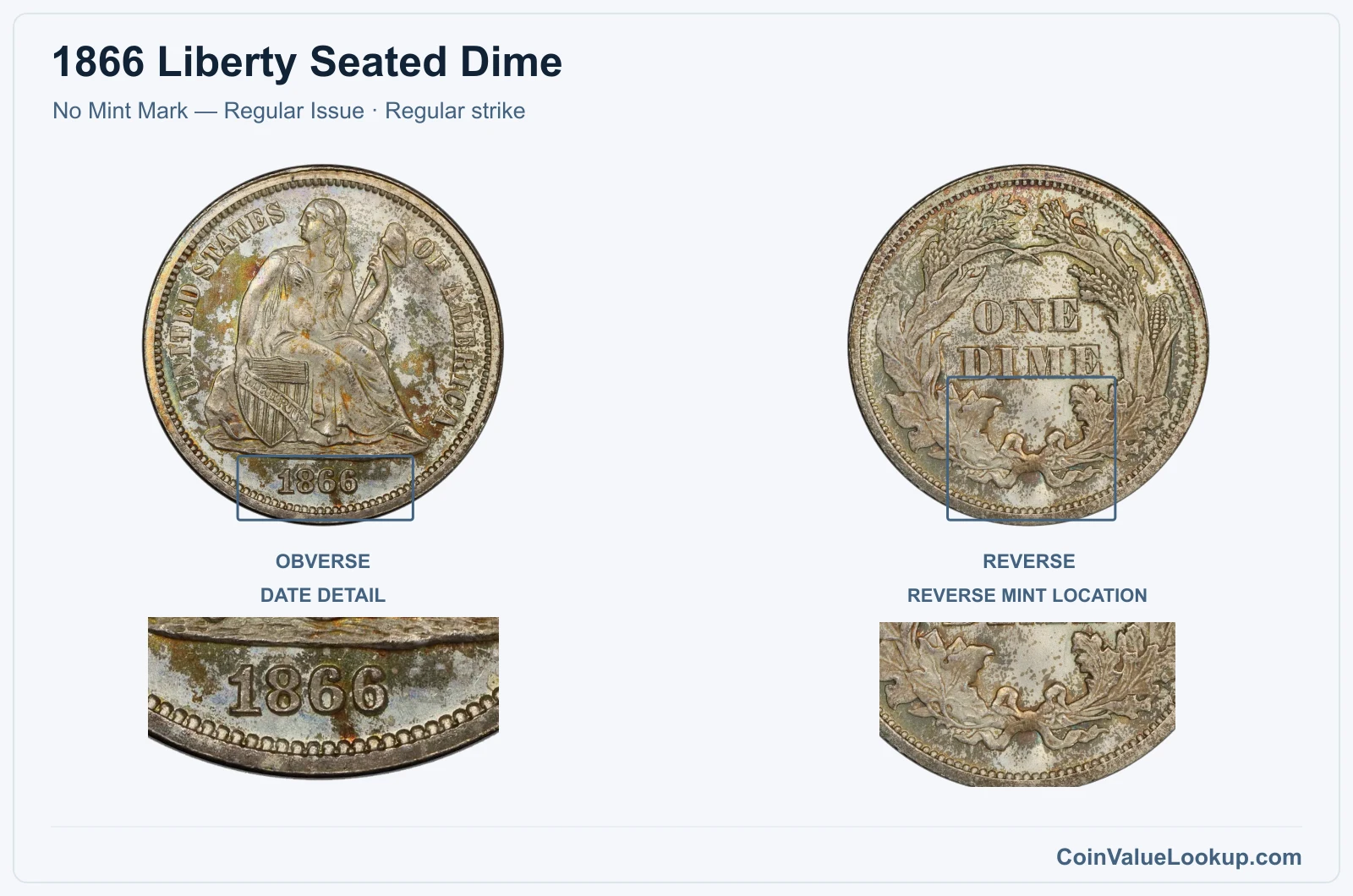
The 1866 Philadelphia dime carries no mintmark. Look at the reverse below the wreath — the space should be completely empty.
This is the scarcer business-strike issue for the date, with a USA Coin Book guide estimate of about $933 at G4 and roughly $3,637 at MS63.
Because a weak San Francisco S can disappear on heavily circulated coins, confirming the Philadelphia attribution is critical. Compare the date's position and slope against known examples; the two mints used different die setups.
The coin is 90% silver, 10% copper, weighing nominally 2.49 grams with a reeded edge. Its obverse features the Legend type with stars replaced by UNITED STATES OF AMERICA, paired with the large agricultural wreath reverse.
Range Grade
Price Auction Records Appraisal PO PO 1
—
Coin Identifier FR FR 2
—
Coin Identifier AG AG 3
Coin Identifier G G 4
—
Coin Identifier
G 6
Coin Identifier VG VG 8
—
Coin Identifier
VG 10
—
Coin Identifier F F 12
—
Coin Identifier
F 15
Coin Identifier VF VF 20
Coin Identifier
VF 25
Coin Identifier
VF 30
Coin Identifier
VF 35
—
Coin Identifier XF XF 40
Coin Identifier
XF 45
Coin Identifier AU AU 50
Coin Identifier
AU 53
—
Coin Identifier
AU 55
Coin Identifier
AU 58
—
Coin Identifier MS MS 60
—
Coin Identifier
MS 61
Coin Identifier
MS 62
Coin Identifier
MS 63
Coin Identifier
MS 64
Coin Identifier
MS 65
Coin Identifier
MS 66
Coin Identifier
MS 67
Coin Identifier
MS 68
—
—
—
MS 69
—
—
—
MS 70
—
—
—
1866 Liberty Seated Dime — S — Regular Issue
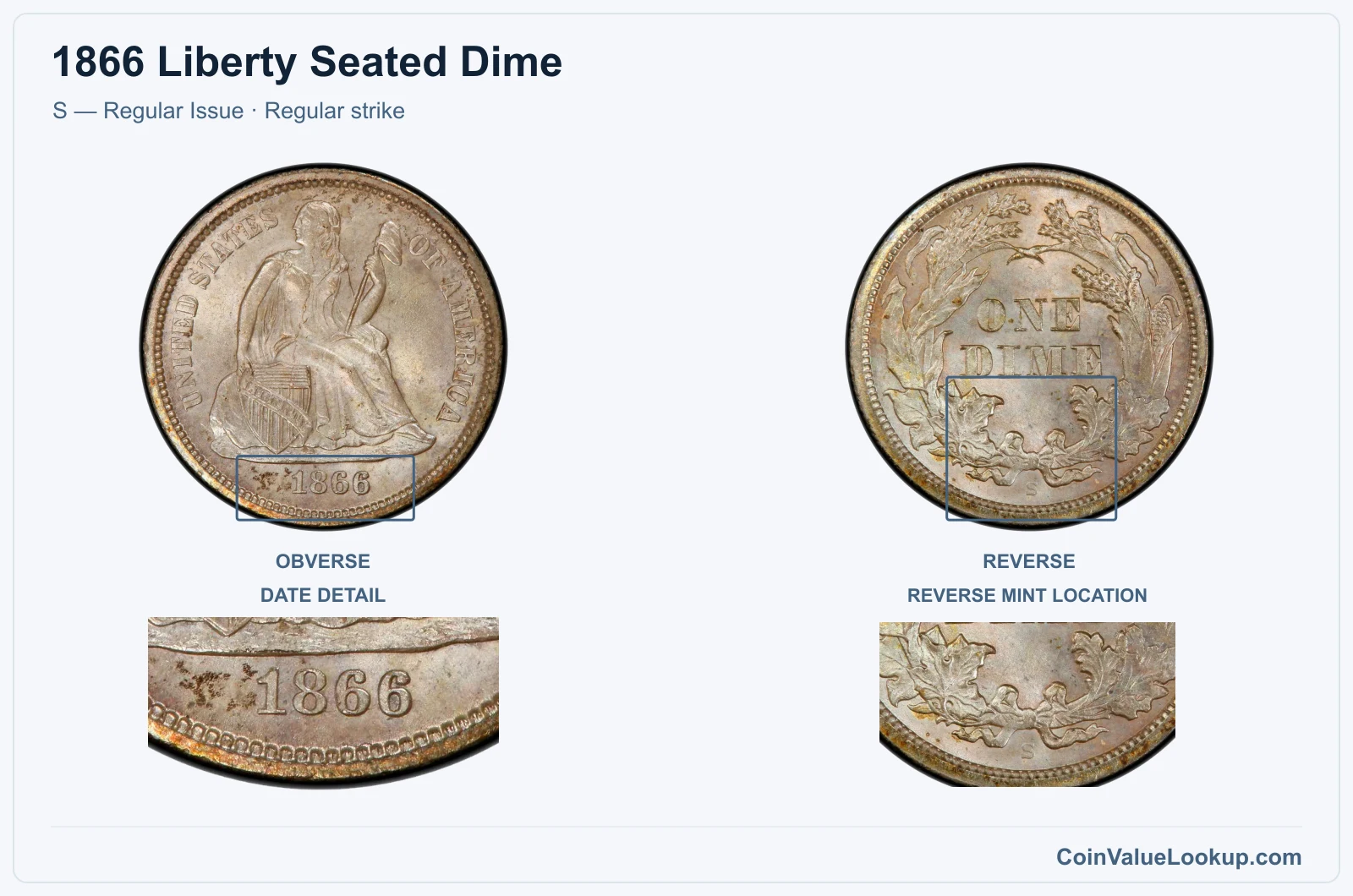
San Francisco dimes bear a small S below the reverse wreath. On 1866-S coins, this S can appear weak or thin depending on which die pair struck the coin — these are known as the Small Weak S and Small Thin S die varieties.
Neither indicates a different alloy or design; the coin is the same 90% silver, 10% copper composition at 2.49 grams.
Guide estimates from USA Coin Book place the 1866-S at about $151 in G4 and around $7,815 in MS63. The wide spread reflects how few examples survive in high grades.
If you have trouble spotting the S, try magnification under strong side lighting — the letter sits in a small, sometimes cluttered area of the die.
Coin Value Lookup is a good starting point if you want to look up guide values for other dates and mints in the Liberty Seated Dime series.
Range Grade
Price Auction Records Appraisal PO PO 1
—
Coin Identifier FR FR 2
Coin Identifier AG AG 3
Coin Identifier G G 4
—
Coin Identifier
G 6
—
Coin Identifier VG VG 8
—
Coin Identifier
VG 10
Coin Identifier F F 12
Coin Identifier
F 15
Coin Identifier VF VF 20
Coin Identifier
VF 25
Coin Identifier
VF 30
Coin Identifier
VF 35
Coin Identifier XF XF 40
Coin Identifier
XF 45
Coin Identifier AU AU 50
Coin Identifier
AU 53
Coin Identifier
AU 55
Coin Identifier
AU 58
Coin Identifier MS MS 60
—
Coin Identifier
MS 61
Coin Identifier
MS 62
Coin Identifier
MS 63
Coin Identifier
MS 64
Coin Identifier
MS 65
Coin Identifier
MS 66
Coin Identifier
MS 67
—
—
—
MS 68
—
—
—
MS 69
—
—
—
MS 70
—
—
—
1866 Liberty Seated Dime — No Mint Mark — Proof Regular Issue
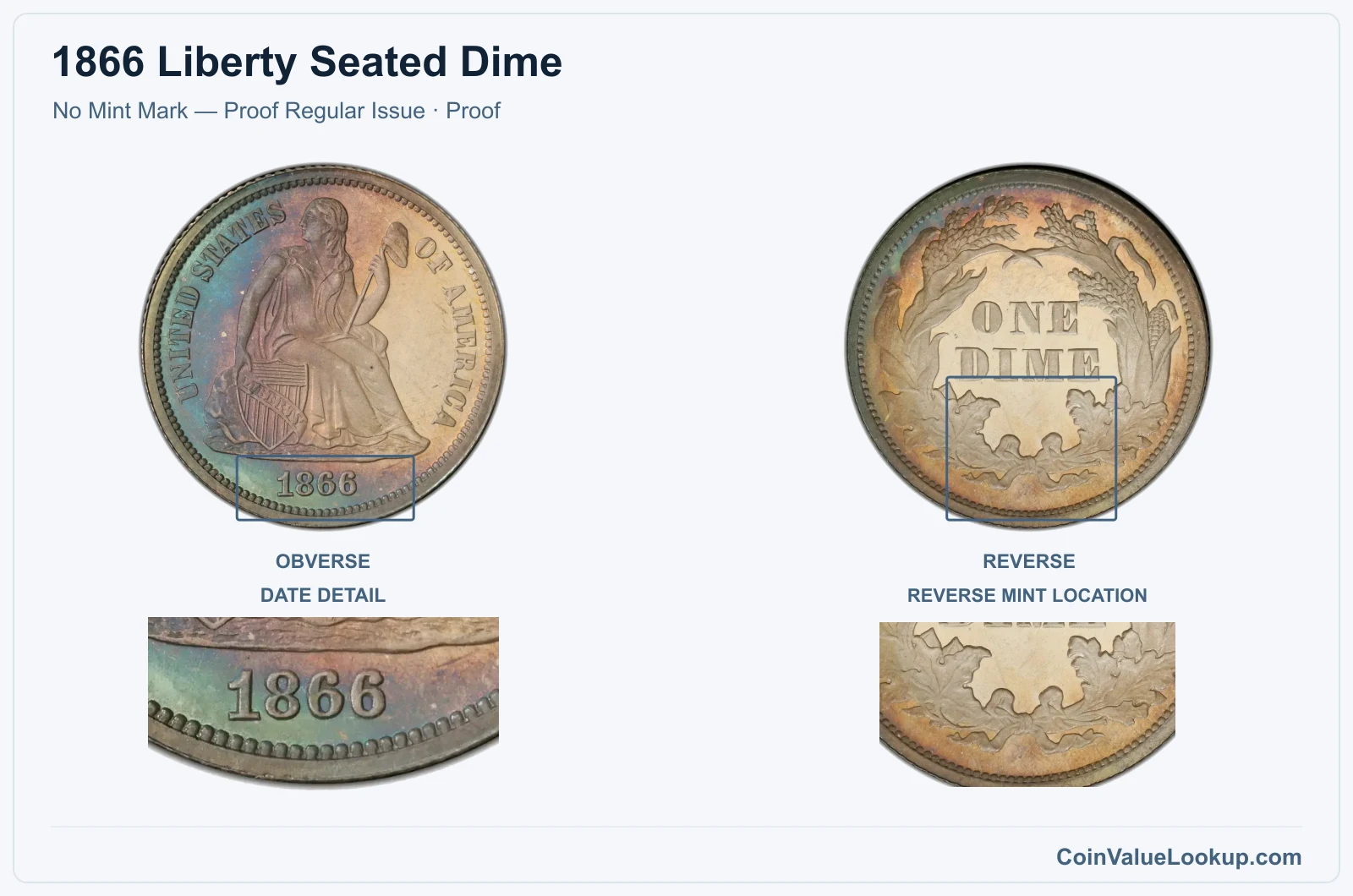
Philadelphia Proof dimes of this era are genuinely rare — they were not mass-produced annual collector products the way later Proofs became. Look for deeply mirrored fields, razor-sharp design details, and squared-off rims.
A PCGS guide estimate places the 1866 Proof at about $725 in PR63. Do not confuse a polished or lightly circulated business strike with a Proof.
Real Proof surfaces show a liquid, reflective quality in the flat fields that no amount of cleaning can replicate on a normal strike. Hairlines from mishandling are graded separately on Proofs and can significantly affect value.
If you suspect you have one, professional attribution from a major grading service is the safest path.
Range Grade
Price Auction Records Appraisal PR PR 1
—
Coin Identifier
PR 2
—
Coin Identifier
PR 3
—
Coin Identifier
PR 4
—
Coin Identifier
PR 6
—
Coin Identifier
PR 8
—
Coin Identifier
PR 10
—
Coin Identifier
PR 12
—
Coin Identifier
PR 15
—
Coin Identifier
PR 20
—
Coin Identifier
PR 25
—
Coin Identifier
PR 30
—
Coin Identifier
PR 35
—
Coin Identifier
PR 40
—
Coin Identifier
PR 45
—
Coin Identifier
PR 50
—
Coin Identifier
PR 55
—
Coin Identifier
PR 58
Coin Identifier
PR 60
Coin Identifier
PR 61
Coin Identifier
PR 62
Coin Identifier
PR 63
Coin Identifier
PR 64
Coin Identifier
PR 65
Coin Identifier
PR 66
Coin Identifier
PR 67
Coin Identifier
PR 68
Coin Identifier
PR 69
—
—
—
PR 70
—
—
—
1866 Liberty Seated Dime Error List
1. 1866 Liberty Seated Dime — Die Crack / Die Chip
A documented die crack variety exists on the 1866-S dime. The primary crack is a raised line running from Liberty's ear downward across her body toward the shield banner.
A second crack extends from below the date toward the right rim. Not every example shows both lines — earlier die states may display only one.
Under magnification, a genuine die crack appears as a thin, slightly raised ridge that follows a consistent path across the design. Contrast this with incuse scratches, surface corrosion, or bits of foreign material stuck to the coin, all of which sit into or on top of the surface rather than rising above it.
No specific price premium has been established here. The value depends on the crack's visibility, the coin's overall condition, and collector demand for the variety.
If you think you see this feature, tilt the coin under a single light source and trace the line carefully before drawing conclusions.