2019 Roosevelt Dime Coin Value: How Much Is It Worth?
Most circulated 2019 Roosevelt dimes are worth face value — ten cents, no more. A USA Coin Book guide estimate places a nice MS65 business strike at about $2.50, an S clad proof at $3.08 in PR65, and an S silver proof at $12.48 in PR65.
Sharp uncirculated coins, genuine proofs and authenticated errors are the ones worth a closer look.
Fast Way to Identify Your 2019 Roosevelt Dime
Snap a clear photo of both sides of your 2019 dime and upload them here for a preliminary identification. The tool can help you sort out the mintmark, finish type and whether the coin looks like a business strike or proof.
It is not a substitute for professional authentication, but it is a solid first step.
2019 Roosevelt Dime Value
Upload both sides of your 2019 Roosevelt Dime.
Front Obverse
Upload photo
Back Reverse
Upload photo
Which 2019 Roosevelt Dime Versions Are Worth Money?
- Uncirculated 2019-P or 2019-D dimes with original luster and sharp torch bands — guide value around $2.50 at MS65.
- 2019-S silver proof in .999 fine silver, confirmed by weight (2.537 g) and edge examination — guide value around $12.48 at PR65.
- 2019-S clad proof with mirror fields and no handling marks — guide value around $3.08 at PR65.
- Authenticated Partial Missing Obverse Clad Layer on a 2019-P — one specimen sold for $139 at auction in September 2024.
Step 1: Identify Your 2019 Roosevelt Dime Mint Mark and Version
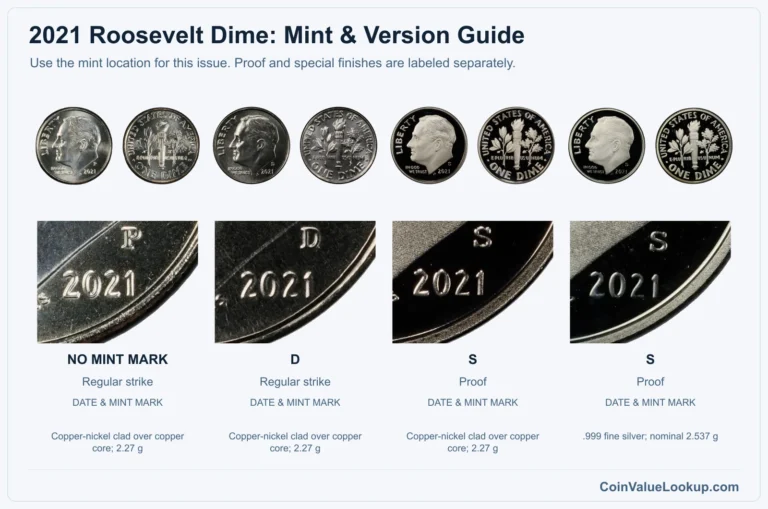
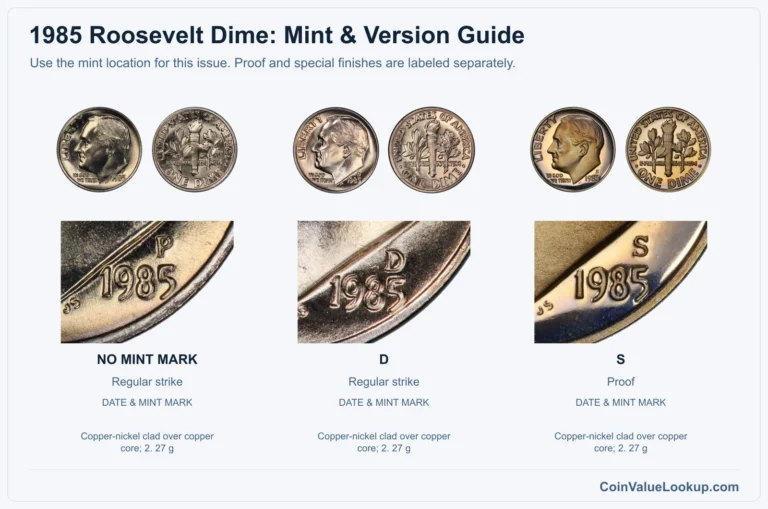
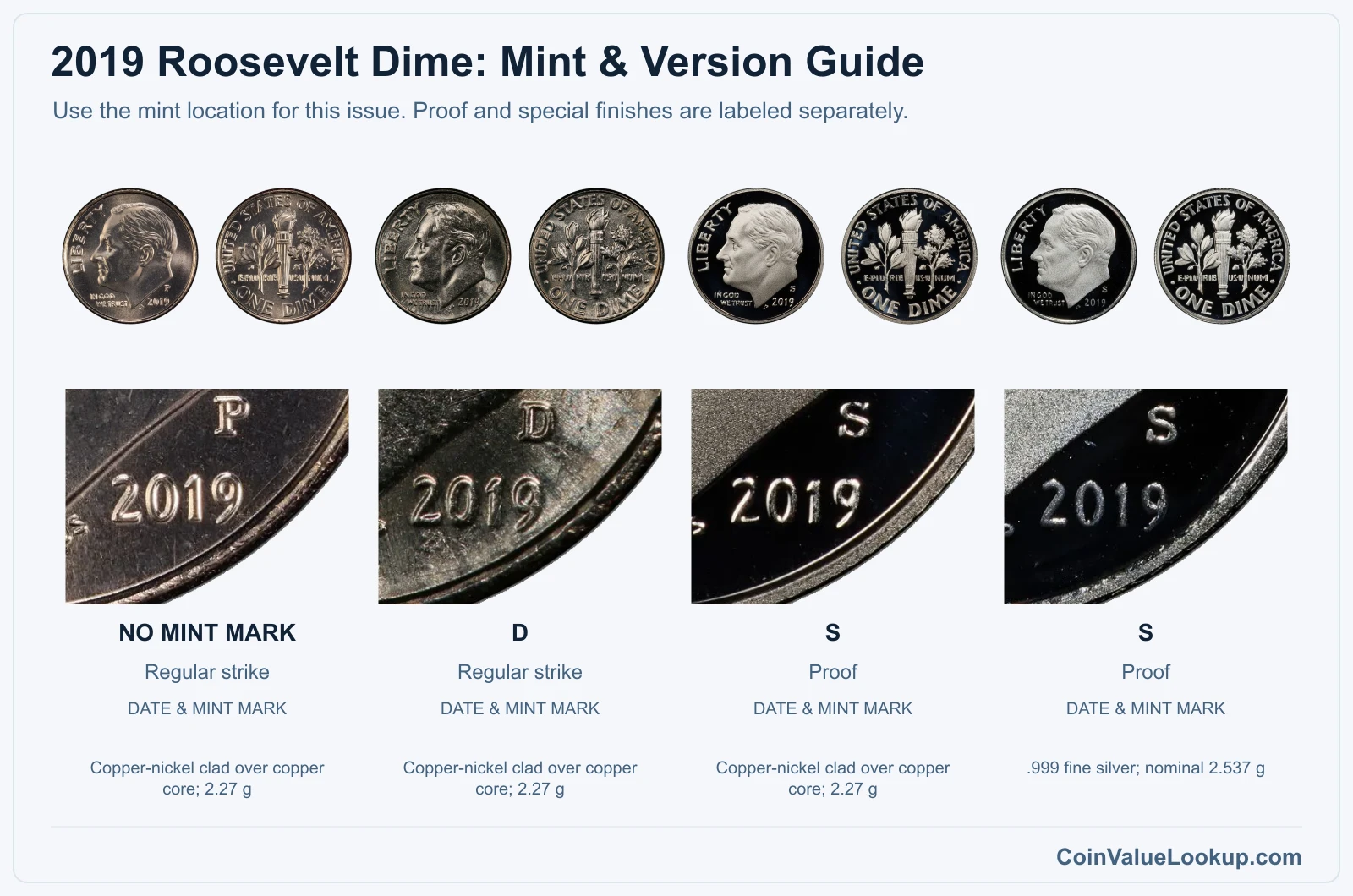
Start with the basics: confirm the date reads 2019, the obverse shows Roosevelt's portrait, and the reverse has the torch flanked by branches. Then look for the mintmark to the right of the torch base on the reverse — P for Philadelphia, D for Denver, or S for San Francisco.
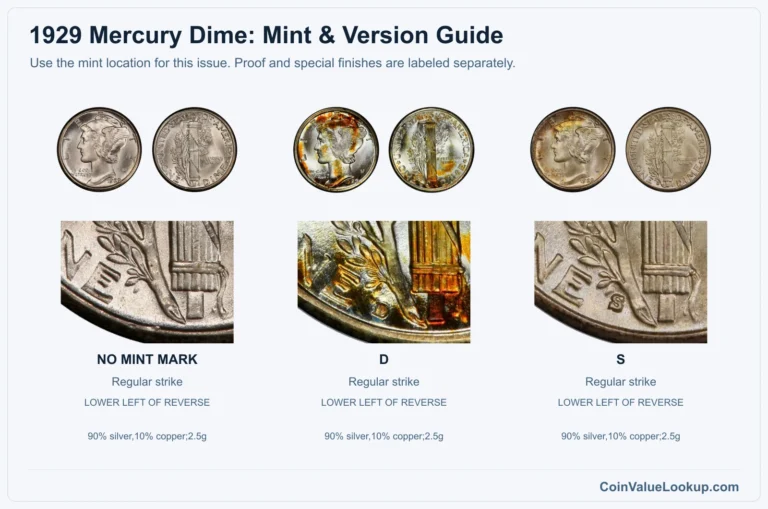
All P and D dimes and the S clad proof are copper-nickel clad, weighing 2.27 grams with a diameter of about 17.9 mm. The S silver proof is a different animal — struck in .999 fine silver and nominally weighing 2.537 grams.
That silver composition began in 2019, so do not assume the older 90% silver figure applies here.
Weight is the quickest way to separate the two S-mint versions if you have a precise scale. Edge color helps too: a clad coin shows a visible copper-toned stripe on the edge, while a silver proof does not.
Weak detail on a circulated coin does not mean it is an error or missing a mintmark — it just means it saw some pocket time.
Step 2: Check Your 2019 Roosevelt Dime Grade
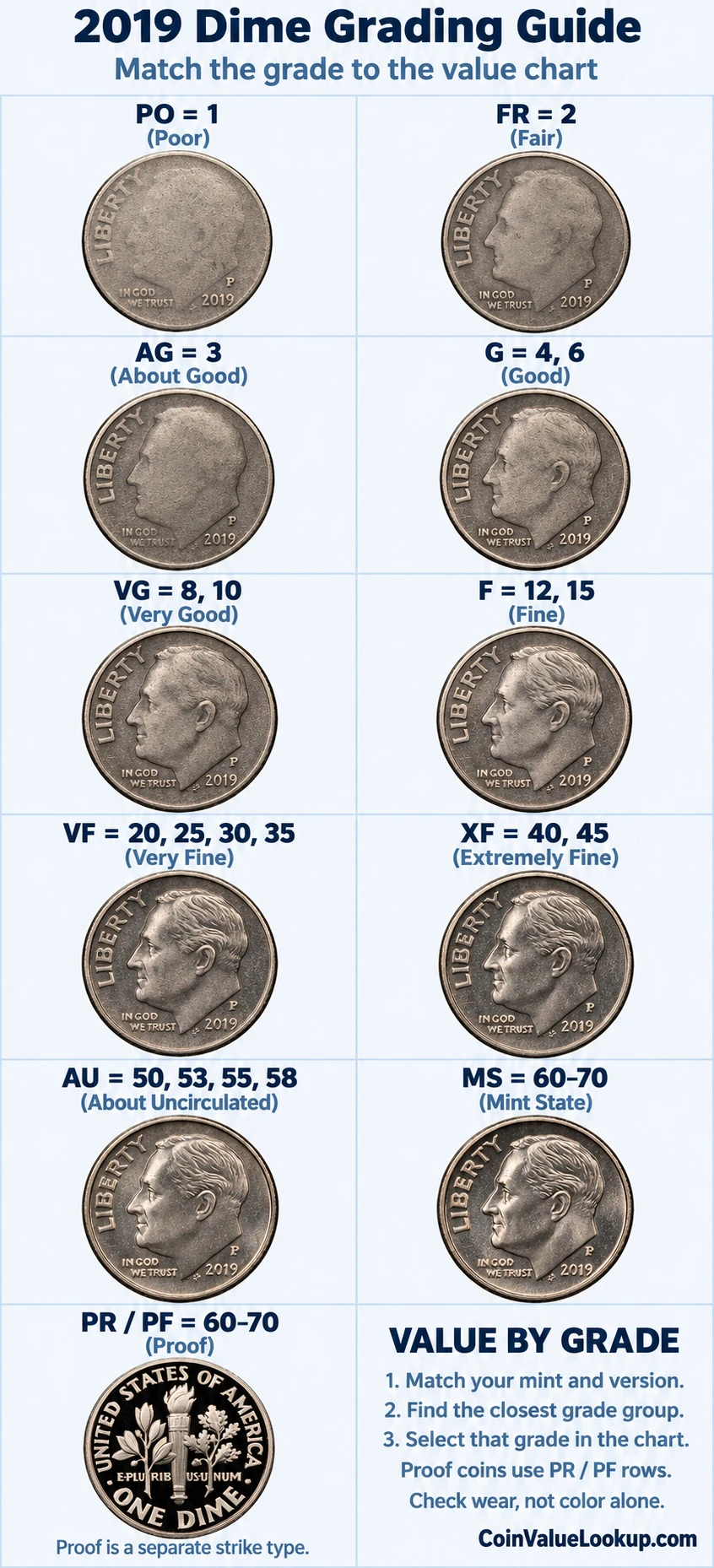
Check Roosevelt's cheekbone, jawline and the hair detail above his ear first. Those are the highest points on the obverse and the first to show friction.
On the reverse, inspect the horizontal torch bands and the leaf details.
Original mint luster matters more than shine. A coin that was polished or cleaned may look bright but will grade lower than a lightly toned piece with undisturbed surfaces.
Bag marks, contact scratches and rim dings all factor in.
Use the comparison image to gauge your coin against known grade examples of the same type. Full Bands refers to complete separation of both horizontal torch band pairs and applies within specific grades — it is a strike designation, not an error.
Proof coins are graded on their own scale starting at PR; proof is a manufacturing finish, not a step above mint state.
Step 3: Check 2019 Roosevelt Dime Value by Mint and Version
2019 Roosevelt Dime — P Business Strike
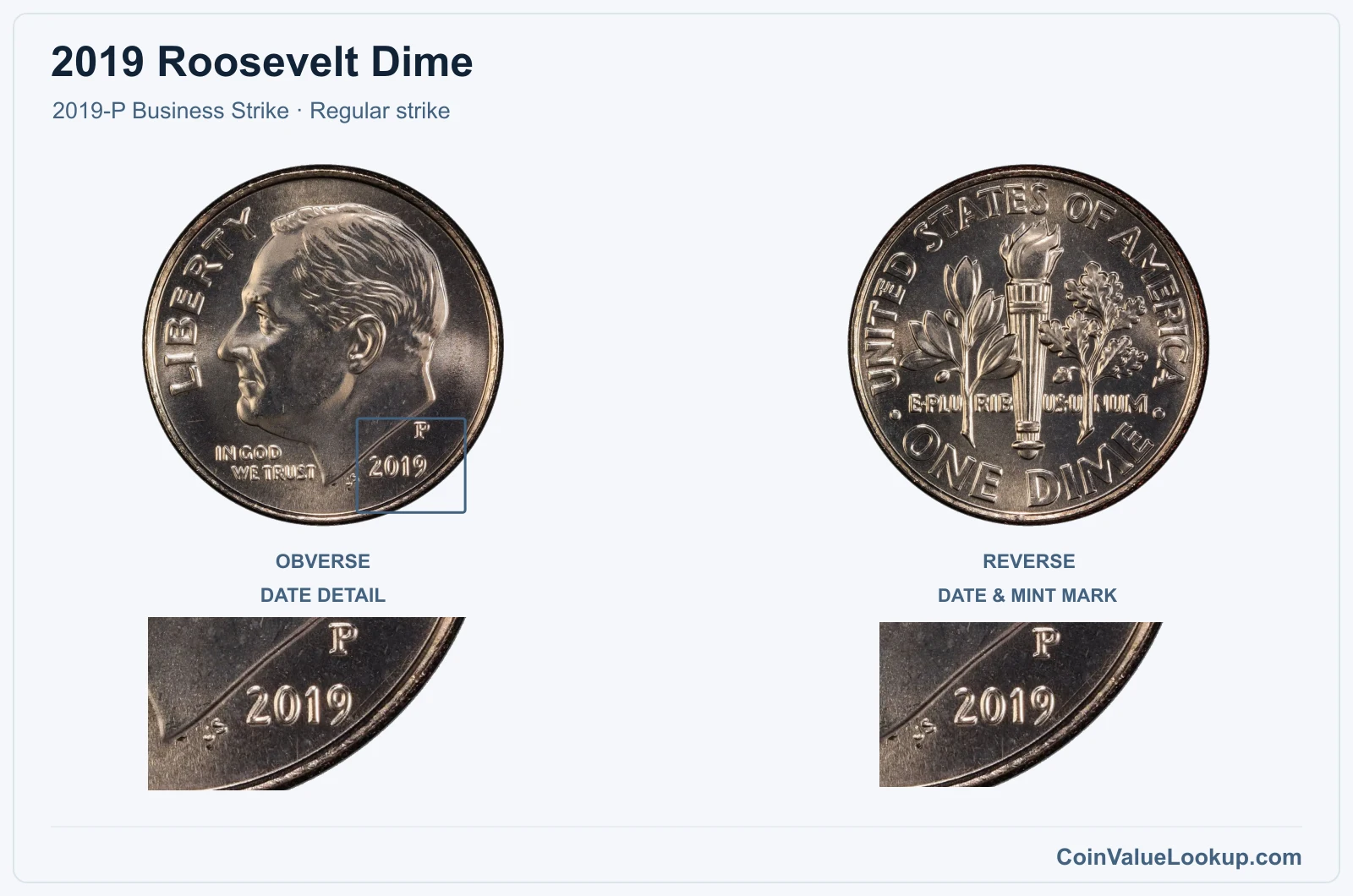
The 2019-P business strike was produced at Philadelphia and carries the P mintmark on the reverse. It is copper-nickel clad over a copper core, weighing 2.27 grams.
In circulated grades, this coin spends at face value and nobody will give you a second glance at the bank.
At MS65, the USA Coin Book guide estimates about $2.50. Look for original luster without cleaning and sharp torch bands to identify a higher-quality example.
This contains no silver regardless of how shiny it looks.
Range Grade
Price Auction Records Appraisal PO PO 1
—
Coin Identifier FR FR 2
—
Coin Identifier AG AG 3
—
Coin Identifier G G 4
—
Coin Identifier
G 6
—
Coin Identifier VG VG 8
—
Coin Identifier
VG 10
—
Coin Identifier F F 12
—
Coin Identifier
F 15
—
Coin Identifier VF VF 20
—
Coin Identifier
VF 25
—
Coin Identifier
VF 30
—
Coin Identifier
VF 35
—
Coin Identifier XF XF 40
—
Coin Identifier
XF 45
—
Coin Identifier AU AU 50
—
Coin Identifier
AU 53
—
Coin Identifier
AU 55
—
Coin Identifier
AU 58
—
Coin Identifier MS MS 60
—
Coin Identifier
MS 61
—
Coin Identifier
MS 62
—
Coin Identifier
MS 63
—
Coin Identifier
MS 64
—
Coin Identifier
MS 65
—
Coin Identifier
MS 66
—
Coin Identifier
MS 67
—
Coin Identifier
MS 68
—
Coin Identifier
MS 69
—
—
—
MS 70
—
—
—
2019 Roosevelt Dime — D Business Strike
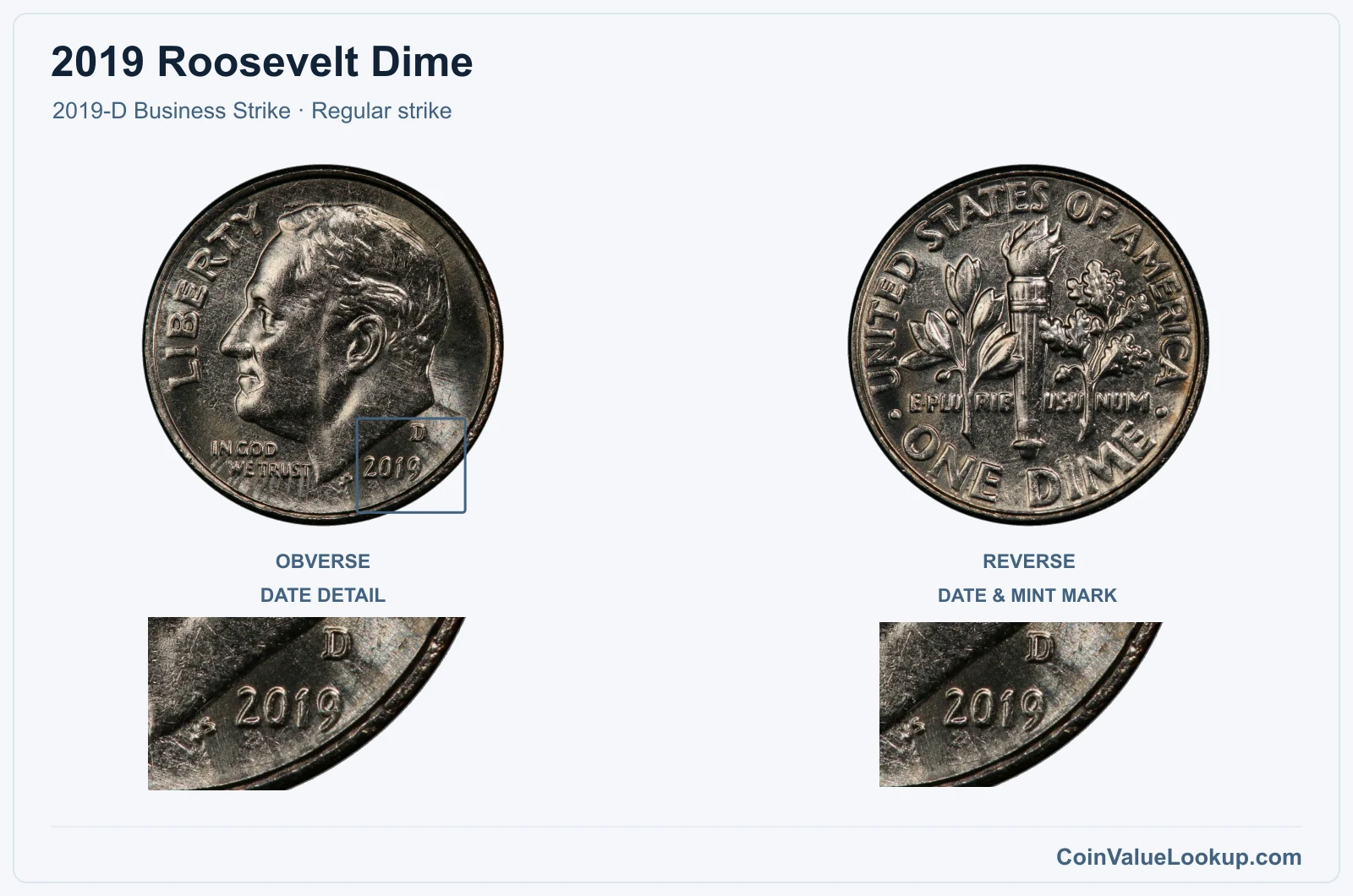
Denver struck the 2019-D dime, identifiable by the D mintmark near the torch base on the reverse. Same copper-nickel clad composition, same 2.27-gram weight, same design as the P mint.
The USA Coin Book guide lists about $2.50 at MS65. A well-preserved roll coin with full original surfaces and clear band separation is the kind of piece that edges above face value.
Circulated examples are still just dimes.
Range Grade
Price Auction Records Appraisal PO PO 1
—
Coin Identifier FR FR 2
—
Coin Identifier AG AG 3
—
Coin Identifier G G 4
—
Coin Identifier
G 6
—
Coin Identifier VG VG 8
—
Coin Identifier
VG 10
—
Coin Identifier F F 12
—
Coin Identifier
F 15
—
Coin Identifier VF VF 20
—
Coin Identifier
VF 25
—
Coin Identifier
VF 30
—
Coin Identifier
VF 35
—
Coin Identifier XF XF 40
—
Coin Identifier
XF 45
—
Coin Identifier AU AU 50
—
Coin Identifier
AU 53
—
Coin Identifier
AU 55
—
Coin Identifier
AU 58
—
Coin Identifier MS MS 60
—
Coin Identifier
MS 61
—
Coin Identifier
MS 62
—
Coin Identifier
MS 63
—
Coin Identifier
MS 64
—
Coin Identifier
MS 65
—
Coin Identifier
MS 66
—
Coin Identifier
MS 67
—
Coin Identifier
MS 68
—
—
—
MS 69
—
—
—
MS 70
—
—
—
2019 Roosevelt Dime — S Clad Proof
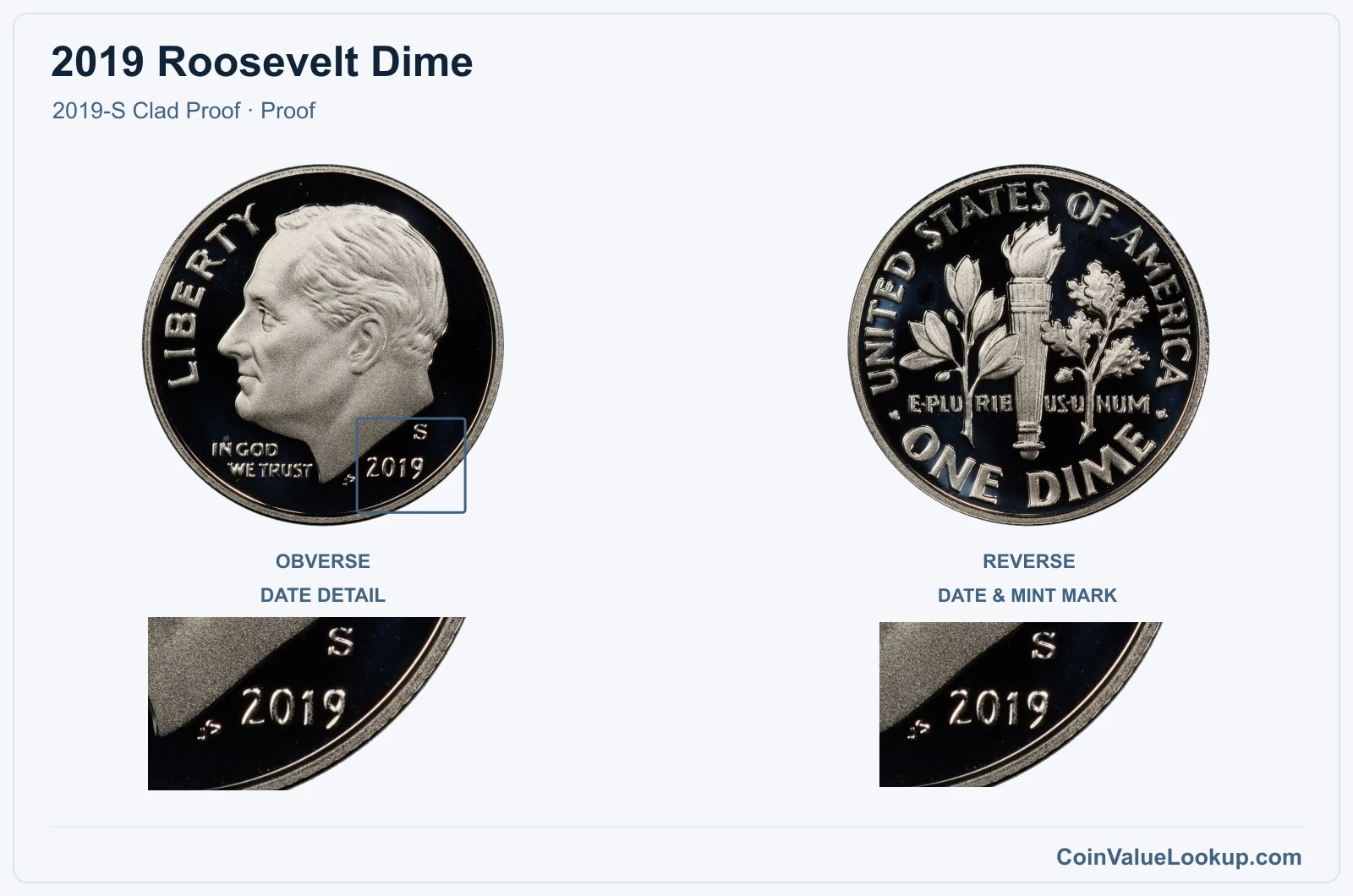
The 2019-S clad proof was struck at San Francisco with an S mintmark and mirror-finish fields. It weighs 2.27 grams — the same as P and D business strikes — because it is copper-nickel clad, not silver.
Check the edge for the telltale copper stripe.
At PR65 the USA Coin Book guide estimates about $3.08. These usually come in original Mint packaging.
A proof finish alone does not mean the coin is silver. If you are unsure, weigh it: the silver version is heavier at roughly 2.537 grams.
Range Grade
Price Auction Records Appraisal PR PR 1
—
Coin Identifier
PR 2
—
Coin Identifier
PR 3
—
Coin Identifier
PR 4
—
Coin Identifier
PR 6
—
Coin Identifier
PR 8
—
Coin Identifier
PR 10
—
Coin Identifier
PR 12
—
Coin Identifier
PR 15
—
Coin Identifier
PR 20
—
Coin Identifier
PR 25
—
Coin Identifier
PR 30
—
Coin Identifier
PR 35
—
Coin Identifier
PR 40
—
Coin Identifier
PR 45
—
Coin Identifier
PR 50
—
Coin Identifier
PR 53
—
Coin Identifier
PR 55
—
Coin Identifier
PR 58
—
Coin Identifier
PR 60
—
Coin Identifier
PR 61
—
Coin Identifier
PR 62
—
Coin Identifier
PR 63
—
Coin Identifier
PR 64
—
Coin Identifier
PR 65
—
Coin Identifier
PR 66
—
Coin Identifier
PR 67
—
Coin Identifier
PR 68
—
Coin Identifier
PR 69
—
Coin Identifier
PR 70
—
Coin Identifier
2019 Roosevelt Dime — S Silver Proof
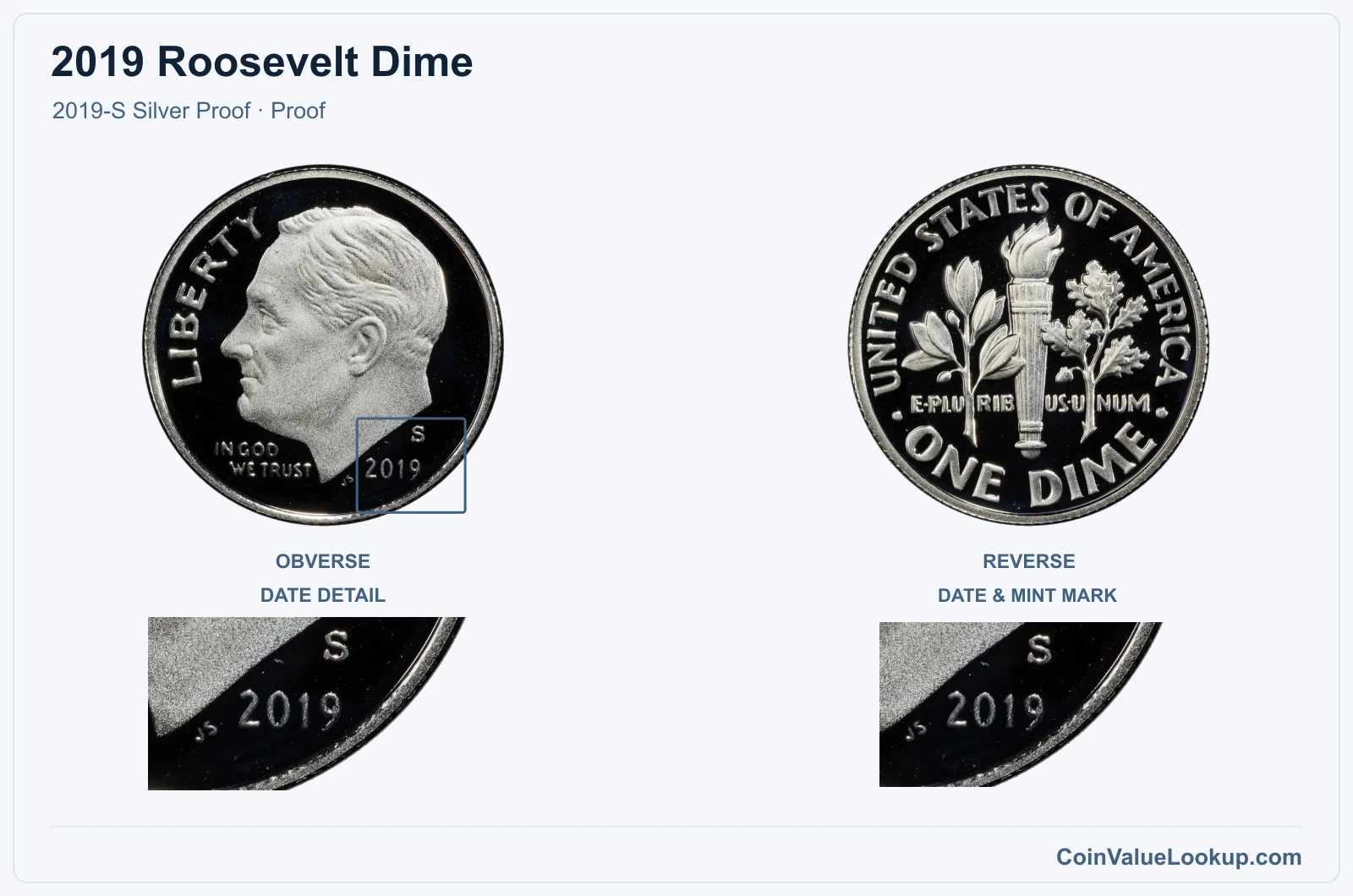
This is the 2019-S silver proof, struck in .999 fine silver — a purity level that began with the 2019 issue, replacing the older 90% silver standard used in earlier proof sets. It nominally weighs 2.537 grams, noticeably more than the 2.27-gram clad versions.
Coin Value Lookup is a handy place to look up guides for different Roosevelt dime years and versions when you want to compare values across the series.
At PR65, the USA Coin Book guide estimates about $12.48. Confirm silver content by weighing the coin and examining the edge — no copper stripe should be visible.
Match the exact mint, metal and finish before comparing any price estimate.
Range Grade
Price Auction Records Appraisal PR PR 1
—
Coin Identifier
PR 2
—
Coin Identifier
PR 3
—
Coin Identifier
PR 4
—
Coin Identifier
PR 6
—
Coin Identifier
PR 8
—
Coin Identifier
PR 10
—
Coin Identifier
PR 12
—
Coin Identifier
PR 15
—
Coin Identifier
PR 20
—
Coin Identifier
PR 25
—
Coin Identifier
PR 30
—
Coin Identifier
PR 35
—
Coin Identifier
PR 40
—
Coin Identifier
PR 45
—
Coin Identifier
PR 50
—
Coin Identifier
PR 53
—
Coin Identifier
PR 55
—
Coin Identifier
PR 58
—
Coin Identifier
PR 60
—
Coin Identifier
PR 61
—
Coin Identifier
PR 62
—
Coin Identifier
PR 63
—
Coin Identifier
PR 64
—
Coin Identifier
PR 65
—
Coin Identifier
PR 66
—
Coin Identifier
PR 67
—
Coin Identifier
PR 68
—
Coin Identifier
PR 69
—
Coin Identifier
PR 70
—
Coin Identifier
2019 Roosevelt Dime Error List
1. 2019 Roosevelt Dime — Partial Missing Obverse Clad Layer
A 2019-P business strike has been authenticated with approximately 80 percent of the obverse clad layer missing, exposing the copper core underneath. The result is a coin with a distinctive copper-orange obverse face while the reverse retains its normal clad appearance.
Look for a clear boundary line on the obverse where the remaining clad metal meets the exposed copper. The date and P mintmark should still be readable.
One PCGS-graded MS61 Full Bands example sold through Heritage Auctions for $139 in September 2024.
Be careful: acid-stripped coins, plated coins and surface staining can mimic this look. Genuine missing clad layer errors show a consistent exposed area with a natural transition at the boundary, not patchy discoloration or chemical residue.
Professional authentication is strongly recommended before assuming any value above face.
2. 2019 Roosevelt Dime — Broadstrike
A broadstrike happens when the collar die that normally confines the blank is absent or malfunctions during striking. The design spreads outward past the normal rim, and the coin's diameter appears slightly larger than a standard dime.
The rim may be weak or missing entirely.
On a 2019 dime, look for the full design visible but stretched toward the edges with no defined reeded edge. The coin should still show both obverse and reverse detail — if large chunks of design are gone, you may be looking at an off-center strike instead.
Post-mint flattening from machinery or deliberate damage can mimic the spread look, but the edge profile and metal flow will differ. Condition, the degree of spread and overall eye appeal all affect value.
Professional attribution helps separate genuine broadstrikes from lookalikes.
3. 2019 Roosevelt Dime — Die Crack / Die Chip
Die cracks appear as thin raised lines on the coin's surface, following the path of a fracture in the steel die. Die chips are small raised blobs where a piece of the die broke away, leaving a recessed spot that fills with metal during striking.
A larger break that connects to the rim is sometimes called a cud.
On a 2019 dime, inspect both sides under good light and magnification. These raised features will be consistent — the same line or blob in the same spot on multiple coins from that die.
Do not confuse die cracks with incuse scratches, which are recessed into the surface rather than raised. Corrosion pitting or foreign material stuck to the surface can also look similar.
Value depends on the size, location and visibility of the crack or chip, plus overall coin condition.
4. 2019 Roosevelt Dime — Clashed Dies
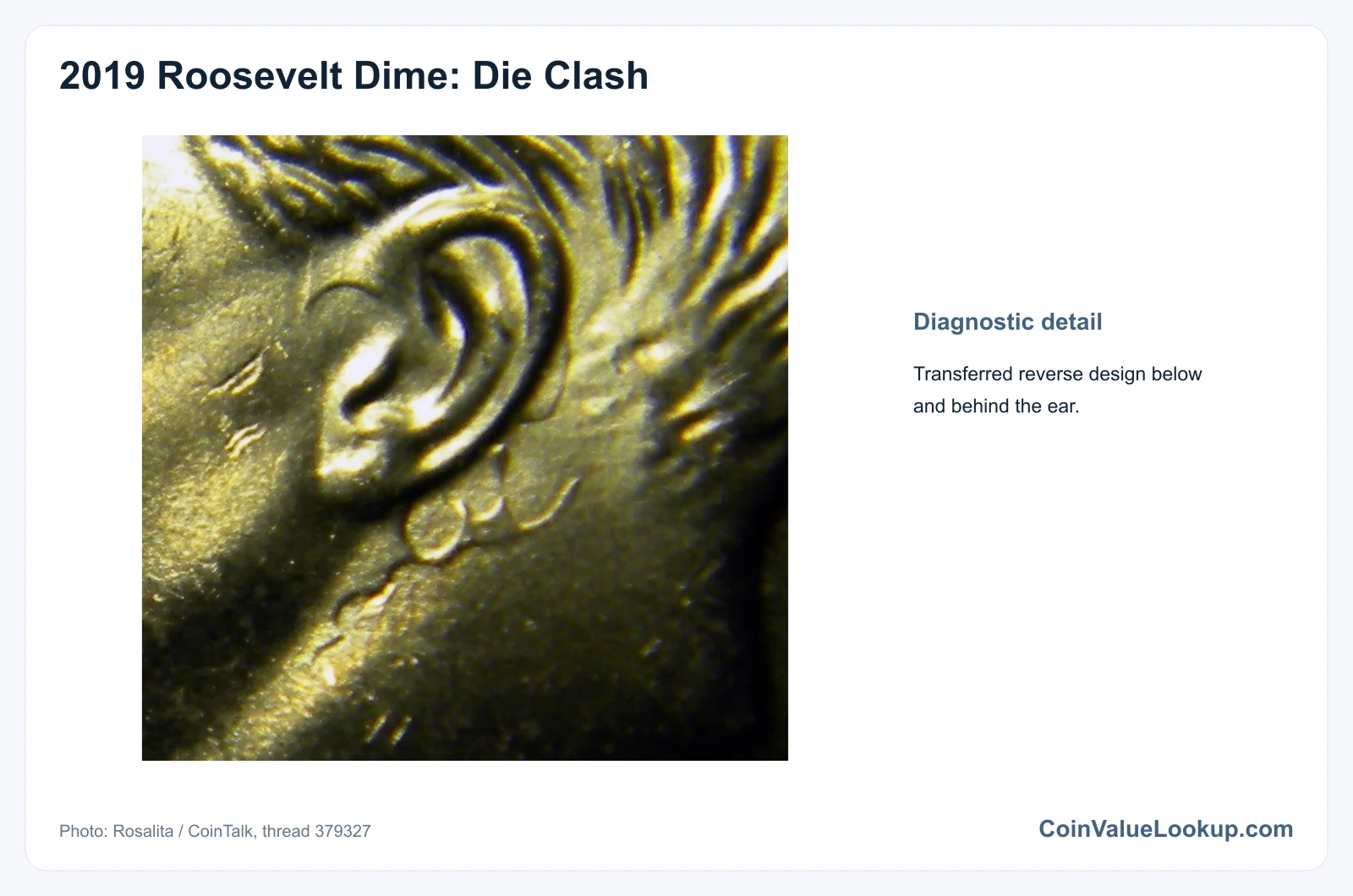
Clashed dies occur when the obverse and reverse dies strike each other without a planchet between them. The impact transfers ghost-like traces of one design onto the opposite die, and those traces then appear on subsequent coins.
On a 2019 dime, look for faint outlines of the torch or lettering in Roosevelt's cheek or neck area on the obverse, or traces of Roosevelt's profile showing up in open fields on the reverse. The transferred features should align with the expected position of the opposing die.
Random scratches, raised lines from other damage or a brockage impression can mimic a clash. True die clash marks are consistent, softly raised and positioned where the opposite design would logically appear.
The strength and clarity of the clash, along with the coin's condition, determine collector interest.
5. 2019 Roosevelt Dime — Lamination / Split Planchet
A lamination error on a 2019 dime shows up as peeling, flaking or separated metal — a flaw that originates within the planchet's alloy layers during manufacturing. You might see a retained flap of metal that can be lifted slightly, or a missing section where a piece has already broken away.
Photograph the affected face and the edge together. The edge view often reveals the separation between layers and helps confirm the defect is internal rather than surface damage.
Scraping, corrosion and deliberately cut or altered coins can look similar. A genuine lamination typically follows the contour of the coin's surface and shows a natural metal grain at the separation.
The size of the affected area and the coin's overall condition influence how much collectors will pay. Professional authentication is recommended for any significant example.
6. 2019 Roosevelt Dime — Off-Center Strike
An off-center strike means the planchet was not properly seated in the collar when the dies came together. The result is a crescent-shaped blank area on one side with the design shifted away from center.
For a 2019 dime, the most collectible off-center errors retain a visible date and mintmark. A coin struck 5% off-center looks slightly odd; one struck 50% off-center with the date showing is considerably more desirable.
Do not confuse this with a clipped planchet, which removes material before striking, or post-mint flattening that distorts the design. A genuine off-center strike shows a smooth unstruck crescent and the design elements shift uniformly in one direction.
The percentage of displacement, date visibility and condition all affect value.
7. 2019 Roosevelt Dime — Struck-Through Error
A struck-through error occurs when foreign material — grease, a thread, a metal fragment — gets caught between the die and the planchet during striking. The result is a localized depression or incomplete area of the design where the obstruction blocked full metal flow.
On a 2019 dime, look for a clearly defined depressed area that does not match normal wear patterns. Grease-filled dies tend to create smooth, rounded missing detail, while a retained foreign object may leave a distinct impression or texture.
Ordinary wear, cleaning marks and weakly struck areas from a tired die can all mimic a struck-through. The key distinction is that a genuine struck-through shows a sharp boundary and surrounding detail at full strength.
The type of material involved, the size of the affected area and the coin's grade all play into what the error is worth.
8. 2019 Roosevelt Dime — Doubled Die Obverse
A doubled die obverse on a 2019 dime would show consistent doubling in the lettering, date or design elements on the obverse — produced by a misalignment during the die-making process rather than during striking.
Compare the obverse inscriptions on your coin to a normal 2019 dime under matching lighting and magnification. Genuine hub doubling produces notching or shelf-like separation on the letters that is consistent across multiple examples from the same die.
Machine doubling, which is far more common, creates a flat shelf appearance with no raised profile on the secondary image. Reflections and lighting tricks can also fool the eye.
Condition, the strength of the doubling and which design elements are affected all determine collector interest. If you suspect a doubled die, professional attribution is the way to confirm it.
9. 2019 Roosevelt Dime — Doubled Die Reverse
A doubled die reverse involves the same hub-doubling mechanism but affects the torch, lettering and design on the back of the coin. On a 2019 dime, compare the reverse legends and torch details carefully against a known normal example.
Look for consistent separation or notching on letters like E PLURIBUS UNUM or UNITED STATES OF AMERICA. The doubling should repeat in the same direction on every affected element.
Machine doubling is the most common lookalike — it produces flat, shelf-like displacement without the raised secondary image that true hub doubling creates. Random damage and reflections can also mislead.
The degree of doubling, which elements are affected and the coin's overall condition all influence value. Professional attribution is recommended for any coin you believe shows genuine die doubling.