1971 Eisenhower Dollar Coin Value: How Much Is It Worth?
The 1971 Eisenhower dollar launched a new large-dollar era, but most clad examples are worth close to face value in circulated condition. A guide estimate for an uncirculated MS63 Philadelphia or Denver clad piece sits around $7–$8.
The real action is in the San Francisco 40% silver issues, the Denver Friendly Eagle variety, and a handful of dramatic mint errors that have individually sold for hundreds or even thousands of dollars.
Fast Way to Identify Your 1971 Eisenhower Dollar
Want a quick read on what you have? Upload clear photos of the front and back of your 1971 Eisenhower dollar.
This preliminary identification can help you figure out the mint, finish and whether the reverse might be a Friendly Eagle or an obvious error. From there you can decide if professional grading is worthwhile.
1971 Eisenhower Dollar Value
Upload both sides of your 1971 Eisenhower Dollar.
Front Obverse
Upload photo
Back Reverse
Upload photo
Which 1971 Eisenhower Dollar Versions Are Worth Money?
- 1971-S 40% silver uncirculated and proof issues carry a guide estimate around $34, well above the clad versions.
- 1971-D Friendly Eagle reverse variety guides near $19 in MS63, roughly double the standard Denver dollar.
- Authenticated dramatic errors such as wrong-planchet strikes and overstrikes have individually sold for hundreds to thousands of dollars at auction.
Step 1: Identify Your 1971 Eisenhower Dollar Mint Mark and Version
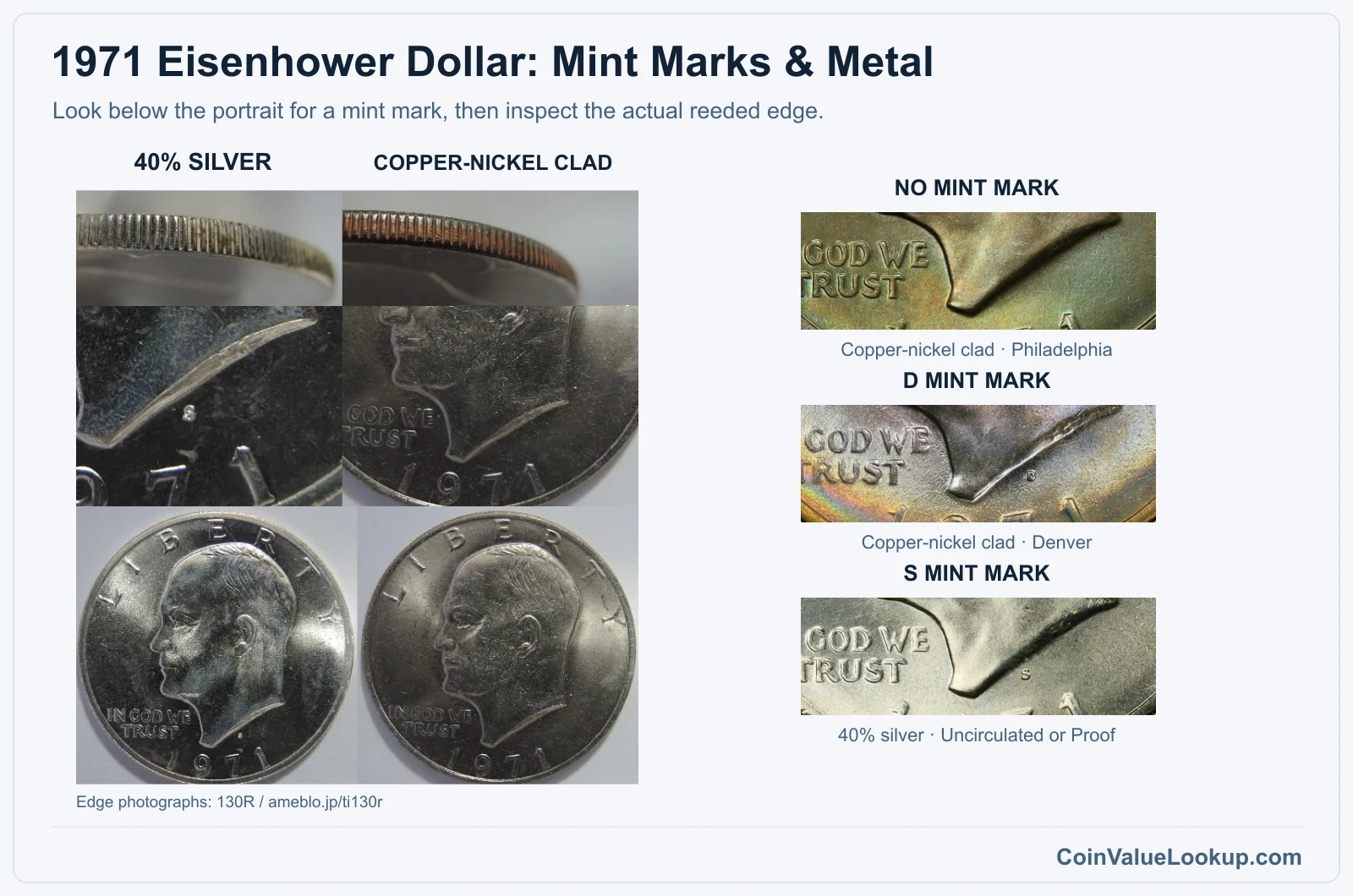
Start with the date. Every 1971 Ike dollar reads "1971" on the obverse, but the mint mark is the real fork in the road.
Philadelphia strikes carry no mint letter at all. Denver and San Francisco coins show a small "D" or "S" on the obverse, just below the bust truncation and above the date.
Mint mark alone does not tell you the whole story. You also need to determine the alloy.
Normal clad dollars from Philadelphia and Denver have a copper-colored core visible along the edge and weigh about 22.68 grams. San Francisco pieces are 40% silver, weigh roughly 24.59 grams and show a uniform silver-gray edge.
A shiny surface does not automatically mean proof or silver. Proof manufacture produces mirrored fields and sharply struck devices; it is a finish, not a grade above Mint State.
If your coin has an "S" mint mark but you are unsure about finish, examine the fields under angled light for the distinctive reflective quality of a proof.
The 1971 lineup breaks down into five main branches: Philadelphia clad business strike, Denver clad business strike (standard reverse), Denver clad Friendly Eagle reverse, San Francisco 40% silver uncirculated, and San Francisco 40% silver proof. There is no ordinary 1971-S clad proof.
Never clean or polish your coin before evaluating it. Cleaning destroys original surfaces and almost always reduces collector value.
Step 2: Check Your 1971 Eisenhower Dollar Grade
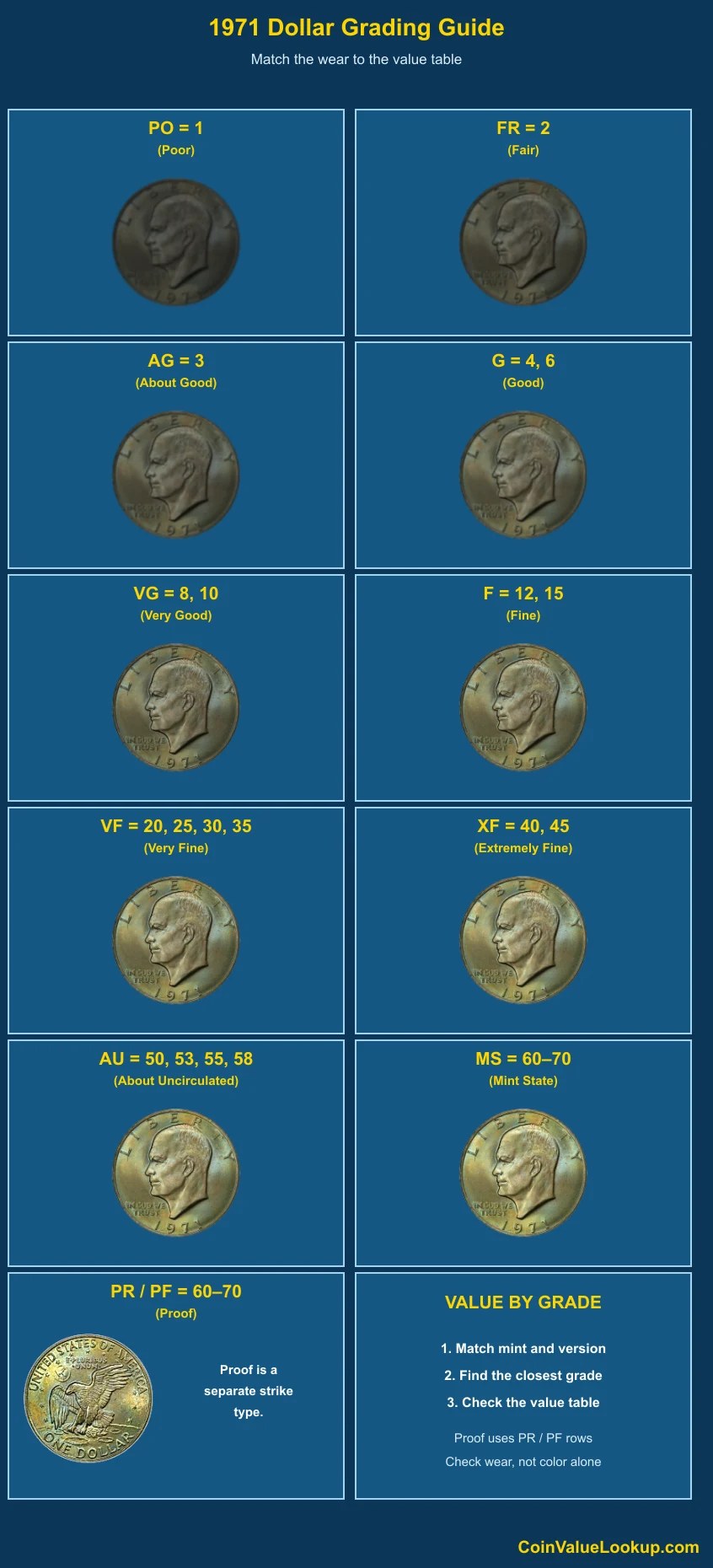
Focus on the high points first. On the obverse, Eisenhower's cheek and jawline show wear earliest, and the broad open fields around the portrait pick up bag marks easily.
Under tilted light, check whether luster flows unbroken across both sides; interrupted or dull patches usually signal wear or contact damage.
On the reverse, inspect the eagle's breast feathers and the tops of the wings. Weak detail there can mean circulation wear, but it can also reflect a soft original strike, so compare your coin against the reference image to see what normal full-strike detail looks like for this type.
For proof coins, grade on a separate ladder. Look for hairlines across the mirrored fields and whether cameo contrast between frosted devices and reflective fields is preserved.
Hairlines from mishandling or wiping are the main condition detractor on proofs.
Bag marks matter a lot on these big coins. Even uncirculated Ikes fresh from a mint bag can carry heavy contact marks from bouncing against other dollars, and those marks separate an MS60 from an MS65 more than anything else.
Step 3: Check 1971 Eisenhower Dollar Value by Mint and Version
1971 Eisenhower Dollar — No Mint Mark — Clad
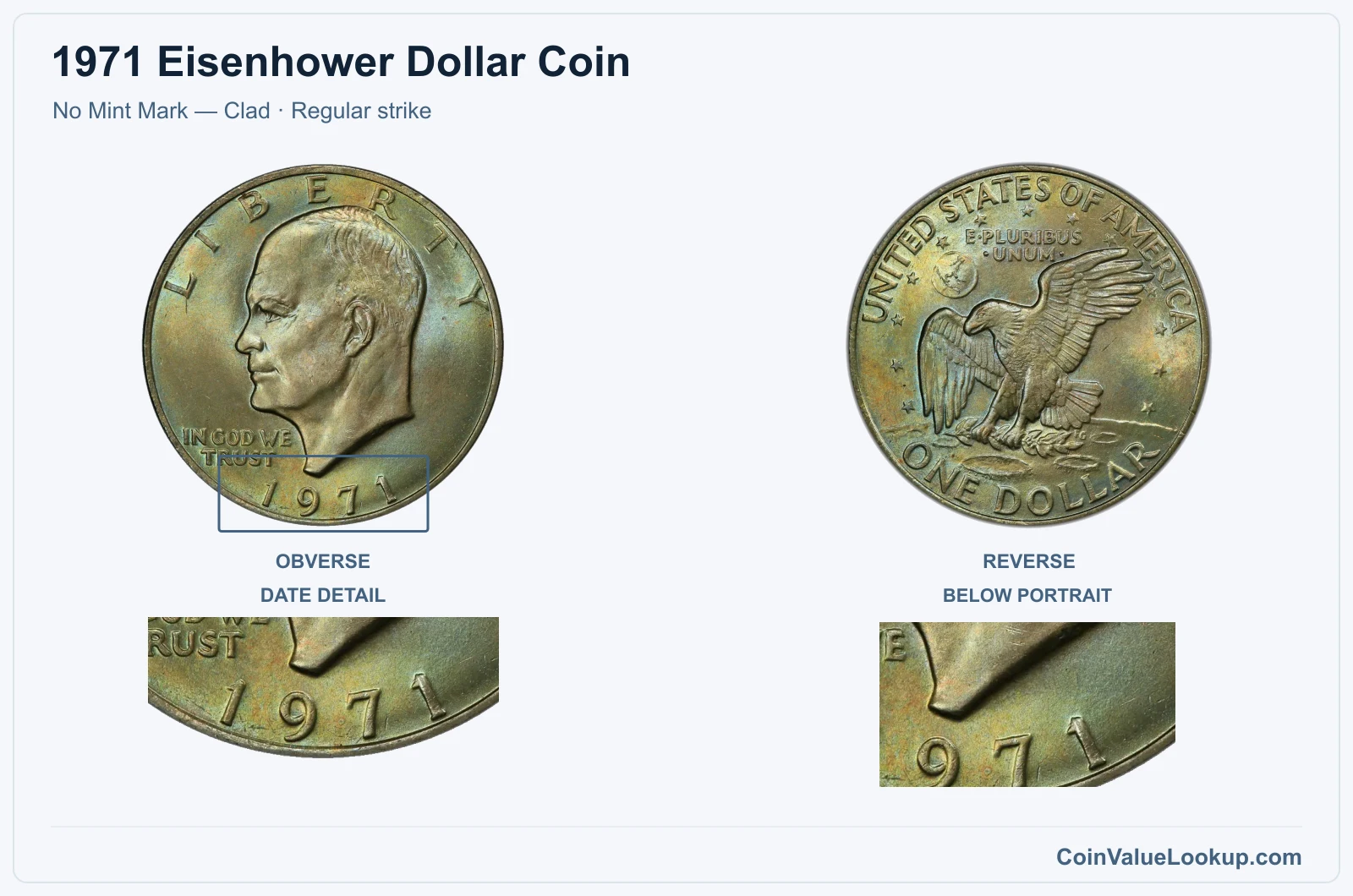
The Philadelphia 1971 Eisenhower dollar has no mint mark on the obverse. It is struck in copper-nickel clad over a copper core, weighing about 22.68 grams with no silver content.
This was the workhorse circulation issue, and worn examples rarely trade above face value. A guide estimate from USA Coin Book places an MS63 example at roughly $7.87.
Any premium above a dollar depends on original luster and the absence of the heavy bag marks these large coins are famous for collecting.
Range Grade
Price Auction Records Appraisal PO PO 1
—
Coin Identifier FR FR 2
—
Coin Identifier AG AG 3
—
Coin Identifier G G 4
—
Coin Identifier
G 6
—
Coin Identifier VG VG 8
—
Coin Identifier
VG 10
—
Coin Identifier F F 12
—
Coin Identifier
F 15
—
Coin Identifier VF VF 20
—
Coin Identifier
VF 25
—
Coin Identifier
VF 30
—
Coin Identifier
VF 35
—
Coin Identifier XF XF 40
—
Coin Identifier
XF 45
—
Coin Identifier AU AU 50
—
Coin Identifier
AU 53
—
Coin Identifier
AU 55
—
Coin Identifier
AU 58
—
Coin Identifier MS MS 60
—
Coin Identifier
MS 61
—
Coin Identifier
MS 62
—
Coin Identifier
MS 63
Coin Identifier
MS 64
Coin Identifier
MS 65
Coin Identifier
MS 66
Coin Identifier
MS 67
Coin Identifier
MS 68
—
—
—
MS 69
—
—
—
MS 70
—
—
—
1971 Eisenhower Dollar — D — Clad, Standard Reverse
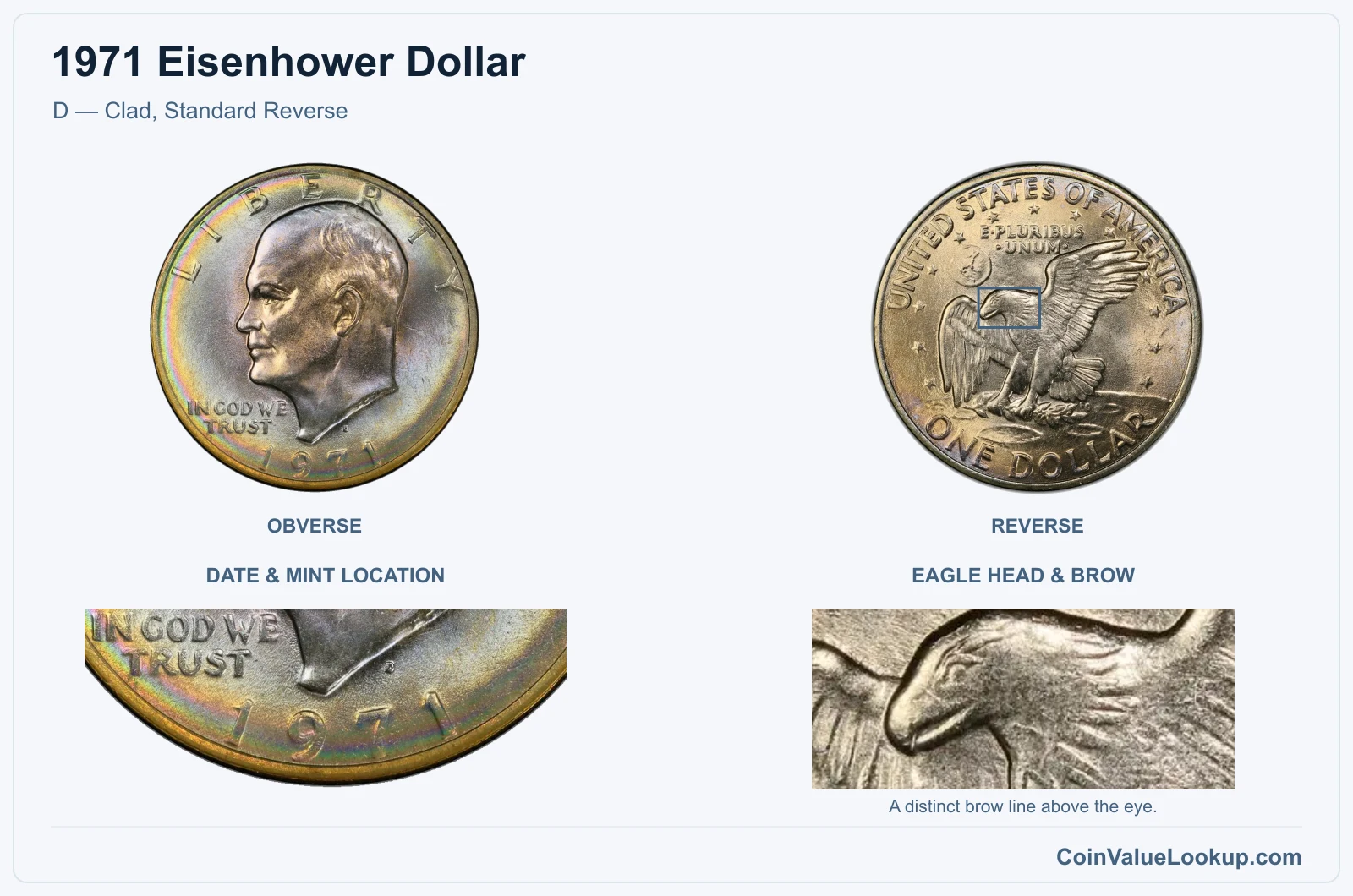
Denver's 1971-D clad dollar is the same copper-nickel composition as the Philadelphia issue, identified by a small "D" on the obverse below the bust. The USA Coin Book guide estimate for MS63 is about $7.29.
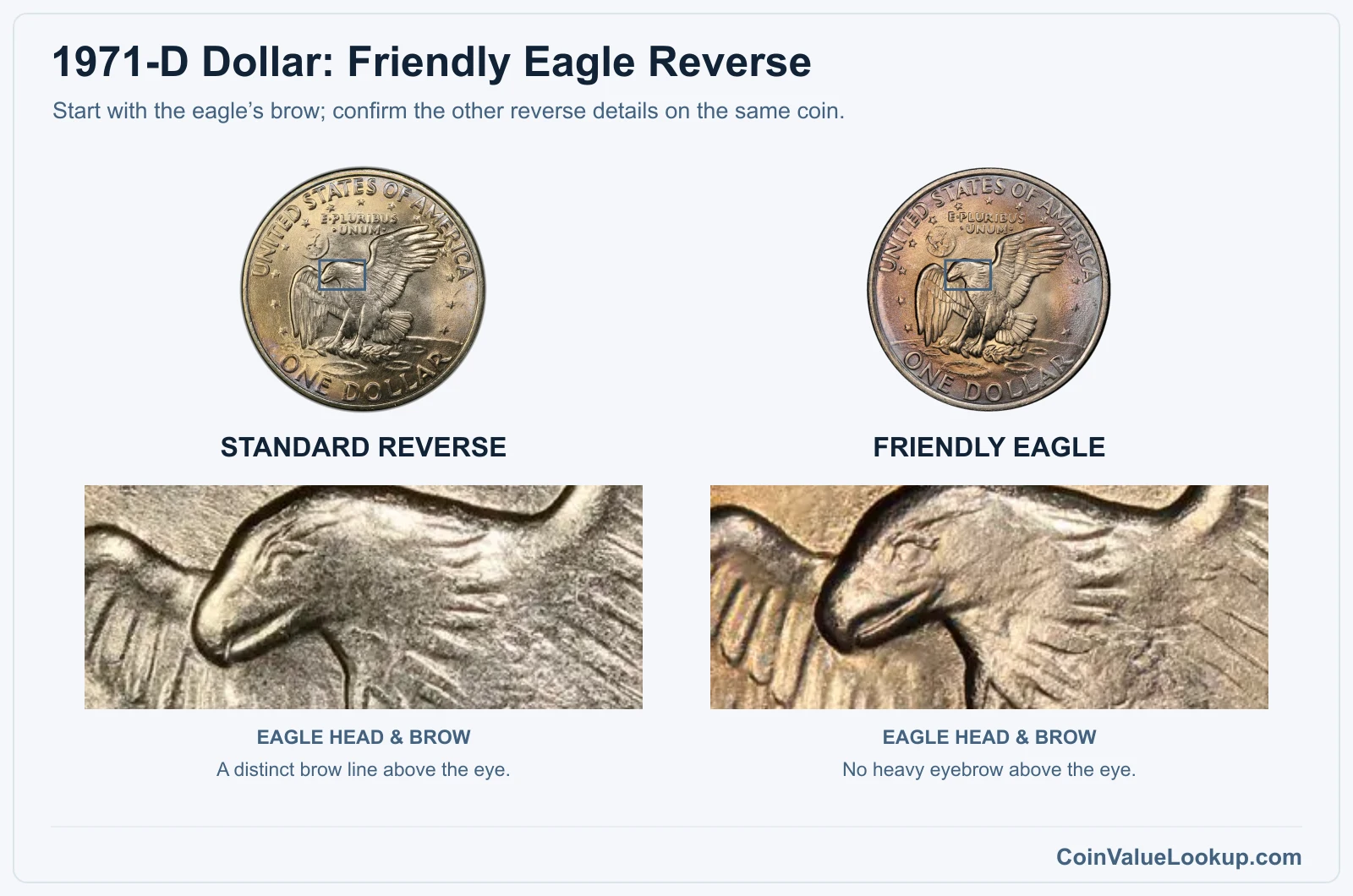
Before you slot your coin here, flip it over and compare the eagle carefully to the Friendly Eagle variety. If your reverse matches the standard design with a clear eyebrow ridge above the eagle's eye and normal geography details, this is your branch.
Range Grade
Price Auction Records Appraisal PO PO 1
—
Coin Identifier FR FR 2
Coin Identifier AG AG 3
Coin Identifier G G 4
—
Coin Identifier
G 6
—
Coin Identifier VG VG 8
—
Coin Identifier
VG 10
—
Coin Identifier F F 12
—
Coin Identifier
F 15
—
Coin Identifier VF VF 20
—
Coin Identifier
VF 25
—
Coin Identifier
VF 30
—
Coin Identifier
VF 35
—
Coin Identifier XF XF 40
—
Coin Identifier
XF 45
—
Coin Identifier AU AU 50
—
Coin Identifier
AU 53
—
Coin Identifier
AU 55
—
Coin Identifier
AU 58
—
Coin Identifier MS MS 60
—
Coin Identifier
MS 61
—
Coin Identifier
MS 62
Coin Identifier
MS 63
Coin Identifier
MS 64
Coin Identifier
MS 65
Coin Identifier
MS 66
Coin Identifier
MS 67
Coin Identifier
MS 68
—
—
—
MS 69
—
—
—
MS 70
—
—
—
1971 Eisenhower Dollar — D — Friendly Eagle Reverse
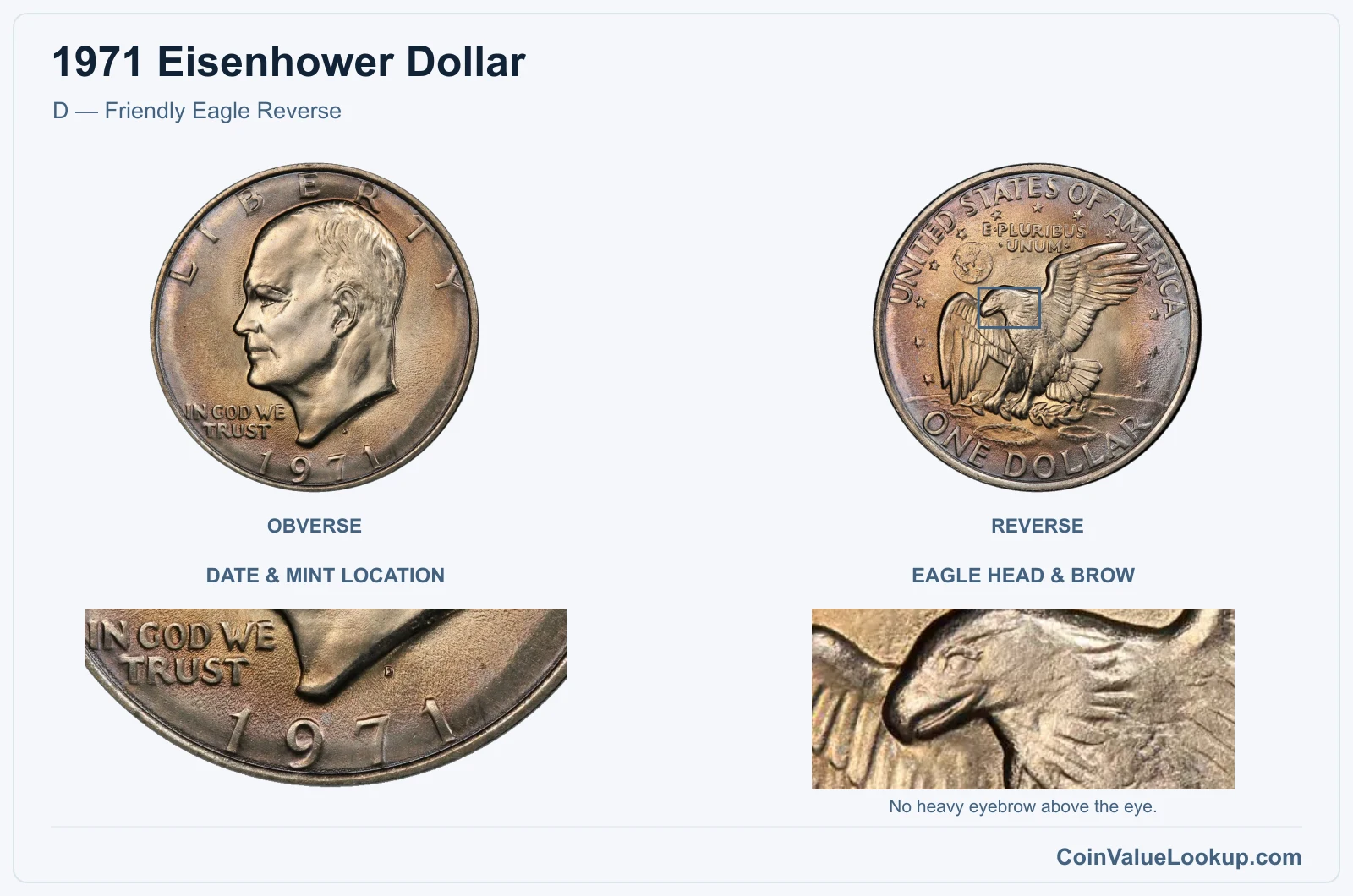
The 1971-D Friendly Eagle is a recognized reverse variety worth checking for. The eagle's eyebrow is absent, giving the bird a smoother, less fierce appearance.
PCGS also identifies raised Andes mountain detail and altered Gulf geography as supporting diagnostics on this die. You need more than a missing eyebrow to be confident, because simple abrasion or a weak strike can obscure that one feature.
Match at least two reverse characteristics before concluding you have the Friendly Eagle. The USA Coin Book guide estimate for this variety in MS63 is about $19, roughly two and a half times the standard 1971-D.
Same clad composition, same weight, just a different reverse die.
Coin Value Lookup is a good starting point if you want to compare your Ike dollar with other dates and varieties in the series.
Range Grade
Price Auction Records Appraisal PO PO 1
—
Coin Identifier FR FR 2
Coin Identifier AG AG 3
Coin Identifier G G 4
—
Coin Identifier
G 6
—
Coin Identifier VG VG 8
—
Coin Identifier
VG 10
—
Coin Identifier F F 12
—
Coin Identifier
F 15
—
Coin Identifier VF VF 20
—
Coin Identifier
VF 25
—
Coin Identifier
VF 30
—
Coin Identifier
VF 35
—
Coin Identifier XF XF 40
—
Coin Identifier
XF 45
—
Coin Identifier AU AU 50
—
Coin Identifier
AU 53
—
Coin Identifier
AU 55
—
Coin Identifier
AU 58
—
Coin Identifier MS MS 60
—
Coin Identifier
MS 61
—
Coin Identifier
MS 62
Coin Identifier
MS 63
Coin Identifier
MS 64
Coin Identifier
MS 65
Coin Identifier
MS 66
Coin Identifier
MS 67
Coin Identifier
MS 68
—
—
—
MS 69
—
—
—
MS 70
—
—
—
1971 Eisenhower Dollar — S — 40% Silver Uncirculated
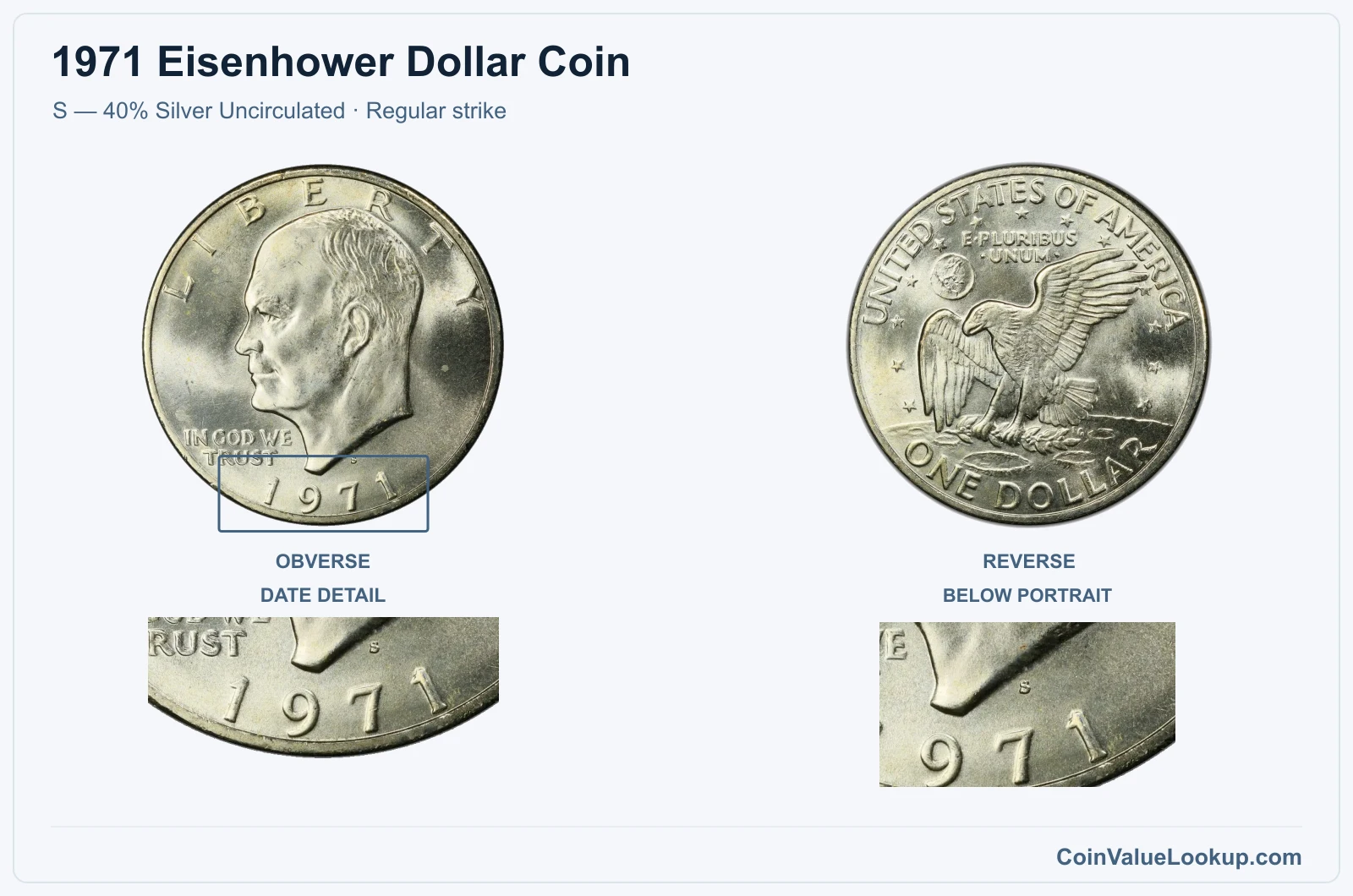
San Francisco produced 1971-S Eisenhower dollars in a 40% silver composition, weighing approximately 24.59 grams. Uncirculated business-strike examples are often found in their original blue government packaging.
That packaging is helpful provenance, but it is not a guarantee of alloy content or grade on its own.
The USA Coin Book guide estimate for MS63 is about $34, a clear step above clad issues. Check the edge for a uniform silvery appearance rather than the copper stripe you see on clad dollars.
The heavier weight is another screening tool, though a precise scale reading alone does not substitute for professional authentication.
Range Grade
Price Auction Records Appraisal PO PO 1
—
Coin Identifier FR FR 2
—
Coin Identifier AG AG 3
—
Coin Identifier G G 4
—
Coin Identifier
G 6
—
Coin Identifier VG VG 8
—
Coin Identifier
VG 10
—
Coin Identifier F F 12
—
Coin Identifier
F 15
—
Coin Identifier VF VF 20
—
Coin Identifier
VF 25
—
Coin Identifier
VF 30
—
Coin Identifier
VF 35
—
Coin Identifier XF XF 40
—
Coin Identifier
XF 45
—
Coin Identifier AU AU 50
—
Coin Identifier
AU 53
—
Coin Identifier
AU 55
—
Coin Identifier
AU 58
—
Coin Identifier MS MS 60
—
Coin Identifier
MS 61
—
Coin Identifier
MS 62
Coin Identifier
MS 63
Coin Identifier
MS 64
Coin Identifier
MS 65
Coin Identifier
MS 66
Coin Identifier
MS 67
Coin Identifier
MS 68
Coin Identifier
MS 69
—
—
—
MS 70
—
—
—
1971 Eisenhower Dollar — S — 40% Silver Proof
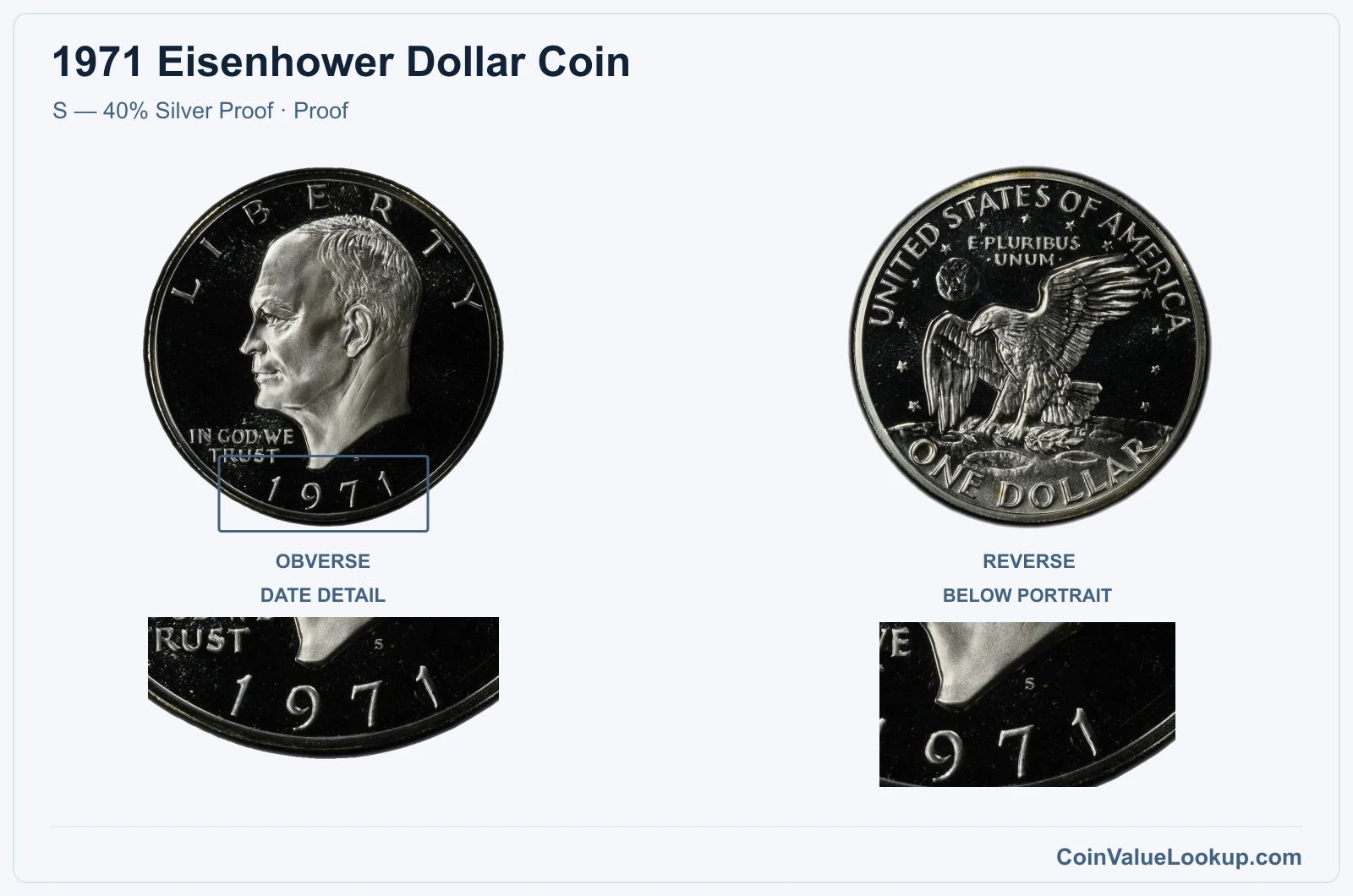
The 1971-S silver proof is also 40% silver and nominally 24.59 grams, but it was manufactured with polished dies and specially prepared planchets to produce mirror-like fields and sharp device detail. The USA Coin Book guide places a PR65 example at about $34.
Proof coins require their own condition assessment. Hairlines from handling or wiping are the most common detractors.
Cameo contrast, where the devices appear frosted against reflective fields, is a desirable characteristic that collectors evaluate within this proof category. Do not confuse a proof finish with a high Mint State grade; they are separate systems.
Range Grade
Price Auction Records Appraisal PR PR 1
—
Coin Identifier
PR 2
—
Coin Identifier
PR 3
—
Coin Identifier
PR 4
—
Coin Identifier
PR 6
—
Coin Identifier
PR 8
—
Coin Identifier
PR 10
—
Coin Identifier
PR 12
—
Coin Identifier
PR 15
—
Coin Identifier
PR 20
—
Coin Identifier
PR 25
—
Coin Identifier
PR 30
—
Coin Identifier
PR 35
—
Coin Identifier
PR 40
—
Coin Identifier
PR 45
—
Coin Identifier
PR 50
—
Coin Identifier
PR 53
—
Coin Identifier
PR 55
—
Coin Identifier
PR 58
—
Coin Identifier
PR 60
—
Coin Identifier
PR 61
—
Coin Identifier
PR 62
—
Coin Identifier
PR 63
—
Coin Identifier
PR 64
—
Coin Identifier
PR 65
Coin Identifier
PR 66
Coin Identifier
PR 67
Coin Identifier
PR 68
Coin Identifier
PR 69
Coin Identifier
PR 70
—
—
—
1971 Eisenhower Dollar Error List
1. 1971 Eisenhower Dollar — Missing Obverse Clad Layer
A 1971-D clad dollar missing its obverse clad layer exposes the copper core on the portrait side while the reverse retains its normal silvery clad surface. The coin typically weighs less than the standard 22.68 grams because an entire outer metal layer is absent.
Look at the obverse color first. If it is distinctly copper-toned while the reverse looks normal, you may have this error.
Check the edge transition as well: the missing layer should be evident where the clad sandwich is visible from the side.
One PCGS MS63 example sold for $1,150 at auction in August 2001. That is a single historical sale, not a current market range.
Watch out for lookalikes: acid-treated coins, environmental damage, heavy toning and actual silver specimens can all produce unusual color. Professional authentication is important here.
2. 1971 Eisenhower Dollar — Double Strike with Off-Center and Brockage Features
This is a compound error on a 1971 Philadelphia (no mint mark) dollar. The coin was struck once normally, then struck a second time approximately 95% off center, with a small 3% obverse brockage and evidence of a tilted partial collar.
All of these features describe one coin and one event sequence, not separate errors to price individually.
You will see a displaced second impression overlapping only a sliver of the original strike, plus a small incuse mirror-image brockage area. The edge may show an uneven collar step from the tilted collar.
One PCGS MS61 example sold for $480 in June 2023 at Heritage Auctions. Machine doubling, vise marks and ordinary rim damage can mimic parts of this error, so examine the full picture before drawing conclusions.
3. 1971 Eisenhower Dollar — Struck on a Foreign Dollar Planchet
A 1971-S proof Eisenhower dollar struck on a Liberia dollar planchet is a wrong-planchet error. The proof design is present, but the underlying blank was not the intended 40% silver dollar planchet.
Composition and measured specifications differ from a normal Ike, though color alone is not enough to identify it.
One NGC PR64 example sold for $8,700 at Heritage Auctions in August 2022. That is a single historical sale for a certified, attributed coin, not a price you should expect for an unverified oddity.
Professional planchet attribution is essential. Lookalikes include normal silver proofs, plated coins and actual Liberia dollars bearing their own design.
If your coin simply looks a little different, get it in expert hands before assuming it is a wrong-planchet strike.
4. 1971 Eisenhower Dollar — Struck over an Assay Office Medal
One of the most dramatic 1971 Eisenhower errors on record is a 1971-S proof struck over a San Francisco Assay Office medal. The defining evidence is surviving medal lettering and devices visible beneath the Eisenhower dollar design.
A reddish surface alone does not prove a medal overstrike; you need actual underlying design elements.
An NGC PR69 Red Cameo example sold for $40,800 at Heritage Auctions in August 2022. This is an exceptional individual result for a uniquely attributed coin.
Do not apply that figure to any normal silver proof or copper-toned dollar. An ordinary damaged coin or one with a collector counterstamp can superficially resemble an overstrike.
Certified attribution is the only reliable path to confirming this error.
5. 1971 Eisenhower Dollar — Clipped Planchet
Clipped planchet errors occur when a curved section of the blank is missing before the coin is struck. On a 1971-D clad Eisenhower dollar, both 5% and 10% curved clips have been cataloged.
The key diagnostic is the edge transition: where the missing crescent meets the normal rim, the change should be smooth and pre-strike, not showing fresh cutting burrs or tool marks. Often the rim opposite the clip is slightly weak because metal could not flow fully during striking.
The design approaches the clip boundary without being sharply cut off.
No specific price range is supported for these clips. Value depends on the authenticated identity, condition and severity of the clip.
A coin cut after minting or an off-center strike on a complete blank can look superficially similar, so compare carefully.
6. 1971 Eisenhower Dollar — Off-Center Strike with Clashed Dies
This documented error is a 1971-S silver business-strike dollar that is 25% off center and also shows clashed dies. You get two features on one coin: a crescent of unstruck blank where the planchet missed the dies, plus faint transferred design from the opposite die visible in the fields.
An ordinary die clash alone, without the off-center strike, would not carry the same significance. The off-center component is the dramatic visual element, while the clash adds a second layer of mint-process evidence.
No supported price range is available. Value would depend on authentication, condition and the combined severity of both features.
Scratches, a misaligned die or a double strike can mimic aspects of this error. Examine the unstruck crescent shape and the ghostly opposite-die impression together before drawing any conclusions.
7. 1971 Eisenhower Dollar — Rotated Dies / Medal Alignment
A 1971-S silver proof has been cataloged with medallic alignment, meaning the reverse is rotated from normal coin orientation. To test this, hold the obverse portrait upright and flip the coin top to bottom.
On a normally aligned US coin, the reverse will also appear upright. On a medal-alignment error, the reverse will be inverted or rotated to a different axis.
No supported price is available for this error. Assessment depends on authentication, the degree of rotation and overall condition.
Be careful when checking: two separately rotated photos, a coin holder turned the wrong way, or a double-struck coin can all create the illusion of die rotation. Photograph both sides with a consistent reference point to document what you see.
8. 1971 Eisenhower Dollar — Indented Strike
An indented strike on a 1971-S silver business dollar occurs when a second blank partially overlaps the target planchet during striking. The result is a recessed, unstruck depression on the obverse, roughly 5% of the surface, shaped like the edge of another planchet.
Look at the boundary of the depression. It should be smooth and rounded, following the curve of the overlapping blank.
The struck design will be complete outside the indent, and the date and other features should remain legible.
No specific price is supported. Value depends on authentication, condition and the indent's size and location.
A post-mint dent or punch damage can look somewhat similar, but dents typically lack the smooth planchet-shaped boundary and do not affect the design in the same pre-strike way.
9. 1971 Eisenhower Dollar — Doubled Die Obverse
Doubled die obverse varieties exist on the 1971-S silver uncirculated Eisenhower dollar. The most visible diagnostic is extra, rounded letter contours in the IN GOD WE TRUST motto.
Compare your coin's lettering side by side with a normal same-finish 1971-S uncirculated example.
Strength varies across the documented dies. Some show bold doubling; others are subtler.
Do not apply proof pricing or proof die information to an uncirculated specimen, as these are separate products.
No supported price range is adopted for these varieties. Individual assessment depends on authenticated die attribution, doubling strength and coin condition.
Flat, shelf-like machine doubling, die deterioration and reflections from proof-like surfaces are common lookalikes. True hub doubling produces rounded, separated extra contours rather than flat mechanical shelving.