1870 Liberty Seated Dollar Coin Value: How Much Is It Worth?
The 1870 Liberty Seated Dollar is a coin that commands attention from collectors across every budget. Guide estimates for the versions and grades covered here range from roughly $478 to $54,425, depending on mint, finish and condition.
Those figures are guide estimates, not guaranteed offers, and your specific coin's value depends on its exact branch and grade.
Before you start dreaming about five-figure paydays, you need to pin down which version you actually have. Philadelphia, Carson City, San Francisco and proof strikes each follow very different value paths.
Identifying the mint and finish comes first; grading comes second.
Fast Way to Identify Your 1870 Liberty Seated Dollar
The quickest way to start figuring out what you have is to upload clear photos of both the front and back of your coin. Our identifier can give you a preliminary read on the mint, design and general version based on those images.
It will not authenticate errors, assign an exact grade or guarantee a price, but it is a solid first step before you dig deeper.
1870 Liberty Seated Dollar Value
Upload both sides of your 1870 Liberty Seated Dollar.
Front Obverse
Upload photo
Back Reverse
Upload photo
Which 1870 Liberty Seated Dollar Versions Are Worth Money?
- The 1870-CC (Carson City) is the key date to check, with guide estimates from $1,384 in G4 to $54,425 in MS63.
- The 1870 Proof is a special-finish Philadelphia striking that requires individual assessment by authenticated identity and condition.
- The 1870-S is an extremely scarce issue with no standard guide price adopted; authenticated examples require individual evaluation.
- Do not pay a premium for ordinary wear, cleaning, artificial toning or an unverified error claim.
Step 1: Identify Your 1870 Liberty Seated Dollar Mint Mark and Version
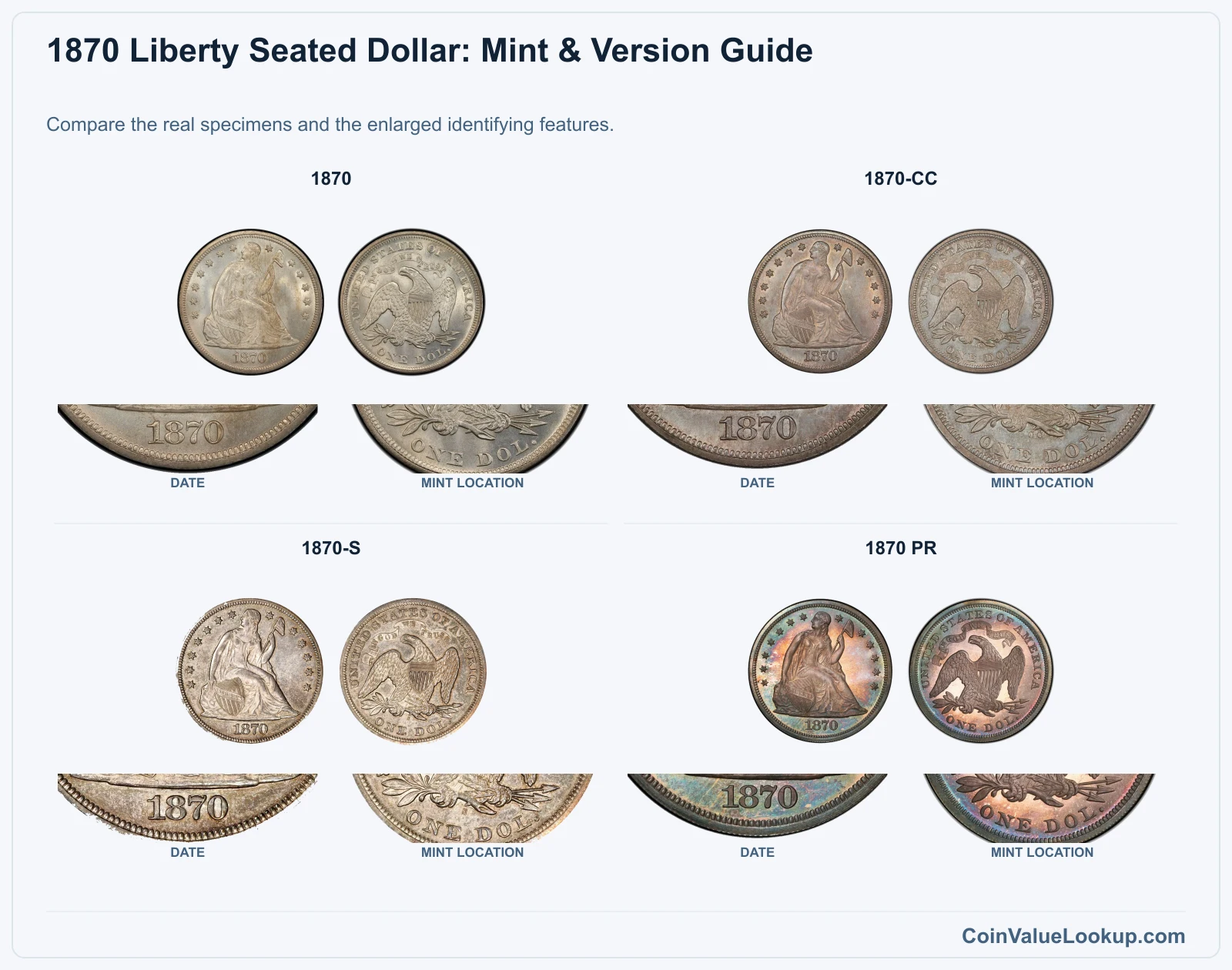
The 1870 Liberty Seated Dollar was struck at three mints and also produced as a proof at Philadelphia. Here is how to tell them apart.
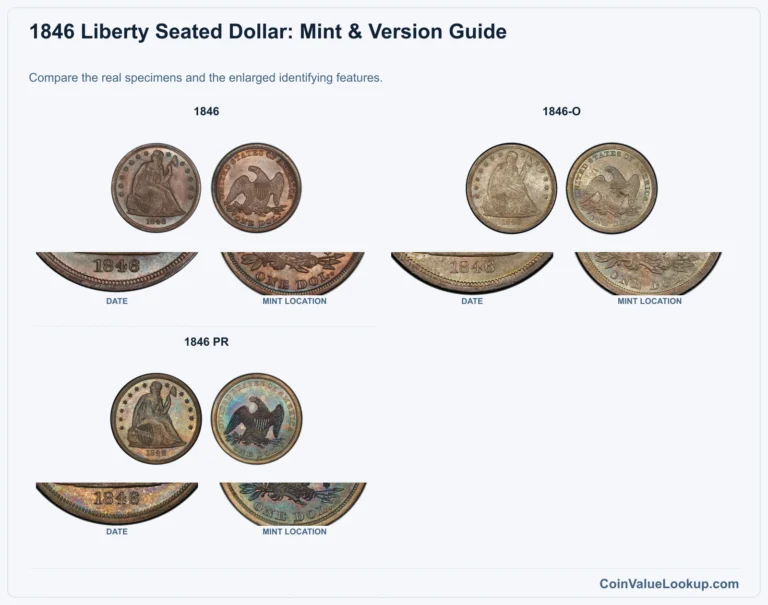
Philadelphia issues carry no mintmark at all. If you flip the coin to the reverse, the area just below the eagle and above the ONE DOL.
denomination is blank.
Carson City coins show a small "CC" mintmark in that same spot beneath the eagle. San Francisco pieces display an "S" in the same location.
Look carefully, because mintmarks on these old dollars can be tiny and weakly impressed.
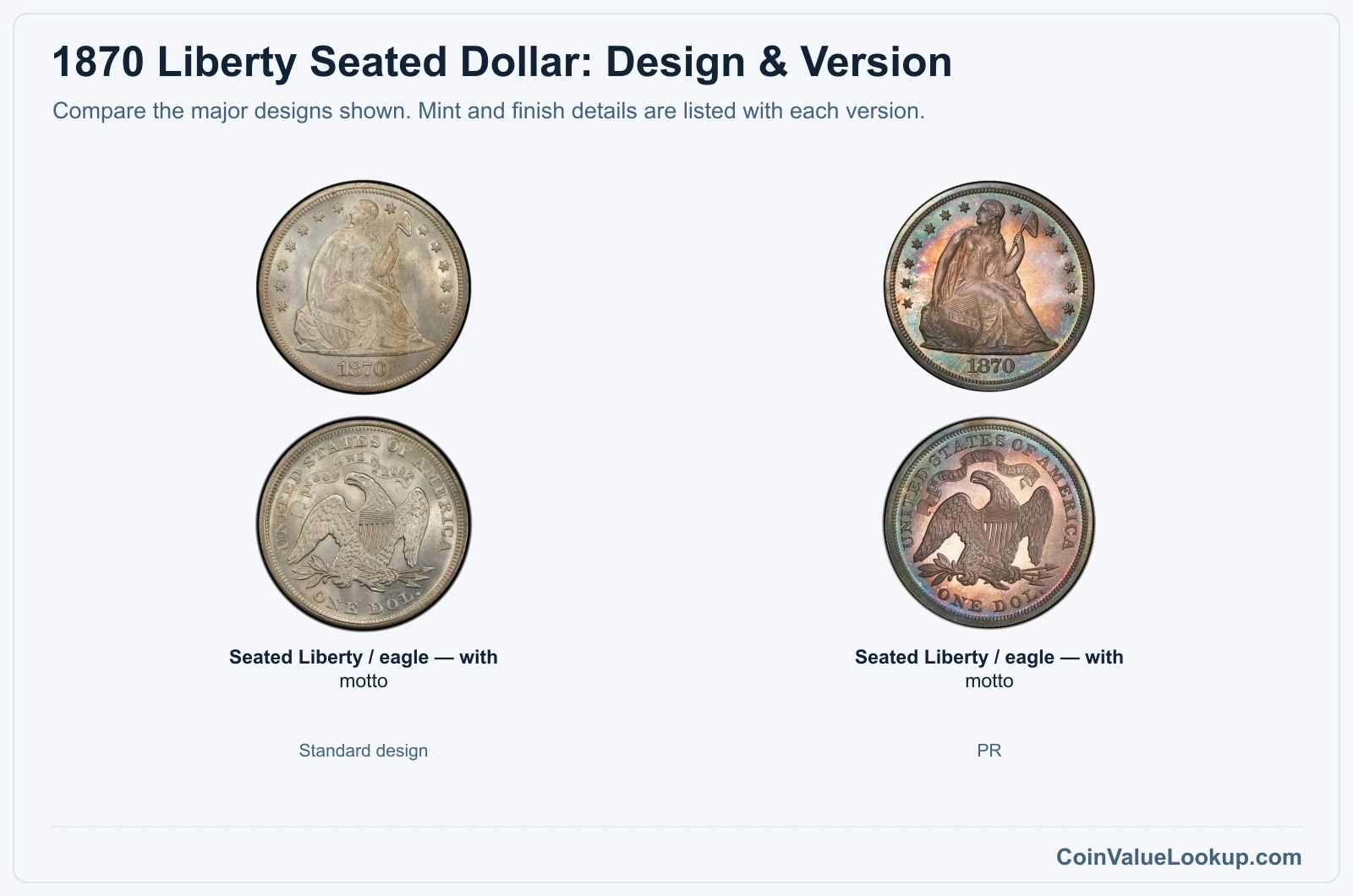
All four versions share the same design: the Seated Liberty figure on the obverse and an eagle on the reverse with the motto. The coin is struck in 90% silver and 10% copper, with a nominal weight of 26.73 grams for the 1840–1873 series.
If your coin feels suspiciously light or does not respond to a magnet test the way silver should, further testing is warranted.
Proof strikes were a special manufacturing finish produced at Philadelphia, so they also lack a mintmark. A proof is not simply a shiny or high-grade regular coin; it was made with polished dies and specially prepared planchets, resulting in mirror-like fields.
Step 2: Check Your 1870 Liberty Seated Dollar Grade
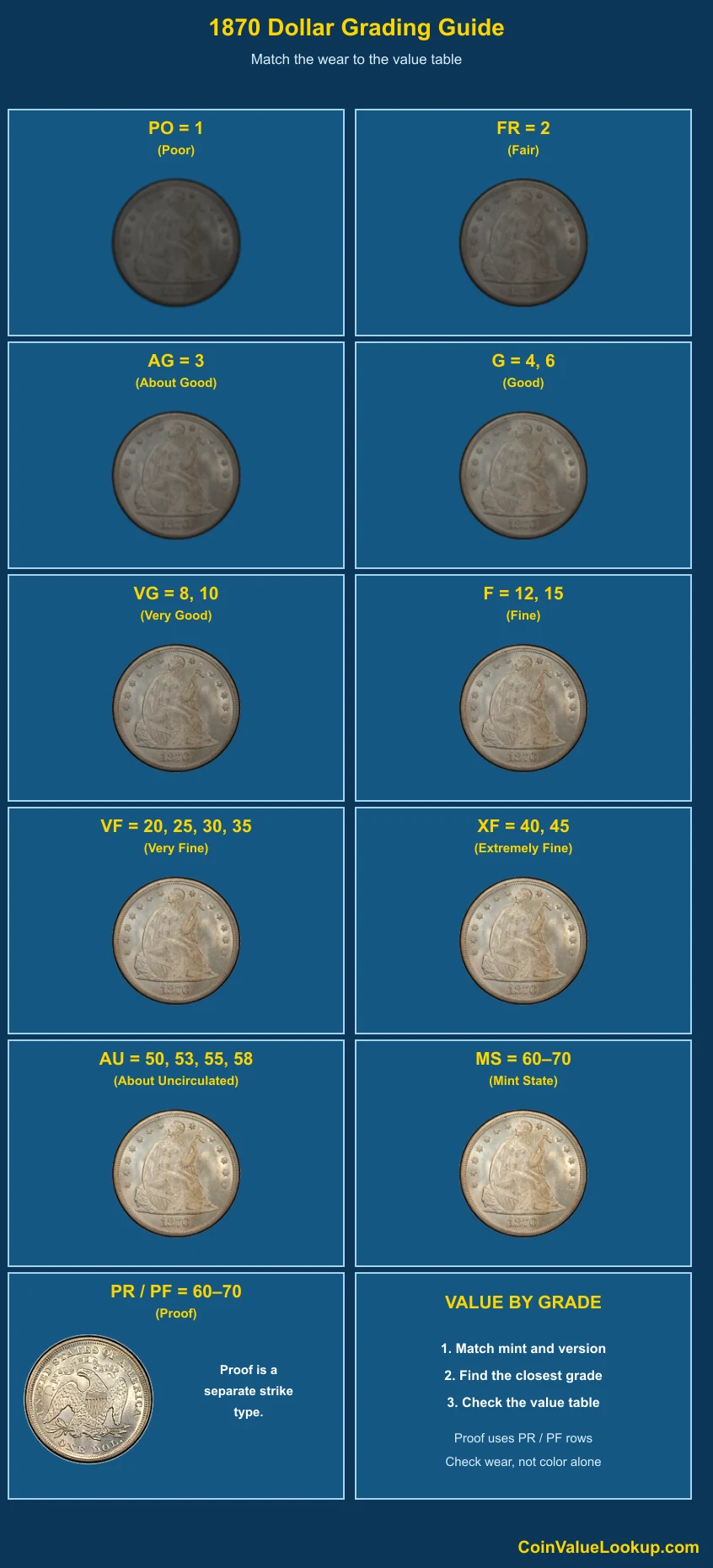
Start with the obverse. Liberty's head, the area across her breast, her knee and the details on the shield are the first spots to lose definition as a coin circulates.
On the reverse, check the eagle's breast feathers and wingtips for wear.
Do not judge grade from the head alone. Weak strikes are common on Seated Liberty dollars, and a soft head does not always mean heavy wear.
Compare the overall surface, including luster in protected areas, before drawing conclusions.
Use a genuine same-type grading comparison to calibrate your eye. Circulated examples in the Good to Fine range will show significant flatness on Liberty's body and the eagle's feathers.
An About Uncirculated coin retains most detail with only light friction on the highest points. Mint State pieces show full luster with no wear, though contact marks and strike quality still vary.
Proof coins should be evaluated separately from business strikes. Their mirrored fields and sharp rims are manufacturing characteristics, not indicators of a higher grade above Mint State.
Step 3: Check 1870 Liberty Seated Dollar Value by Mint and Version
1870 Liberty Seated Dollar
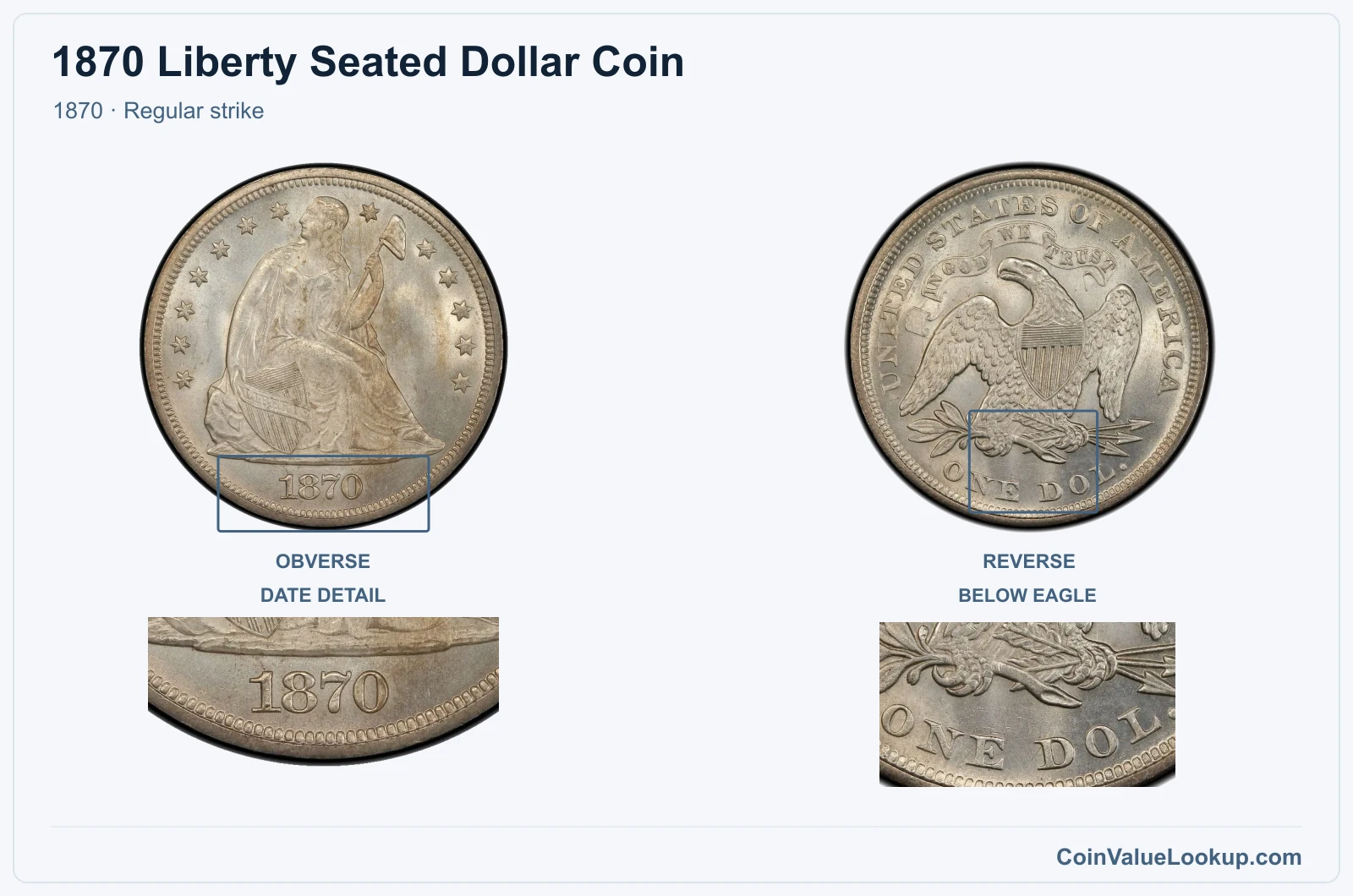
The 1870 Philadelphia business strike has no mintmark. Look at the reverse below the eagle — if the space above ONE DOL.
is clean, you likely have the Philly issue.
Guide estimates place this coin at about $478 in G4 and around $5,760 in MS63, per USA Coin Book. These are guide-level figures, not guaranteed sale prices.
Original, uncleaned surfaces matter a lot at every grade; a harshly polished example will trade well below these benchmarks.
This is the most accessible 1870 dollar for collectors, but even a well-worn example still carries meaningful silver content and collector demand.
Range Grade
Price Auction Records Appraisal PO PO 1
—
Coin Identifier FR FR 2
—
Coin Identifier AG AG 3
—
Coin Identifier G G 4
—
Coin Identifier
G 6
Coin Identifier VG VG 8
—
Coin Identifier
VG 10
Coin Identifier F F 12
Coin Identifier
F 15
Coin Identifier VF VF 20
Coin Identifier
VF 25
Coin Identifier
VF 30
Coin Identifier
VF 35
Coin Identifier XF XF 40
Coin Identifier
XF 45
Coin Identifier AU AU 50
Coin Identifier
AU 53
Coin Identifier
AU 55
Coin Identifier
AU 58
Coin Identifier MS MS 60
Coin Identifier
MS 61
Coin Identifier
MS 62
Coin Identifier
MS 63
Coin Identifier
MS 64
Coin Identifier
MS 65
Coin Identifier
MS 66
Coin Identifier
MS 67
—
—
—
MS 68
—
—
—
MS 69
—
—
—
MS 70
—
—
—
1870 Liberty Seated Dollar — CC
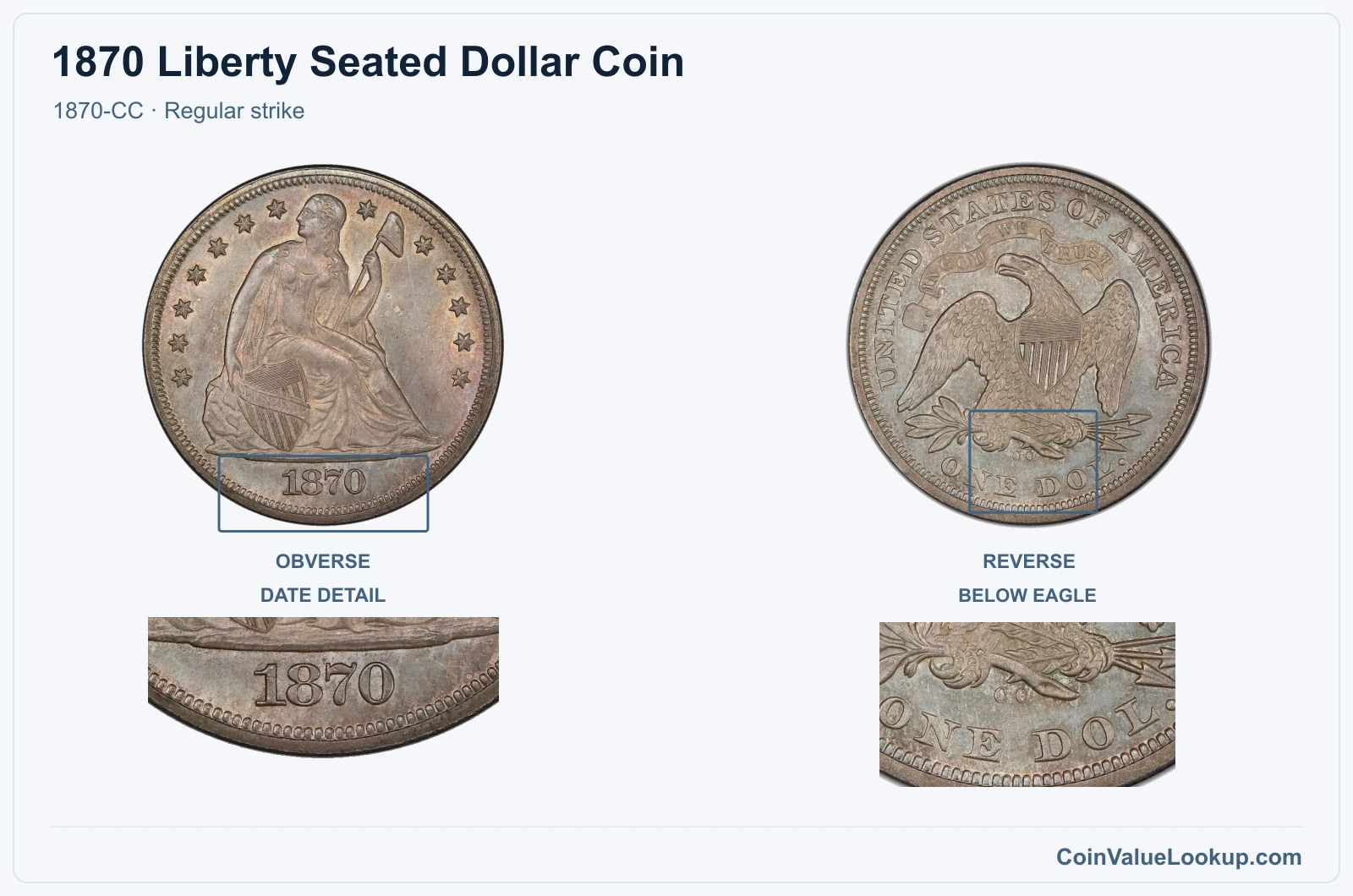
The 1870-CC is the coin that makes collectors' pulses quicken. Carson City had just opened its doors, and production numbers were modest.
Identify it by the small "CC" mintmark on the reverse beneath the eagle and above ONE DOL. Make sure the letters are genuinely part of the coin and not tooled or added after the fact.
Guide estimates from USA Coin Book run from about $1,384 in G4 up to roughly $54,425 in MS63. That spread tells you condition matters enormously.
Even a heavily worn, authenticated example holds strong value because of the Carson City connection and limited original output.
Coin Value Lookup is a good place to look up additional coin guides if you are researching other dates or denominations alongside this one.
Cleaned or damaged pieces will still sell, but expect a significant discount from these guide figures. Authentication by a recognized third-party service is essentially mandatory before any serious transaction.
Range Grade
Price Auction Records Appraisal PO PO 1
Coin Identifier FR FR 2
—
Coin Identifier AG AG 3
Coin Identifier G G 4
Coin Identifier
G 6
Coin Identifier VG VG 8
Coin Identifier
VG 10
Coin Identifier F F 12
Coin Identifier
F 15
Coin Identifier VF VF 20
Coin Identifier
VF 25
Coin Identifier
VF 30
Coin Identifier
VF 35
Coin Identifier XF XF 40
Coin Identifier
XF 45
Coin Identifier AU AU 50
Coin Identifier
AU 53
Coin Identifier
AU 55
Coin Identifier
AU 58
Coin Identifier MS MS 60
Coin Identifier
MS 61
Coin Identifier
MS 62
Coin Identifier
MS 63
Coin Identifier
MS 64
Coin Identifier
MS 65
—
—
—
MS 66
—
—
—
MS 67
—
—
—
MS 68
—
—
—
MS 69
—
—
—
MS 70
—
—
—
1870 Liberty Seated Dollar — S
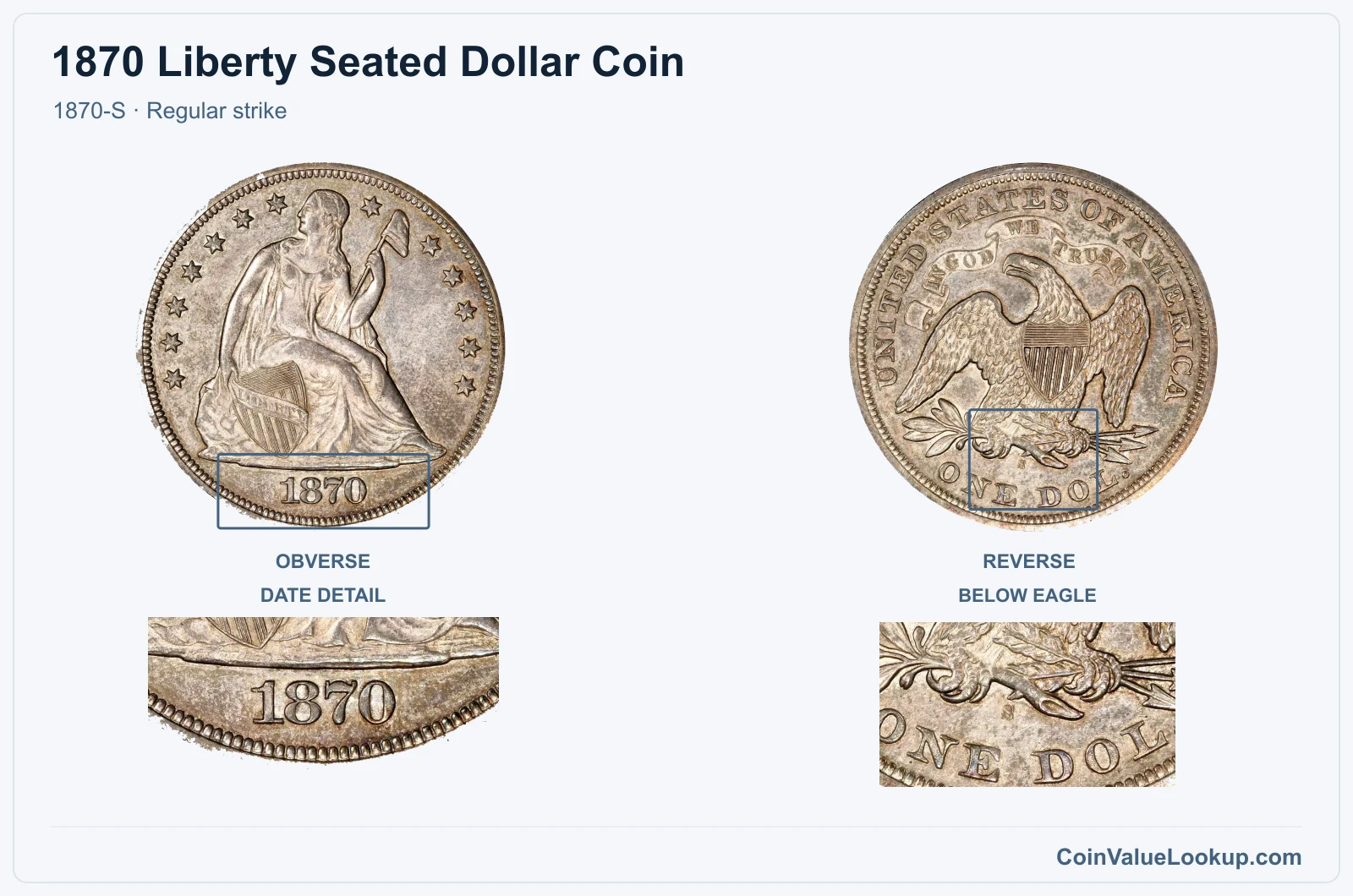
The 1870-S is one of the great rarities in all of American numismatics. So few are confirmed to exist that no standard guide price has been adopted here.
Look for an "S" mintmark on the reverse in the usual spot below the eagle. If you believe you have one, stop cleaning it, stop touching it, and get it to a reputable third-party grading service immediately.
Because of its extreme scarcity, each authenticated 1870-S dollar requires individual assessment based on its specific condition, provenance and authentication. Do not rely on generic price guides for this coin.
Any value conversation starts and ends with professional verification.
Range Grade
Price Auction Records Appraisal PO PO 1
—
Coin Identifier FR FR 2
—
Coin Identifier AG AG 3
—
Coin Identifier G G 4
—
Coin Identifier
G 6
—
Coin Identifier VG VG 8
—
Coin Identifier
VG 10
—
Coin Identifier F F 12
—
Coin Identifier
F 15
—
Coin Identifier VF VF 20
—
Coin Identifier
VF 25
Coin Identifier
VF 30
—
Coin Identifier
VF 35
—
Coin Identifier XF XF 40
Coin Identifier
XF 45
—
Coin Identifier AU AU 50
—
Coin Identifier
AU 53
—
Coin Identifier
AU 55
—
Coin Identifier
AU 58
—
Coin Identifier MS MS 60
—
Coin Identifier
MS 61
—
Coin Identifier
MS 62
—
Coin Identifier
MS 63
—
—
—
MS 64
—
—
—
MS 65
—
—
—
MS 66
—
—
—
MS 67
—
—
—
MS 68
—
—
—
MS 69
—
—
—
MS 70
—
—
—
1870 Liberty Seated Dollar — PR
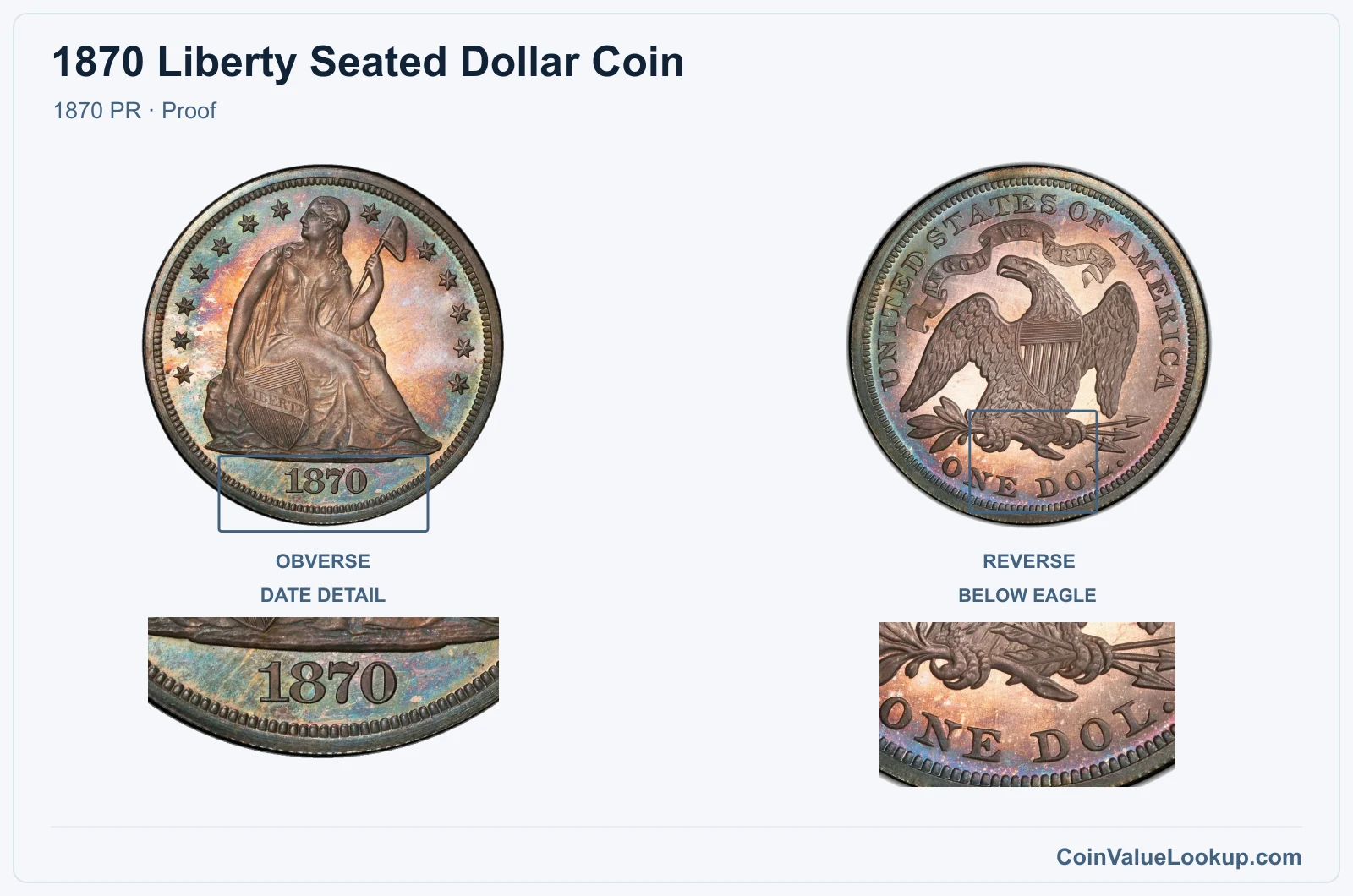
The 1870 Proof was struck at Philadelphia using polished dies and carefully prepared planchets, producing mirror-like fields and sharp detail. Like business strikes from that mint, it carries no mintmark.
A proof is a manufacturing finish, not simply a shiny coin that survived well. Genuine proofs show squared-off rims and deeply reflective surfaces that differ from even the finest Mint State business strikes.
If you are unsure, compare your coin side by side with known proof images of the same type.
No standard guide price has been adopted for this version here. Each proof's value depends on its authenticated identity, surface quality and overall condition, so individual professional assessment is the path forward.
Range Grade
Price Auction Records Appraisal PR PR 1
—
Coin Identifier
PR 2
—
Coin Identifier
PR 3
—
Coin Identifier
PR 4
—
Coin Identifier
PR 6
—
Coin Identifier
PR 8
—
Coin Identifier
PR 10
—
Coin Identifier
PR 12
—
Coin Identifier
PR 15
—
Coin Identifier
PR 20
—
Coin Identifier
PR 25
—
Coin Identifier
PR 30
—
Coin Identifier
PR 35
—
Coin Identifier
PR 40
—
Coin Identifier
PR 45
—
Coin Identifier
PR 50
Coin Identifier
PR 53
—
Coin Identifier
PR 55
Coin Identifier
PR 58
Coin Identifier
PR 60
Coin Identifier
PR 61
Coin Identifier
PR 62
Coin Identifier
PR 63
Coin Identifier
PR 64
Coin Identifier
PR 65
Coin Identifier
PR 66
Coin Identifier
PR 67
—
Coin Identifier
PR 68
—
—
—
PR 69
—
—
—
PR 70
—
—
—
1870 Liberty Seated Dollar Error List
1. 1870 Liberty Seated Dollar — Rotated Dies
A rotated die error occurs when the reverse die is not properly aligned with the obverse die, so the back image appears turned at an angle from its normal orientation. On standard U.S. coins, when you hold the obverse upright and rotate the coin top-to-bottom along a vertical axis, the reverse should also appear upright.
If the reverse is visibly tilted, you may have a rotated die.
This type of error has been reported on Liberty Seated Dollars generally. The degree of rotation matters: a slight turn of a few degrees is less notable than a dramatic 45-degree or greater shift.
Be careful with lookalikes. A photograph taken at an angle, or simply holding the coin sideways, can mimic the appearance of a rotation error.
Always test with the coin in hand.
No specific price range has been adopted for this error. Value depends on the degree of rotation, the coin's condition and overall eye appeal.
Third-party authentication is recommended before attributing any error premium.