2005 Sacagawea Dollar Coin Value: How Much Is It Worth?
The 2005 Sacagawea Dollar comes in five distinct versions spanning two mints, two finishes and a proof issue. Guide estimates from USA Coin Book place individual grades between roughly $7.29 and $12.00, depending on the version, finish and condition — these are not guaranteed offers.
Most circulated examples trade near face value, so knowing your coin's mint, finish and condition is the whole game.
Before you assume yours is special, identify the mintmark and figure out whether it came from a standard roll, a satin-finish mint set or a proof set. That single step filters out 90% of the confusion.
Fast Way to Identify Your 2005 Sacagawea Dollar
Snap a clear photo of the front and back of your 2005 Sacagawea Dollar and upload both images to our identifier. It can help with preliminary identification of your coin's mint and finish.
This is not authentication, grading or error verification — just a quick first look to point you in the right direction.
2005 Sacagawea Dollar Value
Upload both sides of your 2005 Sacagawea Dollar.
Front Obverse
Upload photo
Back Reverse
Upload photo
Which 2005 Sacagawea Dollar Versions Are Worth Money?
- 2005-P Satin Finish — packaged exclusively in mint sets, valued individually based on authenticated condition; not found in circulation rolls.
- 2005-D Satin Finish — same mint-set-only distribution from Denver; separate from standard D-mint business strikes.
- 2005-S Proof — struck at San Francisco for collector proof sets; guide estimate around $7.29 at PR-65 per USA Coin Book.
- Error coins (die breaks, off-center strikes, doubled dies, wrong planchets, improper annealing) can carry premiums, but require professional authentication before paying more than face value.
Step 1: Identify Your 2005 Sacagawea Dollar Mint Mark and Version
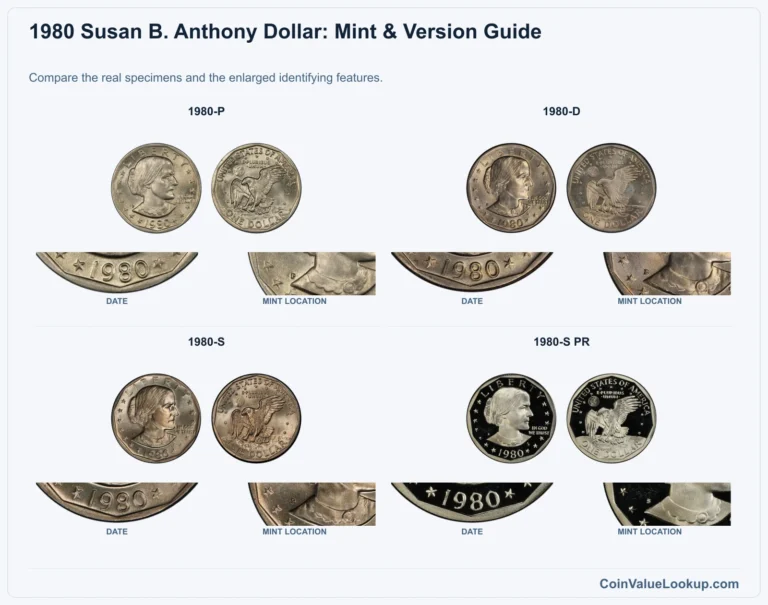
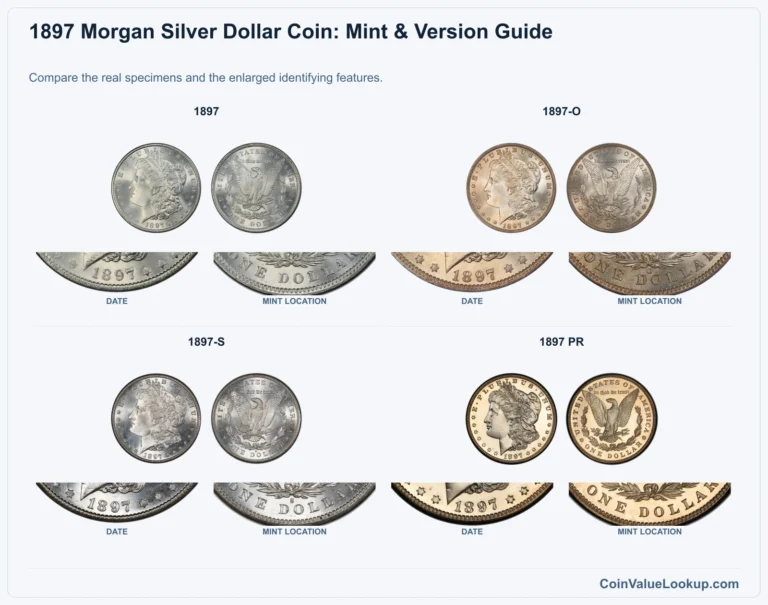
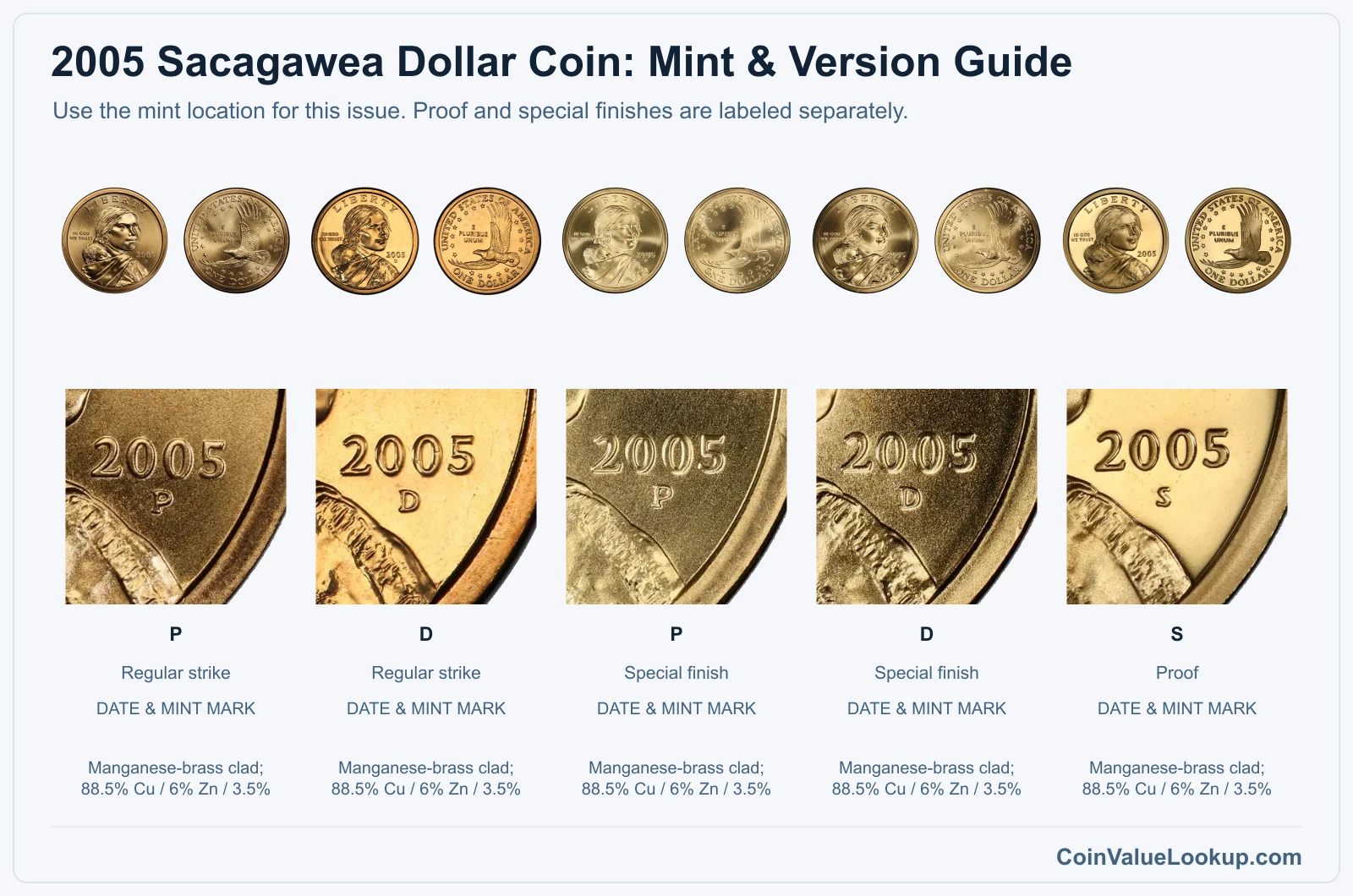
On 2005 Sacagawea Dollars the date sits on the obverse, below Sacagawea's portrait, and the mintmark (P, D or S) appears just below it. The golden color comes from manganese-brass cladding — 88.5% copper, 6% zinc, 3.5% manganese and 2% nickel — weighing 8.10 grams.
It is not gold.
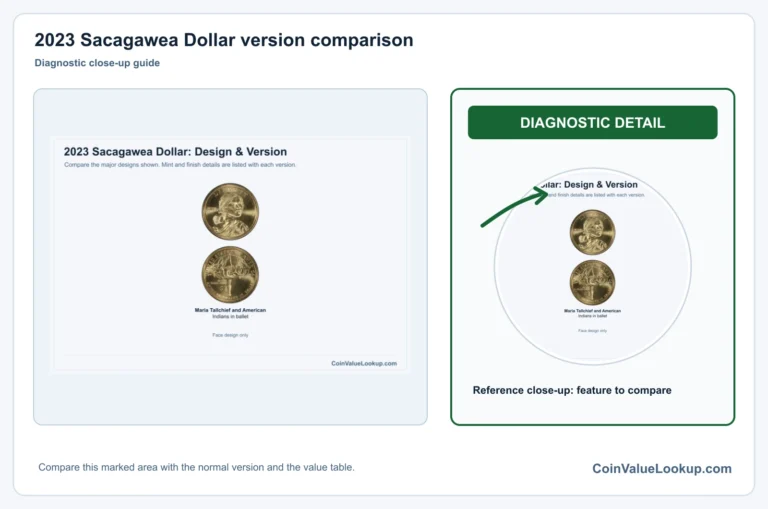
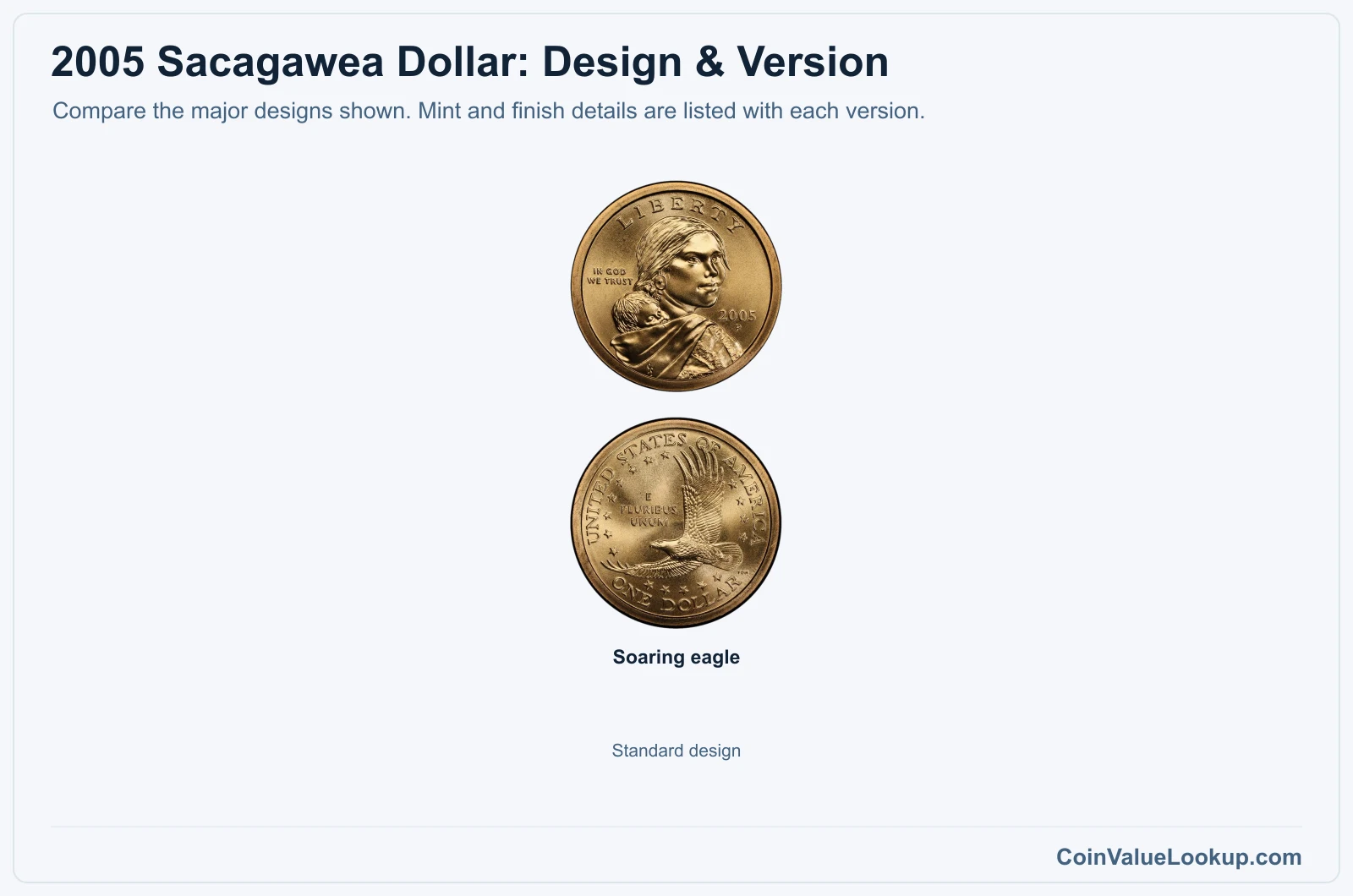
The reverse shows the soaring-eagle design used from 2000 through 2008. Starting in 2009 the series switched to annual Native American reverse themes, so if you see an eagle, you're in the right date range.
Five versions exist for 2005. Philadelphia (P) and Denver (D) each produced standard business strikes and satin-finish coins packaged in that year's uncirculated mint sets.
San Francisco (S) struck proofs only. Satin-finish coins have a distinctive soft, even luster without the cartwheel shine of a business strike or the mirrored fields of a proof.
Telling them apart matters because they are valued separately even at the same numerical grade.
Step 2: Check Your 2005 Sacagawea Dollar Grade
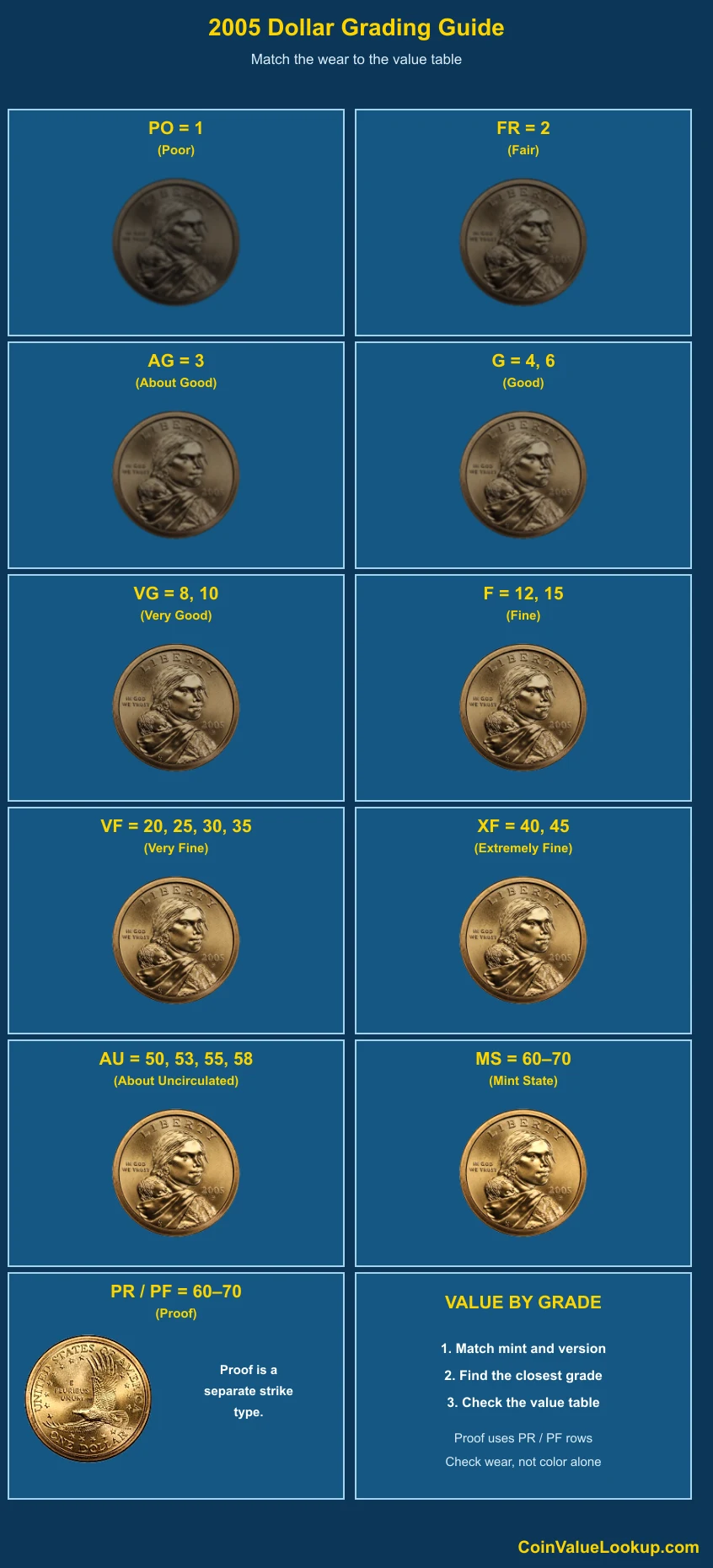
Focus on Sacagawea's cheekbone, the fine hair detail above her forehead and the infant Jean-Baptiste on her back — those are the first spots to show friction. On the reverse, the eagle's breast feathers and wingtip edges lose sharpness early.
For business strikes, a coin with full mint luster and no contact marks on the cheek can reach MS-65 territory, which is where guide values are anchored for the P and D versions. Bag marks on that flat cheek are common and keep many coins a grade or two lower.
Satin-finish and proof coins need different eyes. Satin pieces have a uniform matte-like texture; compare yours to a known satin example rather than judging luster the way you would on a business strike.
Proofs should have deeply mirrored fields and sharp device edges. Hairlines from improper handling are the usual grade-limiter on proofs.
Use the comparison image to see how wear progresses from circulated through AU and into Mint State, keeping special finishes in a separate mental category.
Step 3: Check 2005 Sacagawea Dollar Value by Mint and Version
2005 Sacagawea Dollar — P — Soaring eagle
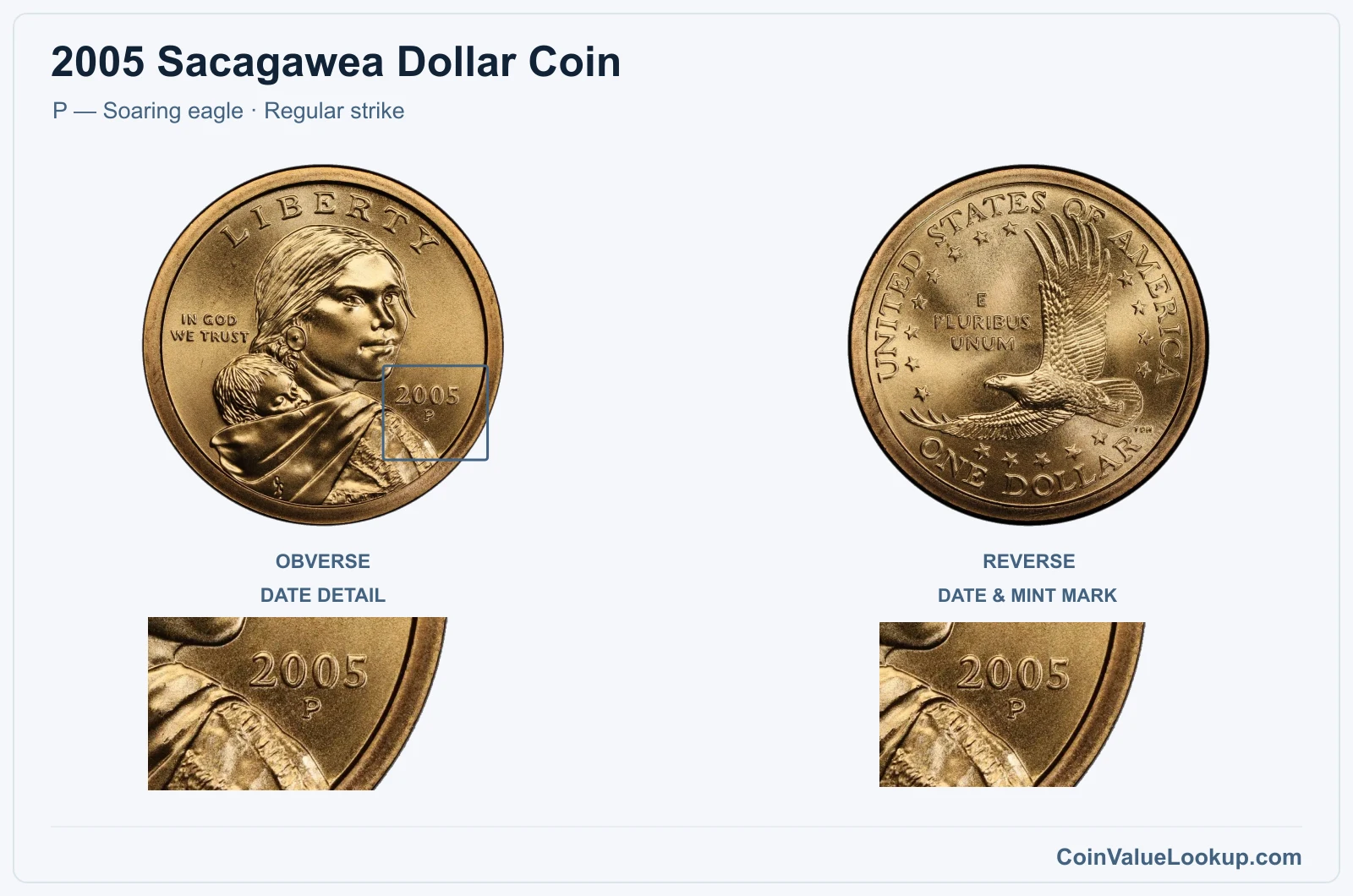
The 2005-P business strike is the standard Philadelphia issue you might pull from a bank roll or find in pocket change. Look for the small "P" mintmark on the obverse below the date.
At MS-65, the USA Coin Book guide places this version at about $12.00.
Most examples you encounter will grade lower due to contact marks on Sacagawea's broad cheek. A circulated piece is worth face value.
Confirm the soaring-eagle reverse and the P mintmark before consulting any value chart.
Range Grade
Price Auction Records Appraisal PO PO 1
—
Coin Identifier FR FR 2
—
Coin Identifier AG AG 3
—
Coin Identifier G G 4
—
Coin Identifier
G 6
—
Coin Identifier VG VG 8
—
Coin Identifier
VG 10
—
Coin Identifier F F 12
—
Coin Identifier
F 15
—
Coin Identifier VF VF 20
—
Coin Identifier
VF 25
—
Coin Identifier
VF 30
—
Coin Identifier
VF 35
—
Coin Identifier XF XF 40
—
Coin Identifier
XF 45
—
Coin Identifier AU AU 50
—
Coin Identifier
AU 53
—
Coin Identifier
AU 55
—
Coin Identifier
AU 58
—
Coin Identifier MS MS 60
—
Coin Identifier
MS 61
—
Coin Identifier
MS 62
—
Coin Identifier
MS 63
—
Coin Identifier
MS 64
—
Coin Identifier
MS 65
—
Coin Identifier
MS 66
Coin Identifier
MS 67
Coin Identifier
MS 68
Coin Identifier
MS 69
Coin Identifier
MS 70
—
—
—
2005 Sacagawea Dollar — P — Soaring eagle — satin
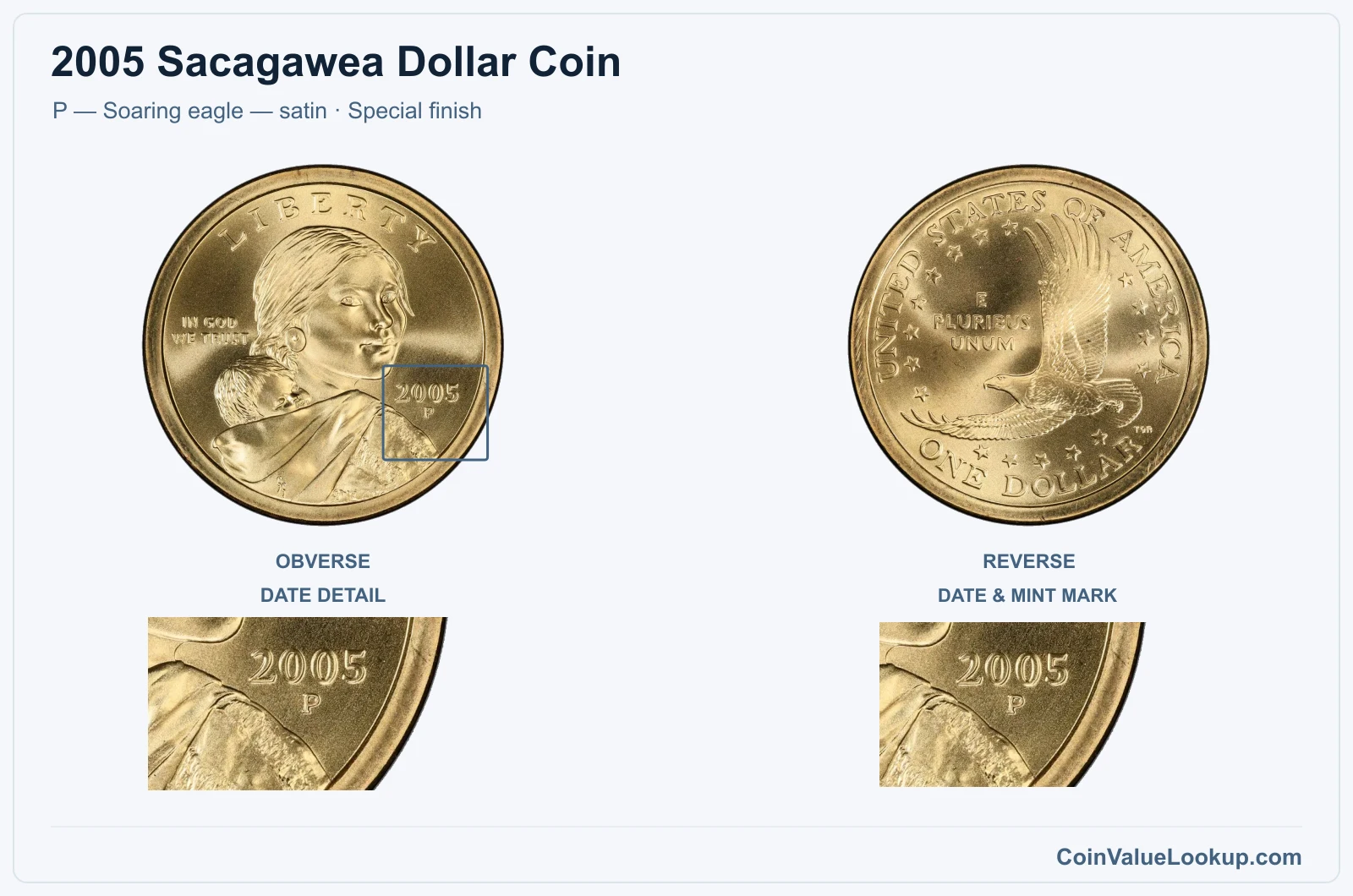
The 2005-P satin-finish dollar was produced exclusively for that year's uncirculated mint set. It has the same P mintmark and soaring-eagle reverse as the business strike, but the surface texture is noticeably different — a soft, even sheen without the sharp cartwheel luster of a regular strike.
No supported guide price is available for this version, so value depends on the coin's authenticated identity, condition and whether any errors are present. If you think you have one, compare the surface carefully to a known business strike.
The difference is subtle but consistent across the entire coin.
Coin Value Lookup is a good starting point if you want to look up guides for other Sacagawea Dollar years or denominations while you're sorting your collection.
Range Grade
Price Auction Records Appraisal SP SP 1
—
Coin Identifier
SP 2
—
Coin Identifier
SP 3
—
Coin Identifier
SP 4
—
Coin Identifier
SP 6
—
Coin Identifier
SP 8
—
Coin Identifier
SP 10
—
Coin Identifier
SP 12
—
Coin Identifier
SP 15
—
Coin Identifier
SP 20
—
Coin Identifier
SP 25
—
Coin Identifier
SP 30
—
Coin Identifier
SP 35
—
Coin Identifier
SP 40
—
Coin Identifier
SP 45
—
Coin Identifier
SP 50
—
Coin Identifier
SP 53
—
Coin Identifier
SP 55
—
Coin Identifier
SP 58
—
Coin Identifier
SP 60
—
Coin Identifier
SP 61
—
Coin Identifier
SP 62
—
Coin Identifier
SP 63
—
Coin Identifier
SP 64
—
Coin Identifier
SP 65
—
Coin Identifier
SP 66
Coin Identifier
SP 67
Coin Identifier
SP 68
Coin Identifier
SP 69
Coin Identifier
SP 70
—
Coin Identifier
2005 Sacagawea Dollar — D — Soaring eagle
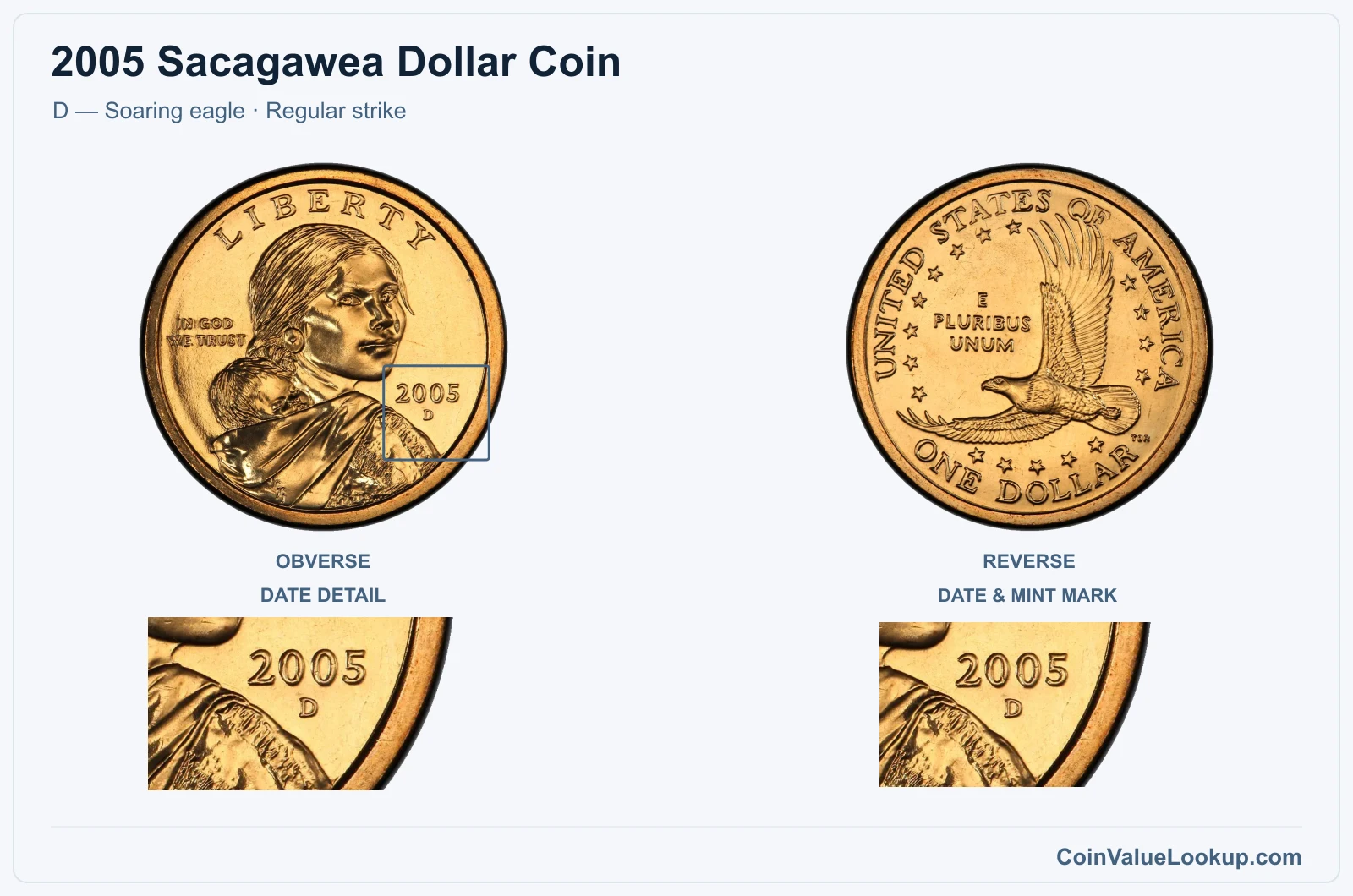
Denver's 2005-D business strike mirrors the Philadelphia issue in design and composition but carries a "D" mintmark. The USA Coin Book guide estimates about $12.00 at MS-65.
Like its Philadelphia counterpart, most examples show enough bag marks to fall below gem grade. Circulated coins are worth a dollar.
Verify the mintmark and the soaring-eagle reverse before assuming anything about value.
Range Grade
Price Auction Records Appraisal PO PO 1
—
Coin Identifier FR FR 2
—
Coin Identifier AG AG 3
—
Coin Identifier G G 4
—
Coin Identifier
G 6
—
Coin Identifier VG VG 8
—
Coin Identifier
VG 10
—
Coin Identifier F F 12
—
Coin Identifier
F 15
—
Coin Identifier VF VF 20
—
Coin Identifier
VF 25
—
Coin Identifier
VF 30
—
Coin Identifier
VF 35
—
Coin Identifier XF XF 40
—
Coin Identifier
XF 45
—
Coin Identifier AU AU 50
—
Coin Identifier
AU 53
—
Coin Identifier
AU 55
—
Coin Identifier
AU 58
—
Coin Identifier MS MS 60
—
Coin Identifier
MS 61
—
Coin Identifier
MS 62
—
Coin Identifier
MS 63
—
Coin Identifier
MS 64
—
Coin Identifier
MS 65
Coin Identifier
MS 66
Coin Identifier
MS 67
Coin Identifier
MS 68
Coin Identifier
MS 69
—
—
—
MS 70
—
—
—
2005 Sacagawea Dollar — D — Soaring eagle — satin
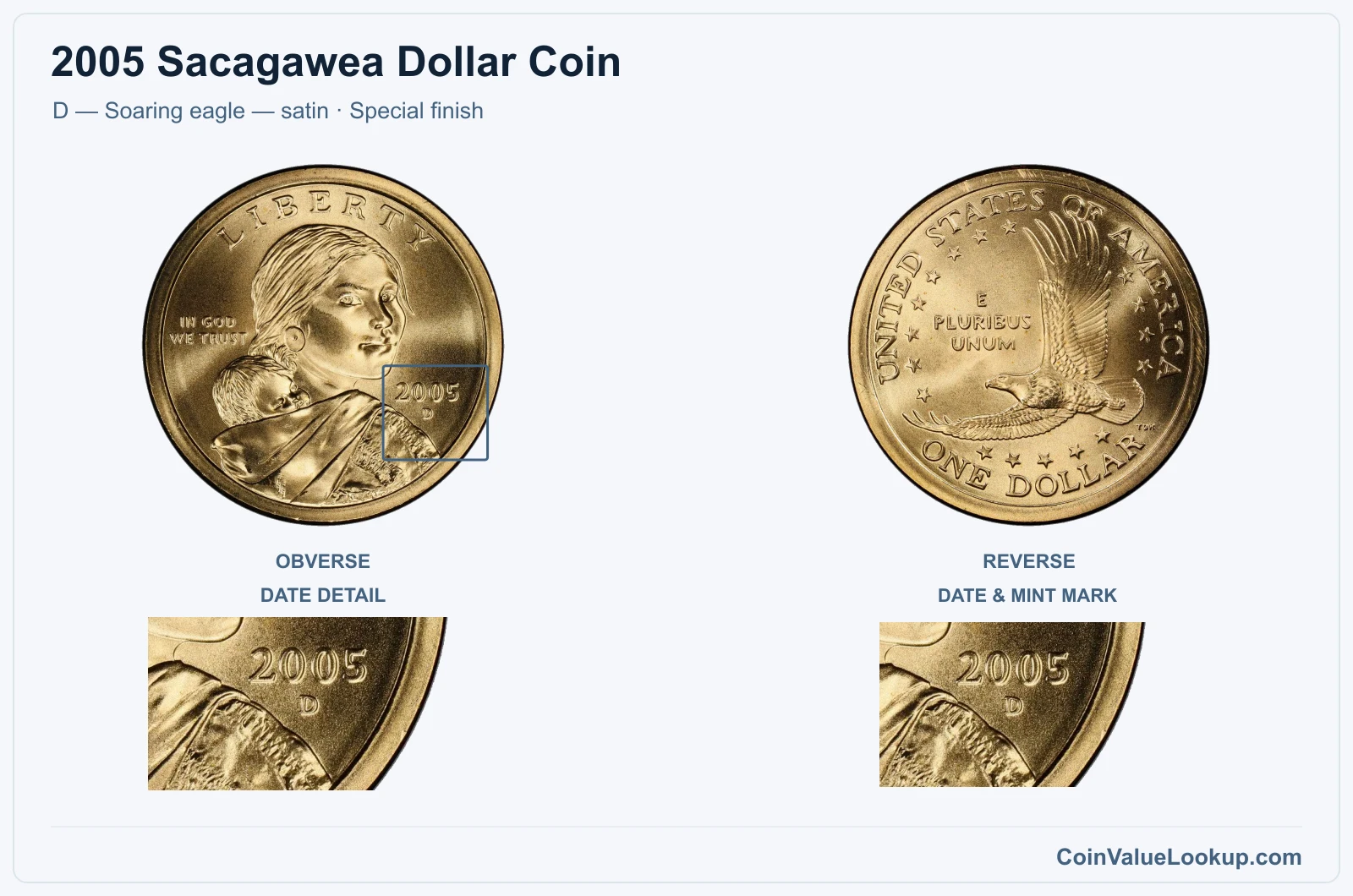
The 2005-D satin-finish coin came in Denver's portion of the uncirculated mint set and shares the soaring-eagle reverse. Its surface has that characteristic matte-like luster that distinguishes it from a standard D-mint strike fresh off the press.
No specific guide price is adopted for this version. Its value hinges on authenticated finish, grade and any verified errors.
Don't pay a premium for one unless the satin finish has been confirmed — glare, album toning or light cleaning can mimic the look in photos.
Range Grade
Price Auction Records Appraisal SP SP 1
—
Coin Identifier
SP 2
—
Coin Identifier
SP 3
—
Coin Identifier
SP 4
—
Coin Identifier
SP 6
—
Coin Identifier
SP 8
—
Coin Identifier
SP 10
—
Coin Identifier
SP 12
—
Coin Identifier
SP 15
—
Coin Identifier
SP 20
—
Coin Identifier
SP 25
—
Coin Identifier
SP 30
—
Coin Identifier
SP 35
—
Coin Identifier
SP 40
—
Coin Identifier
SP 45
—
Coin Identifier
SP 50
—
Coin Identifier
SP 53
—
Coin Identifier
SP 55
—
Coin Identifier
SP 58
—
Coin Identifier
SP 60
—
Coin Identifier
SP 61
—
Coin Identifier
SP 62
—
Coin Identifier
SP 63
—
Coin Identifier
SP 64
—
Coin Identifier
SP 65
Coin Identifier
SP 66
Coin Identifier
SP 67
Coin Identifier
SP 68
Coin Identifier
SP 69
Coin Identifier
SP 70
—
—
—
2005 Sacagawea Dollar — S — Soaring eagle — proof
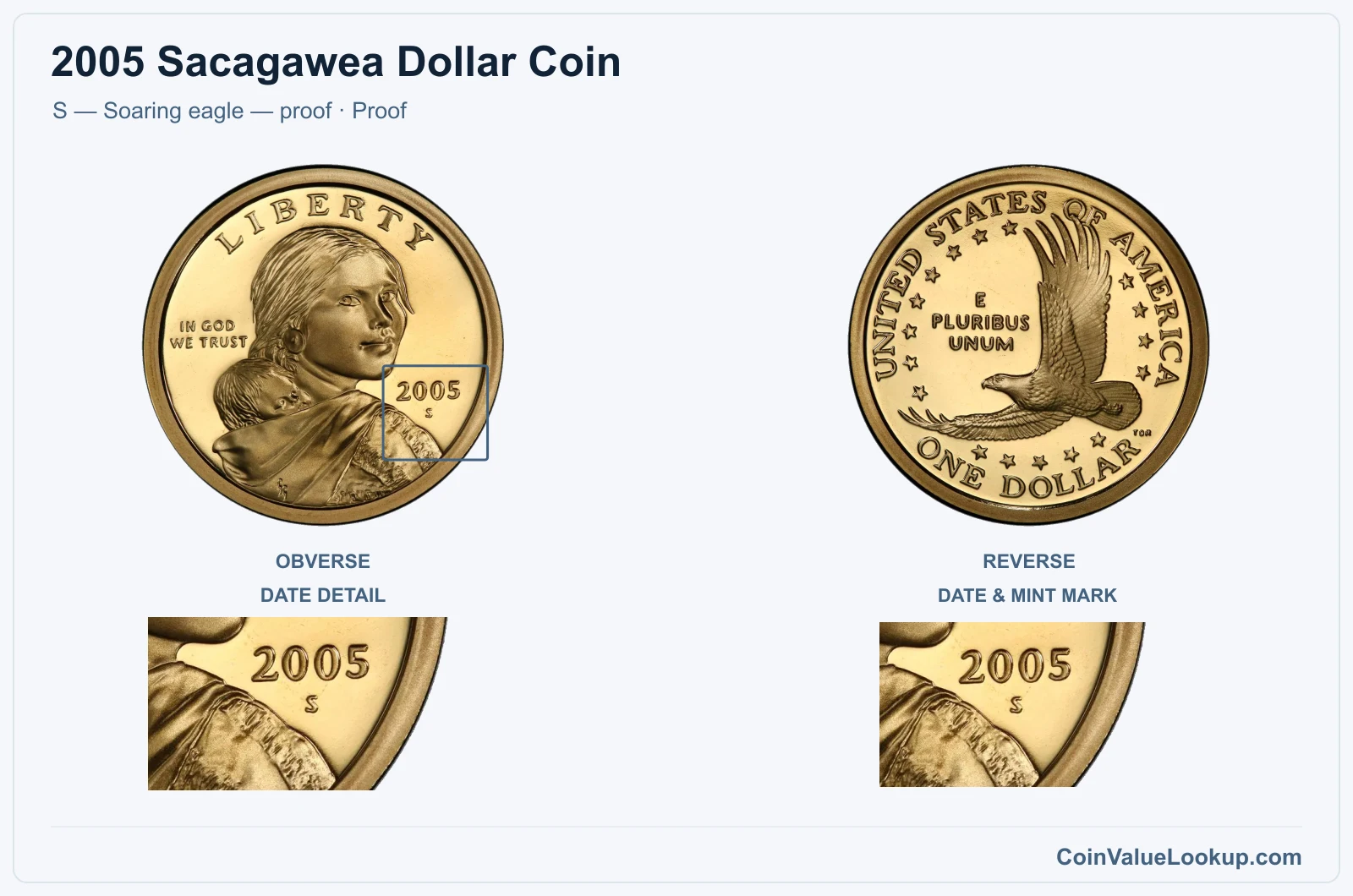
The 2005-S proof was struck at the San Francisco Mint for inclusion in collector proof sets. It features deeply mirrored fields and frosted raised devices, giving it the classic cameo contrast.
The USA Coin Book guide estimates about $7.29 at PR-65.
This is a manganese-brass clad coin, not silver. Buying a silver proof set that year did not magically make the Sacagawea Dollar silver — the composition stayed the same.
Hairlines from mishandling are the most common grade detractor on proofs, so check the fields under good lighting at an angle.
Range Grade
Price Auction Records Appraisal PR PR 1
—
Coin Identifier
PR 2
—
Coin Identifier
PR 3
—
Coin Identifier
PR 4
—
Coin Identifier
PR 6
—
Coin Identifier
PR 8
—
Coin Identifier
PR 10
—
Coin Identifier
PR 12
—
Coin Identifier
PR 15
—
Coin Identifier
PR 20
—
Coin Identifier
PR 25
—
Coin Identifier
PR 30
—
Coin Identifier
PR 35
—
Coin Identifier
PR 40
—
Coin Identifier
PR 45
—
Coin Identifier
PR 50
—
Coin Identifier
PR 53
—
Coin Identifier
PR 55
—
Coin Identifier
PR 58
—
Coin Identifier
PR 60
—
Coin Identifier
PR 61
—
Coin Identifier
PR 62
—
Coin Identifier
PR 63
—
Coin Identifier
PR 64
—
Coin Identifier
PR 65
—
Coin Identifier
PR 66
—
Coin Identifier
PR 67
—
Coin Identifier
PR 68
Coin Identifier
PR 69
Coin Identifier
PR 70
Coin Identifier
2005 Sacagawea Dollar Error List
1. 2005 Sacagawea Dollar — Die Break / Cud
A die break happens when a piece of the die cracks or chips away, leaving a raised lump of metal on the struck coin. When that raised area connects to the rim, collectors call it a cud.
On a 2005 Sacagawea Dollar, look along the rim for an irregular blob that displaces or covers part of the normal design.
The boundary between the raised area and the surrounding design should be sharp and consistent — not rough or pitted. A rim dent from a coin counter, interior die chips or plain corrosion can look similar but won't show the characteristic displaced-design feature.
Condition, the size of the break and its visibility all affect what a collector might pay. Professional authentication is important before assuming any premium.
2. 2005 Sacagawea Dollar — Off-Center Strike
An off-center strike occurs when the planchet isn't properly seated between the dies, producing a coin with a shifted design and an unstruck crescent of blank metal on one side. On a 2005 Sacagawea Dollar, the percentage of offset and whether the date remains visible are the two biggest factors collectors care about.
Don't confuse this with a clipped planchet, which shows a curved bite out of the blank, or with post-mint flattening from a vise or hammer. A genuine off-center strike will have the design uniformly shifted, not smeared or distorted on one face only.
Value depends on the degree of the misalignment and overall condition; no specific price range is available for this year.
3. 2005 Sacagawea Dollar — Doubled Die
Doubled-die errors show a consistent doubling of design elements caused during the die-making process. On a 2005 Sacagawea Dollar, compare lettering, the date or Sacagawea's profile against a normal coin.
Genuine doubling appears as a secondary, slightly offset image — notching on serifs or separation in the letters.
Machine doubling, which is far more common, tends to produce flat, shelf-like distortion without the distinct secondary image. Reflections in photos and post-mint impressions from stacking can also fake the look.
Value depends on which die, which elements are doubled and how visible the doubling is. Have a suspect coin authenticated before assigning any premium.
4. 2005 Sacagawea Dollar — Wrong Planchet / Off-Metal Strike
A wrong-planchet error means a 2005 Sacagawea Dollar die struck a blank intended for a different denomination or even a different country's coin. The result is a coin that looks right in design but feels wrong in hand — different weight, diameter or edge characteristics compared to the standard 8.10-gram, 26.5 mm manganese-brass blank.
Weigh and measure any suspect coin carefully. Plating loss, acid-treated surfaces and deliberate alterations can change a coin's appearance enough to fool a casual glance.
If the weight and diameter match normal specs, you almost certainly don't have a wrong-planchet error. No specific price data is available; value depends on the confirmed wrong blank and the coin's condition.
5. 2005 Sacagawea Dollar — Improper Annealing
Improper annealing is a planchet error reported specifically on the 2005-D Satin Finish Sacagawea Dollar, where a PCGS-graded example was described as an improperly annealed, sintered planchet at SP-65. The surface shows unusual discoloration or texture caused by problems during the heating process that prepares blanks for striking.
Look for uneven tone, a granular or rough texture or woodgrain-like streaks that cover the coin's surface rather than sitting in isolated spots. Environmental toning, corrosion and post-mint heat exposure can mimic these symptoms, so surface appearance alone is a screening clue, not proof.
Value depends on the severity of the annealing defect and the coin's overall condition; no numerical price range is available for this error.