2006 Sacagawea Dollar Coin Value: How Much Is It Worth?
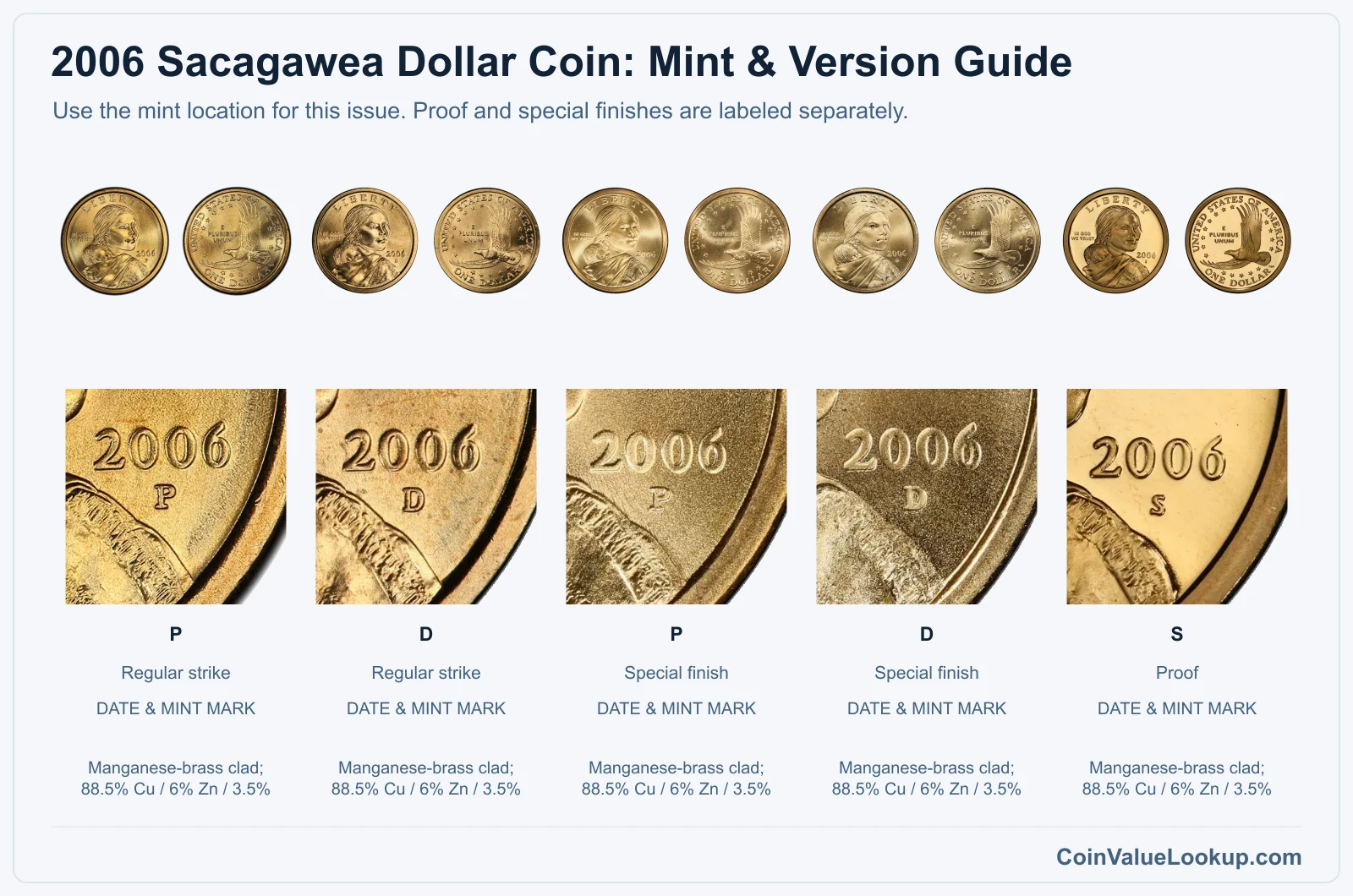
The 2006 Sacagawea Dollar comes in five distinct versions spanning three mints and three finishes. Guide estimates from USA Coin Book place individual grades between roughly $4.96 and $7.29, depending on the specific mint, finish and condition — these are not guaranteed offers.
Most circulated examples trade near face value, so identifying your coin's exact branch matters before assuming any premium.
Fast Way to Identify Your 2006 Sacagawea Dollar
Snap a clear photo of the front and back of your 2006 Sacagawea Dollar and upload both images. Our identifier can give you a preliminary read on which mint and finish you have.
It won't authenticate errors or assign an exact grade, but it is a solid first step toward figuring out what you are holding.
2006 Sacagawea Dollar Value
Upload both sides of your 2006 Sacagawea Dollar.
Front Obverse
Upload photo
Back Reverse
Upload photo
Which 2006 Sacagawea Dollar Versions Are Worth Money?
- 2006-S Proof — the proof finish carries the highest single-grade guide estimate at $7.29 in PR65, per USA Coin Book.
- 2006-P and 2006-D Satin Finish — sold only in mint sets, these require individual assessment because no guide price was adopted; authenticated examples in top condition can carry a premium over business strikes.
- 2006-P Business Strike — guide estimate of $5.63 at MS65, slightly above the Denver issue at the same grade.
- Confirmed error coins such as off-center strikes or wrong-planchet pieces can exceed standard values, but claims need professional verification.
Step 1: Identify Your 2006 Sacagawea Dollar Mint Mark and Version
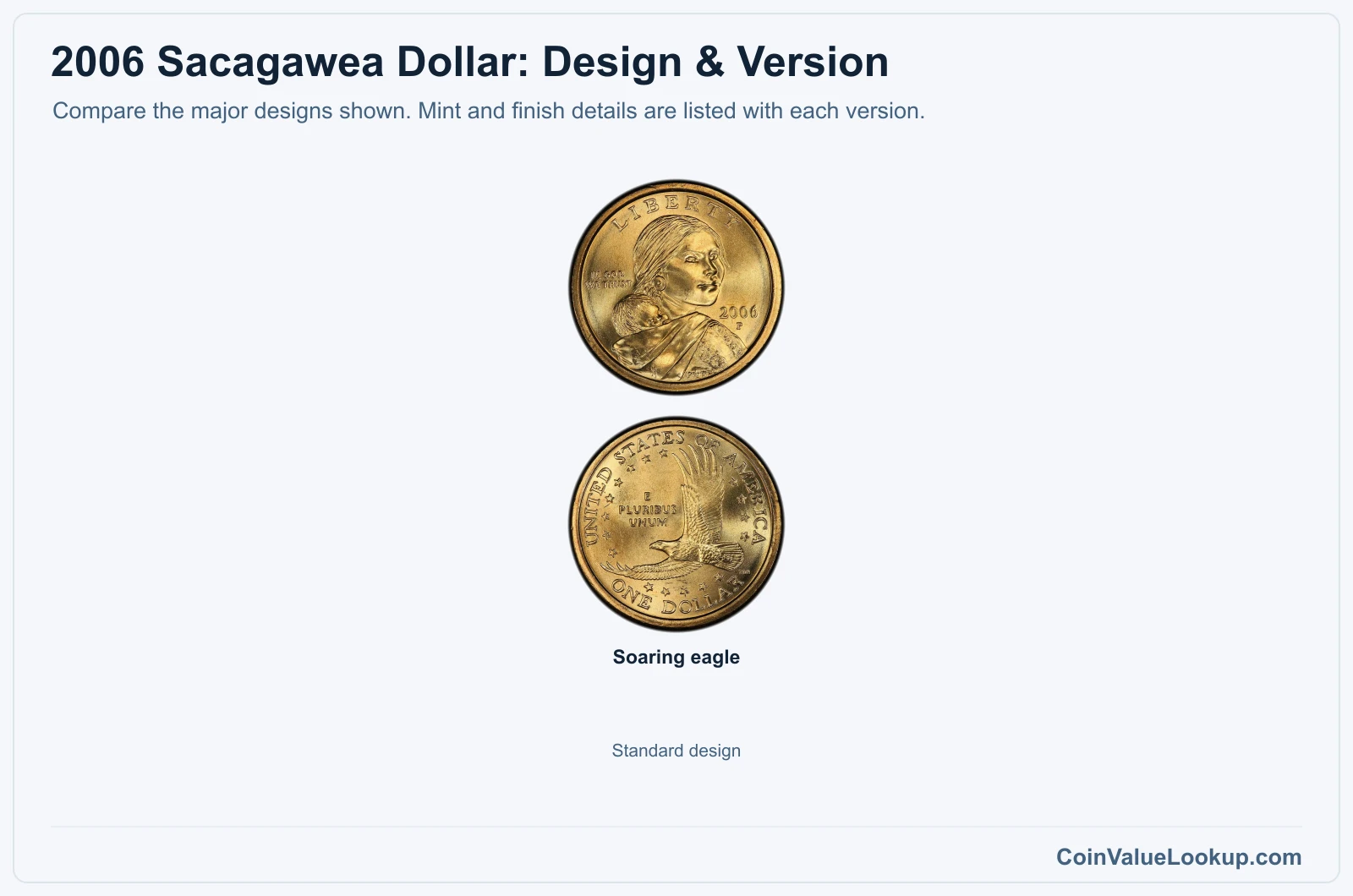
Start on the obverse. The date "2006" sits below Sacagawea's portrait, and the mintmark — P, D or S — appears just below it.
A "P" means Philadelphia, "D" is Denver, and "S" is San Francisco (proof only for this year).
The reverse shows a soaring eagle design used from 2000 through 2008. If your coin has a different reverse, it is not a 2006.
Despite the golden color, this is not a gold coin. The planchet is manganese-brass clad: 88.5% copper, 6% zinc, 3.5% manganese and 2% nickel, weighing 8.10 grams.
Beyond mint and date, you need to determine the finish. Business strikes went into general circulation.
Satin-finish coins came only in 2006 Uncirculated Mint Sets and have a distinctive soft, even luster rather than the cartwheel shine of a regular strike. Proof coins from San Francisco show mirror-like fields with frosted devices.
Confusing one finish for another will throw off your value estimate entirely.
Step 2: Check Your 2006 Sacagawea Dollar Grade
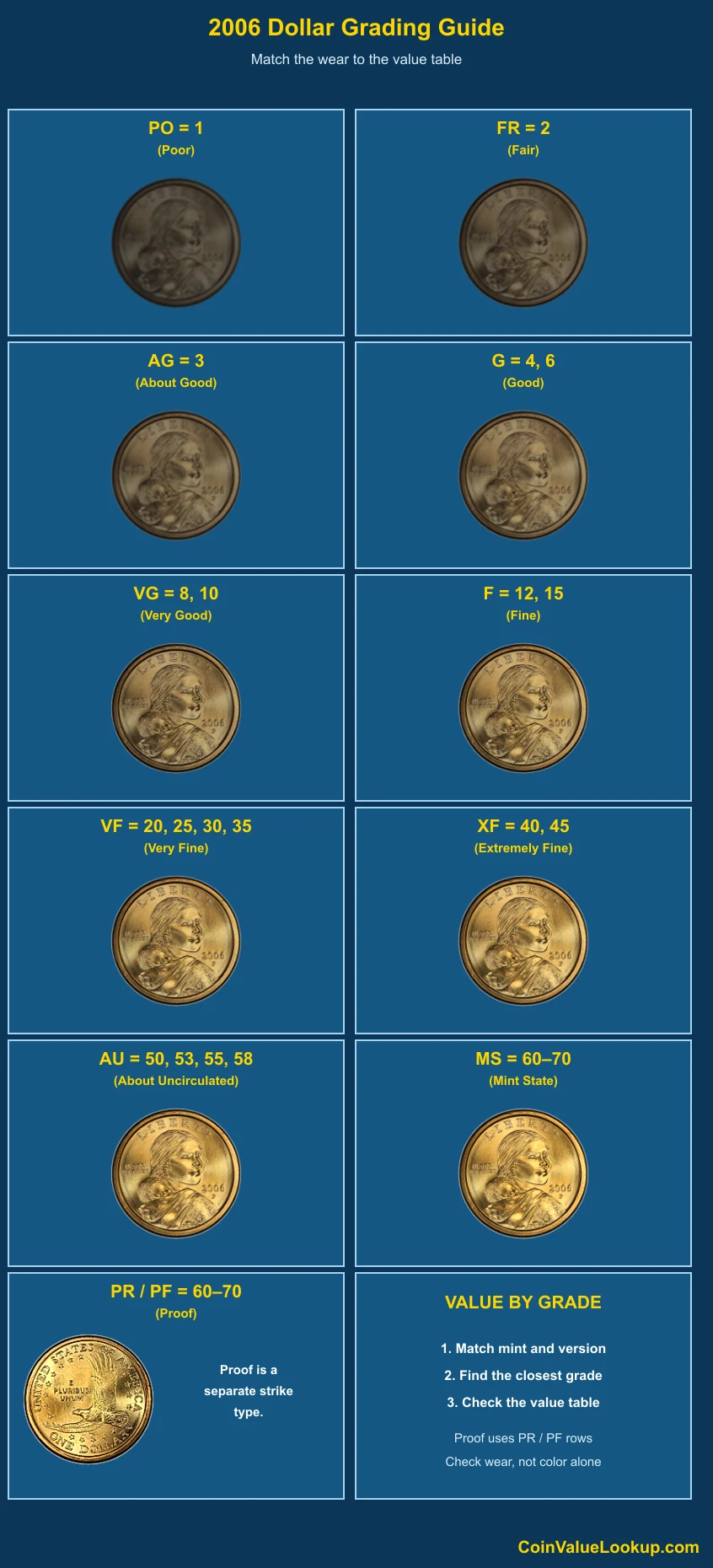
On a business-strike Sacagawea Dollar, check three spots first: the high point of her cheekbone, the fine lines in her hair, and the detail on baby Jean-Baptiste's blanket. These wear down before anything else.
A coin with full hair strands and sharp cheek detail is likely Mint State; one with flatness across the cheek has seen circulation.
On the reverse, the eagle's breast feathers and the tips of the outstretched wings show wear early. Compare your coin against the reference image, matching the same type and finish.
Satin-finish and proof coins should not be graded by the same brightness standard as business strikes. A satin coin will always look "softer" than a proof — that is by design.
Judge proofs by the clarity of the mirror fields and the sharpness of frosted devices, not by how shiny they appear at first glance. Contact marks and hairlines matter more than luster on these special finishes.
Step 3: Check 2006 Sacagawea Dollar Value by Mint and Version
2006 Sacagawea Dollar — P — Soaring eagle
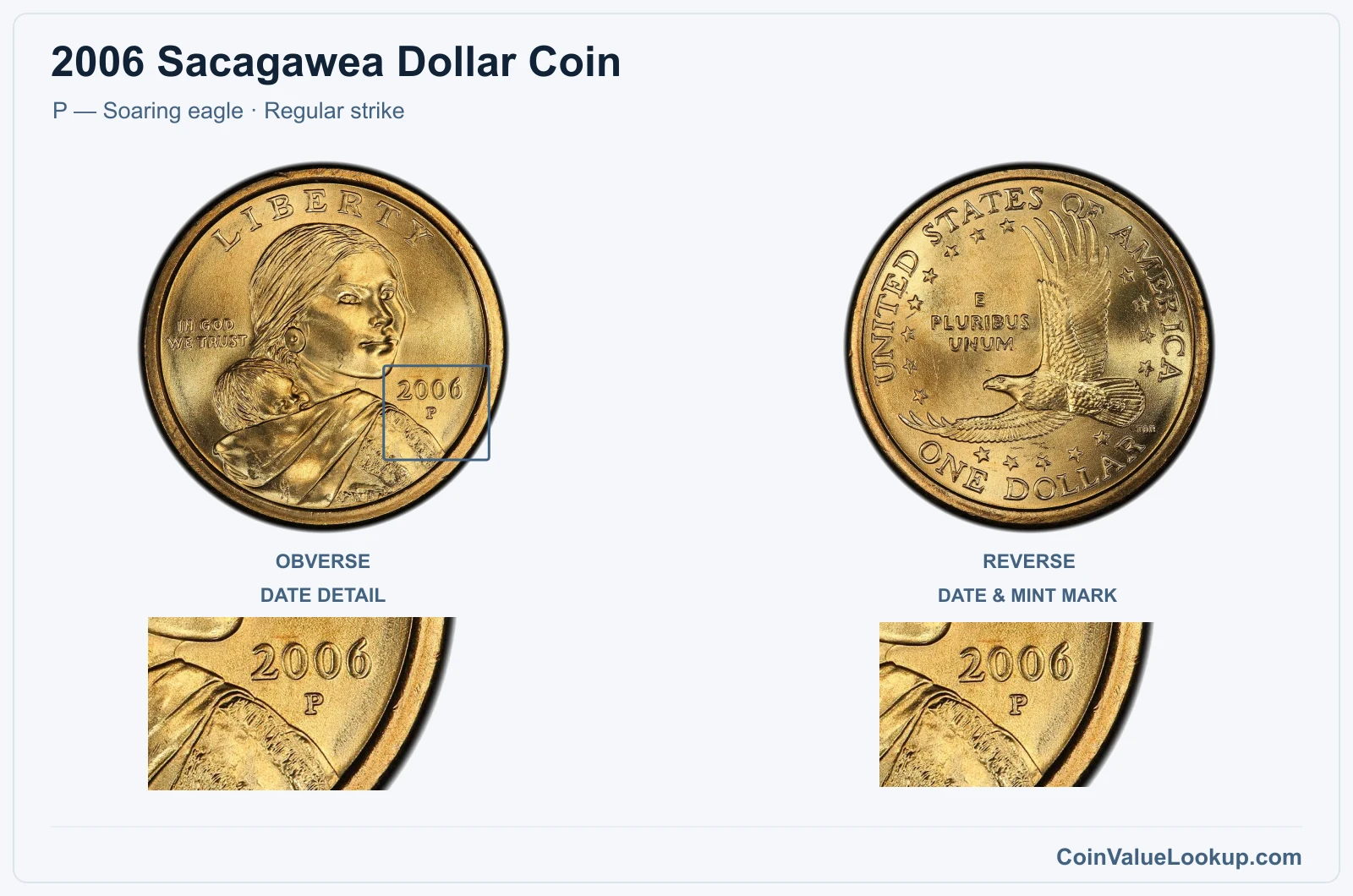
The 2006-P business strike is the standard Philadelphia issue you might find in change or a bank roll. Look for the small "P" mintmark on the obverse below the date.
It has ordinary cartwheel luster — bright and reflective when uncirculated, progressively flat as it wears.
A USA Coin Book guide estimate places this version at about $5.63 in MS65. Circulated pieces are generally worth face value.
Confirm the mintmark and finish before referencing any value chart, because a satin-finish P coin is a different branch entirely.
Range Grade
Price Auction Records Appraisal PO PO 1
—
Coin Identifier FR FR 2
—
Coin Identifier AG AG 3
—
Coin Identifier G G 4
—
Coin Identifier
G 6
—
Coin Identifier VG VG 8
—
Coin Identifier
VG 10
—
Coin Identifier F F 12
—
Coin Identifier
F 15
—
Coin Identifier VF VF 20
—
Coin Identifier
VF 25
—
Coin Identifier
VF 30
—
Coin Identifier
VF 35
—
Coin Identifier XF XF 40
—
Coin Identifier
XF 45
—
Coin Identifier AU AU 50
—
Coin Identifier
AU 53
—
Coin Identifier
AU 55
—
Coin Identifier
AU 58
—
Coin Identifier MS MS 60
—
Coin Identifier
MS 61
—
Coin Identifier
MS 62
—
Coin Identifier
MS 63
—
Coin Identifier
MS 64
—
Coin Identifier
MS 65
—
Coin Identifier
MS 66
Coin Identifier
MS 67
Coin Identifier
MS 68
Coin Identifier
MS 69
—
—
—
MS 70
—
—
—
2006 Sacagawea Dollar — P — Soaring eagle — satin
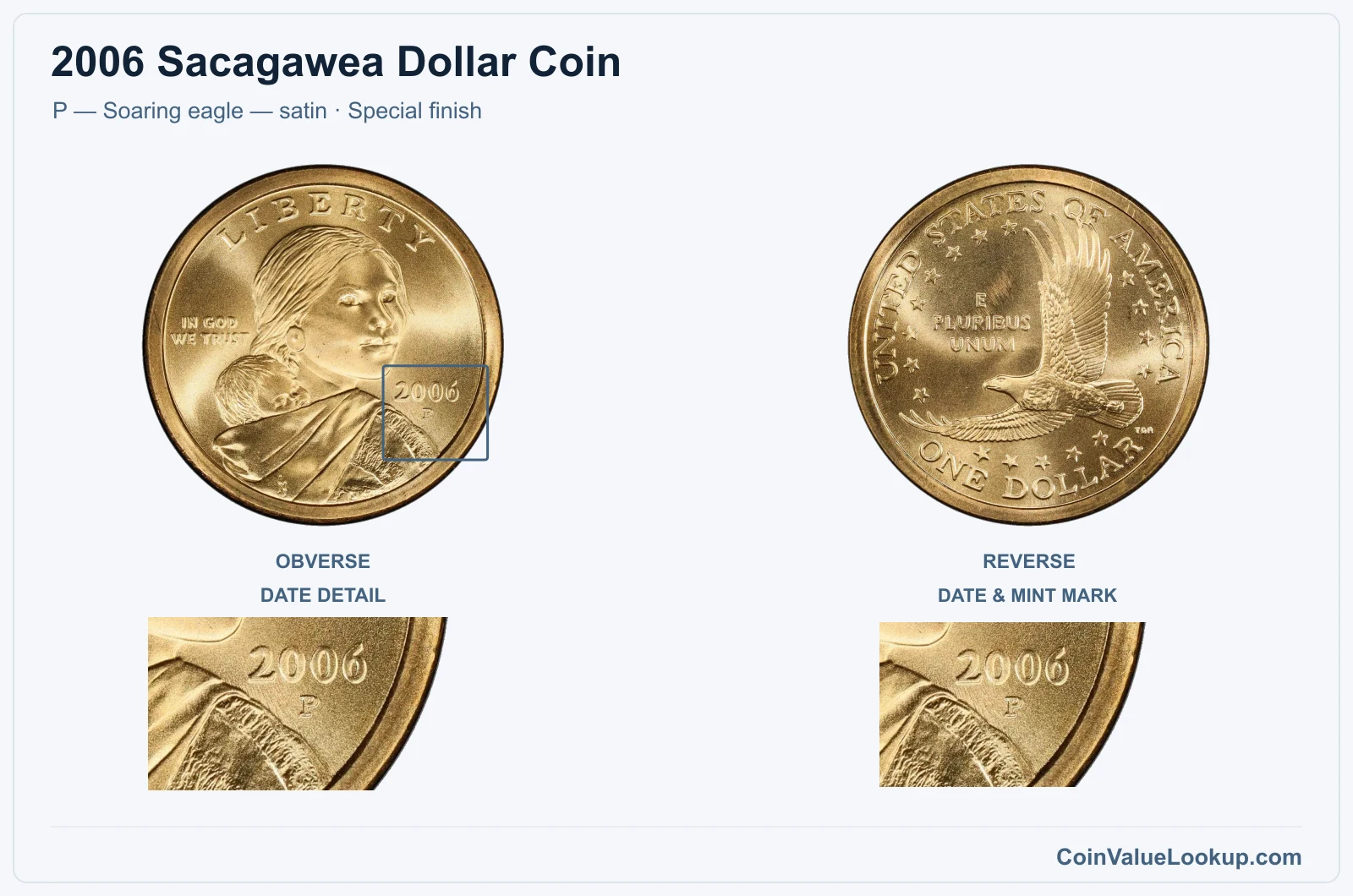
The 2006-P satin-finish dollar was available only inside that year's Uncirculated Mint Set. It carries a "P" mintmark just like the business strike, but the surface texture is noticeably different: a smooth, even, almost matte luster instead of the sharp cartwheel reflection of a regular coin.
No guide price was adopted for this version, so value depends on authenticated identity, condition and any verified errors. If you pulled it from a sealed mint set, that provenance helps.
A loose satin coin can be tricky to distinguish from a lightly circulated business strike without side-by-side comparison, so take your time.
Coin Value Lookup is a handy starting point when you need to look up guides for other Sacagawea Dollar years or different denominations altogether.
Range Grade
Price Auction Records Appraisal SP SP 1
—
Coin Identifier
SP 2
—
Coin Identifier
SP 3
—
Coin Identifier
SP 4
—
Coin Identifier
SP 6
—
Coin Identifier
SP 8
—
Coin Identifier
SP 10
—
Coin Identifier
SP 12
—
Coin Identifier
SP 15
—
Coin Identifier
SP 20
—
Coin Identifier
SP 25
—
Coin Identifier
SP 30
—
Coin Identifier
SP 35
—
Coin Identifier
SP 40
—
Coin Identifier
SP 45
—
Coin Identifier
SP 50
—
Coin Identifier
SP 53
—
Coin Identifier
SP 55
—
Coin Identifier
SP 58
—
Coin Identifier
SP 60
—
Coin Identifier
SP 61
—
Coin Identifier
SP 62
—
Coin Identifier
SP 63
—
Coin Identifier
SP 64
—
Coin Identifier
SP 65
—
Coin Identifier
SP 66
—
Coin Identifier
SP 67
Coin Identifier
SP 68
Coin Identifier
SP 69
Coin Identifier
SP 70
—
—
—
2006 Sacagawea Dollar — D — Soaring eagle
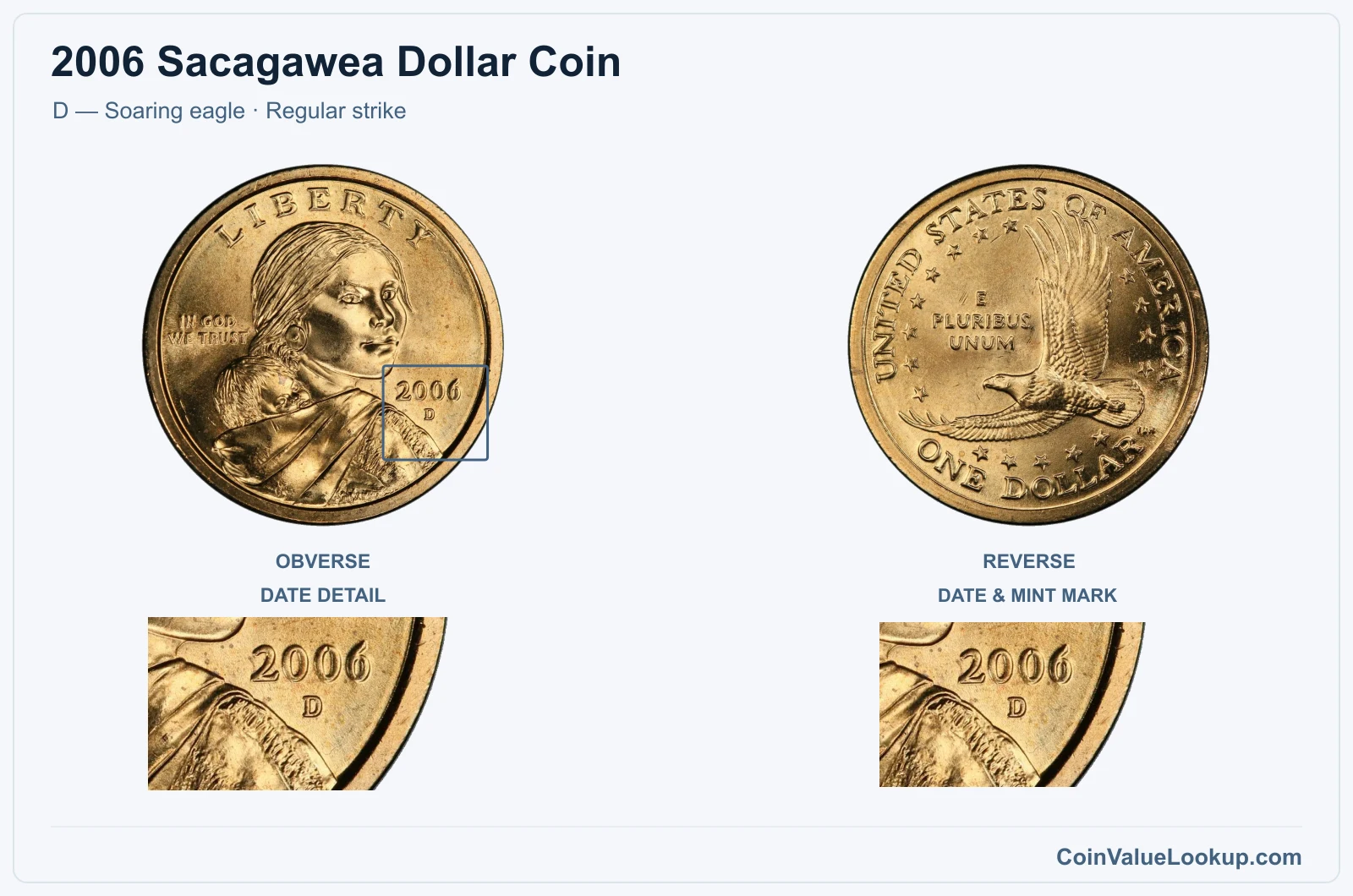
The 2006-D business strike was produced at the Denver Mint. Find the "D" mintmark on the obverse below the date.
Surface and luster are identical in character to the Philadelphia business strike — standard cartwheel shine when fresh.
USA Coin Book estimates this version at roughly $4.96 in MS65. That is a hair below the Philadelphia issue at the same grade.
Worn examples are worth a dollar. As always, make sure you are not looking at a satin-finish D coin before checking the value chart.
Range Grade
Price Auction Records Appraisal PO PO 1
—
Coin Identifier FR FR 2
—
Coin Identifier AG AG 3
—
Coin Identifier G G 4
—
Coin Identifier
G 6
—
Coin Identifier VG VG 8
—
Coin Identifier
VG 10
—
Coin Identifier F F 12
—
Coin Identifier
F 15
—
Coin Identifier VF VF 20
—
Coin Identifier
VF 25
—
Coin Identifier
VF 30
—
Coin Identifier
VF 35
—
Coin Identifier XF XF 40
—
Coin Identifier
XF 45
—
Coin Identifier AU AU 50
—
Coin Identifier
AU 53
—
Coin Identifier
AU 55
—
Coin Identifier
AU 58
—
Coin Identifier MS MS 60
—
Coin Identifier
MS 61
—
Coin Identifier
MS 62
—
Coin Identifier
MS 63
—
Coin Identifier
MS 64
—
Coin Identifier
MS 65
Coin Identifier
MS 66
Coin Identifier
MS 67
Coin Identifier
MS 68
Coin Identifier
MS 69
—
—
—
MS 70
—
—
—
2006 Sacagawea Dollar — D — Soaring eagle — satin
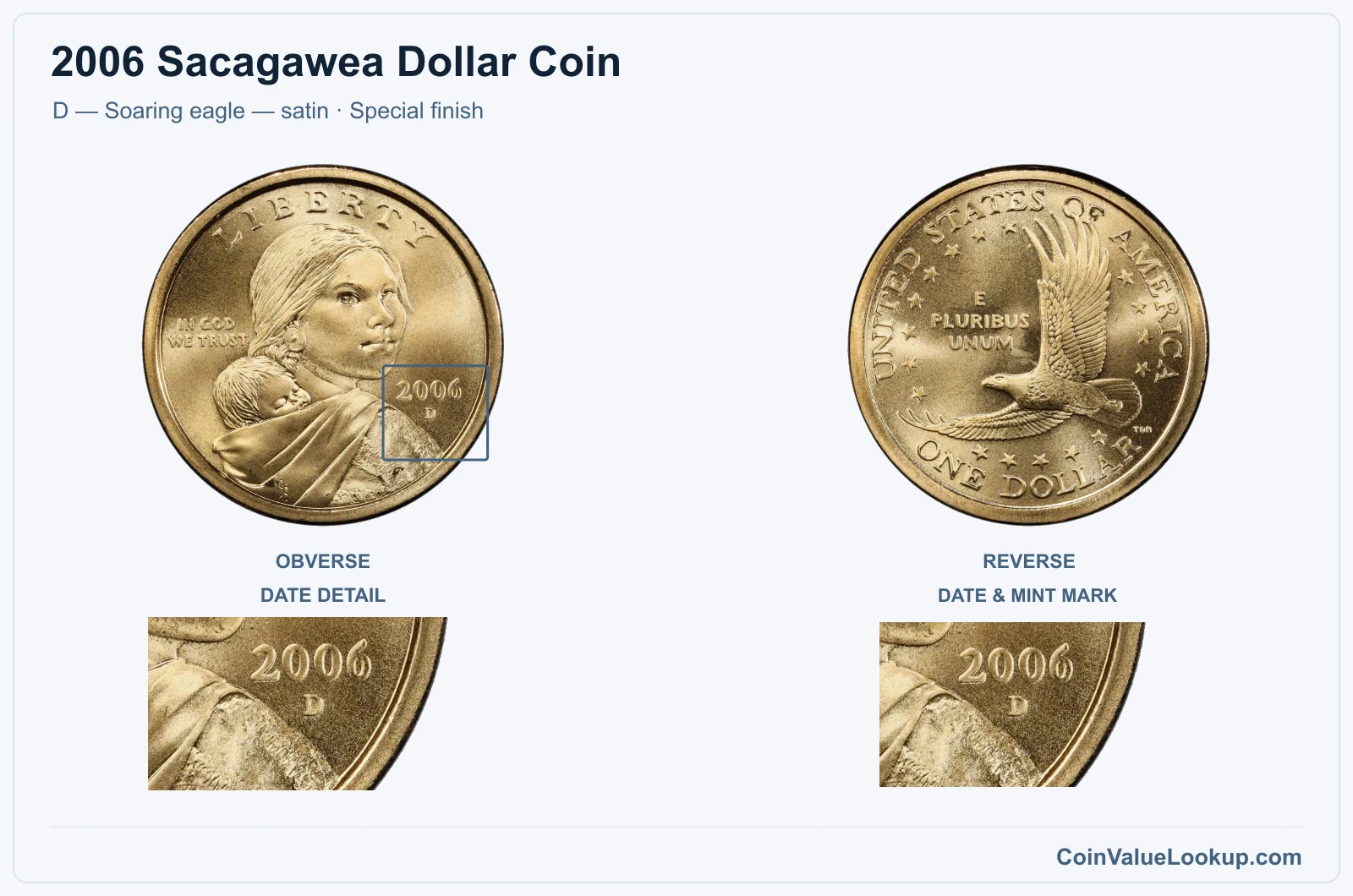
Like its Philadelphia counterpart, the 2006-D satin-finish dollar came exclusively in the 2006 Uncirculated Mint Set. The "D" mintmark sits in the same obverse location, but the surface has that characteristic soft, uniform luster that separates it from business strikes.
No adopted guide estimate exists for this version, so each coin needs individual assessment based on its authenticated identity and condition. Satin coins in top grades with clean surfaces tend to attract a premium over raw business strikes, but you need proper attribution first.
Do not assume a slightly dull business strike is a satin coin — the two finishes are distinct under magnification.
Range Grade
Price Auction Records Appraisal SP SP 1
—
Coin Identifier
SP 2
—
Coin Identifier
SP 3
—
Coin Identifier
SP 4
—
Coin Identifier
SP 6
—
Coin Identifier
SP 8
—
Coin Identifier
SP 10
—
Coin Identifier
SP 12
—
Coin Identifier
SP 15
—
Coin Identifier
SP 20
—
Coin Identifier
SP 25
—
Coin Identifier
SP 30
—
Coin Identifier
SP 35
—
Coin Identifier
SP 40
—
Coin Identifier
SP 45
—
Coin Identifier
SP 50
—
Coin Identifier
SP 53
—
Coin Identifier
SP 55
—
Coin Identifier
SP 58
—
Coin Identifier
SP 60
—
Coin Identifier
SP 61
—
Coin Identifier
SP 62
—
Coin Identifier
SP 63
—
Coin Identifier
SP 64
—
Coin Identifier
SP 65
—
Coin Identifier
SP 66
Coin Identifier
SP 67
Coin Identifier
SP 68
Coin Identifier
SP 69
Coin Identifier
SP 70
—
—
—
2006 Sacagawea Dollar — S — Soaring eagle — proof
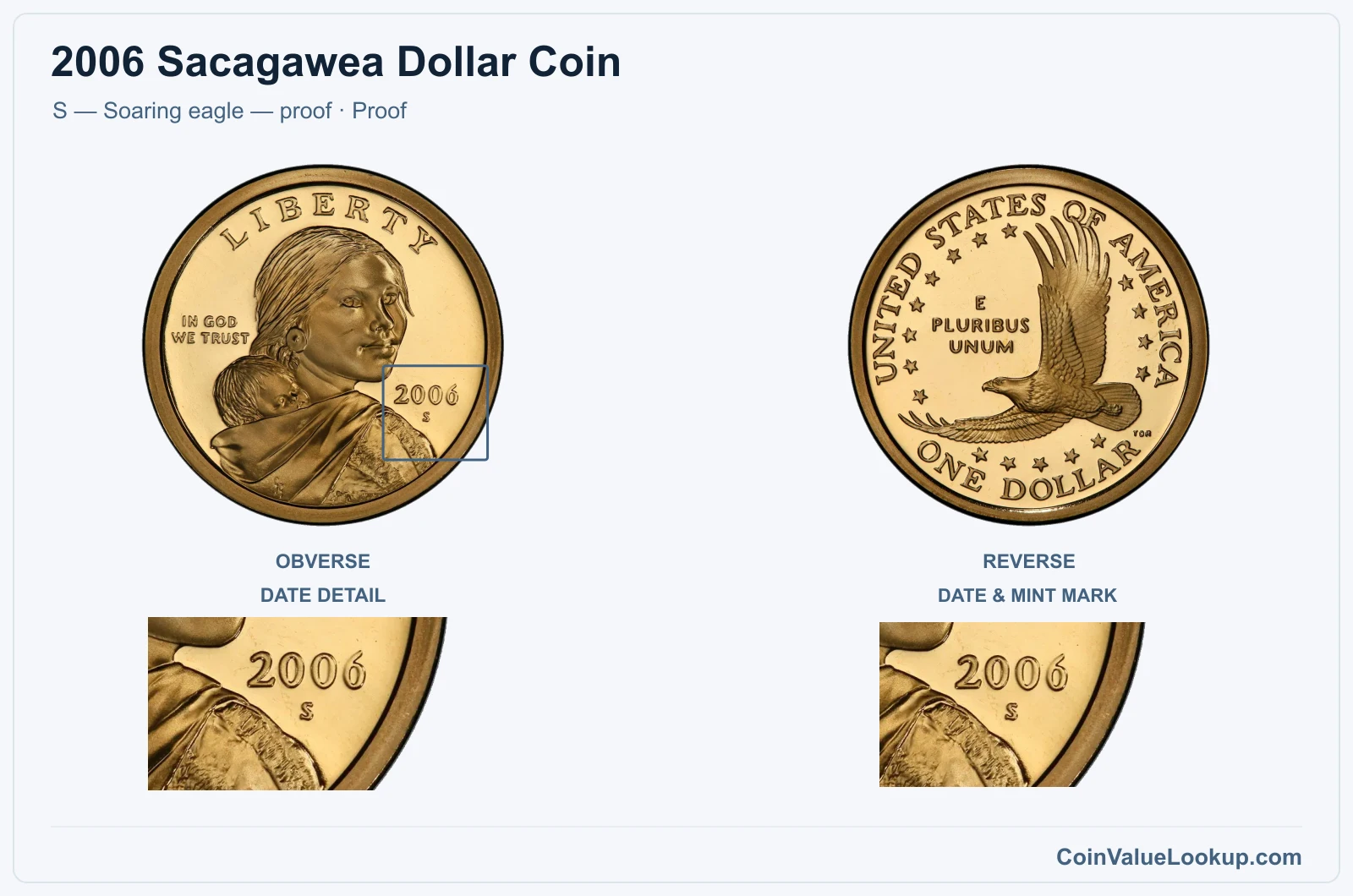
The 2006-S proof was struck at the San Francisco Mint for inclusion in proof sets. It features mirror-like fields contrasting with frosted raised devices — Sacagawea's portrait and the eagle both show that crisp sculptural relief.
USA Coin Book places this at about $7.29 in PR65, the highest single-grade guide estimate among the 2006 Sacagawea versions. A proof is a manufacturing method, not a grade above Mint State, so a mishandled proof can still receive a low numerical grade.
Despite being sold alongside silver proof coins in some sets, this dollar is manganese-brass clad — not silver.
Range Grade
Price Auction Records Appraisal PR PR 1
—
Coin Identifier
PR 2
—
Coin Identifier
PR 3
—
Coin Identifier
PR 4
—
Coin Identifier
PR 6
—
Coin Identifier
PR 8
—
Coin Identifier
PR 10
—
Coin Identifier
PR 12
—
Coin Identifier
PR 15
—
Coin Identifier
PR 20
—
Coin Identifier
PR 25
—
Coin Identifier
PR 30
—
Coin Identifier
PR 35
—
Coin Identifier
PR 40
—
Coin Identifier
PR 45
—
Coin Identifier
PR 50
—
Coin Identifier
PR 53
—
Coin Identifier
PR 55
—
Coin Identifier
PR 58
—
Coin Identifier
PR 60
—
Coin Identifier
PR 61
—
Coin Identifier
PR 62
—
Coin Identifier
PR 63
—
Coin Identifier
PR 64
—
Coin Identifier
PR 65
—
Coin Identifier
PR 66
—
Coin Identifier
PR 67
—
Coin Identifier
PR 68
—
Coin Identifier
PR 69
Coin Identifier
PR 70
Coin Identifier
2006 Sacagawea Dollar Error List
1. 2006 Sacagawea Dollar — Die Crack / Die Chip
A die crack appears as a thin raised line on the coin's surface, tracing a path where the steel die fractured during production. A die chip is a small raised blob where a tiny piece of the die broke away.
Both are mint-made, meaning they are part of the striking process rather than post-mint damage.
On a 2006 Sacagawea Dollar, look carefully at both sides under magnification. A genuine die crack is raised above the field and often runs between design elements or from the rim inward.
Do not confuse it with incuse scratches, surface corrosion or debris stuck to the coin — those are recessed or sit on top of the surface rather than being struck into it.
No specific price range was adopted for these errors. Value depends on the crack's size, location, visual impact and the coin's overall condition.
2. 2006 Sacagawea Dollar — Die Break / Cud
A die break leaves a raised, featureless area on the coin where a chunk of the die fell away. When that break connects to the rim, collectors call it a cud — a distinctive raised blob that replaces part of the normal design along the edge.
On a 2006 Sacagawea Dollar, inspect the rim carefully. A cud will have a clear boundary between the flat, featureless blob and the surviving design.
The displaced area will match the coin's surface level or sit slightly above it.
Do not mistake a rim dent, corrosion buildup or a small interior die chip for a true cud. Rim damage is usually recessed and uneven, while a cud is raised and consistent.
No adopted price range exists for this error; the value depends on the break's size, location and the coin's condition overall.
3. 2006 Sacagawea Dollar — Off-Center Strike
An off-center strike happens when the planchet is not seated properly between the dies, so part of the design is missing and a blank crescent appears on one side. The percentage off-center and whether the date remains visible are the two biggest factors collectors care about.
On a 2006 Sacagawea Dollar, look for a shifted design with a corresponding unstruck area. A genuine off-center strike affects both sides in a consistent direction.
If only one side looks shifted, that points to a misaligned die rather than a true off-center error.
Be careful not to confuse a clipped planchet or post-mint flattening with an off-center strike. No specific price was adopted for this error — value hinges on the degree of misalignment, date visibility and overall condition of the coin.
4. 2006 Sacagawea Dollar — Wrong Planchet / Off-Metal Strike
A wrong-planchet error means the 2006 Sacagawea Dollar design was struck on a blank intended for a different denomination or series. These are scarce and dramatic when genuine.
To check, compare your coin's weight, diameter and edge to the standard specs: 8.10 grams, 26.5 mm diameter, plain edge with manganese-brass clad composition. A wrong-planchet coin will deviate noticeably in one or more of those measurements, and the design may be incomplete if the blank was smaller than intended.
The most common lookalikes are coins that have been plated, corroded, acid-treated or deliberately altered to look unusual. A kitchen scale and a caliper will catch most fakes before you spend money on professional attribution.
No price range was adopted for this error; each example must be evaluated on its own based on the specific planchet, condition and authentication.