2010 Sacagawea Dollar Coin Value: How Much Is It Worth?
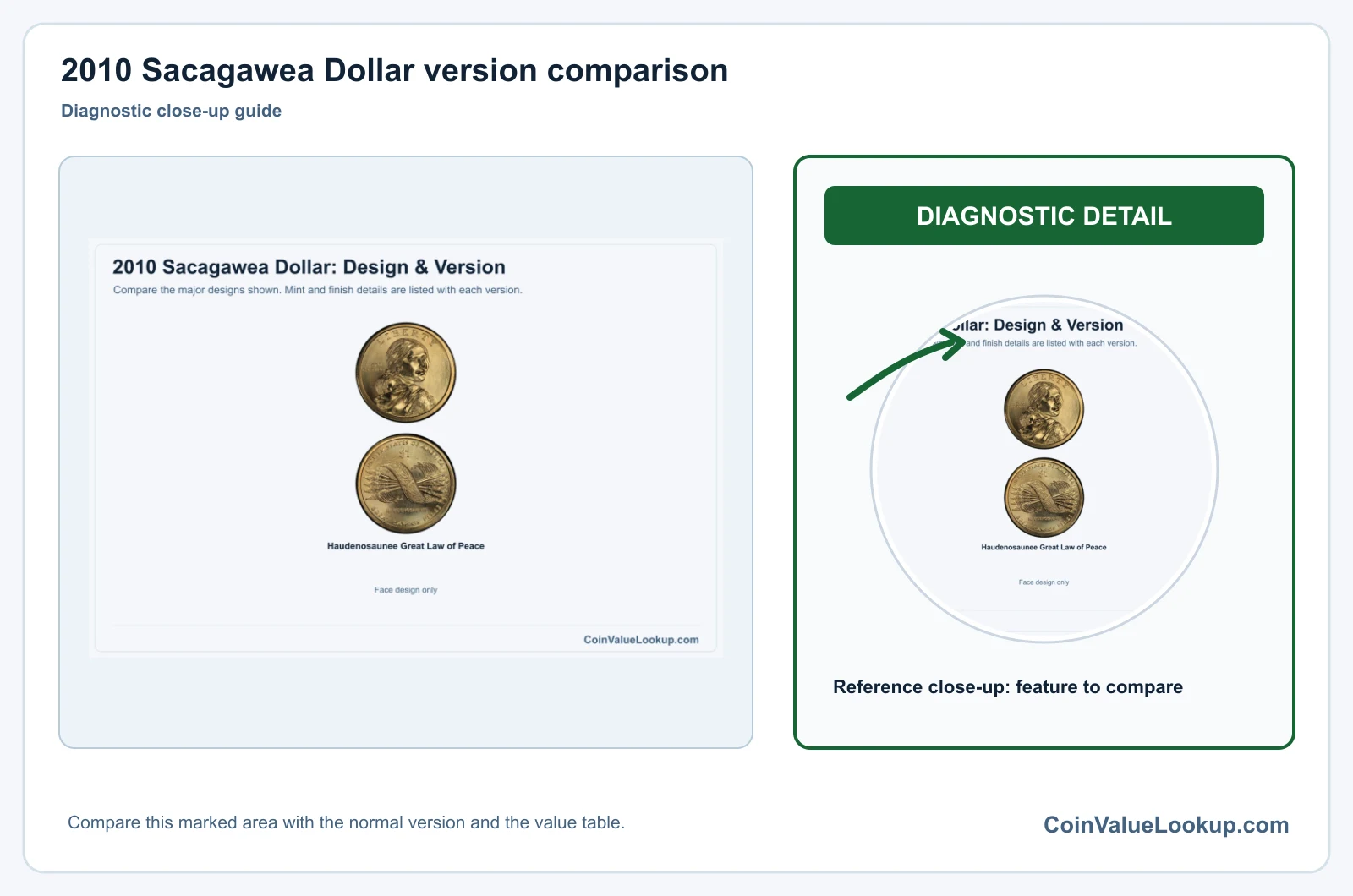
The 2010 Sacagawea Dollar features the Haudenosaunee Great Law of Peace reverse, part of the Native American Dollar series. Guide estimates from USA Coin Book place these coins between about $6.25 in MS65 for business strikes and $10.00 in PR65 for the San Francisco proof.
Your coin's actual value depends on its mint, finish and condition, so sorting those details out first is the whole game.
Fast Way to Identify Your 2010 Sacagawea Dollar
Upload clear photos of both sides of your 2010 Sacagawea Dollar and we can help with a preliminary identification. A straight-on shot of the obverse and reverse, plus a close-up of the edge lettering, gives us what we need to narrow down the mint, finish and edge-letter position.
2010 Sacagawea Dollar Value
Upload both sides of your 2010 Sacagawea Dollar.
Front Obverse
Upload photo
Back Reverse
Upload photo
Which 2010 Sacagawea Dollar Versions Are Worth Money?
- Philadelphia and Denver business strikes in MS65 carry a USA Coin Book guide estimate around $6.25, with Position A and Position B sharing the same value basis.
- Satin-finish coins from the P and D mints, found only in 2010 Mint Sets, are a distinct collectible finish worth identifying separately from ordinary strikes.
- The 2010-S proof, struck at San Francisco, carries a guide estimate of about $10.00 at PR65, the highest listed anchor among all 2010 versions.
- Edge-letter position (A or B) is an easy detail to check and creates separate collectible varieties for both business and satin strikes.
- Confirmed mint errors such as missing edge lettering or off-center strikes can carry premiums, but require careful verification against lookalikes.
Step 1: Identify Your 2010 Sacagawea Dollar Mint Mark and Version
Starting in 2009, the date and mintmark moved to the edge of the Sacagawea Dollar, so you will not find them on the face. Tilt the coin and rotate it slowly under a light to read the incuse lettering around the rim.
You are looking for either a P (Philadelphia), D (Denver) or S (San Francisco) mintmark.
The reverse shows a bundle of five arrows bound together with the Haudenosaunee Great Tree of Peace design. All 2010 dollars share this reverse, so the key sorting happens on the edge and by finish.
Edge-letter position matters. Hold the obverse facing you with Sacagawea right-side up.
If the edge lettering reads normally from left to right, that is Position A. If it reads upside-down relative to the obverse, that is Position B.
Finish is the next divider. Business strikes have the typical satin-like luster you see on circulating coins.
Satin-finish examples came exclusively in 2010 Mint Sets and have a distinctive soft, matte texture across every surface. Proof strikes from the S mint show mirrored fields and frosted devices.
Do not confuse the golden color for gold content; these are manganese-brass clad coins weighing 8.10 grams.
Coin Value Lookup is a useful starting point when you need to look up guides for this series or other U.S. coins. It can help you zero in on the right year, mint and denomination before diving deeper.
Step 2: Check Your 2010 Sacagawea Dollar Grade
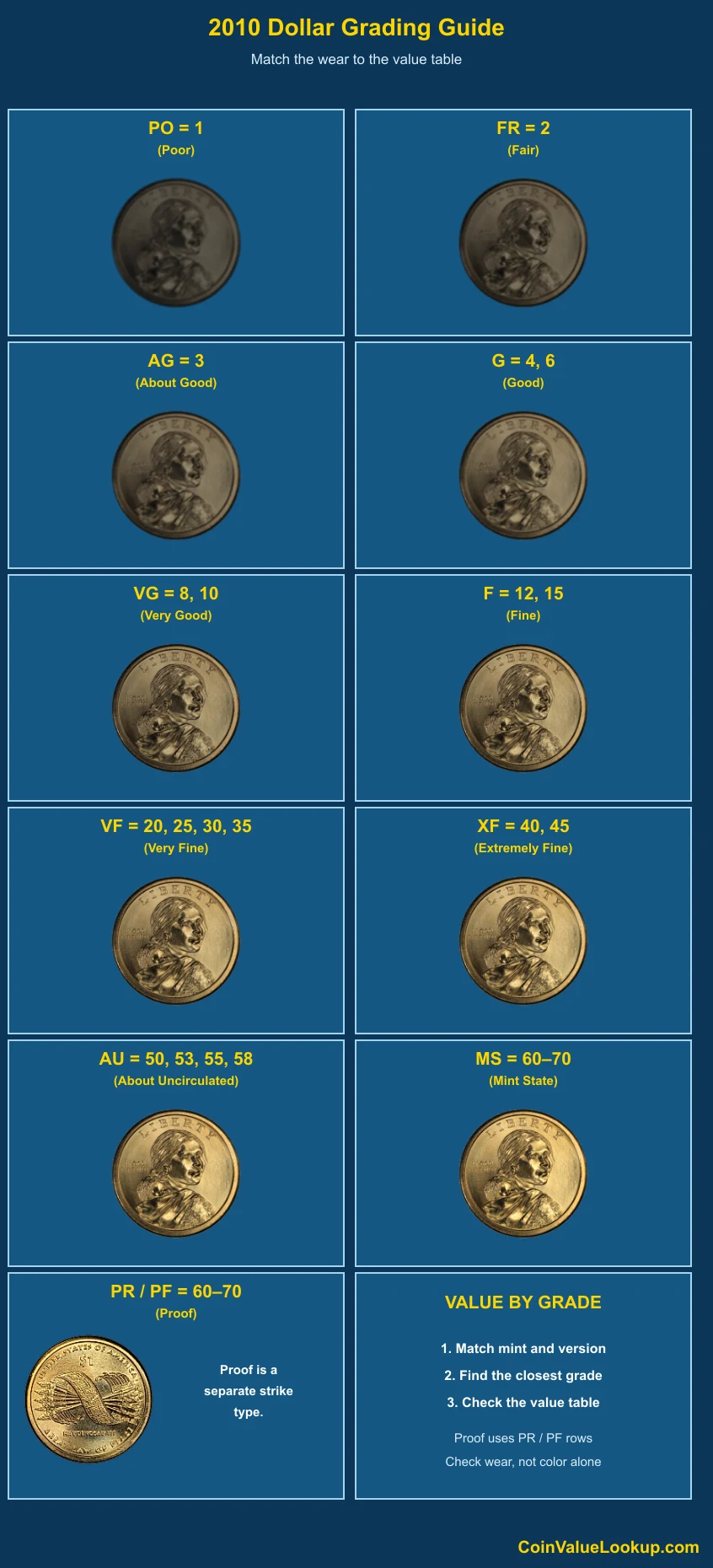
Focus on Sacagawea's cheek and the high points of her hair first. These are the earliest spots to show friction.
On the reverse, check the bundle of arrows and the tree canopy for flatness or contact marks.
At About Uncirculated, you will see slight wear on the cheek and hair but most of the original surface texture remains. A true Mint State coin shows no wear at all, though bag marks from storage are normal.
Satin-finish coins grade differently from business strikes. Their intentionally soft texture can look worn to an untrained eye, so compare your coin against a known satin example rather than a standard strike.
Proof coins should show clean mirrored fields; hairlines from mishandling count against the grade.
Use the comparison image to check circulated, AU and Mint State wear stages side by side. Keep proofs and satin finishes in their own mental category when assessing condition.
Step 3: Check 2010 Sacagawea Dollar Value by Mint and Version
2010 Sacagawea Dollar — P — Haudenosaunee Great Law of Peace — Position A
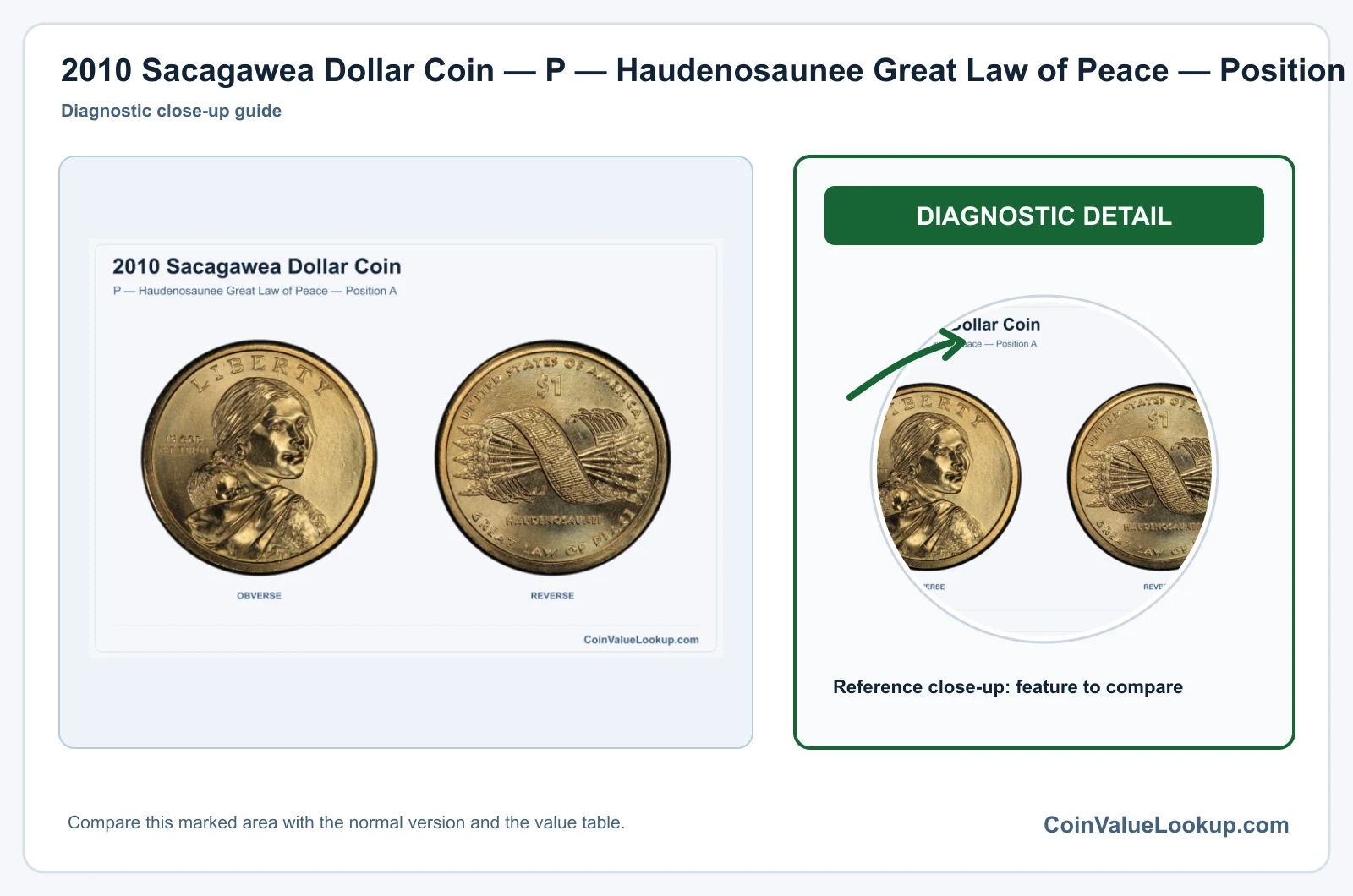
This is the standard Philadelphia business strike with edge lettering in Position A. Hold the obverse face-up with Sacagawea upright; if the edge text reads normally from left to right, you have Position A.
The coin is manganese-brass clad, weighs 8.10 grams, and features the Haudenosaunee Great Law of Peace reverse. A USA Coin Book guide estimate places it around $6.25 at MS65.
Most circulated examples trade at or near face value.
Range Grade
Price Auction Records Appraisal PO PO 1
—
Coin Identifier FR FR 2
—
Coin Identifier AG AG 3
—
Coin Identifier G G 4
—
Coin Identifier
G 6
—
Coin Identifier VG VG 8
—
Coin Identifier
VG 10
—
Coin Identifier F F 12
—
Coin Identifier
F 15
—
Coin Identifier VF VF 20
—
Coin Identifier
VF 25
—
Coin Identifier
VF 30
—
Coin Identifier
VF 35
—
Coin Identifier XF XF 40
—
Coin Identifier
XF 45
—
Coin Identifier AU AU 50
—
Coin Identifier
AU 53
—
Coin Identifier
AU 55
—
Coin Identifier
AU 58
—
Coin Identifier MS MS 60
—
Coin Identifier
MS 61
—
Coin Identifier
MS 62
—
Coin Identifier
MS 63
—
Coin Identifier
MS 64
—
Coin Identifier
MS 65
Coin Identifier
MS 66
Coin Identifier
MS 67
Coin Identifier
MS 68
—
—
—
MS 69
—
—
—
MS 70
—
—
—
2010 Sacagawea Dollar — P — Haudenosaunee Great Law of Peace — satin — Position A
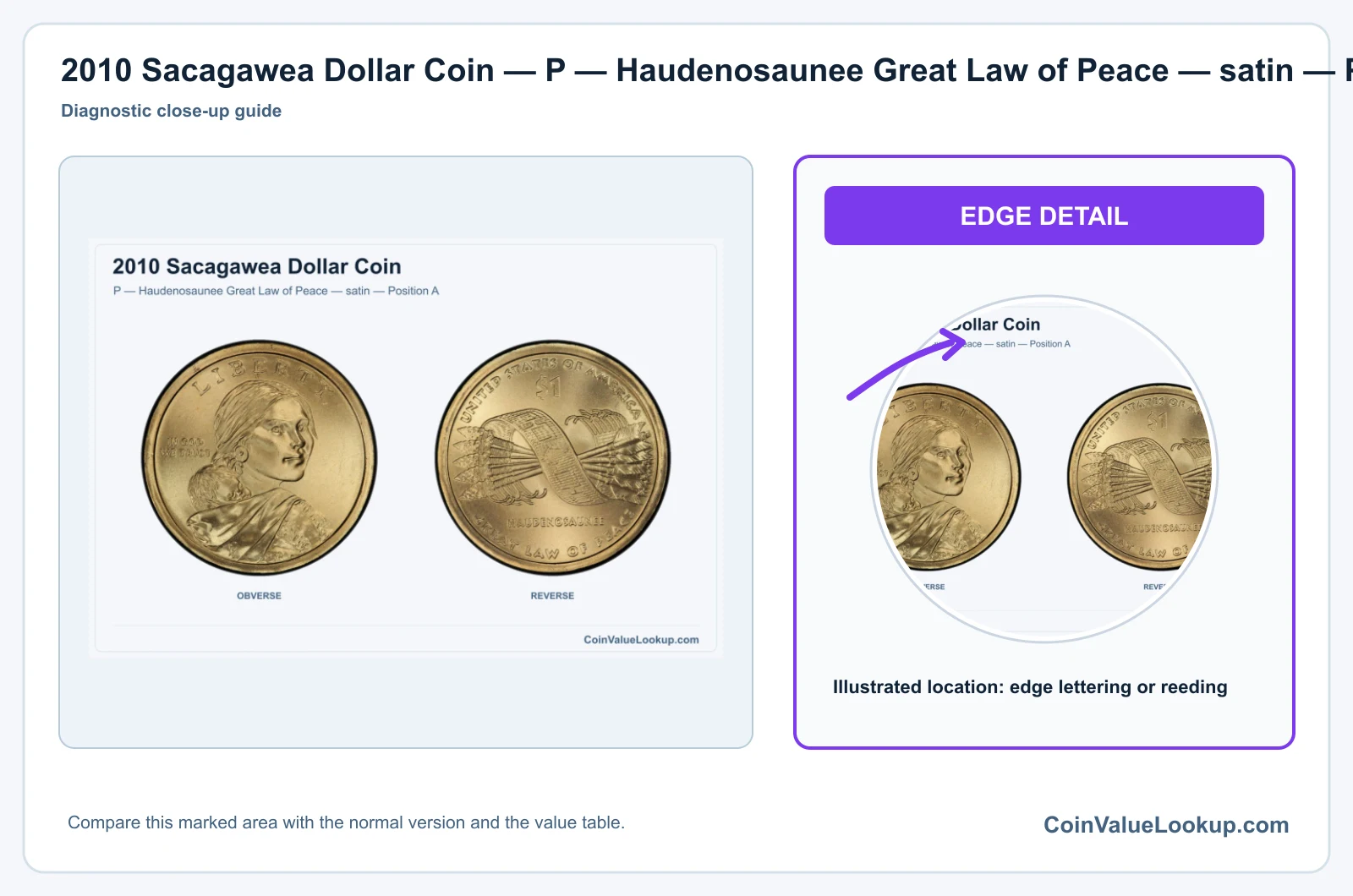
This is the Philadelphia satin-finish version with Position A edge lettering. Satin-finish coins were produced exclusively for 2010 Mint Sets and have a soft, even texture across both sides that looks quite different from a regular business strike.
Even at the same numerical grade, a satin coin and a business strike are not interchangeable. Value depends on authenticated identity and condition, so no single guide figure applies here.
If you pulled yours from an original Mint Set, keep the packaging as supporting documentation.
Range Grade
Price Auction Records Appraisal SP SP 1
—
Coin Identifier
SP 2
—
Coin Identifier
SP 3
—
Coin Identifier
SP 4
—
Coin Identifier
SP 6
—
Coin Identifier
SP 8
—
Coin Identifier
SP 10
—
Coin Identifier
SP 12
—
Coin Identifier
SP 15
—
Coin Identifier
SP 20
—
Coin Identifier
SP 25
—
Coin Identifier
SP 30
—
Coin Identifier
SP 35
—
Coin Identifier
SP 40
—
Coin Identifier
SP 45
—
Coin Identifier
SP 50
—
Coin Identifier
SP 53
—
Coin Identifier
SP 55
—
Coin Identifier
SP 58
—
Coin Identifier
SP 60
—
Coin Identifier
SP 61
—
Coin Identifier
SP 62
—
Coin Identifier
SP 63
—
Coin Identifier
SP 64
—
Coin Identifier
SP 65
—
Coin Identifier
SP 66
—
Coin Identifier
SP 67
—
Coin Identifier
SP 68
Coin Identifier
SP 69
Coin Identifier
SP 70
—
—
—
2010 Sacagawea Dollar — P — Haudenosaunee Great Law of Peace — Position B
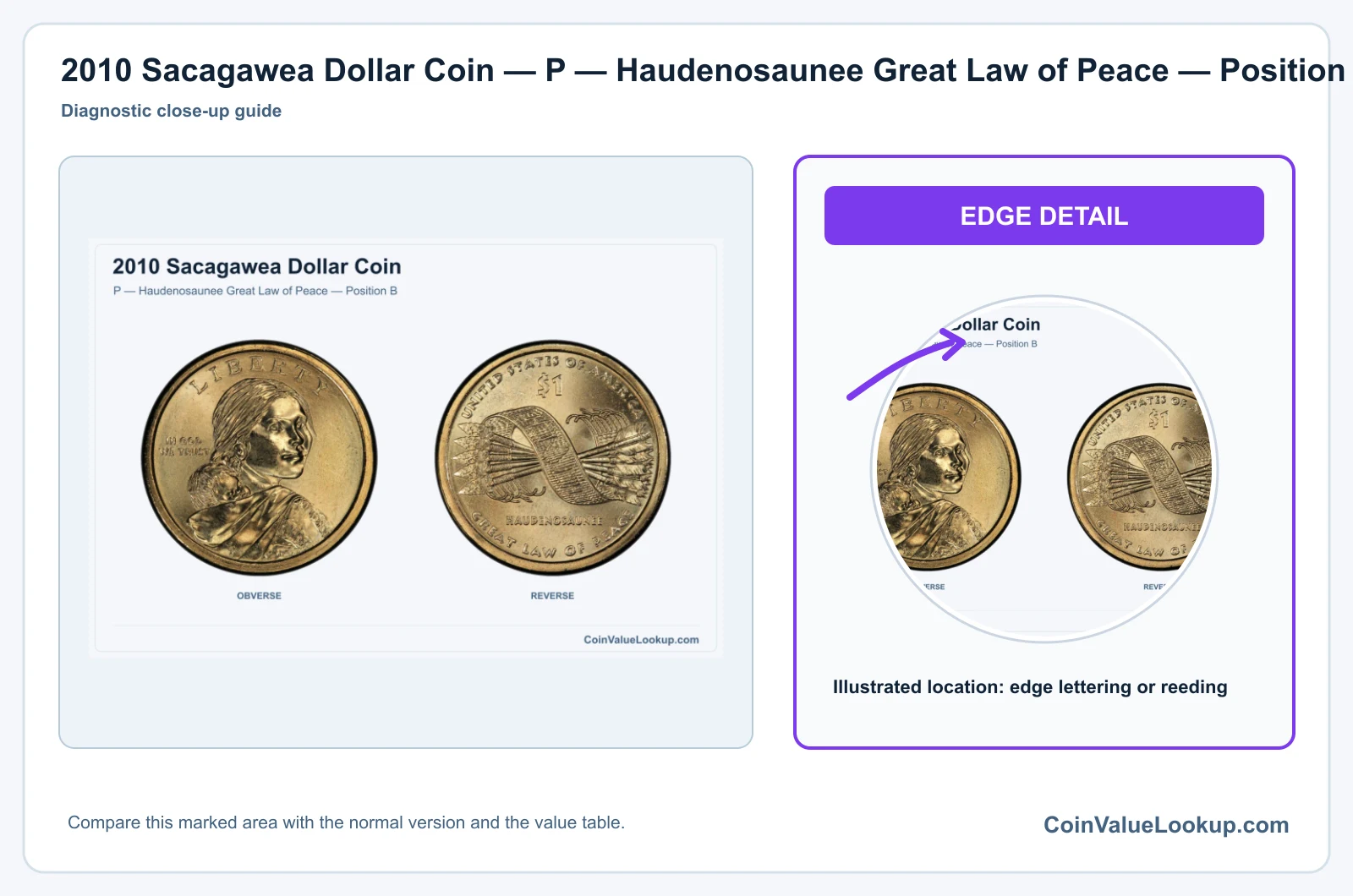
Same Philadelphia business strike as Version 1, but the edge lettering is in Position B. Flip the coin so Sacagawea faces you right-side up; if the incuse text along the edge reads upside-down relative to the obverse, that is Position B.
Material and weight are identical to Position A. The USA Coin Book guide estimate is also about $6.25 at MS65.
Position alone does not create a dramatic price split, but collectors tracking the full set do want both.
Range Grade
Price Auction Records Appraisal PO PO 1
—
Coin Identifier FR FR 2
—
Coin Identifier AG AG 3
—
Coin Identifier G G 4
—
Coin Identifier
G 6
—
Coin Identifier VG VG 8
—
Coin Identifier
VG 10
—
Coin Identifier F F 12
—
Coin Identifier
F 15
—
Coin Identifier VF VF 20
—
Coin Identifier
VF 25
—
Coin Identifier
VF 30
—
Coin Identifier
VF 35
—
Coin Identifier XF XF 40
—
Coin Identifier
XF 45
—
Coin Identifier AU AU 50
—
Coin Identifier
AU 53
—
Coin Identifier
AU 55
—
Coin Identifier
AU 58
—
Coin Identifier MS MS 60
—
Coin Identifier
MS 61
—
Coin Identifier
MS 62
—
Coin Identifier
MS 63
—
Coin Identifier
MS 64
—
Coin Identifier
MS 65
—
Coin Identifier
MS 66
Coin Identifier
MS 67
Coin Identifier
MS 68
—
—
—
MS 69
—
—
—
MS 70
—
—
—
2010 Sacagawea Dollar — P — Haudenosaunee Great Law of Peace — satin — Position B
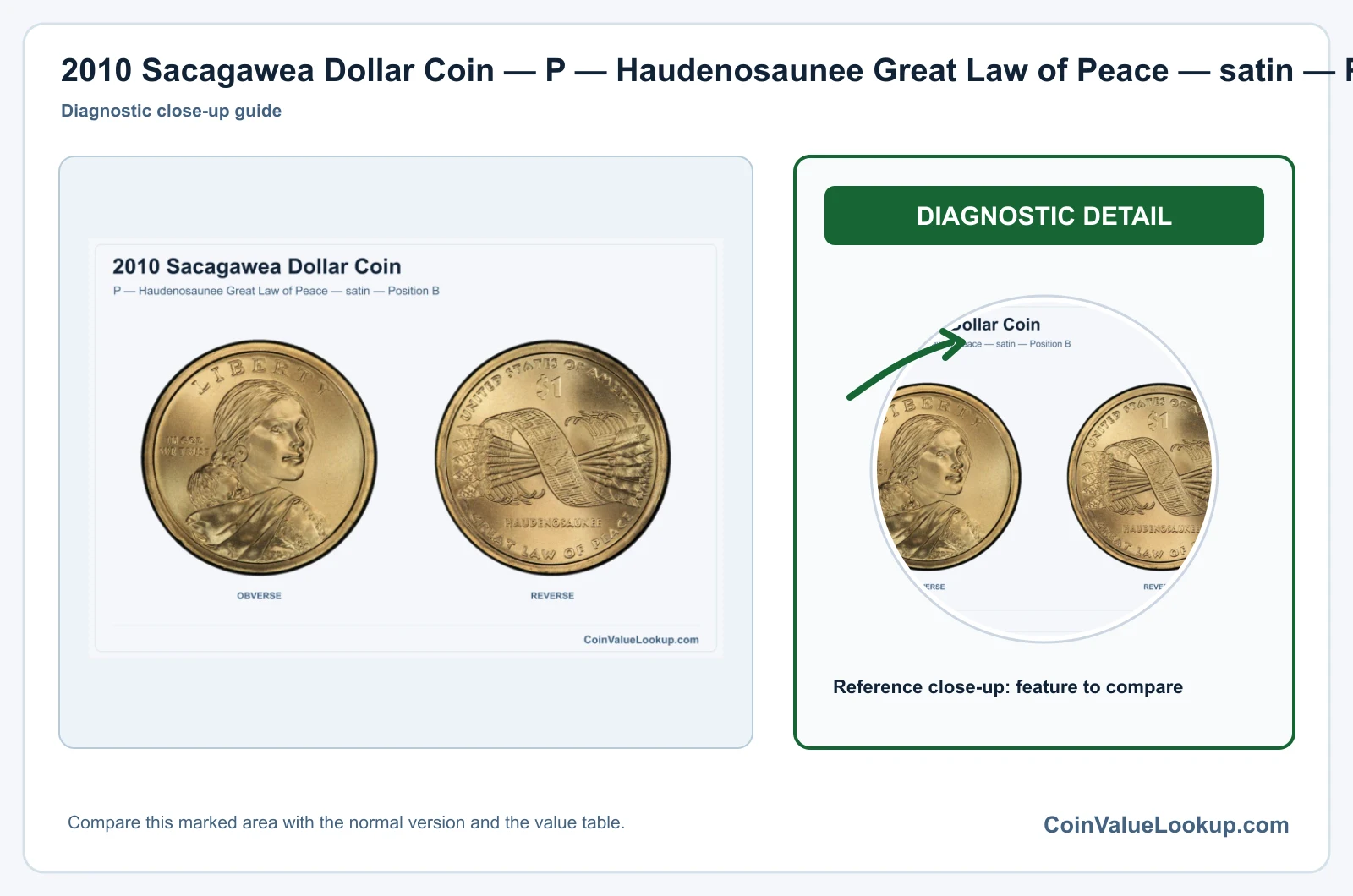
Philadelphia satin finish, Position B. Like the Position A satin coin, this one came from a 2010 Mint Set.
The matte-like surface is the giveaway: under magnification, satin strikes show a uniform fine texture rather than the flow lines of a business strike. Because no specific guide figure is adopted for this finish, value depends on the coin's authenticated identity and overall condition.
Keeping it in its original Mint Set holder helps confirm the satin finish.
Range Grade
Price Auction Records Appraisal SP SP 1
—
Coin Identifier
SP 2
—
Coin Identifier
SP 3
—
Coin Identifier
SP 4
—
Coin Identifier
SP 6
—
Coin Identifier
SP 8
—
Coin Identifier
SP 10
—
Coin Identifier
SP 12
—
Coin Identifier
SP 15
—
Coin Identifier
SP 20
—
Coin Identifier
SP 25
—
Coin Identifier
SP 30
—
Coin Identifier
SP 35
—
Coin Identifier
SP 40
—
Coin Identifier
SP 45
—
Coin Identifier
SP 50
—
Coin Identifier
SP 53
—
Coin Identifier
SP 55
—
Coin Identifier
SP 58
—
Coin Identifier
SP 60
—
Coin Identifier
SP 61
—
Coin Identifier
SP 62
—
Coin Identifier
SP 63
—
Coin Identifier
SP 64
—
Coin Identifier
SP 65
—
Coin Identifier
SP 66
—
Coin Identifier
SP 67
—
Coin Identifier
SP 68
Coin Identifier
SP 69
—
Coin Identifier
SP 70
—
—
—
2010 Sacagawea Dollar — D — Haudenosaunee Great Law of Peace — Position A
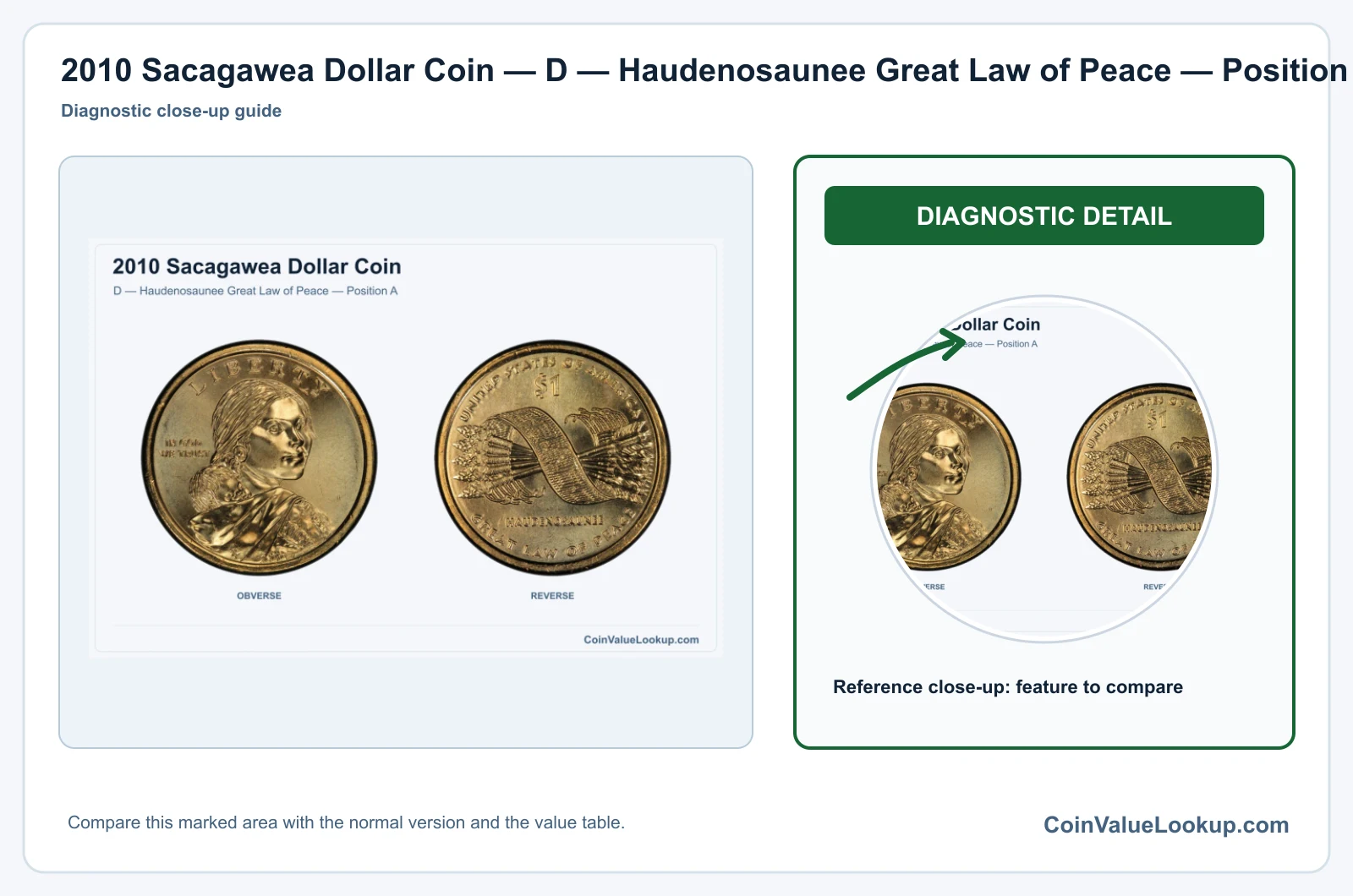
The Denver business strike with Position A edge lettering. Look for the D mintmark incused along the edge alongside the date and motto.
It is the same manganese-brass clad composition and 8.10-gram weight as the Philadelphia version. USA Coin Book lists a guide estimate of about $6.25 at MS65.
Most Denver strikes you find in circulation are worth face value unless they grade well above average.
Range Grade
Price Auction Records Appraisal PO PO 1
—
Coin Identifier FR FR 2
—
Coin Identifier AG AG 3
—
Coin Identifier G G 4
—
Coin Identifier
G 6
—
Coin Identifier VG VG 8
—
Coin Identifier
VG 10
—
Coin Identifier F F 12
—
Coin Identifier
F 15
—
Coin Identifier VF VF 20
—
Coin Identifier
VF 25
—
Coin Identifier
VF 30
—
Coin Identifier
VF 35
—
Coin Identifier XF XF 40
—
Coin Identifier
XF 45
—
Coin Identifier AU AU 50
—
Coin Identifier
AU 53
—
Coin Identifier
AU 55
—
Coin Identifier
AU 58
—
Coin Identifier MS MS 60
—
Coin Identifier
MS 61
—
Coin Identifier
MS 62
—
Coin Identifier
MS 63
—
Coin Identifier
MS 64
—
Coin Identifier
MS 65
—
Coin Identifier
MS 66
Coin Identifier
MS 67
Coin Identifier
MS 68
—
—
—
MS 69
—
—
—
MS 70
—
—
—
2010 Sacagawea Dollar — D — Haudenosaunee Great Law of Peace — satin — Position A
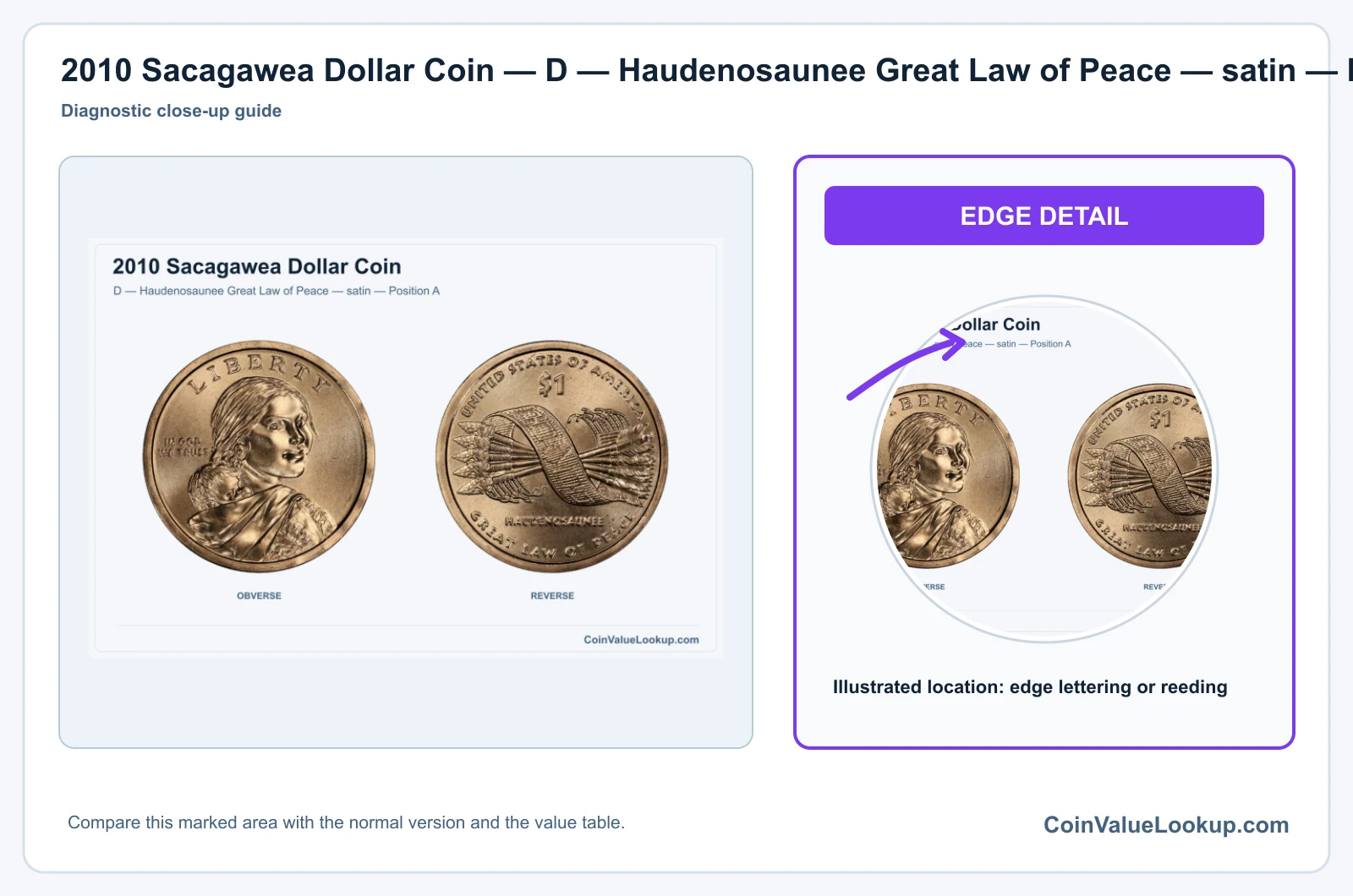
Denver satin finish with Position A edge lettering, sourced from the 2010 Mint Set. The D mintmark appears on the edge, not the face.
Because satin coins were not released into general circulation, finding one loose usually means it was removed from its original packaging at some point. No adopted guide figure is available for this version, so value rests on authenticated finish, condition and any verified errors.
Compare surface texture carefully against a known business strike before assuming satin.
Range Grade
Price Auction Records Appraisal SP SP 1
—
Coin Identifier
SP 2
—
Coin Identifier
SP 3
—
Coin Identifier
SP 4
—
Coin Identifier
SP 6
—
Coin Identifier
SP 8
—
Coin Identifier
SP 10
—
Coin Identifier
SP 12
—
Coin Identifier
SP 15
—
Coin Identifier
SP 20
—
Coin Identifier
SP 25
—
Coin Identifier
SP 30
—
Coin Identifier
SP 35
—
Coin Identifier
SP 40
—
Coin Identifier
SP 45
—
Coin Identifier
SP 50
—
Coin Identifier
SP 53
—
Coin Identifier
SP 55
—
Coin Identifier
SP 58
—
Coin Identifier
SP 60
—
Coin Identifier
SP 61
—
Coin Identifier
SP 62
—
Coin Identifier
SP 63
—
Coin Identifier
SP 64
—
Coin Identifier
SP 65
—
Coin Identifier
SP 66
—
Coin Identifier
SP 67
—
Coin Identifier
SP 68
Coin Identifier
SP 69
—
Coin Identifier
SP 70
—
—
—
2010 Sacagawea Dollar — D — Haudenosaunee Great Law of Peace — Position B
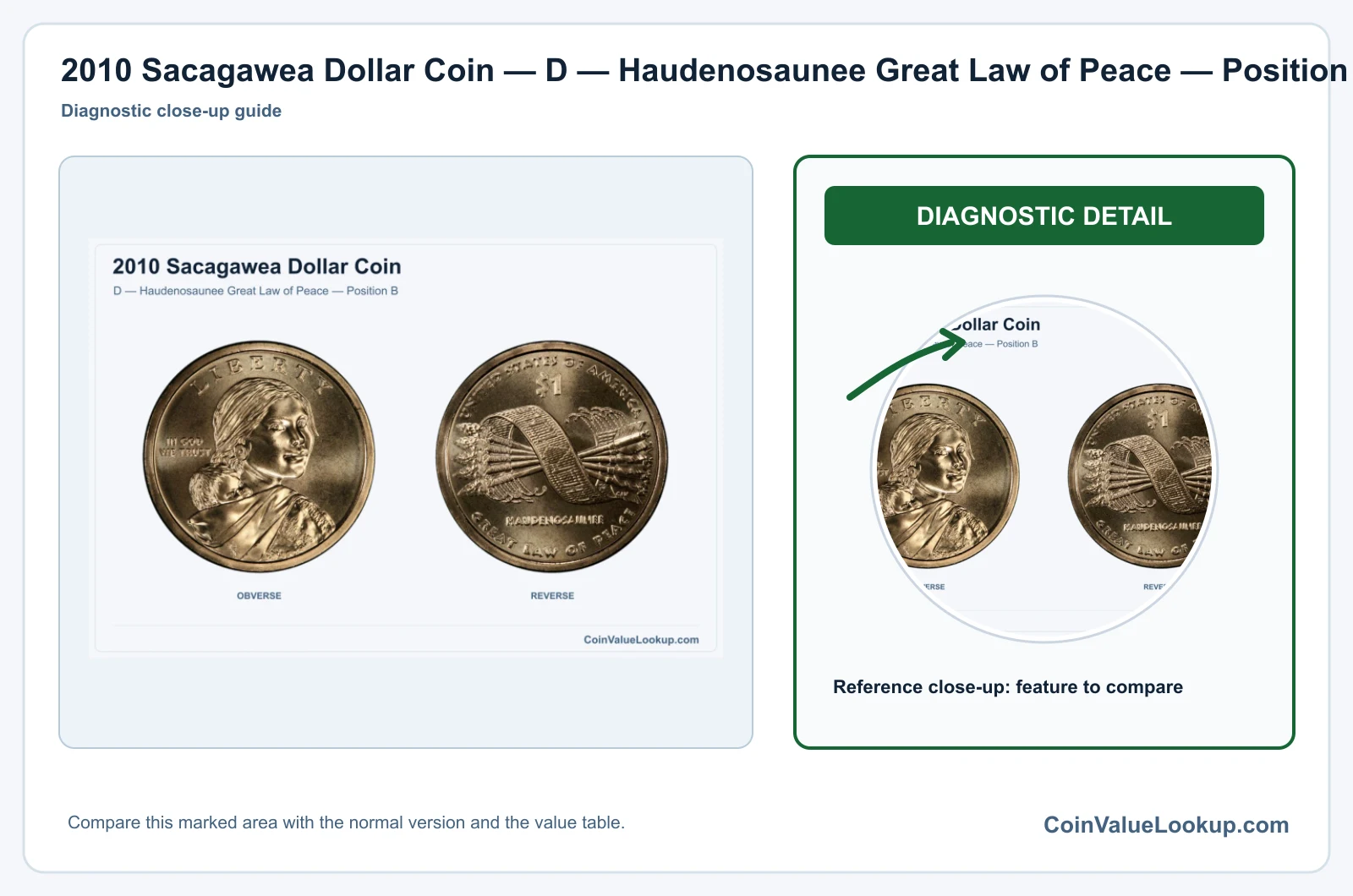
Denver business strike, Position B. The D mintmark is on the edge.
If the incuse lettering reads upside-down when Sacagawea faces you right-side up, you have confirmed Position B. The USA Coin Book guide estimate sits at about $6.25 in MS65, the same as Position A.
Circulated examples are common at face value. The collecting interest here is in completing a full position set across both mints.
Range Grade
Price Auction Records Appraisal PO PO 1
—
Coin Identifier FR FR 2
—
Coin Identifier AG AG 3
—
Coin Identifier G G 4
—
Coin Identifier
G 6
—
Coin Identifier VG VG 8
—
Coin Identifier
VG 10
—
Coin Identifier F F 12
—
Coin Identifier
F 15
—
Coin Identifier VF VF 20
—
Coin Identifier
VF 25
—
Coin Identifier
VF 30
—
Coin Identifier
VF 35
—
Coin Identifier XF XF 40
—
Coin Identifier
XF 45
—
Coin Identifier AU AU 50
—
Coin Identifier
AU 53
—
Coin Identifier
AU 55
—
Coin Identifier
AU 58
—
Coin Identifier MS MS 60
—
Coin Identifier
MS 61
—
Coin Identifier
MS 62
—
Coin Identifier
MS 63
—
Coin Identifier
MS 64
—
Coin Identifier
MS 65
—
Coin Identifier
MS 66
Coin Identifier
MS 67
Coin Identifier
MS 68
—
—
—
MS 69
—
—
—
MS 70
—
—
—
2010 Sacagawea Dollar — D — Haudenosaunee Great Law of Peace — satin — Position B
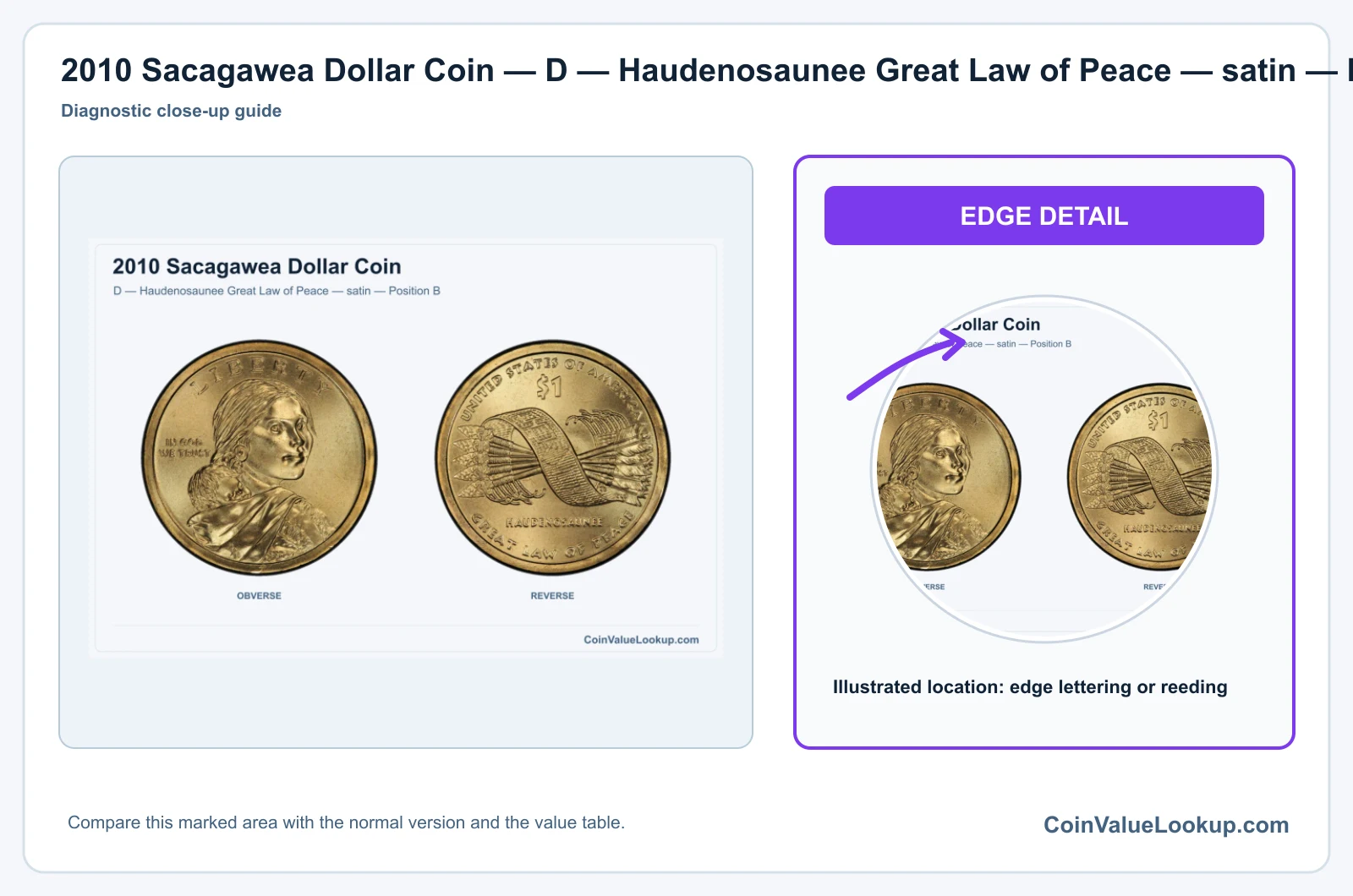
Denver satin finish, Position B. This came from a 2010 Mint Set and carries the distinctive soft surface texture of the satin manufacturing process.
Edge lettering reads inverted relative to the upright obverse. No adopted guide estimate exists for this version, so pricing depends on the individual coin's authenticated identity and condition.
Like all satin-finish dollars from this year, it should not be lumped together with ordinary Denver strikes when evaluating grade or value.
Range Grade
Price Auction Records Appraisal SP SP 1
—
Coin Identifier
SP 2
—
Coin Identifier
SP 3
—
Coin Identifier
SP 4
—
Coin Identifier
SP 6
—
Coin Identifier
SP 8
—
Coin Identifier
SP 10
—
Coin Identifier
SP 12
—
Coin Identifier
SP 15
—
Coin Identifier
SP 20
—
Coin Identifier
SP 25
—
Coin Identifier
SP 30
—
Coin Identifier
SP 35
—
Coin Identifier
SP 40
—
Coin Identifier
SP 45
—
Coin Identifier
SP 50
—
Coin Identifier
SP 53
—
Coin Identifier
SP 55
—
Coin Identifier
SP 58
—
Coin Identifier
SP 60
—
Coin Identifier
SP 61
—
Coin Identifier
SP 62
—
Coin Identifier
SP 63
—
Coin Identifier
SP 64
—
Coin Identifier
SP 65
—
Coin Identifier
SP 66
—
Coin Identifier
SP 67
—
Coin Identifier
SP 68
Coin Identifier
SP 69
—
Coin Identifier
SP 70
—
—
—
2010 Sacagawea Dollar — S — Haudenosaunee Great Law of Peace — proof
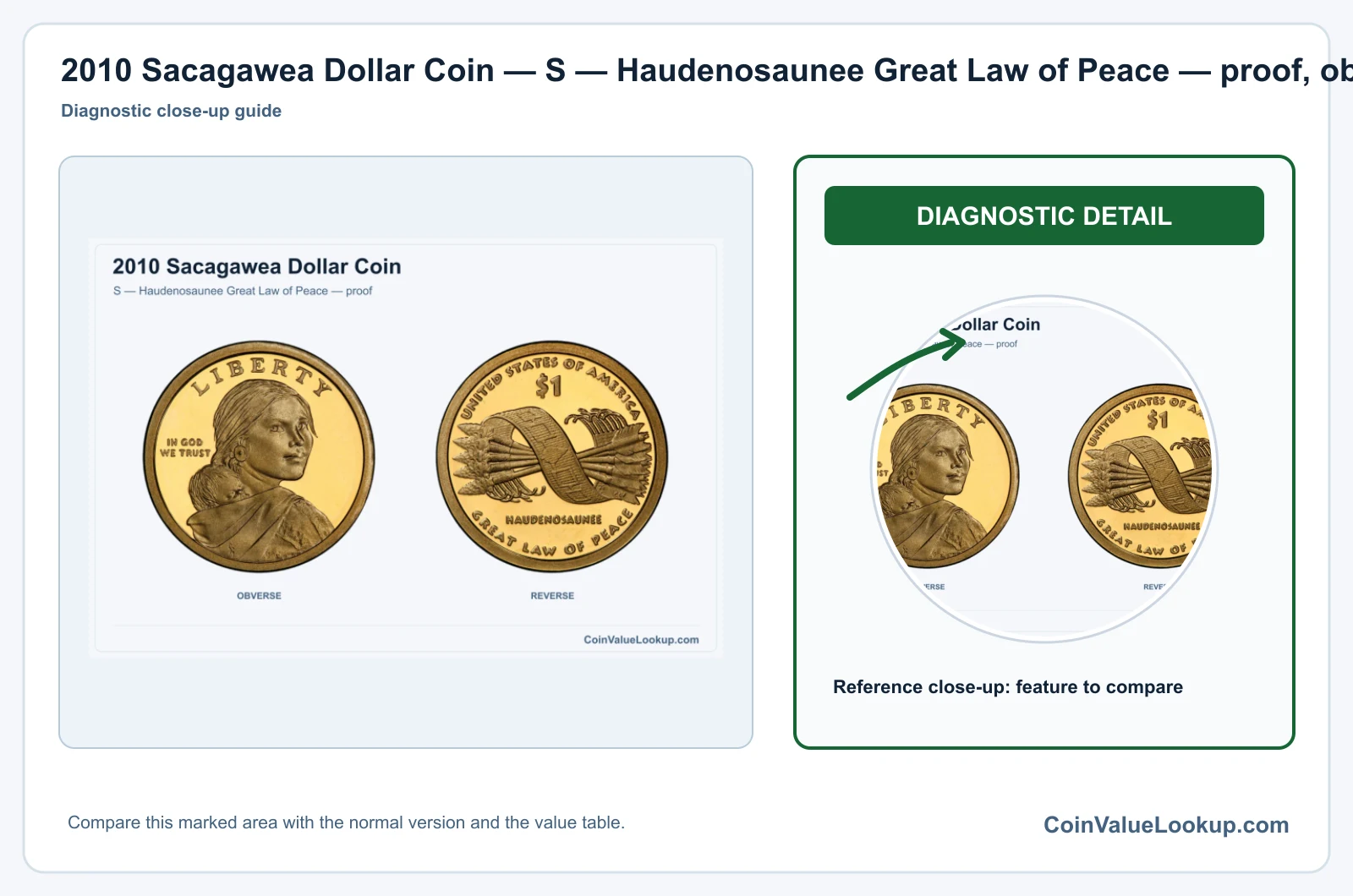
The 2010-S proof was struck at San Francisco for collector sets. It features deeply mirrored fields contrasting with frosted raised devices, giving it that classic cameo look.
A USA Coin Book guide estimate places it at about $10.00 in PR65. Do not confuse this with a silver proof; even though it may have come from a set that included silver quarters and dimes, the Sacagawea Dollar itself is always manganese-brass clad.
Hairlines from improper handling are the main enemy of proof grades, so store these in non-PVC holders.
Range Grade
Price Auction Records Appraisal PR PR 1
—
Coin Identifier
PR 2
—
Coin Identifier
PR 3
—
Coin Identifier
PR 4
—
Coin Identifier
PR 6
—
Coin Identifier
PR 8
—
Coin Identifier
PR 10
—
Coin Identifier
PR 12
—
Coin Identifier
PR 15
—
Coin Identifier
PR 20
—
Coin Identifier
PR 25
—
Coin Identifier
PR 30
—
Coin Identifier
PR 35
—
Coin Identifier
PR 40
—
Coin Identifier
PR 45
—
Coin Identifier
PR 50
—
Coin Identifier
PR 53
—
Coin Identifier
PR 55
—
Coin Identifier
PR 58
—
Coin Identifier
PR 60
—
Coin Identifier
PR 61
—
Coin Identifier
PR 62
—
Coin Identifier
PR 63
—
Coin Identifier
PR 64
—
Coin Identifier
PR 65
—
Coin Identifier
PR 66
—
Coin Identifier
PR 67
—
Coin Identifier
PR 68
—
Coin Identifier
PR 69
Coin Identifier
PR 70
Coin Identifier
2010 Sacagawea Dollar Error List
1. 2010 Sacagawea Dollar — Weak / Partial Edge Lettering
Partial edge lettering means some of the incuse text around the rim is abnormally faint or incomplete. To check, rotate the coin slowly under a good light and compare each letter and digit against a normal 2010 dollar.
Genuine partial-lettering errors show consistent weakness, not random worn spots from pocket carry. Ordinary shallow lettering caused by wear, cleaning or deliberate abrasion can mimic this error, so look for even depth on the letters that are present versus dramatic fading on others.
No specific price range is established for this error; value depends on the severity and visibility of the missing portions along with the coin's overall condition.
2. 2010 Sacagawea Dollar — Missing Edge Lettering
A missing edge lettering error means the entire rim is smooth where incuse date, mintmark and motto text should appear. Rotate the full circumference and compare directly to a normal 2010 dollar.
Since the date lives on the edge from 2009 onward, a truly blank edge makes year attribution trickier; the Haudenosaunee reverse design helps confirm the 2010 date. Watch out for coins that have been filed or polished smooth on the edge, which is a common lookalike.
Pre-2009 Sacagawea dollars had plain edges by design, so do not confuse an older coin for an error. Value depends on the coin's condition and confirmed authenticity of the error.
3. 2010 Sacagawea Dollar — Doubled Die
A doubled die on the 2010 Sacagawea Dollar shows consistent doubling of design elements caused by a misaligned hub impression during die manufacture. Look for separation, notching or a shadowed outline on Sacagawea's profile, lettering or reverse details.
The doubling should repeat in the same direction on every affected element. Machine doubling, which is flat and shelf-like, is the most common lookalike and carries little premium.
Reflections from the coin's golden surface and post-mint impressions from contact with other objects can also fool you. Value for a confirmed doubled die depends on the strength and location of the doubling and the coin's grade.
4. 2010 Sacagawea Dollar — Improper Annealing
Improper annealing happens when the blank is heated incorrectly before striking, producing unusual surface discoloration or a rough, grainy texture. On the golden manganese-brass planchet, this can look like dark streaks, uneven color patches or a distinctly matte finish that does not match a normal business or satin strike.
Compare both sides and the edge against a standard example. Environmental toning from years in a damp drawer, chemical corrosion, or heat damage applied after minting can all produce similar appearances.
The surface oddity alone is a screening clue, not proof of the cause, so professional authentication helps. Value depends on the severity and visual impact of the error.
5. 2010 Sacagawea Dollar — Off-Center Strike
An off-center strike occurs when the planchet is not seated properly in the collar, resulting in part of the design shifted to one side with an unstruck crescent of blank metal on the opposite edge. On a 2010 Sacagawea Dollar, check whether the date is still visible on the edge, since that affects collectibility.
The percentage off-center matters: a 5% shift is mildly interesting while 50% with a readable date is a different story. Do not confuse a clipped planchet, which removes a curved wedge of metal, or post-mint flattening from a vise with a genuine off-center error.
Value depends on the degree of misalignment and overall condition.
6. 2010 Sacagawea Dollar — Die Crack / Die Chip
Die cracks and die chips appear as raised lines or small raised blobs on the coin's surface, transferred from a deteriorating die. A crack running from the rim inward is most common; a larger break at the rim that leaves a flat, featureless blob is called a cud.
Interior die chips show up as tiny raised lumps, often near letters or fine details. These are raised features, which distinguishes them from incuse scratches, corrosion pits or foreign material stuck to the surface.
Check both sides since die damage can affect either the obverse or reverse die. Value varies with the size, location and visual prominence of the crack or chip, plus the coin's condition.
7. 2010 Sacagawea Dollar — Lamination / Split Planchet
A lamination error shows up as peeling, flaking or separated layers within the coin's metal. You might see a thin flap of metal lifting away from the surface or a void where a piece has already broken off.
On a manganese-brass clad coin, the layered construction can make this type of error possible. Photograph the edge alongside the affected face so the separation is clearly visible.
Scraping damage, surface corrosion and deliberately cut or gouged coins can all look similar at first glance, so compare the texture inside any void with the surrounding surface. Value hinges on the size of the affected area, whether the flap is retained, and the coin's overall grade.
8. 2010 Sacagawea Dollar — Die Cap / Capped-Die Strike
A die cap error is dramatic. It happens when a struck coin sticks to the upper die and gets struck repeatedly into subsequent blanks, forming a cupped, bottle-cap shape.
The coin that stuck to the die develops a deep cup with a spread, mirrored brockage image on one side. Coins struck through that cap show a mushy, distorted impression.
This is different from a simple bent coin, vise damage or a weak strike, all of which lack the characteristic cupping and brockage pattern. Genuine die caps on modern dollar coins are scarce.
Value depends on the severity of the cap formation, how many strikes it absorbed, and overall condition, but no specific price range is established here.