1896 Barber Half Dollar Coin Value: How Much Is It Worth?
A 1896 Barber Half Dollar can range from about $74 in well-worn G4 condition to around $15,269 at MS63, depending on which mint produced it. Those figures come from a retail guide snapshot and reflect the three business-strike mints — Philadelphia, New Orleans, and San Francisco — along with their respective hub varieties.
Proof strikes and error coins carry their own separate pricing.
Fast Way to Identify Your 1896 Barber Half Dollar
The quickest way to start figuring out what you have is to upload clear photos of both sides of your coin. A front and back image lets us provide a preliminary identification of your mint, hub type, and general condition.
Snap the photos in even lighting, avoid glare, and try to keep the coin flat and centered in the frame.
1896 Barber Half Dollar Value
Upload both sides of your 1896 Barber Half Dollar.
Front Obverse
Upload photo
Back Reverse
Upload photo
Which 1896 Barber Half Dollar Versions Are Worth Money?
- San Francisco issues (S mintmark) start around $166 at G4 and climb to roughly $4,689 at MS63, making them the priciest business strikes in low grades.
- New Orleans coins (O mintmark) reach the highest guide value at MS63 — about $15,269 — because surviving Mint State examples are scarce.
- Original, problem-free coins in upper circulated or Mint State grades command far more than heavily worn pieces; condition drives value steeply in this series.
- Philadelphia Proof strikes in PR63 are listed near $1,363, a separate finish from any business strike regardless of grade.
- Check your mintmark and hub type before consulting a value chart; an unusual surface mark alone does not establish a valuable error.
Step 1: Identify Your 1896 Barber Half Dollar Mint Mark and Version
The 1896 Barber Half Dollar shows a right-facing Liberty head on the obverse and a heraldic eagle on the reverse. The denomination reads HALF DOLLAR below the eagle.
All regular-issue 1896 half dollars are struck in 90% silver and 10% copper, weigh about 12.5 grams, measure 30.6 mm across, and have a reeded edge.
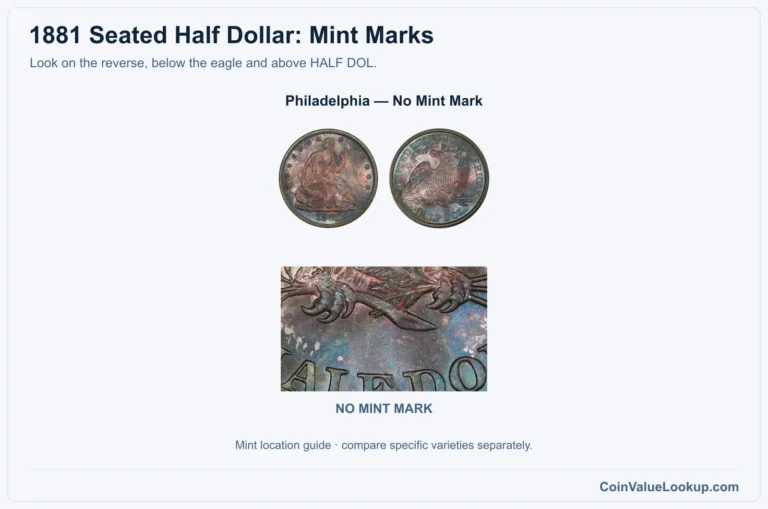
Three mints produced business strikes this year: Philadelphia, New Orleans, and San Francisco. Philadelphia coins carry no mintmark.
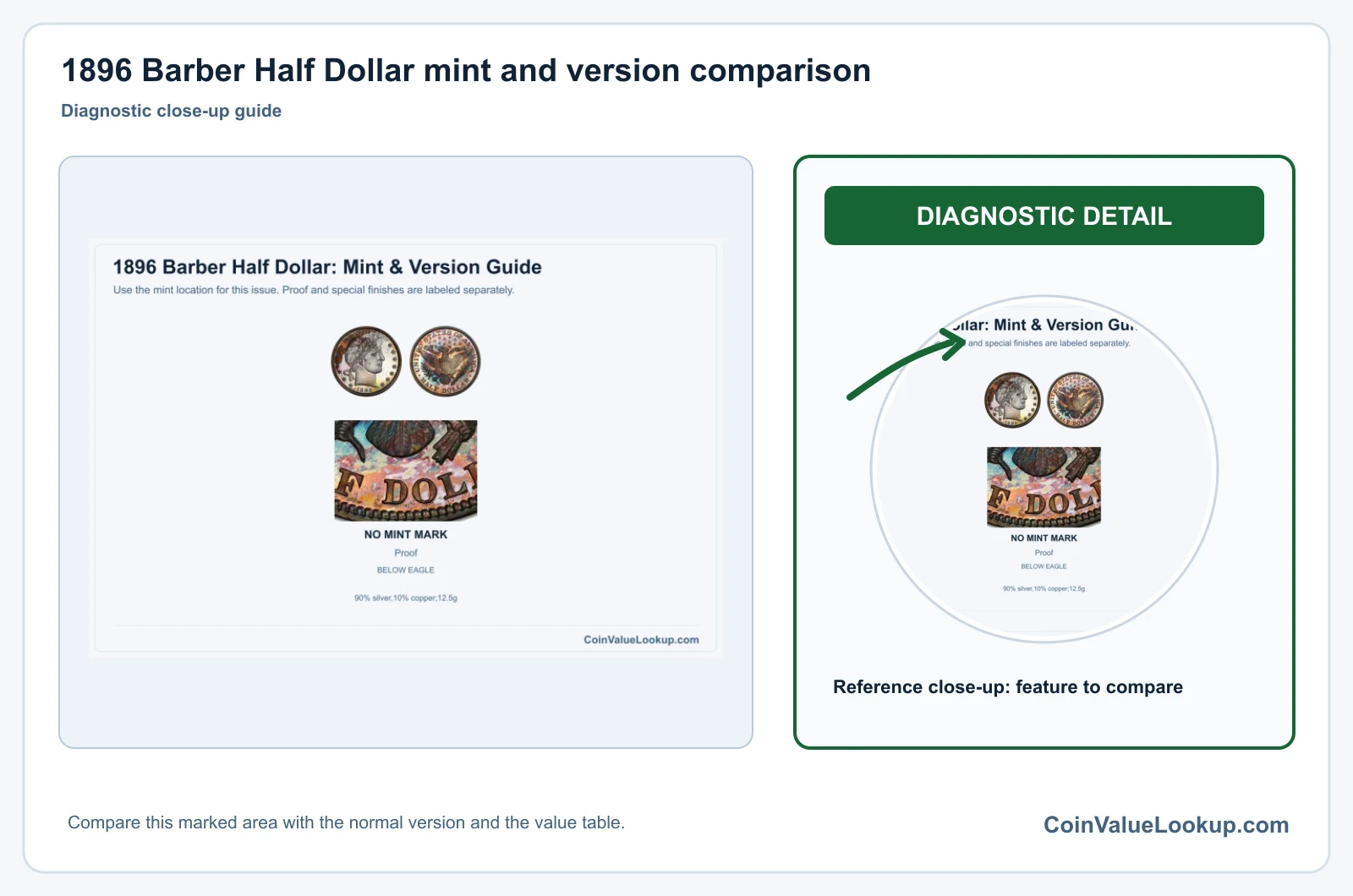
For the O or S mintmark, look on the reverse just below the eagle's tail feathers and above the words HALF DOLLAR.
A hub transition occurred across all three mints. Type I obverse dies lack central ear cartilage detail on Liberty's ear, while Type II dies show that cartilage clearly.
To tell them apart, examine the ear area under magnification and compare it against a known Type I and Type II side by side. Both hub types share the same date-and-mint price anchor in published guides, so the distinction is one of die variety rather than an independently priced premium.
Coin Value Lookup is a useful starting point when you need to look up guides for Barber halves or other series. Bookmark it so you can check back as you work through a group of coins.
Step 2: Check Your 1896 Barber Half Dollar Grade
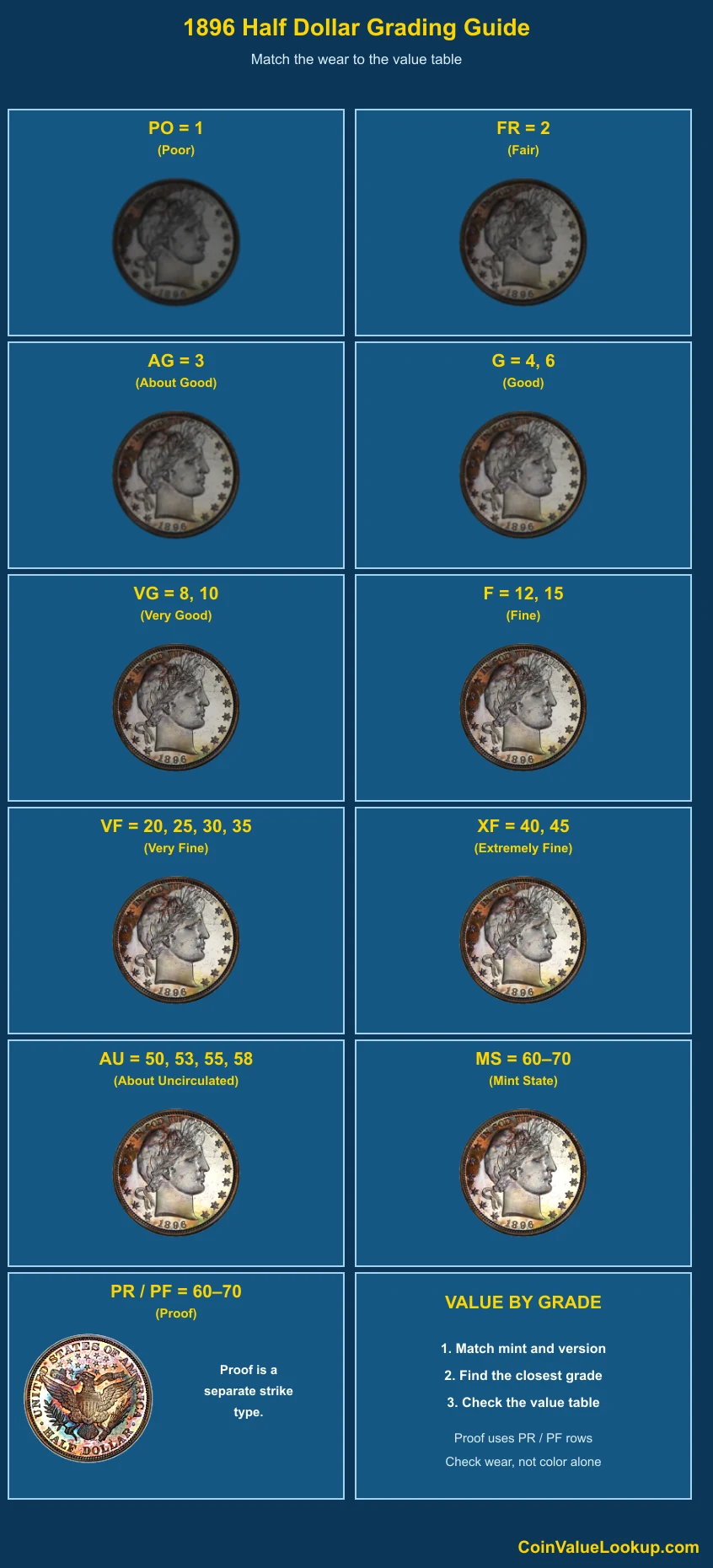
Start by looking at the highpoints on both sides. On the obverse, check Liberty's cheek, hair above the forehead, and the headband ribbon for signs of wear.
On the reverse, focus on the eagle's head, the tips of its wings, and the tail feathers.
Compare your coin to the genuine grade comparison image. A G4 coin will show a very flat Liberty head with almost no hair detail, while an MS63 retains full luster and only minor contact marks.
New Orleans strikes are often weakly struck at the eagle's claws and arrow feathers. That softness is a manufacturing trait, not wear, so do not downgrade your coin because those areas look mushy.
Separate genuine friction — which dulls luster in a directional pattern — from strike weakness, which leaves luster intact underneath the soft detail.
Remember that a Proof is a special manufacturing finish with mirrored fields, not a grade above Mint State. Polishing a business strike will not turn it into a Proof.
If your coin has deeply reflective fields and sharp rims, have it evaluated by a professional grading service before assuming it is a Proof.
Step 3: Check 1896 Barber Half Dollar Value by Mint and Version
1896 Barber Half Dollar — No Mint Mark — Type I Obverse
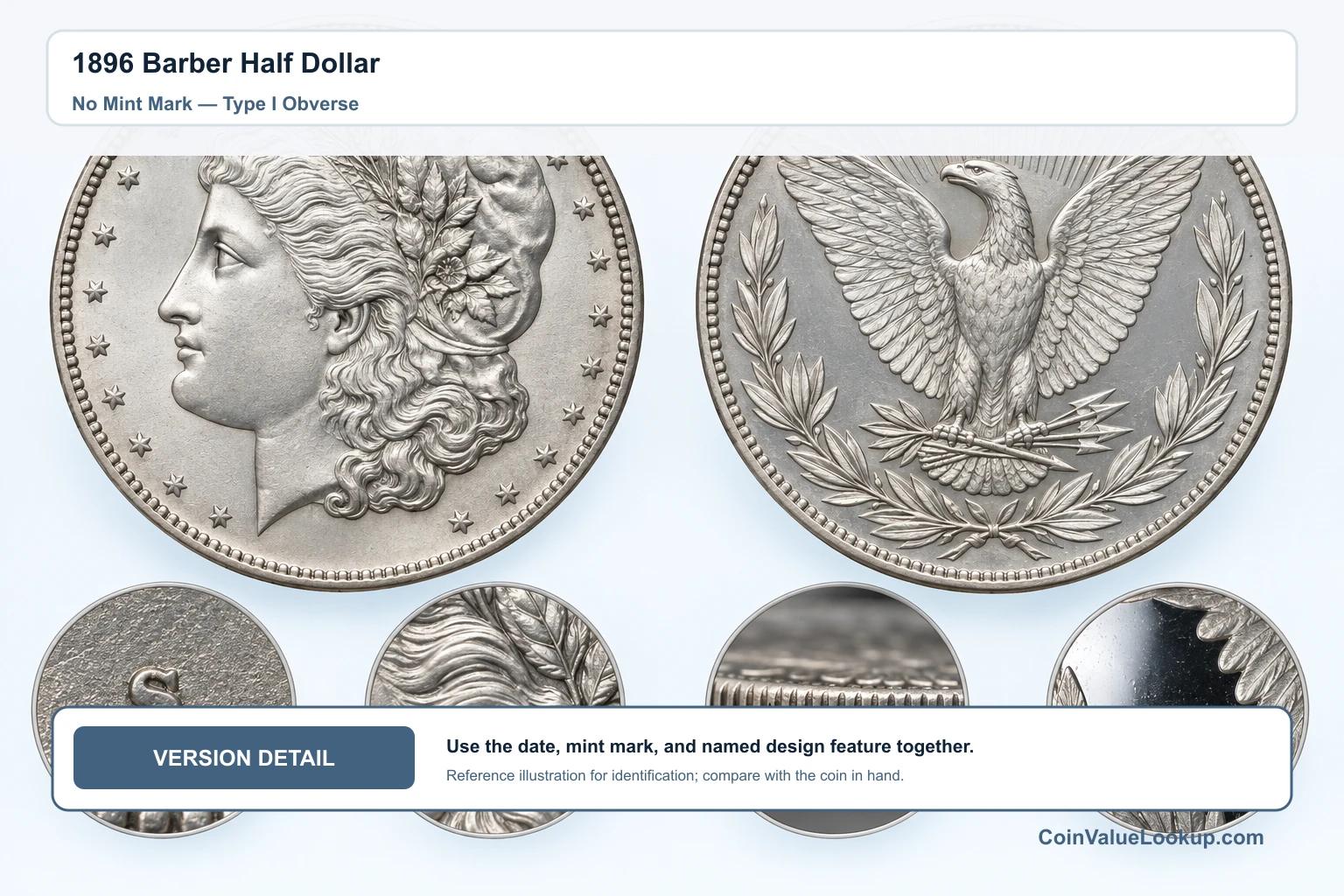
This is a Philadelphia business strike with the Type I obverse hub, which lacks visible central ear cartilage on Liberty's ear. No mintmark appears anywhere on the coin.
A retail guide snapshot places this version at about $74 in G4 and around $1,363 in MS63.
To confirm the Type I hub, examine Liberty's ear under magnification. The interior will look smooth or shallow compared to a Type II, which shows distinct cartilage lines.
Both hub types share the same published price for a given date and mint, so identifying your hub variety is mainly useful for die-study purposes rather than a separate price tier.
Ordinary-issue reference: Ordinary-issue reference only: The table below shows prices for the 1896 Barber Half Dollar (regular strike). It does not represent the value of the specific No Mint Mark — Type I Obverse variety or its variety premium. Year, mint, metal and strike type are matched; the specific variety is not priced by this table.
Range Grade
Price Auction Records Appraisal PO PO 1
—
Coin Identifier FR FR 2
—
Coin Identifier AG AG 3
—
Coin Identifier G G 4
—
Coin Identifier
G 6
—
Coin Identifier VG VG 8
Coin Identifier
VG 10
Coin Identifier F F 12
Coin Identifier
F 15
Coin Identifier VF VF 20
Coin Identifier
VF 25
Coin Identifier
VF 30
Coin Identifier
VF 35
Coin Identifier XF XF 40
Coin Identifier
XF 45
Coin Identifier AU AU 50
Coin Identifier
AU 53
Coin Identifier
AU 55
Coin Identifier
AU 58
Coin Identifier MS MS 60
Coin Identifier
MS 61
Coin Identifier
MS 62
Coin Identifier
MS 63
Coin Identifier
MS 64
Coin Identifier
MS 65
Coin Identifier
MS 66
Coin Identifier
MS 67
Coin Identifier
MS 68
—
—
—
MS 69
—
—
—
MS 70
—
—
—
1896 Barber Half Dollar — No Mint Mark — Type II Obverse
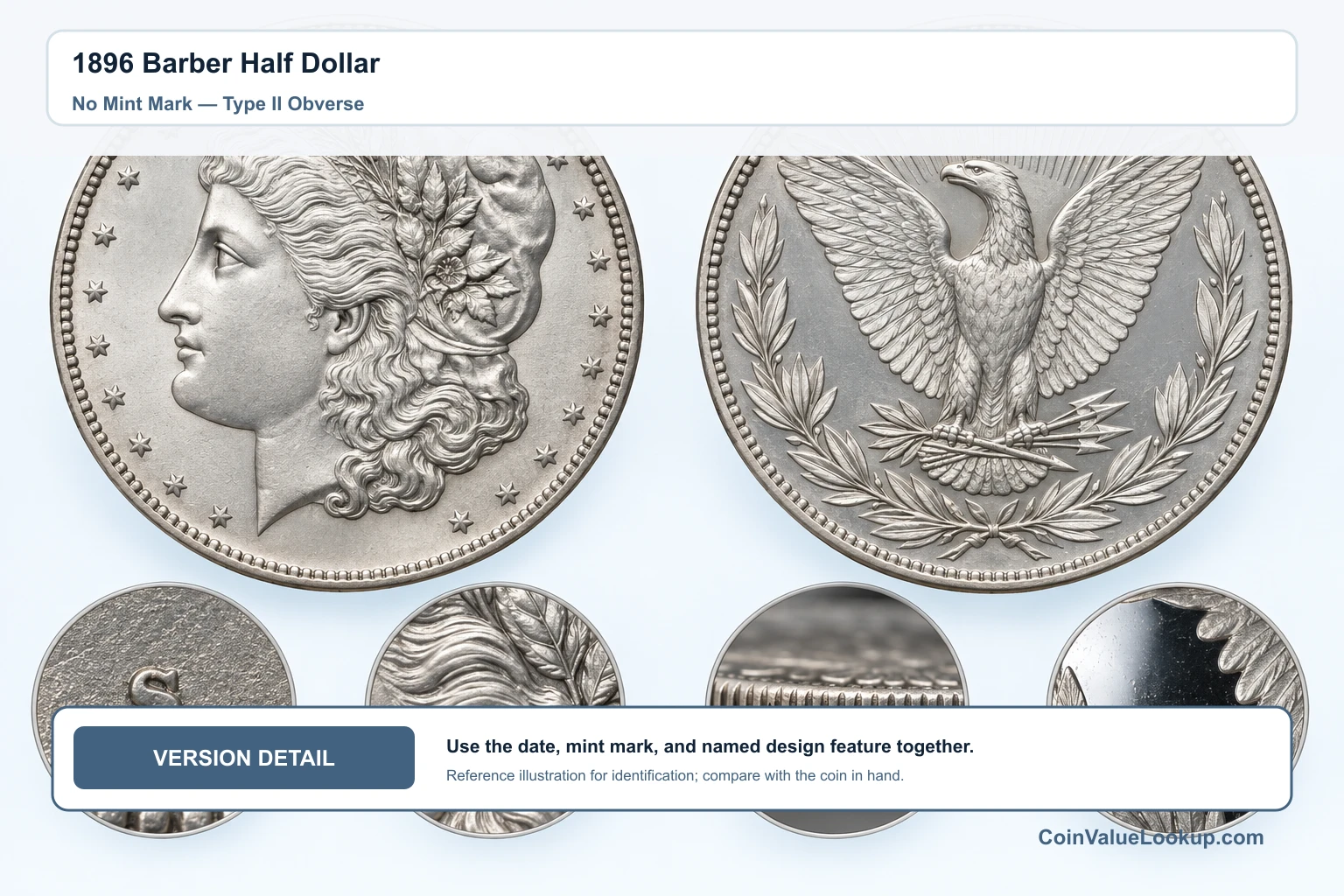
Philadelphia's Type II obverse shows clear central ear cartilage inside Liberty's ear — the key difference from the Type I hub. Again, no mintmark is present.
Guide values sit at roughly $74 in G4 and $1,363 at MS63, identical to the Type I because published pricing pools both hub types under the same date and mint.
When comparing the two hubs side by side, the Type II ear detail is the giveaway. The rest of the design elements are otherwise very similar, so focus your loupe directly on that ear.
This hub transition happened across all three mints in 1896, so the variety is not unique to Philadelphia.
Ordinary-issue reference: Ordinary-issue reference only: The table below shows prices for the 1896 Barber Half Dollar (regular strike). It does not represent the value of the specific No Mint Mark — Type II Obverse variety or its variety premium. Year, mint, metal and strike type are matched; the specific variety is not priced by this table.
Range Grade
Price Auction Records Appraisal PO PO 1
—
Coin Identifier FR FR 2
—
Coin Identifier AG AG 3
—
Coin Identifier G G 4
—
Coin Identifier
G 6
—
Coin Identifier VG VG 8
Coin Identifier
VG 10
Coin Identifier F F 12
Coin Identifier
F 15
Coin Identifier VF VF 20
Coin Identifier
VF 25
Coin Identifier
VF 30
Coin Identifier
VF 35
Coin Identifier XF XF 40
Coin Identifier
XF 45
Coin Identifier AU AU 50
Coin Identifier
AU 53
Coin Identifier
AU 55
Coin Identifier
AU 58
Coin Identifier MS MS 60
Coin Identifier
MS 61
Coin Identifier
MS 62
Coin Identifier
MS 63
Coin Identifier
MS 64
Coin Identifier
MS 65
Coin Identifier
MS 66
Coin Identifier
MS 67
Coin Identifier
MS 68
—
—
—
MS 69
—
—
—
MS 70
—
—
—
1896 Barber Half Dollar — O — Type I Obverse
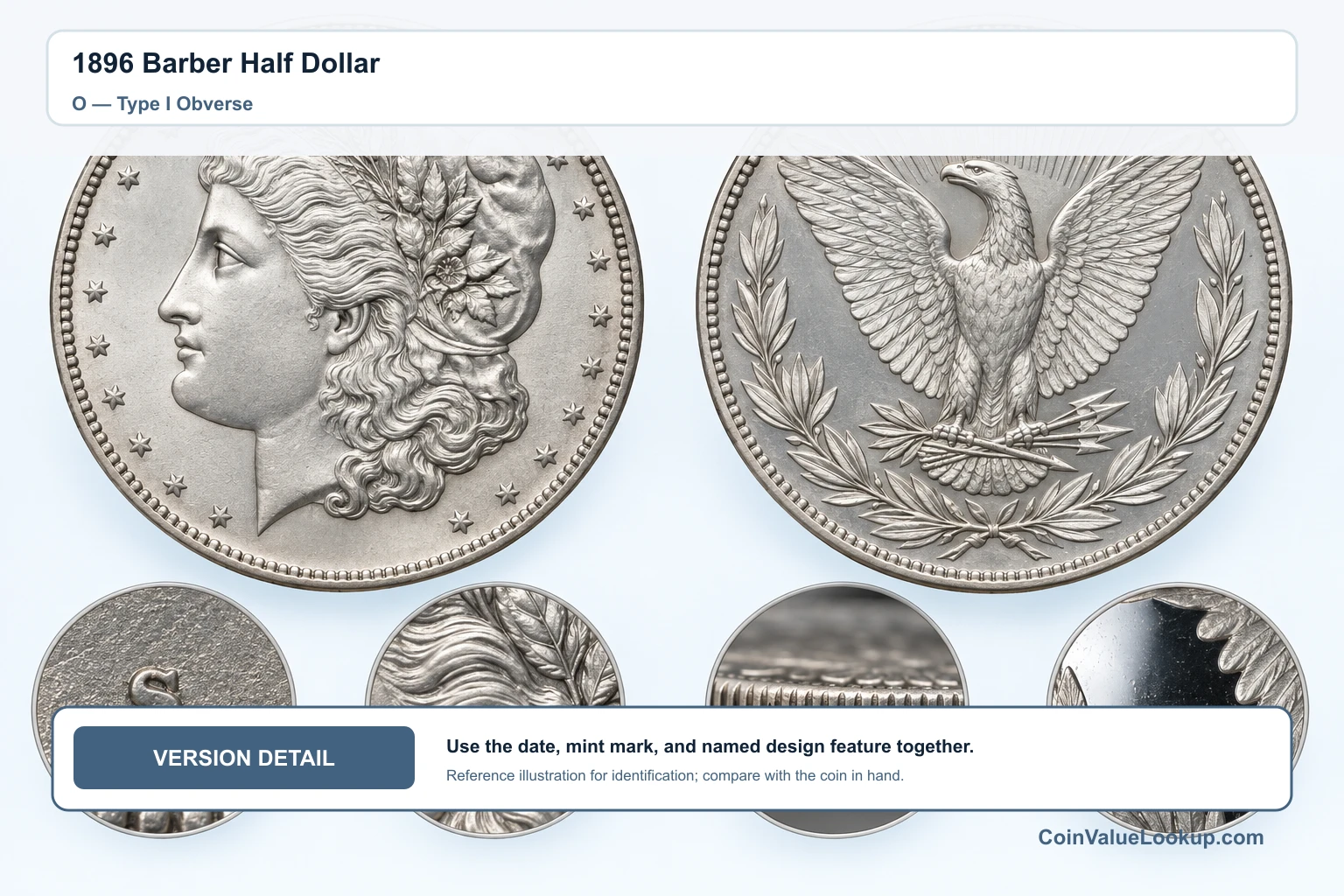
The New Orleans Type I carries an O mintmark below the eagle's tail feathers and uses the obverse hub without central ear cartilage. Guide estimates run about $87 at G4, jumping dramatically to around $15,269 at MS63.
That steep climb reflects how few New Orleans half dollars survived in high grade.
New Orleans coins are often softly struck, especially at the eagle's claws and arrow feathers. Do not mistake that manufacturing softness for wear.
Check luster patterns carefully before assigning a grade. The Type I and Type II hubs share the same published pricing for this date and mint.
Ordinary-issue reference: Ordinary-issue reference only: The table below shows prices for the 1896-O Barber Half Dollar (regular strike). It does not represent the value of the specific O — Type I Obverse variety or its variety premium. Year, mint, metal and strike type are matched; the specific variety is not priced by this table.
Range Grade
Price Auction Records Appraisal PO PO 1
—
Coin Identifier FR FR 2
—
Coin Identifier AG AG 3
Coin Identifier G G 4
Coin Identifier
G 6
Coin Identifier VG VG 8
Coin Identifier
VG 10
Coin Identifier F F 12
Coin Identifier
F 15
Coin Identifier VF VF 20
Coin Identifier
VF 25
Coin Identifier
VF 30
Coin Identifier
VF 35
Coin Identifier XF XF 40
Coin Identifier
XF 45
Coin Identifier AU AU 50
Coin Identifier
AU 53
Coin Identifier
AU 55
Coin Identifier
AU 58
Coin Identifier MS MS 60
—
Coin Identifier
MS 61
—
Coin Identifier
MS 62
Coin Identifier
MS 63
Coin Identifier
MS 64
Coin Identifier
MS 65
Coin Identifier
MS 66
Coin Identifier
MS 67
Coin Identifier
MS 68
—
—
—
MS 69
—
—
—
MS 70
—
—
—
1896 Barber Half Dollar — O — Type II Obverse
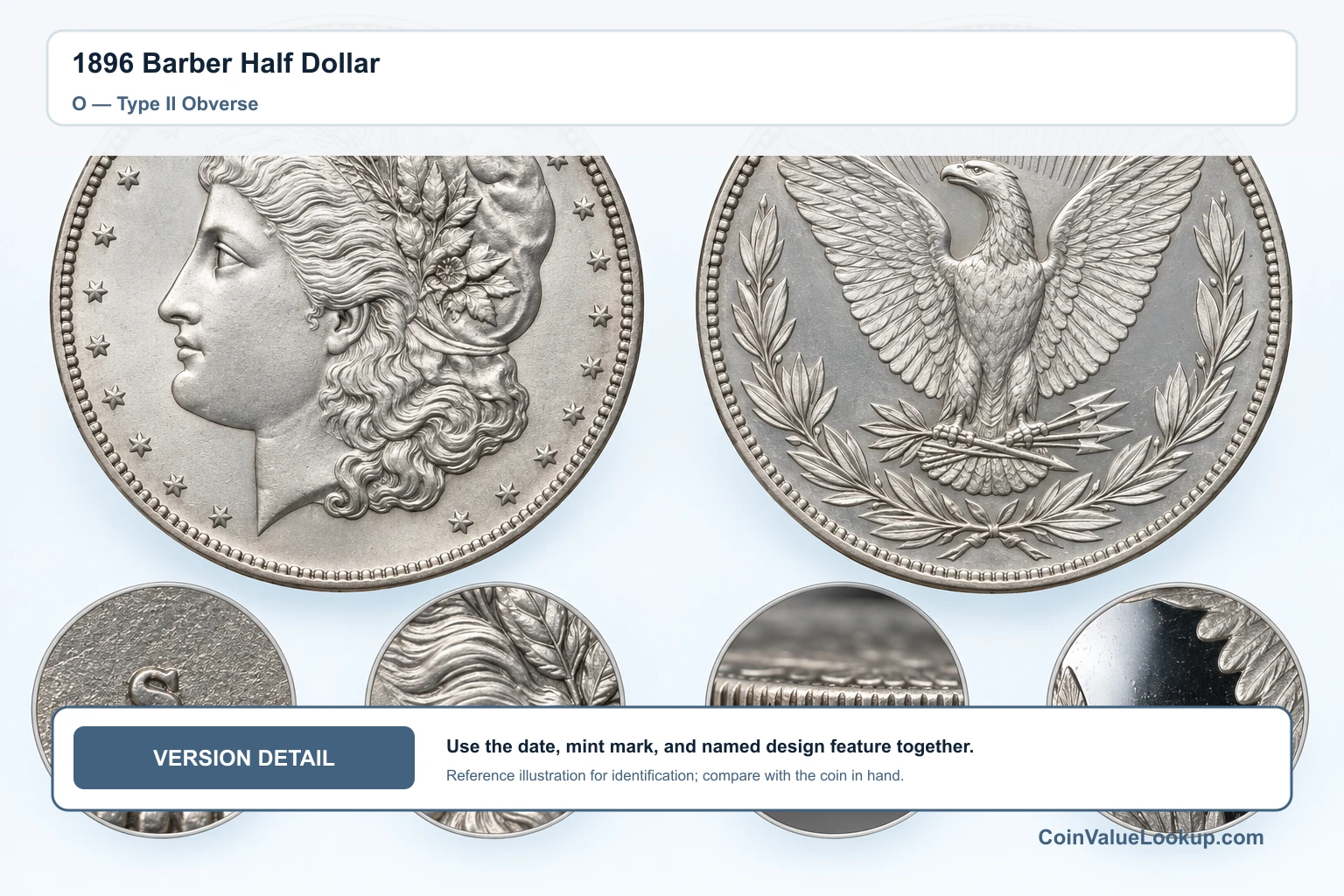
Same mint, different hub. The O-mint Type II obverse displays visible central ear cartilage on Liberty.
The mintmark location is identical — an O on the reverse beneath the eagle's tail. Retail guide figures are about $87 at G4 and approximately $15,269 at MS63.
Because the New Orleans mint is known for inconsistent striking pressure, your Type II coin may still look soft in places even in higher grades. Examine the overall luster and surface quality rather than relying on one detail area.
Both hub types are priced together in standard references for this date.
Ordinary-issue reference: Ordinary-issue reference only: The table below shows prices for the 1896-O Barber Half Dollar (regular strike). It does not represent the value of the specific O — Type II Obverse variety or its variety premium. Year, mint, metal and strike type are matched; the specific variety is not priced by this table.
Range Grade
Price Auction Records Appraisal PO PO 1
—
Coin Identifier FR FR 2
—
Coin Identifier AG AG 3
Coin Identifier G G 4
Coin Identifier
G 6
Coin Identifier VG VG 8
Coin Identifier
VG 10
Coin Identifier F F 12
Coin Identifier
F 15
Coin Identifier VF VF 20
Coin Identifier
VF 25
Coin Identifier
VF 30
Coin Identifier
VF 35
Coin Identifier XF XF 40
Coin Identifier
XF 45
Coin Identifier AU AU 50
Coin Identifier
AU 53
Coin Identifier
AU 55
Coin Identifier
AU 58
Coin Identifier MS MS 60
—
Coin Identifier
MS 61
—
Coin Identifier
MS 62
Coin Identifier
MS 63
Coin Identifier
MS 64
Coin Identifier
MS 65
Coin Identifier
MS 66
Coin Identifier
MS 67
Coin Identifier
MS 68
—
—
—
MS 69
—
—
—
MS 70
—
—
—
1896 Barber Half Dollar — S — Type I Obverse
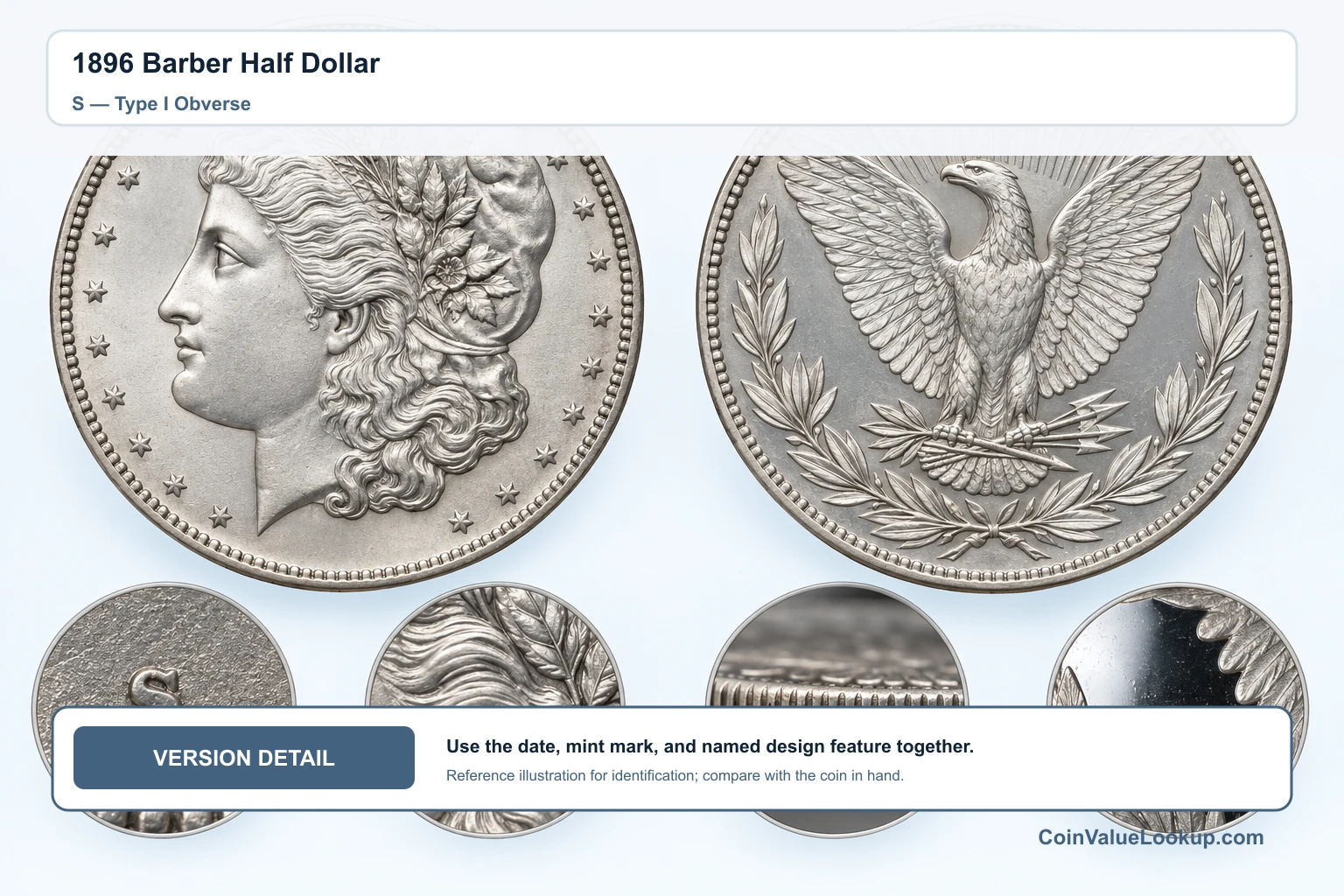
San Francisco's Type I obverse bears an S mintmark below the eagle's tail and lacks the central ear cartilage found on Type II dies. A retail guide places this coin at roughly $166 in G4 and about $4,689 at MS63 — the highest low-grade values among the three 1896 business-strike mints.
That elevated floor price even in well-worn condition tells you San Francisco half dollars from this year are comparatively scarce. As with the other mints, the Type I and Type II hubs share the same published pricing for a given grade, so the hub distinction is a variety-collecting detail rather than a separate price line.
Ordinary-issue reference: Ordinary-issue reference only: The table below shows prices for the 1896-S Barber Half Dollar (regular strike). It does not represent the value of the specific S — Type I Obverse variety or its variety premium. Year, mint, metal and strike type are matched; the specific variety is not priced by this table.
Range Grade
Price Auction Records Appraisal PO PO 1
—
Coin Identifier FR FR 2
Coin Identifier AG AG 3
Coin Identifier G G 4
Coin Identifier
G 6
Coin Identifier VG VG 8
Coin Identifier
VG 10
Coin Identifier F F 12
Coin Identifier
F 15
Coin Identifier VF VF 20
Coin Identifier
VF 25
Coin Identifier
VF 30
Coin Identifier
VF 35
Coin Identifier XF XF 40
Coin Identifier
XF 45
Coin Identifier AU AU 50
Coin Identifier
AU 53
Coin Identifier
AU 55
Coin Identifier
AU 58
Coin Identifier MS MS 60
Coin Identifier
MS 61
—
Coin Identifier
MS 62
Coin Identifier
MS 63
Coin Identifier
MS 64
Coin Identifier
MS 65
Coin Identifier
MS 66
Coin Identifier
MS 67
Coin Identifier
MS 68
—
—
—
MS 69
—
—
—
MS 70
—
—
—
1896 Barber Half Dollar — S — Type II Obverse
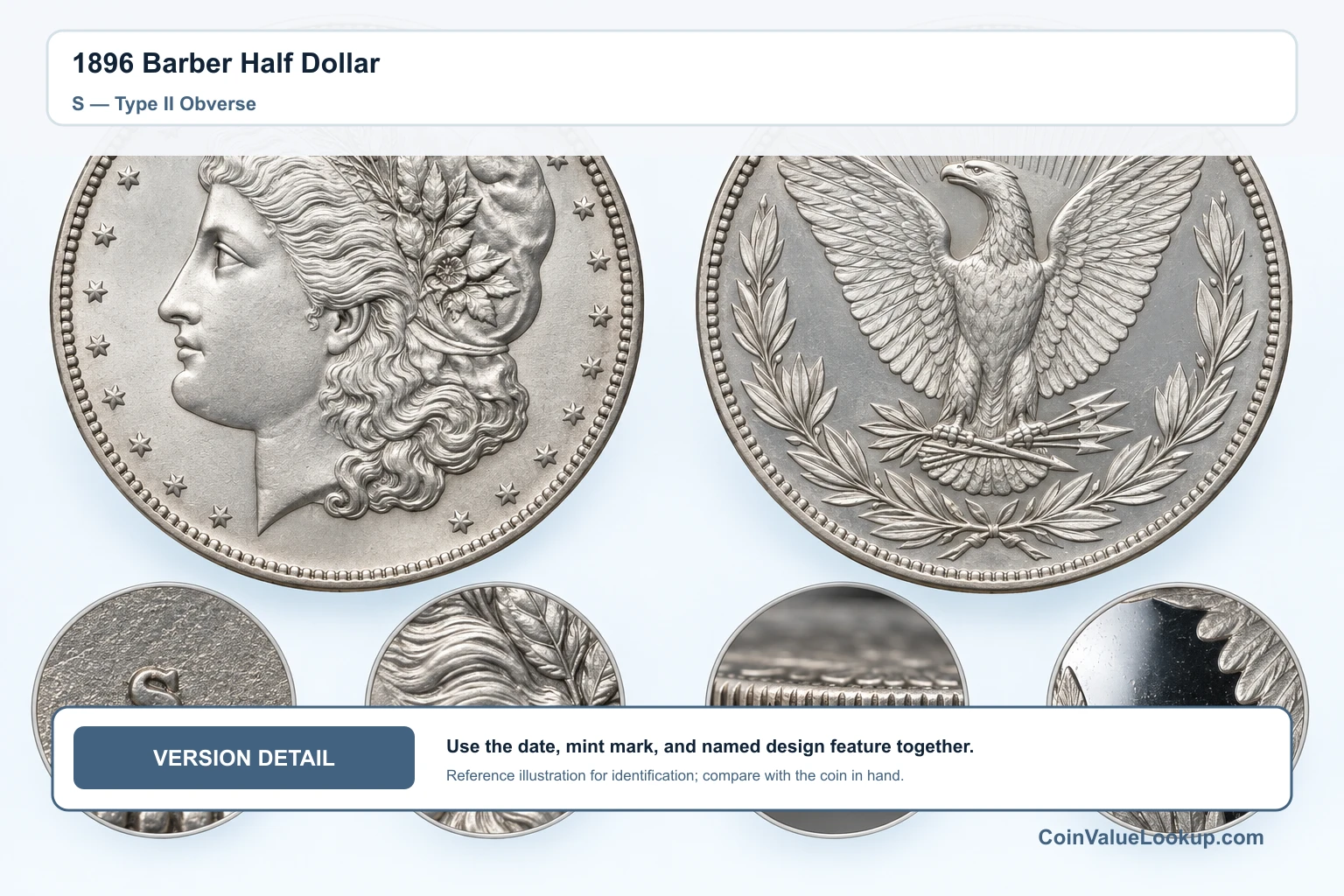
The San Francisco Type II shows the ear cartilage clearly and carries the same S mintmark on the reverse. Guide values match the Type I: about $166 at G4 and around $4,689 at MS63.
If you have a San Francisco half dollar with strong ear detail, you are looking at the Type II hub. The premium for S-mint coins over Philadelphia pieces is substantial in every grade, so confirming that small S below the eagle is important before you estimate value.
Both hub types are pooled under the same pricing in standard guides.
Ordinary-issue reference: Ordinary-issue reference only: The table below shows prices for the 1896-S Barber Half Dollar (regular strike). It does not represent the value of the specific S — Type II Obverse variety or its variety premium. Year, mint, metal and strike type are matched; the specific variety is not priced by this table.
Range Grade
Price Auction Records Appraisal PO PO 1
—
Coin Identifier FR FR 2
Coin Identifier AG AG 3
Coin Identifier G G 4
Coin Identifier
G 6
Coin Identifier VG VG 8
Coin Identifier
VG 10
Coin Identifier F F 12
Coin Identifier
F 15
Coin Identifier VF VF 20
Coin Identifier
VF 25
Coin Identifier
VF 30
Coin Identifier
VF 35
Coin Identifier XF XF 40
Coin Identifier
XF 45
Coin Identifier AU AU 50
Coin Identifier
AU 53
Coin Identifier
AU 55
Coin Identifier
AU 58
Coin Identifier MS MS 60
Coin Identifier
MS 61
—
Coin Identifier
MS 62
Coin Identifier
MS 63
Coin Identifier
MS 64
Coin Identifier
MS 65
Coin Identifier
MS 66
Coin Identifier
MS 67
Coin Identifier
MS 68
—
—
—
MS 69
—
—
—
MS 70
—
—
—
1896 Barber Half Dollar — No Mint Mark — Proof
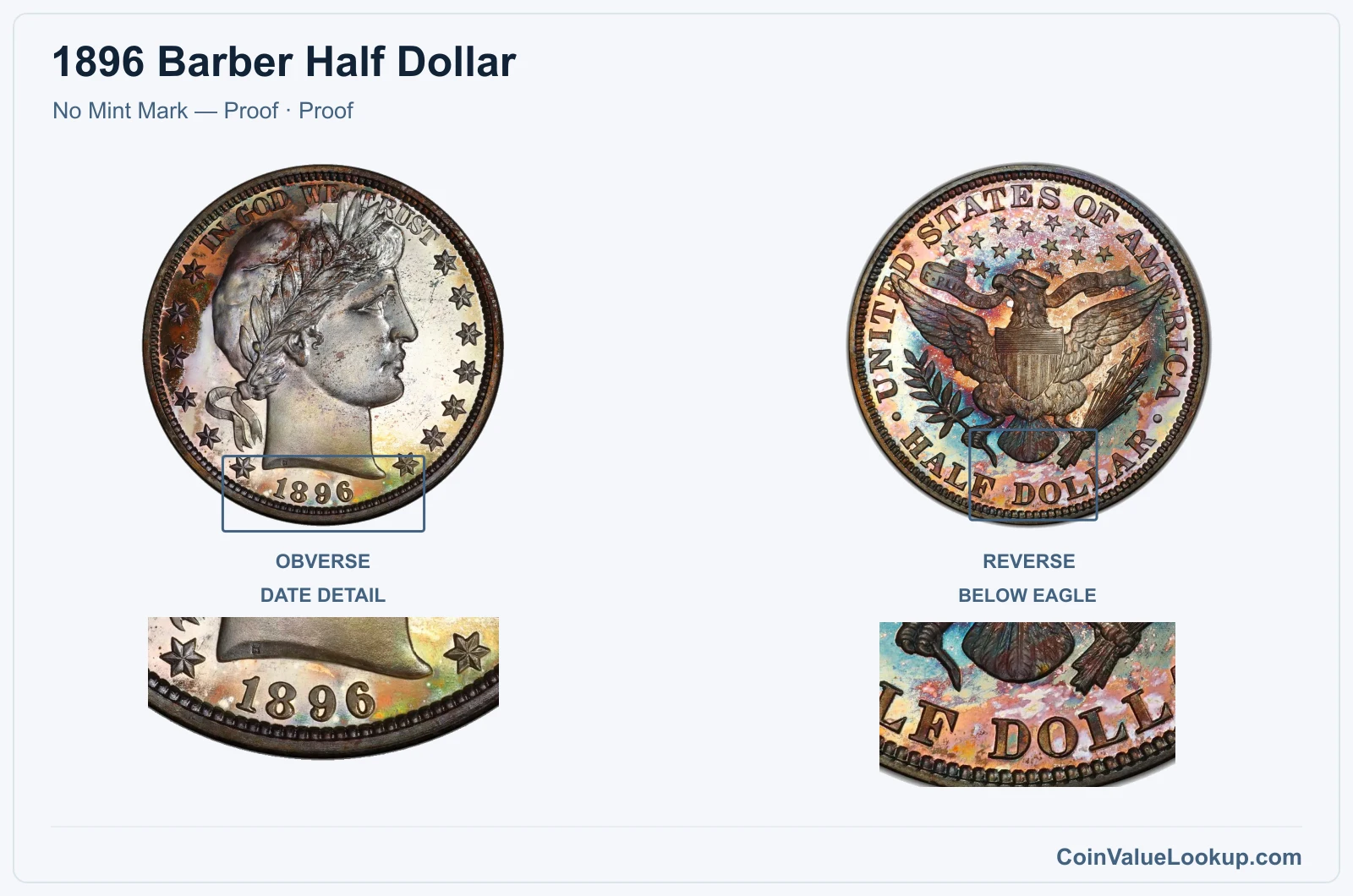
The 1896 Proof Barber Half Dollar was struck at Philadelphia with specially prepared dies and polished planchets, producing deeply mirrored fields and crisp design edges. No mintmark is present.
A retail guide lists PR63 at about $1,363.
Genuine Proofs show glass-like reflective surfaces in the fields and razor-sharp rim detail that business strikes rarely match. Some Proofs display cameo contrast between frosted devices and mirror fields, but that is a within-Proof distinction, not a separate mint branch.
A polished business strike will not have the die characteristics of a true Proof — look for telltale flow lines and die polish marks under magnification. If you suspect you have a Proof, professional authentication is the safest route.
Range Grade
Price Auction Records Appraisal PR PR 1
—
Coin Identifier
PR 2
—
Coin Identifier
PR 3
—
Coin Identifier
PR 4
—
Coin Identifier
PR 6
—
Coin Identifier
PR 8
—
Coin Identifier
PR 10
—
Coin Identifier
PR 12
—
Coin Identifier
PR 15
—
Coin Identifier
PR 20
—
Coin Identifier
PR 25
—
Coin Identifier
PR 30
—
Coin Identifier
PR 35
—
Coin Identifier
PR 40
—
Coin Identifier
PR 45
—
Coin Identifier
PR 50
—
Coin Identifier
PR 53
—
Coin Identifier
PR 55
Coin Identifier
PR 58
Coin Identifier
PR 60
Coin Identifier
PR 61
Coin Identifier
PR 62
Coin Identifier
PR 63
Coin Identifier
PR 64
Coin Identifier
PR 65
Coin Identifier
PR 66
Coin Identifier
PR 67
Coin Identifier
PR 68
Coin Identifier
PR 69
—
—
—
PR 70
—
—
—
1896 Barber Half Dollar Error List
1. 1896 Barber Half Dollar — Off-Center Strike
An off-center strike occurs when the planchet is not properly seated in the collar before the dies close. The result is a crescent-shaped area of blank metal on one side and a shifted design on the other.
For 1896, a reported example is a San Francisco coin struck roughly 10% off-center toward the 7 o'clock position.
To identify this error, look for a displaced design where one edge of the coin shows unstruck planchet while the opposite side crowds the rim. The date should still be visible for the coin to hold collector interest.
That particular reported example also had separate scratches, which would affect its desirability.
Do not confuse an off-center strike with a clipped planchet, a one-sided die misalignment, or post-mint flattening from damage. Clips produce a curved bite out of the rim, and post-mint damage lacks the clean unstruck crescent.
No specific price range is available for this error — value depends on the percentage of off-center shift, date visibility, surface condition, and overall eye appeal.