1908 Barber Half Dollar Coin Value: How Much Is It Worth?
A 1908 Barber Half Dollar in well-worn Good-4 condition starts around $44 based on a USA Coin Book guide snapshot, while upper Mint State examples (MS63) range from about $1,016 to $2,819 depending on the mint. Proofs carry their own pricing.
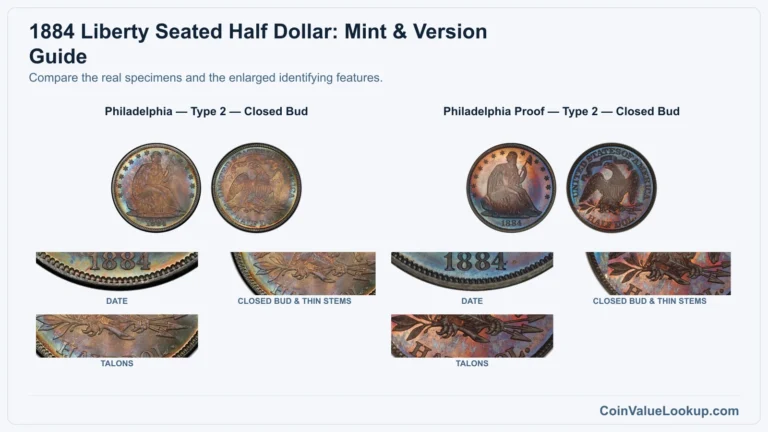
Four business-strike mints were active this year — Philadelphia, Denver, New Orleans, and San Francisco — plus Philadelphia Proof production, so your first job is figuring out which version you have.
Fast Way to Identify Your 1908 Barber Half Dollar
The quickest way to start identifying your 1908 Barber Half Dollar is to upload clear photos of the front and back of your coin. Our identifier can offer a preliminary read on the mint, version, and approximate condition from those images alone.
It is not a substitute for professional authentication or exact grading, but it gives you a solid starting point before digging deeper.
1908 Barber Half Dollar Value
Upload both sides of your 1908 Barber Half Dollar.
Front Obverse
Upload photo
Back Reverse
Upload photo
Which 1908 Barber Half Dollar Versions Are Worth Money?
- The 1908-S in MS63 lists around $2,819 in the USA Coin Book guide — the highest business-strike figure among 1908 mints at that grade.
- Philadelphia Proofs at PR63 list about $1,363, reflecting the separate collector market for this finish.
- Problem-free coins in upper circulated grades (VF and above) can be worth considerably more than heavily worn pieces; original surfaces matter.
- A 1908-O showing the "Mumps" die bulge is a recognized variety that specialist collectors track — worth checking if you have an O-mint coin.
- Misplaced date specimens, where extra numeral fragments appear near the denticles, have been reported and may carry a premium depending on visibility and condition.
Step 1: Identify Your 1908 Barber Half Dollar Mint Mark and Version
The 1908 Barber Half Dollar shows Charles Barber's Liberty head facing right on the obverse, with HALF DOLLAR on the heraldic-eagle reverse. All business strikes are 90% silver and 10% copper, weigh about 12.5 grams, measure 30.6 mm across, and have a reeded edge.
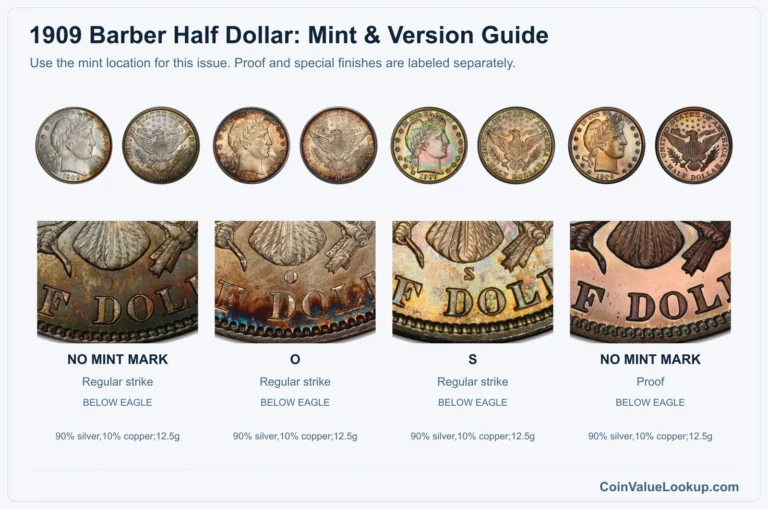
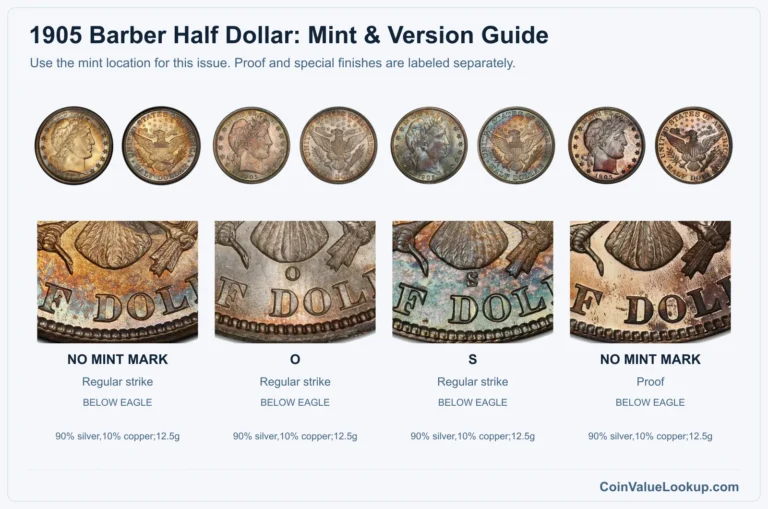
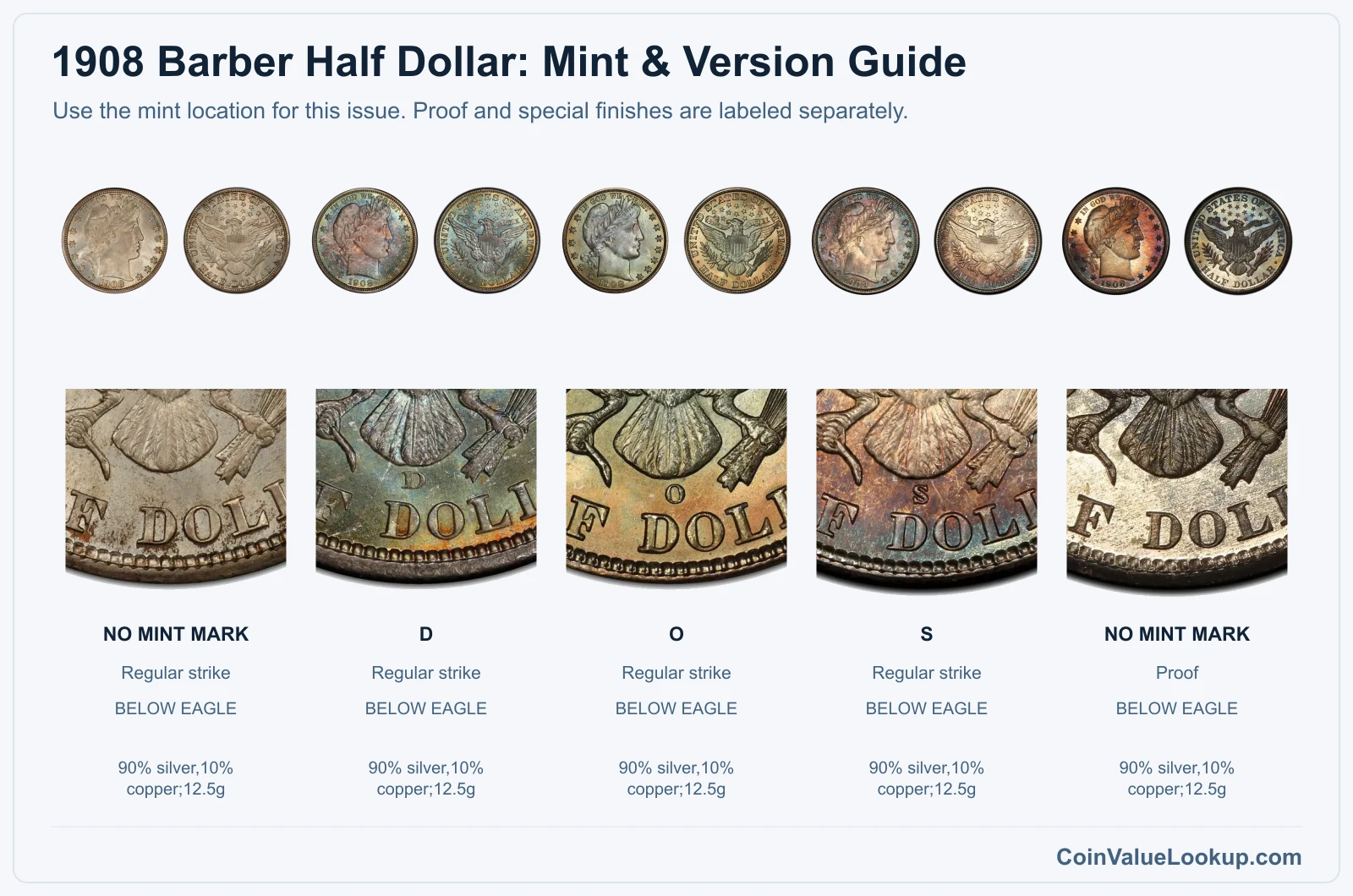
The mintmark is on the reverse, below the eagle's tail feathers and just above the words HALF DOLLAR. Philadelphia coins carry no mintmark at all.
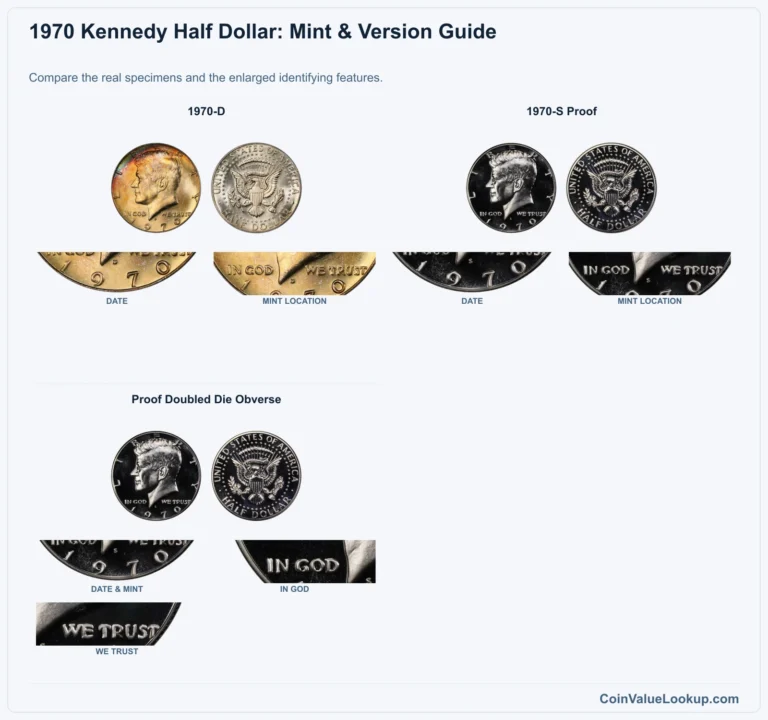
Denver shows a small "D," New Orleans an "O," and San Francisco an "S."
Philadelphia also struck Proof versions this year. A Proof is a special manufacturing finish with mirrored fields — polishing a circulated coin does not make it a Proof.
If you see deep mirror-like surfaces and sharply squared rims, that is a clue worth investigating with a professional grading service.
Beyond mint and finish, the 1908-O is associated with a die-state variety nicknamed "Mumps" (a die bulge at Liberty's neck/jaw area, not actual damage or a different alloy). That variety is covered in the error section below, so check your New Orleans coins carefully.
Step 2: Check Your 1908 Barber Half Dollar Grade
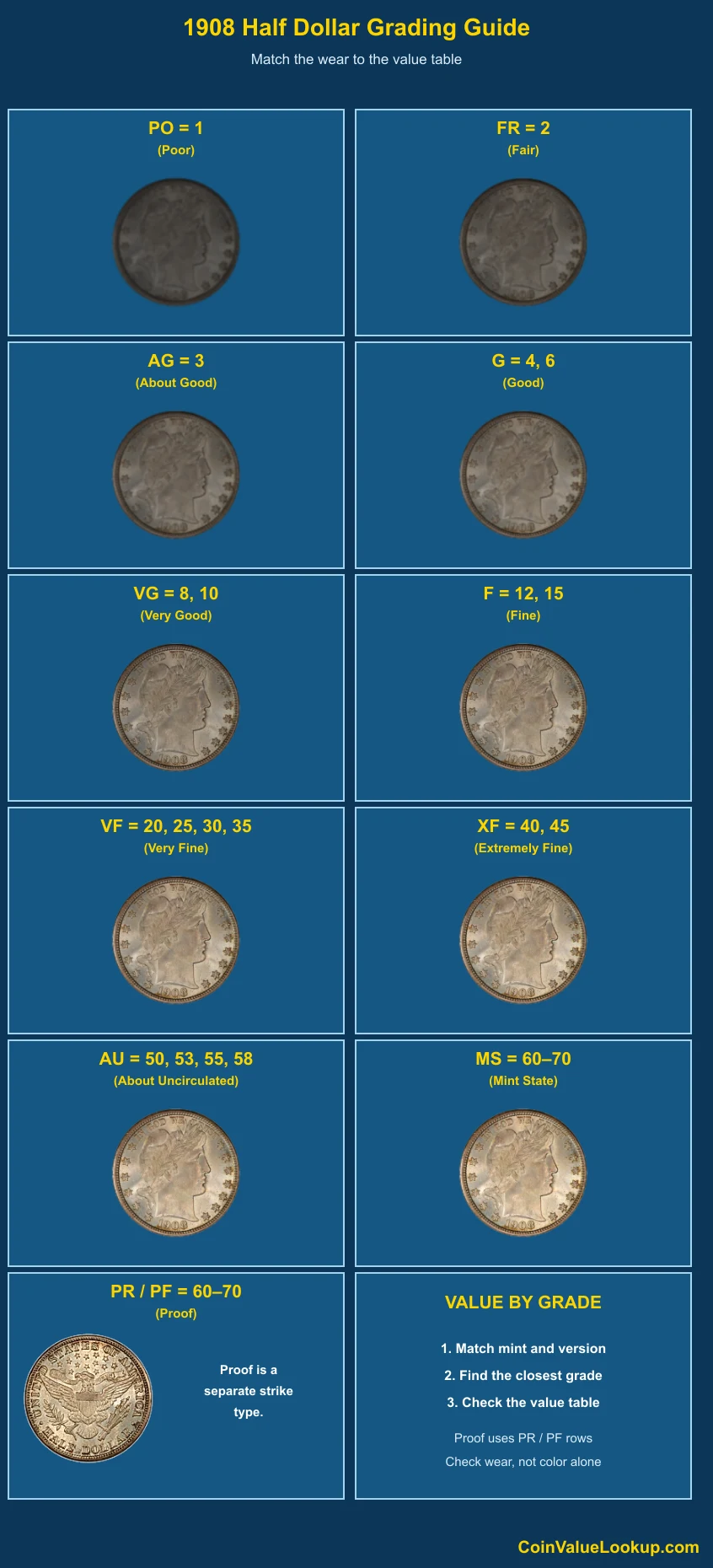
Start by examining Liberty's cheek, hair detail above the ear, and the letters in LIBERTY on the headband. On the reverse, look at the eagle's head, wing tips, and tail feathers.
Compare your coin side-by-side with the grade comparison image.
A coin grading Good-4 will show a smooth, flat portrait with almost no hair detail, while a coin approaching Mint State retains full feather separation and headband lettering. The jump in value between those conditions is dramatic.
New Orleans strikes are often softer at the eagle's claws and arrow feathers. That weakness is a strike characteristic, not wear — so don't downgrade a lustrous coin just because those details look soft.
Separate actual friction (which kills luster first on the cheek and eagle breast) from factory softness.
Also keep in mind that hub changes around 1901 affected how quickly the LIBERTY letters wore. Judging grade by LIBERTY alone can mislead you on this date.
Whole-coin evaluation — luster, surface preservation, overall sharpness — gives a more honest picture.
Coin Value Lookup is a good place to look up guides for other Barber halves and related series once you have your 1908 pinned down. It covers a wide range of U.S. coin dates and denominations.
Step 3: Check 1908 Barber Half Dollar Value by Mint and Version
1908 Barber Half Dollar — No Mint Mark — Regular Issue
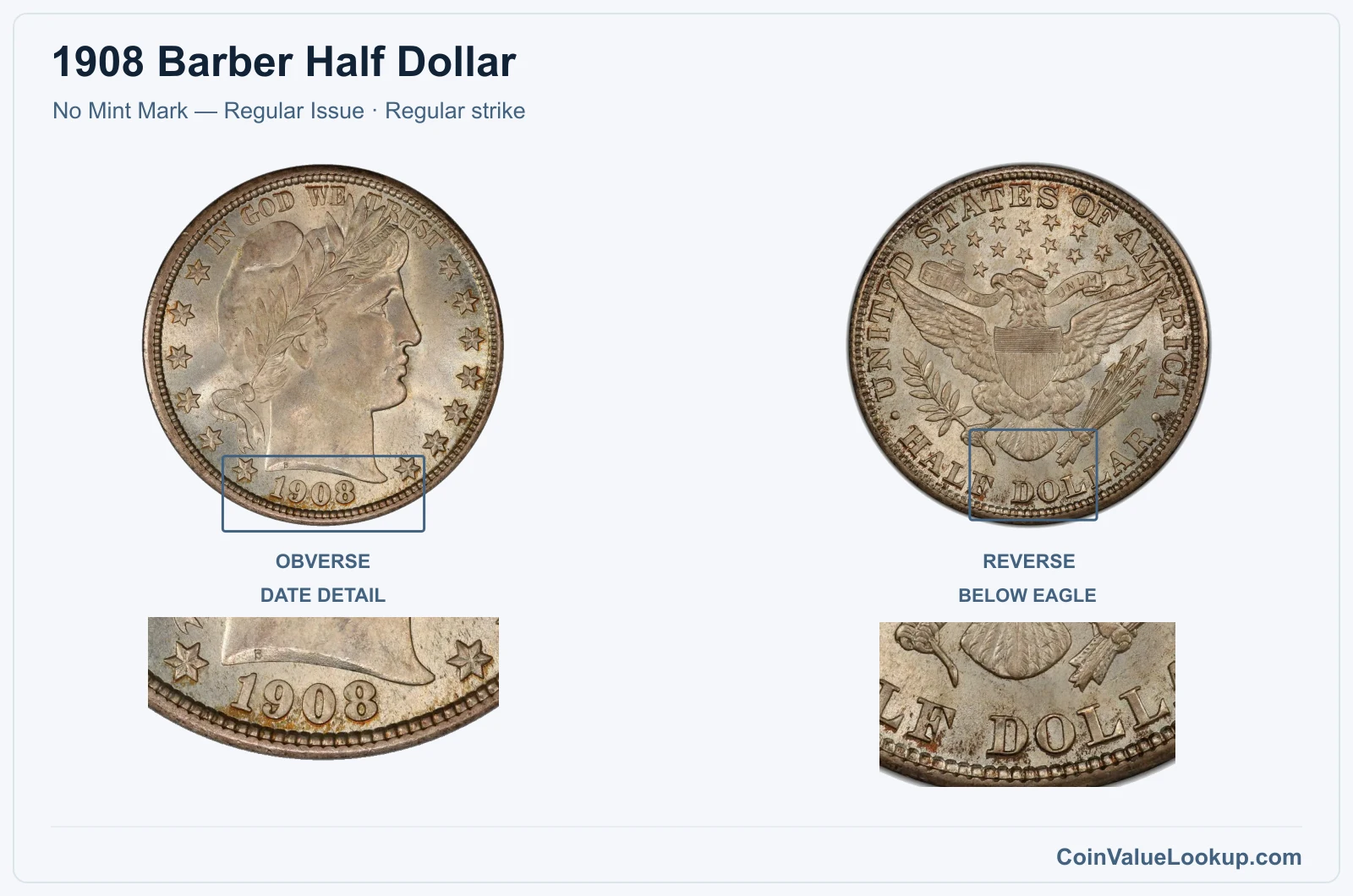
The 1908 Philadelphia half dollar has no mintmark — look at the reverse below the eagle's tail and you should see blank space. Struck in 90% silver at 12.5 grams, this is the most straightforward version to find.
A USA Coin Book guide estimate puts Good-4 around $44 and MS63 around $1,016. Those are guide snapshots, not guaranteed sale prices, and condition plus original surfaces matter enormously.
A lightly circulated example with no cleaning or damage will outperform a scratched-up coin at the same technical grade every time. Confirm the date is fully visible and check both sides for problems before estimating value.
Range Grade
Price Auction Records Appraisal PO PO 1
—
Coin Identifier FR FR 2
—
Coin Identifier AG AG 3
—
Coin Identifier G G 4
—
Coin Identifier
G 6
—
Coin Identifier VG VG 8
Coin Identifier
VG 10
—
Coin Identifier F F 12
Coin Identifier
F 15
Coin Identifier VF VF 20
Coin Identifier
VF 25
Coin Identifier
VF 30
Coin Identifier
VF 35
Coin Identifier XF XF 40
Coin Identifier
XF 45
Coin Identifier AU AU 50
Coin Identifier
AU 53
Coin Identifier
AU 55
Coin Identifier
AU 58
Coin Identifier MS MS 60
Coin Identifier
MS 61
Coin Identifier
MS 62
Coin Identifier
MS 63
Coin Identifier
MS 64
Coin Identifier
MS 65
Coin Identifier
MS 66
Coin Identifier
MS 67
Coin Identifier
MS 68
—
—
—
MS 69
—
—
—
MS 70
—
—
—
1908 Barber Half Dollar — D — Regular Issue
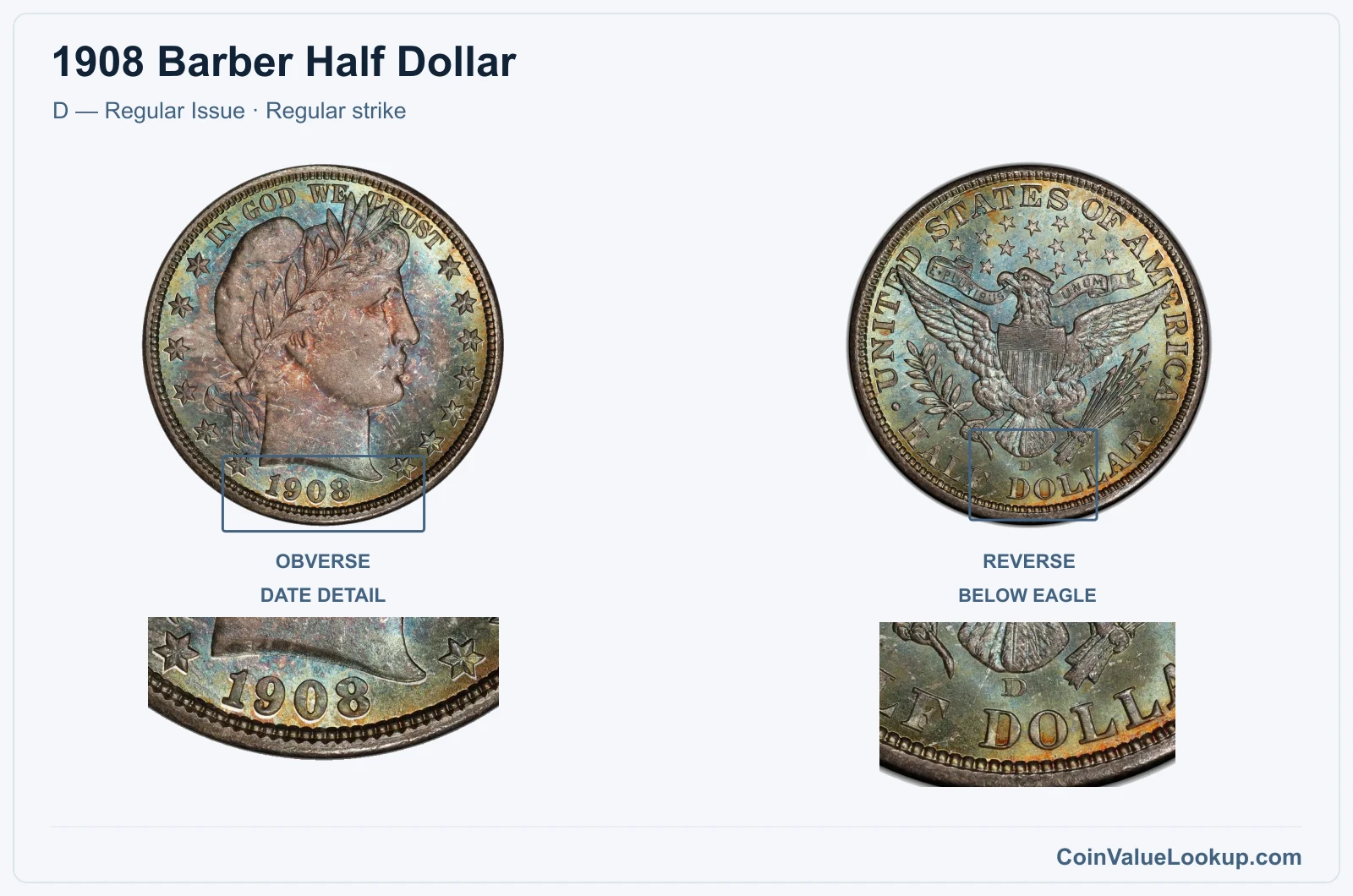
Denver struck 1908 half dollars with a small "D" mintmark on the reverse beneath the eagle's tail. Same 90% silver composition, same 12.5-gram weight.
Guide estimates from USA Coin Book place the 1908-D at about $44 in Good-4 and roughly $1,082 in MS63. That MS63 figure is slightly above Philadelphia, but the difference is modest.
Original luster and clean surfaces push value more than the mint alone at this level. Make sure you are reading a genuine "D" and not a scratch or deposit — under magnification, the letter should be crisply punched, even if shallow.
Range Grade
Price Auction Records Appraisal PO PO 1
—
Coin Identifier FR FR 2
—
Coin Identifier AG AG 3
—
Coin Identifier G G 4
—
Coin Identifier
G 6
—
Coin Identifier VG VG 8
—
Coin Identifier
VG 10
Coin Identifier F F 12
—
Coin Identifier
F 15
—
Coin Identifier VF VF 20
Coin Identifier
VF 25
Coin Identifier
VF 30
Coin Identifier
VF 35
Coin Identifier XF XF 40
Coin Identifier
XF 45
Coin Identifier AU AU 50
Coin Identifier
AU 53
Coin Identifier
AU 55
Coin Identifier
AU 58
Coin Identifier MS MS 60
Coin Identifier
MS 61
Coin Identifier
MS 62
Coin Identifier
MS 63
Coin Identifier
MS 64
Coin Identifier
MS 65
Coin Identifier
MS 66
Coin Identifier
MS 67
Coin Identifier
MS 68
Coin Identifier
MS 69
—
—
—
MS 70
—
—
—
1908 Barber Half Dollar — O — Regular Issue
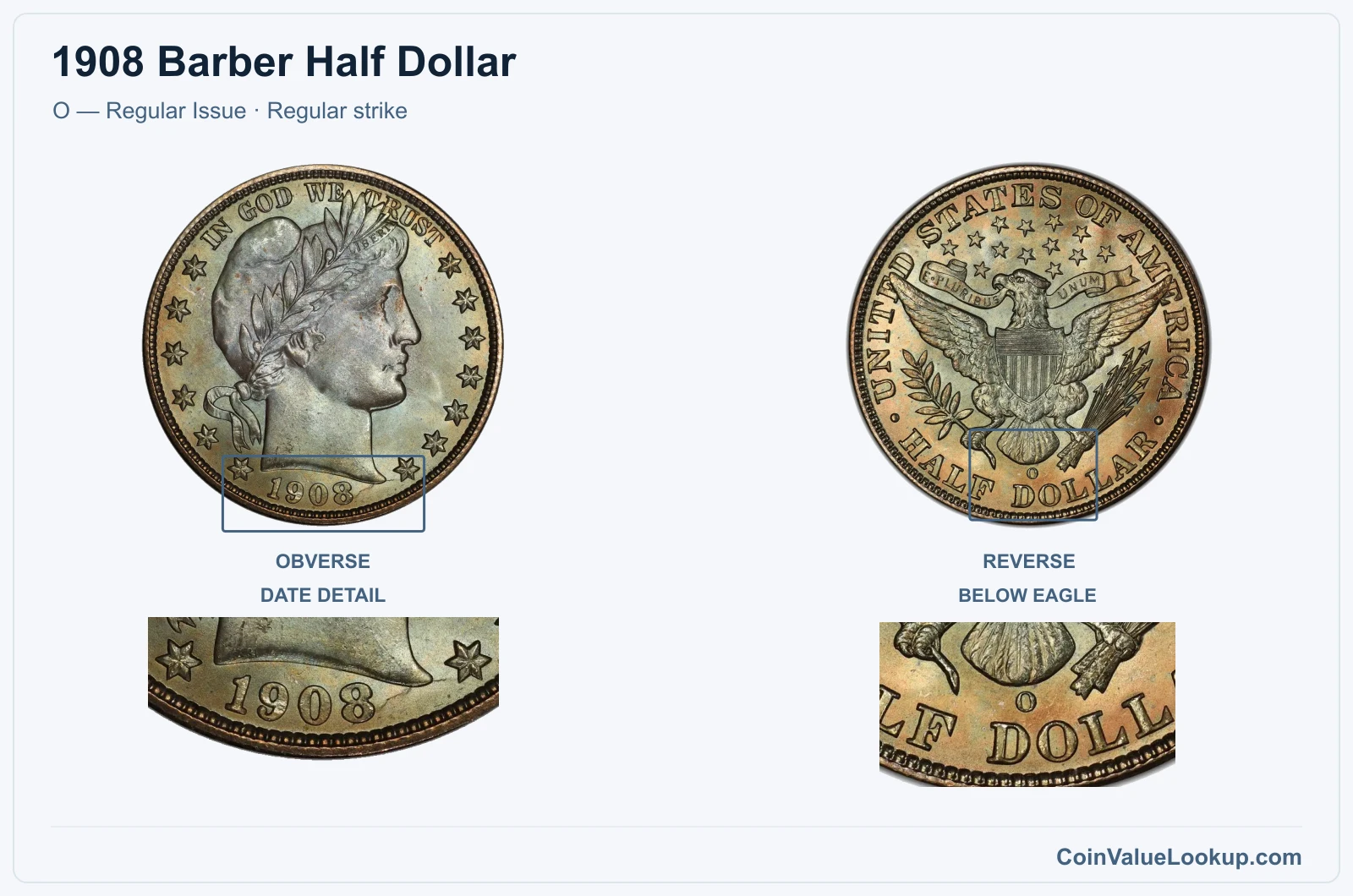
New Orleans half dollars carry an "O" mintmark below the eagle's tail. The 1908-O is worth around $44 at Good-4 and about $1,261 at MS63 per the USA Coin Book guide.
That MS63 number edges above both the P and D mints.
New Orleans strikes tend to be softer, particularly at the eagle's claws and arrow feathers. Weak detail in those spots does not necessarily mean heavy wear — it can be a strike characteristic.
Look at the overall luster and cheek flatness to judge actual grade.
This mint is also the one associated with the "Mumps" die-bulge variety and reported misplaced-date specimens, so give your 1908-O extra scrutiny. Both are covered in the error section below.
Range Grade
Price Auction Records Appraisal PO PO 1
—
Coin Identifier FR FR 2
—
Coin Identifier AG AG 3
—
Coin Identifier G G 4
Coin Identifier
G 6
Coin Identifier VG VG 8
—
Coin Identifier
VG 10
Coin Identifier F F 12
Coin Identifier
F 15
Coin Identifier VF VF 20
Coin Identifier
VF 25
Coin Identifier
VF 30
Coin Identifier
VF 35
Coin Identifier XF XF 40
Coin Identifier
XF 45
Coin Identifier AU AU 50
Coin Identifier
AU 53
Coin Identifier
AU 55
Coin Identifier
AU 58
Coin Identifier MS MS 60
—
Coin Identifier
MS 61
Coin Identifier
MS 62
Coin Identifier
MS 63
Coin Identifier
MS 64
Coin Identifier
MS 65
Coin Identifier
MS 66
Coin Identifier
MS 67
Coin Identifier
MS 68
Coin Identifier
MS 69
—
—
—
MS 70
—
—
—
1908 Barber Half Dollar — S — Regular Issue
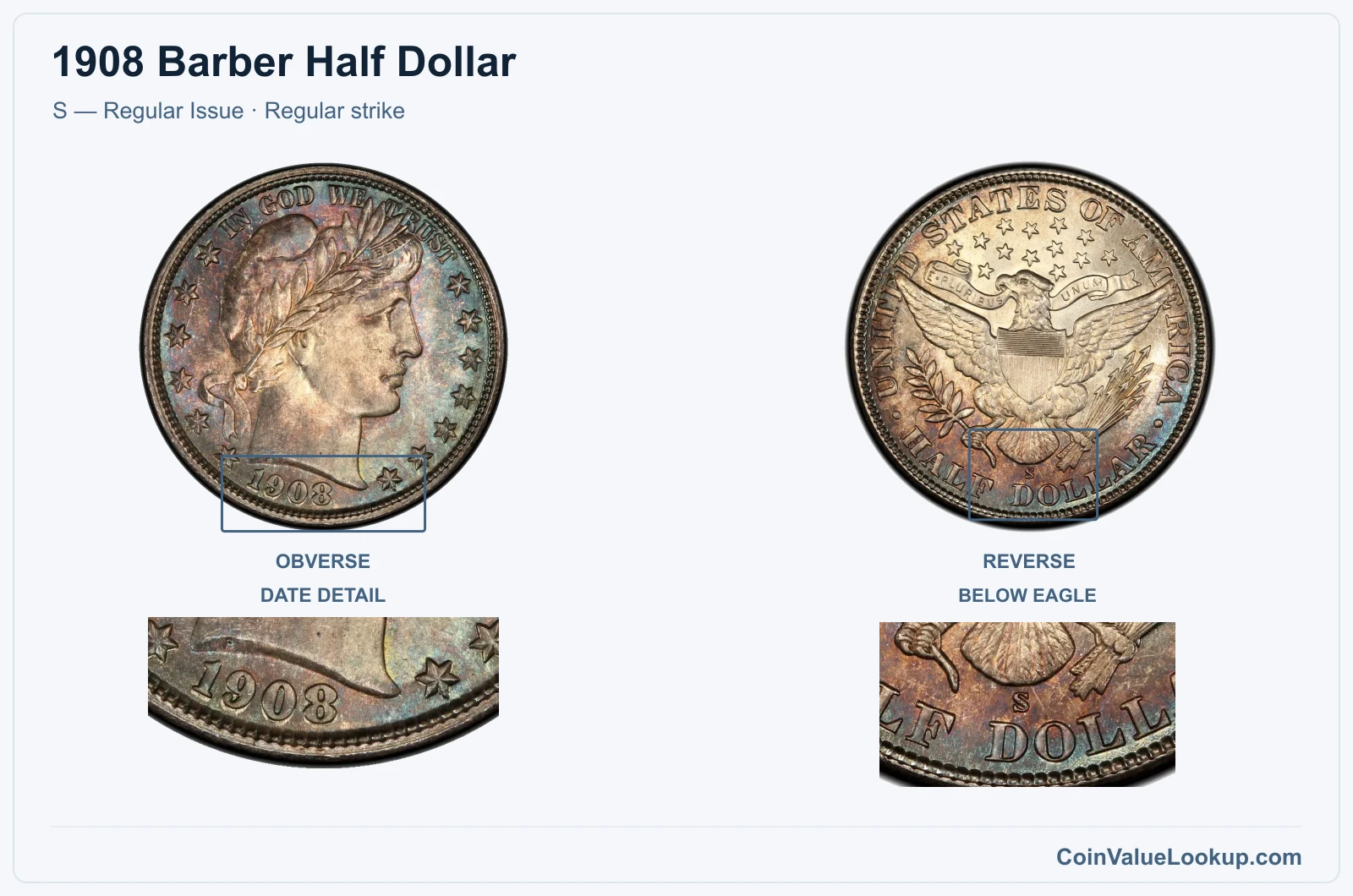
The San Francisco mint used an "S" mintmark, and the 1908-S carries the highest MS63 guide estimate among business strikes at roughly $2,819 per USA Coin Book. At Good-4, it starts around $44 — the same neighborhood as the other mints — but the gap widens fast as condition improves.
That price jump tells you original Mint State survivors are scarce enough to command a serious premium. If your 1908-S still has full cartwheel luster and sharp detail from cheek to eagle breast, it is worth professional evaluation.
Even at mid-circulated grades, a problem-free example with honest wear outperforms a cleaned or damaged coin significantly.
Range Grade
Price Auction Records Appraisal PO PO 1
—
Coin Identifier FR FR 2
—
Coin Identifier AG AG 3
—
Coin Identifier G G 4
—
Coin Identifier
G 6
—
Coin Identifier VG VG 8
Coin Identifier
VG 10
Coin Identifier F F 12
Coin Identifier
F 15
Coin Identifier VF VF 20
Coin Identifier
VF 25
Coin Identifier
VF 30
Coin Identifier
VF 35
Coin Identifier XF XF 40
Coin Identifier
XF 45
Coin Identifier AU AU 50
Coin Identifier
AU 53
Coin Identifier
AU 55
Coin Identifier
AU 58
Coin Identifier MS MS 60
Coin Identifier
MS 61
Coin Identifier
MS 62
Coin Identifier
MS 63
Coin Identifier
MS 64
Coin Identifier
MS 65
Coin Identifier
MS 66
Coin Identifier
MS 67
Coin Identifier
MS 68
—
—
—
MS 69
—
—
—
MS 70
—
—
—
1908 Barber Half Dollar — No Mint Mark — Proof
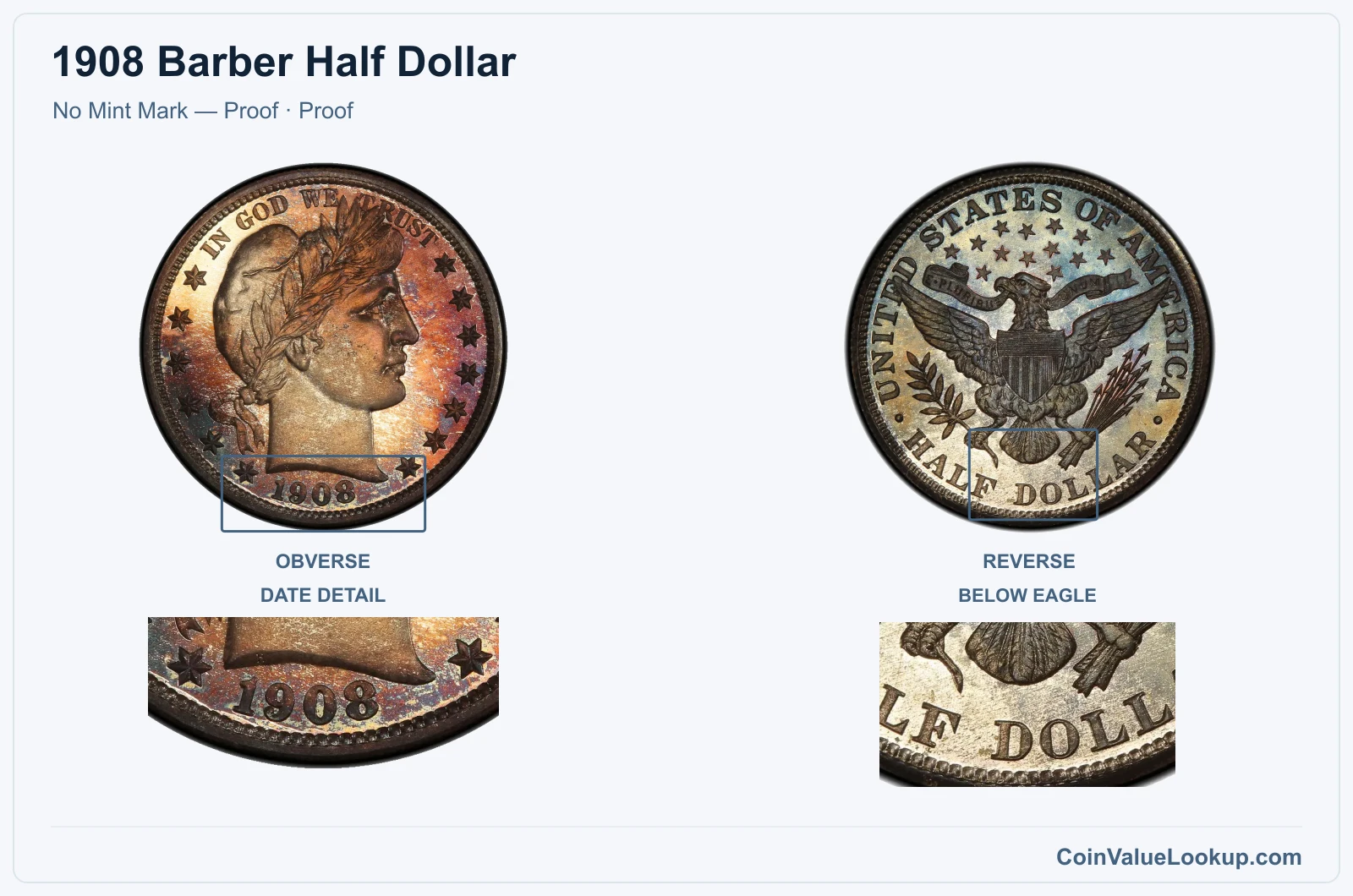
Philadelphia produced Proof Barber half dollars in 1908, struck with polished dies on prepared planchets. Genuine Proofs show deeply mirrored fields, squared-off rims, and crisp detail that business strikes simply cannot match.
A PR63 example lists around $1,363 in the USA Coin Book guide. That is a guide estimate for one specific grade, and cameo contrast within the Proof finish can influence desirability further.
The key thing: polishing a worn Philadelphia business strike does not create a Proof. The manufacturing process is fundamentally different.
If you think you have one, look for the combination of perfect mirror surfaces, knife-edge rims, and full design sharpness. Professional attribution by a grading service is the reliable way to confirm Proof status.
Range Grade
Price Auction Records Appraisal PR PR 1
—
Coin Identifier
PR 2
—
Coin Identifier
PR 3
—
Coin Identifier
PR 4
—
Coin Identifier
PR 6
—
Coin Identifier
PR 8
—
Coin Identifier
PR 10
—
Coin Identifier
PR 12
—
Coin Identifier
PR 15
—
Coin Identifier
PR 20
—
Coin Identifier
PR 25
—
Coin Identifier
PR 30
—
Coin Identifier
PR 35
—
Coin Identifier
PR 40
—
Coin Identifier
PR 45
—
Coin Identifier
PR 50
—
Coin Identifier
PR 53
—
Coin Identifier
PR 55
—
Coin Identifier
PR 58
Coin Identifier
PR 60
Coin Identifier
PR 61
Coin Identifier
PR 62
Coin Identifier
PR 63
Coin Identifier
PR 64
Coin Identifier
PR 65
Coin Identifier
PR 66
Coin Identifier
PR 67
Coin Identifier
PR 68
Coin Identifier
PR 69
—
—
—
PR 70
—
—
—
1908 Barber Half Dollar Error List
1. 1908 Barber Half Dollar — Misplaced Date
A misplaced date on a Barber half dollar means fragments of one or more numerals were punched outside the intended date position — typically visible among the denticles (the small tooth-like projections along the rim) below the date. This is different from a repunched date, where extra impressions sit right beside or overlapping the final digits.
The 1908 misplaced date has been reported for Philadelphia, Denver, and New Orleans strikes, with the O-mint having documented specimens in a society survey. To check, use magnification and look carefully at the denticles directly beneath the 1908 date for any ghost-like numeral traces.
Do not confuse rim dings, contact marks, or machine doubling for a misplaced date — genuine examples show recognizable digit shapes in the wrong location. No specific price range has been established here; the value depends on the clarity of the misplacement, the coin's overall condition, and collector demand for the specific variety.
2. 1908 Barber Half Dollar — Mumps Die-Bulge Variety
The "Mumps" variety is a nickname for a die-state bulge that appears on the 1908-O Barber Half Dollar, showing as a raised swelling around Liberty's neck and jaw area. It is purely a die deterioration feature — the die itself developed a subsurface failure that pushed metal outward in that zone.
This is not damage to the coin, corrosion, or a different alloy composition.
To identify it, compare your 1908-O portrait against a normal example. The affected area will look subtly puffy or swollen in a way that does not match standard relief.
A rim cud (which breaks away from the edge) looks different, and surface corrosion or uneven lighting can mimic the effect on photos, so hands-on inspection under consistent light helps.
No specific price range has been adopted for this variety. Value depends on the strength of the bulge, the coin's grade, and how much a specialist collector wants it.