1958 Franklin Half Dollar Coin Value: How Much Is It Worth?
The 1958 Franklin Half Dollar is a 90% silver coin that remains popular with collectors for both its metal content and its design. Guide estimates for this year range from about $32.00 in well-worn grades to $87.00 for gem-quality examples, depending on the mint, condition, and whether you have a special version like a proof.
These are published guide anchors, not guaranteed sale prices or current silver-melt quotes. Mint, surface quality, and strike detail all matter when figuring out what yours is worth.
Fast Way to Identify Your 1958 Franklin Half Dollar
Want a quick read on what you have? Upload clear photos of both the front and back of your 1958 Franklin Half Dollar, and our identifier can give you a preliminary take on which version you are holding.
This is not a substitute for professional authentication or grading, but it is a solid first step toward understanding your coin.
1958 Franklin Half Dollar Value
Upload both sides of your 1958 Franklin Half Dollar.
Front Obverse
Upload photo
Back Reverse
Upload photo
Which 1958 Franklin Half Dollar Versions Are Worth Money?
- The 1958 Philadelphia business strike ranges from about $32.00 in G4 to $87.00 in MS65 per USA Coin Book, making the gem example the highest guide value among this year's branches at that grade level.
- The 1958-D business strike guides at $32.00 in G4 up to $74.00 in MS65, slightly lower than Philadelphia in top grade.
- The 1958 proof carries a guide estimate of $55.00 in PR65; confirm genuine proof surfaces before applying this value.
- Full Bell Lines detail can add a premium to business strikes, but only when the bell lines are fully intact under the relevant grading standard.
- Mint errors such as clashed dies, clipped planchets, and die breaks have been reported for 1958 and can affect value depending on visibility and condition.
Step 1: Identify Your 1958 Franklin Half Dollar Mint Mark and Version
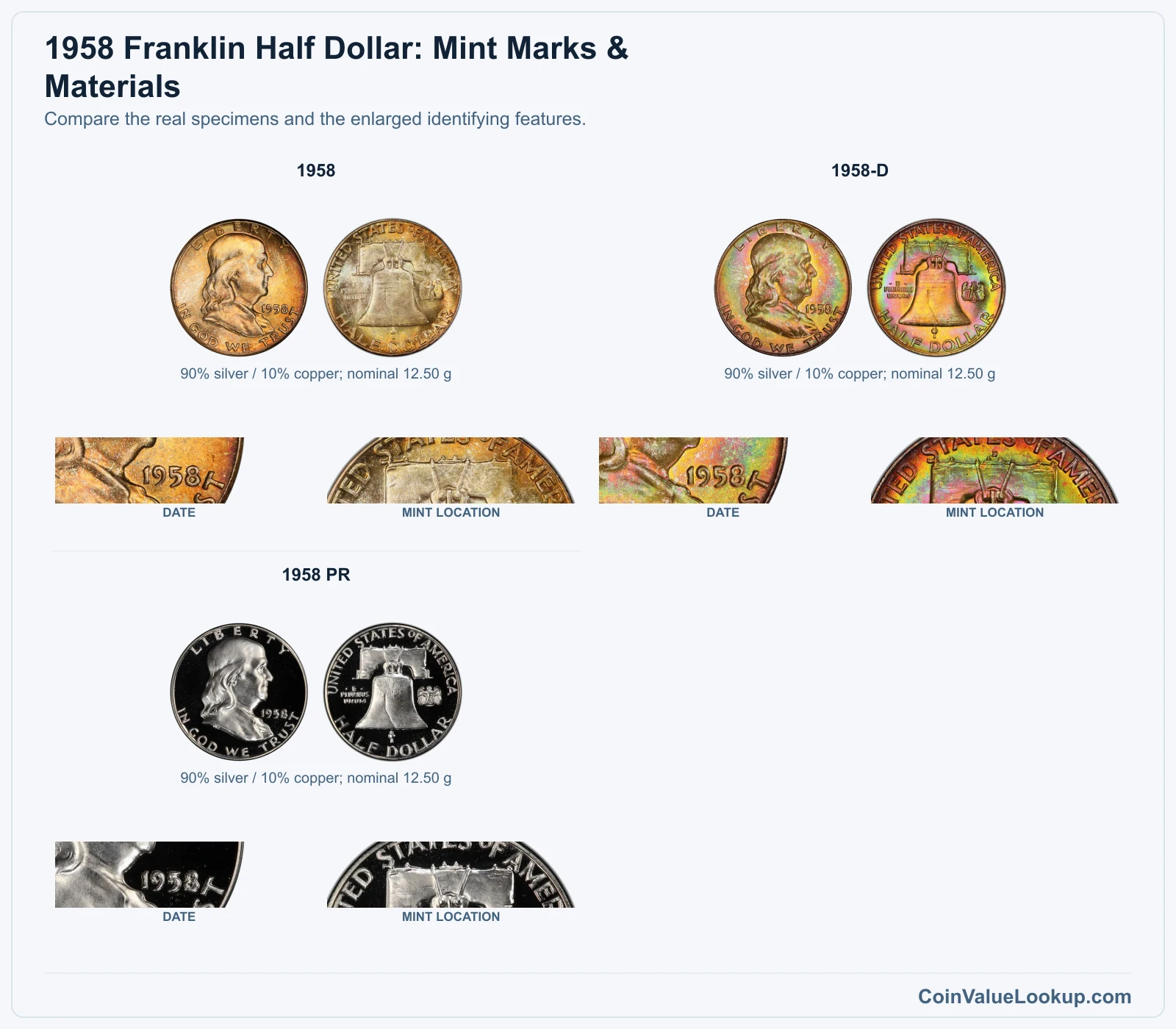
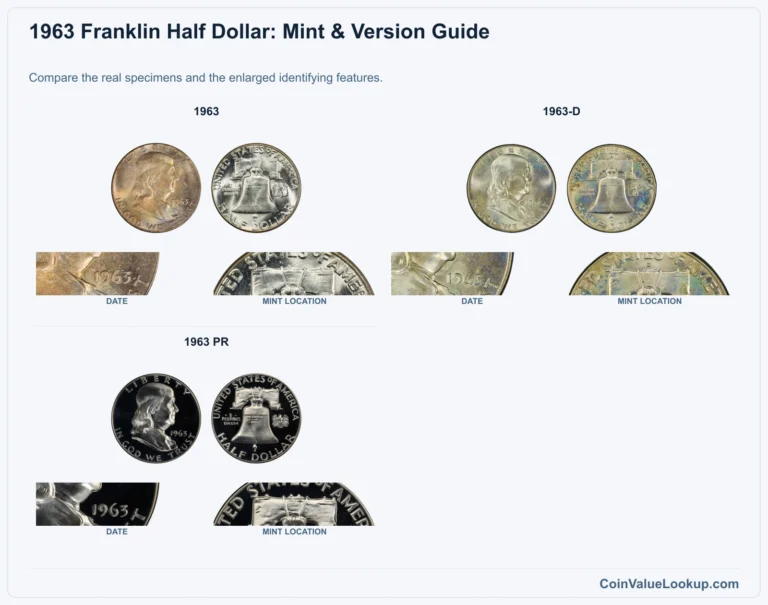
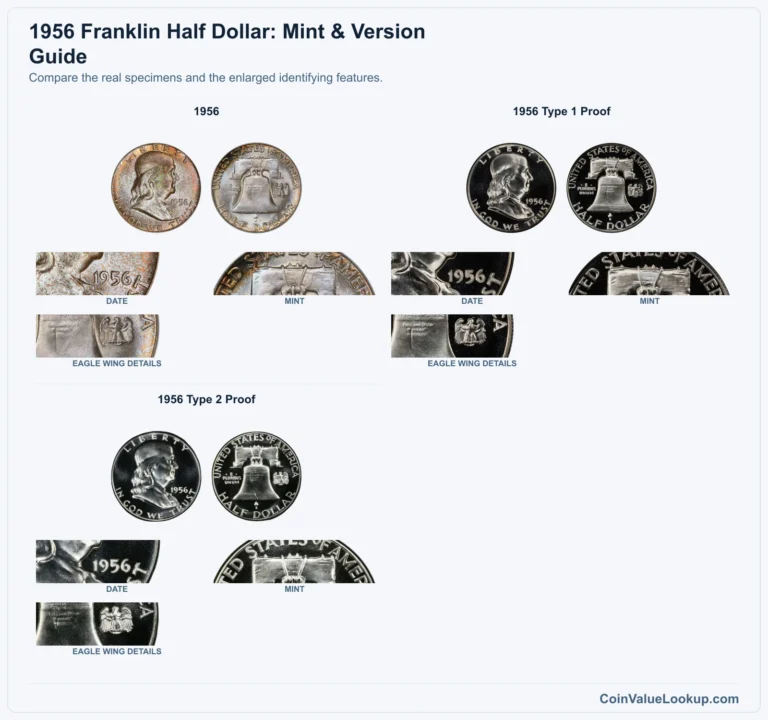
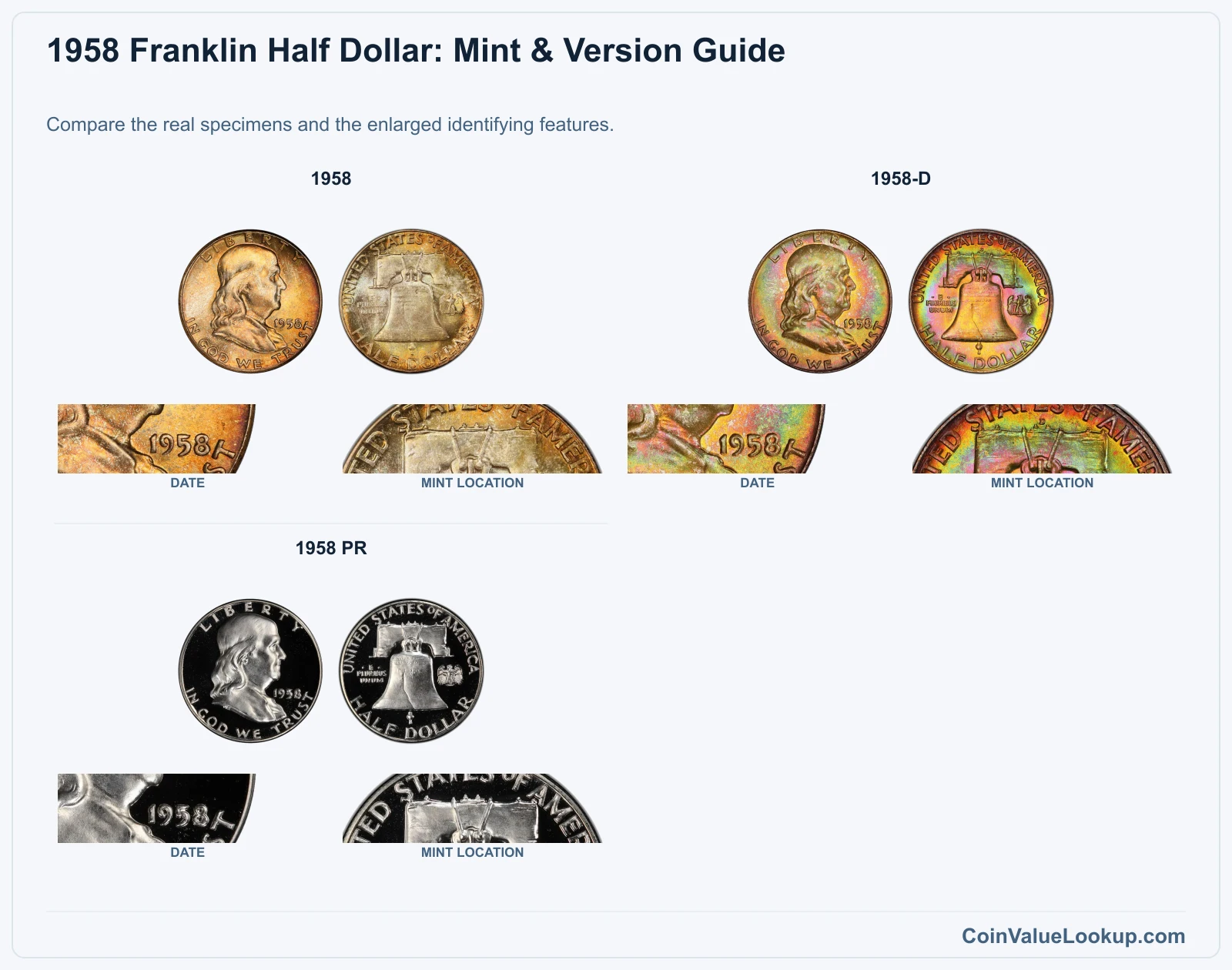
The 1958 Franklin Half Dollar comes in three branches: the 1958 Philadelphia business strike, the 1958-D Denver business strike, and the 1958 proof from Philadelphia. All three are struck in 90% silver and 10% copper at a nominal weight of 12.50 grams.
To figure out which one you have, flip the coin over and look just above the Liberty Bell, below the words E PLURIBUS UNUM. If there is no mintmark at all, you have a Philadelphia coin.
A small "D" in that spot means Denver.
Separating a proof from a regular Philadelphia strike takes a closer look. Proofs have deeply mirrored fields and razor-sharp design details.
A polished circulation strike is not a proof, no matter how shiny it looks. If the surfaces are reflective but the devices look soft or you can see fine parallel polishing lines, someone cleaned it.
Toning can develop on any of these coins over time. It does not change the underlying alloy or necessarily hurt the value, though heavy or unnatural toning is a different story.
Step 2: Check Your 1958 Franklin Half Dollar Grade
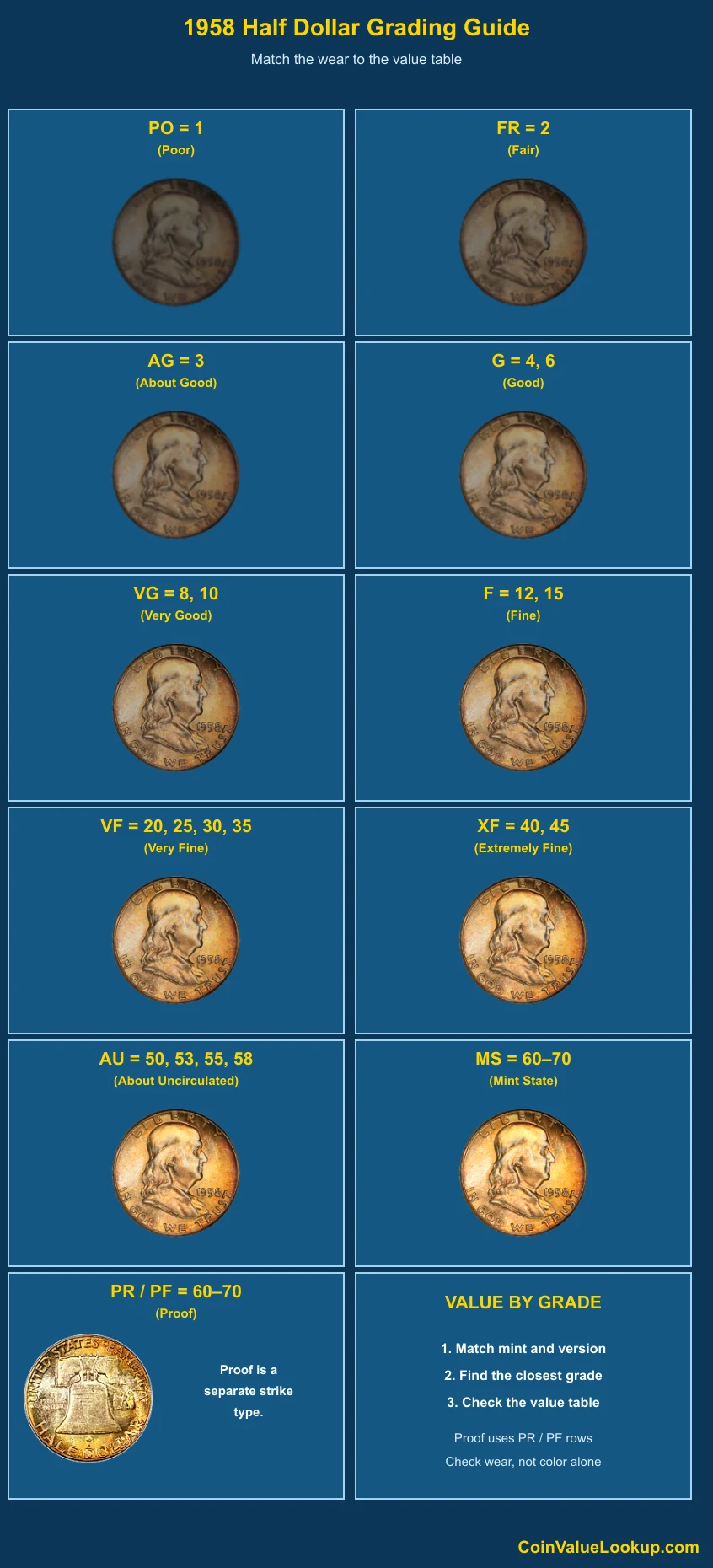
Start with Franklin's cheek and the hair just behind his ear. These are the highest points on the obverse and the first to show smoothing from circulation.
On the reverse, check the lettering across the Liberty Bell and the lower bell lines for wear.
Contact marks are not the same as circulation wear. A coin can be uncirculated but still show bag marks from jostling against other half dollars at the mint.
Compare your coin side by side with the reference image to separate honest wear from handling marks.
Full Bell Lines is a strike-detail designation, not a grade. It means the horizontal lines at the bottom of the Liberty Bell are fully separated and unbroken.
A coin can grade MS65 without Full Bell Lines, and FBL pieces command a different premium. Grade proof surfaces on their own terms: look for hairlines, haze, and whether cameo contrast is present between the fields and the devices.
Step 3: Check 1958 Franklin Half Dollar Value by Mint and Version
1958 Franklin Half Dollar
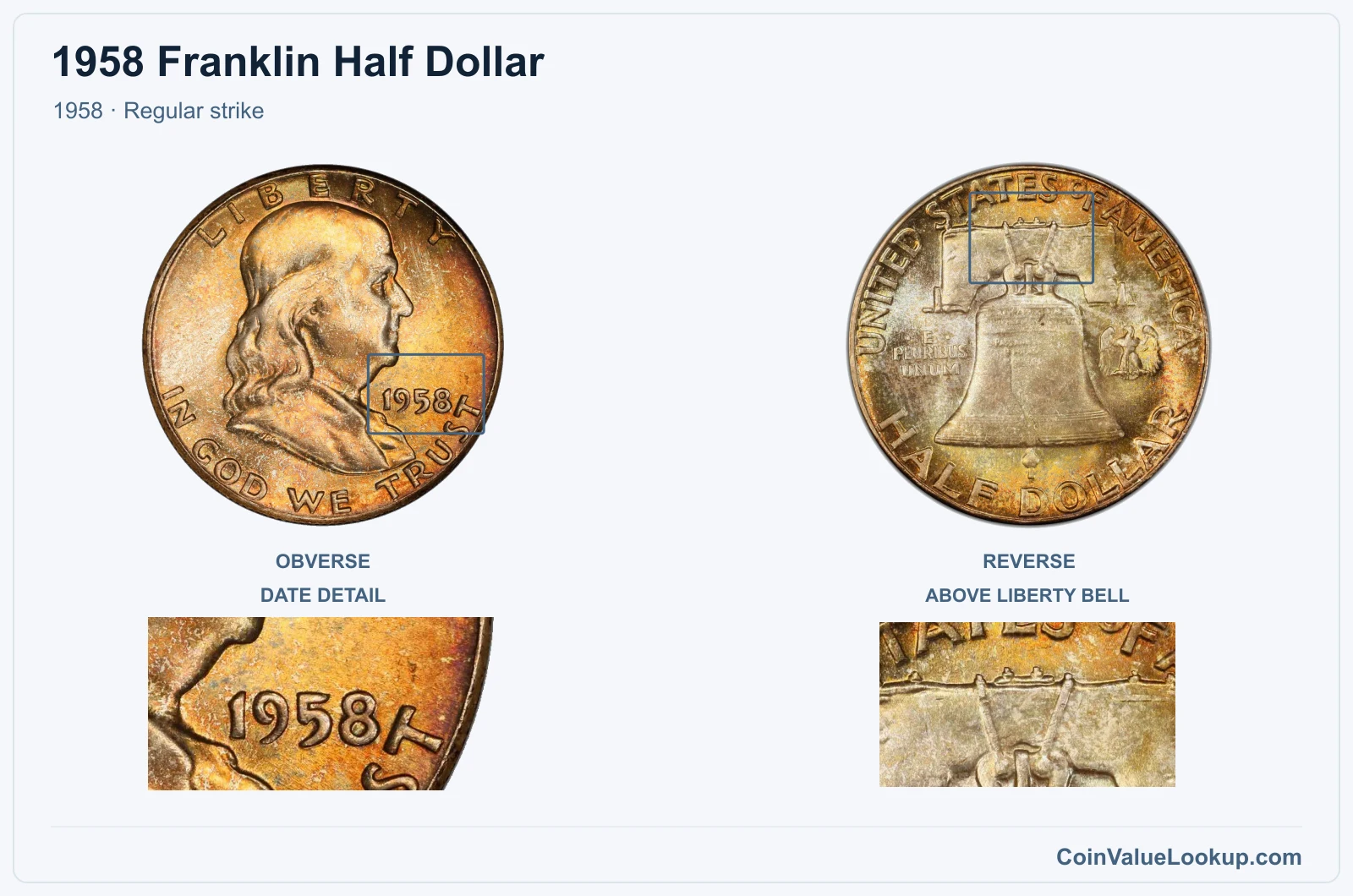
The 1958 Philadelphia business strike has no mintmark on the reverse. It features the standard Franklin portrait on the obverse and the Liberty Bell with a small eagle on the reverse, struck in 90% silver.
USA Coin Book lists guide estimates of about $32.00 in G4 (a heavily worn but identifiable coin) and $87.00 in MS65 (a gem uncirculated piece with minimal marks). These are guide anchors, not guaranteed sale prices.
Cleaned or damaged coins do not qualify for the same values as problem-free examples.
If you want to check guides for other dates and denominations, Coin Value Lookup is a useful starting point for looking up coin value information across a wide range of series.
Range Grade
Price Auction Records Appraisal PO PO 1
—
Coin Identifier FR FR 2
—
Coin Identifier AG AG 3
—
Coin Identifier G G 4
—
Coin Identifier
G 6
—
Coin Identifier VG VG 8
—
Coin Identifier
VG 10
—
Coin Identifier F F 12
—
Coin Identifier
F 15
—
Coin Identifier VF VF 20
—
Coin Identifier
VF 25
—
Coin Identifier
VF 30
—
Coin Identifier
VF 35
—
Coin Identifier XF XF 40
—
Coin Identifier
XF 45
—
Coin Identifier AU AU 50
—
Coin Identifier
AU 53
—
Coin Identifier
AU 55
Coin Identifier
AU 58
Coin Identifier MS MS 60
—
Coin Identifier
MS 61
Coin Identifier
MS 62
—
Coin Identifier
MS 63
Coin Identifier
MS 64
Coin Identifier
MS 65
Coin Identifier
MS 66
Coin Identifier
MS 67
Coin Identifier
MS 68
—
—
—
MS 69
—
—
—
MS 70
—
—
—
1958 Franklin Half Dollar — D
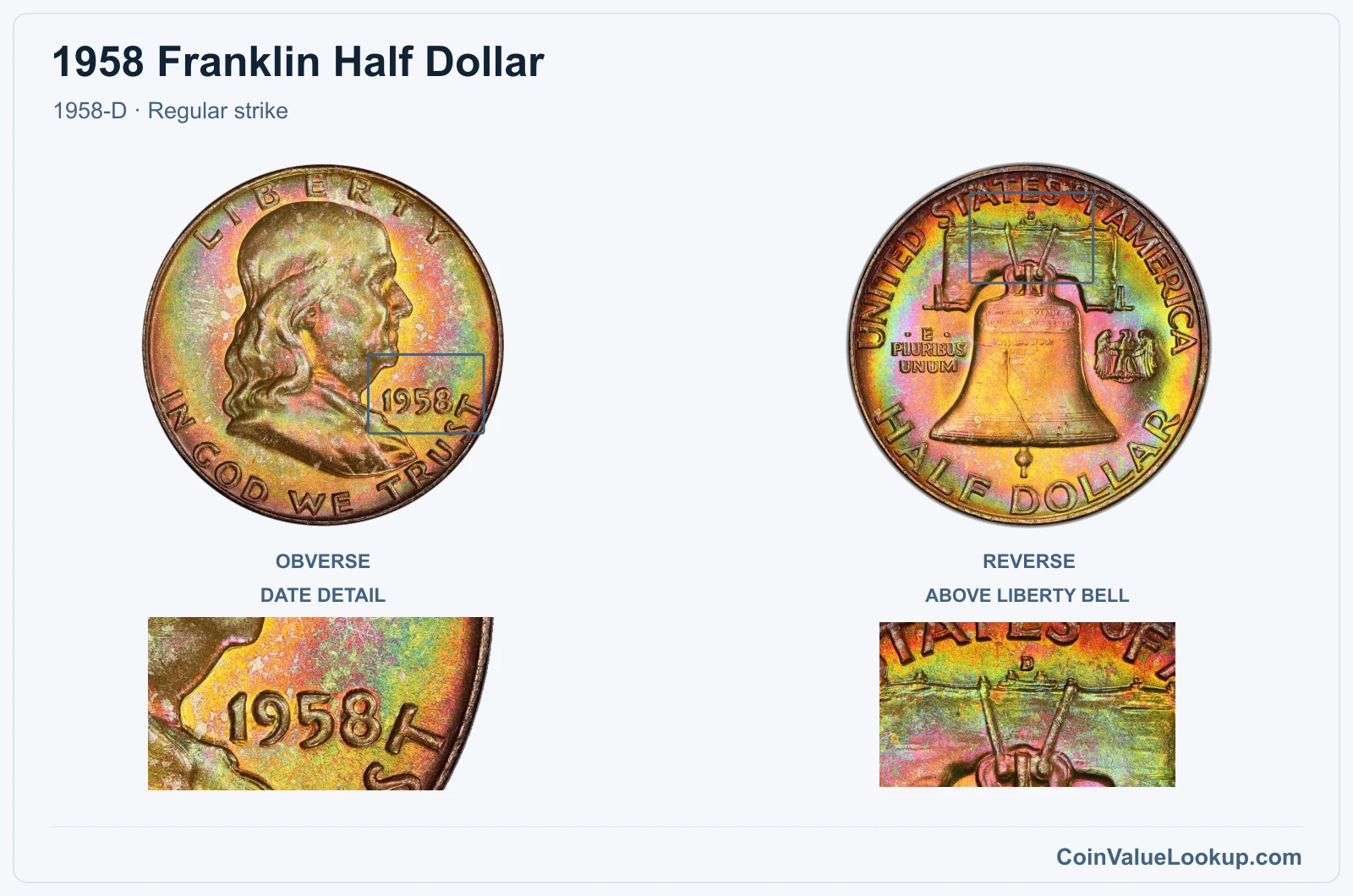
The 1958-D was struck in Denver and carries a small "D" mintmark on the reverse, above the Liberty Bell. Same 90% silver composition, same design.
Guide estimates from USA Coin Book place this one at about $32.00 in G4 and $74.00 in MS65. That MS65 figure is a bit lower than the Philadelphia version at the same grade.
As always, original surfaces matter. A coin that has been cleaned, whizzed, or damaged trades at a discount compared to a problem-free example.
Full Bell Lines is a strike-quality designation, not a different coin. If your 1958-D shows fully separated horizontal lines at the bottom of the bell, that detail can push the value higher than the standard guide figures.
Range Grade
Price Auction Records Appraisal PO PO 1
—
Coin Identifier FR FR 2
—
Coin Identifier AG AG 3
—
Coin Identifier G G 4
—
Coin Identifier
G 6
—
Coin Identifier VG VG 8
—
Coin Identifier
VG 10
—
Coin Identifier F F 12
—
Coin Identifier
F 15
—
Coin Identifier VF VF 20
—
Coin Identifier
VF 25
—
Coin Identifier
VF 30
—
Coin Identifier
VF 35
—
Coin Identifier XF XF 40
—
Coin Identifier
XF 45
—
Coin Identifier AU AU 50
—
Coin Identifier
AU 53
—
Coin Identifier
AU 55
—
Coin Identifier
AU 58
Coin Identifier MS MS 60
—
Coin Identifier
MS 61
—
Coin Identifier
MS 62
Coin Identifier
MS 63
Coin Identifier
MS 64
Coin Identifier
MS 65
Coin Identifier
MS 66
Coin Identifier
MS 67
Coin Identifier
MS 68
—
—
—
MS 69
—
—
—
MS 70
—
—
—
1958 Franklin Half Dollar — PR
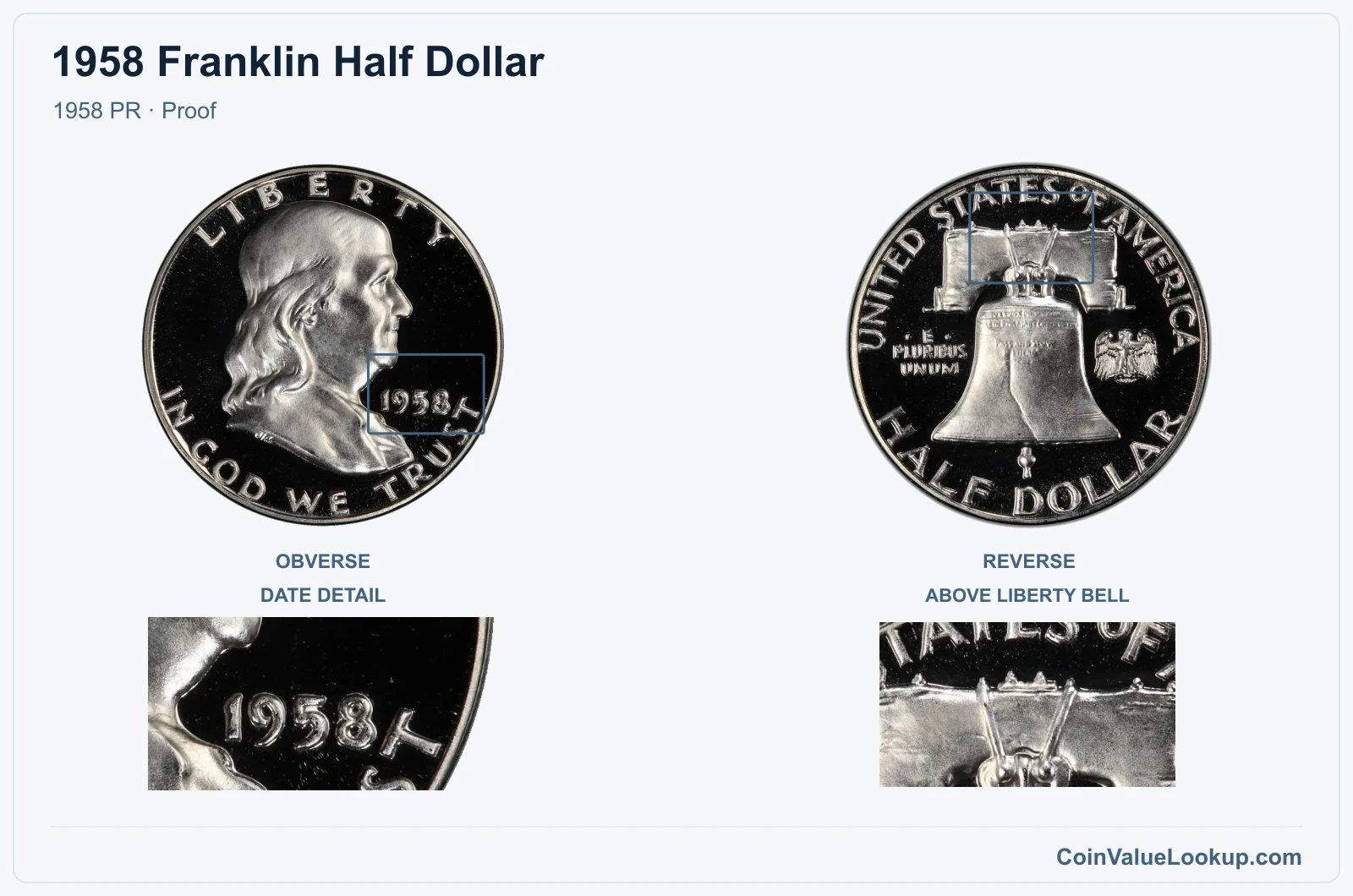
The 1958 proof was made at Philadelphia for collectors, not for circulation. It carries no mintmark.
What sets it apart is the manufacturing method: proof coins are struck with polished dies on specially prepared planchets, producing mirror-like fields and exceptionally sharp devices.
USA Coin Book estimates about $55.00 for a PR65 example. Hairlines, haze, and loss of cameo contrast all affect a proof's grade and value.
A polished ordinary business strike is not a proof. If the fields are shiny but the design edges are soft and rounded, you are likely looking at a cleaned coin rather than a genuine proof.
Confirm mirror fields and crisp device edges before applying this value.
Range Grade
Price Auction Records Appraisal PR PR 1
—
Coin Identifier
PR 2
—
Coin Identifier
PR 3
—
Coin Identifier
PR 4
—
Coin Identifier
PR 6
—
Coin Identifier
PR 8
—
Coin Identifier
PR 10
—
Coin Identifier
PR 12
—
Coin Identifier
PR 15
—
Coin Identifier
PR 20
—
Coin Identifier
PR 25
—
Coin Identifier
PR 30
—
Coin Identifier
PR 35
—
Coin Identifier
PR 40
—
Coin Identifier
PR 45
—
Coin Identifier
PR 50
—
Coin Identifier
PR 53
—
Coin Identifier
PR 55
—
Coin Identifier
PR 58
—
Coin Identifier
PR 60
—
Coin Identifier
PR 61
—
Coin Identifier
PR 62
—
Coin Identifier
PR 63
Coin Identifier
PR 64
Coin Identifier
PR 65
Coin Identifier
PR 66
Coin Identifier
PR 67
Coin Identifier
PR 68
Coin Identifier
PR 69
Coin Identifier
PR 70
—
—
—
1958 Franklin Half Dollar Error List
1. 1958 Franklin Half Dollar — Clashed Dies
A clashed die error happens when the obverse and reverse dies strike each other without a planchet between them. The result is faint traces of the opposite design impressed into the die, which then transfer onto every coin struck afterward.
On a 1958 Franklin Half Dollar with an obverse die clash, look for ghost-like outlines of Liberty Bell details showing up in the fields around Franklin's portrait. These impressions will align with where the opposing design would sit during a normal strike.
Do not confuse random scratches or raised lines with a genuine clash. Clashed die impressions follow the geometry of the opposite die and appear in predictable locations.
The value of a clashed die piece depends on how visible the clash is and the coin's overall condition. No specific price range is established here, so individual evaluation is the way to go.
2. 1958 Franklin Half Dollar — Clipped Planchet
A clipped planchet error means the coin blank was incomplete before it was struck. On a 1958 Half Dollar rim clip, you will see a missing curved, straight, or ragged section along the edge where metal should be.
The area opposite the clip often shows slight design weakness because the metal could not flow fully during striking.
Check the edge texture carefully. A genuine clip shows consistent metal grain and a natural boundary.
Compare that to post-mint damage like a filed notch, a deliberate cut, or corrosion eating away the rim. Those will look rougher and lack the telltale weakness on the opposite side.
Value depends on the size and type of clip, the coin's grade, and overall eye appeal. No adopted price range is available here, so professional assessment is recommended for anything that looks promising.
3. 1958 Franklin Half Dollar — Die Break / Cud
A die break error occurs when part of the die cracks or chips away. The missing piece leaves a raised, featureless blob on the struck coin.
When that blob connects to the rim, collectors call it a cud. Interior breaks appear as raised irregular lines or lumps within the design.
On a 1958 Half Dollar die break, look for a raised area that disrupts the normal design. The boundary of a genuine die break follows the shape of the missing die fragment and displaces the expected detail underneath it.
Do not mistake a rim dent, corrosion, or a tiny interior die chip for a major cud. Rim damage from contact pushes metal inward and looks different from a raised cud that bulges outward.
The value of a die break depends on its size, location, and the coin's condition. No specific price range is established, so each piece needs individual evaluation.