2010 Kennedy Half Dollar Coin Value: How Much Is It Worth?
The 2010 Kennedy half dollar carries a face value of 50 cents, and most ordinary clad examples are worth exactly that. Collector-oriented versions are another story.
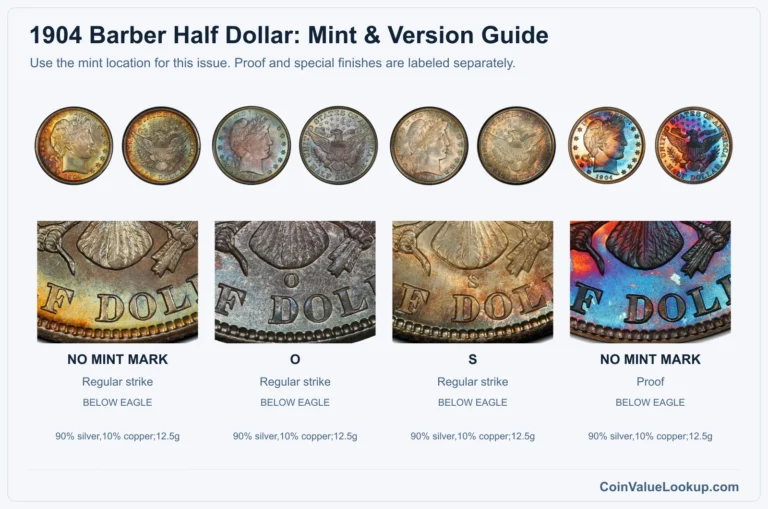
Adopted guide estimates for specific mint, finish and grade combinations range from about $2.50 to $35.00 according to USA Coin Book. Before you check a price chart, you need to identify whether your coin is a regular strike, a satin specimen, a clad proof or a silver proof.
Fast Way to Identify Your 2010 Kennedy Half Dollar
The quickest way to start is to upload clear photos of both sides of your coin. A front-and-back image lets us provide a preliminary identification of your mint, finish and general condition.
That narrows down which version branch your half dollar belongs to, so you are looking at the right value range instead of guessing.
2010 Kennedy Half Dollar Value
Upload both sides of your 2010 Kennedy Half Dollar.
Front Obverse
Upload photo
Back Reverse
Upload photo
Which 2010 Kennedy Half Dollar Versions Are Worth Money?
- 2010-S silver proof commands the highest guide value at $35.00 in PR65 because of its 90% silver content and proof finish.
- 2010-S clad proof is listed at $6.25 in PR65, far less than the silver version despite the same mintmark, so confirming the metal matters.
- Satin-finish specimens from P and D mint sets are a distinct collector branch; do not price them as regular business strikes.
- Reported mint errors such as off-center strikes and clipped planchets exist for this date and can carry premiums depending on severity and authentication.
Step 1: Identify Your 2010 Kennedy Half Dollar Mint Mark and Version
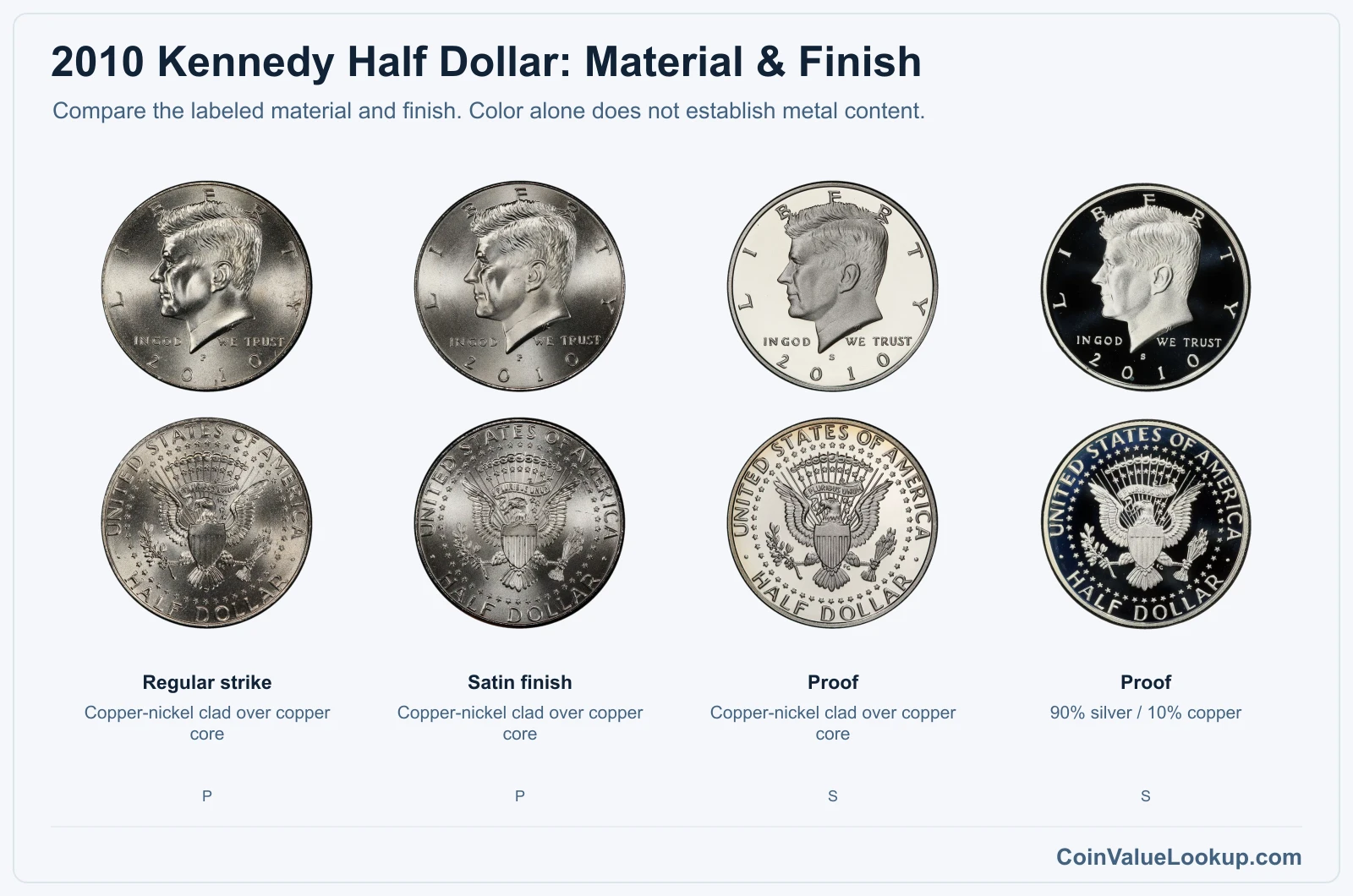
Flip your coin to the obverse and look just beneath Kennedy's portrait, above the date. That is where the mintmark lives.
A "P" means Philadelphia, "D" means Denver, and "S" means San Francisco.
Philadelphia coins minted from 1980 onward carry the P mintmark, so a 2010 without any mark would be unusual. Denver pieces always show a D.
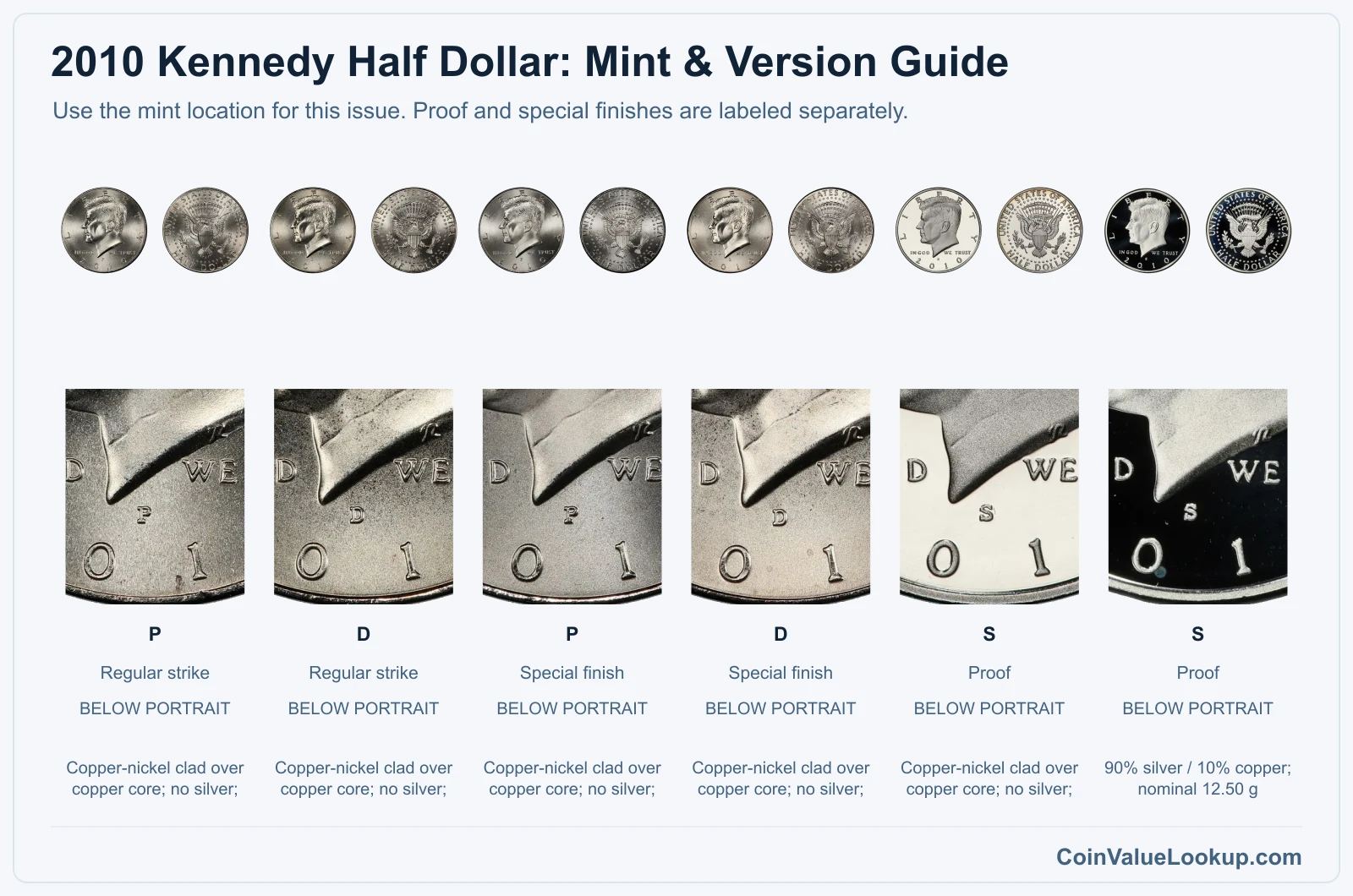
Ordinary P and D business strikes and the S clad proof are all copper-nickel clad over a copper core, weighing about 11.34 grams. The silver proof is 90% silver and 10% copper, coming in heavier at roughly 12.50 grams.
Both the clad proof and silver proof bear the S mintmark, so the letter alone does not tell you the metal. Compare the edge and weight.
Silver will not show a copper-colored stripe on the edge. Original government packaging also helps confirm which set a proof came from.
This year's P and D halves were produced primarily for collector distribution rather than everyday commerce. That means many surviving examples have original mint-set quality, but some were later spent and show wear.
Do not assume every 2010 half is uncirculated just because it looks clean.
Step 2: Check Your 2010 Kennedy Half Dollar Grade
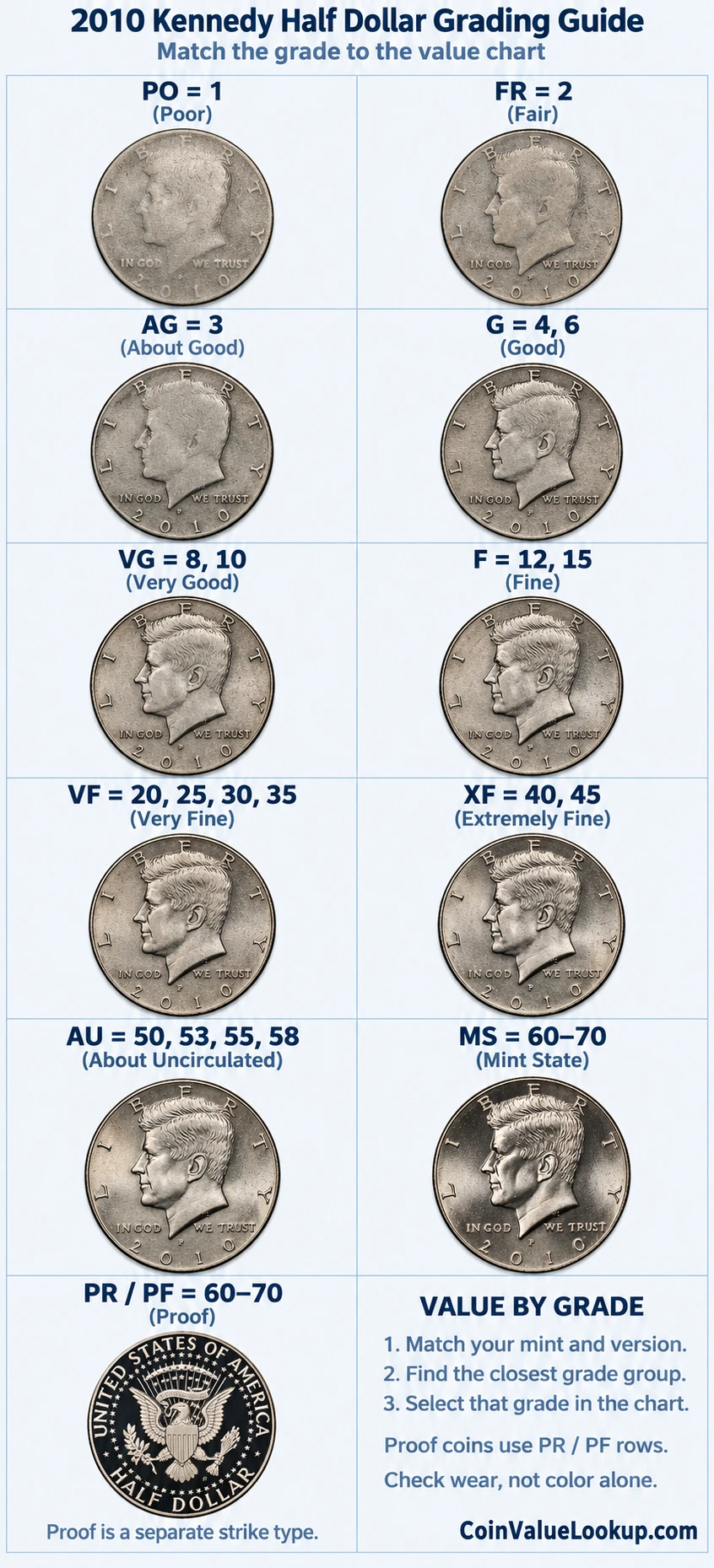
Start with Kennedy's cheek and jaw. These high points lose detail first; smooth, flat patches there signal wear.
Then check the hair above the ear on the obverse and the eagle's breast and wing tips on the reverse.
Mint State coins can still look rough. Bag marks from contact with other coins in bulk storage are not the same as circulation wear, but heavy marks will lower the grade.
Use the comparison image to see where light wear begins versus where contact marks typically land.
Proofs get graded differently. Look for hairlines from improper handling, haze across the mirror fields and contact marks on the frosted devices.
A proof with deep mirrors and clean surfaces grades higher than one with cloudy fields or obvious fingerprint residue.
Step 3: Check 2010 Kennedy Half Dollar Value by Mint and Version
2010 Kennedy Half Dollar — P — clad business
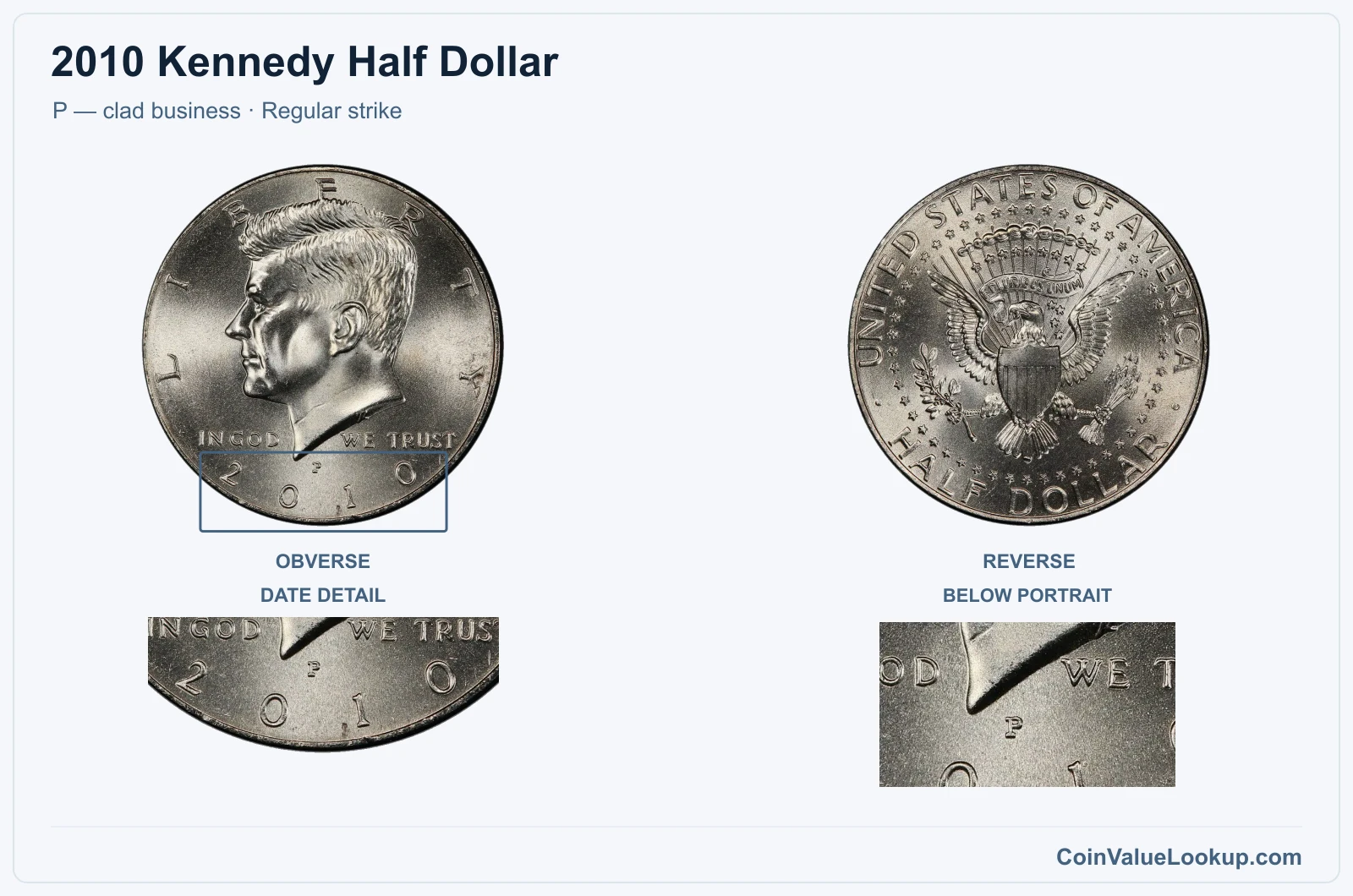
The 2010-P business-strike half dollar is copper-nickel clad over a copper core, weighing about 11.34 grams. Look for the P mintmark beneath Kennedy's portrait on the obverse.
USA Coin Book lists an MS65 guide estimate of $2.50. Worn examples are generally worth face value.
Because 2010 halves were distributed mainly through collector channels, many survive in high grade, which keeps values modest. If yours came from a roll or bag purchase and was never spent, it is likely still in original condition.
Range Grade
Price Auction Records Appraisal PO PO 1
—
Coin Identifier FR FR 2
—
Coin Identifier AG AG 3
—
Coin Identifier G G 4
—
Coin Identifier
G 6
—
Coin Identifier VG VG 8
—
Coin Identifier
VG 10
—
Coin Identifier F F 12
—
Coin Identifier
F 15
—
Coin Identifier VF VF 20
—
Coin Identifier
VF 25
—
Coin Identifier
VF 30
—
Coin Identifier
VF 35
—
Coin Identifier XF XF 40
—
Coin Identifier
XF 45
—
Coin Identifier AU AU 50
—
Coin Identifier
AU 53
—
Coin Identifier
AU 55
—
Coin Identifier
AU 58
—
Coin Identifier MS MS 60
—
Coin Identifier
MS 61
—
Coin Identifier
MS 62
—
Coin Identifier
MS 63
—
Coin Identifier
MS 64
—
Coin Identifier
MS 65
—
Coin Identifier
MS 66
—
Coin Identifier
MS 67
Coin Identifier
MS 68
Coin Identifier
MS 69
—
—
—
MS 70
—
—
—
2010 Kennedy Half Dollar — P — clad satin specimen
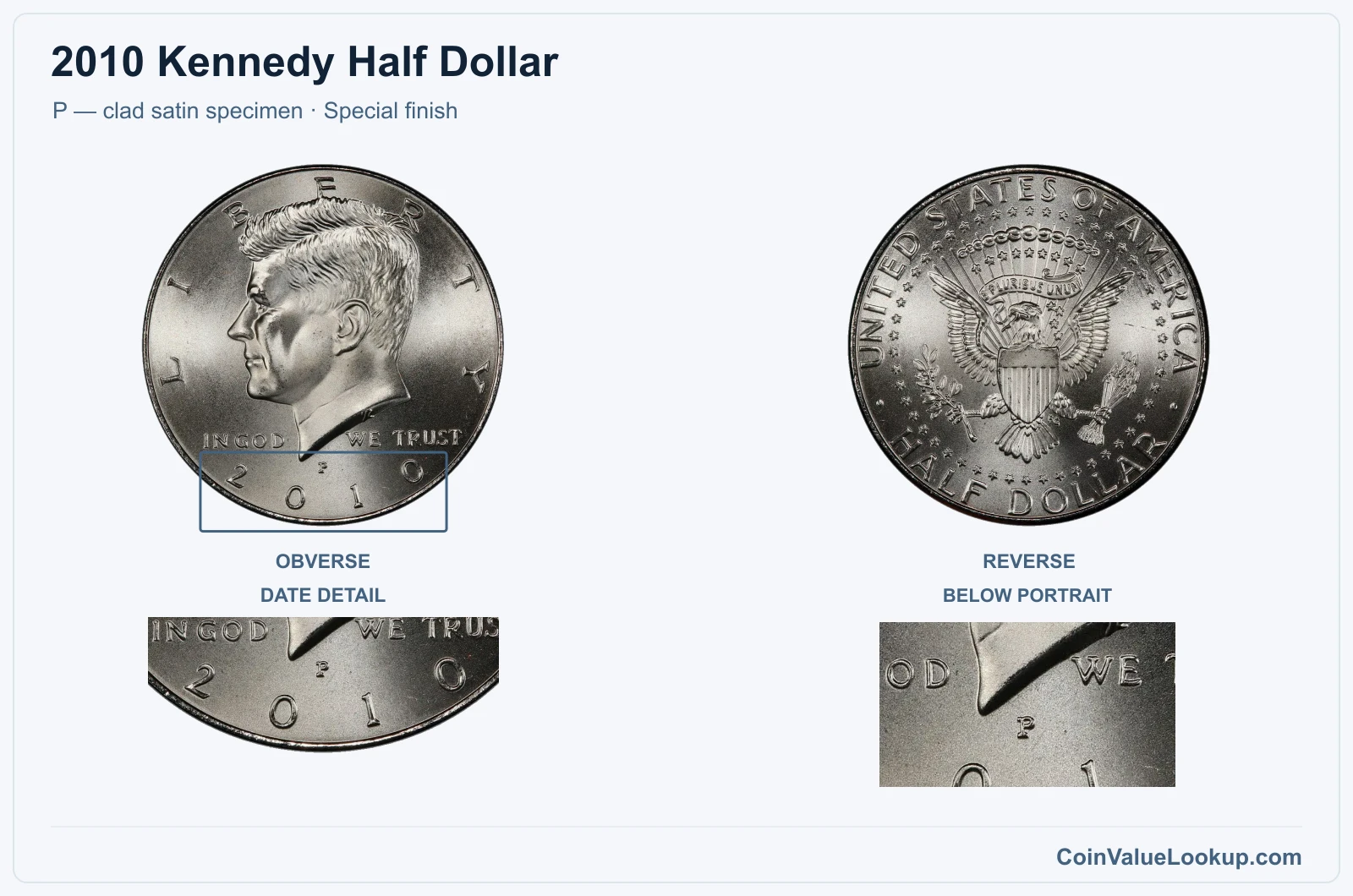
The 2010-P satin specimen was included in that year's U.S. Mint uncirculated set. Same copper-nickel clad composition and weight as the business strike, but the surface has a distinctive soft, matte-like texture created intentionally during production.
Do not confuse a dull or toned coin with a genuine satin finish. The texture is uniform across the entire surface, not patchy.
If your coin did not come from an official mint set, be cautious before calling it satin.
No supported guide price is available for this branch. Value depends on authenticated identity and condition, so individual assessment by a grading service is the practical route for a meaningful number.
Range Grade
Price Auction Records Appraisal SP SP 1
—
Coin Identifier
SP 2
—
Coin Identifier
SP 3
—
Coin Identifier
SP 4
—
Coin Identifier
SP 6
—
Coin Identifier
SP 8
—
Coin Identifier
SP 10
—
Coin Identifier
SP 12
—
Coin Identifier
SP 15
—
Coin Identifier
SP 20
—
Coin Identifier
SP 25
—
Coin Identifier
SP 30
—
Coin Identifier
SP 35
—
Coin Identifier
SP 40
—
Coin Identifier
SP 45
—
Coin Identifier
SP 50
—
Coin Identifier
SP 53
—
Coin Identifier
SP 55
—
Coin Identifier
SP 58
—
Coin Identifier
SP 60
—
Coin Identifier
SP 61
—
Coin Identifier
SP 62
—
Coin Identifier
SP 63
—
Coin Identifier
SP 64
—
Coin Identifier
SP 65
—
Coin Identifier
SP 66
—
Coin Identifier
SP 67
—
Coin Identifier
SP 68
Coin Identifier
SP 69
Coin Identifier
SP 70
—
—
—
2010 Kennedy Half Dollar — D — clad business
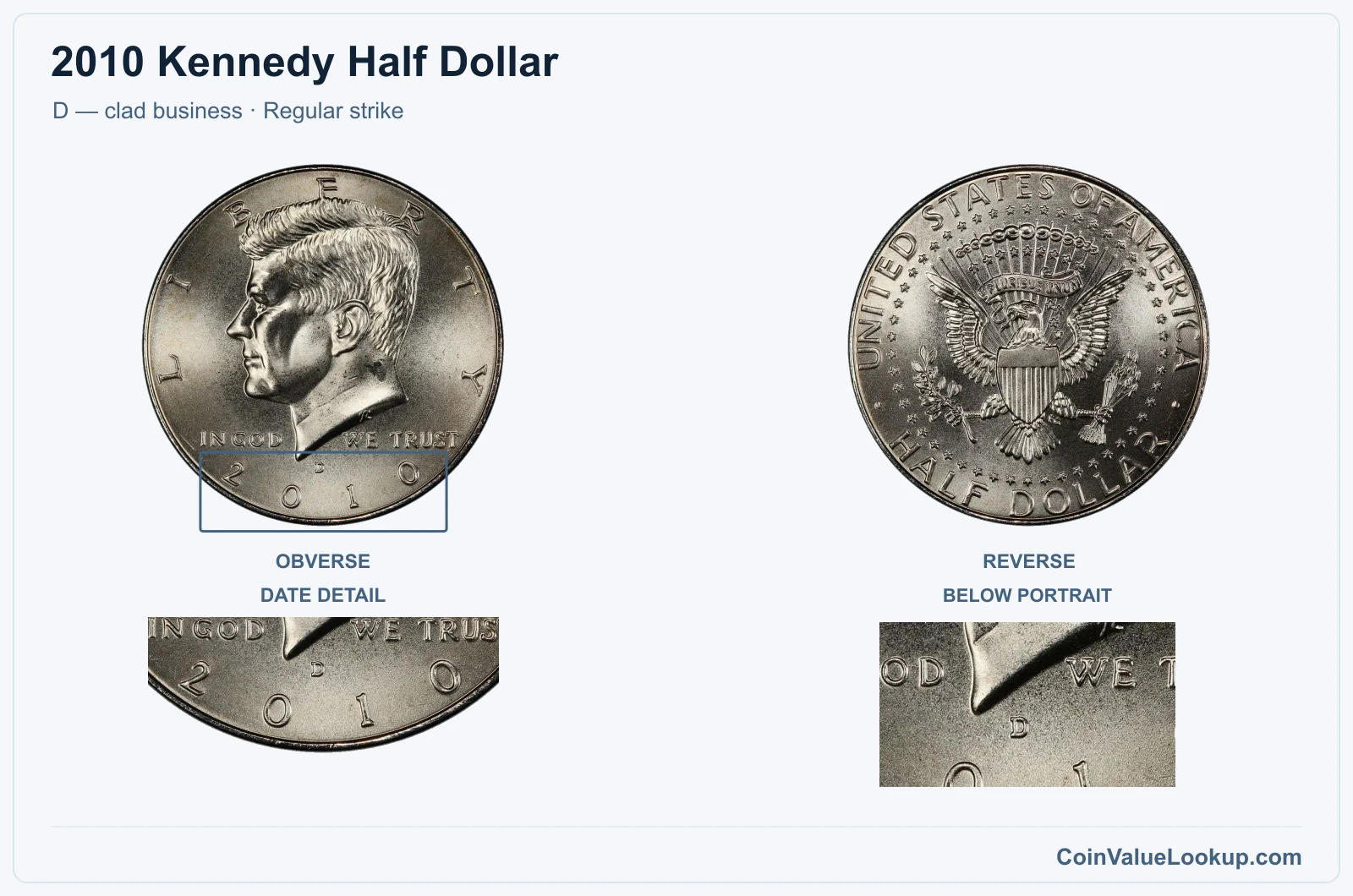
The 2010-D business strike carries the D mintmark beneath Kennedy's portrait. Composition is copper-nickel clad over a copper core at roughly 11.34 grams.
USA Coin Book places the MS65 guide estimate at $2.50. Like the Philadelphia issue, these were aimed at collectors rather than bank tellers, so circulated examples exist but are not the norm.
A worn 2010-D is a face-value coin.
Coin Value Lookup is a good starting point if you are sorting through a pile of Kennedy halves from multiple years. You can look up each date and mint to see which ones are worth pulling aside.
Range Grade
Price Auction Records Appraisal PO PO 1
—
Coin Identifier FR FR 2
—
Coin Identifier AG AG 3
—
Coin Identifier G G 4
—
Coin Identifier
G 6
—
Coin Identifier VG VG 8
—
Coin Identifier
VG 10
—
Coin Identifier F F 12
—
Coin Identifier
F 15
—
Coin Identifier VF VF 20
—
Coin Identifier
VF 25
—
Coin Identifier
VF 30
—
Coin Identifier
VF 35
—
Coin Identifier XF XF 40
—
Coin Identifier
XF 45
—
Coin Identifier AU AU 50
—
Coin Identifier
AU 53
—
Coin Identifier
AU 55
—
Coin Identifier
AU 58
—
Coin Identifier MS MS 60
—
Coin Identifier
MS 61
—
Coin Identifier
MS 62
—
Coin Identifier
MS 63
—
Coin Identifier
MS 64
—
Coin Identifier
MS 65
—
Coin Identifier
MS 66
—
Coin Identifier
MS 67
Coin Identifier
MS 68
Coin Identifier
MS 69
—
—
—
MS 70
—
—
—
2010 Kennedy Half Dollar — D — clad satin specimen
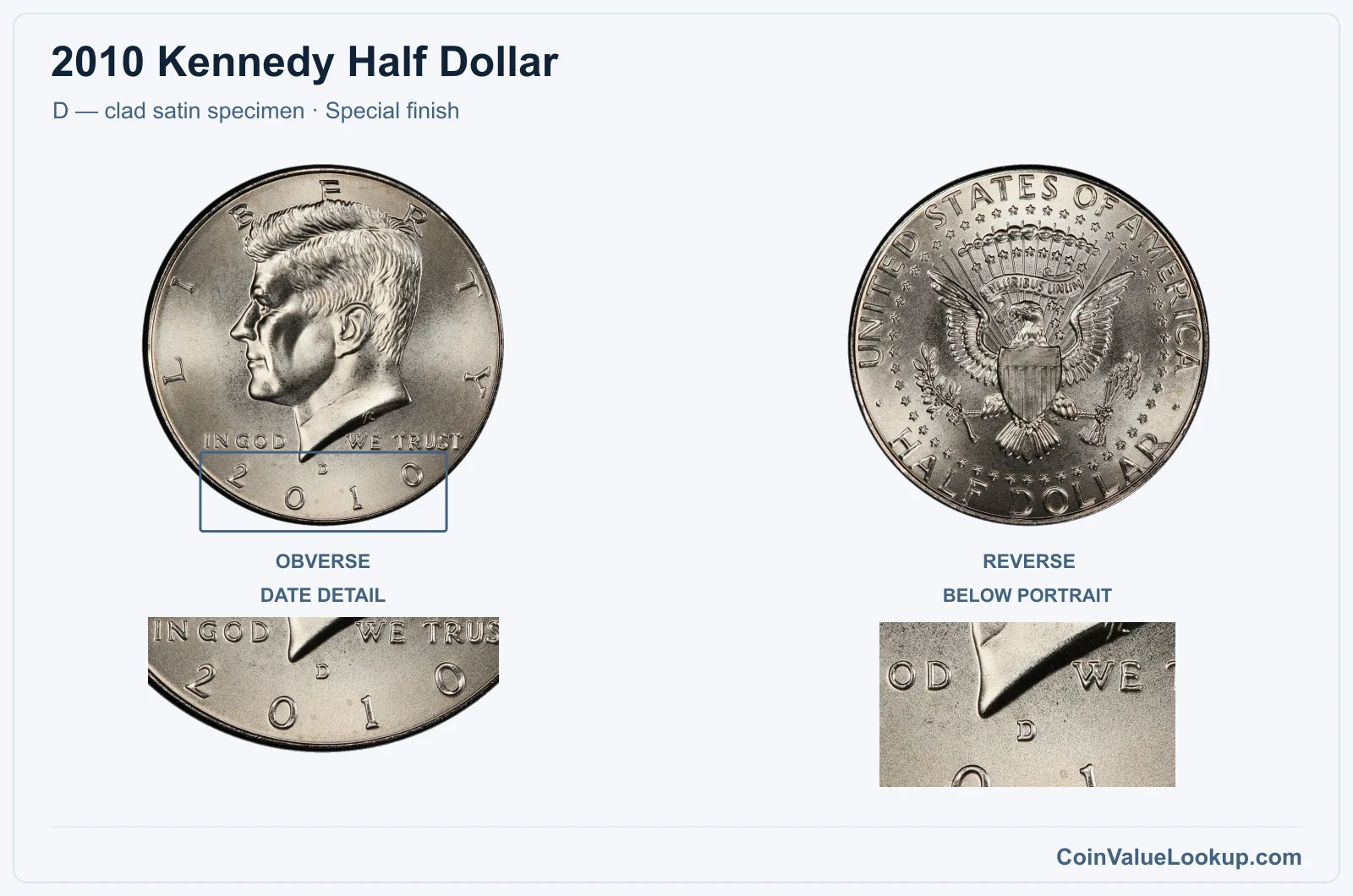
The 2010-D satin specimen came packaged in the official U.S. Mint uncirculated coin set. It shares the same copper-nickel clad composition and 11.34-gram weight as the regular D business strike, but its surface finish is intentionally different: a uniform soft texture across both sides.
A coin that merely looks dull from wear or environmental damage is not a satin specimen. Confirming the finish usually means tracing the coin back to its mint-set packaging or having it authenticated.
No guide price is adopted for this version. Determining value requires authenticated identification and an assessment of overall condition and any errors present.
Range Grade
Price Auction Records Appraisal SP SP 1
—
Coin Identifier
SP 2
—
Coin Identifier
SP 3
—
Coin Identifier
SP 4
—
Coin Identifier
SP 6
—
Coin Identifier
SP 8
—
Coin Identifier
SP 10
—
Coin Identifier
SP 12
—
Coin Identifier
SP 15
—
Coin Identifier
SP 20
—
Coin Identifier
SP 25
—
Coin Identifier
SP 30
—
Coin Identifier
SP 35
—
Coin Identifier
SP 40
—
Coin Identifier
SP 45
—
Coin Identifier
SP 50
—
Coin Identifier
SP 53
—
Coin Identifier
SP 55
—
Coin Identifier
SP 58
—
Coin Identifier
SP 60
—
Coin Identifier
SP 61
—
Coin Identifier
SP 62
—
Coin Identifier
SP 63
—
Coin Identifier
SP 64
—
Coin Identifier
SP 65
—
Coin Identifier
SP 66
—
Coin Identifier
SP 67
—
Coin Identifier
SP 68
Coin Identifier
SP 69
Coin Identifier
SP 70
—
—
—
2010 Kennedy Half Dollar — S — clad proof
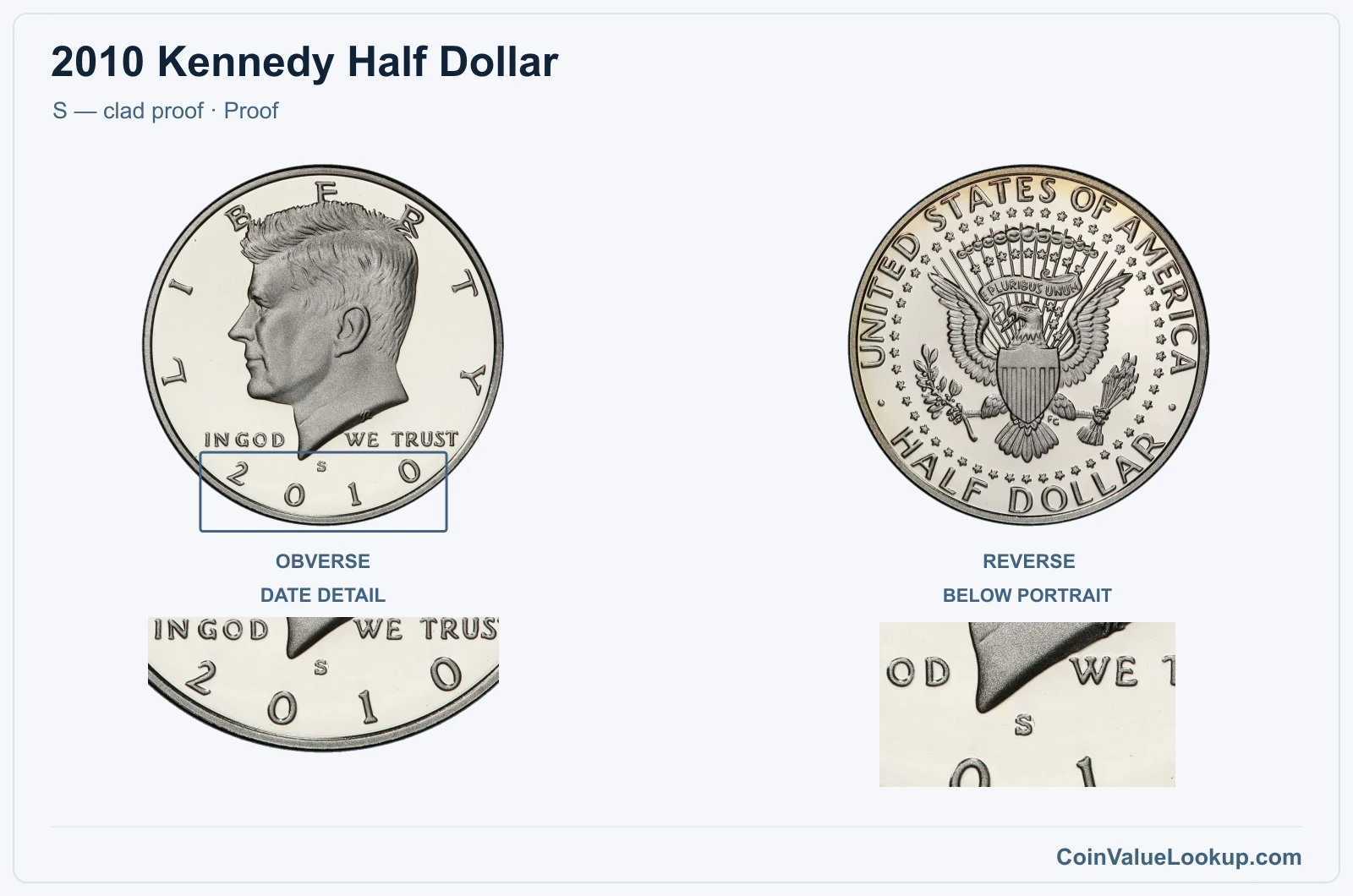
The 2010-S clad proof was struck at the San Francisco Mint and sold in proof sets. Despite the S mintmark, this version contains no silver.
It is the same copper-nickel clad composition as the P and D business strikes.
USA Coin Book lists a PR65 guide estimate of $6.25. Look for mirror-like fields and frosted raised devices.
Hairlines from handling and haze from improper storage will reduce the grade, so check your proof under good lighting at an angle. If the fields look more satin than reflective, you may actually have a business strike with an S mintmark from a different era or a misidentified coin.
Range Grade
Price Auction Records Appraisal PR PR 1
—
Coin Identifier
PR 2
—
Coin Identifier
PR 3
—
Coin Identifier
PR 4
—
Coin Identifier
PR 6
—
Coin Identifier
PR 8
—
Coin Identifier
PR 10
—
Coin Identifier
PR 12
—
Coin Identifier
PR 15
—
Coin Identifier
PR 20
—
Coin Identifier
PR 25
—
Coin Identifier
PR 30
—
Coin Identifier
PR 35
—
Coin Identifier
PR 40
—
Coin Identifier
PR 45
—
Coin Identifier
PR 50
—
Coin Identifier
PR 53
—
Coin Identifier
PR 55
—
Coin Identifier
PR 58
—
Coin Identifier
PR 60
—
Coin Identifier
PR 61
—
Coin Identifier
PR 62
—
Coin Identifier
PR 63
—
Coin Identifier
PR 64
—
Coin Identifier
PR 65
—
Coin Identifier
PR 66
—
Coin Identifier
PR 67
—
Coin Identifier
PR 68
—
Coin Identifier
PR 69
Coin Identifier
PR 70
Coin Identifier
2010 Kennedy Half Dollar — S — silver proof
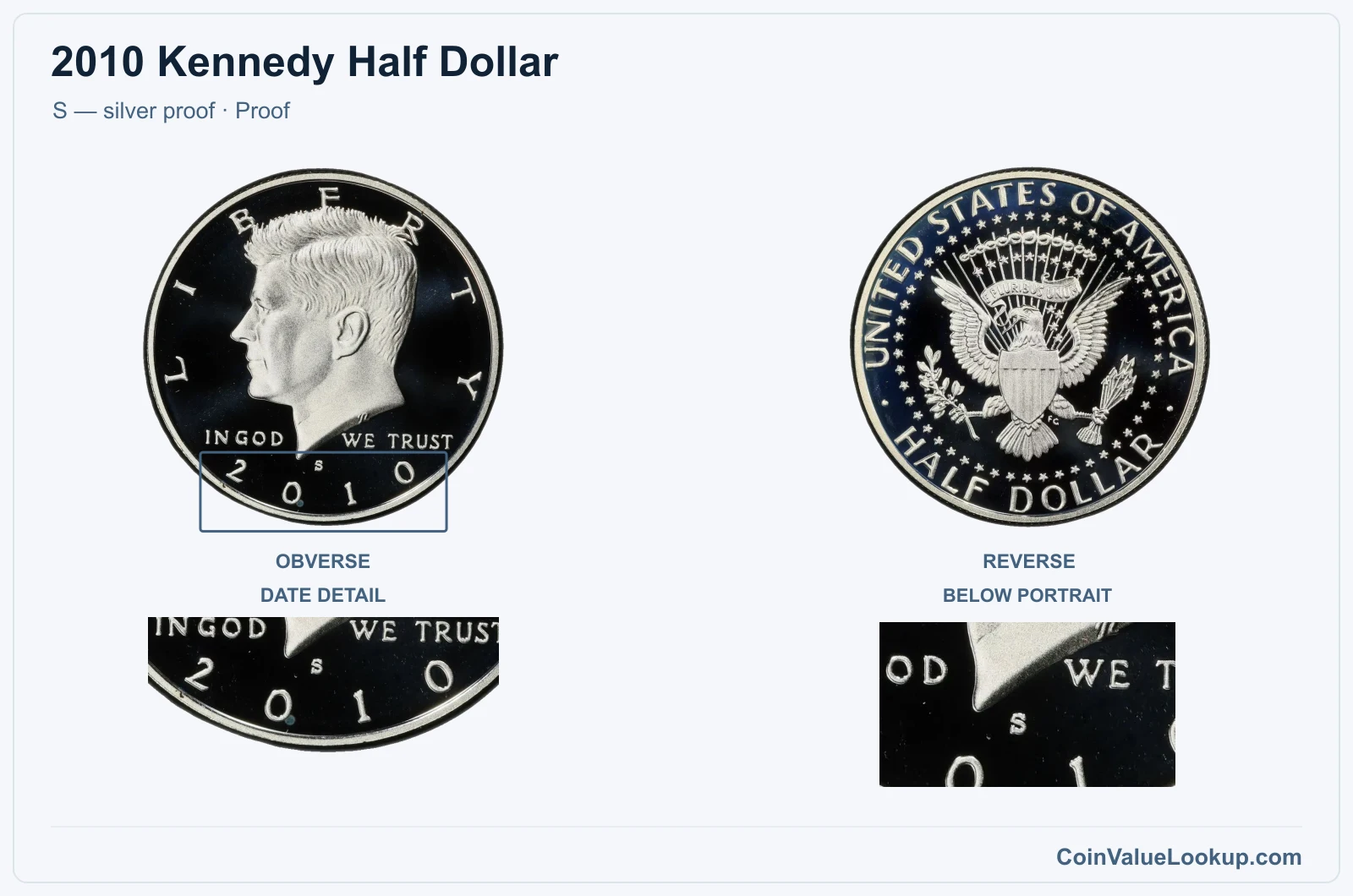
This is the one collectors pay attention to. The 2010-S silver proof is struck in 90% silver and 10% copper, weighing approximately 12.50 grams, noticeably heavier than the 11.34-gram clad versions.
USA Coin Book places the PR65 guide estimate at $35.00. That makes it the highest-valued standard branch for this date.
The silver content alone provides a floor, and the proof finish adds collector appeal on top.
Since both the clad proof and silver proof carry an S mintmark, you cannot rely on the letter to tell them apart. Check the edge for a copper stripe: clad coins show one, silver coins do not.
A precise weight on a digital scale settles most debates quickly. Note that Kennedy silver proof fineness shifted to .999 starting in 2019, but the 2010 issue is the traditional 90/10 alloy.
Range Grade
Price Auction Records Appraisal PR PR 1
—
Coin Identifier
PR 2
—
Coin Identifier
PR 3
—
Coin Identifier
PR 4
—
Coin Identifier
PR 6
—
Coin Identifier
PR 8
—
Coin Identifier
PR 10
—
Coin Identifier
PR 12
—
Coin Identifier
PR 15
—
Coin Identifier
PR 20
—
Coin Identifier
PR 25
—
Coin Identifier
PR 30
—
Coin Identifier
PR 35
—
Coin Identifier
PR 40
—
Coin Identifier
PR 45
—
Coin Identifier
PR 50
—
Coin Identifier
PR 53
—
Coin Identifier
PR 55
—
Coin Identifier
PR 58
—
Coin Identifier
PR 60
—
Coin Identifier
PR 61
—
Coin Identifier
PR 62
—
Coin Identifier
PR 63
—
Coin Identifier
PR 64
—
Coin Identifier
PR 65
—
Coin Identifier
PR 66
—
Coin Identifier
PR 67
—
Coin Identifier
PR 68
—
Coin Identifier
PR 69
Coin Identifier
PR 70
Coin Identifier
2010 Kennedy Half Dollar Error List
1. 2010 Kennedy Half Dollar — Missing FG Initials
On a normal 2010 Kennedy half, the initials FG appear on the reverse near the eagle's tail feathers. These stand for the reverse designer Frank Gasparro.
On a missing-FG error, those initials are absent or extremely faint due to die polishing that smoothed away the shallow letters before striking.
Look carefully with magnification. The key is whether the surrounding design detail is intact while the initials are gone.
If the entire lower-right area of the reverse is worn flat, that is just circulation wear, not an error. Similarly, grease filling or deliberate removal after minting can mimic the look.
No specific price is adopted for this error. Value depends on how clearly the missing initials can be confirmed, the coin's overall condition and whether the specific mint and finish match reported examples.
2. 2010 Kennedy Half Dollar — Off-Center Strike
An off-center strike happens when the planchet is not seated properly between the dies. The result is a design that is shifted to one side, leaving an unstruck crescent of blank metal on the opposite edge.
The degree of off-center shift matters enormously. A 5% shift is minor; a 50% shift with the date still visible is dramatic and far more desirable.
Look for the crescent of blank planchet as the primary diagnostic. The design will appear complete on the struck portion but simply displaced.
Do not confuse this with a clipped planchet, a misaligned die that only affects one side, or post-mint damage such as a coin that was pressed or bent. No specific price is available for this error; value depends on the percentage of displacement, date visibility and overall condition.
3. 2010 Kennedy Half Dollar — Clipped Planchet
A clipped planchet error occurs when the coin blank is punched incorrectly from the metal strip, taking a bite out of what should be a full circle. The missing portion can be curved, straight or irregular in shape.
Look for a section of the rim and edge that is simply absent, with the remaining metal showing a natural, unstruck edge rather than a filed or cut surface. Opposite the clip, you may notice slight design weakness where metal flow was disrupted during striking.
That weakness pattern helps confirm a genuine clip versus post-mint damage.
Filed edges, corrosion and deliberate cuts can look similar at a glance. Check that the missing area has the right geometry and that the coin's weight is slightly below normal.
No adopted price is available; value depends on clip size, shape and the coin's condition.
4. 2010 Kennedy Half Dollar — Double / Multiple Strike
A double-strike error means the coin was struck more than once by the dies, with the planchet shifting or rotating between impacts. The result is two separate, overlapping impressions of the design, often with one clearly offset from the other.
The visual diagnostic is unmistakable when severe: you can see two distinct outlines of Kennedy's portrait or two sets of lettering at different angles. Mild cases show a secondary shadow that is still more dramatic than a doubled die, which involves a single impression from a die that was itself engraved with a slight double image.
Post-mint alterations, such as pressing a coin against another object, can leave false impressions. Compare both sides to confirm the error is consistent.
No guide price is adopted; value depends on how separated the impressions are, their rotation and the coin's overall condition.
5. 2010 Kennedy Half Dollar — Struck-Through Error
A struck-through error occurs when foreign material sits between the die and the planchet during striking. The obstruction blocks part of the design, leaving a depression, an impression of the object or an area of missing detail.
Common culprits include grease, cloth fibers and metal fragments. A grease-filled die produces a smooth, blank patch where the design should be, while a retained fragment may leave a raised or textured impression.
Each type looks different, so examine the affected area closely.
Ordinary wear, cleaning scratches and weak strikes from a tired die can mimic struck-through errors. The difference is that a struck-through typically has sharp boundaries and affects a localized area while the rest of the design remains normal.
No price is adopted for this error; value hinges on the size of the affected area, what caused the obstruction and the coin's condition.