1883 Liberty Nickel Coin Value: How Much Is It Worth?
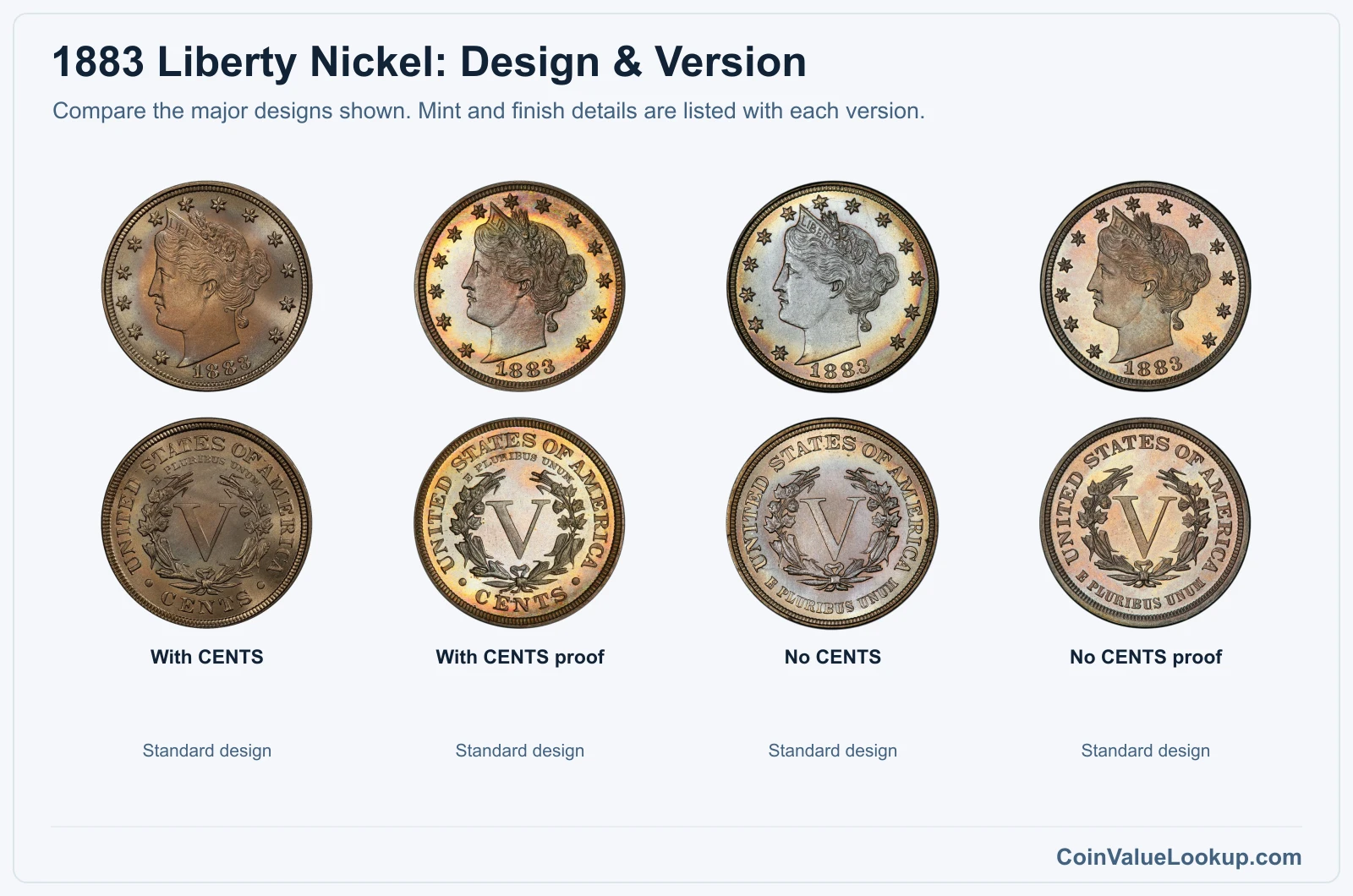
An 1883 Liberty Nickel can be worth anywhere from about $8.64 in well-worn condition for the No CENTS variety up to $376 at PR63 for a No CENTS proof, according to a USA Coin Book guide estimate. Two distinct reverse designs were struck this year, and each exists in both business-strike and proof form, so proper identification matters before you check values.
Fast Way to Identify Your 1883 Liberty Nickel
Snap a clear photo of the front and back of your coin and upload both images. Our identifier can give you a preliminary read on which 1883 Liberty Nickel variety you have — No CENTS or With CENTS — and whether it appears to be a circulation strike or proof.
That initial step saves time before deeper research.
1883 Liberty Nickel Value
Upload both sides of your 1883 Liberty Nickel.
Front Obverse
Upload photo
Back Reverse
Upload photo
Which 1883 Liberty Nickel Versions Are Worth Money?
- Two design types exist: No CENTS and With CENTS. Identifying which reverse your coin has is the first step to accurate pricing.
- With CENTS circulation strikes range from about $25 at G4 to $249 at MS63 per USA Coin Book, making them the higher-value business strike of the two types.
- With CENTS proofs carry a guide value around $344 at PR63, while No CENTS proofs come in near $376 at PR63 — both worth verifying.
- High-grade original surfaces on either type command premiums over worn examples; luster and eye appeal matter.
- Error categories such as repunched dates and clipped planchets have been reported for 1883 nickels and are worth inspecting for, though condition and visibility determine any added value.
Step 1: Identify Your 1883 Liberty Nickel Mint Mark and Version
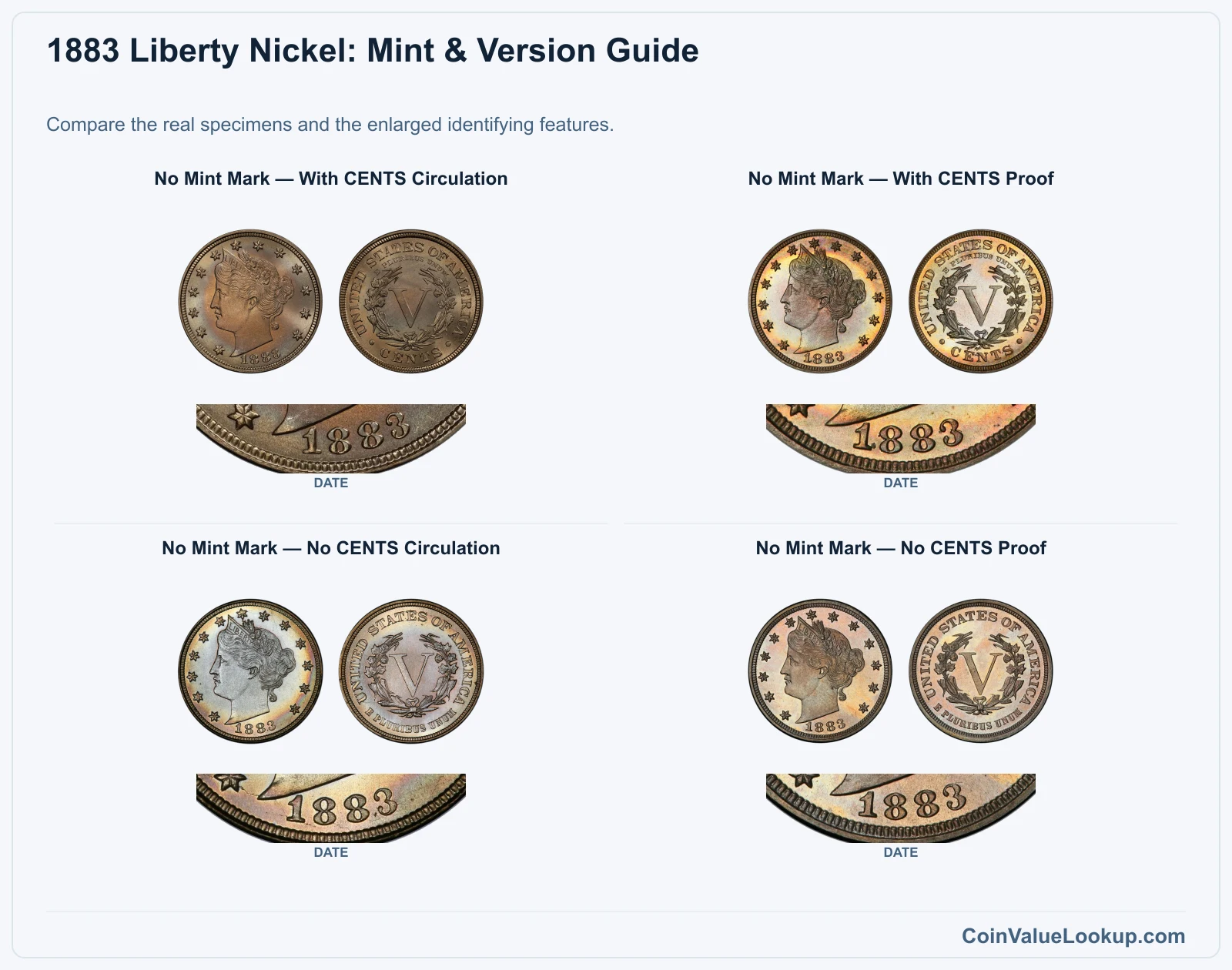
Every 1883 Liberty Nickel was struck at Philadelphia. There is no mintmark, so do not look for a D or S — none exist for this date.
The coin is 75% copper and 25% nickel, weighs about 5 grams, measures 21.2 mm, and has a plain edge. No regular silver version was made.
The critical question is what the reverse says. Early 1883 production carries only the Roman numeral V with no denomination spelled out — that is the No CENTS type.
Mid-year the Mint added CENTS below the V, creating the With CENTS type. Both are intentional design changes, not errors.
If your coin is gold-plated, that is not a Mint product. Gold-plated examples are so-called "racketeer nickels," altered after leaving the Mint to pass as five-dollar gold pieces.
They are collectible curiosities, but the plating is not original to production.
Step 2: Check Your 1883 Liberty Nickel Grade
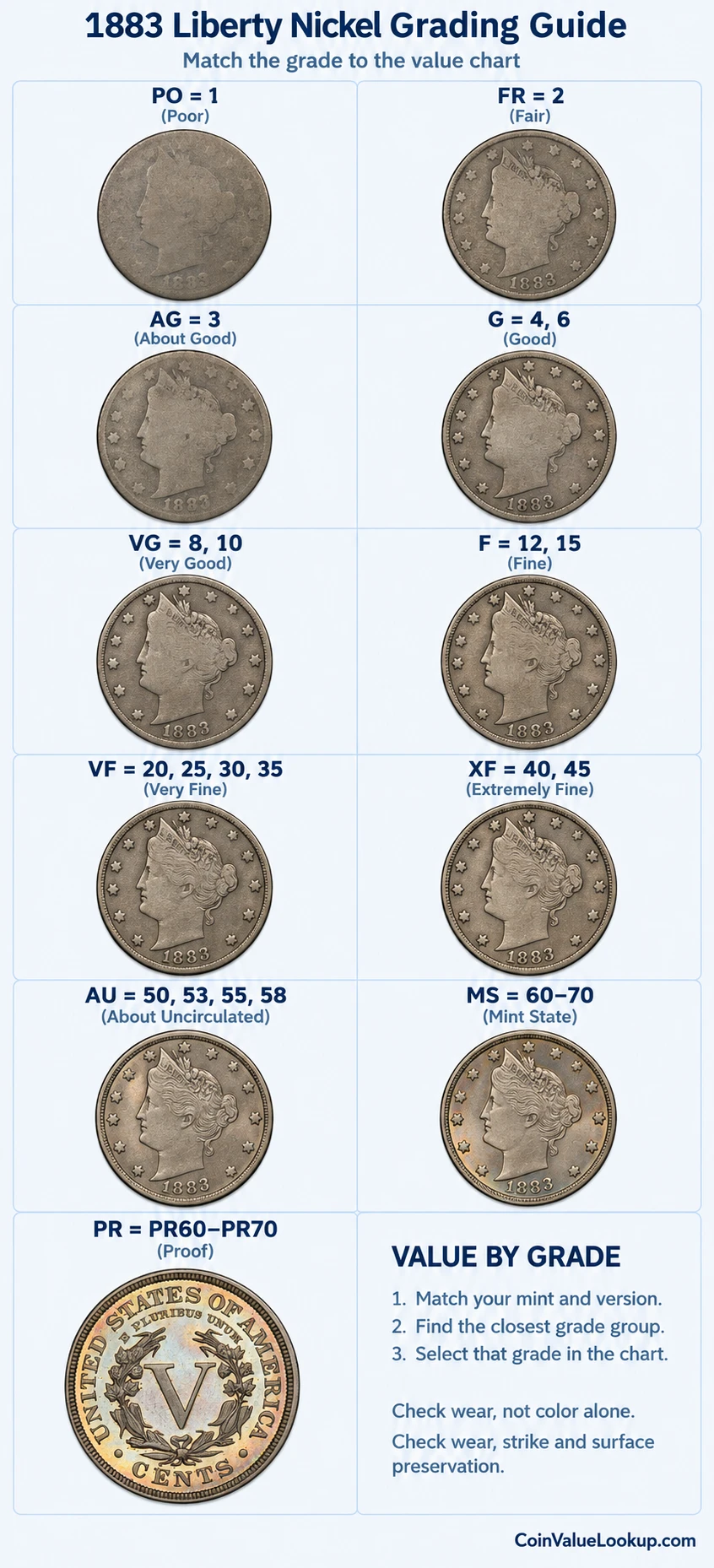
Start with the obverse. The word LIBERTY on the coronet and the high curls above the forehead wear first on circulated pieces.
Check the cheek — it should retain roundness and fine detail in higher grades. On the reverse, the corn ears and wreath leaves lose definition early.
Weak details alone do not prove a coin circulated. Strike weakness at the hair and corn ears is common on Liberty Nickels, so compare fields and luster before assuming wear.
A coin with full luster and no contact marks but mushy hair detail may simply be softly struck. Use the comparison image to see how genuine wear differs from a weak strike.
Proof is a way of manufacturing, not a grade above Mint State. Proof coins show mirrored fields and sharp rims when well preserved.
Inspect for hairlines from cleaning and rim nicks — those lower the proof grade but do not change the coin's identity as a proof.
Step 3: Check 1883 Liberty Nickel Value by Mint and Version
1883 Liberty Nickel — No Mint Mark — With CENTS Circulation
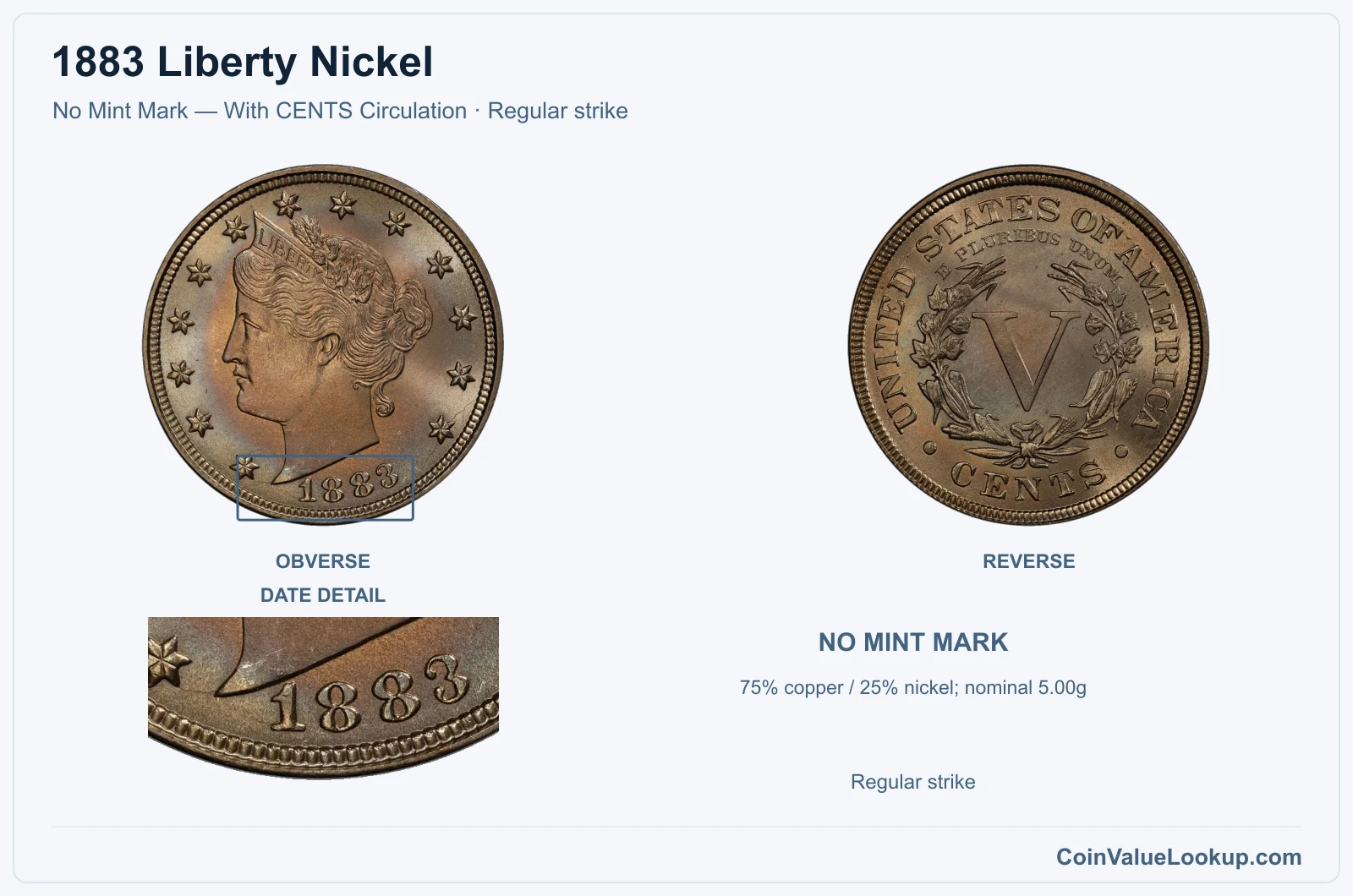
The With CENTS business strike is the version most people picture when they think of the 1883 Liberty Nickel's "corrected" design. Look at the reverse: below the large Roman numeral V you should see the word CENTS in small letters.
The obverse carries no mintmark — all were struck at Philadelphia.
USA Coin Book places this version at roughly $25 in G4 and about $249 in MS63. Those are guide estimates from a single snapshot, not guaranteed sale prices.
Circulated examples are common; high-grade survivors with strong luster and clean fields are where the real value sits.
Range Grade
Price Auction Records Appraisal PO PO 1
—
Coin Identifier FR FR 2
—
Coin Identifier AG AG 3
—
Coin Identifier G G 4
—
Coin Identifier
G 6
—
Coin Identifier VG VG 8
—
Coin Identifier
VG 10
—
Coin Identifier F F 12
—
Coin Identifier
F 15
Coin Identifier VF VF 20
—
Coin Identifier
VF 25
—
Coin Identifier
VF 30
—
Coin Identifier
VF 35
Coin Identifier XF XF 40
Coin Identifier
XF 45
Coin Identifier AU AU 50
Coin Identifier
AU 53
Coin Identifier
AU 55
Coin Identifier
AU 58
Coin Identifier MS MS 60
Coin Identifier
MS 61
Coin Identifier
MS 62
Coin Identifier
MS 63
Coin Identifier
MS 64
Coin Identifier
MS 65
Coin Identifier
MS 66
Coin Identifier
MS 67
Coin Identifier
MS 68
—
—
—
MS 69
—
—
—
MS 70
—
—
—
1883 Liberty Nickel — No Mint Mark — With CENTS Proof
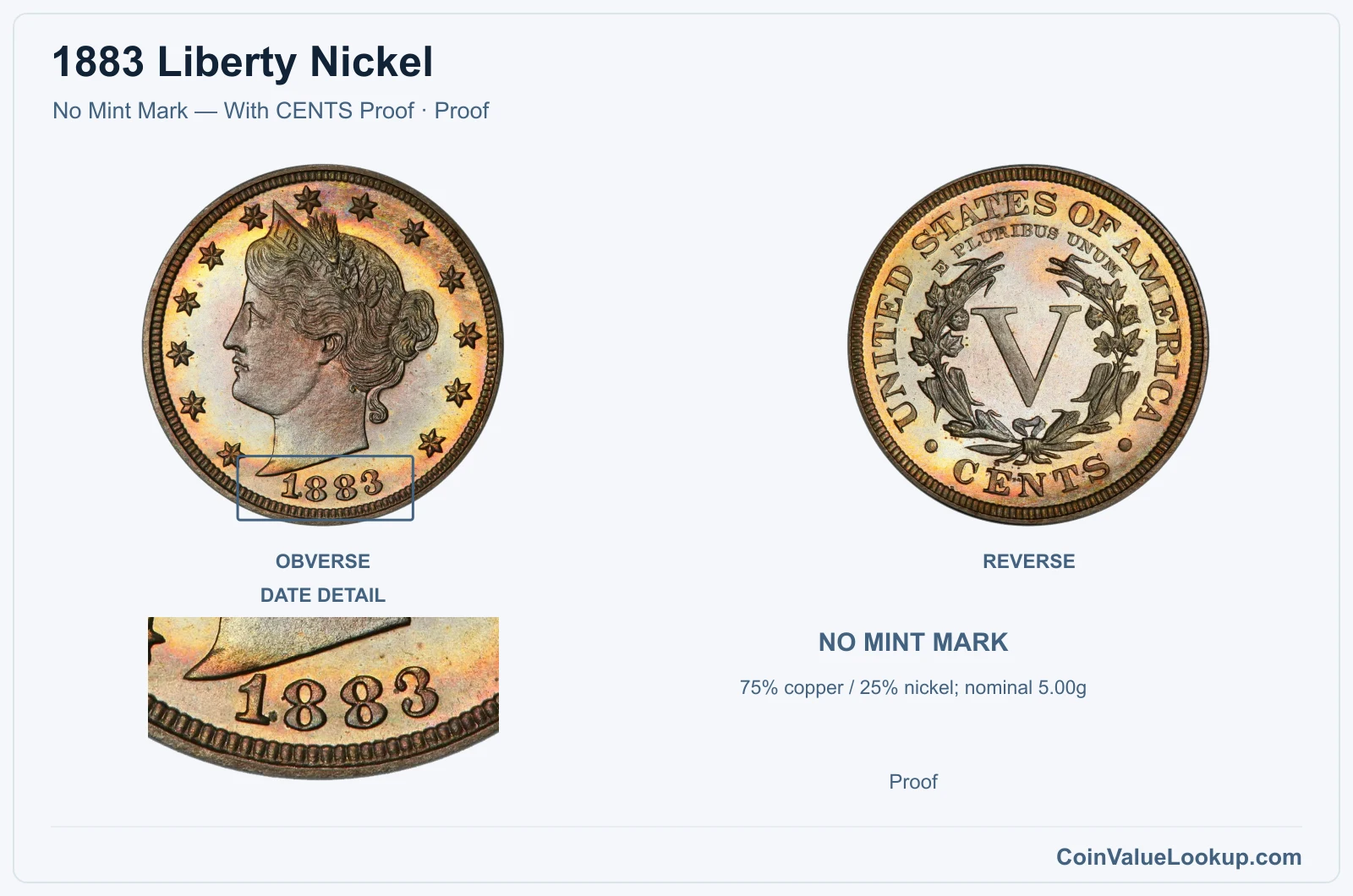
Philadelphia struck proof versions of the With CENTS design in 1883. These show deeply mirrored fields, crisp rims, and full design detail when properly preserved.
A proof is identified by its surface quality and manufacturing method, not simply by being "nicer" than a business strike.
USA Coin Book lists the With CENTS proof at about $344 in PR63. To confirm you have a proof, examine the fields under good light for reflective mirror surfaces and compare the rim sharpness against a known business strike.
Hairlines from cleaning or improper storage will lower the grade. Show both faces and field detail if submitting for identification.
Range Grade
Price Auction Records Appraisal PR PR 1
—
Coin Identifier
PR 2
—
Coin Identifier
PR 3
—
Coin Identifier
PR 4
—
Coin Identifier
PR 6
—
Coin Identifier
PR 8
—
Coin Identifier
PR 10
—
Coin Identifier
PR 12
—
Coin Identifier
PR 15
—
Coin Identifier
PR 20
—
Coin Identifier
PR 25
—
Coin Identifier
PR 30
—
Coin Identifier
PR 35
—
Coin Identifier
PR 40
—
Coin Identifier
PR 45
—
Coin Identifier
PR 50
—
Coin Identifier
PR 53
—
Coin Identifier
PR 55
—
Coin Identifier
PR 58
—
Coin Identifier
PR 60
—
Coin Identifier
PR 61
Coin Identifier
PR 62
Coin Identifier
PR 63
Coin Identifier
PR 64
Coin Identifier
PR 65
Coin Identifier
PR 66
Coin Identifier
PR 67
Coin Identifier
PR 68
Coin Identifier
PR 69
—
—
—
PR 70
—
—
—
1883 Liberty Nickel — No Mint Mark — No CENTS Circulation
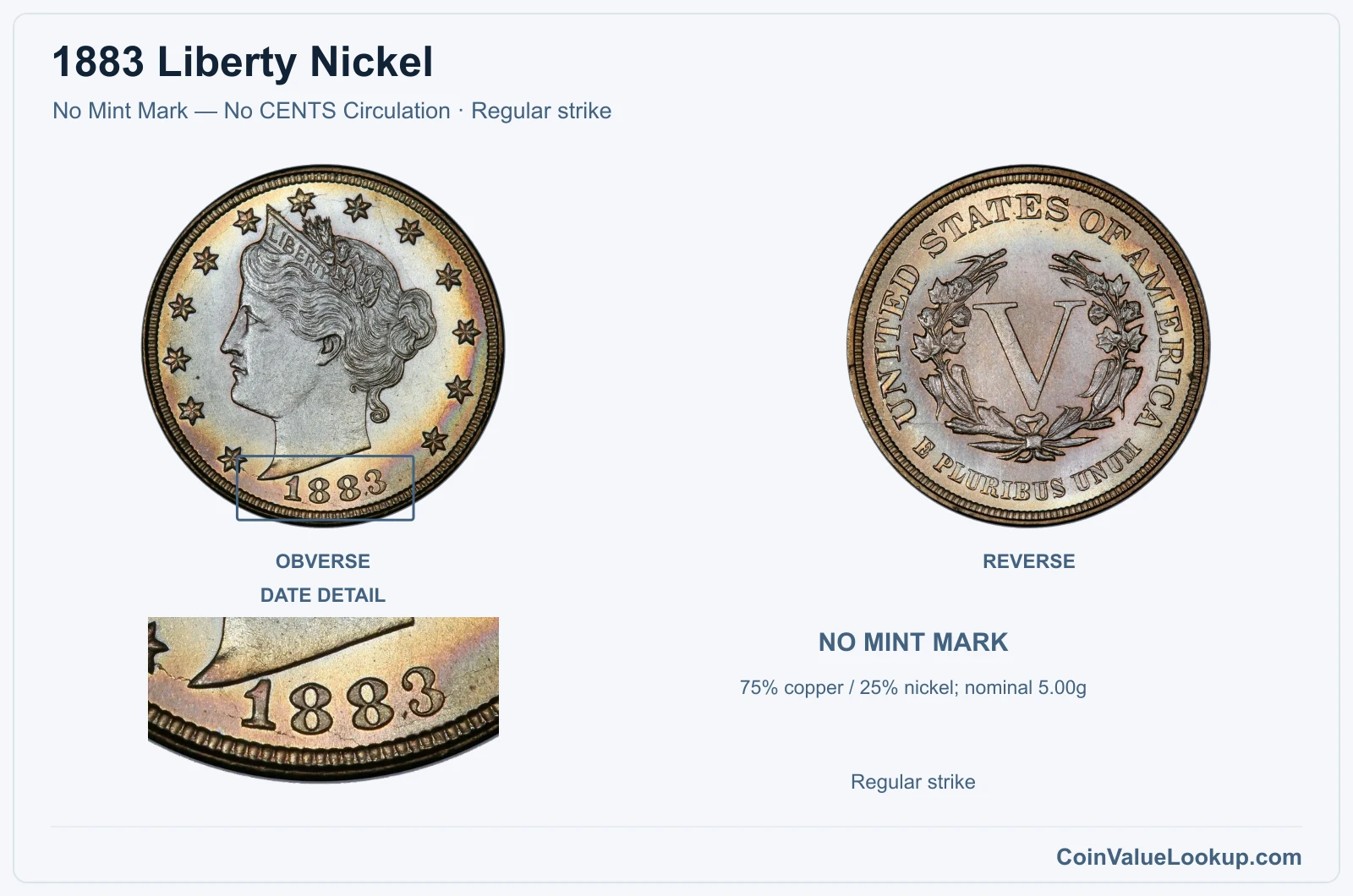
This is the coin that caused all the fuss. Early 1883 nickels carried only a large Roman numeral V on the reverse with no mention of "cents" anywhere.
Because the coin was similar in size to the five-dollar gold piece, some enterprising folks gold-plated them and tried to pass them off at face value of five dollars — the birth of the racketeer nickel legend.
The No CENTS type is an intentional first design, not an error. USA Coin Book estimates about $8.64 at G4 and roughly $61 at MS63.
These were produced in large numbers before the design was revised, so circulated examples turn up regularly. Mint-state coins with original luster are less common and carry the premium.
Coin Value Lookup is a good starting point if you want to compare this variety against other Liberty Nickel dates and denominations. Quick lookups can help you figure out what else in your collection deserves a closer look.
Range Grade
Price Auction Records Appraisal PO PO 1
—
Coin Identifier FR FR 2
—
Coin Identifier AG AG 3
—
Coin Identifier G G 4
—
Coin Identifier
G 6
—
Coin Identifier VG VG 8
—
Coin Identifier
VG 10
—
Coin Identifier F F 12
—
Coin Identifier
F 15
Coin Identifier VF VF 20
—
Coin Identifier
VF 25
—
Coin Identifier
VF 30
—
Coin Identifier
VF 35
Coin Identifier XF XF 40
Coin Identifier
XF 45
Coin Identifier AU AU 50
Coin Identifier
AU 53
Coin Identifier
AU 55
Coin Identifier
AU 58
Coin Identifier MS MS 60
Coin Identifier
MS 61
Coin Identifier
MS 62
Coin Identifier
MS 63
Coin Identifier
MS 64
Coin Identifier
MS 65
Coin Identifier
MS 66
Coin Identifier
MS 67
Coin Identifier
MS 68
—
—
—
MS 69
—
—
—
MS 70
—
—
—
1883 Liberty Nickel — No Mint Mark — No CENTS Proof
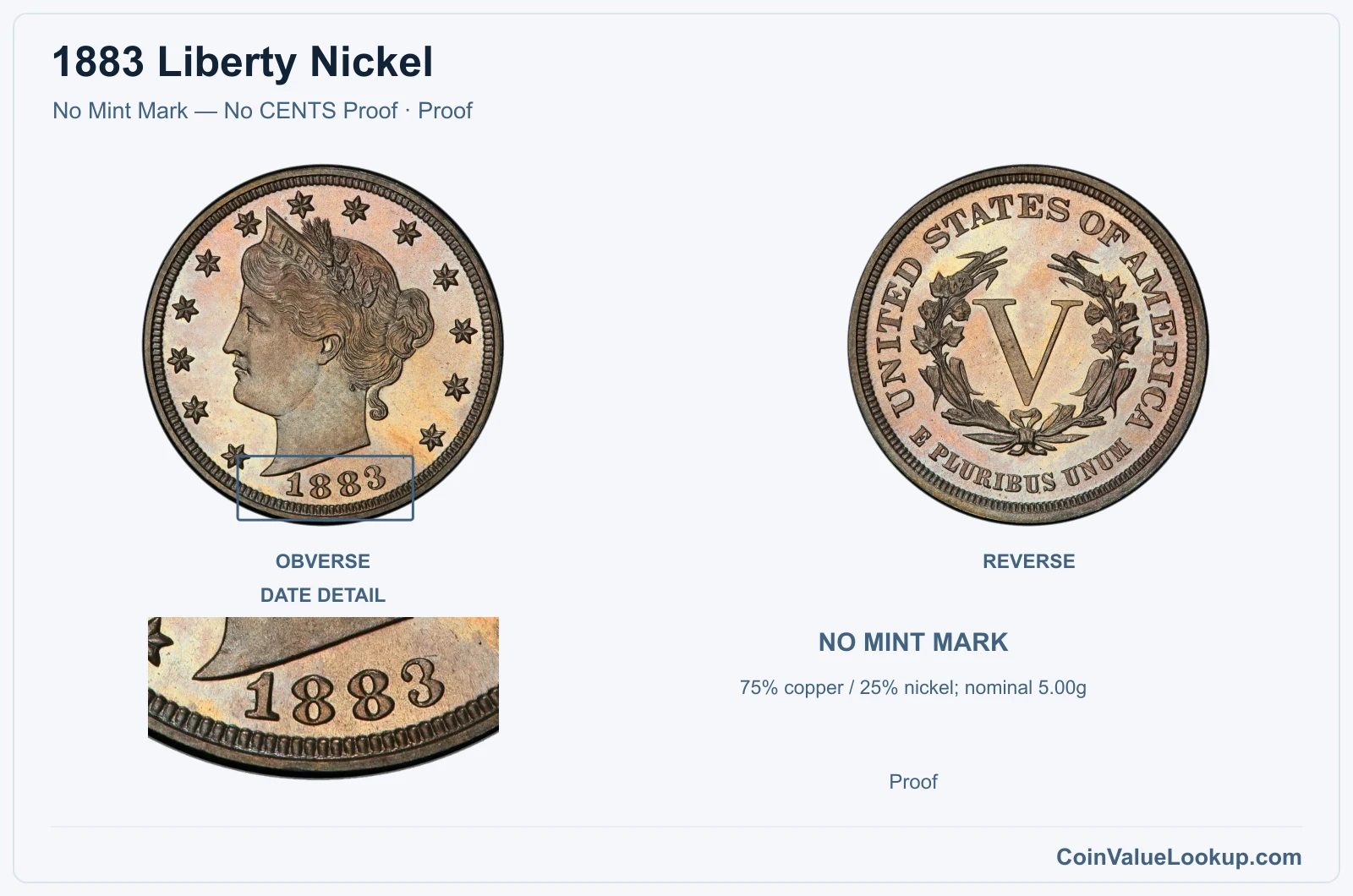
The No CENTS proof is something of a sleeper. Proofs were struck with the original No CENTS reverse before the mid-year design change, and they carry a USA Coin Book guide value of about $376 at PR63 — actually a touch higher than the With CENTS proof at the same grade.
To identify one, you need the full No CENTS reverse showing only the Roman numeral V with no denomination text, combined with proof-quality mirrored fields and sharp rims. Show the complete reverse and the obverse date when seeking identification.
Gold plating on a proof-like surface does not make it a genuine proof; it makes it an altered coin.
Range Grade
Price Auction Records Appraisal PR PR 1
—
Coin Identifier
PR 2
—
Coin Identifier
PR 3
—
Coin Identifier
PR 4
—
Coin Identifier
PR 6
—
Coin Identifier
PR 8
—
Coin Identifier
PR 10
—
Coin Identifier
PR 12
—
Coin Identifier
PR 15
—
Coin Identifier
PR 20
—
Coin Identifier
PR 25
—
Coin Identifier
PR 30
—
Coin Identifier
PR 35
—
Coin Identifier
PR 40
—
Coin Identifier
PR 45
—
Coin Identifier
PR 50
—
Coin Identifier
PR 53
—
Coin Identifier
PR 55
—
Coin Identifier
PR 58
—
Coin Identifier
PR 60
—
Coin Identifier
PR 61
Coin Identifier
PR 62
Coin Identifier
PR 63
Coin Identifier
PR 64
Coin Identifier
PR 65
Coin Identifier
PR 66
Coin Identifier
PR 67
Coin Identifier
PR 68
Coin Identifier
PR 69
—
—
—
PR 70
—
—
—
1883 Liberty Nickel Error List
1. 1883 Liberty Nickel — Repunched Date
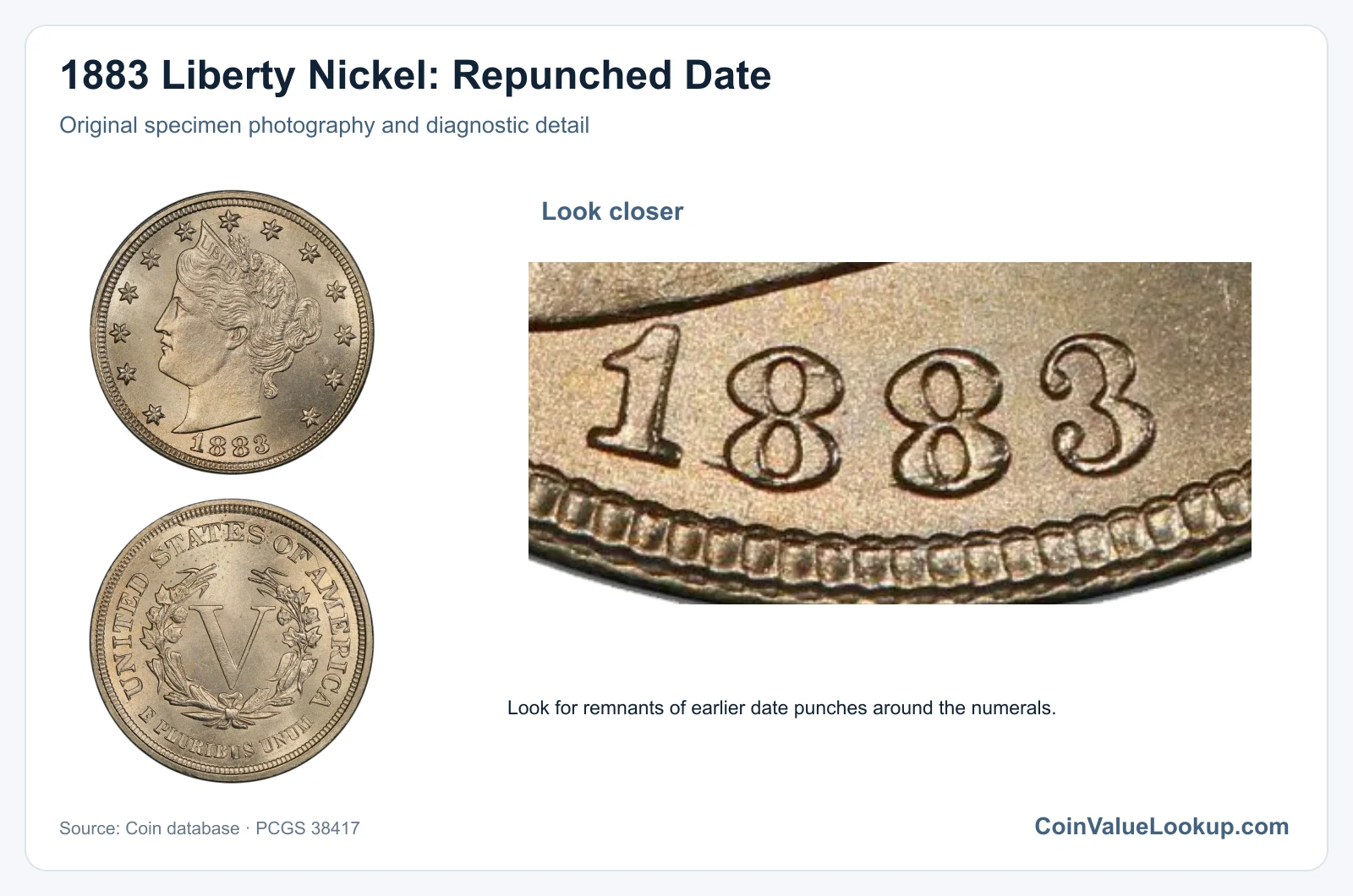
A repunched date on an 1883 Liberty Nickel shows traces of an earlier impression of one or more date numerals slightly offset from the final position. Look closely at the bases and tops of the 1, 8, and 3s for ghost images, thickened serifs, or split digits that suggest the date punch landed more than once.
This is a die variety, distinct from machine doubling, which tends to appear as flat shelf-like doubling across the entire design rather than isolated to the date. It is also different from simple damage — a hit or scratch on the date area will not produce the symmetrical secondary image a repunched date shows.
NGC has recognized multiple repunched-date entries for the 1883 nickel. Value depends on the visibility of the repunching, overall coin condition, and the specific variety involved.
2. 1883 Liberty Nickel — Struck-Through Error
A struck-through error occurs when foreign material — grease, metal fragments, thread, or other debris — sits between the die and the planchet during striking. On the finished coin you will see a localized depression, an impression of the obstruction, or an area where the design simply did not strike up.
Do not confuse this with ordinary wear, cleaning scratches, or a weak strike from tired dies. Wear removes metal gradually and evenly; a struck-through area is typically sharply bounded and may preserve the texture of whatever was trapped.
A grease fill produces a smooth blank patch, while a retained foreign object leaves a distinct impression. The 1883 nickel has been cataloged with struck-through examples, but the premium any individual coin commands depends on the size, location, and overall condition of the piece.
3. 1883 Liberty Nickel — Clipped Planchet
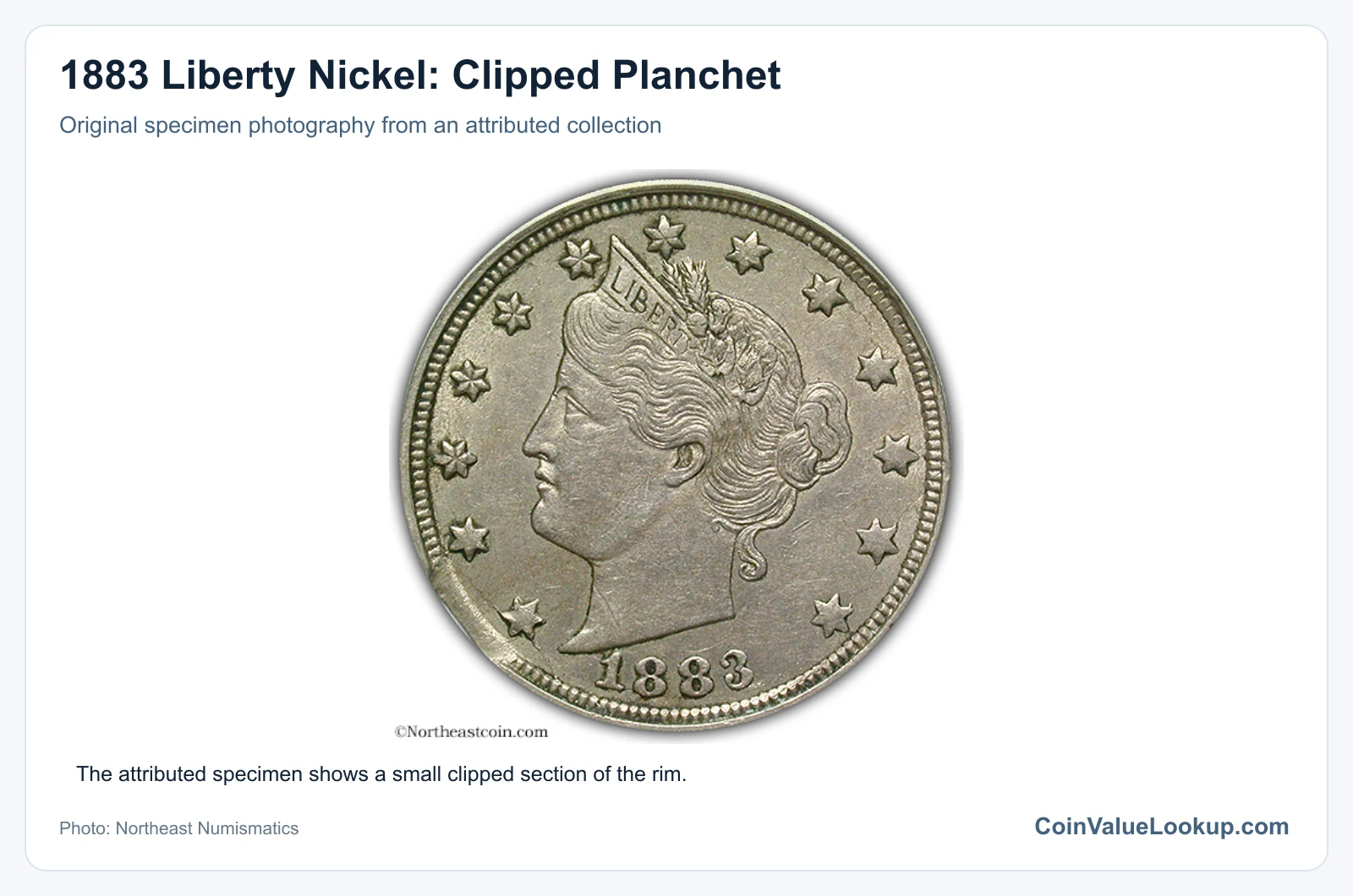
A clipped planchet means part of the blank was missing before the coin was struck. The result is a curved, straight, or ragged absence of metal along the rim, sometimes with a corresponding area of design weakness on the opposite side caused by uneven metal flow during striking.
Dealer-listed examples exist specifically for the 1883 With CENTS variety. To tell a genuine clip from post-mint damage, check the edge texture at the clip boundary — it should show the same surface as the rest of the edge, not file marks or a sharp cut.
A genuine clip may also produce a "Blakesley effect," a weak area of the rim roughly opposite the missing section. Filed notches, corrosion holes, and deliberate cuts will not produce that opposite-side weakness.
Value varies with the clip's size, shape, and the coin's overall preservation.
4. 1883 Liberty Nickel — Off-Center Strike
An off-center strike happens when the planchet is not seated properly between the dies, so the design prints toward one side and leaves an unstruck crescent of blank metal on the other. The date must remain visible for the coin to be attributed to 1883.
Catalog listings for the 1883 With CENTS nickel include an example described as approximately 5% off center combined with a clip. Distinguish a genuine off-center strike from a clipped edge alone or from one-sided die misalignment, which shifts the design on one face but not the other.
Post-mint flattening — a coin squashed in a vise or run over by a car — can mimic an off-center look but will show damage rather than a clean unstruck area. Any premium depends on the percentage of displacement, the coin's condition, and whether the date is fully legible.